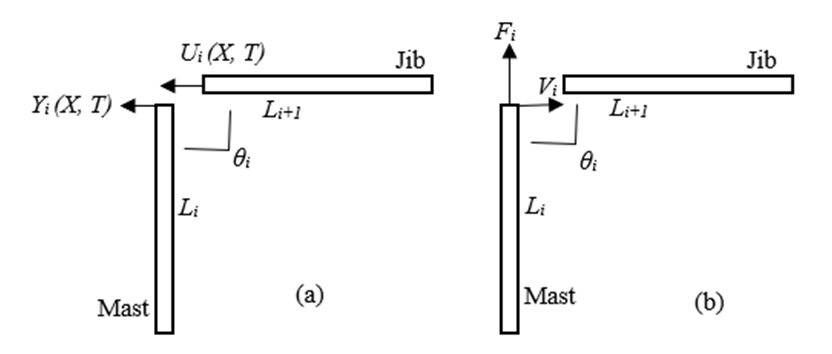
Figure 3. (a) Displacement Compatibility, (b) Force Compatibility
 | (4a) |
 | (4b) |
 | (4c) |
 | (4d) |
 | (4e) |
 | (4f) |
The symbols  and
and  refers to the mast and jib above and below the angle between the two point at
 referred to as
  The assumptions in the mentioned compatibility conditions are the same as the normal analysis of the transverse vibrations of Euler–Bernoulli beam and the axial vibrations of a rod and the angle between the mast and jib is assumed to be constant during the motion of the system.
The following quantities are introduced:
 | (5) |
Thus, in each beam, Eqns. (1) and (2) can be expressed in a non-dimensional form as
 | (6) |
 | (7) |
The non-dimensional ‘‘compatibility conditions’’ from the mast to the jib angle are (from Equations (4a) – (4f))
 | (8a) |
 | (8b) |
 | (8c) |
 | (8d) |
 | (8e) |
 | (8f) |
where  with the 1 standing for the mast and 2 for the jib. Similarly, the non-dimensional boundary conditions from Equations (3a) - (3c), for point
  having a fixed–fixed ends, is written as
 | (9a) |
 | (9b) |
 | (9c) |
2.2. Calculation of the Eigen SolutionsThe solutions of the other boundary conditions can then be obtained through same procedure. Using the separable solutions:  and
and  in Equations (6) and (7) will lead to the associated eigenvalue problem,
 | (10) |
 | (11) |
Where
 | (12) |
From Equation (12), the relationship between  and
and  is expressed as
 | (13) |
where  is a constant expressed as
  From Equations (8a) – (8f), the corresponding compatibility conditions from the mast to the jib angle gives
 | (14a) |
 | (14b) |
 | (14c) |
 | (14d) |
 | (14e) |
 | (14f) |
For  and
and  the boundary conditions, from Equations (9a) – (9c), are
 | (15a) |
 | (15b) |
 | (15c) |
 | (15d) |
 | (15e) |
 | (15f) |
A closed-form solution of this eigenvalue problem is obtained by employing transfer matrix methods as established in 9. The solutions of Equation (10) and (11) for the mast and jib are
 | (16) |
 | (17) |
where  ,
, ,
, ,
, ,
, and
and  are constants associated with the jib segment. The constants in the mast segment are


 and
and  are related to those in the jib segment through the compatibility conditions in Equations (14a) – (14f), which can be expressed as
 | (18) |
Where  is the
  transfer matrix which depends on the eigenvalue
  ; for which the elements are given in reference 9
Through repeated applications of Equation (18), the six constants in the mast ,
, 


 and
and  can be mapped into those of the Jib, hence the number of independent constants of the entire system are reduced to six as:
 | (19) |
These six remaining constants ,
,  ,
,  ,
,  ,
,  and
and  can be determined through the satisfaction of the boundary conditions in Equation (15a) - (15f). For the system, Equations (16), (17), (15a), (15c) and (15e) lead to
 | (20a) |
 | (20b) |
 | (20c) |
The Satisfaction of those boundary conditions of Equations (16) and (17) at the mast support, Equations (15b), (15d) and (15f), requires
 | (20d) |
 | (20e) |
 | (20f) |
this is expressed in matrix form as
 | (21) |
Where
 | (22) |
Substituting Equation (19) into Equation (21) and use of Equations (20a) - (20c) gives
Further written as
 | (23) |
Where
Hence, this gives a non-trivial solution which requires
 | (24) |
The determinant gives the characteristic equation for the solution of the eigenvalues . The solution of this equation with Newton–Raphson iterations, using the method shown in Reference 9 gives the eigenvalues.
This coefficients of the Eigen functions of the equation,  and
and  can then be obtained using back-substitution into Equation (23), (18) and then Equations (16) and (17).
Applying Equations (15a – f) into Equation (20d - f) for the Jib crane leads to,
 | (25) |
For a non-trivial solution of Equation (25), determinant of coefficients of constants 


 and
and must be zero, that is
 | (26) |
Expanding the determinant gives the frequency equation
 | (27) |
This is similar to equation of a cantilever beam in 8, thus  for this case and same solution applies as:
 | (28) |
The possible solution of Equation (28) is , which gives
 | (29) |
From Equation (29) and Equation (13), The natural frequencies are:
 | (30) |
There are infinite number of natural frequencies associated with a continuous structure as it possesses infinite degrees of freedom. The associate mode shapes are obtained by
 | (31) |
The response of the beam is given as linear combination of mode shapes.
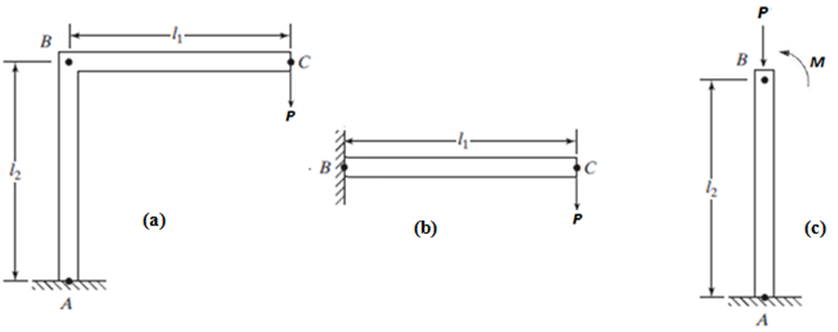
2.3. Forced Vibration of the JibThe principle of superposition is used to solve the forced vibration of the Jib as a cantilever beam as shown in Figure 4b. Thus, the deflection of the beam is assumed as
 | (32) |
where  is the generalized coordinate in the
  mode and
  is the nth normal mode or characteristic function satisfying the differential equation 9
 | (33) |
Substituting Equation (32) in Equation (33), it gives
 | (34) |
From Equation (32), Equation (33) can be written as
 | (35) |
Multiplying Equation (35) throughout by integrating from
  to
to  and using orthogonality condition, it gives
 | (36) |
where  is the generalized force corresponding to
 | (37) |
And the constant is given by
 | (38) |
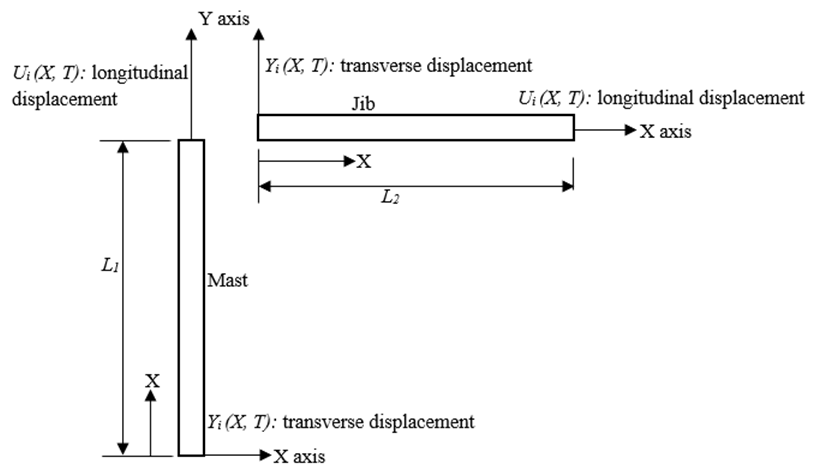
Figure 4. (a) The Jib Crane System, (b) The Jib Under Loading, (c) The Mast Under Loading
Equation (36) is an equation of motion of undamped single degree of freedom system. Using Duhamel integral, the solution of the Equation (36) can be expressed as
 | (39) |
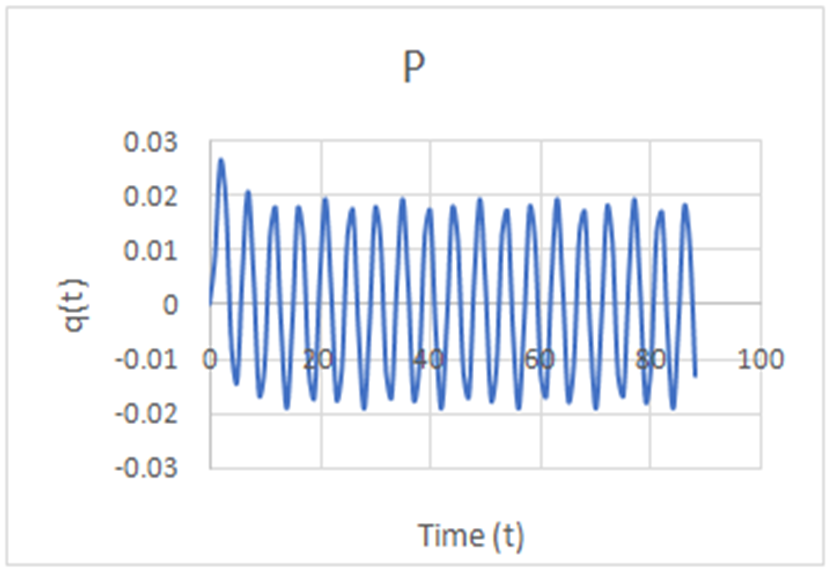
2.4. Response of the Jib Subjected to Harmonic ForceFrom Equation (36), the generalized coordinate  is given by
 | (40) |
Where
 | (41) |
The steady state solution of Equation (36) is given by
 | (42) |
Where
 | (43) |
Using the formula
 | (44) |
Equation (43) can be evaluated to obtain
 | (45) |
2.5. Response of Mast Subjected to a Moment at the Free EndFrom Equation (37), the generalized force  becomes
 | (46) |
Where
 | (47) |
The steady state response of the beam under the action of the moment is given by Equation (32) with
 | (48) |
Where
Noting that
Thus, the steady state response can be written as
 | (49) |
Thus, the combined response of the Jib Crane due to the harmonic force and moment is
 | (50) |
2.6. Numerical Analysis of the Jib Crane Using ANSYSFinite element method is used to analyse the crane frame-structure mode shape, frequency, and amplitude using ANSYS 10 software in other to compare and verify it with the theoretical solution. Its main advantage is that it employs a different technique in its solution to the theoretical solution. However, results must be subjectively analysed.
2.6.1 Element TypeThe selection of the type of element is of paramount importance and time, precision and application are some of the variables that must be considered when choosing an element. The elements selected is SOLID187.
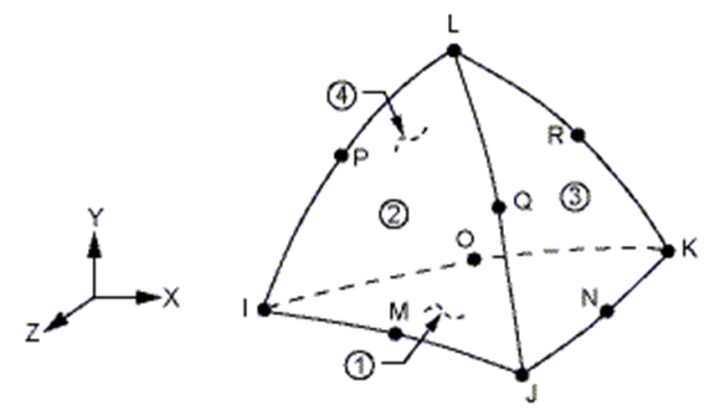
2.6.2. SOLID187SOLID187 as shown in Figure 5 is a higher order 3-D, 10-noded element that considers quadratic displacement behavior throughout the cross-section suited for irregular mesh. This was used because it has three degree of freedom at each nodal x, y, and z direction and gives significant accuracy to the Euler-Bernoulli beam under consideration, section control and accommodate material properties needed for this analysis 10.
2.6.3. Material PropertyThe material of the crane structure is a structural steel with Modulus of Elasticity of 200 GPa, Poisson ratio of 0.3 and Density of 7800 kg/m3.
2.6.4. Geometry
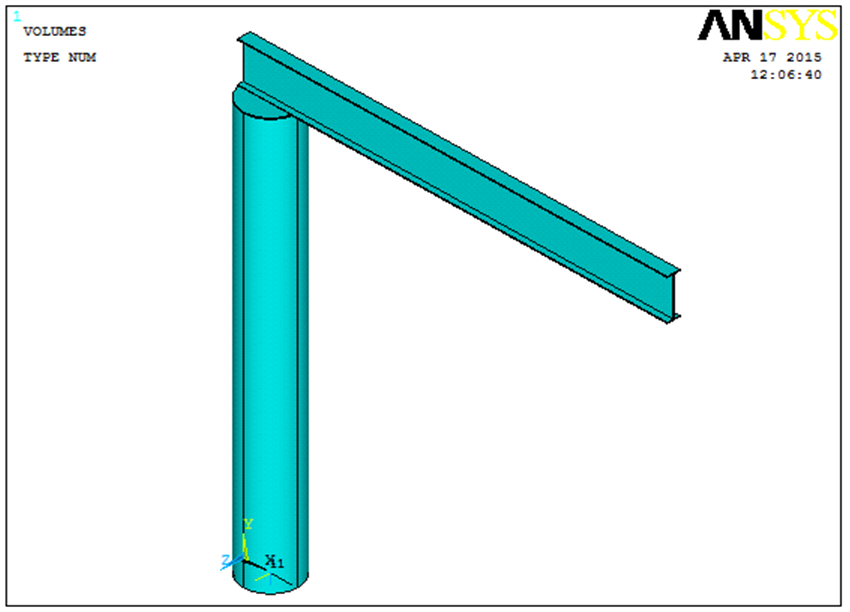
2.6.4.1. Jib and MastThe jib has an I-cross section and keypoints are used to define the edges. Lines are then created through the keypoints, then area and finally extruding the cross-section along the normal to the length of the jib and the mast is then attached to the jib by defining a new working plan due to the difference in plan between the jib and mast as shown in Figure 6.
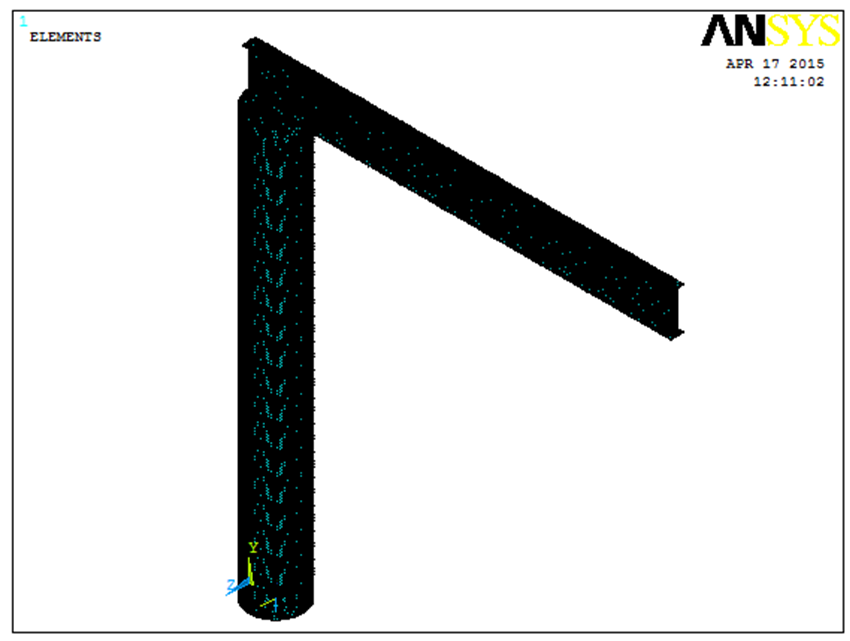
2.6.5. MeshingThe created volume is then meshed. First, the element size is specified as 0.04 because of the complexity of the model which will not allow for AutoMesh and then specifying mesh attributes with Element type as SOLID187 for the Jib as shown in Figure 7.
2.6.6. Solution
2.6.6.1. Modal SolutionModal analysis of the jib crane structure was carried out with frequency range of 0 to 100 Hz and natural frequencies and mode shapes were extracted.
Figure 6. Jib Crane Model in ANSYS
Figure 7. Meshed Jib Crane
3. Results and Discussion
3.1. Numerical ParametersThe following are standard numerical data obtained from 8 for a 5ton model. I-cross section beam,


 and
and  with structural steel (A36) having
 and
and  . The force acting is
  and a motor speed of
  on
on  drum.
drum.
3.2. The Natural Frequencies of the Jib CraneThe following parameters were calculated as  area
area  ,
,  ,
, 


 and maximum displacement as
  . The first three natural frequencies are obtained from Equation (30) and tabulated as in Table 1.
Table I. Modal Analysis frequencies
The result shown in Table 1 shows the first three natural frequencies of the jib crane. This result is almost the same as the solution of a cantilever beam with same boundary conditions as derived in Equation 30. The result tallies with Reference 8 as a good indication of the effective of this approaching of treating the Jib Crane as a Frame Structure.
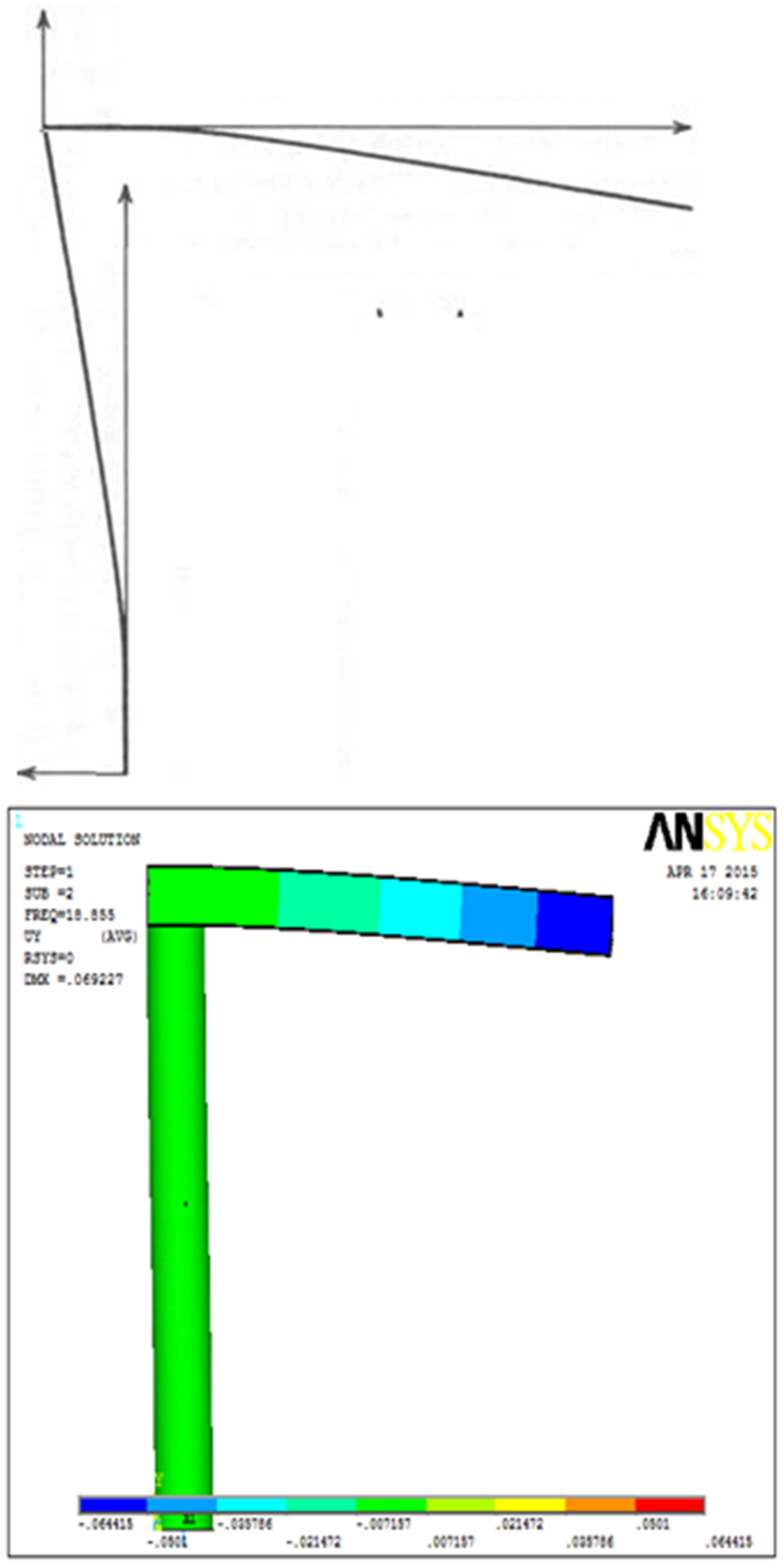
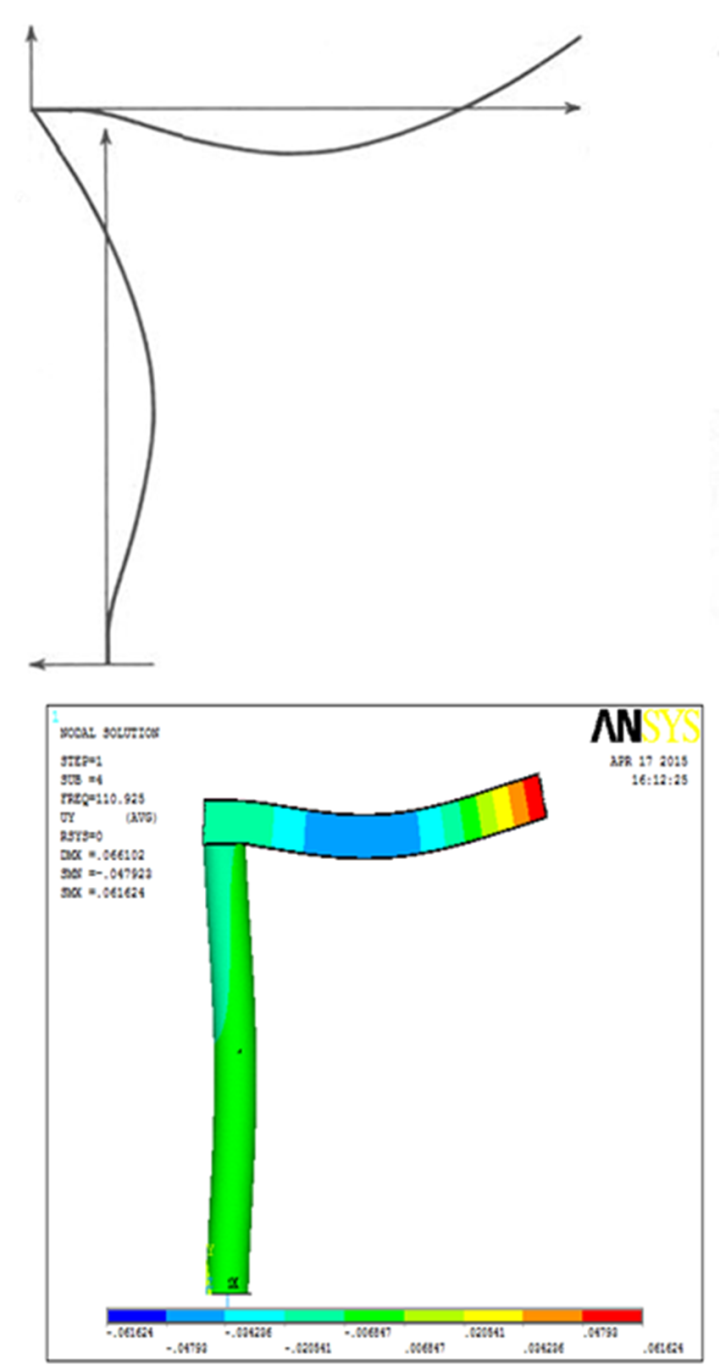
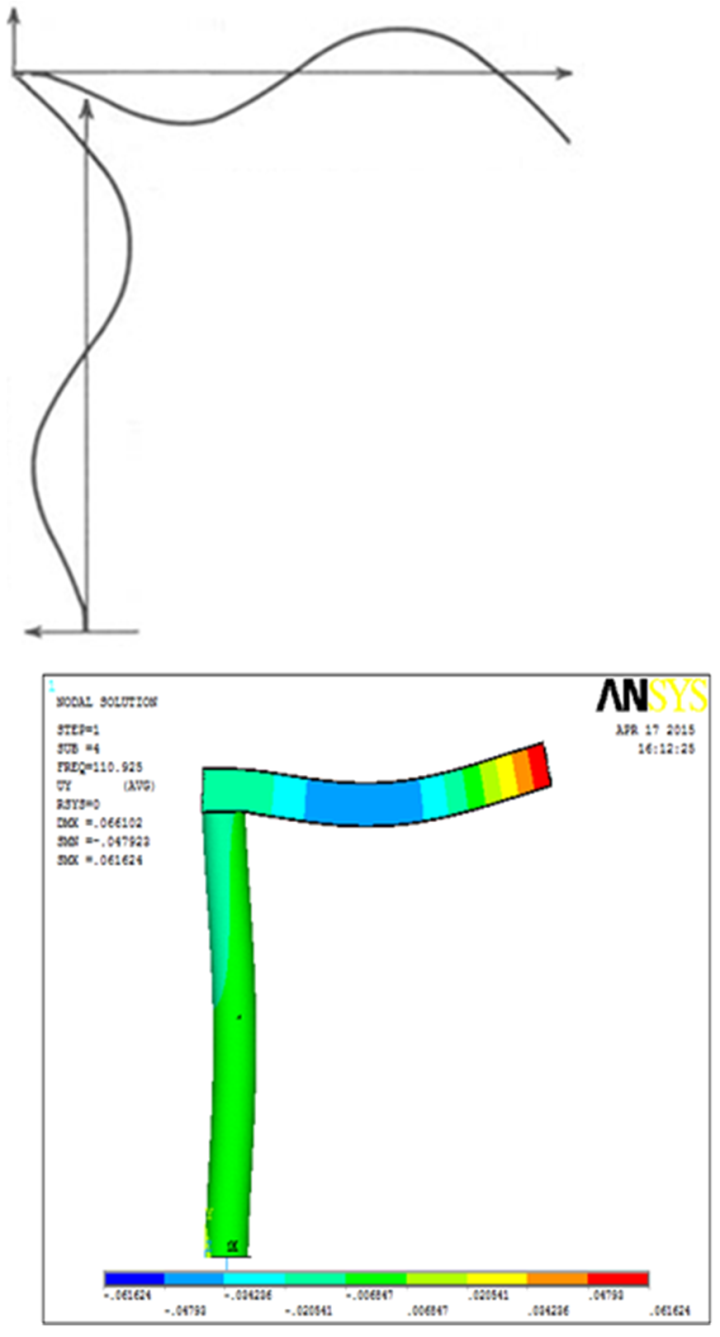
3.3. Mode Shapes of the Jib CraneThe mode shapes of the jib crane are shown in Figure 4a-c from Equation 31. It shows that each of the mast and the jib behaves as an independent cantilever beam. The mast is fixed at the base, but the other end is free in its axis while forming a fixed support for the jib.
Figure 8. (a): First Mode Shape
Figure 8. (b): Second Mode Shape
- Table I. Modal Analysis frequencies
| [1] | T.G. Abu-El Yazied, S.Y. Abu-El-Hagag, M.S. Al-Ajmi an, A.M. Makady “Nonlinear Modelling and Vibration Control of Jib Cranes” World Applied Sciences Journal 16 (11): 1543-1550, 2012. |
| In article | |
| |
| [2] | Dušan Kovacˇevic, Igor Budak, Aco Antic´, Aleš Nagode, Borut Kosec “FEM modelling and analysis in prevention of the waterway dredgers crane serviceability failure” Engineering Failure Analysis 28 (2013) 328-339. |
| In article | View Article |
| |
| [3] | F. Ju, Y.S. Choo, F.S. Cui. “Dynamic Response of Tower Crane induced by the Pendulum Motion of the Payload”. International Journal of Solids and Structures 43 (2006) 376-389. |
| In article | View Article |
| |
| [4] | Fuad Hadžikadunić, Nedeljko Vukojević, Senad Huseinović, Omer Jukić “AN ANALYSIS OF JIB CRANE CONSTRUCTIVE SOLUTION IN EXPLOATATION” 'Trends in the Development of Machinery and Associated Technology, TMT 2008, Istanbul, Turkey, 26-30 August 2008. |
| In article | |
| |
| [5] | K Suresh Bollimpelli, V Ravi Kumar. “Design and Analysis of Column Mounted JIB Crane” INTERNATIONAL JOURNAL OF RESEARCH IN AERONAUTICAL AND MECHANICAL ENGINEERING, Vol. 3, Issue 1 Page, ISSN (ONLINE): 2321-3051 (2015). |
| In article | |
| |
| [6] | S. S. Kiranalli, N.U. Patil “Jib Crane Analysis using FEM” International Journal for Scientific Research & Development, Vol. 3, Issue 04, 2015 | ISSN (online): 2321-0613. |
| In article | |
| |
| [7] | Ismail Gerdemeli, Serpil Kurt “Design and Finite Element Analysis of Gantry Crane” Key Engineering Materials, ISSN: 1662-9795, Vol. 572, pp 517-520 (2014). |
| In article | View Article |
| |
| [8] | Umar Sanusi Umar “Theoretical and Numerical Analysis of a Cantilever Main System to which a Vibration Absorber is Attached” International Journal of Science and Innovative Engineering & Technology (IJSIET), Volume 2 May issue 2015, ISBN 978-81-904760-7-2 (2015). |
| In article | |
| |
| [9] | H. P. Lin, J. Ro “Vibration analysis of Planar Serial-frame structures” Journal of Sound and Vibration, 262, 1113-1131 (2003). |
| In article | View Article |
| |
| [10] | ANSYS Release 15 UP20090415, ANSYS Inc. |
| In article | |
| |
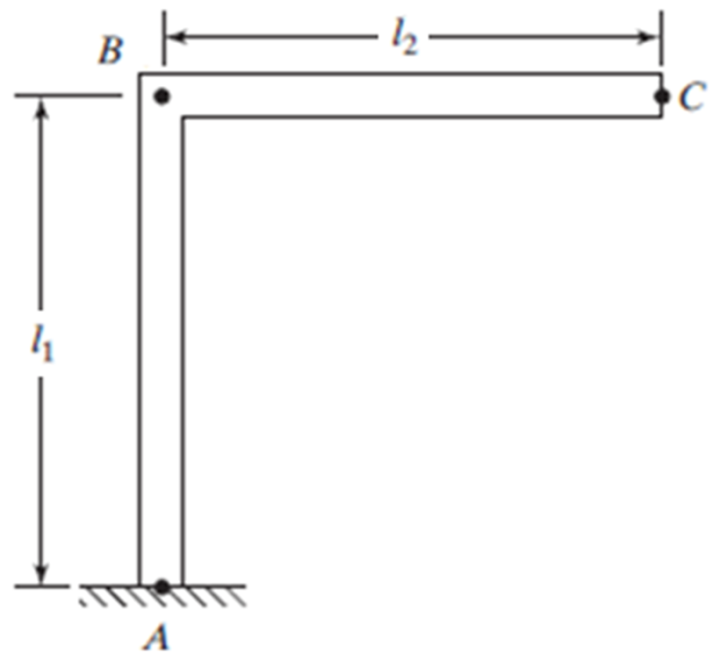
 frame and angle
  The system is sectioned into k and k +1 components inclined at an angle in other to be treated as a sub structural frame. The Jib and Mast having length l1 and l2 respectively with the position of the frame angle located at B. The Jib and Mast are analysed independently by their transverse and longitudinal motion.


 . This compatibility requirements across the mast from the jib angle
  are Yi and Ui that represent the transverse and longitudinal displacements of the jib at point
  as shown in Figure 3(a) while the force compatibility requirements across the jib angle
  are Vi and Fi that represent the shear and axial forces of the Jib at point
  as shown in Figure 3(b). The mast is the
  segment while the Jib is the
  segment.


 This work is licensed under a Creative Commons Attribution 4.0 International License. To view a copy of this license, visit
http://creativecommons.org/licenses/by/4.0/
This work is licensed under a Creative Commons Attribution 4.0 International License. To view a copy of this license, visit
http://creativecommons.org/licenses/by/4.0/



 Displacement Compatibility, (b) Force Compatibility)
 The Jib Crane System, (b) The Jib Under Loading, (c) The Mast Under Loading)




: First Mode Shape)
: Second Mode Shape)
: Third Mode Shape)
: Response of the Jib)
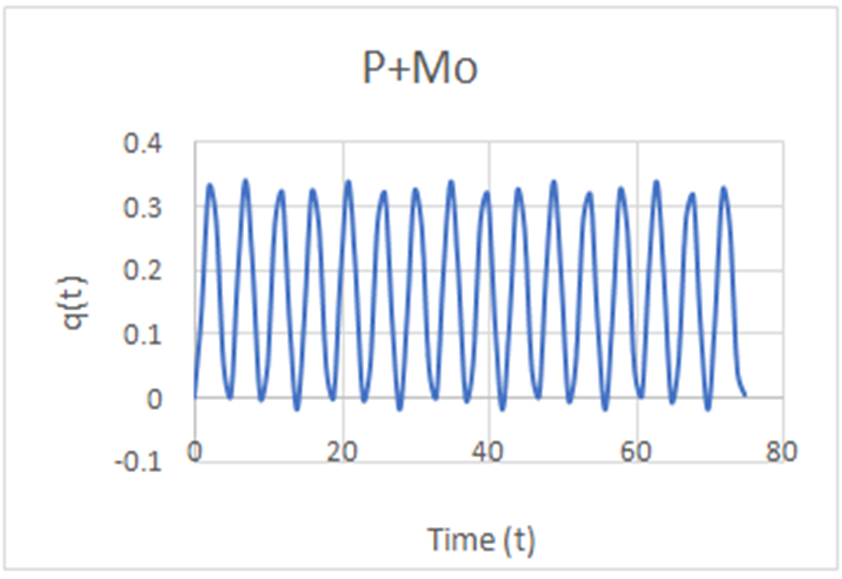
: Response of the Mast)