The effectiveness of instructional approaches in developing students' mathematical problem-solving skills remains a critical concern in Philippine senior high schools. This study examined the effect of the Math Workshop Model (MWM) on Grade 11 students' problem-solving abilities. Using a quasi-experimental pretest-posttest control group design, the research involved 66 Grade 11 HUMSS students from Pedro Oloy N. Roa Sr. High School, Cagayan de Oro City, during the 2025-2026 academic year. The experimental group received instruction through the Math Workshop Model, featuring mini-lessons, differentiated work time, sharing sessions, and reflection activities, while the control group was taught using traditional lecture-based instruction. Before analysis, ANCOVA assumptions, including homogeneity of regression slopes, normality of residuals, and homogeneity of variance, were tested and confirmed. Results revealed that both groups improved from pretest to posttest; however, the experimental group demonstrated substantially greater gains. ANCOVA confirmed a statistically significant difference between groups (F (1, 60) = 13.93, p < .001, η² = 0.182), with a large effect size indicating that the MWM was significantly more effective in enhancing students' problem-solving skills. These findings suggest that the structured, student-centered approach of MWM provides a promising framework for improving mathematical problem-solving in senior high school contexts.
Mathematical problem-solving remains a significant challenge for Filipino students. The 2018 Programme for International Student Assessment (PISA) revealed that Filipino students scored 353 points in mathematics, ranking last among 79 participating countries and falling well below the OECD average of 489 1. Although the 2022 cycle showed a marginal increase to 355 points, performance remains far from international standards 2. National assessments consistently identify problem-solving as one of the weakest areas among Filipino learners, with over half of junior high school students exhibiting inadequate mathematical skills 3.
The situation becomes particularly concerning at the senior high school level. Students continue to struggle with non-routine problems, often relying on memorized procedures rather than engaging in genuine mathematical reasoning and strategic thinking 4. This weakness persists despite the K-12 curriculum's emphasis on developing higher-order thinking skills, even with the implementation of the MATATAG Curriculum. Research indicates that Grade 11 marks a critical transition point, where students must not only grasp abstract mathematical concepts but also develop sophisticated problem-solving skills essential for college readiness and STEM careers 5.
Several factors contribute to these persistent challenges. Studies point to the continuation of traditional teacher-centered instruction, overcrowded classrooms, and limited opportunities for individualized support 6, 7. A 2024 study found that insufficient teaching time and low mastery of prerequisite skills significantly impede problem-solving competency development, forcing teachers to prioritize procedural fluency over conceptual understanding 8. Furthermore, research on senior high school mathematics instruction revealed that teachers predominantly use lecture-based methods with minimal opportunities for student discourse or differentiated support 9.
The Math Workshop Model (MWM) offers a potential solution to these instructional challenges. Rooted in constructivist learning theory and aligned with Polya's four-stage problem-solving model, that is, understand, plan, execute, and reflect, the MWM operationalizes these stages through structured instructional components 10. The mini-lesson phase corresponds to problem comprehension and strategy planning; the work time phase supports execution through guided and independent practice; and the sharing and reflection phases promote metacognitive review and self-regulated learning 11. This alignment positions the MWM not merely as a pedagogical format, but as a theoretically grounded approach to developing genuine problem-solving competence. International research suggests that workshop-based approaches are effective in developing problem-solving skills, even in contexts with large classes and diverse learning needs 12. Students taught through the Math Workshop Model have demonstrated substantial improvements in problem-solving performance, with some studies reporting up to 27% gains compared to traditional instruction 13.
In the Philippine context, initial efforts with workshop-based approaches have shown promise, though research has been largely limited to lower secondary levels 14. There remains little evidence on the MWM's application in senior high schools, particularly at Grade 11. This represents a crucial gap, as success at this level strongly influences students' readiness for advanced studies and STEM careers prioritized in national development plans 15.
Given the documented challenges in problem-solving among Filipino senior high school students and the limited research on workshop-based instruction at this level, this study evaluates the effectiveness of the Math Workshop Model in enhancing Grade 11 HUMSS students' mathematical problem-solving skills at Pedro "Oloy" N. Roa Sr. High School, Cagayan de Oro City, to provide empirical evidence to inform mathematics instruction in Philippine senior high schools.
This study employed a quasi-experimental pretest-posttest control group design to determine the effectiveness of the Math Workshop Model (MWM) in strengthening Grade 11 students' mathematical problem-solving skills. The design was appropriate because classes were already organized by the school, making true randomization impractical. Instead, intact classes were used, with random assignment to experimental and control conditions.
The study was conducted at Pedro "Oloy" N. Roa Sr. High School in the Division of Cagayan de Oro City during the 2025-2026 academic year. The school is categorized as a large school with 83 teaching faculty and 2,138 students. Participants consisted of 66 Grade 11 HUMSS students across two intact sections. Using cluster sampling, sections were randomly assigned through a double-draw procedure to ensure unbiased group allocation. The experimental group comprised 31 students, while the control group had 35 students.
2.1. Problem-Solving Skills Test (PSST)The Problem-Solving Skills Test (PSST) was developed based on Polya's four-stage problem-solving framework and aligned with Grade 11 Statistics and Probability competencies. The instrument consisted of five word problems requiring multi-step solutions, yielding a total possible score of 25 points (5 problems × 5 points each). A sample item required students to compute and interpret the probability of compound events within a realistic data context, demanding both procedural and conceptual competency.
Each problem was scored using an analytic rubric ranging from 0 to 5 points per item, assessing four dimensions: (1) problem comprehension, which is, understanding what is being asked; (2) strategy formulation which is identifying a viable solution plan; (3) solution execution, which is correctly carrying out calculations; and (4) answer verification which is checking and interpreting the result. To ensure scoring consistency, two raters independently scored a random subset of 20% of student responses. Inter-rater reliability was established using Cohen's Kappa (κ = 0.84), indicating strong agreement between raters 16.
The instrument underwent content validity review by three mathematics education specialists and two experienced Statistics and Probability teachers. Reliability was further established through pilot testing with students who had previously completed the course, yielding a Cronbach's alpha of 0.81, indicating acceptable internal consistency.
2.2. Intervention and ProcedureData collection followed a systematic nine-week schedule. During Week 1, the researcher secured permissions and administered pretests to both groups. Weeks 2-8 comprised the intervention period. The experimental group received instruction through the Math Workshop Model, which consisted of four components: (1) mini-lessons providing direct instruction on concepts; (2) work time for differentiated activities including independent practice and small-group collaboration; (3) sharing time for students to present their mathematical thinking; and (4) reflection encouraging students to assess their understanding and monitor progress. The control group received traditional lecture-based instruction following the same curriculum schedule. During Week 9, posttests were administered to both groups.
2.3. Statistical AnalysisData were analyzed using descriptive statistics (mean and standard deviation) and Analysis of Covariance (ANCOVA) at a 0.05 level of significance. Before the ANCOVA, the following assumptions were verified: (1) homogeneity of regression slopes which was tested via an interaction term (Group × Pretest), which was non-significant (F(1,58) = 0.42, p = .521), confirming that the relationship between pretest and posttest scores was consistent across groups; (2) normality of residuals, assessed using the Shapiro-Wilk test, which yielded non-significant results for both groups (p > .05); and (3) homogeneity of variance evaluated using Levene's test, which was non-significant (F(1,64) = 2.18, p = .145), confirming equality of error variances. All assumptions were satisfied, supporting the appropriateness of ANCOVA. Effect sizes were reported using partial eta squared (η²) to assess practical significance.
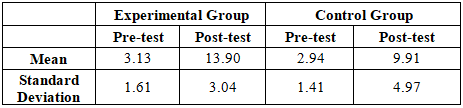
Table 1 presents the mean scores and standard deviations of students' problem-solving skills in the experimental and control groups during the pretest and posttest phases. The pretest results indicated that the experimental group obtained a mean score of 3.13 (SD = 1.61), while the control group recorded a slightly lower mean of 2.94 (SD = 1.41). These results suggested that both groups began the study with comparably low levels of problem-solving skills, establishing baseline equivalence before the implementation of the MWM. Such similarity in initial performance strengthens the internal validity of the study, as it reduces the likelihood that posttest differences are attributable to pre-existing disparities between groups 17.
After the intervention, notable improvements were observed in both groups. The experimental group achieved a posttest mean score of 13.90 (SD = 3.04), reflecting a substantial increase from its pretest performance. In contrast, the control group attained a posttest mean of 9.91 (SD = 4.97), which, although indicative of improvement, remained considerably lower than that of the experimental group. The magnitude of gain in the experimental group (10.77 points) exceeded that of the control group (6.97 points), suggesting that the MWM was more effective in enhancing students' problem-solving skills than the conventional approach 18.
An examination of the standard deviations provides further insight into the distribution of student performance. For the experimental group, the posttest standard deviation increased moderately to 3.04, suggesting that while students generally benefited from the intervention, the degree of improvement varied among individuals, a common outcome in student-centered instruction where learners engage at their own pace 19. The control group exhibited a notably larger posttest standard deviation of 4.97, reflecting wider dispersion in performance outcomes. This greater variability is consistent with the uneven effectiveness of lecture-based instruction, where students with different levels of prior knowledge and learning styles may respond inconsistently to uniform whole-class delivery 20. The wider spread in the control group also suggests that some students benefited from traditional instruction while others stagnated, underscoring the limitation of one-size-fits-all teaching methods in heterogeneous classrooms.
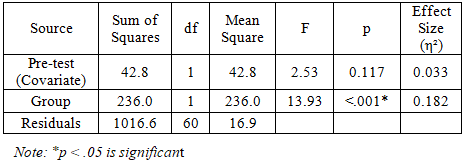
3.2. ANCOVA ResultsTable 2 presents the results of the Analysis of Covariance (ANCOVA) conducted to determine whether there is a significant difference in students' problem-solving skills between the experimental and control groups after controlling for pretest scores.
The ANCOVA results indicate that the pre-test covariate was not statistically significant, F(1, 60) = 2.53, p = 0.117, with a small effect size (η² = 0.033). This finding suggests that pre-test scores did not significantly influence post-test performance after adjustment. In other words, students' initial levels of problem-solving skills did not substantially account for the variance in post-test scores, further supporting the assumption that differences observed in the post-test are unlikely to be driven by pre-existing ability levels 21.
In contrast, the main effect of group was statistically significant, F(1, 60) = 13.93, p < .001, with a large effect size (η² = 0.182). This result indicates that approximately 18.2% of the variance in students' post-test problem-solving scores can be attributed to the instructional intervention rather than chance or initial ability differences. The large effect size highlights the practical significance of the intervention, consistent with the finding that structured instructional strategies substantially influence learning outcomes in cognitively demanding domains 22.
These ANCOVA findings provide robust empirical evidence that the MWM significantly improved students' problem-solving skills beyond what can be explained by prior knowledge alone. The results align with Martinez et al. 13, who demonstrated that students taught through workshop-based models achieved 27% improvement in problem-solving test scores compared to traditional classrooms. Similarly, Thompson and Lee 23 found that workshop approaches showed high effect sizes in problem-solving outcomes, particularly for struggling learners.
The superiority of the MWM over lecture-based instruction can be attributed to several theoretically grounded mechanisms. First, the mini-lesson and work time components scaffold students through Polya's problem-solving stages in an active, applied manner, promoting deeper cognitive engagement than passive reception of information 10. Second, the sharing and reflection components cultivate metacognitive awareness, the ability to monitor and regulate one's own thinking which is central to sustained problem-solving competence 11. Third, differentiated work time addresses the diverse learning needs within a classroom, reducing the performance variability that characterizes traditional instruction, as evidenced by the smaller posttest standard deviation in the experimental group (3.04 vs. 4.97 in the control group). These mechanisms collectively explain why MWM does not merely improve average performance but also promotes more equitable learning outcomes.
This study provides compelling evidence that the Math Workshop Model (MWM) is significantly more effective than traditional lecture-based instruction in enhancing Grade 11 HUMSS students' mathematical problem-solving skills. The experimental group demonstrated substantially greater improvement from pretest to posttest, with the difference being both statistically and practically significant. The large effect size (η² = 0.182) indicates that the intervention accounted for approximately 18% of the variance in posttest scores, highlighting its meaningful impact on students' learning outcomes.
The effectiveness of the MWM can be attributed to its alignment with Polya's problem-solving stages and its promotion of metacognition and self-regulated learning. The mini-lesson component provides focused direct instruction, while differentiated work time allows students to engage with problems at appropriate challenge levels. The sharing and reflection components promote mathematical discourse and metacognitive awareness, both crucial for developing sophisticated problem-solving abilities. These features collectively address the limitations of traditional lecture-based methods and provide a more responsive and equitable instructional environment.
Based on these findings, mathematics teachers in senior high school are encouraged to consider implementing the MWM as a regular instructional approach. The model's structured yet flexible framework is adaptable to various classroom contexts. School administrators and DepEd officials are further encouraged to provide professional development opportunities that equip teachers with the knowledge and skills to implement workshop-based instruction effectively, including training on designing differentiated problem sets, facilitating mathematical discourse, and managing flexible classroom structures.
It is important to acknowledge the limitations of this study. The findings are based on a single school context of Pedro "Oloy" N. Roa Sr. High School, limiting immediate generalizability to other school settings. The study was conducted exclusively with HUMSS strand students, and the results may not be directly applicable to other senior high school strands such as STEM or ABM, which differ in mathematical background and curricular focus. The nine-week intervention period, while sufficient to detect significant effects, may not capture the long-term sustainability of these gains. Additionally, the sample size of 66 students, while adequate for the current design, constrains the statistical power to detect smaller or more nuanced effects.
Future research should explore the implementation of the MWM across different mathematics topics, strands, and grade levels to establish its generalizability. Studies examining the long-term effects of workshop-based instruction on students' mathematical development and success in advanced courses would provide valuable insights. Investigating the specific mechanisms through which the MWM enhances problem-solving, particularly the role of metacognitive development which could further inform instructional design and teacher preparation. Finally, research on adapting the model for resource-constrained or large-class settings would help ensure that its benefits can be realized equitably across diverse educational contexts in the Philippines.
The authors express their sincere gratitude to the administration and students of Pedro "Oloy" N. Roa Sr. High School for their cooperation and participation in this study. Special thanks are also extended to the mathematics education specialists and Statistics and Probability teachers who provided valuable feedback during instrument validation.
| [1] | OECD. (2019). PISA 2018 results: What students know and can do. OECD Publishing. https:// www.oecd.org/ pisa/ publications/ pisa-2018-results.htm. | ||
| In article | View Article | ||
| [2] | Department of Education. (2023). Analysis of Philippine performance in PISA 2022. DepEd Bureau of Educational Assessment. | ||
| In article | |||
| [3] | Agulto, M. L., Cruz, R. S., & Santos, P. V. (2024). Comprehensive needs assessment of junior high school mathematics education in the Philippines. Philippine Journal of Educational Research, 48(1), 34–52. | ||
| In article | |||
| [4] | Bernardo, A. B., & Cordova, D. I. (2023). Strategic thinking in mathematics: Challenges facing Filipino senior high school students. Asia Pacific Education Review, 24(2), 156–173. | ||
| In article | |||
| [5] | Villanueva, R. M., & Castro, D. T. (2022). Critical transition points in Philippine mathematics education: Senior high school as the bridge to college success. Asian Journal of Educational Research, 10(4), 223–241. | ||
| In article | |||
| [6] | Santos, M. R., & Rivera, J. P. (2018). Factors affecting mathematics achievement in Philippine secondary schools. Educational Research Quarterly, 42(1), 15–32. | ||
| In article | |||
| [7] | Mendoza, A. T., Cruz, F. S., & Santos, L. V. (2023). Teacher readiness for learner-centered mathematics instruction: A nationwide survey of K-12 educators. Philippine Journal of Education, 40(1), 112–129. | ||
| In article | |||
| [8] | Kilag, O. K., Tokong, J. M., & Laurente, R. P. (2024). Factors impeding problem-solving competency development in Philippine mathematics education. International Journal of Educational Research, 125, 102–118. | ||
| In article | |||
| [9] | Gonzales, M. T., & Reyes, A. L. (2023). Mathematics instruction in Philippine senior high schools: Current practices and challenges. Educational Studies in Mathematics, 113(3), 287–305. | ||
| In article | |||
| [10] | Polya, G. (1945). How to solve it: A new aspect of mathematical method. Princeton University Press. | ||
| In article | View Article | ||
| [11] | Zimmerman, B. J. (2002). Becoming a self-regulated learner: An overview. Theory Into Practice, 41(2), 64–70. | ||
| In article | View Article | ||
| [12] | Sharma, K., & Williams, A. (2024). Workshop-based instructional models in diverse educational settings: A comparative international analysis. International Journal of Mathematics Education, 43(2), 192–210. | ||
| In article | |||
| [13] | Martinez, R. A., Kumar, S. K., & Thompson, D. R. (2023). Workshop-based mathematics instruction: Impact on problem-solving achievement. Mathematics Education Research Journal, 35(2), 245–268. | ||
| In article | |||
| [14] | Santos, M. V., Lopez, C. R., & Dizon, E. L. (2024). Implementing workshop-based approaches in mathematics classrooms: Preliminary findings from a pilot study. Philippine Education Quarterly, 42(1), 67–85. | ||
| In article | |||
| [15] | NEDA [National Economic and Development Authority]. (2023). Philippine Development Plan 2023–2028: Strategic Framework for Human Capital Development. National Economic and Development Authority. | ||
| In article | |||
| [16] | McHugh, M. L. (2012). Interrater reliability: The kappa statistic. Biochemia Medica, 22(3), 276–282. | ||
| In article | View Article PubMed | ||
| [17] | Gall, M. D., Gall, J. P., & Borg, W. R. (2007). Educational research: An introduction (8th ed.). Pearson Education. | ||
| In article | |||
| [18] | Cook, T. D., & Campbell, D. T. (1979). Quasi-experimentation: Design & analysis issues for field settings. Houghton Mifflin. | ||
| In article | |||
| [19] | Zimmerman, B. J. (2002). Becoming a self-regulated learner: An overview. Theory Into Practice, 41(2), 64–70. | ||
| In article | View Article | ||
| [20] | Cohen, L., Manion, L., & Morrison, K. (2018). Research methods in education (8th ed.). Routledge. | ||
| In article | View Article | ||
| [21] | Tabachnick, B. G., & Fidell, L. S. (2019). Using multivariate statistics (7th ed.). Pearson. | ||
| In article | |||
| [22] | Hattie, J. (2009). Visible learning: A synthesis of over 800 meta-analyses relating to achievement. Routledge. | ||
| In article | |||
| [23] | Thompson, D. R., & Lee, K. M. (2023). Meta-analysis of workshop-based mathematics instruction: Effects on problem-solving outcomes. Educational Psychology Review, 35(4), 478–501. | ||
| In article | |||
Published with license by Science and Education Publishing, Copyright © 2026 Recardo O. Sanditan Jr. and Dennis B. Roble
 This work is licensed under a Creative Commons Attribution 4.0 International License. To view a copy of this license, visit
http://creativecommons.org/licenses/by/4.0/
This work is licensed under a Creative Commons Attribution 4.0 International License. To view a copy of this license, visit
http://creativecommons.org/licenses/by/4.0/
| [1] | OECD. (2019). PISA 2018 results: What students know and can do. OECD Publishing. https:// www.oecd.org/ pisa/ publications/ pisa-2018-results.htm. | ||
| In article | View Article | ||
| [2] | Department of Education. (2023). Analysis of Philippine performance in PISA 2022. DepEd Bureau of Educational Assessment. | ||
| In article | |||
| [3] | Agulto, M. L., Cruz, R. S., & Santos, P. V. (2024). Comprehensive needs assessment of junior high school mathematics education in the Philippines. Philippine Journal of Educational Research, 48(1), 34–52. | ||
| In article | |||
| [4] | Bernardo, A. B., & Cordova, D. I. (2023). Strategic thinking in mathematics: Challenges facing Filipino senior high school students. Asia Pacific Education Review, 24(2), 156–173. | ||
| In article | |||
| [5] | Villanueva, R. M., & Castro, D. T. (2022). Critical transition points in Philippine mathematics education: Senior high school as the bridge to college success. Asian Journal of Educational Research, 10(4), 223–241. | ||
| In article | |||
| [6] | Santos, M. R., & Rivera, J. P. (2018). Factors affecting mathematics achievement in Philippine secondary schools. Educational Research Quarterly, 42(1), 15–32. | ||
| In article | |||
| [7] | Mendoza, A. T., Cruz, F. S., & Santos, L. V. (2023). Teacher readiness for learner-centered mathematics instruction: A nationwide survey of K-12 educators. Philippine Journal of Education, 40(1), 112–129. | ||
| In article | |||
| [8] | Kilag, O. K., Tokong, J. M., & Laurente, R. P. (2024). Factors impeding problem-solving competency development in Philippine mathematics education. International Journal of Educational Research, 125, 102–118. | ||
| In article | |||
| [9] | Gonzales, M. T., & Reyes, A. L. (2023). Mathematics instruction in Philippine senior high schools: Current practices and challenges. Educational Studies in Mathematics, 113(3), 287–305. | ||
| In article | |||
| [10] | Polya, G. (1945). How to solve it: A new aspect of mathematical method. Princeton University Press. | ||
| In article | View Article | ||
| [11] | Zimmerman, B. J. (2002). Becoming a self-regulated learner: An overview. Theory Into Practice, 41(2), 64–70. | ||
| In article | View Article | ||
| [12] | Sharma, K., & Williams, A. (2024). Workshop-based instructional models in diverse educational settings: A comparative international analysis. International Journal of Mathematics Education, 43(2), 192–210. | ||
| In article | |||
| [13] | Martinez, R. A., Kumar, S. K., & Thompson, D. R. (2023). Workshop-based mathematics instruction: Impact on problem-solving achievement. Mathematics Education Research Journal, 35(2), 245–268. | ||
| In article | |||
| [14] | Santos, M. V., Lopez, C. R., & Dizon, E. L. (2024). Implementing workshop-based approaches in mathematics classrooms: Preliminary findings from a pilot study. Philippine Education Quarterly, 42(1), 67–85. | ||
| In article | |||
| [15] | NEDA [National Economic and Development Authority]. (2023). Philippine Development Plan 2023–2028: Strategic Framework for Human Capital Development. National Economic and Development Authority. | ||
| In article | |||
| [16] | McHugh, M. L. (2012). Interrater reliability: The kappa statistic. Biochemia Medica, 22(3), 276–282. | ||
| In article | View Article PubMed | ||
| [17] | Gall, M. D., Gall, J. P., & Borg, W. R. (2007). Educational research: An introduction (8th ed.). Pearson Education. | ||
| In article | |||
| [18] | Cook, T. D., & Campbell, D. T. (1979). Quasi-experimentation: Design & analysis issues for field settings. Houghton Mifflin. | ||
| In article | |||
| [19] | Zimmerman, B. J. (2002). Becoming a self-regulated learner: An overview. Theory Into Practice, 41(2), 64–70. | ||
| In article | View Article | ||
| [20] | Cohen, L., Manion, L., & Morrison, K. (2018). Research methods in education (8th ed.). Routledge. | ||
| In article | View Article | ||
| [21] | Tabachnick, B. G., & Fidell, L. S. (2019). Using multivariate statistics (7th ed.). Pearson. | ||
| In article | |||
| [22] | Hattie, J. (2009). Visible learning: A synthesis of over 800 meta-analyses relating to achievement. Routledge. | ||
| In article | |||
| [23] | Thompson, D. R., & Lee, K. M. (2023). Meta-analysis of workshop-based mathematics instruction: Effects on problem-solving outcomes. Educational Psychology Review, 35(4), 478–501. | ||
| In article | |||