The increased focus on Science, Technology, Engineering, and Mathematics (STEM) education has gained global attention as a result of demands by the industry for professionals in the fields of technology, health care, and engineering. In the Philippines, the K-12 curriculum was implemented to prepare students to be better for STEM careers, but many non-STEM strand completers who were admitted into tertiary STEM programs experienced challenges, specifically with mathematics courses. In this systematic review of literature of studies carried out within the Philippine context, common barriers, cognitive and emotional challenges, and institutional interventions that influence the mathematics learning journeys of non-STEM strand students were identified. After a procedurally-settled, eight-step review process, five studies were picked up and analyzed to find three major themes: (1) mathematical preparedness and performance gaps; (2) emotional and instructional barriers; and (3) institutional interventions and bridging programs. The results suggest that non-STEM students tend to have problems understanding basic mathematical concepts, suffer from high levels of anxiety, and that they also benefited from the enhancement programs. The review ends with the conclusion that there is a need for more responsive, strand-specific support systems to bridge these gaps to equalize access to careers in STEM for all students. The study offers pragmatic implications for educators, policymakers, and curriculum developers to understand and work around in order to enhance the mathematics education and the students’ performance within the context of the Philippine educational practice.
The Science, Technology, Engineering, and Mathematics (STEM) education expansion has become a worldwide educational priority as economies and societies seek more competent professionals for essential sectors of development during the twenty-first century. With the rate of technology change, the need for data-driven decision making, countries across the globe are investing more heavily in STEM education in the pursuit of a competitive, sustainable workforce 1. Hence, different educational systems, such as the Philippines, have broadened their opening of STEM programs throughout the tertiary stage. However, despite the intention of the present curriculum, there are still students who enroll in a college that is not related to their chosen senior high school strand because of the CHED Memorandum Order No. 105, series of 2017, where students are eligible to enter college regardless of their strand taken.
Through the K-12 curriculum, higher education institutions become more inclusive, but students face new difficulties that adversely impact their academic achievement and student retention rates 2. STEM courses rest upon mathematical foundations, but non-STEM students find it challenging due to their insufficient exposure to calculus, trigonometry, and statistical reasoning while attending SHS 3. Inadequate preparation from high school leads to major mental stress while producing poor results in basic STEM courses, while increasing student anxiety about mathematics 4, 5, 6. Students face numerous problems after transitioning to higher education because of these reforms, despite the introduction of strand-based schemes in Senior High School 7. These issues create learning challenges and cause students to quit school, along with preventing their professional progress 5.
Understanding mathematics-based STEM programs requires students to change their existing learning methods. Students in strand mismatch may have a hard time when they encounter college-level math content that may not be familiar to them, such as those in SHS, but are usually developed in mathematics strands like STEM 9. 10 showed that STEM students encounter challenges with abstract and symbolic learning demands, which motivates non-STEM college entrants to move from discussion-based learning toward building skills for abstraction and symbolism combined with structured problem-solving. Students adapt to this environment while facing two types of obstacles, which include curricular structures that don't align and a lack of important basic concepts, as well as affective factors that involve math-related fear and lowered confidence 11. The academic transition teaches students new academic identities together with expanded personal achievement potentials 12.
A systematic literature review investigated the elaborate math learning experiences of non-STEM students who study STEM subjects at the tertiary level. This review merges studies published between 2018 and 2025 to showcase both obstacles and assistance that help these students achieve success. This analysis served to guide both theoretical advancements and practical implementations that create an equitable STEM learning environment based on adaptability and academic mobility for all students, regardless of specialization.
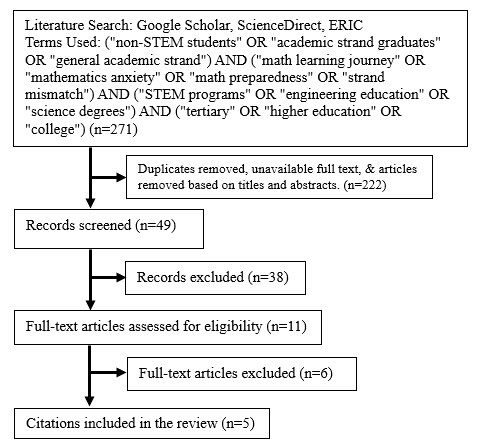
The study employed a systematic review approach to identify, select, and synthesize relevant studies on the journey of non-STEM students enrolled in STEM programs. This literature review used the eight-step guide introduced by 13 to ensure transparency and analytical rigor. Identifying the purpose, drafting a protocol and training the team, applying a practical screen, searching for literature, extracting data, appraising quality, synthesizing studies, and writing the review are the steps to conducting the systematic review. The search and filtering process is presented in Figure 1.

The review included studies that performed their research exclusively in the Philippines. The review included studies that were written in English and published between 2018 to 2025 with full-text availability and peer-reviewed. The review retained studies that examined non-STEM SHS completers enrolled in STEM programs. Research studies had to investigate areas that include students' preparedness in mathematics, learning obstacles, confidence levels, anxiety rates, and teaching support methods. The review excluded research investigations that were carried out outside the Philippines, as well as specific STEM strand research, or studies that did not directly address mathematics learning. The authors excluded non-academic publications and opinion pieces as well as articles that could not be accessed easily.
2.3. Literature SearchThe Crossref database served as the sampling source for this study, adhering strictly to the predefined inclusion and exclusion criteria, resulting in the initial screening of forty-nine (49) articles. The researcher evaluated all papers by reading their titles and abstracts before checking full texts when needed to verify their value for the study, while removing duplicate entries. The final evaluation step led to the elimination of forty-four (44) publications from continuing participation in the research collection. The last research corpus included five (5) articles spanning the years from 2018 to 2025.
2.4. Data AnalysisThe analysis revealed common patterns within non-STEM students' mathematical journey in STEM programs. The researchers utilized a cross-study method to understand methodological similarities and differences between the included studies. All gathered data were clustered into thematic categories to create a unified story that shows how non-STEM strand completers learn math.
The study evaluated five (5) articles on the journey of non-STEM students in STEM programs. It followed the inclusion and exclusion criteria formulated in the study to select the articles. The study used the systematic review process to evaluate the five (5) articles.
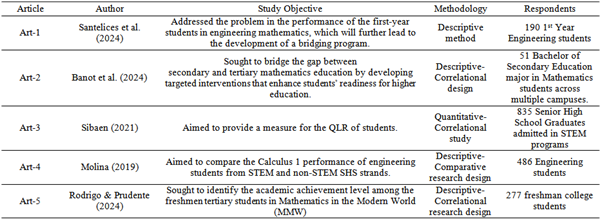
3.1. Overview of the ArticlesThe research examined five Philippine-based empirical researchers who studied the mathematics learning processes of non-STEM strand Senior High School (SHS) graduates enrolled in tertiary STEM programs. The research employed different methods, including descriptive, correlational, and comparative, that mainly examined students with mathematics-heavy courses. Researchers studied the students' mathematical preparation together with their academic differences between STEM and non-STEM fields while examining institutional programs for bridging or enhancement support. All research studies that varied in sample size and location showed that non-STEM students face major hurdles in advanced mathematics because they lack prerequisite mathematical knowledge.
The five studies showed that students focused on non-STEM strands during SHS lacked proper preparation to succeed in tertiary mathematics courses. STEM strand students achieved better scores than non-STEM strand students in derivative tests and application of derivatives assessments, according to 14, 15. The results presented by 14 indicated that STEM engineering students surpassed non-STEM students, particularly from TVL and ABM tracks, in derivative finding and application tasks. 16, through their enhancement program research, they reported that engineering students achieved a 52.79% success rate in Calculus 1, with a score deficiency observed in non-STEM graduates.
The performance difference maintained its consistency throughout all tested subject domains. A significant difference existed between QLR scores for non-STEM students according to 15 findings, while these students had already completed SHS General Mathematics and Statistics. Results indicate SHS mathematics fails to meet the requirements set by tertiary programs in STEM fields. 17 investigated college-level general mathematics and discovered that students' performance on average was average because of insufficient pandemic learning benefits and preparation deficits.
The presence of mathematics anxiety, together with insufficient instructional scaffolding, acted to further challenge non-STEM students. According to 18, students showed emotional trouble in math because they had limited exposure to advanced topics during senior high school. In their study, 16 discovered significant instructional quality problems among students who reported rapid abstract teaching methods and inconsistent basic arithmetic knowledge among teachers. Non-STEM students faced the most difficulty with instruction because they did not acquire algebra, trigonometry, or calculus knowledge at SHS.
Students who started mathematics with difficulty built lower self-confidence and avoided seeking help, along with persisting through academic hurdles. The working memory of students, together with their problem-solving abilities, faces interference from math anxiety, primarily during periods of weak foundational understanding.
A total of four research papers focused on establishing institutional actions that would minimize preparation deficiencies. 16 directly suggested summer education programs for students taking algebra, trigonometry, and analytic geometry in this study. Summer classes would serve both STEM students and non-STEM students to build their foundation for Calculus 1. 14 discovered that HEI’s that established bridging programs faced uneven student preparedness because some institutions failed to provide similar support. The inconsistent support framework given to students shifting between strands demonstrates an important policy gap among tertiary educational institutions.
Students who participated in 18 Enhancement Program experienced substantial enhancement in algebra and trigonometry capabilities, which narrowed their learning disparities compared to their lesser mathematics background. The authors demonstrate through their research that carefully designed supportive programs create conditions for improved school retention and academic performance among students who shift strands.
The assessment of entrance exams and high school grades demonstrated weak associations with actual quantitative reasoning performance, according to 15. The research findings demonstrate a pressing need for specialized placement systems and dedicated counseling, as well as individualized teaching methods throughout the entire first year of STEM education.
Five Philippine-based research studies about the mathematics learning experiences of non-STEM strand Senior High School graduates enrolled in tertiary STEM programs were reviewed systematically. The review used qualitative synthesis methods to analyze repeated challenges among students as well as emotional obstacles and institutional intervention outcomes.
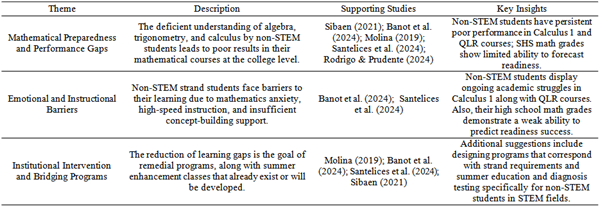
The research data showed that students from non-STEM major courses regularly obtain lower marks when taking foundational college math courses, especially Calculus 1. Non-STEM Senior High School completers struggled in math because their educational programs lacked prerequisite subjects, including algebra, trigonometry, and calculus. The greatest gap existed between STEM strand students because they received undergraduate exposure to these subjects previously.
The transition from high school to college mathematics became more challenging for non-STEM students because of their mathematics anxiety and instructional challenges. Fast-paced abstract instruction made students experience a combination of intimidation, confusion, and frustration. Students experienced lowered confidence, together with poor conceptual clarity, because these factors reduced their performance in STEM programs.
Various research proposals introduced planned educational support systems to address these problems. The most frequently recommended solutions included enhancement classes as well as diagnostic tools that match strands and contextualized instructional methods. Many academic institutions failed to properly execute their academic support initiatives because there was no consistent standardization of these programs between institutions.
The review illustrates how STEM education success depends on better alignment between SHS and tertiary curricula and enhanced strand-specific assistance programs, and improved assessment strategies that support all academic strand students.
The findings of this review point to several areas in need of further investigation. Longitudinal studies must be initiated by future investigations to track non-STEM strand students throughout their participation in STEM programs spanning multiple academic periods and semesters. The ongoing research needs to assess student development regarding classroom performance and self-assurance levels, and academic mindset through time, while analyzing reactions to educational policy changes.
A combination of quantitative data points like grades, test scores, and placement results, and qualitative research methods such as interviews and focus groups should unite in future investigations to develop comprehensive learning experience insights about students. The combination of research methods allows researchers to discover academic performance results together with student motivational dynamics, as well as affective and mental approaches students use for handling mathematically complex courses.
Future studies need to analyze enhancement or bridging programs starting from their design phase to implementation and their final impact on students. Research investigations of specialized programs designed for strand-shifting students can develop useful policies for all higher education facilities through their evaluations. Such research should compare student achievements across different universities throughout the Philippines to uncover elements that affect success outcomes.
The assessment of mathematical abilities across different Senior High School strands needs study-based diagnostic instruments or a tertiary mathematics learning framework that requires validation as an active research field. Tools designed for placement assessment can help universities identify correct placements while guaranteeing that new college students receive appropriate support programs beginning at the start of their academic journey.
The researcher extends their sincerest gratitude to Dr. Laila S. Lomibao for her valuable insights and guidance in refining this paper. Special thanks are also extended to the DOST-STRAND, for the financial support provided to the researcher.
| [1] | Marzuki, O. F., Lih, E. & Abdullah, W., Khairuddin, N., Inai, N., MD Saad, J., & Aziz, M. (2024). Innovating Education: A Comprehensive Review of STEM Education Approaches. International Journal of Academic Research in Progressive Education and Development, 13(1). | ||
| In article | View Article | ||
| [2] | Gorospe, J.D., & Joaquin, J.M. (2022). On the Right Track: Does Senior High School Tracking Matter? Technium Social Sciences Journal, 31(174–182). https:// techniumscience.com/ index.php/ socialsciences/article/view/2668. | ||
| In article | View Article | ||
| [3] | Benosa, M., & Palaoag, T. (2023). Exploring College Academic Performance of K to12 IT and Non-IT-related Strands to Reduce Academic Deficiencies. International Journal of Advanced Computer Science and Applications. | ||
| In article | View Article | ||
| [4] | Lievore, R., Caviola, S. & Mammarella, I. (2024). How Trait and State Mathematics Anxiety Could Affect Performance: Evidence From Children With and Without Specific Learning Disorders, Learning and Individual Differences. Science Dire ct. | ||
| In article | View Article | ||
| [5] | López, M. J., Santelices, M. V., & Taveras, C. M. (2023). Academic performance and adjustment of first-generation students to higher education: A systematic review. Cogent Education, 10(1). | ||
| In article | View Article | ||
| [6] | Mulaudzi, I. (2023). Challenges Faced by First-Year University Students: Navigating the Transition to Higher Education. Journal of Education and Human Development, 12(2), 79-87. | ||
| In article | |||
| [7] | Al-Tameemi, R., Johnson, C., Gitay, R., Abdel-Salam, A., Al Hazaa, K., BenSaid, A., & Romanowski, M. (2023). Determinants of Poor Academic Performance among Undergraduate Students-A Systematic Literature Review. International Journal of Educational Research Open, 4. | ||
| In article | View Article | ||
| [8] | Dita, B. & Velasco, M. J. (2025). The Relationship of Senior High School Strands and Academic Performance in College among Computer Engineering Students: Basis for Policy Guideline Development. International Journal of Innovative Science and Research Technology, 10(1). 10. | ||
| In article | |||
| [9] | Rozgonjuk, D., Kraav, T., Mikkor, K., Puurand, K. & That, K. (2020). Mathematics Anxiety among STEM and Social Sciences Students: The Roles of Mathematics Self-efficacy, and Deep and Surface Approach to Learning. IJ STEM Ed 7, 46 (2020). | ||
| In article | View Article | ||
| [10] | Sidek, M.R.E.B., Impil, J.A.D., Marcos, M.J.B., Punzalan, E.E.M., Ramos, J.T., & Ador, Z.I. (2023). Exploring Course Mismatch among Former STEM Students: A Narrative Research. Cognizance Journal, 3(7), 78–90. | ||
| In article | View Article | ||
| [11] | Coertjens, L., Brahm, T., Trautwein, C., & Lindblom-Ylänne, S. (2017). Students’ Transition Into Higher Education From an International Perspective. Higher Education, 73, 357-369. | ||
| In article | View Article | ||
| [12] | O'Donnell, V., & Kean, M., & Stevens, G. (2016). Student Transitions in Higher Education: Concepts, Theories and Practices. Higher Education Academy. | ||
| In article | |||
| [13] | Okoli, C. (2015). A guide to conducting a standalone systematic literature review. Communications of the Association for Information Systems, 37(1), 879–910. | ||
| In article | View Article | ||
| [14] | Molina, M. (2019). Comparison of the Calculus 1 Performance of Engineering Students from STEM and Non-STEM SHS Strands. International Journal of Teaching, Education, and Learning, 3(2), 103-123. | ||
| In article | View Article | ||
| [15] | Sibaen, N. (2021). Quantitative Literacy and Reasoning of Freshman Students with Different Senior High School Academic Background Pursuing STEM-Related Programs. European Journal of Educational Research, 11(1), 231-242. | ||
| In article | View Article | ||
| [16] | Santelices, R., Banas, K., & Arcilla Jr, P. (2024). Enhancement Program to Bridge the Gap in Mathematics. International Journal of Academic Research in Business & Social Sciences, 14(1). | ||
| In article | View Article | ||
| [17] | Rodrigo, D. (2024). Academic Achievement of College Students in Mathematics in the Modern World in the Changing Normal. International Journal of Social Science, Management, and Economics Research, 2(2), 1-14. | ||
| In article | View Article | ||
| [18] | Banot, V., Batucan, N., Catalan, G., Ubat, J., & Azuelo, J. M. (2025). Mathematical Skills of Freshmen NORSU BSED Math Students: Basis for Entrants’ Testing Material and Enhancement Program. Science International Lahore, 37(1), 11-20, 2024. | ||
| In article | |||
Published with license by Science and Education Publishing, Copyright © 2025 Mary Christine M. Tanquilan and Laila S. Lomibao
 This work is licensed under a Creative Commons Attribution 4.0 International License. To view a copy of this license, visit
http://creativecommons.org/licenses/by/4.0/
This work is licensed under a Creative Commons Attribution 4.0 International License. To view a copy of this license, visit
http://creativecommons.org/licenses/by/4.0/
| [1] | Marzuki, O. F., Lih, E. & Abdullah, W., Khairuddin, N., Inai, N., MD Saad, J., & Aziz, M. (2024). Innovating Education: A Comprehensive Review of STEM Education Approaches. International Journal of Academic Research in Progressive Education and Development, 13(1). | ||
| In article | View Article | ||
| [2] | Gorospe, J.D., & Joaquin, J.M. (2022). On the Right Track: Does Senior High School Tracking Matter? Technium Social Sciences Journal, 31(174–182). https:// techniumscience.com/ index.php/ socialsciences/article/view/2668. | ||
| In article | View Article | ||
| [3] | Benosa, M., & Palaoag, T. (2023). Exploring College Academic Performance of K to12 IT and Non-IT-related Strands to Reduce Academic Deficiencies. International Journal of Advanced Computer Science and Applications. | ||
| In article | View Article | ||
| [4] | Lievore, R., Caviola, S. & Mammarella, I. (2024). How Trait and State Mathematics Anxiety Could Affect Performance: Evidence From Children With and Without Specific Learning Disorders, Learning and Individual Differences. Science Dire ct. | ||
| In article | View Article | ||
| [5] | López, M. J., Santelices, M. V., & Taveras, C. M. (2023). Academic performance and adjustment of first-generation students to higher education: A systematic review. Cogent Education, 10(1). | ||
| In article | View Article | ||
| [6] | Mulaudzi, I. (2023). Challenges Faced by First-Year University Students: Navigating the Transition to Higher Education. Journal of Education and Human Development, 12(2), 79-87. | ||
| In article | |||
| [7] | Al-Tameemi, R., Johnson, C., Gitay, R., Abdel-Salam, A., Al Hazaa, K., BenSaid, A., & Romanowski, M. (2023). Determinants of Poor Academic Performance among Undergraduate Students-A Systematic Literature Review. International Journal of Educational Research Open, 4. | ||
| In article | View Article | ||
| [8] | Dita, B. & Velasco, M. J. (2025). The Relationship of Senior High School Strands and Academic Performance in College among Computer Engineering Students: Basis for Policy Guideline Development. International Journal of Innovative Science and Research Technology, 10(1). 10. | ||
| In article | |||
| [9] | Rozgonjuk, D., Kraav, T., Mikkor, K., Puurand, K. & That, K. (2020). Mathematics Anxiety among STEM and Social Sciences Students: The Roles of Mathematics Self-efficacy, and Deep and Surface Approach to Learning. IJ STEM Ed 7, 46 (2020). | ||
| In article | View Article | ||
| [10] | Sidek, M.R.E.B., Impil, J.A.D., Marcos, M.J.B., Punzalan, E.E.M., Ramos, J.T., & Ador, Z.I. (2023). Exploring Course Mismatch among Former STEM Students: A Narrative Research. Cognizance Journal, 3(7), 78–90. | ||
| In article | View Article | ||
| [11] | Coertjens, L., Brahm, T., Trautwein, C., & Lindblom-Ylänne, S. (2017). Students’ Transition Into Higher Education From an International Perspective. Higher Education, 73, 357-369. | ||
| In article | View Article | ||
| [12] | O'Donnell, V., & Kean, M., & Stevens, G. (2016). Student Transitions in Higher Education: Concepts, Theories and Practices. Higher Education Academy. | ||
| In article | |||
| [13] | Okoli, C. (2015). A guide to conducting a standalone systematic literature review. Communications of the Association for Information Systems, 37(1), 879–910. | ||
| In article | View Article | ||
| [14] | Molina, M. (2019). Comparison of the Calculus 1 Performance of Engineering Students from STEM and Non-STEM SHS Strands. International Journal of Teaching, Education, and Learning, 3(2), 103-123. | ||
| In article | View Article | ||
| [15] | Sibaen, N. (2021). Quantitative Literacy and Reasoning of Freshman Students with Different Senior High School Academic Background Pursuing STEM-Related Programs. European Journal of Educational Research, 11(1), 231-242. | ||
| In article | View Article | ||
| [16] | Santelices, R., Banas, K., & Arcilla Jr, P. (2024). Enhancement Program to Bridge the Gap in Mathematics. International Journal of Academic Research in Business & Social Sciences, 14(1). | ||
| In article | View Article | ||
| [17] | Rodrigo, D. (2024). Academic Achievement of College Students in Mathematics in the Modern World in the Changing Normal. International Journal of Social Science, Management, and Economics Research, 2(2), 1-14. | ||
| In article | View Article | ||
| [18] | Banot, V., Batucan, N., Catalan, G., Ubat, J., & Azuelo, J. M. (2025). Mathematical Skills of Freshmen NORSU BSED Math Students: Basis for Entrants’ Testing Material and Enhancement Program. Science International Lahore, 37(1), 11-20, 2024. | ||
| In article | |||