The study examined the implementation challenges faced by both academic and administrative staff of quality assurance mechanisms at the University of Zambia. The study employed a convergent parallel mixed-methods design, collecting quantitative data through questionnaires from 89 academic staff and qualitative data through interviews with 10 administrative staff and 5 Quality Assurance Directorate personnel and 5 students in leadership. Data analysis included descriptive statistics, correlation analysis, multiple regression and thematic analysis. Findings revealed that resource constraints emerged as the predominant implementation challenge (84.27%). Qualitative findings revealed improved role clarity and streamlined processes attributed to quality systems, but severe understaffing and infrastructure limitations hindered implementation. Based on these findings, the study recommends implementing a tiered quality assurance training framework and establishing a decentralized quality assurance support structure with designated officers in each school.
The University of Zambia (UNZA) was established by Act of Parliament No. 66 of 1965, with the first intake of students taking place on March 17, 1966. Guided by its motto "SERVICE AND EXCELLENCE," UNZA has developed into Zambia's premier institution of higher learning (University of Zambia, 2022). The university operates on two campuses: the main Great East Road Campus located 6km from Lusaka's town centre, and the Ridgeway Campus housing the Medical School, situated 4km southeast of Lusaka opposite the University Teaching Hospital. From its modest beginnings with three schools (Education, Humanities and Social Sciences, and Natural Sciences), UNZA has expanded significantly to include thirteen schools: Agricultural Sciences, Education, Engineering, Graduate School of Business, Health Sciences, Humanities and Social Sciences, Law, Medicine, Mines, Natural and Applied Sciences, Nursing Sciences, Public Health, and Veterinary Medicine 1, 2.
This expansion has been accompanied by substantial growth in student enrolment, from an initial intake of 312 students to over 30,000 students currently, creating an increasing need for robust quality assurance systems 1, 3. The university has established a dedicated Quality Assurance Directorate as a centralized unit to develop policies, monitor compliance, and provide technical support to academic and administrative units 1, 4.
As Zambia's flagship higher education institution, UNZA embodies this national evolution in quality assurance approaches. The university has served as both a pioneer and testing ground for quality assurance systems in Zambian higher education. 4 posits that Its expansion across multiple disciplines and substantial growth in student numbers has created an increasing need for robust quality assurance systems that can address the complexity of a large, multi-disciplinary institution while working within national frameworks.
In recent years, UNZA has strengthened its quality assurance practices in response to changing educational landscapes and increasing demands for accountability. The university has adopted technology-enhanced quality management systems, improved stakeholder engagement processes, and enhanced monitoring and evaluation frameworks. These developments reflect UNZA's commitment to maintaining high academic standards while adapting to evolving educational needs and challenges 1, 4, 5.
The gap between quality assurance policies and their practical implementation remains a significant concern in African higher education institutions 6, 7 indicate substantial differences between policy formulation and implementation effectiveness. 8, 9 further shows that university administrators' management abilities significantly influence quality assurance effectiveness. Internal challenges faced by quality assurance staff, as identified by 10, 11 include issues related to resource allocation, training adequacy, and institutional support.
At the University of Zambia, quality assurance mechanisms have been established to enhance academic and administrative performance. However, as 12, 13 note, the mere existence of such systems does not guarantee their effectiveness but its implementation should be examined. The absence of systematic research on implementation of quality assurance mechanism leads to several institutional challenges. Studies by 14, 15 demonstrate that quality assurance practices directly affect both academic and administrative staff effectiveness, suggesting that poor implementation can negatively impact teaching quality and student learning outcomes. These findings align with 16, 17 researches showing that internal quality assurance practices require effective implementation.
While studies like 12, 18 have identified internal challenges faced by quality assurance staff in other institutions, the specific situation at the University of Zambia remains unexplored. Understanding these would enable the university to address implementation barriers and enhance the effectiveness of its quality assurance mechanisms.This research problem requires immediate attention as it affects the university's ability to maintain and improve academic standards. By examining these challenges of quality assurance mechanisms, this study aims to provide valuable information for enhancing institutional effectiveness and ensuring successful implementation of quality assurance practices at the University of Zambia.
To examine the challenges faced by staff in the implementation of quality assurance mechanisms at the University of Zambia.
19 examined institutional constraints affecting quality assurance processes in Tanzania's private universities through extensive research involving 35 interviews and 180 surveys across six institutions. Through systematic data analysis, the research revealed significant gaps between quality assurance policies and implementation practices, highlighting inadequate staff training and limited institutional support as major barriers. The study did not to examine how institutional leadership approaches influence quality assurance effectiveness, an aspect emphasized in subsequent research. Additionally, the research did not adequately address how resource allocation decisions affect staff engagement with quality systems. These limitations affect understanding of how quality assurance can be effectively implemented in public universities with different funding structures and organizational systems. The present research addresses these gaps through thorough analysis of both academic and administrative staff perspectives within Zambia's public university setting, examining how resource availability and institutional support affect implementation success.
Contributing to East African quality assurance research, 20 assessed internal quality assurance mechanisms at the Open University of Tanzania, employing mixed methods research with structured interviews and document analysis across multiple campuses. The study, complemented by 21 research on student involvement trends, identified significant variations in quality implementation across different academic departments. 22 work on quality assurance issues further validated these findings regarding implementation inconsistencies, particularly in distance education contexts. The research revealed critical gaps in policy interpretation and implementation strategies, highlighting the need for standardized approaches to quality assurance. Whilst their study is commendable, one needs to also look at department cultures that may influence quality assurance effectiveness and the need to address staff development needs. The current study addresses these gaps through detailed analysis of departmental dynamics, resource allocation patterns, and staff development needs at the University of Zambia, providing comprehensive insights into quality assurance implementation in African universities.
Completing the African perspective, 8 research on management capacity further supported their findings regarding implementation challenges in African universities. The study effectively identified policy gaps and implementation barriers but demonstrated several critical limitations: it failed to examine how staff perceptions influence policy implementation, overlooked the impact of institutional culture on quality assurance practices, and did not adequately address resource allocation challenges. Additionally, the research neglected to investigate how leadership approaches affect implementation success. The current study addresses these gaps through detailed analysis of staff perceptions, institutional culture, and leadership dynamics at the University of Zambia, providing practical insights for improving quality assurance implementation in African higher education contexts.
The study by 23 analysis of regulatory frameworks, revealed significant challenges in monitoring and implementation processes of quality assurance systems. The research employed multiple data collection methods, demonstrating that supervision frequency significantly influences quality assurance effectiveness. Furthermore, the research neglected to investigate staff perceptions of quality assurance mechanisms. The current study extends this analysis to higher education, examining institutional culture, resource allocation, and staff perceptions at the University of Zambia.
Institutional Theory, developed by 24 and expanded by 25, provides a framework for understanding implementation challenges in quality assurance systems. The theory explains how organizational structures and practices become institutionalized through regulatory, normative, and cultural pressures. In quality assurance implementation, Institutional Theory helps identify why certain challenges persist despite formal policies and procedures.
The theory's emphasis on institutional isomorphism, supported by 19 research on institutional constraints, explains how external pressures influence quality implementation. Institutional Theory's focus on organizational legitimacy, reinforced by 4 analysis of Zambian higher education, helps understand resistance to change and implementation barriers. This theoretical framework directly addresses the study’s objective by providing a structure for examining how institutional factors create and perpetuate implementation challenges in quality assurance systems.
The study adopted a pragmatic paradigm to investigate staff perceptions of quality assurance mechanisms. This philosophical stance aligned with the mixed-methods approach, acknowledging that both objective and subjective insights were valuable in understanding quality assurance implementation. Following 12 framework, pragmatism supported the use of multiple data collection methods to address research questions from different angles.
The study employed a mixed-methods approach, combining quantitative and qualitative data collection and analysis techniques. This methodology aligned with 16 strategy for examining internal quality assurance practices in higher education institutions. A convergent parallel mixed-methods design guided this research, examining staff perceptions of quality assurance mechanisms at the University of Zambia. Following 26 approach to studying quality assurance impacts, the design enabled simultaneous collection of quantitative and qualitative data, with equal priority given to both strands.
The study population consisted of academic, students leaders and administrative staff at the University of Zambia who interacted with quality assurance mechanisms. The study used stratified random sampling for the quantitative phase and purposive sampling for the qualitative phase. Stratification ensured proportional representation of 89 academic staff, 5 students’ leaders, 5 from Quality Assurance Directorate and 10 administrative staff across departments, following 16 methodology for studying internal quality assurance practices. For qualitative data collection, purposive sampling targeted staff members with direct involvement in quality assurance implementation, similar to 8 approach. This combined sampling strategy ensured collection of representative data while maintaining focus on staff members with relevant experience in quality assurance processes.
The study employed two primary data collection instruments specifically designed to address the research objectives. The questionnaire which was in a survey form for 89 academic staff and semi-structured interview guides were developed for 10 administrative staff, 5 student leaders and 5 Quality Assurance Directorate personnel giving the total of 20 respondents for interviews, both focusing on lived experiences with quality systems. Both instruments underwent rigorous development processes including literature-based item generation. Questionnaires were self-administered through departmental distribution with a one-week completion window, while interviews were conducted in private settings lasting 15-60 minutes and recorded with permission.
Quantitative data analysis employed both descriptive and inferential statistical methods. Descriptive analysis included frequency distributions and percentages to state the challenges faced in the implementation of quality assurance mechanism. Inferential analysis encompassed Pearson correlation coefficients for implementation challenges and multiple linear regression models were developed to identify predictors of quality assurance effectiveness. This model identified key factors that increased or decreased the likelihood of staff being highly engaged in quality assurance implementation.
Qualitative data underwent systematic thematic analysis. The process involved open coding of interview transcripts, categorization of codes into emerging themes, and pattern identification across respondent narratives. NVivo 12 software facilitated the organization and coding of qualitative data. Integration of quantitative and qualitative findings occurred through side-by-side comparison of statistical results and thematic outcomes, with convergence and divergence points identified to develop an understanding of staff perceptions.
Prior to data collection, the researchers obtained formal ethical clearance from both the University of Zambia Directorate of Research and Graduate Studies. All participants received detailed information sheets explaining the study purpose, procedures, voluntary nature of participation, and potential benefits. Signed consent forms were collected from all respondents before questionnaire distribution or interview commencement, with particular emphasis on participants' right to decline answering specific questions or withdraw entirely without penalty. Confidentiality and anonymity were strictly maintained throughout the research process. Questionnaires used identification codes rather than names, and interview recordings were transcribed with pseudonyms replacing actual identities.
The findings were presented addressing the research objective. The analysis systematically examines the quality mechanisms implementation challenges. It presents the difficulties staff encounter when implementing quality assurance mechanisms at the University of Zambia. The analysis identifies prevalent implementation barriers across institutional contexts, revealing both common challenges and department-specific obstacles. Understanding these implementation difficulties provides crucial insights for institutional leadership, highlighting factors that impede quality assurance effectiveness and identifying specific areas requiring strategic intervention to enhance implementation success.Firstly, descriptive analysis is presented followed by the inferential statistics and finally thematic analysis.
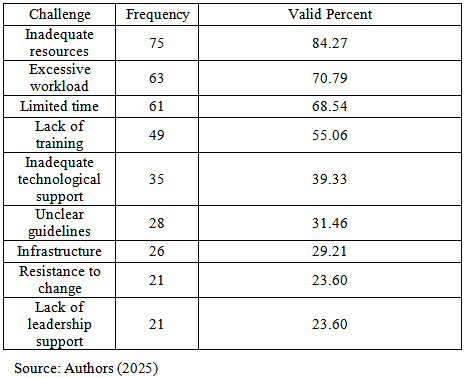
6.1. Descriptive FindingThese results were collected form the 89 (N) respondents from the questionnaires administered to academic staff. These responses were from only academic staff whose views on the challenges were rated as shown in Table 1.
Table 1 presents the key challenges staff face in implementing quality assurance mechanisms at the University of Zambia, revealing resource constraints as the most significant barrier. Inadequate resources rank highest, with an overwhelming 84.27% of respondents identifying this as a challenge. This finding has profound implications for institutional quality assurance as it suggests that despite having mechanisms in place, the university lacks adequate financial, human, and material resources necessary for effective implementation. The prevalence of this challenge indicates a critical need for the university to reassess its resource allocation strategies, potentially exploring alternative funding sources or developing more resource-efficient quality assurance processes that can function effectively within existing constraints.
The second tier of challenges—excessive workload (70.79%) and limited time (68.54%) points to operational and human resource issues affecting quality assurance implementation. These challenges indicate that staff members are likely juggling multiple responsibilities, with quality assurance activities perceived as additional burdens beyond their primary duties. The implication is that quality assurance may not be fully integrated into regular work processes but rather viewed as supplementary tasks. This perception could lead to superficial implementation, with staff prioritizing compliance over meaningful engagement with quality processes. The university should consider strategies to better embed quality assurance within normal operations, potentially through workload adjustments, process streamlining, or recognition systems that value quality assurance contributions.
Lack of training (55.06%) and inadequate technological support (39.33%) represent significant capacity-related challenges. With over half of respondents indicating insufficient training, the implication is that many staff lack the necessary skills and knowledge to implement quality mechanisms effectively. Similarly, the technological gap suggests that digital tools that could enhance efficiency and effectiveness of quality processes are either unavailable or underutilized. These findings highlight the need for comprehensive capacity development initiatives, including regular training programs that go beyond basic awareness to develop practical implementation skills. The university should also invest in appropriate technological infrastructure and digital literacy programs to support quality assurance processes.
The lower-ranked challenges—unclear guidelines (31.46%), infrastructure (29.21%), resistance to change (23.60%), and lack of leadership support (23.60%)—though affecting fewer respondents, reveal important systemic issues. The presence of unclear guidelines suggests communication gaps between quality assurance administrators and implementers. Infrastructure challenges point to physical constraints affecting implementation, while resistance to change indicates cultural barriers within the institution. Perhaps most significantly, the reported lack of leadership support by nearly a quarter of respondents implies that quality assurance may not be consistently championed across all levels of university leadership. The implication is that quality culture may be unevenly developed across the institution. To address these challenges, the university should clarify guidelines, demonstrate leadership commitment through visible support and resource allocation, and develop change management strategies that address resistance by emphasizing the benefits of quality assurance for all stakeholders.
The analysis further distinguishes between resource constraints, leadership issues, communication problems, and other potential barriers. Identifying this primary impediment provides strategic focus for institutional improvement efforts, highlighting which specific factor requires immediate attention to significantly enhance overall quality assurance effectiveness.
Table 4.23 reveals that information frequency (β = -0.288, p = 0.004), understanding level (β = -0.276, p = 0.005), and training status (β = -0.253, p = 0.011) all significantly predict reduced perception of quality assurance implementation challenges, while years of service shows a non-significant effect (β = -0.154, p = 0.115). These findings demonstrate that challenge perceptions are malleable and can be strategically reduced through institutional interventions. Regular communication emerges as the strongest factor in mitigating perceived barriers, closely followed by comprehensive understanding and formal training. The non-significance of experience implies that even newer staff can navigate implementation effectively when properly informed and trained. University leadership should prioritize a three-pronged approach—enhancing communication channels, improving conceptual understanding, and expanding training programs—to reduce implementation barriers across all staff categories regardless of experience level.
6.2. Thematic AnalysisKey themes of challenges that emerged include training deficiencies (particularly for lower-level staff), structural implementation barriers (non-functional quality circles), communication weaknesses (inadequate explanation of purpose and benefits), workload concerns (balancing quality assurance requirements with regular duties), and difficulties in cultivating ownership of quality initiatives across departments. Resource constraints were frequently mentioned:
"Maybe systems and procedures, understaffing and financing of the Senate." [Respondent 1]
Infrastructure limitations were also highlighted:
"In some cases, as the university is growing, we need to grow simultaneously with infrastructure. So, the instances where I find that classrooms become small, it means maybe as a school, as a unit, you have to look for alternative venues to ensure that there is quality service to our clients." [Respondent 2]
Resistance to change was noted by several participants:
"Resistance from members of staff when you tell them this is how things should be done. Also, from the part of the students, there is some resistance and also just them not implementing what you want to ensure that they do." [Respondent 8]
Limited understanding was also mentioned as a challenge:
"I think it's non-inclusive of our offices as administrators. Mostly, I think they concentrate on the academic related things and students' lectures, how they are engaging, but for the administrative part, not really." [Respondent 4]
6.3. Administrative Systems and InfrastructureThe findings revealed that awareness of quality assurance mechanisms among staff has improved significantly over time, though with variations across different staff categories and schools. Key themes include cumbersome administrative processes (particularly for resource acquisition), technological limitations (insufficient IT systems to support quality assurance), monitoring and feedback deficiencies (lack of systematic follow-up on recommendations), structural hierarchy challenges (over-centralization of quality assurance functions), and documentation gaps that impede efficient implementation.Some participants noted hindrances in the systems:
"Well, sometimes when you want to implement quality, you need some resources. And the university, the system here is quite cumbersome. There is a channel in which you have to acquire resources. For example, if you want to acquire computers so that people can be receiving information, can be implementing what you want them to do, it takes long." [Respondent 8]
Infrastructure limitations were frequently mentioned:
"Okay, if we talk about infrastructure, there, I think there is a problem because in cases where maybe you have a lot of students against the limited infrastructure or classrooms where they are supposed to be linked because Quality Assurance encompasses a lot of things." [Respondent 5]
"And it's our pride, being one of them. Let's see how we can explain it. Because the demand out there is so high. And everyone has to come to this big institution. So at the end of the day, our infrastructure is the same from the time of inception. So we are expanding and we want to respond to that. So infrastructure is the most important." [Respondent 9]
Some reported implementation monitoring challenges:
"They do monitor processes of registration and what not. I remember this registration period that we're in, the director quality passed through just to see the situation. He asked one or two questions, but like I said, feedback is never given. He said, okay, why don't you do A, B, C, D next time? So, I don't think we're really... I don't know where that information goes." [Respondent 4]
6.4. Resource ConstraintsThe findings revealed that awareness of quality assurance mechanisms among staff has improved significantly over time, though with variations across different staff categories and schools. Key themes include severe understaffing (only four staff members with two effectively operational), financial limitations (inadequate funding for quality initiatives), centralized structural constraints (insufficient personnel to monitor all university departments), operational prioritization necessitated by resource limitations, and advocacy for increased departmental resources to university management.Financial constraints were most frequently mentioned:
"Of course, it's financial. You know the law wants you to do A, B, C, D, but you don't have enough money to implement. So, you are forced to wait until you have enough money." [Respondent 7]
Multiple respondents described how financial limitations directly affected implementation timelines and created significant delays:
"Sometimes lack of funds. You want to do this but you find there are no funds. The institution is facing financial challenges. So, you want to do something on time it will take you probably months in order for you to implement it because of lack of funds." [Respondent 3]
Human resource limitations were also highlighted:
"Lack of manpower and inadequate information systems." [Respondent 1]
Other participants highlighted significant human resource limitations:
"Other than the financial resources maybe I can say the lack of human resource. You can say like this building I am the only one, this infrastructure I am the only one in charge. So you find sometimes I wouldn't know what is going. If a certain unit has not reported to me that they have this challenge I wouldn't know." [Respondent 3]
Suggestions for improvement from participants cited increased resources were frequently recommended:
"I think beefing up staff and improving our computer systems and better funding towards the activities that have to do with quality assurance and also having designated personnel in the school to implement quality assurance." [Respondent 1]
Infrastructure development requires long-term strategic planning:
"We need to work on infrastructure. We have just a deliberate policy, maybe a two to five-year period, we work on infrastructure development as the university grows." [Respondent 2]
Decentralized quality assurance was suggested:
"I think I would propose that in each unit there must be a quality assurance officer attached to each unit so that they are able to give guidance there and then other than depending on one office." [Respondent 3]
Continuous training was emphasized:
"Well, for quality to be improved, there must be a change of mindset in people, in terms of training. People must undergo training so that not just a few individuals, but almost everyone should attain what they see as important." [Respondent 8]
Gradual implementation was also recommended:
"It should be gradual. It should not just be brought at the landing point where people are expected to do it. If you introduce a change, better give it a time frame. So that people should be ready to work within that time." [Respondent 7]
When discussing how resource limitations affect work prioritization, the respondent explained:
"So, we look at mainly focusing on the critical areas that would make a better impact or, yeah, a good impact than the others. For instance, one of the areas we thought we had no choice is program accreditation. So, we put all our energies there because, yeah, it has serious consequences for us." [Respondent 1]
Regarding specific human resource challenges, the respondent highlighted the severity of understaffing:
"Well, I think in quite a large way, the human, as I mentioned, the way the structure is, it's centralized. So currently I would say there are just four of us. And in fact, literally I would say two of us because those are the ones that are really..." [Respondent 3]
The respondent further elaborated on how staffing limitations affect their ability to fulfil their mandate:
"What is the challenge in the most case is that the department is understaffed. So, we, yeah, we don't, there are certain things that we're not doing which we're supposed to be doing. We know we're supposed to be doing. And I've told the powers that be, well, yeah, you have overloaded us." [Respondent 2]
When asked about the main challenges in implementing quality assurance mechanisms, the respondent highlighted:
"The challenges, I think the main one is training, we need to equip them with the skills. And also, the, yeah, guide them in terms of, yeah, why we're doing certain things and for what benefit. So, we would want to promote, yeah. We're trying to get some champions in these units, quality champions, if you may call them that way." [Respondent 2]
Regarding orientation for new staff, the respondent acknowledged limitations:
"What we do, I would say that, yeah, it's one of our areas that we have not fared well. We do it mainly for senior staff. So, if the university recruits new members of the senior staff, these are deans, directors, managers, like was the case in 2023, when the university recruited a new vice-chancellor, the two deputies... But we have not done so for new members of the lower level, the academic staff and non-academic." [Respondent 3]
The respondent further explained a structural challenge affecting implementation:
"But I think this I can attribute to the fact that the quality circles are not fully functional, in a way. Those are the ones who are supposed to help us undertake such activities." [Respondent 1].
The study identified resource constraints as the predominant challenge affecting quality assurance implementation at the University of Zambia, with 84.27% of respondents highlighting this issue. This finding aligns with 19 research on Tanzanian universities, which similarly identified resource limitations as the primary barrier to effective quality assurance. At UNZA, financial resources emerged as particularly problematic, with 60.67% of respondents identifying them as the most critical resource deficiency, followed by human resources (31.46%). This pattern reflects systemic underfunding challenges facing Zambian public higher education institutions, as documented by 4 in his analysis of quality assurance in Zambian universities.
Workload pressures emerged as the second most significant challenge (70.79%), closely followed by time constraints (68.54%). These operational barriers indicate that quality assurance activities often represent additional responsibilities rather than integrated aspects of normal work processes. The prevalence of these concerns supports 27 finding that staff in African universities frequently perceive quality assurance as adding to already heavy workloads. This workload-related resistance creates significant implementation barriers, as staff prioritize primary teaching and research responsibilities over quality documentation and procedures when facing time pressures.
Training deficiencies represent another substantial implementation barrier, with 55.06% of respondents identifying lack of training as a significant challenge. This finding corresponds with I 14 research demonstrating that inadequate preparation undermines staff effectiveness in quality implementation. The training gap at UNZA appears particularly pronounced for administrative staff, with one interviewee noting. This admission suggests systematic deficiencies in staff preparation for quality roles, creating knowledge gaps that impede effective implementation.
Technological support limitations affect 39.33% of respondents, indicating infrastructure constraints that hinder quality assurance processes. This finding parallels 27 identification of technological inadequacies as significant barriers in Zambian higher learning institutions. In resource-constrained environments, technological limitations particularly affect data management and monitoring aspects of quality systems, reducing efficiency and potentially diminishing implementation effectiveness. The technology gap suggests need for targeted investment in quality-supporting infrastructure to enhance implementation capacity.
Staff engagement levels reveal concerning patterns, with only 29.21% of respondents reporting high or very high engagement in quality assurance implementation. The majority (39.33%) indicate moderate engagement, while 31.46% report low or very low engagement. This engagement deficit aligns with 28 finding that academic staff often demonstrate limited commitment to quality processes they perceive as bureaucratic or disconnected from core educational values. The low engagement levels represent significant barrier to effective implementation, as quality systems require active participation to generate meaningful improvements.
When examined through Total Quality Management Theory, the implementation challenges reveal significant deviation from TQM principles. 6 emphasis on resource adequacy, continuous training, and process integration contrasts sharply with UNZA's reality of resource constraints, training deficiencies, and add-on quality processes. The findings suggest that fundamental TQM requirements remain unmet, creating structural barriers to effective quality implementation. This gap between theoretical requirements and practical conditions helps explain the moderate effectiveness ratings observed across multiple quality domains.
Stakeholder Theory provides additional interpretive framework for understanding implementation challenges. The varying engagement levels across different staff categories suggest inadequate consideration of diverse stakeholder needs in quality system design. As 29 emphasized, effective organizational systems require balanced attention to all stakeholder groups' capabilities and constraints. The concentration of quality knowledge among administrators, coupled with limited resources for frontline implementers, indicates stakeholder imbalance that undermines implementation effectiveness. This pattern aligns with 30 findings regarding stakeholder disequilibrium in quality assurance systems.
Institutional Theory offers particularly relevant framework for understanding the observed challenges. 24 concept of institutional isomorphism explains how universities adopt quality structures for legitimacy despite implementation constraints. The notable gap between formal quality frameworks and implementation capacity at UNZA reflects what 25 termed "coercive isomorphism," where external pressures drive adoption of structures regardless of organizational readiness. This theory helps explain how quality mechanisms can simultaneously exist as formal systems while facing substantial implementation barriers.
Resistance to change emerged as a moderate challenge (23.60%), suggesting that attitudinal factors play lesser role compared to structural and resource constraints. This finding differs somewhat from 10 research, which identified resistance as a major implementation barrier in Vietnamese universities. The relatively low ranking of resistance at UNZA suggests that staff may be generally receptive to quality improvement if structural barriers were addressed. This interpretation gains support from the finding that 100% of respondents expressed willingness to participate in quality assurance training, indicating openness to capacity development despite implementation challenges.
Administrative staff suggested several improvement strategies, including decentralization. This recommendation aligns with 31 finding that decentralized quality structures enhance implementation effectiveness in African universities. The suggestion represents practical response to the observed staffing limitations in the centralized Quality Assurance Directorate.
Gradual implementation approaches emerged as another recommendation. This suggestion aligns with 26 findings regarding change management in quality implementation, emphasizing adaptive approaches that allow for cultural adjustment. The recommendation acknowledges organizational change dynamics that affect quality assurance adoption, suggesting more realistic implementation time frames.
The Quality Assurance Directorate identified specific challenges in orientation processes. This admission helps explain the observed knowledge gradient across positions and highlights systematic gaps in staff preparation. The directorate attributed this limitation partly to non-functional quality circles. This structural implementation gap aligns with 4 observation regarding incomplete operationalization of quality structures in Zambian universities.
When considering the overall challenge pattern, the dominance of resource-related barriers (84.27%) followed by operational constraints (workload: 70.79%; time: 68.54%) and knowledge factors (training: 55.06%) suggests a hierarchy of implementation barriers. This pattern aligns with 19 framework of primary (resource), secondary (operational), and tertiary (knowledge) barriers in African higher education quality implementation. The findings indicate need for multi-level intervention strategies addressing fundamental resource constraints while simultaneously enhancing operational efficiency and knowledge development.
The study revealed that one of the most critical findings was the identification of resource constraints as the primary barrier to effective quality assurance implementation. While limited financial and human resources posed significant challenges, the study demonstrated that engagement with quality assurance processes was primarily driven by knowledge-based factors. Staff who received training on quality assurance mechanisms were significantly more likely to engage actively with these processes. This finding suggested that despite resource limitations, strategic investments in staff training and awareness-building initiatives could substantially improve the effectiveness of quality assurance measures.
Moreover, the study highlighted the need for a more holistic and integrated approach to quality assurance at the University of Zambia. Addressing structural knowledge gaps and fostering better communication between policy designers and implementers would be essential in bridging the perception gap. Training programs should be systematically embedded into the university’s quality assurance framework to ensure that all staff, regardless of their role or academic discipline, have a clear understanding of expectations and best practices. Furthermore, resource allocation strategies should prioritize areas where improved awareness and engagement can yield the highest institutional impact, ensuring a balanced and effective quality assurance system.
Based on the findings of the study, the following recommendations were made;
1. The University of Zambia management should organize regular training and professional development programs focused on quality assurance mechanisms, including how to evaluate and implement quality standards effectively.
The University of Zambia management should actively involve academic and administrative staff in the design and review of quality assurance mechanisms.
| [1] | The university of Zambia 2023-2027 Strategic Plan (2022) Lusaka: The University of Zambia | ||
| In article | |||
| [2] | Masaiti, G., & Simuyaba, E. (2018). University education in Zambia in the face of austerity: History, trends and financing. African Perspectives of Research in Teaching & Learning, 2(1), 1-19. | ||
| In article | |||
| [3] | The University of Zambia 2018-2022 Strategic Plan (2018) Lusaka: The University of Zambia. | ||
| In article | |||
| [4] | Bwalya, T. (2023). Quality Assurance in Higher Education and its Implications on Higher Education Institutions and Challenges in Zambia. Preprints, 202301.0049.v1. | ||
| In article | View Article | ||
| [5] | Daka, H. and Changwe, R. (2020). An Exploration of Education Quality in the Light of the Grade Point Average and Examination Attrition Rate. International Journal of Humanities Social Sciences and Education, 7 (6), 196-207. | ||
| In article | View Article | ||
| [6] | Kajala, M. M., & Daka, H. (2023). Analysis of Quality Assurance Systems in Selected Private Universities in Lusaka District. GSJ: Volume 11, Issue 4. | ||
| In article | |||
| [7] | Mpelo, S. and Daka, H. (2024). An Assessment on the Implementation of Performance Management in Jesuit owned Institutions: A Case Study of St Ignatius College, International Journal of Recent Research in Commerce Economics and Management, 11(1), 29 – 41. | ||
| In article | |||
| [8] | Mohammed, U. D. (2023). Management Capacity of University Administrators as a Predictor of Quality Assurance in Federal Universities. Asian Journal of Education and Social Studies, 46(19), 92-103. | ||
| In article | View Article | ||
| [9] | Daka, H.,Chipindi, F. M. and Mwale, M. (2020). The Relationship between Assessment Practices and Students’ Academic Performances. A Case of Undergraduate Students at the Medical School of the University of Zambia, 2008 – 2016.Zambian Journal of Educational Management, Administration and Leadership, 1 (1), 143 – 156. | ||
| In article | |||
| [10] | Nguyen, H. C. (2021). Exploring internal challenges for quality assurance staff in Vietnam. Quality Assurance in Education, 29(2/3), 241-255. | ||
| In article | View Article | ||
| [11] | Chizyuka, M. and Daka, H. (2021). The Relationship between Organisational Structure and the Provision of Quality Education: A Comparative Study of a Private Secondary School and a Public Secondary School. Global Scientific Journal. 9 (12), 2169 – 2182. | ||
| In article | |||
| [12] | Nguyen, H. C., Ta, T. T. H., & Nguyen, T. T. H. (2021). Factors Affecting Successful Quality Assurance Implementation in Vietnamese Higher Education. The Qualitative Report, 26(4), 1256-1274. | ||
| In article | View Article | ||
| [13] | Bomber, H. S., Daka, H. and Mphande, F. (2020).Strategies to Overcome the Challenges faced by Weekly Boarders: A case study of Selected Day Secondary Schools in Chikankata District in Southern Province, Zambia. International Journal of Humanities Social Sciences and Education. Vol 7 (6), 175 – 186. | ||
| In article | View Article | ||
| [14] | Ibrahim, M. Y. (2021). Quality Assurance Practices as Determinants of Academic Staff Effectiveness in South-West Nigerian Polytechnics. Khazar Journal of Humanities and Social Sciences, 24(2), 59-73. | ||
| In article | View Article | ||
| [15] | Bwembya, I and Daka, H. (2024). The Role of Science Teachers in the Implementation of Quality School based Assessments in Selected Zambian Secondary Schools, International Journal of Advanced Multidisciplinary Research and Studies, 4 (2), 984 – 995. | ||
| In article | View Article | ||
| [16] | Mensah, J. K. (2022). Internal Quality Assurance Practices in Higher Education: Evidence from a Ghanaian University. European Journal of Education Studies, 9(7), 43-88. | ||
| In article | View Article | ||
| [17] | Lungu, S. and Daka, H. (2022). Internal Monitoring and Evaluation of Teaching in Secondary Schools of Kabwe District in Central Province, Zambia. Challenges and Possible solutions. International Journal of Research and Innovation in Social Science, 6 (1), 180 – 186. | ||
| In article | View Article | ||
| [18] | Bwembya, I, Daka, H and Chomba, J. (2024). Achieving Accountability and Quality Education through Assessments: A Comprehensive Exploration of Assessment Practices in Zambia, International Journal of Advanced Multidisciplinary Research and Studies, 4(6), 600 - 607. | ||
| In article | View Article | ||
| [19] | Mgaiwa, S. J., & Ishengoma, J. M. (2022). Institutional Constraints Affecting Quality Assurance Processes in Tanzania's Private Universities. Journal of Higher Education in Africa, 15(1), 67-86. | ||
| In article | View Article | ||
| [20] | Njihia, M. (2022). An Assessment of the Internal Quality Assurance Mechanisms at the Open University of Tanzania. Journal of Issues and Practice in Education, 13(1), 109-124. | ||
| In article | View Article | ||
| [21] | Ncube, L. B. (2024). Student-Involvement Trends (SIT) For Quality-Assurance in Higher Education among STEM Institutions, Zimbabwe. International Journal of Social Science and Human Research, 7(7), 53-67. | ||
| In article | View Article | ||
| [22] | Ghimire, H. P., & Timilsina, M. (2022). Quality Assurance and Accreditation Issues in Nepalese Higher Education. Patan Pragya, 11(2), 89-98. | ||
| In article | View Article | ||
| [23] | Mushumba, M., Chinsembu, K. C., & Mwanza, G. (2024). Impact of the Higher Education Authority on the Quality of Teaching and Learning in Higher Education Institutions in Zambia. Asian Journal of Advanced Science and Technology, 8(4). | ||
| In article | View Article | ||
| [24] | Meyer, J. W., & Rowan, B. (1977). Institutionalized organizations: Formal structure as myth and ceremony. American Journal of Sociology, 83(2), 340-363. | ||
| In article | View Article | ||
| [25] | DiMaggio, P. J., & Powell, W. W. (1983). The iron cage revisited: Institutional isomorphism and collective rationality in organizational fields. American Sociological Review, 48(2), 147-160. | ||
| In article | View Article | ||
| [26] | Khdair, W. A. (2022). The impact of the quality assurance system on improving the performance of employees in Iraqi higher education institutions. International Journal of Research in Human Resource Management, 4(1), 94-99. | ||
| In article | View Article | ||
| [27] | Chiwoya, A, Daka, H and Mulenga - Hagane, M. L. (2025). Innovative Strategies for Enhancing Online Learning in Higher Learning Institutions in Zambia: A Focus on An Ideal Online Learning Enhancement Framework, International Journal of Research and Innovation in Social Science, 12 (4), 760 - 781. | ||
| In article | View Article | ||
| [28] | Daka, H., Minjale, L., Kakupa, P., Kaani, B., Tembo, P., Mulenga, L. M. and Musonda, A. (2023). Bridging the Gap: Addressing the Disparity between Higher Education Knowledge and Industry Needs. International Journal of Social Science and Education Research Studies, 3(8), 1589 – 1594. | ||
| In article | View Article | ||
| [29] | Masonde, J. K. and Daka, H. (2023). An Evaluation of The Organizational Performance of The Department of National Parks and Wildlife Using the Balance Score Card Model, International Journal of Recent Research in Social Sciences and Humanities, 10 (3), 20 – 34. | ||
| In article | |||
| [30] | Sekelani, K., Mbozi, E. H. and Daka, H. (2021). Community Involvement in the Implementation of Comprehensive Sexuality Education in Rural Areas: A Case of Selected Secondary Schools in Chibombo District of Central Province, Zambia. International Journal of Research and Scientific Innovation, 8 (4), 216 – 228, ISSN 2321 – 2705. | ||
| In article | View Article | ||
| [31] | Amoako, R., & Asamoah-Gyimah, K. (2020). Indicators of students' satisfaction of quality education services in some selected universities in Ghana. South African Journal of Higher Education, 34(5), 1-16. | ||
| In article | View Article | ||
Published with license by Science and Education Publishing, Copyright © 2025 Shanziwe Abesi Mijere, Harrison Daka, Mukuka Lydia Mulenga – Hagane, Ireen Bwembya, Boniface Banda and Friday Chazanga
 This work is licensed under a Creative Commons Attribution 4.0 International License. To view a copy of this license, visit
http://creativecommons.org/licenses/by/4.0/
This work is licensed under a Creative Commons Attribution 4.0 International License. To view a copy of this license, visit
http://creativecommons.org/licenses/by/4.0/
| [1] | The university of Zambia 2023-2027 Strategic Plan (2022) Lusaka: The University of Zambia | ||
| In article | |||
| [2] | Masaiti, G., & Simuyaba, E. (2018). University education in Zambia in the face of austerity: History, trends and financing. African Perspectives of Research in Teaching & Learning, 2(1), 1-19. | ||
| In article | |||
| [3] | The University of Zambia 2018-2022 Strategic Plan (2018) Lusaka: The University of Zambia. | ||
| In article | |||
| [4] | Bwalya, T. (2023). Quality Assurance in Higher Education and its Implications on Higher Education Institutions and Challenges in Zambia. Preprints, 202301.0049.v1. | ||
| In article | View Article | ||
| [5] | Daka, H. and Changwe, R. (2020). An Exploration of Education Quality in the Light of the Grade Point Average and Examination Attrition Rate. International Journal of Humanities Social Sciences and Education, 7 (6), 196-207. | ||
| In article | View Article | ||
| [6] | Kajala, M. M., & Daka, H. (2023). Analysis of Quality Assurance Systems in Selected Private Universities in Lusaka District. GSJ: Volume 11, Issue 4. | ||
| In article | |||
| [7] | Mpelo, S. and Daka, H. (2024). An Assessment on the Implementation of Performance Management in Jesuit owned Institutions: A Case Study of St Ignatius College, International Journal of Recent Research in Commerce Economics and Management, 11(1), 29 – 41. | ||
| In article | |||
| [8] | Mohammed, U. D. (2023). Management Capacity of University Administrators as a Predictor of Quality Assurance in Federal Universities. Asian Journal of Education and Social Studies, 46(19), 92-103. | ||
| In article | View Article | ||
| [9] | Daka, H.,Chipindi, F. M. and Mwale, M. (2020). The Relationship between Assessment Practices and Students’ Academic Performances. A Case of Undergraduate Students at the Medical School of the University of Zambia, 2008 – 2016.Zambian Journal of Educational Management, Administration and Leadership, 1 (1), 143 – 156. | ||
| In article | |||
| [10] | Nguyen, H. C. (2021). Exploring internal challenges for quality assurance staff in Vietnam. Quality Assurance in Education, 29(2/3), 241-255. | ||
| In article | View Article | ||
| [11] | Chizyuka, M. and Daka, H. (2021). The Relationship between Organisational Structure and the Provision of Quality Education: A Comparative Study of a Private Secondary School and a Public Secondary School. Global Scientific Journal. 9 (12), 2169 – 2182. | ||
| In article | |||
| [12] | Nguyen, H. C., Ta, T. T. H., & Nguyen, T. T. H. (2021). Factors Affecting Successful Quality Assurance Implementation in Vietnamese Higher Education. The Qualitative Report, 26(4), 1256-1274. | ||
| In article | View Article | ||
| [13] | Bomber, H. S., Daka, H. and Mphande, F. (2020).Strategies to Overcome the Challenges faced by Weekly Boarders: A case study of Selected Day Secondary Schools in Chikankata District in Southern Province, Zambia. International Journal of Humanities Social Sciences and Education. Vol 7 (6), 175 – 186. | ||
| In article | View Article | ||
| [14] | Ibrahim, M. Y. (2021). Quality Assurance Practices as Determinants of Academic Staff Effectiveness in South-West Nigerian Polytechnics. Khazar Journal of Humanities and Social Sciences, 24(2), 59-73. | ||
| In article | View Article | ||
| [15] | Bwembya, I and Daka, H. (2024). The Role of Science Teachers in the Implementation of Quality School based Assessments in Selected Zambian Secondary Schools, International Journal of Advanced Multidisciplinary Research and Studies, 4 (2), 984 – 995. | ||
| In article | View Article | ||
| [16] | Mensah, J. K. (2022). Internal Quality Assurance Practices in Higher Education: Evidence from a Ghanaian University. European Journal of Education Studies, 9(7), 43-88. | ||
| In article | View Article | ||
| [17] | Lungu, S. and Daka, H. (2022). Internal Monitoring and Evaluation of Teaching in Secondary Schools of Kabwe District in Central Province, Zambia. Challenges and Possible solutions. International Journal of Research and Innovation in Social Science, 6 (1), 180 – 186. | ||
| In article | View Article | ||
| [18] | Bwembya, I, Daka, H and Chomba, J. (2024). Achieving Accountability and Quality Education through Assessments: A Comprehensive Exploration of Assessment Practices in Zambia, International Journal of Advanced Multidisciplinary Research and Studies, 4(6), 600 - 607. | ||
| In article | View Article | ||
| [19] | Mgaiwa, S. J., & Ishengoma, J. M. (2022). Institutional Constraints Affecting Quality Assurance Processes in Tanzania's Private Universities. Journal of Higher Education in Africa, 15(1), 67-86. | ||
| In article | View Article | ||
| [20] | Njihia, M. (2022). An Assessment of the Internal Quality Assurance Mechanisms at the Open University of Tanzania. Journal of Issues and Practice in Education, 13(1), 109-124. | ||
| In article | View Article | ||
| [21] | Ncube, L. B. (2024). Student-Involvement Trends (SIT) For Quality-Assurance in Higher Education among STEM Institutions, Zimbabwe. International Journal of Social Science and Human Research, 7(7), 53-67. | ||
| In article | View Article | ||
| [22] | Ghimire, H. P., & Timilsina, M. (2022). Quality Assurance and Accreditation Issues in Nepalese Higher Education. Patan Pragya, 11(2), 89-98. | ||
| In article | View Article | ||
| [23] | Mushumba, M., Chinsembu, K. C., & Mwanza, G. (2024). Impact of the Higher Education Authority on the Quality of Teaching and Learning in Higher Education Institutions in Zambia. Asian Journal of Advanced Science and Technology, 8(4). | ||
| In article | View Article | ||
| [24] | Meyer, J. W., & Rowan, B. (1977). Institutionalized organizations: Formal structure as myth and ceremony. American Journal of Sociology, 83(2), 340-363. | ||
| In article | View Article | ||
| [25] | DiMaggio, P. J., & Powell, W. W. (1983). The iron cage revisited: Institutional isomorphism and collective rationality in organizational fields. American Sociological Review, 48(2), 147-160. | ||
| In article | View Article | ||
| [26] | Khdair, W. A. (2022). The impact of the quality assurance system on improving the performance of employees in Iraqi higher education institutions. International Journal of Research in Human Resource Management, 4(1), 94-99. | ||
| In article | View Article | ||
| [27] | Chiwoya, A, Daka, H and Mulenga - Hagane, M. L. (2025). Innovative Strategies for Enhancing Online Learning in Higher Learning Institutions in Zambia: A Focus on An Ideal Online Learning Enhancement Framework, International Journal of Research and Innovation in Social Science, 12 (4), 760 - 781. | ||
| In article | View Article | ||
| [28] | Daka, H., Minjale, L., Kakupa, P., Kaani, B., Tembo, P., Mulenga, L. M. and Musonda, A. (2023). Bridging the Gap: Addressing the Disparity between Higher Education Knowledge and Industry Needs. International Journal of Social Science and Education Research Studies, 3(8), 1589 – 1594. | ||
| In article | View Article | ||
| [29] | Masonde, J. K. and Daka, H. (2023). An Evaluation of The Organizational Performance of The Department of National Parks and Wildlife Using the Balance Score Card Model, International Journal of Recent Research in Social Sciences and Humanities, 10 (3), 20 – 34. | ||
| In article | |||
| [30] | Sekelani, K., Mbozi, E. H. and Daka, H. (2021). Community Involvement in the Implementation of Comprehensive Sexuality Education in Rural Areas: A Case of Selected Secondary Schools in Chibombo District of Central Province, Zambia. International Journal of Research and Scientific Innovation, 8 (4), 216 – 228, ISSN 2321 – 2705. | ||
| In article | View Article | ||
| [31] | Amoako, R., & Asamoah-Gyimah, K. (2020). Indicators of students' satisfaction of quality education services in some selected universities in Ghana. South African Journal of Higher Education, 34(5), 1-16. | ||
| In article | View Article | ||