The Banefo-Mvoutsaha area lies along the Central Cameroon Shear Zone and belongs to the Central Domain of the Pan-African Fold Belt in Cameroon. The amphibolites of the study area are of two types: The banded amphibolites which are associated with migmatites and composed of Hbl + Bt + Qtz + Kfs + Pl ± Grt + Op; and the massive amphibolites which outcrops as discontinuous bands within the garnet bearing-gneisses; its mineral assemblage is made up of Hbl + Qtz + Kfs ± Grt ± Op. The studied amphibolites are ortho-derived, their SiO2 contents range from 48 to 52 wt%, they are enriched in LREEs and LILEs relatively to HREE, and display negative Eu anomalies (0.65 ≤ Eu/Eu* ≤ 0.96), characteristics of alkali basaltic rocks, which belong to intraplate tholeiitic series. The banded amphibolites samples yield an Ar-Ar age of 618.14 ± 11.43 Ma, while the massive amphibolites samples ages are 547.50 ± 3.15 Ma. The 618 Ma age coincide with the emplacement age of granitoids that intruded the metamorphic basement of the area. The age of 547.50 ± 3.15 Ma is correlated to amphibolitic metamorphism events that mark the end of the Pan-African orogeny in the study area. These new Ar-Ar ages therefore point out at least two phases of amphibolitic metamorphism in the Central domain of the Pan-African Fold Belt in Cameroon.
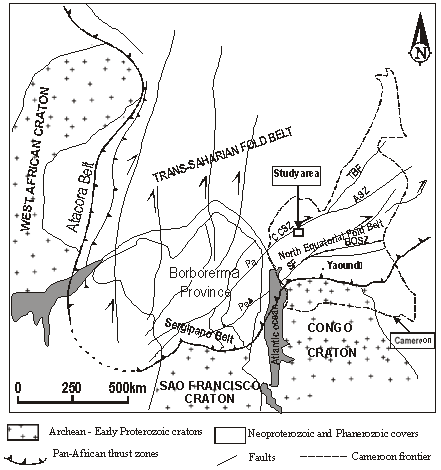
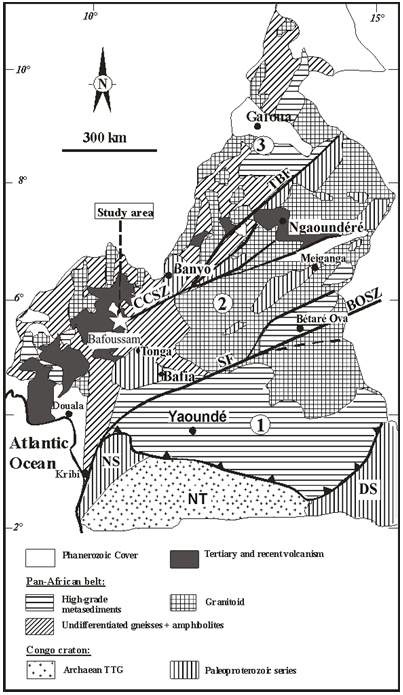
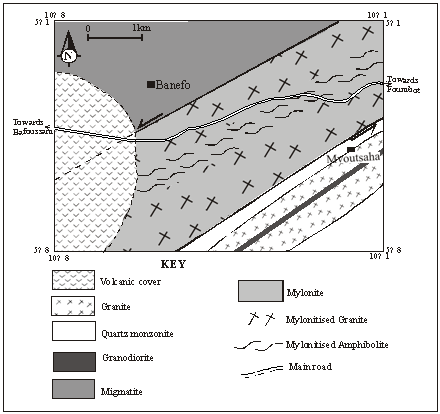
Collisional orogenic belts are worldwide associated to amphibolitic metamorphic facies from medium to high grades 1, 2, 3, 4. Amphibolites are therefore used to characterize orogenies which help: 1) to reveal the nature of the parent rocks; 2) to constraint the different tectonic setting and metamorphism phases; 3) and to time the tectono-metamorphism events 5, 6, 7. The panafrican orogeny formations in Cameroon (Figure 1) are made up of wide range of magmatic and metamorphic rocks, including amphibolites of various metamorphic grades and ages 8, 9, 10, 11. The Banefo-Mvoutsaha area located in the southern part of the Cameroon Central Shear Zone comprises metamorphic rocks intruded by granitic plutons (Figure 2). The Banefo-Mvoutsaha granitoid massif is made up of syn- to post-tectonic, high-K calc-alkaline rocks showing chemical composition of granite, quartz-monzonite and granodiorite 12. Geochronological data from U-Pb zircon dating yielded an age of 602 ± 1.4 Ma for the coarse-grained meta-granites 13. These granitic bodies are elongated N70°E and were emplaced during and after the D2 deformation phase along the Cameroon Central Shear Zone (CCSZ). Amphibolites outcrop in Bafeno-Mvoutsaha area and are still poorly investigated 14. In this paper we present the whole rock geochemical data and the 40Ar/39Ar geochronology data of the amphibolites from the study area to constraint their protoliths, the geotectonic setting and the ages of amphibolitic metamorphism in the Pan-African Fold Belt in Cameroon.


The Neoproterozoic belt in Cameroon is widely known as the Pan-African North Equatorial Fold Belt (PANEFB) 15, 16. This belt is a prolongation in the African continent of the Braziliano-Panafrican Belt in South America across the Atlantic (Figure 1) 17, 18, 19. In Cameroon, the Neoproterozoic belt is made up of three distinct geodynamic domains 20, 21, 22, 23, 24: the northern domain and the southern domain which are separated by the central domain (Figure 2).
The northern domain consists of restricted 830 Ma metavolcanic rocks of tholeiitic and alkaline affinities associated with metasediments and widespread 630-660 Ma calc-alkaline orthogneisses whose age is interpreted as a major episode of continental accretion 25. A Paleoproterozoic crustal source in this region is attested by the presence of 2 Ga old inherited zircons in the granitoids within the orthogneisses 25.
The southern domain comprises Neoproterozoic metasedimentary units such as the Yaoundé, Mbalmayo and Ntui-Betamba series. The protoliths of these units were deposited in a passive margin environment at the northern edge of the Congo Craton, and were metamorphosed under high-P conditions (T = 750-800°C, P = 9-13Kb) at 616 Ma 15, 23. A Pan-African meta-igneous rock assemblage comprising alkaline ultramafic to metagabbros and amphibole-bearing alkaline orthogneisses 23 was also recognized in association with these Neoproterozoic units. The rocks of this southern domain were thrusted onto the Archean Congo Craton towards the south 26.

The central domain in which the present study area is located (Figure 2, Figure 3) is situated between the Sanaga fault to the South and the Tibati-Banyo fault to the North 27. The metamorphic basement of the central domain consists of an assembly of fragments of Paleoproterozoic continental crust, recrystallized under high-grade granulite facies (850-900°C, 10-12Kb) at ca 2100 Ma, and associated with Neoproterozoic amphibolite and gneiss 5, 8, 22, 24. This basement is intruded by widespread Neoproterozoic syntectonic plutonic rocks of high-K, calc-alkaline affinities [12,13,20,21,24,28,29,30,31,32,33]. In the central domain polycyclic metamorphism and three phases of deformation related to metamorphic recrystallisation under low to high grade amphibolite facies conditions have been identified.
Fresh representative samples were sent to ACME Analytical Laboratories Ltd, Vancouver, Canada for whole rock geochemical analysis. Whole rock analyses for major and trace elements were carried out by Inductively-Coupled Plasma Mass Spectrometry (ICP-MS) from pulps. 0.2g of rock powder was fused with 1.5g LiBO2 and then dissolved in 100MM3 5%HNO3. The REE contents were determined by ICP-MS from pulps after 0.25g rock-powder was dissolved with 4 acid digestions. Analytical uncertainties vary from 0.1% to 0.04% for major elements; from 0.1 to 0.5% for trace elements; and from 0.01 to 0.5ppm for rare earth elements.
The Ar-Ar geochronology was performed at the Department of Isotope Geochemistry, Vrije Universiteit de Boelelaan, Amsterdam, The Netherlands. For the two samples (T21G9 and T22A) of amphibolites, hornblende grains measuring as 400-500 microns were used. The 40Ar/39Ar measurements were accomplished on an MAP-215-50 mass spectrometer in VU University Amsterdam. The experimental methods follow those developed at Amsterdam by 34.
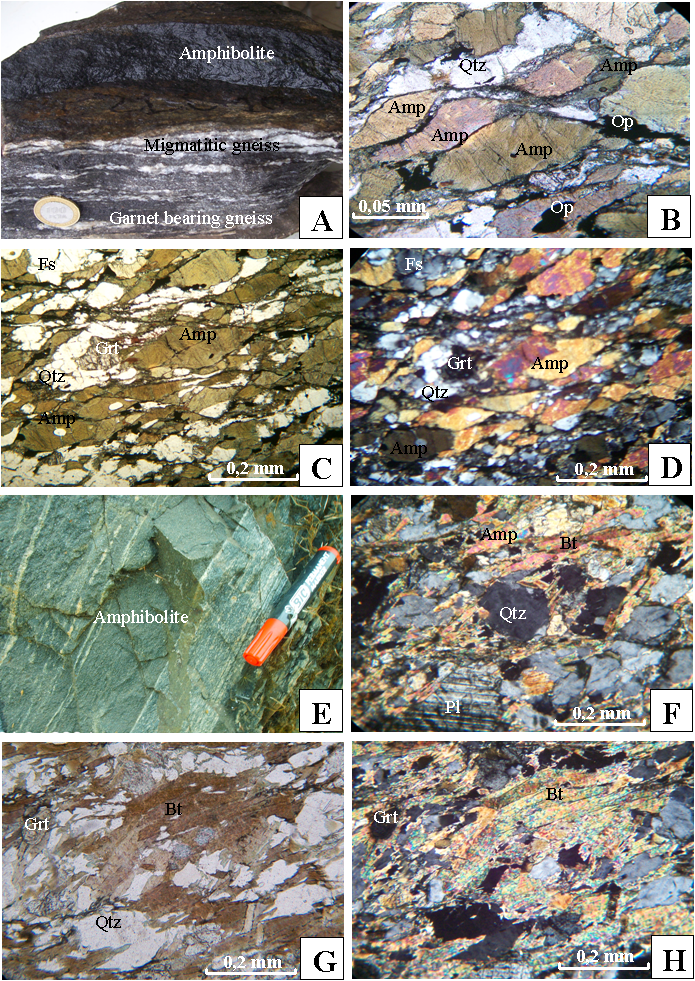
The amphibolites investigated in Banefo-Mvoutsaha area are subdivided, based on their field occurrences and structure into two types. The first one is massive and outcrops as centimetric and discontinuous bands (Figure 4A). The second type is the banded amphibolites which is interbedded with migmatitic gneisses and garnet gneisses (Figure 4E). Those bands are parallel to the foliation within the garnet-bearing gneisses.
The massive amphibolites are very fine to fine grained. They are dark green in color and show poorly-developed foliation (Figure 4A). They occur within garnet-gneisses as lenses of 30 cm - 5 m long and 10 - 20 cm width. It is no easy to see minerals with necked eye, while in microscope, the rock displays granolepidoblastic heterogranular microstructure comprising amphibole, quartz, feldspar, pyroxene, rutile and opaque minerals which are preferentially oriented following the same direction. Amphibole crystals which are the most abundant minerals, are fish-amphibole according to their form (Figure 4B). Depending on their color, two types of amphibole crystals are observed: greenish-light (Figure 4C) and brownish crystals (Figure 4D). The brownish amphibole crystals are secondary resulting from destabilization of pyroxene. Some of these minerals contain opaque minerals inclusions. Quartz and feldspar fill the interstices between amphibole crystals following the same direction as amphibole fish crystals (Figure 4B, Figure 4C). Garnet is very low in the rock, as well as pyroxene crystals, which destabilizes into amphibole crystal. They also follow the same orientation as amphibole, quartz and feldspar. The accessory phase is made of opaque minerals and rutile. Opaque minerals are anhedral primary and secondary minerals (Figure 4B). Mineral assemblages are Hbl + Qtz + Kfs + Px ± Grt ± Op (primary assemblage) and Hbl + Px ± Op (secondary assemblage). They are respectively characteristics of high-grade and low-grade amphibolite facies.


The banded amphibolites are greyish in color. As well as the massive amphibolites, they display very fine to fine grain. The foliation is more expressive (Figure 4E), and the alternance of quartzo-feldspathic bands and ferromagnesian bands is clearly observed. The rock is intimately associated with migmatites. In thin section, the rock displays a granoblastic heterogranular texture consisting of quartz, biotite, amphibole, feldspar, garnet and plagioclase (Figure 4F). Minerals are poorly deformed, differently from the massive amphibolites. Quartz and biotite are the most abundant minerals in this rock. Quartz is mostly rounded (Figure 4E), occurring as anhedral mineral (Figure 4F). Biotite flakes are primary minerals and are scattered in the rock. Amphiboles are anhedral and primary minerals. The percentage of the garnet is lower than in the other rock. Stocky plagioclase crystals are subhedral and lurking in the matrix. The mineral assemblage is made of Hbl + Bt + Qtz + Kfs + Pl ± Grt + Op Which is characteristic of low-grade amphibolite facies. Along micro-shear planes in the study area, the banded amphibolites have been deformed into ultramylonites and pseudotachylites fault rocks.
4.2. Whole Rock GeochemistrySeven fresh samples of amphibolites (massive and banded) were collected and analyzed for whole-rock majors and trace elements, and their compositions are listed in Table 1.
Amphibolite samples are characterized by SiO2 content ranging between 48 wt% and 52 wt%. The percentage of Al2O3 is high (16.36 – 17.25 wt%), except for the sample T21G9 which shows a relatively low percentage (13.86 wt%). As well as Al2O3, samples show low Fe2O3 values (10.53 – 12.43 wt%), while the T21G9 sample displays 16.15 wt% value. The rock present low values of MgO (2.86 – 5.69 wt%) and CaO (4.93 – 6.13 wt%), except for T21G9 sample (9.30 wt% for CaO). TiO2 contents range from 1.52 wt% to 2.94 wt%. The averages A/CNK molar (Al2O3/ CaO + Na2O + K2O), and A/NK molar (Al2O3/ Na2O + K2O) values are 1.22 and 2.47 respectively.
The Banefo-Mvoutsaha amphibolites sample display variable high field strength elements (HFSE: e.g Nb, Ta, Zr, Hf) and large-ion-lithophile elements (LILE; e.g., Ba, Rb, K and Sr) concentrations (Table 1). Ba concentrations are from 436 to 721ppm, Rb (59.6 – 109.6ppm), and Sr from 122.2 to 515.1 ppm.
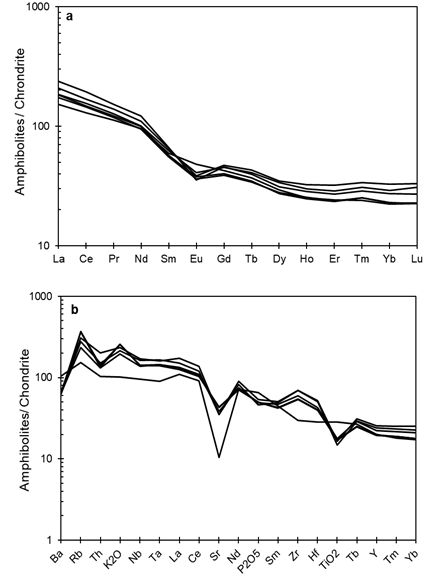
Samples are enriched in LILE (Rb, K), and relatively weakly depleted in the other elements. On the chondrite-normalized rare earth element (REE) diagram from 35, all the samples REE pattern are weakly fractionated (LaN/YbN= 5.78 – 8.03) marked by a slight enrichment of LREE patterns (LaN/SmN = 2.40 – 3.36) relatively to HREE (GdN/YbN= 1.39 – 1.85). The samples display a negative Eu anomaly with Eu/Eu* ratio values ranging between 0.65 and 0.96 (Figure 5A), which highlight feldspar fractionation in the rock, confirmed by the negative anomalies on Sr. On the multi-elements chondrite-normalized plots from 36, Rb, K, Nd and Zr show positive anomalies, and Th, Sr and Ti display negative anomalies except for the sample T21G9 (Figure 5B).
4.3. Ar-Ar GeochronologyThe summary of Ar-Ar geochronology data is represented in Table 2. Two representative samples from the massive amphibolites (T21G9) and the banded amphibolites (T22A) have been subjected to dating.


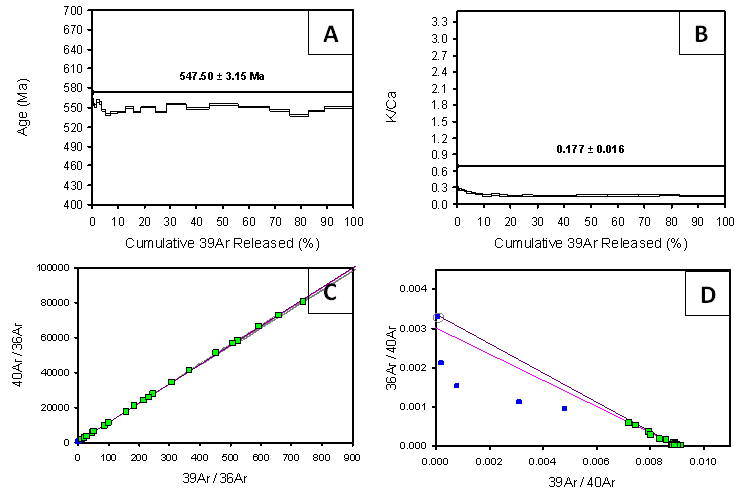
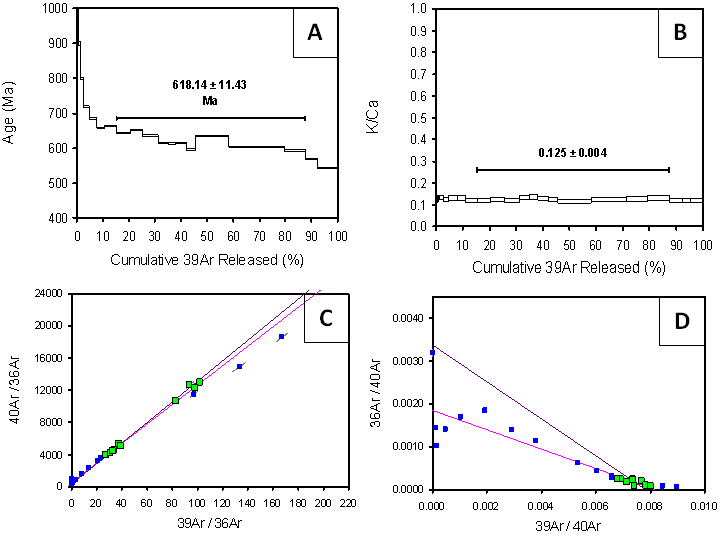
The results of Ar release during stepwise heating and inverse isochrones are given on Figures 6 and 7 for T21G9 and T22A respectively. Sample T21G9 yield an Ar-Ar age of 547.50 ± 3.15 Ma (Figure 6A), the patterns of cumulative 39Ar released %, are relatively flat, and constant from 10% to 100% 39Ar released (Figure 6B). Sample T22A yielded an Ar-Ar age of 618.14 ± 11.43 Ma (Figure 7A), the patterns of cumulative 39Ar released %, show a significant variation in the age plateau, and the results of this sample do not give a line in various isochron diagrams, variation of loss and gain 39Ar released is noted (Figure 7B). Data from T21G9 crushing experiments in 39Ar/36Ar vs. 40Ar/36Ar diagram define a homogenous line on the normal isochron for massive amphibolites samples (Figure 6C), but show a disparity line for the banded amphibolites. From 0 to 60 for 40Ar/36Ar values, the line is homogen, and the disparity start from 70 up to 200 for 40Ar/36Ar values (Figure 7C). In the inverse isochron diagram, the difference is considerable between the two amphibolites. The results of the apparent age spectrum plots for these stepwise-crushing experiments are presented in 36Ar/40Ar vs. 39Ar/40Ar diagrams (Figures 6D and 7D). The lines are not homogeneous, but the gap is wider in the banded amphibolites (Figure 7D). The 36Ar/40Ar values range from 0.0020 to 0.0030 above, while for T21G9 sample, the gap is slight and the lines are very close (Figure 6D). The age spectrum is a convenient way to present the data in terms of progressive gas release 34. It should be noted that the gas is released by progressive crushing and not by progressive heating as it is more commonly the case in 40Ar/39Ar dating experiments.
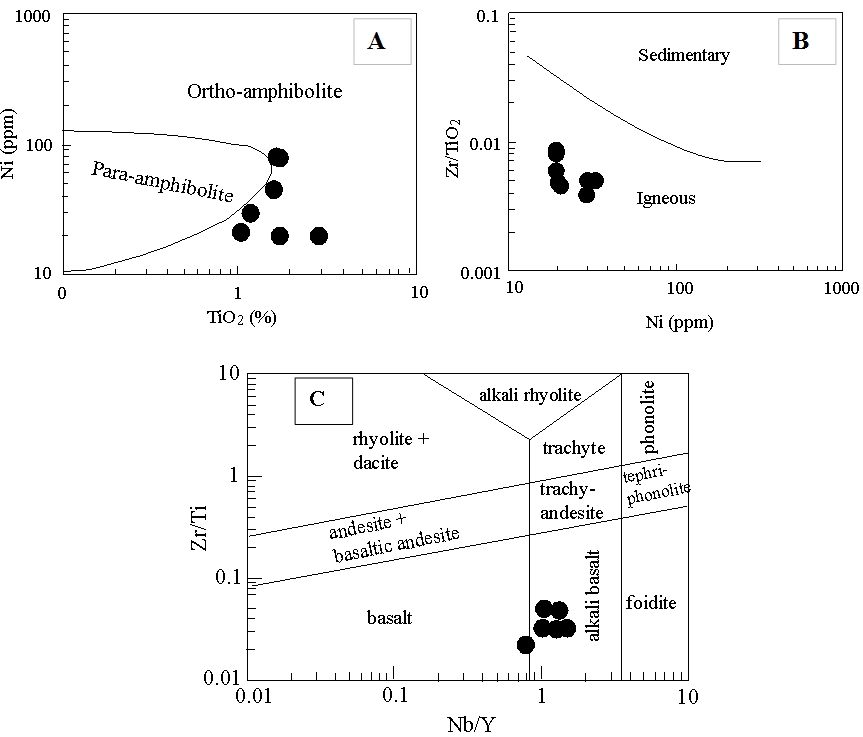
The positions of studied amphibolites are shown in the TiO2-Ni discriminating diagram for ortho and para amphibolites of 37 and the Zr/TiO2 vs Ni diagram indicate that they are orthoderived, with an igneous source for the parental rocks (Figures 8A and 8B). The same results are described in the center domain of CAFB in Makénéné 5, the Fomopéa pluton 11, in Kombé II 8, and in the Congo craton from Akom II 38, Mewongo 7, and Toko-Nlonkeng 39 areas. The geochemical classification of extrusive rocks diagram using Nb/Y vs. Zr/Ti adapted from 40 shows the volcanic origin of those rocks (Figure 8C), where the main samples plot in alkali-basalts field, except one sample falling within the basalts field, probably due to some contamination of the magma source. Alkali basalts are characterized by highest Na2O and K2O content than the basic basalts, and low SiO2 contents (48.35 – 51.13 wt%) 41, 42, they are located behind the arc. However, they are not likely to form at depths shallower than 50-60 km 43, 44. This hypothesis is confirmed by the high values in Ni (11 – 87.4 ppm) and Co (25.6 – 38.6 ppm) which are evidence of a (deep) mantle source 45. Amphibole and rutile as residual minerals can be used to constrain this source. Indeed, rutile and amphibole are index minerals which usually contain abundant Nb and Ta. In the rutile mineral composition, Ta is relative to Nb, and the experimental results showed that, if minor rutile appears in the residual source, the Nb/Ta ratios in the coexisting partial melts will increase 46. On the other hand, Nb is more compatible than Ta in amphibole and small amount of amphibole as residual mineral could lead to lower Nb/Ta ratios 46. All samples of massive and banded amphibolites display lower Nb/Ta ratios (16.65 – 18.72), indicating the compositional source of amphibole minerals.
The degree of contamination can be estimate through certain chemical parameters. For example, the major elements TiO2 is a well-founded discrimination between arc and spreading ridge basalts [47, 48] 47, 48. He is relatively immobile during alteration. Low TiO2 content suggests that the protolith is in an arc system 47. But the TiO2 content of the study amphibolites is low to medium (1.52 – 2.94 wt%), this needs others explanations to give a conclusion. In the same vein, ratios of some trace elements can constrain the crustal contamination in basaltic rocks. Those which are affected by crustal contamination exhibit La/Ta = 22 and La/Nb = 1.5 49. The studied amphibolites display low values of La/Ta and La/Nb, respectively ranging from 14.9 – 19.9 and 0.84 – 1.06, and this confirm that the role of contamination during magma evolution has been minimal. In addition, incompatible trace elements such as Ta, Yb and Th are considered to determine crustal contamination. The crustal contamination affects Th more than Ta and Yb. The contamination shows high Th/Yb values 50. The studied amphibolites show low values of Th/Yb (1.1 – 1.8), and this suggests no or minimal crustal contamination for Banefo-Mvoutsaha amphibolites parent rocks.
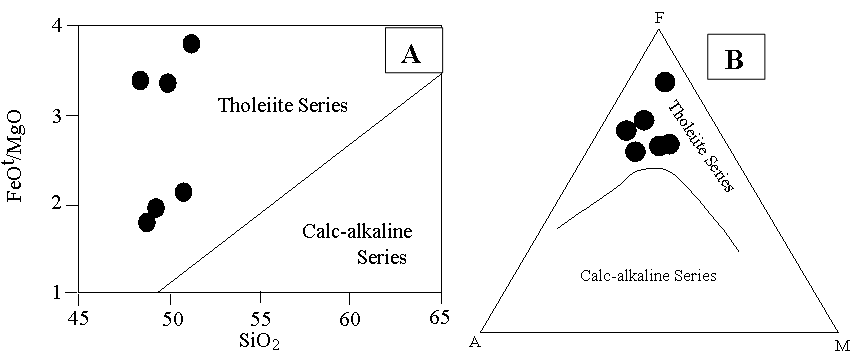
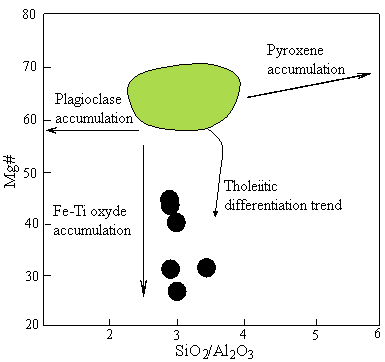
Furthermore, the fractionation occurs during the formation of the protoliths of those amphibolites. The REE patterns are marked by TiO2, Sr and Eu anomalies (Figure 5). The TiO2 anomaly in multi-element diagram suggests a Ti-oxides fractionation. The Sr anomaly in multi-element diagrams indicates plagioclase fractionation 51. This fractionation of plagioclase is confirmed by the presence of Eu anomaly (Eu/Eu*: 0.65 – 0.96) in the chondrite normalized REE diagrams of Banefo-Mvoutsaha amphibolites, which indicate a plagioclase-depleted crustal source or fractionation during magmatic differentiation. The K2O + Na2O vs. K2O/(K2O+Na2O) diagram 52 displays an assimilation and fractional crystallization trend (Figure 9). We can see through this plot, the role of the fractionation in the rock’s emplacement. The combination between low MgO value and moderate to high Fe2O3 contents also suggest fractional crystallization, but the fractional crystallization of Mg-rich minerals (i.e., pyroxene) which is typical of tholeiitic magmas 53. In the same way, the parental basaltic magma from which the Banefo-Mvoutsaha amphibolites were derived is inferred to belong to the tholeiitic series as shown by the SiO2 vs. FeOt/MgO diagram (Figure 10) of 54, like in the Mewongo area 7. All the samples of Banefo-Mvoutsaha amphibolites plot in the tholeiitic series area and display a tholeiitic trend as demonstrated in the Mg# vs. SiO2/Al2O3 diagram, showing the primitive basalts field and differentiation 55 and mineral fractionation trends (Figure 11) adapted after 56.


From the Ar-Ar data, the flat cumulative patterns and the well-defined normal isochron of sample T21G9 means that sample were less disturbed, which is traduced by no significant loss or gain of Argon. The age of 547,50 ± 3,15 Ma may be correlated to an amphibolitic metamorphism phase related to the tectono-metamorphic events marking the end of Pan African orogeny. The important variation in the patterns of sample T22A, coupled to the fact that results are not defining an isochron, are the evidences of significant loss in Ar, this means samples were probably affected by multi phases metamorphism. The age of 618,14 ± 11,43 Ma yielded by T22A of the study area has been obtain by 15, 23, 57, (U-Pb / zircon age) 24, 29, 31, 58, 59, 60. The amphibolites are well documented in the CAFB in Cameroon during the Neoproterozoic 5, 8, 11, 10, 40. 10 showed that amphibolites from the Yaoundé Group (Cameroon, Central Africa) have a basaltic affinity. They are dated between 650 and 600 Ma, and confirm the existence of a Neoproterozoic oceanic crust within the CAFB. The studied amphibolites are younger than the Makénéné amphibolites in the CAFB and the Mewongo amphibolites in the Congo craton which display an Archean age 5, 7.
This age of 618 Ma traduces the local peak of metamorphism which is a high-grade amphibolite to granulite facies. At the regional scale this recurrent age of 618 Ma obtained by different method confirm that the Pan African Fold Belt in Cameroon is homogeneous regarding the ages of events. The Ar-Ar ages of the studied amphibolites characterize a polyphase metamorphism during the Pan African Orogeny in Banefo-Mvoutsaha.
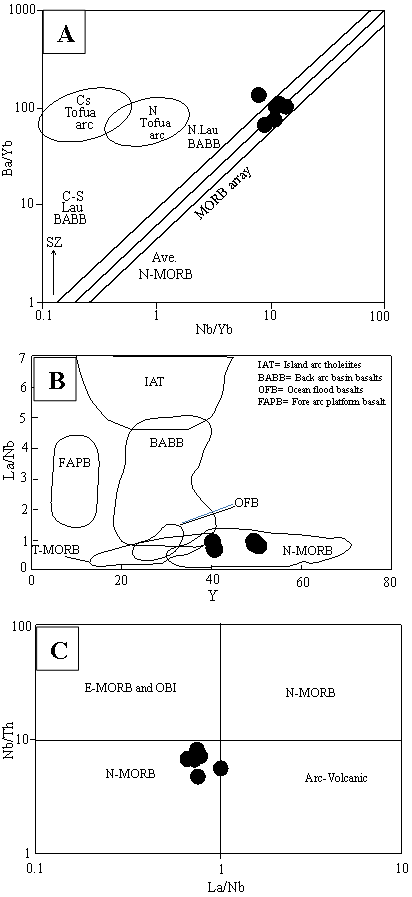
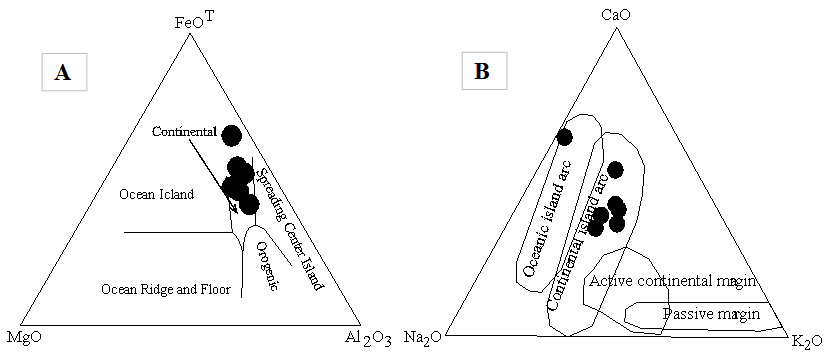
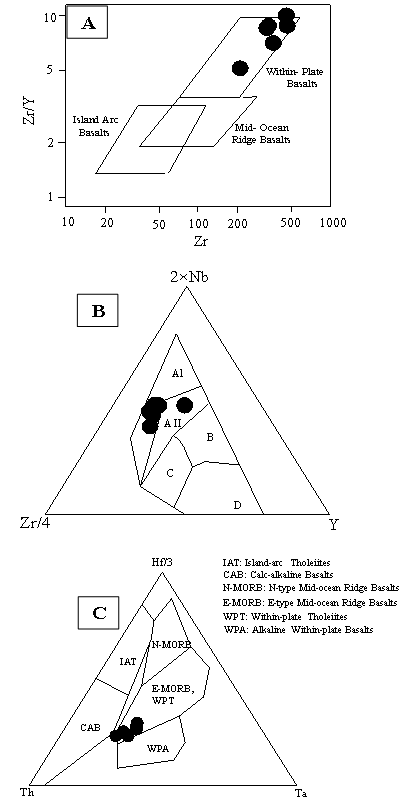
5.3. Tectonic Setting and Geodynamic ImplicationThe Nb/Yb vs. Ba/Yb diagram 61 is useful to constrain the geodynamic settings of the protolith of the mafic metavolcanic rocks. According to this diagram, the studied amphibolites plot in the MORB array (Figure 12A), suggesting that the immobile trace element Nb could be used to separate the different types of ocean-floor basalts 62. They are N-MORB related for the majority of samples, but they also display back arc basin basalts (BABB; Figure 12B) and Arc-Volcanic (Figure 12C) features. The protolith is alkali basalt, and alkali basalts often occur in a subduction area resulting from a collision between a continental and oceanic crusts 63. The ternary MgO-FeOT-Al2O3 diagram of studied amphibolites after 64 displays a continental trend (Figure 13A). They are Continental Island Arc basalts, according to CaO-Na2O-K2O ternary plot of 65 (Figure 13B). On the others geotectonic discrimination diagrams that use immobile trace elements during metamorphism, all the samples belong to the same geotectonic setting which is intraplate context. This context is shown by the binary diagram Zr-Zr/Y of 66 in which the protoliths of studied amphibolites are intraplate basalts (Figure 14A). This is supported by the discrimination geotectonic Nb–Zr–Y 62 and the Th-Hf/3-Ta of 66 ternary diagrams. Indeed, the samples are plotted on AI and AII, which correspond to within plate alkali basalts and within plate tholeiitic basalts according to geochemistry results (Figure 14B). Furthermore, the Figure 14C confirms the same results.
From the petrography, the whole-rock geochemistry and Ar/Ar dating of the Banefo-Mvoutsaha amphibolites, the main findings are as follow:
1). Two distinct types of amphibolites outcrop in Banefo-Mvoutsaha area, the banded amphibolites and the massive amphibolites.
2). Both amphibolites are ortho-derived, their protoliths are alkali basalts which belong to tholeiitic series.
3). The studied samples are enriched in LREE relatively to HREE. The LaN/YbN ratios are between 5,78 and 8,03; and GdN/YbN values are from 1,39 to 1,85. The samples display a negative Eu anomaly with Eu/Eu* values comprised between 0,65 and 0,96. In general samples are enriched in LILE, and relatively weakly depleted in others elements.
4). The Ar/Ar geochronology reveals that all samples have Pan-African age. The banded amphibolites age is 618,14 ± 11,43 Ma and the massive amphibolites age is 547,50 ± 3,15 Ma. The older metamorphic event at 618 Ma match with the emplacement ages of granites that intruded the metamorphic basement of Banefo-Mvoutsaha area. The youngest metamorphic event at 547 Ma is related to the tectono-metamorphic events which mark the end of the Panafrican orogeny in the study area. Therefore, Panafrican orogeny in the study area presents multiphase metamorphism with at least two amphibolitic phases.
5). The Banefo-Mvoutsaha amphibolites are the volcanic input of a volcano-sedimentary protoliths of the metamorphic basement of the area. The massive and banded amphibolites are metabasites and have a basaltic composition. They are N-MORB related and display back arc basin basalts and Arc-Volcanic characteristics. They follow a continental arc trend and correspond to within plate alkali and within plate tholeiitic basalts.


The Ar-Ar geochronology presented here was possible through financial support and technical assistance of Prof Jan WIJBRANS from the Department of Isotope Geochemistry, Vrije Universiteit, de Boelelaan 1085, 1081HV Amsterdam, The Netherlands. We are grateful to Prof Jan WIJBRANS.
| [1] | Goodwin, A. M., 1991. Precambrian Geology. The Dynamic Evolution of the Continental Crust. Academic Press. Harcourt Brace Jovanovich Publishers 666 p. | ||
| In article | View Article | ||
| [2] | Shinjo, R., Chung, S.L., Kato, Y., et al., 1999. Geochemical and Sr-Nd isotopic characteristics of volcanic rocks from the Okinawa trough and Ryukyu arc: implications for the evolution of a young, intracontinental back arc basin. J. Geophys. Res. Solid Earth 104:10591–10608. | ||
| In article | View Article | ||
| [3] | Ernst, R.E., Buchan, K.L., 2001. Large mafic magmatic events through time and links to mantle plume heads. In: Ernst, R.E., Buchan, K.L. (Eds.), Mantle Plumes: Their Identification through Time. Special Paper Geol. Soci. Am. 352: 483–575. | ||
| In article | View Article | ||
| [4] | Harlan, S.S., Geissman, J.W., Snee, L.W., 2008. Paleomagnetism of Proterozoic mafic dikes from the tobacco root Mountains, Southwest Montana. Precambrian Res. 163: 239–264. | ||
| In article | View Article | ||
| [5] | Tchakounté, J., Eglinger, A., Toteu, S. F., Zeh, A., Nkoumbou C., Mvondo, O.J., … Barbey, P., 2017. The Adamawa-Yadé Domain, a piece of Archaean crust in the Neoproterozoic Central African Oro genic Belt (Bafia area, Cameroon). Precambrian Research, 299:210–229. | ||
| In article | View Article | ||
| [6] | Fossi, D.H., Dadjo Djomo, H., Takodjou Wambo, J.D., Ganno, S., Pour, A.B., Kankeu, B., Nzenti, J.P., 2021a. Structural lineament mapping in a sub-tropical region using Landsat-8/SRTM data: a case study of Deng-Deng area in Eastern Cameroon. Arabian J. Geosci. 14: 1–22. | ||
| In article | View Article | ||
| [7] | Kwamou, W.M.M., Nono, K., Nkouathio, G.D., Kenne, D.G.A., 2021. Petrogenesis and U-Pb zircon dating of amphibolite in the Mewengo iron deposit, Nyong series, Cameroon: fingerprints of iron depositional geotectonic setting. Arab. J. Geosci. 14:872 | ||
| In article | View Article | ||
| [8] | Ganwa, A.A., Frisch, W., Siebel, W., Ekodeck, G. E., Shang, C. K., Ngako, V., 2008. Archean inheritances in the pyroxene–amphibole-bearing gneiss of the Méiganga area (Central North Cameroon): Geochemical and 207Pb/206Pb age imprints. Compte Rendu Géosciences 340: 211–222. | ||
| In article | View Article | ||
| [9] | Njanko, T., Nedelec, A., Affaton, P., 2006. Synkinematic high - K calc-alkaline plutons associated to the Pan-African Central Cameroon Shear Zone (W-Tibati area): Petrology and geodynamic significance. Journal of African Earth Sciences 44: 494-510. | ||
| In article | View Article | ||
| [10] | Owona S., Mvondo, O. J., Ekodeck G. E., 2013. Evidence of Quartz, Feldspar andAmphibole Crystal Plastic Deformations in the Paleoproterozoic Nyong Complex Shear Zones Under Amphibolite to Granulite Conditions (West Central African Fold Belt, SW Cameroon). Journal of Geography and Geology 5:3. | ||
| In article | View Article | ||
| [11] | Fozing, E.M., Kwékama M., Gountié, D.M., Asobo N.E., Asaahd, Njankoa, T., Tcheumenak K.J., Efon, A.J., Njonfang, E., 2019. Petrography and geochemistry of amphibolites from the Fomopéa Pluton (West Cameroon): Origin and geodynamic setting. Journal of african earth Science 181–194. | ||
| In article | View Article | ||
| [12] | Kouankap Nono, G. D., NzentiJ. P., Suh C. E. and Ganno S., 2010. Geochemistry of ferriferous, high-K calc-alkaline granitoids from the Banefo-Mvoutsaha Massif (NE Bafoussam), Central Domain of the Pan-African Fold Belt, Cameroon. The Open Geology Journal 4: 15-28. | ||
| In article | View Article | ||
| [13] | Njiekak, G., Dörr, W., Tchouankoué, J. P. and Zulauf, G., 2008. “U-Pbzircon and microfabric data of (meta) granitoids of western Cameroon: constraints on the timing of pluton emplacement and deformation in the Pan-African belt of Central Africa”, Lithos 102: 460-477. | ||
| In article | View Article | ||
| [14] | Kouankap Nono, G.D., 2011. Etude du Cisaillement Centre Camerounais dans la région de Banefo-Mvoutsaha au NE Bafoussam, dans le domaine centre de la Chaine Panafricaine Nord Equatoriale: Petrogenèse, Géochronologie et Structurologie des formations du socle. Thèse de Doctorat / Ph. D, Université de Ydé I, 118 p. | ||
| In article | |||
| [15] | Nzenti, J.P., Barbey, P., Macaudiere, J. and Soba, D., 1988. Origin and evolution of late Precambrian high - grade Yaounde gneisses (Cameroon). Precambrian Research 38: 91 - 109. | ||
| In article | View Article | ||
| [16] | Davison, I., & Dos Santos, R. A., 1989.Tectonic Evolution of the Sergipano Fold Belt, NE Brazil, during the Brasiliano Orogeny. Precambrian Research 45: 319-342. | ||
| In article | View Article | ||
| [17] | Almeida, F.F.M., Hassui, Y., Brito de Neves, B.B., and Fuck, R., 1981. Brasiliano structural provinces: an introduction. Earth Sciences Reviews 17: 1-29. | ||
| In article | View Article | ||
| [18] | Castaing, C., Feybesse, J.L., Thiéblemont, D., Triboulet, C., and Chèvremont, P., 1994. Paleogeographical reconstructions of the Pan-African/Brasiliano orogen: closure of an ocean domain or intracontinental convergence between major blocks? Precambrian Research 69: 327-344. | ||
| In article | View Article | ||
| [19] | Brito neves, B.B., Van schmus, W.R., Fetter, A., 2002. North-Western Africa-North Estern Brazil: major tectonic links and correlation problems. Journal of African Earth Sciences 34: 275-278. | ||
| In article | View Article | ||
| [20] | Nzenti, J.P., Barbey, P., Bertrand, J.M. et Macaudiere, J., 1994. La chaine panafricaine au Cameroun: cherchons structures et modèles In S.G.F. édit. 15e, réunion des Sciences de la terre. France, 99 P. | ||
| In article | |||
| [21] | Nzenti, J.P., Kapajika, B., Wörner, G., and Lubala, R.T., 2006. “Synkinematic emplacement of granitoids in a Pan-African shear zone in Central Cameroon”. J. Afr. Earth Sci. 45:74-86. | ||
| In article | View Article | ||
| [22] | Nzenti, J.P., Njiosseu Tanko, E.L., Nzina, N. A., 2007. The metamorphic evolution of the Paleoproterozoic high grade Banyo gneisses (Adamawa, Cameroon, Central Africa). J. Cam. Acad. Sci. 7: 95–109. | ||
| In article | |||
| [23] | Ngnotué, T., Nzenti, J.P., Barbey, P and Tchoua, F.M., 2000. “The Ntui - Bétamba high-grade gneisses: a northward extension of the Pan- African Yaoundé gneisses in Cameroon”. J. Afr. Earth Sci. 31: 369-381. | ||
| In article | View Article | ||
| [24] | Tanko Njiosseu, E.L., Nzenti, J.P., Njanko, T., Kapajika, B. and Nédelec, A., 2005. “New U-Pb zircon ages from Tonga (Cameroon): coexisting Eburnean-Transamazonian (2.1 Ga) and Pan-African (0.6 Ga) imprints”. C. R. Géosci. 337: 551-562. | ||
| In article | View Article | ||
| [25] | Toteu, S.F., Michard, A., Bertrand, J.M. and Rocci, G., 1987. U/Pb dating of Precambrian rocks from northern Cameroon, orogenic evolution and chronology of the Panafrican belt in Central Africa. Precambrian Res. 37:71 - 87. | ||
| In article | View Article | ||
| [26] | Nédélec, A., Macaudière, J., Nzenti, J. P., et Barbey, P., 1986. Evolution structurale et métamorphisme des schistes de Mbalmayo (Cameroun). Informations pour la structure de la zone mobile panafricaine d'Afrique centrale au contact du craton du Congo. Comptes Rendus Académie des Sciences, Paris, 303: 75-80. | ||
| In article | |||
| [27] | Nzenti, J.P., 1998b. Neoproterozoic alkaline meta-igneous rocks from the Pan-African North Equatorial Fold Belt (Yaounde Cameroon): biotites and magnetite rich pyroxenites. Journal of African Earth Sciences 26: 37-47. | ||
| In article | View Article | ||
| [28] | Djouka-Fonkwé, M.L., Schulz, B., Schüssler, U., Tchouankoué, J-P. and Nzolang, C., 2008. Geochemistry of the Bafoussam Pan-African I- and S- type granitoids in western Cameroon. J. Afr. Earth Sci. 50: 148-167. | ||
| In article | View Article | ||
| [29] | Nzolang, C., Kagami, H., Nzenti, J.P. & Holtz, F., 2003. Geochemistry and preliminary Sr-Nd isotopic data on the neoproterozoïc granotoïds from the Bantoum area, West Cameroon: evidence for a derivation from a paleoproterozoic to Archean crust. Polar Geosciences, 16: 196-226. | ||
| In article | |||
| [30] | Nguiessi, T.C., Nzenti, J.P., Nsifa, E.N., Tempier, P. and Tchoua, F.M., 1997. “Les granitoïdes calco-alcalins, syncisaillement de Bandjadans la chaîne panafricaine nord-équatoriale au Cameroun”, C. R. Acad. Sci. 325: 95-101. | ||
| In article | View Article | ||
| [31] | Tagne-Kamga, G., Mercier, E., Rossy, M., Nsifa, N.E., 1999. Synkinematic emplacement of the Pan-African Ngondo igneous complex (west Cameroon, central Africa). Journal of African Earth Sciences 28: 675-691. | ||
| In article | View Article | ||
| [32] | Tagne-Kamga, G., 2003. Petrogenesis of neoproterozoic Ngondo plutonic complex (Cameroon West central Africa): a case of late collisional ferro-potassic magmatism. Journal of African Earth Sciences 36, 149-171. | ||
| In article | View Article | ||
| [33] | Tchaptchet Tchato, D., Schulz, B., Nzenti,J. P., 2009. Electron microprobe (EMP) monazite dating and P – T data of the Neoproterozoic metamorphic and mylonitic events in the Kekem area, Cameroon North Equatorial Fold belt. Neues Jahb. Palaontol. 186/1: 95-109. | ||
| In article | View Article | ||
| [34] | Qiu, H., and Wijbrans, J., 2006. Paleozoic ages and excess 40Ar in garnets from the Bixiling eclogite in Dabieshan, China: New insights from 40Ar / 39Ar dating by stepwise crushing. Geochimica and cosmochimica. | ||
| In article | View Article | ||
| [35] | Sun, S.S. and McDonough, W.F., 1989. Chemical and isotopic systematics of oceanic basalts: implications for mantle composition and processes. In: Saunders AD, Norry MJ (Eds.), Magmatism in the Ocean Basins. Geological Society of London Special Publication 42:313-345. | ||
| In article | View Article | ||
| [36] | Thompson, R.N., 1982, British Tertiary Volcanic province. Scott. J. Geol. 18: 49-107 | ||
| In article | View Article | ||
| [37] | Winchester, J.A., Park, R.G. and Holland, J.G., 1980. The geochemistry of Lewisian semipelitic schists from the Gairloch District, wester Ross. Scott. J. Geol. 16, 165-179. | ||
| In article | View Article | ||
| [38] | Aye, B.A., Sababa, E., Ndjigui, P.D., 2017. Geochemistry of S, Cu, Ni, Cr and Au-PG from in the garnet amphibolites the Akom II area in the Archaean Cameroon. Chem. de Erde 77: 81–93. | ||
| In article | View Article | ||
| [39] | Evina Aboula, Y.S., Ndjigui, P-D., Mvondo Ondoa, J., 2023a. Petrology and geochemistry of metamorphosed rocks associated with iron formations of the Toko–Nlokeng iron deposit, (southern Cameroon): implications for geo dynamic evolution and mineralization. Geol J. 1–40. | ||
| In article | View Article | ||
| [40] | Winchester, J.A. and Floyd, P.A., 1977. Geochemical discrimination of different magma series and their differentiation products using immobile elements. Chem. Geol 20: pp. 325-343. | ||
| In article | View Article | ||
| [41] | Akihiko Fujiyama, 1992. Distinctive REE patterns for tholeiitic and calc-alkaline magma series co-occurring at Adatara colcano, Northeast Japan. Geochemical jounal, 26(6): 395-409. | ||
| In article | View Article | ||
| [42] | Jakes, P., and Gill J., 1970. Rare earth elements and the island arc tholeiitic series. Science Direct 9: 17-28. | ||
| In article | View Article | ||
| [43] | Kushiro, I., 1987. A petrological model of the mantle wedge and lower crust in the Japanese island arc. In B. O. Mysen, Ed., Magmatic precesses: Physicochemical principles, Special publication No 1, The geochemical society, University Perk, PA, 165-181. | ||
| In article | |||
| [44] | Perchuck, L.L., 1987. Studies of volcanic series related to the origin of some marginal see floors. In B.O. Mysen, Ed., Magmatic processes: Physicochemical Principles, Special publication No 1, the geochemical society, University Park, PA, 209-230. | ||
| In article | |||
| [45] | Bédard J.H., 2006. A catalytic delamination-driven model for coupled genesis of Archaean crust and sub-continental lithospheric mantle. Geochim Cosmochim Acta 70(5):1188–1214 | ||
| In article | View Article | ||
| [46] | Rapp RP, Shimizu N, Norman MD (2003) Growth of early continental crust by partial melting of eclogite. Nature 425(6958):605. | ||
| In article | View Article PubMed | ||
| [47] | Pearce J.A., 1975. Basalt geochemistry used to investigate past tectonic environment in Cyprus. Tectonophysics. 25, 40-67 | ||
| In article | View Article | ||
| [48] | Pearce J.A. and Cann J.R., 1973. Ophiolite origin investigated by discriminate analysis using Ti, Zr and Y. Earth Planet Sci. Lett. 12, 339-349. | ||
| In article | View Article | ||
| [49] | Abdel-Rahman, A.F.M. and P.E. Nassar, 2004. Cenozoic Volcanism in the Middle East: Petrogenesis of alkali basalts from Northern Lebanon. Geol. Mag., 140: 545-563. | ||
| In article | View Article | ||
| [50] | Moghazi, A.K.M., 2003. Geochemistry of a Tertiary Continental Basalt Suite, Red Sea Coastal Plain, Egypt: Petrogenesis and Characteristics of the Mantle Source Region. Geological Magazine 140: 11-24. | ||
| In article | View Article | ||
| [51] | Wilson M., 1989. Igneous petrogenesis. Springer, London, 245–285. | ||
| In article | View Article | ||
| [52] | Hughes, C. J., 1973. Spilites, keratophyres and igneous spectrum. Geological Magazine, 109(6), 513–527. | ||
| In article | View Article | ||
| [53] | Irvine, T.N., Baragar, W.R.A., 2011. A guide to the chemical classifi cation of the Common volcanic rocks. Can J. Earth Sci. 8(5):158. | ||
| In article | View Article | ||
| [54] | Miyashiro, A., 1974. Volcanic rocks series in island arcs and active continental margins. Am J Sci 274, 321-355. | ||
| In article | View Article | ||
| [55] | Irvine, T.N. and Baragar, W.R.A., 1972. A Guide to the Chemical Classification of the Common Volcanic Rocks. Canadian Journal of Earth Sciences, 8, 523-548. http://dx.doi.org/10.1139/e71-055. | ||
| In article | |||
| [56] | Kempton, P.D., Harmon, R.S., 1992. Oxygen isotope evidence for large-scale hybridization of the lower crust during magmatic underplating. Sci Dir. Geochemica and Cosmochemica 56: 971 – 986. | ||
| In article | View Article | ||
| [57] | Ngnotué, T., Ganno, S., Nzenti Jean, P., Schulz, B., Tchaptchet Tchato, D.I., Suh Cheo, E., 2012. Geochemistry and Geochronology of Peraluminous High-K Granitic Leucosomes of Yaoundé Series (Cameroon): Evidence for a Unique Pan-African Magmatism and Melting Event in North Equatorial Fold Belt. International Journal of Geosciences 3, 525-548. | ||
| In article | View Article | ||
| [58] | Soba, D., 1989. La serie du lom: etude geologique et geochronologique d’un bassin volcano-sedimentaire de la chaine panafricaine à l’est du Cameroun, vol. 6. These de doctorat, Paris. | ||
| In article | |||
| [59] | Abaga, B., 1996. Les leucogranites et les orogènes, signification des leucogranites d'Akum (région de Bamenda, Nord-Ouest Cameroun) dans l'orogenèse panafricaine. Etude préliminaire. Mémoire Maîtrise, Université de Yaoundé I, 57p. | ||
| In article | |||
| [60] | Abaga, B., Nzenti, J. P., Njanko, T., Pedjui, P., Njiosseu, E. L. T., Nzolang, C., Kapajika, B., Mouangue, R. M., Tchoua, F. M., 1999. Le plutonisme peralumineux néoprotérozoïque, syntectonique dans la chaîne panafricaine nord-équatoriale du Cameroun. In: Vicat J.P. et Bilong P. (eds) Géologie et environnements au Cameroun. Collection GEOCAM 379 - 385. | ||
| In article | |||
| [61] | Pearce, J.A. and Stern, R.J., 2006. Origin of Back-Arc Basin Magmas: Trace Element and Isotope Perspectives. In: Christie, D.M., Fisher, C.R., Lee, S.M. and Givens, S., Eds., Back-Arc Spreading Systems; Geological, Biological, Chemical, and Physical Interactions. Geophysical Monograph Series 166, American Geophysical Union, Washington, 63-86. | ||
| In article | View Article | ||
| [62] | Meschede, M., 1986. A method of discriminating between different types of mid ocean ridge basalts and continental tholeiites with the Nb-Zr-Y diagram. Chemical Geology 56(3-4):207-218. | ||
| In article | View Article | ||
| [63] | Levinson, A. A., and Cook, F.A., 1994. Gem corundum in alkali basalt: origin and occurrence. Gem and gemmology 30(4): 253-262. | ||
| In article | View Article | ||
| [64] | Pearce T.H, Gorman B.E, Birkett T.C., 1977. The relationship between major element chemistry and tectonic environment of basic and intermediate volcanic rocks. Earth Planet Sci. Lett. 36:121–132 | ||
| In article | View Article | ||
| [65] | Bhatia, M.R., 1983. Plate Tectonics and Geochemical Composition of Sandstone. The Journal of Geology, 91: 611-627. | ||
| In article | View Article | ||
| [66] | Pearce, J.A. and Norry, M.J., 1979. Petrogenetic implications of Ti, Zr, Y and Nb variations in volcanic rocks. Contrib. Mineral petrol 69: 33-47. | ||
| In article | View Article | ||
| [67] | Floyd P.A., Kelling G., Gökcen S.L. and Gökcen N., 1991. Geochemistry and tectonic environment of basaltic rocks from the Misis ophiolitic mélange, South Turkey. Chem. Geol., 89: 263-280. | ||
| In article | View Article | ||
| [68] | Thompson, R. N., Morrison, M. A., Hendry, G. L. & Parry, S. J. (1984). An assessment of the relative roles of crust and mantle in magma genesis: an elemental approach. Philosophical Transactions of the Royal Society of London A310, 549–590 | ||
| In article | View Article | ||
| [69] | Wood, D.A., 1980. The application of a Th-Hf-Ta diagram to problems of tectono-magmatic classification and to establishing the nature of crustal contamination of basaltic lavas of the brutish tertiary volcanic province. Earth Planet Sci. let. 50: 11-30. | ||
| In article | View Article | ||
| [70] | Ross, P.S. and Bédard, J.H., 2009. Magmatic affinity of modern and ancient subalkaline volcanic rocks determined from trace-element discriminant diagrams. Canadian Journal of Earth Sciences, 46, 823–839. | ||
| In article | View Article | ||
Published with license by Science and Education Publishing, Copyright © 2025 MVODO Hermine, NGA ESSOMBA TSOUNGUI Philomène Estelle, KOUANKAP NONO Gus Djibril, KAMGUIA WOGUIA Brice and SIMO Pascal
 This work is licensed under a Creative Commons Attribution 4.0 International License. To view a copy of this license, visit
http://creativecommons.org/licenses/by/4.0/
This work is licensed under a Creative Commons Attribution 4.0 International License. To view a copy of this license, visit
http://creativecommons.org/licenses/by/4.0/
| [1] | Goodwin, A. M., 1991. Precambrian Geology. The Dynamic Evolution of the Continental Crust. Academic Press. Harcourt Brace Jovanovich Publishers 666 p. | ||
| In article | View Article | ||
| [2] | Shinjo, R., Chung, S.L., Kato, Y., et al., 1999. Geochemical and Sr-Nd isotopic characteristics of volcanic rocks from the Okinawa trough and Ryukyu arc: implications for the evolution of a young, intracontinental back arc basin. J. Geophys. Res. Solid Earth 104:10591–10608. | ||
| In article | View Article | ||
| [3] | Ernst, R.E., Buchan, K.L., 2001. Large mafic magmatic events through time and links to mantle plume heads. In: Ernst, R.E., Buchan, K.L. (Eds.), Mantle Plumes: Their Identification through Time. Special Paper Geol. Soci. Am. 352: 483–575. | ||
| In article | View Article | ||
| [4] | Harlan, S.S., Geissman, J.W., Snee, L.W., 2008. Paleomagnetism of Proterozoic mafic dikes from the tobacco root Mountains, Southwest Montana. Precambrian Res. 163: 239–264. | ||
| In article | View Article | ||
| [5] | Tchakounté, J., Eglinger, A., Toteu, S. F., Zeh, A., Nkoumbou C., Mvondo, O.J., … Barbey, P., 2017. The Adamawa-Yadé Domain, a piece of Archaean crust in the Neoproterozoic Central African Oro genic Belt (Bafia area, Cameroon). Precambrian Research, 299:210–229. | ||
| In article | View Article | ||
| [6] | Fossi, D.H., Dadjo Djomo, H., Takodjou Wambo, J.D., Ganno, S., Pour, A.B., Kankeu, B., Nzenti, J.P., 2021a. Structural lineament mapping in a sub-tropical region using Landsat-8/SRTM data: a case study of Deng-Deng area in Eastern Cameroon. Arabian J. Geosci. 14: 1–22. | ||
| In article | View Article | ||
| [7] | Kwamou, W.M.M., Nono, K., Nkouathio, G.D., Kenne, D.G.A., 2021. Petrogenesis and U-Pb zircon dating of amphibolite in the Mewengo iron deposit, Nyong series, Cameroon: fingerprints of iron depositional geotectonic setting. Arab. J. Geosci. 14:872 | ||
| In article | View Article | ||
| [8] | Ganwa, A.A., Frisch, W., Siebel, W., Ekodeck, G. E., Shang, C. K., Ngako, V., 2008. Archean inheritances in the pyroxene–amphibole-bearing gneiss of the Méiganga area (Central North Cameroon): Geochemical and 207Pb/206Pb age imprints. Compte Rendu Géosciences 340: 211–222. | ||
| In article | View Article | ||
| [9] | Njanko, T., Nedelec, A., Affaton, P., 2006. Synkinematic high - K calc-alkaline plutons associated to the Pan-African Central Cameroon Shear Zone (W-Tibati area): Petrology and geodynamic significance. Journal of African Earth Sciences 44: 494-510. | ||
| In article | View Article | ||
| [10] | Owona S., Mvondo, O. J., Ekodeck G. E., 2013. Evidence of Quartz, Feldspar andAmphibole Crystal Plastic Deformations in the Paleoproterozoic Nyong Complex Shear Zones Under Amphibolite to Granulite Conditions (West Central African Fold Belt, SW Cameroon). Journal of Geography and Geology 5:3. | ||
| In article | View Article | ||
| [11] | Fozing, E.M., Kwékama M., Gountié, D.M., Asobo N.E., Asaahd, Njankoa, T., Tcheumenak K.J., Efon, A.J., Njonfang, E., 2019. Petrography and geochemistry of amphibolites from the Fomopéa Pluton (West Cameroon): Origin and geodynamic setting. Journal of african earth Science 181–194. | ||
| In article | View Article | ||
| [12] | Kouankap Nono, G. D., NzentiJ. P., Suh C. E. and Ganno S., 2010. Geochemistry of ferriferous, high-K calc-alkaline granitoids from the Banefo-Mvoutsaha Massif (NE Bafoussam), Central Domain of the Pan-African Fold Belt, Cameroon. The Open Geology Journal 4: 15-28. | ||
| In article | View Article | ||
| [13] | Njiekak, G., Dörr, W., Tchouankoué, J. P. and Zulauf, G., 2008. “U-Pbzircon and microfabric data of (meta) granitoids of western Cameroon: constraints on the timing of pluton emplacement and deformation in the Pan-African belt of Central Africa”, Lithos 102: 460-477. | ||
| In article | View Article | ||
| [14] | Kouankap Nono, G.D., 2011. Etude du Cisaillement Centre Camerounais dans la région de Banefo-Mvoutsaha au NE Bafoussam, dans le domaine centre de la Chaine Panafricaine Nord Equatoriale: Petrogenèse, Géochronologie et Structurologie des formations du socle. Thèse de Doctorat / Ph. D, Université de Ydé I, 118 p. | ||
| In article | |||
| [15] | Nzenti, J.P., Barbey, P., Macaudiere, J. and Soba, D., 1988. Origin and evolution of late Precambrian high - grade Yaounde gneisses (Cameroon). Precambrian Research 38: 91 - 109. | ||
| In article | View Article | ||
| [16] | Davison, I., & Dos Santos, R. A., 1989.Tectonic Evolution of the Sergipano Fold Belt, NE Brazil, during the Brasiliano Orogeny. Precambrian Research 45: 319-342. | ||
| In article | View Article | ||
| [17] | Almeida, F.F.M., Hassui, Y., Brito de Neves, B.B., and Fuck, R., 1981. Brasiliano structural provinces: an introduction. Earth Sciences Reviews 17: 1-29. | ||
| In article | View Article | ||
| [18] | Castaing, C., Feybesse, J.L., Thiéblemont, D., Triboulet, C., and Chèvremont, P., 1994. Paleogeographical reconstructions of the Pan-African/Brasiliano orogen: closure of an ocean domain or intracontinental convergence between major blocks? Precambrian Research 69: 327-344. | ||
| In article | View Article | ||
| [19] | Brito neves, B.B., Van schmus, W.R., Fetter, A., 2002. North-Western Africa-North Estern Brazil: major tectonic links and correlation problems. Journal of African Earth Sciences 34: 275-278. | ||
| In article | View Article | ||
| [20] | Nzenti, J.P., Barbey, P., Bertrand, J.M. et Macaudiere, J., 1994. La chaine panafricaine au Cameroun: cherchons structures et modèles In S.G.F. édit. 15e, réunion des Sciences de la terre. France, 99 P. | ||
| In article | |||
| [21] | Nzenti, J.P., Kapajika, B., Wörner, G., and Lubala, R.T., 2006. “Synkinematic emplacement of granitoids in a Pan-African shear zone in Central Cameroon”. J. Afr. Earth Sci. 45:74-86. | ||
| In article | View Article | ||
| [22] | Nzenti, J.P., Njiosseu Tanko, E.L., Nzina, N. A., 2007. The metamorphic evolution of the Paleoproterozoic high grade Banyo gneisses (Adamawa, Cameroon, Central Africa). J. Cam. Acad. Sci. 7: 95–109. | ||
| In article | |||
| [23] | Ngnotué, T., Nzenti, J.P., Barbey, P and Tchoua, F.M., 2000. “The Ntui - Bétamba high-grade gneisses: a northward extension of the Pan- African Yaoundé gneisses in Cameroon”. J. Afr. Earth Sci. 31: 369-381. | ||
| In article | View Article | ||
| [24] | Tanko Njiosseu, E.L., Nzenti, J.P., Njanko, T., Kapajika, B. and Nédelec, A., 2005. “New U-Pb zircon ages from Tonga (Cameroon): coexisting Eburnean-Transamazonian (2.1 Ga) and Pan-African (0.6 Ga) imprints”. C. R. Géosci. 337: 551-562. | ||
| In article | View Article | ||
| [25] | Toteu, S.F., Michard, A., Bertrand, J.M. and Rocci, G., 1987. U/Pb dating of Precambrian rocks from northern Cameroon, orogenic evolution and chronology of the Panafrican belt in Central Africa. Precambrian Res. 37:71 - 87. | ||
| In article | View Article | ||
| [26] | Nédélec, A., Macaudière, J., Nzenti, J. P., et Barbey, P., 1986. Evolution structurale et métamorphisme des schistes de Mbalmayo (Cameroun). Informations pour la structure de la zone mobile panafricaine d'Afrique centrale au contact du craton du Congo. Comptes Rendus Académie des Sciences, Paris, 303: 75-80. | ||
| In article | |||
| [27] | Nzenti, J.P., 1998b. Neoproterozoic alkaline meta-igneous rocks from the Pan-African North Equatorial Fold Belt (Yaounde Cameroon): biotites and magnetite rich pyroxenites. Journal of African Earth Sciences 26: 37-47. | ||
| In article | View Article | ||
| [28] | Djouka-Fonkwé, M.L., Schulz, B., Schüssler, U., Tchouankoué, J-P. and Nzolang, C., 2008. Geochemistry of the Bafoussam Pan-African I- and S- type granitoids in western Cameroon. J. Afr. Earth Sci. 50: 148-167. | ||
| In article | View Article | ||
| [29] | Nzolang, C., Kagami, H., Nzenti, J.P. & Holtz, F., 2003. Geochemistry and preliminary Sr-Nd isotopic data on the neoproterozoïc granotoïds from the Bantoum area, West Cameroon: evidence for a derivation from a paleoproterozoic to Archean crust. Polar Geosciences, 16: 196-226. | ||
| In article | |||
| [30] | Nguiessi, T.C., Nzenti, J.P., Nsifa, E.N., Tempier, P. and Tchoua, F.M., 1997. “Les granitoïdes calco-alcalins, syncisaillement de Bandjadans la chaîne panafricaine nord-équatoriale au Cameroun”, C. R. Acad. Sci. 325: 95-101. | ||
| In article | View Article | ||
| [31] | Tagne-Kamga, G., Mercier, E., Rossy, M., Nsifa, N.E., 1999. Synkinematic emplacement of the Pan-African Ngondo igneous complex (west Cameroon, central Africa). Journal of African Earth Sciences 28: 675-691. | ||
| In article | View Article | ||
| [32] | Tagne-Kamga, G., 2003. Petrogenesis of neoproterozoic Ngondo plutonic complex (Cameroon West central Africa): a case of late collisional ferro-potassic magmatism. Journal of African Earth Sciences 36, 149-171. | ||
| In article | View Article | ||
| [33] | Tchaptchet Tchato, D., Schulz, B., Nzenti,J. P., 2009. Electron microprobe (EMP) monazite dating and P – T data of the Neoproterozoic metamorphic and mylonitic events in the Kekem area, Cameroon North Equatorial Fold belt. Neues Jahb. Palaontol. 186/1: 95-109. | ||
| In article | View Article | ||
| [34] | Qiu, H., and Wijbrans, J., 2006. Paleozoic ages and excess 40Ar in garnets from the Bixiling eclogite in Dabieshan, China: New insights from 40Ar / 39Ar dating by stepwise crushing. Geochimica and cosmochimica. | ||
| In article | View Article | ||
| [35] | Sun, S.S. and McDonough, W.F., 1989. Chemical and isotopic systematics of oceanic basalts: implications for mantle composition and processes. In: Saunders AD, Norry MJ (Eds.), Magmatism in the Ocean Basins. Geological Society of London Special Publication 42:313-345. | ||
| In article | View Article | ||
| [36] | Thompson, R.N., 1982, British Tertiary Volcanic province. Scott. J. Geol. 18: 49-107 | ||
| In article | View Article | ||
| [37] | Winchester, J.A., Park, R.G. and Holland, J.G., 1980. The geochemistry of Lewisian semipelitic schists from the Gairloch District, wester Ross. Scott. J. Geol. 16, 165-179. | ||
| In article | View Article | ||
| [38] | Aye, B.A., Sababa, E., Ndjigui, P.D., 2017. Geochemistry of S, Cu, Ni, Cr and Au-PG from in the garnet amphibolites the Akom II area in the Archaean Cameroon. Chem. de Erde 77: 81–93. | ||
| In article | View Article | ||
| [39] | Evina Aboula, Y.S., Ndjigui, P-D., Mvondo Ondoa, J., 2023a. Petrology and geochemistry of metamorphosed rocks associated with iron formations of the Toko–Nlokeng iron deposit, (southern Cameroon): implications for geo dynamic evolution and mineralization. Geol J. 1–40. | ||
| In article | View Article | ||
| [40] | Winchester, J.A. and Floyd, P.A., 1977. Geochemical discrimination of different magma series and their differentiation products using immobile elements. Chem. Geol 20: pp. 325-343. | ||
| In article | View Article | ||
| [41] | Akihiko Fujiyama, 1992. Distinctive REE patterns for tholeiitic and calc-alkaline magma series co-occurring at Adatara colcano, Northeast Japan. Geochemical jounal, 26(6): 395-409. | ||
| In article | View Article | ||
| [42] | Jakes, P., and Gill J., 1970. Rare earth elements and the island arc tholeiitic series. Science Direct 9: 17-28. | ||
| In article | View Article | ||
| [43] | Kushiro, I., 1987. A petrological model of the mantle wedge and lower crust in the Japanese island arc. In B. O. Mysen, Ed., Magmatic precesses: Physicochemical principles, Special publication No 1, The geochemical society, University Perk, PA, 165-181. | ||
| In article | |||
| [44] | Perchuck, L.L., 1987. Studies of volcanic series related to the origin of some marginal see floors. In B.O. Mysen, Ed., Magmatic processes: Physicochemical Principles, Special publication No 1, the geochemical society, University Park, PA, 209-230. | ||
| In article | |||
| [45] | Bédard J.H., 2006. A catalytic delamination-driven model for coupled genesis of Archaean crust and sub-continental lithospheric mantle. Geochim Cosmochim Acta 70(5):1188–1214 | ||
| In article | View Article | ||
| [46] | Rapp RP, Shimizu N, Norman MD (2003) Growth of early continental crust by partial melting of eclogite. Nature 425(6958):605. | ||
| In article | View Article PubMed | ||
| [47] | Pearce J.A., 1975. Basalt geochemistry used to investigate past tectonic environment in Cyprus. Tectonophysics. 25, 40-67 | ||
| In article | View Article | ||
| [48] | Pearce J.A. and Cann J.R., 1973. Ophiolite origin investigated by discriminate analysis using Ti, Zr and Y. Earth Planet Sci. Lett. 12, 339-349. | ||
| In article | View Article | ||
| [49] | Abdel-Rahman, A.F.M. and P.E. Nassar, 2004. Cenozoic Volcanism in the Middle East: Petrogenesis of alkali basalts from Northern Lebanon. Geol. Mag., 140: 545-563. | ||
| In article | View Article | ||
| [50] | Moghazi, A.K.M., 2003. Geochemistry of a Tertiary Continental Basalt Suite, Red Sea Coastal Plain, Egypt: Petrogenesis and Characteristics of the Mantle Source Region. Geological Magazine 140: 11-24. | ||
| In article | View Article | ||
| [51] | Wilson M., 1989. Igneous petrogenesis. Springer, London, 245–285. | ||
| In article | View Article | ||
| [52] | Hughes, C. J., 1973. Spilites, keratophyres and igneous spectrum. Geological Magazine, 109(6), 513–527. | ||
| In article | View Article | ||
| [53] | Irvine, T.N., Baragar, W.R.A., 2011. A guide to the chemical classifi cation of the Common volcanic rocks. Can J. Earth Sci. 8(5):158. | ||
| In article | View Article | ||
| [54] | Miyashiro, A., 1974. Volcanic rocks series in island arcs and active continental margins. Am J Sci 274, 321-355. | ||
| In article | View Article | ||
| [55] | Irvine, T.N. and Baragar, W.R.A., 1972. A Guide to the Chemical Classification of the Common Volcanic Rocks. Canadian Journal of Earth Sciences, 8, 523-548. http://dx.doi.org/10.1139/e71-055. | ||
| In article | |||
| [56] | Kempton, P.D., Harmon, R.S., 1992. Oxygen isotope evidence for large-scale hybridization of the lower crust during magmatic underplating. Sci Dir. Geochemica and Cosmochemica 56: 971 – 986. | ||
| In article | View Article | ||
| [57] | Ngnotué, T., Ganno, S., Nzenti Jean, P., Schulz, B., Tchaptchet Tchato, D.I., Suh Cheo, E., 2012. Geochemistry and Geochronology of Peraluminous High-K Granitic Leucosomes of Yaoundé Series (Cameroon): Evidence for a Unique Pan-African Magmatism and Melting Event in North Equatorial Fold Belt. International Journal of Geosciences 3, 525-548. | ||
| In article | View Article | ||
| [58] | Soba, D., 1989. La serie du lom: etude geologique et geochronologique d’un bassin volcano-sedimentaire de la chaine panafricaine à l’est du Cameroun, vol. 6. These de doctorat, Paris. | ||
| In article | |||
| [59] | Abaga, B., 1996. Les leucogranites et les orogènes, signification des leucogranites d'Akum (région de Bamenda, Nord-Ouest Cameroun) dans l'orogenèse panafricaine. Etude préliminaire. Mémoire Maîtrise, Université de Yaoundé I, 57p. | ||
| In article | |||
| [60] | Abaga, B., Nzenti, J. P., Njanko, T., Pedjui, P., Njiosseu, E. L. T., Nzolang, C., Kapajika, B., Mouangue, R. M., Tchoua, F. M., 1999. Le plutonisme peralumineux néoprotérozoïque, syntectonique dans la chaîne panafricaine nord-équatoriale du Cameroun. In: Vicat J.P. et Bilong P. (eds) Géologie et environnements au Cameroun. Collection GEOCAM 379 - 385. | ||
| In article | |||
| [61] | Pearce, J.A. and Stern, R.J., 2006. Origin of Back-Arc Basin Magmas: Trace Element and Isotope Perspectives. In: Christie, D.M., Fisher, C.R., Lee, S.M. and Givens, S., Eds., Back-Arc Spreading Systems; Geological, Biological, Chemical, and Physical Interactions. Geophysical Monograph Series 166, American Geophysical Union, Washington, 63-86. | ||
| In article | View Article | ||
| [62] | Meschede, M., 1986. A method of discriminating between different types of mid ocean ridge basalts and continental tholeiites with the Nb-Zr-Y diagram. Chemical Geology 56(3-4):207-218. | ||
| In article | View Article | ||
| [63] | Levinson, A. A., and Cook, F.A., 1994. Gem corundum in alkali basalt: origin and occurrence. Gem and gemmology 30(4): 253-262. | ||
| In article | View Article | ||
| [64] | Pearce T.H, Gorman B.E, Birkett T.C., 1977. The relationship between major element chemistry and tectonic environment of basic and intermediate volcanic rocks. Earth Planet Sci. Lett. 36:121–132 | ||
| In article | View Article | ||
| [65] | Bhatia, M.R., 1983. Plate Tectonics and Geochemical Composition of Sandstone. The Journal of Geology, 91: 611-627. | ||
| In article | View Article | ||
| [66] | Pearce, J.A. and Norry, M.J., 1979. Petrogenetic implications of Ti, Zr, Y and Nb variations in volcanic rocks. Contrib. Mineral petrol 69: 33-47. | ||
| In article | View Article | ||
| [67] | Floyd P.A., Kelling G., Gökcen S.L. and Gökcen N., 1991. Geochemistry and tectonic environment of basaltic rocks from the Misis ophiolitic mélange, South Turkey. Chem. Geol., 89: 263-280. | ||
| In article | View Article | ||
| [68] | Thompson, R. N., Morrison, M. A., Hendry, G. L. & Parry, S. J. (1984). An assessment of the relative roles of crust and mantle in magma genesis: an elemental approach. Philosophical Transactions of the Royal Society of London A310, 549–590 | ||
| In article | View Article | ||
| [69] | Wood, D.A., 1980. The application of a Th-Hf-Ta diagram to problems of tectono-magmatic classification and to establishing the nature of crustal contamination of basaltic lavas of the brutish tertiary volcanic province. Earth Planet Sci. let. 50: 11-30. | ||
| In article | View Article | ||
| [70] | Ross, P.S. and Bédard, J.H., 2009. Magmatic affinity of modern and ancient subalkaline volcanic rocks determined from trace-element discriminant diagrams. Canadian Journal of Earth Sciences, 46, 823–839. | ||
| In article | View Article | ||