The COVID-19 pandemic aggravated food insecurity mainly among the most vulnerable populations. Food availability is an important tool for monitoring food security, as it allows the quality of food consumed to be assessed. We investigated food availability in households with children and adolescents during the suspension of school meals during the COVID-19 pandemic and its associated factors. A cross-sectional study was conducted with a representative sample of public-school students (n = 611). Socioeconomic factors, food insecurity, and food availability were investigated through telephone interviews with those responsible for purchasing and/or cooking foods in households. Multiple linear regression was used to verify the associations between food availability, Socioeconomic factors, and food insecurity. Of those interviewed, 92.2% were females, 80.2% declared themselves brown or black, and 50.7% were unemployed. Of the households, 82.0% experienced food insecurity, and 64.9% had a low socioeconomic classification. A negative correlation was identified between availability of healthy food and food insecurity (r=-0.64; p<0.001) and negative association with not married marital status (p=0.004), a higher number of children (p=0.020), low socioeconomic status (p<0.001), a drop in family income (p=0.001), and household food insecurity (p<0.001). Households with children and adolescents had unsatisfactory food availability associated with social vulnerability.
During the COVID-19 pandemic, one of the main preventive actions to minimize the spread of SARS-CoV-2 was restricting social contact, with stricter measures depending on the location. By reducing social interactions, preventive measures have changed the population's lifestyle habits, such as food access 1.
In Brazil, one measure adopted was the suspension of face-to-face classes in schools, which interrupted the provision of school meals. The offer of food to all students in basic public education takes place through the National School Feeding Program (Programa Nacional de Alimentação Escolar - PNAE) 2. School feeding contributes to a greater energy supply and quality of meals for students experiencing food insecurity (FI) 4, thereby contributing to the realization of a human right to adequate food (HRAF).
For low-income children living in unfavorable socioeconomic conditions, the suspension of school meals can mean experiencing food and nutrition insecurity 3. To minimize the impact of the suspension of the supply of school meals, basic food baskets or food kits were made available to those responsible for students 5.
However, the Food and Nutrition Security (FNS) situation is not guaranteed solely by access to food baskets/kits because food must be available to all family members depending on the vulnerability conditions of students' families. Therefore, it is needed to verify the food availability – a dimension of food security - in households with children and adolescents and the quality of food available 6, 7. Thus, this study aimed to evaluate food availability and its associated factors in the homes of schoolchildren during the suspension of face-to-face classes due to the COVID-19 pandemic.
This was a cross-sectional study involving a representative sample of households of students enrolled in public schools of the municipalities of Mariana and Ouro Preto, Minas Gerais, Brazil. Baseline data from the Longitudinal Study of Food and Nutrition Security in the COVID-19 Pandemic (ESANP) were analyzed.
Mariana has an estimated population of 62,258 inhabitants, an average monthly salary of formal workers of 2.5 national minimum wages, and a municipal human development index (MHDI) of 0.742 8, 9. The municipality of Ouro Preto has an estimated population of 73,498 inhabitants, an average monthly salary of formal workers of 3.1 minimum wages, and an MHDI of 0.741 9, 10.
According to data from the Municipal Departments of Education, during face-to-face classes, one to four meals are served in the school units, depending on the teaching modality, and length of stay of the students. Meals offered in school feeding programs comprise non-perishable foods, meat, fruits, vegetables, eggs, milk and dairy products. During the suspension of face-to-face classes due to the pandemic, the two municipalities in the study distributed basic baskets or food kits to students' families 11. The kits were distributed monthly in Mariana and every four months in Ouro Preto.
Participants and data collection
The study population was surveyed in April and May 2020 through the Municipal Departments of Education, which supported the study and consented to data availability.
Students from the following teaching modalities participated in the study: kindergarten, early childhood, and elementary education. For sample planning, a proportional stratification representative of the teaching modalities in the municipal network of each city was used. A sample size of 374 individuals was obtained with a 5% margin of error and 95% reliability. Because the ESANP is a longitudinal study that naturally includes a percentage of losses, a recomposition of 60.0% was added to the sample, totaling 611 households interviewed.
Eligible individuals were responsible for purchasing and/or preparing meals in households, that were 18 years old or older and residing in the same household as the students. Contacts with permanently busy telephone lines, with a fax signal or answering machine, or with the impossibility of contact were excluded.
Data collection was conducted by interviewers trained to use the instruments and conduct interviews under the supervision of the researchers from June to July 2020. According to the research protocol, five attempts were made to contact the participants via telephone on alternate days and times (morning, afternoon, and evening). When the attempts were unsuccessful, contacts were excluded, and new raffles were carried out until the sample was completed (N=611).
Outcome variable - household food availability
Household food availability was assessed using questions about the availability of 14 foods and food groups in homes, adapted from the National Child Food and Nutrition Study (Estudo Nacional de Alimentação e Nutrição Infantil - ENANI) 12, and based on regional habits and the components of the food baskets: rice, pasta, corn soup, meat, milk, eggs, sardines, frozen foods, and sausages 13, 14, 15.
The following question was asked for each of the list components: “In the last 30 days, how often were the following foods available in your home?”. Possible answers included “never,” “rarely,” “sometimes,” “almost always,” and “always” 12.
Among the foods and/or food groups investigated, seven were categorized as healthy (fruits, vegetables, beans, milk and dairy products, meat, eggs, and sardines), and another seven were categorized as unhealthy (sausages, frozen foods, industrialized cookies, packaged snacks, sweets, sweet drinks, and industrialized juices), according to the Food Guide for the Brazilian Population 14.
To assess food availability in households, a scoring system was used, considering the frequency of availability of each food/group, on a scale from zero to four points. The maximum score (4 points) was attributed to the 'always' availability of healthy foods, or the absence of unhealthy food. The minimum score (0 points) was attributed to the 'never' availability of healthy foods, and 'always' availability of unhealthy foods (Table 1).
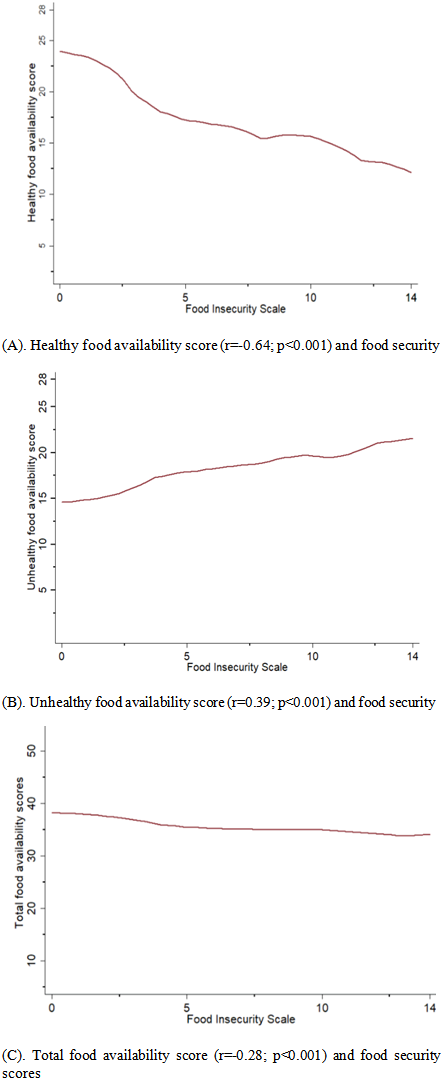
Three availability scores were created from the sum of the scores: healthy food availability score (0 to 28 points), unhealthy food availability score (0 to 28 points), and total food availability score, resulting from the sum of the two previous scores (0 to 56 points). The higher quality of food available in households was indicated by higher scores in the three cases.
Explanatory variables
Sociodemographic and economic characteristics, aspects related to the pandemic, and the food security status of households were investigated.
Sociodemographic variables included student age (0-3 years old/4-5 years old/6-17 years old), respondent's gender (female/male), respondent's marital status (not married/married), referred respondent's skin color (yellow; white; black; brown), respondent's education (illiterate/incomplete elementary I; complete elementary school/incomplete elementary II; complete elementary school II/incomplete high school; complete high school/incomplete university; university), area of residence (urban/rural ), number of people in the household (2-4/≥5) and number of children in the household (1-2/≥3).
The economic variables were respondents’ employment status (unemployed/employed), receipt of benefits from government social programs (not receiving/receiving), and socioeconomic classification [high/low level). The pandemic-related variables were access to the basic food basket (no/yes), receipt of government emergency aid (not receiving/receiving), income reduction (no/yes), and the effect of this income reduction (very large, large/small, very small).
The food security status of the households was assessed using the Brazilian Food Insecurity Scale (EBIA). EBIA evaluates the family’s self-perceived food access for the last 3 months through 14 closed questions (yes/no) and presents degrees of severity (0 to 14 points): food security (0 points); mild food insecurity (1 to 5 points); moderate food insecurity (6 to 9 points): and severe food insecurity (10 to 14 points) 17.
Data analysis
Data was tabulated, and consistency was evaluated using Microsoft Office Excel® (2013). Statistical analyses were performed using the STATA® program version 13.0, and a significance level of 5.0% was considered for all statistical tests.
Descriptive analyses were performed using frequency calculations. Simple linear regression analyses were then performed to investigate the relationship between sociodemographic and economic characteristics, variables related to the pandemic, and the food security status with food availability. Additionally, correlation analyses were conducted between the food insecurity scale and food availability scores.
The association between the food availability scores (outcome variables) and explanatory variables was analyzed using a multiple linear regression model. The explanatory variables were included in the model in blocks, according to plausibility in the literature, p-value ≤ 0.20 in the bivariate analysis, and performance of collinearity analysis. The first block consisted of sociodemographic and economic variables, followed by variables related to the pandemic and food security status. Variables with less significance were analyzed and removed one by one from the model (backward stepwise elimination); variables with p<0.05 were kept in the model. In all models, the normality of residuals was tested.
The study included 611 adults responsible for purchasing food in the homes of children and adolescents aged 1 to 17 years. Of these, 92.2% were female, 59.6% were married, 80.2% were self-declared black or brown, 50.7% were unemployed, and 49.0% had completed high school. Of the households, 80.4% had one to two children, 64.9% had low socioeconomic status, 64.7% had a member receiving emergency aid from the federal government, and 66.5% reported a drop in family income during the pandemic. Concerning basic food baskets provided by municipalities, 46.8% of households reported access. The prevalence of food insecurity in households was 82.0%, with 16.3% having severe or moderate food insecurity (Table 2).
The mean of the healthy food availability score in households was 20.7 points (95% CI: 20.3; 21.1), for the unhealthy food availability score 16.2 points (95%CI: 15.9; 16.6), and for the total food availability score 37.0 points (95%CI: 36.6; 37.4) (Table 2).
A negative correlation was observed between the healthy food availability score (-0.64; p<0.001) and the total availability score (-0.28; p<0.001) with food security scores. Conversely, a positive correlation was identified between the unhealthy food availability score (0.39; p<0.001) and food security scores (Figure 1).
In Table 3, using the final model of multiple linear regression, it is observed that not married marital status (β = -1.02; 95%CI: -1.71; -0.33), the highest number of children (β = -1.02; 95%CI: -1.87; -0.16), low socioeconomic status (β = -1.92; 95%CI: -2.66; -1.19), the highest effect of the drop in family income (β = -1.26; 95%CI: -1.98; -0.55) and the food insecurity status of households, mild (β = -2.30; 95%CI: - 3.20; -1.40) and moderate/severe (β = -6.61; 95%CI: -7.85; -5.38), had a negative association with the healthy food availability score.
Regarding the unhealthy food availability score, there was a positive association with female respondents (β = 1.75; 95%CI: 0.39; 3.11), low socioeconomic status (β = 1.64; 95%CI: 0.86; 2.42) and a greater effect of a drop in income (β = 2.15; 95%CI: 1.39; 2.91). A greater number of children (β = -0.99; 95%CI: -1.96; -0.02), access to the basic food basket (β = -0.78; 95%CI: -1.54; -0.02), and food insecurity, mild (β = -1.32; 95%CI: -2.33; -0.31) and moderate/severe (β = -3.25; 95%CI: - 4.58; -1.92), were negatively associated with the total food availability score.

Households of children and adolescents during the interruption in the supply of school meals during the COVID-19 pandemic showed compromised food availability.
In this context, a survey on the availability of food carried out with the participation of several countries showed that, during the pandemic, 32.7% of the participants had problems purchasing food, 50.4% had access to a smaller variety of food, 30.2% found lower quality food, and 39.2% had a smaller amount of food 18.
The adoption of measures to prevent the spread of COVID-19 added to existing conditions, would reflect on food systems with a decrease in food availability in some regions of the world, mainly those with economic vulnerability. Low availability of food in households can have direct consequences for food security 6. In this study, by analyzing the means of healthy and unhealthy food availability scores, median and low values were found.
Data from the National Survey on Food Insecurity in the Context of the COVID-19 Pandemic in Brazil demonstrated a tendency towards a decrease in the availability of fresh or minimally processed foods in Brazilian households. Moreover, for families that reduced the purchase of these foods, severe FI was present in almost half of the households 24.
Regarding the unhealthy food availability score, there was less availability of processed and ultra-processed foods in households where women were responsible for food preparation since responsibility for family food is still determined by gender 27. The literature also demonstrates that motherhood plays a key role in healthy decision-making processes that shape domestic food environments and protect children's health through practical planning and budgeting strategies 28.
Most of the observed associations revolved around economic conditions. There are inverse relationships between food insecurity, family income, and the number of children in the households, being that a greater number of economic dependents can limit or reduce food availability, especially healthy food 24, 26, 29, 31, 32. Furthermore, low socioeconomic status and the drop in income may suggest the overall difficulty in purchasing food families faced during the pandemic, since increases in food prices higher than the rates of inflation have been registered in Brazil since the first year of the pandemic 33, 34.
Consumers were largely affected by the rise in food prices, especially foods such as cereals, legumes, tubers, roots, and vegetables, in addition to meats and fruits 34. This made it more difficult to cope with the months of social restrictions and decreased income caused by increased unemployment and the closure of businesses, leading to decreased purchasing power among families, especially those with low incomes 33.
Thus, the drop in family income associated with the rise in prices during the pandemic may have triggered a lower acquisition of food groups in general 35, since the total food availability score did not show a high mean in this study. Furthermore, receiving basic food baskets does not seem to be enough to guarantee the availability of food. An American study conducted with schoolchildren who received a backpack with three meals each day on the weekend did not demonstrate improvement in food security in the participants' homes 25. Another study with public education students' homes, during the suspension of face-to-face classes in Brazilian schools, showed that households that received baskets or kits were more likely to experience FI 26.
Given the above, our results corroborate the findings that inequalities in access to income, goods, services, and public policies are the conditions with the greatest capacity to explain inequities related to the guarantee of the FNS and HRFA 24.
The study was limited to the use of telephone interviews, which may imply participation bias, as only people with an active telephone line could participate. In addition, only students receiving public education were analyzed, so the results may not generalize to all students in the municipalities. However, most students in the teaching modalities in the present study are served by public education in Brazil: early childhood education (74.7%) and elementary education (82.0%) 38. Despite this, it is understood that studies on food and nutrition security and its dimensions are important and necessary with the participation of students from all socioeconomic contexts.
The strengths of the study were the use of a representative sampling process for the student population of public schools in the two municipalities studied and the pioneering approach in assessing the availability of food for this population during the COVID-19 pandemic.
Municipalities must promote policies that remove households from vulnerable situations, with support for small local producers and the promotion of access to fresh and healthy food in sufficient quantities at an affordable price so that the basic needs of the population are guaranteed. Furthermore, surveillance of household food security needs to be permanent to prevent the HRAF of these individuals from being jeopardized in emergencies, such as the suspension of face-to-face classes.
These findings highlight the urgent need for public policies aimed at social protection programs and the strengthening of local food systems. The long-term effects of the pandemic on food security need to be investigated in order to evaluate the effectiveness of the interventions adopted to mitigate these impacts. Additionally, studies focusing on the role of governmental institutions and community organizations in supporting food security during crises can provide valuable insights for policy development.
Acknowledgments: We thank the Federal University of Ouro Preto (UFOP), Dean of Research, Graduate Studies and Innovation (PROPPI), Coordination for the Improvement of Higher Education Personnel (CAPES) for their support and assistance, and all ESANP participants who agreed to take part in the study.
Statement of Competing Interests: The authors declare that they have no known competing financial interests or personal relationships or any other conflict of interest that could have appeared to influence the work reported in this paper.
Financial support: This research received no specific grant from any funding agency, commercial or non-profit sectors.
Authors contributions: Priscila Pena Camargo: Conceptualization; Methodology; Formal analysis; Writing original draft; review; editing and finalizing. Erica Costa Rodrigues: Data curation/Data management; Literature review. Mariana Carvalho de Menezes, and Natália Caldeira de Carvalho: Survey management, Review; editing, and finalizing. Adriana L Meireles and Raquel D Mendonça: Project administration; Supervision; Resources; Review and editing.
| [1] | A. Sharma, I. Ahmad Farouk, S.K. Lal. “COVID-19: A Review on the Novel Coronavirus Disease Evolution, Transmission, Detection, Control and Prevention”, Viruses, 13(2), 202, January 2021. [Online]. Available from: https:// pmc.ncbi.nlm.nih.gov/ articles/PMC7911532/. [Accessed: Feb. 24, 2025]. | ||
| In article | View Article PubMed | ||
| [2] | BRASIL. Ministério da Educação. (2023). Programa Nacional de Alimentação Escolar – Histórico. [Online]. Available: https://www.gov.br/fnde/pt-br/acesso-a-informacao/acoes-e-programas/programas/pnae/historico. [Accessed: Feb. 24, 2025]. | ||
| In article | |||
| [3] | C. H. Mota, S. S. B. S, Mastroeni, M. F. Mastoreni. “Consumo da refeição escolar na rede pública municipal de ensino”. Revista Brasileira de Estudos Pedagógicos, 94(236), 168-84, 2013. [Online]. Available: http:// rbep.inep.gov.br/ ojs3/index.php/ rbep/article/view/3536/3271. [Accessed: Feb. 24, 2025]. | ||
| In article | View Article | ||
| [4] | S. Forrestal, E. Potamites, J. Guthrie, N. Paxton. “Associations among Food Security, School Meal Participation, and Students’ Diet Quality in the First School Nutrition and Meal Cost Study”, Nutrients, 13(2), 307, February 2021. [Online]. Available: https://pubmed.ncbi.nlm.nih.gov/33499016/. [Accessed: Feb. 24, 2025]. | ||
| In article | View Article PubMed | ||
| [5] | BRASIL. Ministério da Educação. Resolução no 02, de 09 de abril de 2020. Dispõe sobre a execução do Programa Nacional de Alimentação Escolar – PNAE durante o período de estado de calamidade pública. Diário Oficial da União, Brasília, DF. [Online]. Available: https://www.gov.br/fnde/pt-br/acesso-a-informacao/legislacao/resolucoes/2020/resolucao-ndeg-2-de-09-de-abril-de-2020/view. [Accessed: Feb. 24, 2025]. | ||
| In article | |||
| [6] | HLPE. (2020). Food Security and Nutrition: Building a Global Narrative towards 2030. A report by the High Level Panel of Experts on Food Security and Nutrition of the Committee on World Food Security, Rome. Available: http:// www.fao.org/3/ca9731en/ca9731en.pdf. [Accessed: Feb. 24, 2025]. | ||
| In article | |||
| [7] | L. D. Barbosa, L. K. M. Sousa, E. Schott, F. A. C. Rezende, A. Q. Ribeiro, S. E. Priore et al. “Disponibilidade domiciliar de alimentos a partir da nova classificação de alimentos e (in)segurança alimentar”, Ciência e Saúde Coletiva, 25(7), 2701–9, July 2020. [Online]. Available: http:// www.scielo.br/ j/csc/a/9WkzGxy36TjHW6MDG9D9g9D/?lang=pt. [Accessed: Feb. 24, 2025]. | ||
| In article | View Article PubMed | ||
| [8] | Instituto Brasileiro de Geografia e Estatística (IBGE). (s.d.). Mariana – Panorama. [Online]. Available: https:// cidades.ibge.gov.br/ brasil/ mg/mariana/panorama. [Accessed: Feb. 24, 2025]. | ||
| In article | |||
| [9] | Centro de Integração de Dados e Conhecimentos para Saúde. Publicações - Índice de Desigualdades Sociais para COVID-19. [Online]. Available: https:// cidacs.bahia.fiocruz.br/ idscovid19/publicacoes/. [Accessed: Feb. 24, 2025]. | ||
| In article | |||
| [10] | Instituto Brasileiro de Geografia e Estatística (IBGE). (s.d.). Ouro Preto – Panorama. [Online]. Available: https:// cidades.ibge.gov.br/ brasil/mg/ouro-preto/panorama. [Accessed: Feb. 24, 2025]. | ||
| In article | |||
| [11] | BRASIL. Ministério da Educação. Resolução no 06, de 08 de maio de 2020. Dispõe sobre o atendimento da alimentação escolar aos alunos da educação básica no âmbito do Programa Nacional de Alimentação Escolar – PNAE. Diário Oficial da União, Brasília, DF. [Online]. Available: https://www.gov.br/fnde/pt-br/acesso-a-informacao/legislacao/resolucoes/2020/resolucao-no-6-de-08-de-maio-de-2020/view. [Accessed: Feb. 24, 2025]. | ||
| In article | |||
| [12] | Universidade Federal do Rio de Janeiro. (2020). Manual do Questionário Geral: Estudo Nacional de Alimentação e Nutrição Infantil (ENANI-2019). [Online]. Rio de Janeiro, RJ; 2020. Available: https://enani.nutricao.ufrj.br/download/manual-do-questionario-geral-2/. [Accessed: Feb. 24, 2025]. | ||
| In article | |||
| [13] | BRASIL. Ministério da Saúde. (2008). Protocolos do Sistema de Vigilância Alimentar e Nutricional - SISVAN na assistência à saúde. [Online]. Brasília, DF; 2008. Available: https:// http://189.28.128.100/nutricao/docs/geral/protocolo_sisvan.pdf. [Accessed: Feb. 24, 2025]. | ||
| In article | |||
| [14] | BRASIL. Ministério da Saúde. (2014). Guia Alimentar para a População Brasileira. [Online]. Brasília, DF; 2014. Available: https://bvsms.saude.gov.br/bvs/publicacoes/guia_alimentar_populacao_brasileira_2ed.pdf. [Accessed: Feb. 24, 2025]. | ||
| In article | |||
| [15] | C. E. Rossi, L. C. F. Costa, M. S. Machado, D. F. Andrade, F. A. G. Vasconcelos. “Factors associated with food consumption in schools and overweight/obesity in 7 to 10-year-old schoolchildren in the state of Santa Catarina, Brazil”, Ciência e Saúde Coletiva, 24(2), 443–54, February 2019. [Online]. Available: https:// pubmed.ncbi.nlm.nih.gov/30726377/. [Accessed: Feb. 24, 2025]. | ||
| In article | View Article PubMed | ||
| [16] | Peter, N. B. (2016). Disponibilidade de alimentos no domicílio de escolares da zona rural de Pelotas (Dissertação de Mestrado). [Online]. Universidade Federal de Pelotas, Pelotas; 2016. Available: https:// guaiaca.ufpel.edu.br/handle/prefix/3932. [Accessed: Feb. 24, 2025]. | ||
| In article | |||
| [17] | R. Pérez-Escamilla, A. M. Segall-Corrêa. “Food insecurity measurement and indicators”, Revista de Nutrição, 21(Suplemento), 15s-26s, July/August 2008. [Online]. Available: https://www.scielo.br/j/rn/a/mfgJyKLc9HP7nXLRX5fH3Fh/?format=pdf&lang=en. [Accessed: Feb. 24, 2025]. | ||
| In article | View Article | ||
| [18] | A. Jafri, N. Mathe, E. K. Aglago, S. O. Konyole, M. Ouedraogo, K. Audain et al. “Food availability, accessibility and dietary practices during the COVID-19 pandemic: a multi-country survey”, Public Health Nutrition, 24(7), 1798-805, May 2021. [Online]. Available: https:// pubmed.ncbi.nlm.nih.gov/33663623/. [Accessed: Feb. 24, 2025]. | ||
| In article | View Article PubMed | ||
| [19] | United Nations. (2020). Policy Brief: The Impact of COVID-19 on Food Security and Nutrition - JUNE 2020. [Online]. Available: https://unsdg.un.org/resources/policy-brief-impact-covid-19-food-security-and-nutrition. [Accessed: Feb. 24, 2025]. | ||
| In article | |||
| [20] | N. Sperandio, D. C. Morais. “Alimentação escolar no contexto de pandemia: a ressignificação e o protagonismo do Programa Nacional de Alimentação Escolar”, Segurança Alimentar e Nutricional, 28(00), e021006, March 2021. [Online]. Available: https://periodicos.sbu.unicamp.br/ojs/index.php/san/article/view/8661396. [Accessed: Feb. 24, 2025]. | ||
| In article | View Article | ||
| [21] | BRASIL. Ministério da Educação. (2015). Cartilha Nacional da Alimentação Escolar. [Online]. Brasília, DF; 2015. Available: https://siteal.iiep.unesco.org/sites/default/files/sit_accion_files/cartilha_nacional_da_alimentacao_escolar.pdf. [Accessed: Feb. 24, 2025]. | ||
| In article | |||
| [22] | World Food Programme. (2020). Global Monitoring of School Meals During COVID-19 School Closures. [Online]. Available: https://cdn.wfp.org/2020/school-feeding-map/index.html. [Accessed: Feb. 24, 2025]. | ||
| In article | |||
| [23] | IBGE. Instituto Brasileiro de Geografia e Estatística (IBGE). (2020). Pesquisa de Orçamentos Familiares 2017-2018: Avaliação Nutricional da Disponibilidade Domiciliar de Alimentos no Brasil. [Online]. Rio de Janeiro: IBGE; 2020. Available: https:// biblioteca.ibge.gov.br/ visualizacao/ livros/liv101704.pdf. [Accessed: Feb. 24, 2025]. | ||
| In article | |||
| [24] | Rede Brasileira de Pesquisa em Soberania e Segurança Alimentar e Nutricional (Rede PENSSAN). (2022). II Inquérito Nacional sobre Insegurança Alimentar no Contexto da Pandemia da Covid-19 no Brasil (II VIGISAN). [Online]. São Paulo; 2022. Available: https://olheparaafome.com.br/wp-content/ uploads/2022/ 06/ Relatorio-II-VIGISAN-2022.pdf. [Accessed: Feb. 24, 2025]. | ||
| In article | |||
| [25] | M. Burke, C. Cabili, D. Berman, S. Forrestal, P. A. Gleason. “Randomized Controlled Trial of Three School Meals and Weekend Food Backpacks on Food Security in Virginia”, Journal of the Academy of Nutrition and Dietetics, 121(1S), S34–S45, January 2021. [Online]. Available: https:// pubmed.ncbi.nlm.nih.gov/33342523/. [Accessed: Feb. 24, 2025]. | ||
| In article | View Article PubMed | ||
| [26] | E. C. Rodrigues, R. D. Mendonça, P. P. Camargo, M. C. Menezes, N. C. Carvalho, A. L. Meireles. “Home food insecurity during the suspension of classes in Brazilian public schools due to the COVID-19 pandemic”, Nutrition, 93:111448, 2022. [Online]. Available: https:// www.sciencedirect.com/ science/ article/pii/ S0899900721003105?via%3Dihub. [Accessed: Feb. 24, 2025]. | ||
| In article | View Article PubMed | ||
| [27] | T. R. Prado, A. C. Mazzonetto, A. M. Botelho, G. M. R. Fiates. “Home availability of ultraprocessed foods in families who prepare meals at home”, Revista de Nutrição, 35:e210249, 2022. [Online]. Available: http:// www.scielo.br/ j/rn/a/ bvRmrngJ9XCZJyYD4M4LTmn/ abstract/?lang=en. [Accessed: Feb. 24, 2025]. | ||
| In article | View Article | ||
| [28] | I. G. Raskind, R. C. Woodruff, D. Ballard, S. T. Cherry, S. Daniel, R. Haardörfer et al. “Decision-making processes shaping the home food environments of young adult women with and without children”, Appetite, 113, 124–133, June 2017. [Online]. Available: https://www.sciencedirect.com/science/article/abs/pii/S0195666317302647?via%3Dihub. [Accessed: Feb. 24, 2025]. | ||
| In article | View Article PubMed | ||
| [29] | Instituto Brasileiro de Geografia e Estatística (IBGE). (2019). Síntese de indicadores sociais: uma análise das condições de vida da população brasileira: 2019. [Online]. Rio de Janeiro: IBGE; 2019. Available: https:// biblioteca.ibge.gov.br/ visualizacao/ livros/liv101678.pdf. [Accessed: Feb. 24, 2025]. | ||
| In article | |||
| [30] | N. Valle Silva, C. Hasenbalg. “Tendências da desigualdade educacional no Brasil”, Dados, 43(3), 423-445, 2000. [Online]. Available: http:// www.scielo.br/j/ dados/a/ pjz8g84tSdvrM6p3GbwdNtk/?lang=pt. [Accessed: Feb. 24, 2025]. | ||
| In article | View Article | ||
| [31] | E. I. M. Steele, F. I. Rauber, C. I. S. Costa, M. I. A. Leite, K. I. T. Gabe, M. L. C. Louzada et al. “Dietary changes in the NutriNet Brasil cohort during the covid-19 pandemic”, Revista de Saúde Pública, 54(91), 2020. [Online]. | ||
| In article | View Article PubMed | ||
| [32] | J. A. Wolfson, C. W. Leung. “Food Insecurity and COVID-19: Disparities in Early Effects for US Adults”, Nutrients, 12(6), 1648, June 2020. [Online]. Available: https://www.mdpi.com/2072-6643/12/6/1648/htm. [Accessed: Feb. 24, 2025]. | ||
| In article | View Article PubMed | ||
| [33] | Folha de São Paulo. (2021, 11 de março). “Em um ano de pandemia, alta em preço de alimentos é quase o triplo da inflação”. Folha de São Paulo. [Online]. Available: https://www1.folha.uol.com.br/mercado/2021/03/em-um-ano-de-pandemia-preco-dos-alimentos-sobe-quase-tres-vezes-a-inflacao.shtml. Accessed: Feb. 24, 2025]. | ||
| In article | |||
| [34] | Instituto Brasileiro de Geografia e Estatística (IBGE). (2020). Sistema IBGE de Recuperação Automática - SIDRA. Índice Nacional de Preços ao Consumidor Amplo – IPCA. [Online]. IBGE; 2020. Available from: https:// sidra.ibge.gov.br/ pesquisa/ snipc/ipca/quadros/brasil/julho-2020. Accessed: Feb. 24, 2025]. | ||
| In article | |||
| [35] | J. G. Baccarin, J. A. Oliveira. “Inflação de alimentos no Brasil em período da pandemia da COVID 19, continuidade e mudanças”, Segurança Alimentar e Nutricional, 28(00), e021002, 2021. [Online]. Available: https:// periodicos.sbu.unicamp.br/ ojs/index.php/san/article/view/8661127. Accessed: Feb. 24, 2025]. | ||
| In article | View Article | ||
| [36] | R. B. Levy, G. A. Calixto, G. L. Cruz, F. Rauber, M. L. C. Louzada, R. M. Claro et al. “Three decades of household food availability according to NOVA-Brazil, 1987-2018”, Revista de Saúde Pública, 56(75), 2022. [Online]. Available: https://www.scielo.br/j/rsp/a/G7KPsdVDPBsLFBLr93Q5rpK/?format=pdf&lang=en. Accessed: Feb. 24, 2025]. | ||
| In article | View Article PubMed | ||
| [37] | D. B. Jackson, A. Testa, D. C. Semenza. “Household food insecurity and school readiness among preschool-aged children in the USA”, Public Health Nutrition, 24(6), 1469-1477, 2021. [Online]. Available: https:// www.ncbi.nlm.nih.gov/ pmc/articles/PMC10195580/pdf/S1368980021000550a.pdf. Accessed: Feb. 24, 2025]. | ||
| In article | View Article PubMed | ||
| [38] | Instituto Brasileiro de Geografia e Estatística (IBGE). (2020). Pesquisa Nacional por Amostra de Domicílios Contínua - Educação 2019. [Online]. Rio de Janeiro: IBGE; 2020. Available: https://biblioteca.ibge.gov.br/visualizacao/livros/liv101736_informativo.pdf. Accessed: Feb. 24, 2025]. | ||
| In article | |||
Published with license by Science and Education Publishing, Copyright © 2025 Priscila Pena Camargo, Erica Costa Rodrigues, Mariana Carvalho de Menezes, Natália Caldeira de Carvalho, Adriana Lúcia Meireles and Raquel de Deus Mendonça
 This work is licensed under a Creative Commons Attribution 4.0 International License. To view a copy of this license, visit
http://creativecommons.org/licenses/by/4.0/
This work is licensed under a Creative Commons Attribution 4.0 International License. To view a copy of this license, visit
http://creativecommons.org/licenses/by/4.0/
| [1] | A. Sharma, I. Ahmad Farouk, S.K. Lal. “COVID-19: A Review on the Novel Coronavirus Disease Evolution, Transmission, Detection, Control and Prevention”, Viruses, 13(2), 202, January 2021. [Online]. Available from: https:// pmc.ncbi.nlm.nih.gov/ articles/PMC7911532/. [Accessed: Feb. 24, 2025]. | ||
| In article | View Article PubMed | ||
| [2] | BRASIL. Ministério da Educação. (2023). Programa Nacional de Alimentação Escolar – Histórico. [Online]. Available: https://www.gov.br/fnde/pt-br/acesso-a-informacao/acoes-e-programas/programas/pnae/historico. [Accessed: Feb. 24, 2025]. | ||
| In article | |||
| [3] | C. H. Mota, S. S. B. S, Mastroeni, M. F. Mastoreni. “Consumo da refeição escolar na rede pública municipal de ensino”. Revista Brasileira de Estudos Pedagógicos, 94(236), 168-84, 2013. [Online]. Available: http:// rbep.inep.gov.br/ ojs3/index.php/ rbep/article/view/3536/3271. [Accessed: Feb. 24, 2025]. | ||
| In article | View Article | ||
| [4] | S. Forrestal, E. Potamites, J. Guthrie, N. Paxton. “Associations among Food Security, School Meal Participation, and Students’ Diet Quality in the First School Nutrition and Meal Cost Study”, Nutrients, 13(2), 307, February 2021. [Online]. Available: https://pubmed.ncbi.nlm.nih.gov/33499016/. [Accessed: Feb. 24, 2025]. | ||
| In article | View Article PubMed | ||
| [5] | BRASIL. Ministério da Educação. Resolução no 02, de 09 de abril de 2020. Dispõe sobre a execução do Programa Nacional de Alimentação Escolar – PNAE durante o período de estado de calamidade pública. Diário Oficial da União, Brasília, DF. [Online]. Available: https://www.gov.br/fnde/pt-br/acesso-a-informacao/legislacao/resolucoes/2020/resolucao-ndeg-2-de-09-de-abril-de-2020/view. [Accessed: Feb. 24, 2025]. | ||
| In article | |||
| [6] | HLPE. (2020). Food Security and Nutrition: Building a Global Narrative towards 2030. A report by the High Level Panel of Experts on Food Security and Nutrition of the Committee on World Food Security, Rome. Available: http:// www.fao.org/3/ca9731en/ca9731en.pdf. [Accessed: Feb. 24, 2025]. | ||
| In article | |||
| [7] | L. D. Barbosa, L. K. M. Sousa, E. Schott, F. A. C. Rezende, A. Q. Ribeiro, S. E. Priore et al. “Disponibilidade domiciliar de alimentos a partir da nova classificação de alimentos e (in)segurança alimentar”, Ciência e Saúde Coletiva, 25(7), 2701–9, July 2020. [Online]. Available: http:// www.scielo.br/ j/csc/a/9WkzGxy36TjHW6MDG9D9g9D/?lang=pt. [Accessed: Feb. 24, 2025]. | ||
| In article | View Article PubMed | ||
| [8] | Instituto Brasileiro de Geografia e Estatística (IBGE). (s.d.). Mariana – Panorama. [Online]. Available: https:// cidades.ibge.gov.br/ brasil/ mg/mariana/panorama. [Accessed: Feb. 24, 2025]. | ||
| In article | |||
| [9] | Centro de Integração de Dados e Conhecimentos para Saúde. Publicações - Índice de Desigualdades Sociais para COVID-19. [Online]. Available: https:// cidacs.bahia.fiocruz.br/ idscovid19/publicacoes/. [Accessed: Feb. 24, 2025]. | ||
| In article | |||
| [10] | Instituto Brasileiro de Geografia e Estatística (IBGE). (s.d.). Ouro Preto – Panorama. [Online]. Available: https:// cidades.ibge.gov.br/ brasil/mg/ouro-preto/panorama. [Accessed: Feb. 24, 2025]. | ||
| In article | |||
| [11] | BRASIL. Ministério da Educação. Resolução no 06, de 08 de maio de 2020. Dispõe sobre o atendimento da alimentação escolar aos alunos da educação básica no âmbito do Programa Nacional de Alimentação Escolar – PNAE. Diário Oficial da União, Brasília, DF. [Online]. Available: https://www.gov.br/fnde/pt-br/acesso-a-informacao/legislacao/resolucoes/2020/resolucao-no-6-de-08-de-maio-de-2020/view. [Accessed: Feb. 24, 2025]. | ||
| In article | |||
| [12] | Universidade Federal do Rio de Janeiro. (2020). Manual do Questionário Geral: Estudo Nacional de Alimentação e Nutrição Infantil (ENANI-2019). [Online]. Rio de Janeiro, RJ; 2020. Available: https://enani.nutricao.ufrj.br/download/manual-do-questionario-geral-2/. [Accessed: Feb. 24, 2025]. | ||
| In article | |||
| [13] | BRASIL. Ministério da Saúde. (2008). Protocolos do Sistema de Vigilância Alimentar e Nutricional - SISVAN na assistência à saúde. [Online]. Brasília, DF; 2008. Available: https:// http://189.28.128.100/nutricao/docs/geral/protocolo_sisvan.pdf. [Accessed: Feb. 24, 2025]. | ||
| In article | |||
| [14] | BRASIL. Ministério da Saúde. (2014). Guia Alimentar para a População Brasileira. [Online]. Brasília, DF; 2014. Available: https://bvsms.saude.gov.br/bvs/publicacoes/guia_alimentar_populacao_brasileira_2ed.pdf. [Accessed: Feb. 24, 2025]. | ||
| In article | |||
| [15] | C. E. Rossi, L. C. F. Costa, M. S. Machado, D. F. Andrade, F. A. G. Vasconcelos. “Factors associated with food consumption in schools and overweight/obesity in 7 to 10-year-old schoolchildren in the state of Santa Catarina, Brazil”, Ciência e Saúde Coletiva, 24(2), 443–54, February 2019. [Online]. Available: https:// pubmed.ncbi.nlm.nih.gov/30726377/. [Accessed: Feb. 24, 2025]. | ||
| In article | View Article PubMed | ||
| [16] | Peter, N. B. (2016). Disponibilidade de alimentos no domicílio de escolares da zona rural de Pelotas (Dissertação de Mestrado). [Online]. Universidade Federal de Pelotas, Pelotas; 2016. Available: https:// guaiaca.ufpel.edu.br/handle/prefix/3932. [Accessed: Feb. 24, 2025]. | ||
| In article | |||
| [17] | R. Pérez-Escamilla, A. M. Segall-Corrêa. “Food insecurity measurement and indicators”, Revista de Nutrição, 21(Suplemento), 15s-26s, July/August 2008. [Online]. Available: https://www.scielo.br/j/rn/a/mfgJyKLc9HP7nXLRX5fH3Fh/?format=pdf&lang=en. [Accessed: Feb. 24, 2025]. | ||
| In article | View Article | ||
| [18] | A. Jafri, N. Mathe, E. K. Aglago, S. O. Konyole, M. Ouedraogo, K. Audain et al. “Food availability, accessibility and dietary practices during the COVID-19 pandemic: a multi-country survey”, Public Health Nutrition, 24(7), 1798-805, May 2021. [Online]. Available: https:// pubmed.ncbi.nlm.nih.gov/33663623/. [Accessed: Feb. 24, 2025]. | ||
| In article | View Article PubMed | ||
| [19] | United Nations. (2020). Policy Brief: The Impact of COVID-19 on Food Security and Nutrition - JUNE 2020. [Online]. Available: https://unsdg.un.org/resources/policy-brief-impact-covid-19-food-security-and-nutrition. [Accessed: Feb. 24, 2025]. | ||
| In article | |||
| [20] | N. Sperandio, D. C. Morais. “Alimentação escolar no contexto de pandemia: a ressignificação e o protagonismo do Programa Nacional de Alimentação Escolar”, Segurança Alimentar e Nutricional, 28(00), e021006, March 2021. [Online]. Available: https://periodicos.sbu.unicamp.br/ojs/index.php/san/article/view/8661396. [Accessed: Feb. 24, 2025]. | ||
| In article | View Article | ||
| [21] | BRASIL. Ministério da Educação. (2015). Cartilha Nacional da Alimentação Escolar. [Online]. Brasília, DF; 2015. Available: https://siteal.iiep.unesco.org/sites/default/files/sit_accion_files/cartilha_nacional_da_alimentacao_escolar.pdf. [Accessed: Feb. 24, 2025]. | ||
| In article | |||
| [22] | World Food Programme. (2020). Global Monitoring of School Meals During COVID-19 School Closures. [Online]. Available: https://cdn.wfp.org/2020/school-feeding-map/index.html. [Accessed: Feb. 24, 2025]. | ||
| In article | |||
| [23] | IBGE. Instituto Brasileiro de Geografia e Estatística (IBGE). (2020). Pesquisa de Orçamentos Familiares 2017-2018: Avaliação Nutricional da Disponibilidade Domiciliar de Alimentos no Brasil. [Online]. Rio de Janeiro: IBGE; 2020. Available: https:// biblioteca.ibge.gov.br/ visualizacao/ livros/liv101704.pdf. [Accessed: Feb. 24, 2025]. | ||
| In article | |||
| [24] | Rede Brasileira de Pesquisa em Soberania e Segurança Alimentar e Nutricional (Rede PENSSAN). (2022). II Inquérito Nacional sobre Insegurança Alimentar no Contexto da Pandemia da Covid-19 no Brasil (II VIGISAN). [Online]. São Paulo; 2022. Available: https://olheparaafome.com.br/wp-content/ uploads/2022/ 06/ Relatorio-II-VIGISAN-2022.pdf. [Accessed: Feb. 24, 2025]. | ||
| In article | |||
| [25] | M. Burke, C. Cabili, D. Berman, S. Forrestal, P. A. Gleason. “Randomized Controlled Trial of Three School Meals and Weekend Food Backpacks on Food Security in Virginia”, Journal of the Academy of Nutrition and Dietetics, 121(1S), S34–S45, January 2021. [Online]. Available: https:// pubmed.ncbi.nlm.nih.gov/33342523/. [Accessed: Feb. 24, 2025]. | ||
| In article | View Article PubMed | ||
| [26] | E. C. Rodrigues, R. D. Mendonça, P. P. Camargo, M. C. Menezes, N. C. Carvalho, A. L. Meireles. “Home food insecurity during the suspension of classes in Brazilian public schools due to the COVID-19 pandemic”, Nutrition, 93:111448, 2022. [Online]. Available: https:// www.sciencedirect.com/ science/ article/pii/ S0899900721003105?via%3Dihub. [Accessed: Feb. 24, 2025]. | ||
| In article | View Article PubMed | ||
| [27] | T. R. Prado, A. C. Mazzonetto, A. M. Botelho, G. M. R. Fiates. “Home availability of ultraprocessed foods in families who prepare meals at home”, Revista de Nutrição, 35:e210249, 2022. [Online]. Available: http:// www.scielo.br/ j/rn/a/ bvRmrngJ9XCZJyYD4M4LTmn/ abstract/?lang=en. [Accessed: Feb. 24, 2025]. | ||
| In article | View Article | ||
| [28] | I. G. Raskind, R. C. Woodruff, D. Ballard, S. T. Cherry, S. Daniel, R. Haardörfer et al. “Decision-making processes shaping the home food environments of young adult women with and without children”, Appetite, 113, 124–133, June 2017. [Online]. Available: https://www.sciencedirect.com/science/article/abs/pii/S0195666317302647?via%3Dihub. [Accessed: Feb. 24, 2025]. | ||
| In article | View Article PubMed | ||
| [29] | Instituto Brasileiro de Geografia e Estatística (IBGE). (2019). Síntese de indicadores sociais: uma análise das condições de vida da população brasileira: 2019. [Online]. Rio de Janeiro: IBGE; 2019. Available: https:// biblioteca.ibge.gov.br/ visualizacao/ livros/liv101678.pdf. [Accessed: Feb. 24, 2025]. | ||
| In article | |||
| [30] | N. Valle Silva, C. Hasenbalg. “Tendências da desigualdade educacional no Brasil”, Dados, 43(3), 423-445, 2000. [Online]. Available: http:// www.scielo.br/j/ dados/a/ pjz8g84tSdvrM6p3GbwdNtk/?lang=pt. [Accessed: Feb. 24, 2025]. | ||
| In article | View Article | ||
| [31] | E. I. M. Steele, F. I. Rauber, C. I. S. Costa, M. I. A. Leite, K. I. T. Gabe, M. L. C. Louzada et al. “Dietary changes in the NutriNet Brasil cohort during the covid-19 pandemic”, Revista de Saúde Pública, 54(91), 2020. [Online]. | ||
| In article | View Article PubMed | ||
| [32] | J. A. Wolfson, C. W. Leung. “Food Insecurity and COVID-19: Disparities in Early Effects for US Adults”, Nutrients, 12(6), 1648, June 2020. [Online]. Available: https://www.mdpi.com/2072-6643/12/6/1648/htm. [Accessed: Feb. 24, 2025]. | ||
| In article | View Article PubMed | ||
| [33] | Folha de São Paulo. (2021, 11 de março). “Em um ano de pandemia, alta em preço de alimentos é quase o triplo da inflação”. Folha de São Paulo. [Online]. Available: https://www1.folha.uol.com.br/mercado/2021/03/em-um-ano-de-pandemia-preco-dos-alimentos-sobe-quase-tres-vezes-a-inflacao.shtml. Accessed: Feb. 24, 2025]. | ||
| In article | |||
| [34] | Instituto Brasileiro de Geografia e Estatística (IBGE). (2020). Sistema IBGE de Recuperação Automática - SIDRA. Índice Nacional de Preços ao Consumidor Amplo – IPCA. [Online]. IBGE; 2020. Available from: https:// sidra.ibge.gov.br/ pesquisa/ snipc/ipca/quadros/brasil/julho-2020. Accessed: Feb. 24, 2025]. | ||
| In article | |||
| [35] | J. G. Baccarin, J. A. Oliveira. “Inflação de alimentos no Brasil em período da pandemia da COVID 19, continuidade e mudanças”, Segurança Alimentar e Nutricional, 28(00), e021002, 2021. [Online]. Available: https:// periodicos.sbu.unicamp.br/ ojs/index.php/san/article/view/8661127. Accessed: Feb. 24, 2025]. | ||
| In article | View Article | ||
| [36] | R. B. Levy, G. A. Calixto, G. L. Cruz, F. Rauber, M. L. C. Louzada, R. M. Claro et al. “Three decades of household food availability according to NOVA-Brazil, 1987-2018”, Revista de Saúde Pública, 56(75), 2022. [Online]. Available: https://www.scielo.br/j/rsp/a/G7KPsdVDPBsLFBLr93Q5rpK/?format=pdf&lang=en. Accessed: Feb. 24, 2025]. | ||
| In article | View Article PubMed | ||
| [37] | D. B. Jackson, A. Testa, D. C. Semenza. “Household food insecurity and school readiness among preschool-aged children in the USA”, Public Health Nutrition, 24(6), 1469-1477, 2021. [Online]. Available: https:// www.ncbi.nlm.nih.gov/ pmc/articles/PMC10195580/pdf/S1368980021000550a.pdf. Accessed: Feb. 24, 2025]. | ||
| In article | View Article PubMed | ||
| [38] | Instituto Brasileiro de Geografia e Estatística (IBGE). (2020). Pesquisa Nacional por Amostra de Domicílios Contínua - Educação 2019. [Online]. Rio de Janeiro: IBGE; 2020. Available: https://biblioteca.ibge.gov.br/visualizacao/livros/liv101736_informativo.pdf. Accessed: Feb. 24, 2025]. | ||
| In article | |||