Several excellent studies use the terms feeding behavior (FB) and eating behavior (EB) interchangeably, although they differ in scope. In the present work, FB refers to neuroendocrine regulation, experimental models, and physiological mechanisms, whereas EB pertains to the clinical, psychological, and social aspects observed in humans. FB is shaped by multiple influences—genetic, psychological, and hormonal—within broader socioeconomic, political, cultural, religious, and nutritional contexts. It can therefore be examined from complementary perspectives, particularly neurobiological, clinical, and therapeutic. Body weight (BW) partially reflects FB and its fluctuations over time. This in-depth narrative review explores alterations in EB and BW associated with various endocrine disorders, including hypothalamic syndrome; pituitary cachexia (Simmonds disease); thyroid dysfunction (hyperthyroidism and hypothyroidism); parathyroid diseases; glycemic disturbances (e.g., diabetes mellitus and insulinoma-induced hypoglycemia); disorders of the hypothalamic–pituitary–ovarian axis (e.g., premenstrual syndrome, contraceptive-related changes, and polycystic ovary syndrome); adrenal disorders (Cushing syndrome and adrenal insufficiency); and growth hormone (GH) imbalances (gigantism, acromegaly, and GH deficiency). Whereas many reviews have focused on hormonal alterations underlying obesity as a distinct nosological entity or on primary eating disorders such as anorexia nervosa, bulimia nervosa, and binge eating disorder, the present review specifically addresses changes in EB and BW as secondary manifestations of endocrine dysfunction. These alterations are discussed primarily as clinical signs and symptoms, along with their underlying pathophysiological mechanisms. Relevant historical and therapeutic aspects are also considered.
This narrative review provides an in-depth and integrative analysis of how endocrine disorders influence eating behavior (EB) and body weight (BW), aiming to guide readers through both pathophysiological mechanisms and clinical implications.
Hormones are quintessential mediators of intercellular communication, operating through a sophisticated network that encompasses both distant and local signaling mechanisms. The telecrine (distant secretion) component of the traditional endocrine (internal secretion) system coexists with various local secretory modalities—including paracrine and juxtacrine signaling (between adjacent cells), autocrine signaling (affecting the same cell), and intracrine and cryptocrine signaling (acting within the cell itself).
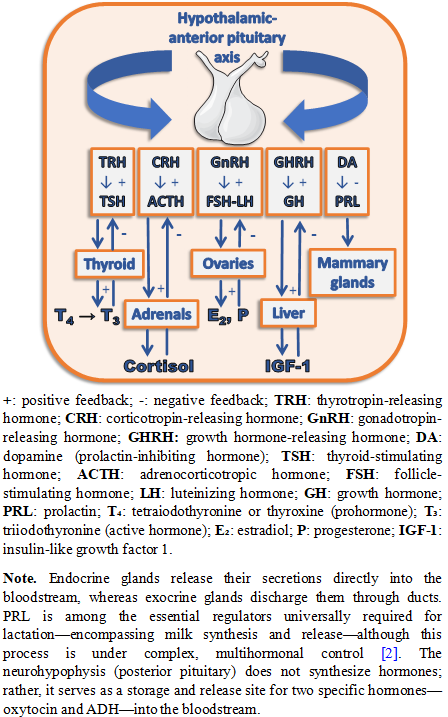
The hypothalamic–anterior pituitary (AP) axis forms an anatomical and functional unit—a neuroendocrine short loop—connected by a neurohemal interface known as the median eminence, a circumventricular organ that typically lacks a blood–brain barrier (BBB). This structure allows neurohormones to flow from the hypothalamus (central nervous system or CNS) to the AP (or adenohypophysis) and subsequently to other peripheral endocrine glands, forming long-loop regulatory circuits (Figure 1).
Briefly, in the hypothalamus, magnocellular (large) neurons project to the posterior pituitary (or neurohypophysis) and secrete two nonapeptides—oxytocin (OT) and vasopressin (also known as antidiuretic hormone, ADH)—whereas parvocellular (small) neurons release peptides that regulate AP hormone secretion 1, 2. Hypothalamic OT-secreting neurons also project to other brain regions involved in the regulation of feeding behavior (FB), including the amygdala, area postrema, nucleus of the solitary tract, and dorsal motor nucleus of the vagus nerve (the tenth of twelve paired cranial nerves) 3. When administered intracerebrally or intracerebroventricularly, OT reduces food intake (FI) and BW in both wild-type and genetically obese rats 3. In humans, OT may affect FI and meal preferences, particularly for carbohydrates and sweets 3. Moreover, OT appears to preferentially suppress the consumption of sweet-tasting carbohydrates by acting both on the brain’s reward circuits and on sweet taste receptors 4. In addition to regulating the intake of sweet-containing foods, OT also inhibits sodium chloride consumption 5, 6.
The mesolimbic dopamine (DA) pathway, regulated by DA, plays a key role in motivation and the pleasure associated with feeding; however, homeostatic signals that regulate energy balance can be overridden by emotional responses—particularly those involving the amygdala—leading to increased consumption of high-calorie foods even when a person is not hungry 7.
Hormone production is not limited to traditional endocrine glands; rather, it is widespread, with nearly every tissue in the body capable of producing its own signaling molecules. For example, muscles secrete myokines such as irisin (112 amino acids or AAs), and adipocytes release adipokines such as leptin 8, 9, 10. Leptin is a 167-amino-acid adipokine, further discussed in Section 3 8 11. Tumor necrosis factor-alpha (TNF-α), a 157-amino-acid polypeptide, is classified not only as an adipokine but also as a proinflammatory cytokine; it is also addressed in Section 3 12, 13. The term adipokine refers to a broad class of cytokines and hormones derived from adipose tissue (AT), which are involved in various physiological processes (including vascular renewal) and are dysregulated in conditions such as obesity (OB) and insulin resistance (IR) 12, 14.
Gastrointestinal (GI) hormones—such as gastric inhibitory polypeptide (GIP), now also known as glucose-dependent insulinotropic polypeptide, a 42-amino-acid peptide—are essential for nutrient processing and the regulation of glucose metabolism; they may also influence postprandial blood redistribution 15, 16, 17. In addition, GI hormones—including GIP, glucagon-like peptide-1 (GLP-1; 30 AAs), and cholecystokinin (CCK; 33 AAs)—play key roles in the regulation of FI 18, 19 (see Section 3).
Gastrin, a 17–amino acid peptide hormone secreted by G cells in the stomach and duodenum, is best known for stimulating gastric acid secretion but has also been recognized as a satiety signal in rodents, strongly inhibiting FI in neonatal chicks in a dose-dependent manner for approximately two hours 20, 21, 22, 23. However, gastrin is not considered a primary satiety hormone in humans: although its potential role in regulating FI has been studied, circulating gastrin concentrations in OB and after bariatric surgery remain unclear 24. Gastrin-releasing peptide (GRP), a 27–amino acid peptide, stimulates gastrin release but can also inhibit it indirectly via somatostatin, a 14–amino acid peptide; GRP itself exerts anorexigenic effects in both mammalian and avian species 25, 26, 27, 28.
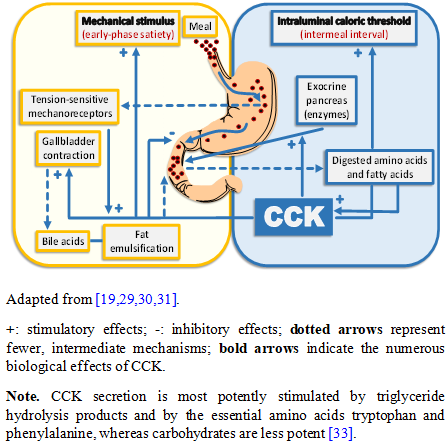
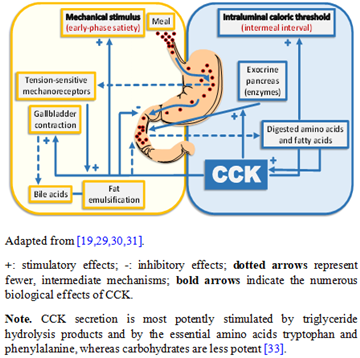
As food is swallowed, gastric distension occurs, triggering the release of CCK, expressed in the hypothalamus, which contributes to the early phase of satiety by promoting meal termination 19, 29, 30, 31. CCK also appears to regulate the intermeal interval by slowing gastric emptying and acting as a peripheral satiety signal in response to intestinal caloric content 30. In addition, CCK induces gallbladder contraction and stimulates pancreatic exocrine secretion 32 (Figure 2).
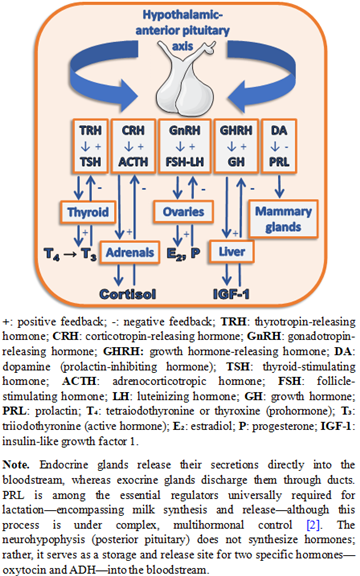
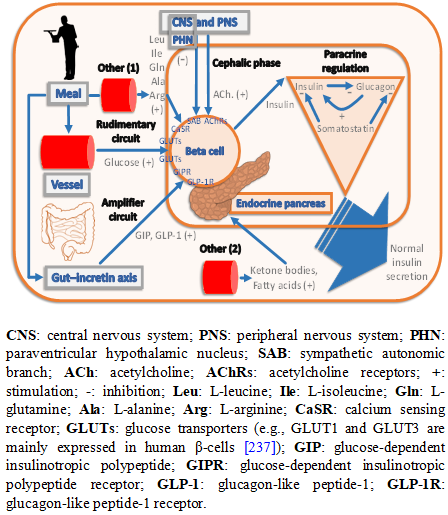
The neuroendocrine system is considered traditional not only because it has been studied for a longer time, but also because it has played a central role in elucidating the functions of major regulatory axes, such as the hypothalamic-pituitary-thyroid and hypothalamic-pituitary-adrenal systems (Figure 1). By contrast, the secretion of certain hormones—such as insulin (51 AAs) and parathyroid hormone (PTH; an 84-amino-acid polypeptide)—is tightly regulated by nutrient or ion concentrations, such as glucose and calcium, respectively 34. A distinct hypothalamus-to-β cell circuit further modulates insulin secretion (see Section 8 and Figure 5) 35, 36, 37.
Metabolism refers to the set of biochemical transformations undergone by all substances in living organisms. It includes two fundamental processes: anabolism, the synthesis of complex molecules, and catabolism, their breakdown. Intermediary metabolism describes these transformations in greater detail, particularly the chemical pathways involved in the production, storage, and utilization of energy. Within this framework, hormones can be broadly classified as anabolic—such as insulin and growth hormone (GH; see Section 11)—or catabolic, such as triiodothyronine (T3) and cortisol, both of which exert significant effects on muscle tissue. Consequently, proximal myopathy may occur in conditions characterized by excessive catabolic hormone activity, such as thyrotoxicosis (Section 6 and Subsection 6.1) and Cushing syndrome (CS) (Subsection 10.1) 38, 39, 40.
Understanding the metabolic effects of hormones enhances the comprehension of the pathophysiology underlying feeding and weight disorders in endocrine diseases. For instance, cortisol receptors are present in most cells of the body, and a well-established relationship exists between elevated cortisol levels and increased adiposity 41. This partially explains the characteristic moon face and central obesity (COB) observed in CS. Moreover, cortisol exerts catabolic effects on proteins, impairing collagen production and protein synthesis. These actions contribute not only to the above-mentioned myopathy but also to skin thinning with striae and delayed wound healing.
Neuroendocrinology—the study of interactions between the nervous and endocrine systems—and neurobiology—the study of nervous system function—are deeply intertwined. Remarkable advances in this interdisciplinary field continue to reveal their convergence, particularly in the regulation of FB and BW.
In this review, particular attention is given to the pre-ingestive, ingestive, and post-ingestive components of normal EB—namely hunger, appetite, satiation, and satiety (see Section 3)—as well as to their alterations, including hyperphagia (or polyphagia), hypophagia, anorexia, pica, food cravings, and disorders of the satiation process (e.g., diabetic gastroparesis). Changes in BW, such as COB and cachexia, are also addressed. Notably, cachexia may occur in untreated thyrotoxic patients and individuals with diabetic neuropathy.
Several excellent studies in the specialized literature use the terms and abbreviations for (FB) and (EB) interchangeably; however, these terms have distinct scopes. In the present work, FB refers to neuroendocrine regulation, experimental models, or physiological mechanisms (e.g., hypothalamic regulation, leptin signaling), whereas EB pertains to the clinical, psychological, or social aspects in humans (e.g., appetite changes in type 2 diabetes mellitus (T2DM), binge eating, patient-reported habits).
Feeding peptides—including peripheral peptide hormones and central neuropeptides—are critical components of the complex signaling network that the CNS orchestrates to regulate energy homeostasis 42. As noted in this introduction, the author carefully specified the number of amino-acid residues in each molecule discussed. Molecular size is an important physicochemical characteristic: molecules with fewer than 50 amino-acid residues are generally classified as peptides, whereas longer chains are termed polypeptides; the precise cutoff varies among sources 43. In fact, all of the peptides introduced above—except irisin, leptin, TNF-α, insulin, and PTH, which are polypeptides—contain fewer than 50 amino-acid residues. By contrast, steroid hormones are low–molecular–weight compounds, including those that regulate FB, such as estrogens (Es) and progesterone (P) (discussed further in Section 9) and cortisol (Section 10).
In addition to the list of abbreviations, frequently recurring terms in this work are presented in full upon first mention, with their corresponding abbreviations used thereafter. Moreover, the term disordered eating (DE) refers to abnormal eating behaviors secondary to endocrine or metabolic disturbances, thereby distinguishing them from primary psychiatric eating disorders, as defined in the Diagnostic and Statistical Manual of Mental Disorders, Fifth Edition (DSM-5) and the International Classification of Diseases, 11th Revision (ICD-11) 44, 45.
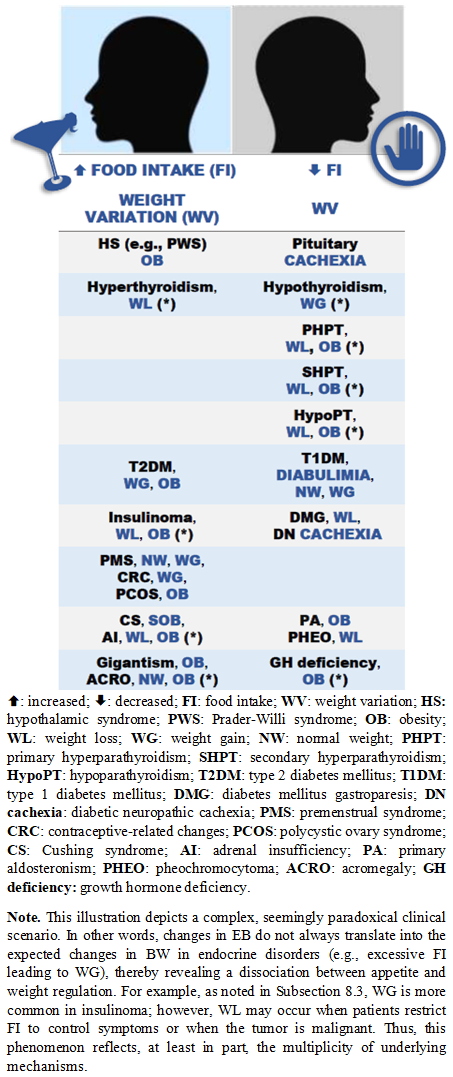
For clarity and didactic synthesis, each disorder section and subsection concludes with a concise Eating Behavior Profile highlighting the principal behavioral alterations. A comparison between alterations in EB and BW is presented in Figure 7 at the end of the work.
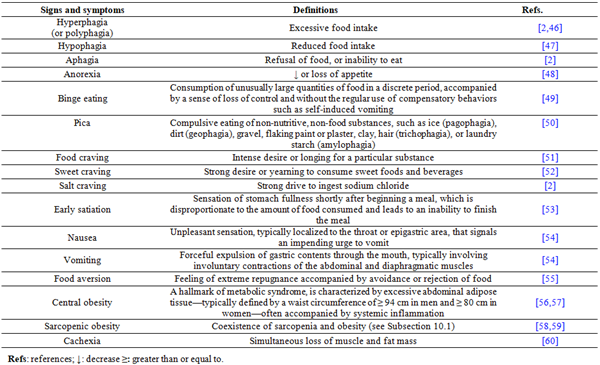
Table 1 summarizes the definitions of the signs and symptoms related to the eating and weight disorders addressed in this review.
The present topic, in addition to being relatively underexplored, is fragmented across the specialized literature. To assemble the pertinent evidence, systematic searches were conducted using predefined keywords in academic search engines (e.g., Google Scholar) and bibliographic databases, including MEDLINE, PubMed, Scopus, Embase, the Cochrane Library, and CINAHL, primarily covering the period from January 2020 to December 2025. Earlier publications of historical relevance were examined irrespective of their year of publication. Articles published in English, French, Spanish, and Portuguese were considered. Eligible sources included peer-reviewed original research articles, narrative and systematic reviews, clinical guidelines, and landmark experimental studies involving human and/or animal models. Case reports, regarded as a foundational component of medical research in the study of rare diseases, were also included as eligible sources. Studies were selected based on their relevance to the topic, methodological rigor, and conceptual contribution to advancing current understanding of the underlying mechanisms. Authoritative textbooks were consulted for foundational and widely accepted concepts, and monographs were reviewed for their specialized and in-depth treatment of specific subtopics.
The review is organized to promote conceptual clarity. An initial integrative overview of FB and BW regulation establishes the physiological foundation, followed by sections dedicated to the traditional neuroendocrine regulatory axes and the consequences of their dysregulation. Each disorder section and subsection concludes with a concise Eating Behavior Profile summarizing the principal behavioral alterations. A final synthesis comparing alterations in EB and BW is presented in Figure 7.
FB and BW are intrinsically interconnected in sustaining life. FB determines energy intake and thus directly influences BW, whereas energy stores—reflected in body mass—reciprocally modulate subsequent feeding. In mammals, AT serves as the principal energy reservoir, storing fat in the form of neutral triacylglycerols (or triglycerides) 61. These energy reserves act as metabolic signals that regulate the drive to eat.
For example, hypothalamic neurons can sense key circulating energy substrates, such as glucose (4 kcal/g) and free fatty acids (9 kcal/g), and initiate essential metabolic responses, including the regulation of FI, metabolic rate or energy expenditure (EE), and glucose homeostasis 62, 63. Leptin, a hormone produced by white AT, crosses the BBB via tanycytes in a leptin-receptor-dependent manner and signals satiety to the hypothalamus, reducing appetite and FI 64, 65, 66, 67. Rodent models of OB, such as the Zucker fa/fa rat, demonstrate how altered FBs (e.g., hyperphagia) and hormonal changes (including hyperinsulinemia and increased opioid activity) contribute to weight gain (WG) 68. This reciprocal interaction between FB and BW exemplifies the homeostatic regulation of energy balance, allowing the body to maintain metabolic stability.
Although the hypothalamus is considered tertiary in the hierarchical organization of neuroendocrine regulation (Figure 1)—following the AP (secondary) and the peripheral endocrine glands (primary)—it nevertheless plays a central role in the neurobiological control of FB. Indeed, hypothalamic lesions—such as those produced by tumor processes—can lead to profound disturbances in FB and BW. For example, damage to the dorsolateral nucleus (the feeding center) may result in aphagia, starvation (or food deprivation), progressive weight loss (WL), cachexia, and ultimately death, whereas injury to the ventromedial nucleus (the satiety center) typically produces hyperphagia and OB, as discussed in Section 4 72, 73, 74, 75, 76.
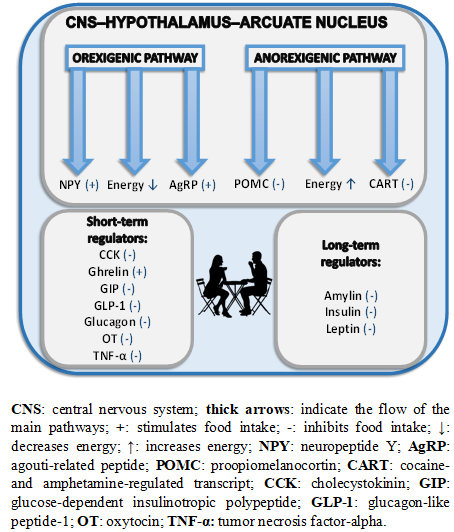
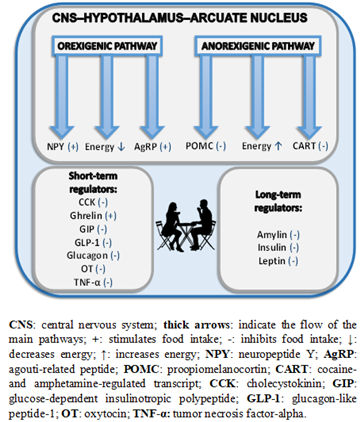
The central neural pathways involved in the homeostatic regulation of FI originate primarily in the arcuate nucleus of the hypothalamus and comprise two key, opposing mechanisms that influence both FI and EE 77. The first is the orexigenic pathway, which secretes neuropeptide Y (NPY)—a 36-amino-acid peptide—and agouti-related peptide (AgRP), a 132-amino-acid polypeptide, whose activation stimulates FI while reducing EE 77, 78. The second is the anorexigenic pathway, which secretes proopiomelanocortin (POMC)—a predominantly pituitary polyprotein that yields multiple active hormones—and cocaine- and amphetamine-regulated transcript (CART), two polypeptides of 129 and 116 AAs generated by alternative splicing, whose activation suppresses FI while increasing EE 77, 79, 80, 81. Short- and long-term regulators of FI are schematically represented in Figure 3 77.
In many contexts, compounds involved in the regulation of FB act either as stimulants—such as corticotropin-releasing hormone (CRH) via cortisol (see Section 10), sauvagine (40 AAs), peptide YY (36 AAs), pancreatic polypeptide (36 AAs), β-endorphin (31 AAs), and dynorphin (17 AAs)—which often promote FI, or as inhibitors—such as CRH, central insulin, vasoactive intestinal polypeptide (28 AAs), bombesin (14 AAs), neurotensin (13 AAs), and cerulenin (a 12-carbon fatty acid amide)—that generally suppress it 82, 83, 84, 85 86, 87, 88, 89 90, 91, 92, 93 94, 95, 96.
Ordinarily, β-endorphin levels rise in response to acute stress due to activation of the hypothalamic–pituitary–adrenal (HPA) axis, and this response occurs rapidly after the onset of the stressor 97. This opioid hormone is released from the POMC precursor 92, 96, 98, 99. The mechanism by which β-endorphin stimulates FI is not yet fully understood, but it is believed to involve self-regulation of POMC neurons through negative feedback 100.
Fatty acid synthase is a multifunctional enzyme system that catalyzes the formation of fatty acids from acetyl-CoA, malonyl-CoA, and nicotinamide adenine dinucleotide phosphate, playing a central role in lipid biosynthesis 101. The naturally occurring inhibitor of this enzyme, cerulenin, together with its more potent synthetic analog C75, has been reported to reduce BW, suppress FI, and increase EE when administered to mice—possibly by acting on hypothalamic glucose-sensing neurons through a leptin-independent mechanism involving malonyl-CoA accumulation 101, 102.
Sauvagine, a peptide isolated from the skin of the South American frog Phyllomedusa sauvagei and structurally related to fish urotensin I and mammalian CRH, inhibits feeding when injected intracerebroventricularly into rats deprived of food for 18 hours 93, 103.
Regarding non-homeostatic processes, components such as emotion, reward, memory, perception, and cognitive control systems each contribute significantly to the regulation of FB 7. For example, memory processes are essential for food-related decision-making, involving the storage of associations between foods and their outcomes that underlie conditioning, while working memory—responsible for maintaining and manipulating information—is critical for integrating goal values; recent research has investigated its role in EBs 104. Cognitive satiety, often termed sensory-specific satiety, has been observed in various contexts involving specific tastes, aromas, and textures 105.
Furthermore, the complexity increases when the microbiota–gut–brain axis is added to the discussion. In fact, the neuroendocrine system constitutes a major bidirectional pathway within this axis, being both influenced by food choices and serving as a key site for host–microbe crosstalk 106. Microbial endocrinology—the study of neuroendocrine host–microbe interkingdom communication—is still in its early stages but provides an important, though not exclusive, lens through which diet, nutrition, and the microbiota–gut–brain axis may be mechanistically linked 106.
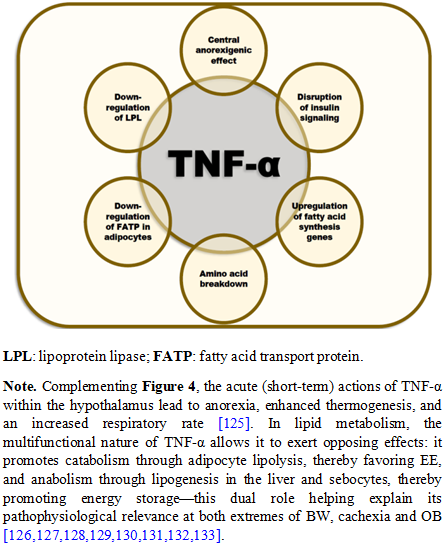
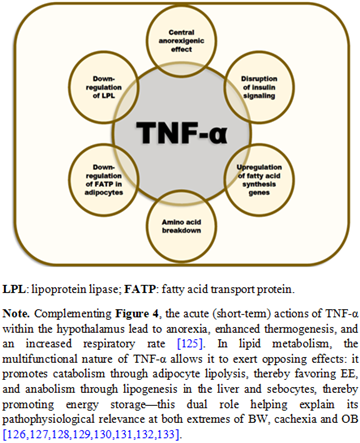
At this point, it is worth emphasizing the theoretical and clinical relevance of TNF-α in the pathophysiology of feeding and weight disorders. First identified in 1975 by Carswell et al. as a serum factor capable of inducing hemorrhagic necrosis in tumors, TNF-α was later found to be identical to cachexin, a mediator of infection-associated wasting 107, 108. It quickly attracted attention for its pleiotropic nature, occupying a central position at the intersection of immunology—as a proinflammatory cytokine and chemokine—endocrinology, and oncology, where it functions as an adipokine 109, 110, 111, 112, 113. Clinically, its levels are elevated at both extremes of BW—cachexia and OB—leading to its original dual designation, TNF-α/cachexin 114, 115, 116, 117, 118 (Figure 4).
In simplified terms, TNF-α from multiple sources (e.g., immune cells, microglia, and adipocytes) exerts anorexigenic effects in the arcuate nucleus of the hypothalamus by inducing production of alpha-melanocyte-stimulating hormone and CART in POMC-expressing neurons and by decreasing production of the orexigenic peptides AgRP and NPY in AgRP neurons via modulation of intracellular AMP-activated protein kinase, which is itself influenced by hormones and energy substrates and integrates orexigenic and anorexigenic signals within the arcuate nucleus 119. In OB, TNF-α is chronically elevated in AT, promoting IR and hyperinsulinemia, and increasing transforming growth factor-β, which is linked to myocardial diseases 117, 120, 121.
An illustrative, hypothetical example of the phases of EB—provided here solely to reinforce understanding—is as follows. Someone asks, “Is there anything to eat?”. This reflects the pre-ingestive phase, in which a nonspecific hunger signal (arousal) triggers the search for food. On a bright summer day, upon opening the refrigerator, the person notices a sweating jar of lemon juice and decides to drink it. This decision represents the ingestive phase, guided by a specific internal signal, or appetite, that initiates eating. Choosing a cold juice on a hot day also exemplifies alliesthesia—the modulation of food-related pleasure according to the body’s internal state—because the cold drink provides cooling relief 141. This phenomenon, whereby a stimulus may feel pleasant (positive alliesthesia) or unpleasant (negative alliesthesia) depending on its physiological relevance, is experimentally demonstrable (e.g., facial expressions and food-hoarding behavior) and relevant to thermal, gustatory, and olfactory sensations, as well as to BW regulation 142, 143. Finally, after drinking the juice, the person feels satisfied and relaxed, marking the post-ingestive phase, in which satiety and drowsiness signal the end of eating.
The hypothalamus lies beneath the thalamus and is separated from it by the hypothalamic sulcus 144. Across species, it is typically partitioned into three longitudinal zones (periventricular, medial, and lateral), each comprising four rostrocaudal regions—preoptic, anterior (supraoptic), tuberal, and mammillary 145.
From 1942 onwards, as noted by Kandel et al. 1, lesion and stimulation studies suggested that the lateral hypothalamus functioned as a feeding center and the medial hypothalamus as a satiety center, since damage or activation of these regions produced opposing effects on FI. However, this model proved overly simplistic, as feeding is regulated by distributed neural circuits rather than discrete centers (see Section 3). The effects of hypothalamic lesions are now understood to arise partly from secondary dysfunctions, including altered sensory processing, disruption of metabolic set points, and impaired behavioral arousal due to damage of dopaminergic pathways.
Hypothalamic syndrome (HS) is a rare disorder resulting from disease- or treatment-related injury to the hypothalamus, most commonly associated with noncancerous parasellar masses—such as craniopharyngiomas, germ cell tumors, gliomas, Rathke’s pouch cysts, and Langerhans cell histiocytosis—as well as with genetic neurodevelopmental syndromes, including Prader–Willi syndrome (PWS) and septo-optic dysplasia 146.
HS is characterized by intractable WG and severe morbid OB, accompanied by multiple endocrine abnormalities, cognitive impairments such as memory deficits and attention problems, reduced impulse control, and an increased risk of cardiovascular and metabolic disorders 146, 147.
PWS warrants particular attention because of its profound impact on FB and BW. First described in 1956, it represents the most common genetic cause of life-threatening OB in humans 148. Characteristically, FB changes dramatically, with an insatiable appetite emerging between 18 months and 2 years of age 148. PWS is also considered a model for understanding the ghrelin system, as it constitutes a unique pathological state marked by severe OB and persistently elevated circulating ghrelin levels across all ages. An early switch in ghrelin dynamics may explain the nutritional phases of the disease—from initial anorexia and failure to thrive to subsequent excessive WG, OB, and hyperphagia 149.
Children with PWS also exhibit characteristic food-related behaviors. In a study of 14 affected children, Holm et al. 150 reported that sneaking food was the most common and serious problem, followed by gorging (observed in half of the children) and the consumption of items typically regarded as unappealing or inedible (e.g., dog and cat food, berries from ornamental bushes). Many other examples of pica in PWS are documented in the specialized literature 151, 152, 153.
Families of the 14 affected children mentioned above also reported additional behaviors, including preoccupation with refrigerators and freezers, persistent worries about food availability, and heightened concern with eating 150.
Hyperphagia, driven in part by elevated ghrelin levels, is the most life-limiting symptom in PWS and underscores the urgent need for new pharmacologic therapies 154.
Eating Behavior Profile: Prader–Willi syndrome as prototype; early anorexia; hyperphagic transition around 18 months of age; food-seeking behaviors (sneaking food, gorging, pica, and preoccupation with food storage).
In 1914, Morris Simmonds (1855–1925) published the first detailed clinical description of pituitary cachexia 69, 70, 155. His account is regarded as the earliest clinical report of anterior pituitary atrophy in humans; in his index patient, the condition was associated with puerperal sepsis and infarction of the anterior lobe 70. The eponym Simmonds disease was introduced in 1922 by L. Lichtwitz 70, 156. As of August 22, 2025, a Google Scholar search retrieved approximately 2,080 results for Simmonds disease and 135 for Simmonds cachexia.
As stated by Uwaifo 157, pituitary cachexia (Simmonds disease) is a syndrome with diverse etiologies that converge on adenohypophyseal failure accompanied by profound wasting. Reported causes include macroadenomas, traumatic injury, infections, and inflammatory diseases—most commonly tuberculosis and syphilis—among others. Improvements in general nutritional status, earlier recognition of underlying disorders, and the widespread availability of multihormone replacement therapy likely account for the declining prevalence, reduced severity, and fewer contemporary reports of Simmonds disease.
Eating Behavior Profile: anorexia; early satiety; decreased food intake in the context of wasting.
The hypothalamic–pituitary–thyroid (HPT) axis is schematically illustrated in Figure 1. Thyroid hormones (THs) play a crucial role in human health. The primary hormone secreted by the thyroid gland is tetraiodothyronine or L-thyroxine (T4), which acts as a prohormone for triiodothyronine (T3)—the biologically active form. T3 exerts widespread physiological effects via high-affinity intranuclear receptors 158. T4 is converted into T3 through monodeiodination, a process mediated by three enzymes collectively known as deiodinases, which regulate the local availability of T3 in target tissues 159.
Euthyroidism refers to a state of normal thyroid function, in which TH levels remain within the physiological range and support appropriate metabolic and physiological regulation 160.
From an etiologic standpoint, thyrotoxicosis with hyperthyroidism denotes a clinical–biochemical syndrome caused by increased synthesis and secretion of THs by the thyroid gland (e.g., Graves disease, toxic adenoma) 161. In contrast, thyrotoxicosis without hyperthyroidism refers to elevated THs levels regardless of source, including nonthyroidal origins (e.g., exogenous hormone ingestion, ectopic thyroid hormone production) 161.
The most common cause of hyperthyroidism is Graves disease, an autoimmune disorder first described in 1835 by Robert James Graves (1796–1853), following earlier posthumous observations by Caleb Hillier Parry (1755–1822), and subsequently described by Karl Adolph von Basedow (1799–1854) in 1840 69, 70, 162, 163. Its global prevalence is estimated at approximately 2% in women and 0.5% in men 163.
Primary hypothyroidism results from intrinsic thyroid dysfunction leading to impaired hormone synthesis 164. Chronic autoimmune thyroiditis—first described in 1912 by Hakaru Hashimoto (1881–1934) in Germany—remains the most common cause of hypothyroidism in iodine-sufficient regions worldwide 164, 165, 166.
Given their broad range of action, THs influence nearly every major physiological system. Consequently, thyroid dysfunction—whether hyperthyroidism or hypothyroidism—can present with a diverse array of signs and symptoms. However, the symptom profile typically reflects either hormone excess or deficiency. For instance, hyperthyroidism is often associated with tachycardia, hyperphagia, WL, and moist skin, while hypothyroidism commonly presents with bradycardia, anorexia, hypophagia, WG, and dry skin. Although the presentation is clearly polarized, these manifestations are sometimes nonspecific and may be misattributed to other medical or psychiatric conditions 167.
Heat intolerance in hyperthyroidism reflects an increase in basal metabolic activity, with enhanced substrate turnover and greater cellular heat production driven by elevated consumption of adenosine triphosphate and oxygen [168]. As a result, patients tend to eat more yet still lose fat stores and muscle mass (Subsection 6.1) [168]. By contrast, hypothyroidism reduces oxygen consumption and carbon dioxide production, leading to a lower EE, diminished substrate catabolism, and often a depressed appetite, as further discussed in Subsection 6.2 [169].
6.1. HyperthyroidismIn hyperthyroidism, rapid WL—ranging from 3 to 20 kg within a few weeks—is common and may occur despite normal or even increased appetite, sometimes approaching true polyphagia 170. This heightened food intake may result from the direct actions of THs on central appetite-regulating circuits 171. Two solute carrier transporters—monocarboxylate transporter 8 and organic anion-transporting polypeptide 1C1—facilitate TH passage across the BBB and into the CNS 172, 173. Notably, T3 directly stimulates FI at the hypothalamic level, and in rodent models, both peripheral and central hypothalamic administration of T3 have been shown to increase FI 171, 174, 175. The nutritional status in affected individuals varies according to age, baseline BW, and the extent to which dietary intake compensates for the elevated EE 170.
According to Daher et al., up to 25% of patients with hyperthyroidism may experience mild to moderate diarrhea with frequent bowel movements 176. Some degree of fat malabsorption is common and may reach up to 35 g/day. In thyrotoxicosis, intestinal hypermotility shortens small bowel transit time—particularly in the presence of diarrhea—and the combination of increased appetite and a high intake of fat-rich foods may contribute to excessive fecal fat loss. Several additional pathophysiological mechanisms may also be involved, including a hypersecretory state of the intestinal mucosa. The adrenergic system appears to play a role, as suggested by improvement in intestinal transit following treatment with the β-adrenergic antagonist propranolol. Furthermore, reduced mixing of food with digestive secretions may impair fat absorption. In addition to propranolol, reducing dietary fat intake can help lessen the frequency of these manifestations (personal unpublished data).
Eating Behavior Profile: normal or, more frequently, increased appetite—sometimes approaching true polyphagia; mild to moderate diarrhea, particularly after fat-rich meals.
6.2. HypothyroidismAs previously mentioned, hypothyroidism can cause hypophagia—reduced FI—despite an overall tendency toward WG. In rodents, central administration of TRH (a tripeptide) and TSH (a glycoprotein of approximately 28 kDa) reduces FI, with peripheral administration of TRH producing similar effects 171, 177. Experimental hypothyroidism also induces a negative energy balance, accompanied by decreased NPY and increased POMC protein levels in the arcuate nucleus, resulting in a predominance of anorexigenic pathways despite central leptin resistance and nuclei-specific impairment of the leptin signaling cascade 178.
Endocrine disorders are commonly investigated as potential causes of OB but are seldom identified, with thyroid dysfunction often being blamed—particularly in adolescents—although hypothyroidism only rarely leads to significant WG, and treatment of thyroid deficiency seldom results in substantial WL 179. In fact, WG in hypothyroidism is generally modest and may even be absent in some patients 180. When present, it primarily reflects water retention rather than fat accumulation. This retention results from reduced T3 levels, which normally inhibit the production of hyaluronic acid by fibroblasts—a hydrophilic glycosaminoglycan of approximately 8 kDa that contributes to tissue edema 2, 180, 181.
Hypothyroidism can also impair GI motility and may contribute to the development or exacerbation of gastroparesis 182. Reduced TH levels decrease overall metabolic activity, including the mechanisms regulating GI motility, which can result in delayed gastric emptying and symptoms of gastroparesis such as early satiety 182.
Eating Behavior Profile: hypophagia; early satiety in the context of delayed gastric emptying (gastroparesis).
6.3. Neurobiological Changes Affecting Food Intake during Thyroid DysfunctionThyroid function is modulated by several neurotransmitters, including catecholamines (which exert sympathetic stimulatory effects), acetylcholine (which mediates parasympathetic inhibitory effects via muscarinic receptors), and various neuropeptides such as NPY and calcitonin gene–related peptide 183, 184. In animal models, chronic peripheral administration of 5-hydroxytryptamine or serotonin has been shown to inhibit TH production by reducing 5’-monodeiodinase activity in tissues such as brown AT, thereby decreasing the local conversion of T₄ to the active T₃ and consequently diminishing EE through reduced thermogenesis 184, 185. Serotonin also exerts an anorexigenic effect by suppressing FI 186.
Conversely, THs can modulate neurotransmitter systems. They may increase dopamine catabolism or alter dopamine receptor sensitivity, potentially contributing to symptoms in individuals predisposed to Parkinson disease (PD) 187. In PD, some patients display food cravings and/or compulsive eating, which can lead to substantial, undesired WG 188.
Ghrelin, a 28–amino acid peptide predominantly secreted by the stomach, is a potent orexigenic (appetite-stimulating) hormone 189. A recent meta-analysis of 23 studies reported that circulating ghrelin levels are significantly lower in patients with hyperthyroidism than in healthy controls, increasing markedly following treatment 190. In hypothyroidism, ghrelin concentrations tend to be slightly elevated, although the difference is not statistically significant 190. These findings, however, do not fully explain the paradoxical clinical manifestations of hyperphagia with WL in hyperthyroidism and anorexia with WG in hypothyroidism.
As previously noted, leptin, secreted by white adipocytes, exerts anorexigenic (appetite-suppressing) effects, whereas NPY, a peptide frequently co-localized with catecholamines in many neurons, stimulates appetite 11, 191, 192. Reported elevations of both leptin and NPY in hyperthyroid and hypothyroid states highlight the complex—and sometimes counterintuitive—interactions between THs and neuroendocrine regulators of appetite 193. More recent data regarding leptin are consistent with this pattern: compared with euthyroid individuals, circulating leptin levels were significantly higher in hypothyroidism and not significantly altered in hyperthyroidism 194.
Overall, thyroid dysfunction disrupts multiple neurobiological pathways that regulate appetite and metabolism, producing paradoxical alterations in both orexigenic and anorexigenic signaling in hyperthyroid and hypothyroid states. These complex and sometimes contradictory patterns highlight persistent gaps in the understanding of the neuroendocrine effects of THs. Bridging these gaps could lead to more accurate diagnostic markers and more targeted therapeutic approaches for metabolic and eating disturbances associated with thyroid disorders.
The parathyroid glands (typically four small glands located posterior to the thyroid) secrete PTH. This polypeptide hormone is the principal regulator of serum calcium and acts on bone, kidney, and intestine to maintain calcium–phosphate homeostasis 195, 196.
7.1. Primary HyperparathyroidismPrimary hyperparathyroidism (PHPT)—characterized by excessive PTH secretion leading to hypercalcemia—is associated with complex eating- and weight-related disturbances that may present in opposite ways: some patients lose appetite and weight, while others show increased adiposity.
Although appetite changes are not always prominent, hypercalcemia can cause GI symptoms such as nausea, constipation, vomiting, and reduced appetite 197, 198. These manifestations can reduce FI and lead to unintentional WL and nutrient deficiencies, which may require targeted dietary interventions 199.
Conversely, numerous studies report a higher prevalence of OB among patients with PHPT, suggesting a significant association between the two conditions even though causality remains unclear 200, 201. Proposed mechanisms include resistance to PTH in target tissues, adipokine resistance, and reduced lipolysis; some reports also link higher serum PTH and larger parathyroid glands to greater body mass index (BMI) in PHPT patients 200, 202, 203. In addition, elevated PTH correlates with higher serum leptin levels, and leptin may stimulate PTH secretion by inhibiting the calcium sensing receptor (CaSR) on parathyroid cells, suggesting potential bidirectional endocrine cross-talk 201, 204. Furthermore, PHPT markedly influences gene regulation in AT, potentially leading to impaired adipocyte function and the release of pathogenic factors that contribute to increased cardiovascular risk 205.
Eating Behavior Profile: nausea; vomiting; constipation; reduced appetite.
7.2. Secondary HyperparathyroidismSecondary hyperparathyroidism (SHPT), most commonly associated with chronic kidney disease (CKD), is characterized by compensatory elevations of PTH in response to hypocalcemia and vitamin D deficiency. Patients frequently experience anorexia related to uremia, altered taste perception, and reduced caloric intake driven by metabolic disturbances 206, 207.
In advanced stages, particularly among patients receiving dialysis, SHPT is associated with DE patterns—notably protein-energy wasting, avoidance of phosphate-rich foods, and poor adherence to complex dietary regimens 208. Diminished appetite has been reported in 40–50% of dialysis patients 208. The combined burden of dietary restrictions together with olfactory and gustatory disturbances contributes to food aversion (see Table 1 for definition) and reduced appetite in CKD, ultimately lowering quality of life and amplifying the impact of parathyroid dysfunction on EB 208, 209, 210.
For the reasons discussed above, WL is recognized as one of the major adverse outcomes of SHPT 211, 212, 213. By contrast, higher BMI—particularly in the OB range—has been associated with higher PTH levels in non-dialysis CKD patients with SHPT, especially among those who also show signs of malnutrition and inflammation 214. Confirmation of these apparently conflicting observations across other CKD populations, together with a clearer characterization of the underlying mechanisms, is required before intentional WL can be recommended as a therapeutic strategy for SHPT in CKD. These findings echo earlier work 215.
Eating Behavior Profile: anorexia; altered taste perception; reduced caloric intake; food aversion and avoidance.
7.3. HypoparathyroidismPTH exerts direct actions on bone resorption and on renal transport of calcium (Ca) and phosphorus, as well as indirect actions on the intestine, where it enhances Ca absorption through increased production of the active form of vitamin D, 1,25-dihydroxycholecalciferol (1,25(OH)₂D) 2, 216. Hypoparathyroidism (HypoPT), characterized by low PTH levels and hypocalcemia (among other alterations), has been less studied with respect to EB and BW. Chronic hypocalcemia, however, can cause neurological symptoms such as irritability, depression, and brain fog—all of which may influence appetite and food choices 217, 218. Brain fog may be defined as an altered state of consciousness in which a person is less wakeful, aware, alert, and focused than usual 219. Patients with HypoPT may thus present with poor appetite and WL 220, 221, 222. While HypoPT is more often associated with reduced appetite and WL 220, 221, 222, the opposite presentation—excessive OB in infancy—points to a different set of concerns. Importantly, patients who develop excessive OB within the first year of life should be considered at high risk for monogenic disorders, including mutations involving guanine nucleotide-binding protein, alpha-stimulating gene exons 1–13 223, 224, 225.
Eating Behavior Profile: reduced appetite in the context of cognitive impairment.
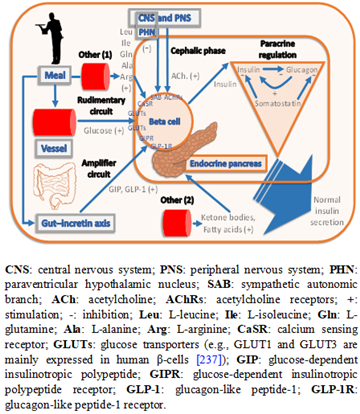
The extraordinary advances to date in the understanding of the histophysiology of the pancreatic islets—first described by Paul Langerhans (1847–1888) in the nineteenth century (1869)—have enabled an integrated and multidimensional view of insulin regulation, the principal hormone of glycemic homeostasis 69. This regulation involves a cascade of mechanisms, beginning with the main insulin secretagogue (ingested glucose), other nutrient stimuli (e.g., amino acids and fatty acids), incretin hormones such as GLP-1 and GIP (which enhance insulin secretion), and the paracrine interactions within the endocrine pancreas (e.g., glucagon from α-cells stimulates insulin secretion, whereas somatostatin from δ-cells inhibits it).
In addition to the tightly regulated secretory control of insulin, the complex cephalic phase of insulin secretion must also be considered. This phase refers to the early release of insulin triggered by food-related sensory stimuli acting on receptors in the head and oropharynx, likely mediated by neural pathways 226. Evidence supporting this neuronal mediation includes the observation that insulin release during this phase is inhibited by trimethaphan (a ganglionic blocker acting via nicotinic receptor antagonism), muscarinic acetylcholine receptor antagonists, and vagotomy (Figure 5) 226, 227. Studies in mice with targeted mutations in M3 muscarinic acetylcholine receptors (M3Rs) further suggest that β-cell M3Rs play a central role in promoting insulin secretion and maintaining glucose homeostasis 228.
Although not depicted in Figure 5 below, the vascular endothelium contributes to insulin action, and tissue-specific endothelial cells are critical for maintaining homeostasis in pancreatic islets and many other tissues 229, 230. The amino acids L-leucine, L-isoleucine, L-glutamine, L-alanine, and L-arginine are particularly important for stimulating β-cell electrical activity and thereby promoting insulin secretion 231. The CaSR functions as a pancreatic nutrient sensor and is expressed in non-calciotropic tissues such as pancreatic α- and β-cells 232. In the gut, CaSR coordinates digestion and nutrient absorption, among other roles 233. The glucose-dependent insulinotropic polypeptide receptor (GIPR) is a member of the class B (class 2) glucagon receptor subfamily of G protein–coupled receptors, which also includes the GLP-1 receptor (GLP-1R) 234, 235, 236.
Building on these molecular insights into insulin action, it is worth noting that the identification of the pancreatic β-cell as the site of insulin secretion is relatively recent, even though the clinical recognition of diabetes mellitus (DM) dates back to antiquity. DM is an endocrine disease that affects more than 400 million people worldwide 232, 238. Type 1 diabetes mellitus (T1DM) is defined by an absolute deficiency of insulin, whereas T2DM involves a relative deficiency. Individuals with T2DM do not require insulin for survival but often need it to achieve optimal glycemic control—typically fasting glucose levels of 70-99 mg/dL, remaining below the renal threshold for glucose (≈180-200 mg/dL) and without glycosuria 239. In such cases, the condition is referred to as insulin-requiring DM.
Furthermore, it is important to note that amylin—a 37‑amino‑acid peptide also known as islet amyloid polypeptide—is a pancreatic β‑cell hormone co‑secreted with insulin in response to nutrient stimuli 240, 241, 242. As an anorectic hormone, amylin contributes to feeding‑related changes in neuronal activity within key structures of the gut–brain axis 241. Abnormal amylin production is a hallmark peripheral pathology in both the early (pre‑diabetic) and late phases of T2DM, where hyperamylinemia (early phase) and hypoamylinemia (late phase) coincide with hyperinsulinemia and hypoinsulinemia, respectively 243. In the late phase of T2DM, amylin may also form amyloid aggregates in the brain, potentially facilitating central Aβ amyloid formation and contributing to neurodegenerative processes 243. Consistent with these findings, recent studies have shown a higher incidence of Alzheimer disease (AD) in individuals with T2DM compared to those without the condition 244. Extending these insights—and based on overlapping mechanisms such as central IR, amyloid accumulation, and neuroinflammation—AD has been proposed as a form of type 3 diabetes, confined primarily to the brain 239, 245. As AD progresses, patients frequently develop significant eating difficulties—particularly once they become fully dependent in their activities of daily living—often requiring specialized nutritional support 246.
Armed with the knowledge summarized above regarding the complex regulation of insulin secretion, the physician can attempt to recreate these physiological circuits—e.g., reducing the impact of glucose intake through dietary guidance and enhancing the gut–incretin axis by using vildagliptin, an incretin-related drug 247. Vildagliptin is a highly selective, orally active inhibitor of dipeptidyl peptidase-4, the enzyme responsible for the inactivation of GLP-1, a naturally occurring incretin hormone, as mentioned above 247, 248.
The so-called incretin effect refers to the phenomenon in which insulin secretion is significantly greater when glucose is administered orally or enterally compared to an isoglycemic intravenous glucose infusion 249. This effect is attributed to the release of the incretin hormones such as GLP-1 and GIP from the gut 249. Incretins thus amplify insulin secretion 250.
However, daily medication use cannot perfectly replicate the physiological regulation of insulin secretion, often resulting in side effects such as hypoglycemia (blood glucose less than 70 mg/dL). The alternating cycles of hyperglycemia and hypoglycemia, with only limited periods of normoglycemia, can lead to changes in EB and BW, as discussed below.
8.1. Diabetes MellitusBecause physiological insulin secretion is no longer finely regulated (see previous section), people with T1DM mainly treated with insulin—the most potent hypoglycemic agent—and those with T2DM receiving sulfonylureas, such as glimepiride or gliclazide (oral hypoglycemic agents), and/or a biguanide such as metformin (an antihyperglycemic agent), or newer agents, live with the constant dual risk of glycemic extremes—from hyperglycemia to hypoglycemia—while striving to maintain near-normoglycemia. As an aggravating factor, cardiovascular disease remains the leading cause of morbidity and mortality in DM 251.
Chronic insulin deficiency, worsened by elevated counter-regulatory (or counter-insulin) hormones such as glucagon, can precipitate a life-threatening metabolic cascade characterized by sustained hyperglycemia, increased plasma osmolarity, osmotic diuresis, polyuria, polydipsia, dehydration, polyphagia, WL, negative potassium balance, muscle weakness (or dynapenia), reduced LPL (an extracellular enzyme), hyperlipidemia (especially hypertriglyceridemia), accelerated lipolysis via hormone-sensitive lipase (an intracellular enzyme), increased availability of free fatty acids as substrates for hepatic ketogenesis, and progressive accumulation of hepatic ketone bodies (KBs) (acetoacetate, 3-β-hydroxybutyrate, and acetone) 122, 252, 253, 254, 255, 256. Increased circulating KBs trigger nausea, abdominal pain, and vomiting (see definitions of nausea and vomiting in Table 1); this can compound the already existing fluid- and electrolyte-depleted state 257. As acidosis deepens, patients may develop Kussmaul respiration, fruity breath, and ultimately impaired consciousness up to coma (total or partial loss of consciousness, voluntary motor function, and sensation) 253. Diabetic ketoacidosis (DKA) is therefore a critical, potentially fatal acute complication in both T1DM and T2DM whose pathophysiology must be understood to ensure effective treatment 258. However, DKA is more common in new-onset or poorly controlled T1DM 254.
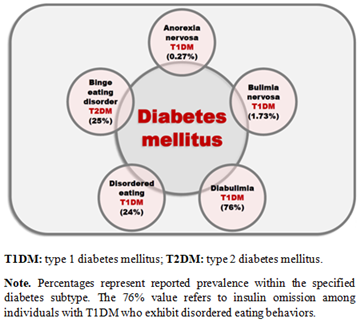
Disordered eating (DE), especially subthreshold forms, is common in both T1DM and T2DM and is associated with poorer glycemic control, higher complication rates, and increased mortality 259. Importantly, the likelihood of diabetic retinopathy is nearly threefold higher in the presence of disordered EBs 260. Eating disorders are about twice as prevalent in young women with T1DM compared with peers without diabetes 261. Additionally, a hospital-based study from Jamia Hamdard University in New Delhi, India, reported a lower prevalence of eating disorders among patients with T2DM than that reported from high-income Western countries 262.
Despite being able to eat freely, people with DM face several challenges in adhering to their dietary regimen, including the need for careful food planning and constant glycemic self-monitoring; denial of the disease’s severity; poor understanding of the diet–disease relationship; misinformation; lack of social support; and feelings of dietary deprivation, among others 263.
Therefore, every consultation should be an opportunity to educate people with DM about daily glycemic monitoring, fostering self-assessment and self-management 264. It is essential to identify restrictive EBs, episodes of overeating, dietary under-reporting, and poor adherence to dietary recommendations, which can lead to suboptimal metabolic control, and to take steps to correct them 263. However, detecting these problems requires specific training, and eating disorders often go unrecognized in diabetes care settings because clinicians may be unaware that DE and WL behaviors can underlie treatment noncompliance and unexplained metabolic impairment in their female patients 265.
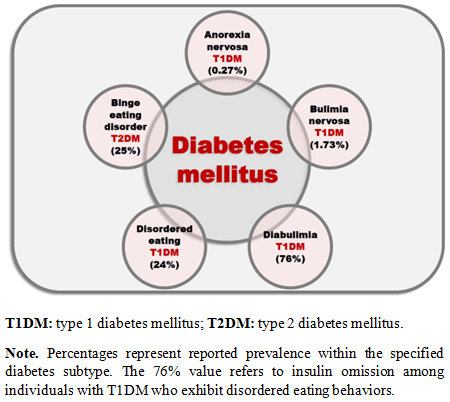
In this context, diabulimia is an emerging DE behavior (Figure 6) characterized by the intentional omission or restriction of insulin by people with T1DM to control weight 266, 267, 268, 269, 270, 271. Although it is not listed as a distinct diagnostic category in the DSM-5, diabulimia represents a high-risk behavior that substantially increases the likelihood of both acute and chronic diabetes complications—including DKA, retinopathy, neuropathy—and premature mortality 44, 268.
The following subsections address chronic complications of DM that have important repercussions on EB and BW, including diabetic gastroparesis (8.2), insulinoma-induced hypoglycemia (8.3), and diabetic neuropathic cachexia (8.4). Regardless of the underlying cause, the clinical manifestations of hypoglycemia are always acute and emergent, requiring prompt healthcare personnel attention. Recognizing these manifestations is essential for both diabetologists and nutritionists, as timely intervention can prevent serious complications—though in many mild cases, a simple cup of hot coffee with sugar will do.
Eating Behavior Profile: polyphagia; nausea, abdominal pain, and vomiting (particularly in uncontrolled hyperglycemic states); restrictive eating and binge-type behaviors.
8.2. Diabetic GastroparesisDiabetic gastropathy is a symptom complex of gastric neuromuscular dysfunction—encompassing functional, contractile, electrical, and sensory abnormalities—associated with DM 272, 273. Its traditional manifestation is diabetic gastroparesis (DG), characterized by delayed gastric emptying 272, 273. DG occurs in T1DM and T2DM, although it is substantially less common in T2DM 272, 273. The estimated 10-year cumulative incidence is approximately 5.2% in T1DM compared to 1% in T2DM 274, 275. The major clinical features of DG include early satiety, loss of appetite, nausea, vomiting, epigastric discomfort, and bloating. WL, however, is reported inconsistently: some authors consider it uncommon, whereas others note that reduced caloric intake in DG patients may lead to significant WL 276, 277.
The pathophysiology of DG is complex and involves multiple factors, with proposed mechanisms including chronic hyperglycemia, vagal nerve dysfunction, disruption of the interstitial cells of Cajal network (specialized pacemaker cells coordinating gastric motility), reduced expression of neuronal nitric oxide synthase in the myenteric plexus, and increased oxidative stress 278, 279. Management focuses on achieving adequate glycemic control and enhancing gastric motility with prokinetic agents, such as domperidone—a type II dopamine receptor antagonist—complemented by dietary modifications and, in selected cases, emerging therapies under investigation 275, 276.
Eating Behavior Profile: early satiety; reduced appetite; nausea and vomiting; epigastric discomfort; bloating.
8.3. Insulinoma-Induced HypoglycemiaInsulinoma is a rare functional pancreatic neuroendocrine tumor, with an incidence of about 4 cases per million person-years 280, 281. It is characterized by autonomous and excessive insulin secretion, leading to recurrent hypoglycemia with symptoms such as confusion, sweating, and palpitations 281. More than 80% of insulinomas are solitary and benign; 7–10% are multiple, often in association with multiple endocrine neoplasia type 1 282, 283.
The diagnostic hallmark of insulinoma was first described by Allen Oldfather Whipple (1881–1963) in 1935 and is known as “Whipple triad,” or descriptively as the “triad of insulinoma” 282, 284, 285. It comprises three features: hypoglycemia-induced symptoms, low blood glucose during episodes, and symptom relief following glucose administration 282.
Most patients with insulinoma develop symptoms 8–10 hours after their last meal, and to relieve these symptoms, they often increase their caloric intake, which can lead to WG 286. During a hypoglycemic episode, increased sweating, tingling, and hunger sensation are mediated by activation of the cholinergic system, whereas nervousness and anxiety are triggered by the catecholaminergic system, imparting urgency to FI 287. In some cases, these compensatory EBs may mimic serious eating disorders, such as binge-eating-like behavior 288.
Although distinct from diabulimia, both conditions illustrate how dysregulated glucose metabolism can drive abnormal eating—insulinoma by triggering eating via pathological hypoglycemia, and diabulimia by resulting from intentional insulin restriction.
Metabolically, hypoglycemia in insulinoma arises primarily from reduced hepatic glucose output rather than from increased peripheral glucose utilization 283, 289. Consequently, it tends to occur predominantly during fasting, when hepatic glucose output becomes the major determinant of glucose homeostasis 283. Insulin suppresses hepatic glucose production by inhibiting glycogenolysis (the breakdown of glycogen) and gluconeogenesis (the synthesis of glucose from non-carbohydrate substrates), while concurrently promoting glycogen synthesis 290. By blocking glycogenolysis (a catabolic pathway) and gluconeogenesis (an anabolic pathway), and stimulating glycogenesis (another anabolic pathway), insulin sharply limits the amount of glucose released into the circulation 291, 292. These coordinated actions underpin the biochemical profile and clinical presentation of insulinoma and form the physiological rationale for both diagnostic assessment and therapeutic strategies.
Clinical observations illustrate these pathophysiological effects. In a report of four patients undergoing surgery for benign insulin-secreting tumors 293, hypoglycemia manifested as chronic neuroglycopenic symptoms, including confusion, personality changes, blurred vision, and loss of consciousness; one patient experienced an inaugural hypoglycemic coma. The most common adrenergic symptoms were asthenia, headache, sweating, and tachycardia, all alleviated by oral glucose administration. All four patients reported WG, with an average BMI of 34.3 kg/m². Indeed, insulin hypersecretion is well known to promote fat accumulation 294.
In a retrospective study of 76 patients diagnosed with insulinoma between 2010 and 2020—including 48 females and 28 males, with a mean age at diagnosis of 52 years—the most frequent symptoms were loss of consciousness (68%), sweating (59%), vertigo (56%), and WG (36%) 295.
A case report of a 24-year-old male medical student with insulinoma described hypoglycemic episodes predominantly during fasting and after exercise 296. The patient also reported increased appetite and gained nearly 20 kg over six months 296.
In contrast, a 94-year-old woman with insulinoma presented without episodes of diaphoresis (profuse sweating) or impaired consciousness and had no recent changes in weight 50, 297. Her appetite varied, appearing to fluctuate with her mood 297. When insulinoma manifests primarily with behavioral changes, it can be mistaken for a psychiatric disorder 298.
Among 59 patients with insulinoma (mean age, 55 years), 42 (71%) reported symptom relief with food intake, 23 (39%) WG, 8 (14%) hunger, and 7 (12%) WL 299. Although WG is more common, WL may occur, particularly when patients restrict food intake to control symptoms or when the tumor is malignant 300, 301.
Collectively, these reports indicate that insulinoma consistently affects EB and BW, although manifestations are heterogeneous. Hypoglycemia often drives increased FI, particularly during fasting or after exercise, leading to hyperphagia and significant WG in many cases. Insulin’s anabolic effects—enhancing glycogen synthesis and promoting fat storage—further contribute to WG. However, some patients, especially older individuals, may show minimal changes in appetite or weight, and behavioral symptoms can mimic psychiatric conditions. Overall, EB and BW alterations in insulinoma reflect a complex interplay between biochemical mechanisms and individual patient factors such as age, metabolic reserve, and symptom perception.
Eating Behavior Profile: intense hunger with urgency to eat; binge-like eating behaviors; neurobehavioral changes mimicking psychiatric conditions.
8.4. Diabetic Neuropathic CachexiaDiabetic neuropathic cachexia (DNC), first described by Max Ellenberg in 1974, is a rare syndrome associated with poorly controlled DM 302, 303, 304, 305. It predominantly affects men with T2DM in their sixth to seventh decades of life, but can affect both types of DM and occurs irrespective of the duration of the DM 306, 307. It is characterized by substantial unintentional WL and the abrupt onset of a symmetric, painful peripheral neuropathy with preserved motor strength 304, 305.
Thus, DNC is a syndrome marked by symmetrical peripheral neuropathy, severe WL (up to 60% of BW), and painful dysesthesias, typically affecting the proximal lower limbs, hands, or lower trunk 308. The pain is usually burning in quality and often accompanied by allodynia–pain sensation generated by low threshold 305, 309. Patients experience significant and rapid WL, marked by emaciation of fat and muscle mass, defining the cachectic state (Table 1) 304, 305, 310.
Marked cutaneous hypersensitivity often renders patients unable to tolerate even light contact, including the touch of bed sheets. As noted, they typically appear severely emaciated and malnourished; oral hypoglycemic agents are ineffective, so insulin is required for glycemic control, with management usually combining insulin therapy, a high-protein diet, and analgesics (e.g., carbamazepine, a tricyclic compound of the dibenzazepine class, or pregabalin, a gamma-aminobutyric acid (GABA) analogue, among others) 308, 311, 312, 313, 314.
Because deficits span all energy-providing macronutrients (i.e., carbohydrates, fats, and proteíns), the malnutrition is proportionate and adopts a marasmic (starvation) pattern in adults 315. Behaviorally, however, the presentation shows little variability: most patients report anorexia (loss of appetite) 302, 303, 304, 310 316, 317, 318, 319 320, 321, 322, 323.
Despite this severe presentation, the prognosis is generally favorable, with most patients regaining their baseline weight and experiencing resolution of painful sensory symptoms within one or two years 302, 303, 304, 305, 308, 323, 324.
Eating Behavior Profile: profound anorexia reflecting a marasmic (starvation-type) pattern.
Figure 1 schematically illustrates the hypothalamic–pituitary–ovarian (HPO) axis. From puberty and adolescence (≈8–18 years) through the reproductive years and into menopause (≈50 years)—typically preceded by perimenopause in the 40s—female physiology is largely regulated by two principal families of sex hormones: estrogens (Es) and progestogens. The main Es, with subscripts indicating the number of hydroxyl groups, are estradiol (E2, the most potent), estrone (E1, of intermediate potency), and estriol (E3, the least potent). Progestogens comprise the natural hormone progesterone (P) as well as its synthetic analogues, the progestins. Estetrol (E4), the estrogen of fetal life, is produced by the fetal liver and is present only during pregnancy, reaching relatively high concentrations in the fetus and lower concentrations in the maternal circulation; notably, it is found only in humans and appears as early as 9 weeks of gestation 325.
Thus, the menstrual cycle represents the coordinated clinical expression of dual estrogen–progesterone influence, with Es predominating in the first (follicular) phase and P in the second (secretory or luteal) phase 326. Their roles are particularly pronounced during pregnancy, when P supports implantation and promotes maternal immune tolerance of the fetus.
In practical terms, when the balance between these hormones is disturbed, characteristic clinical conditions emerge. For instance, relative fluctuations of Es and progestogens underlie premenstrual syndrome (PMS) and influence the choice of hormonal contraception (e.g., combined estrogen–progestin versus progestin-only formulations). Beyond these cyclical disturbances, more chronic dysregulation gives rise to syndromes such as polycystic ovary syndrome (PCOS), first described in 1935 by Irving Freiler Stein (1887–1976) and Michael Leo Leventhal (1901–1971), which has since become one of the most common endocrine disorders in premenopausal women 69, 327, 328, 329, 330, 331.
Accordingly, this section reviews alterations in EB and BW associated with PMS (9.1), contraceptive use (9.2), and PCOS (9.3).
9.1. Premenstrual SyndromePMS comprises recurrent physical, emotional, cognitive, and behavioral symptoms that typically emerge during the luteal phase, 10–14 days before menstruation, and resolve with the onset of bleeding; these symptoms can negatively affect women’s daily functioning and quality of life 332, 333. The physical manifestations often include headache, breast tenderness, abdominal bloating, peripheral edema, fatigue, and WG, whereas the psychological and behavioral symptoms frequently involve irritability, mood swings, increased appetite, food cravings, social withdrawal, anxiety, and depressed mood 332, 334, 335. Importantly, PMS should be distinguished from premenstrual dysphoric disorder, a more severe condition characterized by disabling affective symptoms (e.g., marked irritability, hopelessness, and mood disturbances) and formally recognized in the DSM-5 44, 334. Within this review, the emphasis is placed on eating-related symptoms—particularly appetite, cravings, and EB. In this context, PMS is notably associated with premenstrual cravings for sweets, increased appetite, and indulgence in refined sugar 336.
The pathophysiology of PMS remains complex, imprecise, and not fully understood 337. Several factors may influence the development and severity of PMS symptoms, including genetic predisposition, familial history, variations in female sex hormones (further discussed below), neurotransmitters (e.g., serotonin, opioids, and catecholamines) and their metabolic cofactors (e.g., pyridoxine or vitamin B6 is required for the synthesis of serotonin), inflammatory mediators, and coexisting psychological conditions 338, 339, 340, 341, 342.
Some authors propose that a higher estrogen-to-progesterone ratio—resulting from relatively elevated E or reduced P levels—may contribute to PMS symptoms such as mastalgia, premenstrual anxiety, and menorrhagia 340, 343, 344. In this view, the effects of E may not be sufficiently counterbalanced by P, leading to water retention and mood changes 340, 343, 344. Other investigators, however, report that women with PMS do not exhibit higher E or P concentrations than the general population, and widely accepted explanations for why some women are more sensitive to hormonal fluctuations remain lacking 334.
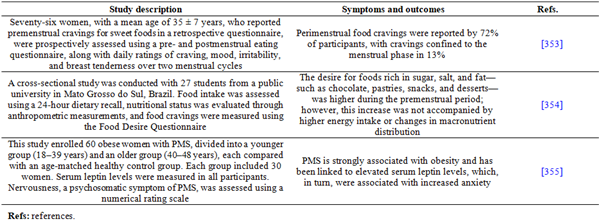
Experimental evidence supports, however, a role of female hormones in fluid and energy balance: in ovariectomized albino rats, Es inhibit both food and water intake, whereas P promotes water intake without affecting BW 345. Similarly, in humans and other species, Es suppress FI and enhance spontaneous activity 346. Additionally, on the one hand, E2 increases the release of satietogenic hormones such as CCK, insulin, and leptin—thereby reducing FI; on the other hand, it inhibits the release of ghrelin in the stomach 347. In contrast, the progesterone-induced increase in appetite is not mediated by ghrelin; in fact, P injection (1 mg) in ewes decreases ghrelin concentration, whereas its simultaneous administration with GH (0.01 mg) increases it 348. Energy intake appears to be lower in the follicular phase than in the luteal phase, with a particularly marked decrease in the days leading up to and including ovulation 349. Table 2.
It is important to note that DM increases the incidence of PMS by disrupting the physiological levels of E, P, serotonin, GABA, as well as by inducing gut dysbiosis, which may further exacerbate PMS severity 350.
The therapeutic scenario of PMS remains elusive. Clinical trials have neither confirmed nor refuted the efficacy of P as a treatment 351. Likewise, vitamin B6 supplementation has been proposed for managing PMS, though evidence supporting its effectiveness remains limited 352.
Eating Behavior Profile: increased appetite; premenstrual food cravings (particularly for sugar, salt, and fat); increased consumption of refined carbohydrates.
9.2. Contraceptive-Related ChangesThe effects of Es and P on EB and BW were outlined in the previous subsection; however, several additional aspects warrant further consideration. Es reduce appetite and FI through central mechanisms, yet they may increase BW—partly owing to hydromineral (fluid) retention—and promote redistribution of fat to the gluteofemoral region 356, 357. In contrast, P increases appetite, FI, and BW in the presence of Es 356. Progestins likewise stimulate appetite and WG and exert anabolic effects 356. Testosterone, the principal human androgen—synthesized mainly by testicular interstitial (Leydig) cells and also produced by the adrenal glands and ovaries—increases appetite and FI via central mechanisms, may promote overeating, favor accumulation of abdominal (visceral) fat, and increase lean body mass 356, 358, 359.
The risk of OB is higher among users of hormonal contraceptives compared with those using non-hormonal methods 360, 361. Moreover, significant WG is almost always attributable to a substantial increase in FI 362.
However, all in all, Es are rather widely recognized for their protective effects against metabolic dysregulation, including their anti-obesogenic properties 363. E1, E2, and E3 undergo extensive metabolism primarily through phase I (hydroxylation, oxidation, and reduction) and phase II (primarily conjugation) reactions, whereas E4 undergoes only phase II reactions 364. Thus, E4 is minimally metabolized—if at all—and is not reconverted to E3 or E2 365. It is not associated with clinically relevant effects on BW and is unlikely to cause WG; indeed, the proportion of women gaining or losing ≥ 2 kg during treatment was similar between those receiving E4/drospirenone (a synthetic progestin) 15 mg/3 mg and those receiving E2 valerate/dienogest (a combination in which dienogest likewise acts as a progestin) 366, 367, 368. Other studies further suggest that E4 may even help prevent WG 369.
Eating Behavior Profile: estrogens tend to reduce appetite; progestogens and androgens tend to increase appetite.
9.3. Polycystic Ovary SyndromePCOS, also known as Stein–Leventhal syndrome, is one of the most common endocrine disorders affecting women of reproductive age 370. The two aforementioned authors, in their seminal report entitled “Amenorrhea associated with bilateral polycystic ovaries” (1935), laid the foundation for identifying this distinct endocrine and reproductive disorder 371, 372. In their historical case series of seven patients, three were obese, one was thin, three had no mention of BW, and no eating-related symptoms were reported 372. Since that first description, however, BW patterns in PCOS have proven heterogeneous, encompassing OB, normal weight (NW), and thinness. Accordingly, this subsection provides a current overview of eating and body weight disorders in PCOS.
Several studies have consistently reported a higher risk and prevalence of DE (e.g., binge-eating symptomatology) and eating disorders (e.g., bulimia nervosa) among patients with PCOS 371, 372, 373, 374 375, 376, 377 378, 379, 380. Nevertheless, food craving—a characteristic feature of this syndrome—represents a transdiagnostic process that underlies clinically significant disordered EBs and eating disorder diagnoses, thereby supporting the need for routine screening for such conditions 376, 378, 381. For greater clarity, a transdiagnostic process refers to a mechanism that occurs across different disorders and acts as either a risk factor or a maintaining factor for the condition 382.
In the U.S., some studies report that the prevalence of overweight and OB among women with PCOS is as high as 80% 383. Outside the U.S., however, the prevalence of OB in affected women is lower, although it has increased over time, with studies reporting rates as low as 20% 383. As previously mentioned, PCOS may manifest with diverse weight patterns, and research often compares NW women with PCOS to their lean and obese counterparts. NW women are more likely to be older at diagnosis and to present with polycystic ovaries, suggesting that PCOS in these cases represents part of a continuous clinical spectrum rather than a distinct entity 384. Other variations in presentation among groups are largely attributable to differences in BW 384, 385. In this regard, the reader is kindly referred to a recent narrative review on the topic 386. In lean women with PCOS, hormonal, metabolic, and hematological profiles are altered compared with healthy counterparts, but these derangements are generally comparable to or less pronounced than those observed in obese women with PCOS 387.
The pathophysiology of PCOS remains poorly understood and continues to pose a challenge. Nevertheless, there is a complex interplay between PCOS, IR, OB, and features of the metabolic syndrome (MS). The relationship among these conditions is multifaceted and often bidirectional: IR exacerbates hyperandrogenism and ovulatory dysfunction, while PCOS itself increases the risk of developing impaired glucose tolerance and T2DM 388.
Eating Behavior Profile: disordered eating patterns (particularly binge-eating symptomatology); increased food cravings.
The hypothalamic–pituitary–adrenal (HPA) axis is schematically depicted in Figure 1. Corticotropin-releasing hormone (CRH), a 41-amino-acid neuropeptide primarily secreted by the paraventricular nucleus of the hypothalamus, stimulates the release of adrenocorticotropic hormone (ACTH), a 39-amino-acid peptide, from the AP. ACTH, in turn, initiates the first enzymatic step of adrenal steroidogenesis through activation of the human cholesterol side-chain cleavage enzyme, cytochrome P450scc, which converts cholesterol to pregnenolone 389, 390, 391 392, 393, 394. Pregnenolone serves as the precursor of all known steroid hormones, and its synthesis from cholesterol via P450scc constitutes the rate-limiting step in steroid hormone production 395.
HPA axis is essential for survival, critically coordinating metabolism and water–electrolyte homeostasis. The adrenal cortex secretes cortisol—the prototypical glucocorticoid—from the middle zona fasciculata; aldosterone—the principal mineralocorticoid—from the outer zona glomerulosa; and dehydroepiandrosterone sulfate from the inner zona reticularis, an adrenal androgen that serves as a precursor for peripheral testosterone and other sex steroids 396, 397.
This section reviews disturbances in EB and BW associated with three adrenal hypersecretion syndromes and one hyposecretion syndrome—Cushing syndrome (glucocorticoid excess, 10.1), adrenal insufficiency (steroid hyposecretion involving cortisol and aldosterone in primary adrenal insufficiency, 10.2), primary aldosteronism (Conn syndrome; aldosterone excess, 10.3), and pheochromocytoma (catecholamine excess arising from the adrenal medulla, 10.4) 398.
10.1. Cushing SyndromeIt is essential to begin this subsection by defining allostasis, a concept that refers to the achievement of stability through change 399. Introduced by P. Sterling and J. Eyer in 1988, this term was coined to clarify ambiguities associated with the word “stress” 399, 400, 401. Allostasis describes the process by which homeostasis—previously defined above—is maintained, while recognizing that physiological set points (i.e., the levels around which regulated systems are adjusted, such as blood pressure, body temperature, or cortisol concentrations) and other regulatory boundaries may shift in response to environmental conditions 2, 399, 402, 403. The primary mediators of this adaptive process include hormones of the HPA axis (e.g., cortisol), catecholamines (e.g., adrenaline), the parasympathetic nervous system, and both pro- and anti-inflammatory cytokines 399, 400, 404. Axes such as the HPA axis operate to maintain these physiological set points 405.
For example, an elevated cortisol set point helps explain the persistently high cortisol levels observed in Cushing syndrome (CS)—the general term for cortisol excess—and in Cushing disease (CD), which specifically arises from a pituitary adenoma. In CD, the corticotroph cells of the pituitary adenoma are reset to a higher-than-normal feedback set point, rendering them less sensitive to glucocorticoid (GC) inhibition. This mechanism has important clinical implications: dexamethasone suppression testing—a diagnostic procedure that uses the synthetic glucocorticoid dexamethasone—can help distinguish pituitary (CD) from ectopic sources of ACTH. Pituitary-driven disease typically shows partial suppression, whereas ectopic ACTH secretion is usually markedly resistant to GC negative feedback 406, 407, 408, 409.
The circadian rhythmicity—i.e., biological rhythms with a periodicity of approximately one day—of plasma glucocorticoids (GCs) has been well characterized in both humans and rats, with extensive evidence indicating daily rhythmicity at every level of the HPA axis 2, 410. The diurnal variation of the HPA axis stress response appears to be closely related to FI as well as basal activity 410. However, CS is marked by disruptions in this rhythmicity, among other alterations 410. Elevated cortisol levels stimulate appetite in humans, and GC infusions have been shown to increase caloric intake in both humans and rats 411, 412. The nighttime elevation of cortisol might also contribute to awakenings to eat, as observed in night eating syndrome 413. Neurobiologically, GC excess stimulates the orexigenic NPY while inhibiting the anorexigenic CRH; together, these effects promote appetite and WG, contributing to the OB of CS 414, 415, 416. Moreover, GCs also promote food-seeking behavior—particularly for foods rich in fat and sucrose—and induce specific cravings that resemble those elicited by stress, ultimately leading to increased BW and preferential central fat accumulation 402, 413, 417 418, 419, 420, 421. Indeed, GCs heighten the salience of pleasurable or compulsive activities (e.g., ingesting sucrose, fat, and drugs, or wheel-running), thereby motivating the consumption of such “comfort foods” and contributing to the systemic increase of abdominal fat depots 422. Consequently, the phenotype of CS is characterized by abdominal and truncal fat accumulation with reduced lean body mass, together with multiple features of the MS—IR, dyslipidemia, hypertension, hypercoagulability, and hypercytokinemia—among others 423.
Contrary to the detailed description of DE in CS presented above, patients with this syndrome may not exhibit overtly abnormal EB; rather, a modest increase in appetite is often observed, and their eating patterns tend to resemble those of individuals with mild OB 424. However, the mechanisms underlying WG in CS are considerably more intricate.
CS is a well-recognized endocrine cause of OB 425, 426, 427. A notable proportion of obese patients—approximately 9.3%—are found to have CS 428. As outlined by Orth et al., the most common sign of CS is progressive COB, characterized by preferential fat accumulation in the face, neck, and trunk, while the extremities are spared or even wasted 429. In adults, this pattern rarely leads to generalized OB, whereas in children it is almost the rule. The reported incidence of COB in CS ranges from 79% to 97%.
More recently, CS has also been regarded as a clinical model for investigating sarcopenic obesity (SOB), as it shares several defining features with this relatively new pathological condition—namely, the coexistence of low lean body mass (or muscle atrophy) and increased fat mass, dynapenia (i.e., reduced muscle strength, occurring in over half of CS patients), and elevated circulating levels of the pro-inflammatory cytokine interleukin-6 430, 431, 432, 433, 434, 435. The inclusion of CS in the study framework of SOB has renewed interest in the former condition, yielding indisputable insights into its convergent pathophysiology.
Of note, an important consideration concerns a very rare form of CS—accounting for fewer than 2% of all cases—caused either by a unilateral adrenal adenoma or by primary bilateral macronodular adrenal hyperplasia 436, 437, 438. In this variant, cortisol secretion becomes stimulable by FI, giving rise to the expression food-dependent CS 436, 437. Here, physiological postprandial increases in GIP abnormally trigger cortisol release because the pathological adrenal tissue ectopically expresses the non-mutated GIP receptor, leading to the alternative designation GIP-dependent CS 436.
GIP is considered a pro-anabolic hormone with significant effects on AT 439. For example, it promotes lipid uptake, lipogenesis, and fat accumulation 436. Conversely, reduced GIP receptor expression impairs these metabolic processes and contributes to IR and OB 436. Dysmetabolism may be defined as a pathological state of energy distribution and storage 440. Indeed, OB is considered a dysmetabolic state because it is strongly associated with a cluster of metabolic dysfunctions and health risks, including—not only IR but also high blood pressure and abnormal lipid levels—among others 441. Experimental evidence further suggests that enhancing GIP receptor activity (through agonism) may confer metabolic benefits—such as improving dyslipidemia and atherosclerosis—independently of BW loss 442, 443.
In contrast to the hypercortisolism of CS, adrenal insufficiency (AI) represents the opposite end of the spectrum of GC action, with equally profound effects on energy balance, metabolism, and EB, as detailed in the following subsection.
Eating Behavior Profile: increased appetite and caloric intake; night eating–type behaviors; food-seeking behavior (particularly for fat- and sugar-rich foods); specific food cravings.
10.2. Adrenal InsufficiencyAt present, in developed countries, 80–90% of cases of primary adrenal insufficiency (AI) are caused by autoimmune adrenalitis, which may occur in isolation (40%) or as part of an autoimmune polyendocrinopathy syndrome (60%) 444. Accordingly, autoimmune Addison disease is characterized by immune-mediated destruction of the adrenal cortex, and antibodies against steroid 21-hydroxylase are detected in approximately 85% of patients with idiopathic primary AI, but only rarely in those with other causes of AI 444.
By contrast, this was not always the case: during the first half of the 20th century, tuberculosis was the most common cause of primary AI 444, 445. Moreover, this historical pattern still persists in many parts of the world: in developing countries, tuberculosis, disseminated fungal infections, and HIV remain significant causes of primary AI 398.
AI is a rare but potentially life-threatening endocrine disorder characterized by inadequate production of steroid hormones by the adrenal cortex—particularly cortisol and aldosterone as mentioned above—resulting in impaired metabolic homeostasis (e.g., reduced cortisol-driven gluconeogenesis), disturbances in fluid and electrolyte balance (especially involving sodium and potassium), and a deficient physiological response to stress 398, 446, 447. The hyponatremia may be exacerbated by hypotension-induced ADH secretion and consequent water retention 446. Clinical manifestations are often nonspecific and include fatigue (50%–95%), nausea and vomiting (20%–62%), and anorexia with WL (43%–73%) 448, 449. Despite the paucity of research on the mechanisms underlying nausea and vomiting in AI, it is well established that these signs and symptoms respond to GC replacement 450.
In rats, GC deficiency increases the anorexigenic CRH and suppresses the orexigenic NPY, a mechanism that may contribute to the anorexia and wasting seen in AI 415. Nonetheless, patients with AI may appear to have a normal appetite, yet reach satiety after minimal food intake 451. Importantly, some studies suggest that patients with idiopathic gastroparesis may have an increased likelihood of AI, highlighting the need for heightened clinical suspicion, although the exact prevalence of AI in this population remains unknown 452.
Aldosterone insufficiency typically manifests with lethargy, muscle cramps, postural hypotension, and salt craving, which may occur even in the absence of overt volume depletion owing to a voluntarily high-salt diet 453, 454. Sodium insufficiency is signaled to the brain through activation of central sodium-sensing mechanisms, osmoreceptors, and cardiac baroreceptors, as well as by elevated circulating levels of angiotensin II—a linear octapeptide hormone—and of aldosterone and corticosterone, the latter being the cortisol equivalent in rodents 455, 456, 457. The specialized literature consistently underscores salt craving as a hallmark manifestation of AI 453, 458, 459, 460, 461, 462, 463, 464. Although this symptom may not always be evident at the initial clinical presentation, it possesses considerable diagnostic value 464, 465. Salt craving appears relatively specific to AI, being reported in approximately 15–20% of cases 458, 466. Some patients “chase” salt intake with lemon juice, whereas others consume remarkably large quantities of salt 460. Additional reports describe a marked preference for salty foods such as peanuts, chips, and liquorice 462.
Whereas traditional presentations of AI typically include WL, contemporary patients may present as overweight or OB, sometimes owing to conditions such as early-onset obesity associated with AI and red hair, or as a late-stage manifestation of the disease 467.
Eating Behavior Profile: salt craving—the hallmark manifestation; nausea, vomiting, and anorexia within a wasting syndrome; early satiety associated with delayed gastric emptying (gastroparesis).
10.3. Conn SyndromeConn syndrome was first described by Jerome W. Conn (1907–1994) in 1955, when he published the inaugural report on primary aldosteronism (PA) in the medical literature 69, 70, 468, 469, 470, 471.
Physiologically, aldosterone promotes sodium reabsorption and potassium excretion, primarily in the kidneys 471. Although cortisol can exert mineralocorticoid effects, the enzyme 11β-hydroxysteroid dehydrogenase type 2 inactivates cortisol to cortisone, thereby permitting aldosterone to serve as the principal ligand of the mineralocorticoid receptor 471.
PA is defined by at least partially autonomous aldosterone production and represents the most common cause of secondary hypertension 470. Its pathophysiology involves dysregulated aldosterone secretion that is independent of renin and not fully suppressed by volume or sodium loading, often occurring despite hypokalemia 471.
Obesity-related hypertension (ORH) is a multifactorial, polygenic condition. Multiple pathogenic mechanisms likely contribute to its development in people with OB, including hyperinsulinemia, activation of the renin–angiotensin–aldosterone system, sympathetic nervous system stimulation, and altered levels of adipokines (for example, leptin) or cytokines acting on the vascular endothelium 472.
Bansal et al. summarized several lines of evidence linking OB with PA 473. Higher serum aldosterone concentrations and urinary aldosterone excretion have been observed in patients with increased BMI or larger waist circumference. In vitro and preclinical studies indicate that adipocytes can both synthesize and secrete aldosterone and release factors that stimulate aldosterone production by the adrenal glands. Aldosterone excess, producing ligand-dependent activation of the mineralocorticoid receptor, has been increasingly recognized as an important mechanism underlying ORH. This aldosterone excess may be conceptualized as acquired hyperaldosteronism, distinguishing it from the traditional, non-obesity-related presentations of PA. A recent meta-analysis reported a higher prevalence of MS among overweight or OB patients with PA 474.
A complex behavioral dimension of eating alterations in PA involves food preferences and habitual dietary patterns. Because food preferences play a key role in shaping eating habits, this aspect has particular clinical relevance 475. In this context, hyperaldosteronism syndromes may promote a preference for a high-salt diet. Supporting this observation, some patients with PA report sodium cravings and consume excessive amounts of salt, thereby creating a convergence of factors that promotes the development of hypertension and its associated complications, including treatment-resistant hypertension, increased target-organ damage, and higher mortality 476. Other eating-behavior-related aspects involving potassium and fructose in PA are more fragmented in the medical literature and remain less well defined.
Eating Behavior Profile: increased preference for high-salt foods; salt craving.
10.4. PheochromocytomaAdrenal pheochromocytoma (PHEO) is a tumor arising from catecholamine-producing chromaffin cells of the adrenal medulla that almost invariably produce, store, release, and metabolize catecholamines—dopamine, norepinephrine (noradrenaline), and epinephrine (adrenaline)—leading to potentially life-threatening systemic effects such as stroke, myocardial infarction, and multiple organ failure 477.
PHEO was first described at autopsy by Felix Fraenkel in 1886 70, 478. Despite being an uncommon but treatable cause of hypertension, it has remained a challenge to clinicians 479.
The role of catecholamines in the regulation of FB and BW is complex and remains incompletely understood. Epinephrine (EPN) can stimulate FI under certain conditions, particularly when injected into specific brain regions or released in response to chronic stress 480. However, in other scenarios, such as systemic administration or during acute stress, EPN can suppress appetite 481, 482.
As described by Thomas et al., beyond these feeding-specific effects, EPN and norepinephrine, the primary effectors of the sympathetic nervous system and adrenal medulla, respectively, regulate adiposity and energy balance through multiple mechanisms 483. They promote catabolism of triglycerides and glycogen, stimulate FI in the CNS, activate thermogenesis in brown adipose tissue (BAT), and modulate heat loss via peripheral vasoconstriction and piloerection. Thermogenesis in BAT is induced by cold exposure and overfeeding, and an inverse relationship exists between diet-induced thermogenesis and OB in both humans and animal models.
In addition to these thermogenic and feeding effects, physiologically, EPN, together with glucagon, GH, and T3, constitutes a counter-regulatory hormonal response that prevents hypoglycemia by stimulating hepatic glucose production and limiting peripheral glucose uptake, thereby influencing FB through CNS signals that restore energy balance.
The understanding of the effects of feeding-related polypeptides on dopaminergic neurons remains incomplete. The ventral tegmental area (VTA), a key hub for reward-seeking behavior, is central to this modulation. In the VTA, pathological hyperinsulinemia disrupts insulin signaling and can increase feeding 484. Leptin inhibits dopaminergic neurons projecting to the ventral striatum in rodents 485. By contrast, ghrelin activates the mesolimbic dopamine system via nitric-oxide–associated mechanisms within the VTA 486.
DE in PHEO is generally linked to excess catecholamine secretion, which induces a hypermetabolic state and leads to WL—often despite normal appetite and FI (see discussion below) 487. Nonetheless, anxiety can markedly suppress appetite 488. Patients may also experience early satiety, nausea, vomiting, and abdominal pain due to the mass effect of the tumor 488, 489 490, 491, 492. Although many symptoms improve or resolve after tumor removal, supportive care—including dietary management and strategies to address anxiety—remains important.
WL is a common manifestation of PHEO and reflects catecholamine-induced hypermetabolism 493, 494. Cachexia is a rarer manifestation 495. In AT, catecholamines acting on β1-adrenergic receptors stimulate hormone-sensitive lipase, mobilizing stored triglycerides into free fatty acids and glycerol 496. Concurrently, α2-adrenergic signaling suppresses pancreatic insulin secretion, blunting a major lipogenic drive—insulin normally promotes lipid storage, in part by stimulating LPL activity 496.
Elevated catecholamines also increase IR and decrease insulin secretion through the above-mentioned α2-adrenergic receptors, resulting in reduced glucose uptake as well as increased gluconeogenesis and glycogenolysis; 15%–35% of patients with PHEO present with impaired glucose tolerance or DM 497.
GI symptoms can also contribute to WL in PHEO, including nausea, vomiting, abdominal pain, and occasionally constipation or diarrhea 498.
Eating Behavior Profile: reduced appetite; early satiety; nausea, vomiting, abdominal pain, and diarrhea.
The hypothalamic–pituitary–growth hormone (GH) axis is illustrated in Figure 1. The regulation of pulsatile GH secretion begins in the hypothalamus, located at the base of the third ventricle in the diencephalon, with the release of growth hormone–releasing hormone (GHRH, a 44-amino-acid peptide) from the arcuate nucleus and somatostatin (a 14-amino-acid peptide) from the periventricular nucleus (PeVN) 499, 500, 501, 502. GH, a glycoprotein composed of 694 amino-acid residues, is secreted by somatotrophs in the anterior pituitary and promotes anabolism and growth in multiple tissues, both directly and indirectly through insulin-like growth factor 1 (IGF-1, a 70-amino-acid polypeptide), which is primarily produced by the liver 499, 503, 504. In AT, however, GH exerts catabolic effects by stimulating lipolysis (via activation of hormone-sensitive lipase) and promoting the release of free fatty acids and glycerol to support lipid metabolism 499, 505. GH, IGF-1, and free fatty acids all inhibit GH release, either directly at the pituitary or indirectly by stimulating somatostatin release from the PeVN 499.
Thus, the traditional effects of GH include stimulation of cell proliferation, tissue and body growth, the previously described lipolysis, and IR 506. Beyond these peripheral actions, as outlined by Egecioglu et al., GH also acts in the CNS, where it influences FB and well-being in humans 507. Experimental evidence in rodents further supports this role, showing that GH increases FI and alters feeding patterns. Consistent with these behavioral effects, both human and rat brains express GH and its receptor in the hypothalamus, hippocampus, and amygdala—regions that regulate feeding, energy balance, and motivation—highlighting a central role in feeding control.
In humans, disruption of the hypothalamic–pituitary–GH axis may result either from GH overproduction and downstream hormonal excess—most often due to pituitary tumors in conditions such as pituitary gigantism (before epiphyseal fusion of the long bones) or acromegaly (after epiphyseal fusion)—or from congenital or acquired GH deficiency, as discussed below 499.
11.1. GigantismPituitary gigantism is a rare condition caused by chronic hypersecretion of GH and IGF-1 due to a pituitary somatotroph adenoma 508. Clinically, in addition to accelerated linear growth before epiphyseal closure, case reports and reviews from the twentieth century to the present consistently describe increased—sometimes voracious—appetite and WG, including OB, in affected patients 508, 509, 510, 511, 512, 513, 514, 515.
Of importance, X-linked acrogigantism (X-LAG) is a recently described syndrome of pituitary gigantism caused by microduplications on chromosome Xq26.3 that encompass the gene GPR101, which is highly upregulated in pituitary tumors. Notably, 7 of 18 patients (38.9%) present with a prior history of increased appetite—or especially other food-seeking behaviors—a feature uncommon in other forms of gigantism 516.
GH is an insulin counter-regulatory hormone (see Subsection 10.4) with profound metabolic consequences for the body. Its actions help explain the development of IR, hyperinsulinism, and the resulting glycemic disturbances, as well as the striking clinical manifestation of acanthosis nigricans—observed in 22.2% of patients with X-LAG—often appearing in the flexural regions of individuals affected by gigantism 516, 517.
Eating Behavior Profile: increased—sometimes voracious—appetite; food-seeking behavior, as seen in X-linked acrogigantism.
11.2. AcromegalyA recent study applied the Hedonic Hunger Scale (HHS), assessed using the Dutch Eating Behavior Questionnaire (DEBQ), to evaluate hedonic hunger—defined as eating for pleasure—and its effects on EBs in patients with acromegaly (ACRO) due to excess GH (n = 55), compared with individuals with non-functional pituitary adenomas (n = 39) and healthy controls without pituitary disease (n = 34) 518, 519. The median ages of patients with ACRO and non-functional adenomas were 53 and 54 years, respectively, while the control group was age-matched (median 53 years) 518. In addition, participants completed the Hospital Anxiety and Depression Scale (HADS) through face-to-face interviews to evaluate psychiatric comorbidities 518. Results showed that average total scores and median values of emotional and external eating on the HHS (DEBQ) were significantly higher in the control group than in the ACRO group. Conversely, in the HADS, the depression subscale score was significantly higher in patients with ACRO compared to those with non-functional adenomas.
According to the DSM-V, individuals with atypical depression are generally more prone to WG and OB than those with typical (melancholic) depression 520.
Although ACRO is associated with an increased risk of psychiatric disorders, including depression, current research does not consistently indicate that atypical depression is more frequent than other forms of depression in patients with ACRO 521, 522. Some studies, however, suggest that chronic depression—which may include features of atypical depression—is relatively common in these patients and can sometimes precede the diagnosis of pituitary pathology 523. Excessive GH secretion and the associated hormonal disturbances in ACRO likely contribute to the psychological burden, including the development of depressive symptoms, although this relationship requires further investigation 521, 524.
OB is common in ACRO, with over 40% of patients exhibiting a body mass index (BMI) greater than 30 kg/m², reflecting a high prevalence of overweight and OB 525. This prevalence correlates positively with disease activity, such that higher IGF-1 levels are associated with higher BMI 526. Although excess GH and IGF-1 often reduce visceral and subcutaneous fat, they simultaneously increase intermuscular fat, contributing to IR and elevated OB risk 527. Furthermore, ACRO is linked to a markedly increased risk of cardiovascular complications—including arrhythmias and cardiomyopathy—which are major contributors to morbidity and mortality in these patients 528.
Eating Behavior Profile: appetite and other eating behaviors usually preserved.
11.3. Growth Hormone DeficiencyChildren with GH deficiency exhibit reduced growth velocity, which typically becomes evident toward the end of the first year of life 529. At this stage, the hormone-dependent phase of childhood growth fails to replace the nutrition-dependent phase of infancy 529. Consequently, affected children may develop truncal OB, a facial appearance that seems younger than their chronological age, and crowding of the facial features toward the midline, suggestive of maxillary hypoplasia 529. In such cases, the primary goal of GH replacement therapy is to restore growth velocity and enable the attainment of adult height within both the normal range and the individual’s target height range (i.e., genetic potential) 530.
According to Wass and Sönksen, in adults with GH deficiency, lean body mass is reduced by approximately 8% (≈4 kg of lean tissue); however, this deficit can be fully reversed after six months of GH replacement therapy 531. Conversely, body fat is typically increased and distributed more centrally (abdominally) than peripherally. A mean reduction of 5 kg in body fat during the first month of GH replacement therapy has been reported, particularly at central sites 531.
GH deficiency is rare but may occur in secondary forms—for example, in neurosarcoidosis, which frequently localizes to the basal brain and may damage hypothalamic centers 532, 533. Such involvement can lead to disturbances in consciousness, body temperature regulation, vascular control, thirst, appetite, and FB 533. Reported manifestations include diabetes insipidus (37.3%), polydipsia (31.9%), changes in smell, taste, and hearing (5.5%), OB or WG (5.5%), hypothermia (4.4%), anorexia (4.4%), growth impairment (3.3%), hypodipsia (2.2%), hyperphagia (2.2%), and nausea (1.1%) 533.
To conclude, it is worth highlighting ghrelin, a potent orexigenic hormone that not only stimulates appetite but also activates GHRH-containing neurons in the arcuate nucleus of the hypothalamus 534. This dual action suggests a complex interplay with leptin in linking the gut, energy homeostasis, and the neuroendocrine regulation of both GH and gonadotropins 535. Despite this central role, circulating ghrelin levels appear to be comparable in ACRO and GH deficiency and, to date, do not seem to contribute meaningfully to the weight and eating disturbances discussed here 536, 537.
Eating Behavior Profile: sensory changes (smell, taste), anorexia or hyperphagia; nausea, as seen in neurosarcoidosis.
In daily clinical practice—based on personal experience, particularly in Manaus (population ≈2,063,689), Brazil—eating and weight disturbances associated with endocrine diseases are most commonly observed in patients with T2DM, followed by thyroid dysfunction and, less frequently, by CS secondary to long-term corticosteroid therapy (iatrogenic CS).
In T2DM, once adequate treatment is initiated, symptoms and metabolic disturbances progressively improve as glycemic variability decreases and near-normoglycemia is reestablished. The earliest symptoms to resolve are typically those of the traditional triad—polyuria, polydipsia, and polyphagia. At this stage, modest WG is common, reflecting metabolic rebalancing as glycosuria subsides and insulin-mediated anabolism is restored.
In thyroid dysfunction, initiation of antithyroid therapy for hyperthyroidism—typically combined with β-blockers—reduces adrenergic activity, particularly tachycardia, until euthyroidism is achieved. In hypothyroidism, restoration of physiological function requires gradual initiation of hormone replacement therapy, largely because the positive inotropic effects of THs can significantly impact cardiac function, especially in the elderly.
In CS, tapering corticosteroid therapy attenuates many manifestations in both behavioral (e.g., improved mood and emotional stability) and biological domains (e.g., reduced IR and improved glycemic control), resulting in overall clinical improvement. However, centripetal redistribution of body fat—namely, COB characterized by fat accumulation in the trunk and abdomen—tends to be more resistant to reversal, owing to factors such as abdominal adipocyte hypertrophy and increased LPL activity 538.
By contrast, public health centers in the world’s more densely populated and cosmopolitan cities diagnose and manage a greater number of rare endocrine disorders, largely owing to a higher concentration of specialists, advanced diagnostic infrastructure, and well-established referral networks.
Figure 7 provides an overview of the alterations in EB and BW associated with the endocrine disorders examined in this work, highlighting notable contradictions.
Nevertheless, the natural history of most endocrine disorders discussed here generally reflects a coherent relationship between FI and BW. Hypothalamic syndromes—particularly PWS—exhibit a clear pathophysiological substrate, namely permanently elevated ghrelin. Other examples include pituitary cachexia; chronic complications of DM, such as gastroparesis with WL and neuropathic diabetic cachexia; and insulinoma, which may lead to hypoglycemia and OB. Disorders of the HPO axis, such as PCOS, are associated with WG or OB. Adrenal diseases show distinct patterns: CS and Conn syndrome often result in COB, whereas PHEO can cause WL. GH imbalances also influence both FI and BW, as seen in gigantism, acromegaly, and GH deficiency. Collectively, these examples highlight the pathophysiologically coherent ways in which endocrine disorders shape EB and BW, underscoring the intricate links between hormonal regulation and energy balance.
However, some endocrine disorders exhibit a seemingly paradoxical relationship between EB and resulting BW. A clear example is thyrotoxicosis with hyperthyroidism, where increased calorigenesis—partly due to the uncoupling of oxidation from phosphorylation, with the uncaptured energy dissipated as heat 539—prevents WG despite hyperphagia. The hypercatabolic effects of excess T3 counterbalance the increased energy intake, causing rapid WL. In contrast, the situation in hypothyroidism is less contradictory: T3 deficiency reduces FI, leading to anorexia, which is consistent with the ongoing hypometabolism, while the modest WG observed is largely due to reduced suppression of hyaluronic acid production and the consequent water retention.
Finally, as discussed in this review, parathyroid disorders are associated with diverse alterations in EB and BW that are only beginning to be understood. Accordingly, careful attention should be given to the emergence of potentially deleterious DE conditions, such as diabulimia. This dynamic area, integrating EB and BW, continues to challenge researchers as the concept of food noise (FN) gains complexity in discussions of OB, weight management, and eating disorders. FN may be defined as persistent thoughts about food that are perceived by the individual as unwanted and/or dysphoric and that may cause harm, including social, mental, or physical problems 540.
Alterations in EB and BW in endocrine disorders arise directly from their underlying pathophysiology, underscoring the need for a thorough, mechanistically specific understanding—an objective pursued in the present work. Knowledge of EB and BW regulation, more broadly, however, is inherently multidisciplinary and should be approached from a broad, integrative perspective.
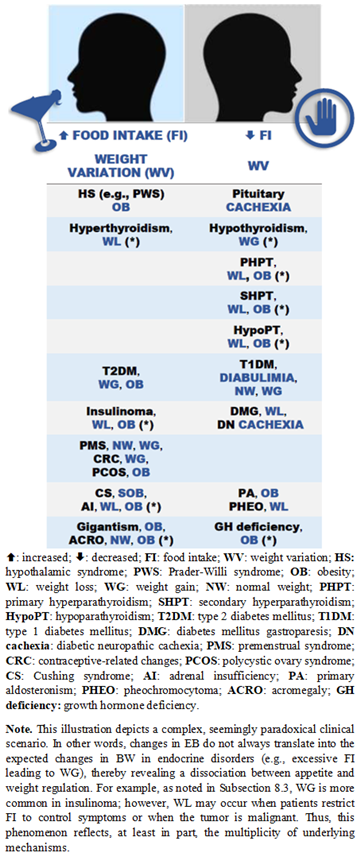
To the engineer Jackson Dinajar Saraiva Feijó, for his unfailing technical assistance throughout my postgraduate trajectory—master’s, doctorate, and early teaching stage (in memoriam).
The author wishes to express sincere gratitude to the librarians of the Instituto Nacional de Pesquisas da Amazônia (INPA, Manaus, Brazil) for their invaluable assistance and dedication in supporting the documentation of this project.
The author also extends heartfelt appreciation to his students, whose steadfast dedication and inquisitive spirit continue to inspire the pursuit of a deeper understanding of the principles of nutrition and metabolic disorders at the Faculty of Medicine, Instituto Metropolitano de Ensino (IME, Manaus, Brazil).
The author declares no conflict of interest.
AAs: amino acids;
ACh: acetylcholine;
AChRs: acetylcholine receptors;
ACRO: acromegaly;
ACTH: adrenocorticotropic hormone;
AD: Alzheimer disease;
ADH: antidiuretic hormone;
AgRP: agouti-related peptide;
AI: adrenal insufficiency;
Ala: L-alanine;
AP: anterior pituitary;
Arg: L-arginine;
AT: adipose tissue;
BAT: brown adipose tissue;
BBB: blood–brain barrier;
BMI: body mass index; BW: body weight; body-weight (attributive form);
Ca: calcium; CART: cocaine- and amphetamine-regulated transcript;
CaSR: calcium-sensing receptor;
CCK: cholecystokinin;
CD: Cushing disease;
CKD: chronic kidney disease;
CNS: central nervous system;
COB: central obesity;
CRC: contraceptive-related changes;
CRH: corticotropin-releasing hormone;
CS: Cushing syndrome;
DA: dopamine (prolactin-inhibiting hormone);
DE: disordered eating/disordered-eating (attributive form);
DEBQ: Dutch Eating Behavior Questionnaire;
DG: diabetic gastroparesis;
DKA: diabetic ketoacidosis;
DM: diabetes mellitus;
DNC: diabetic neuropathic cachexia;
DSM-5: Diagnostic and Statistical Manual of Mental Disorders, 5th edition;
E/Es: estrogen/estrogens;
E1: estrone;
E₂: estradiol;
E3: estriol;
E4: estetrol;
EB/EBs: eating behavior/eating behaviors;
EE: energy expenditure;
EPN: epinephrine;
FATP: fatty acid transport protein;
FB/FBs: feeding behavior/feeding behaviors;
FI: food intake;
FN: food noise;
FSH: follicle-stimulating hormone;
GABA: gamma-aminobutyric acid;
GC/GCs: glucocorticoid/glucocorticoids;
GH: growth hormone;
GHRH: growth hormone-releasing hormone;
GI: gastrointestinal;
GIP: glucose-dependent insulinotropic polypeptide (formerly gastric inhibitory polypeptide);
GIPR: glucose-dependent insulinotropic polypeptide receptor;
Gln: L-glutamine;
GLP-1: glucagon-like peptide-1;
GLP-1R: GLP-1 receptor;
GLUTs: glucose transporters;
GnRH: gonadotropin-releasing hormone;
GRP: gastrin-releasing peptide;
HADS: Hospital Anxiety and Depression Scale;
HHS: Hedonic Hunger Scale;
HPA: hypothalamic–pituitary–adrenal axis;
HPO: hypothalamic–pituitary–ovarian axis;
HPT: hypothalamic–pituitary–thyroid axis;
HS: hypothalamic syndrome;
HypoPT: hypoparathyrodism;
ICD-11: International Classification of Diseases, 11th revision;
IGF-1: insulin-like growth factor 1;
Ile: L-isoleucine;
IR: insulin resistance;
KBs: ketone bodies;
Leu: L-leucine;
LH: luteinizing hormone;
LPL: lipoprotein lipase;
M3Rs: muscarinic acetylcholine receptors;
MS: metabolic syndrome;
NPY: neuropeptide Y;
NW: normal weight/normal-weight (attributive form);
OB: obesity;
ORH: obesity-related hypertension;
OT: oxytocin;
P: progesterone;
PA: primary aldosteronism;
PCOS: polycystic ovary syndrome;
PD: Parkinson disease;
PeVN: periventricular nucleus;
PHEO: pheochromocytoma;
PHN: paraventricular hypothalamic nucleus;
PHPT: primary hyperparathyroidism;
PMS: premenstrual syndrome;
PNS: peripheral nervous system;
POMC: proopiomelanocortin;
PRL: prolactin;
PTH: parathyroid hormone;
PWS: Prader–Willi syndrome;
Refs: references;
SAB: sympathetic autonomic branch;
SHPT: secondary hyperparathyroidism;
SOB: sarcopenic obesity;
T1DM: type 1 diabetes mellitus;
T2DM: type 2 diabetes mellitus;
T₃: triiodothyronine (active hormone);
T₄: tetraiodothyronine or thyroxine (prohormone);
TH/THs: thyroid hormone/thyroid hormones;
TNF-α: tumor necrosis factor-alpha;
TRH: thyrotropin-releasing hormone;
TSH: thyroid-stimulating hormone;
VTA: ventral tegmental area;
WG: weight gain;
WL: weight loss/weight-loss (attributive form);
WV: weight variation;
X-LAG: X-linked acrogigantism.
| [1] | Kandel, E.R., Schwartz, J.H., Jessel, T.M., Principles of neural science, 4 ed., McGraw-Hill, New York, 2000. | ||
| In article | |||
| [2] | Martin, C.R., Dictionary of endocrinology and related biomedical sciences, Oxford University Press, Inc., New York, 1995. | ||
| In article | |||
| [3] | Iovino, M., Messana, T., Marucci, S., Triggiani, D., Giagulli, V.A., Guastamacchia, E., Piazzolla, G., De Pergola, G., Lisco, G., Triggiani, V., “The neurohypophyseal hormone oxytocin and eating behaviors: a narrative review”, Hormones, 23. 15-23. 2023. | ||
| In article | View Article PubMed | ||
| [4] | Leng, G., Sabatier, N., “Oxytocin – the sweet hormone?”, Trends in Endocrinology and Metabolism, 28(5). 365-376. 2017. | ||
| In article | View Article PubMed | ||
| [5] | Chia, C.W., Yeager, S.M., Egan, J.M., “Endocrinology of taste with aging”, Endocrinology and Metabolism Clinics of North America, 52(2). 295-315. 2023. | ||
| In article | View Article PubMed | ||
| [6] | Stricker, E.M., Verbalis, J.G., “Central inhibition of salt appetite by oxytocin in rats”, Regulatory Peptides, 66(1-2). 83-85. 1996. | ||
| In article | View Article PubMed | ||
| [7] | Kanwal, N., Tanveer, M., Shehzad, A., Pasha, I., “Neural control of appetite and food choices in the context of food safety”, in Physiological perspectives on food safety: exploring the intersection of health and nutrition, Sarkar, T., Hamad, A., Chatterjee, A., Eds., Springer, Cham, pp. 133-153, 2025. | ||
| In article | View Article | ||
| [8] | Higos, R., Saitoski, K., Hautefeuille, M., Marcelin, G., Clément, K., Varin-Blank, N., Breton, C., Lecoutre, S., Lambert, M., “The critical role of adipocytes in leukemia”, Biology, 14. 2025. | ||
| In article | View Article PubMed | ||
| [9] | Ataeinosrat, A., Saeidi, A., Abednatanzi, H., Rahmani, H., Daloii, A.A., Pashaei, Z., Hojati, V., Basati, G., Mossayebi, A., Laher, I., Alesi, M.G., Hackney, A.C., VanDusseldorp, T.A., Zouhal, H., “Intensity dependent effects of interval resistance training on myokines and cardiovascular risk factors in males with obesity”, Frontiers in Endocrinology, 13. 2022. | ||
| In article | View Article PubMed | ||
| [10] | Zhang, W., Chang, L., Zhang, C., Zhang, R., Li, Z., Chai, B., Li, J., Chen, E., Mulholland, M., “Central and peripheral irisin differentially regulate blood pressure”, Cardiovascular Drugs and Therapy, 29(2). 121-127. 2015. | ||
| In article | View Article PubMed | ||
| [11] | Prolo, P., Wong, M.-L., Licinio, J., “Leptin”, The International Journal of Biochemistry & Cell Biology, 30(12). 1285-1290. 1998. | ||
| In article | View Article PubMed | ||
| [12] | Guyon, A., Massa, F., Rovère, C., Nahon, J.-L., “How cytokines can influence the brain: a role for chemokines?”, Journal of Neuroimmunology, 198(1-2). 46-55. 2008. | ||
| In article | View Article PubMed | ||
| [13] | Gambino, R., Bo, S., Signorile, A., Menato, G., Pagano, G., Cassader, M., “Comparison of two enzyme immunometric assays to measure tumor necrosis factor-alpha in human serum”, Clinica Chimica Acta, 364(1-2). 349-353. 2006. | ||
| In article | View Article PubMed | ||
| [14] | Cubbon, R.M., Mercer, B.N., Sengupta, A., Kearney, M.T., “Importance of insulin resistance to vascular repair and regeneration”, Free Radical Biology and Medicine, 60(2013). 246-263. 2013. | ||
| In article | View Article PubMed | ||
| [15] | Rasmussen, R.S., Langberg, L.S., Østergaard, F., Nielsen, S.W., Vestergaard, M.B., Skov-Jeppesen, K., Gasbjerg, L.S., “Glucose-dependent insulinotropic polypeptide is involved in postprandial regulation of splanchnic blood supply”, Diabetes, 74(8). 1355-1366. 2025. | ||
| In article | View Article PubMed | ||
| [16] | Rao, R.S., Kini, S., “GIP and bariatric surgery”, Obesity Surgery, 21(2). 244-252. 2011. | ||
| In article | View Article PubMed | ||
| [17] | Khalil, T., Alinder, G., Rayford, P.L., “Gastric inhibitory polypeptide”, in Gastrointestinal endocirnology, Thompson, J.C., Greeley, Jr., G.H., Rayford, P.L., J. Townsend, Jr., C.M., Eds., McGraw-Hill Book Company, New York, pp. 248-259, 1987. | ||
| In article | |||
| [18] | Simsir, I.Y., Soyaltin, U.E., Cetinkalp, S., “Glucagon like peptide-1 (GLP-1) likes Alzheimer’s disease”, Diabetes & Metabolic Syndrome: Clinical Research & Reviews, 12(2018). 469-475. 2018. | ||
| In article | View Article PubMed | ||
| [19] | Pierson, M.E., Comstock, J.M., Simmons, R.D., Kaiser, F., Julien, R., Zongrone, J., Rosamond, J.D., “Synthesis and biological evaluation of potent, selective, hexapeptide CCK-A agonist anorectic agents”, Journal of Medicinal Chemistry, 40(26). 1997. | ||
| In article | View Article PubMed | ||
| [20] | Furuse, M., Ao, R., Bungo, T., Ando, R., Shimojo, M., Masuda, Y., Saito, N., “Central gastrin inhibits feeding behavior and food passage in neonatal chicks”, Life Sciences, 65(3). 305-311. 1999. | ||
| In article | View Article PubMed | ||
| [21] | Jiang, X., Liu, Y., Zhang, X.-Y., Liu, X., Liu, X., Wu, X., Jose, P.A., Duan, S., Xu, F.-J., Yang, Z., “Intestinal gastrin/CCKBR (cholecystokinin B receptor) ameliorates salt-sensitive hypertension by inhibiting intestinal Na+/H+ exchanger 3 activity through a PKC (protein kinase C)-mediated NHERF1 and NHERF2 pathway. Hypertension, 79. 1668-1679. 2022. | ||
| In article | View Article PubMed | ||
| [22] | Reglödi, D., Lubics, A., Szelier, M., Lengvári, I., “Gastrin-and cholecystokinin-like immunoreactivities in the nervous system of the earthworm”, Peptides, 20(5). 569-577. 1999. | ||
| In article | View Article PubMed | ||
| [23] | Wiener, I., Khalil, T., Thompson, J.C., Rayford, P.L., “Gastrin-CCK family”, in Gastrointestinal endocrinology, Thompson, J.C., Greeley, Jr., G.H. Rayford, P.L., Townsend, Jr., C.M., Eds., McGraw-Hill Book Company, New York, pp. 194-212, 1987. | ||
| In article | |||
| [24] | Bliss, E.S., Whiteside, E., “The gut-brain axis, the human gut microbiota and their integration in the development of obesity”, Frontiers in Physiology, 9(900). 2018. | ||
| In article | View Article PubMed | ||
| [25] | Gibbons, A.H., Legon, S., Walker, M.M., Ghatei, M., Calam, J., “The effect of gastrin-releasing peptide on gastrin and somatostatin messenger RNAs in humans infected with Helicobacter pylori”, Gastroenterology, 112(6). 1940-1947. 1997. | ||
| In article | View Article PubMed | ||
| [26] | Sebesta, J.A., Young, A., Bullock, J., Moore, K.H., Azarow, K., Sawin, R.S., “Gastrin-releasing peptide: a potential growth factor expressed in human neuroblastoma tumors”, Current Surgery, 58(1). 86-89. 2001. | ||
| In article | View Article PubMed | ||
| [27] | Bohler, M., Dougherty, C., Tachibana, T., Gilbert, E.R., Cline, M.A., “Gastrin releasing peptide-induced satiety is associated with hypothalamic and brainstem changes in chicks”, Neuroscience Letters, 713(134529). 2019. | ||
| In article | View Article PubMed | ||
| [28] | Harris, A.G., “Somatostatin and somatostatin analogues: pharmacokinetics and pharmacodynamic effects”, Gut, 35(3 Suppl). S1-S4. 1994. | ||
| In article | View Article PubMed | ||
| [29] | Rehfeld, J.F., “Cholecystokinin: clinical aspects of the new biology”, The Journal of Internal Medicine, 298(3). 251-267. 2025. | ||
| In article | View Article PubMed | ||
| [30] | Pappas, T.N., “Physiological satiety implications of gastrointestinal antiobesity surgery”, The American Journal of Clinical Nutrition, 55(2). 571S-572S. 1992. | ||
| In article | View Article PubMed | ||
| [31] | Eftychidis, V., Ellender, T.J., Szymanski, J., Minichiello, L., “Cholecystokinin-expressing neurons of the ventromedial hypothalamic nucleus control energy homeostasis”, Frontiers in Cellular Neuroscience, 18(483368). 2024. | ||
| In article | View Article PubMed | ||
| [32] | Nakae, Y., Onouchi, H., Kagaya, M., Kondo, T., “Interaction among fat, lipase, CCK, and gastric emptying”, Journal of Gastroenterology, 34. 542-544. 1999. | ||
| In article | View Article PubMed | ||
| [33] | Wang, B.J., Cui, Z.J,. “How does cholecystokinin stimulate exocrine pancreatic secretion? From birds, rodents, to humans”, American Journal of Physiology-Regulatory, Integrative and Comparative Physiology. 292(2). R666-R678. 2007. | ||
| In article | View Article PubMed | ||
| [34] | Garrett, G., Sardiwal, S., Lamb, E.J., Goldsmith, D.J.A., “PTH—a particularly tricky hormone: why measure it at all in kidney patients?”, Clinical Journal of the American Society of Nephrology, 8(2). 299-312. 2013. | ||
| In article | View Article PubMed | ||
| [35] | Papazoglou, I., Lee, J.-H., Cui, Z., Li, C., Fulgenzi, G., Bahn, Y.J., Staniszewska-Goraczniak, H.M., Piñol, R.A., Hogue, I.B., Enquist, L.W., Krashes, M.J., Rane, S.G., “A distinct hypothalamus-to-β cell circuit modulates insulin secretion”, Cell Metabolism, 34(2). 285-298. 2022. | ||
| In article | View Article PubMed | ||
| [36] | Lin, Z., Xuan, Y., Zhang, Y., Zhou, Q., Qiu, W., “Hypothalamus and brainstem circuits in the regulation of glucose homeostasis”, American Journal of Physiology-Endocrinology and Metabolism, 328. E588-E598. 2025. | ||
| In article | View Article PubMed | ||
| [37] | Genuth, S.M., “Insulin secretion in obesity and diabetes: an illustrative case”, Annals of Internal Medicine, 87(6). 714-716. 1977. | ||
| In article | View Article PubMed | ||
| [38] | Goswami, R., Shah, P., Ammini, A.C., “Thyrotoxicosis with osteomalacia and proximal myopathy”, Journal of Postgraduate Medicine, 39(2). 89-90. 1993. | ||
| In article | |||
| [39] | Suresh, E., Wimalaratna, S., “Proximal myopathy: diagnostic approach and initial management”, Postgraduate Medical Journal, 89. 470-477. 2013. | ||
| In article | View Article PubMed | ||
| [40] | Braun, L.T., Riester, A., Oßwald-Kopp, A., Fazel, J., Rubinstein, G., Bidlingmaier, M., Beuschlein, F., Reincke, M., “Toward a diagnostic score in Cushing's syndrome”, Frontiers in Endocrinology, 10(766). 2019. | ||
| In article | View Article PubMed | ||
| [41] | Polito, R., Messina, G., Valenzano, A., Scarinci, A., Villano, I., Monda, M., Cibelli, G., Porro, C., Pisanelli, D., Monda, V., Messina, A., “The role of very low-calorie ketogenic diet in sympathetic activation through cortisol secretion in male obese population”, Journal of Clinical Medicine, 10(18). 2021. | ||
| In article | View Article PubMed | ||
| [42] | de Lartigue, G., Raybould, H., Dockray, G., “Introduction to special issue on feeding peptides”, Peptides, 147. 2021. | ||
| In article | View Article PubMed | ||
| [43] | Todaro, B., Ottalagana, E., Luin, S., Santi, M., “Targeting peptides: the new generation of targeted drug delivery systems”, Pharmaceutics, 15(1648). 2023. | ||
| In article | View Article PubMed | ||
| [44] | American Psychiatric Association, Diagnostic and statistical manual of mental disorders (DSM-5), 5 ed., American Psychiatric Publishing, Arlington, 2013. | ||
| In article | View Article | ||
| [45] | World Health Organization, International classification of diseases, Eleventh Revision (ICD-11), 11 ed., World Health Organization, Geneva, 2022. | ||
| In article | |||
| [46] | Stedman's medical dictionary, Lippincott Williams & Wilkins, Baltimore, 2000. | ||
| In article | |||
| [47] | Rammohan, M., Juan, D., Jung, D., “Hypophagia among hospitalized elderly”, Journal of the American Dietetic Association, 89(12). 1774-1779. 1989. | ||
| In article | View Article PubMed | ||
| [48] | McIntyre, N., “Symptoms and signs of liver disease”, in Oxford textbook of clinical hepatology, McIntyre, N., Benhamou, J.-P., Bircher, J., Rizzetto, M., Rodes, J., Eds., Oxford University Press, New York, pp. 271-290, 1991. | ||
| In article | |||
| [49] | Lucia, R., Smith, K., Borton, R., Flinn, L., “Enhancing inclusivity: the crucial role of nurses in supporting students with special educational needs”, in Handbook for educating students with disabilities: implications and strategies, Springer Nature Switzerland, Cham, 2025. | ||
| In article | View Article | ||
| [50] | Dorland's illustrated medical dictionary, W.B. Saunders Company, St. Louis, 1988. | ||
| In article | |||
| [51] | Weingarten, H.P., Elston, D., “The phenomenology of food cravings”, Appetite, 15. 231-246. 1990. | ||
| In article | View Article PubMed | ||
| [52] | Sia, B.T., Low, S.Y., Foong, W.C., Pramasivah, M., Khor, C.Z., Say, Y.H., “Demographic differences of preference, intake frequency and craving hedonic ratings of sweet foods among Malaysian subjects in Kuala Lumpur”, Malaysian Journal of Medicine and Health Science, 9(1). 55-64. 2013. | ||
| In article | |||
| [53] | Tack, J., “Pathophysiology of functional dyspepsia”, in Chronic abdominal and visceral pain, CRC Press, Boca Raton, pp. 417-432, 2006. | ||
| In article | View Article | ||
| [54] | Leslie, T., “Nausea and vomiting”, in Patient assessment in clinical pharmacy: a comprehensive guide, Springer International Publishing, Cham, pp. 79-89, 2019. | ||
| In article | View Article | ||
| [55] | Al-Shanafey, S., AlKhudhur, H., “Food aversion among patients with persistent hyperinsulinemic hypoglycemia of infancy”, Journal of Pediatric Surgery, 47(5). 895-897. 2012. | ||
| In article | View Article PubMed | ||
| [56] | Dousdampanis, P., Aggeletopoulou, I., Mouzaki, A., “The role of M1/M2 macrophage polarization in the pathogenesis of obesity-related kidney disease and related pathologies”, Frontiers in Immunology, 15. 2025. | ||
| In article | View Article PubMed | ||
| [57] | Popiolek-Kalisz, J., “The impact of dietary flavonols on central obesity parameters in Polish adults”, Nutrients, 14(23). 2022. | ||
| In article | View Article PubMed | ||
| [58] | Du, R., Yuan, J., Huang, Y., Jiang, G., Duan, Z., Yang, H., Huang, W., “Sarcopenia is not associated with hypertension, but sarcopenic obesity increases risk of hypertension: a 7-year cohort study”, Frontiers in Public Health, 12(1479169). 2025. | ||
| In article | View Article PubMed | ||
| [59] | Harper, M.E., Dent, R.R., McPherson, R., “High-quality weight loss in obesity: importance of skeletal muscle”, Diabetes. 2025. | ||
| In article | View Article PubMed | ||
| [60] | Gany, S.L.S., Chin, K.-Y., Tan, J.K., Aminuddin, A., Makpol, S., “Preventative and therapeutic potential of tocotrienols on musculoskeletal Duca, F diseases in ageing”, Frontiers in Pharmacology, 14. 2023. | ||
| In article | View Article PubMed | ||
| [61] | Richard, A.J., White, U., Elks, C.M., Stephens, J.M., “Adipose tissue: physiology to metabolic dysfunction”, in Endotext [Internet], Feingold, K.R., Ahmed, S.F., Anawalt, B. et al., Eds., MDText.com, Inc., Dartmouth, 2020. Available from: https:// www. ncbi.nlm. nih.gov/ books/NBK555602/. | ||
| In article | |||
| [62] | .A., Yue, J.T.Y., “Fatty acid sensing in the gut and the hypothalamus: in vivo and in vitro perspectives”, Molecular and Cellular Endocrinology, 397(1-2). 23-33. 2014. | ||
| In article | View Article PubMed | ||
| [63] | Dragano, N.R., Monfort-Pires, M., Velloso, L.A., “Mechanisms mediating the actions of fatty acids in the hypothalamus”, Neuroscience, 447. 15-27. 2020. | ||
| In article | View Article PubMed | ||
| [64] | Alo, B., Lamers, C,. “Crossing barriers: advancements in macromolecular therapeutics for neurodegenerative diseases and strategies to overcome the blood−brain barrier”, ACS Pharmacology & Translational Science, 8(8). 2353-2383. 2025. | ||
| In article | View Article PubMed | ||
| [65] | Levitsky, D.A., Barre, L., Michael, J.J., Zhong, Y., He, Y., Mizia, A., Kaila, S., “The rise and fall of physiological theories of the control of human eating behavior”, Frontiers in Nutrition, 9(826334). 2022. | ||
| In article | View Article PubMed | ||
| [66] | Yeung, A.Y., Tadi, P., “Physiology, obesity neurohormonal appetite and satiety control”. 2020. Available from https:// europepmc.org/ article/ nbk/nbk 555906 [accessed 10 Ago 2025]. | ||
| In article | |||
| [67] | Chu, H., “How the brain regulates food intake?”, Medical and Health Research, 2(6). 2025. | ||
| In article | |||
| [68] | Johnson, P.R., Greenwood, M.R.C., Horwitz, B.A., Stern, J.S., “Animal models of obesity: genetic aspects”, Annual Review of Nutrition, 11(1). 325-353. 1991. | ||
| In article | View Article PubMed | ||
| [69] | Firkin, B.G., Whitworth, J.A,. Dictionary of medical eponyms, The Parthenon Publishing Group, Lancs, New Jersey, 1987. | ||
| In article | |||
| [70] | Medvei, V.C., The history of clinical endocrinology, The Parthenon Publishing Group, Lancs, New York, 1993. | ||
| In article | |||
| [71] | Pearce, J.M.S., “Myxoedema and Sir William Withey Gull (1816–1890”, Journal of Neurology, Neurosurgery & Psychiatry, 77(5). 639-639. 2006. | ||
| In article | View Article PubMed | ||
| [72] | Blocker Jr, W.P., Ostermann, H.J., “Obesity: evaluation and treatment”, Disease-a-Month, 42(12). 829-873. 1996. | ||
| In article | View Article PubMed | ||
| [73] | Carmel, P.W., “Surgical syndromes of the hypothalamus”, Neurosurgery, 27. 133-159. 1980. | ||
| In article | View Article PubMed | ||
| [74] | Dolenc, V.V., Hypothalamic gliomas, Springer-Verlag, Wien. pp. 161-194. 1999. | ||
| In article | View Article PubMed | ||
| [75] | Krieger, D.T., “The hypothalamus and neuroendocrine pathology”, Hospital Practice, 6(11). 127-138. 1971. | ||
| In article | View Article | ||
| [76] | Wang, P.-Z., Ge, M.-H., Su, P., Wu, P.-P., Wang, L., Zhu, W., Li, R., Liu, H., Wu, J.-J., Xu, Y., Zhao, J.-L., Li, S.-J., Wang, Y., Chen, L.-M., Wu, T.-H., Wu, Z.-X., “Sensory plasticity caused by up-down regulation encodes the information of short-term learning and memory”, iScience, 28(4). 2025. | ||
| In article | View Article PubMed | ||
| [77] | Sićović, K., Micov, A., “Pharmacotherapy of obesity: state of the art and perspectives”, Archives of Pharmacy, 74(Notebook 3). 460-482. 2024. | ||
| In article | View Article | ||
| [78] | de Backer, M.W.A., la Fleur, S.E., Adan, R.A.H., “Both overexpression of agouti-related peptide or neuropeptide Y in the paraventricular nucleus or lateral hypothalamus induce obesity in a neuropeptide- and nucleus specific manner”, European Journal of Pharmacology, 660(1). 148-155. 2011. | ||
| In article | View Article PubMed | ||
| [79] | Juo, P.S., Concise dictionary of biomedicine and molecular biology, 2 ed., CRC Press, Boca Raton, 2002. | ||
| In article | View Article PubMed | ||
| [80] | Owe-Larsson, M., Pawłasek, J., Piecha, T., Sztokfisz-Ignasiak, A., Pater, M., Janiuk, I.R., “The role of cocaine- and amphetamine-regulated transcript (CART) in cancer: a systematic review”, International Journal of Molecular Sciences, 24(12). 2023. | ||
| In article | View Article PubMed | ||
| [81] | Slominski, A.T., “Proopiomelanocortin signaling system is operating in mast cells”, Journal of Investigative Dermatology, 126(9). 1934-1936. 2006. | ||
| In article | View Article PubMed | ||
| [82] | Basdevant, A., Le Barzic, M., Guy-Grand, B., Comportement alimentaire: du normal au pathologique, Ardix Médical, Orléans, 1990. | ||
| In article | |||
| [83] | Brown, M.R., Fisher, L.A., Spiess, J., Rivier, J., Rivier, C., Vale, W., “Comparison of the biologic actions of corticotropin-releasing factor and sauvagine”, Regulatory Peptides, 4(2). 107-114. 1982. | ||
| In article | View Article PubMed | ||
| [84] | George, S.A., Khan, S., Briggs, H., Abelson, J.L., “CRH-stimulated cortisol release and food intake in healthy, non-obese adults”, Psychoneuroendocrinology, 35. 607-612. 2010. | ||
| In article | View Article PubMed | ||
| [85] | Gu, J., Restorick, J.M., Blank, M.A., Huang, W.M., Polak, J.M., Bloom, S.R., Mundy, A.R., “Vasoactive intestinal polypeptide in the normal and unstable bladder”, British Journal of Urology, 55(645-647). 645. 1983. | ||
| In article | View Article PubMed | ||
| [86] | Hamid, Q.A., Addis, B.J., Springall, D.R., Ibrahim, N.B.N., Ghatei, M.A., Bloom, S.R., Polak, J.M., “Expression of the C-terminal peptide of human pro-bombesin in 361 lung endocrine tumours, a reliable marker and possible prognostic indicator for small cell carcinoma”, Virchows Archiv A, 411(2). 185-192. 1987. | ||
| In article | View Article PubMed | ||
| [87] | Harris, R.B.S., Gu, H., Mitchell, T.D., Endale, L., Russo, M., Ryan, D.H., “Increased glucocorticoid response to a novel stress in rats that have been restrained”, Physiology & Behavior, 81(4). 557-568. 2004. | ||
| In article | View Article PubMed | ||
| [88] | Krecic, M.R., “Should the canine weight-loss drug dirlotapide be resurrected?”, American Journal of Veterinary Research, 1. 1-3. 2025. | ||
| In article | View Article PubMed | ||
| [89] | Lam, K.S., Gustavson, D.R., Veitch, J.A., Forenza, S., “The effect of cerulenin on the production of esperamicin A1 by Actinomadura verrucosospora”, Journal of Industrial Microbiology and Biotechnology, 12(2). 99-102. 1993. | ||
| In article | View Article PubMed | ||
| [90] | Leiter, A.B., Montminy, M.R., Jamieson, E., Goodman, R.H., “Exons of the human pancreatic polypeptide gene define functional domains of the precursor”, Journal of Biological Chemistry, 260(24). 13013-13017. 1985. | ||
| In article | View Article PubMed | ||
| [91] | Lindberg, I., Fricker, L.D., “Obesity, POMC, and POMC-processing enzymes: surprising results from animal models”, Endocrinology, 162(12). 1-9. 2021. | ||
| In article | View Article PubMed | ||
| [92] | Negri, L., Noviello, L., Noviello, V., “Effects of sauvagine, urotensin I and CRF on food intake in rats”, Peptides, 6. 53-57. 1985. | ||
| In article | View Article PubMed | ||
| [93] | Ouyang, Q., Zhou, J., Yang, W., Cui, H., Xu, M., Yi, L., “Oncogenic role of neurotensin and neurotensin receptors in various cancers”, Clinical and Experimental Pharmacology and Physiology, 44(8). 841-846. 2017. | ||
| In article | View Article PubMed | ||
| [94] | Reichlin, S., “Neuroendocrinology”, in Williams textbook of endocrinology, Wilson, J.D., Foster, D.W., Eds., W.B. Saunders Company, Philadelphia, pp. 135-219, 1992. | ||
| In article | |||
| [95] | Roschina, O.V., Levchuk, L.A., Boiko, A.S., Michalitskaya, E.V., Epimakhova, E.V., Losenkov, I.S., Simutkin, G.G., Loonen, A.J.M., Bokhan, N.A., Ivanova, S.A., “Beta-endorphin and oxytocin in patients with alcohol use disorder and comorbid depression”, Journal of Clinical Medicine, 10(23). 5696. 2021. | ||
| In article | View Article PubMed | ||
| [96] | Watson, S.J., Akil, H., Fischli, W., Goldstein, A., Zimmerman, E., Nilaver, G., van Wimersma Griedanus, T.B., “Dynorphin and vasopressin: common localization in magnocellular neurons”, Science, 216(4541). 85-87. 1982. | ||
| In article | View Article PubMed | ||
| [97] | Marchant-Forde, J.N., Lay Jr., D.C., McMunn, K.A., Cheng, H.W., Pajor, E.A., Marchant-Forde, R.M., “Postnatal piglet husbandry practices and well-being: the effects of alternative techniques delivered in combination”, Journal of Animal Science, 92(3). 1150-1160. 2014. | ||
| In article | View Article PubMed | ||
| [98] | Allely, C.S., “Pain sensitivity and observer perception of pain in individuals with autistic spectrum disorder”, The Scientific World Journal, 2013(1). 916178. 2013. | ||
| In article | View Article PubMed | ||
| [99] | Harada, N., Nomura, M., Yoda, Y., Matsumura, S., Inui, H., Yamaji, R., “Food texture affects glucose tolerance by altering pancreatic β-cell function in mice consuming high-fructose corn syrup”, PloS One, 15(5). e0233797. 2020. | ||
| In article | View Article PubMed | ||
| [100] | Gonzalez, J.D.Z., Mottinelli, M., McCurdy, C.R., de Lartigue, G., McMahon, L.R., Wilkerson, J.L., “Mitragynine and morphine produce dose-dependent bimodal action on food but not water intake in rats”, American Journal of Physiology-Regulatory, Integrative and Comparative Physiology, 327(6). R568-R579. 2024. | ||
| In article | View Article PubMed | ||
| [101] | Mullen, G.E., Yet, L., “Progress in the development of fatty acid synthase inhibitors as anticancer targets”, Bioorganic & Medicinal Chemistry Letters, 25(20). 4363-4369. 2015. | ||
| In article | View Article PubMed | ||
| [102] | Shu, I.W., Lindenberg, D.L., Mizuno, T.M., Roberts, J.L., Mobbs, C.V., “The fatty acid synthase inhibitor cerulenin and feeding, like leptin, activate hypothalamic pro-opiomelanocortin (POMC) neuron”, Brain Research, 985(1). 1-12. 2003. | ||
| In article | View Article PubMed | ||
| [103] | Zhou, H., Ge, C., Chen, A., Lu, W., “Dynamic expression and regulation of urotensin I and corticotropin-releasing hormone receptors in ovary of olive flounder Paralichthys olivaceus”, Frontiers in Physiology, 10(1045). 2019. | ||
| In article | View Article PubMed | ||
| [104] | Higgs, S., Spetter, M.S., “Cognitive control of eating: the role of memory in appetite and weight gain”, Current Obesity Reports, 7(1). 50-59. 2018. | ||
| In article | View Article PubMed | ||
| [105] | Iborra-Bernad, C., Saulais, L., Petit, E., Giboreau, A., “Sensory analysis and observational study in an experimental restaurant: pilot study”, International Journal of Gastronomy and Food Science, 13. 47-51. 2018. | ||
| In article | View Article | ||
| [106] | Lyte, J.M., “Eating for 3.8× 10¹³: examining the impact of diet and nutrition on the microbiota-gut-brain axis through the lens of microbial endocrinology”, Frontiers in Endocrinology, 9. 1-53. 2019. | ||
| In article | View Article PubMed | ||
| [107] | Carswell, E., Old, L.J., Kassel, R., Green, S., Fiore, N., Williamson, B., “An endotoxin-induced serum factor that causes necrosis of tumors”, Proceedings of the National Academy of Sciences, 72(9). 3666-3670. 1975. | ||
| In article | View Article PubMed | ||
| [108] | Beutler, B., Cerami, A., “The biology of cachectin/TNF–a primary mediator of the host response”, Annual Review of Immunology, 7(1). 625-655. 1989. | ||
| In article | View Article PubMed | ||
| [109] | Josephs, S.F., Ichim, T.E., Prince, S.M., Kesari, S., Marincola, F.M., Escobedo, A.R., Jafri, A., “Unleashing endogenous TNF-alpha as a cancer immunotherapeutic”, Journal of Translational Medicine, 16(242). 2018. | ||
| In article | View Article PubMed | ||
| [110] | Michev, A., Orsini, A., Santi, V., Bassanese, F., Veraldi, D., Brambilla, I., Marseglia, G.L., Savasta, S., Foiadelli, T., “An overview of the role of tumor necrosis factor-alpha in epileptogenesis and its terapeutic implications”, Acta Bio Medica: Atenei Parmensis, 92(Suppl 4). e2021418. 2021. | ||
| In article | |||
| [111] | Cawthorn, W.P., Sethi, J.K., “TNF-α and adipocyte biology”, FEBS Letters, 582(1). 117-131. 2008. | ||
| In article | View Article PubMed | ||
| [112] | Drewa, J., Lazar-Juszczak, K., Adamowicz, J., Juszczak, K., “Periprostatic adipose tissue as a contributor to prostate cancer pathogenesis: a narrative review”, Cancers, 17(3). 372. 2025. | ||
| In article | View Article PubMed | ||
| [113] | Petrák, O., Haluzíková, D., Kaválková, P., Štrauch, B., Rosa, J., Holaj, R., Vránková, A.B., Michalský, D., Haluzík, M., Zelinka, T., Widimský, Jr., J., “Changes in energy metabolism in pheochromocytoma”, The Journal of Clinical Endocrinology & Metabolism, 98(1651-1658). 1651. 2013. | ||
| In article | View Article PubMed | ||
| [114] | Piguet, P.F., Collart, M.A., Grau, G.E., Kapanci, Y., Vassalli, P., “Tumor necrosis factor/cachectin plays a key role in bleomycin-induced pneumopathy and fibrosis”, The Journal of Experimental Medicine, 170(3). 655-663. 1989. | ||
| In article | View Article PubMed | ||
| [115] | Andrade Jr., M.C., “Reconhecendo os distúrbios do comportamento alimentar, do peso corporal e da nutrição em medicina interna: aspectos terminológicos, fisiopatológicos e semiológicos”, Parte 1. Jornal Brasileiro de Medicina, 80(3). 22. 2001. | ||
| In article | |||
| [116] | Reid, M.B., Li, Y.-P., “Tumor necrosis factor-α and muscle wasting: a cellular perspective”, Respiratory Research, 2(269). 2001. | ||
| In article | View Article PubMed | ||
| [117] | Samad, F., Uysal, K.T., Wiesbrock, S.M., Loskutoff, D.J., “Tumor necrosis factor α is a key component in the obesity-linked elevation of plasminogen activator inhibitor 1”, Proceedings of the National Academy of Sciences, 96(12). 6902-6907. 1999. | ||
| In article | View Article PubMed | ||
| [118] | Hotamisligil, G.S., Spiegelman, B.M., “Tumor necrosis factor alpha: a key component of the obesity-diabetes link”, Diabetes, 43(11). 1271-1278. 1994. | ||
| In article | View Article PubMed | ||
| [119] | Patsalos, O., Dalton, B., Leppanen, J., Ibrahim, M.A.A., Himmerich, H., “Impact of TNF-α inhibitors on body weight and BMI: a systematic review and meta-analysis”, Frontiers in Pharmacology, 11(481). 2020. | ||
| In article | View Article PubMed | ||
| [120] | Frangogiannis, N.G., “Transforming growth factor-β in myocardial disease”, Nature Reviews Cardiology, 19(7). 435-455. 2022. | ||
| In article | View Article PubMed | ||
| [121] | Khan, S., Aldawood, Y., Shaikh, A.H., Zobairi, A., Nabilah, U., Alqahtani, H.M., Vaali-Mohammed, M.-A., “Tumor necrosis factor-alpha’s role in the pathophysiology of colon cancer”, Diseases, 13(6). 2025. | ||
| In article | View Article PubMed | ||
| [122] | Andrade Jr., M.C., “Lipoprotein lipase: a general review”, Insights in Enzyme Research, 2(1). 2018. | ||
| In article | View Article | ||
| [123] | Wu, G., Brouckaert, P., Olivecrona, T., “Rapid downregulation of adipose tissue lipoprotein lipase activity on food deprivation: evidence that TNF-α is involved”, American Journal of Physiology-Endocrinology and Metabolism, 286(5). E711-E717. 2004. | ||
| In article | View Article PubMed | ||
| [124] | Xu, C., Ezzi, S.H.A., Zou, X., Dong, Y., Alhaskawi, A., Zhou, H., Kota, V., Abdulla, M.H.A.H., Abdalbary, S.A., Lu, H., “The role of TNF in metabolic disorders and liver diseases”, Cytokine, 190(156933). 2025. | ||
| In article | View Article PubMed | ||
| [125] | Burfeind, K.G., Michaelis, K.A., Marks, D.L., “The central role of hypothalamic inflammation in the acute illness response and cachexia”, Seminars in Cell & Developmental Biology, 54. 42-52. 2015. | ||
| In article | View Article PubMed | ||
| [126] | Chen, X., Xun, K., Chen, L., Wang, Y., “TNF-α, a potent lipid metabolism regulator”, Cell Biochemistry and Function: Cellular Biochemistry and its Modulation by Active Agents or Disease, 27(7). 407-416. 2009. | ||
| In article | View Article PubMed | ||
| [127] | Choi, J.J., Park, M.Y., Lee, H.J., Yoon, D., Lim, Y., Hyun, J.W., Zouboulis, C.C., Jin, M., “TNF-α increases lipogenesis via JNK and PI3K/Akt pathways in SZ95 human sebocytes”, Journal of Dermatological Science, 65(3). 179-188. 2012. | ||
| In article | View Article PubMed | ||
| [128] | Feingold, K.R., Soued, M., Staprans, I., Gavin, L.A., Donahue, M.E., Huang, B.J., Moser, A.H., Gulli, R., Grunfeld, C., “Effect of tumor necrosis factor (TNF) on lipid metabolism in the diabetic rat. Evidence that inhibition of adipose tissue lipoprotein lipase activity is not required for TNF-induced hyperlipidemia”, The Journal of Clinical Investigation, 83(4). 1116-1121. 1989. | ||
| In article | View Article PubMed | ||
| [129] | Feingold, K.R., Grunfeld, C., “Tumor necrosis factor-alpha stimulates hepatic lipogenesis in the rat in vivo”, The Journal of Clinical Investigation, 80(1). 184-190. 1987. | ||
| In article | View Article PubMed | ||
| [130] | Grunfeld, C., Dinarello, C.A., Feingold, K.R., “Tumor necrosis factor-α, interleukin-1, and interferon alpha stimulate triglyceride synthesis in HepG2 cells”, Metabolism, 40(9). 894-898. 1991. | ||
| In article | View Article PubMed | ||
| [131] | Laurencikiene, J., van Harmelen, V., Nordström, E.A., Dicker, A., Blomqvist, L., Näslund, E., Langin, D., Arner, P., Rydén, M., “NF-κB is important for TNF-α-induced lipolysis in human adipocytes”, Journal of lipid research. Journal of Lipid Research, 48(5). 1069-1077. 2007. | ||
| In article | View Article PubMed | ||
| [132] | Rydén, M., Arvidsson, E., Blomqvist, L., Perbeck, L., Dicker, A., Arner, P., “Targets for TNF-α-induced lipolysis in human adipocytes”, Biochemical and Biophysical Research Communications, 318(1). 168-175. 2004. | ||
| In article | View Article PubMed | ||
| [133] | Sharma, V.M., Puri, V., “Mechanism of TNF-α-induced lipolysis in human adipocytes uncovered”, Obesity, 24(5). 990. 2016. | ||
| In article | View Article PubMed | ||
| [134] | Andrade Jr., M.C., “Comportamento alimentar: generalidades e fisiopatologia: parte 1”, Jornal Brasileiro de Medicina, 86(4). 22-38. 2004. | ||
| In article | |||
| [135] | Castonguay, T.W., Applegate, E.A., Upton, D.E., Stern, J.S., “Hunger and appetite: old concepts / new distinctions”, Nutrition Reviews, 41(4). 101-110. 1983. | ||
| In article | View Article PubMed | ||
| [136] | Bellisle, F., “Faim et satiété, contrôle de la prise alimentaire”, Encyclopédie Médico-Chirurgicale, 2. 179-197. 2005. | ||
| In article | View Article | ||
| [137] | Cornil, Y., “Mind over stomach: a review of the cognitive drivers of food satiation”, Journal of the Association for Consumer Research, 2(4). 419-429. 2017. | ||
| In article | View Article | ||
| [138] | Pallotta, N., Pezzotti, P., Corazziari, E., “Relationship between antral distension and postprandial symptoms in functional dyspepsia”, World Journal of Gastroenterology, 12(43). 6982. 2006. | ||
| In article | View Article PubMed | ||
| [139] | Pallotta, N., Pezzotti, P., Calabrese, E., Baccini, F., Corazziari, E., “Relationship between gastrointestinal and extra-gastrointestinal symptoms and delayed gastric emptying in functional dyspeptic patients”, World Journal of Gastroenterology, 11(28). 4375. 2005. | ||
| In article | View Article PubMed | ||
| [140] | Wells, A.S., Read, N.W., “Influences of fat, energy, and time of day on mood and performance”, Physiology & Behavior, 59(6). 1069-1076. 1996. | ||
| In article | View Article PubMed | ||
| [141] | Cabanac, M., “Physiological role of pleasure”, Science, 173(4002). 1103-1107. 1971. | ||
| In article | View Article PubMed | ||
| [142] | Cabanac, M., Brondel, L., Cabanac, A., “Alliesthesia. Up-date of the word and concept”, American Journal of Biomedical Science & Research, 8(4). 313-320. 2020. | ||
| In article | View Article | ||
| [143] | Cabanac, M., “Sensory pleasure and homeostasis”, in Beyond environmental comfort, Ong, B.L., Ed., Routledge, New York. pp. 17-35, 2013. | ||
| In article | |||
| [144] | ten Donkelaar, H.J., Hori, A., “The hypothalamus, the preoptic area, and hypothalamohypophysial systems”, in Clinical neuroanatomy: brain circuitry and its disorders, 2 ed., Ten Donkelaar, H.J., Ed., Springer Nature Switzerland AG, Cham, pp. 711-744, 2020. | ||
| In article | View Article | ||
| [145] | Zhang, J.-H., Sampogna, S., Morales, F.R., Chase, M.H., “Orexin (hypocretin)-like immunoreactivity in the cat hypothalamus: a light and electron microscopic study”, Sleep, 24(1). 67-76. 2001. | ||
| In article | View Article PubMed | ||
| [146] | Müller, H.L., Tauber, M., Lawson, E.A., Özyurt, J., Bison, B., Martinez-Barbera, J.-P., Puget, S., Merchant, T.E., van Santen, H.M., “Hypothalamic syndrome”, Nature Reviews Disease Primers, 8(1). 2022. | ||
| In article | View Article PubMed | ||
| [147] | Xu, Z., Ke, X., Yuan, X., Wang, L., Duan, L., Yao, Y., Deng, K., Feng, F., You, H., Lian, X., Wang, R., Yang, H., Pan, H., Lu, L., Zhu, H., “Metabolic syndrome as a common comorbidity in adults with hypothalamic dysfunction”, Frontiers in Endocrinology, 13(973299). 2022. | ||
| In article | View Article PubMed | ||
| [148] | Butler, M.G., Thompson, T., “Prader-Willi syndrome: clinical and genetic findings”, Endocrinologist, 10(4 Suppl 1). 3S-16S. 2000. | ||
| In article | View Article PubMed | ||
| [149] | Tauber, M., Coupaye, M., Diene, G., Molinas, C., Valette, M., Beauloye, V., “Prader-Willi syndrome: a model for understanding the ghrelin system”, Journal of Neuroendocrinology, 31(7). e12728. 2019. | ||
| In article | View Article PubMed | ||
| [150] | Holm, V.A., Pipes, P.L., “Food and children with Prader-Willi syndrome”, American Journal of Diseases of Children, 130(10). 1063-1067. 1976. | ||
| In article | View Article PubMed | ||
| [151] | Duker, P.C., Nielen, M., “The use of negative practice for the control of pica behavior”, Journal of Behavior Therapy and Experimental Psychiatry, 24(3). 249-253. 1993. | ||
| In article | View Article PubMed | ||
| [152] | Thompson, T., Butler, M.G., MacLean Jr, W.E., Joseph, B., “Prader–Willi syndrome: genetics and behavior”, Peabody Journal of Education, 71(4). 187-212. 1996. | ||
| In article | View Article PubMed | ||
| [153] | Young, J., Zarcone, J., Holsen, L., Anderson, M.C., Hall, S., Richman, D., Butler, M.G., Thompson, T., “A measure of food seeking in individuals with Prader–Willi syndrome”, Journal of Intellectual Disability Research, 50(Pt 1). 18-24. 2006. | ||
| In article | View Article PubMed | ||
| [154] | Miller, J., Berry, S., Ismail, E., “Pharmacological aspects in the management of children and adolescents with Prader–Willi syndrome”, Pediatric Drugs, 27(3). 273-281. 2025. | ||
| In article | View Article PubMed | ||
| [155] | Cucu, A.I., Costea, C.F., Perciaccante, A., Donell, S.T., Bianucci, R., “The evolution of pituitary gland surgery from the ancients to the millennials”, World Neurosurgery, 180. 52-65. 2023. | ||
| In article | View Article PubMed | ||
| [156] | Weiner, H.A., “Simmonds' disease: report of a case”, The Yale Journal of Biology and Medicine, 10(1). 31-39. 1937. | ||
| In article | |||
| [157] | Uwaifo, G.I., “Hypothalamic obesity and wasting syndromes”, in The human hypothalamus: anatomy, dysfunction and disease management, Uwaifo, G.I., Ed., Springer International Publishing, Cham, pp. 235-280, 2020. | ||
| In article | View Article | ||
| [158] | Hercbergs, A., Mousa, S.A., Lin, H.Y., Davis, P.J,. “What is thyroid function in your just-diagnosed cancer patient?”, Frontiers in Endocrinology, 14(1109528). 2023. | ||
| In article | View Article PubMed | ||
| [159] | Köhrle, J., Frädrich, C., “Deiodinases control local cellular and systemic thyroid hormone availability”, Free Radical Biology and Medicine, 193(Part 1). 59-79. 2022. | ||
| In article | View Article PubMed | ||
| [160] | Williams, D.L., Goodburn, R., “The thyroid gland and its disorders”, in Scientific foundations of biochemistry in clinical practice, Williams, D.L., Marks, V., Eds., Elsevier, pp. 634-661, 1994. | ||
| In article | View Article | ||
| [161] | Ingbar, S.H., “Classification of the causes of thyrotoxicosis”, in Werner's the thyroid: a fundamental and clinical text, Ingbar, S.H., Braverman, L.E., Eds., J.B. Lippincott Company, Philadelphia, pp. 809-810, 1986. | ||
| In article | |||
| [162] | Halperin, E.C., Quaranta, B., “The eponymy of exophthalmos associated with thyroid disease”, in Thyroid eye disease: diagnosis and treatment, Dutton, J.J., Haik, B.G., Eds., Marcel Dekker, Inc., New York, Basel, pp. 3-8, 2002. | ||
| In article | View Article | ||
| [163] | Lee, S.Y., Pearce, E.N., “Hyperthyroidism: a review”, The Journal of the American Medical Association, 330(15). 1472-1483. 2023. | ||
| In article | View Article PubMed | ||
| [164] | Lazarus, J.H., “Hypothyroidism”, in Endocrinology and metabolism, Pinchera, A., Ed., McGraw-Hill Internatinal (UK) Ltd., London, pp. 173-180, 2001. | ||
| In article | |||
| [165] | Amino, N., Tada, H., Hidaka, Y., Hashimoto, K., “History of Hashimoto’s disease”, Endocrine Journal, 49(4). 393-397. 2002. | ||
| In article | View Article PubMed | ||
| [166] | Munankami, S., Shrestha, M., Amin, S., Bajracharya, A., Paudel, R., “Rhabdomyolysis secondary to severe hypothyroidism due to Hashimoto’s thyroiditis: a case report”, Cureus, 15(6). 2023. | ||
| In article | View Article | ||
| [167] | Melish, J.S., “Thyroid disease”, in Clinical methods: the history, physical, and laboratory examinations, Walker, H.K., Hall, W.D., Hurst, J.W., Eds., Butterworths, Boston, pp. 637-642, 1990. | ||
| In article | |||
| [168] | O’Donnell, A.L., Spaulding, S.W., “Hyperthyroidism: systemic effects and differential diagnosis”, in Thyroid disease: endocrinology, surgery, nuclear medicine, and radiotherapy, Falk, S.A., Ed., Lippincott-Raven, Philadelphia, pp. 241-252, 1997. | ||
| In article | |||
| [169] | Chiu, A.C., Sherman, S.I., “Clinical manifestations and differential diagnosis of hypothyroidism”, in Thyroid disease: endocrinology, surgery, nuclear medicine, and radiotherapy, Falk, S.A., Ed., Lippincott-Raven Publishers, Philadelphia, pp. 379-391, 1997. | ||
| In article | |||
| [170] | Orgiazzi, J., Mornex, R., “Signes et symptômes de la thyrotoxicose”, in La thyroïde: de la physiologie cellulaire aux dysfonctions, des concepts à la pratique clinique, Leclère, J., Orgiazzi, J., Rousset, B., Schlienger, J.-L., Wémeau, J.-L., Eds., Expansion Scientifique Française, Paris, pp. 346-350, 1992. | ||
| In article | |||
| [171] | Amin, A., Dhillo, W.S., Murphy, K.G., “The central effects of thyroid hormones on appetite”, Journal of Thyroid Research, 2011(1). 306510. 2011. | ||
| In article | View Article PubMed | ||
| [172] | Ge, Y., Dou, T., Nguyen, T.U., Yadav, G.P., Wensel, T.G., Jiang, J., Huang, P., “Structural insights into brain thyroid hormone transport via MCT8 and OATP1C1”, Cell, 188(20). 5576-5588. 2025. | ||
| In article | View Article PubMed | ||
| [173] | Tonduru, A.K., Maljaei, S.H., Adla, S.K., Anamea, L., Tampio, J., Králová, A., Jalkanen, A.J., Espada, C., Santos, I.F., Montaser, A.B., Rautio, J., Kronenberger, T., Poso, A., Huttunen, K.M., “Targeting glial cells by organic anion-transporting polypeptide 1C1 (OATP1C1)-utilizing l-thyroxine-derived prodrugs”, Journal of Medicinal Chemistry, 66(22). 15094-15114. 2023. | ||
| In article | View Article PubMed | ||
| [174] | Csiha, S., Molnár, I., Halmi, S., Hutkai, D., Lőrincz, H., Somodi, S., Katkó, M., Harangi, M., Paragh, G., Nagy, E.V., Berta, E., Bodor, M., “Advanced glycation end products and their soluble receptor (sRAGE) in patients with Hashimoto’s thyroiditis on levothyroxine substitution”, Frontiers in Endocrinology, 14(1187725). 2023. | ||
| In article | View Article PubMed | ||
| [175] | Kong, W.M., Martin, N.M., Smith, K.L., Gardiner, J.V., Connoley, I.P., Stephens, D.A., Dhillo, W.S., Ghatei, M.A., Small, C.J., Bloom, S.R., “Triiodothyronine stimulates food intake via the hypothalamic ventromedial nucleus independent of changes in energy expenditure”, Endocrinology, 145(11). 5252-5258. 2004. | ||
| In article | View Article PubMed | ||
| [176] | Daher, R., Yazbeck, T., Jaoude, J.B., Abboud, B., “Consequences of dysthyroidism on the digestive tract and viscera”, World Journal of Gastroenterology, 15(23). 2834-2838. 2009. | ||
| In article | View Article PubMed | ||
| [177] | Varma, S., Burade, D.K., Chaudhari, B.P., “Functionalized gold nanorods (GNRs) as a label for the detection of thyroid-stimulating hormone (TSH) through lateral flow assay (LFA)”, Emergent Materials, 8(1). 601-617. 2025. | ||
| In article | View Article | ||
| [178] | Calvino, C., Império, G.E., Wilieman, M., Costa-e-Sousa, R.H., Souza, L.L., Travenzoli, I., Pazos-Moura, C.C., “Hypothyroidism induces hypophagia associated with alterations in protein expression of neuropeptide Y and proopiomelanocortin in the arcuate nucleus, independently of hypothalamic nuclei-specific changes in leptin signaling”, Thyroid, 26(1). 134-143. 2016. | ||
| In article | View Article PubMed | ||
| [179] | Atkinson, R.L., “Etiologies of obesity”, in The management of eating disorders and obesity, Goldstein, D.J., Ed., Humana Press, Totowa, pp. 83-92, 1999. | ||
| In article | View Article | ||
| [180] | Jaffiol, C., “Symptomatologie de l'hypothyroïdie”, in La thyroïde: de la physiologie cellulaire aux dysfonctions, des concepts à la pratique clinique, Leclère, J., Orgiazzi, J., Rousset B., Schlienger, J.-L., Wémeau, J.-L., Eds., Expansion Scientifique Française, Paris, pp. 389-395, 1992. | ||
| In article | |||
| [181] | Pouyani, T., Sadaka, B.H., Papp, S., Schaffer, L., “Triiodothyronine (T3) inhibits hyaluronate synthesis in a human dermal equivalent by downregulation of HAS2”, Vitro Cellular & Developmental Biology–Animal, 49(3). 178-188. 2013. | ||
| In article | View Article PubMed | ||
| [182] | Nieto Dominguez, A.J., Eichinger, S., “Hypothyroidism in patients with gastroparesis: a nationwide analysis”, The American Journal of Gastroenterology, 119(10S). S1665. 2024. | ||
| In article | View Article | ||
| [183] | Grunditz, T., Sundler, F., “Autonomic nervous control: adrenergic, cholinergic, and peptidergic regulation”, in Werner and Ingbar's the thyroid: a fundamental and clinical text, Braverman, L.E., Utiger, R.D., Eds., Lippincott-Raven, Philadelphia, New York, pp. 247-253, 1996. | ||
| In article | |||
| [184] | Ortiga-Carvalho, T.M., Chiamolera, M.I., Pazos-Moura, C.C., Wondisford, F.E., “Hypothalamus-pituitary-thyroid axis”, Comprehensive Physiology, 6(3). 1387-1428. 2011. | ||
| In article | View Article PubMed | ||
| [185] | Sullo, A., Brizzi, G., Maffulli, N., “Chronic peripheral administration of serotonin inhibits thyroid function in the rat”, Muscles Ligaments Tendons Journal, 1(2). 48-50. 2011. | ||
| In article | |||
| [186] | Frazer, A., Hensler, J.G., “Serotonin”, in Basic neurochemistry: molecular, cellular, and medical aspects, Siegel, G.J., Ed., Raven Press, New York, pp. 283-308, 1994. | ||
| In article | |||
| [187] | Lin, S.-R., Chen, S.-F., Yang, Y.-C., Hsu, C.-Y., Shen, Y.-C., “Association between hyperthyroidism and risk of incident in Parkinson’s disease”, Endocrine Connections, 10(1). 13-20. 2021. | ||
| In article | View Article PubMed | ||
| [188] | Miwa, H., Kondo, T., “Alteration of eating behaviors in patients with Parkinson’s disease: possibly overlooked?”, Neurocase, 14(6). 480-484. 2008. | ||
| In article | View Article PubMed | ||
| [189] | Delporte, C., “Structure and physiological actions of ghrelin”, Scientifica, 2013(1). 2013. | ||
| In article | View Article PubMed | ||
| [190] | Xin, C., Yao, J., Li, H., Sun, X., Wang, H., “Relationship between ghrelin and thyroid disease: a meta-analysis”, Frontiers in Endocrinology, 16(1505085). 2025. | ||
| In article | View Article PubMed | ||
| [191] | Tseng, C.-J., Robertson, D.D., Light, R.T., Atkinson, J.R., Robertson, R.M., “Neuropeptide Y is a vasoconstrictor of human coronary arteries”, The American Journal of the Medical Sciences, 296(1). 11-16. 1988. | ||
| In article | View Article PubMed | ||
| [192] | Baltaci, A.K., Mogulkoc, R., “Leptin, neuropeptide Y (NPY), melatonin and zinc levels in experimental hypothyroidism and hyperthyroidism: relation with melatonin and the pineal gland”, Hormone Molecular Biology and Clinical Investigation, 34(3). 2018. | ||
| In article | View Article PubMed | ||
| [193] | Ayodele, O., Rejnmark, L., Mu, F., Lax, A., Berman, R., Swallow, E., Gosmanova, E.O., “Five-year estimated glomerular filtration rate in adults with chronic hypoparathyroidism treated with rhPTH (1-84): a retrospective cohort study”, Advances in Therapy, 39(11). 5013-5024. 2022. | ||
| In article | View Article PubMed | ||
| [194] | Liu, S., Ma, J., Zhang, L., Yang, Y., Han, Z., Tian, L., “Circulating leptin levels in thyroid dysfunction: a systematic review and meta-analysis”, BMC Endocrine Disorders, 25(140). 2025. | ||
| In article | View Article PubMed | ||
| [195] | Ayodele, O., Rejnmark, L., Mu, F., Lax, A., Berman, R., Swallow, E., Gosmanova, E.O., “Five-year estimated glomerular filtration rate in adults with chronic hypoparathyroidism treated with rhPTH (1-84): a retrospective cohort study”, Advances in Therapy, 39(11). 5013-5024. 2022. | ||
| In article | View Article PubMed | ||
| [196] | Chen, T., Wang, Y., Hao, Z., Hu, Y., Li, J., “Parathyroid hormone and its related peptides in bone metabolism”, Biochemical Pharmacology, 192. 2021. | ||
| In article | View Article PubMed | ||
| [197] | Chan, A.K., Duh, Q.Y., Katz, M.H., Siperstein, A.E., Clark, O.H., “Clinical manifestations of primary hyperparathyroidism before and after parathyroidectomy. A case-control study”, Annals of Surgery, 222(3). 402-414. 1995. | ||
| In article | View Article PubMed | ||
| [198] | Lin, Y.-Y., Weng, S.-F., Yang, T.-T., Lee, Y.-W., Liu, J.-H., Hsieh, Y.-S., “Unusual body weight loss due to primary hyperparathyroidism: a case study with literature review”. Heliyon, 10(6). 2024. | ||
| In article | View Article PubMed | ||
| [199] | Marinari, M., Giusti, F., Brandi, M.L., “Role of nutrition in the management of patients with multiple endocrine neoplasia type 1”, Nutrients, 16(11). 2024. | ||
| In article | View Article PubMed | ||
| [200] | Adam, M.A., Untch, B.R., Danko, M.E., Stinnett, S., Dixit, D., Koh, J., Marks, J.R., Olson, Jr., J.A. . “Severe obesity is associated with symptomatic presentation, higher parathyroid hormone levels, and increased gland weight in primary hyperparathyroidism”, Journal of Clinical Endocrinology & Metabolism, 95(11). 4917-4924. 2010. | ||
| In article | View Article PubMed | ||
| [201] | Cheng, S.-P., Doherty, G.M., Chang, Y.-C., Liu, C.-L., “Leptin: the link between overweight and primary hyperparathyroidism?”, Medical Hypotheses, 76(1). 94-96. 2011. | ||
| In article | View Article PubMed | ||
| [202] | Sarı, I.K., Aksoy, M., “Does obesity affect the clinical course and accompanying metabolic disorders in primary hyperparathyroidism?”, International Journal of Clinical Practice, 2025(3021166). 2025. | ||
| In article | View Article | ||
| [203] | Tran, H., Grange, J.S., Adams-Huet, B., Nwariaku, F.E., Rabaglia, J.L., Woodruff, S.L., Holt, S.A., Maalouf, N.M., “The impact of obesity on the presentation of primary hyperparathyroidism”, The Journal of Clinical Endocrinology & Metabolism, 99(7). 2359-2364. 2014. | ||
| In article | View Article PubMed | ||
| [204] | Kilav-Levin, R., Hassan, A., Melloul, D., Naveh-Many, T., “Leptin regulates parathyroid hormone secretion through CaSR-ERK1/2 signaling”, The FASEB Journal, 39(8). 2025. | ||
| In article | View Article PubMed | ||
| [205] | Christensen, M.H.E., Dankel, S.N., Nordbø, Y., Varhaug, J.E., Almas, B., Lien, E.A., Mellgren, G., “Primary hyperparathyroidism influences the expression of inflammatory and metabolic genes in adipose tissue”, PLOS ONE, 6(6). e20481. 2011. | ||
| In article | View Article PubMed | ||
| [206] | Andrade Jr, M.C. “Reconhecendo os distúrbios do comportamento alimentar, do peso corporal e da nutrição em medicina interna: aspectos terminológicos, fisiopatológicos e semiológico”, Parte 2, Jornal Brasileiro de Medicina, 82(5). 75-92. 2002. | ||
| In article | |||
| [207] | Carrero, J.J., Stenvinkel, P., Cuppari, L., Ikizler, T.A., Kalantar-Zadeh, K., Kaysen, G., Mitch, W.E., Price, S.R., Wanner, C., Wang, A.Y.M., Wee, P., Franch, H.A., “Etiology of the protein-energy wasting syndrome in chronic kidney disease: a consensus statement from the International Society of Renal Nutrition and Metabolism (ISRNM)”, Journal of Renal Nutrition, 23(2). 77-90. 2013. | ||
| In article | View Article PubMed | ||
| [208] | Carrero, J.J., González-Ortiz, A., “Anorexia and appetite stimulants in chronic kidney disease”, in Nutritional management of renal disease, Kopple, J.D., Kalantar-Zadeh, K., Eds., Academic Press, Cambridge, pp. 893-906, 2022. | ||
| In article | View Article | ||
| [209] | Chewcharat, A., Phipps, E.A., Bhatia, K., Kalim, S., Allegretti, A.S., Sise, M.E., Păunescu, T.G., Seethapathy, R., Nigwekar, S.U., “The association between olfactory and gustatory dysfunction and chronic kidney disease”, BMC Nephrology, 23(1). 2022. | ||
| In article | View Article PubMed | ||
| [210] | Kalantar-Zadeh, K., Ikizler, T.A., Block, G., Avram, M.M., Kopple, J.D., “Malnutrition-inflammation complex syndrome in dialysis patients: causes and consequences”, American Journal of Kidney Diseases, 42(5). 864-881. 2003. | ||
| In article | View Article PubMed | ||
| [211] | Komaba, H., Zhao, J., Yamamoto, S., Nomura, T., Fuller, D.S., McCullough, K.P., Evenepoel, P., Christensson, A., Zhao, X., Alrukhaimi, M., Al-Ali, F., Young, E.W., Robinson, B.M., Fukagawa, M., “Secondary hyperparathyroidism, weight loss, and longer-term mortality in haemodialysis patients: results from the DOPPS”, Journal of Cachexia, Sarcopenia and Muscle, 12(4). 855-865. 2021. | ||
| In article | View Article PubMed | ||
| [212] | Komaba, H., Zhao, J., Yamamoto, S., Nomura, T., Fuller, D.S., McCullough, K., Evenepoel, P., Christensson, A., Zhao, X., Al Rukhaimi, M., Al-Ali, F.M., Young, E.W., Robinson, B.M., Fukagawa, M., “Secondary hyperparathyroidism is associated with weight loss and longer-term mortality among patients undergoing hemodialysis: results from the dialysis outcomes and practice patterns study TH-OR17”, Journal of the American Society of Nephrology, 31(10S). 2020. | ||
| In article | View Article | ||
| [213] | Komaba, H., Fukagawa, M., “Secondary hyperparathyroidism and protein-energy wasting in end-stage renal disease”, Therapeutic Apheresis and Dialysis, 22(3). 246-250. 2018. | ||
| In article | View Article PubMed | ||
| [214] | Kovesdy, C.P., Ahmadzadeh, S., Anderson, J.E., Kalantar-Zadeh, K., “Obesity is associated with secondary hyperparathyroidism in men with moderate and severe chronic kidney disease”, Clinical Journal of the American Society of Nephrology, 2(5). 1024-1029. 2007. | ||
| In article | View Article PubMed | ||
| [215] | Andersen, T., McNair, P., Hyldstrup, L., Fogh-Andersen, N., Nielsen, T.T., Astrup, A., Transbøl, I., “Secondary hyperparathyroidism of morbid obesity regresses during weight reduction”, Metabolism, 37(5). 425-428. 1988. | ||
| In article | View Article PubMed | ||
| [216] | Pasieka, J.L., Wentworth, K., Yeo, C.T., Cremers, S., Dempster, D., Fukumoto, S., Goswami, R., Houillier, P., Levine, M.A., Pasternak, J.D., Perrier, N.D., Sitges-Serra, A., Shoback, D.M., “Etiology and pathophysiology of hypoparathyroidism: a narrative review”, Journal of Bone and Mineral Research, 37(12). 2586-2601. 2022. | ||
| In article | View Article PubMed | ||
| [217] | Bove-Fenderson, E., Mannstadt, M.M., “Hypocalcemic disorders”, Best Practice & Research Clinical Endocrinology & Metabolism, 32(5). 639-656. 2018. | ||
| In article | View Article PubMed | ||
| [218] | Martin, S., Chen, K., Harris, N., Vera-Llonch, M., Krasner, A., “Development of a patient-reported outcome measure for chronic hypoparathyroidism”, Advanced Therapeutics, 3(8). 1999-2009. 2019. | ||
| In article | View Article PubMed | ||
| [219] | Chen, Y., Ji, W., Duan, G., Feng, H., Zhang, Y., Chen, S., Li, Z., Shen, Y., Wang, C., Zheng, J., Tao, L., Feng, D., Liu, W., Sui, M., Zhang, C., Yang, H., Chen, S., Long, J., Liu, F., Wang, Z., Wang, Q., Han, S., Dai, B., Dang, D., Li, X., Zhu, P., Li, Z., Li, K., Li, D., Li, S., Li, G., Wang, F., Jin, Y., “Childhood hand, foot and mouth disease sequelae cohort study in Henan, China: cohort profile”, BMJ Open,15(1). e083958. 2025. | ||
| In article | View Article PubMed | ||
| [220] | Karagün, B., Akkuş, G., Olgun, M.E., “A rare cause of hypocalcemia: pseudohypoparathyroidism”, Cukurova Medical Journal, 47(1). 463-465. 2022. | ||
| In article | View Article | ||
| [221] | Kendall, D., “Hypoparathyroidism”, Proceedings of the Royal Society of Medicine. 1087-1089. 1965. | ||
| In article | View Article PubMed | ||
| [222] | Williams, E., Wood, C., “The syndrome of hypoparathyroidism and steatorrhoea”, Archives of Disease in Childhood, 34(176). 302-306. 1959. | ||
| In article | View Article PubMed | ||
| [223] | Abbas, A., Hammad, A.S., Al-Shafai, M., “The role of genetic and epigenetic GNAS alterations in the development of early-onset obesity”, Mutation Research–Reviews in Mutation Research, 793. 108487. 2024 | ||
| In article | View Article PubMed | ||
| [224] | Clarke, B.L., Brown, E.M., Collins, M.T., Jüppner, H., Lakatos, P., Levine, M.A., Mannstadt, M.M., Bilezikian, J.P., Aromanischen, N.F., Rajesh, V., Thakker, R.V., “Epidemiology and diagnosis of hypoparathyroidism”, The Journal of Clinical Endocrinology & Metabolism, 101(6). 2284-2299. 2016. | ||
| In article | View Article PubMed | ||
| [225] | Grüters-Kieslich, A., Reyes, M., Sharma, A., Demirci, C., DeClue, T.J., Lankes, E., Tiosano, D., Schnabel, D., Jüppner, H., “Early-onset obesity: unrecognized first evidence for GNAS mutations and methylation changes”, The Journal of Clinical Endocrinology & Metabolism, 102(8). 2670-2677. 2017. | ||
| In article | View Article PubMed | ||
| [226] | Wiedemann, S.J., Rachid, L., Illigens, B., Böni-Schnetzler, M., Donath, M.Y,. “Evidence for cephalic phase insulin release in humans: a systematic review and meta-analysis”, Appetite, 155(104792). 2020. | ||
| In article | View Article PubMed | ||
| [227] | Westfall, T.C., Macarthur, H., Westfall, D.P., “Neurotransmission: the autonomic and somatic motor nervous systems”, in Goodman & Gilman's the pharmacological basis of therapeutics, Brunton, L.L., Hilal-Dandan, R., Knollmann, B.C., Eds., McGraw Hill Education, New York, pp. 115-147, 2018. | ||
| In article | |||
| [228] | de Azua, I.R., Gautam, D., Guettier, J.-M., Wess, J., “Novel insights into the function of β-cell M3 muscarinic acetylcholine receptors: therapeutic implications”, Trends in Endocrinology and Metabolism, 22(2). 74-80. 2011. | ||
| In article | View Article PubMed | ||
| [229] | Kolka, C.M., “The vascular endothelium plays a role in insulin action”, Clinical and Experimental Pharmacology and Physiology, 47(1). 168-175. 2020. | ||
| In article | View Article PubMed | ||
| [230] | Li, G., Craig-Schapiro, R., Redmond, D., Chen, K., Lin, Y., Geng, F., Gao, M., Rabbany, S.Y., Suresh, G., Pearson, B., Schreiner, R., Rafii, S., “Vascularization of human islets by adaptable endothelium for durable and functional subcutaneous engraftment”, Science Advances, 11(5). 2025. | ||
| In article | View Article PubMed | ||
| [231] | Newsholme, P., Brennan, L., Bender, K., “Amino acid metabolism, β-cell function, and diabetes”, Diabetes, 55(Suppl. 2). S39-S47. 2006. | ||
| In article | View Article | ||
| [232] | Yanagisawa, Y., “How dietary amino acids and high protein diets influence insulin secretion”, Physiological Reports, 11(2). e15577. 2023. | ||
| In article | View Article PubMed | ||
| [233] | Liu, G., Cao, W., Jia, G., Zhao, H., Chen, X., Wang, J., “Calcium-sensing receptor in nutrient sensing: an insight into the modulation of intestinal homoeostasis”, British Journal of Nutrition, 120. 881-890. 2018. | ||
| In article | View Article PubMed | ||
| [234] | Manchanda, Y., Bitsi, S., Kang, Y., Jones, B., Tomas, A., “Spatiotemporal control of GLP-1 receptor activity”, Current Opinion in Endocrine and Metabolic Research, 16. 19-27. 2021. | ||
| In article | View Article | ||
| [235] | Parthier, C., Kleinschmidt, M., Neumann, P., Rudolph, R., Manhart, S., Schlenzig, D., Fanghänel, J., Rahfeld, J.-U., Demuth, H.-U., Stubbs, M.T., “Crystal structure of the incretin-bound extracellular domain of a G protein-coupled receptor”, The Proceedings of the National Academy of Sciences, 104(35). 13942-13947. 2007. | ||
| In article | View Article PubMed | ||
| [236] | Zheng, Z., Zong, Y., Ma, Y., Tian, Y., Pang, Y., Zhang, C., Gao, J. “Glucagon-like peptide-1 receptor: mechanisms and advances in therapy”, Signal Transduction and Targeted Therapy, 9(234). 2024. | ||
| In article | View Article PubMed | ||
| [237] | Berger, C., Zdzieblo, D., “Glucose transporters in pancreatic islets”, Pflügers Archiv - European Journal of Physiology, 472(9). 1249-1272. 2020. | ||
| In article | View Article PubMed | ||
| [238] | Atabi, F., Moassesfar, M., Hashemi, M., “A systematic review on type 3 diabetes: bridging the gap between metabolic dysfunction and Alzheimer’s disease”, Diabetology & Metabolic Syndrome, 17(356). 2025. | ||
| In article | View Article PubMed | ||
| [239] | Khawaja, N., “Understanding the renal threshold for glucose: implications for diabetes management”, African Journal of Diabetes Medicine, 32(4). 2024. | ||
| In article | |||
| [240] | Boyle, C.N., Zheng, Y., Lutz, T.A., “Mediators of amylin action in metabolic control”, Journal of Cinical Medicine, 11(8). 2022. | ||
| In article | View Article PubMed | ||
| [241] | Riediger, T., Zuend, D., Becskei, C., Lutz, T.A., “The anorectic hormone amylin contributes to feeding-related changes of neuronal activity in key structures of the gut-brain axis”, American Journal of Physiology-Regulatory, Integrative and Comparative Physiology, 286(1). R114-R122. 2004. | ||
| In article | View Article PubMed | ||
| [242] | Woods, S.C., Lutz, T.A., Geary, N., Langhans, W., “Pancreatic signals controlling food intake; insulin, glucagon and amylin”, Philosophical Transactions of the Royal Society B: Biological Sciences, 361(1471). 1219-1235. 2006. | ||
| In article | View Article PubMed | ||
| [243] | Lutz, T.A., Meyer, U., “Amylin at the interface between metabolic and neurodegenerative disorders”, Frontiers in Neuroscience, 9(216). 2015. | ||
| In article | View Article PubMed | ||
| [244] | Rojas, M., Chávez-Castillo, M., Bautista, J., Ortega, Á., Nava, M., Salazar, J., Díaz-Camargo, E., Medina, O., Rojas-Quintero, J., Bermúdez, V., “Alzheimer’s disease and type 2 diabetes mellitus: pathophysiologic and pharmacotherapeutics links”, World Journal of Diabetes, 12(6). 745-766. 2021. | ||
| In article | View Article PubMed | ||
| [245] | Steen, E., Terry, B.M., Rivera, E.J., Cannon, J.L., Neely, T.R., Tavares, R., Xu, X.J., Wands, J.R., de la Monte Suzanne, S.M., “Impaired insulin and insulin-like growth factor expression and signaling mechanisms in Alzheimer's disease–is this type 3 diabetes?”, Journal of Alzheimer’s Disease, 7(1). 63-80. 2005. | ||
| In article | View Article PubMed | ||
| [246] | Tsagalioti, E., Trifonos, C., Morari, A., Vadikolias, K., Giaginis, C., “Clinical value of nutritional status in neurodegenerative diseases: what is its impact and how it affects disease progression and management?”, Nutritional Neuroscience, 21(3). 162-175. 2018. | ||
| In article | View Article PubMed | ||
| [247] | Al-Kuraishy, H.M., Sami, O.M., Hussain, N.R., Al-Gareeb, A.I., “Metformin and/or vildagliptin mitigate type II diabetes mellitus induced-oxidative stress: the intriguing effect”, Journal of Advanced Pharmaceutical Technology & Research, 11(3). 142-147. 2020. | ||
| In article | View Article PubMed | ||
| [248] | McIntyre, J.A., Castaner, J., “Vildagliptin”, Drugs of the Future, 29(9). 887-891. 2004. | ||
| In article | View Article | ||
| [249] | Watson, L.E., Wu, T., Horowitz, M., Rayner, C.K., “Whey protein and diabetes”, in Dairy in human health and disease across the lifespan, Elsevier Inc., London, pp. 197-209, 2017. | ||
| In article | View Article PubMed | ||
| [250] | Holst, J.J., Deacon, C.F., Vilsbøll, T., Krarup, T., Madsbad, S., “Glucagon-like peptide-1, glucose homeostasis and diabetes”, Trends in Molecular Medicine, 14(4). 161-168. 2008. | ||
| In article | View Article PubMed | ||
| [251] | Fatima, S., Jameel, A., Ayesha, F.N.U., Menzies, D.J., “The shifting paradigm in the treatment of type 2 diabetes mellitus—a cardiologist's perspective”, Clinical Cardiology, 40(11). 970-973. 2017. | ||
| In article | View Article PubMed | ||
| [252] | Boitano, M., “Hypocaloric feeding of the critically ill”, Nutrition in Clinical Practice, 21(6). 617-622. 2006. | ||
| In article | View Article PubMed | ||
| [253] | Gillespie, G.L., Campbell, M., “Diabetic ketoacidosis: rapid identification, treatment, and education can improve survival rates”, American Journal of Nursing, 102. 13-16. 2002. | ||
| In article | View Article PubMed | ||
| [254] | Green, A., Bishop, R.E., “Ketoacidosis–where do the protons come from?” Trends in Biochemical Sciences, 44(6). 484-489. 2019. | ||
| In article | View Article PubMed | ||
| [255] | Laffel, L., “Ketone bodies: a review of physiology, pathophysiology and application of monitoring to diabetes”, Diabetes/Metabolism Research and Reviews, 15(6). 412-426. 1999. | ||
| In article | View Article | ||
| [256] | Talmud, P.J., “Genetic determinants of plasma triglycerides: impact of rare and common mutations”, Current Atherosclerosis Reports, 3(3). 191-199. 2001. | ||
| In article | View Article PubMed | ||
| [257] | Nambam, B., Winter, W., Schatz, D., “Type 1 diabetes”, in Encyclopedia of Endocrine Diseases, Huhtaniemi, I., Martini, L., Eds., Elsevier, Amsterdam, pp. 110-115, 2018. | ||
| In article | View Article | ||
| [258] | Takai, T., Okada, Y., Takebe, R., Nakamura, T., “Vomiting and hyperkalemia are novel clues for emergency room diagnosis of type 1 diabetic ketoacidosis: a retrospective comparison between diabetes types”, Diabetology international, 13(1). 272-279. 2021. | ||
| In article | View Article PubMed | ||
| [259] | Ismail, K., “Eating disorders and diabetes”, Psychiatry, 7(4). 179-182. 2008. | ||
| In article | View Article | ||
| [260] | Trott, M., Driscoll, R., Iraldo, E., Pardhan, S., “Pathological eating behaviours and risk of retinopathy in diabetes: a systematic review and meta-analysis”, Journal of Diabetes & Metabolic Disorders, 21(1). 1047-1054. 2022. | ||
| In article | View Article PubMed | ||
| [261] | Jones, J., Colton, P., “Prevalence of eating disorders in girls with type 1 diabetes”, Diabetes Spectrum, 15(2). 86-89. 2002. | ||
| In article | View Article | ||
| [262] | Kumar, A., Alam, S., Bano, S., Prakash, R., Jain, V., “Association of eating disorders with glycaemic control and insulin resistance in patients of type 2 diabetes mellitus”, International Journal of Biochemistry and Molecular Biology, 14(4). 40-50. 2023. | ||
| In article | |||
| [263] | Yannakoulia, M., “Eating behavior among type 2 diabetic patients: a poorly recognized aspect in a poorly controlled disease”, The Review of Diabetic Studies, 3(1). 11-16. 2006. | ||
| In article | View Article PubMed | ||
| [264] | Andrade Jr., M.C., “Educação, auto-acompanhamento e autocontrole de pacientes com diabetes mellitus”, Jornal Brasileiro de Medicina, 66(4). 125-126. 1994. | ||
| In article | |||
| [265] | Rydall, A., “Effects of eating disorders in adolescent girls and young women with type 1 diabetes”, Diabetes Spectrum, 15(2). 90-94. 2002. | ||
| In article | View Article | ||
| [266] | Farnia, S., Jahandideh, A., Zamanfar, D., Moosazadeh, M., Hedayatizadeh-Omran, A., “Prevalence of eating behaviors and their influence on metabolic control of children with type 1 diabetes mellitus”, Journal of Pediatrics Review, 11(2). 187-192. 2023. | ||
| In article | View Article | ||
| [267] | Fried, H., Kim, S.K., Augello, J., Zimmerman, J., Schulman-Rosenbau, R., “The intersection of diabetes and eating disorders: prevention, screening, diagnosis, and management”, American Journal of Lifestyle Medicine. 2025. | ||
| In article | View Article PubMed | ||
| [268] | Oikonomou, A., Christoforidis, A., Kotanidou, E.P., Giannopoulou, I., Paschalidou, E., Tsinopoulou, V.R., Sotiriou, G., Tsiroukidou, K., Galli-Tsinopoulou, A., “Detecting disordered eating behaviors in Greek youth with type 1 diabetes mellitus by using the diabetes eating problem survey—revised (DEPS-R): associations with insulin restriction, glycemic control, and anthropometric parameters”, Children, 12(6). 795. 2025. | ||
| In article | View Article PubMed | ||
| [269] | Poos, S., Faerovitch, M., Pinto, C., Jamalkhani, N., Chaudhri, F., Khan, S., Lo, D.F., McGowan, K., Martin, A., “The role of diabetes distress in diabulimia”, Journal of Eating Disorders, 11(213). 2023. | ||
| In article | View Article PubMed | ||
| [270] | Şanlıer, N., Ejder, Z.B., Irmak, E., “Eating disorder in individuals with type 1 diabetes mellitus: diabulimia”, İstanbul Gelişim Üniversitesi Sağlık Bilimleri Dergisi, 25. 375-390. 2025. | ||
| In article | View Article | ||
| [271] | Zabka, C., “The evolving price of perfection”, Journal of Renal Nutrition, 21(5). e21-e24. 2011. | ||
| In article | View Article PubMed | ||
| [272] | Mashimo, H., May, R.J., Goyal, R.K., “Effects of diabetes mellitus on the digestive system”, in Joslin's diabetes mellitus, Kahn, C.R., Weir, G.C., King, G.L., Jacobson, A.M., Moses, A.C., Smith, R.J., Eds., pp. 1069-1102, 2005. | ||
| In article | |||
| [273] | Shen, B., Soffer, E.E., “Diabetic gastropathy: a practical approach to a vexing problem”, Cleveland Clinic Journal of Medicine, 67(9). 659-664. 2000. | ||
| In article | View Article PubMed | ||
| [274] | Choung, R.S., Locke, R.G., Schleck, C.D., Zinsmeister, A.R., Melton, J.L., Talley, N.J., “Risk of gastroparesis in subjects with type 1 and 2 diabetes in the general population”, American Journal of Gastroenterology, 107(1). 82-88. 2012. | ||
| In article | View Article PubMed | ||
| [275] | Young, C.F., Moussa, M., Shubrook, J.H., “Diabetic gastroparesis: a review”, Diabetes Spectrum, 33(3). 290-297. 2020. | ||
| In article | View Article PubMed | ||
| [276] | DeFronzo, R.A., Current therapy of diabetes mellitus, Mosby, St. Louis, 1998. | ||
| In article | |||
| [277] | Bharucha, A.E., Kudva, Y.C., Prichard, D.O., “Diabetic gastroparesis”, Endocrine Reviews, 40(5). 1318-1352. 2019. | ||
| In article | View Article PubMed | ||
| [278] | Caturano, A., Cavallo, M., Nilo, D., Vaudo, G., Russo, V., Galiero, R., Rinaldi, L., Marfella, R., Monda, M., Luca, G., Sasso, F.C., “Diabetic gastroparesis: navigating pathophysiology and nutritional interventions”, Gastrointestinal Disorders, 6(1). 214-229. 2024. | ||
| In article | View Article | ||
| [279] | Ördög, T., “Interstitial cells of Cajal in diabetic gastroenteropathy”, Neurogastroenterology & Motility, 20(1). 8-18. 2008. | ||
| In article | View Article PubMed | ||
| [280] | Mathur, A., Gorden, P., Libutti, S.K., “Insulinoma”, The Surgical Clinics of North America, 89(5). 1105. 2009. | ||
| In article | View Article PubMed | ||
| [281] | Yamaguchi, N., Yamada, E., Matsumoto, S., Nakajima, Y., Nobusawa, S., Yokoo, H., Sekiguchi, S., Yoshino, S., Horiguchi, K., Ishida, E., Okada, S., Yamada, M., “A case of insulinoma-induced hypoglycemia managed by Dexcom G4 Platinum”, Neuroendocrinology Letters, 43(2). 154-159. 2022. | ||
| In article | |||
| [282] | Alsuhaibani, A.A., Alsuhaibani, A.A., Hassan, T.S., “Curative treatment of pancreatic functioning insulinoma with stereotactic ablative radiation therapy: case repor”, International Surgery Journal, 9(1). 181-184. 2022. | ||
| In article | View Article | ||
| [283] | Marks, V., Teale, J.D., “Hypoglycaemia in the adult”, Baillière's Clinical Endocrinology and Metabolism, 7(3). 705-729. 1993. | ||
| In article | View Article PubMed | ||
| [284] | González-Vidal, T., Delgado, E., Menéndez-Torre, E., “Whipple of Whipple’s triad”, Journal of Clinical Practice and Research, 45(6). 655-657. 2023. | ||
| In article | View Article PubMed | ||
| [285] | Whipple, A.O., Frantz, V.K., “Adenoma of islet cells with hyperinsulinism: a review”, Annals of Surgery, 101(6). 1299-1335. 1935. | ||
| In article | View Article PubMed | ||
| [286] | Gagel, R.F., “Hypoglycemia and insulinomas”, in Comprehensive clinical endocrinology, Besser, G.M., Thorner, M.O., Eds., Mosby, St. Louis, pp. 255-265, 2002. | ||
| In article | |||
| [287] | Tesfaye, N., Seaquist, E.R., “Neuroendocrine responses to hypoglycemia”, Annals of the New York Academy of Sciences, 1212(1). 12-28. 2010. | ||
| In article | View Article PubMed | ||
| [288] | Boharoon, H., Navalkissoor, S., Luong, T.V., Caplin, M., Grossman, A., “Insulinoma: a quarter century of dietary control”, Endocrinology, Diabetes & Metabolism Case Reports, 2022(1). 2022. | ||
| In article | View Article PubMed | ||
| [289] | Grant, C.S., “Insulinoma”, Best Practice & Research Clinical Gastroenterology, 19(5). 783-798. 2005. | ||
| In article | View Article PubMed | ||
| [290] | Wu, X., Garvey, W.T., “Insulin action”, in Textbook of diabetes, Holt, R., Cockram, C., Flyvbjerg, A., Goldstein, B., Eds., Blackwell Publishing, Oxford, pp. 104-125, 2010. | ||
| In article | View Article | ||
| [291] | Stenesh, J., Biochemistry, Springer Science+Business Media, New York, 1998. | ||
| In article | View Article | ||
| [292] | Legouis, D., Faivre, A., Cippà, P.E., de Seigneux, S., “Renal gluconeogenesis: an underestimated role of the kidney in systemic glucose metabolism”, Nephrology Dialysis Transplantation, 37(8). 1417-1425, 2022. | ||
| In article | View Article PubMed | ||
| [293] | Bahou, K., Achour, Y., Ilahiane, M., Sekkat, H., Bakali, Y., Alaoui, M.M., Raiss, M., Sabbah, F., Hrora, A., “Diagnosis and management of benign secreting pancreatic insulinoma: what’s new?”, 4 case report, Rare Tumors, 17. 1-7. 2025. | ||
| In article | View Article PubMed | ||
| [294] | Mittendorfer, B., Johnson, J.D., Solinas, G., Jansson, P.A., “Insulin hypersecretion as promoter of body fat gain and hyperglycemia”, Diabetes, 73(6). 837-843. 2024. | ||
| In article | View Article PubMed | ||
| [295] | Li, W., Cheng, Y., Ma, Q., Wu, Z., Wang, Z., “Clinical characteristics and treatment outcomes of patients with insulinoma–a single center’s experience of 76 cases over a 10-year period”, Heliyon, 11(e41799). 2025. | ||
| In article | View Article PubMed | ||
| [296] | Rafaey, W., Alvi, A.M., Aslam, S., Siddiqui, A.I., Shafiq, W., “Insulinoma; a diagnostic challenge: a case report”, Journal of the Pakistan Medical Association, 75(1). 122-124. 2025. | ||
| In article | View Article PubMed | ||
| [297] | Chin, R.T., Kiew, J.J., Ho, K.Y., Deepak, D.S., “Case report: diazoxide-induced diabetic ketoacidosis in a patient with insulinoma”, Frontiers in Endocrinology, 16(1524288). 2025. | ||
| In article | View Article PubMed | ||
| [298] | Aslam, S., Siddiqi, A., Shafiq, W., Azmat, U., Irfan, H., Rafaey, W., Masood, S., “Insulinoma mimicking psychiatric illness: a covert endocrine tumor”, Cureus, 15(1). e33788. 2023. | ||
| In article | View Article | ||
| [299] | Dizon, A.M., Kowalyk, S., Hoogwerf, B.J., “Neuroglycopenic and other symptoms in patients with insulinomas”, The American Journal of Medicine, 106(3). 307-310. 1999. | ||
| In article | View Article PubMed | ||
| [300] | Hernández, M.C., Hoyos, E.G., Foncillas, C.M., Valera, J.S., Pérez, J.Á.D., “Advanced malignant insulinoma. Everolimus response and toxicity”, Endocrinología y Nutrición, 61(1). e1-e3. 2014. | ||
| In article | View Article | ||
| [301] | Prelipcean, M.S., O'Neil, P.J., Bell, D.S.H., “Hyperinsulinemic hypoglycemia precipitated by weight loss”, Southern Medical Journal, 98(7). 726-729. 2005. | ||
| In article | View Article PubMed | ||
| [302] | Ellenberg, M., “Diabetic neuropathic cachexia”, Diabetes, 23(5). 418-423. 1974. | ||
| In article | View Article PubMed | ||
| [303] | D’Costa, D.F., Price, D.E., Burden, A.C., “Diabetic neuropathic cachexia associated with malabsorption”, Diabetic Medicine, 9(2). 203-205. 1992. | ||
| In article | View Article PubMed | ||
| [304] | Naccache, D.D., Nseir, W.B., Herskovitz, M.Z., Khamaisi, M.H., “Diabetic neuropathic cachexia: a case report”, Journal of Medical Case Reports, 8(1). 2014. | ||
| In article | View Article PubMed | ||
| [305] | Knopp, M., Srikantha, M., Rajabally, Y.A., “Insulin neuritis and diabetic cachectic neuropathy: a review”, Current Diabetes Reviews, 9(3). 267-274. 2013. | ||
| In article | View Article PubMed | ||
| [306] | DeOrchis, V.S., Herskovitz, S., Laureta, E., Heptulla, R.A., “Neuropathic cachexia associated with type 1 diabetes in an adolescent girl”, Pediatric Neurolog, 49(4). 282-285. 2013. | ||
| In article | View Article PubMed | ||
| [307] | Iyagba, A., Onwuchekwa, A., “Diabetic cachectic neuropathy: an uncommon neurological complication of diabetes”, South African Medical Journal, 106(12). 1190-1191. 2016. | ||
| In article | View Article PubMed | ||
| [308] | Masharani, U., German, M.S., “Pancreatic hormones and diabetes mellitus”, in Greenspan’s basic & clinical endocrinology, Gardner, D.G., Shoback, D., Eds., McGraw-Hill Education, New York, pp. 595-682, 2018. | ||
| In article | |||
| [309] | Jänig, W., “Mechanical allodynia generated by stimulation of unmyelinated afferent nerve fibres”, The Journal of Physiology, 589(18). 4407-4408. 2011. | ||
| In article | View Article PubMed | ||
| [310] | Khan, Z.U., Ghuman, N., Mak, K., “Rare case of diabetic neuropathic cachexia along with diabetic amyotrophy”, BMJ Case Reports CP, 14(5). e239869. 2021. | ||
| In article | View Article PubMed | ||
| [311] | Halaby, A., Abou Kassm, S., J. Naja, W., “Pregabalin dependence: a case report”, Current Drug Safety, 10(2). 184-186. 2015. | ||
| In article | View Article PubMed | ||
| [312] | Iyagba, A., Onwuchekwa, A., “Diabetic cachectic neuropathy: an uncommon neurological complication of diabetes”, South African Medical Journal, 106(12). 1190-1191. 2016. | ||
| In article | View Article PubMed | ||
| [313] | Keränen, T., Sivenius, J., “Side effects of carbamazepine, valproate and clonazepam during long-term treatment of epilepsy”, Acta Neurologica Scandinavica, 68. 69-80. 1983. | ||
| In article | View Article PubMed | ||
| [314] | Mali, G.D., Shirolkar, S.V., “Development and evaluation of topical formulation of carbamazepine”, World Journal of Pharmaceutical Research, 5(9). 1085-1095. 2016. | ||
| In article | |||
| [315] | Bines, J., “Starvation and fasting: biochemical aspects”, in Encyclopedia of human nurtrition, Sadler, M.J., Strain, J.J, Caballero, B., Academic Press, San Diego, London, pp. 1779-1786, 1998. | ||
| In article | |||
| [316] | Bellelli, A., Santi, D., Simoni, M., Greco, C., “Diabetic neuropathic cachexia: a clinical case and review of literature”, Life, 12(5). 680. 2022. | ||
| In article | View Article PubMed | ||
| [317] | Datta, S., Arora, R., Chitra, S., Chakraborty, P., Baidya, A., Biswas, D., Ghosh, S., “Diabetic neuropathic cachexia in a young female”, Indian Journal of Endocrinology and Metabolism, 17(Suppl1). S333-S334. 2013. | ||
| In article | View Article PubMed | ||
| [318] | Grewal, J., Bril, V., Lewis, G.F., Perkins, B.A., “Objective evidence for the reversibility of nerve injury in diabetic neuropathic cachexia”, Diabetes Care, 29(2). 473-474. 2006. | ||
| In article | View Article PubMed | ||
| [319] | Jerry, M., Chelikam, N., Mathew, P.E., Regassa, H.D., Chacko, P.J., Puli, S., Thakkar, B., Baby, A., Panghal, R., “A case report of a rare debilitating complication of diabetes: neuropathic cachexia”, Cureus, 14(9). 2022. | ||
| In article | View Article PubMed | ||
| [320] | Min, G.J., Jo, I.H., Choi, Y., Choi, J.Y., Park, J.H., Jung, S.M., Kang, B., Lee, S.H., Yang, H.K., Yoon, K.H., “Diabetic neuropathic cachexia in a 50-year-old woman with type 2 diabetes: first case report in Korea”, The Journal of Korean Diabetes, 16(1). 78-82. 2015. | ||
| In article | View Article | ||
| [321] | Naccache, D.D., “Cannabis alleviates neuropathic pain and reverses weight loss in diabetic neuropathic cachexia in a previous heroin abuse”, Endocrinology, Diabetes & Metabolism Case Reports, 2020(1). 2020. | ||
| In article | View Article PubMed | ||
| [322] | Neal, J.M., “Diabetic neuropathic cachexia: a rare manifestation of diabetic neuropathy”, Southern Medical Journal, 102(3). 327-329. 2009. | ||
| In article | View Article PubMed | ||
| [323] | Yusof, N.A., Idris, N.S., Zin, F.M., “Diabetic neuropathic cachexia in a young woman”, Korean Journal of Family Medicine, 40(3). 194-198. 2018. | ||
| In article | View Article PubMed | ||
| [324] | Al-Hajeri, T., El-Gebely, S., Abdella, N., “Profound weight loss in a type 2 diabetic patient with diabetic neuropathic cachexia: a case report”, Diabetes & Metabolism, 35(5). 422-424. 2009. | ||
| In article | View Article PubMed | ||
| [325] | Gérard, C., Arnal, J.-F., Jost, M., Douxfils, J., Lenfant, F., Fontaine, C., Houtman, R., Archer, D.F., Reid, R.L., Lobo, R.A., Gaspard, U., Bennink, H.J.T.C., Creinin, M.D., Foidart, J.-M., “Profile of estetrol, a promising native estrogen for oral contraception and the relief of climacteric symptoms of menopause”, Expert Review of Clinical Pharmacology, 15(2). 121-137. 2022. | ||
| In article | View Article PubMed | ||
| [326] | Matthews, M.L., “Abnormal uterine bleeding in reproductive-aged women”, Obstetrics and Gynecology Clinics of North America, 42(1). 103-115. 2015. | ||
| In article | View Article PubMed | ||
| [327] | Adashi, E.Y., Cibula, D., Peterson, M., Azziz, R., “The polycystic ovary syndrome: the first 150 years of study”, Fertility and Sterility Reports, 4(1). 2-18. 2023. | ||
| In article | View Article PubMed | ||
| [328] | Balamurugan, M., Balamurugan, Ramanathan, G., “Metabolic syndrome in lean patients with polycystic ovary syndrome–a case control study”, International Journal of BioSciences and Technology, 2(3). 37-46. 2009. | ||
| In article | |||
| [329] | Beighton, P., Beighton, G., “STEIN, Irving F. (1887–1976)”, in The person behind the syndrome, Springer, London, pp. 158-159, 1997. | ||
| In article | View Article | ||
| [330] | Darby, A., “Irving Freiler Stein Sr. (1887–1976)”. 2017. Available from https://hdl.handle.net/10776/12956 [accessed 2025 10 12 2025]. | ||
| In article | |||
| [331] | Kiryushkina, D.A., “From the history of polycystic ovary syndrome”, Obstetrics, Gynecology and Reproduction, 13(3). 261-264. 2019. | ||
| In article | View Article | ||
| [332] | Imai, A., Ichigo, S., Matsunami, K., Takagi, H., “Premenstrual syndrome: management and pathophysiology”, Clinical and Experimental Obstetrics & Gynecology, 42(2). 123-128. 2015. | ||
| In article | View Article | ||
| [333] | Tacani, P.M., Ribeiro, D.O., Guimarães, B.E.B., Machado, A.F.P., Tacani, R.E., “Characterization of symptoms and edema distribution in premenstrual syndrome”, International Journal of Women’s Health, 7. 297-303. 2015. | ||
| In article | View Article PubMed | ||
| [334] | Hofmeister, S., Bodden, S., “Premenstrual syndrome and premenstrual dysphoric disorder”, American Family Physician, 94(3). 236-240. 2016. | ||
| In article | |||
| [335] | Siminiuc, R., Turcanu, D., “Impact of nutritional diet therapy on premenstrual syndrome”, Frontiers in Nutrition, 10(1079417). 2023. | ||
| In article | View Article PubMed | ||
| [336] | Abraham, G.E., “Nutritional factors in the etiology of the premenstrual tension syndromes”, The Journal of Reproductive Medicine, 28(7). 446-464. 1983. | ||
| In article | |||
| [337] | Pullayikudi, S.P.T., Sood, A., “The clinical impact and management of premenstrual syndrome”, Obstetrics, Gynaecology & Reproductive Medicine, 35(2). 27-31. 2025. | ||
| In article | View Article | ||
| [338] | Agarwal, K., Franks, A.T., Zhang, X., Schisterman, E., Mumfordd, S.L., Joseph, P.V., “Association of inflammation biomarkers with food cravings and appetite changes across the menstrual cycle”, Clinical Nutrition ESPEN, 56. 193-199. 2023. | ||
| In article | View Article PubMed | ||
| [339] | Kennedy, D.O., “B vitamins and the brain: mechanisms, dose and efficacy—a review”, Nutrients, 8(2). 2016. | ||
| In article | View Article PubMed | ||
| [340] | Liguori, F., Saraiello, E., Calella, P., “Premenstrual syndrome and premenstrual dysphoric disorder’s impact on quality of life, and the role of physical activity”, Medicina, 59(11). 2023. | ||
| In article | View Article PubMed | ||
| [341] | Sayed, S.H., Mohammed, A.M., Ibrahim, E.M., Elsayed, E.A., “Premenstrual syndrome and premenstrual dysphoric disorder: symptoms severity, functional impairment, and associated factors: a Saudi cross-sectional study”, Journal of Education and Health Promotion, 14(1). 2025. | ||
| In article | View Article | ||
| [342] | Yen, S.S.C., “The human menstrual cycle: neuroendocrine regulation”, in Reproductive endocrinology: physiology, pathophysiology and clinical management, Wonsiewicz, M.J., Eds., W.B. Saunders Company, Philadelphia, pp. 273-308, 1991. | ||
| In article | |||
| [343] | Gudipally, P.R., Sharma, G.K., “Premenstrual syndrome”, 2023. [Web Page]. Available from https:// www. ncbi.nlm.nih.gov/ books/NBK560698/# :~: text= The% 20etiology% 20of% 20premenstrual% 20syndrome,disorders% 20through% 20estrogen% 2Dserotonin% 20regulation. [accessed September 26, 2025]. | ||
| In article | |||
| [344] | Sitruk-Ware, R., Péri- et post-ménopause, in Médecine de la reproduction: gynécologie endocrinienne, Mauvais-Jarvis, P., Sitruk-Ware, R., Eds., Flammarion Médecine-Sciences, Paris, pp. 449-471, 1986. | ||
| In article | |||
| [345] | Patil, A., Pal, G., Pal, P., Kumar, D., Nanda, N., Subha, M., “Assessment of the interaction of progesterone and estrogen administered intraperitoneally on food intake, water intake and body weight in ovariectomized albino rats”, International Journal of Clinical and Experimental Physiology, 1(3). 205-205. 2014. | ||
| In article | View Article | ||
| [346] | Okamoto, S., Shimizu, M., Mizuno, A., Higuchi, T., “Estrogens inhibit food intake in CCK-1 receptor-deficient rats”, The Journal of Physiological Sciences, 60(4). 267-271. 2010. | ||
| In article | View Article PubMed | ||
| [347] | Oboza, P., Ogarek, N., Wójtowicz, M., Rhaiem, T.B., Olszanecka-Glinianowicz, M., Kocełak, P., “Relationships between premenstrual syndrome (PMS) and diet composition, dietary patterns and eating behaviors”, Nutrients, 16(12). 2024. | ||
| In article | View Article PubMed | ||
| [348] | Azarbar, N., Khazali, H., Rokni, H., “Effect of intravenous injection of progesterone and its co-administration with growth hormone and morphine on ghrelin concentration in ewes with food restriction”, Physiology and Pharmacology, 15(4). 461-469. 2012. | ||
| In article | |||
| [349] | Rogan, M.M., Black, K.E., “Dietary energy intake across the menstrual cycle: a narrative review”, Nutrition Reviews, 81(7). 869-886. 2022. | ||
| In article | View Article PubMed | ||
| [350] | Nabeh, O.A., Amr, A., Faoosa, A.M., Esmat, E., Osama, A., Khedr, A.S., Amin, B., Saud, A.I., Elmorsy, S.A., “Emerging perspectives on the impact of diabetes mellitus and anti-diabetic drugs on premenstrual syndrome. A narrative review”, Diabetes Therapy, 15(6). 1279-1299. 2024. | ||
| In article | View Article PubMed | ||
| [351] | Ford, O., Lethaby, A., Roberts, H., Mol, B.W.J., “Progesterone for premenstrual syndrome”, Cochrane Database of Systematic Reviews, 2012(3). 2012. | ||
| In article | View Article PubMed | ||
| [352] | Bender, D.A., “Vitamin B6: beyond adequacy”, Journal of Evidence-Based Complementary & Alternative Medicine, 16(1). 29-39. 2011. | ||
| In article | View Article | ||
| [353] | Bancroft, J., Cook, A., Williamson, L., “Food craving, mood and the menstrual cycle”, Psychological Medicine, 18(4). 855-860. 1988. | ||
| In article | View Article PubMed | ||
| [354] | Souza, L.B., Martins, K.A., Cordeiro, M.M., Rodrigues, Y.S., Rafacho, B.P.M., Bomfim, R.A., “Do food intake and food cravings change during the menstrual cycle of young women?”, Revista Brasileira de Ginecologia e Obstetrícia, 40(11). 686-692. 2018. | ||
| In article | View Article PubMed | ||
| [355] | Zaman, A.Y., “Effects of serum leptin level and combined pharmacological treatments on obese women having premenstrual tension syndrome: a randomized controlled trial”, SVU-International Journal of Medical Sciences, 8(1). 141-147. 2025. | ||
| In article | View Article | ||
| [356] | Hirschberg, A.L., “Sex hormones, appetite and eating behaviour in women”, Maturitas, 71(3). 248-256. 2012. | ||
| In article | View Article PubMed | ||
| [357] | Serfaty, D., “Comment choisir et surveiller une contraception?” in La contraception, Serfaty, D., Ed., Doin éditeurs, Paris, pp. 721-737, 1986. | ||
| In article | |||
| [358] | Yang, W., Xiao, W., Liu, X., Li, H., Huang, T., Fan, D., “Testosterone supplementation: a potential therapeutic strategy for amyotrophic lateral sclerosis”, Biomedicines, 13(3). 2025. | ||
| In article | View Article PubMed | ||
| [359] | Watson, R.E., Bouknight, R., Alguire, P.C., “Hirsutism: evaluation and management”, Journal of General Internal Medicine, 10(5). 283-292. 1995. | ||
| In article | View Article PubMed | ||
| [360] | Sugiharti, S., Hadi, H., Julia, M., “Hormonal contraception as a risk factor for obesity”, Medical Journal of Indonesia, 14(3). 163-168. 2005. | ||
| In article | View Article | ||
| [361] | Ulhaq, M.Z., Murti, B., Pamungkasari, E.P., “Meta analysis: effect of oral contraceptives on obesity in fertile age women in Asia”, Journal of Maternal and Child Health, 05(06). 673-682. 2020. | ||
| In article | View Article | ||
| [362] | Connell, E.B., “Clinical aspects of oral contraception”, in Estrogens and progesterones in clinical practice, Fraser, I.S., Ed., Churchill Livingstons, London, pp. 555-577, 1998. | ||
| In article | |||
| [363] | Krolick, K.N., Shi, H., “Estrogenic action in stress-induced neuroendocrine regulation of energy homeostasis”, Cells, 11(879). 2022. | ||
| In article | View Article PubMed | ||
| [364] | Stanczyk, F.Z., “Metabolism of endogenous and exogenous estrogens in women”, The Journal of Steroid Biochemistry and Molecular Biology, 242(106539). 2024. | ||
| In article | View Article PubMed | ||
| [365] | Grandi, G., Del Savio, M.C., da Silva-Filho, A.L., Facchinetti, F., “Estetrol (E4): the new estrogenic component of combined oral contraceptives”, Expert Review of Clinical Pharmacology, 13(4). 327-330. 2020. | ||
| In article | View Article PubMed | ||
| [366] | Lee, A., Syed, Y.Y., “Estetrol/drospirenone: a review in oral contraception”, Drugs, 82(10). 1117-1125. 2022. | ||
| In article | View Article PubMed | ||
| [367] | Jadhav, P., Thomas, A., Chaudhari, S., Chitlange, S., “Computational repurposing of approved drugs: exploring new therapeutic avenues for liver disorders”, Journal of Pharmaceutical Innovation, 20(3). 2025. | ||
| In article | View Article | ||
| [368] | Piacenti, I., Tius, V., Viscardi, M.F., Biasioli, A., Arcieri, M., “Restaino, S., Muzii, L., Vizzielli, G., Porpora, M.G., Dienogest vs. combined oral contraceptive: a systematic review and meta-analysis of efficacy and side effects to inform evidence-based guidelines”, Acta Obstetricia et Gynecologica Scandinavica, 104(8). 1424-1432. 2025. | ||
| In article | View Article PubMed | ||
| [369] | Apter, D., Zimmerman, Y., Beekman, L., Mawet, M., Maillard, C., Foidart, J.-M., Bennink, H.J., “Estetrol combined with drospirenone: an oral contraceptive with high acceptability, user satisfaction, well-being and favourable body weight control”, The European Journal of Contraception & Reproductive Health Care, 22(4). 260-267. 2017. | ||
| In article | View Article PubMed | ||
| [370] | Patil, S.M., “Impact of diet and lifestyle on polycystic ovarian syndrome (PCOS) and the ways to overcome through Ayurveda-a review”, Journal of Ayurveda and Integrated Medical Sciences, 10(7). 285-289. 2025. | ||
| In article | View Article | ||
| [371] | Kabakchieva, P., Bogdanova, S., Angelov, A., “Polycystic ovary syndrome: exploring the iceberg of a lifelong systemic disorder”, Anti-Aging Eastern Europe, 4(3). 166-175. 2025. | ||
| In article | View Article | ||
| [372] | Stein, I.F., Leventhal, M.L., “Amenorrhea associated with bilateral polycystic ovaries”, American Journal of Obstetrics and Gynecology, 29(2). 181-191. 1935. | ||
| In article | View Article | ||
| [373] | Krug, I., Giles, S., Paganini, C., “Binge eating in patients with polycystic ovary syndrome: prevalence, causes, and management strategies”, Neuropsychiatric Disease and Treatment, 15(2019). 1273-1285. 2019. | ||
| In article | View Article PubMed | ||
| [374] | Lala, S., Bhattacharya, N.N., “Assessment of eating disorders among patients with polycystic ovary syndrome presenting to a specialty Hospital in Eastern India: a cross-sectional study”, The Journal of Obstetrics and Gynecology of India, 75(Suppl 1). S221-S226. 2025. | ||
| In article | View Article PubMed | ||
| [375] | Lalonde-Bester, S., Malik, M., Masoumi, R., Ng, K., Sidhu, S., Ghosh, M., Vine, D., “Prevalence and etiology of eating disorders in polycystic ovary syndrome: a scoping review”, Advances in Nutrition, 15(4). 100193. 2024. | ||
| In article | View Article PubMed | ||
| [376] | Lee, I., Cooney, L.G., Saini, S., Sammel, M.D., Allison, K.C., Dokras, A., “Increased odds of disordered eating in polycystic ovary syndrome: a systematic review and meta-analysis”, Eating and Weight Disorders-Studies on Anorexia, Bulimia and Obesity, 24(5). 787-797. 2019. | ||
| In article | View Article PubMed | ||
| [377] | Lee, I., Cooney, L.G., Saini, S., Smith, M.E., Sammel, M.D., Allison, K.C., Dokras, A., “Increased risk of disordered eating in polycystic ovary syndrome”, Fertility and Sterility, 107(3). 796-802. 2017. | ||
| In article | View Article PubMed | ||
| [378] | Paganini, C., Peterson, G., Stavropoulos, V., Krug, I., “The overlap between binge eating behaviors and polycystic ovarian syndrome: an etiological integrative model”, Current Pharmaceutical Design, 24(9). 999-1006. 2018. | ||
| In article | View Article PubMed | ||
| [379] | Pesonen, E., Nurkkala, M., Ollila, M.-M., Elisa Hurskainen, Morin-Papunen, L.C., Jämsä, T., Korpelainen, R., Niemelä, M., Piltonen, T.T., “Women with polycystic ovary syndrome are at risk of emotional and uncontrolled eating at midlife: a population-based cohort study”, Fertility and Sterility, 123(3). 383-393. 2025. | ||
| In article | View Article PubMed | ||
| [380] | Pirotta, S., Barillaro, M., Brennan, L., Grassi, A., Jeanes, Y.M., Joham, A.E., Kulkarni, J., Couch, L.M., Lim, S.S., Moran, L.J., “Disordered eating behaviours and eating disorders in women in Australia with and without polycystic ovary syndrome: a cross-sectional study”, Journal of Clinical Medicine, 8(1682). 2019. | ||
| In article | View Article PubMed | ||
| [381] | Verzijl, C.L., Gius, B., Schlauch, R., Rancourt, D., “The transdiagnostic role of food craving: an application of substance use models”, Appetite, 170(105867). 2022. | ||
| In article | View Article PubMed | ||
| [382] | Wade, T.D., Pennesi, J.-L., Pellizzer, M., “Identifying transdiagnostic psychological processes that can improve early intervention in youth mental health”, Australian & New Zealand Journal of Psychiatry, 59(4). 307-314. 2025. | ||
| In article | View Article PubMed | ||
| [383] | Sam, S., “Obesity and polycystic ovary syndrome”, Obesity Management, 3(2). 69-73. 2007. | ||
| In article | View Article PubMed | ||
| [384] | McManus, S.S., Levitsky, L.L., Misra, M., “Polycystic ovary syndrome: clinical presentation in normal-weight compared with overweight adolescents”, Endocrine Practice, 19(3). 471-478. 2013. | ||
| In article | View Article PubMed | ||
| [385] | Elnashar, A., “Lean polycystic ovary syndrome: a narrative review”, Clinical and Experimental Obstetrics & Gynecology, 51(6). 2024. | ||
| In article | View Article | ||
| [386] | Bril, F., Ezeh, U., Amiri, M., Hatoum, S., Pace, L., Chen, Y.-H., Bertrand, F., Gower, B., Azziz, R,. “Adipose tissue dysfunction in polycystic ovary syndrome”, The Journal of Clinical Endocrinology & Metabolism, 109(1). 10-24. 2024. | ||
| In article | View Article PubMed | ||
| [387] | Toosy, S., Sodi, R., Pappachan, J.M., “Lean polycystic ovary syndrome (PCOS): an evidence-based practical approach”, Journal of Diabetes & Metabolic Disorders, 17(2). 277-285. 2018. | ||
| In article | View Article PubMed | ||
| [388] | Prosperi, S., Chiarelli, F., “Insulin resistance, metabolic syndrome and polycystic ovaries: an intriguing conundrum”, Frontiers in Endocrinology, 16(1669716). 2025. | ||
| In article | View Article PubMed | ||
| [389] | Chung, B.C., Matteson, K.J., Voutilainen, R., Mohandas, T.K., Miller, W.L., “Human cholesterol side-chain cleavage enzyme, P450scc: cDNA cloning, assignment of the gene to chromosome 15, and expression in the placenta”, Proceedings of the National Academy of Sciences, 83(23). 8962-8966. 1986. | ||
| In article | View Article PubMed | ||
| [390] | Clow, A., Hucklebridge, F., Smyth, N., “Hormonal measurement in psychobiological research”, in The Routledge international handbook of psychobiology, Murphy, P.N., Ed., Routledge, London, pp. 95-108, 2018. | ||
| In article | View Article | ||
| [391] | Ghaddhab, C., Vuissoz, J.M., Deladoëy, J., “From bioinactive ACTH to ACTH antagonist: the clinical perspective”, Frontiers in Endocrinology, 8(17). 2017. | ||
| In article | View Article PubMed | ||
| [392] | Schumacher, C.D., Steele, R.E., Brunner, H.R., “Aldosterone synthase inhibition for the treatment of hypertension and the derived mechanistic requirements for a new therapeutic strategy”, Journal of Hypertension, 31(10). 2085-2093. 2013. | ||
| In article | View Article PubMed | ||
| [393] | Swarupa, V., Karki, P., Abdullah, K.M., Nittoor, N., Reddy, P., Raksha, P., Mirle, R., “Effect of xenobiotic compounds on steroidogenesis in humans”, Journal of Advanced Applied Scientific Research, 5(5). 175-202. 2023. | ||
| In article | |||
| [394] | Yang, M.-J., Jia, M., Cai, M., Feng, X., Huang, L.-N., Yang, J.-J., “Central neuropeptides as key modulators of astrocyte function in neurodegenerative and neuropsychiatric disorders”, Psychopharmacology, 242. 2353-2371. 2025. | ||
| In article | View Article PubMed | ||
| [395] | Tariq, S.H., Kamel, H., Morley, J.E., “Dehydroepiandrosterone and pregnenolone”, in Endocrine replacement therapy in clinical practice, Meikle, A.W., Ed., Humana Press Inc., Totowa, pp. 307-329, 2003. | ||
| In article | View Article | ||
| [396] | Neto, T.T., Júnior, H.C.H., Minelli, M.C.S., Mauricio, J., dos Santos, M.P., Junior, M.C., Bella, Y.F., Galante, F., Gonella, C.B., Ferreira, L., Junior, C.E.M., Filho, H.T., “Profile of steroid hormones and sex hormone-binding globulin of elite soldiers”, Journal of Archives in Military Medicine, 8(3). e110360. 2020. | ||
| In article | View Article | ||
| [397] | Endoh, A., Kristiansen, S.B., Casson, P.R., Buster, J.E., Hornsby, P.J., “The zona reticularis is the site of biosynthesis of dehydroepiandrosterone and dehydroepiandrosterone sulfate in the adult human adrenal cortex resulting from its low expression of 3 beta-hydroxysteroid dehydrogenase”, The Journal of Clinical Endocrinology & Metabolism, 81(10). 3558-3565. 1996. | ||
| In article | View Article PubMed | ||
| [398] | Pazderska, A., Pearce, S.H.S., “Adrenal insufficiency–recognition and management”, Clinical medicine (London, England), 17(3). 258-262. 2017. | ||
| In article | View Article PubMed | ||
| [399] | McEwen, B.S., “Central role of the brain in stress and adaptation: allostasis, biological embedding, and cumulative change”, in Stress: concepts, cognition, emotion, and behavior, Fink, G., Ed., Academic Press, pp. 39-55, 2016. | ||
| In article | View Article PubMed | ||
| [400] | McEwen, B.S., “Stressed or stressed out: what is the difference?”, Journal of Psychiatry and Neuroscience, 30(5). 315-318. 2005. | ||
| In article | View Article PubMed | ||
| [401] | Sterling, P., Eyer, J., “Allostasis: a new paradigm to explain arousal pathology”, in Handbook of life stress, cognition and health, Fisher, S., Reason, J., Eds., John Wiley & Sons, New York, pp. 629-649, 1988. | ||
| In article | |||
| [402] | Erkul, C., Ozenoglu, A., “Psychosocial stressors affecting food choices”, International Journal of Gastronomy Research, 2(2). 62-69. 2023. | ||
| In article | View Article | ||
| [403] | Word, K.R., Austin, S.H., Wingfield, J.C., “Allostasis revisited: a perception, variation, and risk framework”, Frontiers in Ecology and Evolution, 10(954708). 2022. | ||
| In article | View Article | ||
| [404] | Groër, M.W., Burns, C., “Stress response in female veterans: an allostatic perspective”, Rehabilitation Nursing Journal, 34(3). 96-104. 2009. | ||
| In article | View Article PubMed | ||
| [405] | Tendler, A., Bar, A., Mendelsohn-Cohen, N., Karin, O., Kohanim, Y.K., Maimon, L., Milo, T., Raz, M., Mayo, A., Tanay, A., Alon, U., “Hormone seasonality in medical records suggests circannual endocrine circuits”, Proceedings of the National Academy of Sciences, 118(7). e2003926118. 2021. | ||
| In article | View Article PubMed | ||
| [406] | Dayal, A., Emanuele, M.A., Emanuele, N., “Diabetes mellitus”, in A color handbook of clinical endocrinology and metabolism, Camacho, P.M., Ed., Manson Publishing Ltd, London, pp. 39-64, 2011. | ||
| In article | |||
| [407] | Larose, S., Rioux, D., Albadine, R., Lacroix, A., “Ectopic ACTH Cushing's syndrome caused by a large-cell neuroendocrine lung carcinoma responding to desmopressin”, Endocrine Oncology, 3(1). e230002. 2023. | ||
| In article | View Article PubMed | ||
| [408] | Ragnarsson, O., Juhlin, C., Torpy, D.J., Falhammar, H., “A clinical perspective on ectopic Cushing’s syndrome”, Trends in Endocrinology & Metabolism, 35(4). 347-360. 2024. | ||
| In article | View Article PubMed | ||
| [409] | Ross, R.J.M., Trainer, P.J., “Endocrine investigation: Cushing's syndrome”, Clinical Endocrinology, 49(2). 153-155. 1998. | ||
| In article | View Article PubMed | ||
| [410] | Leal, A.M.O., Moreira, A.C., “Food and the circadian activity of the hypothalamic-pituitary-adrenal axis”, Brazilian Journal of Medical and Biological Research, 30. 1391-1405. 1997. | ||
| In article | View Article PubMed | ||
| [411] | Dallman, M.F., “Stress-induced obesity and the emotional nervous system”, Trends in Endocrinology and Metabolism, 21(3). 159-165. 2009. | ||
| In article | View Article PubMed | ||
| [412] | Perry, R.J., Resch, J.M., Douglass, A.M., Madara, J.C., Rabin-Court, A., Kucukdereli, H., Wu, C., Song, J.D., Lowell, B.B., Shulman, G.I., “Leptin’s hunger-suppressing effects are mediated by the hypothalamic–pituitary–adrenocortical axis in rodents”, Proceedings of the National Academy of Sciences, 116(27). 13670-13679. 2019. | ||
| In article | View Article PubMed | ||
| [413] | Gluck, M.E., “Stress response and binge eating disorder”, Appetite, 26-30(26). 2006. | ||
| In article | View Article PubMed | ||
| [414] | Lawson, E.A., Holsen, L.M., DeSanti, R., Santin, M., Meenaghan, E., Herzog, D.B., Goldstein, J.M., Klibanski, A., “Increased hypothalamic–pituitary–adrenal drive is associated with decreased appetite and hypoactivation of food-motivation neurocircuitry in anorexia nervosa”, European Journal of Endocrinology, 169(5). 639-647. 2013. | ||
| In article | View Article PubMed | ||
| [415] | Schwartz, M.W., Seeley, R.J., “Neuroendocrine responses to starvation and weight loss”, New England Journal of Medicine, 336(25). 1802-1811. 1997. | ||
| In article | View Article PubMed | ||
| [416] | Xu, M., Zhou, E.Y., Shi, H., “Tryptophan and its metabolite serotonin impact metabolic and mental disorders via the brain–gut–microbiome axis: a focus on sex differences”, Cells, 14(5). 2025. | ||
| In article | View Article PubMed | ||
| [417] | Duong, M., Cohen, J.I., Convit, A., “High cortisol levels are associated with low quality food choice in type 2 diabetes”, Endocrine, 41(1). 76-81. 2012. | ||
| In article | View Article PubMed | ||
| [418] | Fietta, P., Fietta, P., Delsante, G., “Central nervous system effects of natural and synthetic glucocorticoids”, Psychiatry and Clinical Neurosciences, 63(5). 613-622. 2009. | ||
| In article | View Article PubMed | ||
| [419] | Huang, J., Wang, C., Zhang, H.-B., Zheng, H., Huang, T., Di, J.-Z., “Neuroimaging and neuroendocrine insights into food cravings and appetite interventions in obesity”, Psychoradiology, 3(1-12). 1. 2023. | ||
| In article | View Article PubMed | ||
| [420] | Sumithran, P., Proietto, J., “The defense of body weight: a physiological basis for weight regain after weight loss”, Clinical Science, 124(4). 231-241. 2013. | ||
| In article | View Article PubMed | ||
| [421] | Zeppa, S.D., Sisti, D., Amatori, S., Gervasi, M., Agostini, D., Piccoli, G., Bertuccioli, A., Rocchi, M.B.L., Stocchi, V., Sestili, P., “High-intensity interval training promotes the shift to a health-supporting dietary pattern in young adults”, Nutrients, 12(3). 2020. | ||
| In article | View Article PubMed | ||
| [422] | Dallman, M.F., Pecoraro, N., Akana, S.F., La Fleur, S.E., Gomez, F., Houshyar, H., Bell, M.E., Bhatnagar, S., Laugero, K.D., Manalo, S., “Chronic stress and obesity: a new view of ‘‘comfort food’’, Proceedings of the National Academy of Sciences, 100(20). 11696-11701. 2003. | ||
| In article | View Article PubMed | ||
| [423] | Kyrou, I., Chrousos, G.P., Tsigos, C., “Stress, visceral obesity, and metabolic complications”, Annals of the New York Academy of Sciences, 1083(1). 77-110. 2006. | ||
| In article | View Article PubMed | ||
| [424] | Goodman, S., Blinder, B.J., Chaitin, B.F., Hagman, J., “Atypical eating disorders”, in The eating disorders: medical and psychological bases of diagnosis and treatment, Blinder, B.J., Chaitin, B.F., Goldstein, R., Eds., PMA Publishing Corp., New York, pp. 393-403, 1988. | ||
| In article | |||
| [425] | Bray, G.A., “Clinical management of the obese adult”, Postgraduate Medicine, 51(5). 125-130. 1972. | ||
| In article | View Article PubMed | ||
| [426] | Bray, G.A., Davidson, M.B., Drenick, E.J., “Obesity: a serious symptom”, Annals of Internal Medicine, 77(5). 779-795. 1972. | ||
| In article | View Article PubMed | ||
| [427] | Batista, S.L., de Araújo, I.M., Carvalho, A.L., Alencar, M.A.V.S.D., Nahas, A.K., Elias, J., J., Barbosa, M.H.N., Salmon, C.E.G., Elias, P.C.L., Moreira, A.C., Castro, M., de Paula, F.J.A., “Beyond the metabolic syndrome: visceral and marrow adipose tissues impair bone quantity and quality in Cushing’s disease”, PLoS ONE, 14(10). e0223432. 2019. | ||
| In article | View Article PubMed | ||
| [428] | Tiryakioglu, O., Ugurlu, S., Yalin, S., Yirmibescik, S., Caglar, E., Yetkin, D.O., Kadioglu, P., “Screening for Cushing’s syndrome in obese patients”, Clinics, 65(1). 9-13. 2010. | ||
| In article | View Article PubMed | ||
| [429] | Orth, D.N., Knovacs, W.J., “The adrenal cortex”, in Williams textbook of endocrinology, Wilson, J.D., Foster, D.W., Kronenberg, H.M., Larsen, P.R., Eds., W.B. Saunders Company, Philadelphia, pp. 517-664, 1998. | ||
| In article | |||
| [430] | Batsis, J.A., Villareal, D.T., “Sarcopenic obesity in older adults: aetiology, epidemiology and treatment strategies”, Nature Reviews Endocrinology, 14(9). 513-537. 2018. | ||
| In article | View Article PubMed | ||
| [431] | Drey, M., Berr, C.M., Reincke, M., Fazel, J., Seissler, J., Schopohl, J., Bidlingmaier, M., Zopp, S., Reisch, N., Beuschlein, F., Osswald, A., Schmidmaier, R., “Cushing's syndrome: a model for sarcopenic obesity”, Endocrine, 57(3). 481-485. 2017. | ||
| In article | View Article PubMed | ||
| [432] | Hasenmajer, V., Sbardella, E., Sciarra, F., Minnetti, M., Isidori, A.M., Venneri, M.A., “The immune system in Cushing’s syndrome”, Trends in Endocrinology & Metabolism, 31(9). 655-669. 2020. | ||
| In article | View Article PubMed | ||
| [433] | Kalyani, R.R., Corriere, M., Ferrucci, L., “Age-related and disease-related muscle loss: the effect of diabetes, obesity, and other diseases”, The Lancet Diabetes & Endocrinology, 2(10). 819-829. 2014. | ||
| In article | View Article PubMed | ||
| [434] | Kilic, G., Karatas, A., Cindoruk, M., Karakan, T., Kirman, D., Demir, B., Kocyigit, S.E., “The relationship between FIB-4 score and dynapenia in older adults”, Diagnostics, 15(18). 2025. | ||
| In article | View Article PubMed | ||
| [435] | Marty, E., Liu, Y., Samuel, A., Or, O., Lane, J., “A review of sarcopenia: enhancing awareness of an increasingly prevalent disease”, Bone, 105. 276-286. 2017. | ||
| In article | View Article PubMed | ||
| [436] | Lacroix, A., “Extensive expertise in endocrinology: glucose-dependent insulinotropic peptide–dependent Cushing’s syndrome”, European Journal of Endocrinology, 188(3). R56-R72. 2023. | ||
| In article | View Article PubMed | ||
| [437] | Messidoro, C., Elte, J.W.F., Castro Cabezas, M., van Agteren, M., Lacroix, A., de Herder, W.W., “Food-dependent Cushing's syndrome”, The Netherlands Journal of Medicine, 67(5). 187-190. 2009. | ||
| In article | |||
| [438] | Wang, F., Luo, Y., Liu, Z., Xie, J., “Nodule density on CT-scan correlates with CYP11B1 expression in a patient with ARMC5 mutated primary bilateral macronodular adrenal hyperplasia”, Diagnostic Pathology, 20(89). 2025. | ||
| In article | View Article PubMed | ||
| [439] | Yip, R.G., Wolfe, M.M., “GIP biology and fat metabolism”, Life Science, 66(2). 91-103. 2000. | ||
| In article | View Article PubMed | ||
| [440] | Li, B., Chen, J., Ma, H., Yu, Y., He, S., Yang, L., “Serum selenium accelerates the development of metabolic disorders in a metabolically healthy obese U.S. population: a retrospective cross-sectional analysis of a population based study from the NHANES (2011-2018)”, Frontiers in Immunology, 15(1398299). 2024. | ||
| In article | View Article PubMed | ||
| [441] | Porro, S., Genchi, V.A., Cignarelli, A., Natalicchio, A., Laviola, L., Giorgino, F., Perrini, S., “Dysmetabolic adipose tissue in obesity: morphological and functional characteristics of adipose stem cells and mature adipocytes in healthy and unhealthy obese subjects”, Journal of Endocrinological Investigation, 44(5). 921-941. 2021. | ||
| In article | View Article PubMed | ||
| [442] | Sachs, S., Götz, A., Finan, B., Feuchtinger, A., DiMarchi, R.D., Döring, Y., Weber, C., Tschöp, M.H., Müller, T.D., Hofmann, S.M., “GIP receptor agonism improves dyslipidemia and atherosclerosis independently of body weight loss in preclinical mouse model for cardio-metabolic disease”, Cardiovascular Diabetology, 22(217). 2023. | ||
| In article | View Article PubMed | ||
| [443] | Samms, R.J., Sloop, K.W., “A contemporary rationale for agonism of the GIP receptor in the treatment of obesity”, Diabetes, 74(8). 1326-1333. 2025. | ||
| In article | View Article PubMed | ||
| [444] | Charmandari, E., Nicolaides, N.C., Chrousos, G.P., “Adrenal insufficiency”, The Lancet, 383(9935). 2152-2167. 2014. | ||
| In article | View Article PubMed | ||
| [445] | Mosnier-Pudar, H., Paoli, V., Luton, J.-P., “Insuffisances surrénales”, Encyclopédie Médico-Chirurgicale, 10015 A10. | ||
| In article | |||
| [446] | Nwaneri, C., “Is this acute manifestation of adrenal crisis?”, Acta Medica International, 12(1). 66-71. 2025. | ||
| In article | View Article | ||
| [447] | Silva, T.L.R., “Addison's disease: etiology, pathophysiology, clinical manifestations, and diagnostic approaches”, International Health Sciences Review, 1(2). 1-6. 2025. | ||
| In article | |||
| [448] | Perera, L.A.M., Chopra, A., Shaw, A.L., “Approach to patients with unintentional weight loss”, Medical Clinics of North America, 105. 175-186. 2021. | ||
| In article | View Article PubMed | ||
| [449] | Vaidya, A., Findling, J., Bancos, I., “Adrenal insufficiency in adults: a review”, The Journal of the American Medical Association, 334(8). E1-E12. 2025. | ||
| In article | View Article PubMed | ||
| [450] | Melvin, A., Chantzichristos, D., Kyle, C.J., Mackenzie, S.D., Walker, B.R., Johannsson, G., Stimson, R.H., O’Rahilly, S., “GDF15 is elevated in conditions of glucocorticoid deficiency and is modulated by glucocorticoid replacement”, The Journal of Clinical Endocrinology & Metabolism, 105(5). 1427-1434. 2020. | ||
| In article | View Article PubMed | ||
| [451] | Goodman, S., Blinder, B.J., Chaitin, B.F., Hagman, J., “Atypical eating disorders”, in The eating disorders: medical and psychological bases of diagnosis and treatment, Blinder, B.J., Chaitin, B.F., Goldstein, R., Eds., PMA Publishing Corp., New York, pp. 393-403, 1988. | ||
| In article | |||
| [452] | Jehangir, A., Parkman, H.P., “Rome IV diagnostic questionnaire complements patient assessment of gastrointestinal symptoms for patients with gastroparesis symptoms”, Digestive Diseases and Sciences, 63(9). 2231-2243. 2018. | ||
| In article | View Article PubMed | ||
| [453] | Briggs, J., Singh, I., Sawaya, B.E., Schnermann, J., “Disorders of salt balance”, in Fluids and eletrolytes, Kokko, J.P., Tannen, R.L., Eds., W.B. Saunders Company, Philadelphia, pp. 3-62, 1996. | ||
| In article | |||
| [454] | Ekman, N., Grossman, A.B., Nieckarz, A., Jedrzejewski, Ł., Wolf, J., Dworakowska, D., “Non-hypertensive effects of aldosterone”, International Journal of Medical Sciences, 26(540). 2025. | ||
| In article | View Article PubMed | ||
| [455] | Hsu, Y.-C., Fuchs, E., “Building and maintaining the skin”, Cold Spring Harbor Perspectives in Biology, 14(7). a040840. | ||
| In article | View Article PubMed | ||
| [456] | Krause, E.G., Sakai, R.R., “Richter and sodium appetite: from adrenalectomy to molecular biology”, Appetite, 49(2). 353-367. 2007. | ||
| In article | View Article PubMed | ||
| [457] | Lenkinski, R.E., Stephens, R.L., Krishna, N.R., “The conformation of angiotensin II: II. The rates of peptide NH exchange with solvent for [Asn1, Val5] angiotensin II, angiotensin III and saralasi”, Biochimica et Biophysica Acta (BBA)-Protein Structure, 667(1). 157-167. 1981. | ||
| In article | View Article | ||
| [458] | Barnard, C., Kanani, R., Friedman, J.N., “Her tongue tipped us off….”, Canadian Medical Association Journal, 171(5). 451. 2004. | ||
| In article | View Article PubMed | ||
| [459] | García, M.T.O., Gallego, B.S., Bonís, A.C.B., Riscart, J.D., Rodríguez, M.B.G., Suárez, R.M., Muñoz, A.A., “Primary adrenal insufficiency: case study IN 5 tertiary hospitals”, Anales de Pediatría, 101(5). 303-309. 2024. | ||
| In article | View Article PubMed | ||
| [460] | Luken, K.K., “Clinical manifestations and management of Addison's disease”, Journal of the American Association of Nurse Practitioners, 11(4). 151-154. 1999. | ||
| In article | View Article PubMed | ||
| [461] | Nelson, H.A., Joshi, H.R., Straseski, J.A., “Mistaken identity: the role of autoantibodies in endocrine disease”, The Journal of Applied Laboratory Medicine, 7(1). 206-220. 2022. | ||
| In article | View Article PubMed | ||
| [462] | Øksnes, M., Husebye, E.S., “Approach to the patient: diagnosis of primary adrenal insufficiency in adults”, The Journal of Clinical Endocrinology & Metabolism, 109(1). 269-278. 2024. | ||
| In article | View Article PubMed | ||
| [463] | Reddy, P., “Clinical approach to adrenal insufficiency in hospitalised patients”, International Journal of Clinical Practice, 65(10). 1059-1066. 2011. | ||
| In article | View Article PubMed | ||
| [464] | Yensen, R., “Some factors affecting taste sensitivity in man. II: Depletion of body salt”, Quarterly Journal of Experimental Psychology, 11(4). 230-238. 1959. | ||
| In article | View Article | ||
| [465] | Bethin, K.E., Majumdar, I., Muglia, L.J., “Adrenal insufficiency”, in Pediatric endocrinology, Radovick, S., Misra, M., Eds., Springer International Publishing AG, Cham, pp. 285-310, 2018. | ||
| In article | View Article | ||
| [466] | Carroll, T.B., Aron, D.C., Findling, J.W., Tyrrell, J.B., “Glucocorticoids and adrenal androgens”, in Greenspan’s basic & clinical endocrinology, Gardner, D.G., Shoback, D.M., Eds., McGraw-Hill Education, New York, pp. 299-341, 2018. | ||
| In article | |||
| [467] | Mendiratta, M.S., Yang, Y., Balazs, A.E., Willis, A.S., Eng, C.M., Karaviti, L.P., Potocki, L., “Early onset obesity and adrenal insufficiency associated with a homozygous POMC mutation”, International Journal of Pediatric Endocrinology, 2011(1). 2011. | ||
| In article | View Article PubMed | ||
| [468] | Carides, M.D., Sishuba, N.T., Bombil, I., Christofides, C., “The role of surgery in Conn's syndrome–a case of refractory hypertension secondary to an aldosterone secreting adenoma”, South African Journal of Surgery, 59(3). 131a-131c. 2021. | ||
| In article | View Article | ||
| [469] | Kline, G.A., “Jerome W. Conn (1907–1994)”, Springer International Publishing, Cham, pp. 211-213, 2015. | ||
| In article | View Article | ||
| [470] | Seidel, E., Schewe, J., Scholl, U.I., “Genetic causes of primary aldosteronism”, Experimental & Molecular Medicine, 51(11). 1-12. 2019. | ||
| In article | View Article PubMed | ||
| [471] | Turcu, A.F., Yang, J., Vaidya, A., “Primary aldosteronism—a multidimensional syndrome”, Nature Reviews Endocrinology, 18(11). 665-682. 2022. | ||
| In article | View Article PubMed | ||
| [472] | Vanecková, I., Maletınska, L., Behuliak, M., Nagelova, V., Zicha, J., Kunes, J., “Obesity-related hypertension: possible pathophysiological mechanisms”, Journal of Endocrinology, 223(3). R63-R78. 2014. | ||
| In article | View Article PubMed | ||
| [473] | Bansal, S., Puzantian, H., Townsend, R.R., “Rising prevalence of obesity and primary hyperaldosteronism: co-incidence or connected circumstances leading to hypertension? A narrative review”, Journal of General Internal Medicine, 40(4). 871-878. 2025. | ||
| In article | View Article PubMed | ||
| [474] | Sun, K., Zhou, C., Gong, M., Zhang, Y., Jiang, Y., Song, W., “The prevalence of metabolic syndrome in primary aldosteronism and essential hypertension: a systematic review and meta-analysis”, The Journal of Clinical Hypertension, 26(8). 879-889. 2024. | ||
| In article | View Article PubMed | ||
| [475] | Diana, R., Setyaningtyas, S.W., Arimbi, A.N., “Food preferences, eating habits, and nutritional status of full-day school students in urban areas”, Amerta Nutrition, 9(1). 2025. | ||
| In article | View Article | ||
| [476] | Kuralay, A., McDonough, M.C., Resch, J.M., “Control of sodium appetite by hindbrain aldosterone-sensitive neurons”, Molecular and Cellular Endocrinology, 592(112323). 2024. | ||
| In article | View Article PubMed | ||
| [477] | Urabe, F., Kimura, S., Iwatani, K., Takahashi, K., Ito, K., Tashiro, K., Tsuzuki, S., Miki, J., Kimura, T., Furuta, N., Egawa, S., “Risk factors for perioperative hemodynamic instability in pheochromocytoma: a systematic review and meta-analysis”, Journal of Clinical Medicine, 10(19). 4531. 2021. | ||
| In article | View Article PubMed | ||
| [478] | Bausch, B., Neumann, H.P., “Pheochromocytoma and NF1”, in Neurofibromatosis type 1: molecular and cellular biology, Springer Berlin Heidelberg., Berlin, Heidelberg. pp. 381-392, 2012. | ||
| In article | View Article | ||
| [479] | Duncan, M.W., Compton, P., Lazarus, L., Smythe, G.A., “Measurement of norepinephrine and 3,4-dihydroxyphenylglycol in urine and plasma for the diagnosis of pheochromocytoma”, The New England Journal of Medicine, 319. 136-142. 1988. | ||
| In article | View Article PubMed | ||
| [480] | dos Santos, R.L.D., Mansur, S.S., Steffens, S.M., Faria, M.S., Marino-Neto, J., Paschoalini, M.A., “Food intake increased after injection of adrenaline into the median raphe nucleus of free-feeding rats”, Behavioural Brain Research, 197(2). 411-416. 2009. | ||
| In article | View Article PubMed | ||
| [481] | Junquera, J., Lanzagorta, G., Russek, M., “Adrenaline-induced anorexia acts on tail-pinch feeding in the rat”, Appetite, 9(2). 113-118. 1987. | ||
| In article | View Article PubMed | ||
| [482] | Mogenson, G.J., Russek, M., Stevenson, J.A.F., “The effect of adrenaline on bar-pressing for food and for self-stimulation”, Physiology & Behavior, 4(1). 91-94. 1969. | ||
| In article | View Article | ||
| [483] | Thomas, S.A., Palmiter, R.D., “Thermoregulatory and metabolic phenotypes of mice lacking noradrenaline and adrenaline”, Nature, 387(6628). 94-97. 1997. | ||
| In article | View Article PubMed | ||
| [484] | Liu, S., Labouèbe, G., Karunakaran, S., Clee, S.M., Borgland, S.L., “Effect of insulin on excitatory synaptic transmission onto dopamine neurons of the ventral tegmental area in a mouse model of hyperinsulinemia”, Nutrition & Diabetes, 3(e97). 2013. | ||
| In article | View Article PubMed | ||
| [485] | Goldstone, A.P., Prechtl de Hernandez, C.G., Beaver, J.D., Muhammed, K., Croese, C., Bell, G., Durighel, G., Hughes, E., Waldman, A.D., Frost, G., Bell, J.D,. “Fasting biases brain reward systems towards high-calorie foods”, European Journal of Neuroscience, 30(8). 1625-1635. 2009. | ||
| In article | View Article PubMed | ||
| [486] | Engel, J.A., Pålsson, E., Vallöf, D., Jerlhag, E., “Ghrelin activates the mesolimbic dopamine system via nitric oxide associated mechanisms in the ventral tegmental area”, Nitric Oxide, 131. 1-7. 2023. | ||
| In article | View Article PubMed | ||
| [487] | Prakash, P., Ramachandran, R., Tandon, N., Kumar, R., “Changes in blood pressure, blood sugar, and quality of life in patients undergoing pheochromocytoma surgery: a prospective cohort study”, Indian Journal of Urology, 35(1). 34-40. 2019. | ||
| In article | View Article PubMed | ||
| [488] | Singh, R., Mohandas, C., “Rare presentation of collapse and cardiomyopathy in phaeochromocytoma”, Endocrinology, Diabetes & Metabolism Case Reports, 2021(20-0198). 2021. | ||
| In article | View Article PubMed | ||
| [489] | Machairas, N., Papaconstantinou, D., Papala, A., Ioannidis, A., Patapis, P., Misiakos, E.P., “A huge asymptomatic pheochromocytoma”, Clinical Case Reports, 6. 1366-1367. 2018. | ||
| In article | View Article PubMed | ||
| [490] | Muchuwetia, D., Mugutia, E.G., Mbuwayesangoa, B.A., Mungazia, S.G., Makunike-Mutasab, R., “Diagnostic and surgical challenges of a giant pheochromocytoma in a resource limited setting—a case report”, International Journal of Surgery Case Reports, 50(2018). 111-115. 2018. | ||
| In article | View Article PubMed | ||
| [491] | Rodriguez, V., Sridhar, R., Manzano, A., Sabbagh, A.A., Howard, L., Baker, P., Mauyra, P., “Atypical presentation of giant pheochromocytoma managed with minimally invasive surgery”, Journal of Investigative Medicine High Impact Case Reports, 13: 1-4. 2025. | ||
| In article | View Article PubMed | ||
| [492] | Sweeney, A.T., Malabanan, A.O., Blake, M.A., Morenas, A.d.l., Cachecho, R., Melby, J.C., “Megacolon as the presenting feature in pheochromocytoma”, The Journal of Clinical Endocrinology & Metabolism, 85(11). 3968-3972. 2000. | ||
| In article | View Article PubMed | ||
| [493] | Ismail, N.A.M., Abd Rahman, R., Abd Wahab, N., Muhammad, R., Azmi, K.N., “Pheochromocytoma and pregnancy: a difficult and dangerous ordeal”, The Malaysian Journal of Medical Sciences: MJMS, 19(1). 65-68. 2012. | ||
| In article | |||
| [494] | Pannier-Moreau, I., Massien-Simon, C., Plouin, P.F., “Phéochromocytoma”, Encyclopédie Médico-Chirurgicale, 10-015-B-50. 1999. | ||
| In article | |||
| [495] | Nkodo, A., Wu, I., Hobgood, S., Celi, F.S., “Unexplained cachexia as a presenting symptom of pheochromocytoma in a geriatric patient”, JCEM Case Reports, 1(2). 2023. | ||
| In article | View Article PubMed | ||
| [496] | Le Thai-Cyna, F., Valck, J.C., “Physiologie de la médullosurrénale”, Encyclopédie Médico-Chirurgicale. 10-014-C-10. 1998. | ||
| In article | |||
| [497] | Derrou, S., Bouziane, T., Salhi, H., Ouahabi, H.E., “Pheochromocytoma and glucoregulation disorders”, Annals of African Medicine, 20(1). 42-45. 2021. | ||
| In article | View Article PubMed | ||
| [498] | Gianotti, L., Picu, A., Lanfranco, F., Tassone, F., Baldi, M., Giordano, R., Ghigo, E., Maccario, M., “Endocrine disorders”, in Cachexia and wasting: a modern approach, Springer Milan, Milano, pp. 291-299, 2006. | ||
| In article | View Article | ||
| [499] | Dumbell, R., “An appetite for growth: the role of the hypothalamic–pituitary–growth hormone axis in energy balance”, Journal of Neuroendocrinology, 34(e13133). 2022. | ||
| In article | View Article PubMed | ||
| [500] | Popovics, P., Cai, R., Sha, W., Rick, F.G., Schally, A.V., “Growth hormone-releasing hormone antagonists reduce prostatic enlargement and inflammation in carrageenan-induced chronic prostatitis”, The Prostate, 78(13). 970-980. 2018. | ||
| In article | View Article PubMed | ||
| [501] | Jacobson, S., Marcus, E.M., Pugsley, S., “Hypothalamus, neuroendocrine system, and autonomic nervous system”, in Neuroanatomy for the neuroscientist, Springer International Publishing, Cham, pp. 269-295, 2017. | ||
| In article | View Article PubMed | ||
| [502] | Sari, M., Nasserian, A.A., “Effect of short term injection of human somatotropin in early lactating dairy cows”, Proceedings of the British Society of Animal Science, 2004. 176. 2004. | ||
| In article | |||
| [503] | Laron, Z., “Insulin-like growth factor 1 (IGF-1): a growth hormone”, Journal of Clinical Pathology-Molecular Pathology (BMJ), 54. 311-316. 2001. | ||
| In article | View Article PubMed | ||
| [504] | Takeda, K., Haque, M., Sunagawa, T., Okuno, T., Isegawa, Y., Yamanishi, K., “Identification of a variant B-specific neutralizing epitope on glycoprotein H of human herpesvirus-6”, Journal of General Virology, 78. 2171-2178. 1997. | ||
| In article | View Article PubMed | ||
| [505] | Afreen, S., “Diabetes mellitus in acromegaly”, in Acromegaly: a guide to diagnosis and treatment, Springer International Publishing, Cham, pp. 103-110, 2022. | ||
| In article | View Article | ||
| [506] | Donato Jr., J., Kopchick, J.J., “New findings on brain actions of growth hormone and potential clinical implications”, Reviews in Endocrine and Metabolic Disorders, 25(3). 541-553. 2024. | ||
| In article | View Article PubMed | ||
| [507] | Egecioglu, E., Bjursell, M., Ljungberg, A., Dickson, S.L., Kopchick, J.J., Bergström, G., Svensson, L., Oscarsson, J., Törnell, J., Bohlooly-Y, M., “Growth hormone receptor deficiency results in blunted ghrelin feeding response, obesity, and hypolipidemia in mice”, American Journal of Physiology-Endocrinology and Metabolism, 290. E317-E325. 2006. | ||
| In article | View Article PubMed | ||
| [508] | Beckers, A., Petrossians, P., Hanson, J., Daly, A.F., “The causes and consequences of pituitary gigantism”, Nature Reviews Endocrinology, 14. 705-720. 2018. | ||
| In article | View Article PubMed | ||
| [509] | Bauer, J., “Appetite and overeating in their relation to obesity”, The American Journal of Digestive Diseases, 14(12). 397-400. 1947. | ||
| In article | View Article PubMed | ||
| [510] | Simpson, S.L., “Acromegaly and gigantism: including a new syndrome in childhood”, Postgraduate Medical Journal, 26(294). 201-214. 1950. | ||
| In article | View Article PubMed | ||
| [511] | Drimmie, F.M., Maclennan, A.C., Nicoll, J.A.R., Simpson, E., McNeill, E., Donaldson, M.D.C., “Gigantism due to growth hormone excess in a boy with optic glioma”, Clinical Endocrinology, 53(4). 535-538. 2000. | ||
| In article | View Article PubMed | ||
| [512] | Argente, J., Chowen, J.A., Pérez-Jurado, L.A., Frystyk, J., Oxvig, C., “One level up: abnormal proteolytic regulation of IGF activity plays a role in human pathophysiology”, EMBO Molecular Medicine, 9(10). 1338-1345. 2017. | ||
| In article | View Article PubMed | ||
| [513] | Makri, A., Lodish, M., “Gigantism and acromegaly, in Pituitary disorders of childhood, contemporary endocrinology, Kohn, B., Ed., Springer Nature Switzerland AG., pp. 121-139, 2019. | ||
| In article | View Article | ||
| [514] | Bogusławska, A., Korbonits, M., “Genetics of acromegaly and gigantism”, Journal of Clinical Medicine, 10(1377). 2021. | ||
| In article | View Article PubMed | ||
| [515] | Caruso, M., Mazzatenta, D., Asioli, S., Costanza, G., Trivellin, G., Franke, M., Abboud, D., Hanson, J., Raverot, V., Pétrossians, P., Beckers, A., Cappa, M., Daly, A.F., “Case report: management of pediatric gigantism caused by the TADopathy, X-linked acrogigantism”, Frontiers in Endocrinology, 15(1345363). 2024. | ||
| In article | View Article PubMed | ||
| [516] | Beckers, A., Lodish, M.B., Trivellin, G., Rostomyan, L., Lee, M., Faucz, F.R., Yuan, B., Choong, C.S., Caberg, J.-H., Verrua, E., Naves, L.A., Cheetham, T.D., Young, J., Lysy, P.A., Petrossians, P., Cotterill, A., Shah, N.S., Metzger, D., Castermans, E., Ambrosio, M.R., Villa, C., Strebkova, N., Mazerkina, N., Gaillard, S., Barra, G.B., Casulari, L.A., Neggers, S.J., Salvatori, R., Jaffrain-Rea, M.-L., Zacharin, M., Santamaria, B.L., Zacharieva, S., Lim, E.M., Mantovani, G., Zatelli, M.C., Collins, M.T., Bonneville, J.-F., Quezado, M., Chittiboina, P., Oldfield, E.H., Bours, V., Liu, P., de Herder, W.W., Pellegata, N., Lupski, J.R., Daly, A.F., Stratakis, C.A., “X-linked acrogigantism syndrome: clinical profile and therapeutic responses”, Endocrine-Related Cancer, 22(3). 353-367. 2015. | ||
| In article | View Article PubMed | ||
| [517] | Daughaday, W., “Growth hormone, insulin-like growth factors, and acromegaly”, in Endocrinology, DeGroot, L.J., Ed., W.B. Saunders Company, Philadelphia, pp. 303-329, 1995. | ||
| In article | |||
| [518] | Kacmaz, T.A., Kocabas, G.U., Mammadyarzada, A., Ulas, E., Yigit, M., Bektas, M., Ozgur, S., Yurekli, B.S., “The assessment of relationship between acromegaly and hedonic hunger”, Endocrine Abstracts, 110 (EP1112). 2025. | ||
| In article | |||
| [519] | Liu, H., Zhang, M., Fu, P., Chen, Y., Zhou, C., “Dual burden of malnutrition among adolescents with hunger aged 12–15 years in 41 countries: findings from the global school-based student health survey”, Frontiers in Medicine, 8(771313). 2022. | ||
| In article | View Article PubMed | ||
| [520] | Buzuk, G., Łojko, D., Owecki, M., Ruchała, M., Rybakowski, J., “Depression with atypical features in various types of affective disorders”, Psychiatria Polska, 50(4). 827-838. 2016. | ||
| In article | View Article PubMed | ||
| [521] | Algahtany, M., Sharma, S., Fahoum, K., Jing, R., Zhang, S., Kovacs, K., Rotondo, F., Lee, J., Vanek, I., Cusimano, M.D., “The role of growth hormone in depression: a human model”, Frontiers in Neuroscience, 15(661819). 2021. | ||
| In article | View Article PubMed | ||
| [522] | Matthesen, A.T., Rosendal, C., Christensen, E.H., Beckmann, H., Klit, F.Ø., Nikontovic, A., Bizik, G., Vestergaard, P., Dal, J., “Psychiatric morbidity in acromegaly: a cohort study and meta-analysis of the literature”, Pituitary, 28(2). 2025. | ||
| In article | View Article PubMed | ||
| [523] | Shi, Z., Cong, E., Wu, Y., Mei, X., Wang, Y., Peng, D., “Case report: treatment of psychiatric symptoms for an acromegalic patient with pituitary adenoma”, Frontiers in Psychiatry, 13(1068836). 2022. | ||
| In article | View Article PubMed | ||
| [524] | Cangiano, B., Giusti, E., Premoli, C., Soranna, D., Vitale, G., Grottoli, S., et al., “Psychological complications in patients with acromegaly: relationships with sex, arthropathy, and quality of life”, Endocrine, 77 (3). 510-518. 2022. | ||
| In article | View Article | ||
| [525] | Akid, F.H.K., Belabed, W., Missaoui, A.M., Elleuch, M., Mejdoub, N., Salah, D.B., Abid, M., “Obesity prevalence in patients with acromegaly”, Endocrine Abstracts, 90(EP901). 2023. | ||
| In article | |||
| [526] | Khiyami, A., Mehrotra, N., Venugopal, S., Mahmud, H., Zenonos, G.A., Gardner, P.A., Fazeli, P.K., “IGF-1 is positively associated with BMI in patients with acromegaly”, Pituitary 26(Pituitary 2). 221-226. 2023. | ||
| In article | View Article PubMed | ||
| [527] | Freda, P.U., Shen, W., Heymsfield, S.B., Reyes-Vidal, C.M., Geer, E.B., Bruce, J.N., Gallagher, D., “Lower visceral and subcutaneous but higher intermuscular adipose tissue depots in patients with growth hormone and insulin-like growth factor I excess due to acromegaly”, The Journal of Clinical Endocrinology & Metabolism, 93(6). 2334-2343. 2008. | ||
| In article | View Article PubMed | ||
| [528] | Iglesias, P., “Acromegaly and cardiovascular disease: associated cardiovascular risk factors, cardiovascular prognosis, and therapeutic impact”, Journal of Clinical Medicine, 14(6). 1906. 2025. | ||
| In article | View Article PubMed | ||
| [529] | Brook, C.G.D., “Growth disorders”, in Clinical endocrinology, Besser, G.M., Thorner, M.O., Eds., Mosby-Wolf, London, pp. 14.11-14.14, 1994. | ||
| In article | |||
| [530] | Richmond, E., Rogol, A.D., “Treatment of growth hormone deficiency in children, adolescents and at the transitional age”, Best Practice & Research Clinical Endocrinology & Metabolism, 30(6). 749-755. 2016. | ||
| In article | View Article PubMed | ||
| [531] | Wass, J.A.H., Sönksen, P.H., “Hypopituiratism and growth hormone”, in Clinical endocrinology, Besser, G.M., Thorner, M.O., Eds., Mosby-Wolf, London, pp. 2.1-2.22, 1994. | ||
| In article | |||
| [532] | Ilondo, M.M., Vanderschueren-Lodeweyckx, M., De Meyts, P., Eggermont, E., “Serum growth hormone levels measured by radioimmunoassay and radioreceptor assay: a useful diagnostic tool in children with growth disorders?”, The Journal of Clinical Endocrinology & Metabolism, 70(5). 1445-1451. 1990. | ||
| In article | View Article PubMed | ||
| [533] | Murialdo, G., Tamagno, G., “Endocrine aspects of neurosarcoidosis”, Journal of Endocrinological Investigation, 25(7). 650-662. 2002. | ||
| In article | View Article PubMed | ||
| [534] | Maghnie, M., Pennati, M.C., Civardi, E., Di Iorgi, N., Aimaretti, G., Foschini, M.L., Corneli, G., Tinelli, C., Ghigo, E., Lorini, R., Loche, S., “GH response to ghrelin in subjects with congenital GH deficiency: evidence that ghrelin action requires hypothalamic–pituitary connections”, European Journal of Endocrinology, 156(4). 449-454. 2007. | ||
| In article | View Article PubMed | ||
| [535] | Casanueva, F.F., Dieguez, C., “Neuroendocrine regulation and actions of leptin”, Frontiers in Neuroendocrinology, 20(4). 317-363. 1999. | ||
| In article | View Article PubMed | ||
| [536] | Jarkovská, Z., Rosická, M., Marek, J., Hána, V., Weiss, V., Justová, V., Lacinová, Z., Haluzík, M., Krsek, M., “Plasma levels of total and active ghrelin in acromegaly and growth hormone deficiency”, Physiological Research, 55(2). 175-181. 2006. | ||
| In article | View Article PubMed | ||
| [537] | Ranke, M.B., Wit, J.M., “Growth hormone—past, present and future”, Nature Reviews Endocrinology, 14(5). 285-300. 2018. | ||
| In article | View Article PubMed | ||
| [538] | Lee, M.-J., Pramyothin, P., Karastergiou, K., Fried, S.K., “Deconstructing the roles of glucocorticoids in adipose tissue biology and the development of central obesity”, Biochimica et Biophysica Acta-Molecular Basis of Disease, 1842(3). 473-481. 2014. | ||
| In article | View Article PubMed | ||
| [539] | Patil, A., Vaikkakara, S., Dasari, M.D., Ganta, S., Sachan, A., Vinapamula, K.S., “Mediators of energy homeostasis in hyperthyroidism”, Archives of Endocrinology and Metabolism, 66(6). 808-814. 2022. | ||
| In article | View Article PubMed | ||
| [540] | Dhurandhar, E.J., Maki, K.C., Dhurandhar, N.V., Kyle, T.K., Yurkow, S., Hawkins, M.A.W., Agley, J., Ho, E.H., Cheskin, L.J., Sørensen, T.I.A., Wang, X.R., Allison, D.B., “Food noise: definition, measurement, and future research directions”, Nutrition and Diabetes, 15(30). 2025. | ||
| In article | View Article PubMed | ||
Published with license by Science and Education Publishing, Copyright © 2026 Moacir C. Andrade Jr.
 This work is licensed under a Creative Commons Attribution 4.0 International License. To view a copy of this license, visit
http://creativecommons.org/licenses/by/4.0/
This work is licensed under a Creative Commons Attribution 4.0 International License. To view a copy of this license, visit
http://creativecommons.org/licenses/by/4.0/
| [1] | Kandel, E.R., Schwartz, J.H., Jessel, T.M., Principles of neural science, 4 ed., McGraw-Hill, New York, 2000. | ||
| In article | |||
| [2] | Martin, C.R., Dictionary of endocrinology and related biomedical sciences, Oxford University Press, Inc., New York, 1995. | ||
| In article | |||
| [3] | Iovino, M., Messana, T., Marucci, S., Triggiani, D., Giagulli, V.A., Guastamacchia, E., Piazzolla, G., De Pergola, G., Lisco, G., Triggiani, V., “The neurohypophyseal hormone oxytocin and eating behaviors: a narrative review”, Hormones, 23. 15-23. 2023. | ||
| In article | View Article PubMed | ||
| [4] | Leng, G., Sabatier, N., “Oxytocin – the sweet hormone?”, Trends in Endocrinology and Metabolism, 28(5). 365-376. 2017. | ||
| In article | View Article PubMed | ||
| [5] | Chia, C.W., Yeager, S.M., Egan, J.M., “Endocrinology of taste with aging”, Endocrinology and Metabolism Clinics of North America, 52(2). 295-315. 2023. | ||
| In article | View Article PubMed | ||
| [6] | Stricker, E.M., Verbalis, J.G., “Central inhibition of salt appetite by oxytocin in rats”, Regulatory Peptides, 66(1-2). 83-85. 1996. | ||
| In article | View Article PubMed | ||
| [7] | Kanwal, N., Tanveer, M., Shehzad, A., Pasha, I., “Neural control of appetite and food choices in the context of food safety”, in Physiological perspectives on food safety: exploring the intersection of health and nutrition, Sarkar, T., Hamad, A., Chatterjee, A., Eds., Springer, Cham, pp. 133-153, 2025. | ||
| In article | View Article | ||
| [8] | Higos, R., Saitoski, K., Hautefeuille, M., Marcelin, G., Clément, K., Varin-Blank, N., Breton, C., Lecoutre, S., Lambert, M., “The critical role of adipocytes in leukemia”, Biology, 14. 2025. | ||
| In article | View Article PubMed | ||
| [9] | Ataeinosrat, A., Saeidi, A., Abednatanzi, H., Rahmani, H., Daloii, A.A., Pashaei, Z., Hojati, V., Basati, G., Mossayebi, A., Laher, I., Alesi, M.G., Hackney, A.C., VanDusseldorp, T.A., Zouhal, H., “Intensity dependent effects of interval resistance training on myokines and cardiovascular risk factors in males with obesity”, Frontiers in Endocrinology, 13. 2022. | ||
| In article | View Article PubMed | ||
| [10] | Zhang, W., Chang, L., Zhang, C., Zhang, R., Li, Z., Chai, B., Li, J., Chen, E., Mulholland, M., “Central and peripheral irisin differentially regulate blood pressure”, Cardiovascular Drugs and Therapy, 29(2). 121-127. 2015. | ||
| In article | View Article PubMed | ||
| [11] | Prolo, P., Wong, M.-L., Licinio, J., “Leptin”, The International Journal of Biochemistry & Cell Biology, 30(12). 1285-1290. 1998. | ||
| In article | View Article PubMed | ||
| [12] | Guyon, A., Massa, F., Rovère, C., Nahon, J.-L., “How cytokines can influence the brain: a role for chemokines?”, Journal of Neuroimmunology, 198(1-2). 46-55. 2008. | ||
| In article | View Article PubMed | ||
| [13] | Gambino, R., Bo, S., Signorile, A., Menato, G., Pagano, G., Cassader, M., “Comparison of two enzyme immunometric assays to measure tumor necrosis factor-alpha in human serum”, Clinica Chimica Acta, 364(1-2). 349-353. 2006. | ||
| In article | View Article PubMed | ||
| [14] | Cubbon, R.M., Mercer, B.N., Sengupta, A., Kearney, M.T., “Importance of insulin resistance to vascular repair and regeneration”, Free Radical Biology and Medicine, 60(2013). 246-263. 2013. | ||
| In article | View Article PubMed | ||
| [15] | Rasmussen, R.S., Langberg, L.S., Østergaard, F., Nielsen, S.W., Vestergaard, M.B., Skov-Jeppesen, K., Gasbjerg, L.S., “Glucose-dependent insulinotropic polypeptide is involved in postprandial regulation of splanchnic blood supply”, Diabetes, 74(8). 1355-1366. 2025. | ||
| In article | View Article PubMed | ||
| [16] | Rao, R.S., Kini, S., “GIP and bariatric surgery”, Obesity Surgery, 21(2). 244-252. 2011. | ||
| In article | View Article PubMed | ||
| [17] | Khalil, T., Alinder, G., Rayford, P.L., “Gastric inhibitory polypeptide”, in Gastrointestinal endocirnology, Thompson, J.C., Greeley, Jr., G.H., Rayford, P.L., J. Townsend, Jr., C.M., Eds., McGraw-Hill Book Company, New York, pp. 248-259, 1987. | ||
| In article | |||
| [18] | Simsir, I.Y., Soyaltin, U.E., Cetinkalp, S., “Glucagon like peptide-1 (GLP-1) likes Alzheimer’s disease”, Diabetes & Metabolic Syndrome: Clinical Research & Reviews, 12(2018). 469-475. 2018. | ||
| In article | View Article PubMed | ||
| [19] | Pierson, M.E., Comstock, J.M., Simmons, R.D., Kaiser, F., Julien, R., Zongrone, J., Rosamond, J.D., “Synthesis and biological evaluation of potent, selective, hexapeptide CCK-A agonist anorectic agents”, Journal of Medicinal Chemistry, 40(26). 1997. | ||
| In article | View Article PubMed | ||
| [20] | Furuse, M., Ao, R., Bungo, T., Ando, R., Shimojo, M., Masuda, Y., Saito, N., “Central gastrin inhibits feeding behavior and food passage in neonatal chicks”, Life Sciences, 65(3). 305-311. 1999. | ||
| In article | View Article PubMed | ||
| [21] | Jiang, X., Liu, Y., Zhang, X.-Y., Liu, X., Liu, X., Wu, X., Jose, P.A., Duan, S., Xu, F.-J., Yang, Z., “Intestinal gastrin/CCKBR (cholecystokinin B receptor) ameliorates salt-sensitive hypertension by inhibiting intestinal Na+/H+ exchanger 3 activity through a PKC (protein kinase C)-mediated NHERF1 and NHERF2 pathway. Hypertension, 79. 1668-1679. 2022. | ||
| In article | View Article PubMed | ||
| [22] | Reglödi, D., Lubics, A., Szelier, M., Lengvári, I., “Gastrin-and cholecystokinin-like immunoreactivities in the nervous system of the earthworm”, Peptides, 20(5). 569-577. 1999. | ||
| In article | View Article PubMed | ||
| [23] | Wiener, I., Khalil, T., Thompson, J.C., Rayford, P.L., “Gastrin-CCK family”, in Gastrointestinal endocrinology, Thompson, J.C., Greeley, Jr., G.H. Rayford, P.L., Townsend, Jr., C.M., Eds., McGraw-Hill Book Company, New York, pp. 194-212, 1987. | ||
| In article | |||
| [24] | Bliss, E.S., Whiteside, E., “The gut-brain axis, the human gut microbiota and their integration in the development of obesity”, Frontiers in Physiology, 9(900). 2018. | ||
| In article | View Article PubMed | ||
| [25] | Gibbons, A.H., Legon, S., Walker, M.M., Ghatei, M., Calam, J., “The effect of gastrin-releasing peptide on gastrin and somatostatin messenger RNAs in humans infected with Helicobacter pylori”, Gastroenterology, 112(6). 1940-1947. 1997. | ||
| In article | View Article PubMed | ||
| [26] | Sebesta, J.A., Young, A., Bullock, J., Moore, K.H., Azarow, K., Sawin, R.S., “Gastrin-releasing peptide: a potential growth factor expressed in human neuroblastoma tumors”, Current Surgery, 58(1). 86-89. 2001. | ||
| In article | View Article PubMed | ||
| [27] | Bohler, M., Dougherty, C., Tachibana, T., Gilbert, E.R., Cline, M.A., “Gastrin releasing peptide-induced satiety is associated with hypothalamic and brainstem changes in chicks”, Neuroscience Letters, 713(134529). 2019. | ||
| In article | View Article PubMed | ||
| [28] | Harris, A.G., “Somatostatin and somatostatin analogues: pharmacokinetics and pharmacodynamic effects”, Gut, 35(3 Suppl). S1-S4. 1994. | ||
| In article | View Article PubMed | ||
| [29] | Rehfeld, J.F., “Cholecystokinin: clinical aspects of the new biology”, The Journal of Internal Medicine, 298(3). 251-267. 2025. | ||
| In article | View Article PubMed | ||
| [30] | Pappas, T.N., “Physiological satiety implications of gastrointestinal antiobesity surgery”, The American Journal of Clinical Nutrition, 55(2). 571S-572S. 1992. | ||
| In article | View Article PubMed | ||
| [31] | Eftychidis, V., Ellender, T.J., Szymanski, J., Minichiello, L., “Cholecystokinin-expressing neurons of the ventromedial hypothalamic nucleus control energy homeostasis”, Frontiers in Cellular Neuroscience, 18(483368). 2024. | ||
| In article | View Article PubMed | ||
| [32] | Nakae, Y., Onouchi, H., Kagaya, M., Kondo, T., “Interaction among fat, lipase, CCK, and gastric emptying”, Journal of Gastroenterology, 34. 542-544. 1999. | ||
| In article | View Article PubMed | ||
| [33] | Wang, B.J., Cui, Z.J,. “How does cholecystokinin stimulate exocrine pancreatic secretion? From birds, rodents, to humans”, American Journal of Physiology-Regulatory, Integrative and Comparative Physiology. 292(2). R666-R678. 2007. | ||
| In article | View Article PubMed | ||
| [34] | Garrett, G., Sardiwal, S., Lamb, E.J., Goldsmith, D.J.A., “PTH—a particularly tricky hormone: why measure it at all in kidney patients?”, Clinical Journal of the American Society of Nephrology, 8(2). 299-312. 2013. | ||
| In article | View Article PubMed | ||
| [35] | Papazoglou, I., Lee, J.-H., Cui, Z., Li, C., Fulgenzi, G., Bahn, Y.J., Staniszewska-Goraczniak, H.M., Piñol, R.A., Hogue, I.B., Enquist, L.W., Krashes, M.J., Rane, S.G., “A distinct hypothalamus-to-β cell circuit modulates insulin secretion”, Cell Metabolism, 34(2). 285-298. 2022. | ||
| In article | View Article PubMed | ||
| [36] | Lin, Z., Xuan, Y., Zhang, Y., Zhou, Q., Qiu, W., “Hypothalamus and brainstem circuits in the regulation of glucose homeostasis”, American Journal of Physiology-Endocrinology and Metabolism, 328. E588-E598. 2025. | ||
| In article | View Article PubMed | ||
| [37] | Genuth, S.M., “Insulin secretion in obesity and diabetes: an illustrative case”, Annals of Internal Medicine, 87(6). 714-716. 1977. | ||
| In article | View Article PubMed | ||
| [38] | Goswami, R., Shah, P., Ammini, A.C., “Thyrotoxicosis with osteomalacia and proximal myopathy”, Journal of Postgraduate Medicine, 39(2). 89-90. 1993. | ||
| In article | |||
| [39] | Suresh, E., Wimalaratna, S., “Proximal myopathy: diagnostic approach and initial management”, Postgraduate Medical Journal, 89. 470-477. 2013. | ||
| In article | View Article PubMed | ||
| [40] | Braun, L.T., Riester, A., Oßwald-Kopp, A., Fazel, J., Rubinstein, G., Bidlingmaier, M., Beuschlein, F., Reincke, M., “Toward a diagnostic score in Cushing's syndrome”, Frontiers in Endocrinology, 10(766). 2019. | ||
| In article | View Article PubMed | ||
| [41] | Polito, R., Messina, G., Valenzano, A., Scarinci, A., Villano, I., Monda, M., Cibelli, G., Porro, C., Pisanelli, D., Monda, V., Messina, A., “The role of very low-calorie ketogenic diet in sympathetic activation through cortisol secretion in male obese population”, Journal of Clinical Medicine, 10(18). 2021. | ||
| In article | View Article PubMed | ||
| [42] | de Lartigue, G., Raybould, H., Dockray, G., “Introduction to special issue on feeding peptides”, Peptides, 147. 2021. | ||
| In article | View Article PubMed | ||
| [43] | Todaro, B., Ottalagana, E., Luin, S., Santi, M., “Targeting peptides: the new generation of targeted drug delivery systems”, Pharmaceutics, 15(1648). 2023. | ||
| In article | View Article PubMed | ||
| [44] | American Psychiatric Association, Diagnostic and statistical manual of mental disorders (DSM-5), 5 ed., American Psychiatric Publishing, Arlington, 2013. | ||
| In article | View Article | ||
| [45] | World Health Organization, International classification of diseases, Eleventh Revision (ICD-11), 11 ed., World Health Organization, Geneva, 2022. | ||
| In article | |||
| [46] | Stedman's medical dictionary, Lippincott Williams & Wilkins, Baltimore, 2000. | ||
| In article | |||
| [47] | Rammohan, M., Juan, D., Jung, D., “Hypophagia among hospitalized elderly”, Journal of the American Dietetic Association, 89(12). 1774-1779. 1989. | ||
| In article | View Article PubMed | ||
| [48] | McIntyre, N., “Symptoms and signs of liver disease”, in Oxford textbook of clinical hepatology, McIntyre, N., Benhamou, J.-P., Bircher, J., Rizzetto, M., Rodes, J., Eds., Oxford University Press, New York, pp. 271-290, 1991. | ||
| In article | |||
| [49] | Lucia, R., Smith, K., Borton, R., Flinn, L., “Enhancing inclusivity: the crucial role of nurses in supporting students with special educational needs”, in Handbook for educating students with disabilities: implications and strategies, Springer Nature Switzerland, Cham, 2025. | ||
| In article | View Article | ||
| [50] | Dorland's illustrated medical dictionary, W.B. Saunders Company, St. Louis, 1988. | ||
| In article | |||
| [51] | Weingarten, H.P., Elston, D., “The phenomenology of food cravings”, Appetite, 15. 231-246. 1990. | ||
| In article | View Article PubMed | ||
| [52] | Sia, B.T., Low, S.Y., Foong, W.C., Pramasivah, M., Khor, C.Z., Say, Y.H., “Demographic differences of preference, intake frequency and craving hedonic ratings of sweet foods among Malaysian subjects in Kuala Lumpur”, Malaysian Journal of Medicine and Health Science, 9(1). 55-64. 2013. | ||
| In article | |||
| [53] | Tack, J., “Pathophysiology of functional dyspepsia”, in Chronic abdominal and visceral pain, CRC Press, Boca Raton, pp. 417-432, 2006. | ||
| In article | View Article | ||
| [54] | Leslie, T., “Nausea and vomiting”, in Patient assessment in clinical pharmacy: a comprehensive guide, Springer International Publishing, Cham, pp. 79-89, 2019. | ||
| In article | View Article | ||
| [55] | Al-Shanafey, S., AlKhudhur, H., “Food aversion among patients with persistent hyperinsulinemic hypoglycemia of infancy”, Journal of Pediatric Surgery, 47(5). 895-897. 2012. | ||
| In article | View Article PubMed | ||
| [56] | Dousdampanis, P., Aggeletopoulou, I., Mouzaki, A., “The role of M1/M2 macrophage polarization in the pathogenesis of obesity-related kidney disease and related pathologies”, Frontiers in Immunology, 15. 2025. | ||
| In article | View Article PubMed | ||
| [57] | Popiolek-Kalisz, J., “The impact of dietary flavonols on central obesity parameters in Polish adults”, Nutrients, 14(23). 2022. | ||
| In article | View Article PubMed | ||
| [58] | Du, R., Yuan, J., Huang, Y., Jiang, G., Duan, Z., Yang, H., Huang, W., “Sarcopenia is not associated with hypertension, but sarcopenic obesity increases risk of hypertension: a 7-year cohort study”, Frontiers in Public Health, 12(1479169). 2025. | ||
| In article | View Article PubMed | ||
| [59] | Harper, M.E., Dent, R.R., McPherson, R., “High-quality weight loss in obesity: importance of skeletal muscle”, Diabetes. 2025. | ||
| In article | View Article PubMed | ||
| [60] | Gany, S.L.S., Chin, K.-Y., Tan, J.K., Aminuddin, A., Makpol, S., “Preventative and therapeutic potential of tocotrienols on musculoskeletal Duca, F diseases in ageing”, Frontiers in Pharmacology, 14. 2023. | ||
| In article | View Article PubMed | ||
| [61] | Richard, A.J., White, U., Elks, C.M., Stephens, J.M., “Adipose tissue: physiology to metabolic dysfunction”, in Endotext [Internet], Feingold, K.R., Ahmed, S.F., Anawalt, B. et al., Eds., MDText.com, Inc., Dartmouth, 2020. Available from: https:// www. ncbi.nlm. nih.gov/ books/NBK555602/. | ||
| In article | |||
| [62] | .A., Yue, J.T.Y., “Fatty acid sensing in the gut and the hypothalamus: in vivo and in vitro perspectives”, Molecular and Cellular Endocrinology, 397(1-2). 23-33. 2014. | ||
| In article | View Article PubMed | ||
| [63] | Dragano, N.R., Monfort-Pires, M., Velloso, L.A., “Mechanisms mediating the actions of fatty acids in the hypothalamus”, Neuroscience, 447. 15-27. 2020. | ||
| In article | View Article PubMed | ||
| [64] | Alo, B., Lamers, C,. “Crossing barriers: advancements in macromolecular therapeutics for neurodegenerative diseases and strategies to overcome the blood−brain barrier”, ACS Pharmacology & Translational Science, 8(8). 2353-2383. 2025. | ||
| In article | View Article PubMed | ||
| [65] | Levitsky, D.A., Barre, L., Michael, J.J., Zhong, Y., He, Y., Mizia, A., Kaila, S., “The rise and fall of physiological theories of the control of human eating behavior”, Frontiers in Nutrition, 9(826334). 2022. | ||
| In article | View Article PubMed | ||
| [66] | Yeung, A.Y., Tadi, P., “Physiology, obesity neurohormonal appetite and satiety control”. 2020. Available from https:// europepmc.org/ article/ nbk/nbk 555906 [accessed 10 Ago 2025]. | ||
| In article | |||
| [67] | Chu, H., “How the brain regulates food intake?”, Medical and Health Research, 2(6). 2025. | ||
| In article | |||
| [68] | Johnson, P.R., Greenwood, M.R.C., Horwitz, B.A., Stern, J.S., “Animal models of obesity: genetic aspects”, Annual Review of Nutrition, 11(1). 325-353. 1991. | ||
| In article | View Article PubMed | ||
| [69] | Firkin, B.G., Whitworth, J.A,. Dictionary of medical eponyms, The Parthenon Publishing Group, Lancs, New Jersey, 1987. | ||
| In article | |||
| [70] | Medvei, V.C., The history of clinical endocrinology, The Parthenon Publishing Group, Lancs, New York, 1993. | ||
| In article | |||
| [71] | Pearce, J.M.S., “Myxoedema and Sir William Withey Gull (1816–1890”, Journal of Neurology, Neurosurgery & Psychiatry, 77(5). 639-639. 2006. | ||
| In article | View Article PubMed | ||
| [72] | Blocker Jr, W.P., Ostermann, H.J., “Obesity: evaluation and treatment”, Disease-a-Month, 42(12). 829-873. 1996. | ||
| In article | View Article PubMed | ||
| [73] | Carmel, P.W., “Surgical syndromes of the hypothalamus”, Neurosurgery, 27. 133-159. 1980. | ||
| In article | View Article PubMed | ||
| [74] | Dolenc, V.V., Hypothalamic gliomas, Springer-Verlag, Wien. pp. 161-194. 1999. | ||
| In article | View Article PubMed | ||
| [75] | Krieger, D.T., “The hypothalamus and neuroendocrine pathology”, Hospital Practice, 6(11). 127-138. 1971. | ||
| In article | View Article | ||
| [76] | Wang, P.-Z., Ge, M.-H., Su, P., Wu, P.-P., Wang, L., Zhu, W., Li, R., Liu, H., Wu, J.-J., Xu, Y., Zhao, J.-L., Li, S.-J., Wang, Y., Chen, L.-M., Wu, T.-H., Wu, Z.-X., “Sensory plasticity caused by up-down regulation encodes the information of short-term learning and memory”, iScience, 28(4). 2025. | ||
| In article | View Article PubMed | ||
| [77] | Sićović, K., Micov, A., “Pharmacotherapy of obesity: state of the art and perspectives”, Archives of Pharmacy, 74(Notebook 3). 460-482. 2024. | ||
| In article | View Article | ||
| [78] | de Backer, M.W.A., la Fleur, S.E., Adan, R.A.H., “Both overexpression of agouti-related peptide or neuropeptide Y in the paraventricular nucleus or lateral hypothalamus induce obesity in a neuropeptide- and nucleus specific manner”, European Journal of Pharmacology, 660(1). 148-155. 2011. | ||
| In article | View Article PubMed | ||
| [79] | Juo, P.S., Concise dictionary of biomedicine and molecular biology, 2 ed., CRC Press, Boca Raton, 2002. | ||
| In article | View Article PubMed | ||
| [80] | Owe-Larsson, M., Pawłasek, J., Piecha, T., Sztokfisz-Ignasiak, A., Pater, M., Janiuk, I.R., “The role of cocaine- and amphetamine-regulated transcript (CART) in cancer: a systematic review”, International Journal of Molecular Sciences, 24(12). 2023. | ||
| In article | View Article PubMed | ||
| [81] | Slominski, A.T., “Proopiomelanocortin signaling system is operating in mast cells”, Journal of Investigative Dermatology, 126(9). 1934-1936. 2006. | ||
| In article | View Article PubMed | ||
| [82] | Basdevant, A., Le Barzic, M., Guy-Grand, B., Comportement alimentaire: du normal au pathologique, Ardix Médical, Orléans, 1990. | ||
| In article | |||
| [83] | Brown, M.R., Fisher, L.A., Spiess, J., Rivier, J., Rivier, C., Vale, W., “Comparison of the biologic actions of corticotropin-releasing factor and sauvagine”, Regulatory Peptides, 4(2). 107-114. 1982. | ||
| In article | View Article PubMed | ||
| [84] | George, S.A., Khan, S., Briggs, H., Abelson, J.L., “CRH-stimulated cortisol release and food intake in healthy, non-obese adults”, Psychoneuroendocrinology, 35. 607-612. 2010. | ||
| In article | View Article PubMed | ||
| [85] | Gu, J., Restorick, J.M., Blank, M.A., Huang, W.M., Polak, J.M., Bloom, S.R., Mundy, A.R., “Vasoactive intestinal polypeptide in the normal and unstable bladder”, British Journal of Urology, 55(645-647). 645. 1983. | ||
| In article | View Article PubMed | ||
| [86] | Hamid, Q.A., Addis, B.J., Springall, D.R., Ibrahim, N.B.N., Ghatei, M.A., Bloom, S.R., Polak, J.M., “Expression of the C-terminal peptide of human pro-bombesin in 361 lung endocrine tumours, a reliable marker and possible prognostic indicator for small cell carcinoma”, Virchows Archiv A, 411(2). 185-192. 1987. | ||
| In article | View Article PubMed | ||
| [87] | Harris, R.B.S., Gu, H., Mitchell, T.D., Endale, L., Russo, M., Ryan, D.H., “Increased glucocorticoid response to a novel stress in rats that have been restrained”, Physiology & Behavior, 81(4). 557-568. 2004. | ||
| In article | View Article PubMed | ||
| [88] | Krecic, M.R., “Should the canine weight-loss drug dirlotapide be resurrected?”, American Journal of Veterinary Research, 1. 1-3. 2025. | ||
| In article | View Article PubMed | ||
| [89] | Lam, K.S., Gustavson, D.R., Veitch, J.A., Forenza, S., “The effect of cerulenin on the production of esperamicin A1 by Actinomadura verrucosospora”, Journal of Industrial Microbiology and Biotechnology, 12(2). 99-102. 1993. | ||
| In article | View Article PubMed | ||
| [90] | Leiter, A.B., Montminy, M.R., Jamieson, E., Goodman, R.H., “Exons of the human pancreatic polypeptide gene define functional domains of the precursor”, Journal of Biological Chemistry, 260(24). 13013-13017. 1985. | ||
| In article | View Article PubMed | ||
| [91] | Lindberg, I., Fricker, L.D., “Obesity, POMC, and POMC-processing enzymes: surprising results from animal models”, Endocrinology, 162(12). 1-9. 2021. | ||
| In article | View Article PubMed | ||
| [92] | Negri, L., Noviello, L., Noviello, V., “Effects of sauvagine, urotensin I and CRF on food intake in rats”, Peptides, 6. 53-57. 1985. | ||
| In article | View Article PubMed | ||
| [93] | Ouyang, Q., Zhou, J., Yang, W., Cui, H., Xu, M., Yi, L., “Oncogenic role of neurotensin and neurotensin receptors in various cancers”, Clinical and Experimental Pharmacology and Physiology, 44(8). 841-846. 2017. | ||
| In article | View Article PubMed | ||
| [94] | Reichlin, S., “Neuroendocrinology”, in Williams textbook of endocrinology, Wilson, J.D., Foster, D.W., Eds., W.B. Saunders Company, Philadelphia, pp. 135-219, 1992. | ||
| In article | |||
| [95] | Roschina, O.V., Levchuk, L.A., Boiko, A.S., Michalitskaya, E.V., Epimakhova, E.V., Losenkov, I.S., Simutkin, G.G., Loonen, A.J.M., Bokhan, N.A., Ivanova, S.A., “Beta-endorphin and oxytocin in patients with alcohol use disorder and comorbid depression”, Journal of Clinical Medicine, 10(23). 5696. 2021. | ||
| In article | View Article PubMed | ||
| [96] | Watson, S.J., Akil, H., Fischli, W., Goldstein, A., Zimmerman, E., Nilaver, G., van Wimersma Griedanus, T.B., “Dynorphin and vasopressin: common localization in magnocellular neurons”, Science, 216(4541). 85-87. 1982. | ||
| In article | View Article PubMed | ||
| [97] | Marchant-Forde, J.N., Lay Jr., D.C., McMunn, K.A., Cheng, H.W., Pajor, E.A., Marchant-Forde, R.M., “Postnatal piglet husbandry practices and well-being: the effects of alternative techniques delivered in combination”, Journal of Animal Science, 92(3). 1150-1160. 2014. | ||
| In article | View Article PubMed | ||
| [98] | Allely, C.S., “Pain sensitivity and observer perception of pain in individuals with autistic spectrum disorder”, The Scientific World Journal, 2013(1). 916178. 2013. | ||
| In article | View Article PubMed | ||
| [99] | Harada, N., Nomura, M., Yoda, Y., Matsumura, S., Inui, H., Yamaji, R., “Food texture affects glucose tolerance by altering pancreatic β-cell function in mice consuming high-fructose corn syrup”, PloS One, 15(5). e0233797. 2020. | ||
| In article | View Article PubMed | ||
| [100] | Gonzalez, J.D.Z., Mottinelli, M., McCurdy, C.R., de Lartigue, G., McMahon, L.R., Wilkerson, J.L., “Mitragynine and morphine produce dose-dependent bimodal action on food but not water intake in rats”, American Journal of Physiology-Regulatory, Integrative and Comparative Physiology, 327(6). R568-R579. 2024. | ||
| In article | View Article PubMed | ||
| [101] | Mullen, G.E., Yet, L., “Progress in the development of fatty acid synthase inhibitors as anticancer targets”, Bioorganic & Medicinal Chemistry Letters, 25(20). 4363-4369. 2015. | ||
| In article | View Article PubMed | ||
| [102] | Shu, I.W., Lindenberg, D.L., Mizuno, T.M., Roberts, J.L., Mobbs, C.V., “The fatty acid synthase inhibitor cerulenin and feeding, like leptin, activate hypothalamic pro-opiomelanocortin (POMC) neuron”, Brain Research, 985(1). 1-12. 2003. | ||
| In article | View Article PubMed | ||
| [103] | Zhou, H., Ge, C., Chen, A., Lu, W., “Dynamic expression and regulation of urotensin I and corticotropin-releasing hormone receptors in ovary of olive flounder Paralichthys olivaceus”, Frontiers in Physiology, 10(1045). 2019. | ||
| In article | View Article PubMed | ||
| [104] | Higgs, S., Spetter, M.S., “Cognitive control of eating: the role of memory in appetite and weight gain”, Current Obesity Reports, 7(1). 50-59. 2018. | ||
| In article | View Article PubMed | ||
| [105] | Iborra-Bernad, C., Saulais, L., Petit, E., Giboreau, A., “Sensory analysis and observational study in an experimental restaurant: pilot study”, International Journal of Gastronomy and Food Science, 13. 47-51. 2018. | ||
| In article | View Article | ||
| [106] | Lyte, J.M., “Eating for 3.8× 10¹³: examining the impact of diet and nutrition on the microbiota-gut-brain axis through the lens of microbial endocrinology”, Frontiers in Endocrinology, 9. 1-53. 2019. | ||
| In article | View Article PubMed | ||
| [107] | Carswell, E., Old, L.J., Kassel, R., Green, S., Fiore, N., Williamson, B., “An endotoxin-induced serum factor that causes necrosis of tumors”, Proceedings of the National Academy of Sciences, 72(9). 3666-3670. 1975. | ||
| In article | View Article PubMed | ||
| [108] | Beutler, B., Cerami, A., “The biology of cachectin/TNF–a primary mediator of the host response”, Annual Review of Immunology, 7(1). 625-655. 1989. | ||
| In article | View Article PubMed | ||
| [109] | Josephs, S.F., Ichim, T.E., Prince, S.M., Kesari, S., Marincola, F.M., Escobedo, A.R., Jafri, A., “Unleashing endogenous TNF-alpha as a cancer immunotherapeutic”, Journal of Translational Medicine, 16(242). 2018. | ||
| In article | View Article PubMed | ||
| [110] | Michev, A., Orsini, A., Santi, V., Bassanese, F., Veraldi, D., Brambilla, I., Marseglia, G.L., Savasta, S., Foiadelli, T., “An overview of the role of tumor necrosis factor-alpha in epileptogenesis and its terapeutic implications”, Acta Bio Medica: Atenei Parmensis, 92(Suppl 4). e2021418. 2021. | ||
| In article | |||
| [111] | Cawthorn, W.P., Sethi, J.K., “TNF-α and adipocyte biology”, FEBS Letters, 582(1). 117-131. 2008. | ||
| In article | View Article PubMed | ||
| [112] | Drewa, J., Lazar-Juszczak, K., Adamowicz, J., Juszczak, K., “Periprostatic adipose tissue as a contributor to prostate cancer pathogenesis: a narrative review”, Cancers, 17(3). 372. 2025. | ||
| In article | View Article PubMed | ||
| [113] | Petrák, O., Haluzíková, D., Kaválková, P., Štrauch, B., Rosa, J., Holaj, R., Vránková, A.B., Michalský, D., Haluzík, M., Zelinka, T., Widimský, Jr., J., “Changes in energy metabolism in pheochromocytoma”, The Journal of Clinical Endocrinology & Metabolism, 98(1651-1658). 1651. 2013. | ||
| In article | View Article PubMed | ||
| [114] | Piguet, P.F., Collart, M.A., Grau, G.E., Kapanci, Y., Vassalli, P., “Tumor necrosis factor/cachectin plays a key role in bleomycin-induced pneumopathy and fibrosis”, The Journal of Experimental Medicine, 170(3). 655-663. 1989. | ||
| In article | View Article PubMed | ||
| [115] | Andrade Jr., M.C., “Reconhecendo os distúrbios do comportamento alimentar, do peso corporal e da nutrição em medicina interna: aspectos terminológicos, fisiopatológicos e semiológicos”, Parte 1. Jornal Brasileiro de Medicina, 80(3). 22. 2001. | ||
| In article | |||
| [116] | Reid, M.B., Li, Y.-P., “Tumor necrosis factor-α and muscle wasting: a cellular perspective”, Respiratory Research, 2(269). 2001. | ||
| In article | View Article PubMed | ||
| [117] | Samad, F., Uysal, K.T., Wiesbrock, S.M., Loskutoff, D.J., “Tumor necrosis factor α is a key component in the obesity-linked elevation of plasminogen activator inhibitor 1”, Proceedings of the National Academy of Sciences, 96(12). 6902-6907. 1999. | ||
| In article | View Article PubMed | ||
| [118] | Hotamisligil, G.S., Spiegelman, B.M., “Tumor necrosis factor alpha: a key component of the obesity-diabetes link”, Diabetes, 43(11). 1271-1278. 1994. | ||
| In article | View Article PubMed | ||
| [119] | Patsalos, O., Dalton, B., Leppanen, J., Ibrahim, M.A.A., Himmerich, H., “Impact of TNF-α inhibitors on body weight and BMI: a systematic review and meta-analysis”, Frontiers in Pharmacology, 11(481). 2020. | ||
| In article | View Article PubMed | ||
| [120] | Frangogiannis, N.G., “Transforming growth factor-β in myocardial disease”, Nature Reviews Cardiology, 19(7). 435-455. 2022. | ||
| In article | View Article PubMed | ||
| [121] | Khan, S., Aldawood, Y., Shaikh, A.H., Zobairi, A., Nabilah, U., Alqahtani, H.M., Vaali-Mohammed, M.-A., “Tumor necrosis factor-alpha’s role in the pathophysiology of colon cancer”, Diseases, 13(6). 2025. | ||
| In article | View Article PubMed | ||
| [122] | Andrade Jr., M.C., “Lipoprotein lipase: a general review”, Insights in Enzyme Research, 2(1). 2018. | ||
| In article | View Article | ||
| [123] | Wu, G., Brouckaert, P., Olivecrona, T., “Rapid downregulation of adipose tissue lipoprotein lipase activity on food deprivation: evidence that TNF-α is involved”, American Journal of Physiology-Endocrinology and Metabolism, 286(5). E711-E717. 2004. | ||
| In article | View Article PubMed | ||
| [124] | Xu, C., Ezzi, S.H.A., Zou, X., Dong, Y., Alhaskawi, A., Zhou, H., Kota, V., Abdulla, M.H.A.H., Abdalbary, S.A., Lu, H., “The role of TNF in metabolic disorders and liver diseases”, Cytokine, 190(156933). 2025. | ||
| In article | View Article PubMed | ||
| [125] | Burfeind, K.G., Michaelis, K.A., Marks, D.L., “The central role of hypothalamic inflammation in the acute illness response and cachexia”, Seminars in Cell & Developmental Biology, 54. 42-52. 2015. | ||
| In article | View Article PubMed | ||
| [126] | Chen, X., Xun, K., Chen, L., Wang, Y., “TNF-α, a potent lipid metabolism regulator”, Cell Biochemistry and Function: Cellular Biochemistry and its Modulation by Active Agents or Disease, 27(7). 407-416. 2009. | ||
| In article | View Article PubMed | ||
| [127] | Choi, J.J., Park, M.Y., Lee, H.J., Yoon, D., Lim, Y., Hyun, J.W., Zouboulis, C.C., Jin, M., “TNF-α increases lipogenesis via JNK and PI3K/Akt pathways in SZ95 human sebocytes”, Journal of Dermatological Science, 65(3). 179-188. 2012. | ||
| In article | View Article PubMed | ||
| [128] | Feingold, K.R., Soued, M., Staprans, I., Gavin, L.A., Donahue, M.E., Huang, B.J., Moser, A.H., Gulli, R., Grunfeld, C., “Effect of tumor necrosis factor (TNF) on lipid metabolism in the diabetic rat. Evidence that inhibition of adipose tissue lipoprotein lipase activity is not required for TNF-induced hyperlipidemia”, The Journal of Clinical Investigation, 83(4). 1116-1121. 1989. | ||
| In article | View Article PubMed | ||
| [129] | Feingold, K.R., Grunfeld, C., “Tumor necrosis factor-alpha stimulates hepatic lipogenesis in the rat in vivo”, The Journal of Clinical Investigation, 80(1). 184-190. 1987. | ||
| In article | View Article PubMed | ||
| [130] | Grunfeld, C., Dinarello, C.A., Feingold, K.R., “Tumor necrosis factor-α, interleukin-1, and interferon alpha stimulate triglyceride synthesis in HepG2 cells”, Metabolism, 40(9). 894-898. 1991. | ||
| In article | View Article PubMed | ||
| [131] | Laurencikiene, J., van Harmelen, V., Nordström, E.A., Dicker, A., Blomqvist, L., Näslund, E., Langin, D., Arner, P., Rydén, M., “NF-κB is important for TNF-α-induced lipolysis in human adipocytes”, Journal of lipid research. Journal of Lipid Research, 48(5). 1069-1077. 2007. | ||
| In article | View Article PubMed | ||
| [132] | Rydén, M., Arvidsson, E., Blomqvist, L., Perbeck, L., Dicker, A., Arner, P., “Targets for TNF-α-induced lipolysis in human adipocytes”, Biochemical and Biophysical Research Communications, 318(1). 168-175. 2004. | ||
| In article | View Article PubMed | ||
| [133] | Sharma, V.M., Puri, V., “Mechanism of TNF-α-induced lipolysis in human adipocytes uncovered”, Obesity, 24(5). 990. 2016. | ||
| In article | View Article PubMed | ||
| [134] | Andrade Jr., M.C., “Comportamento alimentar: generalidades e fisiopatologia: parte 1”, Jornal Brasileiro de Medicina, 86(4). 22-38. 2004. | ||
| In article | |||
| [135] | Castonguay, T.W., Applegate, E.A., Upton, D.E., Stern, J.S., “Hunger and appetite: old concepts / new distinctions”, Nutrition Reviews, 41(4). 101-110. 1983. | ||
| In article | View Article PubMed | ||
| [136] | Bellisle, F., “Faim et satiété, contrôle de la prise alimentaire”, Encyclopédie Médico-Chirurgicale, 2. 179-197. 2005. | ||
| In article | View Article | ||
| [137] | Cornil, Y., “Mind over stomach: a review of the cognitive drivers of food satiation”, Journal of the Association for Consumer Research, 2(4). 419-429. 2017. | ||
| In article | View Article | ||
| [138] | Pallotta, N., Pezzotti, P., Corazziari, E., “Relationship between antral distension and postprandial symptoms in functional dyspepsia”, World Journal of Gastroenterology, 12(43). 6982. 2006. | ||
| In article | View Article PubMed | ||
| [139] | Pallotta, N., Pezzotti, P., Calabrese, E., Baccini, F., Corazziari, E., “Relationship between gastrointestinal and extra-gastrointestinal symptoms and delayed gastric emptying in functional dyspeptic patients”, World Journal of Gastroenterology, 11(28). 4375. 2005. | ||
| In article | View Article PubMed | ||
| [140] | Wells, A.S., Read, N.W., “Influences of fat, energy, and time of day on mood and performance”, Physiology & Behavior, 59(6). 1069-1076. 1996. | ||
| In article | View Article PubMed | ||
| [141] | Cabanac, M., “Physiological role of pleasure”, Science, 173(4002). 1103-1107. 1971. | ||
| In article | View Article PubMed | ||
| [142] | Cabanac, M., Brondel, L., Cabanac, A., “Alliesthesia. Up-date of the word and concept”, American Journal of Biomedical Science & Research, 8(4). 313-320. 2020. | ||
| In article | View Article | ||
| [143] | Cabanac, M., “Sensory pleasure and homeostasis”, in Beyond environmental comfort, Ong, B.L., Ed., Routledge, New York. pp. 17-35, 2013. | ||
| In article | |||
| [144] | ten Donkelaar, H.J., Hori, A., “The hypothalamus, the preoptic area, and hypothalamohypophysial systems”, in Clinical neuroanatomy: brain circuitry and its disorders, 2 ed., Ten Donkelaar, H.J., Ed., Springer Nature Switzerland AG, Cham, pp. 711-744, 2020. | ||
| In article | View Article | ||
| [145] | Zhang, J.-H., Sampogna, S., Morales, F.R., Chase, M.H., “Orexin (hypocretin)-like immunoreactivity in the cat hypothalamus: a light and electron microscopic study”, Sleep, 24(1). 67-76. 2001. | ||
| In article | View Article PubMed | ||
| [146] | Müller, H.L., Tauber, M., Lawson, E.A., Özyurt, J., Bison, B., Martinez-Barbera, J.-P., Puget, S., Merchant, T.E., van Santen, H.M., “Hypothalamic syndrome”, Nature Reviews Disease Primers, 8(1). 2022. | ||
| In article | View Article PubMed | ||
| [147] | Xu, Z., Ke, X., Yuan, X., Wang, L., Duan, L., Yao, Y., Deng, K., Feng, F., You, H., Lian, X., Wang, R., Yang, H., Pan, H., Lu, L., Zhu, H., “Metabolic syndrome as a common comorbidity in adults with hypothalamic dysfunction”, Frontiers in Endocrinology, 13(973299). 2022. | ||
| In article | View Article PubMed | ||
| [148] | Butler, M.G., Thompson, T., “Prader-Willi syndrome: clinical and genetic findings”, Endocrinologist, 10(4 Suppl 1). 3S-16S. 2000. | ||
| In article | View Article PubMed | ||
| [149] | Tauber, M., Coupaye, M., Diene, G., Molinas, C., Valette, M., Beauloye, V., “Prader-Willi syndrome: a model for understanding the ghrelin system”, Journal of Neuroendocrinology, 31(7). e12728. 2019. | ||
| In article | View Article PubMed | ||
| [150] | Holm, V.A., Pipes, P.L., “Food and children with Prader-Willi syndrome”, American Journal of Diseases of Children, 130(10). 1063-1067. 1976. | ||
| In article | View Article PubMed | ||
| [151] | Duker, P.C., Nielen, M., “The use of negative practice for the control of pica behavior”, Journal of Behavior Therapy and Experimental Psychiatry, 24(3). 249-253. 1993. | ||
| In article | View Article PubMed | ||
| [152] | Thompson, T., Butler, M.G., MacLean Jr, W.E., Joseph, B., “Prader–Willi syndrome: genetics and behavior”, Peabody Journal of Education, 71(4). 187-212. 1996. | ||
| In article | View Article PubMed | ||
| [153] | Young, J., Zarcone, J., Holsen, L., Anderson, M.C., Hall, S., Richman, D., Butler, M.G., Thompson, T., “A measure of food seeking in individuals with Prader–Willi syndrome”, Journal of Intellectual Disability Research, 50(Pt 1). 18-24. 2006. | ||
| In article | View Article PubMed | ||
| [154] | Miller, J., Berry, S., Ismail, E., “Pharmacological aspects in the management of children and adolescents with Prader–Willi syndrome”, Pediatric Drugs, 27(3). 273-281. 2025. | ||
| In article | View Article PubMed | ||
| [155] | Cucu, A.I., Costea, C.F., Perciaccante, A., Donell, S.T., Bianucci, R., “The evolution of pituitary gland surgery from the ancients to the millennials”, World Neurosurgery, 180. 52-65. 2023. | ||
| In article | View Article PubMed | ||
| [156] | Weiner, H.A., “Simmonds' disease: report of a case”, The Yale Journal of Biology and Medicine, 10(1). 31-39. 1937. | ||
| In article | |||
| [157] | Uwaifo, G.I., “Hypothalamic obesity and wasting syndromes”, in The human hypothalamus: anatomy, dysfunction and disease management, Uwaifo, G.I., Ed., Springer International Publishing, Cham, pp. 235-280, 2020. | ||
| In article | View Article | ||
| [158] | Hercbergs, A., Mousa, S.A., Lin, H.Y., Davis, P.J,. “What is thyroid function in your just-diagnosed cancer patient?”, Frontiers in Endocrinology, 14(1109528). 2023. | ||
| In article | View Article PubMed | ||
| [159] | Köhrle, J., Frädrich, C., “Deiodinases control local cellular and systemic thyroid hormone availability”, Free Radical Biology and Medicine, 193(Part 1). 59-79. 2022. | ||
| In article | View Article PubMed | ||
| [160] | Williams, D.L., Goodburn, R., “The thyroid gland and its disorders”, in Scientific foundations of biochemistry in clinical practice, Williams, D.L., Marks, V., Eds., Elsevier, pp. 634-661, 1994. | ||
| In article | View Article | ||
| [161] | Ingbar, S.H., “Classification of the causes of thyrotoxicosis”, in Werner's the thyroid: a fundamental and clinical text, Ingbar, S.H., Braverman, L.E., Eds., J.B. Lippincott Company, Philadelphia, pp. 809-810, 1986. | ||
| In article | |||
| [162] | Halperin, E.C., Quaranta, B., “The eponymy of exophthalmos associated with thyroid disease”, in Thyroid eye disease: diagnosis and treatment, Dutton, J.J., Haik, B.G., Eds., Marcel Dekker, Inc., New York, Basel, pp. 3-8, 2002. | ||
| In article | View Article | ||
| [163] | Lee, S.Y., Pearce, E.N., “Hyperthyroidism: a review”, The Journal of the American Medical Association, 330(15). 1472-1483. 2023. | ||
| In article | View Article PubMed | ||
| [164] | Lazarus, J.H., “Hypothyroidism”, in Endocrinology and metabolism, Pinchera, A., Ed., McGraw-Hill Internatinal (UK) Ltd., London, pp. 173-180, 2001. | ||
| In article | |||
| [165] | Amino, N., Tada, H., Hidaka, Y., Hashimoto, K., “History of Hashimoto’s disease”, Endocrine Journal, 49(4). 393-397. 2002. | ||
| In article | View Article PubMed | ||
| [166] | Munankami, S., Shrestha, M., Amin, S., Bajracharya, A., Paudel, R., “Rhabdomyolysis secondary to severe hypothyroidism due to Hashimoto’s thyroiditis: a case report”, Cureus, 15(6). 2023. | ||
| In article | View Article | ||
| [167] | Melish, J.S., “Thyroid disease”, in Clinical methods: the history, physical, and laboratory examinations, Walker, H.K., Hall, W.D., Hurst, J.W., Eds., Butterworths, Boston, pp. 637-642, 1990. | ||
| In article | |||
| [168] | O’Donnell, A.L., Spaulding, S.W., “Hyperthyroidism: systemic effects and differential diagnosis”, in Thyroid disease: endocrinology, surgery, nuclear medicine, and radiotherapy, Falk, S.A., Ed., Lippincott-Raven, Philadelphia, pp. 241-252, 1997. | ||
| In article | |||
| [169] | Chiu, A.C., Sherman, S.I., “Clinical manifestations and differential diagnosis of hypothyroidism”, in Thyroid disease: endocrinology, surgery, nuclear medicine, and radiotherapy, Falk, S.A., Ed., Lippincott-Raven Publishers, Philadelphia, pp. 379-391, 1997. | ||
| In article | |||
| [170] | Orgiazzi, J., Mornex, R., “Signes et symptômes de la thyrotoxicose”, in La thyroïde: de la physiologie cellulaire aux dysfonctions, des concepts à la pratique clinique, Leclère, J., Orgiazzi, J., Rousset, B., Schlienger, J.-L., Wémeau, J.-L., Eds., Expansion Scientifique Française, Paris, pp. 346-350, 1992. | ||
| In article | |||
| [171] | Amin, A., Dhillo, W.S., Murphy, K.G., “The central effects of thyroid hormones on appetite”, Journal of Thyroid Research, 2011(1). 306510. 2011. | ||
| In article | View Article PubMed | ||
| [172] | Ge, Y., Dou, T., Nguyen, T.U., Yadav, G.P., Wensel, T.G., Jiang, J., Huang, P., “Structural insights into brain thyroid hormone transport via MCT8 and OATP1C1”, Cell, 188(20). 5576-5588. 2025. | ||
| In article | View Article PubMed | ||
| [173] | Tonduru, A.K., Maljaei, S.H., Adla, S.K., Anamea, L., Tampio, J., Králová, A., Jalkanen, A.J., Espada, C., Santos, I.F., Montaser, A.B., Rautio, J., Kronenberger, T., Poso, A., Huttunen, K.M., “Targeting glial cells by organic anion-transporting polypeptide 1C1 (OATP1C1)-utilizing l-thyroxine-derived prodrugs”, Journal of Medicinal Chemistry, 66(22). 15094-15114. 2023. | ||
| In article | View Article PubMed | ||
| [174] | Csiha, S., Molnár, I., Halmi, S., Hutkai, D., Lőrincz, H., Somodi, S., Katkó, M., Harangi, M., Paragh, G., Nagy, E.V., Berta, E., Bodor, M., “Advanced glycation end products and their soluble receptor (sRAGE) in patients with Hashimoto’s thyroiditis on levothyroxine substitution”, Frontiers in Endocrinology, 14(1187725). 2023. | ||
| In article | View Article PubMed | ||
| [175] | Kong, W.M., Martin, N.M., Smith, K.L., Gardiner, J.V., Connoley, I.P., Stephens, D.A., Dhillo, W.S., Ghatei, M.A., Small, C.J., Bloom, S.R., “Triiodothyronine stimulates food intake via the hypothalamic ventromedial nucleus independent of changes in energy expenditure”, Endocrinology, 145(11). 5252-5258. 2004. | ||
| In article | View Article PubMed | ||
| [176] | Daher, R., Yazbeck, T., Jaoude, J.B., Abboud, B., “Consequences of dysthyroidism on the digestive tract and viscera”, World Journal of Gastroenterology, 15(23). 2834-2838. 2009. | ||
| In article | View Article PubMed | ||
| [177] | Varma, S., Burade, D.K., Chaudhari, B.P., “Functionalized gold nanorods (GNRs) as a label for the detection of thyroid-stimulating hormone (TSH) through lateral flow assay (LFA)”, Emergent Materials, 8(1). 601-617. 2025. | ||
| In article | View Article | ||
| [178] | Calvino, C., Império, G.E., Wilieman, M., Costa-e-Sousa, R.H., Souza, L.L., Travenzoli, I., Pazos-Moura, C.C., “Hypothyroidism induces hypophagia associated with alterations in protein expression of neuropeptide Y and proopiomelanocortin in the arcuate nucleus, independently of hypothalamic nuclei-specific changes in leptin signaling”, Thyroid, 26(1). 134-143. 2016. | ||
| In article | View Article PubMed | ||
| [179] | Atkinson, R.L., “Etiologies of obesity”, in The management of eating disorders and obesity, Goldstein, D.J., Ed., Humana Press, Totowa, pp. 83-92, 1999. | ||
| In article | View Article | ||
| [180] | Jaffiol, C., “Symptomatologie de l'hypothyroïdie”, in La thyroïde: de la physiologie cellulaire aux dysfonctions, des concepts à la pratique clinique, Leclère, J., Orgiazzi, J., Rousset B., Schlienger, J.-L., Wémeau, J.-L., Eds., Expansion Scientifique Française, Paris, pp. 389-395, 1992. | ||
| In article | |||
| [181] | Pouyani, T., Sadaka, B.H., Papp, S., Schaffer, L., “Triiodothyronine (T3) inhibits hyaluronate synthesis in a human dermal equivalent by downregulation of HAS2”, Vitro Cellular & Developmental Biology–Animal, 49(3). 178-188. 2013. | ||
| In article | View Article PubMed | ||
| [182] | Nieto Dominguez, A.J., Eichinger, S., “Hypothyroidism in patients with gastroparesis: a nationwide analysis”, The American Journal of Gastroenterology, 119(10S). S1665. 2024. | ||
| In article | View Article | ||
| [183] | Grunditz, T., Sundler, F., “Autonomic nervous control: adrenergic, cholinergic, and peptidergic regulation”, in Werner and Ingbar's the thyroid: a fundamental and clinical text, Braverman, L.E., Utiger, R.D., Eds., Lippincott-Raven, Philadelphia, New York, pp. 247-253, 1996. | ||
| In article | |||
| [184] | Ortiga-Carvalho, T.M., Chiamolera, M.I., Pazos-Moura, C.C., Wondisford, F.E., “Hypothalamus-pituitary-thyroid axis”, Comprehensive Physiology, 6(3). 1387-1428. 2011. | ||
| In article | View Article PubMed | ||
| [185] | Sullo, A., Brizzi, G., Maffulli, N., “Chronic peripheral administration of serotonin inhibits thyroid function in the rat”, Muscles Ligaments Tendons Journal, 1(2). 48-50. 2011. | ||
| In article | |||
| [186] | Frazer, A., Hensler, J.G., “Serotonin”, in Basic neurochemistry: molecular, cellular, and medical aspects, Siegel, G.J., Ed., Raven Press, New York, pp. 283-308, 1994. | ||
| In article | |||
| [187] | Lin, S.-R., Chen, S.-F., Yang, Y.-C., Hsu, C.-Y., Shen, Y.-C., “Association between hyperthyroidism and risk of incident in Parkinson’s disease”, Endocrine Connections, 10(1). 13-20. 2021. | ||
| In article | View Article PubMed | ||
| [188] | Miwa, H., Kondo, T., “Alteration of eating behaviors in patients with Parkinson’s disease: possibly overlooked?”, Neurocase, 14(6). 480-484. 2008. | ||
| In article | View Article PubMed | ||
| [189] | Delporte, C., “Structure and physiological actions of ghrelin”, Scientifica, 2013(1). 2013. | ||
| In article | View Article PubMed | ||
| [190] | Xin, C., Yao, J., Li, H., Sun, X., Wang, H., “Relationship between ghrelin and thyroid disease: a meta-analysis”, Frontiers in Endocrinology, 16(1505085). 2025. | ||
| In article | View Article PubMed | ||
| [191] | Tseng, C.-J., Robertson, D.D., Light, R.T., Atkinson, J.R., Robertson, R.M., “Neuropeptide Y is a vasoconstrictor of human coronary arteries”, The American Journal of the Medical Sciences, 296(1). 11-16. 1988. | ||
| In article | View Article PubMed | ||
| [192] | Baltaci, A.K., Mogulkoc, R., “Leptin, neuropeptide Y (NPY), melatonin and zinc levels in experimental hypothyroidism and hyperthyroidism: relation with melatonin and the pineal gland”, Hormone Molecular Biology and Clinical Investigation, 34(3). 2018. | ||
| In article | View Article PubMed | ||
| [193] | Ayodele, O., Rejnmark, L., Mu, F., Lax, A., Berman, R., Swallow, E., Gosmanova, E.O., “Five-year estimated glomerular filtration rate in adults with chronic hypoparathyroidism treated with rhPTH (1-84): a retrospective cohort study”, Advances in Therapy, 39(11). 5013-5024. 2022. | ||
| In article | View Article PubMed | ||
| [194] | Liu, S., Ma, J., Zhang, L., Yang, Y., Han, Z., Tian, L., “Circulating leptin levels in thyroid dysfunction: a systematic review and meta-analysis”, BMC Endocrine Disorders, 25(140). 2025. | ||
| In article | View Article PubMed | ||
| [195] | Ayodele, O., Rejnmark, L., Mu, F., Lax, A., Berman, R., Swallow, E., Gosmanova, E.O., “Five-year estimated glomerular filtration rate in adults with chronic hypoparathyroidism treated with rhPTH (1-84): a retrospective cohort study”, Advances in Therapy, 39(11). 5013-5024. 2022. | ||
| In article | View Article PubMed | ||
| [196] | Chen, T., Wang, Y., Hao, Z., Hu, Y., Li, J., “Parathyroid hormone and its related peptides in bone metabolism”, Biochemical Pharmacology, 192. 2021. | ||
| In article | View Article PubMed | ||
| [197] | Chan, A.K., Duh, Q.Y., Katz, M.H., Siperstein, A.E., Clark, O.H., “Clinical manifestations of primary hyperparathyroidism before and after parathyroidectomy. A case-control study”, Annals of Surgery, 222(3). 402-414. 1995. | ||
| In article | View Article PubMed | ||
| [198] | Lin, Y.-Y., Weng, S.-F., Yang, T.-T., Lee, Y.-W., Liu, J.-H., Hsieh, Y.-S., “Unusual body weight loss due to primary hyperparathyroidism: a case study with literature review”. Heliyon, 10(6). 2024. | ||
| In article | View Article PubMed | ||
| [199] | Marinari, M., Giusti, F., Brandi, M.L., “Role of nutrition in the management of patients with multiple endocrine neoplasia type 1”, Nutrients, 16(11). 2024. | ||
| In article | View Article PubMed | ||
| [200] | Adam, M.A., Untch, B.R., Danko, M.E., Stinnett, S., Dixit, D., Koh, J., Marks, J.R., Olson, Jr., J.A. . “Severe obesity is associated with symptomatic presentation, higher parathyroid hormone levels, and increased gland weight in primary hyperparathyroidism”, Journal of Clinical Endocrinology & Metabolism, 95(11). 4917-4924. 2010. | ||
| In article | View Article PubMed | ||
| [201] | Cheng, S.-P., Doherty, G.M., Chang, Y.-C., Liu, C.-L., “Leptin: the link between overweight and primary hyperparathyroidism?”, Medical Hypotheses, 76(1). 94-96. 2011. | ||
| In article | View Article PubMed | ||
| [202] | Sarı, I.K., Aksoy, M., “Does obesity affect the clinical course and accompanying metabolic disorders in primary hyperparathyroidism?”, International Journal of Clinical Practice, 2025(3021166). 2025. | ||
| In article | View Article | ||
| [203] | Tran, H., Grange, J.S., Adams-Huet, B., Nwariaku, F.E., Rabaglia, J.L., Woodruff, S.L., Holt, S.A., Maalouf, N.M., “The impact of obesity on the presentation of primary hyperparathyroidism”, The Journal of Clinical Endocrinology & Metabolism, 99(7). 2359-2364. 2014. | ||
| In article | View Article PubMed | ||
| [204] | Kilav-Levin, R., Hassan, A., Melloul, D., Naveh-Many, T., “Leptin regulates parathyroid hormone secretion through CaSR-ERK1/2 signaling”, The FASEB Journal, 39(8). 2025. | ||
| In article | View Article PubMed | ||
| [205] | Christensen, M.H.E., Dankel, S.N., Nordbø, Y., Varhaug, J.E., Almas, B., Lien, E.A., Mellgren, G., “Primary hyperparathyroidism influences the expression of inflammatory and metabolic genes in adipose tissue”, PLOS ONE, 6(6). e20481. 2011. | ||
| In article | View Article PubMed | ||
| [206] | Andrade Jr, M.C. “Reconhecendo os distúrbios do comportamento alimentar, do peso corporal e da nutrição em medicina interna: aspectos terminológicos, fisiopatológicos e semiológico”, Parte 2, Jornal Brasileiro de Medicina, 82(5). 75-92. 2002. | ||
| In article | |||
| [207] | Carrero, J.J., Stenvinkel, P., Cuppari, L., Ikizler, T.A., Kalantar-Zadeh, K., Kaysen, G., Mitch, W.E., Price, S.R., Wanner, C., Wang, A.Y.M., Wee, P., Franch, H.A., “Etiology of the protein-energy wasting syndrome in chronic kidney disease: a consensus statement from the International Society of Renal Nutrition and Metabolism (ISRNM)”, Journal of Renal Nutrition, 23(2). 77-90. 2013. | ||
| In article | View Article PubMed | ||
| [208] | Carrero, J.J., González-Ortiz, A., “Anorexia and appetite stimulants in chronic kidney disease”, in Nutritional management of renal disease, Kopple, J.D., Kalantar-Zadeh, K., Eds., Academic Press, Cambridge, pp. 893-906, 2022. | ||
| In article | View Article | ||
| [209] | Chewcharat, A., Phipps, E.A., Bhatia, K., Kalim, S., Allegretti, A.S., Sise, M.E., Păunescu, T.G., Seethapathy, R., Nigwekar, S.U., “The association between olfactory and gustatory dysfunction and chronic kidney disease”, BMC Nephrology, 23(1). 2022. | ||
| In article | View Article PubMed | ||
| [210] | Kalantar-Zadeh, K., Ikizler, T.A., Block, G., Avram, M.M., Kopple, J.D., “Malnutrition-inflammation complex syndrome in dialysis patients: causes and consequences”, American Journal of Kidney Diseases, 42(5). 864-881. 2003. | ||
| In article | View Article PubMed | ||
| [211] | Komaba, H., Zhao, J., Yamamoto, S., Nomura, T., Fuller, D.S., McCullough, K.P., Evenepoel, P., Christensson, A., Zhao, X., Alrukhaimi, M., Al-Ali, F., Young, E.W., Robinson, B.M., Fukagawa, M., “Secondary hyperparathyroidism, weight loss, and longer-term mortality in haemodialysis patients: results from the DOPPS”, Journal of Cachexia, Sarcopenia and Muscle, 12(4). 855-865. 2021. | ||
| In article | View Article PubMed | ||
| [212] | Komaba, H., Zhao, J., Yamamoto, S., Nomura, T., Fuller, D.S., McCullough, K., Evenepoel, P., Christensson, A., Zhao, X., Al Rukhaimi, M., Al-Ali, F.M., Young, E.W., Robinson, B.M., Fukagawa, M., “Secondary hyperparathyroidism is associated with weight loss and longer-term mortality among patients undergoing hemodialysis: results from the dialysis outcomes and practice patterns study TH-OR17”, Journal of the American Society of Nephrology, 31(10S). 2020. | ||
| In article | View Article | ||
| [213] | Komaba, H., Fukagawa, M., “Secondary hyperparathyroidism and protein-energy wasting in end-stage renal disease”, Therapeutic Apheresis and Dialysis, 22(3). 246-250. 2018. | ||
| In article | View Article PubMed | ||
| [214] | Kovesdy, C.P., Ahmadzadeh, S., Anderson, J.E., Kalantar-Zadeh, K., “Obesity is associated with secondary hyperparathyroidism in men with moderate and severe chronic kidney disease”, Clinical Journal of the American Society of Nephrology, 2(5). 1024-1029. 2007. | ||
| In article | View Article PubMed | ||
| [215] | Andersen, T., McNair, P., Hyldstrup, L., Fogh-Andersen, N., Nielsen, T.T., Astrup, A., Transbøl, I., “Secondary hyperparathyroidism of morbid obesity regresses during weight reduction”, Metabolism, 37(5). 425-428. 1988. | ||
| In article | View Article PubMed | ||
| [216] | Pasieka, J.L., Wentworth, K., Yeo, C.T., Cremers, S., Dempster, D., Fukumoto, S., Goswami, R., Houillier, P., Levine, M.A., Pasternak, J.D., Perrier, N.D., Sitges-Serra, A., Shoback, D.M., “Etiology and pathophysiology of hypoparathyroidism: a narrative review”, Journal of Bone and Mineral Research, 37(12). 2586-2601. 2022. | ||
| In article | View Article PubMed | ||
| [217] | Bove-Fenderson, E., Mannstadt, M.M., “Hypocalcemic disorders”, Best Practice & Research Clinical Endocrinology & Metabolism, 32(5). 639-656. 2018. | ||
| In article | View Article PubMed | ||
| [218] | Martin, S., Chen, K., Harris, N., Vera-Llonch, M., Krasner, A., “Development of a patient-reported outcome measure for chronic hypoparathyroidism”, Advanced Therapeutics, 3(8). 1999-2009. 2019. | ||
| In article | View Article PubMed | ||
| [219] | Chen, Y., Ji, W., Duan, G., Feng, H., Zhang, Y., Chen, S., Li, Z., Shen, Y., Wang, C., Zheng, J., Tao, L., Feng, D., Liu, W., Sui, M., Zhang, C., Yang, H., Chen, S., Long, J., Liu, F., Wang, Z., Wang, Q., Han, S., Dai, B., Dang, D., Li, X., Zhu, P., Li, Z., Li, K., Li, D., Li, S., Li, G., Wang, F., Jin, Y., “Childhood hand, foot and mouth disease sequelae cohort study in Henan, China: cohort profile”, BMJ Open,15(1). e083958. 2025. | ||
| In article | View Article PubMed | ||
| [220] | Karagün, B., Akkuş, G., Olgun, M.E., “A rare cause of hypocalcemia: pseudohypoparathyroidism”, Cukurova Medical Journal, 47(1). 463-465. 2022. | ||
| In article | View Article | ||
| [221] | Kendall, D., “Hypoparathyroidism”, Proceedings of the Royal Society of Medicine. 1087-1089. 1965. | ||
| In article | View Article PubMed | ||
| [222] | Williams, E., Wood, C., “The syndrome of hypoparathyroidism and steatorrhoea”, Archives of Disease in Childhood, 34(176). 302-306. 1959. | ||
| In article | View Article PubMed | ||
| [223] | Abbas, A., Hammad, A.S., Al-Shafai, M., “The role of genetic and epigenetic GNAS alterations in the development of early-onset obesity”, Mutation Research–Reviews in Mutation Research, 793. 108487. 2024 | ||
| In article | View Article PubMed | ||
| [224] | Clarke, B.L., Brown, E.M., Collins, M.T., Jüppner, H., Lakatos, P., Levine, M.A., Mannstadt, M.M., Bilezikian, J.P., Aromanischen, N.F., Rajesh, V., Thakker, R.V., “Epidemiology and diagnosis of hypoparathyroidism”, The Journal of Clinical Endocrinology & Metabolism, 101(6). 2284-2299. 2016. | ||
| In article | View Article PubMed | ||
| [225] | Grüters-Kieslich, A., Reyes, M., Sharma, A., Demirci, C., DeClue, T.J., Lankes, E., Tiosano, D., Schnabel, D., Jüppner, H., “Early-onset obesity: unrecognized first evidence for GNAS mutations and methylation changes”, The Journal of Clinical Endocrinology & Metabolism, 102(8). 2670-2677. 2017. | ||
| In article | View Article PubMed | ||
| [226] | Wiedemann, S.J., Rachid, L., Illigens, B., Böni-Schnetzler, M., Donath, M.Y,. “Evidence for cephalic phase insulin release in humans: a systematic review and meta-analysis”, Appetite, 155(104792). 2020. | ||
| In article | View Article PubMed | ||
| [227] | Westfall, T.C., Macarthur, H., Westfall, D.P., “Neurotransmission: the autonomic and somatic motor nervous systems”, in Goodman & Gilman's the pharmacological basis of therapeutics, Brunton, L.L., Hilal-Dandan, R., Knollmann, B.C., Eds., McGraw Hill Education, New York, pp. 115-147, 2018. | ||
| In article | |||
| [228] | de Azua, I.R., Gautam, D., Guettier, J.-M., Wess, J., “Novel insights into the function of β-cell M3 muscarinic acetylcholine receptors: therapeutic implications”, Trends in Endocrinology and Metabolism, 22(2). 74-80. 2011. | ||
| In article | View Article PubMed | ||
| [229] | Kolka, C.M., “The vascular endothelium plays a role in insulin action”, Clinical and Experimental Pharmacology and Physiology, 47(1). 168-175. 2020. | ||
| In article | View Article PubMed | ||
| [230] | Li, G., Craig-Schapiro, R., Redmond, D., Chen, K., Lin, Y., Geng, F., Gao, M., Rabbany, S.Y., Suresh, G., Pearson, B., Schreiner, R., Rafii, S., “Vascularization of human islets by adaptable endothelium for durable and functional subcutaneous engraftment”, Science Advances, 11(5). 2025. | ||
| In article | View Article PubMed | ||
| [231] | Newsholme, P., Brennan, L., Bender, K., “Amino acid metabolism, β-cell function, and diabetes”, Diabetes, 55(Suppl. 2). S39-S47. 2006. | ||
| In article | View Article | ||
| [232] | Yanagisawa, Y., “How dietary amino acids and high protein diets influence insulin secretion”, Physiological Reports, 11(2). e15577. 2023. | ||
| In article | View Article PubMed | ||
| [233] | Liu, G., Cao, W., Jia, G., Zhao, H., Chen, X., Wang, J., “Calcium-sensing receptor in nutrient sensing: an insight into the modulation of intestinal homoeostasis”, British Journal of Nutrition, 120. 881-890. 2018. | ||
| In article | View Article PubMed | ||
| [234] | Manchanda, Y., Bitsi, S., Kang, Y., Jones, B., Tomas, A., “Spatiotemporal control of GLP-1 receptor activity”, Current Opinion in Endocrine and Metabolic Research, 16. 19-27. 2021. | ||
| In article | View Article | ||
| [235] | Parthier, C., Kleinschmidt, M., Neumann, P., Rudolph, R., Manhart, S., Schlenzig, D., Fanghänel, J., Rahfeld, J.-U., Demuth, H.-U., Stubbs, M.T., “Crystal structure of the incretin-bound extracellular domain of a G protein-coupled receptor”, The Proceedings of the National Academy of Sciences, 104(35). 13942-13947. 2007. | ||
| In article | View Article PubMed | ||
| [236] | Zheng, Z., Zong, Y., Ma, Y., Tian, Y., Pang, Y., Zhang, C., Gao, J. “Glucagon-like peptide-1 receptor: mechanisms and advances in therapy”, Signal Transduction and Targeted Therapy, 9(234). 2024. | ||
| In article | View Article PubMed | ||
| [237] | Berger, C., Zdzieblo, D., “Glucose transporters in pancreatic islets”, Pflügers Archiv - European Journal of Physiology, 472(9). 1249-1272. 2020. | ||
| In article | View Article PubMed | ||
| [238] | Atabi, F., Moassesfar, M., Hashemi, M., “A systematic review on type 3 diabetes: bridging the gap between metabolic dysfunction and Alzheimer’s disease”, Diabetology & Metabolic Syndrome, 17(356). 2025. | ||
| In article | View Article PubMed | ||
| [239] | Khawaja, N., “Understanding the renal threshold for glucose: implications for diabetes management”, African Journal of Diabetes Medicine, 32(4). 2024. | ||
| In article | |||
| [240] | Boyle, C.N., Zheng, Y., Lutz, T.A., “Mediators of amylin action in metabolic control”, Journal of Cinical Medicine, 11(8). 2022. | ||
| In article | View Article PubMed | ||
| [241] | Riediger, T., Zuend, D., Becskei, C., Lutz, T.A., “The anorectic hormone amylin contributes to feeding-related changes of neuronal activity in key structures of the gut-brain axis”, American Journal of Physiology-Regulatory, Integrative and Comparative Physiology, 286(1). R114-R122. 2004. | ||
| In article | View Article PubMed | ||
| [242] | Woods, S.C., Lutz, T.A., Geary, N., Langhans, W., “Pancreatic signals controlling food intake; insulin, glucagon and amylin”, Philosophical Transactions of the Royal Society B: Biological Sciences, 361(1471). 1219-1235. 2006. | ||
| In article | View Article PubMed | ||
| [243] | Lutz, T.A., Meyer, U., “Amylin at the interface between metabolic and neurodegenerative disorders”, Frontiers in Neuroscience, 9(216). 2015. | ||
| In article | View Article PubMed | ||
| [244] | Rojas, M., Chávez-Castillo, M., Bautista, J., Ortega, Á., Nava, M., Salazar, J., Díaz-Camargo, E., Medina, O., Rojas-Quintero, J., Bermúdez, V., “Alzheimer’s disease and type 2 diabetes mellitus: pathophysiologic and pharmacotherapeutics links”, World Journal of Diabetes, 12(6). 745-766. 2021. | ||
| In article | View Article PubMed | ||
| [245] | Steen, E., Terry, B.M., Rivera, E.J., Cannon, J.L., Neely, T.R., Tavares, R., Xu, X.J., Wands, J.R., de la Monte Suzanne, S.M., “Impaired insulin and insulin-like growth factor expression and signaling mechanisms in Alzheimer's disease–is this type 3 diabetes?”, Journal of Alzheimer’s Disease, 7(1). 63-80. 2005. | ||
| In article | View Article PubMed | ||
| [246] | Tsagalioti, E., Trifonos, C., Morari, A., Vadikolias, K., Giaginis, C., “Clinical value of nutritional status in neurodegenerative diseases: what is its impact and how it affects disease progression and management?”, Nutritional Neuroscience, 21(3). 162-175. 2018. | ||
| In article | View Article PubMed | ||
| [247] | Al-Kuraishy, H.M., Sami, O.M., Hussain, N.R., Al-Gareeb, A.I., “Metformin and/or vildagliptin mitigate type II diabetes mellitus induced-oxidative stress: the intriguing effect”, Journal of Advanced Pharmaceutical Technology & Research, 11(3). 142-147. 2020. | ||
| In article | View Article PubMed | ||
| [248] | McIntyre, J.A., Castaner, J., “Vildagliptin”, Drugs of the Future, 29(9). 887-891. 2004. | ||
| In article | View Article | ||
| [249] | Watson, L.E., Wu, T., Horowitz, M., Rayner, C.K., “Whey protein and diabetes”, in Dairy in human health and disease across the lifespan, Elsevier Inc., London, pp. 197-209, 2017. | ||
| In article | View Article PubMed | ||
| [250] | Holst, J.J., Deacon, C.F., Vilsbøll, T., Krarup, T., Madsbad, S., “Glucagon-like peptide-1, glucose homeostasis and diabetes”, Trends in Molecular Medicine, 14(4). 161-168. 2008. | ||
| In article | View Article PubMed | ||
| [251] | Fatima, S., Jameel, A., Ayesha, F.N.U., Menzies, D.J., “The shifting paradigm in the treatment of type 2 diabetes mellitus—a cardiologist's perspective”, Clinical Cardiology, 40(11). 970-973. 2017. | ||
| In article | View Article PubMed | ||
| [252] | Boitano, M., “Hypocaloric feeding of the critically ill”, Nutrition in Clinical Practice, 21(6). 617-622. 2006. | ||
| In article | View Article PubMed | ||
| [253] | Gillespie, G.L., Campbell, M., “Diabetic ketoacidosis: rapid identification, treatment, and education can improve survival rates”, American Journal of Nursing, 102. 13-16. 2002. | ||
| In article | View Article PubMed | ||
| [254] | Green, A., Bishop, R.E., “Ketoacidosis–where do the protons come from?” Trends in Biochemical Sciences, 44(6). 484-489. 2019. | ||
| In article | View Article PubMed | ||
| [255] | Laffel, L., “Ketone bodies: a review of physiology, pathophysiology and application of monitoring to diabetes”, Diabetes/Metabolism Research and Reviews, 15(6). 412-426. 1999. | ||
| In article | View Article | ||
| [256] | Talmud, P.J., “Genetic determinants of plasma triglycerides: impact of rare and common mutations”, Current Atherosclerosis Reports, 3(3). 191-199. 2001. | ||
| In article | View Article PubMed | ||
| [257] | Nambam, B., Winter, W., Schatz, D., “Type 1 diabetes”, in Encyclopedia of Endocrine Diseases, Huhtaniemi, I., Martini, L., Eds., Elsevier, Amsterdam, pp. 110-115, 2018. | ||
| In article | View Article | ||
| [258] | Takai, T., Okada, Y., Takebe, R., Nakamura, T., “Vomiting and hyperkalemia are novel clues for emergency room diagnosis of type 1 diabetic ketoacidosis: a retrospective comparison between diabetes types”, Diabetology international, 13(1). 272-279. 2021. | ||
| In article | View Article PubMed | ||
| [259] | Ismail, K., “Eating disorders and diabetes”, Psychiatry, 7(4). 179-182. 2008. | ||
| In article | View Article | ||
| [260] | Trott, M., Driscoll, R., Iraldo, E., Pardhan, S., “Pathological eating behaviours and risk of retinopathy in diabetes: a systematic review and meta-analysis”, Journal of Diabetes & Metabolic Disorders, 21(1). 1047-1054. 2022. | ||
| In article | View Article PubMed | ||
| [261] | Jones, J., Colton, P., “Prevalence of eating disorders in girls with type 1 diabetes”, Diabetes Spectrum, 15(2). 86-89. 2002. | ||
| In article | View Article | ||
| [262] | Kumar, A., Alam, S., Bano, S., Prakash, R., Jain, V., “Association of eating disorders with glycaemic control and insulin resistance in patients of type 2 diabetes mellitus”, International Journal of Biochemistry and Molecular Biology, 14(4). 40-50. 2023. | ||
| In article | |||
| [263] | Yannakoulia, M., “Eating behavior among type 2 diabetic patients: a poorly recognized aspect in a poorly controlled disease”, The Review of Diabetic Studies, 3(1). 11-16. 2006. | ||
| In article | View Article PubMed | ||
| [264] | Andrade Jr., M.C., “Educação, auto-acompanhamento e autocontrole de pacientes com diabetes mellitus”, Jornal Brasileiro de Medicina, 66(4). 125-126. 1994. | ||
| In article | |||
| [265] | Rydall, A., “Effects of eating disorders in adolescent girls and young women with type 1 diabetes”, Diabetes Spectrum, 15(2). 90-94. 2002. | ||
| In article | View Article | ||
| [266] | Farnia, S., Jahandideh, A., Zamanfar, D., Moosazadeh, M., Hedayatizadeh-Omran, A., “Prevalence of eating behaviors and their influence on metabolic control of children with type 1 diabetes mellitus”, Journal of Pediatrics Review, 11(2). 187-192. 2023. | ||
| In article | View Article | ||
| [267] | Fried, H., Kim, S.K., Augello, J., Zimmerman, J., Schulman-Rosenbau, R., “The intersection of diabetes and eating disorders: prevention, screening, diagnosis, and management”, American Journal of Lifestyle Medicine. 2025. | ||
| In article | View Article PubMed | ||
| [268] | Oikonomou, A., Christoforidis, A., Kotanidou, E.P., Giannopoulou, I., Paschalidou, E., Tsinopoulou, V.R., Sotiriou, G., Tsiroukidou, K., Galli-Tsinopoulou, A., “Detecting disordered eating behaviors in Greek youth with type 1 diabetes mellitus by using the diabetes eating problem survey—revised (DEPS-R): associations with insulin restriction, glycemic control, and anthropometric parameters”, Children, 12(6). 795. 2025. | ||
| In article | View Article PubMed | ||
| [269] | Poos, S., Faerovitch, M., Pinto, C., Jamalkhani, N., Chaudhri, F., Khan, S., Lo, D.F., McGowan, K., Martin, A., “The role of diabetes distress in diabulimia”, Journal of Eating Disorders, 11(213). 2023. | ||
| In article | View Article PubMed | ||
| [270] | Şanlıer, N., Ejder, Z.B., Irmak, E., “Eating disorder in individuals with type 1 diabetes mellitus: diabulimia”, İstanbul Gelişim Üniversitesi Sağlık Bilimleri Dergisi, 25. 375-390. 2025. | ||
| In article | View Article | ||
| [271] | Zabka, C., “The evolving price of perfection”, Journal of Renal Nutrition, 21(5). e21-e24. 2011. | ||
| In article | View Article PubMed | ||
| [272] | Mashimo, H., May, R.J., Goyal, R.K., “Effects of diabetes mellitus on the digestive system”, in Joslin's diabetes mellitus, Kahn, C.R., Weir, G.C., King, G.L., Jacobson, A.M., Moses, A.C., Smith, R.J., Eds., pp. 1069-1102, 2005. | ||
| In article | |||
| [273] | Shen, B., Soffer, E.E., “Diabetic gastropathy: a practical approach to a vexing problem”, Cleveland Clinic Journal of Medicine, 67(9). 659-664. 2000. | ||
| In article | View Article PubMed | ||
| [274] | Choung, R.S., Locke, R.G., Schleck, C.D., Zinsmeister, A.R., Melton, J.L., Talley, N.J., “Risk of gastroparesis in subjects with type 1 and 2 diabetes in the general population”, American Journal of Gastroenterology, 107(1). 82-88. 2012. | ||
| In article | View Article PubMed | ||
| [275] | Young, C.F., Moussa, M., Shubrook, J.H., “Diabetic gastroparesis: a review”, Diabetes Spectrum, 33(3). 290-297. 2020. | ||
| In article | View Article PubMed | ||
| [276] | DeFronzo, R.A., Current therapy of diabetes mellitus, Mosby, St. Louis, 1998. | ||
| In article | |||
| [277] | Bharucha, A.E., Kudva, Y.C., Prichard, D.O., “Diabetic gastroparesis”, Endocrine Reviews, 40(5). 1318-1352. 2019. | ||
| In article | View Article PubMed | ||
| [278] | Caturano, A., Cavallo, M., Nilo, D., Vaudo, G., Russo, V., Galiero, R., Rinaldi, L., Marfella, R., Monda, M., Luca, G., Sasso, F.C., “Diabetic gastroparesis: navigating pathophysiology and nutritional interventions”, Gastrointestinal Disorders, 6(1). 214-229. 2024. | ||
| In article | View Article | ||
| [279] | Ördög, T., “Interstitial cells of Cajal in diabetic gastroenteropathy”, Neurogastroenterology & Motility, 20(1). 8-18. 2008. | ||
| In article | View Article PubMed | ||
| [280] | Mathur, A., Gorden, P., Libutti, S.K., “Insulinoma”, The Surgical Clinics of North America, 89(5). 1105. 2009. | ||
| In article | View Article PubMed | ||
| [281] | Yamaguchi, N., Yamada, E., Matsumoto, S., Nakajima, Y., Nobusawa, S., Yokoo, H., Sekiguchi, S., Yoshino, S., Horiguchi, K., Ishida, E., Okada, S., Yamada, M., “A case of insulinoma-induced hypoglycemia managed by Dexcom G4 Platinum”, Neuroendocrinology Letters, 43(2). 154-159. 2022. | ||
| In article | |||
| [282] | Alsuhaibani, A.A., Alsuhaibani, A.A., Hassan, T.S., “Curative treatment of pancreatic functioning insulinoma with stereotactic ablative radiation therapy: case repor”, International Surgery Journal, 9(1). 181-184. 2022. | ||
| In article | View Article | ||
| [283] | Marks, V., Teale, J.D., “Hypoglycaemia in the adult”, Baillière's Clinical Endocrinology and Metabolism, 7(3). 705-729. 1993. | ||
| In article | View Article PubMed | ||
| [284] | González-Vidal, T., Delgado, E., Menéndez-Torre, E., “Whipple of Whipple’s triad”, Journal of Clinical Practice and Research, 45(6). 655-657. 2023. | ||
| In article | View Article PubMed | ||
| [285] | Whipple, A.O., Frantz, V.K., “Adenoma of islet cells with hyperinsulinism: a review”, Annals of Surgery, 101(6). 1299-1335. 1935. | ||
| In article | View Article PubMed | ||
| [286] | Gagel, R.F., “Hypoglycemia and insulinomas”, in Comprehensive clinical endocrinology, Besser, G.M., Thorner, M.O., Eds., Mosby, St. Louis, pp. 255-265, 2002. | ||
| In article | |||
| [287] | Tesfaye, N., Seaquist, E.R., “Neuroendocrine responses to hypoglycemia”, Annals of the New York Academy of Sciences, 1212(1). 12-28. 2010. | ||
| In article | View Article PubMed | ||
| [288] | Boharoon, H., Navalkissoor, S., Luong, T.V., Caplin, M., Grossman, A., “Insulinoma: a quarter century of dietary control”, Endocrinology, Diabetes & Metabolism Case Reports, 2022(1). 2022. | ||
| In article | View Article PubMed | ||
| [289] | Grant, C.S., “Insulinoma”, Best Practice & Research Clinical Gastroenterology, 19(5). 783-798. 2005. | ||
| In article | View Article PubMed | ||
| [290] | Wu, X., Garvey, W.T., “Insulin action”, in Textbook of diabetes, Holt, R., Cockram, C., Flyvbjerg, A., Goldstein, B., Eds., Blackwell Publishing, Oxford, pp. 104-125, 2010. | ||
| In article | View Article | ||
| [291] | Stenesh, J., Biochemistry, Springer Science+Business Media, New York, 1998. | ||
| In article | View Article | ||
| [292] | Legouis, D., Faivre, A., Cippà, P.E., de Seigneux, S., “Renal gluconeogenesis: an underestimated role of the kidney in systemic glucose metabolism”, Nephrology Dialysis Transplantation, 37(8). 1417-1425, 2022. | ||
| In article | View Article PubMed | ||
| [293] | Bahou, K., Achour, Y., Ilahiane, M., Sekkat, H., Bakali, Y., Alaoui, M.M., Raiss, M., Sabbah, F., Hrora, A., “Diagnosis and management of benign secreting pancreatic insulinoma: what’s new?”, 4 case report, Rare Tumors, 17. 1-7. 2025. | ||
| In article | View Article PubMed | ||
| [294] | Mittendorfer, B., Johnson, J.D., Solinas, G., Jansson, P.A., “Insulin hypersecretion as promoter of body fat gain and hyperglycemia”, Diabetes, 73(6). 837-843. 2024. | ||
| In article | View Article PubMed | ||
| [295] | Li, W., Cheng, Y., Ma, Q., Wu, Z., Wang, Z., “Clinical characteristics and treatment outcomes of patients with insulinoma–a single center’s experience of 76 cases over a 10-year period”, Heliyon, 11(e41799). 2025. | ||
| In article | View Article PubMed | ||
| [296] | Rafaey, W., Alvi, A.M., Aslam, S., Siddiqui, A.I., Shafiq, W., “Insulinoma; a diagnostic challenge: a case report”, Journal of the Pakistan Medical Association, 75(1). 122-124. 2025. | ||
| In article | View Article PubMed | ||
| [297] | Chin, R.T., Kiew, J.J., Ho, K.Y., Deepak, D.S., “Case report: diazoxide-induced diabetic ketoacidosis in a patient with insulinoma”, Frontiers in Endocrinology, 16(1524288). 2025. | ||
| In article | View Article PubMed | ||
| [298] | Aslam, S., Siddiqi, A., Shafiq, W., Azmat, U., Irfan, H., Rafaey, W., Masood, S., “Insulinoma mimicking psychiatric illness: a covert endocrine tumor”, Cureus, 15(1). e33788. 2023. | ||
| In article | View Article | ||
| [299] | Dizon, A.M., Kowalyk, S., Hoogwerf, B.J., “Neuroglycopenic and other symptoms in patients with insulinomas”, The American Journal of Medicine, 106(3). 307-310. 1999. | ||
| In article | View Article PubMed | ||
| [300] | Hernández, M.C., Hoyos, E.G., Foncillas, C.M., Valera, J.S., Pérez, J.Á.D., “Advanced malignant insulinoma. Everolimus response and toxicity”, Endocrinología y Nutrición, 61(1). e1-e3. 2014. | ||
| In article | View Article | ||
| [301] | Prelipcean, M.S., O'Neil, P.J., Bell, D.S.H., “Hyperinsulinemic hypoglycemia precipitated by weight loss”, Southern Medical Journal, 98(7). 726-729. 2005. | ||
| In article | View Article PubMed | ||
| [302] | Ellenberg, M., “Diabetic neuropathic cachexia”, Diabetes, 23(5). 418-423. 1974. | ||
| In article | View Article PubMed | ||
| [303] | D’Costa, D.F., Price, D.E., Burden, A.C., “Diabetic neuropathic cachexia associated with malabsorption”, Diabetic Medicine, 9(2). 203-205. 1992. | ||
| In article | View Article PubMed | ||
| [304] | Naccache, D.D., Nseir, W.B., Herskovitz, M.Z., Khamaisi, M.H., “Diabetic neuropathic cachexia: a case report”, Journal of Medical Case Reports, 8(1). 2014. | ||
| In article | View Article PubMed | ||
| [305] | Knopp, M., Srikantha, M., Rajabally, Y.A., “Insulin neuritis and diabetic cachectic neuropathy: a review”, Current Diabetes Reviews, 9(3). 267-274. 2013. | ||
| In article | View Article PubMed | ||
| [306] | DeOrchis, V.S., Herskovitz, S., Laureta, E., Heptulla, R.A., “Neuropathic cachexia associated with type 1 diabetes in an adolescent girl”, Pediatric Neurolog, 49(4). 282-285. 2013. | ||
| In article | View Article PubMed | ||
| [307] | Iyagba, A., Onwuchekwa, A., “Diabetic cachectic neuropathy: an uncommon neurological complication of diabetes”, South African Medical Journal, 106(12). 1190-1191. 2016. | ||
| In article | View Article PubMed | ||
| [308] | Masharani, U., German, M.S., “Pancreatic hormones and diabetes mellitus”, in Greenspan’s basic & clinical endocrinology, Gardner, D.G., Shoback, D., Eds., McGraw-Hill Education, New York, pp. 595-682, 2018. | ||
| In article | |||
| [309] | Jänig, W., “Mechanical allodynia generated by stimulation of unmyelinated afferent nerve fibres”, The Journal of Physiology, 589(18). 4407-4408. 2011. | ||
| In article | View Article PubMed | ||
| [310] | Khan, Z.U., Ghuman, N., Mak, K., “Rare case of diabetic neuropathic cachexia along with diabetic amyotrophy”, BMJ Case Reports CP, 14(5). e239869. 2021. | ||
| In article | View Article PubMed | ||
| [311] | Halaby, A., Abou Kassm, S., J. Naja, W., “Pregabalin dependence: a case report”, Current Drug Safety, 10(2). 184-186. 2015. | ||
| In article | View Article PubMed | ||
| [312] | Iyagba, A., Onwuchekwa, A., “Diabetic cachectic neuropathy: an uncommon neurological complication of diabetes”, South African Medical Journal, 106(12). 1190-1191. 2016. | ||
| In article | View Article PubMed | ||
| [313] | Keränen, T., Sivenius, J., “Side effects of carbamazepine, valproate and clonazepam during long-term treatment of epilepsy”, Acta Neurologica Scandinavica, 68. 69-80. 1983. | ||
| In article | View Article PubMed | ||
| [314] | Mali, G.D., Shirolkar, S.V., “Development and evaluation of topical formulation of carbamazepine”, World Journal of Pharmaceutical Research, 5(9). 1085-1095. 2016. | ||
| In article | |||
| [315] | Bines, J., “Starvation and fasting: biochemical aspects”, in Encyclopedia of human nurtrition, Sadler, M.J., Strain, J.J, Caballero, B., Academic Press, San Diego, London, pp. 1779-1786, 1998. | ||
| In article | |||
| [316] | Bellelli, A., Santi, D., Simoni, M., Greco, C., “Diabetic neuropathic cachexia: a clinical case and review of literature”, Life, 12(5). 680. 2022. | ||
| In article | View Article PubMed | ||
| [317] | Datta, S., Arora, R., Chitra, S., Chakraborty, P., Baidya, A., Biswas, D., Ghosh, S., “Diabetic neuropathic cachexia in a young female”, Indian Journal of Endocrinology and Metabolism, 17(Suppl1). S333-S334. 2013. | ||
| In article | View Article PubMed | ||
| [318] | Grewal, J., Bril, V., Lewis, G.F., Perkins, B.A., “Objective evidence for the reversibility of nerve injury in diabetic neuropathic cachexia”, Diabetes Care, 29(2). 473-474. 2006. | ||
| In article | View Article PubMed | ||
| [319] | Jerry, M., Chelikam, N., Mathew, P.E., Regassa, H.D., Chacko, P.J., Puli, S., Thakkar, B., Baby, A., Panghal, R., “A case report of a rare debilitating complication of diabetes: neuropathic cachexia”, Cureus, 14(9). 2022. | ||
| In article | View Article PubMed | ||
| [320] | Min, G.J., Jo, I.H., Choi, Y., Choi, J.Y., Park, J.H., Jung, S.M., Kang, B., Lee, S.H., Yang, H.K., Yoon, K.H., “Diabetic neuropathic cachexia in a 50-year-old woman with type 2 diabetes: first case report in Korea”, The Journal of Korean Diabetes, 16(1). 78-82. 2015. | ||
| In article | View Article | ||
| [321] | Naccache, D.D., “Cannabis alleviates neuropathic pain and reverses weight loss in diabetic neuropathic cachexia in a previous heroin abuse”, Endocrinology, Diabetes & Metabolism Case Reports, 2020(1). 2020. | ||
| In article | View Article PubMed | ||
| [322] | Neal, J.M., “Diabetic neuropathic cachexia: a rare manifestation of diabetic neuropathy”, Southern Medical Journal, 102(3). 327-329. 2009. | ||
| In article | View Article PubMed | ||
| [323] | Yusof, N.A., Idris, N.S., Zin, F.M., “Diabetic neuropathic cachexia in a young woman”, Korean Journal of Family Medicine, 40(3). 194-198. 2018. | ||
| In article | View Article PubMed | ||
| [324] | Al-Hajeri, T., El-Gebely, S., Abdella, N., “Profound weight loss in a type 2 diabetic patient with diabetic neuropathic cachexia: a case report”, Diabetes & Metabolism, 35(5). 422-424. 2009. | ||
| In article | View Article PubMed | ||
| [325] | Gérard, C., Arnal, J.-F., Jost, M., Douxfils, J., Lenfant, F., Fontaine, C., Houtman, R., Archer, D.F., Reid, R.L., Lobo, R.A., Gaspard, U., Bennink, H.J.T.C., Creinin, M.D., Foidart, J.-M., “Profile of estetrol, a promising native estrogen for oral contraception and the relief of climacteric symptoms of menopause”, Expert Review of Clinical Pharmacology, 15(2). 121-137. 2022. | ||
| In article | View Article PubMed | ||
| [326] | Matthews, M.L., “Abnormal uterine bleeding in reproductive-aged women”, Obstetrics and Gynecology Clinics of North America, 42(1). 103-115. 2015. | ||
| In article | View Article PubMed | ||
| [327] | Adashi, E.Y., Cibula, D., Peterson, M., Azziz, R., “The polycystic ovary syndrome: the first 150 years of study”, Fertility and Sterility Reports, 4(1). 2-18. 2023. | ||
| In article | View Article PubMed | ||
| [328] | Balamurugan, M., Balamurugan, Ramanathan, G., “Metabolic syndrome in lean patients with polycystic ovary syndrome–a case control study”, International Journal of BioSciences and Technology, 2(3). 37-46. 2009. | ||
| In article | |||
| [329] | Beighton, P., Beighton, G., “STEIN, Irving F. (1887–1976)”, in The person behind the syndrome, Springer, London, pp. 158-159, 1997. | ||
| In article | View Article | ||
| [330] | Darby, A., “Irving Freiler Stein Sr. (1887–1976)”. 2017. Available from https://hdl.handle.net/10776/12956 [accessed 2025 10 12 2025]. | ||
| In article | |||
| [331] | Kiryushkina, D.A., “From the history of polycystic ovary syndrome”, Obstetrics, Gynecology and Reproduction, 13(3). 261-264. 2019. | ||
| In article | View Article | ||
| [332] | Imai, A., Ichigo, S., Matsunami, K., Takagi, H., “Premenstrual syndrome: management and pathophysiology”, Clinical and Experimental Obstetrics & Gynecology, 42(2). 123-128. 2015. | ||
| In article | View Article | ||
| [333] | Tacani, P.M., Ribeiro, D.O., Guimarães, B.E.B., Machado, A.F.P., Tacani, R.E., “Characterization of symptoms and edema distribution in premenstrual syndrome”, International Journal of Women’s Health, 7. 297-303. 2015. | ||
| In article | View Article PubMed | ||
| [334] | Hofmeister, S., Bodden, S., “Premenstrual syndrome and premenstrual dysphoric disorder”, American Family Physician, 94(3). 236-240. 2016. | ||
| In article | |||
| [335] | Siminiuc, R., Turcanu, D., “Impact of nutritional diet therapy on premenstrual syndrome”, Frontiers in Nutrition, 10(1079417). 2023. | ||
| In article | View Article PubMed | ||
| [336] | Abraham, G.E., “Nutritional factors in the etiology of the premenstrual tension syndromes”, The Journal of Reproductive Medicine, 28(7). 446-464. 1983. | ||
| In article | |||
| [337] | Pullayikudi, S.P.T., Sood, A., “The clinical impact and management of premenstrual syndrome”, Obstetrics, Gynaecology & Reproductive Medicine, 35(2). 27-31. 2025. | ||
| In article | View Article | ||
| [338] | Agarwal, K., Franks, A.T., Zhang, X., Schisterman, E., Mumfordd, S.L., Joseph, P.V., “Association of inflammation biomarkers with food cravings and appetite changes across the menstrual cycle”, Clinical Nutrition ESPEN, 56. 193-199. 2023. | ||
| In article | View Article PubMed | ||
| [339] | Kennedy, D.O., “B vitamins and the brain: mechanisms, dose and efficacy—a review”, Nutrients, 8(2). 2016. | ||
| In article | View Article PubMed | ||
| [340] | Liguori, F., Saraiello, E., Calella, P., “Premenstrual syndrome and premenstrual dysphoric disorder’s impact on quality of life, and the role of physical activity”, Medicina, 59(11). 2023. | ||
| In article | View Article PubMed | ||
| [341] | Sayed, S.H., Mohammed, A.M., Ibrahim, E.M., Elsayed, E.A., “Premenstrual syndrome and premenstrual dysphoric disorder: symptoms severity, functional impairment, and associated factors: a Saudi cross-sectional study”, Journal of Education and Health Promotion, 14(1). 2025. | ||
| In article | View Article | ||
| [342] | Yen, S.S.C., “The human menstrual cycle: neuroendocrine regulation”, in Reproductive endocrinology: physiology, pathophysiology and clinical management, Wonsiewicz, M.J., Eds., W.B. Saunders Company, Philadelphia, pp. 273-308, 1991. | ||
| In article | |||
| [343] | Gudipally, P.R., Sharma, G.K., “Premenstrual syndrome”, 2023. [Web Page]. Available from https:// www. ncbi.nlm.nih.gov/ books/NBK560698/# :~: text= The% 20etiology% 20of% 20premenstrual% 20syndrome,disorders% 20through% 20estrogen% 2Dserotonin% 20regulation. [accessed September 26, 2025]. | ||
| In article | |||
| [344] | Sitruk-Ware, R., Péri- et post-ménopause, in Médecine de la reproduction: gynécologie endocrinienne, Mauvais-Jarvis, P., Sitruk-Ware, R., Eds., Flammarion Médecine-Sciences, Paris, pp. 449-471, 1986. | ||
| In article | |||
| [345] | Patil, A., Pal, G., Pal, P., Kumar, D., Nanda, N., Subha, M., “Assessment of the interaction of progesterone and estrogen administered intraperitoneally on food intake, water intake and body weight in ovariectomized albino rats”, International Journal of Clinical and Experimental Physiology, 1(3). 205-205. 2014. | ||
| In article | View Article | ||
| [346] | Okamoto, S., Shimizu, M., Mizuno, A., Higuchi, T., “Estrogens inhibit food intake in CCK-1 receptor-deficient rats”, The Journal of Physiological Sciences, 60(4). 267-271. 2010. | ||
| In article | View Article PubMed | ||
| [347] | Oboza, P., Ogarek, N., Wójtowicz, M., Rhaiem, T.B., Olszanecka-Glinianowicz, M., Kocełak, P., “Relationships between premenstrual syndrome (PMS) and diet composition, dietary patterns and eating behaviors”, Nutrients, 16(12). 2024. | ||
| In article | View Article PubMed | ||
| [348] | Azarbar, N., Khazali, H., Rokni, H., “Effect of intravenous injection of progesterone and its co-administration with growth hormone and morphine on ghrelin concentration in ewes with food restriction”, Physiology and Pharmacology, 15(4). 461-469. 2012. | ||
| In article | |||
| [349] | Rogan, M.M., Black, K.E., “Dietary energy intake across the menstrual cycle: a narrative review”, Nutrition Reviews, 81(7). 869-886. 2022. | ||
| In article | View Article PubMed | ||
| [350] | Nabeh, O.A., Amr, A., Faoosa, A.M., Esmat, E., Osama, A., Khedr, A.S., Amin, B., Saud, A.I., Elmorsy, S.A., “Emerging perspectives on the impact of diabetes mellitus and anti-diabetic drugs on premenstrual syndrome. A narrative review”, Diabetes Therapy, 15(6). 1279-1299. 2024. | ||
| In article | View Article PubMed | ||
| [351] | Ford, O., Lethaby, A., Roberts, H., Mol, B.W.J., “Progesterone for premenstrual syndrome”, Cochrane Database of Systematic Reviews, 2012(3). 2012. | ||
| In article | View Article PubMed | ||
| [352] | Bender, D.A., “Vitamin B6: beyond adequacy”, Journal of Evidence-Based Complementary & Alternative Medicine, 16(1). 29-39. 2011. | ||
| In article | View Article | ||
| [353] | Bancroft, J., Cook, A., Williamson, L., “Food craving, mood and the menstrual cycle”, Psychological Medicine, 18(4). 855-860. 1988. | ||
| In article | View Article PubMed | ||
| [354] | Souza, L.B., Martins, K.A., Cordeiro, M.M., Rodrigues, Y.S., Rafacho, B.P.M., Bomfim, R.A., “Do food intake and food cravings change during the menstrual cycle of young women?”, Revista Brasileira de Ginecologia e Obstetrícia, 40(11). 686-692. 2018. | ||
| In article | View Article PubMed | ||
| [355] | Zaman, A.Y., “Effects of serum leptin level and combined pharmacological treatments on obese women having premenstrual tension syndrome: a randomized controlled trial”, SVU-International Journal of Medical Sciences, 8(1). 141-147. 2025. | ||
| In article | View Article | ||
| [356] | Hirschberg, A.L., “Sex hormones, appetite and eating behaviour in women”, Maturitas, 71(3). 248-256. 2012. | ||
| In article | View Article PubMed | ||
| [357] | Serfaty, D., “Comment choisir et surveiller une contraception?” in La contraception, Serfaty, D., Ed., Doin éditeurs, Paris, pp. 721-737, 1986. | ||
| In article | |||
| [358] | Yang, W., Xiao, W., Liu, X., Li, H., Huang, T., Fan, D., “Testosterone supplementation: a potential therapeutic strategy for amyotrophic lateral sclerosis”, Biomedicines, 13(3). 2025. | ||
| In article | View Article PubMed | ||
| [359] | Watson, R.E., Bouknight, R., Alguire, P.C., “Hirsutism: evaluation and management”, Journal of General Internal Medicine, 10(5). 283-292. 1995. | ||
| In article | View Article PubMed | ||
| [360] | Sugiharti, S., Hadi, H., Julia, M., “Hormonal contraception as a risk factor for obesity”, Medical Journal of Indonesia, 14(3). 163-168. 2005. | ||
| In article | View Article | ||
| [361] | Ulhaq, M.Z., Murti, B., Pamungkasari, E.P., “Meta analysis: effect of oral contraceptives on obesity in fertile age women in Asia”, Journal of Maternal and Child Health, 05(06). 673-682. 2020. | ||
| In article | View Article | ||
| [362] | Connell, E.B., “Clinical aspects of oral contraception”, in Estrogens and progesterones in clinical practice, Fraser, I.S., Ed., Churchill Livingstons, London, pp. 555-577, 1998. | ||
| In article | |||
| [363] | Krolick, K.N., Shi, H., “Estrogenic action in stress-induced neuroendocrine regulation of energy homeostasis”, Cells, 11(879). 2022. | ||
| In article | View Article PubMed | ||
| [364] | Stanczyk, F.Z., “Metabolism of endogenous and exogenous estrogens in women”, The Journal of Steroid Biochemistry and Molecular Biology, 242(106539). 2024. | ||
| In article | View Article PubMed | ||
| [365] | Grandi, G., Del Savio, M.C., da Silva-Filho, A.L., Facchinetti, F., “Estetrol (E4): the new estrogenic component of combined oral contraceptives”, Expert Review of Clinical Pharmacology, 13(4). 327-330. 2020. | ||
| In article | View Article PubMed | ||
| [366] | Lee, A., Syed, Y.Y., “Estetrol/drospirenone: a review in oral contraception”, Drugs, 82(10). 1117-1125. 2022. | ||
| In article | View Article PubMed | ||
| [367] | Jadhav, P., Thomas, A., Chaudhari, S., Chitlange, S., “Computational repurposing of approved drugs: exploring new therapeutic avenues for liver disorders”, Journal of Pharmaceutical Innovation, 20(3). 2025. | ||
| In article | View Article | ||
| [368] | Piacenti, I., Tius, V., Viscardi, M.F., Biasioli, A., Arcieri, M., “Restaino, S., Muzii, L., Vizzielli, G., Porpora, M.G., Dienogest vs. combined oral contraceptive: a systematic review and meta-analysis of efficacy and side effects to inform evidence-based guidelines”, Acta Obstetricia et Gynecologica Scandinavica, 104(8). 1424-1432. 2025. | ||
| In article | View Article PubMed | ||
| [369] | Apter, D., Zimmerman, Y., Beekman, L., Mawet, M., Maillard, C., Foidart, J.-M., Bennink, H.J., “Estetrol combined with drospirenone: an oral contraceptive with high acceptability, user satisfaction, well-being and favourable body weight control”, The European Journal of Contraception & Reproductive Health Care, 22(4). 260-267. 2017. | ||
| In article | View Article PubMed | ||
| [370] | Patil, S.M., “Impact of diet and lifestyle on polycystic ovarian syndrome (PCOS) and the ways to overcome through Ayurveda-a review”, Journal of Ayurveda and Integrated Medical Sciences, 10(7). 285-289. 2025. | ||
| In article | View Article | ||
| [371] | Kabakchieva, P., Bogdanova, S., Angelov, A., “Polycystic ovary syndrome: exploring the iceberg of a lifelong systemic disorder”, Anti-Aging Eastern Europe, 4(3). 166-175. 2025. | ||
| In article | View Article | ||
| [372] | Stein, I.F., Leventhal, M.L., “Amenorrhea associated with bilateral polycystic ovaries”, American Journal of Obstetrics and Gynecology, 29(2). 181-191. 1935. | ||
| In article | View Article | ||
| [373] | Krug, I., Giles, S., Paganini, C., “Binge eating in patients with polycystic ovary syndrome: prevalence, causes, and management strategies”, Neuropsychiatric Disease and Treatment, 15(2019). 1273-1285. 2019. | ||
| In article | View Article PubMed | ||
| [374] | Lala, S., Bhattacharya, N.N., “Assessment of eating disorders among patients with polycystic ovary syndrome presenting to a specialty Hospital in Eastern India: a cross-sectional study”, The Journal of Obstetrics and Gynecology of India, 75(Suppl 1). S221-S226. 2025. | ||
| In article | View Article PubMed | ||
| [375] | Lalonde-Bester, S., Malik, M., Masoumi, R., Ng, K., Sidhu, S., Ghosh, M., Vine, D., “Prevalence and etiology of eating disorders in polycystic ovary syndrome: a scoping review”, Advances in Nutrition, 15(4). 100193. 2024. | ||
| In article | View Article PubMed | ||
| [376] | Lee, I., Cooney, L.G., Saini, S., Sammel, M.D., Allison, K.C., Dokras, A., “Increased odds of disordered eating in polycystic ovary syndrome: a systematic review and meta-analysis”, Eating and Weight Disorders-Studies on Anorexia, Bulimia and Obesity, 24(5). 787-797. 2019. | ||
| In article | View Article PubMed | ||
| [377] | Lee, I., Cooney, L.G., Saini, S., Smith, M.E., Sammel, M.D., Allison, K.C., Dokras, A., “Increased risk of disordered eating in polycystic ovary syndrome”, Fertility and Sterility, 107(3). 796-802. 2017. | ||
| In article | View Article PubMed | ||
| [378] | Paganini, C., Peterson, G., Stavropoulos, V., Krug, I., “The overlap between binge eating behaviors and polycystic ovarian syndrome: an etiological integrative model”, Current Pharmaceutical Design, 24(9). 999-1006. 2018. | ||
| In article | View Article PubMed | ||
| [379] | Pesonen, E., Nurkkala, M., Ollila, M.-M., Elisa Hurskainen, Morin-Papunen, L.C., Jämsä, T., Korpelainen, R., Niemelä, M., Piltonen, T.T., “Women with polycystic ovary syndrome are at risk of emotional and uncontrolled eating at midlife: a population-based cohort study”, Fertility and Sterility, 123(3). 383-393. 2025. | ||
| In article | View Article PubMed | ||
| [380] | Pirotta, S., Barillaro, M., Brennan, L., Grassi, A., Jeanes, Y.M., Joham, A.E., Kulkarni, J., Couch, L.M., Lim, S.S., Moran, L.J., “Disordered eating behaviours and eating disorders in women in Australia with and without polycystic ovary syndrome: a cross-sectional study”, Journal of Clinical Medicine, 8(1682). 2019. | ||
| In article | View Article PubMed | ||
| [381] | Verzijl, C.L., Gius, B., Schlauch, R., Rancourt, D., “The transdiagnostic role of food craving: an application of substance use models”, Appetite, 170(105867). 2022. | ||
| In article | View Article PubMed | ||
| [382] | Wade, T.D., Pennesi, J.-L., Pellizzer, M., “Identifying transdiagnostic psychological processes that can improve early intervention in youth mental health”, Australian & New Zealand Journal of Psychiatry, 59(4). 307-314. 2025. | ||
| In article | View Article PubMed | ||
| [383] | Sam, S., “Obesity and polycystic ovary syndrome”, Obesity Management, 3(2). 69-73. 2007. | ||
| In article | View Article PubMed | ||
| [384] | McManus, S.S., Levitsky, L.L., Misra, M., “Polycystic ovary syndrome: clinical presentation in normal-weight compared with overweight adolescents”, Endocrine Practice, 19(3). 471-478. 2013. | ||
| In article | View Article PubMed | ||
| [385] | Elnashar, A., “Lean polycystic ovary syndrome: a narrative review”, Clinical and Experimental Obstetrics & Gynecology, 51(6). 2024. | ||
| In article | View Article | ||
| [386] | Bril, F., Ezeh, U., Amiri, M., Hatoum, S., Pace, L., Chen, Y.-H., Bertrand, F., Gower, B., Azziz, R,. “Adipose tissue dysfunction in polycystic ovary syndrome”, The Journal of Clinical Endocrinology & Metabolism, 109(1). 10-24. 2024. | ||
| In article | View Article PubMed | ||
| [387] | Toosy, S., Sodi, R., Pappachan, J.M., “Lean polycystic ovary syndrome (PCOS): an evidence-based practical approach”, Journal of Diabetes & Metabolic Disorders, 17(2). 277-285. 2018. | ||
| In article | View Article PubMed | ||
| [388] | Prosperi, S., Chiarelli, F., “Insulin resistance, metabolic syndrome and polycystic ovaries: an intriguing conundrum”, Frontiers in Endocrinology, 16(1669716). 2025. | ||
| In article | View Article PubMed | ||
| [389] | Chung, B.C., Matteson, K.J., Voutilainen, R., Mohandas, T.K., Miller, W.L., “Human cholesterol side-chain cleavage enzyme, P450scc: cDNA cloning, assignment of the gene to chromosome 15, and expression in the placenta”, Proceedings of the National Academy of Sciences, 83(23). 8962-8966. 1986. | ||
| In article | View Article PubMed | ||
| [390] | Clow, A., Hucklebridge, F., Smyth, N., “Hormonal measurement in psychobiological research”, in The Routledge international handbook of psychobiology, Murphy, P.N., Ed., Routledge, London, pp. 95-108, 2018. | ||
| In article | View Article | ||
| [391] | Ghaddhab, C., Vuissoz, J.M., Deladoëy, J., “From bioinactive ACTH to ACTH antagonist: the clinical perspective”, Frontiers in Endocrinology, 8(17). 2017. | ||
| In article | View Article PubMed | ||
| [392] | Schumacher, C.D., Steele, R.E., Brunner, H.R., “Aldosterone synthase inhibition for the treatment of hypertension and the derived mechanistic requirements for a new therapeutic strategy”, Journal of Hypertension, 31(10). 2085-2093. 2013. | ||
| In article | View Article PubMed | ||
| [393] | Swarupa, V., Karki, P., Abdullah, K.M., Nittoor, N., Reddy, P., Raksha, P., Mirle, R., “Effect of xenobiotic compounds on steroidogenesis in humans”, Journal of Advanced Applied Scientific Research, 5(5). 175-202. 2023. | ||
| In article | |||
| [394] | Yang, M.-J., Jia, M., Cai, M., Feng, X., Huang, L.-N., Yang, J.-J., “Central neuropeptides as key modulators of astrocyte function in neurodegenerative and neuropsychiatric disorders”, Psychopharmacology, 242. 2353-2371. 2025. | ||
| In article | View Article PubMed | ||
| [395] | Tariq, S.H., Kamel, H., Morley, J.E., “Dehydroepiandrosterone and pregnenolone”, in Endocrine replacement therapy in clinical practice, Meikle, A.W., Ed., Humana Press Inc., Totowa, pp. 307-329, 2003. | ||
| In article | View Article | ||
| [396] | Neto, T.T., Júnior, H.C.H., Minelli, M.C.S., Mauricio, J., dos Santos, M.P., Junior, M.C., Bella, Y.F., Galante, F., Gonella, C.B., Ferreira, L., Junior, C.E.M., Filho, H.T., “Profile of steroid hormones and sex hormone-binding globulin of elite soldiers”, Journal of Archives in Military Medicine, 8(3). e110360. 2020. | ||
| In article | View Article | ||
| [397] | Endoh, A., Kristiansen, S.B., Casson, P.R., Buster, J.E., Hornsby, P.J., “The zona reticularis is the site of biosynthesis of dehydroepiandrosterone and dehydroepiandrosterone sulfate in the adult human adrenal cortex resulting from its low expression of 3 beta-hydroxysteroid dehydrogenase”, The Journal of Clinical Endocrinology & Metabolism, 81(10). 3558-3565. 1996. | ||
| In article | View Article PubMed | ||
| [398] | Pazderska, A., Pearce, S.H.S., “Adrenal insufficiency–recognition and management”, Clinical medicine (London, England), 17(3). 258-262. 2017. | ||
| In article | View Article PubMed | ||
| [399] | McEwen, B.S., “Central role of the brain in stress and adaptation: allostasis, biological embedding, and cumulative change”, in Stress: concepts, cognition, emotion, and behavior, Fink, G., Ed., Academic Press, pp. 39-55, 2016. | ||
| In article | View Article PubMed | ||
| [400] | McEwen, B.S., “Stressed or stressed out: what is the difference?”, Journal of Psychiatry and Neuroscience, 30(5). 315-318. 2005. | ||
| In article | View Article PubMed | ||
| [401] | Sterling, P., Eyer, J., “Allostasis: a new paradigm to explain arousal pathology”, in Handbook of life stress, cognition and health, Fisher, S., Reason, J., Eds., John Wiley & Sons, New York, pp. 629-649, 1988. | ||
| In article | |||
| [402] | Erkul, C., Ozenoglu, A., “Psychosocial stressors affecting food choices”, International Journal of Gastronomy Research, 2(2). 62-69. 2023. | ||
| In article | View Article | ||
| [403] | Word, K.R., Austin, S.H., Wingfield, J.C., “Allostasis revisited: a perception, variation, and risk framework”, Frontiers in Ecology and Evolution, 10(954708). 2022. | ||
| In article | View Article | ||
| [404] | Groër, M.W., Burns, C., “Stress response in female veterans: an allostatic perspective”, Rehabilitation Nursing Journal, 34(3). 96-104. 2009. | ||
| In article | View Article PubMed | ||
| [405] | Tendler, A., Bar, A., Mendelsohn-Cohen, N., Karin, O., Kohanim, Y.K., Maimon, L., Milo, T., Raz, M., Mayo, A., Tanay, A., Alon, U., “Hormone seasonality in medical records suggests circannual endocrine circuits”, Proceedings of the National Academy of Sciences, 118(7). e2003926118. 2021. | ||
| In article | View Article PubMed | ||
| [406] | Dayal, A., Emanuele, M.A., Emanuele, N., “Diabetes mellitus”, in A color handbook of clinical endocrinology and metabolism, Camacho, P.M., Ed., Manson Publishing Ltd, London, pp. 39-64, 2011. | ||
| In article | |||
| [407] | Larose, S., Rioux, D., Albadine, R., Lacroix, A., “Ectopic ACTH Cushing's syndrome caused by a large-cell neuroendocrine lung carcinoma responding to desmopressin”, Endocrine Oncology, 3(1). e230002. 2023. | ||
| In article | View Article PubMed | ||
| [408] | Ragnarsson, O., Juhlin, C., Torpy, D.J., Falhammar, H., “A clinical perspective on ectopic Cushing’s syndrome”, Trends in Endocrinology & Metabolism, 35(4). 347-360. 2024. | ||
| In article | View Article PubMed | ||
| [409] | Ross, R.J.M., Trainer, P.J., “Endocrine investigation: Cushing's syndrome”, Clinical Endocrinology, 49(2). 153-155. 1998. | ||
| In article | View Article PubMed | ||
| [410] | Leal, A.M.O., Moreira, A.C., “Food and the circadian activity of the hypothalamic-pituitary-adrenal axis”, Brazilian Journal of Medical and Biological Research, 30. 1391-1405. 1997. | ||
| In article | View Article PubMed | ||
| [411] | Dallman, M.F., “Stress-induced obesity and the emotional nervous system”, Trends in Endocrinology and Metabolism, 21(3). 159-165. 2009. | ||
| In article | View Article PubMed | ||
| [412] | Perry, R.J., Resch, J.M., Douglass, A.M., Madara, J.C., Rabin-Court, A., Kucukdereli, H., Wu, C., Song, J.D., Lowell, B.B., Shulman, G.I., “Leptin’s hunger-suppressing effects are mediated by the hypothalamic–pituitary–adrenocortical axis in rodents”, Proceedings of the National Academy of Sciences, 116(27). 13670-13679. 2019. | ||
| In article | View Article PubMed | ||
| [413] | Gluck, M.E., “Stress response and binge eating disorder”, Appetite, 26-30(26). 2006. | ||
| In article | View Article PubMed | ||
| [414] | Lawson, E.A., Holsen, L.M., DeSanti, R., Santin, M., Meenaghan, E., Herzog, D.B., Goldstein, J.M., Klibanski, A., “Increased hypothalamic–pituitary–adrenal drive is associated with decreased appetite and hypoactivation of food-motivation neurocircuitry in anorexia nervosa”, European Journal of Endocrinology, 169(5). 639-647. 2013. | ||
| In article | View Article PubMed | ||
| [415] | Schwartz, M.W., Seeley, R.J., “Neuroendocrine responses to starvation and weight loss”, New England Journal of Medicine, 336(25). 1802-1811. 1997. | ||
| In article | View Article PubMed | ||
| [416] | Xu, M., Zhou, E.Y., Shi, H., “Tryptophan and its metabolite serotonin impact metabolic and mental disorders via the brain–gut–microbiome axis: a focus on sex differences”, Cells, 14(5). 2025. | ||
| In article | View Article PubMed | ||
| [417] | Duong, M., Cohen, J.I., Convit, A., “High cortisol levels are associated with low quality food choice in type 2 diabetes”, Endocrine, 41(1). 76-81. 2012. | ||
| In article | View Article PubMed | ||
| [418] | Fietta, P., Fietta, P., Delsante, G., “Central nervous system effects of natural and synthetic glucocorticoids”, Psychiatry and Clinical Neurosciences, 63(5). 613-622. 2009. | ||
| In article | View Article PubMed | ||
| [419] | Huang, J., Wang, C., Zhang, H.-B., Zheng, H., Huang, T., Di, J.-Z., “Neuroimaging and neuroendocrine insights into food cravings and appetite interventions in obesity”, Psychoradiology, 3(1-12). 1. 2023. | ||
| In article | View Article PubMed | ||
| [420] | Sumithran, P., Proietto, J., “The defense of body weight: a physiological basis for weight regain after weight loss”, Clinical Science, 124(4). 231-241. 2013. | ||
| In article | View Article PubMed | ||
| [421] | Zeppa, S.D., Sisti, D., Amatori, S., Gervasi, M., Agostini, D., Piccoli, G., Bertuccioli, A., Rocchi, M.B.L., Stocchi, V., Sestili, P., “High-intensity interval training promotes the shift to a health-supporting dietary pattern in young adults”, Nutrients, 12(3). 2020. | ||
| In article | View Article PubMed | ||
| [422] | Dallman, M.F., Pecoraro, N., Akana, S.F., La Fleur, S.E., Gomez, F., Houshyar, H., Bell, M.E., Bhatnagar, S., Laugero, K.D., Manalo, S., “Chronic stress and obesity: a new view of ‘‘comfort food’’, Proceedings of the National Academy of Sciences, 100(20). 11696-11701. 2003. | ||
| In article | View Article PubMed | ||
| [423] | Kyrou, I., Chrousos, G.P., Tsigos, C., “Stress, visceral obesity, and metabolic complications”, Annals of the New York Academy of Sciences, 1083(1). 77-110. 2006. | ||
| In article | View Article PubMed | ||
| [424] | Goodman, S., Blinder, B.J., Chaitin, B.F., Hagman, J., “Atypical eating disorders”, in The eating disorders: medical and psychological bases of diagnosis and treatment, Blinder, B.J., Chaitin, B.F., Goldstein, R., Eds., PMA Publishing Corp., New York, pp. 393-403, 1988. | ||
| In article | |||
| [425] | Bray, G.A., “Clinical management of the obese adult”, Postgraduate Medicine, 51(5). 125-130. 1972. | ||
| In article | View Article PubMed | ||
| [426] | Bray, G.A., Davidson, M.B., Drenick, E.J., “Obesity: a serious symptom”, Annals of Internal Medicine, 77(5). 779-795. 1972. | ||
| In article | View Article PubMed | ||
| [427] | Batista, S.L., de Araújo, I.M., Carvalho, A.L., Alencar, M.A.V.S.D., Nahas, A.K., Elias, J., J., Barbosa, M.H.N., Salmon, C.E.G., Elias, P.C.L., Moreira, A.C., Castro, M., de Paula, F.J.A., “Beyond the metabolic syndrome: visceral and marrow adipose tissues impair bone quantity and quality in Cushing’s disease”, PLoS ONE, 14(10). e0223432. 2019. | ||
| In article | View Article PubMed | ||
| [428] | Tiryakioglu, O., Ugurlu, S., Yalin, S., Yirmibescik, S., Caglar, E., Yetkin, D.O., Kadioglu, P., “Screening for Cushing’s syndrome in obese patients”, Clinics, 65(1). 9-13. 2010. | ||
| In article | View Article PubMed | ||
| [429] | Orth, D.N., Knovacs, W.J., “The adrenal cortex”, in Williams textbook of endocrinology, Wilson, J.D., Foster, D.W., Kronenberg, H.M., Larsen, P.R., Eds., W.B. Saunders Company, Philadelphia, pp. 517-664, 1998. | ||
| In article | |||
| [430] | Batsis, J.A., Villareal, D.T., “Sarcopenic obesity in older adults: aetiology, epidemiology and treatment strategies”, Nature Reviews Endocrinology, 14(9). 513-537. 2018. | ||
| In article | View Article PubMed | ||
| [431] | Drey, M., Berr, C.M., Reincke, M., Fazel, J., Seissler, J., Schopohl, J., Bidlingmaier, M., Zopp, S., Reisch, N., Beuschlein, F., Osswald, A., Schmidmaier, R., “Cushing's syndrome: a model for sarcopenic obesity”, Endocrine, 57(3). 481-485. 2017. | ||
| In article | View Article PubMed | ||
| [432] | Hasenmajer, V., Sbardella, E., Sciarra, F., Minnetti, M., Isidori, A.M., Venneri, M.A., “The immune system in Cushing’s syndrome”, Trends in Endocrinology & Metabolism, 31(9). 655-669. 2020. | ||
| In article | View Article PubMed | ||
| [433] | Kalyani, R.R., Corriere, M., Ferrucci, L., “Age-related and disease-related muscle loss: the effect of diabetes, obesity, and other diseases”, The Lancet Diabetes & Endocrinology, 2(10). 819-829. 2014. | ||
| In article | View Article PubMed | ||
| [434] | Kilic, G., Karatas, A., Cindoruk, M., Karakan, T., Kirman, D., Demir, B., Kocyigit, S.E., “The relationship between FIB-4 score and dynapenia in older adults”, Diagnostics, 15(18). 2025. | ||
| In article | View Article PubMed | ||
| [435] | Marty, E., Liu, Y., Samuel, A., Or, O., Lane, J., “A review of sarcopenia: enhancing awareness of an increasingly prevalent disease”, Bone, 105. 276-286. 2017. | ||
| In article | View Article PubMed | ||
| [436] | Lacroix, A., “Extensive expertise in endocrinology: glucose-dependent insulinotropic peptide–dependent Cushing’s syndrome”, European Journal of Endocrinology, 188(3). R56-R72. 2023. | ||
| In article | View Article PubMed | ||
| [437] | Messidoro, C., Elte, J.W.F., Castro Cabezas, M., van Agteren, M., Lacroix, A., de Herder, W.W., “Food-dependent Cushing's syndrome”, The Netherlands Journal of Medicine, 67(5). 187-190. 2009. | ||
| In article | |||
| [438] | Wang, F., Luo, Y., Liu, Z., Xie, J., “Nodule density on CT-scan correlates with CYP11B1 expression in a patient with ARMC5 mutated primary bilateral macronodular adrenal hyperplasia”, Diagnostic Pathology, 20(89). 2025. | ||
| In article | View Article PubMed | ||
| [439] | Yip, R.G., Wolfe, M.M., “GIP biology and fat metabolism”, Life Science, 66(2). 91-103. 2000. | ||
| In article | View Article PubMed | ||
| [440] | Li, B., Chen, J., Ma, H., Yu, Y., He, S., Yang, L., “Serum selenium accelerates the development of metabolic disorders in a metabolically healthy obese U.S. population: a retrospective cross-sectional analysis of a population based study from the NHANES (2011-2018)”, Frontiers in Immunology, 15(1398299). 2024. | ||
| In article | View Article PubMed | ||
| [441] | Porro, S., Genchi, V.A., Cignarelli, A., Natalicchio, A., Laviola, L., Giorgino, F., Perrini, S., “Dysmetabolic adipose tissue in obesity: morphological and functional characteristics of adipose stem cells and mature adipocytes in healthy and unhealthy obese subjects”, Journal of Endocrinological Investigation, 44(5). 921-941. 2021. | ||
| In article | View Article PubMed | ||
| [442] | Sachs, S., Götz, A., Finan, B., Feuchtinger, A., DiMarchi, R.D., Döring, Y., Weber, C., Tschöp, M.H., Müller, T.D., Hofmann, S.M., “GIP receptor agonism improves dyslipidemia and atherosclerosis independently of body weight loss in preclinical mouse model for cardio-metabolic disease”, Cardiovascular Diabetology, 22(217). 2023. | ||
| In article | View Article PubMed | ||
| [443] | Samms, R.J., Sloop, K.W., “A contemporary rationale for agonism of the GIP receptor in the treatment of obesity”, Diabetes, 74(8). 1326-1333. 2025. | ||
| In article | View Article PubMed | ||
| [444] | Charmandari, E., Nicolaides, N.C., Chrousos, G.P., “Adrenal insufficiency”, The Lancet, 383(9935). 2152-2167. 2014. | ||
| In article | View Article PubMed | ||
| [445] | Mosnier-Pudar, H., Paoli, V., Luton, J.-P., “Insuffisances surrénales”, Encyclopédie Médico-Chirurgicale, 10015 A10. | ||
| In article | |||
| [446] | Nwaneri, C., “Is this acute manifestation of adrenal crisis?”, Acta Medica International, 12(1). 66-71. 2025. | ||
| In article | View Article | ||
| [447] | Silva, T.L.R., “Addison's disease: etiology, pathophysiology, clinical manifestations, and diagnostic approaches”, International Health Sciences Review, 1(2). 1-6. 2025. | ||
| In article | |||
| [448] | Perera, L.A.M., Chopra, A., Shaw, A.L., “Approach to patients with unintentional weight loss”, Medical Clinics of North America, 105. 175-186. 2021. | ||
| In article | View Article PubMed | ||
| [449] | Vaidya, A., Findling, J., Bancos, I., “Adrenal insufficiency in adults: a review”, The Journal of the American Medical Association, 334(8). E1-E12. 2025. | ||
| In article | View Article PubMed | ||
| [450] | Melvin, A., Chantzichristos, D., Kyle, C.J., Mackenzie, S.D., Walker, B.R., Johannsson, G., Stimson, R.H., O’Rahilly, S., “GDF15 is elevated in conditions of glucocorticoid deficiency and is modulated by glucocorticoid replacement”, The Journal of Clinical Endocrinology & Metabolism, 105(5). 1427-1434. 2020. | ||
| In article | View Article PubMed | ||
| [451] | Goodman, S., Blinder, B.J., Chaitin, B.F., Hagman, J., “Atypical eating disorders”, in The eating disorders: medical and psychological bases of diagnosis and treatment, Blinder, B.J., Chaitin, B.F., Goldstein, R., Eds., PMA Publishing Corp., New York, pp. 393-403, 1988. | ||
| In article | |||
| [452] | Jehangir, A., Parkman, H.P., “Rome IV diagnostic questionnaire complements patient assessment of gastrointestinal symptoms for patients with gastroparesis symptoms”, Digestive Diseases and Sciences, 63(9). 2231-2243. 2018. | ||
| In article | View Article PubMed | ||
| [453] | Briggs, J., Singh, I., Sawaya, B.E., Schnermann, J., “Disorders of salt balance”, in Fluids and eletrolytes, Kokko, J.P., Tannen, R.L., Eds., W.B. Saunders Company, Philadelphia, pp. 3-62, 1996. | ||
| In article | |||
| [454] | Ekman, N., Grossman, A.B., Nieckarz, A., Jedrzejewski, Ł., Wolf, J., Dworakowska, D., “Non-hypertensive effects of aldosterone”, International Journal of Medical Sciences, 26(540). 2025. | ||
| In article | View Article PubMed | ||
| [455] | Hsu, Y.-C., Fuchs, E., “Building and maintaining the skin”, Cold Spring Harbor Perspectives in Biology, 14(7). a040840. | ||
| In article | View Article PubMed | ||
| [456] | Krause, E.G., Sakai, R.R., “Richter and sodium appetite: from adrenalectomy to molecular biology”, Appetite, 49(2). 353-367. 2007. | ||
| In article | View Article PubMed | ||
| [457] | Lenkinski, R.E., Stephens, R.L., Krishna, N.R., “The conformation of angiotensin II: II. The rates of peptide NH exchange with solvent for [Asn1, Val5] angiotensin II, angiotensin III and saralasi”, Biochimica et Biophysica Acta (BBA)-Protein Structure, 667(1). 157-167. 1981. | ||
| In article | View Article | ||
| [458] | Barnard, C., Kanani, R., Friedman, J.N., “Her tongue tipped us off….”, Canadian Medical Association Journal, 171(5). 451. 2004. | ||
| In article | View Article PubMed | ||
| [459] | García, M.T.O., Gallego, B.S., Bonís, A.C.B., Riscart, J.D., Rodríguez, M.B.G., Suárez, R.M., Muñoz, A.A., “Primary adrenal insufficiency: case study IN 5 tertiary hospitals”, Anales de Pediatría, 101(5). 303-309. 2024. | ||
| In article | View Article PubMed | ||
| [460] | Luken, K.K., “Clinical manifestations and management of Addison's disease”, Journal of the American Association of Nurse Practitioners, 11(4). 151-154. 1999. | ||
| In article | View Article PubMed | ||
| [461] | Nelson, H.A., Joshi, H.R., Straseski, J.A., “Mistaken identity: the role of autoantibodies in endocrine disease”, The Journal of Applied Laboratory Medicine, 7(1). 206-220. 2022. | ||
| In article | View Article PubMed | ||
| [462] | Øksnes, M., Husebye, E.S., “Approach to the patient: diagnosis of primary adrenal insufficiency in adults”, The Journal of Clinical Endocrinology & Metabolism, 109(1). 269-278. 2024. | ||
| In article | View Article PubMed | ||
| [463] | Reddy, P., “Clinical approach to adrenal insufficiency in hospitalised patients”, International Journal of Clinical Practice, 65(10). 1059-1066. 2011. | ||
| In article | View Article PubMed | ||
| [464] | Yensen, R., “Some factors affecting taste sensitivity in man. II: Depletion of body salt”, Quarterly Journal of Experimental Psychology, 11(4). 230-238. 1959. | ||
| In article | View Article | ||
| [465] | Bethin, K.E., Majumdar, I., Muglia, L.J., “Adrenal insufficiency”, in Pediatric endocrinology, Radovick, S., Misra, M., Eds., Springer International Publishing AG, Cham, pp. 285-310, 2018. | ||
| In article | View Article | ||
| [466] | Carroll, T.B., Aron, D.C., Findling, J.W., Tyrrell, J.B., “Glucocorticoids and adrenal androgens”, in Greenspan’s basic & clinical endocrinology, Gardner, D.G., Shoback, D.M., Eds., McGraw-Hill Education, New York, pp. 299-341, 2018. | ||
| In article | |||
| [467] | Mendiratta, M.S., Yang, Y., Balazs, A.E., Willis, A.S., Eng, C.M., Karaviti, L.P., Potocki, L., “Early onset obesity and adrenal insufficiency associated with a homozygous POMC mutation”, International Journal of Pediatric Endocrinology, 2011(1). 2011. | ||
| In article | View Article PubMed | ||
| [468] | Carides, M.D., Sishuba, N.T., Bombil, I., Christofides, C., “The role of surgery in Conn's syndrome–a case of refractory hypertension secondary to an aldosterone secreting adenoma”, South African Journal of Surgery, 59(3). 131a-131c. 2021. | ||
| In article | View Article | ||
| [469] | Kline, G.A., “Jerome W. Conn (1907–1994)”, Springer International Publishing, Cham, pp. 211-213, 2015. | ||
| In article | View Article | ||
| [470] | Seidel, E., Schewe, J., Scholl, U.I., “Genetic causes of primary aldosteronism”, Experimental & Molecular Medicine, 51(11). 1-12. 2019. | ||
| In article | View Article PubMed | ||
| [471] | Turcu, A.F., Yang, J., Vaidya, A., “Primary aldosteronism—a multidimensional syndrome”, Nature Reviews Endocrinology, 18(11). 665-682. 2022. | ||
| In article | View Article PubMed | ||
| [472] | Vanecková, I., Maletınska, L., Behuliak, M., Nagelova, V., Zicha, J., Kunes, J., “Obesity-related hypertension: possible pathophysiological mechanisms”, Journal of Endocrinology, 223(3). R63-R78. 2014. | ||
| In article | View Article PubMed | ||
| [473] | Bansal, S., Puzantian, H., Townsend, R.R., “Rising prevalence of obesity and primary hyperaldosteronism: co-incidence or connected circumstances leading to hypertension? A narrative review”, Journal of General Internal Medicine, 40(4). 871-878. 2025. | ||
| In article | View Article PubMed | ||
| [474] | Sun, K., Zhou, C., Gong, M., Zhang, Y., Jiang, Y., Song, W., “The prevalence of metabolic syndrome in primary aldosteronism and essential hypertension: a systematic review and meta-analysis”, The Journal of Clinical Hypertension, 26(8). 879-889. 2024. | ||
| In article | View Article PubMed | ||
| [475] | Diana, R., Setyaningtyas, S.W., Arimbi, A.N., “Food preferences, eating habits, and nutritional status of full-day school students in urban areas”, Amerta Nutrition, 9(1). 2025. | ||
| In article | View Article | ||
| [476] | Kuralay, A., McDonough, M.C., Resch, J.M., “Control of sodium appetite by hindbrain aldosterone-sensitive neurons”, Molecular and Cellular Endocrinology, 592(112323). 2024. | ||
| In article | View Article PubMed | ||
| [477] | Urabe, F., Kimura, S., Iwatani, K., Takahashi, K., Ito, K., Tashiro, K., Tsuzuki, S., Miki, J., Kimura, T., Furuta, N., Egawa, S., “Risk factors for perioperative hemodynamic instability in pheochromocytoma: a systematic review and meta-analysis”, Journal of Clinical Medicine, 10(19). 4531. 2021. | ||
| In article | View Article PubMed | ||
| [478] | Bausch, B., Neumann, H.P., “Pheochromocytoma and NF1”, in Neurofibromatosis type 1: molecular and cellular biology, Springer Berlin Heidelberg., Berlin, Heidelberg. pp. 381-392, 2012. | ||
| In article | View Article | ||
| [479] | Duncan, M.W., Compton, P., Lazarus, L., Smythe, G.A., “Measurement of norepinephrine and 3,4-dihydroxyphenylglycol in urine and plasma for the diagnosis of pheochromocytoma”, The New England Journal of Medicine, 319. 136-142. 1988. | ||
| In article | View Article PubMed | ||
| [480] | dos Santos, R.L.D., Mansur, S.S., Steffens, S.M., Faria, M.S., Marino-Neto, J., Paschoalini, M.A., “Food intake increased after injection of adrenaline into the median raphe nucleus of free-feeding rats”, Behavioural Brain Research, 197(2). 411-416. 2009. | ||
| In article | View Article PubMed | ||
| [481] | Junquera, J., Lanzagorta, G., Russek, M., “Adrenaline-induced anorexia acts on tail-pinch feeding in the rat”, Appetite, 9(2). 113-118. 1987. | ||
| In article | View Article PubMed | ||
| [482] | Mogenson, G.J., Russek, M., Stevenson, J.A.F., “The effect of adrenaline on bar-pressing for food and for self-stimulation”, Physiology & Behavior, 4(1). 91-94. 1969. | ||
| In article | View Article | ||
| [483] | Thomas, S.A., Palmiter, R.D., “Thermoregulatory and metabolic phenotypes of mice lacking noradrenaline and adrenaline”, Nature, 387(6628). 94-97. 1997. | ||
| In article | View Article PubMed | ||
| [484] | Liu, S., Labouèbe, G., Karunakaran, S., Clee, S.M., Borgland, S.L., “Effect of insulin on excitatory synaptic transmission onto dopamine neurons of the ventral tegmental area in a mouse model of hyperinsulinemia”, Nutrition & Diabetes, 3(e97). 2013. | ||
| In article | View Article PubMed | ||
| [485] | Goldstone, A.P., Prechtl de Hernandez, C.G., Beaver, J.D., Muhammed, K., Croese, C., Bell, G., Durighel, G., Hughes, E., Waldman, A.D., Frost, G., Bell, J.D,. “Fasting biases brain reward systems towards high-calorie foods”, European Journal of Neuroscience, 30(8). 1625-1635. 2009. | ||
| In article | View Article PubMed | ||
| [486] | Engel, J.A., Pålsson, E., Vallöf, D., Jerlhag, E., “Ghrelin activates the mesolimbic dopamine system via nitric oxide associated mechanisms in the ventral tegmental area”, Nitric Oxide, 131. 1-7. 2023. | ||
| In article | View Article PubMed | ||
| [487] | Prakash, P., Ramachandran, R., Tandon, N., Kumar, R., “Changes in blood pressure, blood sugar, and quality of life in patients undergoing pheochromocytoma surgery: a prospective cohort study”, Indian Journal of Urology, 35(1). 34-40. 2019. | ||
| In article | View Article PubMed | ||
| [488] | Singh, R., Mohandas, C., “Rare presentation of collapse and cardiomyopathy in phaeochromocytoma”, Endocrinology, Diabetes & Metabolism Case Reports, 2021(20-0198). 2021. | ||
| In article | View Article PubMed | ||
| [489] | Machairas, N., Papaconstantinou, D., Papala, A., Ioannidis, A., Patapis, P., Misiakos, E.P., “A huge asymptomatic pheochromocytoma”, Clinical Case Reports, 6. 1366-1367. 2018. | ||
| In article | View Article PubMed | ||
| [490] | Muchuwetia, D., Mugutia, E.G., Mbuwayesangoa, B.A., Mungazia, S.G., Makunike-Mutasab, R., “Diagnostic and surgical challenges of a giant pheochromocytoma in a resource limited setting—a case report”, International Journal of Surgery Case Reports, 50(2018). 111-115. 2018. | ||
| In article | View Article PubMed | ||
| [491] | Rodriguez, V., Sridhar, R., Manzano, A., Sabbagh, A.A., Howard, L., Baker, P., Mauyra, P., “Atypical presentation of giant pheochromocytoma managed with minimally invasive surgery”, Journal of Investigative Medicine High Impact Case Reports, 13: 1-4. 2025. | ||
| In article | View Article PubMed | ||
| [492] | Sweeney, A.T., Malabanan, A.O., Blake, M.A., Morenas, A.d.l., Cachecho, R., Melby, J.C., “Megacolon as the presenting feature in pheochromocytoma”, The Journal of Clinical Endocrinology & Metabolism, 85(11). 3968-3972. 2000. | ||
| In article | View Article PubMed | ||
| [493] | Ismail, N.A.M., Abd Rahman, R., Abd Wahab, N., Muhammad, R., Azmi, K.N., “Pheochromocytoma and pregnancy: a difficult and dangerous ordeal”, The Malaysian Journal of Medical Sciences: MJMS, 19(1). 65-68. 2012. | ||
| In article | |||
| [494] | Pannier-Moreau, I., Massien-Simon, C., Plouin, P.F., “Phéochromocytoma”, Encyclopédie Médico-Chirurgicale, 10-015-B-50. 1999. | ||
| In article | |||
| [495] | Nkodo, A., Wu, I., Hobgood, S., Celi, F.S., “Unexplained cachexia as a presenting symptom of pheochromocytoma in a geriatric patient”, JCEM Case Reports, 1(2). 2023. | ||
| In article | View Article PubMed | ||
| [496] | Le Thai-Cyna, F., Valck, J.C., “Physiologie de la médullosurrénale”, Encyclopédie Médico-Chirurgicale. 10-014-C-10. 1998. | ||
| In article | |||
| [497] | Derrou, S., Bouziane, T., Salhi, H., Ouahabi, H.E., “Pheochromocytoma and glucoregulation disorders”, Annals of African Medicine, 20(1). 42-45. 2021. | ||
| In article | View Article PubMed | ||
| [498] | Gianotti, L., Picu, A., Lanfranco, F., Tassone, F., Baldi, M., Giordano, R., Ghigo, E., Maccario, M., “Endocrine disorders”, in Cachexia and wasting: a modern approach, Springer Milan, Milano, pp. 291-299, 2006. | ||
| In article | View Article | ||
| [499] | Dumbell, R., “An appetite for growth: the role of the hypothalamic–pituitary–growth hormone axis in energy balance”, Journal of Neuroendocrinology, 34(e13133). 2022. | ||
| In article | View Article PubMed | ||
| [500] | Popovics, P., Cai, R., Sha, W., Rick, F.G., Schally, A.V., “Growth hormone-releasing hormone antagonists reduce prostatic enlargement and inflammation in carrageenan-induced chronic prostatitis”, The Prostate, 78(13). 970-980. 2018. | ||
| In article | View Article PubMed | ||
| [501] | Jacobson, S., Marcus, E.M., Pugsley, S., “Hypothalamus, neuroendocrine system, and autonomic nervous system”, in Neuroanatomy for the neuroscientist, Springer International Publishing, Cham, pp. 269-295, 2017. | ||
| In article | View Article PubMed | ||
| [502] | Sari, M., Nasserian, A.A., “Effect of short term injection of human somatotropin in early lactating dairy cows”, Proceedings of the British Society of Animal Science, 2004. 176. 2004. | ||
| In article | |||
| [503] | Laron, Z., “Insulin-like growth factor 1 (IGF-1): a growth hormone”, Journal of Clinical Pathology-Molecular Pathology (BMJ), 54. 311-316. 2001. | ||
| In article | View Article PubMed | ||
| [504] | Takeda, K., Haque, M., Sunagawa, T., Okuno, T., Isegawa, Y., Yamanishi, K., “Identification of a variant B-specific neutralizing epitope on glycoprotein H of human herpesvirus-6”, Journal of General Virology, 78. 2171-2178. 1997. | ||
| In article | View Article PubMed | ||
| [505] | Afreen, S., “Diabetes mellitus in acromegaly”, in Acromegaly: a guide to diagnosis and treatment, Springer International Publishing, Cham, pp. 103-110, 2022. | ||
| In article | View Article | ||
| [506] | Donato Jr., J., Kopchick, J.J., “New findings on brain actions of growth hormone and potential clinical implications”, Reviews in Endocrine and Metabolic Disorders, 25(3). 541-553. 2024. | ||
| In article | View Article PubMed | ||
| [507] | Egecioglu, E., Bjursell, M., Ljungberg, A., Dickson, S.L., Kopchick, J.J., Bergström, G., Svensson, L., Oscarsson, J., Törnell, J., Bohlooly-Y, M., “Growth hormone receptor deficiency results in blunted ghrelin feeding response, obesity, and hypolipidemia in mice”, American Journal of Physiology-Endocrinology and Metabolism, 290. E317-E325. 2006. | ||
| In article | View Article PubMed | ||
| [508] | Beckers, A., Petrossians, P., Hanson, J., Daly, A.F., “The causes and consequences of pituitary gigantism”, Nature Reviews Endocrinology, 14. 705-720. 2018. | ||
| In article | View Article PubMed | ||
| [509] | Bauer, J., “Appetite and overeating in their relation to obesity”, The American Journal of Digestive Diseases, 14(12). 397-400. 1947. | ||
| In article | View Article PubMed | ||
| [510] | Simpson, S.L., “Acromegaly and gigantism: including a new syndrome in childhood”, Postgraduate Medical Journal, 26(294). 201-214. 1950. | ||
| In article | View Article PubMed | ||
| [511] | Drimmie, F.M., Maclennan, A.C., Nicoll, J.A.R., Simpson, E., McNeill, E., Donaldson, M.D.C., “Gigantism due to growth hormone excess in a boy with optic glioma”, Clinical Endocrinology, 53(4). 535-538. 2000. | ||
| In article | View Article PubMed | ||
| [512] | Argente, J., Chowen, J.A., Pérez-Jurado, L.A., Frystyk, J., Oxvig, C., “One level up: abnormal proteolytic regulation of IGF activity plays a role in human pathophysiology”, EMBO Molecular Medicine, 9(10). 1338-1345. 2017. | ||
| In article | View Article PubMed | ||
| [513] | Makri, A., Lodish, M., “Gigantism and acromegaly, in Pituitary disorders of childhood, contemporary endocrinology, Kohn, B., Ed., Springer Nature Switzerland AG., pp. 121-139, 2019. | ||
| In article | View Article | ||
| [514] | Bogusławska, A., Korbonits, M., “Genetics of acromegaly and gigantism”, Journal of Clinical Medicine, 10(1377). 2021. | ||
| In article | View Article PubMed | ||
| [515] | Caruso, M., Mazzatenta, D., Asioli, S., Costanza, G., Trivellin, G., Franke, M., Abboud, D., Hanson, J., Raverot, V., Pétrossians, P., Beckers, A., Cappa, M., Daly, A.F., “Case report: management of pediatric gigantism caused by the TADopathy, X-linked acrogigantism”, Frontiers in Endocrinology, 15(1345363). 2024. | ||
| In article | View Article PubMed | ||
| [516] | Beckers, A., Lodish, M.B., Trivellin, G., Rostomyan, L., Lee, M., Faucz, F.R., Yuan, B., Choong, C.S., Caberg, J.-H., Verrua, E., Naves, L.A., Cheetham, T.D., Young, J., Lysy, P.A., Petrossians, P., Cotterill, A., Shah, N.S., Metzger, D., Castermans, E., Ambrosio, M.R., Villa, C., Strebkova, N., Mazerkina, N., Gaillard, S., Barra, G.B., Casulari, L.A., Neggers, S.J., Salvatori, R., Jaffrain-Rea, M.-L., Zacharin, M., Santamaria, B.L., Zacharieva, S., Lim, E.M., Mantovani, G., Zatelli, M.C., Collins, M.T., Bonneville, J.-F., Quezado, M., Chittiboina, P., Oldfield, E.H., Bours, V., Liu, P., de Herder, W.W., Pellegata, N., Lupski, J.R., Daly, A.F., Stratakis, C.A., “X-linked acrogigantism syndrome: clinical profile and therapeutic responses”, Endocrine-Related Cancer, 22(3). 353-367. 2015. | ||
| In article | View Article PubMed | ||
| [517] | Daughaday, W., “Growth hormone, insulin-like growth factors, and acromegaly”, in Endocrinology, DeGroot, L.J., Ed., W.B. Saunders Company, Philadelphia, pp. 303-329, 1995. | ||
| In article | |||
| [518] | Kacmaz, T.A., Kocabas, G.U., Mammadyarzada, A., Ulas, E., Yigit, M., Bektas, M., Ozgur, S., Yurekli, B.S., “The assessment of relationship between acromegaly and hedonic hunger”, Endocrine Abstracts, 110 (EP1112). 2025. | ||
| In article | |||
| [519] | Liu, H., Zhang, M., Fu, P., Chen, Y., Zhou, C., “Dual burden of malnutrition among adolescents with hunger aged 12–15 years in 41 countries: findings from the global school-based student health survey”, Frontiers in Medicine, 8(771313). 2022. | ||
| In article | View Article PubMed | ||
| [520] | Buzuk, G., Łojko, D., Owecki, M., Ruchała, M., Rybakowski, J., “Depression with atypical features in various types of affective disorders”, Psychiatria Polska, 50(4). 827-838. 2016. | ||
| In article | View Article PubMed | ||
| [521] | Algahtany, M., Sharma, S., Fahoum, K., Jing, R., Zhang, S., Kovacs, K., Rotondo, F., Lee, J., Vanek, I., Cusimano, M.D., “The role of growth hormone in depression: a human model”, Frontiers in Neuroscience, 15(661819). 2021. | ||
| In article | View Article PubMed | ||
| [522] | Matthesen, A.T., Rosendal, C., Christensen, E.H., Beckmann, H., Klit, F.Ø., Nikontovic, A., Bizik, G., Vestergaard, P., Dal, J., “Psychiatric morbidity in acromegaly: a cohort study and meta-analysis of the literature”, Pituitary, 28(2). 2025. | ||
| In article | View Article PubMed | ||
| [523] | Shi, Z., Cong, E., Wu, Y., Mei, X., Wang, Y., Peng, D., “Case report: treatment of psychiatric symptoms for an acromegalic patient with pituitary adenoma”, Frontiers in Psychiatry, 13(1068836). 2022. | ||
| In article | View Article PubMed | ||
| [524] | Cangiano, B., Giusti, E., Premoli, C., Soranna, D., Vitale, G., Grottoli, S., et al., “Psychological complications in patients with acromegaly: relationships with sex, arthropathy, and quality of life”, Endocrine, 77 (3). 510-518. 2022. | ||
| In article | View Article | ||
| [525] | Akid, F.H.K., Belabed, W., Missaoui, A.M., Elleuch, M., Mejdoub, N., Salah, D.B., Abid, M., “Obesity prevalence in patients with acromegaly”, Endocrine Abstracts, 90(EP901). 2023. | ||
| In article | |||
| [526] | Khiyami, A., Mehrotra, N., Venugopal, S., Mahmud, H., Zenonos, G.A., Gardner, P.A., Fazeli, P.K., “IGF-1 is positively associated with BMI in patients with acromegaly”, Pituitary 26(Pituitary 2). 221-226. 2023. | ||
| In article | View Article PubMed | ||
| [527] | Freda, P.U., Shen, W., Heymsfield, S.B., Reyes-Vidal, C.M., Geer, E.B., Bruce, J.N., Gallagher, D., “Lower visceral and subcutaneous but higher intermuscular adipose tissue depots in patients with growth hormone and insulin-like growth factor I excess due to acromegaly”, The Journal of Clinical Endocrinology & Metabolism, 93(6). 2334-2343. 2008. | ||
| In article | View Article PubMed | ||
| [528] | Iglesias, P., “Acromegaly and cardiovascular disease: associated cardiovascular risk factors, cardiovascular prognosis, and therapeutic impact”, Journal of Clinical Medicine, 14(6). 1906. 2025. | ||
| In article | View Article PubMed | ||
| [529] | Brook, C.G.D., “Growth disorders”, in Clinical endocrinology, Besser, G.M., Thorner, M.O., Eds., Mosby-Wolf, London, pp. 14.11-14.14, 1994. | ||
| In article | |||
| [530] | Richmond, E., Rogol, A.D., “Treatment of growth hormone deficiency in children, adolescents and at the transitional age”, Best Practice & Research Clinical Endocrinology & Metabolism, 30(6). 749-755. 2016. | ||
| In article | View Article PubMed | ||
| [531] | Wass, J.A.H., Sönksen, P.H., “Hypopituiratism and growth hormone”, in Clinical endocrinology, Besser, G.M., Thorner, M.O., Eds., Mosby-Wolf, London, pp. 2.1-2.22, 1994. | ||
| In article | |||
| [532] | Ilondo, M.M., Vanderschueren-Lodeweyckx, M., De Meyts, P., Eggermont, E., “Serum growth hormone levels measured by radioimmunoassay and radioreceptor assay: a useful diagnostic tool in children with growth disorders?”, The Journal of Clinical Endocrinology & Metabolism, 70(5). 1445-1451. 1990. | ||
| In article | View Article PubMed | ||
| [533] | Murialdo, G., Tamagno, G., “Endocrine aspects of neurosarcoidosis”, Journal of Endocrinological Investigation, 25(7). 650-662. 2002. | ||
| In article | View Article PubMed | ||
| [534] | Maghnie, M., Pennati, M.C., Civardi, E., Di Iorgi, N., Aimaretti, G., Foschini, M.L., Corneli, G., Tinelli, C., Ghigo, E., Lorini, R., Loche, S., “GH response to ghrelin in subjects with congenital GH deficiency: evidence that ghrelin action requires hypothalamic–pituitary connections”, European Journal of Endocrinology, 156(4). 449-454. 2007. | ||
| In article | View Article PubMed | ||
| [535] | Casanueva, F.F., Dieguez, C., “Neuroendocrine regulation and actions of leptin”, Frontiers in Neuroendocrinology, 20(4). 317-363. 1999. | ||
| In article | View Article PubMed | ||
| [536] | Jarkovská, Z., Rosická, M., Marek, J., Hána, V., Weiss, V., Justová, V., Lacinová, Z., Haluzík, M., Krsek, M., “Plasma levels of total and active ghrelin in acromegaly and growth hormone deficiency”, Physiological Research, 55(2). 175-181. 2006. | ||
| In article | View Article PubMed | ||
| [537] | Ranke, M.B., Wit, J.M., “Growth hormone—past, present and future”, Nature Reviews Endocrinology, 14(5). 285-300. 2018. | ||
| In article | View Article PubMed | ||
| [538] | Lee, M.-J., Pramyothin, P., Karastergiou, K., Fried, S.K., “Deconstructing the roles of glucocorticoids in adipose tissue biology and the development of central obesity”, Biochimica et Biophysica Acta-Molecular Basis of Disease, 1842(3). 473-481. 2014. | ||
| In article | View Article PubMed | ||
| [539] | Patil, A., Vaikkakara, S., Dasari, M.D., Ganta, S., Sachan, A., Vinapamula, K.S., “Mediators of energy homeostasis in hyperthyroidism”, Archives of Endocrinology and Metabolism, 66(6). 808-814. 2022. | ||
| In article | View Article PubMed | ||
| [540] | Dhurandhar, E.J., Maki, K.C., Dhurandhar, N.V., Kyle, T.K., Yurkow, S., Hawkins, M.A.W., Agley, J., Ho, E.H., Cheskin, L.J., Sørensen, T.I.A., Wang, X.R., Allison, D.B., “Food noise: definition, measurement, and future research directions”, Nutrition and Diabetes, 15(30). 2025. | ||
| In article | View Article PubMed | ||