The nutritional transition in African urban settings is driving significant changes in dietary habits, exposing populations to a double nutritional burden: persistent micronutrient deficiencies and the rise of metabolic diseases. This study aims to describe the dietary behaviours of the adult population in N’Djamena (Chad) to identify high-risk nutritional trends. A descriptive cross-sectional study was conducted among adults attending four healthcare facilities in N’Djamena. Data were collected using a structured questionnaire covering the frequency of consumption of fruits, vegetables, saturated fats, added sugars, salt, and processed foods. Statistical analysis was performed using SPSS v30.0, with frequency calculations and graphical representations. The results reveal a very high consumption of processed foods (849 individuals reported daily consumption), salt (594), sugars (516), and saturated fats (569). In contrast, fruit consumption was low (only 18 individuals reported daily intake), while vegetable consumption was relatively favourable (716 often, 391 daily). These findings reflect an unbalanced diet dominated by ultra-processed products. This nutritional profile aligns with trends observed in other African capitals undergoing dietary transition. Risky behaviours are influenced by market availability, cultural preferences, and advertising. The inadequate intake of fruits and excessive salt consumption represent major public health threats in urban settings, further exacerbated by weak nutritional regulation. The findings highlight the urgency of a multisectoral response combining nutrition education, improved access to healthy foods, regulation of industrial food products, and promotion of local food systems. They also advocate for promoting healthy eating through community-based, economic, and regulatory interventions, while leveraging healthcare facilities as educational platforms. Further multifactorial, biomedical, longitudinal, and interventional studies are needed to explore the determinants of dietary behaviours and assess the impact of nutrition policies in the urban Chadian context.
Non-communicable nutritional diseases, such as type 2 diabetes, obesity, cardiovascular diseases, and dyslipidaemias, have become a growing public health concern in sub-Saharan Africa. Once considered an issue confined to industrialized societies, these conditions now significantly affect urban African populations undergoing nutritional transition 1, 2. This transition, extensively described by Popkin, refers to a gradual transformation of dietary patterns, marked by the decline of traditional diets based on unprocessed plant-based foods in favour of Westernized diets rich in calories, saturated fats, simple sugars, salt, and ultra-processed foods 3.
In large cities like N’Djamena, the capital of Chad, this shift is particularly evident. The combination of rapid urbanization, the globalization of food supply chains, aggressive marketing of industrial products, and changing lifestyles contributes to a profound dietary shift. A notable increase in the consumption of processed foods, industrial fats, sugary drinks, and ready-to-eat meals has been observed, often at the expense of fruits, vegetables, and minimally processed local foods 4, 5.
This transformation exposes the population to a dual nutritional burden: on the one hand, the persistence of micronutrient deficiencies due to inadequate fruit and vegetable intake; on the other hand, energy overconsumption associated with ultra-processed products, which is a known risk factor for metabolic diseases 6, 7. This situation is particularly concerning given that health systems are often ill-equipped to address the rising burden of non-communicable diseases.
Despite the growing significance of this issue, scientific data remain scarce in Chad, especially in N’Djamena, where studies on urban dietary behaviours are virtually non-existent. A better understanding of current nutritional habits is essential to inform preventive policies, educational interventions, and regulatory reforms.
It is within this context that the present study was undertaken, aiming to describe the dietary behaviours of adults attending healthcare facilities in the city of N’Djamena. The main objective is to assess the frequency of consumption of various food groups, with a focus on high-risk items (processed foods, those rich in fats, sugars, and salt) and protective foods (fruits and vegetables), to propose concrete strategies for promoting a healthier, more balanced diet in the Chadian urban setting.
This was a descriptive and analytical cross-sectional study conducted in an urban context across four (04) healthcare facilities in N’Djamena, Chad. The objective was to estimate the prevalence of obesity and identify associated sociodemographic, behavioural, and clinical factors 8. The cross-sectional nature of the study is based on one-time data collection over a defined period (three months), without longitudinal follow-up, thereby allowing for a snapshot description of the population’s health profile and analysis of associations between variables 9.
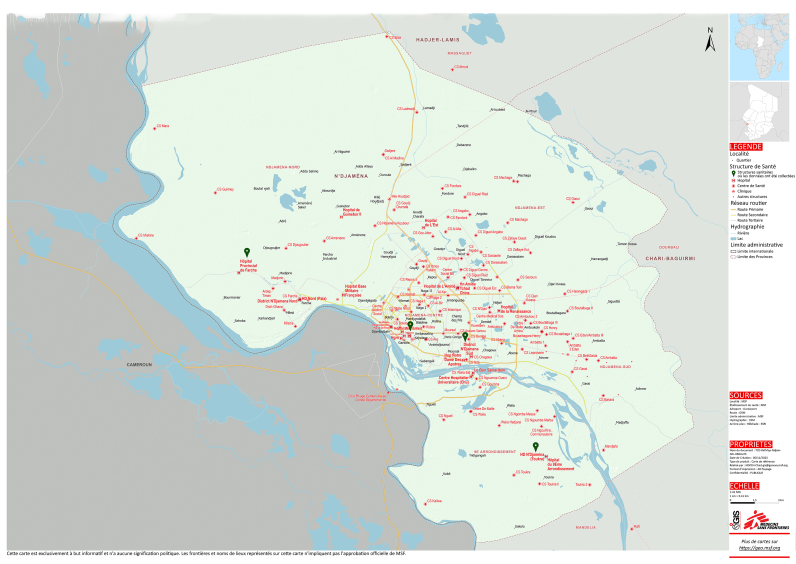
2.2. Study Sites and PeriodThe study was conducted over a continuous three-month period, from September 1 to November 30, 2024, in four (04) district hospitals in the city of N’Djamena. These facilities were selected due to their central role in the management of non-communicable chronic diseases and their geographical representativeness across different city districts. The selected sites were:
• Toukra District Hospital (9th arrondissement)
• Farcha District Hospital (1st arrondissement)
• Sultan Cherif Kasser Hospital (3rd arrondissement)
• Union District Hospital (7th arrondissement)
These public primary healthcare institutions serve a demographically diverse population (in terms of age, gender, and socioeconomic status), ensuring sufficient variability in the data to explore disparities in obesity prevalence across different social and territorial contexts 10.
2.3. Study PopulationThe target population consisted of adults aged 25 to 60 years residing in the districts served by the selected hospitals. Adults within this age range are the most exposed to nutritional transitions and urban lifestyle changes, making them a key demographic for exploring the dual burden of malnutrition 11. The upper age limit of 60 years was chosen to avoid a disproportionate influence from age-related chronic conditions.
2.4. Inclusion and Exclusion CriteriaParticipants were eligible if they:
• Had been living in N’Djamena for at least one year, ensuring adequate exposure to the local environmental factors.
• Were attending outpatient consultations at one of the four selected district hospitals.
• Were able to provide informed and voluntary consent.

Excluded from the study were:
• Hospitalized patients, to avoid bias from severe pathological conditions.
• Pregnant or breastfeeding women, due to their specific nutritional needs.
• Individuals unable to respond to the questionnaire for medical, cognitive, or linguistic reasons.
2.5. Sampling and Sample SizeThe study employed systematic random sampling within urban healthcare facilities to minimize selection bias while ensuring temporal balance in patient recruitment. In each hospital, a fixed sampling interval was applied, following a random selection of the first participant of the day. This approach enabled the construction of a representative sample while maintaining logistical feasibility in the field 12.
A total of 1,270 participants were enrolled, with balanced distribution across the four district hospitals in N’Djamena, based on their respective patient capacities. The minimum required sample size was calculated using an assumed prevalence of 50%, a margin of error of ±5%, a 95% confidence level, and an anticipated 10% non-response rate, following standard epidemiological recommendations 13, 14.
The formula used was as follows:
 |
Where n is the sample size, Z is the Z-score (1.96 for 95% confidence), p is the assumed prevalence (0.5), and d is the desired precision (0.05).
After adjusting for non-response, the final target number was set at 1,270 participants.
2.6. Ethical ConsiderationsEthical principles were strictly observed to ensure the rights, dignity, and safety of participants were protected. These principles were applied in accordance with international standards for human research, particularly the Declaration of Helsinki of the World Medical Association 15.
In addition, official authorization was obtained from the Ministry of Public Health of Chad and the Doctoral School Directorate of the University of N’Djamena.
2.7. Data Collection ProcedureThe data collection was conducted over a three-month period, following a rigorous protocol divided into three main phases: preparatory, fieldwork, and quality control.
Initially, the questionnaires were translated into Chadian Arabic and Ngambaye, then back translated into French following Brislin’s method (1970) 16 to ensure linguistic validity. A pre-test was conducted with 20 patients at the Union District Hospital to assess clarity, duration of administration, and technical feasibility using the KoboCollect application. Four health workers were then trained in a standardized manner on digital data entry, survey administration procedures, and anthropometric and biological measurement techniques.
The field phase was implemented across the four selected hospitals. Data were collected daily by trained agents under the supervision of the heads of outpatient consultation services and the general supervisors of the health facilities. Each participant completed a structured questionnaire covering sociodemographic characteristics, dietary habits, physical activity, and medical history 17.
Strict quality control was maintained throughout the data collection process. Data, entered via KoboCollect, were reviewed in real time to identify inconsistencies, outliers, or missing values. Weekly supervisory meetings ensured methodological compliance. The digital system facilitated standardized measurements and minimized data entry errors, in accordance with Nampa et al. (2020) 18.
Dietary and behavioural data were collected through self-reporting, using ordinal scales and simplified dietary recalls. The frequencies of fruit, vegetable, saturated fat, added sugar, salt, and processed food consumption were systematically recorded. This approach enabled a comprehensive and reliable assessment of dietary behaviours and lifestyle within the study population.
2.8. Statistical AnalysisDescriptive analyses were performed using SPSS version 30.0. Dietary behaviour variables were categorized into five response levels: never, rarely, occasionally, often, and daily. Absolute and relative frequencies were calculated for each category. Histogram charts were generated to illustrate the distribution of dietary behaviours.
The results reveal significant nutritional trends within the adult population of the city of N’Djamena.
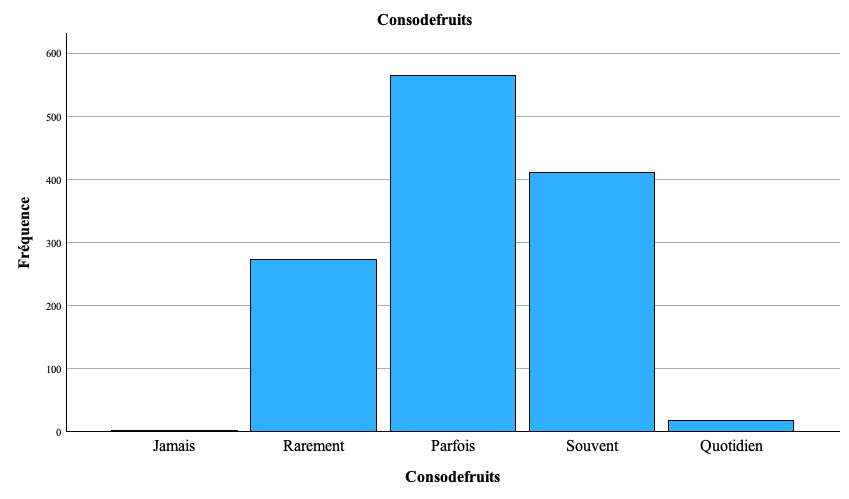
Most respondents reported consuming fruits occasionally (n = 565) or often (n = 411), while only a small proportion consumed fruits daily (n = 18).

This pattern reflects an overall insufficient fruit intake, despite the essential role of fruits in preventing cardiovascular and metabolic diseases, as shown by Boeing et al. (2012) 19 and FAO (2022) 20. Similar findings were reported in studies conducted in Dakar and Ouagadougou, where daily fruit consumption among adults was below 10% 21, 22.
This low frequency may be attributed to seasonality, high cost, or a misperception of the role of fruits in a balanced diet. It raises concerns regarding the physical and economic accessibility of fruits.
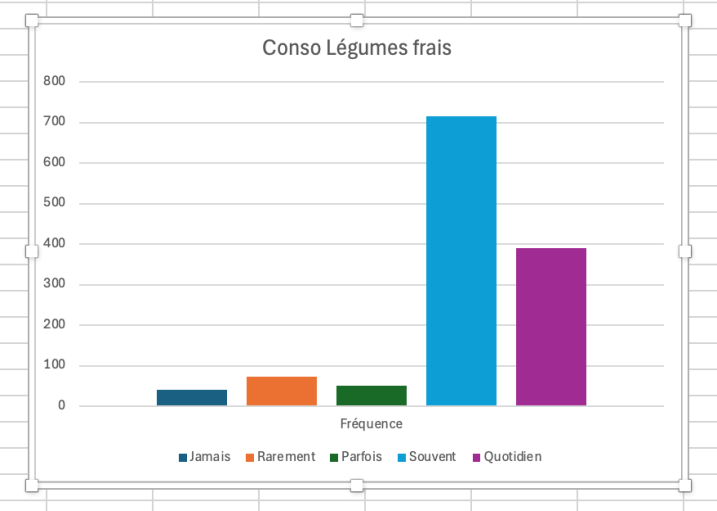
3.2. Fresh Vegetable ConsumptionMost respondents reported consuming vegetables often (n = 716) or daily (n = 391).

This is an encouraging finding, suggesting that vegetables are more culturally integrated into daily diets. This may be due to their local availability in urban markets and presence in traditional dishes. A similar contrast between fruit and vegetable consumption has been noted in Nigeria and Mali, where vegetables tend to be more accessible and less expensive 23, 24.
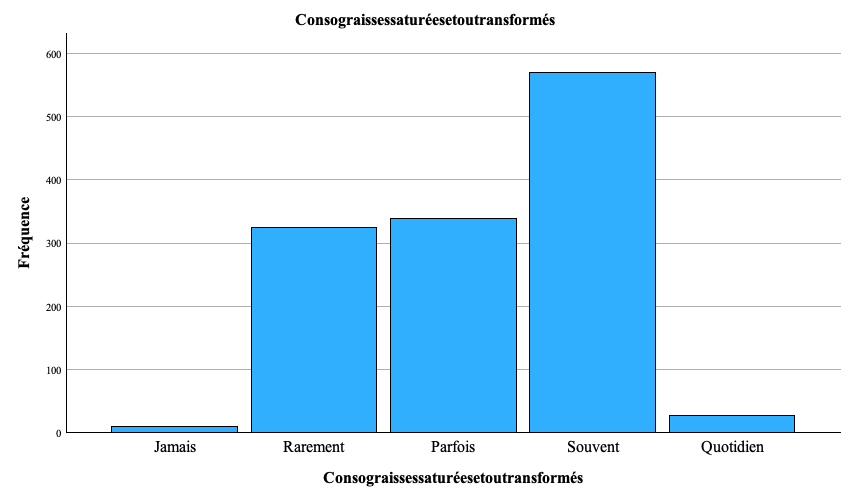
3.3. Saturated and Processed Fat ConsumptionThe consumption of saturated and processed fats is high, with 569 respondents reporting frequent intake and 28 consuming them daily.

This alarming frequency reflects the dietary westernization observed in major African cities, where traditional fats (e.g., peanut, sesame oils) are being replaced by industrial oils high in trans fats 25. Studies in Cameroon and Ghana have highlighted this shift as a key contributor to the rise in dyslipidemia and type 2 diabetes 26, 27.
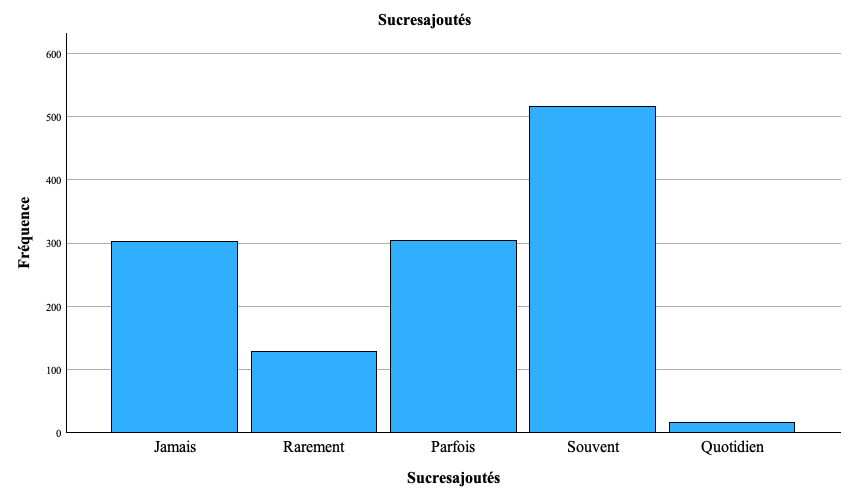
3.4. Added SugarsFrequent consumption of added sugars was reported by 516 participants, although 303 stated they never consume them.

This dual profile likely indicates heterogeneous dietary behaviors: a portion of the population may be reducing sugar intake, while another segment, exposed to sugary beverages and industrial sweets, consumes them regularly.
The link between added sugars and metabolic diseases is well established 28, 6, and excessive consumption is fueled by advertising, product availability, and low cost. Further analysis by age or socioeconomic status would be insightful.
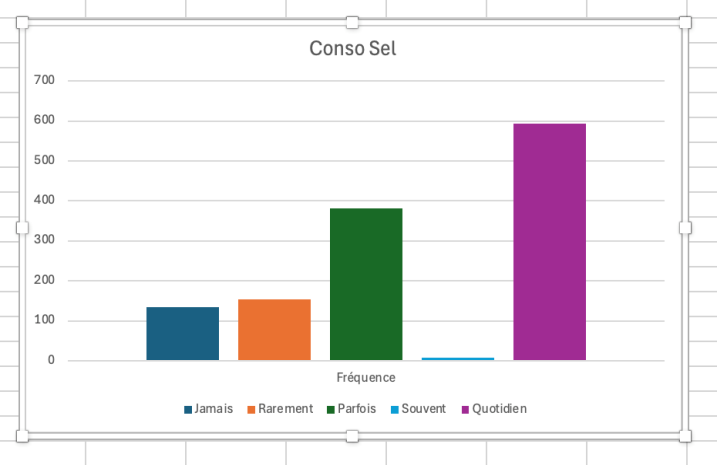
3.5. Salt ConsumptionDaily salt consumption was extremely high (n = 594), with “often” being marginal (n = 7).

This reflects an overconsumption of salt far beyond WHO recommendations (<5g/day) 29. The widespread use of sodium-rich industrial bouillon cubes is suspected to be the main source. This trend is consistent with findings in Abidjan and Cotonou, where over 80% of households use such products daily 30, 31.
3.6. Processed FoodsDaily consumption of processed foods was the highest among all dietary variables, with 849 individuals reporting this habit.
3.7. Cross-Analysis and Health ImplicationsThe data analysis highlights a nutritional profile typical of a setting undergoing dietary transition. The dietary habits reported in this study show a very high frequency of consumption of processed foods, salt, saturated fats, and added sugars, coupled with a low daily intake of fruits. Regular consumption of fresh vegetables represents a favourable exception, though insufficient to offset other high-risk dietary patterns.
This overall picture fits within the theoretical framework of the double burden of malnutrition, extensively described by Popkin (2006) 3 and recognized by the WHO as an emerging public health challenge in African cities 1. On one side, persistent micronutrient deficiencies, due to insufficient fruit consumption, compromise nutritional and immune status. On the other, the proliferation of ultra-processed foods promotes energy overconsumption with low nutritional density, increasing the prevalence of metabolic diseases such as obesity, type 2 diabetes, and hypertension.
The daily salt consumption revealed by this study is especially concerning, given that international guidelines recommend a maximum of 5 g per day 7. The widespread use of industrial bouillon cubes, heavily laden with sodium, as noted in other urban West African settings 30, 31, appears to be a major contributing factor. In parallel, the high frequency of processed food consumption, reported by over 80% of participants, reflects the westernization of diets already documented in several African metropolises 4. This trend is fuelled by rapid urbanization, modernization of food distribution chains, and the growing influence of food marketing 32.
The extremely low daily fruit consumption (1%) raises questions about the structural and cultural barriers limiting the integration of fruits into local dietary habits. Studies in Bamako and Ouagadougou have similarly highlighted the impact of price, seasonality, and lack of awareness of nutritional benefits on fruit consumption 22, 33.
This convergence of high-risk dietary practices calls for a multisectoral response. Beyond health policy, interventions must incorporate educational, economic, agricultural, and regulatory dimensions. Stronger actions are needed on nutrition labelling, advertising regulation, and promotion of diversified local food production, in line with FAO guidelines for sustainable food systems 20. The challenge for policymakers is to reposition healthy eating as an accessible, valued, and culturally integrated choice, especially in urban contexts such as N’Djamena.
This study reveals a concerning dietary profile among the adult population of N’Djamena, marked by very high consumption of processed foods, salt, added sugars, and saturated fats, alongside a low frequency of daily fruit intake. These habits, observed in a Sahelian urban setting undergoing nutritional transition, represent major risk factors for the emergence and worsening of non-communicable diseases, including hypertension, type 2 diabetes, dyslipidaemia, and obesity. Although the regular consumption of fresh vegetables is a positive sign, it does not sufficiently counterbalance the harmful effects of an ultra-processed diet. These findings underscore the urgent need for interdisciplinary actions to guide dietary behaviours toward healthier, more sustainable practices that are adapted to local realities.
It is recommended to intensify nutrition education campaigns targeting high-risk dietary behaviours, particularly excessive intake of processed foods, salt, added sugars, and saturated fats. Improving access to fruits and vegetables, economically and logistically, should also be a priority. In addition, regulation of industrial food products, through nutritional labelling, taxation, and advertising controls, is essential. Primary health centres should incorporate nutritional counselling services, while promoting local, healthier food products can play a pivotal role in transforming urban dietary practices sustainably.
To build on this study, analytical research should be conducted to identify sociodemographic factors associated with observed dietary practices. Including biomedical markers would help explore links between behaviours and health status. Moreover, longitudinal and interventional studies are needed to monitor dietary trends over time and evaluate the impact of public policies or community strategies on improving the population’s nutritional profile.
The authors thank the University of N’Djamena authorities and Professors Brahim Boy OTCHOM (FSEA/N’Djamena), Abdelsalam Tidjani, and Bakaranga-Via Issakou (FSSH/N’Djamena) for their scientific support. They also express their deep gratitude to all staff members at the four participating hospitals, whose collaboration was instrumental in facilitating the data collection phase.
| [1] | World Health Organization. Global Action Plan for the Prevention and Control of Noncommunicable Diseases 2013-2020. Geneva: WHO; 2013. (35). | ||
| In article | |||
| [2] | GBD 2019 Risk Factors Collaborators. Global burden of 87 risk factors in 204 countries and territories, 1990–2019: a systematic analysis. Lancet. 2020; 396(10258): 1223–49. | ||
| In article | |||
| [3] | Popkin BM. Global nutrition dynamics: the world is shifting rapidly toward a diet linked with noncommunicable diseases. Am J Clin Nutr. 2006; 84(2): 289–98. (38). | ||
| In article | View Article PubMed | ||
| [4] | Monteiro CA, Moubarac JC, Cannon G, Ng SW, Popkin BM. Ultra-processed products are becoming dominant in the global food system. Obes Rev. 2013; 14 Suppl 2: 21–8. (33,39). | ||
| In article | View Article PubMed | ||
| [5] | FAO. The State of Food Security and Nutrition in the World 2022. Rome: FAO; 2022. | ||
| In article | |||
| [6] | Te Morenga L, Mallard S, Mann J. Dietary sugars and body weight: systematic review and meta-analyses. BMJ. 2013; 346: e7492. (29). | ||
| In article | View Article PubMed | ||
| [7] | WHO. Guideline: Sodium intake for adults and children. Geneva: World Health Organization; 2012. (36). | ||
| In article | |||
| [8] | Setia MS. 2016. Methodology series module 3: Cross-sectional studies. Indian Journal of Dermatology, 61(3), 261-264. | ||
| In article | View Article PubMed | ||
| [9] | Wang X, Cheng Z. 2020. Cross-Sectional Studies: Strengths, Weaknesses, and Recommendations. Chest, 158(1S), S65–S71. | ||
| In article | View Article PubMed | ||
| [10] | World Health Organization. Regional Office for the Western Pacific. 2013. Measles-Rubella Bulletin - Vol 07 Issue 02. WHO Regional Office for the Western Pacific. https:// iris.who.int/ handle/10665/206694. | ||
| In article | |||
| [11] | Popkin BM. 2016. Nutritional patterns and transitions. Population and Development Review, 42(Suppl), 47–71. | ||
| In article | |||
| [12] | Etikan I, Bala K. (2017). Sampling and Sampling Methods. Biometrics & Biostatistics International Journal, 5(6), 215–217. | ||
| In article | View Article | ||
| [13] | Lwanga SK, Lemeshow S. 1991. Détermination de la taille d'un échantillon dans les études sanometriques. OMS Genève. | ||
| In article | |||
| [14] | Pourhoseingholi MA, Vahedi M, Rahimzadeh M. 2013. Sample size calculation in medical studies. Gastroenterol Hepatol Bed Bench. Winter; 6(1): 14-7. PMID: 24834239; PMCID: PMC4017493. | ||
| In article | |||
| [15] | World Medical Association. 2013. World Medical Association Declaration of Helsinki: Ethical Principles for Medical Research Involving Human Subjects. JAMA, 310(20), 2191–2194. | ||
| In article | View Article PubMed | ||
| [16] | Brislin RW. 1970. Back-Translation for Cross-Cultural Research. Journal of Cross-Cultural Psychology, 1(3), 185–216. | ||
| In article | View Article | ||
| [17] | Thompson FE, Subar AF. 2017. Dietary Assessment Methodology. In A. M. Coulston, C. J. Boushey, & M. G. Ferruzzi (Eds.), Nutrition in the Prevention and Treatment of Disease (4th ed., pp. 5–48). Academic Press. | ||
| In article | View Article | ||
| [18] | Nampa IW, Mudita IW, Kaho NPLBR. 2020. The KoboCollect for Research Data Collection and Management (An experience in Researching the Socio-Economic Impact of Blood Disease in Banana). SOCA: Journal Sosial Ekonomi Pertanian, 14(3), 546-557. | ||
| In article | View Article | ||
| [19] | Boeing H, Bechthold A, Bub A, et al. Critical review: vegetables and fruit in the prevention of chronic diseases. Eur J Nutr. 2012; 51(6): 637–63. | ||
| In article | View Article PubMed | ||
| [20] | FAO. Lutter contre la malnutrition par les systèmes alimentaires durables. Rome: FAO; 2022. (43). | ||
| In article | |||
| [21] | Tine JAD, Diouf A, et al. Habitudes alimentaires des femmes sénégalaises: entre traditions et modernité. Rev Nutr Santé Publique. 2021; 21(3): 187–96. | ||
| In article | |||
| [22] | Coulibaly M, Diallo F, et al. Étude des comportements alimentaires à Ouagadougou. Rev Sahel Sci Santé. 2020; 17(2): 23–33. (22). | ||
| In article | |||
| [23] | Ogunniyi LT, et al. Urban households food consumption pattern in South West Nigeria. J Hum Ecol. 2011; 35(3): 167–71. | ||
| In article | |||
| [24] | Traoré S, et al. Facteurs influençant la consommation des fruits et légumes à Bamako. Cah Agric. 2015; 24(5): 313–9. | ||
| In article | |||
| [25] | Chikafa T, et al. Substitution of traditional fats by trans fats in Southern Africa: health risk perspectives. Public Health Nutr. 2018; 21(6): 1078–85. | ||
| In article | |||
| [26] | Sobngwi E, Mbanya JC, et al. Physical activity and its relationship with obesity, hypertension and diabetes in urban Cameroon. Int J Epidemiol. 2002; 31(3): 716–23. | ||
| In article | View Article PubMed | ||
| [27] | Agyemang C, et al. Urbanization and dietary change in Ghana: understanding the transition. BMC Public Health. 2015;15: 1312. | ||
| In article | |||
| [28] | Malik VS, Popkin BM, Bray GA, Després JP, Willett WC, Hu FB. Sugar-sweetened beverages and risk of metabolic syndrome and type 2 diabetes. Diabetes Care. 2010; 33(11): 2477–83. | ||
| In article | View Article PubMed | ||
| [29] | World Health Organization. Guideline: Sodium intake for adults and children. Geneva: WHO; 2012. | ||
| In article | |||
| [30] | Bouzitou GDN, Hounkpatin WA, Sossa A, et al. Connaissances, attitudes et pratiques liées à l’usage du sel à Cotonou. Nutr Clin Métabol. 2021; 35(1): 23–9. (31). | ||
| In article | |||
| [31] | Koné M, Diarra A, et al. Utilisation des bouillons cubes chez les ménages à Abidjan. Arch Santé Afr. 2020; 13(2): 9–16. (32). | ||
| In article | |||
| [32] | Hawkes C, Harris JL. An analysis of the content of food industry pledges on marketing to children. Public Health Nutr. 2011; 14(8): 1403–14. | ||
| In article | View Article PubMed | ||
| [33] | Traoré S, et al. Facteurs influençant la consommation des fruits et légumes à Bamako. Cah Agric. 2015; 24(5): 313–9. | ||
| In article | |||
Published with license by Science and Education Publishing, Copyright © 2025 Hal Souakar Ambera and Brahim Boy Otchom
 This work is licensed under a Creative Commons Attribution 4.0 International License. To view a copy of this license, visit
http://creativecommons.org/licenses/by/4.0/
This work is licensed under a Creative Commons Attribution 4.0 International License. To view a copy of this license, visit
http://creativecommons.org/licenses/by/4.0/
| [1] | World Health Organization. Global Action Plan for the Prevention and Control of Noncommunicable Diseases 2013-2020. Geneva: WHO; 2013. (35). | ||
| In article | |||
| [2] | GBD 2019 Risk Factors Collaborators. Global burden of 87 risk factors in 204 countries and territories, 1990–2019: a systematic analysis. Lancet. 2020; 396(10258): 1223–49. | ||
| In article | |||
| [3] | Popkin BM. Global nutrition dynamics: the world is shifting rapidly toward a diet linked with noncommunicable diseases. Am J Clin Nutr. 2006; 84(2): 289–98. (38). | ||
| In article | View Article PubMed | ||
| [4] | Monteiro CA, Moubarac JC, Cannon G, Ng SW, Popkin BM. Ultra-processed products are becoming dominant in the global food system. Obes Rev. 2013; 14 Suppl 2: 21–8. (33,39). | ||
| In article | View Article PubMed | ||
| [5] | FAO. The State of Food Security and Nutrition in the World 2022. Rome: FAO; 2022. | ||
| In article | |||
| [6] | Te Morenga L, Mallard S, Mann J. Dietary sugars and body weight: systematic review and meta-analyses. BMJ. 2013; 346: e7492. (29). | ||
| In article | View Article PubMed | ||
| [7] | WHO. Guideline: Sodium intake for adults and children. Geneva: World Health Organization; 2012. (36). | ||
| In article | |||
| [8] | Setia MS. 2016. Methodology series module 3: Cross-sectional studies. Indian Journal of Dermatology, 61(3), 261-264. | ||
| In article | View Article PubMed | ||
| [9] | Wang X, Cheng Z. 2020. Cross-Sectional Studies: Strengths, Weaknesses, and Recommendations. Chest, 158(1S), S65–S71. | ||
| In article | View Article PubMed | ||
| [10] | World Health Organization. Regional Office for the Western Pacific. 2013. Measles-Rubella Bulletin - Vol 07 Issue 02. WHO Regional Office for the Western Pacific. https:// iris.who.int/ handle/10665/206694. | ||
| In article | |||
| [11] | Popkin BM. 2016. Nutritional patterns and transitions. Population and Development Review, 42(Suppl), 47–71. | ||
| In article | |||
| [12] | Etikan I, Bala K. (2017). Sampling and Sampling Methods. Biometrics & Biostatistics International Journal, 5(6), 215–217. | ||
| In article | View Article | ||
| [13] | Lwanga SK, Lemeshow S. 1991. Détermination de la taille d'un échantillon dans les études sanometriques. OMS Genève. | ||
| In article | |||
| [14] | Pourhoseingholi MA, Vahedi M, Rahimzadeh M. 2013. Sample size calculation in medical studies. Gastroenterol Hepatol Bed Bench. Winter; 6(1): 14-7. PMID: 24834239; PMCID: PMC4017493. | ||
| In article | |||
| [15] | World Medical Association. 2013. World Medical Association Declaration of Helsinki: Ethical Principles for Medical Research Involving Human Subjects. JAMA, 310(20), 2191–2194. | ||
| In article | View Article PubMed | ||
| [16] | Brislin RW. 1970. Back-Translation for Cross-Cultural Research. Journal of Cross-Cultural Psychology, 1(3), 185–216. | ||
| In article | View Article | ||
| [17] | Thompson FE, Subar AF. 2017. Dietary Assessment Methodology. In A. M. Coulston, C. J. Boushey, & M. G. Ferruzzi (Eds.), Nutrition in the Prevention and Treatment of Disease (4th ed., pp. 5–48). Academic Press. | ||
| In article | View Article | ||
| [18] | Nampa IW, Mudita IW, Kaho NPLBR. 2020. The KoboCollect for Research Data Collection and Management (An experience in Researching the Socio-Economic Impact of Blood Disease in Banana). SOCA: Journal Sosial Ekonomi Pertanian, 14(3), 546-557. | ||
| In article | View Article | ||
| [19] | Boeing H, Bechthold A, Bub A, et al. Critical review: vegetables and fruit in the prevention of chronic diseases. Eur J Nutr. 2012; 51(6): 637–63. | ||
| In article | View Article PubMed | ||
| [20] | FAO. Lutter contre la malnutrition par les systèmes alimentaires durables. Rome: FAO; 2022. (43). | ||
| In article | |||
| [21] | Tine JAD, Diouf A, et al. Habitudes alimentaires des femmes sénégalaises: entre traditions et modernité. Rev Nutr Santé Publique. 2021; 21(3): 187–96. | ||
| In article | |||
| [22] | Coulibaly M, Diallo F, et al. Étude des comportements alimentaires à Ouagadougou. Rev Sahel Sci Santé. 2020; 17(2): 23–33. (22). | ||
| In article | |||
| [23] | Ogunniyi LT, et al. Urban households food consumption pattern in South West Nigeria. J Hum Ecol. 2011; 35(3): 167–71. | ||
| In article | |||
| [24] | Traoré S, et al. Facteurs influençant la consommation des fruits et légumes à Bamako. Cah Agric. 2015; 24(5): 313–9. | ||
| In article | |||
| [25] | Chikafa T, et al. Substitution of traditional fats by trans fats in Southern Africa: health risk perspectives. Public Health Nutr. 2018; 21(6): 1078–85. | ||
| In article | |||
| [26] | Sobngwi E, Mbanya JC, et al. Physical activity and its relationship with obesity, hypertension and diabetes in urban Cameroon. Int J Epidemiol. 2002; 31(3): 716–23. | ||
| In article | View Article PubMed | ||
| [27] | Agyemang C, et al. Urbanization and dietary change in Ghana: understanding the transition. BMC Public Health. 2015;15: 1312. | ||
| In article | |||
| [28] | Malik VS, Popkin BM, Bray GA, Després JP, Willett WC, Hu FB. Sugar-sweetened beverages and risk of metabolic syndrome and type 2 diabetes. Diabetes Care. 2010; 33(11): 2477–83. | ||
| In article | View Article PubMed | ||
| [29] | World Health Organization. Guideline: Sodium intake for adults and children. Geneva: WHO; 2012. | ||
| In article | |||
| [30] | Bouzitou GDN, Hounkpatin WA, Sossa A, et al. Connaissances, attitudes et pratiques liées à l’usage du sel à Cotonou. Nutr Clin Métabol. 2021; 35(1): 23–9. (31). | ||
| In article | |||
| [31] | Koné M, Diarra A, et al. Utilisation des bouillons cubes chez les ménages à Abidjan. Arch Santé Afr. 2020; 13(2): 9–16. (32). | ||
| In article | |||
| [32] | Hawkes C, Harris JL. An analysis of the content of food industry pledges on marketing to children. Public Health Nutr. 2011; 14(8): 1403–14. | ||
| In article | View Article PubMed | ||
| [33] | Traoré S, et al. Facteurs influençant la consommation des fruits et légumes à Bamako. Cah Agric. 2015; 24(5): 313–9. | ||
| In article | |||