The gustatory system is essential to homeostasis given its ability to differentiate between various flavor modalities and direct dietary preferences based on the energy content, digestive processes, appetite regulation, hydration, and even emotional aspects of food consumption. The taste buds process information through three cranial nerves, which is then processed and transmitted to higher brain regions such as the thalamus and gustatory cortex in the insular cortex, and the frontal operculum of the frontal lobe. These are responsible for perceiving and interpreting taste. Additionally, sensing taste and detecting nutrients are regulated by specific G protein-coupled receptor cells (GPCRs), which are also expressed in the gut. This highlights the importance of the gut-brain axis in influencing taste perception and food preferences. A recent study in mice demonstrated how cholecystokinin (CCK)-labeled duodenal neuropod cells can distinguish and transmit signals related to sugars and sweeteners to the vagus nerve. The gut-brain axis may be a critical interface for taste perception, nutrient sensing, and appetite regulation. Thus, understanding the role of the enteric nervous system may uncover certain mechanisms involved in regulating food consumption and metabolic balance. Therefore, additional research is crucial to understand the complex relationship between the digestive system and the brain in the context of taste perception and actions associated with eating. This review explores recent advances in gustation encoding, taste perception and the role of enteric nervous system in taste perception and functions.
The traditional theory about the localization of the five tastes in specific regions of the tongue became widely accepted following the publication of Edwin G. Boring’s 1942 textbook “Sensation and Perception,” wherein he re-examined the empirical evidence presented in David Pauli Hanig’s 1901 thesis 1. However, recent advancements in research have shown that taste sensitivities vary among regions and subjects 2. For instance, some studies suggest that recognition for salt declines with age, and in the case of younger people, it is greater on the tip of the tongue than the posterior region 2, 3. Therefore, the perception of taste involves distinct transduction pathways that are not strictly localized to specific areas of the tongue, and is supported by evidence of taste bud density variations, expression of taste receptors and channels, and taste perception in the tongue’s specific regions 4.
Taste perception involves analyzing responses at various levels of the neural axis, starting from the sensory organs, such as taste buds, to the gustatory cortex located in the anterior insula in the temporal lobe and the frontal opercular region, responsible for taste processing 4, 5. The tongue, palate, pharynx, and epiglottis serve as the primary location for taste receptor cells (TRCs). It has different types of papillae – fungiform papillae, the highest in number, are primarily located on the anterior two-thirds of the tongue 5. Circumvallate papillae, which are larger in size, are situated in a row at the back of the tongue within the sulcus terminalis in the posterior third, while foliate papillae are found on the sides of the tongue. These papillae provide structural support for taste buds and facilitate the interaction of tastants and taste receptors. When these chemoreceptors detect specific tastes (salty, sour, bitter, sweet, umami), they trigger cellular activity and depolarization. These signals synapse with primary sensory axons in nerves like the facial, glossopharyngeal, and vagus nerves 5, 6. Additionally, neuroimaging studies have lent insights into the gustatory cortex’s organization and functions. For instance, functional magnetic resonance imaging (fMRI) data revealed increased activation in the insular cortex and operculum when taste stimuli are presented, indicating that these regions play a role in taste processing 7, 14. Moreover, studies involving electrophysiological recordings in animal models have helped understand the mechanisms behind taste perception and identify neural ensembles responsible for coding different taste qualities 8.
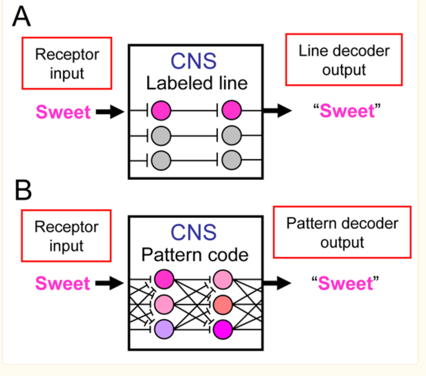
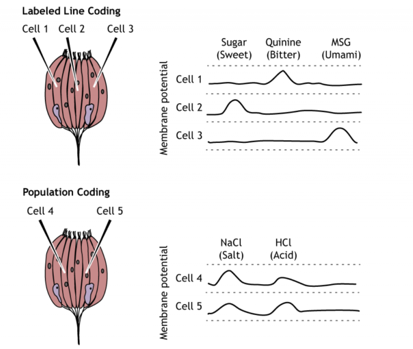
2.1. Gustatory Coding (Computation)Encoding taste information from taste buds to the gustatory cortex involves various neural levels. In general, two models of spatial coding were proposed to account for the neural representation of taste information. 8, 9. The concept of ‘labeled line coding’ suggests that specific neurons and pathways encode taste in a binary manner and are dedicated to individual taste qualities. In contrast, alternative coding mechanisms such as ‘across-fiber’, or ‘combinatorial’ or ensemble theory suggests that taste is carried by a pattern of activity across a population of neurons, with individual neurons contributing to the representation of multiple stimulus qualities and signaling of information by the response of a neuronal population. Additionally, ‘temporal coding’ proposes that taste quality aspects are represented in nerve impulse timing or patterns 8, 9. These computational processes involve the integration of taste information at the level of taste buds, transmission through afferent gustatory nerves, and processing in multiple taste centers of the brain (Figure 1 and Figure 2).
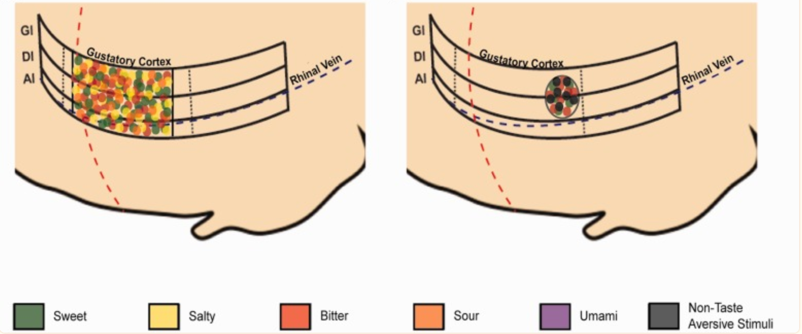
Previous studies were concentrated on whether taste quality is recorded by labeled line or ensemble mechanisms 9. However, recent imaging and electrophysiological investigations have produced contradictory results. Previous studies on taste processing have neglected potentially significant temporal dynamics and often define the spatial structure and temporal components of taste processing in the Insular cortex (IC). However, this is interconnected with multiple cortical and subcortical structures, including the insula, frontal operculum, parietal operculum, and orbitofrontal cortex, all showing activity in response to tastes 10, 11. IC has a general role in interoception or homeostatic regulation of the body. It receives gustatory input primarily from the taste thalamus and from other taste-related inputs originating from the amygdala and parabrachial nucleus of the pons 11. Neurons within IC are multimodal, responding to taste, olfactory, somatosensory, and visceral stimuli, suggesting an integrative role in regulating behavioral states, consumption decisions, or taste-related learning 10, 11. Research showing spatial organization of taste coding within IC also explores the existence of a chemotopic or “gustotopic” map 12, 13. While some evidence suggests the presence of quality-specific spatial organization of taste-responsive neurons, others found a lack of such organization, indicating the complexity of taste representation within the Insular Cortex. 12, 13


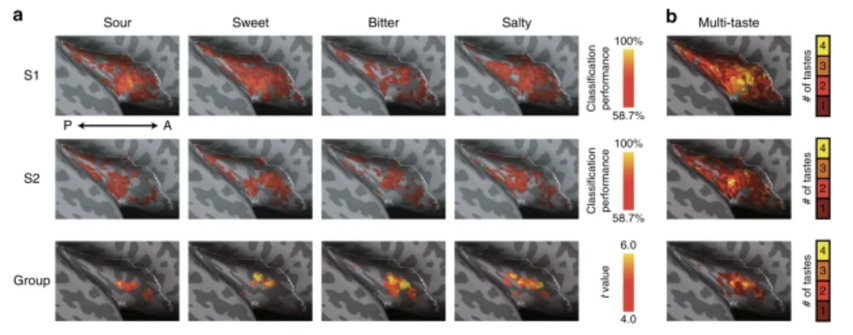
For instance, Chikazoe et.al. 14 implemented a multivoxel pattern analysis model with a linear discriminant analysis (LDA) classifier in the insular cortex’s 4mm searchlight radius. This sought to identify taste-specific activation patterns 14. Four taste discriminability maps showed taste type differences. The brain activity in anterior/middle insula showed distinct responses to all four basic tastes which aligned with the proposed primary gustatory cortex in nonhuman primates which was based on gustatory thalamic projections. This paradigm focused spatial separations of flavor representation in the insular cortex 14.

Taste buds have several nerve fibers and types of chemosensory cells. These taste fibers have ionotropic purinergic (P2X) receptors, which transmit information from taste receptor cells to afferent neurons 15. Each taste cell-type perceives tastes and reacts differently to specific taste stimuli. Sour tastants and high NaCl concentrations release serotonin from type III taste cells 15. Sourness comes from excessive acidity, which produces hydrogen ions, depolarizing the cells to release serotonin. The taste cells have two types of receptors for serotonin, 5-HT1 and 5-HT3. Type II taste cells express the 5-HT1 receptors, while gustatory nerve fibers may express 5-HT3 receptors 15. Type III taste cells release serotonin (5 HT), activating type II taste cells through the 5 HT1A receptor but simultaneously inhibiting them 15. This inhibition occurs with the signaling of molecules called afferent nerve fibers, which possess 5 HT3 receptors activated by serotonin released from type III cells, hence contributing to sour or salty taste perception 15. Sweet, umami, and bitter tastants activate sensory afferents by releasing ATP from type II receptor cells. Additionally, a study using Drosophila and optogenetic stimulation, identified specific sugar- and bitter-responsive serotonin neurons (5-HT) and demonstrated their crucial role as mediators 16. The study showed that sugar-SELs (Serotonin-Expressing Neurons) trigger insulin release upon sweet taste detection, thus reducing feeding and preventing overconsumption, while bitter-SELs stimulate enteric neurons seem to promote gastric motility, which could help in processing and making more nutrients available in the body, thus preparing for potential food scarcity 16. Thus, the role of 5-HT neurons in anticipatory feeding modulation and nutrient homeostasis is demonstrated.
2.3. Learning and PlasticityThe plastic nature of the gustatory system was demonstrated by Heath et.al by modulating taste sensitivity through the inhibition of 5-HT transporters and the subsequent enhancement of paracrine signaling through 5-HT 17. They showed that activation of G protein coupled receptors in taste receptor cells triggers a shared pathway that involves PLCβ2, α-gustducin-associated β/γ subunits, G3/G13 subunits and the release of calcium ions for signal transmission. This pathway involves the release of ATP and neurotransmitters like serotonin (5HT) and noradrenaline (NA) and does not directly engage with gustatory nerves.
The researchers presented a feedback mechanism involving 5 HT1A receptors between receptor cells, potentially influencing sweet and bitter signaling. To show this they used paroxetine, a serotonin reuptake inhibitor (SSRI) 17. It increased the sensitivity to sweet and bitter tastes and marginally affected sour or salty tastes. This suggests that serotonin plays a role in our perception of taste. Furthermore, higher noradrenaline (NA) levels reduced the threshold for perceiving sour tastes, indicating its influence on our taste sensitivity. Finally, the study correlated anxiety levels and taste thresholds, suggesting a relationship between mood and taste sensitivity 17. These results show that modifying monoamines can alter taste perception, thus highlighting the gustatory system’s plastic nature. Another study by Pittman et al. 18, which investigated the impact of subclinical intestinal inflammation on taste responses, found diminished behavioral and neurophysiological responses to sweet and salty tastes in the model of intestinal inflammation. Reduced neural and behavioral responses to sweet and salts indicate the gustatory system’s high sensitivity to intestinal and colonic inflammation induced by a relatively low weekly dose of enteral LPS. This study provides insights into the impact of subclinical intestinal inflammation on taste perception, highlighting the intricate interplay between inflammatory processes and gustatory responses, which is surprising, as Koren et al. 19 found that the insular cortex maintains a ‘memory’ of immune challenges that occur in the periphery, and that reactivating the same neuronal ensembles that were stimulated during the original gut inflammation is enough to reactivate the illness. Both these correlative findings suggest the role of insular cortex neural networks and gustatory system in learning and plasticity.
2.4. Gustation and the Enteric Nervous System RoleBuchanan et.al. 20 found that animals can develop a strong preference for sugar even in the absence of sweet taste receptors, suggesting the existence of a mechanism independent of taste perception. This indicates that the perception and preference for sugar may involve additional sensory or cognitive processes beyond the traditional taste receptors. This study focuses on how the digestive system detects sugars and why artificial sweeteners are ineffective in curbing these cravings. The study primarily determined how gut sensory cues affect preferences for non-caloric sweeteners and nutritive sugars. Previously, these cells were thought to convey this distinction using two pathways, purinergic for sweeteners and glutamatergic, for sugar 20. However, it was discovered that specific enteroendocrine cells, in the gut lumen, called neuropods express cholecystokinin (CCK) and make glutamatergic synapses with vagal nodose neurons to convey sensory information from the duodenum to the brain quickly. These neuropod cells in the intestine have a remarkable ability to differentiate between sugars and sweeteners. The study used a novel optogenetics method, developed by the team, to manipulate gut cells temporally and spatially, and used a flexible fiberoptic device to optically stimulate the gut lumen to observe how animals preferred sugar over sweeteners 20. They discovered that specific receptors for detecting sweet taste such as T1R3 and the sodium glucose transporter 1 (SGLT1) in the neuropod cells play a role in transmitting signals. This helps mice naturally prefer glucose, i.e. nutritive sugars over non-nutritive substitutes (artificial sweeteners). Additionally, this mechanism may regulate metabolic processes and the connection between gut sensing, the brain’s reward and pleasure centers, which are associated with perceiving sweetness. This research is an example of how the gut can send sensory gustatory signals. It presents compelling evidence for the existence of a dedicated sugar-sensing pathway in the gut, mediated by CCK-labeled neuropod cells and glutamatergic neurotransmission to the brain 20.
The enteric nervous system produces more than 30 neurotransmitters and has more neurons than the spine. Various studies show that gut bacteria manufacture 95% of serotonin(5-HT) 21, 22. Thus, studying the connection between the enteric nervous system and the autonomic nervous systems offers exciting opportunities to enhance our knowledge of how gustatory signals are transmitted and perceived at the periphery. Furthermore, the gut-brain connection has been studied extensively in behavioral disorders and gaining insights into their interactions could reveal mechanisms that shape our perception of taste as it is not limited to the mouth, but also intricately connected to physiological reactions.
We sincerely thank researchers and professionals whose invaluable insights and experiences have informed this paper.
| [1] | Spence C., “The tongue map and the spatial modulation of taste perception,” Current Research in Food Science, 5, 598–610. 2022. | ||
| In article | View Article PubMed | ||
| [2] | Doty, R.L., Heidt, J.M., MacGillivray, M.R., D’Souza, M., Tracey, E.H., Mirza, N., and Bigelow, D.C., “Influences of age, tongue region, and chorda tympani nerve sectioning on signal detection measures of lingual taste sensitivity,” Physiology & Behavior, 155, 202-207. Mar. 2016. | ||
| In article | View Article PubMed | ||
| [3] | Sato, H., Wada, H., Matsumoto, H., Takagiwa, M. and Goto T.K., “Differences in dynamic perception of salty taste intensity between young and older adults,” Scientific Reports, 12. 7558. 2022. | ||
| In article | View Article PubMed | ||
| [4] | Gilbertson, T.A. and Boughter, J.D., “Taste transduction: appetizing times in gustation,” NeuroReport, 14(7). 905-911. 2003 | ||
| In article | View Article PubMed | ||
| [5] | Gibbons JR, Sadiq NM. Neuroanatomy, Neural Taste Pathway.. StatPearls Publishing [Updated 2023 May 1] Available: https://www.ncbi.nlm.nih.gov/books/NBK545236/. | ||
| In article | |||
| [6] | Banik, D.D., and Medler, K.F., “Taste Receptor Signaling.” In: Palmer, R.K., Servant, G. (eds) The Pharmacology of Taste. Handbook of Experimental Pharmacology, 275. Springer, Cham. 2021. | ||
| In article | |||
| [7] | Mascioli, G., Berlucchi, G., Pierpaoli, C., Salvolini, U., Barbaresi, P., Fabri, M., and Polonara, G., “Functional MRI cortical activations from unilateral tactile-taste stimulations of the tongue,” Physiology & Behavior. Nov. 2015. | ||
| In article | View Article PubMed | ||
| [8] | Ohla K., Yoshida, R., Roper, S.D., Di Lorenzo, P.M., Victor, J.D., Boughter, J.D., Fletcher, M., Katz, D.B. and Chaudhari, N., “Recognizing Taste: Coding Patterns Along the Neural Axis in Mammals,” Chemical Senses, 44(4). 237–247. May. 2019. | ||
| In article | View Article PubMed | ||
| [9] | Lemon, C.H. and Katz, D.B., “The neural processing of taste,” BMC Neuroscience, 8 (3), S5. 2007. | ||
| In article | View Article PubMed | ||
| [10] | Staszko, S.M., Boughter, J.D., Jr, and Fletcher, M.L., “Taste coding strategies in insular cortex,” Experimental Biology and Medicine, 245(5). 448–455. 2020. | ||
| In article | View Article PubMed | ||
| [11] | Avery, J.A., Kerr, K.L., Ingeholm, J.E., Burrows, K., Bodurka, J., and Simmons, W.K., “A common gustatory and interoceptive representation in the human mid-insula,” Human Brain Mapping, 36(8). 2996–3006. 2015. | ||
| In article | View Article PubMed | ||
| [12] | Levitan, D., Lin, J.Y., Wachutka, J., Mukherjee, N., Nelson, S.B., and Katz, D.B., “Single and population coding of taste in the gustatory cortex of awake mice,” Journal of Neurophysiology, 122(4). 1342–1356. 2019. | ||
| In article | View Article PubMed | ||
| [13] | Chen, X., Gabitto, M., Peng, Y., Ryba, N.J., and Zuker, C.S., “A gustotopic map of taste qualities in the mammalian brain.” Science, 333(6047). 1262–1266. 2011. | ||
| In article | View Article PubMed | ||
| [14] | Chikazoe, J., Lee, D.H., Kriegeskorte, N. and Anderson, A.K., “Distinct representations of basic taste qualities in human gustatory cortex,” Nature Communications 10, 1048. 2019. | ||
| In article | View Article PubMed | ||
| [15] | Larson, E.D., Vandenbeuch, A., Voigt, A., Meyerhof, W., Kinnamon, S.C., and Finger, T.E., “The Role of 5-HT3 Receptors in Signaling from Taste Buds to Nerves.” The Journal of Neuroscience: The Official Journal of The Society for Neuroscience, 35(48). 15984–15995. 2015. | ||
| In article | View Article PubMed | ||
| [16] | Yao, Z., and Scott, K., “Serotonergic neurons translate taste detection into internal nutrient regulation.” Neuron, 110 (6), 1036-1050. Mar. 2022. | ||
| In article | View Article PubMed | ||
| [17] | Heath, T.P., Melichar, J.K., Nutt, D.J., and Donaldson, L.F., “Human taste thresholds are modulated by serotonin and noradrenaline,” The Journal Of Neuroscience: The Official Journal Of The Society For Neuroscience, 26(49). 12664–12671. 2006. | ||
| In article | View Article PubMed | ||
| [18] | Pittman, D.W., Dong, G., Brantly, A.M., He, L., Nelson, T.S., Kogan, S., Powell, J. and McCluskey, L.P., “Behavioral and neurophysiological taste responses to sweet and salt are diminished in a model of subclinical intestinal inflammation,” Scientific Reports, 10(1). 2020. | ||
| In article | View Article PubMed | ||
| [19] | Koren, T., Yifa, R., Amer, M., Krot, M., Boshnak, N., Ben-Shaanan, T.L., Azulay-Debby, H., Zalayat, I., Avishai, E., Hajjo, H., Schiller, M., Haykin, H., Korin, B., Farfara, D., Hakim, F., Kobiler, O., Rosenblum, K., and Rolls, A. “Insular cortex neurons encode and retrieve specific immune responses.” Cell, 184(24). 5902–5915. 2021. | ||
| In article | View Article PubMed | ||
| [20] | Buchanan, K.L., Rupprecht, L.E., Kaelberer, M.M., Sahasrabudhe, A., Klein, M.E., Villalobos, J.A., Liu, W.W., Yang, A., Gelman, J., Park, S., Anikeeva, P., and Bohórquez, D.V., “The preference for sugar over sweetener depends on a gut sensor cell,” Nature Neuroscience 25. 191–200. 2022. | ||
| In article | View Article PubMed | ||
| [21] | Cryan, J. F., O'Riordan, K.J., Cowan, C.S.M., Sandhu, K.V., Bastiaanssen, T.F.S., Boehme, M., Codagnone, M.G., Cussotto, S., Fulling, C., Golubeva, A.V., Guzzetta, K.E., Jaggar, M., Long-Smith, C.M., Lyte, J.M., Martin, J.A., Molinero-Perez, A., Moloney, G., Morelli, E., Morillas, E., O'Connor, R., Cruz-Pereira, J.S., Peterson, V.L., Rea, K., Ritz, N.L., Sherwin, E., Spichak, S., Teichman, E.M., van de Wouw, M., Ventura-Silva, A.P., Wallace-Fitzsimons, S.E., Hyland, N., Clarke, G. and Dinan, T.G., “The Microbiota-Gut-Brain Axis,” Physiological Reviews, 99(4), 1877–2013. 2019. | ||
| In article | View Article PubMed | ||
| [22] | iome, Gut-Brain Axis and Relationship with Exercise; Exploring the Impact of Exercise on Metabolic and Mental Well-Being. International Journal of Horticulture, Agriculture and Food Science (IJHAF), 9(1), 17–25. | ||
| In article | View Article | ||
Published with license by Science and Education Publishing, Copyright © 2025 Charul Mishra and Apeksha Mewani
 This work is licensed under a Creative Commons Attribution 4.0 International License. To view a copy of this license, visit
http://creativecommons.org/licenses/by/4.0/
This work is licensed under a Creative Commons Attribution 4.0 International License. To view a copy of this license, visit
http://creativecommons.org/licenses/by/4.0/
| [1] | Spence C., “The tongue map and the spatial modulation of taste perception,” Current Research in Food Science, 5, 598–610. 2022. | ||
| In article | View Article PubMed | ||
| [2] | Doty, R.L., Heidt, J.M., MacGillivray, M.R., D’Souza, M., Tracey, E.H., Mirza, N., and Bigelow, D.C., “Influences of age, tongue region, and chorda tympani nerve sectioning on signal detection measures of lingual taste sensitivity,” Physiology & Behavior, 155, 202-207. Mar. 2016. | ||
| In article | View Article PubMed | ||
| [3] | Sato, H., Wada, H., Matsumoto, H., Takagiwa, M. and Goto T.K., “Differences in dynamic perception of salty taste intensity between young and older adults,” Scientific Reports, 12. 7558. 2022. | ||
| In article | View Article PubMed | ||
| [4] | Gilbertson, T.A. and Boughter, J.D., “Taste transduction: appetizing times in gustation,” NeuroReport, 14(7). 905-911. 2003 | ||
| In article | View Article PubMed | ||
| [5] | Gibbons JR, Sadiq NM. Neuroanatomy, Neural Taste Pathway.. StatPearls Publishing [Updated 2023 May 1] Available: https://www.ncbi.nlm.nih.gov/books/NBK545236/. | ||
| In article | |||
| [6] | Banik, D.D., and Medler, K.F., “Taste Receptor Signaling.” In: Palmer, R.K., Servant, G. (eds) The Pharmacology of Taste. Handbook of Experimental Pharmacology, 275. Springer, Cham. 2021. | ||
| In article | |||
| [7] | Mascioli, G., Berlucchi, G., Pierpaoli, C., Salvolini, U., Barbaresi, P., Fabri, M., and Polonara, G., “Functional MRI cortical activations from unilateral tactile-taste stimulations of the tongue,” Physiology & Behavior. Nov. 2015. | ||
| In article | View Article PubMed | ||
| [8] | Ohla K., Yoshida, R., Roper, S.D., Di Lorenzo, P.M., Victor, J.D., Boughter, J.D., Fletcher, M., Katz, D.B. and Chaudhari, N., “Recognizing Taste: Coding Patterns Along the Neural Axis in Mammals,” Chemical Senses, 44(4). 237–247. May. 2019. | ||
| In article | View Article PubMed | ||
| [9] | Lemon, C.H. and Katz, D.B., “The neural processing of taste,” BMC Neuroscience, 8 (3), S5. 2007. | ||
| In article | View Article PubMed | ||
| [10] | Staszko, S.M., Boughter, J.D., Jr, and Fletcher, M.L., “Taste coding strategies in insular cortex,” Experimental Biology and Medicine, 245(5). 448–455. 2020. | ||
| In article | View Article PubMed | ||
| [11] | Avery, J.A., Kerr, K.L., Ingeholm, J.E., Burrows, K., Bodurka, J., and Simmons, W.K., “A common gustatory and interoceptive representation in the human mid-insula,” Human Brain Mapping, 36(8). 2996–3006. 2015. | ||
| In article | View Article PubMed | ||
| [12] | Levitan, D., Lin, J.Y., Wachutka, J., Mukherjee, N., Nelson, S.B., and Katz, D.B., “Single and population coding of taste in the gustatory cortex of awake mice,” Journal of Neurophysiology, 122(4). 1342–1356. 2019. | ||
| In article | View Article PubMed | ||
| [13] | Chen, X., Gabitto, M., Peng, Y., Ryba, N.J., and Zuker, C.S., “A gustotopic map of taste qualities in the mammalian brain.” Science, 333(6047). 1262–1266. 2011. | ||
| In article | View Article PubMed | ||
| [14] | Chikazoe, J., Lee, D.H., Kriegeskorte, N. and Anderson, A.K., “Distinct representations of basic taste qualities in human gustatory cortex,” Nature Communications 10, 1048. 2019. | ||
| In article | View Article PubMed | ||
| [15] | Larson, E.D., Vandenbeuch, A., Voigt, A., Meyerhof, W., Kinnamon, S.C., and Finger, T.E., “The Role of 5-HT3 Receptors in Signaling from Taste Buds to Nerves.” The Journal of Neuroscience: The Official Journal of The Society for Neuroscience, 35(48). 15984–15995. 2015. | ||
| In article | View Article PubMed | ||
| [16] | Yao, Z., and Scott, K., “Serotonergic neurons translate taste detection into internal nutrient regulation.” Neuron, 110 (6), 1036-1050. Mar. 2022. | ||
| In article | View Article PubMed | ||
| [17] | Heath, T.P., Melichar, J.K., Nutt, D.J., and Donaldson, L.F., “Human taste thresholds are modulated by serotonin and noradrenaline,” The Journal Of Neuroscience: The Official Journal Of The Society For Neuroscience, 26(49). 12664–12671. 2006. | ||
| In article | View Article PubMed | ||
| [18] | Pittman, D.W., Dong, G., Brantly, A.M., He, L., Nelson, T.S., Kogan, S., Powell, J. and McCluskey, L.P., “Behavioral and neurophysiological taste responses to sweet and salt are diminished in a model of subclinical intestinal inflammation,” Scientific Reports, 10(1). 2020. | ||
| In article | View Article PubMed | ||
| [19] | Koren, T., Yifa, R., Amer, M., Krot, M., Boshnak, N., Ben-Shaanan, T.L., Azulay-Debby, H., Zalayat, I., Avishai, E., Hajjo, H., Schiller, M., Haykin, H., Korin, B., Farfara, D., Hakim, F., Kobiler, O., Rosenblum, K., and Rolls, A. “Insular cortex neurons encode and retrieve specific immune responses.” Cell, 184(24). 5902–5915. 2021. | ||
| In article | View Article PubMed | ||
| [20] | Buchanan, K.L., Rupprecht, L.E., Kaelberer, M.M., Sahasrabudhe, A., Klein, M.E., Villalobos, J.A., Liu, W.W., Yang, A., Gelman, J., Park, S., Anikeeva, P., and Bohórquez, D.V., “The preference for sugar over sweetener depends on a gut sensor cell,” Nature Neuroscience 25. 191–200. 2022. | ||
| In article | View Article PubMed | ||
| [21] | Cryan, J. F., O'Riordan, K.J., Cowan, C.S.M., Sandhu, K.V., Bastiaanssen, T.F.S., Boehme, M., Codagnone, M.G., Cussotto, S., Fulling, C., Golubeva, A.V., Guzzetta, K.E., Jaggar, M., Long-Smith, C.M., Lyte, J.M., Martin, J.A., Molinero-Perez, A., Moloney, G., Morelli, E., Morillas, E., O'Connor, R., Cruz-Pereira, J.S., Peterson, V.L., Rea, K., Ritz, N.L., Sherwin, E., Spichak, S., Teichman, E.M., van de Wouw, M., Ventura-Silva, A.P., Wallace-Fitzsimons, S.E., Hyland, N., Clarke, G. and Dinan, T.G., “The Microbiota-Gut-Brain Axis,” Physiological Reviews, 99(4), 1877–2013. 2019. | ||
| In article | View Article PubMed | ||
| [22] | iome, Gut-Brain Axis and Relationship with Exercise; Exploring the Impact of Exercise on Metabolic and Mental Well-Being. International Journal of Horticulture, Agriculture and Food Science (IJHAF), 9(1), 17–25. | ||
| In article | View Article | ||