Normal metabolism ensures the adequate use of nutrients. Enzymes are the most important mediators of metabolism. Vitamin C, also identified as L-ascorbic acid (or L-ascorbate), is an important enzyme cofactor, playing other significant physiological roles in the human organism. During evolution, a few species, including the Homo sapiens, lacked L-gulonolactone oxidase (recommended name), L-gulono-1,4-lactone oxidase (a synonym), i.e., the enzyme that catalyzes the last step of vitamin C biosynthesis. Hereafter, vitamin C is an essential micronutrient for humans and its deficiency (or scurvy) may be fatal. Indeed, scurvy has plagued humankind since prehistoric times. Nevertheless, the industry began producing vitamin C in the early 1930s. Scientific interest in vitamin C became popular thanks to the eminent American chemist Linus Carl Pauling (1901-1994), who helped to spread the vitamin benefits worldwide, especially toward viral infections (e.g., common cold and flu). The COVID-19 pandemic has renewed the interest in vitamin C, opening new perspectives in the vitamin research and potential therapeutic uses. New conceptual elements have emerged, allowing the elucidation of points related to the evolution, prehistory, and history of vitamin C, and motivating the present review article.
Unlike paleontologists, biologists cannot use fossil evidence per se to investigate the evolution of complex organic compounds such as water-soluble vitamins, especially vitamin C, but the conservation of these molecules among living species can give clues to evolutionary changes 1.
At this regard, pseudogenes, defined as nonfunctional (or noncoding) sequences of genomic deoxyribonucleic acid (DNA), and originally derived from functional genes, may be considered the equivalents of genomic fossils 2, 3, 4, 5, 6, 7. As such, pseudogenes serve as valuable tools for studying the dynamics and evolution of genes and genomes (the pertinent aspects of vitamin C are reviewed ahead) 3, 4, 5.
Vitamin C is an essential (or indispensable) nutrient for anthropoid primates, including humans, among other species. As a reminder, essential nutrients cannot be synthesized by the human organism and must be provided by the diet, including: (i) ten amino acids (arginine during growth, histidine, isoleucine, leucine, lysine, methionine, phenylalanine, threonine, tryptophan, and valine); (ii) two polyunsaturated fatty acids (linoleic and α-linolenic acids); (iii) most vitamins (except vitamin B3 (or niacin) and vitamin D that can be synthesized by humans); (iv) and all minerals 7, 8, 9, 10, 11.
Humans are, therefore, among the few species who cannot synthesize vitamin C, gaining it from the daily diet. Vitamin C is crucial for human physiology, for instance, for the absorption and metabolism of iron, antioxidant activity, collagen synthesis (subsection 3.1.), and stimulation of immune process (subsection 3.6.) 12, 13. Vitamin C deficiency (or scurvy) presents with particular clinical manifestations according to age groups (i.e., children, adults, and the elderly) and may lead to death without the mandatory adequate supplementation 13.
Briefly, on genetic and biochemical bases, two large groups of single-celled microorganisms can be differentiated and have diverged early in evolution: the Archaea and Bacteria, whose members are prokaryotes as described below 14. Eukaryotes (e.g., fungi, plants, animals, and humans), which make up the third domain (Eucarya), evolved from the same branch that gave rise to the Archaea (hence eukaryotes are more closely related to Archaea than Bacteria), and are discussed below as well 14.
Prokaryotes such as bacteria are the oldest existing life form on Earth 15. They are unicellular microorganisms, lacking a distinct nucleus and other membrane-bound organelles 16, 17. In contrast, most eukaryotes are multicellular organisms (although several are unicellular microorganisms such as fungi and the Leishmania protozoan parasites) 18, 19, 20. A membrane-bound nucleus characterizes eukaryotes and, among other features, a microtubule cytoskeleton that serves to separate chromosomes during mitosis (or nuclear division) 21, 22, 23.
Prokaryotes do not synthesize vitamin C neither need it to be supplied, so the particular vitamin functions that are essential for mammals and plants are unnecessary or are replaceable by other compounds 24.
Conversely, most eukaryotes synthesize vitamin C, while yeast and fungal cells (e.g., Saccharomyces cerevisiae and Candida albicans, respectively), as a substitute, usually produce D-erythroascorbic acid (D-EAA), an isomeric five-carbon analog whose significance is not yet sure (although it could serve as an antioxidant, potentially aiding fungal survival in the presence of oxidative stress induced by the host) 24, 25, 26, 27, 28. Nonetheless, microorganisms such as the baker's yeast S. cerevisiae are versatile, and under suitable conditions, can synthesize vitamin C via the pathway naturally used for D-EAA biosynthesis 29, 30.
Furthermore, eukaryotes such as plants synthesize vitamin C and vitamin E (or α- tocopherol) in abundance and are also rich in polyphenolic compounds (among which flavonoids make up the most important single group) 30, 31. These substances have strong antioxidant properties 30, 31. In fact, antioxidant molecules are necessary for aerobic organisms like plants and humans (see additional discussion below).
Most insects that feed on green plants need vitamin C to develop, but authors suggest some species forgo the vitamin or either synthesize it de novo or depend on symbiotic organisms 32. Moreover, a study showed the potential role of antioxidant diet (vitamin C intake) in adaptive genome responses, and thus on the pesticide resistance evolution within insect populations (e.g., the fruit fly Drosophila melanogaster) 33.
Galliform birds synthesize vitamin C in the kidneys 34. This endogenous synthesis may present a limit in young birds (whose supplementation with vitamin C remains controversial) 35. However, certain bird species (genera of Passeriformes) have lost the ability to synthesize vitamin C in different organs (i.e., either in the kidneys only or in the kidneys and liver, or in the liver only, or even in no organ) 10. Other vertebrates unable to synthesize vitamin C comprise teleost fishes, additional anthropoid primates, guinea pigs, and bat species 10, 36.
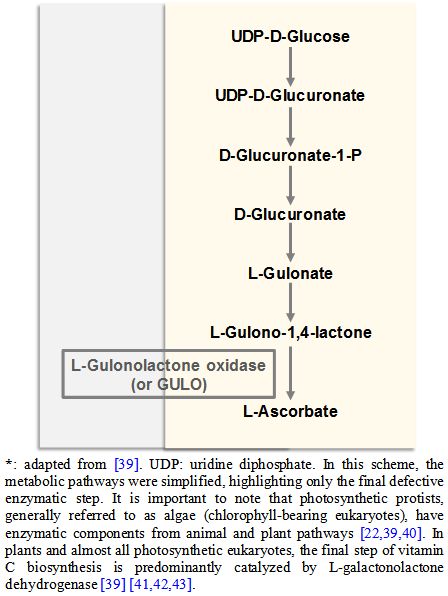
In vertebrates, the inability to synthesize vitamin C is due to random mutations in the GULO gene, which encodes the eponymous enzyme responsible for catalyzing the last step of vitamin C biosynthesis (Figure 1) 10 36, 37, 38, 39.
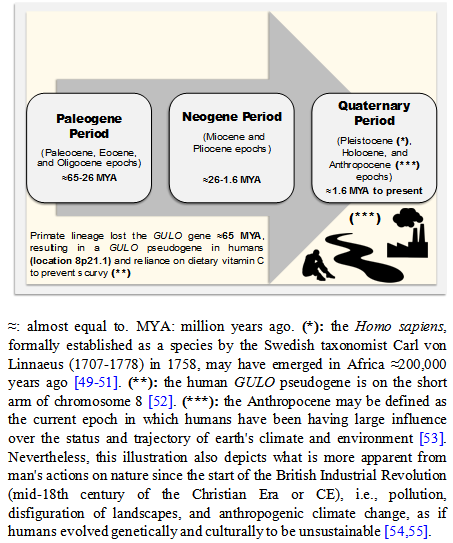
Nishikimi and Yagi (1991) sequenced the rat GULO gene, then used this gene sequence to probe the genomes of other species 37, 38. The human genome was proven to have a nonfunctional GULO pseudogene that is homologous to the functional rat GULO gene (Figure 2) 37, 38, 44.
Primitive man’s diet underwent important changes, in sum, from predominant carnivorous diet in the early and middle Pleistocene (animal flesh could provide enough vitamin C to prevent scurvy) to seasonal omnivorous diet (both plants and meat) in the end of the Pleistocene, ensuring availability of the micronutrient and compensating for its lack of biosynthesis 56.
It is worth remarking that oxygen free radicals are byproducts of normal metabolism and their formation is not problematic as long as a balance between production and excretion occurs 57. Free radicals play a role in the toxicity of chemicals 58. Strong natural antioxidants, such as the abovementioned vitamins C and E and flavonoids, scavenge and neutralize free radicals, preventing oxidative damage to cellular components 31, 59.


Interestingly, with the increase of fresh water eutrophication (i.e., areas where the concentration of nitrate exceeds 1 mg NO3-N l-1) and global warming, vitamin C helps turtle species in coping with stressful factors (e.g., hypoxia, anoxia) in harsh environments during their hibernation 60, 61, 62.
Actually, the evolution of vertebrates from the aquatic medium to the terrestrial atmosphere (with a high concentration of environmental oxygen) was marked by tissue-specific expression of the GULO gene 63. The mechanisms of oxygen-sensing and epigenetic control (i.e., a regulation independent of the DNA sequence itself) constitute new findings on the multifaceted biological role of vitamin C 64, 65.
Uric acid is a strong antioxidant molecule too, but its major (pathophysiological) importance lies in its potential accumulation in the body, triggering chronic hyperuricemia, gout (the most common form of inflammatory arthritis by the deposition of monosodium urate crystals in the joints), and constituting a cardiovascular risk factor 66, 67. Humans also lack factor-independent urate hydroxylase (recommended name) or urate oxidase (a synonym), or simply UOX, i.e., an endogenous enzyme existent in most mammals that converts uric acid to allantoin (a highly soluble metabolite readily excreted by the kidneys) 68, 69. The human UOX pseudogene is on the short arm of chromosome 1 (1p22) and its formation can be attributed to several mutations during evolution 46, 70.
The present work does not delve into the applicability of the “resurrected” human-source UOX, i.e., an enzyme with high uricolytic activity and stability 70. The implications of the loss of this enzyme activity in the intermediary metabolism are also outside the realm of this work. However, it should be noted that the loss of UOX activity took place 20-30 MYA, independently from the earlier loss of vitamin C biosynthesis ability in primates (≈65 MYA), as pointed out in Figure 2 48.
In general, prehistory is divided into periods that are called by the name of the major material used at the time such as the Stone Age, the Bronze Age, and the Iron Age 71. The Stone Age, in its turn, is divided in three archeological periods, i.e., the Paleolithic (≈12,000-9500 before the Christian Era or BCE), the Mesolithic (≈9500-4000 BCE), and the Neolithic (≈4000-1700 BCE), ending up with the advent of literacy in ancient civilizations 45 72, 73, 74.
Ancient civilizations such as the Greek, the Mesopotamian, and the Egyptian emerged in the Bronze Age, while civilizations such as the Phoenician in the Iron Age, and are discussed in subsection 3.1. 75.
The primary goal of Paleolithic and Mesolithic men was probably to gather all available resources to obtain calories for immediate survival, soon learning that vegetables were also necessary (but without correlating vegetable shortage in winter with consequent deficiencies of vitamin C and iron) 76. In these pre-agricultural times, the meat of large mammals (e.g., mammoth, rhinoceros, and bison) was the major energy source along with that of vitamin C (as mentioned before) 77, 78, 79.
The Neolithic period is known for its groundbreaking developments in animal and crop domestication, specifically cereals and the emergence of agriculture 80, 81. It changed the hunter-gatherer diet (plentiful in red meat and more bioavailable heme iron) to the cereal grain diet (with a predominance of the less bioavailable nonheme iron); this dietary shift resulting in an increased incidence of iron deficiency anemia and applying to the common mutation (C282Y) of the Homeostatic Iron Regulator (HFE) gene, related to hereditary hemochromatosis (or primary iron overload), thus representing an adaptation to the decreased dietary iron during this period (the HFE gene is on the short arm of chromosome 6 (6p21.3) and controls intestinal iron absorption and deposition in the tissues) 46 82, 83, 84, 85, 86.
As referred to above, vitamin C impacts both on iron absorption and metabolism, and the lower incidence of this mutation in agrarian regions such as the Mediterranean and the Near East might have resulted from higher dietary intakes of iron owing to vitamin C abundant sources 12, 83.
Archeological evidence of vitamin C deficiency can be found in prehistoric times. An analysis of periosteal lesions from commingled human remains at the Xagħra Circle hypogeum (i.e., an underground burial chamber) revealed the first case of probable scurvy from Neolithic Malta 87.
In contrast to prehistory, where archeological periods are determined by material usage, history may be divided into diverse periods based on impactful events that transformed entire civilizations or even the world, as further discussed below.
3.1. Ancient HistoryAncient history studies encompass the civilizations of the oriental antiquity, such as the Egyptian, the Mesopotamian, the Hebrew, and the Phoenician, as well as the classic antiquity, which comprises the Greek and the Roman civilizations 55.
The German Egyptologist Georg Ebers (1837-1898) discovered an ancient papyrus at Thebes in the second half of the 19th century (1872), henceforth called by his name 88, 89. The Ebers papyrus is considered the most comprehensive medical papyrus ever recovered, dating back to 1534 BCE and revealing primordial commentaries on scurvy, such as major symptoms (e.g., bleeding gums and petechial hemorrhages) 90, 91, 92.
In ancient Mesopotamia, scurvy was known as “the evil smelling disease”, being classified in the therapeutic texts with disorders of the teeth 93.
The issue of scurvy was also discussed in biblical verses 94. Of note, pomegranate (Punica granatum L., Lythraceae), whose fruits contain vitamin C (e.g., 6.2 mg/100 mL juice at harvest), is one of the seven food staples of the land of Israel mentioned in the Old Testament 95, 96. It originated from the regions now occupied by Iran and Afghanistan, and was brought to the Mediterranean countries by the Phoenicians (but the Egyptians are famous for having cultivated it around 2500 BCE) 95.
The Greek physician Hippocrates (460-370 BCE) termed scurvy ileos emantis to refer to a condition where the gums detach from the teeth and blood runs from the nostrils 97. It is considered the first formal description of the disease 98.
Strabo (63 or 64 BCE–24 CE) was a Greek geographer who described the emergence of an epidemic of scurvy among the Roman troops in Arabia during the reign of Gaius Aelius Gallus, a Roman prefect 98, 99.
In total, the clinical presentation of scurvy throughout the ancient history underscores the significance of oral and bleeding manifestations of this disease. In effect, vitamin C deficiency results in faulty collagen synthesis, which increases vascular fragility, bleeding tendency, and the related clinical signs 13.
3.2. Middle AgesThe Middle Ages began with the downfall of the Western Roman Empire (456 CE), subsisting until the conquest of Constantinople by the Ottoman Turks (1453) 55. In this long historic corridor of almost a thousand years, the Crusades stand out as an example of religion used to justify war 100. The Crusades occurred between the 11th and 14th centuries 101. However, more Crusaders succumbed from scurvy than from fighting battles 102.
3.3. Modern HistoryThe modern history started in the 15th century, and the date of 1492 (discovery of America) is a landmark for its beginning 55. The first outbreak of sea scurvy was recorded during the Portuguese expedition to India (1497-1499) headed by Vasco da Gama (1469-1524), and more than half of his crew died from scurvy on this trip around the Cape of Hope (although the etiology of the deaths was entirely inexplicable at that point) 103, 104, 105.
These tragic outbreaks of sea scurvy would unfortunately repeat in history, as discussed below.
3.4. Contemporary HistoryUsually, the French Revolution (1789-1799) is used as a milestone to mark the beginning of the contemporary history 55. Despite that, this and all the aforementioned pivotal events are not directly applicable to the historic demarcation of every known civilization. For instance, the medieval period in Denmark began with the end of the Viking Age in 1050 and came to a close in the mid-16th century 106.
The Napoleonic Age began during the French Revolution and ended in the renowned battle of Waterloo in 1815 55. But, according to Bhattacharyya et al., what was really behind the defeat of the French Forces against a healthier British Navy during their constant war, was the proper use of fresh lime juice (e.g., 0.35 g/L of vitamin C), then proposed by Sir James Lind (1716-1794), a Scottish surgeon in the Royal Navy, to help fight the scourge (scurvy) 14 107, 108, 109.
In fact, in the mid-l8th century, James Lind demonstrated that the juice of fresh citrus fruits cures scurvy 110, 111. However, until the end of the 18th century, vitamin C was often unreachable in the dried foods and other food supplies stored for winter or for extended travels 14. As a result, scurvy was a common disease in the world’s navies and sailors until the beginning of the 19th century 112.
At this time, Axel Holst (1860-1931), professor of hygiene and bacteriology at the University of Oslo, and the pediatrician Theodor Frølich (1870-1947), were interested in a disease called ship beriberi (vitamin B1 or thiamine deficiency), which tormented the crews of sailing ships, showing an uncanny similarity to scurvy 113. These two investigators suspected a nutritional deficiency, establishing an animal model (the abovementioned guinea pig, a non-synthesizer of vitamin C) that allowed a systematic study of factors that led to the disease and the preventive value of different substances 113. Their findings were published at the beginning of the 20th century (1907), but caused scientific upheaval since the concept of nutritional deficiencies was an innovation at the time 113.
The Polish biochemist Casimir Funk (1884-1967) coined the term vitamin in 1912 for a substance that appeared to be vital to life, although it was not an amine, but the term was already enshrined and persisted without change (Latin vita + amine) 114, 115, 116, 117. A vitamin is an organic micronutrient existing in minute amounts in natural foodstuffs, indispensable to normal metabolism, whose lack in the diet may cause deficiency disease 114, 116, 117.
The Hungarian biochemist Albert von Szent-Györgyi (1893-1986) isolated vitamin C in the late 1920s, becoming the winner of the 1937 Nobel Prize in Physiology or Medicine 107, 110, 118.
The industrial production of vitamin C started in 1934 and was widely based on the Tadeus Reichstein (1897- 1996) and Andreas Grüssner process, combining one-step bacterial fermentation with chemical conversions (now, the production is almost exclusively based on a two-step fermentation process, which reduces the chemical conversion stages) 119, 120, 121, 122.
At the present time, around half of global vitamin C production is allocated for vitamin supplements, while the rest is used as a food additive (25%), in beverage production (15%), and for animal feed (10%) 123.
3.5. The Significance of Linus Carl Pauling (1901-1994) in Promoting Vitamin C Knowledge Cannot Be OverstatedLinus Pauling was a distinguished figure in the scientific contemporary history, warranting a subsection apart. That said, his well-known biography, which includes two Nobel Prizes (Chemistry in 1954 and Peace in 1962), is not revised here. Nonetheless, when conducting a review as thematically extensive as this one, it is necessary to acknowledge his contribution to promoting vitamin C (Table 1).
Table 1 displays an insightful set of works on vitamin C by Linus Pauling and colleagues. Essentially, his primary focus was on studying the impact of high doses of this vitamin on common cold, flu, and cancer 137. This paved the way for the rise of an innovative (orthomolecular) approach to medicine and fresh perspectives for the fight against cancer and its intricate biology (e.g., endothelial dysfunction), despite the criticism of his methodology all along the way 138, 139. The effectiveness of vitamin C as a therapy for cancer continues to be debated 140, 141.
Coronavirus disease 2019 (or COVID-19) is caused by a novel viral agent, SARS-CoV-2 (Severe Acute Respiratory Syndrome-Coronavirus-2), and was declared a pandemic by the World Health Organization (WHO) on March 11th, 2020, because of its widespread transmission and infection rates 142, 143, 144, 145, 146. A search for COVID-19 and vitamin C on the internet yielded 597 results in 2019 and 11,600 results in 2022. This viral infection has indeed reignited curiosity about the possible therapeutic benefits of vitamin C, despite vaccines being the safe and effective methods of preventing the serious illness.
Vitamin C effectively fulfills the conceptual requirements of a conventional vitamin (subsection 3.4.), still serving as an important bioactive compound, i.e., a compound that can interact with one or more part(s) of living tissues by displaying an immense range of probable effects 147.
As a result, vitamin C may boost immune function in several ways, including: improvement of chemotaxis (or leukocyte migration); neutrophilic phagocytosis and oxidative killing; attenuation of the neutrophil extracellular trap formation (NETosis) and reduction of the uncontrollable inflammatory cytokine production in the alveolar space; differentiation and proliferation of B- and T-lymphocytes; antibody production; cortisol production; interferon-γ production; downregulation of interleukin (IL) -6 and endothelin-1; increased lung epithelial barrier; susceptibility and outcome of low respiratory tract infections 148, 149, 150, 151, 152, 153, 154, 155.
The inflammatory response in COVID-19 patients may be dramatic and referred to as cytokine storm because of the large amount of pro-inflammatory molecules released in the plasma (i.e., IL-1b, IL-2, IL-6, IL-8, IL-10, interferon-γ, and tumor necrosis factor-α or TNF-α), potentially leading to acute lung injury, subsequent acute respiratory distress syndrome, multiorgan failure, and death if immediate intensive care unit interventions are not initiated 155, 156, 157, 158.
In addition, obesity is a chronic low-grade inflammatory state and adipose tissue serves as a source of inflammatory mediators (e.g., chemerin (a 163 amino acid protein), galectin-3, resistin, IL-6, TNF-α, leptin, adiponectin, and C-reactive protein) 159, 160, 161, 162. That is in part why overweight people have a higher risk of COVID-19-related hospitalizations but not death, whereas obese and extremely obese people increase the risk of both hospitalizations and death 163.
The effectiveness of large amounts of vitamin C to treat COVID-19 patients is still being debated.
Evolution, prehistory, and history are intermingled and consequential events that may be better comprehended when explored together, notably when related to vitamin C, as attempted in the present review article.
Most species can synthesize vitamin C, except for a few, including humans. The recent heated debates on this evolutionary aspect bring to mind the era of the famous English naturalist Charles Robert Darwin (1809-1882), with evolutionists and creationists taking opposing stances and showing, among other aspects, how exciting evolutionary biology is as a scientific field. Today, pseudogenes draw growing attention in multidisciplinary research, especially in cancer biology, but still raise more questions than answers.
The emergence of scurvy as a dreadful clinical repercussion of the inability to synthesize vitamin C has made up a heavy burden to humankind over the centuries, as extensively discussed here. However, only lately have the archeological records revealed the evidence of this terrible disease in the remote past of human beings.
To encourage day-to-day vitamin C consumption and prevent scurvy, health professionals should insistently advocate for the population to consume fresh fruits and vegetables, which are the richest sources of this micronutrient.
The author expresses gratitude to Prof. Dr. Felipe Jules de Araújo Santos (Molecular Biology Laboratory, Fundação Hospitalar Alfredo da Matta─FUHAM), for his valuable discussion on the genetic aspects of vitamin C.
The author is also indebted to his dear father, Moacir Couto de Andrade, who was an accomplished historian himself and would have appreciated reading some pertinent passages in the present review article (in memoriam).
The author declares no conflict of interest.
| [1] | Andrade Jr., M.C. de, “Evolutionary aspects of hormones”, Archives of Endocrinology and Metabolism, 46(3). 291-298. 2002. | ||
| In article | View Article | ||
| [2] | Balakirev, E.S., Ayala, F.J., “Pseudogenes: are they “junk” or functional DNA?”, Annual Review of Genetics, 37. 123-151. 2003. | ||
| In article | View Article PubMed | ||
| [3] | Zheng, D., Frankish, A., Baertsch, R., Kapranov, P., Reymond, A., Choo, S.W., Lu, Y., Denoeud, F., Antonarakis, S.E., Snyder, M., Ruan, Y., Wei, C.-L., Gingeras, T.R., Guigó, R., Harrow, J., Gerstein, M.B., “Pseudogenes in the ENCODE regions: consensus annotation, analysis of transcription, and evolution”, Genome Research, 17(6). 839-851. 2007. | ||
| In article | View Article PubMed | ||
| [4] | Chen, F.-C., Chen, Y.-Z., Chuang, T.-J., “CNVVdb: a database of copy number variations across vertebrate genomes”, Bioinformatics, 25(11). 1419-1421. 2009. | ||
| In article | View Article PubMed | ||
| [5] | Zhang, Y., Sun, Y., “PseudoDomain: identification of processed pseudogenes based on protein domain classification”, in Proceedings of the ACM Conference on Bioinformatics, Computational Biology and Biomedicine, 2012, 178-185. | ||
| In article | View Article | ||
| [6] | Chan, W.-L., Yuo, C.-Y., Yang, W.-K., Hung, S.-Y., Chang, Y.-S., Chiu, C.-C., Yeh, K.-T., Huang, H.-D., Chang, J.-G., “Transcribed pseudogene ψPPM1K generates endogenous siRNA to suppress oncogenic cell growth in hepatocellular carcinoma”, Nucleic Acids Research, 41(6). 3734-3747. 2013. | ||
| In article | View Article PubMed | ||
| [7] | Zhang, Q., “Using pseudogene database to identify lineage-specific genes and pseudogenes in humans and chimpanzees”, Journal of Heredity, 105(3). 436-443. 2014. | ||
| In article | View Article PubMed | ||
| [8] | Bender, D.A., Benders’ dictionary of nutrition and food technology, 8 ed, CRC Press, Boca Raton, 2006. | ||
| In article | View Article | ||
| [9] | Lopez, M.J., Mohiuddin, S.S., Biochemistry, essential amino acids, StatPearls Publishing, Treasure Island (FL), 2023. | ||
| In article | |||
| [10] | Drouin, G., Godin, J.R., Pagé, B., “The genetics of vitamin C loss in vertebrates”, Current Genomics, 12(5). 371-378. 2011. | ||
| In article | View Article PubMed | ||
| [11] | Korus, A., “Changes in the content of minerals, B-group vitamins and tocopherols in processed kale leaves”, Journal of Food Composition and Analysis, 89(103464). 2020. | ||
| In article | View Article | ||
| [12] | Lane, D.J., Richardson, D.R., “The active role of vitamin C in mammalian iron metabolism: much more than just enhanced iron absorption!”, Free Radical Biology and Medicine, 75. 69-83. 2014. | ||
| In article | View Article PubMed | ||
| [13] | Andrade Jr., M.C., “Vitamin C deficiency (or scurvy): pathophysiology and clinical manifestations according to age groups”, Journal of Food and Nutrition Research, 11(12). 752-758. 2023. | ||
| In article | View Article | ||
| [14] | Nelson, D.L., Cox, M.M., Hoskins, A.A., Lehninger principles of biochemistry, 8 ed, Macmillan Learning, New York, 2021. | ||
| In article | |||
| [15] | Poole, A., Jeffares, D., Penny, D., “Early evolution: prokaryotes, the new kids on the block”, BioEssays, 21(10). 880-889. 1999. | ||
| In article | View Article | ||
| [16] | De la Cruz, A.A., Chernoff, N., Sinclair, J.L., Hill, D., Diggs, D.L., Lynch, A.T., “Introduction to cyanobacteria and cyanotoxins”, in Hiskia, A.E., Triantis, T.M., Antoniou, M.G., Kaloudis, T., Dionysiou, D.D., Eds., Water treatment for purification from cyanobacteria and cyanotoxins, John Wiley & Sons Ltd., New Jersey, 2020, 1-35. | ||
| In article | View Article PubMed | ||
| [17] | Kristensen, T., Guillaume, F., “Different regimes for classification of DNA sequences”, in IEEE 7th International Conference on Cybernetics and Intelligent Systems (CIS) and IEEE Conference on Robotics, Automation and Mechatronics, Siem Reap, Cambodia, 15-17 July, 2015. | ||
| In article | View Article PubMed | ||
| [18] | Olagunju, O.F., “Incidence of mycotoxigenic fungi during processing and storage of bambara groundnut (Vigna subterranea) composite flour”, Doctor Degree, Durban, South Africa, Department of Biotechnology and Food Technology, Durban University of Technology, 2019. | ||
| In article | |||
| [19] | Sunter J.D., Moreira-Leite F., Gull K., “Dependency relationships between IFT-dependent flagellum elongation and cell morphogenesis in Leishmania”, Royal Society Open Biology, 8(11). 180124. 2018. | ||
| In article | View Article PubMed | ||
| [20] | Olivier, M., Hassani, K, “Protease inhibitors as prophylaxis against leishmaniasis: new hope from the major surface protease gp63”, Future Medicinal Chemistry, 2(4). 539-542. 2010. | ||
| In article | View Article PubMed | ||
| [21] | Dolan, M.F., “The missing piece: the microtubule cytoskeleton and the origin of the eukaryotes”, in Sapp, J., Ed., Microbial phylogeny and evolution: concepts and controversies, Oxford University Press, Inc., New York, 2005, 281-289. | ||
| In article | |||
| [22] | King, R.C., Stansfield, W.D., and Mulligan, P.K., A dictionary of genetics, 7 ed, Oxford University Press, New York, 2006. | ||
| In article | |||
| [23] | Liffner, B., and Absalon, S., “Expansion microscopy of apicomplexan parasites” Molecular Microbiology. 2023. | ||
| In article | View Article | ||
| [24] | Smirnoff, N., “Ascorbic acid metabolism and functions: a comparison of plants and mammals”, Free Radical Biology and Medicine, 122. 116-129. 2018. | ||
| In article | View Article PubMed | ||
| [25] | Branduardi, P., Fossati, T., Sauer, M., Pagani, R., Mattanovich, D., Porro, D., “Biosynthesis of vitamin C by yeast leads to increased stress resistance”, PLoS ONE, 2(10). 2007. | ||
| In article | View Article PubMed | ||
| [26] | Evers, M.S., Roullier-Gall, C., Morge, C., Sparrow, C., Gobert, A., Alexandre, H., “Vitamins in wine: which, what for, and how much?”, Comprehensive Reviews in Food Science and Food Safety, 20. 2991-3035. 2021. | ||
| In article | View Article PubMed | ||
| [27] | Köhler, J.R., Acosta-Zaldívar, M., Qi, W., “Phosphate in virulence of Candida albicans and Candida glabrata”, Journal of Fungi, 6(2). 2020. | ||
| In article | View Article PubMed | ||
| [28] | Zhitkovich, A., “Nuclear and cytoplasmic functions of vitamin C”, Chemical Research in Toxicology, 33(10). 2515-2526. 2020. | ||
| In article | View Article PubMed | ||
| [29] | Hancock, R.D., Galpin, J.R., Viola, R., “Biosynthesis of L-ascorbic acid (vitamin C) by Saccharomyces cerevisiae”, FEMS Microbiology Letters, 186(2). 245-250. 2000. | ||
| In article | View Article PubMed | ||
| [30] | Andrade Jr., M.C, Andrade J.S., Fermented foods in general and ethnic fermented foods in particular, LAP LAMBERT Academic Publishing, Saarbrücken, 2015. | ||
| In article | |||
| [31] | Han, B., Nimni, M.E., “Transdermal delivery of amino acids and antioxidants enhance collagen synthesis: in vivo and in vitro studies”, Connective Tissue Research, 46. 251-257. 2005. | ||
| In article | View Article PubMed | ||
| [32] | Kramer, K.J., Seib, P.A., “Ascorbic acid and the growth and development of insects”, in Ascorbic acid: chemistry, metabolism, and uses, ACS Publications, Washington, DC, 1982, 275-291. | ||
| In article | View Article | ||
| [33] | Huang, J., Sun, W., Seong, K.M., Mittapalli, O., Ojo, J., Coates, B., Paige, K.N., Clark, J.M., Pittendrigh, B.R., “Dietary antioxidant vitamin C influences the evolutionary path of insecticide resistance in Drosophila melanogaster”, Pesticide Biochemistry and Physiology, 168(104631). 2020. | ||
| In article | View Article PubMed | ||
| [34] | Lohakare, J.D., Kim, J.K., Ryu, M.H., Hahn, T.-W., Chae, B.J., “Effects of vitamin C and vitamin D interaction on the performance, immunity, and bone characteristics of commercial broilers”, Journal of Applied Poultry Research, 14(4). 670-678. 2005. | ||
| In article | View Article | ||
| [35] | Leskovec, J., Levart, A., Nemec Svete, A., Perić, L., Đukić Stojčić, M., Žikić, D., Salobir, J., Rezar, V., “Effects of supplementation with α-tocopherol, ascorbic acid, selenium, or their combination in linseed oil-enriched diets on the oxidative status in broilers”, Poultry Science, 97(5). 1641-1650. 2018. | ||
| In article | View Article PubMed | ||
| [36] | Meduri, G.U., Chrousos, G.P., “General adaptation in critical illness: glucocorticoid receptor-alpha master regulator of homeostatic corrections”, Frontiers in Endocrinology, 11(161). 2020. | ||
| In article | View Article PubMed | ||
| [37] | Deacon, T.W., “A degenerative process underlying hierarchic transitions in evolution”, Biosystems, 222(104770). 2022. | ||
| In article | View Article PubMed | ||
| [38] | Nishikimi, M., Yagi, K., “Molecular basis for the deficiency in humans of gulonolactone oxidase, a key enzyme for ascorbic acid biosynthesis”, The American Journal of Clinical Nutrition, 54(6). 1203S-1208S. 1991. | ||
| In article | View Article PubMed | ||
| [39] | Duque, P., Vieira, C.P., Bastos, B., Vieira, J., “The evolution of vitamin C biosynthesis and transport in animals”, BMC Ecology and Evolution, 22(1). 1-21. 2022. | ||
| In article | View Article PubMed | ||
| [40] | Larkum, A.W.D., “The golden apples of the sun: the history of photosynthesis—so far, in Photosynthesis research for food, fuel and the future: 15th International Conference on Photosynthesis, Springer, Berlin, Heidelberg. 2013. | ||
| In article | View Article | ||
| [41] | Kuivanen, J., Penttilä, M., Richard, P, “Metabolic engineering of the fungal D-galacturonate pathway for L-ascorbic acid production”, Microbial Cell Factories, 14(1). 1-9. 2015. | ||
| In article | View Article PubMed | ||
| [42] | Fernie, A.R., Tohge, T., “A cross-kingdom history”, eLife, 4(e07527). 2015. | ||
| In article | View Article PubMed | ||
| [43] | Smirnoff, N., Wheeler, G.L., “The ascorbate biosynthesis pathway in plants is known but there is a way to go with understanding control and functions”, Journal of Experimental Botany, erad505. 2024. | ||
| In article | View Article PubMed | ||
| [44] | Inai, Y., Ohta, Y., Nishikimi, M., “The whole structure of the human nonfunctional L-gulono-γ-lactone oxidase gene-the gene responsible for scurvy-and the evolution of repetitive sequences thereon”, Journal of Nutritional Science and Vitaminology, 49(5). 315-319. 2003. | ||
| In article | View Article PubMed | ||
| [45] | Lincoln, R.J., Boxshall, G.A., Clark, P.F., A dictionary of ecology, evolution and systematics, Cambridge University Press, Cambridge. 1982. | ||
| In article | |||
| [46] | Amberger, J.S., Hamosh, A., Mckusick, V.A., “Morbid anatomy of human genome”, Scriver, C.R., Beaudet, A.L., Sly, W.S., Valle, D., Eds., in The metabolic and molecular bases of inherited disease, New York, 2001, 47-125. | ||
| In article | |||
| [47] | Gerstein, M., Zheng, D., “The real life of pseudogenes”, Scientific American, 295(2). 48-55. 2006. | ||
| In article | View Article PubMed | ||
| [48] | Li, Z., Hoshino, Y., Tran, L., Gaucher, E.A., “Phylogenetic articulation of uric acid evolution in mammals and how it informs a therapeutic uricase”, Molecular Biology and Evolution, 39(1). 2022. | ||
| In article | View Article PubMed | ||
| [49] | Ligrone, R., “The emergence of humanity”, in Biological innovations that built the world, Springer Nature Switzerland AG, Cham, 2019, 399-470. | ||
| In article | View Article | ||
| [50] | Kvist, U., “Spermatology in Sweden”, in XIIIth International Symposium on Spermatology, Björndahl, L., Flanagan, J., Holmberg, R., Kvist, U., Eds., Springer International Publishing, Cham, 2021, 19-32. | ||
| In article | View Article PubMed | ||
| [51] | Sauer, G., “Astrobiology, a new chapter in the book of nature”, Theology and Science. 1-12. 2024. | ||
| In article | View Article | ||
| [52] | Moran, L.A., Horton, H.R., Scrimgeour, K.G., Perry, M.D., Principles of biochemistry, 5 ed, Pearson Education, Inc., Boston, 2012. | ||
| In article | |||
| [53] | Coleman, M.A., “Algae in the Anthropocene: managing, conserving, and utilizing algae in an era of rapid environmental change” Journal of Phycology. 2023. | ||
| In article | View Article PubMed | ||
| [54] | Richerson, P.J., Boyd, R.T., Efferson, C., “Agentic processes in cultural evolution: relevance to Anthropocene sustainability”, Philosophical Transactions of the Royal Society B, 379(1893). 2024. | ||
| In article | View Article PubMed | ||
| [55] | Vicentino, C., [General history], História geral, 8 ed, Scipione, São Paulo, 2000. | ||
| In article | |||
| [56] | Flodin, N.W., “Nutritional influences in the geographic dispersal of Pleistocene man”, Ecology of Food and Nutrition, 38(1). 71-99. 1999. | ||
| In article | View Article | ||
| [57] | Kerr, M.E., Bender, C.M., Monti, E.J., “An introduction to oxygen free radicals”, Heart & Lung: the Journal of Critical Care, 25(3). 200-209. 1996. | ||
| In article | View Article PubMed | ||
| [58] | Aust, S.D., Chignell, C.F., Bray, T.M., Kalyanaraman, B., Mason, R.P., “Free radicals in toxicology”, Toxicology and Applied Pharmacology, 120(2). 168-178. 1993. | ||
| In article | View Article PubMed | ||
| [59] | Gudasi, S., Gharge, S., Koli, R., Patil, K., “Antioxidant properties and cytotoxic effects of Oxalis corniculata on human Hepatocarcinoma (Hep-G2) cell line: an in vitro and in silico evaluation”, Future Journal of Pharmaceutical Sciences, 9(25). 2023. | ||
| In article | View Article | ||
| [60] | Li, M., Niu, C., Chen, Y., “Diverse response pattern to anoxia in three freshwater turtle species”, Biology, 12(1). 2022. | ||
| In article | View Article PubMed | ||
| [61] | Erisman, J.W., Galloway, J.N., Seitzinger, S., Bleeker, A., Dise, N.B., Petrescu, A.M.R., Leach, A.M., de Vries, W., “Consequences of human modification of the global nitrogen cycle”, Philosophical Transactions of the Royal Society B: Biological Sciences, 368(1621). 20130116. 2013. | ||
| In article | View Article PubMed | ||
| [62] | Chen, B., Niu, C., Yuan, L., Zhang, W., “Physiological responses in vitamin C system during hibernation in juvenile Chinese soft-shelled turtle Pelodiscus sinensis”, Journal of Oceanology and Limnology, 37(2). 767-776. 2019. | ||
| In article | View Article | ||
| [63] | Nandi, A., Mukhopadhyay, C.K., Ghosh, M.K., Chattopadhyay, D.J., Chatterjee, I.B., “Evolutionary significance of vitamin C biosynthesis in terrestrial vertebrates”, Free Radical Biology and Medicine, 22(6). 1047-1054. 1997. | ||
| In article | View Article PubMed | ||
| [64] | Kietzmann, T., “Vitamin C: from nutrition to oxygen sensing and epigenetics”, Redox Biology, 63(102753). 2023. | ||
| In article | View Article PubMed | ||
| [65] | Thompson, R.F., Einstein, F.H., “Epigenetic basis for fetal origins of age-related disease”, Journal of Women's Health, 19(3). 581-587. 2010. | ||
| In article | View Article PubMed | ||
| [66] | Kuo, C.F., Grainge, M.J., Zhang, W., Doherty, M., “Global epidemiology of gout: prevalence, incidence and risk factors”, Nature Reviews Rheumatology, 11(11). 649-662. 2015. | ||
| In article | View Article PubMed | ||
| [67] | Santos, C.S., Salgueiro, R.R., Morales, C.M., Castro, C.Á., Álvarez, E.D., “Risk factors for cardiovascular disease in primary Sjögren’s syndrome (pSS): a 20-year follow-up study”, Clinical Rheumatology, 42(11). 3021-3031. 2023. | ||
| In article | View Article PubMed | ||
| [68] | Chang, A., Jeske, L., Ulbrich, S., Hofmann, J., Koblitz, J., Schomburg, I., Neumann-Schaa, l.M., Jahn, D., Schomburg, D., “BRENDA, the ELIXIR core data resource in 2021: new developments and updates”, Nucleic Acids Research, 49(D1). D498-D508. 2021. | ||
| In article | View Article PubMed | ||
| [69] | Crews, K.R., Zhou, Y., Pauley, J.L., Howard, S.C., Jeha, S., Relling, M.V., Pui, C.H., “Effect of allopurinol versus urate oxidase on methotrexate pharmacokinetics in children with newly diagnosed acute lymphoblastic leukemia”, Cancer: Interdisciplinary International Journal of the American Cancer Society, 116(1). 227-232. 2010. | ||
| In article | View Article PubMed | ||
| [70] | Jiang, N., Xu, C., Zhang, L., Chen, J., ““Resurrected” human-source urate oxidase with high uricolytic activity and stability”, Enzyme and Microbial Technology, 149(109852). 2021. | ||
| In article | View Article PubMed | ||
| [71] | Birat, J.P., “Society and materials: how it all started, a few million years ago”, Matériaux & Techniques, 104(6-7). 605. 2016. | ||
| In article | View Article | ||
| [72] | Wastegård, S., “The Holocene of Sweden–a review”, GFF, 144(2). 126-149. 2022. | ||
| In article | View Article | ||
| [73] | Castaneda, D., Archaeology, ED-Tech Press, Waltham Abbey, 2018. | ||
| In article | |||
| [74] | Singh, V., “Study of history purpose and methods of archaeology”, Asian Journal Of Multidimensional Research, 10(7). 70-74. 2021. | ||
| In article | View Article | ||
| [75] | Brooks, C., Western civilization: a concise history, Portland Community College, Portland, 2022. | ||
| In article | |||
| [76] | Rausing, G., “Stone Age man, anemia and iron oxide”, Fornvännen: Journal of Swedish Antiquarian Research, 87. 127-128. 1992. | ||
| In article | |||
| [77] | Mann, N., “Dietary lean red meat and human evolution”, European Journal of Nutrition, 39. 71-79. 2000. | ||
| In article | View Article PubMed | ||
| [78] | Siminialayi, I.M., “The rising burden of non-communicable disease and food as medicine”, Niger Delta Medical Journal, 2(1). 19-36. 2017. | ||
| In article | |||
| [79] | Guil-Guerrero, J.L., “The role of large mammals as vitamin C sources for MIS 3 hominins”, Quaternary, 6(1). 2023. | ||
| In article | View Article | ||
| [80] | Szczęsny, T.J., “Was the 4.2 ka event an anthropogenic disaster?”, Open Journal of Ecology, 6(10). 2016. | ||
| In article | View Article | ||
| [81] | Abdel-Haleem, H., Bowman, J.G., Kanazin, V., Surber, L., Talbert, H., Hayes, P.M., and Blake, T., “Quantitative trait loci for dry matter digestibility and particle size traits in two-rowed × six-rowed barley population”, Euphytica, 172. 419-433. 2010. | ||
| In article | View Article | ||
| [82] | Haak, W., Lazaridis, I., Patterson, N., Rohland, N., Mallick, S., Llamas, B., Brandt, G., Nordenfelt, S., Harney, E., Stewardson, K., Fu, Q., Mittnik, A., Bánffy, E., Economou, C., Francken, M., Friederich, S., Pena, R.G., Hallgren, F., Khartanovich, V., Khokhlov, A., Kunst, M., Kuznetsov, P., Meller, H., Mochalov, O., Moiseyev, V., Nicklisch, N., Pichler, S.L., Risch, R., Guerra, M.A.R., Roth, C., Szécsényi-Nagy, A., Wahl, J., Meyer, M., Krause, J., Brown, D., Anthony, D., Cooper, A., Alt, K.W., Reich, D., “Massive migration from the steppe was a source for Indo-European languages in Europe”, Nature, 522(7555). 7555. 2015. | ||
| In article | View Article PubMed | ||
| [83] | Naugler, C., “Hemochromatosis: a Neolithic adaptation to cereal grain diets”, Medical Hypotheses, 70(3). 691-692. 2008. | ||
| In article | View Article PubMed | ||
| [84] | Pinyopornpanish, K., Tantiworawit, A., Leerapun, A., Soontornpun, A., Thongsawat, S., “Secondary iron overload and the liver: a comprehensive review”, Journal of Clinical and Translational Hepatology, 11(4). 932-941. 2023. | ||
| In article | |||
| [85] | Dorak, M.T., Relton, C.L., Hammal, D., Hall, A.G., Parker, L,. “HFE-C282Y association in childhood ALL: pointing towards iron?”, in Children with Leukaemia Conference, London, 2004. | ||
| In article | |||
| [86] | Machado, C.C., Dinis-Oliveira, R.J., “Clinical and forensic signs resulting from exposure to heavy metals and other chemical elements of the periodic table”, Journal of Clinical Medicine, 12(7). 2023. | ||
| In article | View Article PubMed | ||
| [87] | Thompson, J.E., Power, R.K., Mercieca-Spiteri, B., Magnussen, J.S., Pardey, M., Buck, L.T., Stock, J.T., McLaughlin, T.R., Stoddart, S., Malone, C., “Analysis of periosteal lesions from commingled human remains at the Xagħra Circle hypogeum reveals the first case of probable scurvy from Neolithic Malta”, International Journal of Osteoarchaeology, 32(1). 18-37. 2022. | ||
| In article | View Article | ||
| [88] | Greydanus, D.E., Apple, R.W., Chahin, S.S., “Integrated behavioral health care: reflections of the past”, Pediatric Clinics, 68(3). 519-531. 2021. | ||
| In article | View Article PubMed | ||
| [89] | Khalil, R.B., Richa, S., “When affective disorders were considered to emanate from the heart: the Ebers papyrus”, American Journal of Psychiatry, 171(3). 275. 2014. | ||
| In article | View Article PubMed | ||
| [90] | Santos-Gallego, C.G., Badimon, J. “Overview of aspirin and platelet biology”, American Journal of Cardiology, 144(supplement 1). S2-S9. 2021. | ||
| In article | View Article PubMed | ||
| [91] | Kinlin, L.M., Weinstein, M., “Scurvy: old disease, new lessons”, Paediatrics and International Child Health, 43(4). 83-94. 2023. | ||
| In article | View Article PubMed | ||
| [92] | De Villiers, J.C., “The Dutch East India Company, scurvy and the victualling station at the Cape: history of medicine: SAMJ forum”, South African Medical Journal, 96(2). 105-110. 2006. | ||
| In article | |||
| [93] | Wilson, J.V.K., “Diseases of Babylon: an examination of selected texts”, Journal of the Royal Society of Medicine, 89(3). 135-140. 1996. | ||
| In article | View Article PubMed | ||
| [94] | Ben-Noun, L., Scurvy: forgotten but still exists, B.N. Publication House, Beersheba, 2022. | ||
| In article | |||
| [95] | Artés, F., Marin, J.G., Martínez, J.A., “Controlled atmosphere storage of pomegranate”, Zeitschrift für Lebensmittel-Untersuchung und Forschung, 203. 33-37. 1996. | ||
| In article | View Article | ||
| [96] | Horowitz, S., “The power of the pomegranate: biblical fruit with medicinal properties”, Alternative & Complementary Therapies, 12(3). 121-126. 2006. | ||
| In article | View Article | ||
| [97] | Byard, R.W., Maxwell-Stewart, H., “Scurvy—characteristic features and forensic issues”, American Journal of Forensic Medicine and Pathology, 40(1). 43-46. 2018. | ||
| In article | View Article PubMed | ||
| [98] | Magiorkinis, E., Beloukas, A., Diamantis, A., “Scurvy: past, present and future”, European Journal of Internal Medicine, 22(2). 147-152. 2011. | ||
| In article | View Article PubMed | ||
| [99] | Mikula, K., Ambroz, M., Mokošová, R., “What was the river Ister in the time of Strabo? A mathematical approach”, Tatra Mountains Mathematical Publications, 80(3). 71-118. 2021. | ||
| In article | View Article | ||
| [100] | Galtung, J., “Dialogue of faiths”, World Affairs: The Journal of International Issues, 7(2). 15-30. 2003. | ||
| In article | |||
| [101] | Belfiglio, V., “Discordibus culturis in antiquitate”, World Wide Journal of Multidisciplinary Research and Development, 3(8). 227-223. 2017. | ||
| In article | |||
| [102] | Bender, D.A., Introduction to nutrition and metabolism, 4 ed., CRC Press, Boca Raton, 2008. | ||
| In article | |||
| [103] | World Health Organization (WHO), Scurvy and its prevention and control in major emergencies, WHO/NHD/99.11, 1999. | ||
| In article | |||
| [104] | Claridge, J.A., Fabian, T.C., “History and development of evidence-based medicine”, World Journal of Surgery, 29(547-553). 547. 2005. | ||
| In article | View Article PubMed | ||
| [105] | Diniz, A.J.A., “[Reflections on the New World Order], Reflexões sobre a Nova Ordem Mundial”, Revista da Faculdade de Direito da Universidade Federal Minas Gerais, 34. 145-157. 1994. | ||
| In article | |||
| [106] | Yoder, C., “Let them eat cake? Status-based differences in diet in medieval Denmark”, Journal of Archaeological Science, 39. 1183- 1193. 2012. | ||
| In article | View Article | ||
| [107] | Bhattacharyya, B., Baruah, M.P., Kalra, B,. “The vitamin which defeated Napoleon”, Journal of Medical Nutrition and Nutraceuticals, 1(2). 59-60. 2012. | ||
| In article | View Article | ||
| [108] | Liu, S., Li, S., Ho, C.T., “Dietary bioactives and essential oils of lemon and lime fruits”, Food Science and Human Wellness, 11(4). 753-764. 2022. | ||
| In article | View Article | ||
| [109] | Pucci, L., Addor, O., Duplain, H., “Haemodynamic instability of uncommon aetiology in Switzerland”, BMJ Case Reports. bcr2015214050. 2016. | ||
| In article | View Article PubMed | ||
| [110] | Cameron, E., Pauling, L., Leibovitz, B., “Ascorbic acid and cancer: a review”, Cancer Research, 39. 663-681. 1979. | ||
| In article | |||
| [111] | Meiklejohn, A.P., “The curious obscurity of Dr. James Lind”, Journal of the History of Medicine and Allied Sciences, 9(3). 304-310. 1954. | ||
| In article | View Article PubMed | ||
| [112] | Yang, W., Xu, H., “Industrial fermentation of vitamin C”, in Vandamme, E.J., Revuelta, J.L., Eds., Industrial biotechnology of vitamins, biopigments, and antioxidants, Wiley-VCH Verlag GmbH & Co. KGaA, Weinheim, 2016, 161-192. | ||
| In article | View Article | ||
| [113] | Norum, K.R., Grav, H.J., “Axel Holst and Theodor Frolich – pioneers in the combat of scurvy”, Tidsskrift for den Norske Laegeforening: Tidsskrift for Praktisk Medicin, ny Raekke, 122(17). 1686-1687. 2002. | ||
| In article | |||
| [114] | Vieth, R., “Vitamin D supplementation: cholecalciferol, calcifediol, and calcitriol”, European Journal of Clinical Nutrition, 74(11). 1493-1497. 2020. | ||
| In article | View Article PubMed | ||
| [115] | Toniato, E., Spinas, E., Saggini, A., Kritas, S.K., Caraffa, A., Antinolfi, P., Saggini, R., Pandolfi, F., Conti, P., “Immunomodulatory effects of vitamin D on skin inflammation”, Journal of Biological Regulators and Homeostatic Agents, 29(3). 563-567. 2015. | ||
| In article | |||
| [116] | Rosenfeld, L., “Vitamine—vitamin. The early years of discovery”, Clinical Chemistry, 43(4). 680-685. 1997. | ||
| In article | View Article PubMed | ||
| [117] | Vieth, R., “Why “vitamin D” is not a hormone, and not a synonym for 1, 25-dihydroxy-vitamin D, its analogs or deltanoids”, Journal of Steroid Biochemistry and Molecular Biology, 89-90. 571-573. 2004. | ||
| In article | View Article PubMed | ||
| [118] | Albert Szent-Györgyi–Facts–Nobel Lecture. https:// www.nobelprize.org/ prizes/ medicine/1937/szent-gyorgyi/facts/. Accessed Sun. 27 Mar 2022, 2022. | ||
| In article | |||
| [119] | Lipnizki, F., “Basic aspects and applications of membrane processes in agro-food and bulk biotech industries”, in Drioli, E., Giorno, L., Eds., Compreehensive membrane science and engineering II, Elsevier Science Publishers B.V., Kidlington, 2017, 189-213. | ||
| In article | View Article | ||
| [120] | Paterson, D., “The fruits of labor: the first industrial synthesis of vitamin C”, Karger Gazette, 71. 2010. | ||
| In article | |||
| [121] | Pappenberger, G., Hohmann, H.P., “Direct microbial routes to vitamin C production”, in Vandamme, E.J.,. Revuelta, J.L., Eds., Industrial biotechnology of vitamins, biopigments, and antioxidants, Wiley-VCH Verlag GmbH & Co. KGaA., Weinheim, 2016, 193-225. | ||
| In article | View Article | ||
| [122] | Yang, W., Xu, H., “Industrial fermentation of vitamin C”, in Vandamme, E.J., Revuelta, J.L., Eds., Industrial biotechnology of vitamins, biopigments, and antioxidants, Wiley-VCH Verlag GmbH & Co. KGaA, Weinheim, 2016, 161-192. | ||
| In article | View Article | ||
| [123] | Hancock, R., Viola, R., “The use of micro-organisms for L-ascorbic acid production: current status and future perspectives”, Applied Microbiology and Biotechnology, 56. 567-576. 2001. | ||
| In article | View Article PubMed | ||
| [124] | Pauling, L., Vitamin C, the common cold and the flu, A Berkley Book/published by arrangement with W.H. Freeman and Company, San Francisco, 1970. | ||
| In article | |||
| [125] | Pauling, L., “Evolution and the need for ascorbic acid”, Proceedings of the National Academy of Sciences, 67(4). 1643-1648. 1970. | ||
| In article | View Article PubMed | ||
| [126] | Pauling, L., “Vitamin C and the common cold”, Canadian Medical Association Journal, 105. 448,450. 1971. | ||
| In article | |||
| [127] | Pauling, L., “The significance of the evidence about ascorbic acid and the common cold”, Proceedings of the National Academy of Sciences, 68(11). 2678-2681. 1971. | ||
| In article | View Article PubMed | ||
| [128] | Pauling, L., “Are recommended daily allowances for vitamin C adequate?” Proceedings of the National Academy of Sciences, 71(11). 4442-4446. 1974. | ||
| In article | View Article PubMed | ||
| [129] | Pauling, L., “Early evidence about vitamin C and the common cold”, Journal of Orthomolecular Psychiatry, 3(3). 139-151. 1974. | ||
| In article | |||
| [130] | Pauling, L., Nixon, J.C., Stitt, F., Marcuson, R., Dunham, W.B., Barth, R., Bensch, K., Herman, Z.S., Blaisdell, B.E., Tsao, C., “Effect of dietary ascorbic acid on the incidence of spontaneous mammary tumors in RIII mice”, Proceedings of the National Academy of Sciences, 82(15). 5185-5189. 1985. | ||
| In article | View Article PubMed | ||
| [131] | Pauling, L., Moertel, C., “A proposition: megadoses of vitamin C are valuable in the treatment of cancer”, Nutrition Reviews, 44(1). 28-29. 1986. | ||
| In article | View Article PubMed | ||
| [132] | Pauling, L., How to live longer and feel better, Avon Books/published by arrangement with W.H. Freeman and Company, New York, 1986. | ||
| In article | |||
| [133] | Pauling, L., “Vitamin C papers”, Science, 243(4898). 1535. 1989. | ||
| In article | View Article PubMed | ||
| [134] | Pauling, L., “Respect for vitamin C”, Science, 254(5039). 1712. 1991. | ||
| In article | View Article | ||
| [135] | McBeath, M., Pauling, L,. “A case history: lysine/ascorbate-related amelioration of angina pectoris”, Journal of Orthomolecular Medicine, 8. 77-78. 1993. | ||
| In article | |||
| [136] | Kartha, C.C., “Linus Pauling and vitamin C”, Current Science, 67(5). 411-414. 1994. | ||
| In article | |||
| [137] | Bland, J.S., “Linus Pauling (1901-1994)”, Integrative Medicine: A Clinician's Journal, 18(3). 50-51. 2019. | ||
| In article | |||
| [138] | Weiss, K.J., “Linus Pauling, Ph. D.(1901–1994): from chemical bond to civilization”, American Journal of Psychiatry, 174(6). 518-519. 2017. | ||
| In article | View Article PubMed | ||
| [139] | Rodemeister, S., Biesalski, H.K., “There’s life in the old dog yet: vitamin C as a therapeutic option in endothelial dysfunction”, Critical Care, 18(461). 1-2. 2014. | ||
| In article | View Article PubMed | ||
| [140] | Cabanillas, F., “Vitamin C and cancer: what can we conclude-1,609 Patients and 33 Years later?”, Puerto Rico Health Sciences Journal, 29(3). 215-217. 2010. | ||
| In article | |||
| [141] | Frei, B., Lawson, S., “Vitamin C and cancer revisited”, Proceedings of the National Academy of Sciences, 105(32). 11037-11038. 2008. | ||
| In article | View Article PubMed | ||
| [142] | Wang, Q.-H., Wang, J., Wang, Y.-Y., He, W., Feng, C., Gao, J., Lu, Q., Wang, Y., Dun, S., Zhang, Q., Zou, L.-P., “Accelerated course of cerebral adrenoleukodystrophy after coronavirus disease 2019 infection”, Pediatric Neurology, 152. 87-92. 2024. | ||
| In article | View Article PubMed | ||
| [143] | Firouzi, S., Pahlavani, N., Navashenaq, J.G., Clayton, Z.S., Beigmohammadi, M.T., Malekahmadi, M., “The effect of vitamin C and Zn supplementation on the immune system and clinical outcomes in COVID-19 patients”, Clinical Nutrition Open Science, 44. 144-154. 2022. | ||
| In article | View Article PubMed | ||
| [144] | Şenay, Ş., “Coronavirus pandemic and cardiovascular issues”, Turkish Journal of Thoracic and Cardiovascular Surgery, 28(2). 227-228. 2020. | ||
| In article | View Article PubMed | ||
| [145] | Arunachalam, K., Sasidharan, S.P., Yang, X., “A concise review of mushrooms antiviral and immunomodulatory properties that may combat against COVID-19”, Food Chemistry Advances, 1. 100023. 2022. | ||
| In article | View Article PubMed | ||
| [146] | Tang, S., Ji, L., Bishwajit, G., Guo, S., “Uptake of COVID-19 and influenza vaccines in relation to preexisting chronic conditions in the European countries”, BMC Geriatrics, 24(56). 2024. | ||
| In article | View Article PubMed | ||
| [147] | Malakar, S., “Bioactive food chemicals and gastrointestinal symptoms: a focus of salicylates”, Journal of Gastroenterology and Hepatology, 32(S1). 73-77. 2017. | ||
| In article | View Article PubMed | ||
| [148] | Hemilä, H., “Vitamin C, respiratory infections and the immune system”, Trends in Immunology, 24(11). 579-580. 2003. | ||
| In article | View Article PubMed | ||
| [149] | Carr, A.C., Maggini, S., “Vitamin C and immune function”, Nutrients, 9(11). 2017. | ||
| In article | View Article PubMed | ||
| [150] | Mortaz, E., Bezemer, G., Alipoor, S.D., Varahram, M., Mumby, S., Folkerts, G., Garssen, J., Adcock, I.M., “Nutritional impact and its potential consequences on COVID-19 severity”, Frontiers in Nutrition, 8. 698617. 2021. | ||
| In article | View Article PubMed | ||
| [151] | Naidu, A.S., Pressman, P., Clemens, R.A., “Coronavirus and nutrition: what is the evidence for dietary supplements usage for COVID-19 control and management?”, Nutrition Today, 56(1) 19-25. 2021. | ||
| In article | View Article | ||
| [152] | Cerullo, G., Negro, M., Parimbelli, M., Pecoraro, M., Perna, S., Liguori, G., Rondanelli, M., Cena, H., D’Antona, G., “The long history of vitamin C: from prevention of the common cold to potential aid in the treatment of COVID-19”, Frontiers in Immunology, 11. 574029. 2020. | ||
| In article | View Article PubMed | ||
| [153] | Neethu, R.S., Reddy, M.J., Batra, S., Srivastava, S.K., Syal, K., “Vitamin C and its therapeutic potential in the management of COVID19”, Clinical Nutrition ESPEN, 50. 8-14. 2022. | ||
| In article | View Article PubMed | ||
| [154] | Infusino, F., Marazzato, M., Mancone, M., Fedele, F., Mastroianni, C.M., Severino, P., Ceccarelli, G., Santinelli, L., Cavarretta, E., Marullo, A.G.M., Miraldi, F., Carnevale, R., Nocella, C., Biondi-Zoccai, G., Pagnini, C., Schiavon, S., Pugliese, F., Frati, G., d’Ettorre, G., “Diet supplementation, probiotics, and nutraceuticals in SARS-CoV-2 infection: a scoping review”, Nutrients, 12. 1718. 2020. | ||
| In article | View Article PubMed | ||
| [155] | Dos Santos, W.G., “Natural history of COVID-19 and current knowledge on treatment therapeutic options”, Biomedicine & Pharmacotherapy, 129. 110493. 2020. | ||
| In article | View Article PubMed | ||
| [156] | Peter, T., Aruna, A., “Prevention and treatment of COVID–19: a review”, World Journal of Advanced Research and Reviews, 9(3). 272-280. 2021. | ||
| In article | View Article | ||
| [157] | Yıldız, Y., Şahin, B.Ö., Taşdemir, M.C., Demir, Ş., Çifci, B., Köktürk, N., Çiftçi, T.U., Yurdakul, A.S., Demirci, N.Y., Aydoğdu, M., Dizbay, M., Oğuzülgen, İ.K., “Risk factors for post-acute sequelae of COVID-19 in hospitalized patients: an observational study based on a survey in a tertiary care center in Türkiye”, Tüberküloz ve Toraks, 71(3). 261-272. 2023. | ||
| In article | View Article PubMed | ||
| [158] | Low, R.N., Low, R.J., Akrami, A., “A review of cytokine-based pathophysiology of long COVID symptoms”, Frontiers in Medicine, 10. 1011936. 2023. | ||
| In article | View Article PubMed | ||
| [159] | Chung, M.Y., Hong, S.J., Lee, J.Y., “The influence of obesity on postoperative inflammatory cytokine levels”, Journal of International Medical Research, 39(6). 2370-2378. 2011. | ||
| In article | View Article PubMed | ||
| [160] | Grewal, T., Buechler, C., “Adipokines as diagnostic and prognostic markers for the severity of COVID-19”, Biomedicines, 11(5). 2023. | ||
| In article | View Article PubMed | ||
| [161] | Kim, J.W., Kim, J.H., Lee, Y.J., “The role of adipokines in tumor progression and its association with obesity”, Biomedicines, 12(1). 2024. | ||
| In article | View Article PubMed | ||
| [162] | Kiernan, K., MacIver, N.J., “The role of the adipokine leptin in immune cell function in health and disease”, Frontiers in Immunology, 11. 622468. 2021. | ||
| In article | View Article PubMed | ||
| [163] | Sawadogo, W., Tsegaye, M., Gizaw, A., Adera, T., “Overweight and obesity as risk factors for COVID-19-associated hospitalisations and death: systematic review and meta-analysis”, BMJ Nutrition, Prevention & Health, 5(1). 2022. | ||
| In article | View Article PubMed | ||
Published with license by Science and Education Publishing, Copyright © 2024 Moacir C. Andrade Jr.
 This work is licensed under a Creative Commons Attribution 4.0 International License. To view a copy of this license, visit
https://creativecommons.org/licenses/by/4.0/
This work is licensed under a Creative Commons Attribution 4.0 International License. To view a copy of this license, visit
https://creativecommons.org/licenses/by/4.0/
| [1] | Andrade Jr., M.C. de, “Evolutionary aspects of hormones”, Archives of Endocrinology and Metabolism, 46(3). 291-298. 2002. | ||
| In article | View Article | ||
| [2] | Balakirev, E.S., Ayala, F.J., “Pseudogenes: are they “junk” or functional DNA?”, Annual Review of Genetics, 37. 123-151. 2003. | ||
| In article | View Article PubMed | ||
| [3] | Zheng, D., Frankish, A., Baertsch, R., Kapranov, P., Reymond, A., Choo, S.W., Lu, Y., Denoeud, F., Antonarakis, S.E., Snyder, M., Ruan, Y., Wei, C.-L., Gingeras, T.R., Guigó, R., Harrow, J., Gerstein, M.B., “Pseudogenes in the ENCODE regions: consensus annotation, analysis of transcription, and evolution”, Genome Research, 17(6). 839-851. 2007. | ||
| In article | View Article PubMed | ||
| [4] | Chen, F.-C., Chen, Y.-Z., Chuang, T.-J., “CNVVdb: a database of copy number variations across vertebrate genomes”, Bioinformatics, 25(11). 1419-1421. 2009. | ||
| In article | View Article PubMed | ||
| [5] | Zhang, Y., Sun, Y., “PseudoDomain: identification of processed pseudogenes based on protein domain classification”, in Proceedings of the ACM Conference on Bioinformatics, Computational Biology and Biomedicine, 2012, 178-185. | ||
| In article | View Article | ||
| [6] | Chan, W.-L., Yuo, C.-Y., Yang, W.-K., Hung, S.-Y., Chang, Y.-S., Chiu, C.-C., Yeh, K.-T., Huang, H.-D., Chang, J.-G., “Transcribed pseudogene ψPPM1K generates endogenous siRNA to suppress oncogenic cell growth in hepatocellular carcinoma”, Nucleic Acids Research, 41(6). 3734-3747. 2013. | ||
| In article | View Article PubMed | ||
| [7] | Zhang, Q., “Using pseudogene database to identify lineage-specific genes and pseudogenes in humans and chimpanzees”, Journal of Heredity, 105(3). 436-443. 2014. | ||
| In article | View Article PubMed | ||
| [8] | Bender, D.A., Benders’ dictionary of nutrition and food technology, 8 ed, CRC Press, Boca Raton, 2006. | ||
| In article | View Article | ||
| [9] | Lopez, M.J., Mohiuddin, S.S., Biochemistry, essential amino acids, StatPearls Publishing, Treasure Island (FL), 2023. | ||
| In article | |||
| [10] | Drouin, G., Godin, J.R., Pagé, B., “The genetics of vitamin C loss in vertebrates”, Current Genomics, 12(5). 371-378. 2011. | ||
| In article | View Article PubMed | ||
| [11] | Korus, A., “Changes in the content of minerals, B-group vitamins and tocopherols in processed kale leaves”, Journal of Food Composition and Analysis, 89(103464). 2020. | ||
| In article | View Article | ||
| [12] | Lane, D.J., Richardson, D.R., “The active role of vitamin C in mammalian iron metabolism: much more than just enhanced iron absorption!”, Free Radical Biology and Medicine, 75. 69-83. 2014. | ||
| In article | View Article PubMed | ||
| [13] | Andrade Jr., M.C., “Vitamin C deficiency (or scurvy): pathophysiology and clinical manifestations according to age groups”, Journal of Food and Nutrition Research, 11(12). 752-758. 2023. | ||
| In article | View Article | ||
| [14] | Nelson, D.L., Cox, M.M., Hoskins, A.A., Lehninger principles of biochemistry, 8 ed, Macmillan Learning, New York, 2021. | ||
| In article | |||
| [15] | Poole, A., Jeffares, D., Penny, D., “Early evolution: prokaryotes, the new kids on the block”, BioEssays, 21(10). 880-889. 1999. | ||
| In article | View Article | ||
| [16] | De la Cruz, A.A., Chernoff, N., Sinclair, J.L., Hill, D., Diggs, D.L., Lynch, A.T., “Introduction to cyanobacteria and cyanotoxins”, in Hiskia, A.E., Triantis, T.M., Antoniou, M.G., Kaloudis, T., Dionysiou, D.D., Eds., Water treatment for purification from cyanobacteria and cyanotoxins, John Wiley & Sons Ltd., New Jersey, 2020, 1-35. | ||
| In article | View Article PubMed | ||
| [17] | Kristensen, T., Guillaume, F., “Different regimes for classification of DNA sequences”, in IEEE 7th International Conference on Cybernetics and Intelligent Systems (CIS) and IEEE Conference on Robotics, Automation and Mechatronics, Siem Reap, Cambodia, 15-17 July, 2015. | ||
| In article | View Article PubMed | ||
| [18] | Olagunju, O.F., “Incidence of mycotoxigenic fungi during processing and storage of bambara groundnut (Vigna subterranea) composite flour”, Doctor Degree, Durban, South Africa, Department of Biotechnology and Food Technology, Durban University of Technology, 2019. | ||
| In article | |||
| [19] | Sunter J.D., Moreira-Leite F., Gull K., “Dependency relationships between IFT-dependent flagellum elongation and cell morphogenesis in Leishmania”, Royal Society Open Biology, 8(11). 180124. 2018. | ||
| In article | View Article PubMed | ||
| [20] | Olivier, M., Hassani, K, “Protease inhibitors as prophylaxis against leishmaniasis: new hope from the major surface protease gp63”, Future Medicinal Chemistry, 2(4). 539-542. 2010. | ||
| In article | View Article PubMed | ||
| [21] | Dolan, M.F., “The missing piece: the microtubule cytoskeleton and the origin of the eukaryotes”, in Sapp, J., Ed., Microbial phylogeny and evolution: concepts and controversies, Oxford University Press, Inc., New York, 2005, 281-289. | ||
| In article | |||
| [22] | King, R.C., Stansfield, W.D., and Mulligan, P.K., A dictionary of genetics, 7 ed, Oxford University Press, New York, 2006. | ||
| In article | |||
| [23] | Liffner, B., and Absalon, S., “Expansion microscopy of apicomplexan parasites” Molecular Microbiology. 2023. | ||
| In article | View Article | ||
| [24] | Smirnoff, N., “Ascorbic acid metabolism and functions: a comparison of plants and mammals”, Free Radical Biology and Medicine, 122. 116-129. 2018. | ||
| In article | View Article PubMed | ||
| [25] | Branduardi, P., Fossati, T., Sauer, M., Pagani, R., Mattanovich, D., Porro, D., “Biosynthesis of vitamin C by yeast leads to increased stress resistance”, PLoS ONE, 2(10). 2007. | ||
| In article | View Article PubMed | ||
| [26] | Evers, M.S., Roullier-Gall, C., Morge, C., Sparrow, C., Gobert, A., Alexandre, H., “Vitamins in wine: which, what for, and how much?”, Comprehensive Reviews in Food Science and Food Safety, 20. 2991-3035. 2021. | ||
| In article | View Article PubMed | ||
| [27] | Köhler, J.R., Acosta-Zaldívar, M., Qi, W., “Phosphate in virulence of Candida albicans and Candida glabrata”, Journal of Fungi, 6(2). 2020. | ||
| In article | View Article PubMed | ||
| [28] | Zhitkovich, A., “Nuclear and cytoplasmic functions of vitamin C”, Chemical Research in Toxicology, 33(10). 2515-2526. 2020. | ||
| In article | View Article PubMed | ||
| [29] | Hancock, R.D., Galpin, J.R., Viola, R., “Biosynthesis of L-ascorbic acid (vitamin C) by Saccharomyces cerevisiae”, FEMS Microbiology Letters, 186(2). 245-250. 2000. | ||
| In article | View Article PubMed | ||
| [30] | Andrade Jr., M.C, Andrade J.S., Fermented foods in general and ethnic fermented foods in particular, LAP LAMBERT Academic Publishing, Saarbrücken, 2015. | ||
| In article | |||
| [31] | Han, B., Nimni, M.E., “Transdermal delivery of amino acids and antioxidants enhance collagen synthesis: in vivo and in vitro studies”, Connective Tissue Research, 46. 251-257. 2005. | ||
| In article | View Article PubMed | ||
| [32] | Kramer, K.J., Seib, P.A., “Ascorbic acid and the growth and development of insects”, in Ascorbic acid: chemistry, metabolism, and uses, ACS Publications, Washington, DC, 1982, 275-291. | ||
| In article | View Article | ||
| [33] | Huang, J., Sun, W., Seong, K.M., Mittapalli, O., Ojo, J., Coates, B., Paige, K.N., Clark, J.M., Pittendrigh, B.R., “Dietary antioxidant vitamin C influences the evolutionary path of insecticide resistance in Drosophila melanogaster”, Pesticide Biochemistry and Physiology, 168(104631). 2020. | ||
| In article | View Article PubMed | ||
| [34] | Lohakare, J.D., Kim, J.K., Ryu, M.H., Hahn, T.-W., Chae, B.J., “Effects of vitamin C and vitamin D interaction on the performance, immunity, and bone characteristics of commercial broilers”, Journal of Applied Poultry Research, 14(4). 670-678. 2005. | ||
| In article | View Article | ||
| [35] | Leskovec, J., Levart, A., Nemec Svete, A., Perić, L., Đukić Stojčić, M., Žikić, D., Salobir, J., Rezar, V., “Effects of supplementation with α-tocopherol, ascorbic acid, selenium, or their combination in linseed oil-enriched diets on the oxidative status in broilers”, Poultry Science, 97(5). 1641-1650. 2018. | ||
| In article | View Article PubMed | ||
| [36] | Meduri, G.U., Chrousos, G.P., “General adaptation in critical illness: glucocorticoid receptor-alpha master regulator of homeostatic corrections”, Frontiers in Endocrinology, 11(161). 2020. | ||
| In article | View Article PubMed | ||
| [37] | Deacon, T.W., “A degenerative process underlying hierarchic transitions in evolution”, Biosystems, 222(104770). 2022. | ||
| In article | View Article PubMed | ||
| [38] | Nishikimi, M., Yagi, K., “Molecular basis for the deficiency in humans of gulonolactone oxidase, a key enzyme for ascorbic acid biosynthesis”, The American Journal of Clinical Nutrition, 54(6). 1203S-1208S. 1991. | ||
| In article | View Article PubMed | ||
| [39] | Duque, P., Vieira, C.P., Bastos, B., Vieira, J., “The evolution of vitamin C biosynthesis and transport in animals”, BMC Ecology and Evolution, 22(1). 1-21. 2022. | ||
| In article | View Article PubMed | ||
| [40] | Larkum, A.W.D., “The golden apples of the sun: the history of photosynthesis—so far, in Photosynthesis research for food, fuel and the future: 15th International Conference on Photosynthesis, Springer, Berlin, Heidelberg. 2013. | ||
| In article | View Article | ||
| [41] | Kuivanen, J., Penttilä, M., Richard, P, “Metabolic engineering of the fungal D-galacturonate pathway for L-ascorbic acid production”, Microbial Cell Factories, 14(1). 1-9. 2015. | ||
| In article | View Article PubMed | ||
| [42] | Fernie, A.R., Tohge, T., “A cross-kingdom history”, eLife, 4(e07527). 2015. | ||
| In article | View Article PubMed | ||
| [43] | Smirnoff, N., Wheeler, G.L., “The ascorbate biosynthesis pathway in plants is known but there is a way to go with understanding control and functions”, Journal of Experimental Botany, erad505. 2024. | ||
| In article | View Article PubMed | ||
| [44] | Inai, Y., Ohta, Y., Nishikimi, M., “The whole structure of the human nonfunctional L-gulono-γ-lactone oxidase gene-the gene responsible for scurvy-and the evolution of repetitive sequences thereon”, Journal of Nutritional Science and Vitaminology, 49(5). 315-319. 2003. | ||
| In article | View Article PubMed | ||
| [45] | Lincoln, R.J., Boxshall, G.A., Clark, P.F., A dictionary of ecology, evolution and systematics, Cambridge University Press, Cambridge. 1982. | ||
| In article | |||
| [46] | Amberger, J.S., Hamosh, A., Mckusick, V.A., “Morbid anatomy of human genome”, Scriver, C.R., Beaudet, A.L., Sly, W.S., Valle, D., Eds., in The metabolic and molecular bases of inherited disease, New York, 2001, 47-125. | ||
| In article | |||
| [47] | Gerstein, M., Zheng, D., “The real life of pseudogenes”, Scientific American, 295(2). 48-55. 2006. | ||
| In article | View Article PubMed | ||
| [48] | Li, Z., Hoshino, Y., Tran, L., Gaucher, E.A., “Phylogenetic articulation of uric acid evolution in mammals and how it informs a therapeutic uricase”, Molecular Biology and Evolution, 39(1). 2022. | ||
| In article | View Article PubMed | ||
| [49] | Ligrone, R., “The emergence of humanity”, in Biological innovations that built the world, Springer Nature Switzerland AG, Cham, 2019, 399-470. | ||
| In article | View Article | ||
| [50] | Kvist, U., “Spermatology in Sweden”, in XIIIth International Symposium on Spermatology, Björndahl, L., Flanagan, J., Holmberg, R., Kvist, U., Eds., Springer International Publishing, Cham, 2021, 19-32. | ||
| In article | View Article PubMed | ||
| [51] | Sauer, G., “Astrobiology, a new chapter in the book of nature”, Theology and Science. 1-12. 2024. | ||
| In article | View Article | ||
| [52] | Moran, L.A., Horton, H.R., Scrimgeour, K.G., Perry, M.D., Principles of biochemistry, 5 ed, Pearson Education, Inc., Boston, 2012. | ||
| In article | |||
| [53] | Coleman, M.A., “Algae in the Anthropocene: managing, conserving, and utilizing algae in an era of rapid environmental change” Journal of Phycology. 2023. | ||
| In article | View Article PubMed | ||
| [54] | Richerson, P.J., Boyd, R.T., Efferson, C., “Agentic processes in cultural evolution: relevance to Anthropocene sustainability”, Philosophical Transactions of the Royal Society B, 379(1893). 2024. | ||
| In article | View Article PubMed | ||
| [55] | Vicentino, C., [General history], História geral, 8 ed, Scipione, São Paulo, 2000. | ||
| In article | |||
| [56] | Flodin, N.W., “Nutritional influences in the geographic dispersal of Pleistocene man”, Ecology of Food and Nutrition, 38(1). 71-99. 1999. | ||
| In article | View Article | ||
| [57] | Kerr, M.E., Bender, C.M., Monti, E.J., “An introduction to oxygen free radicals”, Heart & Lung: the Journal of Critical Care, 25(3). 200-209. 1996. | ||
| In article | View Article PubMed | ||
| [58] | Aust, S.D., Chignell, C.F., Bray, T.M., Kalyanaraman, B., Mason, R.P., “Free radicals in toxicology”, Toxicology and Applied Pharmacology, 120(2). 168-178. 1993. | ||
| In article | View Article PubMed | ||
| [59] | Gudasi, S., Gharge, S., Koli, R., Patil, K., “Antioxidant properties and cytotoxic effects of Oxalis corniculata on human Hepatocarcinoma (Hep-G2) cell line: an in vitro and in silico evaluation”, Future Journal of Pharmaceutical Sciences, 9(25). 2023. | ||
| In article | View Article | ||
| [60] | Li, M., Niu, C., Chen, Y., “Diverse response pattern to anoxia in three freshwater turtle species”, Biology, 12(1). 2022. | ||
| In article | View Article PubMed | ||
| [61] | Erisman, J.W., Galloway, J.N., Seitzinger, S., Bleeker, A., Dise, N.B., Petrescu, A.M.R., Leach, A.M., de Vries, W., “Consequences of human modification of the global nitrogen cycle”, Philosophical Transactions of the Royal Society B: Biological Sciences, 368(1621). 20130116. 2013. | ||
| In article | View Article PubMed | ||
| [62] | Chen, B., Niu, C., Yuan, L., Zhang, W., “Physiological responses in vitamin C system during hibernation in juvenile Chinese soft-shelled turtle Pelodiscus sinensis”, Journal of Oceanology and Limnology, 37(2). 767-776. 2019. | ||
| In article | View Article | ||
| [63] | Nandi, A., Mukhopadhyay, C.K., Ghosh, M.K., Chattopadhyay, D.J., Chatterjee, I.B., “Evolutionary significance of vitamin C biosynthesis in terrestrial vertebrates”, Free Radical Biology and Medicine, 22(6). 1047-1054. 1997. | ||
| In article | View Article PubMed | ||
| [64] | Kietzmann, T., “Vitamin C: from nutrition to oxygen sensing and epigenetics”, Redox Biology, 63(102753). 2023. | ||
| In article | View Article PubMed | ||
| [65] | Thompson, R.F., Einstein, F.H., “Epigenetic basis for fetal origins of age-related disease”, Journal of Women's Health, 19(3). 581-587. 2010. | ||
| In article | View Article PubMed | ||
| [66] | Kuo, C.F., Grainge, M.J., Zhang, W., Doherty, M., “Global epidemiology of gout: prevalence, incidence and risk factors”, Nature Reviews Rheumatology, 11(11). 649-662. 2015. | ||
| In article | View Article PubMed | ||
| [67] | Santos, C.S., Salgueiro, R.R., Morales, C.M., Castro, C.Á., Álvarez, E.D., “Risk factors for cardiovascular disease in primary Sjögren’s syndrome (pSS): a 20-year follow-up study”, Clinical Rheumatology, 42(11). 3021-3031. 2023. | ||
| In article | View Article PubMed | ||
| [68] | Chang, A., Jeske, L., Ulbrich, S., Hofmann, J., Koblitz, J., Schomburg, I., Neumann-Schaa, l.M., Jahn, D., Schomburg, D., “BRENDA, the ELIXIR core data resource in 2021: new developments and updates”, Nucleic Acids Research, 49(D1). D498-D508. 2021. | ||
| In article | View Article PubMed | ||
| [69] | Crews, K.R., Zhou, Y., Pauley, J.L., Howard, S.C., Jeha, S., Relling, M.V., Pui, C.H., “Effect of allopurinol versus urate oxidase on methotrexate pharmacokinetics in children with newly diagnosed acute lymphoblastic leukemia”, Cancer: Interdisciplinary International Journal of the American Cancer Society, 116(1). 227-232. 2010. | ||
| In article | View Article PubMed | ||
| [70] | Jiang, N., Xu, C., Zhang, L., Chen, J., ““Resurrected” human-source urate oxidase with high uricolytic activity and stability”, Enzyme and Microbial Technology, 149(109852). 2021. | ||
| In article | View Article PubMed | ||
| [71] | Birat, J.P., “Society and materials: how it all started, a few million years ago”, Matériaux & Techniques, 104(6-7). 605. 2016. | ||
| In article | View Article | ||
| [72] | Wastegård, S., “The Holocene of Sweden–a review”, GFF, 144(2). 126-149. 2022. | ||
| In article | View Article | ||
| [73] | Castaneda, D., Archaeology, ED-Tech Press, Waltham Abbey, 2018. | ||
| In article | |||
| [74] | Singh, V., “Study of history purpose and methods of archaeology”, Asian Journal Of Multidimensional Research, 10(7). 70-74. 2021. | ||
| In article | View Article | ||
| [75] | Brooks, C., Western civilization: a concise history, Portland Community College, Portland, 2022. | ||
| In article | |||
| [76] | Rausing, G., “Stone Age man, anemia and iron oxide”, Fornvännen: Journal of Swedish Antiquarian Research, 87. 127-128. 1992. | ||
| In article | |||
| [77] | Mann, N., “Dietary lean red meat and human evolution”, European Journal of Nutrition, 39. 71-79. 2000. | ||
| In article | View Article PubMed | ||
| [78] | Siminialayi, I.M., “The rising burden of non-communicable disease and food as medicine”, Niger Delta Medical Journal, 2(1). 19-36. 2017. | ||
| In article | |||
| [79] | Guil-Guerrero, J.L., “The role of large mammals as vitamin C sources for MIS 3 hominins”, Quaternary, 6(1). 2023. | ||
| In article | View Article | ||
| [80] | Szczęsny, T.J., “Was the 4.2 ka event an anthropogenic disaster?”, Open Journal of Ecology, 6(10). 2016. | ||
| In article | View Article | ||
| [81] | Abdel-Haleem, H., Bowman, J.G., Kanazin, V., Surber, L., Talbert, H., Hayes, P.M., and Blake, T., “Quantitative trait loci for dry matter digestibility and particle size traits in two-rowed × six-rowed barley population”, Euphytica, 172. 419-433. 2010. | ||
| In article | View Article | ||
| [82] | Haak, W., Lazaridis, I., Patterson, N., Rohland, N., Mallick, S., Llamas, B., Brandt, G., Nordenfelt, S., Harney, E., Stewardson, K., Fu, Q., Mittnik, A., Bánffy, E., Economou, C., Francken, M., Friederich, S., Pena, R.G., Hallgren, F., Khartanovich, V., Khokhlov, A., Kunst, M., Kuznetsov, P., Meller, H., Mochalov, O., Moiseyev, V., Nicklisch, N., Pichler, S.L., Risch, R., Guerra, M.A.R., Roth, C., Szécsényi-Nagy, A., Wahl, J., Meyer, M., Krause, J., Brown, D., Anthony, D., Cooper, A., Alt, K.W., Reich, D., “Massive migration from the steppe was a source for Indo-European languages in Europe”, Nature, 522(7555). 7555. 2015. | ||
| In article | View Article PubMed | ||
| [83] | Naugler, C., “Hemochromatosis: a Neolithic adaptation to cereal grain diets”, Medical Hypotheses, 70(3). 691-692. 2008. | ||
| In article | View Article PubMed | ||
| [84] | Pinyopornpanish, K., Tantiworawit, A., Leerapun, A., Soontornpun, A., Thongsawat, S., “Secondary iron overload and the liver: a comprehensive review”, Journal of Clinical and Translational Hepatology, 11(4). 932-941. 2023. | ||
| In article | |||
| [85] | Dorak, M.T., Relton, C.L., Hammal, D., Hall, A.G., Parker, L,. “HFE-C282Y association in childhood ALL: pointing towards iron?”, in Children with Leukaemia Conference, London, 2004. | ||
| In article | |||
| [86] | Machado, C.C., Dinis-Oliveira, R.J., “Clinical and forensic signs resulting from exposure to heavy metals and other chemical elements of the periodic table”, Journal of Clinical Medicine, 12(7). 2023. | ||
| In article | View Article PubMed | ||
| [87] | Thompson, J.E., Power, R.K., Mercieca-Spiteri, B., Magnussen, J.S., Pardey, M., Buck, L.T., Stock, J.T., McLaughlin, T.R., Stoddart, S., Malone, C., “Analysis of periosteal lesions from commingled human remains at the Xagħra Circle hypogeum reveals the first case of probable scurvy from Neolithic Malta”, International Journal of Osteoarchaeology, 32(1). 18-37. 2022. | ||
| In article | View Article | ||
| [88] | Greydanus, D.E., Apple, R.W., Chahin, S.S., “Integrated behavioral health care: reflections of the past”, Pediatric Clinics, 68(3). 519-531. 2021. | ||
| In article | View Article PubMed | ||
| [89] | Khalil, R.B., Richa, S., “When affective disorders were considered to emanate from the heart: the Ebers papyrus”, American Journal of Psychiatry, 171(3). 275. 2014. | ||
| In article | View Article PubMed | ||
| [90] | Santos-Gallego, C.G., Badimon, J. “Overview of aspirin and platelet biology”, American Journal of Cardiology, 144(supplement 1). S2-S9. 2021. | ||
| In article | View Article PubMed | ||
| [91] | Kinlin, L.M., Weinstein, M., “Scurvy: old disease, new lessons”, Paediatrics and International Child Health, 43(4). 83-94. 2023. | ||
| In article | View Article PubMed | ||
| [92] | De Villiers, J.C., “The Dutch East India Company, scurvy and the victualling station at the Cape: history of medicine: SAMJ forum”, South African Medical Journal, 96(2). 105-110. 2006. | ||
| In article | |||
| [93] | Wilson, J.V.K., “Diseases of Babylon: an examination of selected texts”, Journal of the Royal Society of Medicine, 89(3). 135-140. 1996. | ||
| In article | View Article PubMed | ||
| [94] | Ben-Noun, L., Scurvy: forgotten but still exists, B.N. Publication House, Beersheba, 2022. | ||
| In article | |||
| [95] | Artés, F., Marin, J.G., Martínez, J.A., “Controlled atmosphere storage of pomegranate”, Zeitschrift für Lebensmittel-Untersuchung und Forschung, 203. 33-37. 1996. | ||
| In article | View Article | ||
| [96] | Horowitz, S., “The power of the pomegranate: biblical fruit with medicinal properties”, Alternative & Complementary Therapies, 12(3). 121-126. 2006. | ||
| In article | View Article | ||
| [97] | Byard, R.W., Maxwell-Stewart, H., “Scurvy—characteristic features and forensic issues”, American Journal of Forensic Medicine and Pathology, 40(1). 43-46. 2018. | ||
| In article | View Article PubMed | ||
| [98] | Magiorkinis, E., Beloukas, A., Diamantis, A., “Scurvy: past, present and future”, European Journal of Internal Medicine, 22(2). 147-152. 2011. | ||
| In article | View Article PubMed | ||
| [99] | Mikula, K., Ambroz, M., Mokošová, R., “What was the river Ister in the time of Strabo? A mathematical approach”, Tatra Mountains Mathematical Publications, 80(3). 71-118. 2021. | ||
| In article | View Article | ||
| [100] | Galtung, J., “Dialogue of faiths”, World Affairs: The Journal of International Issues, 7(2). 15-30. 2003. | ||
| In article | |||
| [101] | Belfiglio, V., “Discordibus culturis in antiquitate”, World Wide Journal of Multidisciplinary Research and Development, 3(8). 227-223. 2017. | ||
| In article | |||
| [102] | Bender, D.A., Introduction to nutrition and metabolism, 4 ed., CRC Press, Boca Raton, 2008. | ||
| In article | |||
| [103] | World Health Organization (WHO), Scurvy and its prevention and control in major emergencies, WHO/NHD/99.11, 1999. | ||
| In article | |||
| [104] | Claridge, J.A., Fabian, T.C., “History and development of evidence-based medicine”, World Journal of Surgery, 29(547-553). 547. 2005. | ||
| In article | View Article PubMed | ||
| [105] | Diniz, A.J.A., “[Reflections on the New World Order], Reflexões sobre a Nova Ordem Mundial”, Revista da Faculdade de Direito da Universidade Federal Minas Gerais, 34. 145-157. 1994. | ||
| In article | |||
| [106] | Yoder, C., “Let them eat cake? Status-based differences in diet in medieval Denmark”, Journal of Archaeological Science, 39. 1183- 1193. 2012. | ||
| In article | View Article | ||
| [107] | Bhattacharyya, B., Baruah, M.P., Kalra, B,. “The vitamin which defeated Napoleon”, Journal of Medical Nutrition and Nutraceuticals, 1(2). 59-60. 2012. | ||
| In article | View Article | ||
| [108] | Liu, S., Li, S., Ho, C.T., “Dietary bioactives and essential oils of lemon and lime fruits”, Food Science and Human Wellness, 11(4). 753-764. 2022. | ||
| In article | View Article | ||
| [109] | Pucci, L., Addor, O., Duplain, H., “Haemodynamic instability of uncommon aetiology in Switzerland”, BMJ Case Reports. bcr2015214050. 2016. | ||
| In article | View Article PubMed | ||
| [110] | Cameron, E., Pauling, L., Leibovitz, B., “Ascorbic acid and cancer: a review”, Cancer Research, 39. 663-681. 1979. | ||
| In article | |||
| [111] | Meiklejohn, A.P., “The curious obscurity of Dr. James Lind”, Journal of the History of Medicine and Allied Sciences, 9(3). 304-310. 1954. | ||
| In article | View Article PubMed | ||
| [112] | Yang, W., Xu, H., “Industrial fermentation of vitamin C”, in Vandamme, E.J., Revuelta, J.L., Eds., Industrial biotechnology of vitamins, biopigments, and antioxidants, Wiley-VCH Verlag GmbH & Co. KGaA, Weinheim, 2016, 161-192. | ||
| In article | View Article | ||
| [113] | Norum, K.R., Grav, H.J., “Axel Holst and Theodor Frolich – pioneers in the combat of scurvy”, Tidsskrift for den Norske Laegeforening: Tidsskrift for Praktisk Medicin, ny Raekke, 122(17). 1686-1687. 2002. | ||
| In article | |||
| [114] | Vieth, R., “Vitamin D supplementation: cholecalciferol, calcifediol, and calcitriol”, European Journal of Clinical Nutrition, 74(11). 1493-1497. 2020. | ||
| In article | View Article PubMed | ||
| [115] | Toniato, E., Spinas, E., Saggini, A., Kritas, S.K., Caraffa, A., Antinolfi, P., Saggini, R., Pandolfi, F., Conti, P., “Immunomodulatory effects of vitamin D on skin inflammation”, Journal of Biological Regulators and Homeostatic Agents, 29(3). 563-567. 2015. | ||
| In article | |||
| [116] | Rosenfeld, L., “Vitamine—vitamin. The early years of discovery”, Clinical Chemistry, 43(4). 680-685. 1997. | ||
| In article | View Article PubMed | ||
| [117] | Vieth, R., “Why “vitamin D” is not a hormone, and not a synonym for 1, 25-dihydroxy-vitamin D, its analogs or deltanoids”, Journal of Steroid Biochemistry and Molecular Biology, 89-90. 571-573. 2004. | ||
| In article | View Article PubMed | ||
| [118] | Albert Szent-Györgyi–Facts–Nobel Lecture. https:// www.nobelprize.org/ prizes/ medicine/1937/szent-gyorgyi/facts/. Accessed Sun. 27 Mar 2022, 2022. | ||
| In article | |||
| [119] | Lipnizki, F., “Basic aspects and applications of membrane processes in agro-food and bulk biotech industries”, in Drioli, E., Giorno, L., Eds., Compreehensive membrane science and engineering II, Elsevier Science Publishers B.V., Kidlington, 2017, 189-213. | ||
| In article | View Article | ||
| [120] | Paterson, D., “The fruits of labor: the first industrial synthesis of vitamin C”, Karger Gazette, 71. 2010. | ||
| In article | |||
| [121] | Pappenberger, G., Hohmann, H.P., “Direct microbial routes to vitamin C production”, in Vandamme, E.J.,. Revuelta, J.L., Eds., Industrial biotechnology of vitamins, biopigments, and antioxidants, Wiley-VCH Verlag GmbH & Co. KGaA., Weinheim, 2016, 193-225. | ||
| In article | View Article | ||
| [122] | Yang, W., Xu, H., “Industrial fermentation of vitamin C”, in Vandamme, E.J., Revuelta, J.L., Eds., Industrial biotechnology of vitamins, biopigments, and antioxidants, Wiley-VCH Verlag GmbH & Co. KGaA, Weinheim, 2016, 161-192. | ||
| In article | View Article | ||
| [123] | Hancock, R., Viola, R., “The use of micro-organisms for L-ascorbic acid production: current status and future perspectives”, Applied Microbiology and Biotechnology, 56. 567-576. 2001. | ||
| In article | View Article PubMed | ||
| [124] | Pauling, L., Vitamin C, the common cold and the flu, A Berkley Book/published by arrangement with W.H. Freeman and Company, San Francisco, 1970. | ||
| In article | |||
| [125] | Pauling, L., “Evolution and the need for ascorbic acid”, Proceedings of the National Academy of Sciences, 67(4). 1643-1648. 1970. | ||
| In article | View Article PubMed | ||
| [126] | Pauling, L., “Vitamin C and the common cold”, Canadian Medical Association Journal, 105. 448,450. 1971. | ||
| In article | |||
| [127] | Pauling, L., “The significance of the evidence about ascorbic acid and the common cold”, Proceedings of the National Academy of Sciences, 68(11). 2678-2681. 1971. | ||
| In article | View Article PubMed | ||
| [128] | Pauling, L., “Are recommended daily allowances for vitamin C adequate?” Proceedings of the National Academy of Sciences, 71(11). 4442-4446. 1974. | ||
| In article | View Article PubMed | ||
| [129] | Pauling, L., “Early evidence about vitamin C and the common cold”, Journal of Orthomolecular Psychiatry, 3(3). 139-151. 1974. | ||
| In article | |||
| [130] | Pauling, L., Nixon, J.C., Stitt, F., Marcuson, R., Dunham, W.B., Barth, R., Bensch, K., Herman, Z.S., Blaisdell, B.E., Tsao, C., “Effect of dietary ascorbic acid on the incidence of spontaneous mammary tumors in RIII mice”, Proceedings of the National Academy of Sciences, 82(15). 5185-5189. 1985. | ||
| In article | View Article PubMed | ||
| [131] | Pauling, L., Moertel, C., “A proposition: megadoses of vitamin C are valuable in the treatment of cancer”, Nutrition Reviews, 44(1). 28-29. 1986. | ||
| In article | View Article PubMed | ||
| [132] | Pauling, L., How to live longer and feel better, Avon Books/published by arrangement with W.H. Freeman and Company, New York, 1986. | ||
| In article | |||
| [133] | Pauling, L., “Vitamin C papers”, Science, 243(4898). 1535. 1989. | ||
| In article | View Article PubMed | ||
| [134] | Pauling, L., “Respect for vitamin C”, Science, 254(5039). 1712. 1991. | ||
| In article | View Article | ||
| [135] | McBeath, M., Pauling, L,. “A case history: lysine/ascorbate-related amelioration of angina pectoris”, Journal of Orthomolecular Medicine, 8. 77-78. 1993. | ||
| In article | |||
| [136] | Kartha, C.C., “Linus Pauling and vitamin C”, Current Science, 67(5). 411-414. 1994. | ||
| In article | |||
| [137] | Bland, J.S., “Linus Pauling (1901-1994)”, Integrative Medicine: A Clinician's Journal, 18(3). 50-51. 2019. | ||
| In article | |||
| [138] | Weiss, K.J., “Linus Pauling, Ph. D.(1901–1994): from chemical bond to civilization”, American Journal of Psychiatry, 174(6). 518-519. 2017. | ||
| In article | View Article PubMed | ||
| [139] | Rodemeister, S., Biesalski, H.K., “There’s life in the old dog yet: vitamin C as a therapeutic option in endothelial dysfunction”, Critical Care, 18(461). 1-2. 2014. | ||
| In article | View Article PubMed | ||
| [140] | Cabanillas, F., “Vitamin C and cancer: what can we conclude-1,609 Patients and 33 Years later?”, Puerto Rico Health Sciences Journal, 29(3). 215-217. 2010. | ||
| In article | |||
| [141] | Frei, B., Lawson, S., “Vitamin C and cancer revisited”, Proceedings of the National Academy of Sciences, 105(32). 11037-11038. 2008. | ||
| In article | View Article PubMed | ||
| [142] | Wang, Q.-H., Wang, J., Wang, Y.-Y., He, W., Feng, C., Gao, J., Lu, Q., Wang, Y., Dun, S., Zhang, Q., Zou, L.-P., “Accelerated course of cerebral adrenoleukodystrophy after coronavirus disease 2019 infection”, Pediatric Neurology, 152. 87-92. 2024. | ||
| In article | View Article PubMed | ||
| [143] | Firouzi, S., Pahlavani, N., Navashenaq, J.G., Clayton, Z.S., Beigmohammadi, M.T., Malekahmadi, M., “The effect of vitamin C and Zn supplementation on the immune system and clinical outcomes in COVID-19 patients”, Clinical Nutrition Open Science, 44. 144-154. 2022. | ||
| In article | View Article PubMed | ||
| [144] | Şenay, Ş., “Coronavirus pandemic and cardiovascular issues”, Turkish Journal of Thoracic and Cardiovascular Surgery, 28(2). 227-228. 2020. | ||
| In article | View Article PubMed | ||
| [145] | Arunachalam, K., Sasidharan, S.P., Yang, X., “A concise review of mushrooms antiviral and immunomodulatory properties that may combat against COVID-19”, Food Chemistry Advances, 1. 100023. 2022. | ||
| In article | View Article PubMed | ||
| [146] | Tang, S., Ji, L., Bishwajit, G., Guo, S., “Uptake of COVID-19 and influenza vaccines in relation to preexisting chronic conditions in the European countries”, BMC Geriatrics, 24(56). 2024. | ||
| In article | View Article PubMed | ||
| [147] | Malakar, S., “Bioactive food chemicals and gastrointestinal symptoms: a focus of salicylates”, Journal of Gastroenterology and Hepatology, 32(S1). 73-77. 2017. | ||
| In article | View Article PubMed | ||
| [148] | Hemilä, H., “Vitamin C, respiratory infections and the immune system”, Trends in Immunology, 24(11). 579-580. 2003. | ||
| In article | View Article PubMed | ||
| [149] | Carr, A.C., Maggini, S., “Vitamin C and immune function”, Nutrients, 9(11). 2017. | ||
| In article | View Article PubMed | ||
| [150] | Mortaz, E., Bezemer, G., Alipoor, S.D., Varahram, M., Mumby, S., Folkerts, G., Garssen, J., Adcock, I.M., “Nutritional impact and its potential consequences on COVID-19 severity”, Frontiers in Nutrition, 8. 698617. 2021. | ||
| In article | View Article PubMed | ||
| [151] | Naidu, A.S., Pressman, P., Clemens, R.A., “Coronavirus and nutrition: what is the evidence for dietary supplements usage for COVID-19 control and management?”, Nutrition Today, 56(1) 19-25. 2021. | ||
| In article | View Article | ||
| [152] | Cerullo, G., Negro, M., Parimbelli, M., Pecoraro, M., Perna, S., Liguori, G., Rondanelli, M., Cena, H., D’Antona, G., “The long history of vitamin C: from prevention of the common cold to potential aid in the treatment of COVID-19”, Frontiers in Immunology, 11. 574029. 2020. | ||
| In article | View Article PubMed | ||
| [153] | Neethu, R.S., Reddy, M.J., Batra, S., Srivastava, S.K., Syal, K., “Vitamin C and its therapeutic potential in the management of COVID19”, Clinical Nutrition ESPEN, 50. 8-14. 2022. | ||
| In article | View Article PubMed | ||
| [154] | Infusino, F., Marazzato, M., Mancone, M., Fedele, F., Mastroianni, C.M., Severino, P., Ceccarelli, G., Santinelli, L., Cavarretta, E., Marullo, A.G.M., Miraldi, F., Carnevale, R., Nocella, C., Biondi-Zoccai, G., Pagnini, C., Schiavon, S., Pugliese, F., Frati, G., d’Ettorre, G., “Diet supplementation, probiotics, and nutraceuticals in SARS-CoV-2 infection: a scoping review”, Nutrients, 12. 1718. 2020. | ||
| In article | View Article PubMed | ||
| [155] | Dos Santos, W.G., “Natural history of COVID-19 and current knowledge on treatment therapeutic options”, Biomedicine & Pharmacotherapy, 129. 110493. 2020. | ||
| In article | View Article PubMed | ||
| [156] | Peter, T., Aruna, A., “Prevention and treatment of COVID–19: a review”, World Journal of Advanced Research and Reviews, 9(3). 272-280. 2021. | ||
| In article | View Article | ||
| [157] | Yıldız, Y., Şahin, B.Ö., Taşdemir, M.C., Demir, Ş., Çifci, B., Köktürk, N., Çiftçi, T.U., Yurdakul, A.S., Demirci, N.Y., Aydoğdu, M., Dizbay, M., Oğuzülgen, İ.K., “Risk factors for post-acute sequelae of COVID-19 in hospitalized patients: an observational study based on a survey in a tertiary care center in Türkiye”, Tüberküloz ve Toraks, 71(3). 261-272. 2023. | ||
| In article | View Article PubMed | ||
| [158] | Low, R.N., Low, R.J., Akrami, A., “A review of cytokine-based pathophysiology of long COVID symptoms”, Frontiers in Medicine, 10. 1011936. 2023. | ||
| In article | View Article PubMed | ||
| [159] | Chung, M.Y., Hong, S.J., Lee, J.Y., “The influence of obesity on postoperative inflammatory cytokine levels”, Journal of International Medical Research, 39(6). 2370-2378. 2011. | ||
| In article | View Article PubMed | ||
| [160] | Grewal, T., Buechler, C., “Adipokines as diagnostic and prognostic markers for the severity of COVID-19”, Biomedicines, 11(5). 2023. | ||
| In article | View Article PubMed | ||
| [161] | Kim, J.W., Kim, J.H., Lee, Y.J., “The role of adipokines in tumor progression and its association with obesity”, Biomedicines, 12(1). 2024. | ||
| In article | View Article PubMed | ||
| [162] | Kiernan, K., MacIver, N.J., “The role of the adipokine leptin in immune cell function in health and disease”, Frontiers in Immunology, 11. 622468. 2021. | ||
| In article | View Article PubMed | ||
| [163] | Sawadogo, W., Tsegaye, M., Gizaw, A., Adera, T., “Overweight and obesity as risk factors for COVID-19-associated hospitalisations and death: systematic review and meta-analysis”, BMJ Nutrition, Prevention & Health, 5(1). 2022. | ||
| In article | View Article PubMed | ||