Aiming to improve the proteolysis of Edam cheese by using 0.2% ultrasonic treated lactobacilli as adjunct cultures on cheese curd based on the quantity of cheese-milk and followed its impact on the quality characteristics. Edam cheese was made with a traditional starter to serve as control cheese. Other treatments were made by using traditional starter with 0.2% ultrasonic treated Lb. casei (T1), Lb. helveticus (T2) and Lb. plantarum (T3). The changes in the composition, ripening indices, rheological properties and sensory attributes of Edam cheese from different treatments were followed during 60 days’ ripening. Ultrasonic treated cultures cheeses had no significant effect on the gross composition with lower pH values as compared to control. Also, using treated lactobacilli in Edam cheese enhanced all the ripening indices expressed as soluble nitrogen coefficient, non-protein nitrogen coefficient, free amino acids and total volatile fatty acids. The rheological characteristics of Edam cheese with ultrasonic treated cultures had less hardness, cohesiveness, gumminess and chewiness than control. Edam cheese made with Lb. helveticus (T2), showed the highest proteolysis rate, significantly lower hardness, gumminess, and improved the sensory attributes than control cheese. Using ultrasonic treated Lb. helveticus, Lb. casei and Lb. plantarum as an adjunct culture for Edam cheese making had a pronounced effect on both flavour and body & texture of the resultant cheese and accelerated the ripening period to 45 days instead of 60 days for control cheese. Using Lb. helveticus as adjunct culture at 0.2% on cheese curd improved the cheese quality more effectively.
Edam cheese is a semi-hard Dutch cheese variety which contains about 40 – 44 % fat on dry matter and ripens for two months to around two years. This cheese is manufactured in the form of sphere loaf weighing about 0.9 - 2 kg. It is characterized by the smooth-textured interior with a rich yellow-gold colour, with a mild flavour that makes it so popular all over the world. The quality of the resultant cheese characteristics is affected by the cheese-milk quality with its bacteriological content and standardized chemical composition 1. Different microorganisms groups can effect on cheese quality through post-contamination after pasteurization or the surrounding environment. Part of these microorganisms had a role in the development of flavour, body texture, and some of them are undesirable, which causes some defects in this cheese. Egyptian Standards (2005) reported the chemical and microbial standards of Edam cheese as follows: dry matter % and Fat on dry matter (F/DM) must be not less than 54 and 40%; respectively, and the final product must be free from pathogenic microorganisms, Coliforms, yeasts and molds must be not exceeding 10,100 and 10 CFU.g-1 of cheese, respectively.
Cheese ripening is a detailed biochemical process by which the rubbery curd is converted into a smooth-body and texture and fully flavoured cheese. Cheese acceptability of aged cheese can be affected intensively by its flavour and body& texture. The required time to develop the original flavour and texture varies from several weeks for soft cheeses up to a few years for very hard varieties. During this period, cheeses gained their own characteristics through a series of chemical, microbiological and biochemical changes whereby fat, protein and residual lactose are broken down to primary products which are further degraded to secondary products which participate more extensively in cheese flavour 2, 3.
Acceleration of cheese ripening has been focused more attention for several scientists and stakeholders to offer a cheese with rich organoleptic properties in shorter ripening period, so scientists focused their efforts towards enhancing cheese ripening. Several strategies were proposed to accelerate cheese ripening such as use of exogenous enzymes and encapsulated enzymes, genetically engineered starters, cheese slurries, adjunct and attenuated adjunct cultures, high temperature and pressure and concentrated source of substrates as enzyme-modified cheese powder 4, 5.
Adjunct bacterial cultures and NSLAB are the principal contributors to the ripening process by which most of the cheese flavor develops. The variety in cheese flavor and aroma across the different types arises from the incorporation of different secondary flora in the production process 6.
Lactobacillus helveticus and Lactobacillus casei are bacterial strains with top activities of aminopeptidase, dipeptidase and protease enzymes, besides, they retain in the cheese matrix 7. Also, Lactobacillus plantarum strains are widely used as adjunct cultures for accelerated ripening during production of different types of cheeses 8, 9. Because Lb. plantarum strains possess a potent collection of enzymes, including cell envelope–bound proteinases and intracellular peptidases, such enzymes, when released into the cheese matrix, may influence proteolysis, as previously shown in Cheddar cheese 10.
Ultrasound application as biotechnological processes has attracted more attention of scientists. Firstly, the ultra-sonication process is widely used for laboratory scale because of it doesn’t require sophisticated equipment or extensive technical training. Several attempts were developed to apply on acceleration cheese ripening through increased the lysis rates. Ultrasound irradiation can affect bacterial cell wall and membrane effectively through the breakdown of the cell wall and, under the stress of applied ultrasound, be accelerated of autolysis in cheese. This mechanism including impact of heat on chemical effects leading to induce cavitation activity or the mechanical effect induced by shear stress of shock waves on the biomolecules found in cell wall 11.
12 Studied the autolysis of different cheese starters as affected by ultrasonication at 20 kHz for 0, 5, 10, 15 and 20 min frequency of Str. thermophillus, Lb. delbrueckii ssp bulgaricus and Lb. helveticus and amplitude of 80% at 20°C and pH 7. Inactivation of total viable counts and cell lysis release of lactate dehydrogenase due to autolysis of lactic acid bacteria were examined during the ripening. Results showed that the lactococci were more sensitive than the lactobacilli to ultrasound up to 20 min (3-5) log cycle reduction. The degree of inactivation of starter cultures was correlated to ultrasound exposure time; since as time of exposure increased as degree of inactivation was increased. So, the autolysis of the starter was increased when time of exposure to ultrasound was not less than 15 minutes.
For this reason, ultrasonication has been applied in several cheese varieties such as Cheddar cheese 13, Feta cheese 14, Iranian White cheese 15 and Oaxaca cheese 16.
In this research, it was thought that ultrasonication lactobacilli cultures can enhance flavour and accelerate different cheese varieties during ripening because of induced autolysis without increasing the cheese acidities. Since it hydrolyzes more casein and releases various bioactive compounds. Therefore, the objective of this study was to evaluate the impact of using ultrasonication of concentrated lactobacilli on the quality characteristics of Edam cheese during ripening.
Fresh cow’s was obtained from the dairy processing unit, dairy department, Faculty of Agriculture, Suez Canal University, Ismailia governorate, Egypt. Skim milk powder (T.S 97%) (Grade A-low heat-spray process-pasteurized) - USA was obtained from the local market. The starter cultures (FD-DVS CHN-11, mesophilic aromatic culture) consist of Lactococcus lactis subsp. cremoris, Leuconostoc, Lactococcus lactis subsp. lactis, Lactococcus lactis subsp. lactis biovar diacetylactis was supplied by MIFAD Company for food additives, Cairo, Egypt. - Pure strain of Lactobacillus delbrueckii subsp. helveticus DSMZ 20082 (Lb. helveticus), (Lb. Casei 101) and (Lb. Plantarium LpU4) were obtained from the Egyptian Microbial Culture Collection (EMCC) at Cairo Microbial Resources Center (MIRCEN), Faculty of Agriculture, Ain Shams University, Egypt. Rennet powder (CHY-MAX, 2280 IMCU/ml) was obtained from Ch. Hansen Lab., Denmark. Commercial pure fine grade salt (NaCl) was obtained from local market, Egypt. Calcium chloride (Food quality grade) was obtained from EL-Nasr Company, Cairo, Egypt. All chemicals and reagents used in this study were analytical grade.
2.2. MethodsThe culture was subcultured for 12 hrs. at 37ºC in 11.5% reconstituted skim milk powder at least twice before using. After overnight cultivation (cell count of ~9.0 ± 0.2 log CFU.mL-1), microorganisms were harvested by centrifugation (10,000 × g, 10 min, 4C), washed twice with sterile 50 mM potassium phosphate buffer, pH 7.0, re-suspended in the same buffer at a cell density of ~11.0 ± 0.1 log CFU.mL-1, and subjected to sonication in an ice bath. Sonication was carried out using a VibraCell sonicator (Sonic and Materials Inc., Danbury, CT), equipped with a microtip setting (sonic power 375 W; output control 5) for 45 min (3 cycles, 15 min/ cycle, 15-min interval between cycles. Efficiency of the sonication treatment was estimated by plate count. Total bacterial count (TBC) of different adjunct cultures when fresh or after ultrasonic treatment was measured using plate count agar according to the method described by 17.
Edam cheese was manufactured according to the method described by 18 with using the traditional starter. The cheese curd was divided into 4 portions. The first was used as a control with using a traditional starter. The other three portions made with using traditional starter and cell-free ultrasonic concentrated cultures of Lb. casei, Lb. helveticus and Lb. plantarum separately at 0.2 % calculated as cheese-milk quantity on cheese curd respectively to prepare T1, T2 and T3 in the same order.
Total solids, fat, casein and titratable acidity of cheese milk were determined according to AOAC (2007). Values of pH were measured using Jenway 3505 pH meter, Jenway limited, Gransmore green, Felsted, Dunmow, England.
Moisture contents by drying method, fat content using Gerber method, total protein and total nitrogen content by Kjeldahl method using semi-micro Kjeldahl and total acidity by titration method were determined according to the method described in AOAC (2007). Water soluble nitrogen (WSN) and non-protein nitrogen (NPN) contents using trichloroacetic acid 12% were prepared and determined according to the method described in 19. Salt% was measured according to Volhard method as described by 19. The values of pH were measured using Jenway pH meter with Jenway spear electrode No: 3505. Free amino acids value was estimating using cadmium-ninhydrin method, as described by 20. Total volatile fatty acids (TVFA) contents were estimated by the distillation method according to 21.
Texture profile analyses (TPA) of experimental Edam cheeses were carried out by a Universal Testing Machine, TMS-pro (Stable Microsystems, Godalming, UK). Formulations, in the original containers, were compressed at a depth of 8 mm using a type P 25/L acrylic cylinder probe with compression rate of 2 mm/s and force of 0.10 N for 5 s. The output of the machine is a table contains some cheese rheological characteristics such as hardness, springiness and cohesiveness. Both of Gumminess and Chewiness can be calculated from the obtained results as follows: Gumminess = Hardness × Cohesiveness & Chewiness = Gumminess × Springiness
The organoleptic properties of cheese samples were examined as described by 22 with maximum score points 50, 40 and 10 for flavour, body& texture and appearance respectively. The organoleptic properties were evaluated after 15, 30, 40 and 54 days of ripening by trained members of Dairy Department, Faculty of Agriculture, Suez Canal University.
All measurements were done in triplicate, and analysis of variance with two factorial (treatments and ripening period) were conducted by the procedure of General Linear Model (GLM) according to 23 using Costat under windows software version 6.311 and least significant difference (LSD) test were employed to determine significant difference at p<0.01.
The total counts (T.C) of different Lactobacilli strains after ultrasonic treatment are illustrated in Table 1. It was appeared that the higher total count of different lactobacilli strains were found in freshly prepared starter. The highest total count among these strains was Lb. plantarum followed by Lb. helveticus and the least was Lb. casei. Generally, ultrasonic treatment of different lactobacilli caused obvious autolysis of lactobacilli cultures expressed as a loss in its total count of these strains. The reduction in a total count of these strains by ultrasonic treatment may be due to the damage occurred in cell wall and membrane resulting cell lysis with partially decrease its ability to ferment lactose 12, 24, 25. But the rate of decreases for the treated cultures was culture dependent.
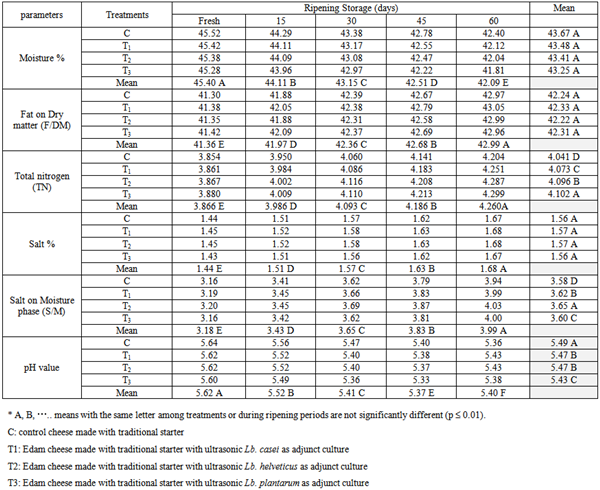
The gross chemical composition of different Edam cheese treatments as affected by using ultrasonic treated lactobacilli is seen in Table 2.
Generally, treated cheeses with different lactobacilli had an insignificant effect on moisture, total nitrogen, salt contents and fat on dry matter values than control. It was found that the rate of decreasing in moisture content was higher in the first month with descending rates through ripening period for all cheese treatments. Similar results were reported by 26, 27 for Gouda cheese treated by adjunct cultures. The moisture content of Edam cheese during ripening periods was significantly (p≤0.01) different. This may be due to the surface loss of moisture during ripening. Similar finding was reported by 28. This decreases in moisture contents caused gradual increases for all constituents of cheese during ripening. All cheese treatments conform to the Egyptian Standards 29. All the aged cheeses contained moisture and fat on dry matter content within the reported limits in Edam cheese 29, 30, 31.
Generally, as the ripening period of Edam cheese advanced, pH value of all cheeses tended to decrease significantly because of production of acidic compounds through fermentation of residual lactose and degradation of intermediate components of protein and fat 32. Similar findings were reported by 31. Treated Edam cheeses (Table 2) had significantly lower pH values than the control when fresh or throughout the ripening period. So, using ultrasonic treated lactobacilli in Edam cheese caused gradual decreases with different rates than control as affected by the excessive viable cells of treated cultures to utilize lactose and produce more lactic acid caused parallel decreases for the pH values. So the differences among treatments are significant (p≤0.01).
The lowest pH value of treated cheeses throughout the ripening period was that treated with Lb. plantarum followed by Lb. casei and lastly, that treated by Lb. helveticus. Similar results were reported by 33 for Gouda cheese treated by adjunct Lb. helveticus and Lb. plantarum.
These results are in agreement with the findings of 8 who found that semi-hard cheese treated with Lb. plantarum had significantly lower pH than that treated with Lb. helveticus. At the end of the ripening period, pH of treated cheeses tended to increase as a result of the further decomposition of lactate, the decarboxylation of the free amino acids, the oxidation of fatty acids and for the liberation of ammonia 34.
3.3. Ripening Indices of Edam CheeseThe differences in ripening indices of Edam cheese as affected by using ultrasonic treated lactobacilli during the ripening period is illustrated in Table 3. Treated cheeses had significantly higher ripening indices expressed as soluble nitrogen (SN), soluble nitrogen coefficient (SN/TN), non-protein nitrogen (NPN) contents, non-protein nitrogen coefficient (NPN/TN), total free amino acids (FAA) and total volatile fatty acids (TVFA) than control cheese when fresh or throughout the ripening period. Generally, the release of SN in cheese is primarily a result of casein breakdown by proteolytic enzymes. As ripening advancing, soluble nitrogen of all cheese treatments was increased significantly (p< 0.01) as a result of microbial and enzymatic activities which leading to protein decomposition and fat hydrolysis 35. Similar findings were reported by 28, 36, 37.
12 found that ultrasonication of Str. thermophillus, Lb. delbrueckii ssp. bulgaricus and Lb. helveticus at 20 kHz for 20 min caused variable ratios of autolysis. This may be due to ultrasonic impact on the bacterial cell wall and membrane effectively through the breakdown of the cell wall and release its intracellular enzymes, which will enhance the proteolysis and lipolysis 11. The lyses of more bacterial cells will cause a greater release of intracellular enzymes: amino peptidases, dipeptidases and other peptide hydrolyzing enzymes 38 which accelerate the rate of proteolysis during cheese ripening. The highest ripening indices expressed as soluble nitrogen coefficient, non-protein nitrogen coefficient and FAA among treatments throughout the ripening period were reported for Edam cheese treated by Lb. helveticus followed by Lb. casei followed by treated by Lb. plantarum and lastly the control cheese. 39 Found that Cheddar cheese treated with Lb. helveticus had significantly higher soluble nitrogen coefficient and non-protein nitrogen coefficient than those made with Lb. casei throughout the ripening periods.
The increase of TVFA during the ripening period could be due to the residual activity of heat resistance lipase, which may cause the fat hydrolysis 40. Using ultrasonic treated lactobacilli in Edam cheese increased significantly TVFA throughout the ripening as compared to control as a result of the higher levels of free amino acids which may serve as precursors for fatty acids 41. The highest rate of lipolysis expressed as TVFA among treatments during ripening was that treated with Lb. helveticus followed by Lb. casei and Lb. plantarum. Similar findings were reported, such as 42, 43 for Edam cheese made with lactobacilli as adjunct culture. Also 33 found that Gouda cheese made with Lb. helveticus had higher TVFA than that made with Lb. plantarum. 38 reported that Cheddar cheese made with Lb. helveticus had higher free fatty acids than that made with Lb. casei.
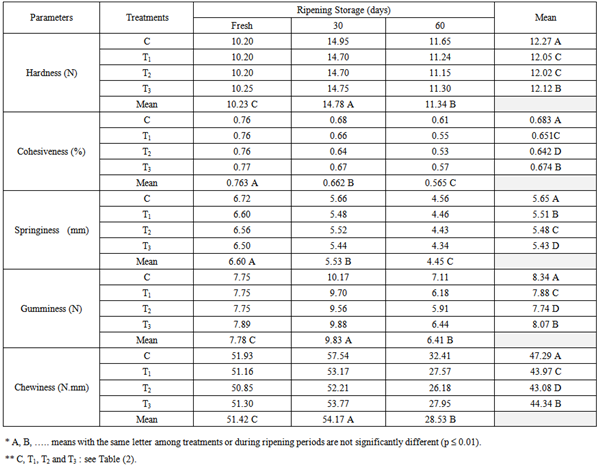
3.4. The rheological CharacteristicsThe rheological characteristics of Edam cheese as affected by using ultrasonic treated lactobacilli are seen in Table 4. Hardness values can be defined as the peak force recorded at 60% compression. From the obtained data, the hardness values of different cheese treatments increased in the early ripening period. This may be due to the decreasing of moisture content. 44 Reported that decreasing the moisture content in cheese results in a firmer texture due to the alteration in the casein matrix, therefore, increase the hardness. At the end of ripening period, these values decreased because of the enzymatic hydrolysis of the caseins in particular, αs1- casein results in peptides, some of which are water-soluble and so cannot contribute to the protein matrix responsible for cheese rigidity 45. So, treated Edam cheeses had significantly lower hardness values than control.
While the cohesiveness values of different treatments decreased gradually at different rate; the rate of decrease in the early period was slower than the late period as a result of the continuous breakdown of the casein matrix with a slight moisture loss at the end of ripening period. Similar finding was reported by 33 for Gouda cheese. The obtained results revealed that Edam cheese made with using freeze-shocked lactobacilli (T1, T2 and T3) at late ripening periods were significantly (p<0.01) lower for both the hardness and cohesiveness values than these of the control because of its higher proteolysis rates than control. 46 Reported that the hydrolysis of casein during cheese ripening produces compounds that are very soluble in water and do not contribute to the protein network. For this reason, the cheese softens during maturation. Similar findings were reported by 33, 41 for Trappist and Gouda cheeses made with adjunct lactobacilli.
The maximum values of springiness are present in fresh cheeses. These differences in the springiness during ripening may be attributed to the continuous breakdown of protein matrix and its strength, the latter being dependent on some factors such as moisture, protein and fat content of the cheese 47. 33 Also reported a decrease in springiness of Gouda cheese with increase the proteolysis during ripening. The same trend was observed for Edam and Trappist cheeses made from cow’s milk by 48 and 41. Treated Edam cheeses with different ultrasonic treated lactobacilli had significantly (p<0.01) lower values of springiness values than control as a result of higher proteolysis rates of treated cheeses as compared to control one.
Gumminess of cheese is the product of multiplication of cheese hardness and cohesiveness. While chewiness of cheese referred to the product of multiplication of cheese gumminess and springiness. Generally, the gumminess and chewiness increased significantly (p<0.01) up to 30 days of ripening as a result of higher losses of moisture contents. Then, these values decrease significantly (p<0.01) till the end of ripening period as a result of the continuous breakdown of cheese matrix during ripening. It is found that the gumminess and chewiness values of treated cheeses with ultrasonic treated lactobacilli, especially during the late ripening periods, were significantly (p<0.01) lower than that of control. This result is in agreement with the obtained results for gumminess and chewiness of these treatments. Similar trend was reported by 33, 41 for Trappist and Gouda cheeses treated with adjunct lactobacilli in the same order.
3.5. The Organoleptic PropertiesThe organoleptic properties of Edam cheese as affected by using ultrasonic treated lactobacilli cultures during the ripening period are presented in Table 5. During the first 15 days of ripening, control cheese had a firm consistency with a slight flavour and gained total acceptability score of 73 points out of 100. After 30 days of ripening. Control cheese was characterized for flavour as mild and for body& texture as smooth with few eyes and it possessed a total score of 77.5 points out of 100. After 45 days of ripening, the same treatment was characterized for flavour as cheesy and for body & texture as smooth, with few eyes, and ranked a total score 82 out of 100. At the end of the ripening period, the cheese was characterized for flavour as full ripened and smooth body& texture with few eyes and gained total scores 87.5 out of 100 points.
Using ultrasonic treated of Lb. casei at 0.2% as adjunct culture (T1) in Edam cheese improves the organoleptic properties expressed as flavour, body & texture and total acceptability of the resultant cheese than control.
Using ultrasonic treated of Lb. casei at 0.2% as adjunct culture (T1) in Edam cheese improve the organoleptic properties expressed as flavour, body & texture and total acceptability of the resultant cheese than control. After 30 days of ripening, this treatment has significantly (p<0.01) higher total scores than control and scored 82.5 out of 100 points. At the end of the ripening period, the cheese is characterized for flavour as cheesy flavour and for body & texture as slightly smooth and scored a total score 92.5 out of 100 points. Similar trend was found for Cheddar cheese made with attenuated Lb. helveticus which gained higher body& texture and flavour scores than that made with Lb. casei 38.
Data presented in Table 5 show that the flavour intensity of the Edam cheese treated with ultrasonic treated of Lb. helveticus (T2) as adjunct culture was significantly (p<0.01) more pronounced than in control cheese at each period of ripening. It could be also observed that the flavour of treated cheeses developed earlier than untreated cheese. The same treatment after 30 days of ripening has a slightly bitter flavour as well as a hard body& texture and scored 89.5 out of 100. At the end of ripening period, the cheese is characterized for flavour as cheesy and for body& texture as slightly hard and scored a total score 94.5 out of 100 points. Generally, Lb. helveticus culture improved the cheese flavour of the resultant cheese. The highest total acceptability scores were reported for Edam cheese made with Lb. helveticus among treatments as a result of the higher levels of soluble nitrogen, and volatile fatty which are considered being essential contributor for flavour development. The results of the present study are in agreement with those of 27 for Gouda cheese, 49 for Ras cheese and 41 for Trappist cheese. They reported that treated cheeses had higher flavour intensity supplemented with attenuated Lb. helveticus.
Edam cheese made with Lb. plantarum (T3) enhanced the organoleptic properties of the resultant cheese and gained significantly (p<0.01) higher total acceptability scores than untreated cheese. But these scores are significantly (p<0.01) lower than T1 and T2 throughout the ripening period. After 30 days of ripening, the cheese is characterized for flavour as slight flavour and for body as smooth with few eyes and scored 78.5. While at the end of the ripening period, the cheese is characterized for flavour as cheesy flavour and scored a total score 88.5 out of 100 points. This may be correlated to the lowest ripening indices of this treatment among other treated cheeses. Similar results were reported for Gouda cheese made with Lb. helveticus and Lb. plantarum 50 who found that total acceptability scores of Gouda cheese made with Lb. helveticus gained higher total acceptability scores than that made with Lb. plantarum.
From the foregoing results, it could be concluded that using ultrasonic treated Lb. helveticus, Lb. casei and Lb. plantarum as an adjunct culture for Edam cheese making has a pronounced effect on both flavour and body & texture of the resultant cheese. It can be concluded that using ultrasonic treated lactobacilli accelerated the ripening of Edam cheese. Using treated Lb. helveticus as an adjunct culture at 0.2% on cheese curd improved the cheese quality more effectively with acceleration of ripening period to 45 days instead of 60 days for control cheese.
The authors declare that they have no competing of interests in relation to this research, whether financial, personal, authorship or otherwise, that could affect the research and its results presented in this paper.
| [1] | Fox, P.F.; Guinee, T.P.; Cogan, T.M. and McSweeney, P.L. Fundamentals of Cheese Science. Springer, Boston, MA. 2017. | ||
| In article | View Article | ||
| [2] | McSweeney, P.L.H and Fox, P.F. “Chemical methods for the characterization of proteolysis in cheese during ripening”. Lait, 77, 41-76. 1997. | ||
| In article | View Article | ||
| [3] | Kheadr, E.E., Vuillemard, J.C. and El-Deeb, S.A. “Impact of liposome-encapsulated enzyme cocktails on Cheddar cheese ripening”. Food Research International, 36, 241-252. 2003. | ||
| In article | View Article | ||
| [4] | Azarnia, S.; Lee, B.; St-Gelais, D.; Kilcawley, K. and Noroozi, E. “Effect of free and encapsulated recombinant aminopeptidase on proteolysis indices and sensory characteristics of Cheddar cheese”. LWT Food Sci Technol, 44, 570-575. (2011). | ||
| In article | View Article | ||
| [5] | Khattab, Amira R.; Guirguis, H.A.; Tawfik, Sherouk M. and Farag, M.A. “Cheese ripening: A review on modern technologies towards flavor enhancement, process acceleration and improved quality assessment”. Trends in Food Science & Technology, 88, 343–360. 2019. | ||
| In article | View Article | ||
| [6] | Andiç, S., Tunçtürk, Y., & Boran, G. “Changes in volatile compounds of cheese”. Processing and impact on active components in food, 231-239. 2014. | ||
| In article | View Article | ||
| [7] | Pettersson, H.E. and Sjöström, G. “Accerelated cheese ripening: a method for increasing the number of lactic starter bacteria in cheese without detrimental effect to the cheese-making process and its effect on the cheese ripening”. J. of Dairy Res., 42, 313-326. 1975. | ||
| In article | View Article | ||
| [8] | Gomez, M.; Gaya, P.; Nuüez, M. and Medina, M. “Effect of Lactobacillus plantarum as adjunct starter on the flavour and texture of a semi-hard cheese made from pasteurised cows’ milk”. Le Lait, 76 (5), 461-472. 1996. | ||
| In article | View Article | ||
| [9] | Spus, M., H. Liu, M. Wels, T. Abee, and E. J. Smid. “Isolation and characterization of Lactobacillus helveticus DSM 20075 variants with improved autolytic capacity”. Int. J. Food Microbiol, 241, 173-180. 2017. | ||
| In article | View Article PubMed | ||
| [10] | Griffiths, M. W., and A. M. Tellez. “Lactobacillus helveticus: The proteolytic system. Front”. Microbiol. 4, 30-38. 2013. | ||
| In article | View Article | ||
| [11] | Upadyay, K., T. Huppertz, A. Kelly and L.H. MCSweeney. “Use of high pressure treatment to attenuate starter bacteria for use as adjuncts for cheddar cheese manufacture”. Innovative Food Science and Emerging Technol., 8(4), 485-492. 2007. | ||
| In article | View Article | ||
| [12] | Tabatabaie Farideh and Mortazavi, S.A. “Effects of ultrasound treatment on viability and autolysis of starter bacteria in hard cheese”. American-Eurasian J. Agric. & Environ. Sci., 8 (3), 301-304. 2010. | ||
| In article | |||
| [13] | Munir, Masooma; Nadeem, M.; Ali, B.; Sultan, M.; Kanwal; R.; Al-Jumayi, A.; Algarni, Eman H.A.; Alnofeai, M.B. and Mahmoud, S. F. “Investigating the Impact of Ultrasound, Microwave, and High-Pressure Processing of Milk on the Volatile Compounds and Sensory Properties of Cheddar Cheese”. Agriculture, 12, 577:1-17. 2022. | ||
| In article | View Article | ||
| [14] | Jalilzadeh, A.; Hesari, J.; Peighambardoust, S. H. and Javidipour, I. “The effect of ultrasound treatment on microbial and physicochemical properties of Iranian ultrafiltered feta-type cheese”. J. Dairy Sci. 101. 5809- 5820. 2018. | ||
| In article | View Article PubMed | ||
| [15] | Bahri, S.M.H. and Kenari, Reza E. “The effects of ultrasound waves on yield, texture and some qualitative characteristics of cheese”. Iranian Food Science and Technology Research Journal, 14 (3), 41-51. 2018. | ||
| In article | |||
| [16] | Carrillo-López, L. M.; Huerta-Jiménez, Mariana; Morales-Rodríguez, S.; Gámez-Piñón, J. R.; Carballo-Carballo, D. E.; Gutiérrez-Méndez, N. and Alarcón-Rojo A. D. “Textural, Rheological, and Sensory Modifications in Oaxaca Cheese Made with Ultrasonicated Raw Milk”. Advances in Ultrasound-Based Technology Applications in Food Processing, 11(4), 11:22. 2023. | ||
| In article | View Article | ||
| [17] | Houghtby, G. A.; Maturin, L.J. and Koening, E. K. Standard methods for the examination of dairy products. American Public Health Association (APHA), Washington, D.C., USA. (16th ed.) pp. 213-246. 1992. | ||
| In article | |||
| [18] | Scott, R. Cheese Making Practice. Applied Science Publishers LTD, London. 1981. | ||
| In article | |||
| [19] | AOAC. Official Methods of Analysis. Association of Official Analysis Chemists Inc., USA. 19th ed., 2007 | ||
| In article | |||
| [20] | Folkertsma, B and Fox, P.F. “Use of the Cd-ninhydrin reagent to assess proteolysis in cheese during ripening”. J. Dairy Res., 59: 217. 1992. | ||
| In article | View Article | ||
| [21] | Koiskowski, F.V. Cheese and Fermented Milk Foods. F.V. Brooktonale, New York. 2nd ed. 1982. | ||
| In article | |||
| [22] | Clark, S.; Costello, M.; Drake, MarryAnne and Bodyfelt, F. The sensory evaluation of dairy products. Springer science, USA. 2nd Ed. 2009. | ||
| In article | View Article | ||
| [23] | Snedcor, G.W. and Cochran, W.G. Statistical Methods. Iowa state University press, Iowa, U.S.A. 6th ed. 1967. | ||
| In article | |||
| [24] | Benedito, J., J. A. Carcel, N. Sanjuan, and A. Mulet. “Use of ultrasound to assess Cheddar cheese characteristics”. Ultrasonics, 38, 727-730. 2000. | ||
| In article | View Article PubMed | ||
| [25] | Gallo, M., L. Ferrara, and D. Naviglio. “Application of ultrasound in food science and technology: A perspective”. Foods 7, 164-170. 2018. | ||
| In article | View Article PubMed | ||
| [26] | El-Tanboly, E; El-Hofi, M.; Youssef, Y. B.; El-Desoki, W. and Jalil, R.A. “Influence of freeze-shocked mesophilic lactic starter bacteria and adjunct lactobacilli on the rate of ripening Gouda cheese and flavor development”. J. of Amer. Sci., 6 (11), 465-471. 2010. | ||
| In article | |||
| [27] | El-Nagar, G.F.; Essawy, E.A.Y.; Abd El-Hady, S.; Montasser, E. A. and Hamad, M.N. “Ripening acceleration and quality improvement of Gouda cheese using freeze or heat –shocked Lactobacillus delbrueckii subsp. helveticus DSMZ 20082”. Proc 11th Egyptian Conf. Dairy Sci. and Tech. Egyptian J. of Dairy Sci. 2010. | ||
| In article | |||
| [28] | Hamdy, Shaimaa; Abdelmeged, Doha and Abdelmontaleb, H. “Influence of different heat treatments on the quality characteristics of Edam cheese”. Egyptian J. Food Sci., 50 (1), 83-98. 2022. | ||
| In article | |||
| [29] | Ministry of Industry and Technological Development. Egyptian Standards For semi-hard Cheese, Edam cheese Part 5: Cheese, ES: 1183-3/2005. Egypt. 2005. | ||
| In article | |||
| [30] | Nalepa, B.; Ciesielski, S. and Aljewicz, M. “The microbiota of Edam cheeses determined by cultivation and high-throughput sequencing of the 16S rRNA amplicon”. Appl. Sci., 10, 4063: 1-12. 2020. | ||
| In article | View Article | ||
| [31] | Abdelmontaleb, H.S. ; Galal, E.A.; Abdelmageed, Doha A. and Hamdy, Shaimaa M. “Biochemical and microbiological properties of Edam cheese with black cumin oil”. Egypt. J. Food. Sci., 48(1), 181-192. 2020. | ||
| In article | |||
| [32] | El-Kholy, A.M. Ras cheese making with vegetable Coagulant - a comparison with calf rennet”. World J. of Dairy & Food Sciences. 10 (1), 82-89. 2015. | ||
| In article | |||
| [33] | El-Deeb, Amany M.; Elwahsh, Nahed A. A. and Ahmed, M.B.M. “Effect of using buffalo’s milk with cow’s milk and selected bacterial strains on the properties and safety of Gouda cheese”. Egypt. J. Food. Sci., 48 (2), 351-364. 2020. | ||
| In article | |||
| [34] | McSweeney, P. “Biochemistry of cheese ripening”. Inter. J. of Dairy Technol., 57 (2/3), 127-144. 2004. | ||
| In article | View Article | ||
| [35] | Law, B.A. Microbiological and Biochemistry of cheese and fermented milk. T. J. Podstow. Cornwall, Great Britain. 2nd ed. 1997. | ||
| In article | View Article | ||
| [36] | El-Desoki, W. I. and W. I. A. Nasr. “Influence of heat treated adjunct culture on the quality of Edam cheese made from reconstituted whole milk powder”. J. Food and Dairy Sci., Mansoura Univ., 5 (11), 763 – 774. 2014. | ||
| In article | View Article | ||
| [37] | El-Aidie, Safaa A. M.; Ghita, Ebtisam I.; El-Dieb, Samia M. and El-Garhi, H.M. “Physicochemical, microstructural and sensory impact of fat replacers on low-fat Edam cheese manufactured from Buffalo’s milk”. Int J Adv Life Sci Res., 2(3), 11-21. 2019. | ||
| In article | View Article | ||
| [38] | El-Soda, M.; Chen, Reisterer and Olson, N. “Acceleration of low-fat cheese ripening using lyophilized extracts or freeze shocked cells of some cheese related microorganism”. Milchwissenschaft 46, 358-360. 1991. | ||
| In article | |||
| [39] | Madkor, P; Tong, S. and El Soda, M. “Ripening of Cheddar cheese with added attenuated adjunct cultures of Lactobacilli”. J. Dairy Sci., 83(8),1684-1691. 2000. | ||
| In article | View Article PubMed | ||
| [40] | Mansour, F.M.S. “Technological studies on Mozzarella cheese from Egyptian buffaloe`s milk”. Ph. D. Thesis, Ain-Shams University, Egypt. 2005. | ||
| In article | |||
| [41] | Khalil, R.A.M.; Abou El-Nour, A.M.; Abbas, F.M.; Farag, M.D. and El-Safty, M.S. “Improving The Quality Of Trappist Cheese Made From Buffaloe`s Milk By Using Modified Starter”. Egyptian J. Dairy Science, 38, 121-132. 2010. | ||
| In article | |||
| [42] | Tungjaroenchai, W.; White, C. H.; Holmes, W. E. and Drake, M. A. “Influence of Adjunct Cultures on Volatile Free Fatty Acids in Reduced-Fat Edam Cheeses”. Journal of Dairy Science, 87, 10: 3224-3234. 2004. | ||
| In article | View Article PubMed | ||
| [43] | Zaki, M., and Salem, S.A. “Effect of proteolytic enzymes on accelerated ripening of Edam cheese”. Indian Journal of Dairy Science, 45, 303-312. 1992. | ||
| In article | |||
| [44] | Tunick, M.H; Mackey, K.L.; Smith, P.W. and Holsinger, V.H. “Effects of composition and storage on the texture of Mozzarella cheese”. Neth. Milk Dairy J., 45, 117-120. 1991. | ||
| In article | |||
| [45] | Lane, C.N.; Fox, P.F.; Johnson, D.E. and McSweeney, P.L.H. “Contribution of coagulant to proteolysis and textural changes in Cheddar cheese during ripening”. Int. Dairy J., 7, 453-464. 1997. | ||
| In article | View Article | ||
| [46] | Adda, J.J.; Gripon, F. and Vassel, L. “The chemistry of flavour and texture generation in cheese”. Food Chemistry, 9, 115-119. 1982. | ||
| In article | View Article | ||
| [47] | Lawrence, R.C.; Gills, J. and Creamer, L.K. “The relationship between cheese texture and flavor”. New Zeland J. Dairy Sci. Techno., 67 (1): 175- 180. 1983. | ||
| In article | |||
| [48] | El-Tawel, H. “Studies on Edam cheese”. Ph. D. Thesis, Cairo University, El-Fayoum, Egypt. 2004). | ||
| In article | |||
| [49] | Kebary, K.M.K.; Khader, A.E.; Zedan,A.N. and Mahmoud, S.F. “Accelerated ripening of low-fat Ras cheese by attenuated lactobacilli cells”. Food Research International, 29,: 705-713. 1996. | ||
| In article | View Article | ||
| [50] | El wahsh, Nahed A.A. and El-Deeb, Amany M. “Quality of probiotic Gouda cheese as a functional food”. J. Sus. Agric. Sci., 46 (4), 89-97. 2020. | ||
| In article | |||
Published with license by Science and Education Publishing, Copyright © 2023 Ahmed H. A. A., Khalil R. A. M., AbouElNour A. M., El-Sisi A. S. and Aida H. Ibrahim
 This work is licensed under a Creative Commons Attribution 4.0 International License. To view a copy of this license, visit
http://creativecommons.org/licenses/by/4.0/
This work is licensed under a Creative Commons Attribution 4.0 International License. To view a copy of this license, visit
http://creativecommons.org/licenses/by/4.0/
| [1] | Fox, P.F.; Guinee, T.P.; Cogan, T.M. and McSweeney, P.L. Fundamentals of Cheese Science. Springer, Boston, MA. 2017. | ||
| In article | View Article | ||
| [2] | McSweeney, P.L.H and Fox, P.F. “Chemical methods for the characterization of proteolysis in cheese during ripening”. Lait, 77, 41-76. 1997. | ||
| In article | View Article | ||
| [3] | Kheadr, E.E., Vuillemard, J.C. and El-Deeb, S.A. “Impact of liposome-encapsulated enzyme cocktails on Cheddar cheese ripening”. Food Research International, 36, 241-252. 2003. | ||
| In article | View Article | ||
| [4] | Azarnia, S.; Lee, B.; St-Gelais, D.; Kilcawley, K. and Noroozi, E. “Effect of free and encapsulated recombinant aminopeptidase on proteolysis indices and sensory characteristics of Cheddar cheese”. LWT Food Sci Technol, 44, 570-575. (2011). | ||
| In article | View Article | ||
| [5] | Khattab, Amira R.; Guirguis, H.A.; Tawfik, Sherouk M. and Farag, M.A. “Cheese ripening: A review on modern technologies towards flavor enhancement, process acceleration and improved quality assessment”. Trends in Food Science & Technology, 88, 343–360. 2019. | ||
| In article | View Article | ||
| [6] | Andiç, S., Tunçtürk, Y., & Boran, G. “Changes in volatile compounds of cheese”. Processing and impact on active components in food, 231-239. 2014. | ||
| In article | View Article | ||
| [7] | Pettersson, H.E. and Sjöström, G. “Accerelated cheese ripening: a method for increasing the number of lactic starter bacteria in cheese without detrimental effect to the cheese-making process and its effect on the cheese ripening”. J. of Dairy Res., 42, 313-326. 1975. | ||
| In article | View Article | ||
| [8] | Gomez, M.; Gaya, P.; Nuüez, M. and Medina, M. “Effect of Lactobacillus plantarum as adjunct starter on the flavour and texture of a semi-hard cheese made from pasteurised cows’ milk”. Le Lait, 76 (5), 461-472. 1996. | ||
| In article | View Article | ||
| [9] | Spus, M., H. Liu, M. Wels, T. Abee, and E. J. Smid. “Isolation and characterization of Lactobacillus helveticus DSM 20075 variants with improved autolytic capacity”. Int. J. Food Microbiol, 241, 173-180. 2017. | ||
| In article | View Article PubMed | ||
| [10] | Griffiths, M. W., and A. M. Tellez. “Lactobacillus helveticus: The proteolytic system. Front”. Microbiol. 4, 30-38. 2013. | ||
| In article | View Article | ||
| [11] | Upadyay, K., T. Huppertz, A. Kelly and L.H. MCSweeney. “Use of high pressure treatment to attenuate starter bacteria for use as adjuncts for cheddar cheese manufacture”. Innovative Food Science and Emerging Technol., 8(4), 485-492. 2007. | ||
| In article | View Article | ||
| [12] | Tabatabaie Farideh and Mortazavi, S.A. “Effects of ultrasound treatment on viability and autolysis of starter bacteria in hard cheese”. American-Eurasian J. Agric. & Environ. Sci., 8 (3), 301-304. 2010. | ||
| In article | |||
| [13] | Munir, Masooma; Nadeem, M.; Ali, B.; Sultan, M.; Kanwal; R.; Al-Jumayi, A.; Algarni, Eman H.A.; Alnofeai, M.B. and Mahmoud, S. F. “Investigating the Impact of Ultrasound, Microwave, and High-Pressure Processing of Milk on the Volatile Compounds and Sensory Properties of Cheddar Cheese”. Agriculture, 12, 577:1-17. 2022. | ||
| In article | View Article | ||
| [14] | Jalilzadeh, A.; Hesari, J.; Peighambardoust, S. H. and Javidipour, I. “The effect of ultrasound treatment on microbial and physicochemical properties of Iranian ultrafiltered feta-type cheese”. J. Dairy Sci. 101. 5809- 5820. 2018. | ||
| In article | View Article PubMed | ||
| [15] | Bahri, S.M.H. and Kenari, Reza E. “The effects of ultrasound waves on yield, texture and some qualitative characteristics of cheese”. Iranian Food Science and Technology Research Journal, 14 (3), 41-51. 2018. | ||
| In article | |||
| [16] | Carrillo-López, L. M.; Huerta-Jiménez, Mariana; Morales-Rodríguez, S.; Gámez-Piñón, J. R.; Carballo-Carballo, D. E.; Gutiérrez-Méndez, N. and Alarcón-Rojo A. D. “Textural, Rheological, and Sensory Modifications in Oaxaca Cheese Made with Ultrasonicated Raw Milk”. Advances in Ultrasound-Based Technology Applications in Food Processing, 11(4), 11:22. 2023. | ||
| In article | View Article | ||
| [17] | Houghtby, G. A.; Maturin, L.J. and Koening, E. K. Standard methods for the examination of dairy products. American Public Health Association (APHA), Washington, D.C., USA. (16th ed.) pp. 213-246. 1992. | ||
| In article | |||
| [18] | Scott, R. Cheese Making Practice. Applied Science Publishers LTD, London. 1981. | ||
| In article | |||
| [19] | AOAC. Official Methods of Analysis. Association of Official Analysis Chemists Inc., USA. 19th ed., 2007 | ||
| In article | |||
| [20] | Folkertsma, B and Fox, P.F. “Use of the Cd-ninhydrin reagent to assess proteolysis in cheese during ripening”. J. Dairy Res., 59: 217. 1992. | ||
| In article | View Article | ||
| [21] | Koiskowski, F.V. Cheese and Fermented Milk Foods. F.V. Brooktonale, New York. 2nd ed. 1982. | ||
| In article | |||
| [22] | Clark, S.; Costello, M.; Drake, MarryAnne and Bodyfelt, F. The sensory evaluation of dairy products. Springer science, USA. 2nd Ed. 2009. | ||
| In article | View Article | ||
| [23] | Snedcor, G.W. and Cochran, W.G. Statistical Methods. Iowa state University press, Iowa, U.S.A. 6th ed. 1967. | ||
| In article | |||
| [24] | Benedito, J., J. A. Carcel, N. Sanjuan, and A. Mulet. “Use of ultrasound to assess Cheddar cheese characteristics”. Ultrasonics, 38, 727-730. 2000. | ||
| In article | View Article PubMed | ||
| [25] | Gallo, M., L. Ferrara, and D. Naviglio. “Application of ultrasound in food science and technology: A perspective”. Foods 7, 164-170. 2018. | ||
| In article | View Article PubMed | ||
| [26] | El-Tanboly, E; El-Hofi, M.; Youssef, Y. B.; El-Desoki, W. and Jalil, R.A. “Influence of freeze-shocked mesophilic lactic starter bacteria and adjunct lactobacilli on the rate of ripening Gouda cheese and flavor development”. J. of Amer. Sci., 6 (11), 465-471. 2010. | ||
| In article | |||
| [27] | El-Nagar, G.F.; Essawy, E.A.Y.; Abd El-Hady, S.; Montasser, E. A. and Hamad, M.N. “Ripening acceleration and quality improvement of Gouda cheese using freeze or heat –shocked Lactobacillus delbrueckii subsp. helveticus DSMZ 20082”. Proc 11th Egyptian Conf. Dairy Sci. and Tech. Egyptian J. of Dairy Sci. 2010. | ||
| In article | |||
| [28] | Hamdy, Shaimaa; Abdelmeged, Doha and Abdelmontaleb, H. “Influence of different heat treatments on the quality characteristics of Edam cheese”. Egyptian J. Food Sci., 50 (1), 83-98. 2022. | ||
| In article | |||
| [29] | Ministry of Industry and Technological Development. Egyptian Standards For semi-hard Cheese, Edam cheese Part 5: Cheese, ES: 1183-3/2005. Egypt. 2005. | ||
| In article | |||
| [30] | Nalepa, B.; Ciesielski, S. and Aljewicz, M. “The microbiota of Edam cheeses determined by cultivation and high-throughput sequencing of the 16S rRNA amplicon”. Appl. Sci., 10, 4063: 1-12. 2020. | ||
| In article | View Article | ||
| [31] | Abdelmontaleb, H.S. ; Galal, E.A.; Abdelmageed, Doha A. and Hamdy, Shaimaa M. “Biochemical and microbiological properties of Edam cheese with black cumin oil”. Egypt. J. Food. Sci., 48(1), 181-192. 2020. | ||
| In article | |||
| [32] | El-Kholy, A.M. Ras cheese making with vegetable Coagulant - a comparison with calf rennet”. World J. of Dairy & Food Sciences. 10 (1), 82-89. 2015. | ||
| In article | |||
| [33] | El-Deeb, Amany M.; Elwahsh, Nahed A. A. and Ahmed, M.B.M. “Effect of using buffalo’s milk with cow’s milk and selected bacterial strains on the properties and safety of Gouda cheese”. Egypt. J. Food. Sci., 48 (2), 351-364. 2020. | ||
| In article | |||
| [34] | McSweeney, P. “Biochemistry of cheese ripening”. Inter. J. of Dairy Technol., 57 (2/3), 127-144. 2004. | ||
| In article | View Article | ||
| [35] | Law, B.A. Microbiological and Biochemistry of cheese and fermented milk. T. J. Podstow. Cornwall, Great Britain. 2nd ed. 1997. | ||
| In article | View Article | ||
| [36] | El-Desoki, W. I. and W. I. A. Nasr. “Influence of heat treated adjunct culture on the quality of Edam cheese made from reconstituted whole milk powder”. J. Food and Dairy Sci., Mansoura Univ., 5 (11), 763 – 774. 2014. | ||
| In article | View Article | ||
| [37] | El-Aidie, Safaa A. M.; Ghita, Ebtisam I.; El-Dieb, Samia M. and El-Garhi, H.M. “Physicochemical, microstructural and sensory impact of fat replacers on low-fat Edam cheese manufactured from Buffalo’s milk”. Int J Adv Life Sci Res., 2(3), 11-21. 2019. | ||
| In article | View Article | ||
| [38] | El-Soda, M.; Chen, Reisterer and Olson, N. “Acceleration of low-fat cheese ripening using lyophilized extracts or freeze shocked cells of some cheese related microorganism”. Milchwissenschaft 46, 358-360. 1991. | ||
| In article | |||
| [39] | Madkor, P; Tong, S. and El Soda, M. “Ripening of Cheddar cheese with added attenuated adjunct cultures of Lactobacilli”. J. Dairy Sci., 83(8),1684-1691. 2000. | ||
| In article | View Article PubMed | ||
| [40] | Mansour, F.M.S. “Technological studies on Mozzarella cheese from Egyptian buffaloe`s milk”. Ph. D. Thesis, Ain-Shams University, Egypt. 2005. | ||
| In article | |||
| [41] | Khalil, R.A.M.; Abou El-Nour, A.M.; Abbas, F.M.; Farag, M.D. and El-Safty, M.S. “Improving The Quality Of Trappist Cheese Made From Buffaloe`s Milk By Using Modified Starter”. Egyptian J. Dairy Science, 38, 121-132. 2010. | ||
| In article | |||
| [42] | Tungjaroenchai, W.; White, C. H.; Holmes, W. E. and Drake, M. A. “Influence of Adjunct Cultures on Volatile Free Fatty Acids in Reduced-Fat Edam Cheeses”. Journal of Dairy Science, 87, 10: 3224-3234. 2004. | ||
| In article | View Article PubMed | ||
| [43] | Zaki, M., and Salem, S.A. “Effect of proteolytic enzymes on accelerated ripening of Edam cheese”. Indian Journal of Dairy Science, 45, 303-312. 1992. | ||
| In article | |||
| [44] | Tunick, M.H; Mackey, K.L.; Smith, P.W. and Holsinger, V.H. “Effects of composition and storage on the texture of Mozzarella cheese”. Neth. Milk Dairy J., 45, 117-120. 1991. | ||
| In article | |||
| [45] | Lane, C.N.; Fox, P.F.; Johnson, D.E. and McSweeney, P.L.H. “Contribution of coagulant to proteolysis and textural changes in Cheddar cheese during ripening”. Int. Dairy J., 7, 453-464. 1997. | ||
| In article | View Article | ||
| [46] | Adda, J.J.; Gripon, F. and Vassel, L. “The chemistry of flavour and texture generation in cheese”. Food Chemistry, 9, 115-119. 1982. | ||
| In article | View Article | ||
| [47] | Lawrence, R.C.; Gills, J. and Creamer, L.K. “The relationship between cheese texture and flavor”. New Zeland J. Dairy Sci. Techno., 67 (1): 175- 180. 1983. | ||
| In article | |||
| [48] | El-Tawel, H. “Studies on Edam cheese”. Ph. D. Thesis, Cairo University, El-Fayoum, Egypt. 2004). | ||
| In article | |||
| [49] | Kebary, K.M.K.; Khader, A.E.; Zedan,A.N. and Mahmoud, S.F. “Accelerated ripening of low-fat Ras cheese by attenuated lactobacilli cells”. Food Research International, 29,: 705-713. 1996. | ||
| In article | View Article | ||
| [50] | El wahsh, Nahed A.A. and El-Deeb, Amany M. “Quality of probiotic Gouda cheese as a functional food”. J. Sus. Agric. Sci., 46 (4), 89-97. 2020. | ||
| In article | |||