Taro, commonly known as Amadumbe is a traditional Southern African tuber crop. In this study, the influence of genotypes and environment on the physicochemical properties of amadumbe starches were investigated. Nine amadumbe genotypes grown at two different agro-ecological locations were studied. The genotypes had smaller sized (1-5µm) and polygonal starch granules. The amylose contents (0-14%) of amadumbe starches were low and varied significantly due to the variation in growth location and genotypes. Three genotypes namely G2, G20, and G21 seemed to lack the amylose molecule. The crystallinity pattern of starch was not affected by genotype and environment. All tested amadumbe starches showed reflective peaks at 2θ=15o and a doublet at 17° and 18°, typical of A-type starches. Functional properties including water absorption, swelling power, and peak viscosity significantly and positively correlated with amylose contents, which would help in future improvement programme for industrial production of amadumbe.
Amadumbe (Colocasia esculenta (L.) Schott), commonly known as taro, is a traditional Southern African tuber crop that is grown for its edible corms 1 Nutritionally, amadumbe contain an appreciable amount of carbohydrates (approx. 72%) 2. Starch is the major carbohydrate in amadumbe and its content ranges between 80-96% 3, 4, 5. A high proportion of amadumbe starch is reportedly resistant to digestion 5. Further, amadumbe contains mucilage (7-10%) 6, 7, a soluble fiber, that is good for human digestive health 8. Hence, amadumbe starch and mucilage could be used as functional ingredients in food formulations 2. However, many factors including processing and growing conditions could influence the properties of major components of amadumbe.
Several studies have demonstrated the influence of genotypes and growing conditions on physicochemical properties of starch. According to 9, growth temperature contributes significantly to change in physicochemical properties of starch than does the varietal difference. Amylose content and the branch chain length distribution of amylopectin have been found to significantly influence starch pasting 10, 11 and gelatinisation 3, 10. Starch with high amylose content and abundant short chain amylopectin reportedly showed low pasting viscosity and high pasting temperature 10. Generally, amylose is known to restrict starch swelling during pasting and gelatinisation. Furthermore, 12 studied the physicochemical properties of starches from sweet potato grown at four different soil temperatures (15, 21, 27 or 33°C). The amylose contents (13-17%) of these starches increased with increasing soil temperature. The peak gelatinisation of increased by approx. 40% when the soil temperature was raised from 15 to 33°C.
Amadumbe grown in Southern Africa has received less attention from research. Previous studies on amadumbe focused on DNA fingerprinting of wild and cultivated amadumbe 1, water-use and drought resistance of locally grown varieties 13. These studies revealed significant variations among amadumbe landraces grown under varying environmental conditions. According to 13, different irrigation treatments were found to have an effect on harvested amadumbe corm mass, which reduced with a decrease in water availability. Recent efforts in breeding of amadumbe in South Africa focused only on the agro-morphological and molecular markers. The integration of breeding for yield and yield related traits as well as physicochemical properties is important for food and nutritional security. Hence, in this study, it is important to determine the composition, microstructure and functionality of starches extracted from amadumbe genotypes grown in different environmental conditions.
Nine genotypes of Amadumbe were obtained from the gene bank of the Agricultural Research Council – Vegetable, Industrial and Medicinal Plants Institute, Pretoria, South Africa. The genotypes were grown at Roodeplaat research farm and Umbumbulu farmers’ field in 2014-2015 cropping season for the analysis of physicochemical properties of the starch. The altitude of Umbumbulu and Roodeplaat is 597m and 1168m above sea level, respectively. The locations receive an annual rainfall of 828mm and 514mm for Umbumbulu and Roodeplaat, respectively. The average temperatures for Roodeplaat and Umbumbulu were 19 and 24°C, respectively for the cropping season (Sept/2014- May/2015) (Table 1).
Freshly harvested amadumbe corms were washed, peeled, and sliced into a thickness of three mm. Peeled corms were dried at 50°C for 48h in a hot air oven (D-37520, Thermo Fisher Scientific, Germany). Dried slices were then milled into flour using a warring blender (Model: 8010S, Torrington, USA) and sieved (screen size: 180mm) to obtained fine flours, which were then stored at 4°C prior to analysis.
Starch was extracted from amadumbe following a method of 14 as described by 15. Amadumbe flour was suspended in water (1:10), stirred at room temperature for 6 hr. The mixture was separated using a screen size of 180mm to remove non-starch component and the resulting filtrate was left at an ambient temperature for 24hr. Thereafter, the slurry was washed repeatedly using a centrifuge (Ependorf 5810R Centrifuge, Germany) at 14000 × g for 20 minutes until the supernatant was colourless. The remaining sediment which is starch fraction was dried at 50°C for 24 hr in a hot air oven (D-37520, Thermo Fisher Scientific, Germany). The starch yield was calculated as the ratio of the starch obtained to the amount of flour used. Dried starch was packed, sealed and kept at 4°C until analysed.
Sample preparation for scanning electron microscopy (SEM) was done following standard laboratory procedures 16. Starch granule shape and size was viewed using Scanning Electron Microscope (EVO 15 HD SEM) following standard laboratory procedures. A thin layer of amadumbe starch granule was mounted on the aluminium specimen holder by double-sided tape. The starch sample was coated with a thin film of gold up to a thickness of about 30 nm and the micrographs were obtained 16.
Starch spectra were obtained following a method described by 15. Dry potassium bromide (0.15g) was mixed with 0.0015g of the dried starch sample and compressed for 5 min using a 10 MPa mechanical compressor system to obtain a clear pellet. The pellets were then analysed in a Bruker Tensor 27 FTIR spectrophotometer (Bruker Optics, Inc., Billerica, MA). The frequency range used was between 400 and 4000cm.
X-ray diffraction pattern of amadumbe starch was done following established method used by 16. The relative crystallinity of the starch was calculated using the following equation:
 |
Ac is the crystalline area and Aa is the amorphous area on the X-ray diffractogram.
Amylose contents of the isolated amadumbe starch were determined as previously described following established iodine binding method 17.
Water absorption capacity was done according to the method described by 18. The following equation was used to calculate water/ oil absorption capacity:
 |
Swelling power and solubility index were determined following methods followed by 5. The swelling (SP) and solubility Index (SI) was calculated using equations (1) and (2), respectively.
 | (1) |
 | (2) |
Where  , is weight of swollen starch/flour,
  is sample weight and
  is the weight of dried supernatant.
The pasting properties of extracted amadumbe starches were determined using the Rapid Visco Analyser (RAV-4, Newport, Scientific, Warriewood, Australia) following established method as described by 19.
2.2. Statistical Data AnalysisData was analysed using two-way analysis of variance (ANOVA) and the means were compared using the Fisher Least significant difference (LSD) test (p<0.05). The variations observed in the functional and pasting properties of the starches from different growth locations were examined by principal component analysis (PCA). Using PCA, it was possible to reduce the dimension and the noise of the raw data and identify several correlations between various starch properties and the contribution of the traits to variation among the genotypes.
The starch yields were significantly affected by genotype and growth locations. Generally, the starch yield was low and ranged between (8-23%) and (9-21%) for amadumbe genotypes grown at Roodeplaat and Umbumbulu locations, respectively (Table 2). Amadumbe genotypes, G1, G2, G3, G9, G20, G22, and G26 showed higher starch yield when grown at Umbumbulu site compared to the same genotypes grown at Roodeplaat. This could be attributed to the variation in the environmental conditions prevailed during the growing season at both locations. Similarly, high starch yield was reported for Pinto Durango bean variety which was constantly irrigated compared to the same variety which was receiving inconsistent rain water 20. Genotypes G21 and G29 showed a lower starch yield when grown in the Umbumbulu, suggesting that amadumbe genotypes responded differently to different environmental conditions such as temperature, rainfall patterns, soil and the ability of the genotype to absorb and translocate the nutrient from the soil to the plant system. The variations in starch yield could also be due to genotypic differences 9, 21. Previous studies reported significant differences in the starch yield (10-19%) for taro genotypes grown in the same environment 21.
3.2. Amylose ContentThe amylose contents of amadumbe starches were generally low for the genotypes grown at Roodeplaat and Umbumbulu (Table 2). Amongst studied genotypes, G1, G2, G3, G9, and G22 showed high amylose contents when grown at Umbumbulu site compared to the same genotype grown at Roodeplaat. This can be attributed to a fairly high average temperature at Umbumbulu (24°C) compared to Roodeplaat (19°C). Variations in genotypes, rainfall, and soil type also contributed to the variation in the amylose content. Similarly the reference 12 reported high amylose contents for starches extracted from sweet potato grown at higher environmental temperature. Other genotypes, G26, G29 showed higher amylose content when grown at Roodeplaat. This finding agrees with those of 22, which showed that cold weather environments could cause an increase in amylose conten of the same variety of rice. However, some genotypes, G2, G20, G21 grown at both Roodeplaat and Umbumbulu sites did not show any detected level of amylose content, suggesting that these starches are waxy starches.
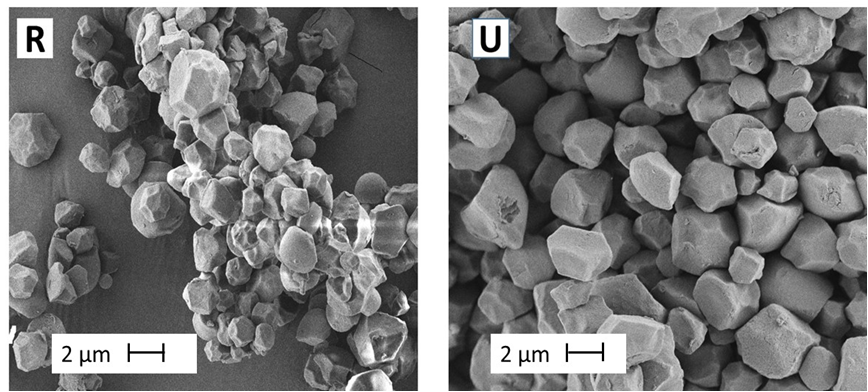
Amadumbe starch granules were mainly polygonal in shape with some granules appearing spherical or irregular in shape, suggesting that these are compound starches (Figure 1). Generally, amadumbe starch granules were very small with a diameter varying between 1-5µm across genotypes (Table 1). Previous studies similarly reported compound and very small sized granules for amadumbe 5 and taro starches 3, 23. According to 24, soil water deficit significantly influence the starch granules size for a variety of wheat grown under rain-fed and irrigated conditions, respectively. Possibly, differences in rainfall patterns between the two locations could have played a role in varying starch granule size of amadumbe of corms. Furthermore, microscopic image results showed clean starch granules, which suggest that the granules are relatively pure (Figure 1).

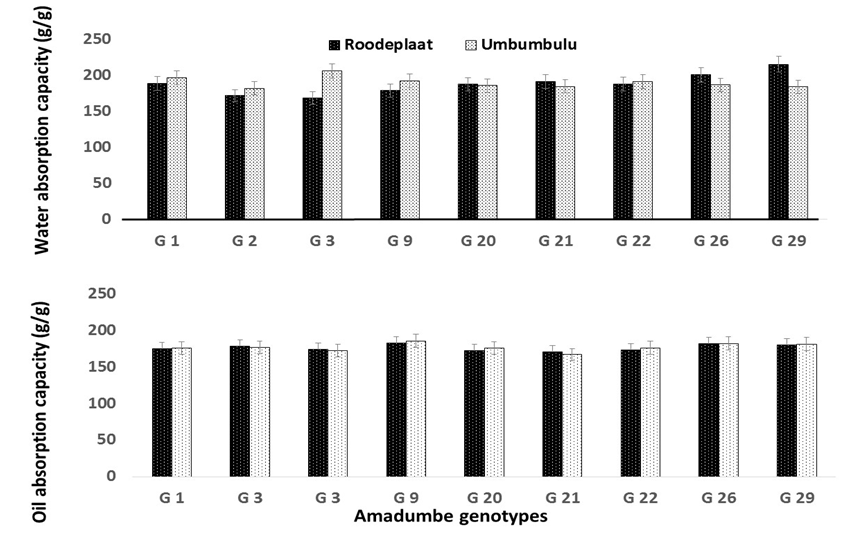
Generally, the water absorption capacities (WAC) of amadumbe starches were not substantially different across genotypes and growth location (Figure 2). However, among studied genotypes, G3 and G29 showed the highest WAC irrespective of growth location (Figure 2). The highest WAC can be attributed to the high amylose content in these genotypes (Table 1). The hydroxyl groups in amylose may have contributed to its high water uptake. Reference 5 similarly observed higher WAC for starches extracted from wild amadumbe with high amylose content (20%) compared to starches from cultivated amadumbe with low amylose content (12%). Furthermore, a similar observation has been reported for Chinese yam starch with high amylose content 25. However, some authors found a negative correlation between amylose content and water absorption capacity 21.

The oil absorption capacity (OAC) of amadumbe starches was almost similar across all genotypes and appeared to be interdependent of the growth location (Figure 3). There was no notable effect of environment or genotypes observed although slight differences in OAC was observed. Oil absorption capacity is useful in structure interaction in food especially in flavor retention, improvement of palatability and extension of shelf life particularly in bakery or meat products.

Swelling power of amadumbe starches was determined between 55 and 85°C (Data not shown). At temperatures below 65°C, amadumbe starches showed relatively low swelling power. This was followed by a rapid and continuous increase with increasing temperature between 65-85°C degrees which could be associated with melting of starch crystallites 26. The genotype had a significant effect on swelling power which were noted at temperature ranging from 70-85°C, irrespective of growth location. This can be attributed to differences in genotypes amylose content. The reference 27, also found that high amylose restrict swelling. Furthermore, the genotypic variation may be contributing to observed variations in starch swelling.
The solubility index of amadumbe starches from both locations similarly increased with increasing temperature across all amadumbe genotypes (Data not shown). Significant variation was observed between 75-85°C. This can be due to differences in starch granule size and environmental effects. Previous studies reported that smaller sized starch granules normally exhibit high solubility index than those with large starch granules 5, 23.
3.6. Pasting PropertiesThe pasting temperature of amadumbe starches (approx. 81°C), were not significantly different across genotypes and growth location. Only a minor variation was observed (Table 3). Smaller sized starch granules are reportedly resistant to rupture and loss of molecular order 28. In this study, fairly high pasting temperature values were observed in comparison to potato starch (approx. 67°C) 29, which could be attributed to small size (1-5µm) granules of amadumbe starch (Table 1). Pasting temperature is a useful indicator of the ease of cooking these starches, which provide an indication of the minimum temperature required for sample cooking, energy costs involved and other components stability. The pasting temperatures of amadumbe starch compared favourably with reports from the literature 5, 21. The peak viscosity measures the ability of starch to swell freely before their physical breakdown. It also indicates the water binding capacity of starch. The peak viscosity (86-271 RVU) of amadumbe starches varied significantly among genotypes. On average, genotypes grown at Umbumbulu location showed slightly high peak viscosity (PV) value of (222 RVU) compared to their counterparts grown at Roodeplaat which had 202 RVU (Table 2). Genotypes G3, G20, G21 and G22 grown at Roodeplaat showed significantly higher PV when compared to other genotypes grown in both locations. This can be attributed to their relatively low or no amylose content (Table 1). Starch with low amylose content exhibit high peak viscosity was also reported by 30. Relatively, high PV starch may be suitable for products requiring high gel strength and elasticity. Previous authors postulated that amylose content of starches restricts swelling during pasting 27. Genotypes G9 and G29 showed low PV when compared to other genotypes grown at both locations, which could be attributed to their relatively high amylose contents as stated above.
Breakdown viscosity (BV) of amadumbe starch genotypes grown in Roodeplaat and Umbumbulu varied significantly (p<0.05). High BV with an average of 105 RVU was generally observed for starch samples obtained from amadumbe genotypes grown at Umbumbulu in comparison to starch samples extracted from the same amadumbe genotypes grown in Roodeplaat which had an average of 96 RVU. Genotypes G9, G26, and G29 showed relatively low BV when grown either at Roodeplaat or Umbumbulu. According to 21, lower breakdown viscosity showed greater resistance which is normally expected of starches with lower peak viscosities and this was the case in this study. These findings show that starch extracted from amadumbe genotypes grown in Umbumbulu or Roodeplaat have high resistance to the shear and less susceptible to disintegration. These results agree with those that have previously reported for cocoyam 21, 31.
The final viscosity of the extracted amadumbe starches ranged from (101 to 237 RVU). When comparing the two locations, starch samples from Umbumbulu showed a higher final viscosity (199 RVU) compared to their counterparts grown at Roodeplaat (189 RVU). Final viscosity is used to define the quality of starch and indicates the stability of the cooked paste. It also indicates the ability of starch to form various paste or gel after cooling. Less stability of starch paste commonly accompanied with a high value of breakdown 32. The high final pasting viscosity observed for amadumbe starches suggest that these can be potentially used as thickening agent in food applications.
Setback viscosity (SV) is associated with the tendency of starch to retrogradation 33. The setback viscosity of amadumbe starches was generally low 41-100 RVU across all genotypes. However, genotypes G1, G2, G3, G21, G26 starches from Umbumbulu showed high setback viscosity compared to their counterparts grown at Roodeplaat (Table 2). The higher setback suggests that the starches retrograde faster and may exhibit a high stalling tendency when used in food applications 21, 34. Furthermore, starch with higher setback viscosity tend to have stiffer pastes than low setback viscosity starches and also susceptible to weeping when used is a frozen product as a filling 35.
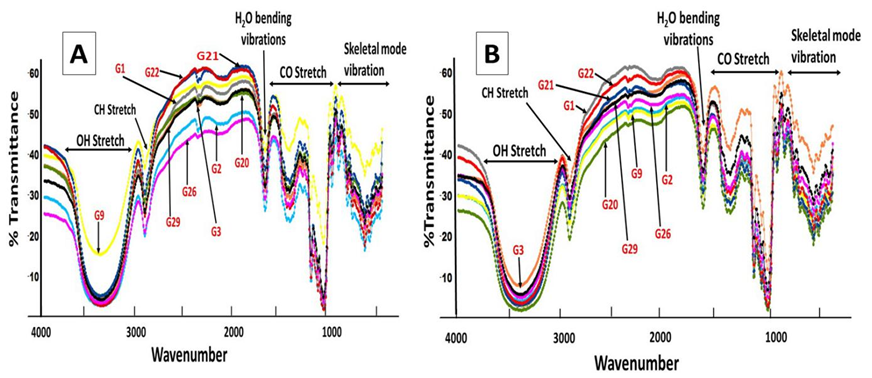
3.7. FTIRTypical FTIR of amadumbe starches is shown in Figure 3 above. The broad band at 3414 cm-1 could be attributed to O-H bond vibrations 36. In this study, different peak intensities were observed on amadumbe starches with different amylose contents. A characteristic band with a peak at 2931cm-1 in the region of 2800-3000cm-1 can result as of C-H bond stretching. At wavenumber 1655cm-1 and 1642cm-1 in the region of 1000-2000cm-1, the sharp band produced is attributed to water molecule bending vibrations in the non-crystalline region of starch 37. The peaks occurring at 1164cm-1 in amadumbe starches may be due to C-O and C-C stretching, while peaks at 860 and 928cm-1 could be attributed to C-O stretching 37, 38. Amadumbe starches showed complex vibrations at low wavenumber (< 800cm-1) which can be attributed to the skeletal vibration mode of glucose pyranose ring.
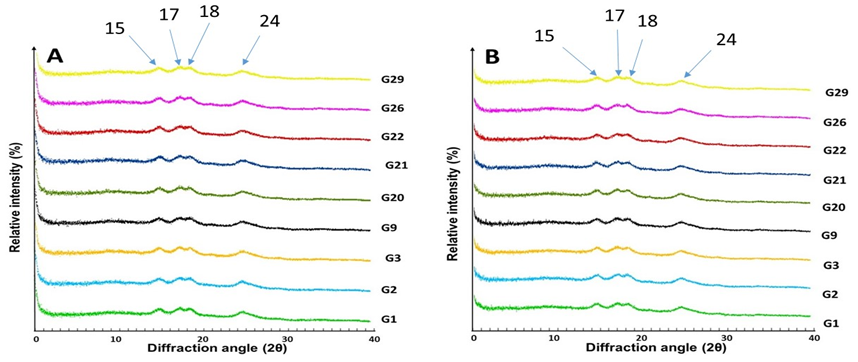
3.8. XRDAll amadumbe starches show diffractograms with strong singlet peak at 2θ=15°, a single duplet at 17 and another peak at 18° and 24° typical of A-types starches (Figure 4). Similar peak positions have previously been reported for taro starch 31. The relative crystallinity for amadumbe starches ranged from 28-39% for amadumbe genotypes grown at both Roodeplaat and Umbumbulu (Table 1). Starches extracted from genotypes grown at Roodeplaat site generally showed low relatively crystallinity (approx. 26%) compared to their counterparts grown at Umbumbulu site (approx. 34%). The side chains of amylopectin forms the crystalline structure in starch granules. Therefore, it is expected that the relative crystallinity will be directly proportional to amylopectin content 15. Higher relative crystallinity can be attributed to low amylose contents of starch (Table 1). Amylose content may be influenced by low environmental temperatures or limited crop water supply, which could be associated with reduced activity of enzymes involved in starch biosynthesis. Similarly results where starches with low amylose exhibit high relative crystallinity have been reported for taro starches 31, or legume starches 15.

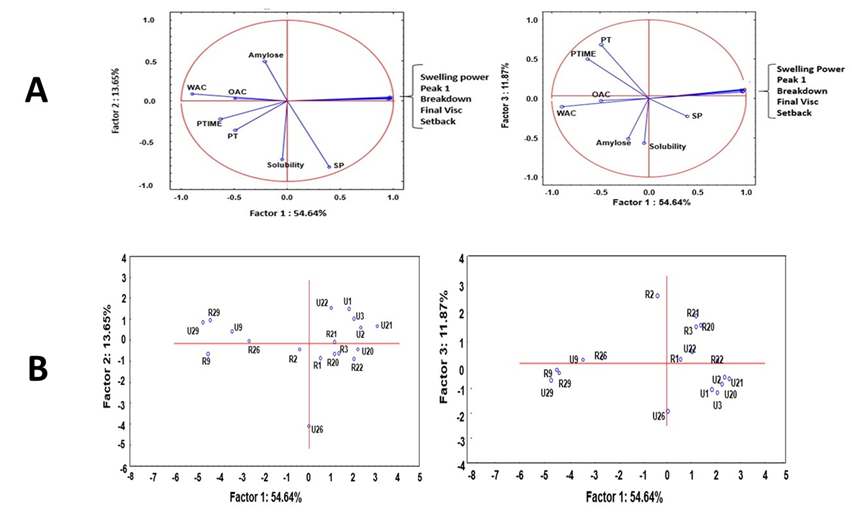
PCA biplot illustrates an overview of the similarities and differences in starches extracted from amadumbe genotype on all measured properties. The distance existing between the locations of any two starch samples on the score plot is directly proportional to the level of difference or similarity between them. The first principal component explains 67% of the total variance (Figure 5) among the genotypes.

From the first principal component (PC), 55% of the overall variation was explained among the genotypes. The starch samples extracted from amadumbe genotypes from Roodeplaat and Umbumbulu in a cluster on the right side of the plot were separated from other starch samples clustered on the left side of the plot. Starch samples on the right side of the plot were characterised by high peak viscosity, breakdown, final viscosity and setback viscosity. Starch samples on the left side of the plot were characterised by high pasting temperature, high water, and oil absorption capacities. The second PC, in addition, explained 14% of the total variation and separated G26 from Umbumbulu with high swelling power and high solubility index to G2 from Roodeplaat which was characterised by highest pasting temperature than other starch samples. The third PC finally explained 12% making it a total of 80% of the total variation and clearly differentiated G2 grown in Roodeplaat which had high pasting temperature, smallest granule size to G26 grown in Umbumbulu which had slightly high amylose content, high swelling power and solubility index.
Amadumbe genotypes are excellent sources of starch. The starches appeared polygonal and small size granules. The amylose contents varied across all amadumbe genotypes and had a significant effect on swelling power, pasting properties, water absorption or XRD. The tested amadumbe genotypes displayed the A-type starches that can be used in the food industry for food products or additives for thickening, preservation and quality enhancer in baked foods, confectioneries, pastas, soups and sauces, and mayonnaises.
The authors wish to thank the Agricultural Research Council Collaborative Consortium of Broadening the Food Base Project, South Africa for the financial support to carry out the study.
The authors declare no conflict of interest.
| [1] | Mabhaudhi, T. & Modi, AT. 2013. Preliminary assessment of genetic diversity in three taro (Colocasia esculenta L. Schott) landraces using agro-morphological and SSR DNA characterisation. Journal of Agricultural Science and Technology B 3: 265-271. | ||
| In article | |||
| [2] | Liu, Q., Donner, E., Yin, Y., Huang, R. & Fan, M. 2006. The physicochemical properties and in vitro digestibility of selected cereals, tubers and legumes grown in China. Food Chemistry 99(3): 470-477. | ||
| In article | View Article | ||
| [3] | Aboubakar, Y., Njintang, N., Scher, J. & Mbofung, C. 2008. Physicochemical, thermal properties and microstructure of six varieties of taro (Colocasia esculenta L. Schott) flours and starches. Journal of Food Engineering 86(2): 294-305. | ||
| In article | View Article | ||
| [4] | Aprianita, A., Purwandari, U., Watson, B. & Vasiljevic, T. 2009. Physico-chemical properties of flours and starches from selected commercial tubers available in Australia. International Food Research Journal 16(4): 507-520. | ||
| In article | |||
| [5] | Naidoo, K., Amonsou, E. & Oyeyinka, S. 2015. In vitro digestibility and some physicochemical properties of starch from wild and cultivated amadumbe corms. Carbohydrate Polymers 125: 9-15. | ||
| In article | View Article PubMed | ||
| [6] | Hong, P.G. & Nip, K.W. (1990). Functional properties pre-cooked taro flour insorbets. Food Chemistry 36(261): 261-270. | ||
| In article | View Article | ||
| [7] | Huang, C.C., Lai, P., Chen, I.-H., Liu, Y.F. & Wang, C.C. 2010. Effects of mucilage on the thermal and pasting properties of yam, taro, and sweet potato starches. LWT-Food Science and Technology 43(6): 849-855. | ||
| In article | View Article | ||
| [8] | Guevara-Arauza, J. C., de Jesús Ornelas-Paz, J., Pimentel-González, D. J., Mendoza, S. R., Guerra, R. E. S. & Maldonado, L.M.T.P. 2012. Prebiotic effect of mucilage and pectic-derived oligosaccharides from nopal (Opuntia ficus-indica). Food Science and Biotechnology 21(4): 997-1003. | ||
| In article | View Article | ||
| [9] | Tester, R.F. & Karkalas, J. 2001. The effects of environmental conditions on the structural features and physic-chemical properties of starches. Starch‐Stärke 53(10): 513-519. | ||
| In article | View Article | ||
| [10] | Jane, J., Shen, L., Chen, J., Lim, S., Kasemsuwan, T. & Nip, W. 1992. Physical and Chemical Studies of Taro Starches and Flours1 2. Cereal Chemistry 69: 528-535. | ||
| In article | |||
| [11] | Jane, J., Chen, Y., Lee, L., McPherson, A., Wong, K., Radosavljevic, M. & Kasemsuwan, T. 1999. Effects of amylopectin branch chain length and amylose content on the gelatinization and pasting properties of starch 1. Cereal Chemistry 76(5): 629-637. | ||
| In article | View Article | ||
| [12] | Noda, T., Kobayashi, T. & Suda, I. 2001. Effect of soil temperature on starch properties of sweet potatoes. Carbohydrate Polymers 44(3): 239-246. | ||
| In article | View Article | ||
| [13] | Mabhaudhi, T., Modi A.T. & Beletse Y.G. 2013. Response of taro (Colocasia esculenta L. Schott) landraces to varying water regimes under a rainshelter. Agricultural water management 121: 102-112. | ||
| In article | View Article | ||
| [14] | Singh, U., Voraputhaporn, W., Rao, P. V., & Jambunathan, R. 1989. Physicochemical Characteristics of Pigeonpea and Mung Bean Starches and Their Noodle Quality. Journal of Food Science 54(5): 1293-1297. | ||
| In article | View Article | ||
| [15] | Oyeyinka, S.A., Singh, S., Adebola, P.O., Gerrano, A.S., & Amonsou, E.O. 2015. Physicochemical properties of starches with variable amylose contents extracted from bambara groundnut genotypes. Carbohydrate Polymers 133: 171-178. | ||
| In article | View Article PubMed | ||
| [16] | Li, W., Xiao, X., Zhang, W., Zheng, J., Luo, Q., Ouyang, S. & Zhang, G. 2014. Compositional, morphological, structural and physicochemical properties of starches from seven naked barley cultivars grown in China. Food Research International 58: 7-14. | ||
| In article | View Article | ||
| [17] | Williams, P., Kuzina, F. & Hlynka, I. 1970. Rapid colorimetric procedure for estimating the amylose content of starches and flours. Cereal Chemistry 47: 411-421. | ||
| In article | |||
| [18] | Falade, K.O. & Okafor, C.A. 2015. Physical, functional, and pasting properties of flours from corms of two Cocoyam (Colocasia esculenta and Xanthosoma sagittifolium) cultivars. Journal of Food Science and Technology 52(6): 3440-3448. | ||
| In article | View Article | ||
| [19] | Oyeyinka, S.A., Singh, S. & Amonsou, E.O. 2016. Physicochemical properties of starches extracted from bambara groundnut landraces. Starch‐Stärke 64(3-4): 1600089. | ||
| In article | View Article | ||
| [20] | Ovando-Martínez, M., Bello-Pérez, L. A., Whitney, K., Osorio-Díaz, P. & Simsek, S. 2011. Starch characteristics of bean (Phaseolus vulgaris L.) grown in different localities. Carbohydrate Polymers 85(1): 54-64. | ||
| In article | View Article | ||
| [21] | Falade, K.O. & Okafor, C.A. 2013. Physicochemical properties of five cocoyam (Colocasia esculenta and Xanthosoma sagittifolium) starches. Food Hydrocolloids 30(1): 173-181. | ||
| In article | View Article | ||
| [22] | Asaoka, M., Okuno, K. & Fuwa, H. 1985. Effect of environmental temperature at the milky stage on amylose content and fine structure of amylopectin of waxy and nonwaxy endosperm starches of rice (Oryza sativa L.). Agricultural and Biological Chemistry 49(2): 373-379. | ||
| In article | View Article | ||
| [23] | Moorthy, S. N. 2002. Physicochemical and functional properties of tropical tuber starches: a review. Starch‐Stärke 54(12): 559-592. | ||
| In article | View Article | ||
| [24] | Zhong-Min, D., Yan-Ping, Y., Zhang, M., Wen-Yang, L., Su-Hui, Y., Rui-Guo, C. & Zhen-Lin, W. 2008. Distribution of starch granule size in grains of wheat grown under irrigated and rainfed conditions. Acta Agronomica Sinica 34(5): 795-802. | ||
| In article | View Article | ||
| [25] | Shujun, W., Hongyan, L., Wenyuan, G., Haixia, C., Jiugao, Y. &Peigen, X. 2006. Characterization of new starches separated from different Chinese yam (Dioscorea opposita Thunb.) cultivars. Food Chemistry 99(1): 30-37. | ||
| In article | View Article | ||
| [26] | Hoover, R. and Sosulski, F.W. 1985. Studies on the functional, Characteristics and diigestibility of starches from phaseous vulgaris biotypes. Starch 37: 181-191. | ||
| In article | View Article | ||
| [27] | Tester, R.F. & Morrison, W.R. 1990. Swelling and gelatinization of cereal starches. I. Effects of amylopectin, amylose, and lipids. Cereal Chemistry 67(6): 551-557. | ||
| In article | |||
| [28] | Dreher, M. & Berry, J. 1983. Buffalo gourd root starch. Part I. Properties and structure. Starch‐Stärke 35(3): 76-81 | ||
| In article | View Article | ||
| [29] | Gałkowska, D., Pycia, K., Juszczak, L. & Pająk, P. 2014. Influence of cassia gum on rheological and textural properties of native potato and corn starch. Starch‐Stärke 66(11-12): 1060-1070. | ||
| In article | View Article | ||
| [30] | Noda, T., Tsuda, S., Mori, M., Takigawa, S., Matsuura-Endo, C., Saito, K., Mangalika, W.H.A., Hanaoka, A., Suzuki, Y. & Yamauchi, H. 2004. The effect of harvest dates on the starch properties of various potato cultivars. Food Chemistry 86(1): 119-125. | ||
| In article | View Article | ||
| [31] | Sit, N., Misra, S. & Deka, S.C. 2014. Characterization of Physicochemical, Functional, Textural and Color Properties of Starches from Two Different Varieties of Taro and Their Comparison to Potato and Rice Starches. Food Science and Technology Research 20(2): 357-365. | ||
| In article | View Article | ||
| [32] | Ikegwu, O., Okechukwu, P. & Ekumankana, E. 2010. Physico-chemical and pasting characteristics of flour and starch from achi Brachystegia eurycoma seed. Journal of Food Technology 8(2): 58-66. | ||
| In article | View Article | ||
| [33] | Owuamanam, C., Ihediohanma, N. & Nwanekezi, E. 2010. Sorption isotherm, particle size, chemical and physical properties of cocoyam corm flours. Researcher 2(8): 11-19. | ||
| In article | |||
| [34] | Idowu, M., Adeyemi, I. & David, M. 1993. Sensory evaluation and nutrient composition of weaning food from pregelatinized maize-sweet potato mixtures. Plant Foods for Human Nutrition 44(2): 149-155. | ||
| In article | View Article PubMed | ||
| [35] | Seog, H., Park, Y., Nam, Y., Shin, D. & Kim, J. 1987. Physicochemical properties of several sweet potato starches. Ham guk Nanghwa Hakhechi 30: 179-185. | ||
| In article | |||
| [36] | Zhang, Y. & Han, J. 2006. Plasticization of pea starch films with monosaccharides and polyols. Journal of Food Science 71(6): E253-E261. | ||
| In article | View Article | ||
| [37] | Kizil, R., Irudayaraj, J. & Seetharaman, K. 2002. Characterization of irradiated starches by using FT-Raman and FTIR spectroscopy. Journal of Agricultural and Food Chemistry 50(14): 3912-3918. | ||
| In article | View Article PubMed | ||
| [38] | Capron, I., Robert, P., Colonna, P., Brogly, M. & Planchot, V. 2007. Starch in rubbery and glassy states by FTIR spectroscopy. Carbohydrate Polymers 68(2): 249-259. | ||
| In article | View Article | ||
Published with license by Science and Education Publishing, Copyright © 2022 Bruce Mawoyo, Abe Shegro Gerrano, Patrick Adebola and Eric Amonsou
 This work is licensed under a Creative Commons Attribution 4.0 International License. To view a copy of this license, visit
http://creativecommons.org/licenses/by/4.0/
This work is licensed under a Creative Commons Attribution 4.0 International License. To view a copy of this license, visit
http://creativecommons.org/licenses/by/4.0/
| [1] | Mabhaudhi, T. & Modi, AT. 2013. Preliminary assessment of genetic diversity in three taro (Colocasia esculenta L. Schott) landraces using agro-morphological and SSR DNA characterisation. Journal of Agricultural Science and Technology B 3: 265-271. | ||
| In article | |||
| [2] | Liu, Q., Donner, E., Yin, Y., Huang, R. & Fan, M. 2006. The physicochemical properties and in vitro digestibility of selected cereals, tubers and legumes grown in China. Food Chemistry 99(3): 470-477. | ||
| In article | View Article | ||
| [3] | Aboubakar, Y., Njintang, N., Scher, J. & Mbofung, C. 2008. Physicochemical, thermal properties and microstructure of six varieties of taro (Colocasia esculenta L. Schott) flours and starches. Journal of Food Engineering 86(2): 294-305. | ||
| In article | View Article | ||
| [4] | Aprianita, A., Purwandari, U., Watson, B. & Vasiljevic, T. 2009. Physico-chemical properties of flours and starches from selected commercial tubers available in Australia. International Food Research Journal 16(4): 507-520. | ||
| In article | |||
| [5] | Naidoo, K., Amonsou, E. & Oyeyinka, S. 2015. In vitro digestibility and some physicochemical properties of starch from wild and cultivated amadumbe corms. Carbohydrate Polymers 125: 9-15. | ||
| In article | View Article PubMed | ||
| [6] | Hong, P.G. & Nip, K.W. (1990). Functional properties pre-cooked taro flour insorbets. Food Chemistry 36(261): 261-270. | ||
| In article | View Article | ||
| [7] | Huang, C.C., Lai, P., Chen, I.-H., Liu, Y.F. & Wang, C.C. 2010. Effects of mucilage on the thermal and pasting properties of yam, taro, and sweet potato starches. LWT-Food Science and Technology 43(6): 849-855. | ||
| In article | View Article | ||
| [8] | Guevara-Arauza, J. C., de Jesús Ornelas-Paz, J., Pimentel-González, D. J., Mendoza, S. R., Guerra, R. E. S. & Maldonado, L.M.T.P. 2012. Prebiotic effect of mucilage and pectic-derived oligosaccharides from nopal (Opuntia ficus-indica). Food Science and Biotechnology 21(4): 997-1003. | ||
| In article | View Article | ||
| [9] | Tester, R.F. & Karkalas, J. 2001. The effects of environmental conditions on the structural features and physic-chemical properties of starches. Starch‐Stärke 53(10): 513-519. | ||
| In article | View Article | ||
| [10] | Jane, J., Shen, L., Chen, J., Lim, S., Kasemsuwan, T. & Nip, W. 1992. Physical and Chemical Studies of Taro Starches and Flours1 2. Cereal Chemistry 69: 528-535. | ||
| In article | |||
| [11] | Jane, J., Chen, Y., Lee, L., McPherson, A., Wong, K., Radosavljevic, M. & Kasemsuwan, T. 1999. Effects of amylopectin branch chain length and amylose content on the gelatinization and pasting properties of starch 1. Cereal Chemistry 76(5): 629-637. | ||
| In article | View Article | ||
| [12] | Noda, T., Kobayashi, T. & Suda, I. 2001. Effect of soil temperature on starch properties of sweet potatoes. Carbohydrate Polymers 44(3): 239-246. | ||
| In article | View Article | ||
| [13] | Mabhaudhi, T., Modi A.T. & Beletse Y.G. 2013. Response of taro (Colocasia esculenta L. Schott) landraces to varying water regimes under a rainshelter. Agricultural water management 121: 102-112. | ||
| In article | View Article | ||
| [14] | Singh, U., Voraputhaporn, W., Rao, P. V., & Jambunathan, R. 1989. Physicochemical Characteristics of Pigeonpea and Mung Bean Starches and Their Noodle Quality. Journal of Food Science 54(5): 1293-1297. | ||
| In article | View Article | ||
| [15] | Oyeyinka, S.A., Singh, S., Adebola, P.O., Gerrano, A.S., & Amonsou, E.O. 2015. Physicochemical properties of starches with variable amylose contents extracted from bambara groundnut genotypes. Carbohydrate Polymers 133: 171-178. | ||
| In article | View Article PubMed | ||
| [16] | Li, W., Xiao, X., Zhang, W., Zheng, J., Luo, Q., Ouyang, S. & Zhang, G. 2014. Compositional, morphological, structural and physicochemical properties of starches from seven naked barley cultivars grown in China. Food Research International 58: 7-14. | ||
| In article | View Article | ||
| [17] | Williams, P., Kuzina, F. & Hlynka, I. 1970. Rapid colorimetric procedure for estimating the amylose content of starches and flours. Cereal Chemistry 47: 411-421. | ||
| In article | |||
| [18] | Falade, K.O. & Okafor, C.A. 2015. Physical, functional, and pasting properties of flours from corms of two Cocoyam (Colocasia esculenta and Xanthosoma sagittifolium) cultivars. Journal of Food Science and Technology 52(6): 3440-3448. | ||
| In article | View Article | ||
| [19] | Oyeyinka, S.A., Singh, S. & Amonsou, E.O. 2016. Physicochemical properties of starches extracted from bambara groundnut landraces. Starch‐Stärke 64(3-4): 1600089. | ||
| In article | View Article | ||
| [20] | Ovando-Martínez, M., Bello-Pérez, L. A., Whitney, K., Osorio-Díaz, P. & Simsek, S. 2011. Starch characteristics of bean (Phaseolus vulgaris L.) grown in different localities. Carbohydrate Polymers 85(1): 54-64. | ||
| In article | View Article | ||
| [21] | Falade, K.O. & Okafor, C.A. 2013. Physicochemical properties of five cocoyam (Colocasia esculenta and Xanthosoma sagittifolium) starches. Food Hydrocolloids 30(1): 173-181. | ||
| In article | View Article | ||
| [22] | Asaoka, M., Okuno, K. & Fuwa, H. 1985. Effect of environmental temperature at the milky stage on amylose content and fine structure of amylopectin of waxy and nonwaxy endosperm starches of rice (Oryza sativa L.). Agricultural and Biological Chemistry 49(2): 373-379. | ||
| In article | View Article | ||
| [23] | Moorthy, S. N. 2002. Physicochemical and functional properties of tropical tuber starches: a review. Starch‐Stärke 54(12): 559-592. | ||
| In article | View Article | ||
| [24] | Zhong-Min, D., Yan-Ping, Y., Zhang, M., Wen-Yang, L., Su-Hui, Y., Rui-Guo, C. & Zhen-Lin, W. 2008. Distribution of starch granule size in grains of wheat grown under irrigated and rainfed conditions. Acta Agronomica Sinica 34(5): 795-802. | ||
| In article | View Article | ||
| [25] | Shujun, W., Hongyan, L., Wenyuan, G., Haixia, C., Jiugao, Y. &Peigen, X. 2006. Characterization of new starches separated from different Chinese yam (Dioscorea opposita Thunb.) cultivars. Food Chemistry 99(1): 30-37. | ||
| In article | View Article | ||
| [26] | Hoover, R. and Sosulski, F.W. 1985. Studies on the functional, Characteristics and diigestibility of starches from phaseous vulgaris biotypes. Starch 37: 181-191. | ||
| In article | View Article | ||
| [27] | Tester, R.F. & Morrison, W.R. 1990. Swelling and gelatinization of cereal starches. I. Effects of amylopectin, amylose, and lipids. Cereal Chemistry 67(6): 551-557. | ||
| In article | |||
| [28] | Dreher, M. & Berry, J. 1983. Buffalo gourd root starch. Part I. Properties and structure. Starch‐Stärke 35(3): 76-81 | ||
| In article | View Article | ||
| [29] | Gałkowska, D., Pycia, K., Juszczak, L. & Pająk, P. 2014. Influence of cassia gum on rheological and textural properties of native potato and corn starch. Starch‐Stärke 66(11-12): 1060-1070. | ||
| In article | View Article | ||
| [30] | Noda, T., Tsuda, S., Mori, M., Takigawa, S., Matsuura-Endo, C., Saito, K., Mangalika, W.H.A., Hanaoka, A., Suzuki, Y. & Yamauchi, H. 2004. The effect of harvest dates on the starch properties of various potato cultivars. Food Chemistry 86(1): 119-125. | ||
| In article | View Article | ||
| [31] | Sit, N., Misra, S. & Deka, S.C. 2014. Characterization of Physicochemical, Functional, Textural and Color Properties of Starches from Two Different Varieties of Taro and Their Comparison to Potato and Rice Starches. Food Science and Technology Research 20(2): 357-365. | ||
| In article | View Article | ||
| [32] | Ikegwu, O., Okechukwu, P. & Ekumankana, E. 2010. Physico-chemical and pasting characteristics of flour and starch from achi Brachystegia eurycoma seed. Journal of Food Technology 8(2): 58-66. | ||
| In article | View Article | ||
| [33] | Owuamanam, C., Ihediohanma, N. & Nwanekezi, E. 2010. Sorption isotherm, particle size, chemical and physical properties of cocoyam corm flours. Researcher 2(8): 11-19. | ||
| In article | |||
| [34] | Idowu, M., Adeyemi, I. & David, M. 1993. Sensory evaluation and nutrient composition of weaning food from pregelatinized maize-sweet potato mixtures. Plant Foods for Human Nutrition 44(2): 149-155. | ||
| In article | View Article PubMed | ||
| [35] | Seog, H., Park, Y., Nam, Y., Shin, D. & Kim, J. 1987. Physicochemical properties of several sweet potato starches. Ham guk Nanghwa Hakhechi 30: 179-185. | ||
| In article | |||
| [36] | Zhang, Y. & Han, J. 2006. Plasticization of pea starch films with monosaccharides and polyols. Journal of Food Science 71(6): E253-E261. | ||
| In article | View Article | ||
| [37] | Kizil, R., Irudayaraj, J. & Seetharaman, K. 2002. Characterization of irradiated starches by using FT-Raman and FTIR spectroscopy. Journal of Agricultural and Food Chemistry 50(14): 3912-3918. | ||
| In article | View Article PubMed | ||
| [38] | Capron, I., Robert, P., Colonna, P., Brogly, M. & Planchot, V. 2007. Starch in rubbery and glassy states by FTIR spectroscopy. Carbohydrate Polymers 68(2): 249-259. | ||
| In article | View Article | ||