The public sector, and more specifically the civil service, holds an indispensable position in ensuring the effective provision of essential public services, which are fundamental to the functioning of a nation’s economy. The primary aim of this research was to investigate how revenue mobilization influences the efficiency of service delivery within Kenya’s county governments. The study was anchored on Relative Income Theory. The target population comprised all 47 counties. Secondary data was obtained from audited county financial statements covering the fiscal years 2013/2014 to 2020/2021. For data analysis, STATA software version 27.0 was employed to generate descriptive statistics such as percentages, frequency distributions, measures of central tendency, and measures of dispersion. The interpretation of results was based on both descriptive statistics and inferential techniques, including correlation analysis, univariate regression analysis, tests for multicollinearity, autocorrelation, heteroscedasticity, normality, and panel data regression analysis. The findings revealed a statistically significant positive relationship between own-source revenue and revenue mobilization among county governments. Partnerships, collaborations, and grants also showed a positive relationship, though their effect on service delivery efficiency was statistically insignificant.
Within the public sector, the civil service plays a vital role in delivering essential services effectively to citizens, which is crucial for sustaining the operations of a country’s economy. When service delivery is hindered or inefficient, the consequences affect citizens’ quality of life and can slow the pace of national development Hossen, 1. Many developing countries continue to grapple with governance challenges, such as rent-seeking, corrupt practices, poor allocation of resources, ineffective revenue systems, and inadequate provision of essential public services Hendriks, 2. To address these issues, robust public financial management (PFM) systems are required to maximize resource utilization efficiently, enhance transparency and accountability in government finances, and support the long-term stability of the economy.
The relationship between fiscal management the efficiency of service delivery is multifaceted. Research indicates that counties with stronger revenue-generation mechanisms tend to perform better in delivering services. For instance, Kiraka, & Otieno, 3. observed that counties with diversified revenue sources reported improved healthcare outcomes compared to those that relied solely on national government allocations. Conversely, the research consistently highlights that financial mismanagement and weak fiscal policies result in poor service delivery outcomes.
Previous studies also highlight the role of intergovernmental relations in strengthening fiscal management. Ndii 4 emphasized that coherent fiscal policies and collaborative frameworks between the national and county governments can significantly improve financial stability and service delivery efficiency.
In line with this, the present study sought to determine the effect of revenue mobilization on service delivery efficiency within Kenya’s county governments. The study was based on the following hypothesis: revenue mobilization has no significant effect onservice delivery efficiency of the county governments in Kenya.
The specific objective of this study was to determine the effect of revenue mobilization on the efficiency of service delivery of county governments in Kenya.
2.1. Relative Income TheoryThetheory of relative income as pronounced in economics, is attributed to Veblen and Duesen berry 4. However, Duesen berry 4 documented the implications of this hypothesis to consumption behavior in his 1949 book: “Income, Saving and the Theory of Consumer Behavior”. This theory posits that the satisfaction, or utility, an individual derives from a given level of consumption is largely determined by its relative size compared to others in society, rather than its absolute value. In essence, individuals tend to measure their consumption against the average consumption patterns of a chosen reference group. The foundation of this idea is supported by sociologists and psychologists, who assert that individuals place importance on their social status.
Duesenberry 4 argued that a person’s utility index is determined by the ratio of their consumption to the consumption-weighted average of their reference group Carr &Jayadev, 5. A reference group refers to a social circle that holds significance for the individual, and such groups can be defined by socio-economic characteristics such as age, income level, educational attainment, and occupation. For example, in an organization, employees may belong to various tiers of management operational, middle, or top-level forming distinct reference groups Carr&Jayadev, 5. Georgarakos et al. 6 applied this concept by using age categories as the basis for reference groups. Reference groups serve as important sources of information, introducing individuals to new products and expanding their range of choices. They also share experiences and knowledge that help members appreciate, enjoy, and effectively utilize these products Bryan, Taylor & Veliziolis, Cynamon & Fazzari, 7.
People tend to preserve not only their absolute consumption levels but also their relative standing within their social circles. Maintaining one’s social position often depends on the visibility of consumption. Luxurious goods with high social visibility are generally preferred over wealth accumulation, which is less visible to peers Carr&Jayadev, 5. This phenomenon can result in heightened consumption driven by comparisons within social groups. In many cases, members may participate in a “status race,” which can be detrimental, for instance, by increasing personal debt. Such competition is especially common for durable goods such as vehicles, jewelry, and electronics Carr&Jayadev, 5. According to Georgarakos et al. 6, variationsreal or perceived among members of a social group can lead to greater borrowing to close the gap, which ultimately increases debt levels. Awareness of peers’ debt burdens can also influence individuals to take on more debt, often leading to financial strain and social stigma once debt levels become unmanageable. Georgarakos et al 6. concluded that individuals assess their own debt in relation to that of their peers.
In summary, the Relative Income Theory suggests that lower-income groups may engage in unsustainable borrowing to match the consumption patterns of higher-income peers. This behavior, known as the “Veblen effect,” refers to the tendency to “keep up with the neighbors.” In investment contexts, it is often described as the “herding effect,” while in sociology it is called the “peer effect” Baddeley, Burke, Schultz & Tobler, 8. Within this study, the theory explains the relationship between income levels and revenue mobilization, proposing that higher incomes lead to greater county revenue and improved service delivery.
The weakness of this theory is the observation that higher growth rates lead to higher saving rates, which is inconsistent with the life-cycle/permanent-income theory since the lifetime resources of an individual increases as growth rate increases.
2.2. Empirical LiteratureRutto, Minja, &Kosimbei 9 conducted an investigation into the structure and organization of intergovernmental fiscal transfers (IGFTs) in Kenya, pointing out that subnational governments (SNGs) remain heavily dependent on IGFTs and suggesting ways to strengthen fiscal decentralization. Using a descriptive research design, the study reviewed publicly available data and incorporated interviews with budget, finance, and planning directors from three county governments. Their findings indicated that IGFTs constitute the principal source of revenue for SNGs in Kenya, while own-source revenues form only a small portion of total county revenue. The study also identified challenges in IGFT implementation, including constraints within the legal framework on fund usage and issues like delays in settling pending bills. An increase in conditional grants from the national government was noted, with allocations based on a formula that accounts for factors such as population, poverty levels, land area, and fiscal effort. The researchers concluded that counties’ overdependence on IGFTs limits their capacity for independent decision-making and can undermine devolution efforts. Recommended measures included introducing tax-sharing mechanisms and pooling resources for special-purpose vehicles to support subnational borrowing. The study concludes that subnational governments in Kenya are heavily dependent on intergovernmental fiscal transfers, which constrains their ability to provide adequate public services and impede fiscal decentralization initiatives.
Nyanumba 10 examined the impact of financial sustainability strategies on the performance of Kenya’s counties. The target population included all 47 county governments, as established under the 2010 Constitution and highlighted in the 2011 CRA report. The study adopted a census approach, employing both probabilistic and non-probabilistic sampling methods. Samples was derived from strata which the first group of the Forty-Seven counties were clustered into eight geographic regions, equal in area to the abolished eight Kenyan provinces. Twenty-five counties were picked from the entire number of counties, from which respondents were picked per county based on the proportionate county population number as per the CRA publication of 2011. Findings showed that most counties had diversified their revenue streams as a strategy for achieving financial sustainability, thereby enhancing performance and service delivery. In the current study, secondary data served as the metric for revenue mobilization, while county gross product was used as a measure of service delivery efficiency.
Mbau 11 explored the relationship between fiscal decentralization and the performance of county governments in Kenya over the period 2013–2018. The target population was the entire forty-seven counties in the context of Kenya. The study adopted descriptive correlational research design and data gathered was quantitative in form. Multiple linear regression was used to measure the strength and direction of relationships. County performance was assessed using a well-being index. Results indicated a positive correlation between revenue mobilization and county performance, consistent with theoretical predictions. The current study prescribed other theories such as normative budget theory, relative income theory and lifecycle theory to fill the existing theoretical gap.
Mwangi, Roba, & Muthengi 12 provided qualitative evidence on how fiscal decentralization affects public service delivery in devolved governance systems, focusing on two Kenyan counties: Kiambu and Nairobi City. The study interviewed 126 respondents and held two focus group discussions with key stakeholders. It examined fiscal decentralization through three elements expenditure responsibilities, revenue autonomy, and borrowing powers and assessed service delivery primarily in terms of affordability. Results indicated that fiscal decentralization did not necessarily improve service affordability due to moderating factors like corruption, legal constraints, cultural norms, conformity pressures, and the role of change agents. While corruption reduced service affordability in both counties, the Nairobi Metropolitan Services acted as a change agent, improving affordability for certain services in Nairobi City County. The paper outlines a conceptual framework for further research into implementation of fiscal decentralization in Kenya and elsewhere, especially in Africa, and calls for more qualitative studies, especially longitudinal studies, case studies and ethnographic approaches to enrich knowledge in this field.
Gorina 13 examined fiscal management in U.S. local governments, focusing on the influence of government structure, revenue diversity, and local economic bases. Drawing from surveys, government bureau data, and financial indicator databases, the study analyzed how these variables affect local fiscal management. The study was an effort to make use of accounting data in the custody of the government from annual reports of financial data to make prediction of the status of localized fiscal management. The results showed that pension liability funding is largely determined by government size, indebtedness correlates strongly with the strength of the local economic base, and balanced budgets are associated with the diversity of local revenue streams. The present study adapts this framework to the Kenyan county government context.
Oyedijo 14 investigated the impact of organizational and environmental factors on the performance outcomes of strategic planning practices in 46 state and federal universities in Nigeria. Using a multiple-informant survey method, the study found that institutions whose planning approaches aligned with the ideal model of strategic planning managed external pressures more effectively than those whose approaches deviated from this model. The research emphasized mobilization as an area of scholarly interest, aimed at helping managers decide on potential new ventures. Since mobilization can be driven by various factors, the ultimate goal of diversifying operations is to strengthen market share and exploit opportunities for synergy. The current study adopted the joint effect of revenue mobilization with additional variables such as liquidity control and debt management on county governments’ service delivery efficiency.
Adu-Gyamfi 15 studied effective revenue mobilization within Ghana’s Upper Denkyira East Municipal Assembly. Using a mixed-method approach, the study drew on both qualitative and quantitative methods, with a sample of 85 participants selected through convenience and purposive sampling. The primary internal revenue sources identified included property rates, licenses, market tolls, and lorry park fees, with property rates contributing the most to internally generated funds (IGF). Key challenges to revenue mobilization included insufficient data on revenue sources, lack of enforcement of by-laws, and inadequate training for revenue collectors. Recommendations from this study were improved tax education, enhanced training and motivation for revenue staff, establishment of a comprehensive database of revenue sources, strict enforcement of by-laws, and regular prosecution of defaulters.
Rutto 16 further evaluated the organization of IGFTs in Kenya, using a descriptive design and interviews with finance, budget, and planning directors from the counties of Baringo, Kiambu, and Vihiga. The study found that IGFTs make up 87% of SNG revenue, with the equalization fund contributing around 2% and own-source revenues about 10%. Other revenue sources are conditional transfers in form of ad hoc and cost-reimbursement approaches from both the national government and development partners. The study stressed the importance of timely and efficient disbursement of IGFTs to enable counties to fulfill their mandates. It concluded that heavy reliance on IGFTs can limit the capacity of counties to deliver services and hinder devolution. Recommendations included accelerating legal mechanisms for identifying and assigning local revenues, introducing tax-sharing arrangements to incentivize revenue mobilization, and pooling resources for subnational borrowing through special-purpose vehicles. The study contributes to the existing knowledge by devolving more into the elements of fiscal decentralization and in particular intergovernmental fiscal transfers. Recommendations for further studies include studies on how other elements of mobilization impact the performance of the counties, how mobilization is improving governance at the local level and how the East African Community may affect governance and service delivery at the sub-national levels.
2.3. Conceptual FrameworkThe study adopted a positivist research philosophy, which is rooted in the principle of objectively establishing facts through empirical evidence. This approach shaped the procedures for collecting, analyzing, and interpreting data related to the service delivery efficiency of county governments in Kenya. The independent variables investigated included budget analysis, revenue mobilization, debt management, and liquidity control. In line with the positivist paradigm, the researcher maintained independence from the data and avoided subjective interpretation, similar to prior Kenyan studies in the financial and banking sectors that employed this methodology.
A descriptive correlational research design was selected to measure the strength and direction of relationships among the variables. This design enabled the collection and analysis of data at a single point in time, providing a snapshot of fiscal management practices and service delivery efficiency across all 47 counties. A cross-sectional approach was applied, consistent with earlier research on fiscal decentralization and public sector spending, ensuring comparability with existing empirical evidence in Kenya.
The target population comprised all 47 counties in Kenya. Given the relatively small and manageable population size, a census approach was used rather than sampling, which improved data validity and eliminated sampling errors. The study relied exclusively on secondary data sources, specifically audited financial records and annual reports from the Office of the Auditor-General and the Kenya National Bureau of Statistics (KNBS). Data was extracted using a data collection sheet designed to capture relevant financial information from county audited statements for the fiscal years 2013 to 2022. The use of standardized official reports ensured reliability and consistency in the data obtained.
The data analysis process involved multiple statistical tests to ensure accuracy and validity. The statistical analysis was conducted using STATA software version 13.0. Descriptive statistics including means, standard deviations, and frequency distributions were employed to summarize the variables. To examine relationships among the variables, regression models were applied, specifically Fixed Effects Models (FEM) and Random Effects Models (REM), with the Hausman test used to determine the more appropriate model for each analysis. Additionally, panel data tests, such as unit root and cointegration tests, were conducted to ensure data stationarity. Diagnostic tests, including tests for normality, heteroscedasticity, and autocorrelation, were performed to validate the regression models and ensure statistical accuracy.
County population size was incorporated as a moderating variable, based on the understanding that it could influence the strength or direction of the relationship between explanatory variables and service delivery efficiency. A moderating effect is considered to occur if the coefficient of the moderated variable was statistically significant and if the R² value of the moderated regression model exceeded that of the unmoderated model (Fairchild & MacKinnon, 2009). The analytical moderated model for moderating effect was as follows:
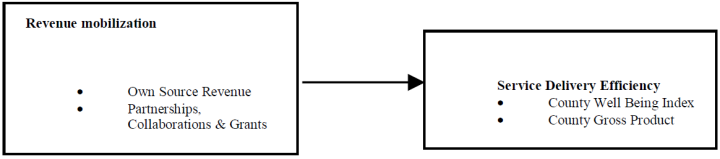
Y = β0+β1X1+β2X2 + εit …………. 3
Where, Y = Service Delivery Efficiency
X1 = Own Source Revenue
X2= Partnerships, Collaborations & Grants
εit = Error term assumed to be a constant
This section presents the research findings, their interpretation, analysis, and their discussion as guided by the specified objectives effect of revenue mobilization on service delivery efficiency of county governments in Kenya. It also outlines the regression models developed from the collected and analyzed data.
4.1. Descriptive StatisticsThe study followed a positivist approach, emphasizing objective fact-finding through empirical analysis. This guided the collection, analysis, and interpretation of data on service delivery efficiency in county governments. The independent variables examined included budget analysis, revenue mobilization, debt management, and liquidity control. Consistent with prior research in Kenya’s financial and public administration sectors, the researcher maintained an objective and independent stance throughout the process.
A descriptive correlational research design was employed to evaluate the strength of relationships among the variables. This design allowed data collection and analysis at a single point in time, assessing fiscal management practices and service delivery efficiency across all 47 counties. A cross-sectional approach was chosen to facilitate analysis of multiple variables simultaneously, in line with earlier studies on fiscal decentralization and public spending.
Given the manageable size of the population, the study conducted a census of all 47 counties in Kenya, which enhanced data validity and eliminated sampling errors. Data was obtained from secondary sources, including audited financial reports and statistical publications from the Office of the Auditor-General and the Kenya National Bureau of Statistics (KNBS). Information was drawn from audited county financial statements covering 2013 to 2021 using a standardized data collection sheet to ensure reliability and consistency.
The descriptive statistics in Table 1 summarize the variables of interest: County Gross Product (CGP) and Consumer Well-Being (CWB) as measures of service delivery efficiency, and Own Source Revenue (OSR) together with Partnerships, Collaborations, and Grants (PCG) as indicators of revenue mobilization. Mean values indicated variation across counties in both service delivery efficiency and revenue mobilization levels, while standard deviations reflected a reasonable spread of the data from the mean. Skewness and kurtosis suggested moderate deviation from a normal distribution and Jarque-Bera tests confirmed that the variables deviated from normality at a statistically significant level.
4.2. Diagnostic TestsTo ensure the suitability of the dataset for multiple linear regression analysis, several diagnostic tests were conducted. This was necessary because violations of regression assumptions can distort findings and lead to unreliable conclusions. The classical linear regression model requires key assumptions, including linearity, independence of errors, homoscedasticity, and normality of residuals. The researcher thoroughly examined these assumptions to identify any potential model misspecifications.
The results revealed significant heteroscedasticity for both dependent variables (CGP and CWB). To correct this, the regression models were re-estimated using robust standard errors. Implementing robust standard errors enhances the validity of hypothesis testing when standard assumptions are not met, thus improving the reliability of statistical inferences despite variance instability of heteroscedasticity. To counteract this issue, robust standard errors were incorporated into the regression analysis.
In summary, while some classical linear regression assumptions were violated, corrective measures such as robust standard errors and GLS estimation were applied to maintain the reliability and validity of the model results.
The Hausman test was applied to determine the most suitable model Fixed Effects Model (FEM) or Random Effects Model (REM) for the analysis. The null hypothesis for the test was that the random effects model was the most appropriate against an alternative that the fixed effects model should be used. The null hypothesis (H0) indicated that the random effects model (REM) should be used to investigate the effect of fiscal management and service delivery efficiency of county governments in Kenya, as opposed to the fixed effects model (FEM). If the p-value was less than 0.05, the FEM model should be used; otherwise, the REM model should be fitted.
The Hausman test determines whether or not the unique errors are correlated with the regressors; the null hypothesis is that they are not. The study was cautious that the use of the random effects model assumes exogeneity of all regressors with the random individual effects. Contrary to this, the fixed effects model allows for endogeneity of all the regressors in the case of individual effects Baltagi, 17. To ensure the validity and reliability of the estimated model parameters, the study used the Hausman test to select the right model for research variables, either fixed effects or random effects.
The results, summarized in Table 2, showed that the REM was the preferred model for most variables since the p-values exceeded 0.05. Specifically, when the dependent variable was County Gross product (CGP), with independent variables Own Source Revenue (OSR) and Partnerships, collaborations and grants (PCG), the chi-square value was 3.72 with a p-value of 0.156, leading to the selection of the random effects model. Similarly, for Consumer Well-Being (CWB) with the same independent variables, the chi-square value was 0.231, and the p-value was 0.891, again favoring the random effects model.
Contrary to this, the study anticipated cases where the fixed effects model might be appropriate when dealing with different dependent variables, as noted in prior literature. Similar findings were observed by Wairimu et al. (2019) when they fitted heterogeneous models with dependent variables such as short-term, long-term, and total debt. Table 2 summarizes the model adapted during the study.
The analysis confirmed that revenue mobilization plays a key role in improving service delivery efficiency among Kenya’s county governments. Well-managed fiscal systems enable counties to generate sufficient resources to fund essential public services, which strengthens governance and drives local economic growth. However, disparities in financial management practices such as differences in budget analysis quality, debt management strategies, and liquidity controls influence how effectively mobilized revenues are utilized.
Understanding these dynamics is crucial for developing policies that enhance counties' financial sustainability and their capacity to deliver quality public services. The second objective of the study investigated the effect of revenue mobilization and service delivery efficiency of county governments in Kenya. Multiple panel regression model was applied and results in Table 3 and Table 4 indicated that own source revenue and partnership, collaboration and grants had significant effect on County gross product. Further, the results highlighted that both own source revenue and partnership, collaboration and grants had a positive and significant effects on county wellbeing.
CGP= 3.333+0.15*OSR +.207*PCG
CWB = 100.959+ 2.306*OSR + .245*PCG
The findings were consistent with Fjeldstad & Heggstad 18 research paper that entailed revenue mobilization by governments at the local levels in Anglophone Africa undertaken for the year 2012. The assessment deduced that a need exists for progressive development of tax collectors and course of actions implemented for accountability by relevant Governments. Generally, the emerging conclusion from the scrutiny was that revenues mobilized locally in a majority of the local government hierarchies in Africa are needful but not completely adequate to lay ground and supply enough services for the fast-expanding population.
However, the results contrasted Akeem 19 that revealed to which extent formulas relating to revenue mobilization prior employed affected the road map to economic advancement in Nigeria. A need was deduced therefore, to take into account challenges by formulating a strategy for efficient revenue devolution, leakage and mismanagement of resources. Effort ought to be geared towards formation of policies that enhances capital accumulation, more employment. The policies include direction of more focus to the share of government at local level from the overall federal collected revenue. It can also be done by laying more emphasis on mechanisms of internal revenue generation, and sustainability effort of government with regards to budget monitoring implementation and review.
The r square indicated a 0.09 for CGP and 0.0772 for CWB meaning revenue mobilization accounted for 9 percent and 7.772 percent respectively of the service delivery efficiency of county governments. The 91 percent and 93 percent respectively was accounted for by other variables. Both OSR and PCG had a positive and significant effect on service delivery efficiency of county governments in Kenya. Since OSR had greater significant effect (p-value of 0.000) on service delivery, it was used as the indicator of revenue mobilization in the multivariate model. These grants however are important as a vertical balance that occur when the expenditure responsibilities of COGs do not match with their ability to raise revenue (Cok,2010). The citizens expect welfare improvement and reduction of poverty levels to accrue from county government activities as spelt out in the various Act and policy papers.
The findings of this research carry significant implications for improving the efficiency and effectiveness of service delivery in Kenya’s county governments. To begin with, counties should focus on strengthening Own Source Revenue (OSR), as it has a notable and statistically significant impact on service delivery efficiency. Expanding domestic revenue streams and reducing dependence on grants as a primary funding source can enhance fiscal management. At the same time, Public County Grants (PCG) play an important role in addressing disparities in fiscal capacity; their proper management is vital to ensure service provision in counties with relatively low revenue potential. Secondly, fiscal policies should promote a vertical balance between expenditure responsibilities and revenue-generating authority, ensuring that both OSR and grants are effectively utilized. Finally, county governments must maintain a high level of accountability in how funds are used to meet citizen expectations for improved welfare and reduced poverty. Alongside other determinants of service delivery, these financial resources should be managed strategically to maximize the likelihood of meeting local needs.
Kiraka, & Otieno, 3. found that counties with diversified revenue portfolios achieved better healthcare outcomes compared to those dependent on national allocations. Conversely, research consistently shows that poor financial management and weak fiscal policies lead to substandard service delivery.
The analysis of revenue mobilization’s impact on service delivery efficiency revealed that both own-source revenue and partnerships, collaborations, and grants significantly affect the counties’ gross product. Further, the results highlighted that both own source revenue and partnership, collaboration and grants had a positive and significant effects on county wellbeing. The investigation into the effects of revenue mobilization and service delivery efficiency within county governments in Kenya reveals significant insights into the relationship between financial resources and economic output. The study indicates that own-source revenue, partnerships, collaborations, and grants substantially influence the county gross product, underscoring the importance of financial autonomy and intergovernmental fiscal transfers in enhancing service delivery.
The positive effect on county wellbeing mirrors findings by Torome 20, who found that in Nakuru East Sub-County, revenue mobilization positively influenced service delivery in public health facilities, although the relationship was weak and statistically insignificant. Similarly, Muriithi 21 concluded that while increased revenue mobilization can enhance service delivery, its direct impact is often limited. These findings are in line with Wanjau et al. 22, who linked insufficient financial resources to a decline in healthcare service provision.
The results also support Rutto et al. 16, although the broader literature shows mixed results on the effect of fiscal decentralization. Some studies note that counties face bureaucratic hurdles in exercising revenue autonomy, while others observe that the creation of institutional frameworks after devolution has improved service delivery in sectors such as health and education Mwangi et al., Roba et al., 23. The evidence highlights the importance of effective revenue mobilization strategies, including the targeted use of grants and partnerships, in boosting county economic performance Mbau et al., 24. Fiscal decentralization, anchored in the 2010 Constitution, which guarantees county governments a set share of national revenue, was intended to empower local authorities to raise their own revenues and manage services more effectively.
In addition, technology and innovation have emerged as key drivers of revenue collection efficiency. The adoption of electronic billing systems has been recommended to improve collection performance, thereby enabling better service delivery Nyanumba, 10. This aligns with broader trends in governance, where technology integration is increasingly recognized as essential for enhancing accountability and service quality Limo & Koskei, 25. Evidence shows that counties leveraging technology effectively tend to record stronger financial performance and service delivery outcomes.
Political dynamics in Kenya have also shaped the success of devolution. In many cases, powers and responsibilities were devolved rapidly before adequate administrative capacity was built, creating service delivery challenges Akida & Kandiri, 26. This reinforces the need for ongoing capacity building and training for county personnel to ensure effective resource management Tsofa et al., 27.The relationship between governance, revenue mobilization, and service delivery efficiency is multifaceted. Both financial capacity and human resource development must be addressed to achieve sustained improvements Mwangi, Roba, & Muthengi, 23.
In conclusion, the study reaffirms the critical role of revenue mobilization in improving the efficiency of county governments in Kenya. The evidence suggests that a multifaceted approach that includes effective fiscal decentralization, strategic partnerships, technological integration, and capacity building is essential for optimizing the performance of county governments and improving the overall welfare of citizens.
The study established that revenue mobilization exerts a positive influence on the service delivery efficiency of Kenya’s county governments. This underscores the importance of counties consistently monitoring their revenue performance. The findings indicate that increasing internally generated funds, particularly own-source revenue (OSR), is essential, as OSR showed a statistically significant and substantial effect on service delivery efficiency. It is therefore important for county administrations to review and refine the revenue mobilization models currently in use to ensure they maximize their contribution to service delivery outcomes. The evidence suggests that improving local revenue performance requires diversifying revenue sources to avoid overdependence on national government transfers. Counties should also set realistic local revenue targets that are aligned with the resource potential within their jurisdictions. Sound fiscal management further requires clear guidelines and procedures to ensure timely budget preparation, along with robust public participation mechanisms so that citizens are actively engaged in fiscal planning. To strengthen accountability and efficiency, county governments should ensure that regulatory frameworks for budgetary planning are well established and adhered to. Moreover, effective strategies should be put in place to expand the revenue collection base, thereby increasing OSR and supporting sustainable service provision. By implementing these recommendations, county governments can strengthen fiscal discipline, improve revenue performance, and ultimately enhance service delivery efficiency, leading to better welfare outcomes and poverty reduction for their citizens.
The sponsors of this study were the authors. The author acknowledges the scholarly support received from the Jomo Kenyatta University of Agriculture and Technology.
| [1] | Hossen, S. (2015). Quality of Public Financial Management in Bangladesh: An Analysis from PEFA Framework Perspective. IOSR Journal of Humanities and Social Science, 20(6), 43-55. | ||
| In article | |||
| [2] | Hendriks, C.J. (2012). Integrated Financial Management Information Systems: Guidelines for effective implementation by the public sector of South Africa. SA Journal of Information Management 14(1), 21-38. | ||
| In article | View Article | ||
| [3] | Kiraka, R. N., & Otieno, H. N. (2024). Promoting gender responsive public procurement: Strengthening the procurement ecosystem in Kenya. | ||
| In article | |||
| [4] | Duesen berry (1949), The Relative Income Theory of Consumption: A Synthetic Keynes-Duesenberry Friedman Model. | ||
| In article | |||
| [5] | Carr, M. D., & Jayadev, A. (2014). Relative income and indebtedness: Evidence from panel Data. Review of Income and Wealth. US: International Association forResearch in Income and Wealth. | ||
| In article | View Article | ||
| [6] | Georgarakos, D., Lojschova, A., & Ward-Warmedinger, M. (2010). Mortgage indebtedness and household financial distress (Working Paper Series No.1156). Available from http:// hdl.handle.net/ 10419/36368. | ||
| In article | View Article | ||
| [7] | Cynamon, Barry Z., and Steven M. Fazzari. 2008. “Household Debt in the Consumer Age: Source of Growth—Risk of Collapse.” Capitalism and Society 3 (2): 1–32. | ||
| In article | View Article | ||
| [8] | Baddeley, M. C., Burke, C. J., Schultz, W., & Tobler, P. N. (2012). Herding in financial behaviour: A behavioural and neuroeconomic analysis of individual differences. CWPE 1225, University of Cambridge. | ||
| In article | |||
| [9] | Rutto, A., Minja, D., &Kosimbei, G. (2022). Intergovernmental Fiscal Transfers and Decentralization Initiatives in Sub-Saharan Africa: A Case Study of SNGs in Kenya. SDMIMD Journal of Management, 13(1). | ||
| In article | View Article PubMed | ||
| [10] | Nyanumba, M. P. (2018). Influence of Financial Sustainability Strategies on Performance of Counties in Kenya. Unpublished PhD thesis, Juja: JKUAT | ||
| In article | |||
| [11] | Mbau, K., Mwangi, J., & Roba, A. (2019). Strategies for effective revenue mobilization in county governments: A case study of Kenya. African Journal of Public Administration, 8(1), 23-39. | ||
| In article | |||
| [12] | MWANGI, J., Roba, A., & Muthengi, J. (2023). Fiscal decentralization and service delivery: Evidence from Kenyan counties. Journal of African Governance, 10(2), 78-94. | ||
| In article | |||
| [13] | Gorina, (2013), Fiscal management of local government: effect of government structure, revenue diversity, and local economic base. | ||
| In article | |||
| [14] | Oyedijo, A. (2012). Antecedents and performance outcomes of strategic planning in Nigerian public universities. International Journal of Asian Social Sciences, 2(4), 448-461. | ||
| In article | |||
| [15] | Adu-Gyamfi, E. (2014). Assessing the effect of teenage pregnancy on achieving universal basic education in Ghana: A case study of Upper Denkyira West District. Journal of Education and Practice, 5(17). ISSN: 2222-1735 (Paper), 2222-288X. | ||
| In article | |||
| [16] | Rutto, P., Walubaka, E., & Munene, H. N. (2022). The influence of county government financial mobilization on service delivery in Meru County, Kenya. International Journal of Finance, 7(1), 59-77. | ||
| In article | View Article | ||
| [17] | Baltagi, B. H. (2005). Econometric Analysis of Panel Data (3rd ed.). Chichester, UK: John Wiley & Sons. | ||
| In article | |||
| [18] | Fjeldstad, O., & Heggstad, K. (2012). Local government revenue mobilization in Anglophone Africa. CMI Working Paper Series, 6, 31-36. | ||
| In article | View Article | ||
| [19] | Akeem, U. (2011). Revenue decentralization formula and its impact on economic growth process in Nigeria. Journal of Economics and Sustainable Development, 2, 29-37. | ||
| In article | |||
| [20] | Torome, P. K. (2013). Relationship between revenue mobilization and performance of local authorities in Kenya (Doctoral dissertation, University of Nairobi). | ||
| In article | |||
| [21] | Muriithi, R. W., Kyalo, T., &Kinyanjui, J. (2018). Assessment of the relationship between entrepreneurial orientation, organisational culture adaptability and performance of Christian faith-based hotels in Kenya. International Journal of Entrepreneurial Knowledge, 7(1), 31–45. | ||
| In article | View Article | ||
| [22] | Wanjau, K. N., Muiruri, B. W., &Ayodo, E. (2012). Factors Affecting Provision of Service Quality in the Public Health Sector: A Case of Kenyatta National Hospital. International Journal of Humanities and Social Science, 2(13), 114–125. | ||
| In article | |||
| [23] | MWANGI, J., Roba, A., & Muthengi, J. (2023). Fiscal decentralization and service delivery: Evidence from Kenyan counties. Journal of African Governance, 10(2), 78-94. | ||
| In article | |||
| [24] | Mbau, K., Mwangi, J., & Roba, A. (2019). Strategies for effective revenue mobilization in county governments: A case study of Kenya. African Journal of Public Administration, 8(1), 23-39. | ||
| In article | |||
| [25] | Limo, J., & Koskei, M. (2024). The role of technology in enhancing revenue mobilization in Kenyan counties. International Journal of Public Administration, 29(2), 112-130. | ||
| In article | |||
| [26] | Akida, A., & Kandiri, J. (2024). The impact of devolution on service delivery in Kenya: Challenges and opportunities. Journal of Public Administration, 12(3), 45-67. | ||
| In article | |||
| [27] | Tsofa, B., Mbau, K., & Roba, A. (2017). Capacity building for effective service delivery in devolved governments: Lessons from Kenya's counties. Public Policy Review, 9(4), 56-72. | ||
| In article | |||
Published with license by Science and Education Publishing, Copyright © 2025 John Kirika Kamau, Joshua Matanda and Florence Memba
 This work is licensed under a Creative Commons Attribution 4.0 International License. To view a copy of this license, visit
http://creativecommons.org/licenses/by/4.0/
This work is licensed under a Creative Commons Attribution 4.0 International License. To view a copy of this license, visit
http://creativecommons.org/licenses/by/4.0/
| [1] | Hossen, S. (2015). Quality of Public Financial Management in Bangladesh: An Analysis from PEFA Framework Perspective. IOSR Journal of Humanities and Social Science, 20(6), 43-55. | ||
| In article | |||
| [2] | Hendriks, C.J. (2012). Integrated Financial Management Information Systems: Guidelines for effective implementation by the public sector of South Africa. SA Journal of Information Management 14(1), 21-38. | ||
| In article | View Article | ||
| [3] | Kiraka, R. N., & Otieno, H. N. (2024). Promoting gender responsive public procurement: Strengthening the procurement ecosystem in Kenya. | ||
| In article | |||
| [4] | Duesen berry (1949), The Relative Income Theory of Consumption: A Synthetic Keynes-Duesenberry Friedman Model. | ||
| In article | |||
| [5] | Carr, M. D., & Jayadev, A. (2014). Relative income and indebtedness: Evidence from panel Data. Review of Income and Wealth. US: International Association forResearch in Income and Wealth. | ||
| In article | View Article | ||
| [6] | Georgarakos, D., Lojschova, A., & Ward-Warmedinger, M. (2010). Mortgage indebtedness and household financial distress (Working Paper Series No.1156). Available from http:// hdl.handle.net/ 10419/36368. | ||
| In article | View Article | ||
| [7] | Cynamon, Barry Z., and Steven M. Fazzari. 2008. “Household Debt in the Consumer Age: Source of Growth—Risk of Collapse.” Capitalism and Society 3 (2): 1–32. | ||
| In article | View Article | ||
| [8] | Baddeley, M. C., Burke, C. J., Schultz, W., & Tobler, P. N. (2012). Herding in financial behaviour: A behavioural and neuroeconomic analysis of individual differences. CWPE 1225, University of Cambridge. | ||
| In article | |||
| [9] | Rutto, A., Minja, D., &Kosimbei, G. (2022). Intergovernmental Fiscal Transfers and Decentralization Initiatives in Sub-Saharan Africa: A Case Study of SNGs in Kenya. SDMIMD Journal of Management, 13(1). | ||
| In article | View Article PubMed | ||
| [10] | Nyanumba, M. P. (2018). Influence of Financial Sustainability Strategies on Performance of Counties in Kenya. Unpublished PhD thesis, Juja: JKUAT | ||
| In article | |||
| [11] | Mbau, K., Mwangi, J., & Roba, A. (2019). Strategies for effective revenue mobilization in county governments: A case study of Kenya. African Journal of Public Administration, 8(1), 23-39. | ||
| In article | |||
| [12] | MWANGI, J., Roba, A., & Muthengi, J. (2023). Fiscal decentralization and service delivery: Evidence from Kenyan counties. Journal of African Governance, 10(2), 78-94. | ||
| In article | |||
| [13] | Gorina, (2013), Fiscal management of local government: effect of government structure, revenue diversity, and local economic base. | ||
| In article | |||
| [14] | Oyedijo, A. (2012). Antecedents and performance outcomes of strategic planning in Nigerian public universities. International Journal of Asian Social Sciences, 2(4), 448-461. | ||
| In article | |||
| [15] | Adu-Gyamfi, E. (2014). Assessing the effect of teenage pregnancy on achieving universal basic education in Ghana: A case study of Upper Denkyira West District. Journal of Education and Practice, 5(17). ISSN: 2222-1735 (Paper), 2222-288X. | ||
| In article | |||
| [16] | Rutto, P., Walubaka, E., & Munene, H. N. (2022). The influence of county government financial mobilization on service delivery in Meru County, Kenya. International Journal of Finance, 7(1), 59-77. | ||
| In article | View Article | ||
| [17] | Baltagi, B. H. (2005). Econometric Analysis of Panel Data (3rd ed.). Chichester, UK: John Wiley & Sons. | ||
| In article | |||
| [18] | Fjeldstad, O., & Heggstad, K. (2012). Local government revenue mobilization in Anglophone Africa. CMI Working Paper Series, 6, 31-36. | ||
| In article | View Article | ||
| [19] | Akeem, U. (2011). Revenue decentralization formula and its impact on economic growth process in Nigeria. Journal of Economics and Sustainable Development, 2, 29-37. | ||
| In article | |||
| [20] | Torome, P. K. (2013). Relationship between revenue mobilization and performance of local authorities in Kenya (Doctoral dissertation, University of Nairobi). | ||
| In article | |||
| [21] | Muriithi, R. W., Kyalo, T., &Kinyanjui, J. (2018). Assessment of the relationship between entrepreneurial orientation, organisational culture adaptability and performance of Christian faith-based hotels in Kenya. International Journal of Entrepreneurial Knowledge, 7(1), 31–45. | ||
| In article | View Article | ||
| [22] | Wanjau, K. N., Muiruri, B. W., &Ayodo, E. (2012). Factors Affecting Provision of Service Quality in the Public Health Sector: A Case of Kenyatta National Hospital. International Journal of Humanities and Social Science, 2(13), 114–125. | ||
| In article | |||
| [23] | MWANGI, J., Roba, A., & Muthengi, J. (2023). Fiscal decentralization and service delivery: Evidence from Kenyan counties. Journal of African Governance, 10(2), 78-94. | ||
| In article | |||
| [24] | Mbau, K., Mwangi, J., & Roba, A. (2019). Strategies for effective revenue mobilization in county governments: A case study of Kenya. African Journal of Public Administration, 8(1), 23-39. | ||
| In article | |||
| [25] | Limo, J., & Koskei, M. (2024). The role of technology in enhancing revenue mobilization in Kenyan counties. International Journal of Public Administration, 29(2), 112-130. | ||
| In article | |||
| [26] | Akida, A., & Kandiri, J. (2024). The impact of devolution on service delivery in Kenya: Challenges and opportunities. Journal of Public Administration, 12(3), 45-67. | ||
| In article | |||
| [27] | Tsofa, B., Mbau, K., & Roba, A. (2017). Capacity building for effective service delivery in devolved governments: Lessons from Kenya's counties. Public Policy Review, 9(4), 56-72. | ||
| In article | |||