Purpose- Although there is empirical evidence that the board members has a major impact to firm performance, studies are fragmented, with many focused on skewed thinking. Design/ methodology- Explanatory research design was utilized. 371 private firms in Kenya were studied. Hierarchical regression was done to test for moderation. Findings- The results show that a diverse board promotes company performance, while a short tenured CEO reduces the effect of diverse board members on firm performance. Practical implication- privately owned firms should consider diverse board members to improve firm performance. However, when CEOs stay in office for an extended period of time, they wield enormous power to the point that board members become passive and succumb to the CEO's directives, negatively impacting firm performance. Originality- the study findings seeks to address gaps in existing research by giving more proof on the association between a diverse board members and business performance and whether CEO tenure moderates the relationship.
Board diversity is an essential board attribute that every corporation should consider when hiring board members. Diverse boards expand the board's knowledge resources and enhance its ability to identify potential threats, develop effective strategies, manage disagreements, while enhancing the business as a whole 1. Previous research on diverse board members and performance in companies has mostly focused on industrialized nations and their findings are inconsistent, recently scholars have recommends that every firm to improve on their performance they should consider diverse board members in their board 2, 3. Currently studies on developing nations have further focused their attention on a variety of topics in corporate governance especially in diversity of boards members, this topics include women's inclusion on boards, age diversity, nationality diversity, diverse education background, and board experience/expertise on other firms, there findings are still inconsistent on whether diverse boards actually enhance firm performance, the inconsistence differ in terms of nationality, size of the board member, market share and most recently the length of time the CEO has had in office 4, 5
In undeveloped nations, studies on board diversity and business performance are scarce, and their conclusions are inconsistent on whether board diversity is relevant for firm success 6, 7. In such, firms have collapse while others have merge to survive the volatile business environment with high competition from local competing firms and international firms in the same industry 8, 9. Firms in developing nation are faced with high competition in the market and this jeopardize their existence. Studies in the private sector on board members and CEOs are sparse and inconsistent, leaving the subject area rich. The findings seeks to address gaps in the field via researching whether diverse board members influence business performance and what role the tenure CEO plays in the process of enhancing company performance as secretary to the board.
This study provides substantial contributions to theory and practice. For example, agency theory and human capital theory have been disputed as theories in relation to board composition and CEO. Human Capital Theory contends that diverse board members bring in new ideas to the firm, this may differ in terms of education, abilities, and experience, determines the firm's future orientation 10. Agency Theory, on the contrary, emphasizes the managerial role of a governing board of governance in satisfying shareholder interests. Whereas more diversity in the members of the board improve board member's independence and hence firms' efficiency, the Agency Theory shows no significant association between board member's diversity and firm effectiveness 11.
A comparable study has backed the notion, resource dependency theory contends that broad and varied boards’ members were better in acquiring exposure to important capabilities outside the firm. Members of the board possessing diverse skills, experience, expertise, as well as reputations may have easy access to these firms' assets. It will improve the business's ability to handle the situation with greater competence 12, 13. As a result, the variety of board members extends organizations' systems, potentially leading to fresh views on collecting and interpreting vital data, strengthening deciding, enhancing surveillance, including participating in firms boosting efficiency 14. Meanwhile upper echelons theory also states that a company can be identified by the characteristics of its top management 15. Boards have accountability of making critical operational and financial choices, like hiring senior executives, including the company's chief executive officer 16, 17.
Existing research has further emphasized the significance of diverse boards as valuable resource providers for firms to increase its performance especially competitive environment where corporate leaders are expected to be at the forefront in terms of advising and formulating innovative strategies for firm performance that allow firms to remain competitive 13, 18. Privately owned enterprises in Kenya compete fiercely in the market and as a results other firms in the same industry have exited while the remaining are findings various ways of survival. For such the remaining firms to remain competitive board members and CEO need to align their strategies to the goal of the firm. As the interest in firm performance is within the purview of boards evolves, so doe’s scholarly interest in which roles diverse board members and CEO tenure play achieving firm performance in the private sector. The CEO plays a vital role in strategy implementation in a firm so as the board members, this increases the overall firm performance. The present research aims to address a gap in the prior research by explaining that both diverse board members and CEO tenure are essential top executives that drive a firm to improve its performance.
Concept of Firm Performance
The notion of company performance differs in relation to the larger idea of corporate efficiency. Firms’ efficiency encompasses all areas of the business’s functioning 19. Business performance is a component of company efficiency which considers combined functional plus monetary outcomes.
Concept of Board Diversity
The diversity of board members refers to their age, gender, religion, expertise, tenure, education, ethnicity, and nationality 20. Diversity in board members has been categorized into several categories in the literature based on viewpoints such as experiences, skills, duties, personality, demographic, cognitive capacities, observable and non-observable variables, and cohort participation 60, 61. Joshi, & Jackson 62 offer a technique that determining individual traits of top executives. The theory of agency and the theory of resource dependence are both renowned explanations theories for the impact of diversity on boards on corporate governance.
Diversifying the board members fosters an energetic environment which may provide an edge benefiting the company 21. Diversity on a board promotes autonomy for the board because the varying experiences and expertise of members of the board could offer a stronger oversight process for senior executives. Furthermore, diversity on boards could strengthen market understanding and enhance firms' innovative incentive and initiatives that make more inventive, make more informed choices, learn strong managerial abilities, and engage with global connections, all of which will improve business performance 22.
Concept of CEO Tenure
Chief executive officers present duration represents how long they have worked in that position. Prolonged tenure as CEO diminishes the lure to urge enterprises to take risks with regard to performance goals when compared to short-term tenure 23. Transition on a strategic focus of innovation with a major shift in culture requires enterprises to overcome the barriers to innovation as well as adapt their framework, incentive and sanctions structure, along with ethical and moral standards towards pursue of creative endeavors. As a result, in order to promote inventiveness, CEOs frequently need to upgrade their expertise, competence, as well as their abilities. CEOs who extend their current tenure are not as inclined to gain and hone novel skills and expertise, along with they are prone to solidify existing expertise and skills 24. It also suggests that the greater number of years the CEOs serve in the office, greater the probability they're going to possess the expertise and abilities to put frameworks in place to assure the company's longevity and innovations. However, when not advocating for businesses' creative initiatives can reveal CEOs ineptness, heightening the possibility they will be removed. As a result, in order to keep their current positions, long tenured CEOs are going to be hesitant to urge enterprises to innovate when reacting to deteriorating performance. CEOs having prolonged predicted tenures, on the other hand, tend to be more inclined to want to improve firms' performance as well as optimize investors' interests over the long term, which results in improving their roles while getting more remuneration.
Link between Board Diversity and Firm Performance
Growing boardroom diversity with respect to age, gender, education, and independence is a modern workplace conditions that promotes excellent governance of the company 25, 26. Earlier studies into the influence of diverse board members on firm performance has yielded results that vary. For instance, Fernández-Temprano, and Tejerina-Gaite, 27 studying non-financial firms in Spain conclude that board diversity increases firm performance. Similarly Miller and del Carmen Triana, 2 found corresponding results in a fortune 500 firms and conclude that diverse board enhance firm to increase its performance. Scholtz, and Kieviet, 28 concluded that diverse board members in relation to gender are positively correlated to firm performance. 29 Found similar findings regarding diverse board and firm performance. EmadEldeen et al., 30; Darmadi, 31; and Ujunwa, et al., 32 found negative influence of diverse board members and firm performance. Studies in Malaysian companies show conflicting results in the association between diverse board members and firm performance, increase in diverse board increases firm performance 21, 33 while decrease on board diversity reduces firm performance 34 the study concluded that several board demographic aspects that are board members gender, ethnicity, culture, religion, and many more affects how decision are made in the board, long tenured CEO may facilitate such diverse board compared to short tenured CEO 35. In addition greater involvement of women in industries and communities, multiple stakeholders endorse the value of female boards in improving firm performance 36, 37.
H01: Board member’s diversity influence firm performance
Link between CEO Tenure and Firm Performance
Chief executive officers are considered to be essential decision-makers for today's companies, and their decisions serve a vital part in response to company's' performance. Nevertheless, the majority of previous company appraisal analyses have overlooked the CEO's possible influence in decision-making 63. Integrating behavioral theory and agency theory is a critical aspect in expanding a prolonged company performance 64. The present research aims to establish the moderating influence of CEO tenure for these motives: Firstly, CEO tenure influences the CEO's cognitive as well as leadership competence in terms of risk orientation, attitudes, as well as experience as a manager, which has a substantial results on business outcomes. Secondly, research indicates that a CEO's term has a significant impact on whether or not they prioritize the interests of shareholders 24. Finally no study have tried to explain the influence of the CEO tenure on board’s decision specifically regarding firm performance in private firms in developing nation like Kenya.
When CEOs are appointed from within the company, they require time to adjust to their new role as CEO and understand the intricacies of interacting with board members, other managers, and various stakeholders 38. Newly appointed CEO is in a weak spot, possesses little influence, therefore he/she is not as inclined to pursue his own goals at cost of shareholders. Considering one of the key benefits of vigilant boards is lower agency expenses, such boards are expected to benefit shareholders more as CEO tenure extends 39. In a comparable manner as the CEO's tenure lengthens and his or her authority grows, such power may be used to pursue acquisitions that the CEO views to be in his or her best interests, but not always in the best interests of the shareholders. This common agency issue may be compounded by the other issue commonly linked with a long-serving CEO: a strategy fixation, which can lead to poor business performance 40.
The stress placed on new CEOs is likely to be greater than on older CEOs because they have yet to establish their ability to succeed in their new roles. In order to secure their new jobs, new CEOs will strive to build early records of success 41.
A new CEO with expertise, knowledge, and a strong vision of investment to improve business performance has less leverage over the varied board and cannot persuade diverse board members to consider his interests, lowering firm performance 42. Diverse boards are usually assumed to strengthen board independence, hence improving governance and firm performance. By increasing financial allocation to new investment, a new CEO reduces firms’ profitability thus reducing firm performance. As a result, new CEOs frequently lack job stability, and some are still learning and developing abilities, which reduces the possibility of pursuing firm performance.
Long-tenured CEOs may have considerable power that can influence members of the board during selection and maintain close connections with board members 43. Eventually, such board members may learn to blindly trust their CEOs 44, 45. As a consequence of such a power shift, CEOs may pursue personal gains other than investors’ interests, like firm expansion, in order to justify higher monetary benefits 46, diversification of risk 47, as well as satisfaction of their own narcissism 48.
Chief executive officers might begin to lose enthusiasm in gaining expertise when their tenure increases from low to high levels. CEOs competence may outshine their limitations, this will enable them to gain authority relative to members of the board, and this will boosting company's performance Zorn, et al., 49. Incoming CEOs endure an extended learning process while gaining a large quantity of vital information in relation to job-relevant expertise during the initial couple of years of work, reducing corporate performance 50. Long-tenured CEOs have been found to be having conflicting effect on firm performance. Long-term CEOs frequently inhibit their expertise gain, progress, and advancement 51, reduce how committed they are to exploring and limit their area of expertise quest 52 thereby impairing their performance 53. Similarly, long-tenured Chief executive officers can exert substantial power upon board of directors’ recruitment and create intimate connections with members of the board 54. At some point, boards might start to rely on their chief executive officers, resulting in improved corporate performance 43. Gaps in literature on how board member diversity influences firm performance are inconsistent, and further sparse literature is known on how CEO tenure influences such diverse board in attaining firm performance. This paper will fill in the gap in literature on how CEO affects board decisions despite their diversity. Longevity of CEOs in leadership may result in corporate transparency, yet as time goes by, supervisory focuses shrink as their focus towards facts gets broader and concentrated. We thus anticipate that CEO tenure with diverse board members increases firm performance in private firms.
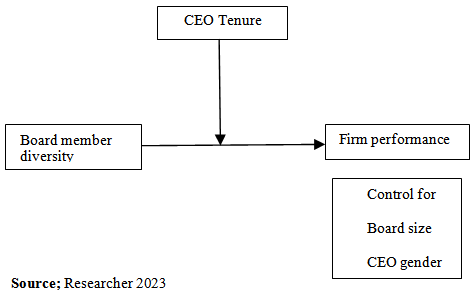
H02: CEO Tenure influences board diversity on firm performance.
Conceptual Framework
The conceptual framework in Figure 1 displays the moderating effect of CEO tenure on the relationship between board member’s diversity and firm performance in private firms in Nairobi Kenya.

Methodology
Explanatory research design has been employed in this research. It attempts to establish the causal relationship among the variables under study by considering the way each variable affects another variable; additionally, it seeks to provide hypothetical explanation to the cause and effect relationship and ultimate lead relationship of a minimum of one factor 55, 56. Equations are also used whenever the purpose of the research is to clarify the "why" in each situation. As stated by Cooper and Schindler 56, explanatory research design emphasizes on the why questions. In order to answer the 'why' questions, this research developed and clarified its findings. The clarifications contend that a phenomenon Y (firm performance) is influenced by factor X (board diversity and CEO tenure). This was used on the grounds that it connected nearly to the goals of this study and was functional in testing the results of the study.
The target population for the study was 1130 registered firms in the private sector with active boards in Nairobi county government in Kenya, private firms were chosen because these are the firms that are very competitive and have the largest market share and largely contribute to the economy.
From the target population of 1130, Taro Yamane (1973) sample size formula and modified by Singh & Masuku 57 was used to obtain a sample size of 402 respondents’, this is because it is ideal for stratified sampling, simple random sampling was also utilized to choose the respondent at random. The study used primary data since it suites the nature of my study to obtain first-hand information and to obtain the required output. Primary data was appropriate because private sector is not required by law to publish their books of account making them unreliable for secondary data. First-hand information is often praised for a different approach of assessing business governance ideas, since they mainly depend on secondary data. The questionnaires adapted from prior research were utilized to gather information from a target sample of 402 private firms that were approachable. The analysis included a total of 371 valid surveys.
The present research permitted a sampling error of 0.04. So, the sample size was as follows:
402=1130/1+1130(0.04)2.
I investigated the hypotheses we proposed utilizing a moderated regression technique, using the approach established by Aiken 68. Normality of data was performed using skewness and kurtosis. The findings revealed no significant breaches of normal distribution. Prior running a regression test, we normalized the independent variables in order to minimize the multicollinearity issue that occurs when a moderator variable has been calculated as the result of two variables, a moderator and an independent variable. For the purpose of examining moderated regressions, independent variable and moderated variable were incorporated to the model of regression simultaneously.
Measurement of variables
Board member diversity was measured by asking the CEO the degree to which the members of the board indicate diversity in professional experiences (sales, marketing, finance, accounting, etc.); board diversity in manufacturing experiences (which are distinct business sectors and companies); and board diversity in relation to academic accomplishments (which vary colleges and universities, and sorts of higher learning) 20, 35, 58. The tenure of a chief executive was determined by tallying the years since a CEO took office 65.
Firm performance was measured Using 6 items adopted from Zou et al., 59. The items include; Our organization has been tremendously prosperous in the last three years, Our organization has achieved a substantial amount in revenue in the last three years, Our company has experienced remarkable expansion during the last three years, Our firm has enhanced its marketability in the last three years, Our organization has reinforced its strategic orientation in the last three years and Our company's position in the market has grown dramatically during the last three years.
Model Specification
The data collected was analyzed using multiple regression and hierarchical regression models, with each independent variable's significance verified at a 95% confidence level. The multiple regression equation will be shown as follows:
Hierarchical regression models
(i). Firm performance= constant + control variables + error term.
(ii). Firm performance= constant + control variables + coefficient*board diversity + error term.
(iii). Firm performance= constant + control variables + coefficient*board diversity + CEO tenure + error term.
(iv). Firm performance= constant + control variables + coefficient*board diversity + CEO tenure +board diversity*CEO tenure + error term.
Descriptive statistics on Firm performance
Table 1 shows that majority of the respondent were in favor that their firm had been profitable in the last 3 years with a mean of 4.33. Skewness and Kurtosis indicate that the data is normally distributed. This implies that the firms under the study had adopted various strategies in top executives to remain profitable for the last three years. The respondent were also unaware of their market share this jeopardize the firm performance.
Descriptive statistics on Board member’s diversity
Table 2 revealed that majority of the respondent agreed that board members are diverse regarding their functional backgrounds in terms of their specialty like sales, finance and accounting and marketing. Skewness and Kurtosis shows that the data was not far from a normal distribution curve.
Descriptive Statistics on CEO Tenure
Table 3 present descriptive statistics of CEO Tenure and the findings indicate that out of 371 CEO respondent, majority had been CEO for a period of 2-5 years with 47.7% while above 10 years of being CEO were 8.6%.
Correlation Analysis
Pearson's coefficient assesses the magnitude as well as direction that the linear correlation among variables. The Pearson Correlations values in Table 4 show that the control variable were negatively correlated to firm performance, while Board member diversity was positive and significant to firm performance and CEO tenure was also positive significant to firm performance, this implies that a change in board member diversity and CEO Tenure correlate to firm performance.
Regression Results and Hypothesis Testing
In Table 5 represent the hierarchical regression results for control variables, independent variable and moderating variable. Model 1 shows all the control variables and the findings indicate that CEO gender was negatively significant to firm performance (p< 0.05). In Model 2 CEO gender and board size were insignificant while board member’s diversity was positive and significant (coeff = 0.370. p< 0.05) implying that an increase in board member’s diversity increases firm performance positively. Thus hypothesis one was accepted and conclude that diverse board members increases firm performance. In Model 3 board size and CEO tenure were negatively significant to firm performance. Board diversity was positively significant to firm performance. For moderation to occur the moderator should be significant with or without the moderation and the findings indicate that CEO tenure is positive and significant implying that CEO Tenure influences firm performance (coeff =0.298. p<0.05). In Model 4 on the interaction of CEO tenure on the association between diverse board members and firm performance indicate that the interaction in negatively significant to firm performance. Hypothesis H02 was fail to be rejected and conclude that CEO tenure with diverse board members influences firm performance significantly and negatively. R square shows that in Model 2, it explains 34.7% variation on firm performance and keep increasing to Model 4 as it explains 53% of variation on firm performance.
The study sought to determine the moderating influence of CEO tenure on the link between board member diversity and company performance in private Kenyan enterprises. The findings shows that there was normality of data and a positive linear relationship between diverse board members and firm performance this implies that a change in board diversity have an impact of firm performance. Also CEO tenure had a positive association with firm performance and a change in CEO tenure changes firm performance. Hypothesis 1 postulated that board member diversity increases firm performance. In hierarchical regression Model 2, board member’s diversity have further proven to increases firm performance. This can be further explains that increase in board member’s diversity widen the ideas of the board increasing firm performance. The study results are consistent with the suggestions made by Fernández-Temprano & Tejerina-Gaite, 27 that there is a positive association between diverse board members and firm performance. Post et al., 37 also supports this statement that the presence of diverse board encourages investors, since most of diverse board members have diverse characteristics like education, gender, expertise, knowledge, and nationality this enables them to focus on the growth and expansion of the firm, increasing their performance and share value. Extant studies have acknowledged board member diversity especially gender diversity among board members to encourage diverse information and gender-based rule to be invaded in the board, this is to develop and integrate board member’s with knowledge as well as to coordinate their competences towards their decisions 28. Therefore, the results of the current study are consistent with this argument since among the other predictor variables board member diversity was found to have predictive effect on firm performance. The study adds knowledge on privately owned firm in Kenya to consider board members who are diverse to sort out the issue affecting these firms. This will enable such firms to be firm in their performance increasing investors’ confidence thus increasing country’s development.
Hypothesis 2 postulated that CEO tenure influences firm performance. The findings in model 3 supports this argument that CEO tenure increases firm performance. Similar studies correspond to this findings and elaborate that the long-term CEO tenure enables the CEO to gain experience and expertise of the firm operation increasing firm performance. Similarly, long-tenured CEOs may wield significant power on members of the board during their selection and form close connections with such new members of the board 54. Over time, diverse board members can begin to have confidence with such CEOs, resulting in improved corporate performance.
The moderating effect of CEO tenure on the relationship between board member’s diversity and firm performance shows a negative significant association in model 4. From descriptive statistics shows that majority of the respondent were short tenure CEOs, and for this reason the new CEO may lack knowledge and expertise on the board. The pressure placed on new CEOs is likely to be greater than on older CEOs because they have yet to establish their ability to succeed in their new roles. Also short tenured CEO has less leverage over the diverse board and can't convince diverse board members to consider his priorities by utilizing the majority of the profits on investment while cutting off other projects; this conflict reduces firm performance the findings are similar to the findings of Zhu, et al., 42. From the findings CEO tenure matters on firm performance and therefore it can be concluded that the current challenges facing privately owned firms in Kenya can be minimized by hiring diverse board members and CEOs who are long tenure with firm’s expertise, this will guarantee firm performance and investors’ confidence. This study has provided sufficient evidence that CEO tenure matters in diverse board’s decision to increase overall firm performance.
Theoretical and Practical Implication
The study findings are in line with resource dependency theory as it elaborates how the external resources this are board members and CEO of the firm affect the behavior of the firm performance. According to Hillman et al., 66 resource dependency theory, members of the board and CEOs contribute resources to organizations in the form of skills, networks, experience, diversity, and independence. Board members with strong external linkages facilitates the firm's access to a variety of resources 67. Therefore, in support of this theory, the results has revealed that diverse board members and CEO are full of diverse resources that can benefit a firm, the resources are in the form of skills, expertise and experience possessed by a diverse board and CEO.
Our research has practical ramifications as well. First, we demonstrated that the diversity of board members is crucial in board decision making regarding firm performance. In such a situation, it is vital to consider selecting members of the board with diverse backgrounds. As a result, the study proposes that private enterprises consider choosing diverse board members to meet organizational goals. Furthermore, if private enterprises are to gain from board participation in firm success, long-term CEO tenure must be considered, as it is important.
Limitations and Directions for Future Research
Without a doubt, our research has limitations. Primarily the ultimate sample size of 371 were comparatively small. Nevertheless it ought to be noted that all of the respondents were chief executive officers of the businesses that were sampled across different business sectors. Upcoming scholars in the same field can focused on better samples using alternative measurements and situations may assist to advance the idea. Second, because CEOs were the respondents, prejudice in their favor may have slipped in, particularly on their perceptions of board members' diversity. Future study could include incorporating member’s board in the survey group to address this problem. Finally, the analysis was restricted to privately owned companies in Kenya, which have distinct organizational structures than publicly traded firms. Future research using similar methods may therefore be extended to publicly listed firms.
I would like to acknowledge my respondents the chief executive officers in the private sector in Kenya who responded to my questions. Thank you.
The authors of this paper report no conflicts of interest.
| [1] | Hsu, C. S., Lai, W. H., & Yen, S. H. (2019). Boardroom diversity and operating performance: the moderating effect of strategic change. Emerging Markets Finance and Trade, 55(11), 2448-2472. | ||
| In article | View Article | ||
| [2] | Miller, T., & del Carmen Triana, M. (2009). Demographic diversity in the boardroom: Mediators of the board diversity–firm performance relationship. Journal of Management studies, 46(5), 755-786. | ||
| In article | View Article | ||
| [3] | Ararat, M., Aksu, M., & Tansel Cetin, A. (2015). How board diversity affects firm performance in emerging markets: Evidence on channels in controlled firms. Corporate Governance: An International Review, 23(2), 83-103. | ||
| In article | View Article | ||
| [4] | Terjesen, S., Couto, E. B., & Francisco, P. M. (2016). Does the presence of independent and female directors impact firm performance? A multi-country study of board diversity. Journal of Management & Governance, 20, 447-483. | ||
| In article | View Article | ||
| [5] | Aggarwal, R., Jindal, V., & Seth, R. (2019). Board diversity and firm performance: The role of business group affiliation. International Business Review, 28(6), 101600. | ||
| In article | View Article | ||
| [6] | Dedunu, H. H., & Anuradha, P. A. N. S. (2020). Impact of board diversity on firm performance: Evidence from Sri Lanka. | ||
| In article | View Article | ||
| [7] | Mohsni, S., Otchere, I., & Shahriar, S. (2021). Board gender diversity, firm performance and risk-taking in developing countries: The moderating effect of culture. Journal of International Financial Markets, Institutions and Money, 73, 101360. | ||
| In article | View Article | ||
| [8] | Saeed, A., Sameer, M., Raziq, M. M., Salman, A., & Hammoudeh, S. (2019). Board gender diversity and organizational determinants: Empirical evidence from a major developing country. Emerging Markets Finance and Trade, 55(8), 1803-1820. | ||
| In article | View Article | ||
| [9] | Farah, B., Elias, R., Aguilera, R., & Abi Saad, E. (2021). Corporate governance in the Middle East and North Africa: A systematic review of current trends and opportunities for future research. Corporate Governance: An International Review, 29(6), 630-660. | ||
| In article | View Article | ||
| [10] | Coleman, J. S. (1988). Social capital in the creation of human capital. American journal of sociology, 94, S95-S120. | ||
| In article | View Article | ||
| [11] | Guping, C., Safdar Sial, M., Wan, P., Badulescu, A., Badulescu, D., & Vianna Brugni, T. (2020). Do board gender diversity and non-executive directors affect CSR Reporting? Insight from agency theory perspective. Sustainability, 12(20), 8597. | ||
| In article | View Article | ||
| [12] | Bear, S., Rahman, N., & Post, C. (2010). The impact of board diversity and gender composition on corporate social responsibility and firm reputation. Journal of business ethics, 97, 207-221. | ||
| In article | View Article | ||
| [13] | Kakabadse, N. K., Figueira, C., Nicolopoulou, K., Hong Yang, J., Kakabadse, A. P., & Özbilgin, M. F. (2015). Gender diversity and board performance: Women's experiences and perspectives. Human Resource Management, 54(2), 265-281. | ||
| In article | View Article | ||
| [14] | Azmat, F., & Rentschler, R. (2017). Gender and ethnic diversity on boards and corporate responsibility: The case of the arts sector. Journal of Business Ethics, 141, 317-336. | ||
| In article | View Article | ||
| [15] | Hiebl, M. R. (2014). Upper echelons theory in management accounting and control research. Journal of Management Control, 24, 223-240. | ||
| In article | View Article | ||
| [16] | Uhde, D. A., Klarner, P., & Tuschke, A. (2017). Board monitoring of the chief financial officer: A review and research agenda. Corporate Governance: An International Review, 25(2), 116-133. | ||
| In article | View Article | ||
| [17] | Bose, S., Hossain, S., Sobhan, A., & Handley, K. (2022). Does female participation in strategic decision‐making roles matter for corporate social responsibility performance?. Accounting & Finance, 62(3), 4109-4156. | ||
| In article | View Article | ||
| [18] | Estélyi, K. S., & Nisar, T. M. (2016). Diverse boards: Why do firms get foreign nationals on their boards?. Journal of Corporate Finance, 39, 174-192. | ||
| In article | View Article | ||
| [19] | Cetin, C. K., & Cerit, A. G. (2010). Organizational effectiveness at seaports: a systems approach. Maritime Policy & Management, 37(3), 195-219. | ||
| In article | View Article | ||
| [20] | Van der Walt, N., Ingley, C., Shergill, G. S., & Townsend, A. (2006). Board configuration: are diverse boards better boards?. Corporate Governance: The international journal of business in society, 6(2), 129-147. | ||
| In article | View Article | ||
| [21] | Abdullah, S. N., & Ku Ismail, K. N. I. (2017). Gender, ethnic and age diversity of the boards of large Malaysian firms and performance. Abdullah, SN, & Ismail, KNIK (2013). Gender, Ethnic and Age Diversity of the Boards of Large Malaysian Firms and Performance. Jurnal Pengurusan, 38, 27-40. | ||
| In article | View Article | ||
| [22] | Adams, R. B., & Ferreira, D. (2009). Women in the boardroom and their impact on governance and performance. Journal of financial economics, 94(2), 291-309. | ||
| In article | View Article | ||
| [23] | Makri, M., Lane, P. J., & Gomez‐Mejia, L. R. (2006). CEO incentives, innovation, and performance in technology‐intensive firms: a reconciliation of outcome and behavior‐based incentive schemes. Strategic Management Journal, 27(11), 1057-1080. | ||
| In article | View Article | ||
| [24] | Chen, W., Zhong, X., & Lv, D. D. (2022). Negative performance feedback, CEO tenure, and punctuated equilibrium innovation. R&D Management, 52(3), 564-576. | ||
| In article | View Article | ||
| [25] | Mahadeo, J. D., Soobaroyen, T., & Hanuman, V. O. (2012). Board composition and financial performance: Uncovering the effects of diversity in an emerging economy. Journal of business ethics, 105, 375-388. | ||
| In article | View Article | ||
| [26] | Şener, İ., & Karaye, A. B. (2014). Board composition and gender diversity: comparison of Turkish and Nigerian listed companies. Procedia-Social and Behavioral Sciences, 150, 1002-1011. | ||
| In article | View Article | ||
| [27] | Fernández-Temprano, M. A., & Tejerina-Gaite, F. (2020). Types of director, board diversity and firm performance. Corporate Governance: The International Journal of Business in Society, 20(2), 324-342. | ||
| In article | View Article | ||
| [28] | Scholtz, H., & Kieviet, S. (2018). The influence of board diversity on company performance of South African companies. Journal of African Business, 19(1), 105-123. | ||
| In article | View Article | ||
| [29] | Song, H. J., Yoon, Y. N., & Kang, K. H. (2020). The relationship between board diversity and firm performance in the lodging industry: The moderating role of internationalization. International Journal of Hospitality Management, 86, 102461. | ||
| In article | View Article | ||
| [30] | EmadEldeen, R., Elbayoumi, A. F., Basuony, M. A., & Mohamed, E. K. (2021). The effect of the board diversity on firm performance: An empirical study on the UK. Corporate Ownership and Control, 18(3), 337-347. | ||
| In article | View Article | ||
| [31] | Darmadi, S. (2011). Board diversity and firm performance: The Indonesian evidence. Corporate ownership and control Journal, 8. | ||
| In article | View Article | ||
| [32] | Ujunwa, A., Okoyeuzu, C., & Nwakoby, I. (2012). Corporate board diversity and firm performance: Evidence from Nigeria. Revista de Management Comparat International, 13(4), 605. | ||
| In article | View Article | ||
| [33] | Karim, S., Naeem, M. A., & Ismail, R. B. (2022). Re-configuring ownership structure, board characteristics and firm value nexus in Malaysia: the role of board gender and ethnic diversity. International Journal of Emerging Markets. | ||
| In article | View Article | ||
| [34] | Julizaerma, M. K., & Sori, Z. M. (2012). Gender diversity in the boardroom and firm performance of Malaysian public listed companies. Procedia-Social and Behavioral Sciences, 65, 1077-1085. | ||
| In article | View Article | ||
| [35] | Minichilli, A., Zattoni, A., & Zona, F. (2009). Making boards effective: An empirical examination of board task performance. British Journal of Management, 20(1), 55-74. | ||
| In article | View Article | ||
| [36] | Carter, M. E., Franco, F., & Gine, M. (2017). Executive gender pay gaps: The roles of female risk aversion and board representation. Contemporary Accounting Research, 34(2), 1232-1264. | ||
| In article | View Article | ||
| [37] | Chen, J., Leung, W. S., Song, W., & Goergen, M. (2019). Why female board representation matters: The role of female directors in reducing male CEO overconfidence. Journal of Empirical Finance, 53, 70-90. | ||
| In article | View Article | ||
| [38] | Brown, J. A., Anderson, A., Salas, J. M., & Ward, A. J. (2017). Do investors care about director tenure? Insights from executive cognition and social capital theories. Organization Science, 28(3), 471-494. | ||
| In article | View Article | ||
| [39] | Duru, A., Iyengar, R. J., & Zampelli, E. M. (2016). The dynamic relationship between CEO duality and firm performance: The moderating role of board independence. Journal of Business Research, 69(10), 4269-4277. | ||
| In article | View Article | ||
| [40] | Nyarko, F. K., Yusheng, K., & Zhu, N. (2017). Corporate governance and performance of firms: An empirical evidence from the banking sector of Ghana. Journal of Economics and International Business Management, 5(1), 14-29. | ||
| In article | |||
| [41] | Harrison, J. S., & Fiet, J. O. (1999). New CEOs pursue their own self-interests by sacrificing stakeholder value. Journal of Business Ethics, 19, 301-308. | ||
| In article | View Article | ||
| [42] | Zhu, Q., Hu, S., & Shen, W. (2020). Why do some insider CEOs make more strategic changes than others? The impact of prior board experience on new CEO insiderness. Strategic Management Journal, 41(10), 1933-1951. | ||
| In article | View Article | ||
| [43] | Walters, B. A., Kroll, M. J., & Wright, P. (2007). CEO tenure, boards of directors, and acquisition performance. Journal of Business Research, 60(4), 331-338. | ||
| In article | View Article | ||
| [44] | Boivie, S., Withers, M. C., Graffin, S. D., & Corley, K. G. (2021). Corporate directors' implicit theories of the roles and duties of boards. Strategic Management Journal, 42(9), 1662-1695. | ||
| In article | View Article | ||
| [45] | Guldiken, O., Mallon, M. R., Fainshmidt, S., Judge, W. Q., & Clark, C. E. (2019). Beyond tokenism: How strategic leaders influence more meaningful gender diversity on boards of directors. Strategic Management Journal, 40(12), 2024-2046. | ||
| In article | View Article | ||
| [46] | Davis, J. H., Schoorman, F. D., & Donaldson, L. (2018). Toward a stewardship theory of management. In Business Ethics and Strategy, Volumes I and II (pp. 473-500). Routledge. | ||
| In article | |||
| [47] | Ting, H. I., Chueh, H., & Chang, P. R. (2017). CEO power and its effect on performance and governance: Evidence from Chinese banks. Emerging Markets Review, 33, 42-61. | ||
| In article | View Article | ||
| [48] | Zhu, D. H., & Chen, G. (2015). CEO narcissism and the impact of prior board experience on corporate strategy. Administrative science quarterly, 60(1), 31-65. | ||
| In article | View Article | ||
| [49] | Zorn, M. L., DeGhetto, K., Ketchen Jr, D. J., & Combs, J. G. (2020). The impact of hiring directors' choice‐supportive bias and escalation of commitment on CEO compensation and dismissal following poor performance: A multimethod study. Strategic Management Journal, 41(2), 308-339. | ||
| In article | View Article | ||
| [50] | Hamori, M., & Koyuncu, B. (2015). Experience matters? The impact of prior CEO experience on firm performance. Human Resource Management, 54(1), 23-44. | ||
| In article | View Article | ||
| [51] | Serrano-Bedia, A. M., López-Fernández, M. C., & Garcia-Piqueres, G. (2016). Analysis of the relationship between sources of knowledge and innovation performance in family firms. Innovation, 18(4), 489-512. | ||
| In article | View Article | ||
| [52] | Chatterjee, A., & Pollock, T. G. (2017). Master of puppets: How narcissistic CEOs construct their professional worlds. Academy of Management Review, 42(4), 703-725. | ||
| In article | View Article | ||
| [53] | Brauer, M. F. (2013). The effects of short-term and long-term oriented managerial behavior on medium-term financial performance: longitudinal evidence from Europe. Journal of Business Economics and Management, 14(2), 386-402. | ||
| In article | View Article | ||
| [54] | Cook, M. L., & Burress, M. J. (2013). The impact of CEO tenure on cooperative governance. Managerial and decision economics, 34(3-5), 218-229. | ||
| In article | View Article | ||
| [55] | Hair Jr, J. F., Matthews, L. M., Matthews, R. L., & Sarstedt, M. (2017). PLS-SEM or CB-SEM: updated guidelines on which method to use. International Journal of Multivariate Data Analysis, 1(2), 107-123. | ||
| In article | View Article | ||
| [56] | Cooper, D. R., Schindler, P. S., Cooper, D. R., & Schindler, P. S. (2006). Marketing research. New York: McGraw-Hill/Irwin. | ||
| In article | |||
| [57] | Singh, A. S., & Masuku, M. B. (2014). Sampling techniques & determination of sample size in applied statistics research: An overview. International Journal of economics, commerce and management, 2(11), 1-22. | ||
| In article | |||
| [58] | Huse, M., Nielsen, S. T., & Hagen, I. M. (2009). Women and employee-elected board members, and their contributions to board control tasks. Journal of Business Ethics, 89, 581-597. | ||
| In article | View Article | ||
| [59] | Zou, S., Taylor, C. R., & Osland, G. E. (1998). The EXPERF scale: a cross-national generalized export performance measure. Journal of international Marketing, 6(3), 37-58. | ||
| In article | View Article | ||
| [60] | Yousaf, U. B., Jebran, K., & Wang, M. (2021). Can board diversity predict the risk of financial distress?. Corporate Governance: The International Journal of Business in Society, 21(4), 663-684. | ||
| In article | View Article | ||
| [61] | Shalhoub, O. (2019). The Effects of Board Diversity on Firm Risk (Doctoral dissertation, Concordia University). | ||
| In article | |||
| [62] | Joshi, A., & Jackson, S. E. (2003). Managing workforce diversity to enhance cooperation in organizations. International handbook of organizational teamwork and cooperative working, 277-296. | ||
| In article | View Article | ||
| [63] | Schumacher, C., Keck, S., & Tang, W. (2020). Biased interpretation of performance feedback: The role of CEO overconfidence. Strategic Management Journal, 41(6), 1139-1165. | ||
| In article | View Article | ||
| [64] | Alessandri, T. M., & Pattit, J. M. (2014). Drivers of R&D investment: The interaction of behavioral theory and managerial incentives. Journal of Business Research, 67(2), 151-158. | ||
| In article | View Article | ||
| [65] | Oh, W. Y., Chang, Y. K., & Jung, R. (2018). Experience-based human capital or fixed paradigm problem? CEO tenure, contextual influences, and corporate social (ir) responsibility. Journal of Business Research, 90, 325-333 | ||
| In article | View Article | ||
| [66] | Hillman, A. J., Withers, M. C., & Collins, B. J. (2009). Resource dependence theory: A review. Journal of management, 35(6), 1404-1427. | ||
| In article | View Article | ||
| [67] | Bhatt, R. R., & Bhattacharya, S. (2015). Do board characteristics impact firm performance? An agency and resource dependency theory perspective. Asia-Pacific Journal of Management Research and Innovation, 11(4), 274-287. | ||
| In article | View Article | ||
| [68] | Aiken, L. S. (1991). Multiple regression: Testing and interpreting interactions. Sage google schola, 2, 103-135. | ||
| In article | |||
Published with license by Science and Education Publishing, Copyright © 2024 Chepkwony Protus, Tuwey Joel and Tenai Joel
 This work is licensed under a Creative Commons Attribution 4.0 International License. To view a copy of this license, visit
http://creativecommons.org/licenses/by/4.0/
This work is licensed under a Creative Commons Attribution 4.0 International License. To view a copy of this license, visit
http://creativecommons.org/licenses/by/4.0/
| [1] | Hsu, C. S., Lai, W. H., & Yen, S. H. (2019). Boardroom diversity and operating performance: the moderating effect of strategic change. Emerging Markets Finance and Trade, 55(11), 2448-2472. | ||
| In article | View Article | ||
| [2] | Miller, T., & del Carmen Triana, M. (2009). Demographic diversity in the boardroom: Mediators of the board diversity–firm performance relationship. Journal of Management studies, 46(5), 755-786. | ||
| In article | View Article | ||
| [3] | Ararat, M., Aksu, M., & Tansel Cetin, A. (2015). How board diversity affects firm performance in emerging markets: Evidence on channels in controlled firms. Corporate Governance: An International Review, 23(2), 83-103. | ||
| In article | View Article | ||
| [4] | Terjesen, S., Couto, E. B., & Francisco, P. M. (2016). Does the presence of independent and female directors impact firm performance? A multi-country study of board diversity. Journal of Management & Governance, 20, 447-483. | ||
| In article | View Article | ||
| [5] | Aggarwal, R., Jindal, V., & Seth, R. (2019). Board diversity and firm performance: The role of business group affiliation. International Business Review, 28(6), 101600. | ||
| In article | View Article | ||
| [6] | Dedunu, H. H., & Anuradha, P. A. N. S. (2020). Impact of board diversity on firm performance: Evidence from Sri Lanka. | ||
| In article | View Article | ||
| [7] | Mohsni, S., Otchere, I., & Shahriar, S. (2021). Board gender diversity, firm performance and risk-taking in developing countries: The moderating effect of culture. Journal of International Financial Markets, Institutions and Money, 73, 101360. | ||
| In article | View Article | ||
| [8] | Saeed, A., Sameer, M., Raziq, M. M., Salman, A., & Hammoudeh, S. (2019). Board gender diversity and organizational determinants: Empirical evidence from a major developing country. Emerging Markets Finance and Trade, 55(8), 1803-1820. | ||
| In article | View Article | ||
| [9] | Farah, B., Elias, R., Aguilera, R., & Abi Saad, E. (2021). Corporate governance in the Middle East and North Africa: A systematic review of current trends and opportunities for future research. Corporate Governance: An International Review, 29(6), 630-660. | ||
| In article | View Article | ||
| [10] | Coleman, J. S. (1988). Social capital in the creation of human capital. American journal of sociology, 94, S95-S120. | ||
| In article | View Article | ||
| [11] | Guping, C., Safdar Sial, M., Wan, P., Badulescu, A., Badulescu, D., & Vianna Brugni, T. (2020). Do board gender diversity and non-executive directors affect CSR Reporting? Insight from agency theory perspective. Sustainability, 12(20), 8597. | ||
| In article | View Article | ||
| [12] | Bear, S., Rahman, N., & Post, C. (2010). The impact of board diversity and gender composition on corporate social responsibility and firm reputation. Journal of business ethics, 97, 207-221. | ||
| In article | View Article | ||
| [13] | Kakabadse, N. K., Figueira, C., Nicolopoulou, K., Hong Yang, J., Kakabadse, A. P., & Özbilgin, M. F. (2015). Gender diversity and board performance: Women's experiences and perspectives. Human Resource Management, 54(2), 265-281. | ||
| In article | View Article | ||
| [14] | Azmat, F., & Rentschler, R. (2017). Gender and ethnic diversity on boards and corporate responsibility: The case of the arts sector. Journal of Business Ethics, 141, 317-336. | ||
| In article | View Article | ||
| [15] | Hiebl, M. R. (2014). Upper echelons theory in management accounting and control research. Journal of Management Control, 24, 223-240. | ||
| In article | View Article | ||
| [16] | Uhde, D. A., Klarner, P., & Tuschke, A. (2017). Board monitoring of the chief financial officer: A review and research agenda. Corporate Governance: An International Review, 25(2), 116-133. | ||
| In article | View Article | ||
| [17] | Bose, S., Hossain, S., Sobhan, A., & Handley, K. (2022). Does female participation in strategic decision‐making roles matter for corporate social responsibility performance?. Accounting & Finance, 62(3), 4109-4156. | ||
| In article | View Article | ||
| [18] | Estélyi, K. S., & Nisar, T. M. (2016). Diverse boards: Why do firms get foreign nationals on their boards?. Journal of Corporate Finance, 39, 174-192. | ||
| In article | View Article | ||
| [19] | Cetin, C. K., & Cerit, A. G. (2010). Organizational effectiveness at seaports: a systems approach. Maritime Policy & Management, 37(3), 195-219. | ||
| In article | View Article | ||
| [20] | Van der Walt, N., Ingley, C., Shergill, G. S., & Townsend, A. (2006). Board configuration: are diverse boards better boards?. Corporate Governance: The international journal of business in society, 6(2), 129-147. | ||
| In article | View Article | ||
| [21] | Abdullah, S. N., & Ku Ismail, K. N. I. (2017). Gender, ethnic and age diversity of the boards of large Malaysian firms and performance. Abdullah, SN, & Ismail, KNIK (2013). Gender, Ethnic and Age Diversity of the Boards of Large Malaysian Firms and Performance. Jurnal Pengurusan, 38, 27-40. | ||
| In article | View Article | ||
| [22] | Adams, R. B., & Ferreira, D. (2009). Women in the boardroom and their impact on governance and performance. Journal of financial economics, 94(2), 291-309. | ||
| In article | View Article | ||
| [23] | Makri, M., Lane, P. J., & Gomez‐Mejia, L. R. (2006). CEO incentives, innovation, and performance in technology‐intensive firms: a reconciliation of outcome and behavior‐based incentive schemes. Strategic Management Journal, 27(11), 1057-1080. | ||
| In article | View Article | ||
| [24] | Chen, W., Zhong, X., & Lv, D. D. (2022). Negative performance feedback, CEO tenure, and punctuated equilibrium innovation. R&D Management, 52(3), 564-576. | ||
| In article | View Article | ||
| [25] | Mahadeo, J. D., Soobaroyen, T., & Hanuman, V. O. (2012). Board composition and financial performance: Uncovering the effects of diversity in an emerging economy. Journal of business ethics, 105, 375-388. | ||
| In article | View Article | ||
| [26] | Şener, İ., & Karaye, A. B. (2014). Board composition and gender diversity: comparison of Turkish and Nigerian listed companies. Procedia-Social and Behavioral Sciences, 150, 1002-1011. | ||
| In article | View Article | ||
| [27] | Fernández-Temprano, M. A., & Tejerina-Gaite, F. (2020). Types of director, board diversity and firm performance. Corporate Governance: The International Journal of Business in Society, 20(2), 324-342. | ||
| In article | View Article | ||
| [28] | Scholtz, H., & Kieviet, S. (2018). The influence of board diversity on company performance of South African companies. Journal of African Business, 19(1), 105-123. | ||
| In article | View Article | ||
| [29] | Song, H. J., Yoon, Y. N., & Kang, K. H. (2020). The relationship between board diversity and firm performance in the lodging industry: The moderating role of internationalization. International Journal of Hospitality Management, 86, 102461. | ||
| In article | View Article | ||
| [30] | EmadEldeen, R., Elbayoumi, A. F., Basuony, M. A., & Mohamed, E. K. (2021). The effect of the board diversity on firm performance: An empirical study on the UK. Corporate Ownership and Control, 18(3), 337-347. | ||
| In article | View Article | ||
| [31] | Darmadi, S. (2011). Board diversity and firm performance: The Indonesian evidence. Corporate ownership and control Journal, 8. | ||
| In article | View Article | ||
| [32] | Ujunwa, A., Okoyeuzu, C., & Nwakoby, I. (2012). Corporate board diversity and firm performance: Evidence from Nigeria. Revista de Management Comparat International, 13(4), 605. | ||
| In article | View Article | ||
| [33] | Karim, S., Naeem, M. A., & Ismail, R. B. (2022). Re-configuring ownership structure, board characteristics and firm value nexus in Malaysia: the role of board gender and ethnic diversity. International Journal of Emerging Markets. | ||
| In article | View Article | ||
| [34] | Julizaerma, M. K., & Sori, Z. M. (2012). Gender diversity in the boardroom and firm performance of Malaysian public listed companies. Procedia-Social and Behavioral Sciences, 65, 1077-1085. | ||
| In article | View Article | ||
| [35] | Minichilli, A., Zattoni, A., & Zona, F. (2009). Making boards effective: An empirical examination of board task performance. British Journal of Management, 20(1), 55-74. | ||
| In article | View Article | ||
| [36] | Carter, M. E., Franco, F., & Gine, M. (2017). Executive gender pay gaps: The roles of female risk aversion and board representation. Contemporary Accounting Research, 34(2), 1232-1264. | ||
| In article | View Article | ||
| [37] | Chen, J., Leung, W. S., Song, W., & Goergen, M. (2019). Why female board representation matters: The role of female directors in reducing male CEO overconfidence. Journal of Empirical Finance, 53, 70-90. | ||
| In article | View Article | ||
| [38] | Brown, J. A., Anderson, A., Salas, J. M., & Ward, A. J. (2017). Do investors care about director tenure? Insights from executive cognition and social capital theories. Organization Science, 28(3), 471-494. | ||
| In article | View Article | ||
| [39] | Duru, A., Iyengar, R. J., & Zampelli, E. M. (2016). The dynamic relationship between CEO duality and firm performance: The moderating role of board independence. Journal of Business Research, 69(10), 4269-4277. | ||
| In article | View Article | ||
| [40] | Nyarko, F. K., Yusheng, K., & Zhu, N. (2017). Corporate governance and performance of firms: An empirical evidence from the banking sector of Ghana. Journal of Economics and International Business Management, 5(1), 14-29. | ||
| In article | |||
| [41] | Harrison, J. S., & Fiet, J. O. (1999). New CEOs pursue their own self-interests by sacrificing stakeholder value. Journal of Business Ethics, 19, 301-308. | ||
| In article | View Article | ||
| [42] | Zhu, Q., Hu, S., & Shen, W. (2020). Why do some insider CEOs make more strategic changes than others? The impact of prior board experience on new CEO insiderness. Strategic Management Journal, 41(10), 1933-1951. | ||
| In article | View Article | ||
| [43] | Walters, B. A., Kroll, M. J., & Wright, P. (2007). CEO tenure, boards of directors, and acquisition performance. Journal of Business Research, 60(4), 331-338. | ||
| In article | View Article | ||
| [44] | Boivie, S., Withers, M. C., Graffin, S. D., & Corley, K. G. (2021). Corporate directors' implicit theories of the roles and duties of boards. Strategic Management Journal, 42(9), 1662-1695. | ||
| In article | View Article | ||
| [45] | Guldiken, O., Mallon, M. R., Fainshmidt, S., Judge, W. Q., & Clark, C. E. (2019). Beyond tokenism: How strategic leaders influence more meaningful gender diversity on boards of directors. Strategic Management Journal, 40(12), 2024-2046. | ||
| In article | View Article | ||
| [46] | Davis, J. H., Schoorman, F. D., & Donaldson, L. (2018). Toward a stewardship theory of management. In Business Ethics and Strategy, Volumes I and II (pp. 473-500). Routledge. | ||
| In article | |||
| [47] | Ting, H. I., Chueh, H., & Chang, P. R. (2017). CEO power and its effect on performance and governance: Evidence from Chinese banks. Emerging Markets Review, 33, 42-61. | ||
| In article | View Article | ||
| [48] | Zhu, D. H., & Chen, G. (2015). CEO narcissism and the impact of prior board experience on corporate strategy. Administrative science quarterly, 60(1), 31-65. | ||
| In article | View Article | ||
| [49] | Zorn, M. L., DeGhetto, K., Ketchen Jr, D. J., & Combs, J. G. (2020). The impact of hiring directors' choice‐supportive bias and escalation of commitment on CEO compensation and dismissal following poor performance: A multimethod study. Strategic Management Journal, 41(2), 308-339. | ||
| In article | View Article | ||
| [50] | Hamori, M., & Koyuncu, B. (2015). Experience matters? The impact of prior CEO experience on firm performance. Human Resource Management, 54(1), 23-44. | ||
| In article | View Article | ||
| [51] | Serrano-Bedia, A. M., López-Fernández, M. C., & Garcia-Piqueres, G. (2016). Analysis of the relationship between sources of knowledge and innovation performance in family firms. Innovation, 18(4), 489-512. | ||
| In article | View Article | ||
| [52] | Chatterjee, A., & Pollock, T. G. (2017). Master of puppets: How narcissistic CEOs construct their professional worlds. Academy of Management Review, 42(4), 703-725. | ||
| In article | View Article | ||
| [53] | Brauer, M. F. (2013). The effects of short-term and long-term oriented managerial behavior on medium-term financial performance: longitudinal evidence from Europe. Journal of Business Economics and Management, 14(2), 386-402. | ||
| In article | View Article | ||
| [54] | Cook, M. L., & Burress, M. J. (2013). The impact of CEO tenure on cooperative governance. Managerial and decision economics, 34(3-5), 218-229. | ||
| In article | View Article | ||
| [55] | Hair Jr, J. F., Matthews, L. M., Matthews, R. L., & Sarstedt, M. (2017). PLS-SEM or CB-SEM: updated guidelines on which method to use. International Journal of Multivariate Data Analysis, 1(2), 107-123. | ||
| In article | View Article | ||
| [56] | Cooper, D. R., Schindler, P. S., Cooper, D. R., & Schindler, P. S. (2006). Marketing research. New York: McGraw-Hill/Irwin. | ||
| In article | |||
| [57] | Singh, A. S., & Masuku, M. B. (2014). Sampling techniques & determination of sample size in applied statistics research: An overview. International Journal of economics, commerce and management, 2(11), 1-22. | ||
| In article | |||
| [58] | Huse, M., Nielsen, S. T., & Hagen, I. M. (2009). Women and employee-elected board members, and their contributions to board control tasks. Journal of Business Ethics, 89, 581-597. | ||
| In article | View Article | ||
| [59] | Zou, S., Taylor, C. R., & Osland, G. E. (1998). The EXPERF scale: a cross-national generalized export performance measure. Journal of international Marketing, 6(3), 37-58. | ||
| In article | View Article | ||
| [60] | Yousaf, U. B., Jebran, K., & Wang, M. (2021). Can board diversity predict the risk of financial distress?. Corporate Governance: The International Journal of Business in Society, 21(4), 663-684. | ||
| In article | View Article | ||
| [61] | Shalhoub, O. (2019). The Effects of Board Diversity on Firm Risk (Doctoral dissertation, Concordia University). | ||
| In article | |||
| [62] | Joshi, A., & Jackson, S. E. (2003). Managing workforce diversity to enhance cooperation in organizations. International handbook of organizational teamwork and cooperative working, 277-296. | ||
| In article | View Article | ||
| [63] | Schumacher, C., Keck, S., & Tang, W. (2020). Biased interpretation of performance feedback: The role of CEO overconfidence. Strategic Management Journal, 41(6), 1139-1165. | ||
| In article | View Article | ||
| [64] | Alessandri, T. M., & Pattit, J. M. (2014). Drivers of R&D investment: The interaction of behavioral theory and managerial incentives. Journal of Business Research, 67(2), 151-158. | ||
| In article | View Article | ||
| [65] | Oh, W. Y., Chang, Y. K., & Jung, R. (2018). Experience-based human capital or fixed paradigm problem? CEO tenure, contextual influences, and corporate social (ir) responsibility. Journal of Business Research, 90, 325-333 | ||
| In article | View Article | ||
| [66] | Hillman, A. J., Withers, M. C., & Collins, B. J. (2009). Resource dependence theory: A review. Journal of management, 35(6), 1404-1427. | ||
| In article | View Article | ||
| [67] | Bhatt, R. R., & Bhattacharya, S. (2015). Do board characteristics impact firm performance? An agency and resource dependency theory perspective. Asia-Pacific Journal of Management Research and Innovation, 11(4), 274-287. | ||
| In article | View Article | ||
| [68] | Aiken, L. S. (1991). Multiple regression: Testing and interpreting interactions. Sage google schola, 2, 103-135. | ||
| In article | |||