The integration of Generative Artificial Intelligence (AI) in education presents a transformative frontier, shaping teaching, learning, and research practices in higher education institutions. This systematic review explores recent studies on the application of Generative AI in education, examining its benefits, challenges, and implications. Through an analysis of literature from prominent databases, key themes emerge surrounding Generative AI's multifaceted applications. These include personalized learning, academic integrity policy development, multimodal writing enhancement, and research innovation. While Generative AI offers promising benefits such as enhanced teaching methodologies, accessibility, and efficiency, challenges persist regarding academic integrity, algorithmic bias, and equitable distribution of resources. Additionally, the review identifies areas lacking sufficient exploration within education research, emphasizing the need for interdisciplinary collaboration, ethical guidelines, and innovative pedagogical approaches to harness Generative AI's transformative potential responsibly.
Generative Artificial Intelligence (AI) has emerged as a transformative force in various fields, including education. Its ability to autonomously produce content, simulate human-like behaviours, and facilitate personalized learning experiences has garnered significant attention within the educational landscape. In this systematic review, we delve into the application of Generative AI in Education, with a specific focus on its implications for Education.
1.1. Overview of Generative AIGenerative AI refers to a subset of artificial intelligence techniques that involve the generation of new content, such as images, text, audio, and even videos, mimicking human creativity and problem-solving capabilities 1. It encompasses various methodologies, including but not limited to generative adversarial networks (GANs), recurrent neural networks (RNNs), and transformers.
Generative AI operates on the principle of learning from vast amounts of data to generate new outputs that are indistinguishable from those produced by humans. This technology has found applications in diverse domains, ranging from art and entertainment to healthcare and finance.
1.2. Significance of Generative AI in EducationIn recent years, significant advancements in artificial intelligence (AI), particularly in generative AI, have propelled it to the forefront of discussions within the tech industry. Like numerous other sectors, education stands poised for transformation through the utilization of generative AI technologies like ChatGPT, Bard, DALL-E, Mid journey, and DeepMind 2. As generative Artificial Intelligence (AI) continues to evolve rapidly, in the next few years, it will drive innovation and improvements in education, but it will also create a myriad of new challenges 3, 4.
The integration of Generative AI in education holds profound implications for teaching and learning processes. It offers opportunities to create adaptive learning environments, generate personalized educational content, and augment traditional teaching methods with interactive and immersive experiences.
Moreover, Generative AI has the potential to address challenges such as scalability, accessibility, and individualization in education. By automating certain tasks and providing real-time feedback, it can enhance the efficiency and effectiveness of educational interventions.
1.3. Purpose of the Systematic ReviewThis systematic review aims to provide a comprehensive overview of recent studies exploring the application of Generative AI in (EMI) Education. By synthesizing existing literature, we seek to identify the benefits, challenges, and implications of incorporating Generative AI into teaching and learning practices within the context of English as a Medium of Instruction (EMI).
1.4. Structure of the PublicationThe remainder of this publication is structured as follows:
In Section II, we outline the methodology employed for conducting the systematic review, including the search strategy, selection criteria, and data extraction process.
Section III provides an overview of Generative AI applications in Higher Education, highlighting current trends and case studies.
Section IV explores the benefits and challenges of Generative AI in EMI Higher Education, along with ethical considerations.
Section V discusses the implications of Generative AI for teaching and learning, focusing on its impact and pedagogical approaches.
Section VI presents a summary of recent studies in Generative AI and EMI Higher Education, analysing findings and identifying trends.
Section VII identifies key areas for future research, highlighting gaps in the existing literature and proposing directions for further exploration.
Finally, Section VIII concludes the publication by summarizing key findings and discussing the future of Generative AI in EMI Higher Education.
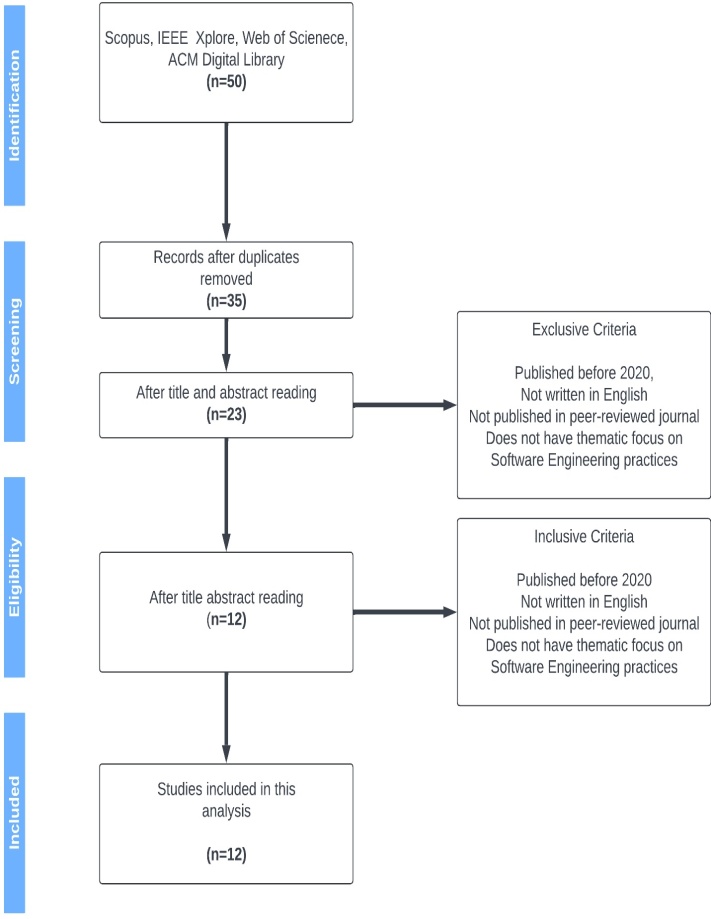
This section outlines the systematic approach employed in conducting the review of generative AI in Education, including the search strategy, selection criteria, data extraction process, quality assessment, and visualization of the process.
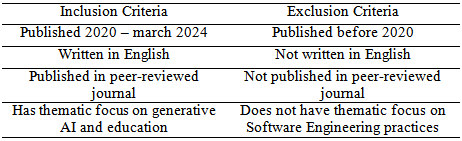
2.1. Search Strategy and Selection CriteriaTo ensure a comprehensive coverage of relevant literature, electronic databases such as IEEE, Science Direct, MDPI, and Google Scholar were systematically searched. The search strings included combinations of keywords such as "generative AI", "educational technology" and "higher education". The search was limited to articles published in English from the last five years to capture recent developments.
2.2. Data Extraction ProcessInitially, two reviewers independently screened titles and abstracts of retrieved articles to assess their relevance based on predefined inclusion and exclusion criteria. Full-text articles were then assessed for eligibility. Data were extracted from selected studies using a standardized form, including details such as author(s), publication year, study design, sample size, AI techniques utilized, educational context, and outcomes.
2.3. Quality AssessmentThe quality of included studies was evaluated using established criteria appropriate to the study designs employed. This assessment considered factors such as research methodology, sample size, data analysis techniques, and the rigor of reporting. Studies were rated on a scale of low, moderate, or high quality based on the extent to which they met these criteria.
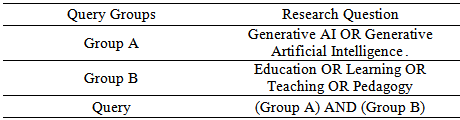
To systematically gather literature on the intersection of Generative AI and Education, we employed a comprehensive search strategy. Specifically, we conducted searches across four prominent online databases: ScienceDirect, IEEE Xplore, and ResearchGate. Our search strings were constructed using three distinct groups of keywords, detailed in Table 2. Our approach aimed for inclusivity and structure, employing identical keywords across all four databases and targeting searches within titles, abstracts, and author-provided keywords.
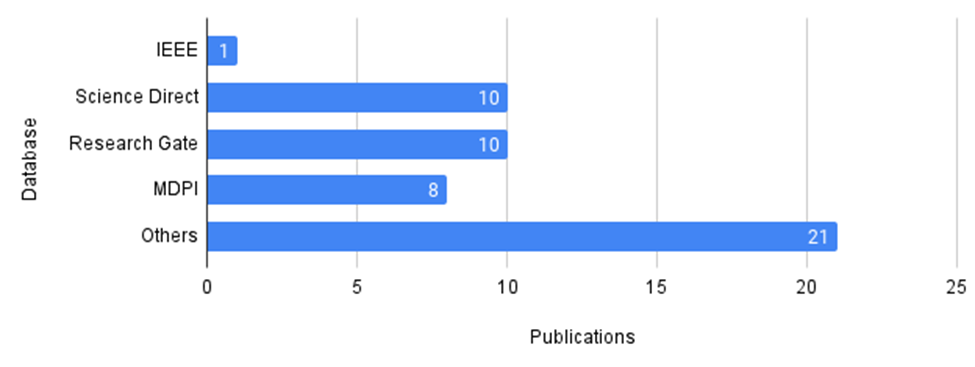
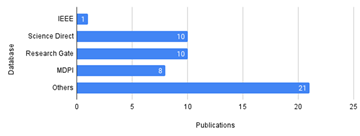
Upon executing the searches, we retrieved a total of 50 results, the distribution of which is illustrated in Figure 2. Notably, ScienceDirect and ResearchGate yielded the highest number of papers, with 20 entries, followed by 8 from MDPI, 1 from IEEE Xplore, and 21 from Other Digital Library.
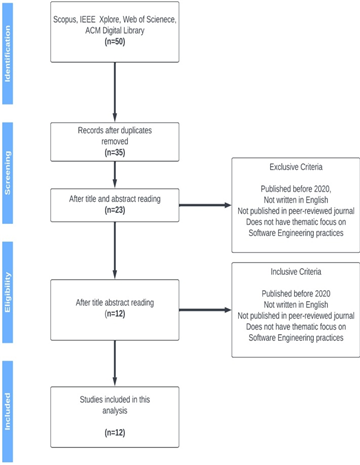
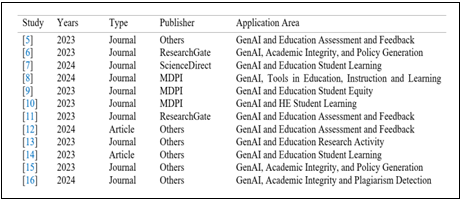
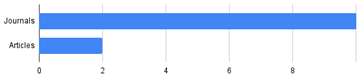
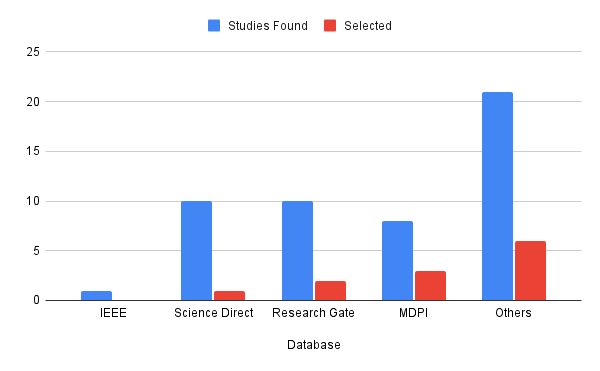
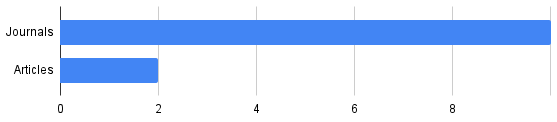
Table 3 Table 4 provide a detailed summary of all studies included. Among the selected 12 publications, 10 are journal while 2 are articles papers. This information is visualized in Figure 5. Figure 6 shows the papers published with respect to years in journals and conferences, respectively. We can see that they were all published between 2023 and 2024 respectively.
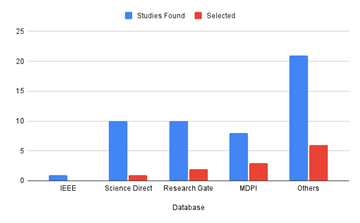
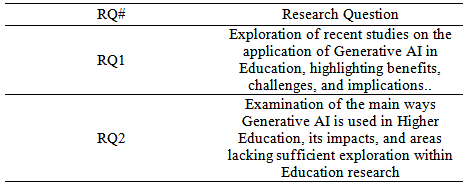
An In this section, we discuss our answers for the RQs presented in Table 1.
3.1. RQ1. Exploration of Recent Studies on the Application of Generative AI in Education, Highlighting Benefits, Challenges, and ImplicationsThe Generative AI, exemplified by models such as ChatGPT, demonstrates multifaceted applications within higher education, profoundly impacting teaching and learning methodologies. These applications span various domains, including personalized learning, academic integrity policy development, and multimodal writing enhancement. In personalized learning, chatbots powered by large language models like ChatGPT offer tailored support to students, adapting to individual learning styles and preferences 5. This not only fosters a more engaging learning experience but also enhances students' comprehension and retention of course materials. Moreover, in the context of English Medium Instruction (EMI) higher education, Generative AI plays a pivotal role in developing academic integrity policies 6. The Gen AI Academic Integrity Policy Development Blueprint, for instance, addresses potential biases in assessment methods and promotes fair treatment of students, particularly those from diverse linguistic backgrounds.
Generative AI's impact extends beyond administrative functions to transformative pedagogical approaches. For instance, in the realm of digital composition and multimodal writing, Generative AI tools like ChatGPT empower students to craft engaging and cohesive narratives, leveraging AI-generated content to enhance their creative expression and communication skills 7. Additionally, the integration of Generative AI into online learning platforms facilitates adaptive learning experiences, where educational content dynamically adjusts to students' progress and performance 8. This personalized approach not only accommodates diverse learning styles but also promotes self-directed learning and autonomy among students.
As higher education institutions continue to embrace Generative AI technologies, it is essential to recognize their potential to democratize access to quality education. By providing language support and accessibility features, Generative AI tools enhance educational inclusivity, ensuring equitable learning opportunities for students from diverse backgrounds 9. Furthermore, the adoption of Generative AI fosters innovation in instructional design, enabling educators to explore novel teaching methodologies and assessment strategies that cater to the evolving needs of 21st-century learners.
In essence, Generative AI's integration into higher education heralds a paradigm shift in teaching and learning practices, empowering educators to deliver personalized instruction, fostering academic integrity, and cultivating a culture of innovation and inclusivity. By harnessing the transformative potential of Generative AI, educational institutions can enrich the learning experiences of students, equipping them with the skills and knowledge necessary to thrive in an increasingly complex and interconnected world.
Generative AI's integration into EMI Higher Education presents a host of benefits and challenges that demand careful consideration. On the one hand, the adoption of Generative AI technologies promises to revolutionize educational practices by enhancing language support, promoting accessibility, and diversifying teaching methodologies 9. For instance, personalized learning experiences facilitated by Generative AI empower educators to cater to individual student needs, thereby optimizing learning outcomes and fostering student engagement.
Moreover, the automation of routine administrative tasks streamlines academic operations, enabling educators to allocate more time and resources to pedagogical activities. However, this integration is not without its challenges. Ensuring academic integrity amidst the proliferation of AI-generated content poses a significant concern 10, necessitating the development of robust plagiarism detection mechanisms and ethical guidelines. Furthermore, issues related to data privacy, algorithmic bias, and the equitable distribution of educational resources underscore the complexities associated with Generative AI adoption in EMI Higher Education 11. Educators and policymakers must navigate these challenges judiciously to harness Generative AI's transformative potential while upholding ethical standards and safeguarding students' educational experiences.
In addition to its benefits in teaching and learning, Generative AI holds the promise of revolutionizing research practices within higher education institutions. By automating data analysis and hypothesis testing, Generative AI tools expedite the research process, enabling scholars to uncover new insights and discoveries 12. Moreover, the integration of AI-based research assistants facilitates interdisciplinary collaboration, fostering innovation and knowledge dissemination across academic disciplines.
In conclusion, while Generative AI offers immense potential to enhance teaching, learning, and research in EMI Higher Education, its adoption must be accompanied by comprehensive strategies to address the associated challenges. By fostering collaboration among stakeholders, promoting ethical AI practices, and investing in faculty development, educational institutions can leverage Generative AI to create inclusive and innovative learning environments that empower students to succeed in a rapidly evolving global landscape.
3.2. RQ2. Examination of the Main Ways Generative Ai Is Used in Higher Education, Its Impacts, and Areas Lacking Sufficient Exploration Within Education ResearchGenerative The advent of Generative AI in education heralds' transformative implications for teaching and learning methodologies, necessitating a nuanced understanding of its impact. By automating routine administrative tasks and providing personalized support to students, Generative AI optimizes teaching processes, fostering a conducive learning environment that prioritizes student engagement and academic success 8. The integration of Generative AI tools like ChatGPT enables educators to tailor instructional content to individual learning styles, facilitating differentiated instruction and enhancing student comprehension.
Moreover, the responsible deployment of Generative AI requires the establishment of clear guidelines and policies to address ethical considerations surrounding data privacy, algorithmic bias, and academic integrity 13. Collaboration among stakeholders, including educators, policymakers, and technology developers, is essential in shaping comprehensive AI policies that uphold educational integrity while leveraging the transformative potential of Generative AI.
Furthermore, the integration of Generative AI into educational settings offers opportunities for innovative pedagogical approaches that promote active learning and critical thinking skills. By leveraging AI-based adaptive learning platforms, educators can create personalized learning experiences that cater to the diverse needs and preferences of students 14. Additionally, Generative AI tools can facilitate collaborative learning experiences, enabling students to engage in meaningful discussions and knowledge sharing activities.
As educational institutions navigate this evolving landscape, a concerted effort to integrate Generative AI ethically and equitably is imperative to realize its full benefits in enhancing teaching and learning outcomes. By fostering a culture of innovation, collaboration, and continuous improvement, educators can harness the transformative potential of Generative AI to create inclusive and engaging learning environments that prepare students for success in the digital age.
Recent studies have delved into the intersection of Generative AI and English Medium Instruction (EMI) Higher Education, shedding light on the diverse applications and implications of AI technologies in educational settings. 6 Explores the development of an evidence-informed framework for academic integrity policy development in EMI institutions, highlighting the role of Generative AI in mitigating biases and ensuring fairness in assessment methods. Similarly, studies by various researchers have examined the impact of Generative AI tools like ChatGPT on student motivation and learning outcomes in EMI contexts 8, 11, 12. These studies underscore the transformative potential of Generative AI in enhancing teaching effectiveness, promoting personalized learning experiences, and fostering academic integrity in higher education.
Furthermore, investigations into the integration of Generative AI chatbots into educational contexts have elucidated the benefits and challenges associated with AI-driven support systems. Studies by researchers emphasize the importance of ethical considerations and comprehensive measures to address plagiarism concerns and safeguard student privacy 14, 15, 16. Moreover, recent research endeavours have explored the multifaceted implications of Generative AI for international students, highlighting the disproportionate impact of AI biases and the need for language support initiatives 9. Overall, recent studies underscore the growing importance of Generative AI in shaping the future of EMI Higher Education, offering valuable insights into its potential applications and challenges.
While recent studies have provided valuable insights into the applications and implications of Generative AI in EMI Higher Education, several key areas warrant further exploration to advance our understanding and address emerging challenges. Firstly, future research endeavours should focus on investigating the efficacy of Generative AI tools in fostering inclusive learning environments for diverse student populations. This includes examining the impact of AI-driven support systems on students with varying linguistic backgrounds and learning needs.
Moreover, there is a pressing need for research on developing robust ethical guidelines and policies to govern the responsible use of Generative AI in educational settings. Studies should explore strategies for addressing algorithmic biases, ensuring data privacy, and promoting academic integrity amidst the proliferation of AI-generated content. Additionally, future research endeavours could explore the integration of Generative AI into interdisciplinary research practices, facilitating collaboration and knowledge exchange across academic disciplines.
Furthermore, research on the pedagogical implications of Generative AI adoption in EMI Higher Education remains a crucial area for exploration. Studies should delve into innovative teaching methodologies that leverage AI technologies to promote active learning, critical thinking, and student engagement. Additionally, investigations into the long-term impact of Generative AI on student learning outcomes and academic achievement are essential for informing evidence-based educational practices.
In conclusion, future research in Generative AI and EMI Higher Education should prioritize interdisciplinary collaboration, ethical considerations, and pedagogical innovation to harness the transformative potential of AI technologies responsibly. By addressing these key areas, researchers can contribute to the development of effective strategies for integrating Generative AI into educational settings, ultimately enhancing teaching and learning experiences for students worldwide.
In conclusion, this systematic review provides a comprehensive examination of the role of Generative AI in education, elucidating its impacts, challenges, and avenues for future research. The findings underscore Generative AI's capacity to revolutionize teaching, learning, and research practices in higher education institutions, facilitating personalized learning experiences, academic integrity, and interdisciplinary collaboration. However, as educational institutions embrace Generative AI technologies, careful consideration of ethical implications and the equitable integration of AI-driven solutions are imperative. Addressing challenges related to algorithmic bias, data privacy, and inclusive pedagogy requires collaborative efforts among educators, policymakers, and technology developers. Furthermore, future research endeavours should prioritize investigating the efficacy of Generative AI tools in fostering inclusive learning environments, developing robust ethical guidelines, and exploring innovative pedagogical approaches. By embracing interdisciplinary collaboration and ethical considerations, educational stakeholders can harness the transformative potential of Generative AI to create inclusive and engaging learning environments that empower students to thrive in the digital age.
| [1] | Y.-C. Wang, J. Xue, C. Wei, and C.-C. J. Kuo, "An Overview on Generative AI at Scale with Edge–Cloud Computing," IEEE, 2023. [Online]. Available: https:// ieeexplore.ieee.org/ abstract/ document/10268594. | ||
| In article | View Article | ||
| [2] | M. E. Kars, "Generative AI in Education," 2023. [Online]. Available: https:// www. researchgate.net/ publication/378044211_Generative_AI_in_Education. | ||
| In article | View Article | ||
| [3] | Y.K. Dwivedi et al., "So what if ChatGPT wrote it? Multidisciplinary perspectives on generative conversational AI." *Int. J. Inf. Manag. *, 2023, 71, 102642. [Online]. Available: [Google Scholar]() [CrossRef]. | ||
| In article | |||
| [4] | E. Kasneci et al., "ChatGPT for good? Opportunities and challenges of large language models in education." *Learn. Individ. Differ.*, 2023, 103, 102274. [Online]. Available: [Google Scholar] [CrossRef]. | ||
| In article | View Article | ||
| [5] | A. O. Tzirides et al., "Generative AI: Implications and Applications for Education," Journal, 2023. [Online]. Available: https://typeset.io/papers/generative-ai-implications-and-applications-for-education-11ltfawe. | ||
| In article | |||
| [6] | P. Bannister, E. Alcalde, and A. Santamaria, "Transnational Higher Education Cultures and Generative AI: A Nominal Group Study for Policy Development in English Medium Instruction," *Journal*, 2023. [Online]. Available: https:// www.researchgate.net publication/ 376951659_Transnational_higher_ education_ cultures_and_ generative_AI_ a_nominal_group_study _for_policy_development _in_English_medium_instruction. | ||
| In article | View Article | ||
| [7] | M. Liu, L. J. Zhang, and C. Biebricher, "Investigating students’ cognitive processes in generative AI-assisted digital multimodal composing and traditional writing," IEEE Trans. Educ., vol. 2024. [Online]. Available: https:// www.sciencedirect.com/ science/article/pii/S0360131523002543. | ||
| In article | View Article | ||
| [8] | K. Denecke, R. Glauser, and D. Reichenpfader, "Assessing the Potential and Risks of AI-Based Tools in Higher Education: Results from an eSurvey and SWOT Analysis," *Journal of MDPI*, 2023. | ||
| In article | View Article | ||
| [9] | T. Farrelly and N. Barker, "Generative Artificial Intelligence: Implications and Considerations for Higher Education Practice," *Journal*, vol. 13, no. 11, p. 1109, 2023. [Online]. Available: https://www.mdpi.com/2227-7102/13/11/1109. | ||
| In article | View Article | ||
| [10] | S. Yeralan and L. A. Lee, "Generative AI: Challenges to Higher Education," Journal, ResearchGate, 2023. [Online]. Available: https://www.researchgate.net/publication/373809812_Generative_AI_Challenges_to_higher_education. | ||
| In article | View Article | ||
| [11] | M. Hmoud, H. Swaity, N. Hamad, O. Karram, and W. Daher, "Higher Education Students’ Task Motivation in the Generative Artificial Intelligence Context: The Case of ChatGPT," *Journal of MDPI*, vol. 15, no. 1, p. 33, 2024. [Online]. Available: [https://www.mdpi.com/2078-2489/ 15/1/33] (https:// www.mdpi.com/2078-2489/15/1/33). | ||
| In article | View Article | ||
| [12] | C. Hodges and C. Ocak, "Integrating Generative AI into Higher Education: Considerations," 2023. [Online]. Available: https:// www.researchgate.net/ publication/ 373512985_ Integrating_Generative_ AI_into_Higher_Education_Considerations. | ||
| In article | |||
| [13] | H. Yu and Y. Guo, "Generative artificial intelligence empowers educational reform: current status, issues, and prospects," Frontiers, 2023. [Online]. Available: https:// www.frontiersin.org/ articles/10.3389/feduc.2023.1183162/full. | ||
| In article | View Article | ||
| [14] | M. Hmoud, H. Swaity, N. Hamad, O. Karram, and W. Daher, "Higher Education Students’ Task Motivation in the Generative Artificial Intelligence Context: The Case of ChatGPT," IEEE Transactions on Learning Technologies, vol. 15, no. 1, pp. 33-42, 2024. [Online]. Available: https://www.mdpi.com/2078-2489/15/1/33 . | ||
| In article | View Article | ||
| [15] | R. T. Williams, "The Ethical Implications of Using Generative Chatbots in Higher Education," *Frontiers in Education*, 2023. [Online]. Available: https:// www.frontiersin.org/ articles/ 10.3389/feduc.2023.1331607/full. | ||
| In article | View Article | ||
| [16] | R. Michel-Villarreal, E. Vilalta-Perdomo, D. E. Salinas-Navarro, R. Thierry-Aguilera, and F. S. Gerardou, "Challenges and Opportunities of Generative AI for Higher Education as Explained by ChatGPT," Journal of MDPI, 2023. | ||
| In article | View Article | ||
Published with license by Science and Education Publishing, Copyright © 2024 Nzenwata U. J., Barn-Nzekwe C. L., Ojelabi E. O, Oduware O., Atalor. P. E., Yisau Y., Adeyela A. T., Nwanguma E. C., Emokiniovo E. and Osisanya O. A
 This work is licensed under a Creative Commons Attribution 4.0 International License. To view a copy of this license, visit
https://creativecommons.org/licenses/by/4.0/
This work is licensed under a Creative Commons Attribution 4.0 International License. To view a copy of this license, visit
https://creativecommons.org/licenses/by/4.0/
| [1] | Y.-C. Wang, J. Xue, C. Wei, and C.-C. J. Kuo, "An Overview on Generative AI at Scale with Edge–Cloud Computing," IEEE, 2023. [Online]. Available: https:// ieeexplore.ieee.org/ abstract/ document/10268594. | ||
| In article | View Article | ||
| [2] | M. E. Kars, "Generative AI in Education," 2023. [Online]. Available: https:// www. researchgate.net/ publication/378044211_Generative_AI_in_Education. | ||
| In article | View Article | ||
| [3] | Y.K. Dwivedi et al., "So what if ChatGPT wrote it? Multidisciplinary perspectives on generative conversational AI." *Int. J. Inf. Manag. *, 2023, 71, 102642. [Online]. Available: [Google Scholar]() [CrossRef]. | ||
| In article | |||
| [4] | E. Kasneci et al., "ChatGPT for good? Opportunities and challenges of large language models in education." *Learn. Individ. Differ.*, 2023, 103, 102274. [Online]. Available: [Google Scholar] [CrossRef]. | ||
| In article | View Article | ||
| [5] | A. O. Tzirides et al., "Generative AI: Implications and Applications for Education," Journal, 2023. [Online]. Available: https://typeset.io/papers/generative-ai-implications-and-applications-for-education-11ltfawe. | ||
| In article | |||
| [6] | P. Bannister, E. Alcalde, and A. Santamaria, "Transnational Higher Education Cultures and Generative AI: A Nominal Group Study for Policy Development in English Medium Instruction," *Journal*, 2023. [Online]. Available: https:// www.researchgate.net publication/ 376951659_Transnational_higher_ education_ cultures_and_ generative_AI_ a_nominal_group_study _for_policy_development _in_English_medium_instruction. | ||
| In article | View Article | ||
| [7] | M. Liu, L. J. Zhang, and C. Biebricher, "Investigating students’ cognitive processes in generative AI-assisted digital multimodal composing and traditional writing," IEEE Trans. Educ., vol. 2024. [Online]. Available: https:// www.sciencedirect.com/ science/article/pii/S0360131523002543. | ||
| In article | View Article | ||
| [8] | K. Denecke, R. Glauser, and D. Reichenpfader, "Assessing the Potential and Risks of AI-Based Tools in Higher Education: Results from an eSurvey and SWOT Analysis," *Journal of MDPI*, 2023. | ||
| In article | View Article | ||
| [9] | T. Farrelly and N. Barker, "Generative Artificial Intelligence: Implications and Considerations for Higher Education Practice," *Journal*, vol. 13, no. 11, p. 1109, 2023. [Online]. Available: https://www.mdpi.com/2227-7102/13/11/1109. | ||
| In article | View Article | ||
| [10] | S. Yeralan and L. A. Lee, "Generative AI: Challenges to Higher Education," Journal, ResearchGate, 2023. [Online]. Available: https://www.researchgate.net/publication/373809812_Generative_AI_Challenges_to_higher_education. | ||
| In article | View Article | ||
| [11] | M. Hmoud, H. Swaity, N. Hamad, O. Karram, and W. Daher, "Higher Education Students’ Task Motivation in the Generative Artificial Intelligence Context: The Case of ChatGPT," *Journal of MDPI*, vol. 15, no. 1, p. 33, 2024. [Online]. Available: [https://www.mdpi.com/2078-2489/ 15/1/33] (https:// www.mdpi.com/2078-2489/15/1/33). | ||
| In article | View Article | ||
| [12] | C. Hodges and C. Ocak, "Integrating Generative AI into Higher Education: Considerations," 2023. [Online]. Available: https:// www.researchgate.net/ publication/ 373512985_ Integrating_Generative_ AI_into_Higher_Education_Considerations. | ||
| In article | |||
| [13] | H. Yu and Y. Guo, "Generative artificial intelligence empowers educational reform: current status, issues, and prospects," Frontiers, 2023. [Online]. Available: https:// www.frontiersin.org/ articles/10.3389/feduc.2023.1183162/full. | ||
| In article | View Article | ||
| [14] | M. Hmoud, H. Swaity, N. Hamad, O. Karram, and W. Daher, "Higher Education Students’ Task Motivation in the Generative Artificial Intelligence Context: The Case of ChatGPT," IEEE Transactions on Learning Technologies, vol. 15, no. 1, pp. 33-42, 2024. [Online]. Available: https://www.mdpi.com/2078-2489/15/1/33 . | ||
| In article | View Article | ||
| [15] | R. T. Williams, "The Ethical Implications of Using Generative Chatbots in Higher Education," *Frontiers in Education*, 2023. [Online]. Available: https:// www.frontiersin.org/ articles/ 10.3389/feduc.2023.1331607/full. | ||
| In article | View Article | ||
| [16] | R. Michel-Villarreal, E. Vilalta-Perdomo, D. E. Salinas-Navarro, R. Thierry-Aguilera, and F. S. Gerardou, "Challenges and Opportunities of Generative AI for Higher Education as Explained by ChatGPT," Journal of MDPI, 2023. | ||
| In article | View Article | ||