In the first quarter of the 21st Century, urban areas especially in the developing economies have suffered the effects of fire disaster. Whilst urban fire disaster often takes people unaware, it is undoubtedly clear that planning to secure urban markets for future fire occurrence has been fruitless. It is against this background that the recent fire disaster in the Bamenda Central Market on the 22nd of February, 2024 received unanswered planning questions. This paper probes to investigate urban fire incidence and planning responses at the Bamenda Central Market. The study used systematic field observation, 85 copies of questionnaire and personal interview technique as primary sources of data collection. The administration of 85 copies of questionnaire was carried out using purposive and simple random sampling techniques in the Bamenda Central market. The number of directly affected victims, stores damaged and estimated cost were matched with secondary data obtained from Bamenda City Council. Findings revealed that about 25% of the Bamenda Central Market was consumed by fire with goods, liquid cash and infrastructural damage amounting to billions of FCFA were lost in the process. The population revealed that technological triggers (63.53%) and urban market planning problems (36.47%) were responsible for the fire incidence. Findings revealed market planning mistakes with a 2.5m distance from one shop alignment to another. This indicates limited space for vehicles to access during emergency. The materials used for market construction and the continuum of roofing system precipitated the fire crossover. The study opts for proper segmentation of markets, decongesting the inner market paths while expanding these paths to 5m apart. Also, the market should be constructed in a modern way using cemented roofing to reduce fire outrage. The study equally recommends the installation of electric systems that detect contact and failure in individual shops in order to tackle pro-active fire management and planning in urban markets.
Markets have been one of the most vulnerable sections of the urban centres to fire disaster. Fire incidents have considerably increased during the past four years by endangering human lives and have caused economic and ecological damages 1. Shocking fire events challenged the essence of building performances. Fire disasters have plagued livelihoods of urban settlers across the globe for decades with developing countries being the worst hit. World Fire Statistics Centre 2 documented that fire disaster related loses account for about one percent of the global nation Gross Domestic Product. World Fire Statistics Report of 2018, No. 23 reported that fire incidents in years 1993-2016 amounted to 2.5 to 4.5 million fires and nearly 62,000 fire deaths were reported from 57 countries 3. The rapid rate of urbanization (characterized by social ills) in developing countries pose formidable challenges and render the environment precarious and vulnerable to fire disasters of this nature 4. In much the same way, 5 iterated that urban market mismanagement contributes to the prevalence of fire disasters which result in the loss of life, property, means of livelihood and spatial displacement. Loss of lives due to fire incidences is becoming a frequent cause of death in West and Central African countries.
Uncontrolled fires, is one of the major reasons for building collapses, implied damages, potential injury and loss 6. Losses due to market fires have been reported to run into billions over the years. Despite the global urban concentration of economic activities, city fire disaster continues to underplay the city resilience and sustainability 7. Urban market fire tends to traumatize people or victims due to the losses of belongings. Among that, losing the building is one of the most stressful factors for building owners 8. Accordingly, failure to consider the causes for building fire incidents leads to under-performance of existing fire safety system in the building 9. 10 revealed that the spatial arrangement within many urban markets is disorderly and remains unplanned. The ‘unplanned markets’ is characterized by poor accessibility, zero air spacing of stores in relation to one another and absence of firefighting facilities, has added to the devastation of markets by fire in developing countries. Amongst many other challenges, the late arrivals of emergency responders at the scenes of these conflagrations as well as the inadequacy of facilities to combat the fire have led to some market fires burn for over 20 hours. These have heightened the losses incurred during fire outbreaks at markets. Some traders have died, not from severe burns but from the shock of watching their means of livelihood being ruined. Many of these traders have little or no preparedness for fire eventualities. They lack fire extinguishers, fire buckets or any other fire combating implements.
Nigeria markets, for example, have been rocked with incidences of market fires throughout the earlier decades 4. Fire outbreaks in market places have occurred repeatedly claiming goods worth millions of naira and rendering scores jobless while displacing a few others residing in the market surroundings. In Nigeria, it has been documented that urban planners and city managers are continually faced with the problem of responding and managing frequent urban business and market structure, goods and place fire disaster 11. In the Cameroonian cities of Douala, Yaounde and Maroua, urban market fires have become the order of the day. The issue of urban market fire has never been experienced in Bamenda until the recent outbreak of fire in the Bamenda Central market that took many by surprise. This explains why this study probes to investigate urban fire incidence and planning responses at the Bamenda Central market, North West Region of Cameroon.
In the midst of socio-political upheaval in the North West Region (with Bamenda city as headquarters) and the struggle by households to ensure socio-economic sustenance, a section of the Bamenda Central Market was ravaged by the incidence of fire on the 22nd of February, 2024. This fire disaster which took the urban population unaware only comes to add more pains and suffering to the already affected population that have experienced a regressive growth and development in recent years.
There is much believed that nothing will happen until something happens. This is the problem with planning as it always results in severe consequences such as loss of property, shops destruction, loss of lives, psychological trauma, poverty infliction and loss of billions of FCFA. Shops owners and government officials are setting up plans to reconstruct the damaged areas of the Bamenda Central Market as well as assist victims financially, however, the fear is that the root cause of fire incidence and the planning problems might still remained unsolved. While previous studies have investigated urban markets in Cameroon with respect to space and infrastructural functionality, location analysis and efficiency, urbanization and growth trends, space management 12, 13, 14, 15 and more recently urban market dynamics and population accessibility 16, there has been limited research on urban market fire incidence across African urban spaces in general and Cameroon in particular. This study investigates urban fire incidence, implications and planning responses at the Bamenda Central Market.
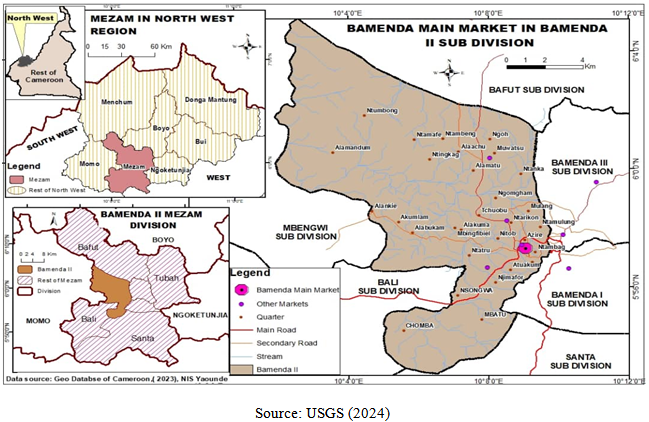
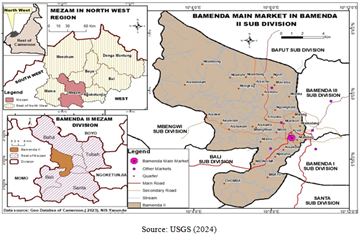
Bamenda Central Market is found in the Regional Capital of the North West. The market is found in Bamenda II Sub Division, Mezam Division located between Latitudes 5o54’ and 6o00’N of the Equator and Longitudes 100 60’ and 100 120’ East of the Greenwich Meridian. The market is situated along the Bamenda Commercial Avenue, South of the Bamenda escarpment. The market has a surface area of 1km2 (Bamenda City Council, 2024). The Bamenda Central market is bounded to the South and South-East by Food market, West by Hausa Quarter, East by Meta Quarter and North by T-Junction (Figure 1).
The choice and justification of this study holds from the fact that Bamenda Central Market is the largest market in the whole region, which happens to be hub of economic activity in the region. This is a market with all varieties of goods and services and it is the busiest of all the markets in the region. Consequently, there are huge investments that have been carried out by the government and individual business operators such that the fire disaster that occurred does not only affect the victims, relatives and the government, but also the population as a whole. Besides this, the fire incidence comes at a time when the population is facing a difficult moment of socio-political crisis characterized by theft, kidnapping for ransom and unreliable market sales which remain an issue of great concern to the population and the government.
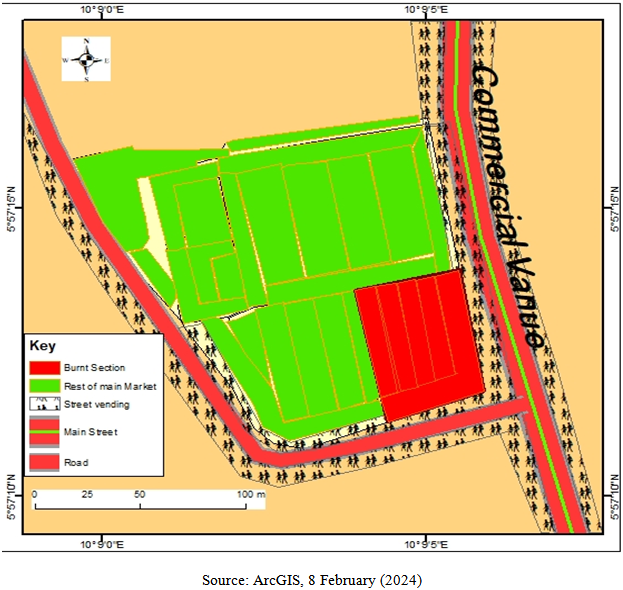
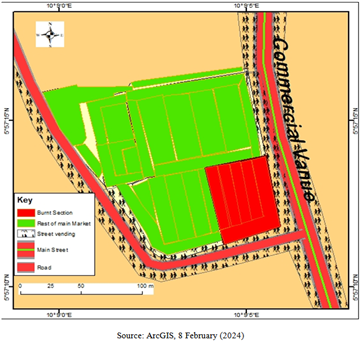
This study employed the use of primary and secondary sources in data collection. Broad field observation and copies of questionnaire facilitated the collection of information pertaining to the study. Field observation was undertaken at the Bamenda Central market and provided first-hand information on the degree of damage caused and poor market planning aspects that precipitated the fire disaster. A total of 230 shops were burnt in the segment of the market that was affected by the fire disaster. However, 85 copies of questionnaire were used to sample victims and collect their views on the probable cause of the fire incidence, the estimated loss incurred per shop, market planning problems and challenges faced as well as suggestions to prevent future market fire incidence. The determination of the 85 copies of questionnaire was based on a certain percentage of the total number of shops that were exposed to fire incidence in the market. The Bamenda Central market has 1700 shops and these shops had equal probability of being affected by the fire incidence. As a consequence, 5% of 1700 shops (85) constituted the sample size population to respond to the questionnaire especially direct victims. From the 85 copies of questionnaire, a total of 55 copies of questionnaire were distributed to victims of fire incidence (affected shop owners) while 30 copies were distributed to other shop owners that were not victims or directly affected by the fire incidence. To get the 55 respondents of those whose shops were burnt, the researchers took advantage of the call by the Bamenda City Mayor on the 3rd of March, 2024 ordering all affected shops owners to be present at their burnt sites at 10am with valid documents for justification. This was in line with the census organized by the city council in order to effectively determine the number of shops affected by the fire disaster. The copies of questionnaire were distributed using purposive and simple random sampling techniques. The purposive sampling method was used to collect information to specific respondents especially those whose shops were burnt and were direct victims of the fire incidence. The use of this method was necessary because it specifically target the shop owners. On the other hand, since the researcher could not get to all the fire victims, given the copies of questionnaire, the simple random method was used. This method was best suited such that each victim has equal right or chance to respond to the questionnaire. This was equally to minimize bias in the distribution of copies of questionnaire to respondents. Data on the number of shops destroyed and estimated cost were gotten from the Bamenda City Council. The Aerial view of the Bamenda Central market was produced by the use of GIS and Remote Sensing. The GIS map also presented the surface area of the market and surface area consumed by the fire incidence. The GIS map was for better planning perspective in the market area. The opinion of the respondents from the copies of questionnaire were analysed qualitatively and presented using maps, photographs, frequency tables and figures for better understanding.
The results are presented in three perspectives, being the urban market fire triggers and planning problems, implications of the fire incidence as well as the stakeholders’ planning responses to prevent future market fire disaster.
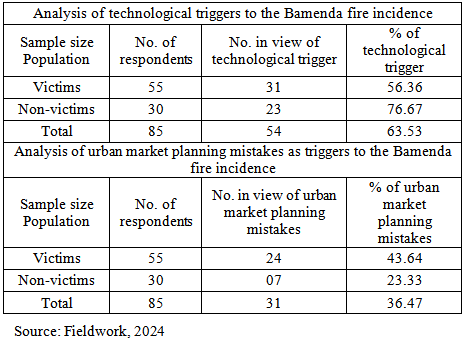
4.1. The Bamenda Central Market Fire Triggers and Planning ProblemsThe triggers to the fire incidence that consumed part of the Bamenda Central market have been linked to two drivers. The urban market fire triggers were investigated as being immediate and accelerated. Findings revealed the immediate triggers to be linked to technological failure and urban market planning problems as being the accelerators (Table 1).
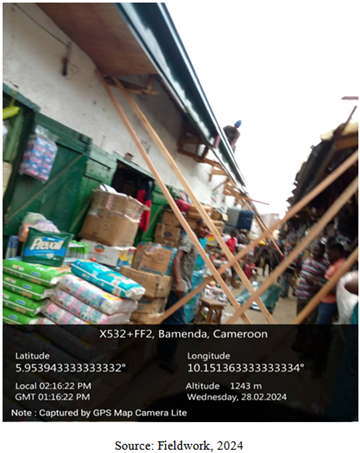
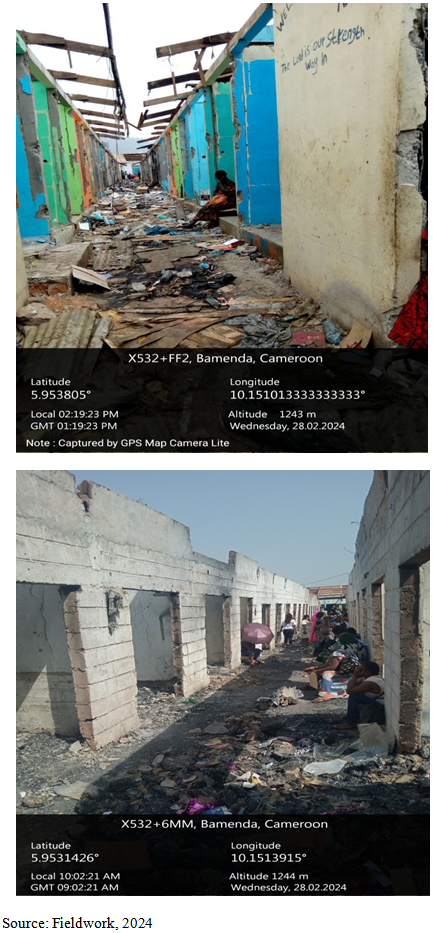
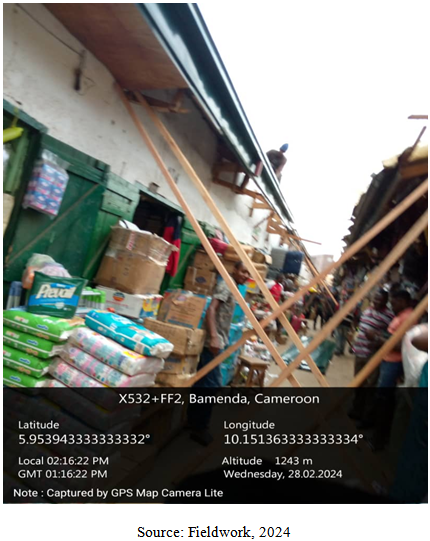
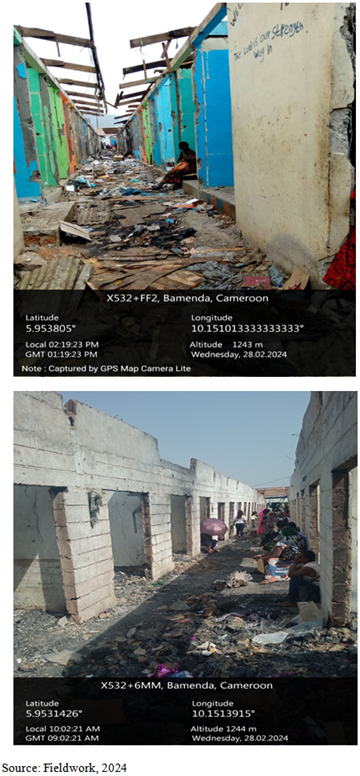
Findings showed that technological failures accounted for about 63.53% of the urban market fire triggers. Field investigation further revealed that the Bamenda Central market is characterized by uncontrolled electricity cable distributions that crisscross each other at different points. Almost all the stores in the market are electrified by different electricians. This makes it difficult to maintain steady power flow and tracing of faults in connection lines (Figure 2).
In situation of high voltage, there is usually sparking effect indicating poor connection and cable contact. Most of the stores in the Central market use low grade distributors which are often unable to carry the power supply system. Most vendors or business operators usually turn blind eyes to this and it has been identified as one of the immediate causes to the fire incidence.
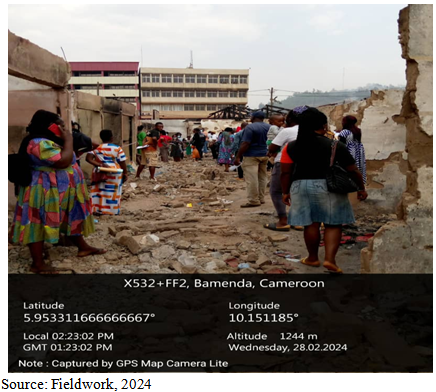
In another dimension of triggers, findings revealed the urban market planning mistakes as accelerators to the fire incidence. The results showed that the accelerators accounted for about 36.47% of the fire incidence that consumed part of the Bamenda Central market. According to the respondents, adequate planning for the construction of the market significantly minimizes fire outbreaks. Findings present some of the urban market planning problems as investigated by the researchers. Field observation presents that the Bamenda urban market was conceived, planned and constructed some 3 to 4 decades ago. The planning of the market did not however consider the unprecedented growth in the human population today. This has triggered the need for more shops by the growing economic population. In response to this effect, the market administrators reduced the spacing between buildings from 5m to 2.5m and equally extending building lanes for more shops. This action of reduce alignment of buildings precipitated fire to crossover from one building to another (Figure 3).
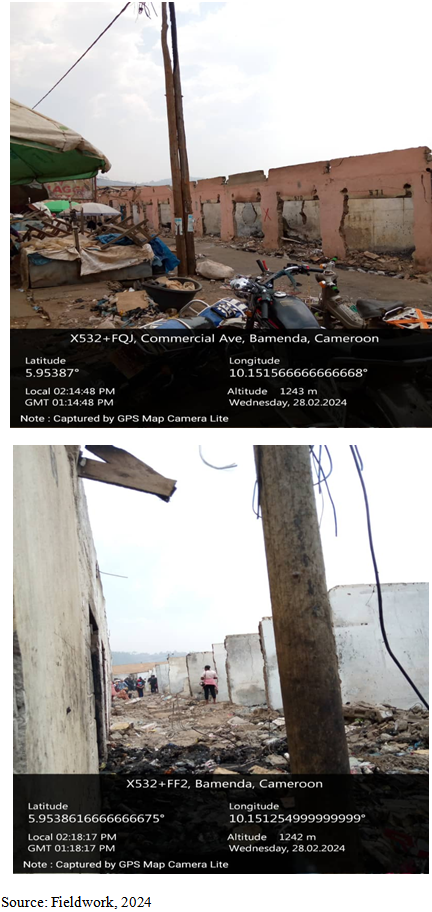
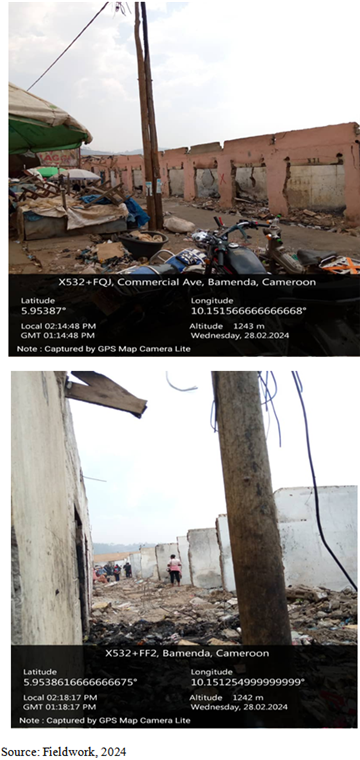
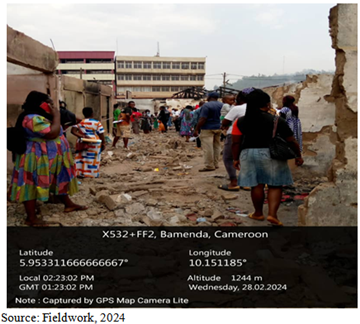
Findings equally revealed that the insufficient spacing did not only precipitate fire extending from one building to another but also reduce the chances of intervention from the fire fighters. This is due to the inaccessibility of the lanes by the vehicle to quench the fire. This explains why most of the shops in a particular segment had to be destroyed to enable the fire fighter vehicle have access to extinguish fire though the efforts made were not significant enough to reduce the fire disaster (Figure 4).
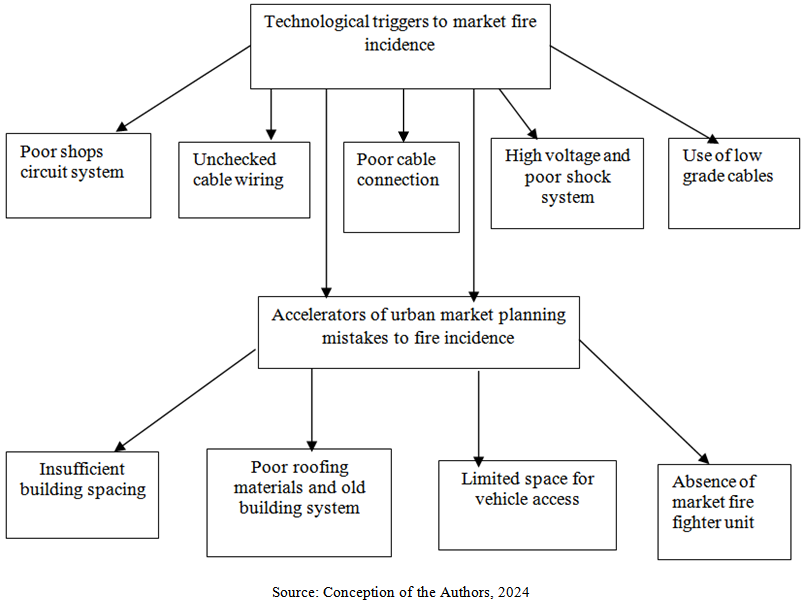
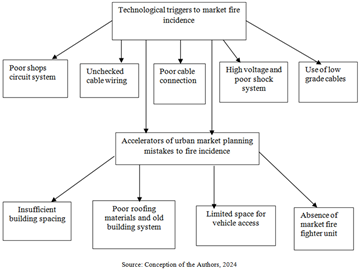
Findings also identified one of the accelerators to market fire incidence as the types of materials used for the construction of the market. The market is mostly constructed and roofed with planks and zincs which are essential catalysts to fire. In much the same way, the market buildings are constructed almost at the same height which facilitates fire crisscrossing given that the market revealed a continuum of buildings or stores. This equally justified that effective planning in the construction of the market was not considered. Figure 5 presents the simulative framework for the triggers of the Bamenda Central market fire incidence.
According to the framework in Figure 5, the technological and urban market planning mistakes work together to explain the causal incidence of the market fire in the Bamenda Central Market. This implies that most of the buildings affected were built with materials that are not heat conductors. From the study, it was revealed that “most of the things” consumed by fire were buildings with single-floor since the market is dominantly constructed at same height. Field observation held that most of the buildings in the affected market segment were low rise structures that could not pose a challenge to fire fighters. However, the closeness of the buildings did not permit effective firefighting unit to operate successfully. The framework shows that interrelatedness of the triggering mechanism or variables, in order to justify the occurrence of the fire while opting for better measure to prevent future disasters in the market in particular and other markets with similar characteristics in general.
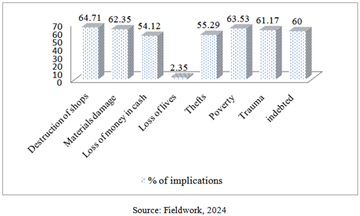
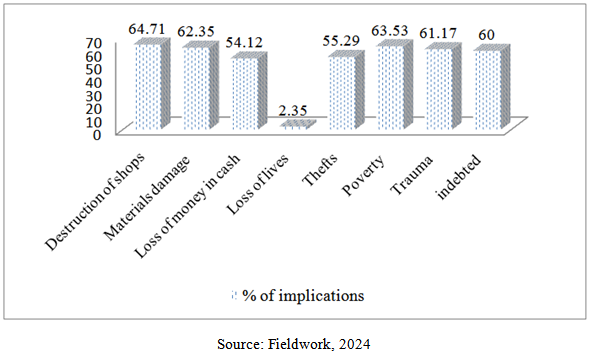
The fire incidence that occurred in the Bamenda Central market left the victims and the population with unexpected and immeasurable damage. The information obtained from the copies of questionnaire indicated that the fire disaster resulted in materials damage, shops destruction, loss of money in liquid form, loss of lives and thefts. Figure 6 presents some of the identified implications from the fire disaster incidence.
Findings revealed the frequency of sample implications incurred by the victims of the fire disaster in particular. About 64.71% of the victims were of the view that their shops were destroyed by the fire. Field investigation revealed that about 230 shops were consumed by the fire incidence and this result was matched by GIS mapping with about one quarter (1/4) of the Bamenda Central market consumed by the disastrous fire incidence (Figure 7). Also, some of the victims revealed that their shops were broken and destroyed by some people even before and during the fire damage. These were thieves who took advantage of the fire disaster in the struggle to help the victims by removing the items from being consumed by fire. Nevertheless, the rescued items were never seen or recovered indicating a rising theft activity during the incidence. This explains why about 55.29% of the victims opined that thefts were equally responsible for the destruction of their shops and property loss. Findings further showed that 62.35% of the victims held that they experienced huge materials damage in the process while 63.53% were of the view that the fire incidence has come to add to the existing poverty situation.
The results indicated that the fire disaster comes at a time where business is slow due to the on-going socio-political crisis thereby worsening the poverty situation of the victims in particular. The results equally showed that trauma and indebtedness are major implications as indicated by 61.17% and 60.0% respectively. Some 60.0% of the victims held that they had to engage in extra sources of income through borrowing and sell of land in order start up a business. Unfortunately, they are unable to repay the loans or get back their property due to the fire incidence. This is traumatizing and placed the victims into debts. Findings equally showed that about 54.12% of the victims lost money in liquid form and materials worth estimated billions of FCFA. Field investigation also revealed that at least two (2) victims lost their lives from the fire incidence as they could not withstand the shock and watch their life time investment consumed in just few minutes.
4.3. Stakeholders’ Planning Responses to the Bamenda Central Market Fire IncidenceConsidering the causes and implications of the fire disaster in Bamenda Central market, the tendency is for stakeholders to react promptly, in order to prevent such incidence in future. There have been heated responses of stakeholders and planning to the victims and the municipality as a whole. According to the government delegate to the Bamenda City Council, there is definitely planning actions towards reconstruction of the market to a modern standard. This construction takes into consideration the provision of enough pathways or lanes to ensure vehicle access and building of modern shops with roofing that do not encourage fire crisscrossing. The government plan of action is to revisit the outdated plan that was used in the construction of the market some decades ago. To many, this is seen as political maneuver given that this planning action was supposed to have been put in place before the fire disaster. Many argued why the government is reactive rather than proactive in planning, especially in urban markets within the Cameroonian cities. Such planning construction process should be initiated immediately but that is not the case because some of the business operators have already embarked in reconstruction and renovation of the affected shops which is the project of the council (Figure 8).
The government, victims and the urban population are ready to welcome plans for effective reconstruction and planning in the Bamenda Central market in particular and other markets within the municipality in general. Findings equally identified another domain of stakeholders’ responses to the fire incidence in the Bamenda Central market. In order to response to the damage caused and incurred by the victims, the civil society launched a Civic Emergency Assistance for the Helpless Victims of the Bamenda Central Market fire disaster. This response from the civic society acknowledged that the national, regional and local authorities are working towards planning to mitigate the pain of the victims and to rebuild a modern economic infrastructure (market). They were of the opinion that the dire situation of these victims cannot wait for the statutory government procedure to come to fruition. Their response strategy is urgent and immediate which does not intervene for market planning and construction but mere assistance while waiting for sustainable planning responses and actions from the government to build a better marker for the population.
A market remains the fundamental economic life wire of the population. It is the focus of economic development of any region and as a consequence, there is need to protect the market not only from fire incidence but from theft. Considering the triggers and the associated implications of the urban market fire which has become phenomenal in most of our cities today, market planning to withstand the negative consequences should be the utmost attention to the different municipalities. Whilst urban markets have become vulnerable to fire incidence in recent years, the technological and planning aspects have to be addressed to prevent unexpected damages and losses. In line with the summary of findings, the accelerators accounted for about 36.47% of the fire incidence that consumed part of the Bamenda Central market. Findings showed that technological failures accounted for about 63.53% of the urban market fire triggers while the urban market planning mistakes stood at 36.47%. The Bamenda fire incidence affected about ¼ of the entire market with 230 shops completely burnt. Some 64.71% of the victims were of the view that their shops were destroyed by the fire. Whilst the government and other stakeholders are gradually recovering from the shock, the tendency has been to ensure a fire disaster free market in future. This is however possible if the identified recommendations are put in practice by the competent authorities. This study therefore opts for some recommendations to be implemented by the different stakeholders.
• The government should ensure complete reconstruction of the market and provide enough spacing of at least 5m from one building to another to ensure free vehicle access (such as firefighter vehicles).
• Vertical structures could also be erected in order to economize space and create space for vehicles access.
• There should equally be a modern roofing system, installation of electrical devices to detect technological failures and a standby fire fighter vehicle in the market for emergency.
• There should be regular checking of electrical cables and connection by the registered authorities.
| [1] | Félix, D., Monteiro, D., Branco, J., Bologna, R. and Feio, A, “The role of temporary accommodation building for post disaster housing reconstruction”, Journal of Housing and the Built Environment, 30 (4). 683-699. 2014. | ||
| In article | View Article | ||
| [2] | World Fire Statistics Centre (WFSC), United Nations Report Endorsed and Data Tables. A Report Submitted to the United Nations Economic Commission for Europe (UNECE). 2012. | ||
| In article | |||
| [3] | International Association of Fire and Rescue Services, CTIF report-world fire statistics, 2018. https:// www.ctif.org/ sites/default/files/ 2018b06/ CTIF_ Report23 _World_Fire_Statistics_2018_vs_2_0.pdf. | ||
| In article | |||
| [4] | Popoola, A., Adekalu, O., Audu, A. and Adeleye, B, “Analysis of causes and characteristics of market fires in Lagos State, Nigeria”, International Journal of Agriculture and Rural Development, 19 (1). 2407-2421. 2016. | ||
| In article | |||
| [5] | Mtani, I.W. and Mbuya, E.C, “Urban fire risk control: House design, upgrading and replanning”, Jàmbá: Journal of Disaster Risk Studies, l0, (1).1-8. 2018.b. | ||
| In article | View Article PubMed | ||
| [6] | Wong, N. and Jan, W, “Total building performance evaluation of academic institution in Singapore”, Building and Environment, 38 (1).161-176. 2003. | ||
| In article | View Article | ||
| [7] | Oteng-Ababio, M., Sarfo, K. and Owusu-Sekyere, E, “Exploring the realities of resilience: Case study of Kantamanto market fire in Accra, Ghana”, International Journal of Disaster Risk Reduction, 12:311–318. 2015. | ||
| In article | View Article | ||
| [8] | Caia, G., Ventimiglia, F. and Maass, A, “Container vs. dacha: The psychological effects of temporary housing characteristics on earthquake survivors,” Journal of Environmental Psychology, 30 (5). 60-66. 2010. | ||
| In article | View Article | ||
| [9] | Xiuyu, L., Hao, Z., and Qingming, Z, “Factor analysis of high-rise building fires reasons and fire protection measures”, Procedia Engineering, 45:643-648. 2012. | ||
| In article | View Article | ||
| [10] | Chhetri, S. and Kayastha, P, “Manifestation of an analytic hierarchy process (AHP) model on fire potential zonation mapping in Kathmandu Metropolitan City, Nepal”, ISPRS International Journal of Geo-Information, 4:400-417. 2015. | ||
| In article | View Article | ||
| [11] | Oladokun, V. and Emmanuel, C, “Urban market fire disasters management in Nigeria: A damage minimization based fuzzy logic model approach”, International Journal of Computer Applications, 106(17). 1-6. 2014. | ||
| In article | |||
| [12] | Ndi, N.H. and Oben, E.E.E, “Space and Infrastructural Functionality in Yaounde Markets”, Journal of Geography and Geology, 6(2). 93-102. 2014 | ||
| In article | View Article | ||
| [13] | Oben, E.E.E. and Ndi, N.H, “Urbanisation and market growth trends in the Yaounde Metropolis”, Journal of Geography and Geology, 6(3). 203-213. 2014. | ||
| In article | View Article | ||
| [14] | Oben, E.E.E. and Fombe, L.F, “Space management in ‘traditional’ markets of the Yaounde Municipality”, Journal of Geography and Geology, 6(1). 28-37. 2014. | ||
| In article | View Article | ||
| [15] | Oben, E.E.E. and Ndi, N.H, “Market Location Analysis and Efficiency in Yaounde”, African Journal of Social Sciences. 8 (7). 1-17. 2017. | ||
| In article | |||
| [16] | Wanie, C.M. and Wallang, R. S, “Urban markets dynamics and population accessibility in the Bamenda II and III municipalities, Cameroon”, 2024. (In Press). | ||
| In article | |||
Published with license by Science and Education Publishing, Copyright © 2024 Clarkson Mvo Wanie, Edwin Mua Kang and Roland Saah Wallang
 This work is licensed under a Creative Commons Attribution 4.0 International License. To view a copy of this license, visit
http://creativecommons.org/licenses/by/4.0/
This work is licensed under a Creative Commons Attribution 4.0 International License. To view a copy of this license, visit
http://creativecommons.org/licenses/by/4.0/
| [1] | Félix, D., Monteiro, D., Branco, J., Bologna, R. and Feio, A, “The role of temporary accommodation building for post disaster housing reconstruction”, Journal of Housing and the Built Environment, 30 (4). 683-699. 2014. | ||
| In article | View Article | ||
| [2] | World Fire Statistics Centre (WFSC), United Nations Report Endorsed and Data Tables. A Report Submitted to the United Nations Economic Commission for Europe (UNECE). 2012. | ||
| In article | |||
| [3] | International Association of Fire and Rescue Services, CTIF report-world fire statistics, 2018. https:// www.ctif.org/ sites/default/files/ 2018b06/ CTIF_ Report23 _World_Fire_Statistics_2018_vs_2_0.pdf. | ||
| In article | |||
| [4] | Popoola, A., Adekalu, O., Audu, A. and Adeleye, B, “Analysis of causes and characteristics of market fires in Lagos State, Nigeria”, International Journal of Agriculture and Rural Development, 19 (1). 2407-2421. 2016. | ||
| In article | |||
| [5] | Mtani, I.W. and Mbuya, E.C, “Urban fire risk control: House design, upgrading and replanning”, Jàmbá: Journal of Disaster Risk Studies, l0, (1).1-8. 2018.b. | ||
| In article | View Article PubMed | ||
| [6] | Wong, N. and Jan, W, “Total building performance evaluation of academic institution in Singapore”, Building and Environment, 38 (1).161-176. 2003. | ||
| In article | View Article | ||
| [7] | Oteng-Ababio, M., Sarfo, K. and Owusu-Sekyere, E, “Exploring the realities of resilience: Case study of Kantamanto market fire in Accra, Ghana”, International Journal of Disaster Risk Reduction, 12:311–318. 2015. | ||
| In article | View Article | ||
| [8] | Caia, G., Ventimiglia, F. and Maass, A, “Container vs. dacha: The psychological effects of temporary housing characteristics on earthquake survivors,” Journal of Environmental Psychology, 30 (5). 60-66. 2010. | ||
| In article | View Article | ||
| [9] | Xiuyu, L., Hao, Z., and Qingming, Z, “Factor analysis of high-rise building fires reasons and fire protection measures”, Procedia Engineering, 45:643-648. 2012. | ||
| In article | View Article | ||
| [10] | Chhetri, S. and Kayastha, P, “Manifestation of an analytic hierarchy process (AHP) model on fire potential zonation mapping in Kathmandu Metropolitan City, Nepal”, ISPRS International Journal of Geo-Information, 4:400-417. 2015. | ||
| In article | View Article | ||
| [11] | Oladokun, V. and Emmanuel, C, “Urban market fire disasters management in Nigeria: A damage minimization based fuzzy logic model approach”, International Journal of Computer Applications, 106(17). 1-6. 2014. | ||
| In article | |||
| [12] | Ndi, N.H. and Oben, E.E.E, “Space and Infrastructural Functionality in Yaounde Markets”, Journal of Geography and Geology, 6(2). 93-102. 2014 | ||
| In article | View Article | ||
| [13] | Oben, E.E.E. and Ndi, N.H, “Urbanisation and market growth trends in the Yaounde Metropolis”, Journal of Geography and Geology, 6(3). 203-213. 2014. | ||
| In article | View Article | ||
| [14] | Oben, E.E.E. and Fombe, L.F, “Space management in ‘traditional’ markets of the Yaounde Municipality”, Journal of Geography and Geology, 6(1). 28-37. 2014. | ||
| In article | View Article | ||
| [15] | Oben, E.E.E. and Ndi, N.H, “Market Location Analysis and Efficiency in Yaounde”, African Journal of Social Sciences. 8 (7). 1-17. 2017. | ||
| In article | |||
| [16] | Wanie, C.M. and Wallang, R. S, “Urban markets dynamics and population accessibility in the Bamenda II and III municipalities, Cameroon”, 2024. (In Press). | ||
| In article | |||