Background: The seven organizational personality types affect the innovative performance. This study was aimed to highlight the three healthy and four unhealthy types of the organizational personality and how it can improve the innovative performance with the comparison between Egyptian and international organizations in Egypt. Methods: A total of 200 questionnaires were included in this study (100 questionnaires for employees from Egyptian organizations and 100 questionnaires for employees from international organizational organizations in Egypt). Results: in this study, there is interaction between types of organizational personality and type of the organization on the effects of organizational personality on the innovative performance by 24% in the Egyptian organizations and by 14.8% in the international organizations in Egypt. Conclusions: There was a positive relation between the three heathy organizational personality types and the innovative performance in both local and international organizations in Egypt and there was a negative relation between the four unhealthy organizational personality types and the innovative performance in both local and international organizations in Egypt.
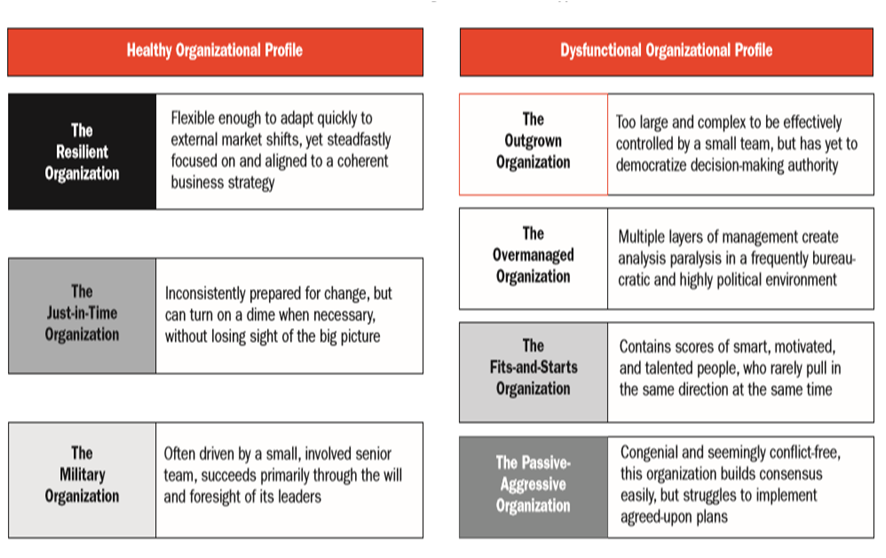
Based on Hamilton’s experience working with organizations, there are seven principal types of organizations- the first three are healthy and the latest four are unhealthy.
The listed below is an overview of organizational personality types 7 and 2.
The resilient organization: are flexible enough to adapt quickly to external market shift, forward looking, and fun, and they attract team players. The resilient organization is the healthiest of all the profiles because it always scans the horizon for the next competitive battle or market innovation.
The just in time organization: (JIT Organization)
This type of organization has demonstrated an ability to “turn on a dime” when necessary, without losing sight of big picture. JIT organization is inconsistently prepared for change by having attitudes that infuses the office and inspires creative outbursts.
The military organization: In such organizations, everyone knows his or her role and implements it diligently. This organization often driven by a small, involved senior team because it is hierarchical and operate under a highly controlled management model that allows it to efficiently execute large volumes of similar transactions.
The outgrown organization: This organization is too large and complex to be effectively controlled by a small team, but yet it has to democratize decision -making authority. Because power is closely held at the top, this organization tends to react slowly to market developments and often it cannot get out of its own way.
The over managed organization: Burdened with multiple layers of management, this organization is a case study in” analysis paralysis”. Managers in this organization spend their time checking subordinates work rather than scanning environment.
The fit and starts organization: Organizations contain scores of smart, motivated and talented people, who rarely pull in the same direction at the same time.
The passive aggressive organization: This is the seething, smiley-face organization. Making change isn’t problem in this organization, but implementing these changes is next to impossible. Management in passive aggressive organization struggles to implement agreed-upon plans.
The industrial companies have the important economical roles today in the growth and dynamism of the economy of any country. Thus, the models and researches that could help increase the effectiveness of organizations seem to be essential and vital. Therefore, identifying organizational personality types and its role on innovative performance could provide great roles in improving the innovative performance in organizations. Hence, this research aims to identifying the effect of the types of the organizational personality on innovative performance in Egyptian and international organization in Egypt.
There are many views concerning with innovation concept. 13 considers innovation as the process by which new knowledge is embraced into practice by organizations. Innovation is also new things or ideas 12. According to 8 innovation is the process of creating a commercial product from an invention.
Innovative performance has been measured by many metrics. 8 shows three areas that are time to market, product quality, and creation of customer value.
15 determines flexibility, continually improvement in quality and speed as an innovation performance metrics. 16 has been illustrated three areas: new product, product quality, and faster distribution. In a recent study conducted by 7 innovative performance is a function to time to market, product quality, and development cost 3. Finally, 3 determined three areas, depending on latest Hamilton experience working, that are speed of decision making about new opportunities, transparency-exchange of information between functions, and accountability:
Speed of decision making about new opportunities:
Means innovate faster than other competitors. Speed in decision making enable organizations to mobilize against new opportunities in order to capture first-to-market advantages as well as to respond quickly to changes in customer environment or to the actions of competitors.
Transparency-exchange of information between function:
Transparency is the properties that allow direction and action to be made visible through an organization. For effective innovation, transparency ensures that development priorities and efforts can aligned with strategic priorities.
Accountability:
It is the mechanism that ensures cross-functional commitments are taken seriously, and it establishes personal ownership for performance and outcomes.
Seven Organization Stereotypes
Based on Hamilton’s experience working with organizations, there are seven principal types of organizational personality- the first three are healthy and the latest four are unhealthy. The listed below is an overview of organizational stereotypes 8 and 9.
Resilient organizations are flexible enough to adapt quickly to external market shift, forward looking, fun, and they attract team players. The resilient organization is the healthiest of all the profiles because it always scans the horizon for the next competitive battle or market innovation.
This type of organization has demonstrated an ability to “turn on a dime” when necessary, without losing sight of big picture. JIT organization is inconsistently prepared for change by having attitudes that infuses the office and inspires creative outbursts.
In such organizations, everyone knows his or her role and implements it diligently. This organization often driven by a small, involved senior team because it is hierarchical and operate under a highly controlled management model that allows it to efficiently execute large volumes of similar transactions.
This organization is too large and complex to be effectively controlled by a small team, but yet it has to democratize decision -making authority. Because power is closely held at the top, this organization tends to react slowly to market developments and often it cannot get out of its own way.
Burdened with multiple layers of management, this organization is a case study in” analysis paralysis”. Managers in this organization spend their time checking subordinates work rather than scanning environment.
Organizations contain scores of smart, motivated and talented people, who rarely pull in the same direction at the same time.
This is the seething, smiley-face organization. Making change isn’t problem in this organization, but implementing these changes is next to impossible. Management in passive aggressive organization struggles to implement agreed-upon plans.
2.2. Innovation PerformanceInnovation performance has been measured by many metrics. 5 shows three areas that are time to market, product quality, and creation of customer value.
6 determines flexibility, continually improvement in quality, and speed as an innovation performance metrics. 7 has been illustrated three areas: new product, product quality, and faster distribution. In another study conducted by Hamilton innovation performance is a function to time to market, product quality, and development cost 9. Although there are many definitions for innovative performance, the definition that will be used in the current article was the done by 9 that determined three areas -depending on latest 7 Experience working- that are speed of decision making about new opportunities, transparency-exchange of information between functions, and accountability as the following:

Means innovate faster than other competitors. Speed in decision making enable organizations to mobilize against new opportunities to capture first-to-market advantages as well as to respond quickly to changes in customer environment or to the actions of competitors.
Transparency-Exchange of Information between Functions transparency is the properties that allow direction and action to be made visible through an organization. For effective innovation, transparency ensures that development priorities and efforts can aligned with strategic priorities.
Accountability is the mechanism that ensures cross-functional commitments are taken seriously, and it establishes personal ownership for performance and outcomes.
2.3. Types of the Organizations (Local Versus International Organizations)Organizations are complex and inter-related systems where the executive members affect, and are affected by, external social factors and influencing situations 18. Local organizations: have been established on participatory approach whose central purpose is to establish development activities bringing about positive change as four pillars of developments: to establish decentralized robust local organization for sustainable forest management to enhance livelihood of rural people, to meet the forest products basic needs of local people, targeted interventions for poverty alleviation and social mobilization initiatives and biodiversity conservation climate change mitigation and adaptation 18. Similarly, the local organizations are also legal organizations that involve their members from planning process to decision-making 1, International organizations are defined as any organization that operates in more than one country 10 and 17. Political science typically conceives of two kinds of international organizations: international governmental organizations (IGOs) and international non-governmental organizations (INGOs) 8; 14. Although both address global challenges through collective action 10, they utilize different mechanisms to achieve these goals 2 and 11.
There is one independent variable for the study which is types of the organizational personality (seven organizational personality stereotypes). There is one dependent variable which is innovative performance. There is one moderating variable namely type of the organizations (Egyptian or international). It shows the rational link between types of observed variables i.e. independent, moderating and dependent variables. From the above discussion.
The research will be trying to answer the following questions:
Q1: What is the relation between types of organizational personality and the innovative performance in Egyptian organizations.
Q2: What is the relation between types of organizational personality and the innovative performance in international organizations in Egypt.
Q3: To what extent the interaction between types of organizational personality and type of organization on their common effects on the innovative performance in the Egyptian organizations.
Q4: To what extent the interaction between types of organizational personality and type of organization on their common effects on the innovative performance in the international organizations in Egypt.
The following hypotheses were developed to decide if there is a significant correlation between Types of organizational personality (healthy and unhealthy organizational personality types) and innovative performance in comparing this effect in Egyptian and international organizations in Egypt.
H1: There is a significant correlation between the types of organizational personality and the innovative performance components in the Egyptian organizations.
H2: There is a correlation of statistical significance between the types of organizational personality and the innovative performance components in international organizations.
H3: There is statistically significant interaction between the types of the organizational personality and types of the organizations in their common effects on the innovative performance in the Egyptian organizations.
H4: There is statistically significant interaction between the types of the organizational personality and types of the organizations in their common effects on the innovative performance in the international organizations in Egypt.
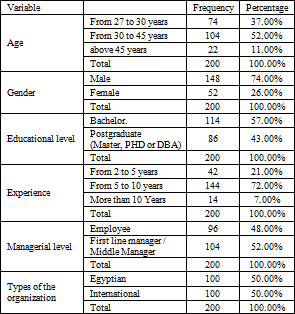
The population of the study included employees from Egyptian and international organizations in Egypt. The study includes 100 employees from Egyptian organizations and 100 employees from international organization in Egypt.
5.2. Procedure5.3. Research Variables and Methods of MeasuringThe study of data collected through questionnaires has three sources: the seven types of organizational personality, innovative performance dimensions and types of the organization (Egyptian or international organization) and basic respondent demographic data. The 21- items scale of types of organizational personality section (3 questions per each organizational personality type). There were nine items measuring innovative performance (3 items for speed of decision making, 3 items for accountability and 3 items for transparency). Responses to all item's scales were anchored on a five (5) point Likert scale for each statement which ranges from (5) “full agreement,” (4) for “agree,” (3) for “neutral,” (2) for “disagree,” and (1) for “full disagreement”.
5.4. Data Analysis and Testing HypothesesThe researcher has employed the following methods: (1) Cronbach's alpha, (2) Simple and multiple linear regression models, (3) Pearson's correlation coefficient and (4) T-test. All these tests are found in SPSS.
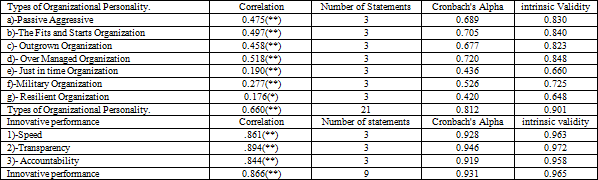
Cronbach's Alpha was used to assess the reliability of the scales. Item analysis indicated that dropping any items from the scales would not significantly raise the alphas. Table 2 the results of the reliability test for each variable of types of organizational personality and innovative performance.
To assess the reliability of the data, Cronbach’s alpha test was conducted. Table 2 shows the reliability results. All items (total of each variable) had alphas above 0.70 and were therefore excellent.
The 21 items of types of organizational personality scales are reliable since the Cronbach's Alpha is 0.812. Thus, the reliability of types of organizational personality scales can be acceptable. The 9 items of innovative performance scales are reliable because the Cronbach's Alpha is 0.931. The speed, which consists of 3 items, is reliable since the Cronbach's Alpha is 0.928. The three items related to transparency are reliable as Cronbach's Alpha is 0.946. Furthermore, the accountability, which consists of three items, is reliable since the Cronbach's Alpha is 0.919.
6.2. Types of Organizational personality and Innovative PerformanceThe relationship between Types of Organizational personality and Innovative Performance is determined. The first hypothesis to be tested is:
H1: There is a significant correlation between the types of organizational personality and the innovative performance components in the Egyptian organizations.
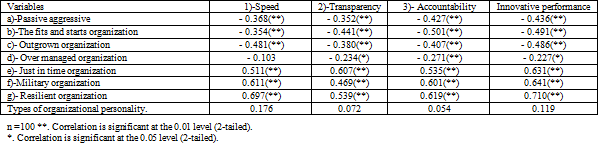
According to Table 3, there is statistically significant negative correlation between types of unhealthy organizational personality types (Passive aggressive, Fits and starts, Outgrown and overmanaged) and components of innovative performance (Speed, Transparency and accountability) in Egyptian organizations. There is a significant positive correlation between the types of healthy organizational personality (Just in time, Military and Resilient) and the components of innovative performance (Speed, Transparency and accountability) in the Egyptian organizations.
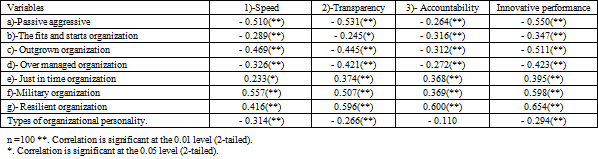
H2: There is a correlation of statistical significance between the types of organizational personality and the innovative performance components in international organizations. According to Table 4, there is statistically significant negative correlation between types of unhealthy organizational personality types (Passive aggressive, Fits and starts, Outgrown and overmanaged) and components of innovative performance (Speed, Transparency and accountability) in the international organizations in Egypt. There is a significant positive correlation between the types of healthy organizational personality (Just in time, Military and Resilient) and the components of innovative performance (Speed, Transparency and accountability) in the International organizations in Egypt.
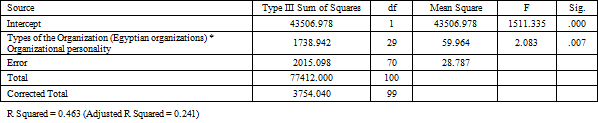
H3: There is statistically significance interactive effects between types of the organizations (as a moderating variable) and types of organizational personality (independent variable) on their common effects on innovative performance (dependent variable) in the Egyptian organizations. According to Table 5, there is statistically significant interaction by 24.1% between types of the organizational personality and type of the organizations (Egyptian organizations) in their common effects on the innovative performance in the Egyptians organizations.
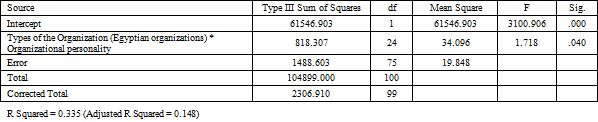
H4: There is statistically significance interactive effects between types of the organizations (as a moderating variable) and types of organizational personality (independent variable) on their common effects on innovative performance (dependent variable) in the international organizations in Egypt. According to Table 6, there is statistically significant interaction by 14.8% between types of the organizational personality and type of the organizations (international organizations in Egypt) in their common effects on the innovative performance in the international organizations in Egypt.
The present article on analyzing the relationship between types of the organizational personality and innovative performance and with types of organizations as a moderating variable has revealed the following results:
1) There is a statistically significant relationship between the types of the organizational personality (healthy or unhealthy) and the components of the innovative performance (as a dependent variable) in the Egyptian organizations.
2) There is a statistically significant relationship between the types of the organizational personality (healthy or unhealthy) and the components of the innovative performance (as a dependent variable) in the international organizations in Egypt.
3) There is a statistically significant interaction between types of organizational personality (as an independent variable) and the types of organizations (Egyptian organizations) on their effect on innovative performance (as a dependent variable)
4) There is a statistically significant interaction between types of organizational personality (as an independent variable) and the types of organizations (international organizations in Egypt) on their effect on innovative performance (as a dependent variable).
1-Employees in the Egyptian and international organizations in Egypt should detect the type of personality of their organizations by using survey such as online which had made by more than 234000 respondents.
2-Egyptian organizations should depend on consultant agencies or consultants from international organizations in order to adjust organizational structure (organogram) to get rid of complex managerial layers and bureaucracy which lead to "analysis paralysis syndrome" by dividing the organogram into business units and lines which decrease the probability of unhealthy organizations (over managed personality) and increase the innovative performance in local organizations.
3- Train executive managers and employees in Egyptian organizations to better use of authority and organizational empowerment in order to make the approved organizational plan be implanted on time to get rid of "a passive aggressive personality type" in Egyptian organizations.
4- Strategic and human resources management departments in Egyptian organizations should adjust the co-ordination and match operations activities between different organizational departments to repeat the successful organizational processes on regular basis. In addition, talent management department in Egyptian organizations should harmonize the ideas and effort ideas and effort of talented employees inside the organization.
Finally, it is better to decentralize the talent management department in order to facilitate the coordination between talented employees especially in Egyptian organizations which contain different scientific offices in different governates in Egypt, as this will help the Egyptian organization to get rid of unhealthy organizational personality (Fits and starts personality type)
5- Train the top and the middle managers in Egyptian organizations to use ascending and descending feedback (training of the group think phenomena), as this step help these managers to be aware of market demands and rapidly make changes according to market needs especially in large complex Egyptian organizations to decrease the probability of unhealth organizational personality type (Outgrown personality) and foster the innovative performance ability in Egyptian organizations.
6-The Egyptian organizations should train employees within all managerial layers to "change management " to make suitable changes according to market changes, the top managers should help all employees to be motivated to these changes by explaining the benefits of these changes to every employee in the organizations. "Risk management" should be taken inside the local organizations in order to get innovative ideas
1- There is negative correlation between types of unhealthy organizational personality (passive aggressive, fits and starts, outgrown and overmanaged) and the innovative performance in the international organizations in Egypt
2- There is positive correlation between types of healthy organizational personality (resilient, just in time and military) and the innovative performance in the international organizations in Egypt
3-There is negative correlation between types of unhealthy organizational personality (passive aggressive, fits and starts, outgrown and overmanaged) and the innovative performance in the Egyptian organizations
4-There is interaction between types of organizational personality and type of the organization (in the Egyptian organizations) on the effects of organizational personality on the innovative performance by 24% in the Egyptian organizations.
5-There is interaction between types of organizational personality and type of the organization (in the International organizations) on the effects of organizational personality on the innovative performance by 14.8% in the international organizations in Egypt
| [1] | Agrawal, A., and Ostrom, E. (2001). Collective action, property rights, and decentralization in resource use in India and Nepal. Politics and Society, 29(4), 485-514. | ||
| In article | View Article | ||
| [2] | Boehmer, C., and Nordstrom, T. (2008). Intergovernmental organization memberships: Examining political community and the attributes of international organizations. International Interactions, 34(3), 282-309. | ||
| In article | View Article | ||
| [3] | Bordia, R., Kronenberg, E., & Neely, D. (2005). Innovations Organizational DNA. Retrieved from http://www.boozallen.com. | ||
| In article | |||
| [4] | Daft, R. (2001). Organization Theory & Design. South-Western College Publishing. | ||
| In article | |||
| [5] | Gharmy, B. (2006). The Factor of Organizational DNA. Harvard Business, 119, 3-10. | ||
| In article | |||
| [6] | Govindarajan, V., & Trimble, C. (2006). Organizational DNA for Structure Innovation, Management Span and Layers. Retrieved from http://www.Orgdna.com. | ||
| In article | |||
| [7] | Hamilton, B. (2005). Organizational DNA. Retrieved from http://www.boozallen.com. | ||
| In article | |||
| [8] | Hitt,M. Duaneirel and, R. Hoskission, R. (2001), Strategic Management :Competitiveness & Globalization, south-westren college publishing | ||
| In article | |||
| [9] | Hodge, B. J., Anthony, W. P., & Gales, L. M. (1991). Organizational Theory: A strategic approach. | ||
| In article | |||
| [10] | Iriye, A. (2004). Global community: The role of international organizations in the making of the contemporary world. International Relations of Asia Pacific, 4(1), 204-206. | ||
| In article | View Article | ||
| [11] | Kajimbwa, M. (2006). NGOs and their role in the global south. Int'l J. Not-for-Profit L., 9, 58. | ||
| In article | |||
| [12] | Macmillan H. & Tampoe, M. (2000), Strategic Management: process content and Implementation , Oxford University Press. | ||
| In article | |||
| [13] | McElroy, M. W. (2000). Integrating complexity theory, knowledge management and organizational learning. Journal of knowledge management, 4(3), 195-203. | ||
| In article | View Article | ||
| [14] | Rey, D., and Barkdull, J. (2005). Why do some democratic countries join more intergovernmental organizations than others? Social Science Quarterly, 86(2), 386402. | ||
| In article | View Article | ||
| [15] | Robbins, S.P (2003), Organizational Behavior, Person Education, Inc. Upper Saddle River, New Jersey | ||
| In article | |||
| [16] | Wheelen, T. L., & Hunger, J. D. (2004). Strategic Management and Business Policy: Concepts (9th ed.). Pearson Education, Inc., Upper Saddle River. | ||
| In article | |||
| [17] | Womack, R. (2010). International organizations. Journal of Business and Finance Librarianship, 15(2), 123-123. | ||
| In article | View Article | ||
| [18] | Yadav, B. D., Bigsby, H., and MacDonald, I. (2015). The relative distribution: An alternative approach to evaluate the impact of community level forestry organizations on households. Land Use Policy, 42, 443-449. | ||
| In article | View Article | ||
Published with license by Science and Education Publishing, Copyright © 2020 Amgad Bahaa EL Din Abdel-Raheem and Mohamed Saad
 This work is licensed under a Creative Commons Attribution 4.0 International License. To view a copy of this license, visit
http://creativecommons.org/licenses/by/4.0/
This work is licensed under a Creative Commons Attribution 4.0 International License. To view a copy of this license, visit
http://creativecommons.org/licenses/by/4.0/
| [1] | Agrawal, A., and Ostrom, E. (2001). Collective action, property rights, and decentralization in resource use in India and Nepal. Politics and Society, 29(4), 485-514. | ||
| In article | View Article | ||
| [2] | Boehmer, C., and Nordstrom, T. (2008). Intergovernmental organization memberships: Examining political community and the attributes of international organizations. International Interactions, 34(3), 282-309. | ||
| In article | View Article | ||
| [3] | Bordia, R., Kronenberg, E., & Neely, D. (2005). Innovations Organizational DNA. Retrieved from http://www.boozallen.com. | ||
| In article | |||
| [4] | Daft, R. (2001). Organization Theory & Design. South-Western College Publishing. | ||
| In article | |||
| [5] | Gharmy, B. (2006). The Factor of Organizational DNA. Harvard Business, 119, 3-10. | ||
| In article | |||
| [6] | Govindarajan, V., & Trimble, C. (2006). Organizational DNA for Structure Innovation, Management Span and Layers. Retrieved from http://www.Orgdna.com. | ||
| In article | |||
| [7] | Hamilton, B. (2005). Organizational DNA. Retrieved from http://www.boozallen.com. | ||
| In article | |||
| [8] | Hitt,M. Duaneirel and, R. Hoskission, R. (2001), Strategic Management :Competitiveness & Globalization, south-westren college publishing | ||
| In article | |||
| [9] | Hodge, B. J., Anthony, W. P., & Gales, L. M. (1991). Organizational Theory: A strategic approach. | ||
| In article | |||
| [10] | Iriye, A. (2004). Global community: The role of international organizations in the making of the contemporary world. International Relations of Asia Pacific, 4(1), 204-206. | ||
| In article | View Article | ||
| [11] | Kajimbwa, M. (2006). NGOs and their role in the global south. Int'l J. Not-for-Profit L., 9, 58. | ||
| In article | |||
| [12] | Macmillan H. & Tampoe, M. (2000), Strategic Management: process content and Implementation , Oxford University Press. | ||
| In article | |||
| [13] | McElroy, M. W. (2000). Integrating complexity theory, knowledge management and organizational learning. Journal of knowledge management, 4(3), 195-203. | ||
| In article | View Article | ||
| [14] | Rey, D., and Barkdull, J. (2005). Why do some democratic countries join more intergovernmental organizations than others? Social Science Quarterly, 86(2), 386402. | ||
| In article | View Article | ||
| [15] | Robbins, S.P (2003), Organizational Behavior, Person Education, Inc. Upper Saddle River, New Jersey | ||
| In article | |||
| [16] | Wheelen, T. L., & Hunger, J. D. (2004). Strategic Management and Business Policy: Concepts (9th ed.). Pearson Education, Inc., Upper Saddle River. | ||
| In article | |||
| [17] | Womack, R. (2010). International organizations. Journal of Business and Finance Librarianship, 15(2), 123-123. | ||
| In article | View Article | ||
| [18] | Yadav, B. D., Bigsby, H., and MacDonald, I. (2015). The relative distribution: An alternative approach to evaluate the impact of community level forestry organizations on households. Land Use Policy, 42, 443-449. | ||
| In article | View Article | ||