This study explores the relationship between talent management and organizational performance within private banks in Bangladesh. Drawing on both primary data collected through a structured questionnaire of 115 bank employees and secondary sources including published reports, a quantitative research approach was employed. The questionnaire utilized a five-point Likert scale to measure perceptions of talent management practices. Data analysis involved chi-square tests to assess associations and regression analysis to evaluate the impact of talent management on bank performance, using SPSS version 26. Results confirm a significant positive correlation between talent management and employee performance, and demonstrate that talent management substantially influences overall bank success. The findings highlight the importance of strategic talent management initiatives in driving sustainable competitive advantage in the banking industry.
A structured process is necessary for an organization to do a number of tasks, including attracting applicants, choosing, developing, and training them, as well as guaranteeing the best performance possible from highly qualified workers. We call this procedure talent management. Supporting its competent staff is essential for a firm to gain a competitive edge. The organization's top management must be devoted and committed to effective talent management 1.
Commercial banks need to put in place a talent management strategy that prioritizes the education, growth, and retention of qualified staff. The workforce will grow more talented and dedicated the more investment banks engage in their employees' professional development 2. Within a company, talent management is a methodical process that involves a range of activities and administrative strategies. In order to draw in additional talent, banks should use a variety of approaches, making sure that these efforts closely correspond with the goals of the company.
In order to carve out distinct market niches for themselves, businesses should prioritize talent management procedures and work to build a favorable company image 3. Organizations can thrive in the competitive marketplace by placing a high priority on effective talent management. Talented employees feel valued and are driven to contribute more to the achievement of organizational goals, so employers should strive to keep them. Employee loyalty and experience also rise as a result of this. The three main facets of talent management—talent attraction and selection, training and development, and retention—need to be understood by managers. Organizations need to know how to carry out these tasks well and have a thorough understanding of these determinants in order to succeed 4.
The focal point of this study is to identify the impression of managing talent on getting the best job performance in banking sector.
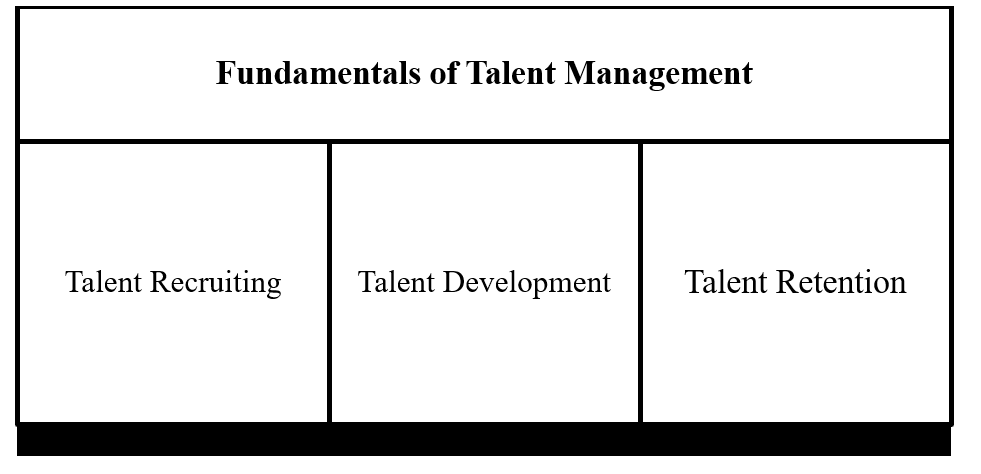
Given its direct correlation to an organization's performance, talent management is an essential component 3. Three key components make up effective talent management: 1. Recruiting and choosing talent; 2. Maintaining talent; and 3. Developing talent. The key elements of talent management are talent attraction and selection, which concentrate on finding, luring, and selecting the most qualified applicants for a company. In order to make sure that the organization hires people who not only have the necessary talents but also mesh well with the company culture and values, this process entails a number of tactics and procedures.
The term "talent attraction" describes an organization's initiatives to entice qualified applicants to submit applications for available positions. This can be accomplished in a number of ways, including by providing competitive benefits, recruiting marketing, and employer branding 5. For example, Google is well known for its creative and welcoming work environment. The organization draws in top people by highlighting its distinctive workplace, chances for professional advancement, and first-rate benefits. Google demonstrates its dedication to innovation and employee well-being through its presence on social media, involvement in job fairs, and recruitment films 6.
Assessing and selecting the top applicants from the application pool is the process of talent selection. The purpose of this procedure is to make sure that the candidates fit the job criteria and are consistent with the organization's values 7. It consists of several steps, including resume screening, evaluations, interviews, and background checks. For example, AI-driven interviews and online games are two components of Unilever's digital hiring process. Using this method aids the business in determining the cognitive, emotional, and cultural fit of individuals. Unilever has been able to expedite hiring and draw in tech-savvy personnel thanks to the creative selection process 8, 9.
The tactics and procedures used by businesses to hold onto their best workers and lower attrition are referred to as talent retention strategies. Keeping on qualified workers is essential for continuity, creating a happy workplace, and cutting down on the expenses of recruiting and onboarding new hires 10. For examples, Netflix places a strong emphasis on giving its staff members a lot of autonomy and accountability. In addition to flexible work hours and unlimited vacation time, the company allows its employees to concentrate on projects that pique their interest 11. Netflix is able to retain top personnel who value autonomy and creativity by cultivating a culture of trust and empowerment 12.
The plans and initiatives put in place by businesses to improve the competencies, expertise, and skills of their workforce are referred to as talent development initiatives. With the goal of maximizing employee potential and coordinating personal aspirations with corporate objectives, this process includes opportunities for professional development, ongoing learning, and assistance with career promotion 13. For example, regardless of whether the abilities are applicable to a career at Amazon, the company's "Career Choice" initiative prepays 95% of the tuition for employees to pursue degrees in in-demand disciplines. This program exemplifies Amazon's dedication to advancing workers' long-term professional goals 14. Within each of its sections, the firm provides extensive training programs and chances for ongoing development.
Employers should provide career management services to staff members in order to encourage dedication and drive. Employees can establish a sense of career identity and match their objectives with the organization's by being given opportunities for self-improvement 15. Employee commitment may be easily increased and the organization can move closer to its goals when senior management supports career management activities 16. It is underlined the significance of firms managing their workforces carefully, pointing out that neglecting to do so might lead to poorer performance levels and impede success 17. Organizations must therefore give this component top priority.
Since employee commitment forges a solid connection between workers and the company, it is essential to the success of the latter. Early goal integration between personnel and the organization promotes higher levels of commitment. 18 Employee loyalty and commitment can be fostered by offering assistance, just compensation, clear incentives, and a supportive work environment 15. Organizations need to prioritize developing devoted employees since they are so important.
The literature on talent management emphasizes how effectively using organizational talent can boost performance and achieve employee commitment. On the other hand, luring, nurturing, and keeping talented workers present formidable obstacles. To thrive, firms must give top priority to all facets and procedures related to talent management 19.
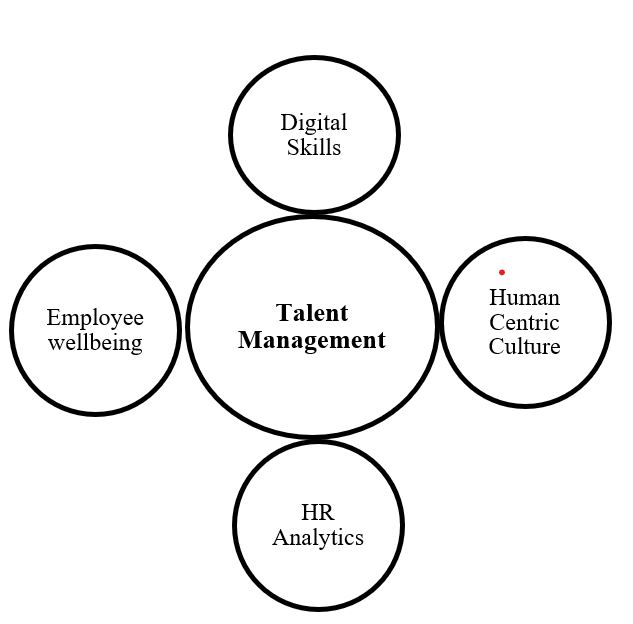
Organizations looking to improve their competitiveness in the complicated and volatile global and dynamic economy of today will find that human talent is becoming more and more important. Talent management is a critical job that supervises the entire talent lifecycle, regardless of location, from talent acquisition to development and retention. Organizational leadership support, sufficient infrastructure, and investments in modern HRIS are all necessary for effective people management 20. Four essential elements make up a framework that is based on literature and reflects the state of the world today: employee well-being, human resource analytics, digital skills, and a human-centric culture (Figure 1).
Human resources are currently implementing digital solutions that offer new experiences and improve corporate performance and employee engagement. For multinational firms, digitization presents a big challenge, especially when it comes to luring and keeping top people. A further obstacle is that HR departments are not actively involved in providing employees with digital skills, which makes talent acquisition more competitive.
Digital platforms are currently the link between Big Data analytics and improving organizational performance in the IT industry. Young professionals need to specialize in technology and use automation platforms skillfully in their professions given the changing nature of the business sector. In the workplace of the future, a human-centric approach will take precedence over task-centricity, thereby enhancing employee involvement and maximizing productivity. Planning and execution are integrated, users are given authority over technology and work processes, human competences are promoted, and a positive, socially engaged work environment is created by a human-centric culture 21. An organizational culture like this is essential for fostering innovation, especially in the face of internal and external shifts that put current business models to the test. Experiences with empathy are frequently thought to be important markers of a culture that values people 4.
In order to achieve the needs of various business sections and employee demographics, a change towards prioritizing employee benefits and perceived value is anticipated, facilitated by a human-centric culture 22. Evidence-based decision-making is aided by human resource analytics, which can result in enhanced performance and a competitive edge. These analytics can range from simple reporting to predictive modeling 23. Better results can be achieved using HR analytics that evaluate the connection between HR procedures and business impact. The pressures on the labor to deliver goods and services have grown dramatically in today's interconnected global economy, which has a negative effect on workers' health and well-being 24. A wider understanding of the possibility for a healthier, happier, and more productive workforce has replaced the conventional organizational focus on problems like absenteeism and workplace injuries 25. When employers and employees have similar interests when designing environments, organizations can achieve greater profitability and performance. This means establishing an environment at work where workers see real financial and psychological gains from the company's success 26. Three essential components support employee well-being: opportunities for long-term career advancement inside the company, continual skill development to guarantee employability throughout one's career, and acknowledgment and gratitude for well-done work 27.
Encouraging employee well-being in the workplace is essentially synonymous with cultivating an organizational culture that is both high-performing and compassionate 28. This strategy helps to increase employee engagement and satisfaction while also improving their long-term employability and the performance of the company.
In many different industries, talent management has a significant impact on an organization's ability to succeed and endure. Fundamentally, talent management is the deliberate process of drawing in, nurturing, and keeping brilliant brain who are critical to the accomplishment of organizational objectives. Organizations can make sure they have the appropriate people in the right roles with the skills and capabilities to drive performance and innovation by identifying and developing top talent. Through talent management strategies like hiring, training, performance reviews, and succession planning, businesses may develop a flexible and adaptable staff that can change with the needs of the market. Effective personnel management also promotes a culture of empowerment, engagement, and ongoing learning among staff members, all of which boost morale, creativity, and productivity. Organizations that emphasize personnel management are better positioned to negotiate obstacles, seize opportunities, and maintain a competitive edge in the market in today's dynamic and competitive business world. As a result, talent management promotes growth, profitability, and long-term sustainability, all of which are essential components of organizational success.
Organizations use talent management methods to maximize the performance and potential of their staff through a variety of strategic initiatives. The first step in these procedures is talent acquisition, which entails finding, luring, and employing people whose values and skill set complement the needs and culture of the company. New personnel are incorporated into the company's atmosphere and expectations through planned onboarding programs after they join. The next step is talent development, which emphasizes lifelong learning and skill improvement through mentoring, training courses, and professional growth opportunities 20. Another essential procedure is performance management, which includes goal-setting, performance reviews, and frequent feedback to make sure staff members are fulfilling their responsibilities and developing professionally. By ensuring that competent individuals are prepared to assume important roles, succession planning protects the company against future leadership voids. Additionally, by creating a supportive and upbeat work atmosphere, employee engagement programs including wellness initiatives, work-life balance support, and recognition programs aid in the retention of top talent. When combined, these individual management techniques offer a unified strategy that fosters long-term success and growth while simultaneously enhancing individual and organizational performance.
The three fundamental parts of talent management in a continuous cycle, showing how they are related and necessary for efficient talent management 19, 20
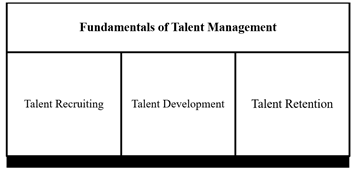
• Hiring and Recruiting: This entails drawing in and choosing the best applicants for the company.
• Onboarding: The process of effectively integrating new hires into the team so they can start contributing right away.
7.2. Development of TalentGiving workers the chance to develop professionally and learn new things. This involves initiatives to improve employees' skills through training, mentoring, and career development.
7.3. Retaining TalentPutting several plans into action to keep high achievers in the company. This could involve offering competitive pay, chances for job progression, acknowledgment, and fostering a happy workplace.
The following theories have been developed in light of the materials mentioned above.
H1: There is a correlation between talent management and bank’s performance.
H2: The bank's success is impacted by talent management.
Both primary and secondary data have been used in the data collecting process. A structured questionnaire survey was used to collect primary information and publishes reports and existing literature were used to obtain secondary data. The study, which focused on a sample of 115 workers from various private banks in Bangladesh, employed a quantitative research design. To ensure gender representation, a convenient sampling method was used to select respondents.
The questionnaire featured closed-ended questions designed with a five-point Likert scale, where 1 represented "strongly agree," 2 "agree," 3 "neutral," 4 "disagree," and 5 "Strongly disagree." The Likert scale categories were established following standard procedures.
To analyze the data, a chi-square test was conducted to examine the association between talent management and employee performance, and a regression analysis was employed to assess the impact of talent management on the performance of banks. The hypotheses were tested using statistical analysis in SPSS software, version 26.
Reliability Statistics reports a Cronbach’s Alpha value of 0.821, indicating a high level of internal consistency among the eight items measured in the study. A Cronbach’s Alpha above 0.7 is generally deemed acceptable, and values exceeding 0.8 are considered good. This suggests that the data collected in the study is reliable and that the items measured consistently reflect the underlying constructs.
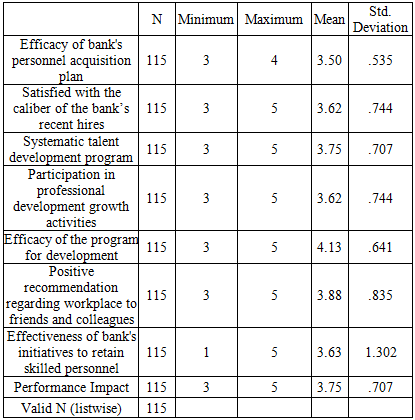
The descriptive statistics summarize the responses regarding the bank's talent management practices. The mean scores for various aspects, such as the effectiveness of the bank's talent acquisition strategy (3.50) and the satisfaction with the quality of new hires (3.62), suggest generally positive perceptions, with standard deviations of 0.5351 and 0.744, respectively, indicating moderate consistency in responses. The structured talent development program received a higher mean score of 3.75, with a standard deviation of 0.707, reflecting relatively consistent satisfaction. Participation in professional development activities and the effectiveness of these programs were rated similarly, with means of 3.62 and 4.13, and standard deviations of 0.744 and 0.641, respectively. Recommendations for the bank as a good place to work received a mean score of 3.88, with more variability in responses (standard deviation of 0.835). The effectiveness of the bank’s efforts to retain talented employees had a mean of 3.63 but with a higher standard deviation of 1.302, indicating more diverse opinions. Finally, the impact on performance was rated with a mean of 3.75 and a standard deviation of 0.707, showing relatively consistent agreement. Overall, the data reflect a positive perception of the bank's talent management strategies, with some areas showing more variability in responses.
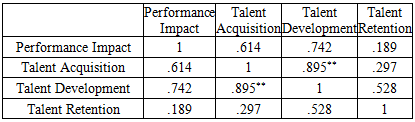
Table 3 reveals the relationships between key variables in the study. Performance Impact has a moderate positive correlation with both Talent Acquisition (r=0.614) and Talent Development (r=0.742), indicating that improvements in these areas are associated with better performance outcomes. However, it shows only a weak correlation with Talent Retention (r=0.189), suggesting that retention efforts may not directly influence performance as strongly. Talent Acquisition is strongly correlated with Talent Development (r=0.895), highlighting a close connection between these two aspects, and it also has a moderate correlation with Talent Retention (r=0.297). Additionally, Talent Development shows a moderate correlation with Talent Retention (r=0.528), indicating that effective development programs are linked to better retention outcomes. Overall, these correlations suggest that while all these factors are interrelated, Talent Acquisition and Development are more strongly tied to performance and each other than to Talent Retention.
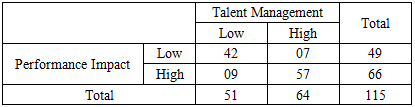
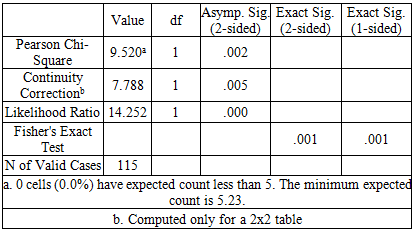
The crosstabulation analysis between performance impact and talent management reveals a strong association. Specifically, 57 out of 66 cases with high performance impact also exhibited high talent management. Similarly, 42 out of 49 cases with low performance impact were associated with low talent management. The Pearson Chi-Square test yielded a value of 9.520, with a significance level of 0.002, confirming that the relationship between talent management and performance impact is statistically significant.
The R-squared value of 0.620 indicates that about 62% of the variance in performance impact can be attributed to the bank's talent management practices. The adjusted R-squared value, which accounts for the number of predictors in the model, is slightly lower at 0.575. This adjustment provides a more accurate reflection of the model's explanatory power. The standard error of the estimate is 0.316, signifying the average deviation of the observed values from the regression line, and offering insight into the model's precision.
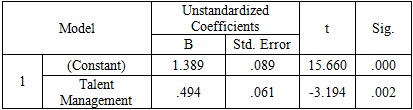
The constant value of 1.389, with a standard error of 0.089, represents the baseline level of performance impact when talent management is absent. The coefficient for talent management is 0.494, with a standard error of 0.061, indicating that effective talent management positively influences performance. The negative t-value of -3.194 and the p-value of 0.002 further confirm that this impact is statistically significant, suggesting that improvements in talent management are likely to lead to enhanced performance outcomes.
Finally the result of hypothesis test suggest that there is an association between talent management and performance of the bank. And also bank's success is impacted by talent management.
In the current competitive environment, "talent management" has become essential for businesses. Skilled personnel are essential to a company's ability to obtain an advantage in the competition for success. This study demonstrates how good talent management improves staff motivation and bank performance, which in turn raises commitment, customer satisfaction, and overall business success. In the end, a fair and encouraging work environment helps to retain top personnel and accomplish organizational goals by boosting morale, encouraging employee loyalty, and improving the organization's reputation.
| [1] | ARMSTRONG, M. (2001). Human Resource Management. London: Kegan Page Limited, London. | ||
| In article | |||
| [2] | Ashton, C. &. (2005). Managing Talent for Competitive Advantage: Taking a Systemic Approach to Talent Management. . Strategic HR Review, 28-31. | ||
| In article | View Article | ||
| [3] | Wright, P. M. (2012). Strategic HRM and organizational behavior: Integrating multiple levels of analysis. In J. Paauwe, D. E. Guest, & P. M. Wright (Eds.), HRM and performance: Achievements and challenges (pp. 97–110). Wiley. | ||
| In article | View Article | ||
| [4] | Dalahmeh, M. L. (2020). TALENT MANAGEMENT: A SYSTEMATIC REVIEW. Oradea Journal of Business and Economics, Volume V, Special Issue, 116-123. | ||
| In article | View Article | ||
| [5] | Backhaus, K., & Tikoo, S. (2004). Conceptualizing and researching employer branding. Career Development International, 9(5), 501–517. D. M. (2004). The knowledge value chain: how intellectual. International Journal of Technology, 575-590. | ||
| In article | View Article | ||
| [6] | Sullivan, J. (2007, March 26). Google: The ultimate example of recruiting innovation and excellence. ERE Media. https://www.ere.net/google-the-ultimate-example-of-recruiting-innovation-and-excellence/. | ||
| In article | |||
| [7] | Gatewood, R. D., Feild, H. S., & Barrick, M. R. (2015). Human resource selection (8th ed.). Cengage Learning. | ||
| In article | |||
| [8] | Dastin, J. (2019, October 25). Unilever sees success using AI to hire employees. Reuters. https://www.reuters.com/article/us-unilever-ai-hiring-idUSKBN1X41DL. | ||
| In article | |||
| [9] | Van Esch, P., Black, J. S., & Ferolie, J. (2019). Marketing AI recruitment: The next phase in job application and selection. Computers in Human Behavior, 90, 215–222. | ||
| In article | View Article | ||
| [10] | Hausknecht, J. P., Rodda, J., & Howard, M. J. (2009). Targeted employee retention: Performance‐based and job‐related differences in reported reasons for staying. Human Resource Management, 48(2), 269–288. | ||
| In article | View Article | ||
| [11] | Hastings, R., & McCord, P. (2009). Netflix culture: Freedom & responsibility. Netflix. https://jobs.netflix.com/culture. | ||
| In article | |||
| [12] | McCord, P. (2014). How Netflix reinvented HR. Harvard Business Review. https://hbr.org/2014/01/how-netflix-reinvented-hr. | ||
| In article | |||
| [13] | Garavan, T. N., Carbery, R., & Rock, A. (2012). Mapping talent development: Definition, scope and architecture. European Journal of Training and Development, 36(1), 5–24. | ||
| In article | View Article | ||
| [14] | Weise, K., & Conger, K. (2021, September 9). Amazon plans to pay college tuition for most of its 750,000 hourly workers in the U.S. The New York Times. https:// www.nytimes.com/ 2021/09/09/technology/amazon-workers-college-tuition.html. | ||
| In article | |||
| [15] | Mowdey, R. P. (1981). Organizational linkage: the psychology of. | ||
| In article | |||
| [16] | Sturges, J., Guest, D., Conway, N., & Davey, K. M. (2002). A longitudinal study of the relationship between career management and organizational commitment among graduates in the first ten years at work. Journal of Organizational Behavior, 23(6), 731–748. | ||
| In article | View Article | ||
| [17] | Carlucci, D. M. (2004). The knowledge value chain: how intellectual. International Journal of Technology, 575-590. | ||
| In article | View Article | ||
| [18] | Hall, D. a. (1972). Correlates of organizational identification as a function of career pattern and organizational type. In Academy of Management, 159-161. | ||
| In article | View Article | ||
| [19] | akkas. (2012). Management Act. Newyork: Progati. | ||
| In article | |||
| [20] | Dessler, G. (2013). Human Resource Management. Pearson, 2013. | ||
| In article | |||
| [21] | De Smet, A., Lund, S., Madgavkar, A., Manyika, J., & Schaninger, B. (2016). Organizing for the future: Why now?. McKinsey & Company. https://www.mckinsey.com/business-functions/people-and-organizational-performance/our-insights/organizing-for-the-future-why-now Top of Form. | ||
| In article | |||
| [22] | Marler, J. H., & Boudreau, J. W. (2017). An evidence-based review of HR Analytics. The International Journal of Human Resource Management, 28(1), 3–26. | ||
| In article | View Article | ||
| [23] | Deloitte. (2017). Rewriting the rules for the digital age: 2017 Deloitte Global Human Capital Trends. Deloitte University Press. https://www2.deloitte.com/content/dam/Deloitte/global/Documents/HumanCapital/hc-trends-2017.pdf. | ||
| In article | |||
| [24] | Grant, A. M., Christianson, M. K., & Price, R. H. (2007). Happiness, health, or relationships? Managerial practices and employee well-being tradeoffs. Academy of Management Perspectives, 21(3), 51–63. | ||
| In article | View Article | ||
| [25] | World Health Organization. (2010). Healthy workplaces: A model for action – For employers, workers, policymakers and practitioners. https:// www.who.int/ publications/ i/item/ 9789241599313. | ||
| In article | |||
| [26] | Harter, J. K., Schmidt, F. L., & Keyes, C. L. M. (2003). Well-being in the workplace and its relationship to business outcomes: A review of the Gallup studies. Flourishing: Positive psychology and the life well-lived, 2, 205–224. | ||
| In article | View Article | ||
| [27] | Deci, E. L., Olafsen, A. H., & Ryan, R. M. (2017). Self-determination theory in work organizations: The state of a science. Annual Review of Organizational Psychology and Organizational Behavior, 4, 19–43. | ||
| In article | View Article | ||
| [28] | JA Dargham, A. C. (2013). Conference on Engineering Education., (pp. 131-135). | ||
| In article | View Article | ||
Published with license by Science and Education Publishing, Copyright © 2025 Professor Gopal Chandra Saha, Aditi Roy and Suma Akther
 This work is licensed under a Creative Commons Attribution 4.0 International License. To view a copy of this license, visit
http://creativecommons.org/licenses/by/4.0/
This work is licensed under a Creative Commons Attribution 4.0 International License. To view a copy of this license, visit
http://creativecommons.org/licenses/by/4.0/
| [1] | ARMSTRONG, M. (2001). Human Resource Management. London: Kegan Page Limited, London. | ||
| In article | |||
| [2] | Ashton, C. &. (2005). Managing Talent for Competitive Advantage: Taking a Systemic Approach to Talent Management. . Strategic HR Review, 28-31. | ||
| In article | View Article | ||
| [3] | Wright, P. M. (2012). Strategic HRM and organizational behavior: Integrating multiple levels of analysis. In J. Paauwe, D. E. Guest, & P. M. Wright (Eds.), HRM and performance: Achievements and challenges (pp. 97–110). Wiley. | ||
| In article | View Article | ||
| [4] | Dalahmeh, M. L. (2020). TALENT MANAGEMENT: A SYSTEMATIC REVIEW. Oradea Journal of Business and Economics, Volume V, Special Issue, 116-123. | ||
| In article | View Article | ||
| [5] | Backhaus, K., & Tikoo, S. (2004). Conceptualizing and researching employer branding. Career Development International, 9(5), 501–517. D. M. (2004). The knowledge value chain: how intellectual. International Journal of Technology, 575-590. | ||
| In article | View Article | ||
| [6] | Sullivan, J. (2007, March 26). Google: The ultimate example of recruiting innovation and excellence. ERE Media. https://www.ere.net/google-the-ultimate-example-of-recruiting-innovation-and-excellence/. | ||
| In article | |||
| [7] | Gatewood, R. D., Feild, H. S., & Barrick, M. R. (2015). Human resource selection (8th ed.). Cengage Learning. | ||
| In article | |||
| [8] | Dastin, J. (2019, October 25). Unilever sees success using AI to hire employees. Reuters. https://www.reuters.com/article/us-unilever-ai-hiring-idUSKBN1X41DL. | ||
| In article | |||
| [9] | Van Esch, P., Black, J. S., & Ferolie, J. (2019). Marketing AI recruitment: The next phase in job application and selection. Computers in Human Behavior, 90, 215–222. | ||
| In article | View Article | ||
| [10] | Hausknecht, J. P., Rodda, J., & Howard, M. J. (2009). Targeted employee retention: Performance‐based and job‐related differences in reported reasons for staying. Human Resource Management, 48(2), 269–288. | ||
| In article | View Article | ||
| [11] | Hastings, R., & McCord, P. (2009). Netflix culture: Freedom & responsibility. Netflix. https://jobs.netflix.com/culture. | ||
| In article | |||
| [12] | McCord, P. (2014). How Netflix reinvented HR. Harvard Business Review. https://hbr.org/2014/01/how-netflix-reinvented-hr. | ||
| In article | |||
| [13] | Garavan, T. N., Carbery, R., & Rock, A. (2012). Mapping talent development: Definition, scope and architecture. European Journal of Training and Development, 36(1), 5–24. | ||
| In article | View Article | ||
| [14] | Weise, K., & Conger, K. (2021, September 9). Amazon plans to pay college tuition for most of its 750,000 hourly workers in the U.S. The New York Times. https:// www.nytimes.com/ 2021/09/09/technology/amazon-workers-college-tuition.html. | ||
| In article | |||
| [15] | Mowdey, R. P. (1981). Organizational linkage: the psychology of. | ||
| In article | |||
| [16] | Sturges, J., Guest, D., Conway, N., & Davey, K. M. (2002). A longitudinal study of the relationship between career management and organizational commitment among graduates in the first ten years at work. Journal of Organizational Behavior, 23(6), 731–748. | ||
| In article | View Article | ||
| [17] | Carlucci, D. M. (2004). The knowledge value chain: how intellectual. International Journal of Technology, 575-590. | ||
| In article | View Article | ||
| [18] | Hall, D. a. (1972). Correlates of organizational identification as a function of career pattern and organizational type. In Academy of Management, 159-161. | ||
| In article | View Article | ||
| [19] | akkas. (2012). Management Act. Newyork: Progati. | ||
| In article | |||
| [20] | Dessler, G. (2013). Human Resource Management. Pearson, 2013. | ||
| In article | |||
| [21] | De Smet, A., Lund, S., Madgavkar, A., Manyika, J., & Schaninger, B. (2016). Organizing for the future: Why now?. McKinsey & Company. https://www.mckinsey.com/business-functions/people-and-organizational-performance/our-insights/organizing-for-the-future-why-now Top of Form. | ||
| In article | |||
| [22] | Marler, J. H., & Boudreau, J. W. (2017). An evidence-based review of HR Analytics. The International Journal of Human Resource Management, 28(1), 3–26. | ||
| In article | View Article | ||
| [23] | Deloitte. (2017). Rewriting the rules for the digital age: 2017 Deloitte Global Human Capital Trends. Deloitte University Press. https://www2.deloitte.com/content/dam/Deloitte/global/Documents/HumanCapital/hc-trends-2017.pdf. | ||
| In article | |||
| [24] | Grant, A. M., Christianson, M. K., & Price, R. H. (2007). Happiness, health, or relationships? Managerial practices and employee well-being tradeoffs. Academy of Management Perspectives, 21(3), 51–63. | ||
| In article | View Article | ||
| [25] | World Health Organization. (2010). Healthy workplaces: A model for action – For employers, workers, policymakers and practitioners. https:// www.who.int/ publications/ i/item/ 9789241599313. | ||
| In article | |||
| [26] | Harter, J. K., Schmidt, F. L., & Keyes, C. L. M. (2003). Well-being in the workplace and its relationship to business outcomes: A review of the Gallup studies. Flourishing: Positive psychology and the life well-lived, 2, 205–224. | ||
| In article | View Article | ||
| [27] | Deci, E. L., Olafsen, A. H., & Ryan, R. M. (2017). Self-determination theory in work organizations: The state of a science. Annual Review of Organizational Psychology and Organizational Behavior, 4, 19–43. | ||
| In article | View Article | ||
| [28] | JA Dargham, A. C. (2013). Conference on Engineering Education., (pp. 131-135). | ||
| In article | View Article | ||