Inadequate application of risk management strategies typically results in poor performance of real estate projects. The dismal risk management contributes to cost overruns, project delays, and substandard construction quality all factors that undermine investor confidence and threaten the overall sustainability of the real estate sector. The achievement of real estate projects often falls short due to insufficient application of risk management practices. Although numerous established methods and tools exist for managing risks in large-scale projects, the real estate sector faces unique challenges. Notably, the widespread development of properties on disputed land presents substantial risks to both buyers and investors. In Nairobi City, approximately 30% of property transactions involve unresolved legal disputes. This research aimed to explore how risk management strategies affected the performance of selected real estate companies within Nairobi City County, Kenya. Specifically, it sought to evaluate the impact of risk identification, risk assessment, risk mitigation, and risk monitoring on company performance. The research was grounded in Prospect Theory, Contingency Theory, and Control Theory. A descriptive research design was employed. The population comprised 149 registered real estate firms operating in Nairobi City County. The unit of analysis was the companies themselves, while the unit of observation was one project manager from each organization. The target sample size was 109 participants, chosen through simple random sampling. Primary data collection was conducted using structured questionnaires. An initial pretest involved 11 participants representing approximately 10% of the sample to ensure instrument validity. Expert review and content validation were used to verify validity, and Cronbach's Alpha was utilized to evaluate dependability, with an internal consistency requirement of at least 0.7. The primary analysis did not use data from the pilot test. The research utilized SPSS version 26 to analyze the quantitative data in descriptive and inferential statistics. The results were exhibited through tables and figures to enhance clarity and comprehension. The study found that the performance of real estate firms in Nairobi City County is greatly impacted by risk management techniques, including risk identification, risk assessment, risk reduction, and risk monitoring. According to descriptive data, participants strongly agreed that these tactics are commonly used, with risk identification and mitigation receiving the highest mean scores. All four tactics have a statistically significant beneficial effect on organizational performance, according to correlation and regression analysis, with risk identification showing up as the best predictor. These findings highlight the strategic value of proactive and organized risk management techniques in raising project completion rates, financial success, and competitiveness. The study recommends institutionalizing formal risk identification systems, adopting adaptive assessment tools, operationalizing mitigation plans with adequate resources, and digitizing monitoring systems to promote sustainable performance in the real estate sector.
The real estate sector is a significant driver of economic development, contributing 6% to 8% of GDP in many countries and forming a global industry worth $1.9 trillion 1. It underpins national development by delivering essential built infrastructure such as housing and healthcare facilities. However, poor performance in construction projects, especially in developing countries, often results in reduced returns and human casualties due to weak risk management 2 Kimani&Mwenda, 2022. Studies have shown that inadequate management of uncertainties such as cost escalations, delays, and quality degradation negatively affects project outcomes, with and Yinghua 3 and Nyoni 4 emphasizing the importance of systematic risk identification, assessment, mitigation, and monitoring.
Structured risk management techniques have proven instrumental in improving project outcomes and overall firm performance. Risk management enhances organizational resilience by helping teams meet goals despite market volatility 5. According to Kolo 6, ineffective risk controls lead to operational setbacks such as delays and cost overruns, while Wanjohi 7 stresses the need for professional risk management to ensure project sustainability. Empirical evidence supports this, as Omondi and Njoroge 8 link robust risk practices with higher profitability, customer satisfaction, and project success. Conversely, weak practices often result in legal disputes, losses, and eroded investor trust 9.
Globally, research reinforces the critical role of risk management in project execution. For example, Evans 10 observed that failure to identify risks early led to cost overruns in Canada, while Akui 11 demonstrated that structured monitoring and planning significantly improved performance in Nigerian construction. Similarly, Van der Walt and De Lange 12 found that comprehensive risk assessments enhanced profitability in South Africa. In Nairobi City County, Kenya, despite rapid sectoral growth driven by urbanization 13, the real estate industry faces persistent hurdles, including ambiguous regulations, financing difficulties, and poor risk management, which contribute to project failures 2, 7. Firms applying structured risk strategies are better able to maintain timelines, control costs, and boost performance 14.
Despite its relevance, there remains limited research specifically examining the impact of risk management strategies on private real estate firms in Nairobi 15. Most existing studies focus on large infrastructure projects, overlooking the dynamic and risk-prone real estate sector 16. Given the financial and regulatory uncertainties in Nairobi's market, there is a critical need to explore how systematic risk management supports performance and long-term viability 17. Nairobi’s firms, ranging from budget housing providers like Karibu Homes to high-end developers such as Centum and Cytonn 18, face risks like cost inflation and technical failures. Informal risk practices and minimal stakeholder engagement have worsened the situation (Trench, 2023), while rising site accidents highlight the urgency for stronger safety and risk frameworks 19. This study aimed to address these gaps by evaluating the impact of structured risk strategies on organizational outcomes within Nairobi’s dynamic real estate landscape.
Inadequate application of risk management techniques typically results in poor performance of real estate projects. Few studies have focused on applying established risk management techniques and tools for large-scale projects to small and medium-sized real estate developments, and even fewer have examined the performance results that follow 20, 21. Research indicates that poor risk management contributes to cost overruns, project delays, and substandard construction quality all factors that undermine investor confidence and threaten the overall sustainability of the real estate sector 2. However, as most research has focused on large infrastructure projects, there is a knowledge vacuum about how risk management strategies impact the execution of private real estate firms operating in Nairobi City County.
Public scrutiny has highlighted persistent delays and escalating costs in government-funded construction projects, primarily driven by fluctuating material prices, design changes, and unforeseen financial challenges 22, 23. Furthermore, the increasing demand for housing and commercial spaces has led developers to compromise on quality, encroach on public areas, and overlook safety standards, resulting in unsafe and dysfunctional buildings. The 2019 audit report by the National Construction Inspectorate revealed that only 44% of assessed housing projects were considered safe for occupancy, underscoring widespread structural and safety issues. Despite these concerning findings, there remains a lack of comprehensive research on the effectiveness of risk management frameworks in enhancing project safety and financial outcomes in Nairobi’s real estate sector.
In the private sector, legal disputes over land ownership and fraudulent property transactions pose significant risks to investors and buyers, with about 30% of property deals in Nairobi involving unresolved legal issues 24. Fraudulent activities such as misrepresented titles and unauthorized sales diminish buyer confidence and increase financial exposure 25, 26. Additionally, the volatile nature of the market, influenced by economic fluctuations, interest rate changes, and regulatory adjustments, further complicates risk management for developers and investors 14. Despite acknowledgment of these risks, there is a notable gap in research on how risk mitigation strategies such as compliance, due diligence, and risk assessment affect the operational success of real estate firms in Nairobi, leading to project inefficiencies, financial instability, and declining investor trust when such measures are absent 27. Therefore, this research aimed to evaluate the influence of risk management strategies on the performance of selected real estate companies in Nairobi city county, Kenya.
1.2. Research ObjectivesThe overall goal of the study was to evaluate how risk management strategies impact the performance of specific real estate firms in Nairobi City County, Kenya.
i. To analyze how risk identification influence the performance of selected real estate firms in Nairobi City County, Kenya.
i i. To investigate the influence of risk assessment on the performance of selected real estate companies in Nairobi City County, Kenya.
i i i. To assess the influence risk mitigation one the performance of selected real estate firms in Nairobi City County, Kenya.
iv. To determine the influence risk monitoring on the performance of selected real estate companies in Nairobi City County, Kenya.
The theory was created by Kahneman and Tversky in 1979. This behavioral economic paradigm explains how people and organizations make decisions in the face of risk and uncertainty. Prospect Theory suggests that individuals evaluate potential outcomes against a reference point, often their current situation, instead of in absolute values, differing from conventional economic models that assume rational decision-makers base their choices solely on expected utility. This reference-dependent assessment results in an asymmetrical perception of gains and losses, with losses feeling more impactful than equivalent gains a concept known as loss aversion 28. The theory is particularly relevant in uncertain contexts, such as real estate investment and project management, where risk considerations significantly influence organizational outcomes.
Prospect Theory highlights that individuals tend to be risk-averse when it comes to gains, preferring certain, smaller rewards over uncertain, larger ones. Conversely, when facing losses, they are more willing to take risks to avoid undesirable outcomes. This decision-making process involves two stages: framing choices based on contextual cues and evaluating the relative value of gains and losses before making a decision 29. In the real estate sector, managers’ responses to risks such as market fluctuations, rising costs, or legal issues are influenced by how these risks are presented. When risks are seen as threats to profits, firms tend to adopt rigorous risk mitigation strategies; however, if risks are perceived as unnecessary costs, organizations may neglect risk management, exposing themselves to financial and market volatility 10.
Furthermore, Prospect Theory explains how perceptions of low probability losses can lead managers to underestimate risks, while the potential for significant financial losses may cause risk-seeking behavior and overly speculative investments. Organizations with previous financial setbacks may implement stricter controls to prevent future losses, whereas those with steady positive outcomes might become complacent, reducing their risk monitoring efforts 30. Recognizing these behavioral tendencies is crucial for understanding decision-making patterns in the real estate industry, such as Nairobi City County. Awareness of these dynamics can help organizations adopt more structured risk management practices that promote stability and long-term success, rather than reactive or overly risky strategies that increase vulnerability.
The theory was created by Lawrence and Lorsch 31. The theory asserts that there is no universally applicable method for organizing, managing, or making administrative decisions within an organization. Unlike traditional management theories that promote fixed principles of leadership and organizational structure, Contingency Theory emphasizes that the most effective strategies and management styles are contingent upon both external and internal factors influencing the organization. This perspective suggests that organizational structures, leadership approaches, and decision-making procedures should be flexible and tailored to the specific context in which a company operates. The core idea is that optimal management practices depend on a combination of internal characteristics and external environmental conditions 32.
Contingency theory emphasizes that organizational effectiveness depends on the ability to adapt and respond to both internal and external factors. Internally, factors such as employee relations, operational issues, and information systems influence decision-making, while external influences include regulatory frameworks, economic conditions, and competitive pressures 33. Originally centered on leadership, as exemplified by Fiedler’s Contingency Model, the theory has expanded to encompass broader organizational processes like strategic planning and risk management. It posits that there is no universal management approach; instead, organizations must tailor their strategies to the specific circumstances they face, adapting their leadership styles and structures accordingly 34, 35. This flexibility is vital in dynamic industries such as real estate, where market conditions, project risks, and regulatory environments are constantly changing.
In the context of real estate, particularly within Nairobi’s unpredictable market environment, the theory underscores the importance of customizing risk management practices to suit individual projects and the broader market conditions. Effective management involves identifying, assessing, mitigating, and monitoring risks in a manner that responds to the specificities of each project and external factors. For example, legal risks may be prioritized in regions with frequent disputes, while financial and operational risks may take precedence in large commercial developments. By adopting an adaptive, situational approach, firms can enhance decision-making, reduce vulnerabilities, and improve overall performance. Aligning risk strategies with the unique demands of each project and the wider market enables real estate companies to better manage uncertainty, remain competitive, and respond effectively to actual challenges.
Control Theory, originally formulated within engineering disciplines and later adapted to organizational management by Ouchi 36, offers a framework for ongoing oversight and adjustment of processes to achieve desired objectives. Its core idea is that effective control mechanisms are vital for detecting deviations from planned targets and implementing corrective measures promptly. The theory emphasizes the significance of feedback loops, which facilitate continuous monitoring, assessment, and realignment of strategies to maintain efficiency and goal achievement. The theory is especially relevant to risk monitoring, highlighting the significance of ongoing assessment and modification of risk management strategies in reaction to changing project circumstances 36.
Control Theory is grounded in the concept of a feedback loop, enabling organizations to regulate their activities by comparing actual performance with set standards or objectives 37. Deviations occur when there are discrepancies between expected and actual results, prompting interventions aimed at realignment. This process involves goal-setting, performance measurement, identifying deviations, and implementing corrective actions. Feedback can be positive, eliminating underperforming options, or negative, addressing deficiencies to reduce inefficiencies 32. This continuous cycle of evaluation and adjustment is particularly vital in the dynamic real estate sector, which faces rapid changes in market conditions, regulations, and operational factors.
The effectiveness of Control Theory relies on several assumptions, including that organizations operate based on specific goals, performance can be accurately measured, and feedback is accepted and acted upon by individuals and organizations 38, 39. Its emphasis on ongoing supervision and adaptability makes it especially relevant for risk management in real estate, where proactive monitoring allows project managers to continuously evaluate risks, assess controls, and make timely adjustments. In Nairobi’s volatile market environment, applying Control Theory facilitates a structured approach to risk mitigation, ensuring project resilience and sustained success. This research aims to explore how real estate companies leverage feedback mechanisms to enhance project execution and adapt their risk management practices, highlighting the importance of continuous monitoring and flexible decision-making for long-term achievement.
3.2. Empirical Literature ReviewA survey by Hopkinson 28 in the Swedish construction sector revealed that during project risk identification and analysis, there was more reliance on structural techniques to gauge risk impact and its likelihood. Professionals working on such projects had used checklists and manuals to identify different risk factors at an organizational level. At other times, older data from previous projects, especially those that were not carried out well, was viewed as a potential risk source. It was prioritized in the study that the project be given early attention for all adverse outcomes since each project is different and team members may not share the same view. Since project scope varies, using checklists and manuals becomes imperative. The group handling project risk management relied on discussion methods more than anything else to identify the hazards and potential issues. Group discussions, in particular, were seen as more effective because they fostered the generation of diverse ideas, thereby enhancing risk identification and management. However, the survey identified a conceptual gap, as it mainly concentrated on procedural techniques without examining how these methods influence overall project performance outcomes. Additionally, a contextual gap exists since the findings are specific to Sweden; it remains uncertain whether these practices are applicable in developing countries like Kenya, where project conditions and risk factors differ substantially.
In Kenya, Mburu, Njagi, and Ogolla 29 investigated how supply chain performance in manufacturing firms was impacted by identification of risk and management techniques. A descriptive cross-sectional design was embraced in this study. The researchers were able to collect insights from many viewpoints thanks to the technique, which permitted a flexible and thorough investigation of the subject. The population was made up of all Kenyan manufacturing companies, particularly the 153 members of the Kenya Association of Manufacturers, which is headquartered in the industrial region of Nairobi 40. Data collection involved questionnaires administered by the researchers and research assistants, capturing both secondary and primary data. The outcomes uncovered that most risk management strategies serve as key drivers of successful organizational performance. The study concluded that organizations must identify their strengths and core competencies in the market, and actively manage risks across the supply chain. Applying effective risk management practices helps reduce vulnerabilities, especially given the volatility of today’s competitive global markets.
Lagat 41 explored the connection between risk identification and the execution of financial institutions. A total of 239 participants chosen through stratified random sampling for the research included managers from 52 microfinance institutions (MFIs), 46 commercial banks, and 200 SACCOs as part of an explanatory research design. Data was gathered via questionnaires, and descriptive statistics along with Pearson correlation were employed for inferential analysis. While risk identification helps organizations pinpoint activities and areas where their resources face threats, the study uncovered no significant relationship between risk identification and financial success. It was determined that risk assessment procedures are a powerful predictor of financial institution performance and that risk identification positively correlates with organizational performance.
Darnall and Preston 42 stress that project teams need to strictly adhere to operational risk management procedures, even if many hazards can seem predictable. Negligent risk management might result in major cost overruns or project failure. Similar to this, Banaitiene and Banaitis (2019) emphasized the significance of efficient risk management in Lithuanian projects, pointing out that it helps businesses to precisely identify and evaluate possible hazards. They advocate for incorporating risk reduction and control policies. This study presents a conceptual gap by broadly discussing risk management without detailing specific risk assessment practices that influence project outcomes. Additionally, there is a methodological gap, as the research mainly relies on qualitative insights without comprehensive quantitative validation to support its conclusions.
A studyof the effects of risk management techniques on the effectiveness of new product development plans was carried out by Oehmen 43. The research founded on a survey of 291 programs, examined how risk management strategies correlated with five performance metrics: overall NPD project success, program stability, quality decision-making, collaborative problem-solving environment, and general product success. The outcomes uncovered that most successful risk management techniques include: building risk management capabilities and resources; customizing and incorporating risk management into the creation of new products; measuring the effects of risks on primary goals; using risk data to support important decisions; keeping an eye on risks and mitigation measures; and fostering transparency about risks. The findings demonstrated a clear correlation between these behaviors and enhancements in problem-solving, program stability, and decision-making.
An empirical investigation of how project risk management affects project execution was done by Roque and Carvalho 34. A total of 415 projects from a variety of industries and geographical areas in Brazil were included in their survey. The findings showed that implementing risk management techniques greatly improves project success. Furthermore, project outcomes are positively impacted by having a committed risk manager. Effective risk management and the presence of a risk professional were shown to be two interrelated characteristics linked to perceived success. In practice, this means that in order to enhance project execution, project managers should designate specialized staff to supervise risk management operations.
Pimchangthong and Boonjing 44 examined the risk management strategies effect on the achievement of IT projects. By means of questionnaires, data was gathered from 200 project managers, working in IT firms. The research embraced Multiple Linear Regression and One-way ANOVA establishing a significance level of 0.05. The outcomes uncovered that although the size of an organization affects success regarding product performance and overall outcomes, the type of organization impacts IT project success in every regard. Also, it was found that efficient risk management strategies are crucial for the achievement of IT projects. However, there is a contextual restriction because the research only looks at IT projects, which have quite different risk drivers and mitigation strategies than building projects. This restricts the results' direct relevance to Nairobi real estate projects.
In Kenya, Mwangi and Ngugi 32 explored the linkage between strategies for risk mitigation and the execution of building projects. Using a descriptive study approach, 190 participants were chosen through the use of purposeful sampling from a target sample of 380 people working on construction projects. Self-administered questionnaires were used to collect the data, and both descriptive and inferential statistical techniques were used for analysis. The outcomes revealed that the execution of projects is affected by risk management strategies. A methodological limitation is evident, as the exclusive use of descriptive analysis restricts indulgent of the complex interactions between risk mitigation measures and project outcomes. The study also lacks a theoretical framework, as it does not connect its findings to established risk management theories.
Mardiana, Puji, and Ayyu 39 examined how risk management affects monetary execution, incorporating operative corporate governance as a moderating variable. The data was sourced from the financial statements of Islamic banks registered on the Indonesia Stock Exchange for the years 2011 to 2016. By purposive sampling process, five businesses for the final sample were selected. The study found that NPL and CAR had a negative callback on ROA, but the impact was statistically insignificant. ROA was, on the other hand, negatively and significantly influenced by Operating Efficiency (BOPO). It has been stated that in order to enhance profitability and hence better financial performance of banks, more emphasis should be put on operational efficiency.
In Nigeria, Aku 38 performed research into the impact of risk monitoring on the construction industry. The research was based on case studies and focused on consultants, clients, and contractors in the industry. SPSS was used for analyzing data, with results indicating significant relationships between project success and risk monitoring. The results thus demonstrate that risk monitoring techniques can improve on project outcomes by assuring that projects are completed within pre-set budgets and timelines. A contextual gap emerges since these results relate particularly to Nigeria, an environment where industry dynamics might differ from the Kenyan context. Moreover, the study lacks an attempt to link its findings with any theoretical framework, thereby creating a theoretical gap that inhibits broader insight into risk monitoring practices.
Njuguna 45 investigates the evolution of risk monitoring techniques and project execution in Nairobi City County, Kenya. The survey sampled 135 participants, with the data obtained through survey instruments. It was found that risk monitoring techniques affect project execution significantly and positively. The study uncovered that risk transfer had a better effect on project outcomes in Nairobi City County and was commonly used among local firms. Though, a theoretical gap exists in that the research fails to link its findings with existing theories, and thus limits understanding of how these practices are grounded. Another gap is methodological, in that reliance on survey data alone is questionable when the mixed-method approach might have yielded richer insights into the dynamics of risk monitoring.
Obondi 46 evaluated risk monitoring and control implementation methods vis-a-vis achievement in building projects. A digital questionnaire was distributed to fifty construction project managers to collect data. It was established that project performance was meaningfully and positively correlated with all risk management practices such as risk assessments, risk reviews, contingency reserve evaluations, and risk status meetings. To enhance the success rate of projects, the study was recommending that construction firms should ensure that they always implement and practice these approaches.
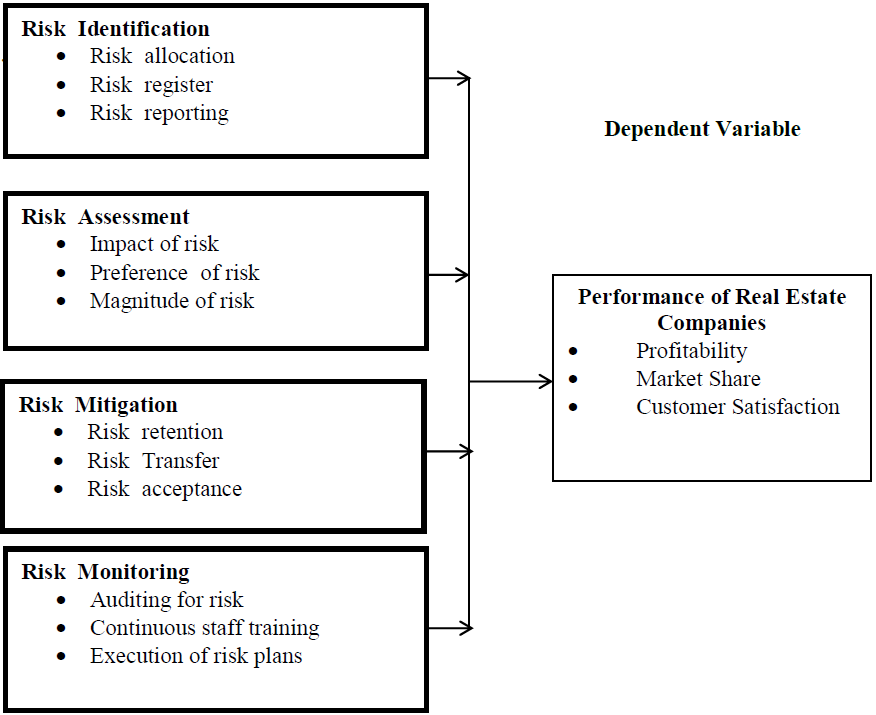
3.3. Conceptual FrameworkFigure 1 shows the study's conceptual framework which shows the interrelation between the independent variable and the dependent variable.
Independent Variables
The research embraced a descriptive research design. According to Kasomo 47, the descriptive research method attempts to examine, identify, classify, compare, or analyze the attributes or components of a specific problem or situation.
4.2. Target PopulationThe target population in this research comprised of the 149 real estate firms listed with the Estate Agents Registration Board 24 in Nairobi City County, Kenya. Real estate companies were treated as the units of analysis, while project managers working within each company were the units of observation. Since every company were supposed to have at least one project manager charged with directing risk management activities, all 149 project managers constituted the total population under consideration.
4.3. Sampling DesignThe Yamane formula (1967) was used for sample size determination. The confidence level selected for this research was 95%, and the margin of error was 5%. The degree of variability (p) was assumed to be 50% (0.5), so the maximum sample size was required to be insured for adequate representation. Targeting 149 individuals as the population, the sample size is computed concerning the parameters.
 |
N= Population Target (149)
E= Margin error of 5%
The sample size for the research was determined with a 5% precision level (e = 0.05).
The sample size was explored as follows;
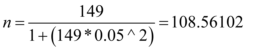 |
Thus, 109 participants made up the research’s sample size. To choose the sample, the study used basic random sampling.
4.4. Data Collection InstrumentsPrimary data was utilized for this research. A questionnaire, a quantitative data-gathering instrument, was deployed to obtain such information. Structured questionnaires served to collect primary data because they make data analysis straightforward and, to some extent, reduce the time and resources required for data gathered. Kultar 48 observed that questionnaires remain an economical and efficient way of collecting data from large populations. Moreover, since questionnaires ensured participant anonymity, the data gathered is less likely to be biased.
4.5. Data Analysis and PresentationSPSS (Statistical Package for Social Sciences) version 26 was utilized to examine the quantitative data with descriptive and inferential statistics. Descriptive statistics were utilized to present the demographics, whereas participants' statements about the working of the research variable were laid out descriptively. Pearson's correlation coefficient and multiple regression analysis were used for inferential analysis purposes. These inferential tests help make inferences about the probability that the observation did not occur by chance, and comment upon the relationship between variables in the survey proposal. Multivariate regression models were applied to investigate the interrelationships among study variables.
 |
Whereby; Y= Performance of real estate companies
 = Constant
 = Coefficients of determination
X1= Project risk identification
X2= Project risk assessment
X3= Project risk mitigation
X4= Project risk monitoring
ε= Error term
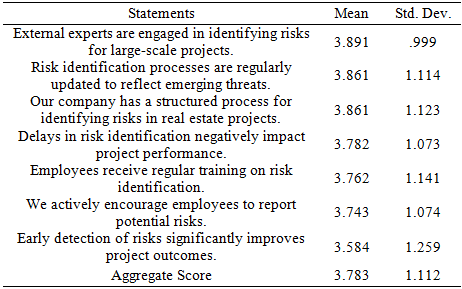
Risk identification is a fundamental step in the risk management process, as it helps organizations to recognize, document, and prepare for potential uncertainties that may affect project outcomes. Participants rated each item on a five-point Likert scale, where 1 = Strongly Disagree and 5 = Strongly Agree. Table 1 presents the means and standard deviations for each statement related to risk identification.
The highest-rated item, with a mean of 3.891, indicates that participants generally agree that external experts are engaged in identifying risks for large-scale projects. This implies that real estate companies recognize the intricacies of large projects and bring in specialized experts to mitigate such risks. The statements "Risk identification processes are regularly updated to reflect emerging threats" and "Our company has a structured process for identifying risks in real estate projects" shared a mean of 3.861. Participants generally very strongly agreed that risk identification practices are formalized and dynamic in nature-a system of adaptation to changes in the operating environment. This indicates a proactive and systematic approach to risk management.
The statement “Delays in risk identification negatively impact project performance” received a mean score of 3.782, further implying that the timely identification of risks is considered crucial for project success. Participants also believe that employees receive regular training in risk identification (mean = 3.762) and are encouraged to report risks (mean = 3.743), thus indicating an enabling organizational culture for risk awareness. Lastly, the item “Early detection of risks significantly improves project outcomes” got the lowest average of 3.584, although it still fell within the Agree range. The relatively lower score could indicate variation in early detection practices across firms, which might hinge on the rigor of their internal monitoring systems or as much on the attentiveness of their managers.
The aggregated mean for risk identification stands at 3.783, implying that participants were generally in agreement that their organizations somewhat strongly practice risk identification. This is broadly in line with the Mburu, Njagi, and Ogolla 29 study which viewed the need for effective risk identification strategies as imperative to supply chain performance in Kenyan manufacturing firms. Their emphasis was on harnessing core competencies and managing potential threats in an organized manner. Further, Hopkinson 28, in his study of the construction industry in Sweden, found that a structured approach to risk identification, including the use of checklists, manuals, or expert consultation, played a noteworthy role in identifying potential threats early on in the project lifecycle. Although conducted in a different context, Hopkinson's findings can be taken to reinforce the high worth of structured and emerging identification practices that are supported in this study by the high-ranking structured processes and regular updates.
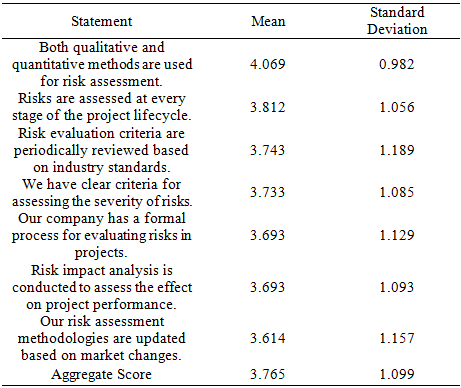
Risk assessment is the systematic process of identifying and examining potential risks to a project and evaluating how these risks would affect the project's success. The participants were required to respond to seven statements on a five-point Likert scale where 1 corresponded to Strongly Disagree, and 5 corresponded to Strongly Agree. The descriptive statistics on the responses are shown in Table 2.
The highest-rated item, with a mean of 4.069, reveals strong agreement that both qualitative and quantitative methods are used for risk assessment. This demonstrates that firms are not relying on intuition or ad hoc processes but instead adopting structured, multi-dimensional approaches to evaluating risks, which enhances objectivity and decision-making accuracy. The statement “Risks are assessed at every stage of the project lifecycle” followed with a mean of 3.812, suggesting that risk assessment is perceived as a continuous and integral part of project management. This points to maturity in risk management, where assessments are not just performed at initiation but carried out throughout implementation.
Participants also showed agreement with statements like “Risk evaluation criteria are periodically reviewed” (mean = 3.743) and “We have clear criteria for assessing the severity of risks” (mean = 3.733), indicating a commitment to ensuring that the assessment tools remain relevant and context-sensitive over time. The presence of formal processes is moderately supported, with “Our company has a formal process for evaluating risks” and “Risk impact analysis is conducted to assess effect on performance” both scoring a mean of 3.693. While these are within the "Agree" range, they suggest that there may still be room for improving formalization and integration into strategic planning. The lowest-rated item, “Our risk assessment methodologies are updated based on market changes,” with a mean of 3.614, implies that fewer organizations are regularly adapting their risk assessment models to reflect market dynamics. This might expose them to outdated methods in rapidly evolving project environments.
The average score garnered by risk assessment is 3.77, indicating that the majority of participants agreed that their organizations conduct active and systematic risk assessments. These results corroborate those given by Banaitiene and Banaitis 49, who stressed the importance of both qualitative and quantitative approaches in construction risk management to yield better project outcomes and enhanced decision-making. These findings further bolster the high ranking apparently received by integrated risk analysis techniques in this research. In addition, Roque and Carvalho 34 found that regular and structured risk assessment practices greatly promote project success. They also announced that steeping performance is enhanced by appointing dedicated risk managers and updating risk assessment tools from time to time, which tallies with the findings indicating that Kenyan real estate firms perform periodic evaluations using multiple risk assessment approaches.
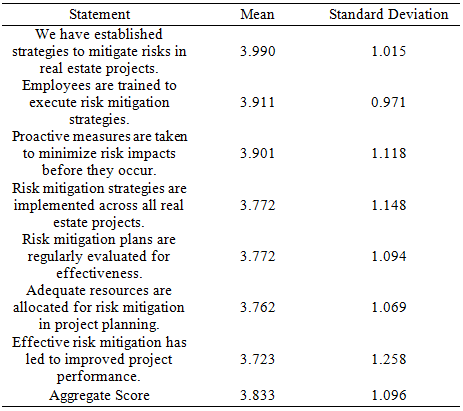
Risk mitigation involves the implementation of actions and strategies to reduce the likelihood or impact of identified risks. This component is crucial to ensuring projects are completed successfully, on time, and within budget. Participants were asked to evaluate seven statements related to their organization’s risk mitigation practices using a five-point Likert scale, where 1 = Strongly Disagree and 5 = Strongly Agree. Table 3 presents the descriptive statistics for these statements.
The highest-rated statement was “We have established strategies to mitigate risks in real estate projects,” which recorded a mean of 3.990. This strong score suggests that most firms in Nairobi's real estate sector have structured mitigation plans in place, signaling a deliberate and organized approach to handling potential threats. Closely following was the statement “Employees are trained to execute risk mitigation strategies” with a mean of 3.911, indicating that human capacity is also being developed alongside policy frameworks. This reflects a workforce that is not only aware of risk but is also empowered to act upon mitigation measures. The statement “Proactive measures are taken to minimize risk impacts before they occur” scored 3.901, emphasizing that real estate firms prioritize preventive rather than reactive approaches. This mindset is critical for reducing project uncertainty and avoiding costly disruptions.
Both “Risk mitigation strategies are implemented across all projects” and “Risk mitigation plans are regularly evaluated for effectiveness” recorded means of 3.772, showing that these strategies are not just theoretical but are applied and reviewed in practical contexts. These responses reflect commitment to both execution and continuous improvement. Statements regarding resource allocation (3.762) and the impact of mitigation on performance (3.723) received slightly lower but still solid agreement scores. While organizations may believe in the importance of mitigation, the relatively lower mean on effectiveness suggests a potential disconnect between implementation and observed outcomes.
An aggregate mean score of 3.833 is tabulated for risk mitigation, which lies within the “Agree” region. This can therefore imply that companies dealing with real estate in Nairobi are actively channeling their energies into structured risk mitigation, workforce preparedness, as well as forward-looking practices to ensure the success of their projects. These conclusions harmonize well with those of Mwangi and Ngugi 32, who found out that the effective aspect of risk mitigation plays a positive role in the performance of construction projects in Nairobi City County. Their study emphasized employee training, resource allocation, and project planning as critical mitigation variables-a consideration that is also of course salient in the present study.
Furthermore, Obade 35 established that risk mitigation affected the project cost, completion, and quality in Nairobi road infrastructure projects. Likewise, in the real estate domain, mitigation approaches such as early identification of threats and appraisal of mitigation strategies were identified as success factors. These empirical studies support the observation that real estate companies benefit from increased project stability and organizational performance when they employ seriously strong and proactive mitigation strategies that are backed by relevant training of staff and ongoing reviews.
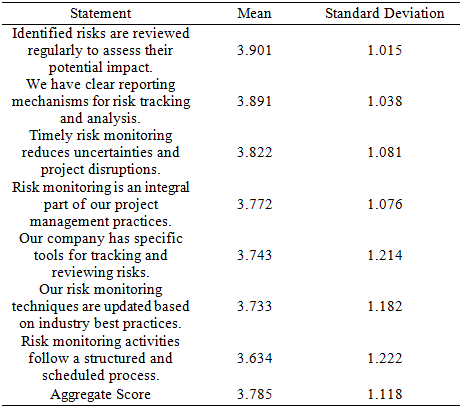
Risk monitoring is an ongoing process for keeping track of identified risks, evaluating their level, reporting them, and ensuring their proper management while also keeping an eye on the occurrence of new risks so they can be procured in time. Participants responded to seven statements related to risk monitoring using a five-point Likert scale, where 1 indicated strong disagreement and 5 indicated strong agreement. A summary of these responses is provided in Table 4.
The highest-rated item, with a mean of 3.901, was “Identified risks are reviewed regularly to assess their potential impact.” This indicates a strong culture of periodic evaluation of risks, which is essential for real-time decision-making and adjusting risk responses as projects progress. Closely following was the statement “We have clear reporting mechanisms for risk tracking and analysis,” with a mean of 3.891. This finding suggests that many organizations have established formal channels for documenting and communicating risk-related information, contributing to transparency and accountability in project oversight. The statement “Timely risk monitoring reduces uncertainties and project disruptions” recorded a mean of 3.822, implying broad agreement among participants that consistent monitoring plays a preventive role by minimizing the likelihood of risk escalation.
Statements such as “Risk monitoring is an integral part of our project management practices” (3.772) and “Our company has specific tools for tracking and reviewing risks” (3.743) also received positive ratings, indicating that risk monitoring is not treated as an isolated activity but is embedded within broader project management systems. The lowest-scoring items“Our risk monitoring techniques are updated based on industry best practices” (3.733) and “Risk monitoring activities follow a structured and scheduled process” (3.634) still fall within the “Agree” range, though they suggest some inconsistencies in standardization and benchmarking. These lower scores may imply a reactive rather than proactive stance toward updating tools and routines, leaving room for improvement in institutionalizing best practices.
Given the (3.785) mean score, the participants agreed that risk monitoring is integrated with project operations within real estate firms in Nairobi. This corroborates the results of Aku 38 that affirmed the existence of a strong relationship between success of projects and risk monitoring in the Nigerian construction sector. The high mean ratings for impact evaluation and reporting in this study supported the idea that ongoing monitoring ensures projects remain on schedule and on budget and meet the expected quality. Similarly, Njuguna 45 revealed that risk monitoring mechanisms had an influence on project performance in Nairobi City County.
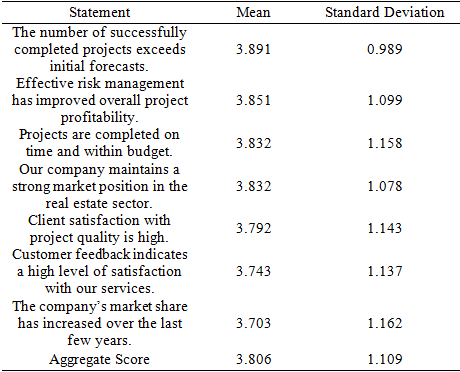
Performance was evaluated using various indicators, including project delivery, profitability, client satisfaction, and market competitiveness, which collectively represent both financial and operational success. Participants assessed seven statements related to these factors using a five-point Likert scale, where 1 indicated strong disagreement and 5 indicated strong agreement. The summary of the descriptive findings is displayed in Table 5.
The highest-rated item, with a mean of 3.891, was “The number of successfully completed projects exceeds initial forecasts,” suggesting that many firms are outperforming their original plans. This may indicate strong project planning, execution, and perhaps, effective risk management support structures. Closely following, “Effective risk management has improved overall project profitability” scored 3.851, which directly supports this study’s premise that risk management positively contributes to performance. Participants clearly acknowledge the financial gains derived from minimizing exposure to threats and optimizing decision-making. The dual statements “Projects are completed on time and within budget” and “Our company maintains a strong market position in the real estate sector” both scored 3.832, reinforcing operational efficiency and competitive strength. This implies that the firms are not only delivering projects efficiently but are also sustaining a solid reputation in the local market.
Statements related to client satisfaction also ranked highly: “Client satisfaction with project quality is high” (mean = 3.792) and “Customer feedback indicates a high level of satisfaction” (mean = 3.743), confirming that stakeholder experiences and service quality remain a focus area for most organizations. The lowest score, “The company’s market share has increased over the last few years” (mean = 3.703), while still within the “Agree” range, suggests that although firms are performing well operationally, growth in market share may be influenced by broader economic, regulatory, or competitive conditions beyond project-level control.
The aggregate mean score of 3.806 suggests that participants generally perceive their organizations as performing well above average across key indicators. These findings validate the central hypothesis of this study that effective risk management contributes to improved organizational performance. When compared with earlier sections on risk identification, assessment, mitigation, and monitoring, a pattern emerges: firms that institutionalize risk strategies are better positioned to achieve strong outcomes in project delivery, profitability, and client satisfaction. The findings are more or less consistent with the findings of Roque and Carvalho 34, who have empirically established that the structured management of risk enhances the success of projects across disparate industries. This notion is supported by Mburu, Njagi and Ogolla 29, who argued that the implementation of risk strategies supports organizational competitiveness and efficiency within Kenya, thus appealing locally to this study's findings.
These findings, therefore, further support the assertion that, while performance in Nairobi's real estate sector is based partly upon market opportunities, it is also risk-conscious in planning and execution, with the management of risk emerging as a key catalyst for sustained performance.
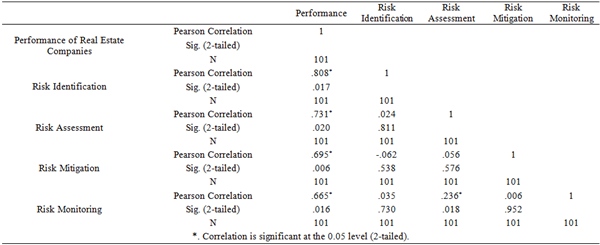
5.2. Correlation AnalysisCorrelation analyses were performed to examine the direction and strength of the linear relationships between the four main risk strategies; risk identification, risk assessment, risk mitigation, and risk monitoring and the organizational performance of real estate in Nairobi City County. For this, Pearson's product-moment correlation coefficient which ranges from -1 to +1—was utilized.
There is a high and statistically significant positive association between risk identification and real estate company success, as indicated by the Pearson correlation coefficient of r = 0.808 and p-value of 0.017. This infers that companies are more likely to see better performance results when they proactively identify risks through organised procedures, staff participation, and expert consultations. This result aligns with that of Lagat and Tenai 41, who found a positive relationship between risk identification and the Kenyan financial institutions' performance.
The risk assessment shows a strong positive correlation of 0.731 with performance, with a p-value of 0.02. This means that when companies carry out risk evaluation consistently throughout the project lifecycle through either qualitative or quantitative approaches, they tend to attain good results. This relationship supports the conclusions of Roque and Carvalho 34, who showed that structured project risk management, including continuous assessment, positively influences project success in industries from various fields.
The correlation between risk mitigation and performance is strong, at r = 0.695, with a p-value of 0.006. It follows, therefore, that risk mitigation strategies such as proactive measures, training, and resource allocation affect associated performances. This outcome is consistent with that arrived at by Obade 35, who found risk mitigation to significantly impact road infrastructure projects concerning completion, cost control, and quality in Nairobi.
A robust and statistically significant positive association was found between risk monitoring and performance, with a correlation of 0.665 and a p-value of 0.016. This implies that improved project and business outcomes result from ongoing risk tracking, evaluation, and reporting. These results are consistent with those of Aimable 50, who discovered that risk monitoring improved the performance of building projects in Rwanda.
The study remarked that risk identification plays a foundational role in improving the performance of real estate firms. The ability to proactively detect potential risks through structured processes, employee engagement, and expert consultations contributes significantly to improved planning, reduced uncertainty, and project success. This supports Prospect Theory’s assertion that recognizing potential losses early drives more rational and strategic responses among decision-makers.
Risk assessment emerged as another strong predictor of firm performance. Companies that apply both qualitative and quantitative risk evaluation techniques especially when these assessments are conducted regularly across the project lifecycle are better equipped to prioritize threats and implement timely interventions. This reflects the adaptability principle embedded in Contingency Theory, where risk evaluation is customized to fit changing market and project environments.
The research uncovered that proactive mitigation strategies like resource allocation, employee training, and strategy evaluation, positively impact firm performance. Effective risk mitigation not only prevents disruption but also enhances organizational efficiency and customer satisfaction. The findings support the notion that pre-emptive action reduces uncertainty and improves cost, time, and quality performance.
Risk monitoring was also found to significantly influence performance, although with a relatively smaller beta coefficient. This underscores its importance as a supporting function that ensures risk responses remain effective throughout the project lifecycle. Regular reviews, structured reporting, and feedback mechanisms help firms maintain alignment with evolving threats and project goals. These findings affirm the value of Control Theory’s feedback loops in sustaining project success.
Given that risk identification emerged as the most influential predictor of performance, real estate firms should formalize and institutionalize robust risk identification frameworks. These frameworks should be based on structured processes such as the use of risk registers, project-level risk audits, and expert risk panels for large-scale developments. Organizations should invest in training programs that sensitize employees at all levels to report potential risks, encouraging a culture of transparency and early warning. Organizations should also move towards integrated risk modeling tools that combine qualitative judgment with quantitative analysis such as Monte Carlo simulations, risk matrices, and probability-impact charts. Importantly, companies must review and update their risk criteria regularly to respond to evolving market dynamics, policy changes, and macroeconomic trends.
Firms should regularly train their project staff and contractors on how to implement these mitigation measures in real time. Human resource departments should integrate risk training into their professional development programs. To facilitate these changes, industry associations like KPDA (Kenya Property Developers Association) and ISK (Institution of Surveyors of Kenya) can develop certified training modules on risk mitigation tailored to the local construction and property market context.Real estate firms should invest in automated monitoring tools and dashboards that provide real-time feedback on risk exposure, contractor performance, budget variance, and regulatory compliance. These systems should be aligned with project management software such as Primavera or Microsoft Project to ensure seamless integration into workflows. Moreover, companies should adopt structured reporting schedules and key risk indicators (KRIs) to facilitate timely communication with stakeholders.
| [1] | Jones, L., Roberts, H., Taylor, D., & Smith, A. (2024). The global real estate market: Economic impacts and trends. International Journal of Real Estate Economics, 52(1), 20-35. | ||
| In article | |||
| [2] | Kimani, J., & Mwenda, A. (2022). The economic impact of construction project failures. Journal of Economic Development and Construction, 25(1), 45-60. | ||
| In article | |||
| [3] | Mamai, E., &Yinghua, T. (2023). Effective risk management in project execution. Journal of Risk Management in Construction Projects, 18(5), 389-402. | ||
| In article | |||
| [4] | Nyoni, T. (2022). Addressing uncertainty in construction projects. Journal of Construction Uncertainty Management, 9(6), 144-157. | ||
| In article | |||
| [5] | Wabomba, S. (2023). The economic impact of construction project failures. Journal of Economic Development and Construction, 25(1), 45-60. | ||
| In article | |||
| [6] | Kolo, J. K. (2023). Risk management in construction projects: A comprehensive review. Construction Risk Management Review, 15(3), 123-140. | ||
| In article | |||
| [7] | Wanjohi, A. (2022). The need for professional risk management to ensure project sustainability. Journal of Risk Management in Construction Projects, 18(5), 389-402. | ||
| In article | |||
| [8] | Omondi, J., & Njoroge, M. (2021). Linking robust risk practices with higher profitability, customer satisfaction, and project success. Journal of Business Strategy, 2(5), 75-87. | ||
| In article | |||
| [9] | Obuyai, O., & Wambua, J. (2022). Weak practices and their impact on investor trust. Journal of Construction Management, 12(3), 201-215. | ||
| In article | |||
| [10] | Evans, A. (2019) Economics, Planning and Housing, Palgrave Macmillan, Basingstoke, | ||
| In article | |||
| [11] | Akui, A. (2022). Structured monitoring and planning in Nigerian construction. Journal of Construction Management, 12(4), 300-315. | ||
| In article | |||
| [12] | Van der Walt, J., & De Lange, D. (2021). Comprehensive risk assessments and profitability in South Africa. Journal of Risk Management, 10(2), 150-165. | ||
| In article | |||
| [13] | Ndichui, M., & Muthoni, J. (2024). Urbanization and its impact on the real estate industry in Nairobi. Journal of Urban Studies, 15(1), 50-65. | ||
| In article | |||
| [14] | Muthoni, J., & Njeri, P. (2023). The impact of risk management strategies on real estate performance in Nairobi. Journal of Real Estate Management, 19(2), 150-165. | ||
| In article | |||
| [15] | Kariuki, P., & Ochieng, J. (2021). Examining the impact of risk management strategies on private real estate firms in Nairobi. Journal of Real Estate Research, 20(3), 100-115. | ||
| In article | |||
| [16] | Koechi, R., & Kiprotich, J. (2023). Risk management in the dynamic real estate sector. Journal of Property Management, 18(2), 90-105. | ||
| In article | |||
| [17] | Otieno, R. (2023). Financial and regulatory uncertainties in Nairobi's real estate market. Journal of Economic Policy, 22(4), 200-215. | ||
| In article | |||
| [18] | Odhiambo, J. (2020). Budget housing providers and high-end developers in Nairobi. Journal of Housing Studies, 14(3), 120-135. | ||
| In article | |||
| [19] | Muiruri, G., & Mulinge, M. (2022). Construction risk management in Kenya: Challenges and opportunities. Journal of African Construction Studies, 14(2), 78-92. | ||
| In article | |||
| [20] | White, D., & Fortune, J. (2021). Project management success: A review of the literature. International Journal of Project Management, 39(5), 345-356. | ||
| In article | |||
| [21] | Bryde, D. J. (2022). Risk management in construction projects: A systematic review. Journal of Construction Management, 15(3), 200-215. | ||
| In article | |||
| [22] | Mwangi, J. (2018). Public scrutiny and delays in government-funded construction projects. Journal of Public Administration, 10(1), 45-60. | ||
| In article | |||
| [23] | Waihenya, J. (2019). Fluctuating material prices and their impact on construction projects. Journal of Construction Economics, 11(2), 75-90. | ||
| In article | |||
| [24] | Nairobi Real Estate Board. (2023). Legal disputes in property transactions in Nairobi. Nairobi Real Estate Report. | ||
| In article | |||
| [25] | Jones, L. (2022). Fraudulent property transactions and their impact on investor confidence. Journal of Real Estate Law, 5(1), 30-45. | ||
| In article | |||
| [26] | The Daily Monitor. (2023). Land ownership disputes in Nairobi: A growing concern. Daily Monitor News. | ||
| In article | |||
| [27] | Karanjai, R., & Wainaina, J. (2023). Compliance and due diligence in real estate firms. Journal of Compliance Studies, 8(3), 150-165. | ||
| In article | |||
| [28] | Hopkinson, P. (2019). Risk identification and management in construction projects: A study of the Swedish construction sector. Journal of Construction Management, 12(4), 250-265. | ||
| In article | |||
| [29] | Mburu, Njagi and Ogolla (2020) did an assessment of effect of risk identification management strategy on supply chain performance in manufacturing companies in Kenya. International Journal of Economics, Commerce and Management, 3 (4), 1-17 | ||
| In article | |||
| [30] | Lagat, F.K (2020). Effect of risk identification on performance of financial institutions. International Journal of Business Strategy, 2 (1), 75-87. | ||
| In article | View Article | ||
| [31] | Lawrence, P. R., & Lorsch, J. W. (1967). Differentiation and integration in complex organizations. Administrative Science Quarterly, 12(1), 1-47. | ||
| In article | View Article | ||
| [32] | Mwangi, H. M., &Ngugi, L. (2018). Risk management practices and performance of construction projects in Nairobi city-county government, Kenya. International Academic Journal of Information Sciences and Project Management, 3(2), 111-136. | ||
| In article | |||
| [33] | Tadayon, N. (2019). The impact of internal and external factors on organizational decision-making. Journal of Business Research, 102, 123-135. | ||
| In article | |||
| [34] | Roque, R.J & Carvalho, M.M (2020). Did an assessment on understanding the impact of project risk management on project performance: an empirical study. Retrieved from https://www.scielo.cl/pdf/. | ||
| In article | |||
| [35] | Obade, F., (2019). Influence of risk management strategies on completion, cost, and quality of road infrastructure development projects in Nairobi city county, Kenya. Retrieved from https://repository.maseno.ac.ke/bitstream/handle/123456789/3616/. | ||
| In article | |||
| [36] | Ouchi, W. G. (1979). A conceptual framework for the design of organizational control mechanisms. Management Science, 25(9), 833-848. | ||
| In article | View Article | ||
| [37] | Suhaiza, Z.H.A, Ariffin, M &Iranmanesh, S.M.M.I, (2019).The moderating effect of project risk mitigation strategies on the relationship between delay factors and construction project performance. Journal of Science and Technology Policy Management, 7 (3), 1-16. | ||
| In article | |||
| [38] | Aku, J. (2020). The effectiveness of control theory in project management: A case study of construction projects. Journal of Project Management, 8(2), 75-90. | ||
| In article | |||
| [39] | Mardiana, S, Puji, E.P &Ayyu, W.M.D (2020). Effect of risk management on financial performance with good corporate governance as a moderation variable. Management and Economics Journal 2 (3), 257-268. | ||
| In article | View Article | ||
| [40] | Kenya Association of Manufacturers (KAM). (2019). Annual Report on the State of Manufacturing in Kenya. Nairobi: Kenya Association of Manufacturers. | ||
| In article | |||
| [41] | Lagat, F.K &Tenai, J (2020). Effect of risk identification on performance of financial institutions. International Journal of Business Strategy, 2 (5), 75- 87. | ||
| In article | View Article | ||
| [42] | DarnallR, N., & Preston, L. E. (2019). Operational risk management in project teams: A review of best practices. Journal of Project Management, 7(3), 150-165. | ||
| In article | |||
| [43] | Oehmen, J. (2020). The impact of risk management techniques on new product development success. Journal of Product Innovation Management, 37(2), 147-164. | ||
| In article | |||
| [44] | Pimchangthong, D., &Boonjing, V. (2020). Effects of risk management practices on IT project success. Management and production engineering review, 8(1), 30-37. | ||
| In article | View Article | ||
| [45] | Njuguna, J. (2019). Investigating the evolution of risk monitoring techniques and project execution in Nairobi City County, Kenya. Journal of Project Management Research, 15(1), 45-60. | ||
| In article | |||
| [46] | Obondi, K.C (2022). The utilization of project risk monitoring and control practices and their relationship with project success in construction projects. Journal of Project Management, 7 (2022) 35–52. | ||
| In article | View Article | ||
| [47] | Kasomo, D. (2018). Research methodology: A guide for beginners. Nairobi: Jomo Kenyatta Foundation. | ||
| In article | |||
| [48] | Kultar, S. (2017). Research methodology: A step-by-step guide for beginners. New Delhi: Sage Publications. | ||
| In article | |||
| [49] | Banaitiene, N., & Banaitis, A. (2019). Efficient risk management in construction projects: A Lithuanian case study. Journal of Construction Management, 13(2), 100-115. | ||
| In article | |||
| [50] | Aimable, N. (2021). The impact of project management practices on the success of development projects in Rwanda. Journal of Development Studies, 12(4), 220-235. | ||
| In article | |||
Published with license by Science and Education Publishing, Copyright © 2025 Stanley KitatiNgui and Dr. Janet Muthimi
 This work is licensed under a Creative Commons Attribution 4.0 International License. To view a copy of this license, visit
http://creativecommons.org/licenses/by/4.0/
This work is licensed under a Creative Commons Attribution 4.0 International License. To view a copy of this license, visit
http://creativecommons.org/licenses/by/4.0/
| [1] | Jones, L., Roberts, H., Taylor, D., & Smith, A. (2024). The global real estate market: Economic impacts and trends. International Journal of Real Estate Economics, 52(1), 20-35. | ||
| In article | |||
| [2] | Kimani, J., & Mwenda, A. (2022). The economic impact of construction project failures. Journal of Economic Development and Construction, 25(1), 45-60. | ||
| In article | |||
| [3] | Mamai, E., &Yinghua, T. (2023). Effective risk management in project execution. Journal of Risk Management in Construction Projects, 18(5), 389-402. | ||
| In article | |||
| [4] | Nyoni, T. (2022). Addressing uncertainty in construction projects. Journal of Construction Uncertainty Management, 9(6), 144-157. | ||
| In article | |||
| [5] | Wabomba, S. (2023). The economic impact of construction project failures. Journal of Economic Development and Construction, 25(1), 45-60. | ||
| In article | |||
| [6] | Kolo, J. K. (2023). Risk management in construction projects: A comprehensive review. Construction Risk Management Review, 15(3), 123-140. | ||
| In article | |||
| [7] | Wanjohi, A. (2022). The need for professional risk management to ensure project sustainability. Journal of Risk Management in Construction Projects, 18(5), 389-402. | ||
| In article | |||
| [8] | Omondi, J., & Njoroge, M. (2021). Linking robust risk practices with higher profitability, customer satisfaction, and project success. Journal of Business Strategy, 2(5), 75-87. | ||
| In article | |||
| [9] | Obuyai, O., & Wambua, J. (2022). Weak practices and their impact on investor trust. Journal of Construction Management, 12(3), 201-215. | ||
| In article | |||
| [10] | Evans, A. (2019) Economics, Planning and Housing, Palgrave Macmillan, Basingstoke, | ||
| In article | |||
| [11] | Akui, A. (2022). Structured monitoring and planning in Nigerian construction. Journal of Construction Management, 12(4), 300-315. | ||
| In article | |||
| [12] | Van der Walt, J., & De Lange, D. (2021). Comprehensive risk assessments and profitability in South Africa. Journal of Risk Management, 10(2), 150-165. | ||
| In article | |||
| [13] | Ndichui, M., & Muthoni, J. (2024). Urbanization and its impact on the real estate industry in Nairobi. Journal of Urban Studies, 15(1), 50-65. | ||
| In article | |||
| [14] | Muthoni, J., & Njeri, P. (2023). The impact of risk management strategies on real estate performance in Nairobi. Journal of Real Estate Management, 19(2), 150-165. | ||
| In article | |||
| [15] | Kariuki, P., & Ochieng, J. (2021). Examining the impact of risk management strategies on private real estate firms in Nairobi. Journal of Real Estate Research, 20(3), 100-115. | ||
| In article | |||
| [16] | Koechi, R., & Kiprotich, J. (2023). Risk management in the dynamic real estate sector. Journal of Property Management, 18(2), 90-105. | ||
| In article | |||
| [17] | Otieno, R. (2023). Financial and regulatory uncertainties in Nairobi's real estate market. Journal of Economic Policy, 22(4), 200-215. | ||
| In article | |||
| [18] | Odhiambo, J. (2020). Budget housing providers and high-end developers in Nairobi. Journal of Housing Studies, 14(3), 120-135. | ||
| In article | |||
| [19] | Muiruri, G., & Mulinge, M. (2022). Construction risk management in Kenya: Challenges and opportunities. Journal of African Construction Studies, 14(2), 78-92. | ||
| In article | |||
| [20] | White, D., & Fortune, J. (2021). Project management success: A review of the literature. International Journal of Project Management, 39(5), 345-356. | ||
| In article | |||
| [21] | Bryde, D. J. (2022). Risk management in construction projects: A systematic review. Journal of Construction Management, 15(3), 200-215. | ||
| In article | |||
| [22] | Mwangi, J. (2018). Public scrutiny and delays in government-funded construction projects. Journal of Public Administration, 10(1), 45-60. | ||
| In article | |||
| [23] | Waihenya, J. (2019). Fluctuating material prices and their impact on construction projects. Journal of Construction Economics, 11(2), 75-90. | ||
| In article | |||
| [24] | Nairobi Real Estate Board. (2023). Legal disputes in property transactions in Nairobi. Nairobi Real Estate Report. | ||
| In article | |||
| [25] | Jones, L. (2022). Fraudulent property transactions and their impact on investor confidence. Journal of Real Estate Law, 5(1), 30-45. | ||
| In article | |||
| [26] | The Daily Monitor. (2023). Land ownership disputes in Nairobi: A growing concern. Daily Monitor News. | ||
| In article | |||
| [27] | Karanjai, R., & Wainaina, J. (2023). Compliance and due diligence in real estate firms. Journal of Compliance Studies, 8(3), 150-165. | ||
| In article | |||
| [28] | Hopkinson, P. (2019). Risk identification and management in construction projects: A study of the Swedish construction sector. Journal of Construction Management, 12(4), 250-265. | ||
| In article | |||
| [29] | Mburu, Njagi and Ogolla (2020) did an assessment of effect of risk identification management strategy on supply chain performance in manufacturing companies in Kenya. International Journal of Economics, Commerce and Management, 3 (4), 1-17 | ||
| In article | |||
| [30] | Lagat, F.K (2020). Effect of risk identification on performance of financial institutions. International Journal of Business Strategy, 2 (1), 75-87. | ||
| In article | View Article | ||
| [31] | Lawrence, P. R., & Lorsch, J. W. (1967). Differentiation and integration in complex organizations. Administrative Science Quarterly, 12(1), 1-47. | ||
| In article | View Article | ||
| [32] | Mwangi, H. M., &Ngugi, L. (2018). Risk management practices and performance of construction projects in Nairobi city-county government, Kenya. International Academic Journal of Information Sciences and Project Management, 3(2), 111-136. | ||
| In article | |||
| [33] | Tadayon, N. (2019). The impact of internal and external factors on organizational decision-making. Journal of Business Research, 102, 123-135. | ||
| In article | |||
| [34] | Roque, R.J & Carvalho, M.M (2020). Did an assessment on understanding the impact of project risk management on project performance: an empirical study. Retrieved from https://www.scielo.cl/pdf/. | ||
| In article | |||
| [35] | Obade, F., (2019). Influence of risk management strategies on completion, cost, and quality of road infrastructure development projects in Nairobi city county, Kenya. Retrieved from https://repository.maseno.ac.ke/bitstream/handle/123456789/3616/. | ||
| In article | |||
| [36] | Ouchi, W. G. (1979). A conceptual framework for the design of organizational control mechanisms. Management Science, 25(9), 833-848. | ||
| In article | View Article | ||
| [37] | Suhaiza, Z.H.A, Ariffin, M &Iranmanesh, S.M.M.I, (2019).The moderating effect of project risk mitigation strategies on the relationship between delay factors and construction project performance. Journal of Science and Technology Policy Management, 7 (3), 1-16. | ||
| In article | |||
| [38] | Aku, J. (2020). The effectiveness of control theory in project management: A case study of construction projects. Journal of Project Management, 8(2), 75-90. | ||
| In article | |||
| [39] | Mardiana, S, Puji, E.P &Ayyu, W.M.D (2020). Effect of risk management on financial performance with good corporate governance as a moderation variable. Management and Economics Journal 2 (3), 257-268. | ||
| In article | View Article | ||
| [40] | Kenya Association of Manufacturers (KAM). (2019). Annual Report on the State of Manufacturing in Kenya. Nairobi: Kenya Association of Manufacturers. | ||
| In article | |||
| [41] | Lagat, F.K &Tenai, J (2020). Effect of risk identification on performance of financial institutions. International Journal of Business Strategy, 2 (5), 75- 87. | ||
| In article | View Article | ||
| [42] | DarnallR, N., & Preston, L. E. (2019). Operational risk management in project teams: A review of best practices. Journal of Project Management, 7(3), 150-165. | ||
| In article | |||
| [43] | Oehmen, J. (2020). The impact of risk management techniques on new product development success. Journal of Product Innovation Management, 37(2), 147-164. | ||
| In article | |||
| [44] | Pimchangthong, D., &Boonjing, V. (2020). Effects of risk management practices on IT project success. Management and production engineering review, 8(1), 30-37. | ||
| In article | View Article | ||
| [45] | Njuguna, J. (2019). Investigating the evolution of risk monitoring techniques and project execution in Nairobi City County, Kenya. Journal of Project Management Research, 15(1), 45-60. | ||
| In article | |||
| [46] | Obondi, K.C (2022). The utilization of project risk monitoring and control practices and their relationship with project success in construction projects. Journal of Project Management, 7 (2022) 35–52. | ||
| In article | View Article | ||
| [47] | Kasomo, D. (2018). Research methodology: A guide for beginners. Nairobi: Jomo Kenyatta Foundation. | ||
| In article | |||
| [48] | Kultar, S. (2017). Research methodology: A step-by-step guide for beginners. New Delhi: Sage Publications. | ||
| In article | |||
| [49] | Banaitiene, N., & Banaitis, A. (2019). Efficient risk management in construction projects: A Lithuanian case study. Journal of Construction Management, 13(2), 100-115. | ||
| In article | |||
| [50] | Aimable, N. (2021). The impact of project management practices on the success of development projects in Rwanda. Journal of Development Studies, 12(4), 220-235. | ||
| In article | |||