This research paper explores the phenomenon of an innovative consumer gaming experience and the accumulation of social currency through the case of Pokémon Go’s brand image and its impact on consumer behavioral outcomes. The study addresses critical research gaps and contributes to the field of digital marketing strategy by examining how brand image interacts with the sense of virtual community and customer experience in both online and offline environments. An online questionnaire was administered to 360 participants in Taiwan, and structural equation modeling (SEM) was applied to test the proposed relationships. The study also incorporated positive and negative word-of-mouth as moderating variables to evaluate the strength of the relationship between social currency and behavioral intention. The findings suggest that Pokémon Go’s compelling brand image and immersive experience foster a strong sense of virtual community and enhance social currency, which in turn positively affects consumers’ behavioral intentions. Furthermore, positive word-of-mouth significantly strengthens this relationship, while negative word-of-mouth shows no moderating effect. This study provides new insights into the role of social currency as a catalyst for gamified brand engagement and offers a framework that can be replicated across other mobile games and gamified platforms to promote user loyalty and community participation.
In July 2016, software company Niantic, Inc., in collaboration with gaming giant Nintendo, launched Pokémon Go. The famous Japanese cartoon character, Pokémonster, became the most downloaded mobile app in the US just five days after its release. The design of Pokémon Go has been praised by critics and players alike. The game has been credited with popularizing AR technology and with getting people up and moving around. Pokémon Go has also been credited with bringing people together and with creating a sense of community. A survey company, SurveyMonkey, reported that this game is the most popular mobile game in U.S. history. This occurrence illustrates the influence of a burgeoning pattern and the significance of customer experience. The game's service interface allows users to view a GPS tool that incorporates real-world geographic details, including streets, along with in-game characters, locations, and destinations. As the players move in their real-life location and explore their local neighborhoods, parks, and stores, the in-game character moves on the AR map. Pokémon Go is generating unexpected forms of connection and human interaction, revolutionizing people's lifestyles, shopping habits, and tools of communication. As a marketing scholar, the author believes a combination of Nintendo’s brand image and a brand-new customer experience could bring something new to the social media marketing field.
However, alongside its marketing innovation, Pokémon Go also raises important ethical considerations and operational challenges. As an augmented reality (AR) game that depends heavily on geolocation data and real-world interaction, it introduces concerns around user privacy, safety, and behavioral manipulation. Multiple incidents have been reported worldwide, including accidents caused by distracted walking, trespassing into private property, and crowding in public spaces. These real-world consequences have prompted regulatory attention and raised questions about the ethical responsibilities of game developers and marketers. Moreover, the persuasive design strategies of Pokémon Go—such as reward loops, streak-based engagement, and location-triggered incentives—have been associated with compulsive usage patterns, particularly among younger users. 1 highlighted that such immersive digital environments can lead to increased psychological dependence, digital fatigue, and ethical concerns regarding data use and user autonomy. These challenges emphasize the need for experience marketing strategies that not only engage users effectively but also prioritize ethical data use, public safety, and psychological well-being.
1.1. Research PurposeThere are several research gaps in the field of e-servicescape studies. Nevertheless, in the current study, the author posits that favorable brand images conveyed through online channels have the potential to positively impact consumer patronage and consumer decision-making 2. Second, in his work, social currency is a concept developed by sociologist 3 to describe the value that people place on certain social assets, such as knowledge, skills, and social connections. 3 argued that social currency can be used to gain access to resources, build relationships, and achieve status. 4 suggests that experience marketing does not focus on product categories but rather on brand image and consumption situations. However, these authors focus only on the physical consumption environment, and do not consider the SVOC and online consuming experience. Lastly, 5 emphasizes that businesses should focus on creating positive WOM for their products and services. This can be achieved by delivering exceptional customer service, providing high-quality products and services, and fostering connections with customers. In line with this concept, studies have demonstrated a moderating effect of these factors on consumers’ intention; for instance, in prior study in marketing such as 6, 7 primarily concentrated on the overall influence of Word-of-mouth on results like media show ratings or product sales, as well as the techniques for generating Word-of-mouth 8. Social media platforms such as Facebook, Twitter, and Instagram enable consumers to share their opinions and encounters regarding products and services with a broad audience. This can be a powerful way to influence other consumers' opinions and purchasing behavior. This is why businesses should focus on creating positive WOM for their products and services.
Accordingly, those authors did not provide discussions on examinations of different aspects, such as the effects of positive WOM within the AR gaming environment. According to 9, image generates value through multiple avenues, including aiding consumers in information processing, differentiating the brand, providing reasons for purchase, and eliciting positive emotions. Furthermore, the fundamental components of the servicescape that stimulate individuals' visual senses consist of lighting, colors, artifacts, layout, and design, as highlighted by 10. To emphasize the importance of this research and fill up the research gaps mentioned above, the author proposes that brand image can be developed by satisfactory and engaging experience and commitments made from a SOVC, both of which will positively affect behavior intention.
Social currency pertains to the resources and capabilities that are established and attainable through participation in social networks and communities, whether in online or offline settings. This concept originates from the notion of social capital, initially introduced by sociologist 3. Researchers 11, 12 have proposed that social currency can be categorized into six dimensions: "affiliation, conversation, utility, advocacy, information, and indemnity." Consumers can also accumulate social currency in the context of novelty e-servicescape and user interface (virtual characters and physical scenes) such as those found in the Pokémon Go gaming experience.
To create a theoretical the conceptual framework, drawing on the social currency theory wheel, the author conceptualized the importance of online and offline factors and social currency toward customer behavior intention into the research framework:
First, the brand's image boosts user interactions and engagement with the brand, providing them access to information and knowledge. Therefore, the author formulated the “information” and “conversation” from the social currency wheel into the first construct- “Brand image”.
Second, active participation in social platforms and effective utilization of online social technologies offer customers substantial benefits. A robust brand attachment serves as a primary motivator for customer engagement, brand advocacy, and even brand image defense. Therefore, the “affiliation” and “advocacy” from the social currency wheel are the basis of the construct- “SOVC”.
Third, Acknowledging the sense of belonging to a group not only benefits gamers but also facilitates personal growth within the brand context. In this research, participants gain access to new forms of "utility" and further develop their unique "identity" within their respective peer groups. Therefore, the author defined the construct of “experience marketing” formed beyond these dimensions from the social currency wheel.
Finally, according to 13, the social currency model is a newer approach to understanding how consumers make purchase decisions. It focuses on the role of social media and word-of-mouth in influencing consumers' decisions. It evaluates the impact of customer social behavior and with three outcomes: consideration, purchase, and loyalty. Therefore, it can be formulated into the concept of the relationship between social currency and behavior intention. Moreover, the author transformed consideration into the moderation construct-positive and negative WOM for a deeper understanding.
In conclusion, to address these research gaps; the present study adopted the social currency as the fundamental core theory and develops the conceptual framework. The founder and CEO of 13 consulting, 14 mentioned and defined the term “social currency” in 2009 and restated again in 2017-Social currency refers to the extent to which individuals utilize brands and brand-related information to establish connections with others and foster relationships. This realization has led to the belief that consumers' inclination to share holds significant potential for brand building. In addition, 15 conducted a study in 2016 to explore the role of micro-influencers in shaping consumer purchasing behavior. The study focused on quantifying the volume and impact of recommendations made by micro-influencers on consumers 16. Regarding the study, 15 commented, "Our research indicates that individuals who are genuine influencers, genuinely passionate about what they recommend, engage in significantly more buying conversations, and consumers are more inclined to act upon their recommendations." This emphasizes the significance of positive WOM and underscores the value of discussing it within the manuscript in relation to brand image and social currency. Moreover, the key findings of 15 reveal that 87 percent of influencer-generated buying recommendations occur in face-to-face interactions. This highlights the continued relevance of experience marketing. Moreover, micro-influencers were perceived as 11 percent more credible and trustworthy (94% vs. 83%) than ordinary individuals, underscoring their significant impact on consumer behavior. To sum up those experts’ opinion in social currency field; a brand/product can be successfully spread, all things considered a multi-marketing strategy will be need, therefore, in this manuscript, the author use brand image, SOVC, experience marketing, social currency, word of mouth and behavior intention as the research variables and to build up a research framework in the context of Pokémon game. The results of this study carry substantial implications for market managers striving to gain a comprehensive understanding of how both online and offline marketing strategies directly influence consumer buying behavior. The result demonstrates that a brand, product, or influencer's social currency serves as a reliable and credible channel with a tangible impact on shaping consumer behavior.
Based upon the framework and the social currency theory, the author summarized the research problem as to investigate the relationships between all those research variables and derived the research objectives in the following chapter.
1.2. Objectives of the StudyThis study aims to investigate the psychological and behavioral mechanisms through which brand image and virtual community engagement influence consumers’ behavioral intention in a mobile augmented reality (AR) game context. The specific objectives are as follows:
1. To examine the influence of brand image on players perceived sense of virtual community (SOVC) and experience marketing.
2. To explore the role of SOVC in shaping players’ experiential perceptions and accumulation of social currency.
3. To analyze how experience marketing affects the formation of social currency among players.
4. To determine the impact of social currency on players’ behavioral intention, including continued gameplay and in-game purchases.
5. To assess the moderating effects of positive and negative word-of-mouth on the relationship between social currency and behavioral intention.
6. To construct and validate a comprehensive research model grounded in social currency theory that integrates online (social media) and offline (AR game play) consumer experiences.
By achieving these objectives, the study contributes to the theoretical development of social currency in digital marketing and offers actionable insights for game developers and marketers aiming to build brand loyalty and engagement in gamified environments.
17 mentions that brand image indicates the way consumers decode brands represented by goods, services, and communication. The servicescape also affects the overall image of a service organization. Research papers on brand image have focused on the way in which certain groups understand the commodity, brand, policy, company, or even country. For this reason, brand image also refers to “perceptions about a brand as reflected by the brand associations held in the consumer’s memory” 18. Consequently, the concept of SOC has also been applied to the online context as the conceptual SOVC 19. 20 found that when brands implement experience-driven strategies—such as gamification, real-time rewards, and interactive storytelling—users report a higher degree of emotional involvement and social sharing behavior. These strategies are particularly effective among Gen Z and millennial users who value co-creation and digital playfulness. The Pokémon Go platform, with its location-based AR mechanics and community engagement features, exemplifies this shift from traditional marketing to an immersive brand experience model that facilitates social connection and advocacy. 21 concluded that brands are intangible, they need to be supported by physical activities and SOVC to help people understand and connect with them. Physical activities can help people to experience the brand in a tangible way. In examining consumers’ insights into brand image and in gauging their SOVC while engaging with this brand-in this study on the official Pokémon Go Fan Page – the author proposes hypothesis below:
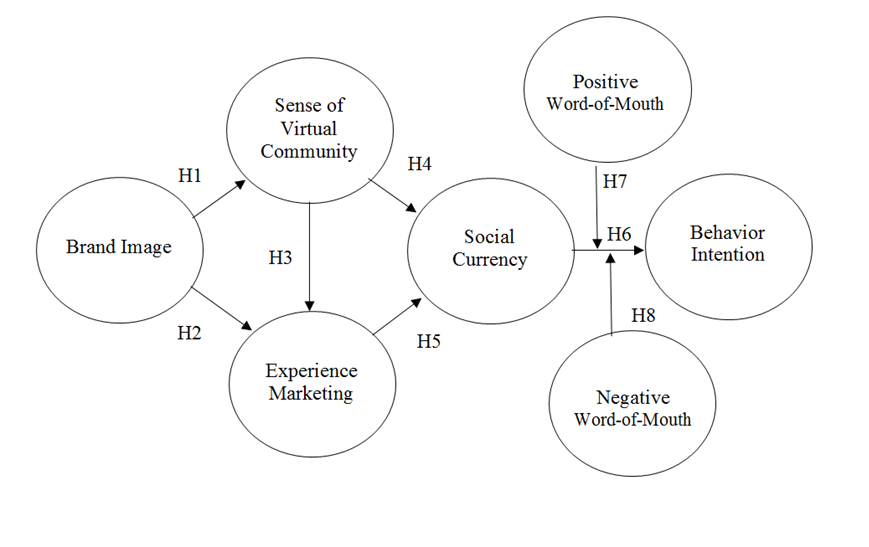
H1: Brand image has a significantly positive effect on sense of virtual community.
2.2. Brand Image and Experience MarketingNiantic's Pokémon Go has introduced a novel gaming experience to smartphone/mobile device users worldwide. AR technology is built upon real-world sensory information (actual visual, auditory), enhancing the view of the physical environment with additional graphics or sounds. In the case of Pokémon Go is not only new technologies that have upgraded user experiences, but also the theory of experience marketing.
4 argues that experience marketing is more effective than traditional marketing in creating customer loyalty and advocacy. This is because experience marketing creates a deeper emotional connection between the customer and the brand. Experience marketing does not focus on product categories but on brand image and consumption situations. Experience marketing, on the other hand, is focused on creating a memorable and engaging experience for the customer.
H2: Brand image has a significantly positive effect on experience marketing.
2.3. SOVC and Experience MarketingThis study examines the mobile game community specifically that of Pokémon Go, whose official Fan page is listed on the company’s website. 19 found that the dimensions of SOVC are positively correlated with satisfaction and communication within virtual communities. This means that people who feel more connected to the group and who have a stronger sense of community are more likely to be satisfied with the group and to communicate more with other members of the group. Additionally, these dimensions can also foster greater trust and social capital within the larger face-to-face community or organization. According to 22, members of online communities perceive a greater sense of familiarity with others' personalities and develop more personal connections compared to members of face-to-face communities. 23 highlight that online communities serve as valuable platforms for fostering the generation and dissemination of innovative knowledge through the utilization of social capital. Engaging in brand community management helps fulfill the inherent desire among individuals while simultaneously enhancing the brand's social currency. As a result, the author contends that SOVC has a positive impact on the brand's social currency and positively influences consumers' experiences.
H3: Sense of virtual community has a significantly positive effect on experience marketing.
H4: Sense of virtual community has a significantly positive effect on social currency.
2.4. Experience Marketing and Social Currency4 mentioned, experience marketing does not focus on product categories but on brand image and consumption situations. In this study, the brand community is represented by the official Fan page of the Pokémon Go. Recent developments in experiential marketing research have highlighted a significant shift from product-centered to experience-centered strategies. 24 emphasized that experiential marketing today involves immersive, emotionally engaging, and multisensory interactions, where consumers do not just purchase products but participate in meaningful brand experiences. This updated perspective aligns with 4 experiential framework and is especially relevant in digital platforms where user interface and interactivity become central to consumer-brand engagement. In the context of AR-based mobile games such as Pokémon Go, the convergence of physical movement, location-based mechanics, and branded storytelling offers a unique environment to study how experiential marketing affects social currency and behavioral outcomes. As described by 25, brand experience encompasses consumers' perceptions formed during every interaction they have with a brand. This includes encounters with brand imagery through advertising, initial personal interactions, and the perceived level of quality in the personal treatment they receive. From literature above and the definition of social currency, the consulting company 11, the consulting firm that created the term “social currency” in 2017, 14, the founder and CEO of 11, mentioned in an online magazine-Adweek that social currency refers to the degree to which individuals actively share brands or information related to brands as an integral part of their daily social interactions 14.
H5: Experience marketing has a significantly positive effect on social currency.
2.5. Social Currency and Behavior IntentionThe concept of social currency, which is closely related to 3 notion of social capital, has a significant impact on brand performance and serves as a key driver of brand loyalty, influencing consumers' behavioral intentions. Moreover, brands with high social currency command a price premium, and the components of social currency assess the influence of customer social behaviors on three outcomes: consideration, purchase, and loyalty. For this reason, the author proposes hypotheses as follows:
H6: Social currency has a significantly positive effect on behavior intention.
2.6. Word-of-Mouth and the Relationship between Social Currency and Behavior Intention.The indirect impact of computer-mediated interaction with customers extends beyond the immediate effect on in-person service quality, influencing customer-perceived value and various customer metrics 26. Word-of-Mouth plays a crucial role in helping to reduce consumers’ perceived risks and uncertainty. From the literatures, the author proposes hypotheses as follows:
H7: The impact of social currency on behavior intention is stronger when Word-of-mouth is positive.
H8: The impact of social currency on behavior intention is stronger when world-of-mouth is negative.
The research framework used in this study was innovative because it combined elements of traditional marketing research with elements of social media research. This allowed the researchers to gain a deeper understanding of how Pokémon Go players interact with the game and with each other. The study found that Pokémon Go players are motivated by a variety of factors, including the desire to collect Pokémon, to socialize with other players, and to explore their surroundings. Based on the literature survey above, this research measures: (1) the extent to which brand image affects video game players’ SOVC and the behavior of experience marketing. (2) The study investigates the potential positive impact of SOVC and feedback from experience marketing on social currency and behavior intention. (3) The study examines the potential moderating effect of positive and negative Word-of-Mouth on the relationship between social currency and behavior intention. The conceptual model shown below in Figure 1:

The target population for this study consists of individuals who have played and had experience with the mobile AR game Pokémon Go. The questionnaires were distributed through popular social media platforms such as Facebook.com and Taiwan's largest online survey platform, mySurvey.tw, over the course of one month. A total of 360 valid samples were obtained by the author, and structural equation modeling (SEM) was selected as the appropriate technique for data analysis in this study.
The age section of this study shows that the largest proportion of respondents (55.8%) were 19-25 years old. Moreover, the majority of respondents (83.6%) were male, while 16.4% were female. In addition, 67.2% of the respondents had a university degree. Furthermore, 94.7% of respondents had belonged to the Facebook virtual community for over three years, which shows that most of them had been using FB for a long time. 69.5% of respondents in this study had spent over 400 NT dollars to purchase Pokémon for virtual goods.
4.2. ReliabilityTo assess the reliability of the constructs, Cronbach's alpha coefficients were calculated and the results, presented in Table 1, indicate that all constructs yielded values greater than 0.6 27, suggesting satisfactory internal consistency.
Based upon the literature 35 support and the results presented in Table 2, all factor loadings were found to be statistically significant. These findings demonstrate the convergent validity of the measures used in the study. The correlations between constructs, as presented in Table 4, are found to be less than the square root of the average variance extracted (AVE) for the corresponding construct's indicators, suggesting satisfactory discriminant validity.
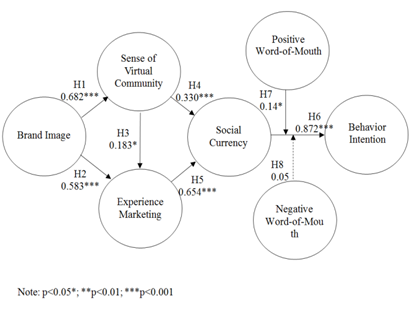
AMOS 19 was utilized to test the framework model in this research. Figure 2 shows that Brand image has a significant and positive influence on SOVC (H1, ß = 0.682, p < 0.001), Experience Marketing (H2, ß = 0.583 p < 0.001). Therefore, H1 and H2 are supported, demonstrating that Brand image could be a key motivation to increase the SOVC to accumulate social currency and encourage consumers to experience Pokemon Go game. The model indicated a significant deviation in the predicted path from SOVC to Experience marketing (ß = 0.183, p<0.05), H3 was supported. Moreover, Social currency is significantly and positively influenced by SOVC (H4, ß = 0.330, p < 0.001). The Experience Marketing to social currency (H5, ß = 0.654, p < 0.001) in H5 is supported. For H6, the social currency, has a significant and positive influence on behavior intention (H6, ß = 0.872, p < 0.001). The resulting figures and numbers are displayed in Figure 2 and Table 3, respectively. And the moderating effect (H7 and H8) will be discussed in the next section.
4.5. The Moderating EffectBroadly speaking, a moderator refers to a variable, whether qualitative or quantitative, that influences the nature and/or intensity of the relationship between an independent or predictor variable and a dependent or criterion variable. Based on 36, the moderating effect was tested in H7 and H8, positive and negative Word-of-Mouth. The independent variable is social currency; the moderator variables are positive and negative Word-of-Mouth; and the dependent variable is behavior intention.
Before hypotheses testing, the author checked the model fit indexes. In this phase, the structural model's fit indices demonstrated a satisfactory fit (χ2 test statistics/df = 2.91; GFI = 0.89; AGFI = 0.86; CFI = 0.94; NFI = 0.91; RMSEA = 0.07). These results indicated that the researcher could proceed to the final analysis based on the data. The proposed hypotheses were analyzed and the results are presented in Table 4, based on the SEM analysis.

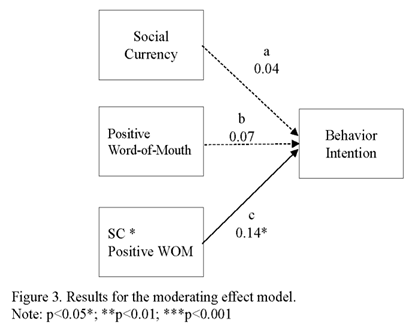
As the moderating effect in this study, as shown below, Figure 3, path c, from respondents’ feedback on positive Word-of-Mouth, has a moderating effect on social currency and behavior intention (H7, ß=0.140, p<0.05), H7 is supported. Positive Word-of-Mouth as a moderator has a significant impact on the relationship between social currency and behavior intention. All the positive Word-of-Mouth feedbacks from Pokémon Go players increased the influence of the willingness of social currency on behavior intention. Table 5 presented the total effect of positive Word-of-Mouth items, and this result shows that these items together have a strong influence on social currency; therefore, H7 was accepted.

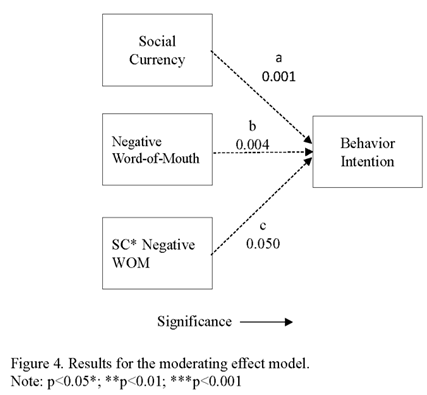
However, from Figure 4, path c, respondents’ negative Word-of-Mouth, does not have a moderating effect on social currency and behavior intention (H8, ß=0.050, p>0.05). Therefore, H8 is not supported. Negative Word-of-Mouth as a moderator does not have a significant impact on the relationship between social currency and behavior intention. Hypothesis 8 was not accepted as Table 6 indicates that the total effect of negative word-of-mouth items on social currency is not strong.

The result of moderating effect shows that the strength of influence of positive word-of-mouth (H7) varies contingent upon the behavior intention. For the moderation effect of H7, it consistent with prior studies 40, 41 positive word-of-mouth mostly emphasize the product/brand’s benefits and advantages, and even relate to pleasant or novel experience with the product, leading to the recommendation or share to others. However, negative word-of-mouth underline the weaknesses of a product/brand and mostly advise against the acquisition 42, 43, 34. By contrast, the moderation effect result of negative word-of-mouth (H8) is totally different with prior studies in the context of Pokémon Go behavior intention research.
Today, brands have become an integral part of consumers' daily lives, encompassing every moment. Marketers have shown a growing interest in leveraging social media platforms to enhance the connection between their brands and customers 44. Limited research has focused on examining the potential strategies employed by marketers to influence social currency and behavior intention through the utilization of a strong brand image, sense of virtual community (SOVC), and innovative user experiences (UX).
This study measured the power of brand image, SOVC, and customer experience in individuals’ accumulation of social currency, and investigated the relationship between social currency and behavior intention. As the study’s findings show, the effects of brand image on SOVC (H1) and customer experience (H2) were significant in the context of the Pokémon Go. Second, the effect of the SOVC on customer experience (H3) and on social currency (H4) was significant. Moreover, customer experience was positively affected by social currency (H5).
Thirdly, to gain a more profound comprehension, the author investigated not only the correlation between social currency and behavioral intention but also explored whether positive or negative Word-of-Mouth plays a moderating role in the relationship between social currency and behavioral intention.
The impact of social currency on consumer behavior (H6) showed statistical significance. Furthermore, the research revealed that positive Word-of-Mouth played a moderating role in the connection between social currency and behavior intention (H7), whereas no moderating effect was observed for negative Word-of-Mouth on the relationship between social currency and behavior intention (H8). To empirically evaluate and test the relationship of the hypotheses, the author applied data from a Taiwan consumer survey, and the survey questions were adopted or modified from previous scholars.
To sum up, the results of the proposed hypotheses testing are presented in Tables 5,6 and 7. Among these hypotheses, H1-H7 was supported, and H8 was not supported. The results produced notable findings that regarding the relationship of social currency and behavior intention can be influenced by the moderating effect of positive word-of-mouth. The author believes that the brand image of Pokémon Go not only bring customers an online- offline seamless experiences, but also, they can easily accumulate their personal social currency, and finally have positive behavior intention toward this product/game. Moreover, the relationship between social currency and behavior intention can be increased by continually positive word-of-mouth with those positively engaged players. However, for the result of moderating effect of negative word-of-mouth was not support. It contributes if a product/brand have an immense viral success like the case of Pokémon Go with the excellent customer experience; the negative word-of-mouth usually can be forgotten easily. These results are consistent with 45 findings that people tend to recall positive word-of-mouth (89%) significantly more than negative (7%)..
5.2. SignificanceThis research paper explores the phenomenon of a new way of customers’ consuming experience and ways of earning social currency in the context of a SOVC and social media marketing, from the novelty case of Pokémon Go’s brand image. Numerous studies have explored the association between brand image and consumers' behavior intention 46. However, limited research has delved into the holistic aspect of brand strategy concerning both online and offline marketing. As a result, this study bridges the research gap and represents a significant advancement in social marketing strategy. This study investigates brand image through observations of the SOVC (online environment) consumers experience and their gaming experience (offline, the real-world environment). In alignment with 47, social media platforms offer customers opportunities to share their usage experiences, opinions, preferences, and expectations regarding product quality. It needs a multi-platform across-the-board marketing strategy. Moreover, the author takes a closer look at the accumulation of social currency to gain an in-depth understanding of behavior intention. It consists with 48 research-social capital and virtual community knowledge sharing are both positively related to members’ e-loyalty.
Furthermore, to probe for a deeper understanding and better implementation suggestions from this research, the author adds positive and negative Word-of-Mouth as moderating variables and to evaluate the strength of the relationship between social currency and behavior intention. As a result, this study reveals that with a positive Word-of-Mouth and the usage of SOVC and physical customer experience as in the gaming environment could be effective in accumulating social currency and positively affecting consumer behavior intentions.
5.3. ImplicationsThe results of this study have practical implications for marketing practitioners, emphasizing specific areas of concern for managers:
First, the findings suggest that marketers can enhance brand awareness by creatively engaging customers online through the use of social currency (SOVC) and offline through immersive customer experiences. Given the increasing reliance of consumers on social media for shopping decisions, promotion through these platforms has become crucial 49.
Second, the study suggests new insights for practitioners. An examination of the hypotheses shows that social currency could be the most effective and positive variable for marketers in strengthening customers’ behavior intention. The Vivaldi research group has reported that higher social currency corresponds on average to a 19% greater willingness to pay a price premium. Social capital has been extensively examined at the micro-level, while social currency has emerged as a key component of the social system, representing an individual's intentions and perspectives 50. Furthermore, researchers have emphasized the significance of social currency as a crucial factor in maximizing human behavioral potential 51. Therefore, building up a stronger brand image, operating a higher SOVC, and creating a greater customer experience (ex. User interface, customer journey) to accumulate social currency could be valuable marketing strategies for marketing managers. In support of this experiential framework, 52 argue that multisensory elements—such as ambient sound, color schemes, and tactile user interfaces—enhance brand recall and perceived value in advergames. Their findings suggest that when experiential design is implemented holistically, it increases players’ emotional attachment and social capital. This insight supports the inclusion of Pokémon Go’s sensory-rich AR environment in the current model, and also presents a compelling opportunity for future research to explore how specific experiential cues contribute to the accumulation of social currency and long-term behavioral intention.
Third, according to the findings of this research, positive Word-of-Mouth plays a great role by positively affecting the relationship between social currency and behavior intention. Word-of-Mouth is incited when a customer encounters an experience that surpasses their initial expectations significantly. Hence, with a good SOVC and creative strategies, this suggests business excellence should make good use of Word-of-Mouth communication and increase their social currency to ensure positive behavior intention among consumers. Despite these implications, several avenues remain open for future exploration.
5.4. Scope for Future ResearchWhile this study has provided valuable insights into the roles of brand image, sense of virtual community, experience marketing, and social currency in shaping consumer behavior within the context of an AR mobile game, several opportunities exist for future research. First, researchers may explore longitudinal effects to better understand how the influence of social currency and word-of-mouth evolves over time, especially in response to changes in game design, social features, or player engagement cycles. Second, future studies could investigate cross-cultural differences by replicating the model in diverse cultural contexts to examine whether the proposed relationships hold or vary across regions. Given the global reach of Pokémon Go, cultural values and norms may moderate the effectiveness of brand experience and virtual community engagement. Third, integrating other constructs such as gamification elements, emotional attachment, or brand trust could enrich the theoretical framework and uncover deeper behavioral mechanisms. Fourth, qualitative or mixed-method approaches could be employed to complement the quantitative findings, offering richer insights into user motivations and community dynamics. Lastly, as emerging technologies such as the metaverse or extended reality (XR) continue to reshape digital consumption experiences, future research may extend the current model to investigate how immersive brand interactions influence social capital and behavioral intention in more complex virtual environments. Importantly, the validated framework in this study may serve as a reference model that can be adapted and applied to other mobile games or gamified platforms, thereby guiding promotional strategies and community-building efforts beyond the Pokémon Go context
| [1] | Farah, M. F., Hasni, M. J. S., & Abbas, A. K. (2022). Ethical issues in digital marketing: A systematic literature review. *Journal of Business Research*, 139, 1228–1245. | ||
| In article | |||
| [2] | Porter, S.S. and Claycomb, C. (1997) ‘The influence of brand recognition on retail store image’, Journal of Product & Brand Management, 6(6), pp. 373–387. | ||
| In article | View Article | ||
| [3] | Bourdieu P. (1997) The forms of capital. In: Halsey A.H., Lauder H., Brown P., Wells A.M., editors. Education, Culture, and Society. Oxford University Press; Oxford, UK: pp. 46–58. | ||
| In article | |||
| [4] | Schmitt, B. (1999) ‘Experiential marketing’, Journal of Marketing Management, 15(1-3), pp. 53–67. | ||
| In article | View Article | ||
| [5] | Yang, S., Hu, M., Winer, R.S., Assael, H. and Chen, X. (2012a) ‘An empirical study of word-of-mouth generation and consumption’, Marketing Science, 31(6), pp. 952–963. | ||
| In article | View Article | ||
| [6] | Godes D, Mayzlin D (2004) Using online conversation to study word-of-mouth communication. Marketing Science. 23(4): 545–560. | ||
| In article | View Article | ||
| [7] | Liu Y. (2006). Word of mouth for movies: Its dynamics and impact on box office revenue. Journal of Marketing. 70(3):74–89. | ||
| In article | View Article | ||
| [8] | Bowman D, Narayandas D (2001). Managing customer-initiated contacts with manufacturers: The impact on share of category requirements and word-of-mouth behavior. Journal of Marketing. Res. 38(3):281–297. | ||
| In article | View Article | ||
| [9] | Aaker, D. (1991) Managing Brand Equity. Capitalizing on the Value of a Brand Name. Free Press: New York. | ||
| In article | |||
| [10] | Kotler, P., (1973). Atmospherics as a marketing tool. Journal of Retailing, 49(4), 48–64. | ||
| In article | |||
| [11] | Vivaldi Partners. (2010). Social currency study. http:// www.vivaldipartners.com/ pdfs/ Vivaldi_Partners_ Social_Currency_US_Report_2010WEB.pdf. | ||
| In article | |||
| [12] | Zinnbauer, M. and Honer, T. (2011) ‘How brands can create social currency – A framework for managing brands in a network era’, Marketing Review St. Gallen, 28(5), pp. 50–55. | ||
| In article | View Article | ||
| [13] | Vivaldi Partners. (2012). Social currency study 2012: How brands and businesses can prosper in a digitally connected world. http://vivaldigroup.com/en/wp-content/ uploads/sites/ 2/2016/ 08/ socialcurrency2012.pdf. | ||
| In article | |||
| [14] | Joachimsthaler, E. (2017). The Power of Social Currency. Adweek.com. Retrieved 23 June 2025, from http://www.adweek.com/digital/erich-joachimsthaler-vivaldi-guest-post-social-currency/. | ||
| In article | |||
| [15] | Berger, J. (2016). Invisible influence: The hidden forces that shape behavior. Simon & Schuster. | ||
| In article | |||
| [16] | Lafferty, J. (2017). Can Influencer Marketing Really Motivate Purchases? (Study). [online] Adweek.com. Available at: http://www.adweek.com/digital/can-influencer-marketing-really-drive-conversions-study/ [Accessed 18 June 2025]. | ||
| In article | |||
| [17] | Azoulay, A. and Kapferer, J.N. (2003) ‘Do brand personality scales really measure brand personality? Journal of Brand Management, 11(2), pp. 143–155. | ||
| In article | View Article | ||
| [18] | Keller, K.L. (1993) ‘Conceptualizing, measuring, and managing customer-based brand equity’, Journal of Marketing, 57(1), pp. 1–22. | ||
| In article | View Article | ||
| [19] | Blanchard, A.L. (2008) ‘Testing a model of sense of virtual community’, Computers in Human Behavior, 24(5), pp. 2107–2123. | ||
| In article | View Article | ||
| [20] | Singhal, P. (2024). From content marketing to experience marketing: A study on experiential marketing strategies and customer engagement. African Journal of Biomedical Research, 27(4S), 13478–13487. | ||
| In article | View Article | ||
| [21] | Ho, C.-W. and Wang, Y.-B. (2015) ‘Re-purchase intentions and virtual customer relationships on social media brand community’, Human-centric Computing and Information Sciences, 5(1). | ||
| In article | View Article | ||
| [22] | Derlath, J. (2017). Measuring the Sense of Community in Online Communities. The-virtual-community-blog.blogspot.tw. Retrieved 19 May 2025 from http://the-virtual-community-blog.blogspot.tw/2014/10/measuring-sense-of-community-in-online.html. | ||
| In article | |||
| [23] | Sheng, M., & Hartono, R. (2013). An exploratory study of knowledge creation and sharing in online community: a social capital perspective. Total Quality Management & Business Excellence, 26(1-2), 93-107. | ||
| In article | View Article | ||
| [24] | Iloka, C., Ndu, J., & Mbah, E. (2024). The concept of experiential marketing: A comprehensive review. International Journal of Marketing Studies, 16(2), 45–61. | ||
| In article | |||
| [25] | Alloza, A. (2008) Brand Engagement and Brand Experience At BBVA: The Transformation of a 150Years Old Company. Corporate Reputation Review, 11(4): 371-381. | ||
| In article | View Article | ||
| [26] | Wang, T., Yeh, R. K.-J., Yen, D. C., & Nugroho, C. A. (2016). Electronic and in-person service quality of hybrid services. The Service Industries Journal, 36(13-14), 638–657. | ||
| In article | View Article | ||
| [27] | Bagozzi, R. P., & Yi, Y. (1988). On the evaluation of structural equation models. Academic of Marketing Science, 16 (1), 76-94. | ||
| In article | View Article | ||
| [28] | Koh, J. and Kim, Y.G. (2003) ‘Sense of virtual community: A conceptual framework and empirical validation’, International Journal of Electronic Commerce, 8, pp. 75–93. | ||
| In article | View Article | ||
| [29] | Azize et al.(2011). The effects of brand experiences, trust and satisfaction on building brand loyalty: Empirical research on global brands. Procedia - Social and Behavioral Sciences, 24, 1288–1301. | ||
| In article | View Article | ||
| [30] | Davis, F.D. (1989) ‘Perceived usefulness, perceived ease of use, and user acceptance of information technology’, MIS Quarterly, 13(3), p. 319. | ||
| In article | View Article | ||
| [31] | Goyette, I., Ricard, L., Bergeron, J. and Marticotte, F. (2010) ‘E-WOM scale: Word-of-mouth measurement scale for e-services context’, Canadian Journal of Administrative Sciences / Revue Canadienne des Sciences de l’Administration, 27(1), pp. 5–23. | ||
| In article | View Article | ||
| [32] | Kim, W. G., Han, J. S., & Lee, E. (2001). Effects of relationship marketing on repeat purchase and word of mouth. Journal of Hospitality and Tourism Research, 25(3), 272-288. | ||
| In article | View Article | ||
| [33] | Harrison-Walker, L.J. (2001). The measurement of Word-of-Mouth communication and an investigation of service quality and customer commitment as potential antecedents. Journal of Service Research, 4(1), 60–75. | ||
| In article | View Article | ||
| [34] | Cheung, C. M. K. & Thadani, D. R. (2012). The Impact of Electronic Word-of-Mouth Communication: A Literature Analysis and Integrative Model. Decision Support Systems, 54, 461–470. | ||
| In article | View Article | ||
| [35] | Fornell, C. G., & Larcker, D. F. (1981). Evaluating structural equation models with unobservable variables and measurement error. Journal of Marketing Research, 18(1), 39–50. | ||
| In article | View Article | ||
| [36] | Baron, R. M., & Kenny, D. A. (1986). The moderator–mediator variable distinction in social psychological research: Conceptual, strategic, and statistical considerations. Journal of Personality and Social Psychology, 51(6), 1173–1182. | ||
| In article | View Article PubMed | ||
| [37] | Hair, J. F., Black, W. C., Babin, B. J., & Anderson, R. E. (2009). Multivariate data analysis (7th ed.). Pearson Prentice Hall. | ||
| In article | |||
| [38] | Anderson, J. C., & Gerbing, D. W. (1991). Predicting the Performance of Measures in a Confirmatory Factor Analysis with a Pretest Assessment of Their Substantive Validities. Journal of Applied Psychology, 76(5), 732-740. | ||
| In article | View Article | ||
| [39] | Browne, M. W., & Cudeck, R. (1993). Alternative ways of assessing model fit. In K. A. Bollen & J. S. Long (Eds.), Testing structural equation models (pp. 136–162). Sage. | ||
| In article | |||
| [40] | Sweeney, Soutar, Mazzarol, (2014) "Factors enhancing word-of-mouth influence: positive and negative service-related messages", European Journal of Marketing, Vol. 48 Issue: 1/2, pp.336-359. | ||
| In article | View Article | ||
| [41] | Su, Lin & Chang, (2013) Exploring the impact factor of positive word-of-mouth influences satisfied customers, Total Quality Management & Business Excellence, 26:3-4, 430-444. | ||
| In article | View Article | ||
| [42] | Anderson, E. W. (1998). Customer satisfaction and word of mouth. Journal of service research, 1(1), 5-17. | ||
| In article | View Article | ||
| [43] | Buttle, F. A. (1998). Word of mouth: understanding and managing referral marketing. Journal of strategic marketing, 6(3), 241-254.Cheung, M.Y., Luo, C., Sia, C.L. and Chen, H. (2009) ‘Credibility of electronic word-of-mouth: Informational and normative determinants of on-line consumer recommendations’, International Journal of Electronic Commerce, 13(4), pp. 9–38. | ||
| In article | View Article | ||
| [44] | Martin, J. D., & Todorov, A. (2010). Dynamic evaluation of situational faces. Social Cognitive and Affective Neuroscience, 5(1), 45–54. | ||
| In article | |||
| [45] | Morris, H., (2017). Positive Word-of-Mouth is More Effective than Negative – Because it Sticks - WOMMA. Retrieved 22 June 2025, from https://womma.org/positive-word-of-mouth-is-more-effective-than-negative-because-it-sticks/. | ||
| In article | |||
| [46] | Zhang, Y. (2015) ‘The impact of brand image on consumer behavior: A literature review’, Open Journal of Business and Management, 03(01), pp. 58–62. | ||
| In article | View Article | ||
| [47] | Liu, Y., Jiang, C., Ding, Y., Wang, Z., Lv, X., & Wang, J. (2017). Identifying helpful quality-related reviews from social media based on attractive quality theory. Total Quality Management & Business Excellence, 1-20. | ||
| In article | View Article | ||
| [48] | Yao, C., Tsai, C., & Fang, Y. (2014). Understanding social capital, team learning, members' e-loyalty and knowledge sharing in virtual communities. Total Quality Management & Business Excellence, 26(5-6), 619-631. | ||
| In article | View Article | ||
| [49] | Shankar, V., Inman, J. J., Mantrala, M., Kelley, E., & Rizley, R. (2011). Innovations in shopper marketing: Current insights and future research issues. Journal of Retailing, 87(S1), S29–S42. | ||
| In article | View Article | ||
| [50] | Cofield, M. (2017), Building Social Capital in Multicultural Communities: The Dyadic Process and Related Social Outcomes of Executive Leaders. Ph.D. Thesis, St. John Fisher College, Ulster County, NY, USA. | ||
| In article | |||
| [51] | Wang, Y-B. and Ho, C-W., (2017) "No Money? No Problem! The Value of Sustainability: Social Capital Drives the Relationship among Customer Identification and Citizenship Behavior in Sharing Economy". Sustainability, 9(8), 2017-08. | ||
| In article | View Article | ||
| [52] | Farzinnejad, A., Mohammadi, R., & Kim, H. (2024). Multisensory experience design and consumer response in advergames. Interactive Marketing Research, 12(3), 103–118. | ||
| In article | |||
Published with license by Science and Education Publishing, Copyright © 2025 Yu-Bing Wang
 This work is licensed under a Creative Commons Attribution 4.0 International License. To view a copy of this license, visit
http://creativecommons.org/licenses/by/4.0/
This work is licensed under a Creative Commons Attribution 4.0 International License. To view a copy of this license, visit
http://creativecommons.org/licenses/by/4.0/
| [1] | Farah, M. F., Hasni, M. J. S., & Abbas, A. K. (2022). Ethical issues in digital marketing: A systematic literature review. *Journal of Business Research*, 139, 1228–1245. | ||
| In article | |||
| [2] | Porter, S.S. and Claycomb, C. (1997) ‘The influence of brand recognition on retail store image’, Journal of Product & Brand Management, 6(6), pp. 373–387. | ||
| In article | View Article | ||
| [3] | Bourdieu P. (1997) The forms of capital. In: Halsey A.H., Lauder H., Brown P., Wells A.M., editors. Education, Culture, and Society. Oxford University Press; Oxford, UK: pp. 46–58. | ||
| In article | |||
| [4] | Schmitt, B. (1999) ‘Experiential marketing’, Journal of Marketing Management, 15(1-3), pp. 53–67. | ||
| In article | View Article | ||
| [5] | Yang, S., Hu, M., Winer, R.S., Assael, H. and Chen, X. (2012a) ‘An empirical study of word-of-mouth generation and consumption’, Marketing Science, 31(6), pp. 952–963. | ||
| In article | View Article | ||
| [6] | Godes D, Mayzlin D (2004) Using online conversation to study word-of-mouth communication. Marketing Science. 23(4): 545–560. | ||
| In article | View Article | ||
| [7] | Liu Y. (2006). Word of mouth for movies: Its dynamics and impact on box office revenue. Journal of Marketing. 70(3):74–89. | ||
| In article | View Article | ||
| [8] | Bowman D, Narayandas D (2001). Managing customer-initiated contacts with manufacturers: The impact on share of category requirements and word-of-mouth behavior. Journal of Marketing. Res. 38(3):281–297. | ||
| In article | View Article | ||
| [9] | Aaker, D. (1991) Managing Brand Equity. Capitalizing on the Value of a Brand Name. Free Press: New York. | ||
| In article | |||
| [10] | Kotler, P., (1973). Atmospherics as a marketing tool. Journal of Retailing, 49(4), 48–64. | ||
| In article | |||
| [11] | Vivaldi Partners. (2010). Social currency study. http:// www.vivaldipartners.com/ pdfs/ Vivaldi_Partners_ Social_Currency_US_Report_2010WEB.pdf. | ||
| In article | |||
| [12] | Zinnbauer, M. and Honer, T. (2011) ‘How brands can create social currency – A framework for managing brands in a network era’, Marketing Review St. Gallen, 28(5), pp. 50–55. | ||
| In article | View Article | ||
| [13] | Vivaldi Partners. (2012). Social currency study 2012: How brands and businesses can prosper in a digitally connected world. http://vivaldigroup.com/en/wp-content/ uploads/sites/ 2/2016/ 08/ socialcurrency2012.pdf. | ||
| In article | |||
| [14] | Joachimsthaler, E. (2017). The Power of Social Currency. Adweek.com. Retrieved 23 June 2025, from http://www.adweek.com/digital/erich-joachimsthaler-vivaldi-guest-post-social-currency/. | ||
| In article | |||
| [15] | Berger, J. (2016). Invisible influence: The hidden forces that shape behavior. Simon & Schuster. | ||
| In article | |||
| [16] | Lafferty, J. (2017). Can Influencer Marketing Really Motivate Purchases? (Study). [online] Adweek.com. Available at: http://www.adweek.com/digital/can-influencer-marketing-really-drive-conversions-study/ [Accessed 18 June 2025]. | ||
| In article | |||
| [17] | Azoulay, A. and Kapferer, J.N. (2003) ‘Do brand personality scales really measure brand personality? Journal of Brand Management, 11(2), pp. 143–155. | ||
| In article | View Article | ||
| [18] | Keller, K.L. (1993) ‘Conceptualizing, measuring, and managing customer-based brand equity’, Journal of Marketing, 57(1), pp. 1–22. | ||
| In article | View Article | ||
| [19] | Blanchard, A.L. (2008) ‘Testing a model of sense of virtual community’, Computers in Human Behavior, 24(5), pp. 2107–2123. | ||
| In article | View Article | ||
| [20] | Singhal, P. (2024). From content marketing to experience marketing: A study on experiential marketing strategies and customer engagement. African Journal of Biomedical Research, 27(4S), 13478–13487. | ||
| In article | View Article | ||
| [21] | Ho, C.-W. and Wang, Y.-B. (2015) ‘Re-purchase intentions and virtual customer relationships on social media brand community’, Human-centric Computing and Information Sciences, 5(1). | ||
| In article | View Article | ||
| [22] | Derlath, J. (2017). Measuring the Sense of Community in Online Communities. The-virtual-community-blog.blogspot.tw. Retrieved 19 May 2025 from http://the-virtual-community-blog.blogspot.tw/2014/10/measuring-sense-of-community-in-online.html. | ||
| In article | |||
| [23] | Sheng, M., & Hartono, R. (2013). An exploratory study of knowledge creation and sharing in online community: a social capital perspective. Total Quality Management & Business Excellence, 26(1-2), 93-107. | ||
| In article | View Article | ||
| [24] | Iloka, C., Ndu, J., & Mbah, E. (2024). The concept of experiential marketing: A comprehensive review. International Journal of Marketing Studies, 16(2), 45–61. | ||
| In article | |||
| [25] | Alloza, A. (2008) Brand Engagement and Brand Experience At BBVA: The Transformation of a 150Years Old Company. Corporate Reputation Review, 11(4): 371-381. | ||
| In article | View Article | ||
| [26] | Wang, T., Yeh, R. K.-J., Yen, D. C., & Nugroho, C. A. (2016). Electronic and in-person service quality of hybrid services. The Service Industries Journal, 36(13-14), 638–657. | ||
| In article | View Article | ||
| [27] | Bagozzi, R. P., & Yi, Y. (1988). On the evaluation of structural equation models. Academic of Marketing Science, 16 (1), 76-94. | ||
| In article | View Article | ||
| [28] | Koh, J. and Kim, Y.G. (2003) ‘Sense of virtual community: A conceptual framework and empirical validation’, International Journal of Electronic Commerce, 8, pp. 75–93. | ||
| In article | View Article | ||
| [29] | Azize et al.(2011). The effects of brand experiences, trust and satisfaction on building brand loyalty: Empirical research on global brands. Procedia - Social and Behavioral Sciences, 24, 1288–1301. | ||
| In article | View Article | ||
| [30] | Davis, F.D. (1989) ‘Perceived usefulness, perceived ease of use, and user acceptance of information technology’, MIS Quarterly, 13(3), p. 319. | ||
| In article | View Article | ||
| [31] | Goyette, I., Ricard, L., Bergeron, J. and Marticotte, F. (2010) ‘E-WOM scale: Word-of-mouth measurement scale for e-services context’, Canadian Journal of Administrative Sciences / Revue Canadienne des Sciences de l’Administration, 27(1), pp. 5–23. | ||
| In article | View Article | ||
| [32] | Kim, W. G., Han, J. S., & Lee, E. (2001). Effects of relationship marketing on repeat purchase and word of mouth. Journal of Hospitality and Tourism Research, 25(3), 272-288. | ||
| In article | View Article | ||
| [33] | Harrison-Walker, L.J. (2001). The measurement of Word-of-Mouth communication and an investigation of service quality and customer commitment as potential antecedents. Journal of Service Research, 4(1), 60–75. | ||
| In article | View Article | ||
| [34] | Cheung, C. M. K. & Thadani, D. R. (2012). The Impact of Electronic Word-of-Mouth Communication: A Literature Analysis and Integrative Model. Decision Support Systems, 54, 461–470. | ||
| In article | View Article | ||
| [35] | Fornell, C. G., & Larcker, D. F. (1981). Evaluating structural equation models with unobservable variables and measurement error. Journal of Marketing Research, 18(1), 39–50. | ||
| In article | View Article | ||
| [36] | Baron, R. M., & Kenny, D. A. (1986). The moderator–mediator variable distinction in social psychological research: Conceptual, strategic, and statistical considerations. Journal of Personality and Social Psychology, 51(6), 1173–1182. | ||
| In article | View Article PubMed | ||
| [37] | Hair, J. F., Black, W. C., Babin, B. J., & Anderson, R. E. (2009). Multivariate data analysis (7th ed.). Pearson Prentice Hall. | ||
| In article | |||
| [38] | Anderson, J. C., & Gerbing, D. W. (1991). Predicting the Performance of Measures in a Confirmatory Factor Analysis with a Pretest Assessment of Their Substantive Validities. Journal of Applied Psychology, 76(5), 732-740. | ||
| In article | View Article | ||
| [39] | Browne, M. W., & Cudeck, R. (1993). Alternative ways of assessing model fit. In K. A. Bollen & J. S. Long (Eds.), Testing structural equation models (pp. 136–162). Sage. | ||
| In article | |||
| [40] | Sweeney, Soutar, Mazzarol, (2014) "Factors enhancing word-of-mouth influence: positive and negative service-related messages", European Journal of Marketing, Vol. 48 Issue: 1/2, pp.336-359. | ||
| In article | View Article | ||
| [41] | Su, Lin & Chang, (2013) Exploring the impact factor of positive word-of-mouth influences satisfied customers, Total Quality Management & Business Excellence, 26:3-4, 430-444. | ||
| In article | View Article | ||
| [42] | Anderson, E. W. (1998). Customer satisfaction and word of mouth. Journal of service research, 1(1), 5-17. | ||
| In article | View Article | ||
| [43] | Buttle, F. A. (1998). Word of mouth: understanding and managing referral marketing. Journal of strategic marketing, 6(3), 241-254.Cheung, M.Y., Luo, C., Sia, C.L. and Chen, H. (2009) ‘Credibility of electronic word-of-mouth: Informational and normative determinants of on-line consumer recommendations’, International Journal of Electronic Commerce, 13(4), pp. 9–38. | ||
| In article | View Article | ||
| [44] | Martin, J. D., & Todorov, A. (2010). Dynamic evaluation of situational faces. Social Cognitive and Affective Neuroscience, 5(1), 45–54. | ||
| In article | |||
| [45] | Morris, H., (2017). Positive Word-of-Mouth is More Effective than Negative – Because it Sticks - WOMMA. Retrieved 22 June 2025, from https://womma.org/positive-word-of-mouth-is-more-effective-than-negative-because-it-sticks/. | ||
| In article | |||
| [46] | Zhang, Y. (2015) ‘The impact of brand image on consumer behavior: A literature review’, Open Journal of Business and Management, 03(01), pp. 58–62. | ||
| In article | View Article | ||
| [47] | Liu, Y., Jiang, C., Ding, Y., Wang, Z., Lv, X., & Wang, J. (2017). Identifying helpful quality-related reviews from social media based on attractive quality theory. Total Quality Management & Business Excellence, 1-20. | ||
| In article | View Article | ||
| [48] | Yao, C., Tsai, C., & Fang, Y. (2014). Understanding social capital, team learning, members' e-loyalty and knowledge sharing in virtual communities. Total Quality Management & Business Excellence, 26(5-6), 619-631. | ||
| In article | View Article | ||
| [49] | Shankar, V., Inman, J. J., Mantrala, M., Kelley, E., & Rizley, R. (2011). Innovations in shopper marketing: Current insights and future research issues. Journal of Retailing, 87(S1), S29–S42. | ||
| In article | View Article | ||
| [50] | Cofield, M. (2017), Building Social Capital in Multicultural Communities: The Dyadic Process and Related Social Outcomes of Executive Leaders. Ph.D. Thesis, St. John Fisher College, Ulster County, NY, USA. | ||
| In article | |||
| [51] | Wang, Y-B. and Ho, C-W., (2017) "No Money? No Problem! The Value of Sustainability: Social Capital Drives the Relationship among Customer Identification and Citizenship Behavior in Sharing Economy". Sustainability, 9(8), 2017-08. | ||
| In article | View Article | ||
| [52] | Farzinnejad, A., Mohammadi, R., & Kim, H. (2024). Multisensory experience design and consumer response in advergames. Interactive Marketing Research, 12(3), 103–118. | ||
| In article | |||