Digital marketing refers to advertising delivered through digital channels viz. search engines, websites, social media, email, and mobile apps. Using online media channels, digital marketing is the method by which companies sell goods, services, and brands. Consumers heavily rely on digital means for consumerism. It is a stark reality that when we proceed with Google marketing insights we have found that almost 48% of consumers start their inquiries on search engines, while almost 33% look through brand websites and rest 26% search through mobile applications.
In this modern age of internet almost every progressive business equipped with web presence, some people opined that web site just a commercial requirement but others opined that it would mandatory to run their company activities. Different theories about internet have been discussed a lot in recent marketing literature .In the past marketers had Confucius concept about the role of internet in marketing. Initially marketers used to use internet as communication tool but as time passed away they realized the true outcome of internet.
The following are the important review related to this study: Here we have many researches and studies about the comparison between traditional marketing and modern marketing and also advantages and disadvantages of internet marketing, which perceived the performances and its transformation from traditional to modern era.
Cashton and Mangles 1, studied the influence of internet marketing among small UK manufacturing firms. They adopted a quantitative methodology to determine whether, in intra business markets, the Internet could be a technology that would be managed effectively by firms. The survey was conducted through mailed questionnaires on a sample of 298 UK based small firms. Insufficient evidence was found to support the view that relationship-orientated firms, when compared with transaction ally-orientated competitors, exhibited differing perceptions about the nature of online markets.
According to Hodge 1, 2, Internet marketing (IM) is the transfer of goods or services from seller to buyer that contained one or more electronic methods or media. It had started with the use of telegraphs in the nineteenth century. With the advent and mass acceptance of the telephone, radio, television, and then cable, electronic media grabbed the dominant marketing force.
Yazdanifard, R., Venpin, M., Wan Yusoff, Wan F. & Rabiul Islam, M. 3 opined that Internet marketing could have been interesting topic especially for researchers in the marketing field. It could be precisely a new way of marketing a product or service globally to the targeted market around the world. This paper introduced a new approach concerned with Internet marketing in electronic commerce; showed how advertisers could use this innovation to be the most successful. This also revealed that marketing managers would be more comfortable for more value added tasks such as implementation of marketing plans for better development of the company.
According to Stuart E. J. 4 day by day there was upward growth of online services in regular usages by consumers. However, traditional marketers somehow did not want to admit that the world had changed. They were slow learners in taking the advantages of new opportunities presented to them. B2B-enhanced supply chain process needed to pay much attention to real-world business process, adapted automated systems to business behavior and mingled content and technologies with crucial information systems.
Hodge's 2 idea of internet marketing proved to be simple although it did not touch the important aspect of customer relationship. Strauss and Ansary 5 defined internet marketing as a means of using information technology in the process of creating, communicating, and delivering value to customers, and for regulating customer relationships in such a ways that could benefit both the organization and its stake holders. This explanation conveyed that internet marketing associated with not only about selling products or providing services through IT but it could be lot more than that. It would not just traditional marketing using the information technology tools but mere a strategic model to achieve brand value that could provide customer satisfaction. Idea of internet marketing could be derived as type of marketing in which objectives could be achieved through use of electronic communication tools like internet, interactive TV and mobile phones.
Internet marketing is nothing but “Applying Digital technologies on online channels (Web, e- mail, databases etc) to contribute to marketing activities aimed at achieving profitability and retention of customers (within a multi- channel buying process and customer lifecycle) by means of improving our customer knowledge (profiles, behavior, value and loyalty drivers), then delivering integrated targeted communications and online services that could easily match their individual needs.” as defined by Dave Chaffey 6. Chaffey's definition highlighted the relationship marketing concept, it emphasized that it should not be technology that derived Electronic marketing, rather the business model.
Comparing both internet as well as traditional marketing, Internet Marketing would be more economical and faster way to reach out buyer directly, and proved the ideal way for business to advertise locally or internationally. (FIIB Business Review Volume 3, Issue 3, July - September 2014 Salehi, M., Mirzaei, H., & Aghaei, M. 7. As the result in case of comparison; both types of marketing could help traders and marketers to do business. Each proved advantageous and disadvantageous. In traditional marketing consumers could see and touch the real goods or services but the domain of effect proved to be low, on the other hand using of internet marketing would exceed the boundaries and introduce goods and services to the demographic of internet users. Using the internet would be more chipper, faster and convenient for marketing. Approximately the advantages of internet marketing would have been much more than that of traditional marketing.
Vishal Khasgiwala & Monica Sainy 8 opined that “Impulsive buying behavior originated from gender disparity is a common tendency of youth in central India” and Impulsive buying is a common exorbitant today and can occur in any setting.
Dastidar &Datta 9 Relationship – presents gender wise between both the variable and influence of exploratory tendencies on impulsive buying behavior on in young female is higher than young male.
Sathish and A. Rajamohan 10 conveyed as consumer’s buying behavior is seen as the sum of his interactions with his environment.
Priyanka Mehra 11 opined that “youth have always been targeted by the marketers in a common parlance throughout the world. So in India, as two-thirds of the population is below 35 years of age.
Manjeet 12 conveyed as youth are ambitious, technology-oriented and confident. Tastes and preferences of the consumers are also changing at a rapid rate. Marketers are finding it difficult to adjust with the changing need of the customers.
We have most common digital marketing tactics and those are:
Search Engine Optimization (SEO): This is a process of optimizing website ranking in search engine, thereby increasing the amount of organic traffic a particular website receives. The channels that benefit from SEO include Websites, Blogs, and Info graphics.
Social Media Marketing: This form of marketing promotes brand and content on social media to increase brand awareness, drive traffic, and generate leads of business. This includes Face book, Twitter, LinkedIn, Instagram, Snap chat, Pinterest, and Google+.
Content Marketing: a form of marketing which deals with creation and promotion of content assets for generating brand awareness, traffic growth, lead generation, and customers. The medium that can play a significant role in content marketing strategy includes Blog posts, EBooks, etc.
Performance based advertising where we receive commission for promoting someone else's products, services on our website is known as Affiliate-Marketing. It includes Hosting video ads through the YouTube Partner Program and Posting affiliate links from our social media accounts.
Native advertising signifies those advertisements that are primarily content-led and featured on a platform along with other, non-paid content. Buzz Feed-sponsored posts are a good example, but many people also consider social media advertising to be the most important "native".
Marketing automation refers to that software that serves to automate our basic marketing operations. Many marketing departments can automate repetitive tasks which would have been done manually, such as Email newsletters, Social media post scheduling, Contact list and so many.
PPC i.e. pay per click is a method of driving traffic to our website by paying a publisher every time our ad is clicked. One of the most common types of PPC is Google Ad Words, which allows you to pay for top slots on Google's search engine results pages at a price "per click" of the links you place. Other channels where we can have possibility of using PPC mainly include Paid ads on Facebook, Promoted Tweets on Twitter, and Sponsored Messages on LinkedIn.
Very often Companies use email marketing as a means of communicating with their audiences. Email is often used to upgrade content, discounts and events, as well as to regulate people toward the business's website. Emails which we usually send in an email marketing campaign include Blog subscription newsletters, Follow-up emails to website visitors who usually downloads.
Inbound marketing is a form of marketing which refers to the "full-fledged" approach to focusing, engaging, and motivating customers using online content. We can use every digital marketing tactic as mentioned above throughout an inbound marketing strategy.
Online PR is the process of securing online coverage with digital publications, blogs, and other content-based websites. It's much similar to traditional PR but in the online space. The channels we can use to maximize our PR efforts including Reporter outreach via social media Engaging online reviews of our company, and Engaging comments on our personal website.
• To determine which method of DIGITAL MARKETING is more convenient.
• To identify comfortable to start & cost effective DIGITALMARKETING techniques.
• TO determine Which Marketing Technique gives better ROI.
• To identify which is the fastest mode of reaching Targeted Audience.
To determine the area where a START-UP should be adapt in the initial days of starting of business.
• To determine a basic monthly budget allotted in DIGITALMARKETING.
|
We have surveyed people across Durgapur and have come to know many aspects regarding digital marketing as well as traditional marketing. We have also gone through case studies related to said aspect. So we have collected both primary and secondary data were during the research work.
Primary Data
Data collected by researchers directly from main sources through interviews, surveys, experiments, etc. is said to be primary data. Primary data are usually collected from the source— wherethe data originally originates from and are regarded as the best kind of data in research.
Sample Size- 101 Sample Area- Durgapur
Sample Tool – Questionnaire Sample Media- Google Forms
Secondary Data:
Data that has already been collected by someone through primary sources and made readily available for researchers to use for their own research is said to be secondary data. It is a type of data that has already been collected in the past. Here we have studied case studies of Lays and Zomato which have been collected from Internet.
Gender Analysis in digital marketing:
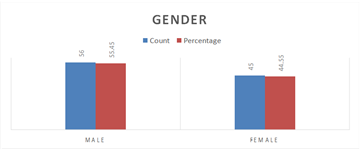
We have surveyed 101 people out of which 56 are males and 45 are females. The percentage stands for 55.45 % for males and 44.55 % for females.
Age factor:
|
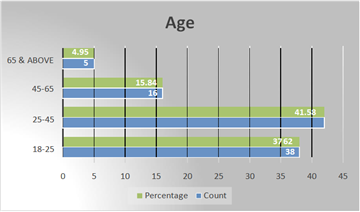
Through this survey, we also get to know that our maximum respondents are entrepreneurs ranging from 25-45 years of age which is about 41.58 %.The percentage leading the age group 18-25 is 37.62 %. The group which follows 45-65 years of age their percentage is about 15.84%.The percentage what we have got from the last age group ranging from 65 & above is 4.95%
Convenient methods of DIGITAL MARKETING:
|
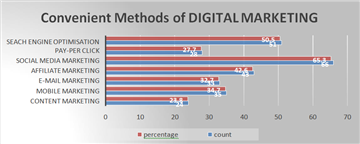
Marketing (Digital) is so important at this point that we have got a mixed opinion from the Entrepreneur. Some of them use Search Engine Optimization (SEO) with Social Media marketing , while some of them use four, five or more as this can be very cost-effective if one can use them with precise knowledge.
In this diagram we can see that the majority of customer use Social Media Marketing i.e., 66 use Social Media Marketing which is about 65.3%, following them comes the Search Engine Optimization (SEO) where 51 people use it, which is about 50.5%. We have the method which leads is Affiliate Marketing where we have 43 user, which is about 42.6%.We have also the Mobile Marketing where we have 35 user, which is about 34.7%.More over we have E-Mail Marketing where we have 33user, which is about 32.7%, following comes the Pay- Per-Click Marketing where we have 28 user it, which is about 27.7%. Lastly, we have content marketing where we have24 user, which is about 27.7%.
Budget (monthly) allotted in DIGITALMARKETING:
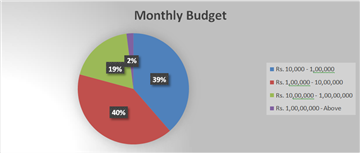
In this diagram we can clearly observe that the majority of the user allot the monthly budget i.e., 41of them allots the monthly budget ranges betweenRs.1,00,000 –10,00,000 which is about 40%, following them comes the budget range of Rs. 10,000 – 1,00,000 where 39 people allots the monthly budget, which is about 39%. 19 people allots the monthly budget ranges between Rs. 10,00,000 – 1,00,00,000, which is about 19% and only 2 people allots which is 2% in the last budget ranges we have Rs. 1,00,00,000 and above.
|
TRADITIONAL MARKETING and its convenience:
|
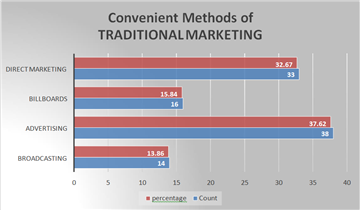
Traditional Marketing is the oldest form of marketing. People use sometime Direct Marketing, Billboards while others use Advertising or Broadcasting. We have clearly observed that the majority of them uses Offline mode of Advertising i.e., 38. People also use Advertising Marketing which is about 37.62%. Some people use Direct Marketing where 33 people uses it, which is about 32.67%.We have Billboards where 16 people uses it, which is about 15.84%, at last but not the least comes the Broadcasting where only 14 people uses, which is about 13.86%.
Budget (monthly) allotted in TRADITIONAL MARKETING:
|
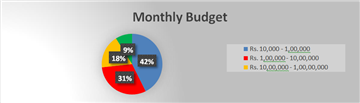
In this diagram we can clearly observe that the majority of them allot the monthly budget i.e., 42 persons allot the monthly budget range between Rs.10,000 – 1,00,000 which is about 42%, following them comes the budget range of Rs. 1,00,000 – 10,00,000 where 31 people allot the monthly budget, which is about 31%. 18 people allot the monthly budget range between Rs. 10,00,000 – 1,00,00,000, which is about 18%. 9 people allot which is 9% in the budget range of Rs. 1,00,00,000 and above
DIGITAL MARKETING and identification of traffic:
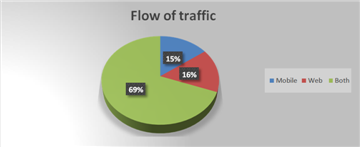
After the JIO revolution majority of us are using internet in our daily life to do basic works, banking work, socializing with friends etc, In this graph we can clearly see that the majority of them use both web as well as mobile phones to operate digitally i.e., 69 people uses both web as well as mobile phones which is about 69%, following them comes the WEB where 16 people use it, which is about 16%. After this, we have the mobile phones, where 15 people use it daily to operate digitally, which is about 15%.
|
Easy to start &Cost effective DIGITAL MARKETING:
|
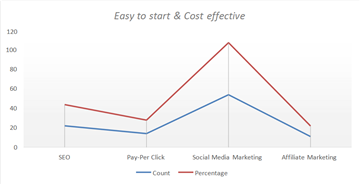
Digital Marketing is very easy to start and more precisely it’s highly Cost effective. Anyone can gather preliminary knowledge about certain terms and conditions and can easily start there venture digitally and can touch the sky in terms of profitability. So, in this graph we can clearly see that the majority of them use social media marketing i.e., 54 people use them, which is about 53.47%, following them comes the Search Engine Optimization (SEO) where 22 people use it, which is about 21.78%. After this, the method which lead’s is pay-per click (PPC), where 14 people use it, which is about 13.86%. In affiliate marketing in we have only 11 people, which is about 10.89%.
Profitable Marketing Techniques:
|
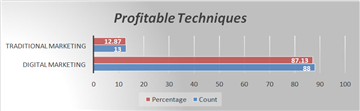
We have asked all the feasible entrepreneurs to give a brief idea about which marketing techniques give more profit and it is shocked to see that the Digital Marketing which is comparatively a new technique in the marketing is surpassing the old traditional marketing techniques in terms of profit making. We can clearly see that the majority of them have selected Digital Marketing in profit making part, 88 people have selected Digital Marketing which is about 87.13%. Meagerly, 13 people have selected traditional marketing techniques which are roughly about 12.87%.
Fastest mode of reaching Targeted Audience
|
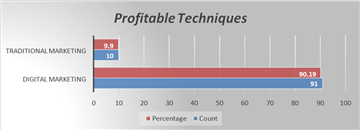
We also have asked the entrepreneurs to give a brief idea about which marketing techniques is the fastest mode of reaching Targeted Audience, and it is shocked to see that the Digital Marketing is surpassing the old traditional marketing techniques in terms of reaching Targeted Audience. So, in this diagram we can clearly observe that 91 people have selected Digital Marketing which is about 90.10%. Only 10 people have selected traditional marketing techniques which are roughly 9.90%.
Marketing Technique with more ROI
|
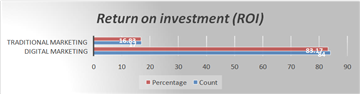
In the survey we have asked the entrepreneurs to give a brief idea about which marketing techniques give more Return on investment (ROI), and we have been shocked to observe that the Digital Marketing which is comparatively a new technique in the marketing is overtaking the old traditional marketing techniques in terms of profit making. Here we have clearly seen that the majority of people have selected Digital Marketing i.e. 84 people have selected Digital Marketing which is about 83.17% and Only 17 people have selected traditional marketing techniques which are roughly about 16.83%.
START-UP:
|
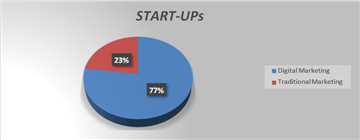
We have also asked to give suggestions to the emerging entrepreneurs who are going to do a start-up business. Majority of the experienced Entrepreneur have suggested to start with digital marketing at the beginning as it is cost-effective as well as it will give a larger set of customers. We can clearly visualize that the majority of them have selected Digital Marketing, 78 people have selected Digital Marketing which is about 77.23%. Legitimately 23 people have selected traditional techniques which are roughly about 22.77%.
Case studies related to Digital Marketing
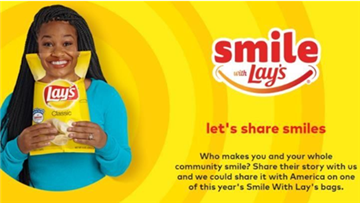
Lays- #SmileDekeDekho-
Case Summary- Lay’s is a potato chips invention from the parent company PepsiCo that initiated the ‘Smile Deke Dekho campaign’ in October 2019. The unique selling proposal was that the brand promoted the message of how a simple smile can connect different
|
Individuals universally and simultaneously reflects the emotions and the mood effortlessly through each flavor and packet of chips. The uniqueness of the initiative was activiting the influencers on various social platforms
Resulting reverberation-
1. A sensible feeling of personalized and customized product that is uniquely curetted just for the sake of customers.
2. It is a sensible way to communicate with the consumers individually and vice versa. The campaign stated the power of a single smile and the power of positivity
3. The campaign motivated the use of social media platforms like snap chat and Instagram by asking the consumers to act a smile with their packets of Lays.
Zomato #Never have a bad meal-
|
Zomato is another digital food giant that could not escape but master the world of digital marketing. The brand is known to be winning hearts on social media credit goes to its mastery in digital marketing platform. Its tweets, for example, have been consistently promoting customers to brand and vice versa engagement.
Resulting Reverberation-
It is a special Interactive digital marketing platform which influences and motivates people to join the Zomato community of foodies. Incorporating memes and current issues have made the brand’s presence on digital media, quite remarkable and prominent now and probably forever.
We have surveyed respondents in Durgapur and also studied case studies of selected companies. The following reverberations are:
1. Out of the total respondents’ maximum of the respondents were male.
2. We had observed a mixed opinion from different marketers.
3. We had also asked entrepreneurs to give an approx budget a n d 1,00,000 - 10,00,000.
4. Respondents preferred advertising as the most convenient method of traditional marketing.
5. For traditional marketing maximum of them preferred to spend ten lacs to one crore.
6. Respondents concluded that the maximum traffic comes from both web and mobile.
7. The majority of people suggested that social media marketing is the most costeffective and easy to start method.
8. They further suggested that digital marketing will be the most profitable marketing technique.
9. Maximum respondents agreed with that digital marketing can give more ROI.
10. They also opined that digital marketing will be the most convenient marketing method for start up.
11. We had an outcome that social media marketing was the major tool used by them.
12.Companies could communicate with people more via social media.
• Small businesses and start-ups should be adapted with Digital marketing more.
• We have found that the Indian market is under investing in data science and analysis which should be looked after more.
• We have found that most marketers in India are not harnessing the true potential of newer technology. They should try out mixed marketing approaches.
• Firms should consider digital marketing as a long term process. They should not stop at the initial failures because digital marketing will take time to implement, but after the effectiveness the efficiency will be high.
• We approached many respondents throughout but out of that only few people responded.
• We approached different people from different gender groups but male respondents were more.
• We were confined only to Durgapur so our results were very specific, not general.
• The age group from 25-45 was maximum, whereas the age group from65 and above were least.
• Time was the major limitation of the study as the project was restricted to a small period.
We have been embarked on with the objective how digital marketing is creating more impact than traditional marketing. Existing marketing process is well studied here. The entire work focuses on the perception of people toward digital and traditional marketing. We all know that with respect to applicability people will go less for traditional marketing as most of them think that digital marketing can be the most easier , cost friendly and safe way of marketing. It can be a major tool nowadays which can help marketers to achieve more of their goals in their business. The entire work has given us the conclusion about how digital marketing is better in respect of profitability, ROI, flexibility and reach. It portrays the conclusion that digital marketing can be a more effective method for start- up companies. They can avail social media marketing, affiliate marketing, pay-per-click (PPC), SEO and many more. The study also suggests that digital marketing can have a greater impact on business in future. The importance of marketing on the Internet is increasingly important for companies. In fact, online marketing has become an important focus for most companies as they can reach customers online and increase sales.
Companies understand the importance of digital marketing but they are struggling with how to make it more effective. So feasible solutions are customization, periodic review and return on investment.
Finally, notion which was prevalent in the year 2016, is still persistent and positive outcome will be on reconciliation i.e. the blending of two approaches to get success in present business era but there is a lot more to experiment with and learn from in the near future
| [1] | I. Chaston, T. Mangles marketing in online business‐to‐business markets Corpus ID: 167154959 Published 1 June 2003 Business European Journal of Marketing. | ||
| In article | |||
| [2] | An In-depth Look at Relationship Marketing with New Media in the Green Industry May 2017 Journal of Applied Communications 101(2). | ||
| In article | View Article | ||
| [3] | Internet Marketing vs Traditional Marketing: A Comparative Analysis by Sanjay Bhayani & Nishant V. Vachhani Priyanka Mehra. | ||
| In article | |||
| [4] | Marketing under Uncertainty: The Logic of an Effectual Approach Author(s): Stuart. | ||
| In article | |||
| [5] | Judy Strauss, Adel I. Ansary, Raymond Frost Pearson/Prentice Hall, 2006 - Business & Economics. | ||
| In article | |||
| [6] | Dave Chaffey, Raymond Frost, Judy Strauss 2003. | ||
| In article | |||
| [7] | Salehi, M., Mirzaei, H., Aghaei, M., & Abyari, M. (2012). Dissimilarity of E-Marketing vs Traditional Marketing. International Journal of Academic Research in Business and Social Sciences, 2, 510-51. | ||
| In article | |||
| [8] | IMPACT STUDIES OF IMPULSIVE BUYING BEHAVIOR AND EXPLORATORY TENDENCIES ON YOUTH OF CENTRAL INDIA November 2014. | ||
| In article | |||
| [9] | Demographic differences in empirical examination umer exploratory tendencies: An e January 2009 IIMB Management Review 21(4): 297-312. | ||
| In article | |||
| [10] | Sathish, S., and Rajamohan, A. (2012, October). Consumer Behaviour and Lifestyle Marketing. International Journal of Marketing, financial Services & Management. | ||
| In article | |||
| [11] | Digital Marketing and Its Impact on Buying Behaviour of ...Scribd https://id.scribd.com › document › sivasankaran-pdf. | ||
| In article | |||
| [12] | ResearchGate https:// www.researchgate.net› publication › linksdoc. | ||
| In article | |||
Published with license by Science and Education Publishing, Copyright © 2025 Dr. priyabrata Bandyopadhyay, Prof. Biswajit Sen and Dr. B.C.Roy
 This work is licensed under a Creative Commons Attribution 4.0 International License. To view a copy of this license, visit
http://creativecommons.org/licenses/by/4.0/
This work is licensed under a Creative Commons Attribution 4.0 International License. To view a copy of this license, visit
http://creativecommons.org/licenses/by/4.0/
| [1] | I. Chaston, T. Mangles marketing in online business‐to‐business markets Corpus ID: 167154959 Published 1 June 2003 Business European Journal of Marketing. | ||
| In article | |||
| [2] | An In-depth Look at Relationship Marketing with New Media in the Green Industry May 2017 Journal of Applied Communications 101(2). | ||
| In article | View Article | ||
| [3] | Internet Marketing vs Traditional Marketing: A Comparative Analysis by Sanjay Bhayani & Nishant V. Vachhani Priyanka Mehra. | ||
| In article | |||
| [4] | Marketing under Uncertainty: The Logic of an Effectual Approach Author(s): Stuart. | ||
| In article | |||
| [5] | Judy Strauss, Adel I. Ansary, Raymond Frost Pearson/Prentice Hall, 2006 - Business & Economics. | ||
| In article | |||
| [6] | Dave Chaffey, Raymond Frost, Judy Strauss 2003. | ||
| In article | |||
| [7] | Salehi, M., Mirzaei, H., Aghaei, M., & Abyari, M. (2012). Dissimilarity of E-Marketing vs Traditional Marketing. International Journal of Academic Research in Business and Social Sciences, 2, 510-51. | ||
| In article | |||
| [8] | IMPACT STUDIES OF IMPULSIVE BUYING BEHAVIOR AND EXPLORATORY TENDENCIES ON YOUTH OF CENTRAL INDIA November 2014. | ||
| In article | |||
| [9] | Demographic differences in empirical examination umer exploratory tendencies: An e January 2009 IIMB Management Review 21(4): 297-312. | ||
| In article | |||
| [10] | Sathish, S., and Rajamohan, A. (2012, October). Consumer Behaviour and Lifestyle Marketing. International Journal of Marketing, financial Services & Management. | ||
| In article | |||
| [11] | Digital Marketing and Its Impact on Buying Behaviour of ...Scribd https://id.scribd.com › document › sivasankaran-pdf. | ||
| In article | |||
| [12] | ResearchGate https:// www.researchgate.net› publication › linksdoc. | ||
| In article | |||