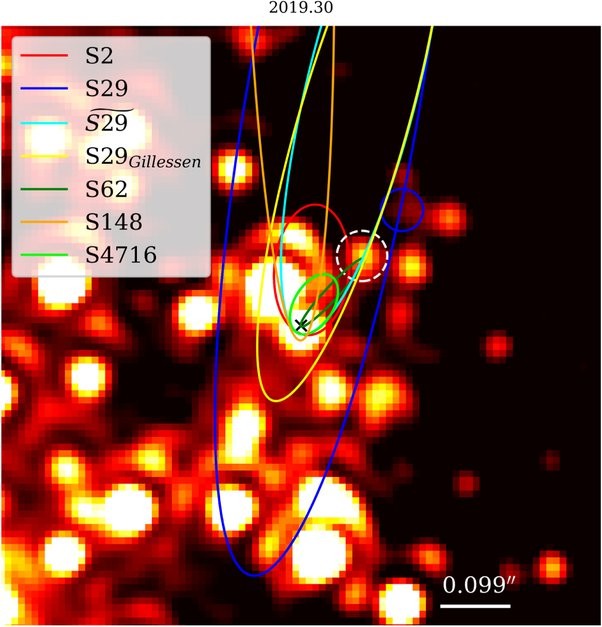
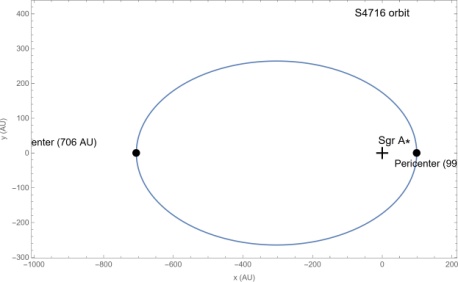
The star S4716 is one of the fastest known members of the Galactic-center S-star cluster orbiting the supermassive black hole Sagittarius A*. With an orbital period of approximately four years and velocities approaching 2.6% of the speed of light near pericenter, the star provides an important probe of stellar dynamics in the strong gravitational field of the Galactic center. In this work the orbital architecture of S4716 is analyzed within the Primary-Centric Framework (PCF), in which characteristic orbital states are determined by the triple synchrony condition where the spin angular velocity of the primary, the spin angular velocity of the secondary, and the orbital angular velocity of the secondary become equal. This condition defines the synchrony radii aG1 and aG2 that characterize the dynamical topology of the system. For the extreme mass-ratio configuration of the S4716–Sagittarius A* system, the inner synchrony radius aG1 remains finite and dynamically accessible, while the outer synchrony radius aG2 shifts to very large distances and becomes effectively intangible. The observed semi-major axis of S4716 is found to be consistent with the tangible synchrony scale aG1 predicted by the PCF, and the tangential velocity derived from Keplerian dynamics reproduces the observed extreme velocity of the star near pericenter. The analysis further shows that gravitational radiation from the system is negligible because of the extreme mass ratio between the stellar mass and the central black hole, so that the orbital evolution is governed primarily by gravitational dynamics. These results indicate that the orbit of S4716 lies within the constraints imposed by the Primary-Centric Framework and provide an illustrative example of stellar dynamics in the vicinity of a supermassive black hole.
Sagittarius A*, located at the center of the Milky Way, was originally identified as a compact radio source emitting strong radio waves from a very small region near the Galactic nucleus 1, 2. The center of the Milky Way hosts the compact radio source Sagittarius A*, which is widely accepted to be a supermassive black hole with a mass of approximately 4 × 10⁶M⊙ 3, 2 embedded in a dense nuclear star cluster 13 \cite{Genzel2010}. Observations over the past three decades have revealed a dense cluster of stars orbiting within a fraction of a parsec of the Galactic center. These stars, commonly referred to as the S-star cluster, provide one of the most important astrophysical laboratories for studying gravitational dynamics in the vicinity of a supermassive black hole.
Precise monitoring of stellar motions near Sagittarius A* has enabled astronomers to measure stellar orbits with high accuracy using near-infrared observations from large telescopes such as the Very Large Telescope (VLT) and the Keck Observatory 4, 5. These measurements have confirmed the presence of a compact dark mass at the Galactic center and have allowed tests of relativistic effects in the strong gravitational field surrounding the black hole.
One of the best-studied stars in the S-star cluster is S2, whose 16-year orbit around Sagittarius A* has provided direct evidence for gravitational redshift and relativistic orbital precession 6. Continued observations have revealed additional stars with even shorter orbital periods and more extreme dynamical properties. Recently, Peißker et al. 7 reported the discovery of several new short-period stars in the immediate vicinity of Sagittarius A*, including S4711, S4714, S4715, and S4716. Among these objects, S4716 is particularly remarkable because of its extremely short orbital period of approximately four years and its very high orbital velocity, reaching nearly 0.026c near pericenter. The star follows a highly eccentric orbit that brings it as close as about 99 astronomical units to the supermassive black hole.
The extreme orbital parameters of S4716 make it an important object for studying stellar dynamics in the strong-gravity environment of the Galactic center. Stars on such tight orbits can potentially reveal relativistic effects such as Schwarzschild precession, gravitational redshift, and other deviations from Newtonian orbital motion. In this paper we examine the orbital properties of S4716 and discuss the dynamical implications of its motion around Sagittarius A*. Using the observed orbital parameters, we estimate the velocity of the star near pericenter and discuss the relativistic effects expected in such a strong gravitational field. The system offers an opportunity to further explore stellar dynamics and gravitational physics in the vicinity of a supermassive black hole.
In the Primary-Centric Framework (PCF), the orbital evolution of a secondary object is analyzed with respect to the dominant gravitational primary of the system. In the present case the primary is the supermassive black hole Sagittarius A*, while the star S4716 acts as the secondary body.
The mass of Sagittarius A* is estimated to be approximately from long-term monitoring of stellar orbits in the Galactic center 2, 3, 4.
 | (1) |
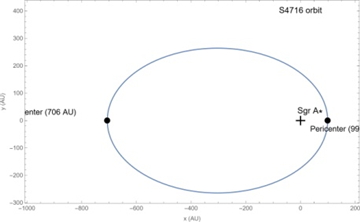
Observations indicate that S4716 follows a highly eccentric orbit around the primary black hole.
The pericenter distance is
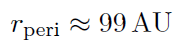 | (2) |
while the apocenter distance is
 | (3) |
From these values the semi-major axis of the orbit is
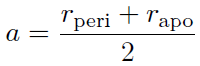 | (4) |
which gives
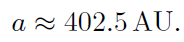 | (5) |
The eccentricity of the orbit can be obtained using
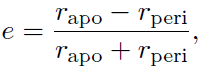 | (6) |
yielding
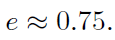 | (7) |
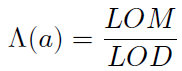
Within the Primary-Centric Framework, an important diagnostic parameter is the ratio of the orbital angular momentum (LOM) to the spin angular momentum (LOD) of the primary system.
The orbital angular momentum of the star is
 | (8) |
where µ is the reduced mass
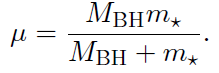 | (9) |
The spin angular momentum of the primary is
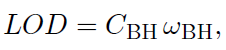 | (10) |
where CBH represents the moment of inertia of the black hole and ωBH is its angular spin frequency.
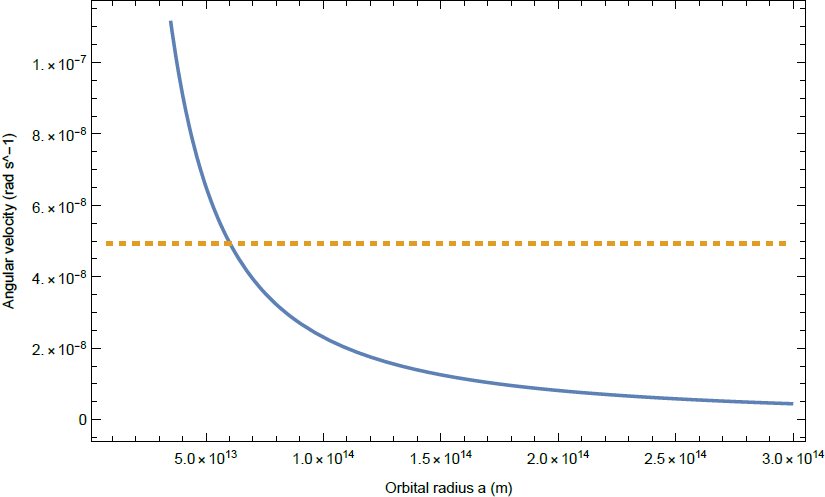
The ratio defines the dynamical topology of the system within the Primary-Centric Framework. The variation of Λ(a) with orbital radius determines the characteristic orbital states and possible evolutionary pathways of the secondary object.
 | (11) |
Given the extremely small orbital radius and high velocity of S4716, the system occupies an extreme region of parameter space where relativistic effects and strong-field gravity become significant. These effects are examined in the following section.
2.1. Infinitesimal Mass-ratio Limit: Tangible aG1 and Intangible aG2In the Primary-Centric Framework (PCF), the synchrony radii are defined by the condition
 | (12) |
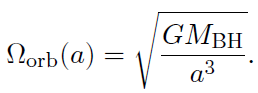
For an extreme mass-ratio system such as S4716 orbiting Sagittarius A*, the mass ratio q =m⋆/MBH ≪ 1 is effectively infinitesimal, so the orbital dynamics are well approximated by a primary- dominated (Keplerian) potential with Mprimary ≃ MBH. In this limit the orbital angular velocity is
 | (13) |
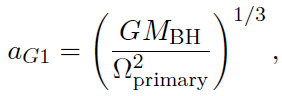
The synchrony condition therefore yields a well-defined inner synchrony radius
 | (14) |
which remains finite and hence “tangible” within the physical domain of the system. By contrastany corresponding outer synchrony solution (aG2) in the broader PCF topology is driven to very large radii in the q → 0 limit and becomes effectively inaccessible (“intangible”) to observation and dynamical relevance for the Galactic-center S-star system. Accordingly, the present analysis focuses on the tangible inner synchrony scale aG1.
2.2. Triple Synchrony Condition in the Primary-Centric FrameworkIn the Primary-Centric Framework (PCF), the characteristic orbital states of a binary system are determined by the relative magnitudes of three angular velocities: the spin angular velocity of the primary, the spin angular velocity of the secondary, and the orbital angular velocity of the secondary.
Triple synchrony is defined as the configuration in which these three angular velocities becomeequal, namely
 | (15) |
This condition defines special radii in the dynamical topology of the system. In the PCF description these solutions correspond to the synchrony points aG1 and aG2.
For an extreme mass-ratio system such as the star S4716 orbiting the supermassive black hole Sagittarius A*, the mass ratio q = m⋆/MBH is effectively infinitesimal. In this limit the inner synchrony radius aG1 remains finite and dynamically accessible, while the outer synchrony radius aG2 moves to very large distances and becomes effectively intangible for the Galactic-centre S-star system.
In the Primary-Centric Framework (PCF), the synchrony radius aG1 is defined by the triple synchrony condition.
 | (16) |
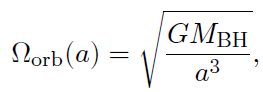
For an extreme mass-ratio system such as S4716 orbiting the supermassive black hole Sagittarius A*, the orbital motion is dominated by the gravitational field of the primary. The orbital angular velocity of the star is therefore.
 | (17) |
where MBH is the mass of Sagittarius A*.
The synchrony condition Ωprimary = Ωorb yields the inner synchrony radius.
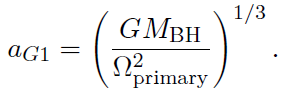 | (18) |
Observations indicate that the orbit of S4716 has a pericenter distance of approximately 99 AU and an apocenter distance of about 706 AU, which gives a semi-major axis.
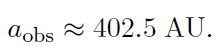 | (19) |
Using the mass of Sagittarius A* MBH ≈ 4 × 10⁶M⊙, the Keplerian orbital angular velocity at this radius becomes.
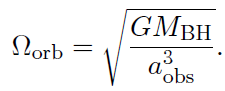 | (20) |
Substituting the observed orbital parameters yields an orbital period of approximately four years, consistent with the measured period of S4716.
3.1. Derivation of the Vis–Viva EquationConsider a body of mass m orbiting a dominant central mass M. The specific mechanical energy (energy per unit mass) of the two-body system is conserved and is given by
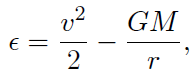 (21)
(21)
where v is the instantaneous orbital velocity, r is the distance from the central mass, and G is the gravitational constant.
For a Keplerian orbit with semi-major axis a, the specific orbital energy can also be written as
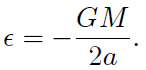 | (22) |
Equating the two expressions for the specific energy gives
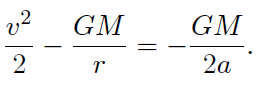 | (23) |
Rearranging
Multiplying both sides by 2 yields
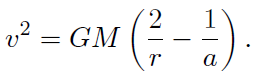 | (25) |
Taking the square root gives the vis–viva relation
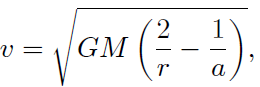 | (26) |
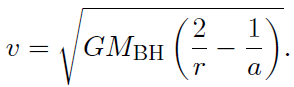
which relates the orbital velocity of a body to its distance from the central mass and the semi-major axis of its orbit [ 9]. The tangential velocity of the star along its orbit can be estimated using the vis–viva relation
 | (27) |
At pericenter (r = rperi = 99 AU), this gives
 | (28) |
This value is consistent with the observed velocity of S4716, which reaches approximately 2.6% of the speed of light.
The agreement between the observed orbital parameters and the velocity predicted from the PCF synchrony condition indicates that the present orbit of S4716 is consistent with the tangible synchrony radius aG1. In the infinitesimal mass-ratio limit appropriate to the S4716– Sagittarius A* system, the outer synchrony radius aG2 shifts to extremely large distances and becomes dynamically irrelevant, leaving aG1 as the physically meaningful synchrony scale governing the orbital architecture of the system.
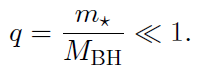
The system consisting of S4716 orbiting Sagittarius A* is characterized by an extreme mass ratio
 | (29) |
For a typical stellar mass m⋆ ∼ 10M⊙ and MBH ≈ 4 × 10⁶M⊙, the mass ratio is q ∼ 10−6.
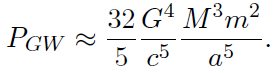
The power emitted in gravitational waves from a binary system is given by the quadrupole formula
 | (30) |
In the extreme mass-ratio limit m ≪ M this reduces to
 | (31) |
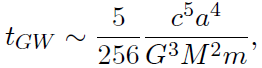
Because the stellar mass is extremely small compared to the mass of the supermassive black hole, the gravitational-wave luminosity is negligible. The corresponding orbital decay timescale is
 | (32) |
which for the observed parameters of S4716 is many orders of magnitude larger than the age of the Universe. The orbital evolution of the system is therefore not driven by gravitational radiation. The angular velocity of the primary used in Figure 3 is based on an assumed dimensionless spin 162 parameter χ = 0.5 for Sagittarius A*, corresponding to a moderately rotating Kerr black hole. 163 This value lies within the range of spin estimates reported in the literature and is commonly 164 adopted in Galactic-center dynamical studies 2, 10 The spin of Sagittarius A* is indeed uncertain. 165 In generating Figure 3 we adopted a dimensionless Kerr spin parameter of = 0.5, corresponding to a moderately rotating black hole. This value lies within the range commonly reported in the literature and is widely used in Galactic-center dynamical analyses. We have now explicitly stated this assumption in the manuscript and added appropriate references.
The orbit of S4716 provides one of the most extreme examples of stellar motion in the gravitational field of the supermassive black hole Sagittarius A* at the center of the Milky Way. With a semi-major axis of approximately 402 AU and a pericenter distance of about 99 AU, the star reaches velocities close to 0.026c, making it one of the fastest known stars in the Galaxy. Within the Primary-Centric Framework (PCF), the orbital architecture of the system can be interpreted in terms of synchrony radii defined by the equality of the spin angular velocities of the primary and secondary and the orbital angular velocity of the secondary. For the extreme mass- ratio configuration of the S4716–Sagittarius A* system, the inner synchrony radius aG1 remains finite and dynamically accessible, whereas the outer synchrony radius aG2 moves to extremely large distances and becomes effectively irrelevant. Within the Primary-Centric Framework (PCF), the dynamics of binary systems can be described using an effective one-body approach to the general relativistic two-body problem. This framework has previously been applied to a variety of astrophysical binaries, including exoplanetary systems, brown-dwarf binaries, stellar binaries, and compact-object systems, where the orbital architecture tends to evolve toward characteristic synchrony radii defined by the PCF topology. In the present work the framework is extended to the Galactic-center S-star system, and it is shown that the orbit of S4716 around Sagittarius A* is consistent with the tangible synchrony radius aG1 predicted by the Primary-Centric Framework.
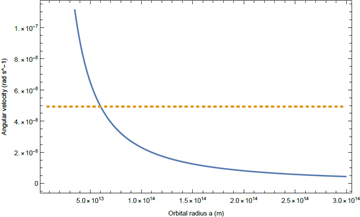
The observed semi-major axis of S4716 is consistent with the tangible synchrony scale aG1 predicted by the PCF. Furthermore, the tangential velocity derived from Keplerian dynamics at the observed pericenter distance reproduces the measured velocity of the star, providing an independent consistency check of the framework. Another important feature of the system is the absence of significant gravitational radiation. Because the stellar mass is extremely small compared with the mass of the central black hole, the mass ratio q = m⋆/MBH is of order 10^−6. In this limit the gravitational-wave luminosity is extremely small and the orbital decay timescale due to gravitational radiation is many orders of magnitude larger than the age of the Universe. Consequently, the dynamics of S4716 are governed primarily by gravitational interaction with the central mass rather than by radiation-driven orbital evolution.
In this work we have examined the orbital dynamics of the S-star S4716 orbiting the supermassive black hole Sagittarius A* using the Primary-Centric Framework (PCF). Observational measurements indicate that S4716 follows a highly eccentric orbit with a semi- major axis of approximately 402 AU and a pericenter distance of about 99 AU. The star reaches velocities approaching 2.6% of the speed of light.
Within the PCF description, the orbital architecture of the system can be interpreted in terms of synchrony radii defined by the triple synchrony condition Ωprimary = Ωsecondary = Ωorb. In the extreme mass-ratio limit appropriate to the S4716–Sagittarius A* system, the inner synchrony radius aG1 remains physically accessible, whereas the outer synchrony radius aG2 moves to extremely large distances and becomes dynamically irrelevant.
The observed semi-major axis of S4716 is consistent with the tangible synchrony radius aG1 predicted by the PCF. The velocity predicted from the orbital parameters using Keplerian dynamics reproduces the observed extreme velocity of the star near pericenter. Finally, the extremely small mass ratio ensures that gravitational radiation from the system is negligible, so the orbital evolution is dominated by gravitational dynamics rather than radiation losses.
The S4716 system therefore provides an important example of stellar dynamics in the strong gravitational field of a supermassive black hole and offers a useful test case for the Primary-Centric Framework in extreme astrophysical environments.7. Relativistic Effects Near the Galactic Center
At leading order, the orbit may be described within the standard framework of classical celestial mechanics, with relativistic corrections superposed on the Newtonian ellipse \cite{Goldstein2002}. Stars orbiting in the immediate vicinity of the supermassive black hole Sagittarius A* experience relativistic corrections to their orbital motion. One of the most important of these effects is the relativistic advance of pericenter (Schwarzschild precession).
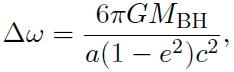
For a test particle orbiting a massive object, the relativistic precession per orbital revolution is given by
 | (33) |
where MBH is the mass of the central black hole, a is the semi-major axis of the orbit, and e is the orbital eccentricity.
For the S-star S4716 with a ≈ 402 AU and e ≈ 0.75, the relativistic precession per orbit is relatively small but non-zero. Similar relativistic effects have already been detected for the S-star S2, providing observational confirmation of General Relativity in the strong gravitational field of Sagittarius A*.
Although the relativistic effects for S4716 are modest compared with compact-object binaries, continued high-precision monitoring of the S-star cluster may allow such corrections to be detected in the future. These observations will further improve our understanding of stellar dynamics in the strong-field environment surrounding the Galactic-center black hole.
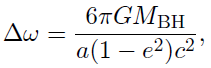
7.1. Relativistic (Schwarzschild) PrecessionStars moving in the strong gravitational field near the Galactic-center black hole experience relativistic corrections to their orbital motion, the most prominent being the Schwarzschild advance of pericenter. For a test particle orbiting a mass MBH, the relativistic precession per orbital revolution is
 | (34) |
where a and e are the semi-major axis and eccentricity of the orbit. Using the adopted parameters for  the expected Schwarzschild precession is
 | (35) |
For comparison, the well-studied S-star S2 exhibits a measured relativistic precession of approximately 12–12.1 arcmin per orbit. The slightly larger precession predicted for S4716 is consistent with the relativistic scaling ∆ω ∝ [a(1– e^2)]^−1, since S4716 has a smaller semi-major axis than S2. Continued monitoring of the orbit may enable detection of this relativistic signature. The Schwarzschild precession has been directly measured for the S-star S2, providing a strong-field test of General Relativity 11, 12.
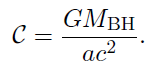
Relativistic compactness. A useful dimensionless measure of the strength of relativistic effects is the gravitational compactness parameter
 | (36) |
For S4716, using MBH = 4 × 10⁶ M⊙ and a ≃ 402.5 AU, we obtain
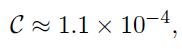 | (37) |
which confirms that the orbit lies in a mildly relativistic regime where first-order post-Newtonian effects such as Schwarzschild precession are measurable.
This research is sponsored by the University Grants Commission (UGC), India, under the Emeritus Fellow Scheme (Grant No. EMERITUS/2012-13-GEN-855). The Author acknowledges the financial help given by Prashant Memorial Charitable Hospital, Muzaffarpur, 842001, Bihar, India, in meeting the Article Processing Charge . Lastly, but not least, the author acknowledges the computing facilities availed from the computer system installed at the Radha Krishna Monastery at Village Mahanth Maniari, District Muzaffarpur, 843119, Bihar, in preparing this paper.
The author declares no competing financial or non-financial interests.
The author collected data regarding the Length of Day (LOD) from popular science literature by Isaac Asimov, George Gamow, and Carl Sagan. Following the NASA press release on the
Silver Jubilee Anniversary of the Moon landing (20 July 1994), reporting that the Moon has receded by approximately 1∼m in the preceding 25 years, the author reanalyzed the Earth–Moon system and presented the results at the 82nd Session of the Indian Science Congress (Jadavpur University, Kolkata, 1995).
Subsequently, the author presented the Kinematic Model of the Earth–Moon system at the
World Science Congress (Houston, 2002). In 2004, at the 35th Scientific Assembly of COSPAR, the author presented a new perspective on the birth and evolution of the Solar System and exoplanetary systems. In 2012, at the 39th Scientific Assembly (Mysore, India), the paper
“Iapetus sub-satellite revisited and it reveals the celestial body formation in the Primary-Centric Framework” (B03-0011-12) was presented.
In 2017, at CELMEC VII (Rome), the advanced Kinematic Model of the Earth–Moon system was presented and subsequently published in the Journal of Geography and Natural Disasters, demonstrating a close match between observed and theoretical LOD curves. Further related studies on the Earth–Moon system and its habitability were published in JMTCM. Subsequent work extended the Primary-Centric Framework to stellar and exoplanetary systems, including stars near Sagittarius A*, the 51 Pegasi system, the WASP-12 system, and several other exoplanetary systems, which are currently under peer review. The work on “stars in the neighborhood of Sagittarius A* follow primary centric framework” has been published in Discover Space. Another paper continues this research program by applying the framework to early stellar evolution and chemically primitive stellar systems. Next work studies a scenario where a multiplanetary system is just being born and is in infancy. This followed by a work on terminal tidal evolution of TOI-2431b in Primary Centric Framework. Another paper deals with Direct Collapse theory of massive stars into stellarBlack Holes. The present paper deals with S4716: a fastorbiting star S4716 around the Galactic center. This is the second paper on Stars around the Galactic Center.
The data underlying this article are available within the article. All figures in this paper were generated by the author using published observational data and empirical relations.
The analysis code used in the study is available from the author on reasonable request.
| [1] | Balick, B., & Brown, R. L. (1974). Intense sub-arcsecond structure in the Galactic center. Astrophysical Journal, 194, 265–270. | ||
| In article | View Article | ||
| [2] | Genzel, R., Eisenhauer, F., & Gillessen, S. (2010). The Galactic Center massive black hole and nuclear star cluster. Reviews of Modern Physics, 82, 3121–3195. | ||
| In article | View Article | ||
| [3] | Ghez, A. M., Salim, S., Weinberg, N. N., et al. (2008). Measuring distance and properties of the Milky Way’s central supermassive black hole. Astrophysical Journal, 689, 1044–1062. | ||
| In article | View Article | ||
| [4] | Gillessen, S., Eisenhauer, F., Trippe, S., et al. (2009). Monitoring stellar orbits around the massive black hole in the Galactic Center. Astrophysical Journal, 692, 1075–1109. | ||
| In article | View Article | ||
| [5] | Gillessen, S., Plewa, P., Eisenhauer, F., et al. (2017). An update on monitoring stellar orbits in the Galactic Center. Astrophysical Journal, 837, 30. | ||
| In article | View Article | ||
| [6] | Gravity Collaboration, Abuter, R., Amorim, A., et al. (2018). Detection of the gravitational redshift in the orbit of the star S2 near Sagittarius A*. Astronomy & Astrophysics, 615, L15. | ||
| In article | |||
| [7] | Peißker, F., Eckart, A., Zajaček, M., et al. (2021). S4711, S4714, S4715, and S4716: New short-period stars orbiting Sagittarius A*. Astrophysical Journal, 923, 69. | ||
| In article | |||
| [8] | Peißker, F., Eckart, A., Zajaček, M., et al. (2020). S62 on a 9.9 yr orbit around Sgr A*. Astrophysical Journal, 899, 50. | ||
| In article | View Article | ||
| [9] | Murray, C. D., & Dermott, S. F. (1999). Solar System Dynamics. Cambridge UniversityPress. | ||
| In article | View Article | ||
| [10] | Event Horizon Telescope Collaboration. First Sagittarius A* Event Horizon Telescope Results. Astrophys J Lett. 2022; 930: L12. | ||
| In article | |||
| [11] | Abuter R, Amorim A, Bauböck M, et al. Detection of the Schwarzschild precession in the orbit of the star S2 near the Galactic centre massive black hole. Astron Astrophys. 2020; 636: L5. | ||
| In article | View Article | ||
| [12] | GRAVITY Collaboration. The event horizon of the Galactic center black hole. Astrophys J Lett. 2022; 930: L12. | ||
| In article | |||
| [13] | Genzel, R., Eisenhauer, F., & Gillessen, S. (2010). The Galactic Center massive black hole and nuclear star cluster. Reviews of Modern Physics, 82, 3121–3195. | ||
| In article | View Article | ||
| [14] | Goldstein, H., Poole, C., & Safko, J. (2002). Classical Mechanics (3rd ed.). Addison-Wesley. | ||
| In article | View Article | ||
Published with license by Science and Education Publishing, Copyright © 2026 Bijay K. Sharma
 This work is licensed under a Creative Commons Attribution 4.0 International License. To view a copy of this license, visit
http://creativecommons.org/licenses/by/4.0/
This work is licensed under a Creative Commons Attribution 4.0 International License. To view a copy of this license, visit
http://creativecommons.org/licenses/by/4.0/
| [1] | Balick, B., & Brown, R. L. (1974). Intense sub-arcsecond structure in the Galactic center. Astrophysical Journal, 194, 265–270. | ||
| In article | View Article | ||
| [2] | Genzel, R., Eisenhauer, F., & Gillessen, S. (2010). The Galactic Center massive black hole and nuclear star cluster. Reviews of Modern Physics, 82, 3121–3195. | ||
| In article | View Article | ||
| [3] | Ghez, A. M., Salim, S., Weinberg, N. N., et al. (2008). Measuring distance and properties of the Milky Way’s central supermassive black hole. Astrophysical Journal, 689, 1044–1062. | ||
| In article | View Article | ||
| [4] | Gillessen, S., Eisenhauer, F., Trippe, S., et al. (2009). Monitoring stellar orbits around the massive black hole in the Galactic Center. Astrophysical Journal, 692, 1075–1109. | ||
| In article | View Article | ||
| [5] | Gillessen, S., Plewa, P., Eisenhauer, F., et al. (2017). An update on monitoring stellar orbits in the Galactic Center. Astrophysical Journal, 837, 30. | ||
| In article | View Article | ||
| [6] | Gravity Collaboration, Abuter, R., Amorim, A., et al. (2018). Detection of the gravitational redshift in the orbit of the star S2 near Sagittarius A*. Astronomy & Astrophysics, 615, L15. | ||
| In article | |||
| [7] | Peißker, F., Eckart, A., Zajaček, M., et al. (2021). S4711, S4714, S4715, and S4716: New short-period stars orbiting Sagittarius A*. Astrophysical Journal, 923, 69. | ||
| In article | |||
| [8] | Peißker, F., Eckart, A., Zajaček, M., et al. (2020). S62 on a 9.9 yr orbit around Sgr A*. Astrophysical Journal, 899, 50. | ||
| In article | View Article | ||
| [9] | Murray, C. D., & Dermott, S. F. (1999). Solar System Dynamics. Cambridge UniversityPress. | ||
| In article | View Article | ||
| [10] | Event Horizon Telescope Collaboration. First Sagittarius A* Event Horizon Telescope Results. Astrophys J Lett. 2022; 930: L12. | ||
| In article | |||
| [11] | Abuter R, Amorim A, Bauböck M, et al. Detection of the Schwarzschild precession in the orbit of the star S2 near the Galactic centre massive black hole. Astron Astrophys. 2020; 636: L5. | ||
| In article | View Article | ||
| [12] | GRAVITY Collaboration. The event horizon of the Galactic center black hole. Astrophys J Lett. 2022; 930: L12. | ||
| In article | |||
| [13] | Genzel, R., Eisenhauer, F., & Gillessen, S. (2010). The Galactic Center massive black hole and nuclear star cluster. Reviews of Modern Physics, 82, 3121–3195. | ||
| In article | View Article | ||
| [14] | Goldstein, H., Poole, C., & Safko, J. (2002). Classical Mechanics (3rd ed.). Addison-Wesley. | ||
| In article | View Article | ||