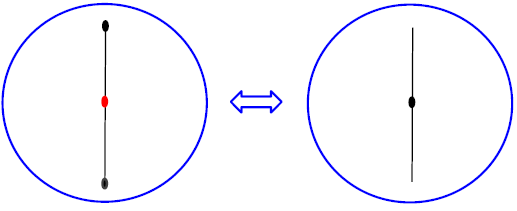
This study presents a novel analogy for the Higgs mass-generation mechanism, based on the hypothesis of the photon as an electric dipole in combined motions, a rotation and a linear uniform motion perpendicular to its rotational axis. Within this framework, photon interaction occurs through two distinct chemical bonding modes: a side-by-side (-bond) or a head-to-tail (-bond) configuration, resulting in the formation of a quadrupole. The subsequent collision of these quadrupoles with ambient photons and their resulting decomposition provides a theoretical visualization for the production of cosmic rays. Furthermore, this chemical bonding analysis identifies specific candidates for dark matter and dark energy, effectively integrating mass generation, cosmic ray origins, and dark energy into a unified model of photon interaction. By deriving matter's mass-generation mechanism from these interactions, the study concludes that mass is inherently quantized, mirroring the fundamental quantization of energy
The history of modern physics is marked by three major pillars that explain how the universe works: how particles acquire mass (matter), where the high-speed cosmic messengers (cosmic rays) come from, and why the mysterious force (dark energy) driving the universe apart exists.
For much of the 20th century, physicists faced a crisis: the Standard Model 1 required fundamental particles, such as the  ,
,  and
and  bosons to be massless, yet experiments clearly showed they had relatively large masses. If there were no Higgs field, particles would not have the mass. Giving mass to a particle is referred to as the Higgs effect which adds mass to any particle that interacts with the field. The Higgs field is a field of energy which is thought to be everywhere in the universe. The field is accompanied by the Higgs boson.
The breakthrough Higgs effect was first developed in 1964 by three independent teams, Francois Englert 2, Peter Higgs 3, and Gerald Garalink 4, based on the Gauge Theory 5, 6, 7. The particles that acquire mass not by containing the field but by interacting with it in a similar way to an object moving through molasses, will become slower and heavier when passing through the molasses. The discovery of the Higgs particle at CERN’s large Hadron Collider on October 8, 2013 tentatively confirmed the Higgs mechanism.
In 1896 Henri Becquerel 8 discovered radioactivity, after which it was generally believed that atmospheric electricity, or ionization of the air, was the result of the radiation 9 by the radioactive elements in the ground of the Earth. The increasing ionization rates at heights above the ground could be interpreted as the absorption of ionizing radiation by the air 10. With the invention of electrometers by Theodor Wulf 11 in 1910, which made it possible for accurate measurements of the radioactivity underwater and at higher altitude.
In 1912 Domenico Pacini 12 concluded atmospheric radiation must be due to sources other than the radioactivity of the Earth based on the observation of less radioactivity underwater 3 meters from the surface than ionization over lake or over the sea. In 1912 Victor Hess 13 found that the ionization to an altitude of 5300 meters increased to twice the rate at ground level, which enabled him to draw the conclusion that radiation levels increased with altitude and radiation of very high penetrating power enters from high above extraterrestrial space into our atmosphere. In 1913-1914, Werner Kolhöster 14, 15 confirmed Hess’s conclusion by measuring the ionization rate at an altitude of 9 km.
Cosmic rays are high-energy particles. According to the current theoretical explanation, of primary cosmic rays originating from outside the Solar system 16 in the Milky Way 17 and from distant galaxies 18, 99% are the bare nuclei of Hydrogen atoms and Helium atoms 19, about 1% are electrons. Of the nuclei, about 90% are simple protons (Hydrogen nuclei) while 9% are alpha particles(Helium Nuclei). A very small portion are stable anti-particles such as positrons and antiprotons. Of secondary cosmic rays, are the Pions produced by primary cosmic particles colliding with the molecules in the atmosphere 20.
If gravity is attractive, the expansion of the universe should be slowing down. However, in the late 1990s, astronomers found the opposite. The two Supernova Search teams, Type Ia Supernova 21 and Supernova Cosmology Project 22 noticed that the distant galaxies were moving away faster than they should be or were accelerating 23. In cosmology and astronomy, Dark Energy is a proposed form of energy causing this acceleration. It acts like a repulsive force inherent to the vacuum of space itself. It drives the accelerating expansion of the universe and slows the rate of structure formation 24.
The evidence for dark energy is not direct, but comes from the three independent sources: distance measurements and their relation to redshift, the theoretical need for some type of additional energy to form the observational flat universe, and the measurements of large-scale wave patterns of mass density in the universe. If the Lambda-CDM model 25 is correct, Dark energy will dominate the universe, contributing 68% of the total energy in the present observable universe while dark matter and ordinary matter contribute 27% and 5% respectively 26, 27, 28. Up to now, the exact nature of dark energy is still a mystery. It remains in the realm of speculation and exploration.
It seems these three major pillars are totally different physical realms, there is nothing to do with one another. Our present work will apply the similar Higgs interaction effect to the two photons to correlate the mass generation, the source of cosmic rays, and dark energy based on the hypothesis of the photon as an electrical dipole.
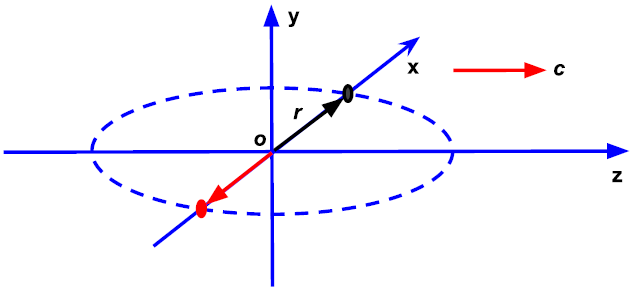
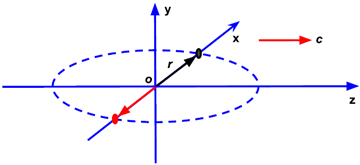
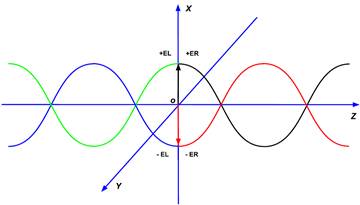
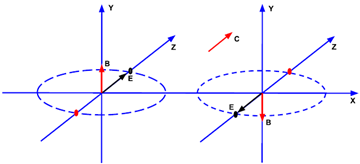
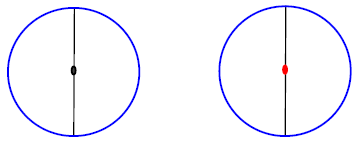
Recently we developed a theory that the photon is an electrical dipole, the trajectory of its electrical spinvector tip in combined motions is an electromagnetic wave 29, and its four wave components of the dipole satisfy the Dirac equation 30. The spinvector is defined as a vector in rotation and in translation with its translational direction perpendicular to its rotating axis. The spinvector is illustrated as Figure 1, the negative pole as a black dot and the positive pole as red dot.
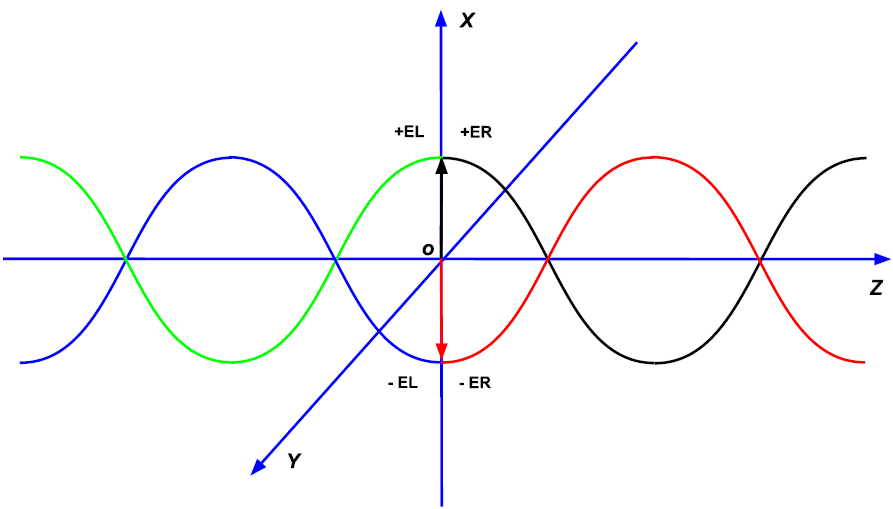
For each pole of the photon, there are two rotational directions, clockwise (right) or counterclockwise direction(left). If we assume the wave on Z axis and define the wave function of the negative pole as positive , then the wave function of the positive pole must be negative
 , because the phase difference between two poles is
 . The four-wave components of the photon are illustrated and Figure 2, the wave in black represents the negative pole in clockwise rotation (
 ), and the wave in green as its rotation in counterclockwise direction (
 ); while the wave in red as the positive pole in clockwise rotation(
 ), and the wave in blue as its rotation in counterclockwise direction (
 ).
).
According to Higgs field theory of mass generation, two real scalar field ,
,  of spin-one particles and a real vector field
  interact to generate mass. Herewith we will apply Higgs field theory to two force-carrying photons. Their field
 ,
,  interact through the electromagnetic vector field
 . The Lagrangian density of the interactions between them will be described as:
 Eq. 1.
Where



 is a dimensionless coupling constant.
  is invariant under simultaneous gauge transformations of the first kind on
  and of the second kind on
 . Suppose that
 , and
, and ; then spontaneous breakdown of U(1) symmetry occurs. If we treat
 ,
,  and
and  as small quantities, the further equations are derived from Equation 1 for the vacuum expectation solution when
 ,
,  :
:
 Eq. 2.
 Eq. 3.
 Eq. 4.
Equation 4 describes scalar waves whose quanta have mass 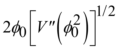 .
.
With the introduction of new variables,


Equation 2 and 3 will be transformed into Equation 5,
 ;
;  . Eq. 5.
The Equation 5 describes the vector waves whose quanta have mass .
.
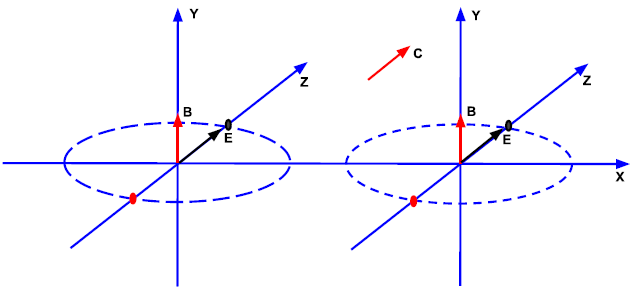
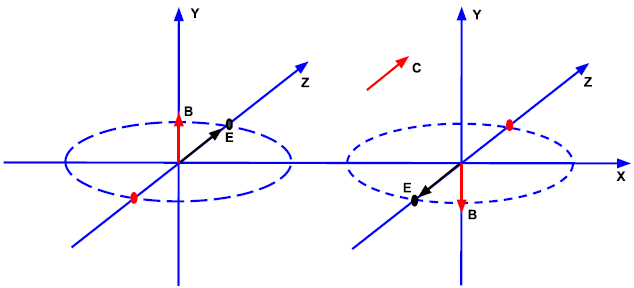
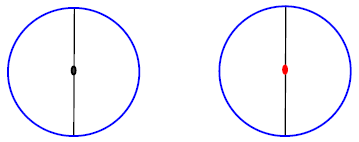
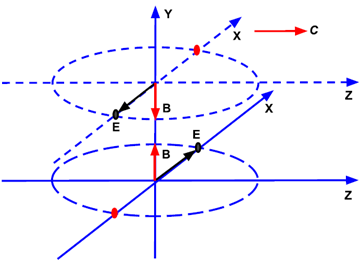
In our previous work 30, 31, we struggled about the photons’ motion mode to bond together as a photon molecule. Now we will visualize the mass generation process based on the chemical bond mechanism and force analysis to explain the reaction process between two photons. Figure 3 describes a side by side mode when two photons approach together with zero phase difference, so with net repulsive forces (both electric and magnetic).
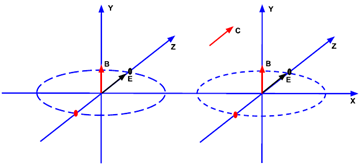
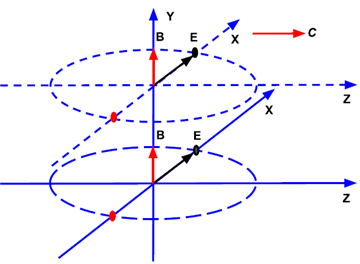
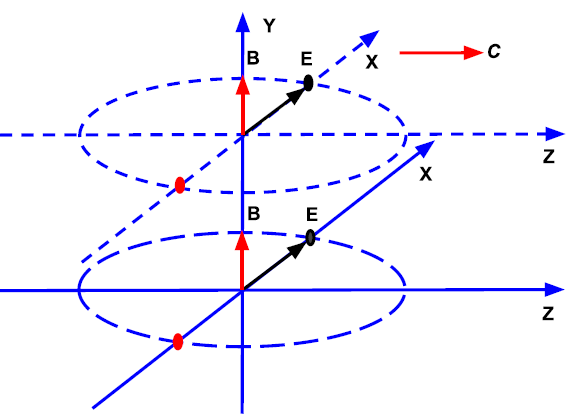
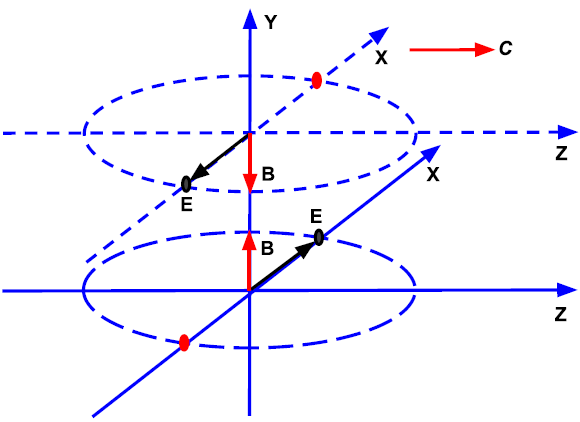
Figure 4 describes a head to tail mode when two photons approach together with zero phase difference, thus with net repulsive forces (repulsive electric force but attractive magnetic force). Either of these approaching modes will not bond the two photons together.
While Figure 5 describes a side by side mode when two photons approach together with  phase difference, so with net attractive forces (both electric and magnetic). The attractive action is similar to chemical
  bond.
bond.
 bond
bondAnd Figure 6 describes a head to tail mode when two photons approach together with  phase difference, therefore with net attractive forces (strong electric attractive and weak magnetic repulsive). The attractive action is similar to chemical
  bond. Both of these approaching modes will bond the two photons as a quadrupole or a photon molecule.
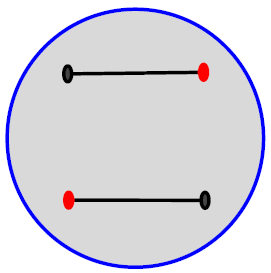
For the  bond quadrupole, the attractive electric force and the repulsive magnetic force are constant when the two dipoles are balanced at some distance, as a consequence the net bond force is a constant force as long as the two photons rotate in the same direction. However for the
  bond quadrupole, the magnitude of attractive electric force is varying due to the rotation of the photons, therefore the magnitude of attractive magnetic force varies as the electric force changes. And the net bond force forms a periodically vibrating force. In order to simplify the illustration, we will describe the
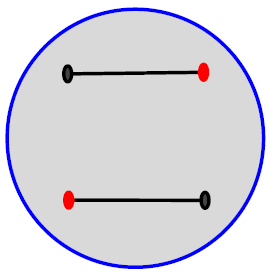
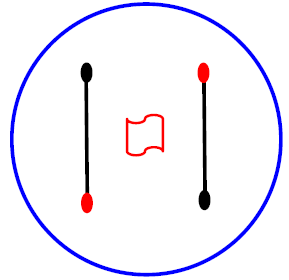
  bond quadrupole as Figure 7, and describe the
  bond quadrupole as Figure 8, both of them are with a disk-like structure (shape).
 bond quadrupole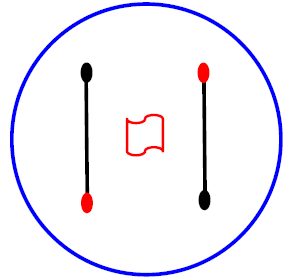
According to classical physics, the two photons are bonded together with an attractive force no matter as  bond or as
  bond, therefore the system(two photons) increases the potential energy (
 ) between them. Due to the energy conservation, the system has to decrease the kinetic energy to conserve the constant total energy as Equation 6. As a consequence, the system must decrease the motion speed from C to
  as the mass generation. If we assume the motion mass of the photon as
 , based on our previous work the total kinetic energy of the photon is the sum of its translational kinetic energy and its rotational kinetic energy, then the total rest mass (
 ) of the disk generated from the two photons through the bonding mechanism still in translation and rotation will be expressed as Equation 7, the net acquired mass as Equation 8.
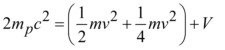 Eq. 6
Eq. 6
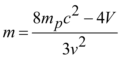 Eq. 7
Eq. 7
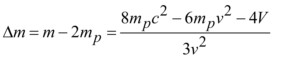 Eq. 8
Eq. 8
Based on the force analysis, we realize that the  bond quadrupole is relatively unstable compared to the
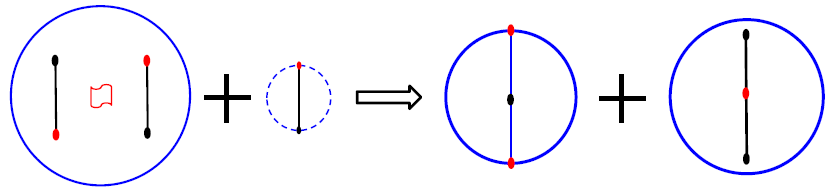
  bond quadrupole. It is vulnerable to collide or attack by the surrounding photons. The proposed collision results will be illustrated as Figure 9 and Equation 9 to form Proton and Neutron, the massless photon with dot-line circle, the massive particles with solid-line circle. The positive charges of the Proton are exposed to outside, and the negative charges of the neutron are embedded into its mass body.
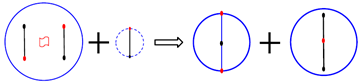
 Eq. 9
Eq. 9
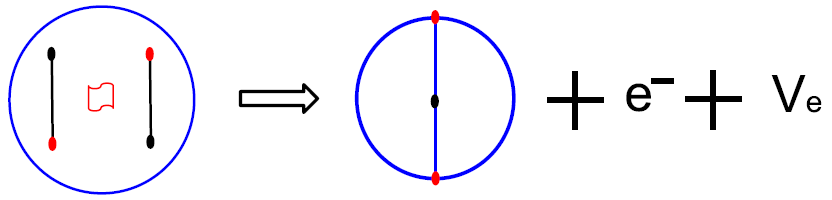
The Neutron would be further collided by surrounding photons to form one Proton, two Electrons and one electron neutrino as Figure 10 and Equation 10.

 Eq. 10
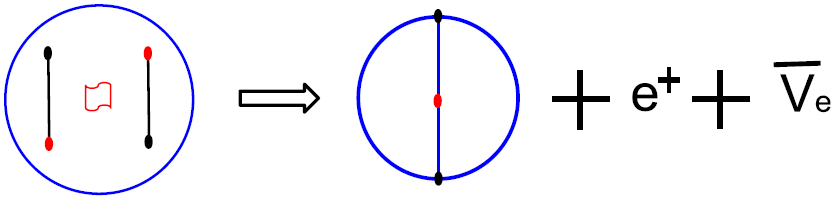
And the unstable  bond quadrupole would decompose to form Proton and Antiproton as described as Figure 11/Equation 11 and Figure 12/Equation 12.
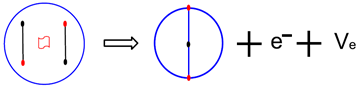
 Eq. 11
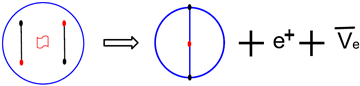
 Eq. 12
 Eq. 13
 Eq. 14
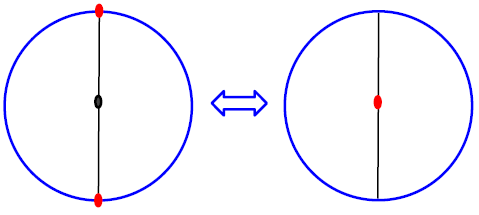
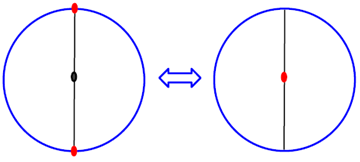
All the above Figures and Equations will elucidate and interpret the composition of the Primary Cosmic rays. But we need to explain something about the structure of Proton and Neutron. From the perspective of static electrical theory, our proposed structure of the Proton is equivalent to the classical Proton as Figure 13, but with diametric electric vectors corresponding to four-wave components of the Dirac Equation.
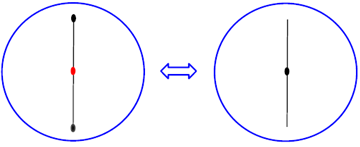
For our proposed structure of the Neutron as Figure 14, because the electric charge is embedded in the mass, and the mass body shall be electrically insulative, which will explain why the neutron doesn’t show electric property but has magnetic moment in rotation and has diametric electric vectors corresponding to four-wave components of the Dirac Equation.
As to the Electron and Positron, we suppose they all have the same structure of diametric vectors as Proton and Neutron as Figure 15 due to some unknown mechanism, corresponding to four-wave components of the Dirac Equation.
One of the candidate of the dark matter is the  bond quadrupole. It has constant bond force and its mass is denser and more uniform than the
  bond quadrupole. Another candidate of the dark matter is a kind of condensed
  bond quadrupole. We suppose the mass density of
  bond quadrupole depends on the initial distance between the photons, the farther the sparser mass density, the closer the higher density. The mass body becomes denser and stickier as the distance changes just like the phase change (condensation process) of the matter from vapor to liquid and to solid. When the mass body turns too dense or sticky enough, it prevents the electric charges from moving closer or rotating within the mass body, finally the condensed quadrupole turns into dark matter as Figure 16 and loses both the electric and the magnetic properties.

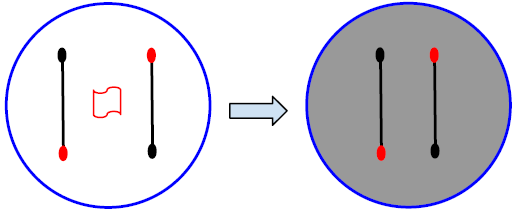
When we check the formation of  bond quadrupole, we realize that in another scenario if the initial distance is very much close while the attractive force is strong enough, there is a high chance for the photons to annihilate charges into some kind of energy as Figure 17 and lose the interaction capability with electromagnetism. If that is the case, we believe this energy is the dark energy we are looking for in the universe.
The bonding process of quadrupole formation and the subsequent generation of protons and neutrons suggest that fractionally charged quarks and antiquarks do not exist independently. Instead, quarks and antiquarks appear to carry a single integer charge, appearing primarily as fragmented products of protons or neutrons.
Dark matter is an invisible, hypothetical form of matter that does not interact with light or any other form of electromagnetic radiation. Its existence is inferred from robust observational evidence, including galaxy rotation curves 32, galaxy clusters 33, and gravitational lensing 34.
Current theoretical frameworks classify dark matter into three primary categories based on its velocity and thermal history: cold, warm, and hot 35. Regarding its composition, numerous hypotheses exist. Potential candidates include light bosons—such as QCD axions or axion-like particles—as well as neutrinos, supersymmetric particles, or Weakly Interacting Massive Particles (WIMPs) 36, 37. Our proposed candidates, the  -bond quadrupole and condensed
  -bond quadrupole, are based on the bonding processes of photons, aligning with current wave-like coupling axions 38 or "dark photon" hypotheses.
Up to now whether observing atmospheric lightning discharges or electron-positron annihilation, the resulting products—such as lightning or gamma radiation—manifest as electric dipoles. This suggests that while mass is annihilated in these processes, the electric charge persists. Conversely, in photon annihilation, it is the electric charge itself that is annihilated. Consequently, we propose defining the energy released from the annihilation of charges (photons) as “dark energy”, while the energy derived from mass annihilation constitutes “normal matter energy” with the photon serving as the primary product.
In particle physics, the photon is defined as having zero charge. However, our model proposes that the photon is an electric dipole. Under this framework, Equation 13 remains consistent with the principle of charge conservation. Consequently, the standard Feynman diagram 39 for electron-positron annihilation must be modified to reflect this feature of dipole structure, rather than the simple creation of a neutral gauge boson.
Building on the hypothesis of the photon as an electric dipole, our previous work 30 derived the total kinetic energy ( ) as the sum of translational and rotational kinetic energy through classical kinematics. This aligns with Simulik’s application 40 of the massless Dirac equation and with Simulik-Bondar’s derivation 41 of the formula for a photon mass in media which is partially based on Schwinger’s derivation 42 of
  from Maxwell’s equations in a vacuum. While Einstein’s special relativity defines the energy of a static object as Equation 15:
 . Eq. 15
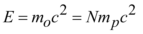
We integrate Planck’s principle of quantization by proposing that the photon itself is the basic energy quantum. Given that energy is a scalar with additive properties, the energy of any macroscopic object can be viewed as the accumulation of vast quantities of photons—analogous to how raindrops converge into streams and eventually oceans. By representing an object’s mass as  and a photon’s motion mass as
 , we arrive at Equation 16:
 Eq. 16
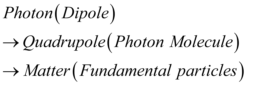
This suggests that mass is quantized, with the photon’s motion mass serving as the fundamental quantum. Consequently, an object’s mass measures the number of photons it contains, implying that fundamental particles like protons, neutrons, and electrons are ultimately decomposed from quadrupoles formed through photon interactions, or that the photon(dipole) is the precursor to the quadrupole formation, creating a clear hierarchy as below:
Based on the exploration of the chemical bonding processes between two photons, it becomes evident that applying the Higgs effect to photon-photon interactions via electromagnetic forces provides a compelling theoretical framework to the mass generation. The formation of a  -bond quadrupole facilitates the transition of energy into fundamental particles with mass, a mechanism that offers a novel explanation for the origin of cosmic rays within our solar system and identifies the
  -bond quadrupole as the high potential physical identity of the Higgs particle.
This proposed internal configuration for protons and neutrons aligns with current empirical observations in particle physics, while simultaneously necessitating a critical re-evaluation of the existence of fractionally charged quarks and antiquarks. Furthermore, the integration of dark matter and dark energy into this model provides a directed pathway for cosmological exploration, potentially resolving Olbers’ Paradox (the dark night sky instead of a bright night sky). Ultimately, mass generation through photon interaction leads to the fundamental conclusion that mass is quantized, echoing the established quantization of energy.
| [1] | M.A. Schwartz, Quantum Field Theory and the Standard Model, Cambridge University Press. ISBN: 978-1-107-03473-0, c2014. | ||
| In article | |||
| [2] | F. Englert; R. Brout, “Broken symmetry and the mass of gauge vector mesons”. Physical Review letters. 13(9): p 321-323(1964). | ||
| In article | View Article | ||
| [3] | P. Higgs, “Broken symmetries and the messes of gauge bosons”. Physical Review letters. 13(16): p 508-509(1964). | ||
| In article | View Article | ||
| [4] | G. Guralink; C.R. Hagan; T.W.B. Kibble, “Global conservation laws and massless particles”. Physical Review letters. 13(20): p585-587(1964). | ||
| In article | View Article | ||
| [5] | J. Goldstone, “Field theories with superconductor solution”. Nuovo Cimento. 19: p 154-164(1961). | ||
| In article | View Article | ||
| [6] | J. Goldstone; A. Salam; S. Weinberg, “Broken Symmetries”. Phys. Rev. 127: p965-970(1962). | ||
| In article | View Article | ||
| [7] | P.W. Anderson, “Plasmons, Gauge Invariance, and Mass”. Phys. Rev. 130: p 439-442(1963). | ||
| In article | View Article | ||
| [8] | R.A. Serway, J.W. Jewett, Physics for Scientists and Engineers with Modern Physics, Philadelphia: Saunders College Pub., ISBN-13: 978-1-133-95405-7. c2012. | ||
| In article | |||
| [9] | M.C. Malley, Radioactivity: A History of a Mysterious Science, Oxford University Press. ISBN: 978-0-19-976641-3.c2011. | ||
| In article | |||
| [10] | J. North, Cosmos: An Illustrated History of Astronomy and Cosmology. The University of Chicago Press. ISBN: 978-0-226-59441-5. c2008. | ||
| In article | |||
| [11] | T. Wulf, “Observations of radiation of high penetration power at the Eiffel tower”. Physikalische Zeitschrift(in German). 11: p 811-813(1910). | ||
| In article | |||
| [12] | D. Pacini, “Penetrating Radiation at the Surface of and in Water”. II Nuovo Cimento. 3(1): p 93-100(1912). | ||
| In article | View Article | ||
| [13] | V.F. Hess, “On observation of penetrating radiation during seven free balloon flights”. Physikalische Zeitschrift (in German). 13: p 1084-1091(1912). | ||
| In article | |||
| [14] | W. Kolhöster, “Measurements of the penetrating radiation in a free balloon at high altitudes”. Physikalische Zeitschrift (in German). 14: p 1153-1156(1913). | ||
| In article | |||
| [15] | W. Kolhöster, “Measurements of the penetrating radiation up to height of 9300 m”. Verhandlungen der Deutschen Physikalischen Gesellschaft (in German). 16: p 719-721(1914). | ||
| In article | |||
| [16] | M. Potgieter, “Solar Modulation of Cosmic Rays”. Living Reviews in Solar Physics. 10(1): 3(2013). | ||
| In article | View Article | ||
| [17] | S. Sharma, Atomic and Nuclear Physics. Pearson Education India, ISBN: 978-81-317-1924-4. c2008. | ||
| In article | |||
| [18] | Y. Sekido; T. Masuda; S. Yoshida; M. Wada, “The Crab Nebula as an observed point source of cosmic rays”. Physical REview. 83(3): p 658-659(1951). | ||
| In article | View Article | ||
| [19] | B.B. Rossi, Cosmic Rays. New York: McGraw-Hill. ISBN: 978-0-07-053890-0. c1964. | ||
| In article | |||
| [20] | I. Morison, Introduction to Astronomy and Cosmology. John Wiley & Sons. ISBN: 978-0-470-03334-3. c2008. | ||
| In article | |||
| [21] | A.G. Riess; A.V. Filippenko; P. Challis; A. Clocchiattia; A. Diercks; P.M. Garnavich; R.L. Gilliland; C.J. Hogan; S. Jha; R.P. Kirshner; B. Leibundgut; M.M. Phillips; D. Reiss; B.P. Schmidt; R.A. Schommer; R.C. Smith; J. Spyromilio; C. Stubbs; N.B. Suntzeff; J. Tonry, “Observational evidence from supernovae for an accelerating universe and a cosmological constant”. Astronomical Journal. 116(3): p 1009-1038(1998). | ||
| In article | View Article | ||
| [22] | S. Perlmutter, et al. “Measurements of Omega and Lambda from 42 high redshift supernovae”. Astrophysical Journal. 517(2): p 565-586(1999). | ||
| In article | |||
| [23] | G. Paal; I. Horvath; B. Lukacs, “Inflation and compactification from galaxy redshift”. Astrophysical and Space Science. 191(1): p 107-124(1992). | ||
| In article | View Article | ||
| [24] | D. Huterer, “Growth of Cosmic Structure”. The Astronomy and Astrophysical Review. 31(1): 2(2023). | ||
| In article | View Article | ||
| [25] | A.I. Lonappan; S. Kumar; R. Ruchika; B.R. Dinda; A.A. Sen, “Bayesian Evidences for dark energy models in light of current observational data”. Physical Review D. 97(4): 043524(2018). | ||
| In article | View Article | ||
| [26] | P.A.R. Ade, et al. “Planck 2013 Results. I. Overview of products and scientific results”. Astronomy and Astrophysics. 571: A1. arXiv:1303.5062(2014). | ||
| In article | View Article | ||
| [27] | P.J. Steinhardt; N.Turok, “Why the cosmological constant is small and positive”. Science. 312(5777): p 1180-1183(2006). | ||
| In article | View Article PubMed | ||
| [28] | D.N. Spergel, et al. “Three-year Wilkinson Microwave Anisotropy Prob (WMAP) Observation: Implication for Cosmology”. Astrophysical Journal Supplement Series. 170(2): p 377-408(2007). | ||
| In article | View Article | ||
| [29] | Zhonglin BO, “On the Motions of the Photon as an Electric Dipole and the Exploration of the Origin of Mass and Gravitation-Spinvector Motion III”. International Journal of Physics, 12(3): p95-105(2024). | ||
| In article | View Article | ||
| [30] | Zhonglin BO, “On the Motions of the Photon as an Electric Dipole and A New Interpretation of the Dirac Equation- Spinvector Motion V”. International Journal of Physics, 13(6): p124-130(2025). | ||
| In article | View Article | ||
| [31] | Zhonglin BO, “Is the String Theory Still Alive? Exploration of the Mass of Photon and THe Origin of Matter”. International Journal of Physics, 10(2): p88-92(2022). | ||
| In article | |||
| [32] | P. Salucci, “The distribution of dark matter in galaxies”. The Astronomy and Astrophysics Review, 27(1): p1-60(2019). | ||
| In article | View Article | ||
| [33] | D. Clowe, M. Bradac, A.H. Gonzalez, M. Markevich, S.W. Randall, C. Jones, D. Zaritsky, “A Direct Empirical Proof of the Existence of Dark Matter”. The Astrophysical Journal Letters, 648(2): L109-L113 (2006). | ||
| In article | View Article | ||
| [34] | A. Refregier, “Weak gravitational lensing by large-scale structure”. Annual Review of Astronomy and Astrophysics, 41(1): p645-668(2003). | ||
| In article | View Article | ||
| [35] | Joseph Silk, The Big Bang: Third Edition. Henry Holt and Company. ISBN: 978-0-8050-7256-3. c2000. | ||
| In article | |||
| [36] | P.J. Fox, G. Jung, P. Sorensen, W. Neal, “Dark matter in light of LUX”. Physical Review D. 89(10): 103526(2014). | ||
| In article | View Article | ||
| [37] | G. Jungman, M. Kamionkowski, K. Griest, “Supersymmetric dark matter”. Physics Reports, 267(5-6): p195-373(1996). | ||
| In article | View Article | ||
| [38] | M. Bauer, M. Neubert, A. Thamm, “Collider Probes of Axion-like Particles”. Journal of High Energy Physics, 12:44(2017). : . | ||
| In article | View Article | ||
| [39] | R. Feynman. “Space-Time Approach to Quantum Electrodynamics”. Physical Review. 76(6): p 769-789(1949). | ||
| In article | View Article | ||
| [40] | V.M. Simulik, “The Dirac equation near centenary: a contemporary introduction to the Dirac equation consideration”. Journal of Physics A: Mathematical and Theoretical, 58(2025)053001. | ||
| In article | View Article | ||
| [41] | V. Simulik, D.I. Bondar, “The Mass and Velocity of Light from Energy and Momentum Conservation”, arXiv 2509.12477(2025) | ||
| In article | |||
| [42] | Monograph of Schwinger reproduced by his co-author in reproduction. K. Milton, J. Schwinger, Classical Electrodynamics, second edition, CRC Press, Taylor and Francis group, New York. ISBN: 978-0367502072, c2024. | ||
| In article | |||
Published with license by Science and Education Publishing, Copyright © 2026 Zhonglin BO
 This work is licensed under a Creative Commons Attribution 4.0 International License. To view a copy of this license, visit
http://creativecommons.org/licenses/by/4.0/
This work is licensed under a Creative Commons Attribution 4.0 International License. To view a copy of this license, visit
http://creativecommons.org/licenses/by/4.0/
| [1] | M.A. Schwartz, Quantum Field Theory and the Standard Model, Cambridge University Press. ISBN: 978-1-107-03473-0, c2014. | ||
| In article | |||
| [2] | F. Englert; R. Brout, “Broken symmetry and the mass of gauge vector mesons”. Physical Review letters. 13(9): p 321-323(1964). | ||
| In article | View Article | ||
| [3] | P. Higgs, “Broken symmetries and the messes of gauge bosons”. Physical Review letters. 13(16): p 508-509(1964). | ||
| In article | View Article | ||
| [4] | G. Guralink; C.R. Hagan; T.W.B. Kibble, “Global conservation laws and massless particles”. Physical Review letters. 13(20): p585-587(1964). | ||
| In article | View Article | ||
| [5] | J. Goldstone, “Field theories with superconductor solution”. Nuovo Cimento. 19: p 154-164(1961). | ||
| In article | View Article | ||
| [6] | J. Goldstone; A. Salam; S. Weinberg, “Broken Symmetries”. Phys. Rev. 127: p965-970(1962). | ||
| In article | View Article | ||
| [7] | P.W. Anderson, “Plasmons, Gauge Invariance, and Mass”. Phys. Rev. 130: p 439-442(1963). | ||
| In article | View Article | ||
| [8] | R.A. Serway, J.W. Jewett, Physics for Scientists and Engineers with Modern Physics, Philadelphia: Saunders College Pub., ISBN-13: 978-1-133-95405-7. c2012. | ||
| In article | |||
| [9] | M.C. Malley, Radioactivity: A History of a Mysterious Science, Oxford University Press. ISBN: 978-0-19-976641-3.c2011. | ||
| In article | |||
| [10] | J. North, Cosmos: An Illustrated History of Astronomy and Cosmology. The University of Chicago Press. ISBN: 978-0-226-59441-5. c2008. | ||
| In article | |||
| [11] | T. Wulf, “Observations of radiation of high penetration power at the Eiffel tower”. Physikalische Zeitschrift(in German). 11: p 811-813(1910). | ||
| In article | |||
| [12] | D. Pacini, “Penetrating Radiation at the Surface of and in Water”. II Nuovo Cimento. 3(1): p 93-100(1912). | ||
| In article | View Article | ||
| [13] | V.F. Hess, “On observation of penetrating radiation during seven free balloon flights”. Physikalische Zeitschrift (in German). 13: p 1084-1091(1912). | ||
| In article | |||
| [14] | W. Kolhöster, “Measurements of the penetrating radiation in a free balloon at high altitudes”. Physikalische Zeitschrift (in German). 14: p 1153-1156(1913). | ||
| In article | |||
| [15] | W. Kolhöster, “Measurements of the penetrating radiation up to height of 9300 m”. Verhandlungen der Deutschen Physikalischen Gesellschaft (in German). 16: p 719-721(1914). | ||
| In article | |||
| [16] | M. Potgieter, “Solar Modulation of Cosmic Rays”. Living Reviews in Solar Physics. 10(1): 3(2013). | ||
| In article | View Article | ||
| [17] | S. Sharma, Atomic and Nuclear Physics. Pearson Education India, ISBN: 978-81-317-1924-4. c2008. | ||
| In article | |||
| [18] | Y. Sekido; T. Masuda; S. Yoshida; M. Wada, “The Crab Nebula as an observed point source of cosmic rays”. Physical REview. 83(3): p 658-659(1951). | ||
| In article | View Article | ||
| [19] | B.B. Rossi, Cosmic Rays. New York: McGraw-Hill. ISBN: 978-0-07-053890-0. c1964. | ||
| In article | |||
| [20] | I. Morison, Introduction to Astronomy and Cosmology. John Wiley & Sons. ISBN: 978-0-470-03334-3. c2008. | ||
| In article | |||
| [21] | A.G. Riess; A.V. Filippenko; P. Challis; A. Clocchiattia; A. Diercks; P.M. Garnavich; R.L. Gilliland; C.J. Hogan; S. Jha; R.P. Kirshner; B. Leibundgut; M.M. Phillips; D. Reiss; B.P. Schmidt; R.A. Schommer; R.C. Smith; J. Spyromilio; C. Stubbs; N.B. Suntzeff; J. Tonry, “Observational evidence from supernovae for an accelerating universe and a cosmological constant”. Astronomical Journal. 116(3): p 1009-1038(1998). | ||
| In article | View Article | ||
| [22] | S. Perlmutter, et al. “Measurements of Omega and Lambda from 42 high redshift supernovae”. Astrophysical Journal. 517(2): p 565-586(1999). | ||
| In article | |||
| [23] | G. Paal; I. Horvath; B. Lukacs, “Inflation and compactification from galaxy redshift”. Astrophysical and Space Science. 191(1): p 107-124(1992). | ||
| In article | View Article | ||
| [24] | D. Huterer, “Growth of Cosmic Structure”. The Astronomy and Astrophysical Review. 31(1): 2(2023). | ||
| In article | View Article | ||
| [25] | A.I. Lonappan; S. Kumar; R. Ruchika; B.R. Dinda; A.A. Sen, “Bayesian Evidences for dark energy models in light of current observational data”. Physical Review D. 97(4): 043524(2018). | ||
| In article | View Article | ||
| [26] | P.A.R. Ade, et al. “Planck 2013 Results. I. Overview of products and scientific results”. Astronomy and Astrophysics. 571: A1. arXiv:1303.5062(2014). | ||
| In article | View Article | ||
| [27] | P.J. Steinhardt; N.Turok, “Why the cosmological constant is small and positive”. Science. 312(5777): p 1180-1183(2006). | ||
| In article | View Article PubMed | ||
| [28] | D.N. Spergel, et al. “Three-year Wilkinson Microwave Anisotropy Prob (WMAP) Observation: Implication for Cosmology”. Astrophysical Journal Supplement Series. 170(2): p 377-408(2007). | ||
| In article | View Article | ||
| [29] | Zhonglin BO, “On the Motions of the Photon as an Electric Dipole and the Exploration of the Origin of Mass and Gravitation-Spinvector Motion III”. International Journal of Physics, 12(3): p95-105(2024). | ||
| In article | View Article | ||
| [30] | Zhonglin BO, “On the Motions of the Photon as an Electric Dipole and A New Interpretation of the Dirac Equation- Spinvector Motion V”. International Journal of Physics, 13(6): p124-130(2025). | ||
| In article | View Article | ||
| [31] | Zhonglin BO, “Is the String Theory Still Alive? Exploration of the Mass of Photon and THe Origin of Matter”. International Journal of Physics, 10(2): p88-92(2022). | ||
| In article | |||
| [32] | P. Salucci, “The distribution of dark matter in galaxies”. The Astronomy and Astrophysics Review, 27(1): p1-60(2019). | ||
| In article | View Article | ||
| [33] | D. Clowe, M. Bradac, A.H. Gonzalez, M. Markevich, S.W. Randall, C. Jones, D. Zaritsky, “A Direct Empirical Proof of the Existence of Dark Matter”. The Astrophysical Journal Letters, 648(2): L109-L113 (2006). | ||
| In article | View Article | ||
| [34] | A. Refregier, “Weak gravitational lensing by large-scale structure”. Annual Review of Astronomy and Astrophysics, 41(1): p645-668(2003). | ||
| In article | View Article | ||
| [35] | Joseph Silk, The Big Bang: Third Edition. Henry Holt and Company. ISBN: 978-0-8050-7256-3. c2000. | ||
| In article | |||
| [36] | P.J. Fox, G. Jung, P. Sorensen, W. Neal, “Dark matter in light of LUX”. Physical Review D. 89(10): 103526(2014). | ||
| In article | View Article | ||
| [37] | G. Jungman, M. Kamionkowski, K. Griest, “Supersymmetric dark matter”. Physics Reports, 267(5-6): p195-373(1996). | ||
| In article | View Article | ||
| [38] | M. Bauer, M. Neubert, A. Thamm, “Collider Probes of Axion-like Particles”. Journal of High Energy Physics, 12:44(2017). : . | ||
| In article | View Article | ||
| [39] | R. Feynman. “Space-Time Approach to Quantum Electrodynamics”. Physical Review. 76(6): p 769-789(1949). | ||
| In article | View Article | ||
| [40] | V.M. Simulik, “The Dirac equation near centenary: a contemporary introduction to the Dirac equation consideration”. Journal of Physics A: Mathematical and Theoretical, 58(2025)053001. | ||
| In article | View Article | ||
| [41] | V. Simulik, D.I. Bondar, “The Mass and Velocity of Light from Energy and Momentum Conservation”, arXiv 2509.12477(2025) | ||
| In article | |||
| [42] | Monograph of Schwinger reproduced by his co-author in reproduction. K. Milton, J. Schwinger, Classical Electrodynamics, second edition, CRC Press, Taylor and Francis group, New York. ISBN: 978-0367502072, c2024. | ||
| In article | |||