A detailed kinematic analysis was conducted based on the hypothesis of the photon as an electric dipole in combined motions, a rotation and a linear uniform motion perpendicular to its rotational axis. A particle wave coefficient(j) of a rotational object in combined motions is defined based on the analysis of the motion quantities, translational momentum and rotational angular momentum. The motion analysis explains the intrinsic nature of particle-wave duality, the relation among momentum, angular momentum and its wavelength when the rotational particle in combined motions. For the photon, j equals Planck constant (h), hv is the sum of its translational kinetic energy and rotational energy. The derivation processes of the wave equation of the photon, both the first order derivative method and the second order derivative method, demonstrate that the Dirac Equation is applicable to describe the motions of the photon as the dipole. The four wave components of the photon interpret why the negative energy solutions exist to the Dirac equation, which reveals the disk structure of dimetric spinvectors of the electron.
Particle-wave duality is one of the unique features in Quantum Mechanics that fundamental particles such as photons, electrons, neutrons and protons exhibit particle or wave properties according to the different experimental circumstances 1. It demonstrates the inability of classical mechanics to fully describe the behaviors of quantum particles 2.
The first wave theory of light 3 was proposed in 1637 by René Descartes; he published a theory of the refraction of light by analogy with the behavior of sound waves. The particle theory of light could be traced back to Isaac Newton. In 1675 he postulated that light was composed of particles which were emitted in all directions from a source. Newton's theory could explain the reflection of light. In 1678 Christiaan Huygens worked out a mathematical wave theory 4 of light And in 1690 he published his wave theory in his Treatise on Light and proposed that light was emitted in all directions as a series of waves. The wave theory predicted that light waves could interfere with each other like sound waves which was validated by Thomas Young with famous double-slit interference experiment 5.
However in 1901 the wave theory of light was challenged by Planck's law for black body radiation 6. Max Planck creatively developed a formula for the observed spectrum by assuming that an electrically charged oscillator in a cavity that contained black-body radiation could only change its energy in a minimal increment, which was proportional to the frequency of light waves. In 1905 Albert Einstein 7 innovatively interpreted the photoelectric effect with discrete energies for photons. These both indicate particle behavior of the photons.
The contradictory evidence from electrons was in just the opposite order. Many experiments in 1897 by J. J. Thomson 8 demonstrated that free electrons had particle properties. In 1927, the wave nature of electrons was evidently validated by two famous experiments. The Davisson–Germer 9 experiment demonstrated electrons scattered from Ni metal surfaces at Bell Labs.
Following de Broglie's proposal of wave–particle duality of electrons, from 1925 to 1926, Erwin Schrödinger 10 developed the wave equation for electrons, now as the Schrödinger Equation. In 1928, Dirac 11 derived another relativistic wave equation to describe the Quantum theory of the electron. Dirac’s theory laid a very important foundation for quantum mechanics as the relativistic quantum theory for the electron. However the Dirac equation introduced a problem, the unique feature that the equation could have two possible energy solutions, one for an electron with positive energy state, and the other for an electron with negative energy state. While classical physics insisted that the energy of a particle must always be positive. When interpreting the negative energy solutions of the equation, Dirac initially considered these solutions as problematic. But in 1930 he postulated a theoretical model of the vacuum, the Dirac sea 12, as an infinite sea of particles with negative energy quantum states for relativistic electrons (traveling near the speed of light). And then in 1931, he further postulated the existence of anti-particle or antimatter.
Particles and waves are two very different models in classical physics, each with an exceptionally large range of application. Classical particles follow classical mechanics. They have some center of mass and extent and follow trajectories characterized by positions and velocities that vary over time. Their trajectories are straight lines in the absence of forces. Particle models work across a huge scale from sand grains to ping-pong ball, soccer ball, spacecraft, planets and even to stars.
Light was advocated to behave as a wave, then later was found to have a particle-like behavior, whereas electrons behaved like particles in early experiments, then later were confirmed to have wave-like behavior. The unique concept of duality in the domain of Quantum Mechanics arose to reconcile particle and wave contradictions.
The domains of applicability of Quantum Mechanics and classical physics are in such big differences, most situations require that only one of them be applied 13, 14. The two theories are considered incompatible or clash in realms of extremely small scale or the Planck scale.
But up to now there is no theory to explain what the photon is, why it exhibits particle-wave duality, and why the trajectory of the photon’s motion is an electromagnetic wave. Just as Richard Feynman 15 once said, "I think I can safely say that nobody understands Quantum Mechanics". According to Steven Weinberg 16, "There is now in my opinion no entirely satisfactory interpretation of Quantum Mechanics".
Our present work will start with the kinematic analysis of the photon as a rotational electric dipole to elaborate why the photon has particle-wave duality, and to articulate why we can use Dirac’s wave equation to describe the motions of the photon.
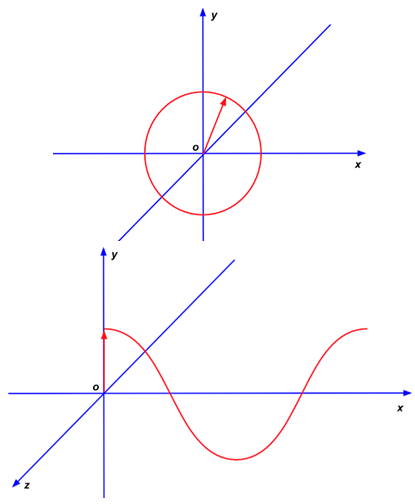
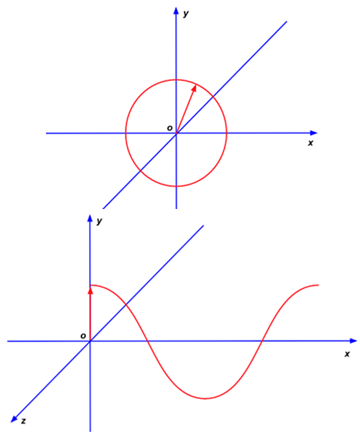
Recently we developed a theory that the trajectory of a spinvector tip in combined motions is a wave, the spinvector is defined as a vector in rotation and in translation with its translational direction perpendicular to its rotating axis. The spinvector and its wave will be illustrated as Figure 1 and the wave equation 17 of the spinvector tip will be described as Equation 1 or 2, where  is the length of the spinvector,
  as the angular speed of the rotation and
  as the speed of the translation.
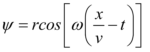 Eq. 1
Eq. 1
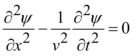 Eq. 2
Eq. 2
In our previous research 18, we once postulated the photon as an electric dipole to explain why the motion of the photon is the electromagnetic wave. In this work we will focus only on the mechanical properties of the dipole instead of its electric feature to describe the motions of the photon as a dipole.
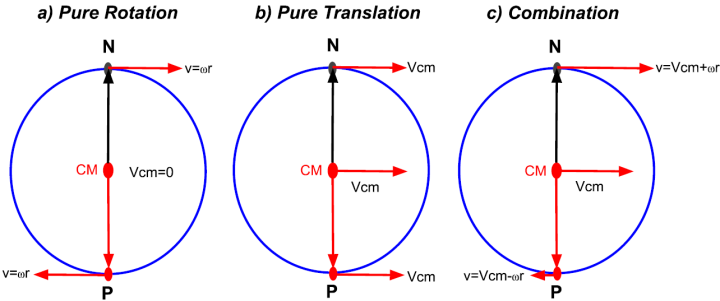
Since we decide to formulate wave equations to describe the motions of the dipole as a rotational object in combined motions, our first step is to model the combined motions 19 of the dipole as a pure rotation and a pure translation as Figure 2, and to analyze the motion features of the spinvector tip(each pole) and the whole dipole, momentum and angular momentum according to the classical mechanics, assuming  is the motion mass of each pole,
  is the rotation radius of the spinvector tip,
  the motion mass of the whole dipole or the center of mass(CM),
  the uniform translational speed of the dipole,
  the angular speed of the dipole.
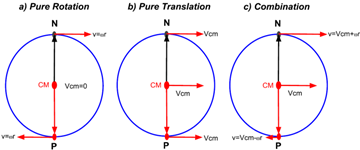
During pure rotation (a) of Figure 2, the momentum and angular momentum of each pole and the dipole are described as follows:
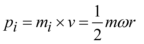 |
 |
 |
For pure translation (b) of Figure 2, the translational momentum of each pole and the dipole are expressed as follows:
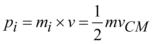 |
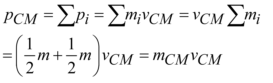 |
While in the combined motions (c) of Figure 2, it is apparent that each pole doesn’t contribute translational momentum to the dipole as a whole. Because the momentum of any mass point is a vector, during rotation each pole of the dipole is in an opposite position(antipodal position), the ultimate net translational momentum is zero in any direction. The motion quantities in the combined motions are listed in Table 1.
Based on the above momentum information, we can establish the relation between translational momentum (or net translational momentum) and rotational angular momentum of the dipole in the combined motions, where  is the circumference of the motion circle of the spinvector tip, and
  is the wavelength of the spinvector tip in the combined motions, when
  ,
,
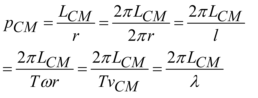
if we define as a coefficient of particle-wave duality, or simply as duality coefficient of the dipole, then:
 Eq. 3
Eq. 3
Furthermore, if we define  as a reduced duality coefficient of the dipole in the combined motions, thus:
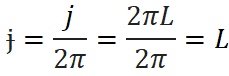
 Eq. 4
Eq. 4
Equation 4 reveals that the reduced duality coefficient is the intrinsic nature of the dipole; it is just the rotational angular momentum of the dipole and is determined by its mass, angular speed, and the spinvector length. Therefore Equation 3, particle-wave duality relation, is the intrinsic nature of the dipole when its rotational axis is moving along the wave direction.
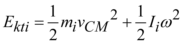
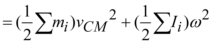
2.2. The Wave Equation of the Spinvector TipBefore we proceed to explore a wave equation of each pole for a dipole, let’s check the kinetic energy for the dipole. According to the classic mechanics 20, 21,
 |
 |
 |
 |
 |
It is obvious that the rotational kinetic energy of the dipole is determined by its moment of inertia and its angular speed. The kinetic energies of the photon are summarized in Table 2, where  is the motion mass of the photon, and
  as the light speed.
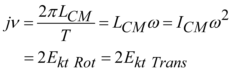
Based on the energy information of the photon in Table 2, when it is in combined motions and with its translational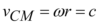 , according to our definition of duality coefficient, if the rotational frequency (
 ) is given, then
 |
 |
 |
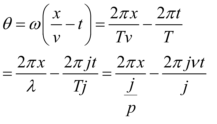
If we proceed the equation transformation on Equation 1, let
 |
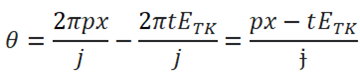 |
According to Planck, the kinetic energy of the photon is , so
, so
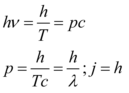 |
Therefore the wave Equation 1 is transformed as:
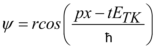 |
Actually we prefer to use the real part of the exponent function to describe a wave equation, so the wave of the photon moves along  axis is described as,
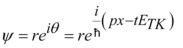 Eq. 5
Eq. 5
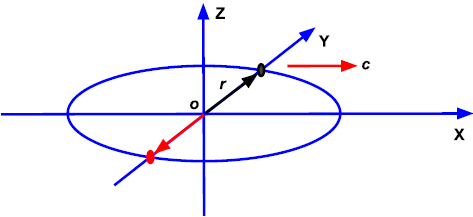
When we analyze the motion status of the photon as Figure 3, the negative pole as a black dot and the positive pole as red dot, we realize that for each pole of the photon there are two rotational directions, clockwise (right) or counterclockwise direction(left).
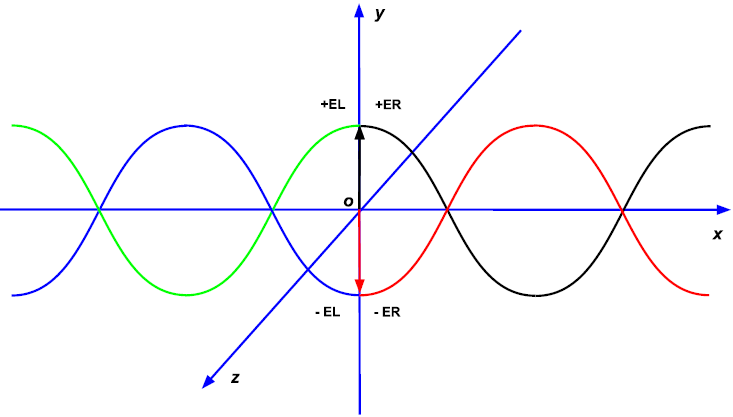
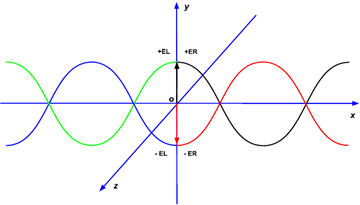
If we assume the wave on  axis and define the wave function of the negative pole as positive
  , then the wave function of the positive pole must be negative
  , because the phase difference between two poles is
 . The actual motion status of the photon is illustrated as Figure 4, the wave in black represents the negative pole in clockwise rotation (
 ), and the wave in green as its rotation in counterclockwise direction (
 ); while the wave in red as the positive pole in clockwise rotation (
 ), and the wave in blue as its rotation in counterclockwise direction (
 ).
).
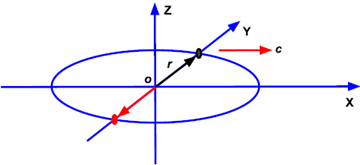
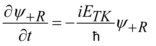
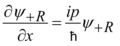
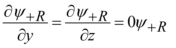
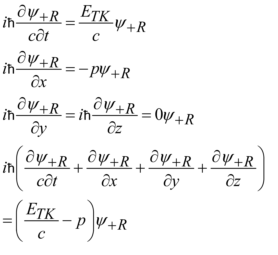
For the four-component wave function of the photon, if we apply the first order derivatives to the Equation 5, we will get,
 |
 |
 |
or
 Eq. 6
Eq. 6
Since ,
,
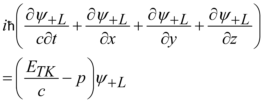 Eq. 7
Eq. 7
Due to , thus
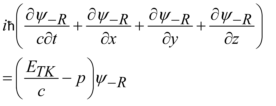 Eq. 8
Eq. 8
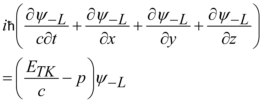 Eq. 9
Eq. 9
For Equation 6,7,8 and 9, we can describe them as matrix equations 22 with Pauli’s spin matrices.
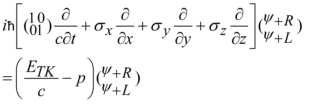 Eq. 10
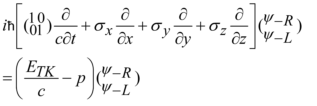 Eq. 11
or
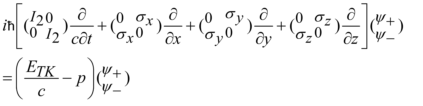 Eq. 12
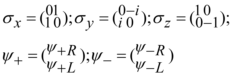 |
if we plug the  and
and  into the right side of Equation 12,
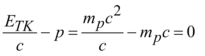 |
because  is the momentum operator, and the rest mass of the photon
  , so
, so
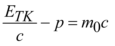 |
therefore the Equation 12 will be expressed as,
 Eq. 13
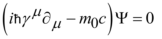
or the final famous Dirac Equation,
 Eq. 14
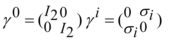
in the Equation 14,  , the coefficients
 ,
,
 |
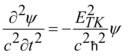
For Equation 5, if we take the second order derivatives, we will obtain,
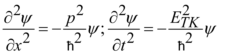 |
or
 |
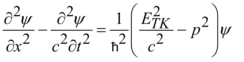 |
if the wave of the photon propagates in arbitrary direction in three-dimension space, we can easily get,
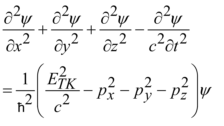 |
 Eq. 15
For the left side of the Equation 15, if we can treat the wave operator as the square of the first order partial derivatives according to Dirac’s coup 11,
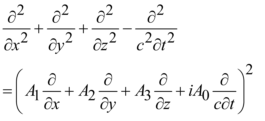 |
when multiplying out the right side, it is apparent that in order to get all the cross-terms such as  to vanish, we must assume,
 |
and with
 |
In order to satisfy these non-commutative conditions,  ,
,  ,
,  and
and  must be matrices. For the right side of the Equation 15, according to Einstein’s total kinetic energy expression 23 as Equation 16,
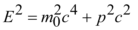 Eq. 16
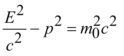 |
then Equation 15 will be transformed as,
 Eq. 17
Setting

Because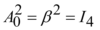 , and with the introduction of Pauli’s spin matrices,
 |
Finally we get another Dirac Equation 18,
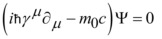 Eq. 18
in the Equation 18, the new coefficients ,
,
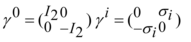 |
Based on the hypothesis of the photon as an electric dipole, we derived the total kinetic energy ( ) of the photon as a sum of translational kinetic energy and rotational kinetic energy when it is in combined motions through classical kinematics. While Simulik 24 developed it through the massless Dirac equation and an approach of energy and momentum conservation, and Schwinger 25 formulated the
  from Maxwell’s equation in vacuum. Compared to those approaches, our derivation is more classical, direct and simpler.
As to the Dirac equation, it is one of the most important foundations of modern physics, in the past 100 years there were more than 35 approaches to the Dirac equation derivation as summarized by Simulik 26 and they were categorized as (i) H. Sallhofer approach, (ii) massless approach through Maxwell equation, and (iii) nonzero mass from relativistic canonical quantum mechanics. Our second order derivative method is the Dirac’s original approach and it is the category (iii) approach through the non-commutative algebra which is harder to follow and more difficult to invent as commented by Darwin 27
In our first order derivative method, it is apparent that the wave of its spinvector tip is a function of space and time , the space dimension of the wave is only relevant to the direction of the wave propagation(one dimension) when the photon is in the combined motions. Actually there is no preference of which coordinate axis is selected as the wave direction. The wave direction could be along any one(..,
  , or
, or ) of the three coordinates in three-dimension space. But as long as the wave direction is selected, the space dimension in the wave function
  will be the same as this wave direction. If the wave direction is selected to along
  coordinate axis, then the wave function will be
 ; If the wave direction is fixed to along
  coordinate axis, thus the function must be
 . For the two dimensions other than the wave dimension, their first order partial derivatives of the wave function are always equal to zero. Because the direction of the photon’s momentum is always the same as the wave propagation direction in the photon’s combined motions. If the photon’s wave propagation is in any direction in three-dimension space, we can always select that direction as one of the coordinate directions in three-dimension space, so the equation
 |
will always be correct.
Our derivation processes of the Dirac Equation for the photon demonstrate that the motions of the photon are the special solutions to the Dirac Equation. If the positive energy refers to the wave states of the negative charge of the photon, then the negative energy automatically refers to the wave states of the positive charge(the anti-particle), which is consistent with classical physics that the energy of the particle is always positive. But the wave component of the particle is in a negative state due to the phase difference between the two components of the dipole in combined motions.
Since the electron is a particle with only one negative charge, there is no existence of anti-particle within the electron itself compared to the photon, and the energy of the particle is always positive, therefore the negative energy solutions to the Dirac equation for the same electron must refer to its wave component with phase difference of , which reveals the disk structure of the electron with dimetric vectors or bispinors, and which provides a proof to our previous work 28 on the structure proposal of the electron.
Based on the kinematic analysis of the photon as an electric dipole in combined motions(rotation and translation), we validate that the translational momentum of the photon is in direct proportion to its rotational angular momentum, and the energy of the photon  is its total kinetic energy, the sum of its translational kinetic energy and its rotational energy. Due to the structure of the dipole, the dimetric spinvectors or bispinors will be formed in the combined motions, the trajectory of any spinvector tip will become a wave component in some rotational direction. The derivation process of the Dirac equation of the photon elucidates what the four components of the photon are, and why the Dirac equation has negative solutions. The hypothesis of the photon as an electric dipole validates not only the photon’s motion as an electromagnetic wave 18, but also Dirac’s postulation of the existence of anti-particle, but within the photon itself.
| [1] | A. Messiah, Quantum Mechanics, North Holland, John Wiley & Sons. ISBN: 0486409244, c1966. | ||
| In article | |||
| [2] | R.P. Feynman, R.B. Leighton, M.L. Sands, Quantum Mechanics, The Feynman Lecture on Physics. Vol.3. Addison-Wesley. ISBN: 978-0-201-02118-9, c2007. | ||
| In article | |||
| [3] | A.I. Sabra, Theories of light: From Descartes to Newton, Cambridge University Press, ISBN: 978-0521240949, c1981. | ||
| In article | |||
| [4] | Fokko Jan Dijksterhuis, Lenses and Waves: Christiaan Huygens and the Mathematical Science of Optics in the 17th Century, Kluwer Academic Publishers, ISBN: 1-4020-2697-8, c2004. | ||
| In article | View Article | ||
| [5] | Thomas Young, “The bakerian lecture. Experiments and calculation relative to physical optics”. Philosophical Transactions of Royal Society of London. 94: p1-16(1804). | ||
| In article | View Article | ||
| [6] | Max Planck, “Ueber das Gesetz der Energieverteilung im Normalspectrum”. Annalen der Physik (in German). 309(3): p553-563(1901). | ||
| In article | View Article | ||
| [7] | Albert Einstein, The collected papers of Albert Einstein. 3: The Swiss years: writings, 1909-1911. Princeton, NJ: Princeton Univ. Press, ISBN: 978-0-691-10250-4, c1993. | ||
| In article | |||
| [8] | J.J. Thomson, “XL. Cathode Rays”, The London, Edinburgh, and Dublin Philosophical Magazine and Journal of Science. 44(269): p293-316(1897). | ||
| In article | View Article | ||
| [9] | C. Davisson and L.H. Germer, “The scattering of electrons by a single crystal of nickel”. Nature. 119(2998): p558-560(1927). | ||
| In article | View Article | ||
| [10] | E. Schrödinger, “An undulatory Theory of the Mechanics of Atoms and Molecules”. Physical Review. 28(6): p1049-1070(1926). | ||
| In article | View Article | ||
| [11] | P.A.M. Dirac, “The Quantum Theory of the Electron”. Proceedings of the Royal Society of London A. 117(778): p610-624(1928). | ||
| In article | View Article | ||
| [12] | P.A.M. Dirac, “A theory of electrons and protons” Proceedings of the Royal Society of London A. 126(801): p360-365(1930). | ||
| In article | View Article | ||
| [13] | L. Smolin, Einstein’s Unfinished Revolution. New York: Penguin Press, ISBN 978-1594206191, c2019. | ||
| In article | |||
| [14] | S.H.Priest, Encyclopedia of Science and Technology Communication, SAGE Publications, ISBN 978-1-4522-6578-0, c2010. | ||
| In article | |||
| [15] | R. Feynman, The Character of Physical Law. MIT Press, p129. ISBN 0-262-56003-8, c1967. | ||
| In article | |||
| [16] | S. Weinberg, "Collapse of the state vector". Physical Review A. 85 (6): 062116(2012). | ||
| In article | View Article | ||
| [17] | A.P. French, Vibration and Waves, The Massachusetts Institute of Technology, c1971. | ||
| In article | |||
| [18] | Zhonglin BO, “On the Motions of the Photon as an Electric Dipole and the Exploration of the Origin of Mass and Gravitation-Spinvector Motion III”. International Journal of Physics, 12(3): p95-105(2024). | ||
| In article | View Article | ||
| [19] | R.A. Serway, J.W. Jewett, Physics for Scientists and Engineers with Modern Physics, Philadelphia: Saunders College Pub., c1983. | ||
| In article | |||
| [20] | C. Kittel, W.D. Knight and M.A. Ruderman, Mechanics (Berkeley Physics Course) Vol 1, McGraw-Hill Book Company, ISBN: 0-07-004880-0, c1973. | ||
| In article | |||
| [21] | G.A. Dilisi, Classical Mechanics, Vol. 5: Conservation laws and rotational motion. Morgan & Claypool Publishers, ISBN: 978-1-64327-398-3, c2019. | ||
| In article | View Article | ||
| [22] | G. Strang, Introduction to Linear Algebra, 6th Edition, Wellesley-Cambridge Press. ISBN: 978-1-7331466-7-8, c2023. | ||
| In article | |||
| [23] | L. Susskind; A. Friedman, Special Relativity and Classical Field Theory: The Theoretical Minimum. Basic Books. ISBN-13: 978-0-465-09335-9, c2017. | ||
| In article | |||
| [24] | V. Simulik, D.I. Bondar, “The Mass and Velocity of Light from Energy and Momentum Conservation”, arXiv 2509.12477(2025) | ||
| In article | |||
| [25] | K. Milton, J. Schwinger, Classical Electrodynamics, second edition, CRC Press, Taylor and Francis group, New York. ISBN: 978-0367502072, c2024. | ||
| In article | |||
| [26] | C.G. Darwin, “The Wave Equations of the Electron”, Proceedings of the Royal Society of London A. 118(780): p654-680(1928). | ||
| In article | View Article | ||
| [27] | V.M. Simulik, “The Dirac equation near centenary: a contemporary introduction to the Dirac equation consideration”. Journal of Physics A: Mathematical and Theoretical, 58(2025)053001. | ||
| In article | View Article | ||
| [28] | Zhonglin BO, “A New Interpretation of the Negative Energy Solutions to Dirac Equation and a Configuration of the Electron”. International Journal of Physics, 11(6): p236-241(2023). | ||
| In article | View Article | ||
Published with license by Science and Education Publishing, Copyright © 2025 Zhonglin BO
 This work is licensed under a Creative Commons Attribution 4.0 International License. To view a copy of this license, visit
http://creativecommons.org/licenses/by/4.0/
This work is licensed under a Creative Commons Attribution 4.0 International License. To view a copy of this license, visit
http://creativecommons.org/licenses/by/4.0/
| [1] | A. Messiah, Quantum Mechanics, North Holland, John Wiley & Sons. ISBN: 0486409244, c1966. | ||
| In article | |||
| [2] | R.P. Feynman, R.B. Leighton, M.L. Sands, Quantum Mechanics, The Feynman Lecture on Physics. Vol.3. Addison-Wesley. ISBN: 978-0-201-02118-9, c2007. | ||
| In article | |||
| [3] | A.I. Sabra, Theories of light: From Descartes to Newton, Cambridge University Press, ISBN: 978-0521240949, c1981. | ||
| In article | |||
| [4] | Fokko Jan Dijksterhuis, Lenses and Waves: Christiaan Huygens and the Mathematical Science of Optics in the 17th Century, Kluwer Academic Publishers, ISBN: 1-4020-2697-8, c2004. | ||
| In article | View Article | ||
| [5] | Thomas Young, “The bakerian lecture. Experiments and calculation relative to physical optics”. Philosophical Transactions of Royal Society of London. 94: p1-16(1804). | ||
| In article | View Article | ||
| [6] | Max Planck, “Ueber das Gesetz der Energieverteilung im Normalspectrum”. Annalen der Physik (in German). 309(3): p553-563(1901). | ||
| In article | View Article | ||
| [7] | Albert Einstein, The collected papers of Albert Einstein. 3: The Swiss years: writings, 1909-1911. Princeton, NJ: Princeton Univ. Press, ISBN: 978-0-691-10250-4, c1993. | ||
| In article | |||
| [8] | J.J. Thomson, “XL. Cathode Rays”, The London, Edinburgh, and Dublin Philosophical Magazine and Journal of Science. 44(269): p293-316(1897). | ||
| In article | View Article | ||
| [9] | C. Davisson and L.H. Germer, “The scattering of electrons by a single crystal of nickel”. Nature. 119(2998): p558-560(1927). | ||
| In article | View Article | ||
| [10] | E. Schrödinger, “An undulatory Theory of the Mechanics of Atoms and Molecules”. Physical Review. 28(6): p1049-1070(1926). | ||
| In article | View Article | ||
| [11] | P.A.M. Dirac, “The Quantum Theory of the Electron”. Proceedings of the Royal Society of London A. 117(778): p610-624(1928). | ||
| In article | View Article | ||
| [12] | P.A.M. Dirac, “A theory of electrons and protons” Proceedings of the Royal Society of London A. 126(801): p360-365(1930). | ||
| In article | View Article | ||
| [13] | L. Smolin, Einstein’s Unfinished Revolution. New York: Penguin Press, ISBN 978-1594206191, c2019. | ||
| In article | |||
| [14] | S.H.Priest, Encyclopedia of Science and Technology Communication, SAGE Publications, ISBN 978-1-4522-6578-0, c2010. | ||
| In article | |||
| [15] | R. Feynman, The Character of Physical Law. MIT Press, p129. ISBN 0-262-56003-8, c1967. | ||
| In article | |||
| [16] | S. Weinberg, "Collapse of the state vector". Physical Review A. 85 (6): 062116(2012). | ||
| In article | View Article | ||
| [17] | A.P. French, Vibration and Waves, The Massachusetts Institute of Technology, c1971. | ||
| In article | |||
| [18] | Zhonglin BO, “On the Motions of the Photon as an Electric Dipole and the Exploration of the Origin of Mass and Gravitation-Spinvector Motion III”. International Journal of Physics, 12(3): p95-105(2024). | ||
| In article | View Article | ||
| [19] | R.A. Serway, J.W. Jewett, Physics for Scientists and Engineers with Modern Physics, Philadelphia: Saunders College Pub., c1983. | ||
| In article | |||
| [20] | C. Kittel, W.D. Knight and M.A. Ruderman, Mechanics (Berkeley Physics Course) Vol 1, McGraw-Hill Book Company, ISBN: 0-07-004880-0, c1973. | ||
| In article | |||
| [21] | G.A. Dilisi, Classical Mechanics, Vol. 5: Conservation laws and rotational motion. Morgan & Claypool Publishers, ISBN: 978-1-64327-398-3, c2019. | ||
| In article | View Article | ||
| [22] | G. Strang, Introduction to Linear Algebra, 6th Edition, Wellesley-Cambridge Press. ISBN: 978-1-7331466-7-8, c2023. | ||
| In article | |||
| [23] | L. Susskind; A. Friedman, Special Relativity and Classical Field Theory: The Theoretical Minimum. Basic Books. ISBN-13: 978-0-465-09335-9, c2017. | ||
| In article | |||
| [24] | V. Simulik, D.I. Bondar, “The Mass and Velocity of Light from Energy and Momentum Conservation”, arXiv 2509.12477(2025) | ||
| In article | |||
| [25] | K. Milton, J. Schwinger, Classical Electrodynamics, second edition, CRC Press, Taylor and Francis group, New York. ISBN: 978-0367502072, c2024. | ||
| In article | |||
| [26] | C.G. Darwin, “The Wave Equations of the Electron”, Proceedings of the Royal Society of London A. 118(780): p654-680(1928). | ||
| In article | View Article | ||
| [27] | V.M. Simulik, “The Dirac equation near centenary: a contemporary introduction to the Dirac equation consideration”. Journal of Physics A: Mathematical and Theoretical, 58(2025)053001. | ||
| In article | View Article | ||
| [28] | Zhonglin BO, “A New Interpretation of the Negative Energy Solutions to Dirac Equation and a Configuration of the Electron”. International Journal of Physics, 11(6): p236-241(2023). | ||
| In article | View Article | ||