Free Space Optical (FSO) communication systems use laser beams to transmit data through the atmosphere. No physical transmission media is required and it is a good response to the growing demands in terms of communication broadband. Taking into account the specific atmospheric conditions of Abidjan, this study evaluates the performance of the FSO link. Abidjan is a subtropical region where climatic variations significantly influence the propagation of optical signals, leading to phenomena such as diffusion, pointing errors, and link blockage. The atmospheric characteristics are presented and the effects of various climatic factors and seasonal changes on laser beam propagation are assessed. Results reveal that the rainy season is the least favorable period for the deployment of FSO links, with rain being the primary attenuation factor, causing a signal reduction measured at 2.5 dB/km during the month of June. To deepen our understanding of system performance, the Bit Error Rate (BER) was assessed under these specific conditions. For this purpose, several turbulence models were studied to identify which best represents the dynamics of turbulence in this environment. Through numerical simulations, the efficiency of four main models (Málaga, Gamma-Gamma, Lognormal, and K-Distribution) was systematically evaluated by comparing their predictions with the results of Monte Carlo simulations. The study demonstrates that the Málaga model provides the most accurate results, with a Mean Squared Error (MSE) of 0.009398 and a Mean Absolute Error (MAE) of 0.018925 in estimating the turbulence distribution and system performance, highlighting its robustness and applicability in complex environments. Finally, the observed BER values, on the order of , indicate that deploying FSO links in Abidjan is feasible, despite the challenges posed by seasonal rains, suggesting promising potential for the development of FSO systems by implementing appropriate mitigation strategies to optimize performance under changing weather conditions.
Demand for high-speed connectivity has grown with the proliferation of smartphones, connected devices and internet access. In developing countries like Côte d’Ivoire, existing communication technologies, such as radio frequency (RF) communication and fiber optics, are often prohibitively expensive and lack the affordability needed to provide high-speed data transmission, reduce interference, and ensure secure data transfer at a low cost 1. This makes it crucial to explore alternative technologies that can meet the growing bandwidth demands while addressing the limitations of current communication methods. Free Space Optics (FSO) technology, which uses laser beams to wirelessly transmit data, presents a promising alternative due to its high data rates, inherent security, and operation in unlicensed frequency bands 1, 2. FSO enables network expansion, subscriber connectivity, and inter-building links without the need for extensive physical infrastructure 2. However, FSO systems are highly sensitive to environmental factors such as rain, fog, and dust, which can cause signal attenuation or even complete link disruption 2, 3. Therefore, precise modelling of these weather-induced effects is essential to ensure the reliability and availability of FSO systems, particularly in sensitive applications. Environmental factors can cause significant degradation of optical signals, leading to increased attenuation, signal fading, and, in severe cases, complete link outages 2. These disruptions pose substantial risks in applications where uninterrupted, highspeed communication is paramount. Accurate modelling of weather-induced effects on Free Space Optics (FSO) systems is critical to maintaining their reliability and availability, especially in sensitive applications such as emergency response, financial data transmission, and military communications 4. Moreover, precise modelling provides critical data for optimizing system parameters, such as transmission power, beam divergence, and receiver sensitivity, ensuring that FSO links remain operational even in adverse weather conditions. It also enables the development of predictive maintenance protocols, where FSO systems can adjust in real time to fluctuating environmental conditions, thereby reducing downtime and ensuring continuous service availability. Several atmospheric propagation models have been developed to account for the effects of turbulence on optical signals. The lognormal model is widely used to describe signal fluctuations under low turbulence conditions due to its simplicity and effectiveness 5. However, its accuracy diminishes as turbulence intensity increases, limiting its applicability in more severe conditions. The K-distribution model better matches experimental data in moderate to strong turbulence by accounting for both small-scale and large-scale effects, offering improved performance predictions under such conditions 6. The gamma-gamma model excels by effectively modelling optical signal fluctuations over a wide range of turbulence conditions, from mild to severe. It considers both scintillation (large-scale fluctuations) and fading (small-scale fluctuations), making it a more realistic model for FSO performance prediction 7. To bridge the gaps between these models, the Málaga model, has been introduced 8. This model incorporates several probability distributions, including lognormal, K, and gamma-gamma, as special cases, providing greater flexibility to represent various levels of atmospheric turbulence. Abidjan, with its humid tropical climate, presents unique challenges for the deployment of Free Space Optics (FSO) systems. The region experiences a complex mix of weather conditions, including heavy rainfall, humidity, fog, and airborne particulates such as dust and smoke, all of which can severely impact the performance of FSO links 9. Rain is particularly problematic due to its strong scattering and absorption effects, which can cause significant signal attenuation 10. Meanwhile, high humidity and fog increase the refractive index variations in the atmosphere, leading to turbulence and scintillation that disrupt the optical beam, resulting in fluctuations in signal intensity and quality 11. Given these environmental challenges, the deployment of FSO systems in Abidjan requires a thorough understanding of local atmospheric conditions to ensure optimal system performance and reliability.
This paper aims to evaluate the performance of various models in predicting atmospheric turbulence in this environment. Through this analytical approach, the study first seeks to identify the model best suited for characterizing atmospheric disturbances in a subtropical region like Abidjan. Additionally, it aims to develop a detailed statistical representation of this atmospheric environment, which is critical for predicting signal attenuation and designing more resilient FSO systems. The approach involves collecting local meteorological data, including measurements of visibility, rainfall rate, temperature, and humidity, integrating these into the Málaga, Lognormal, Gamma gamma and K-distribution models with pointing error to simulate the expected impact on FSO signal propagation. By accurately characterizing atmospheric turbulence, this study aims to guide the design and deployment of FSO systems that are specifically tailored to the climatic conditions of Abidjan. This will enhance the robustness and reliability of highspeed optical communication links. The insights gained from this study will not only improve FSO system performance in Abidjan but also provide a valuable framework for similar deployments in other tropical and subtropical regions facing analogous environmental challenges.
In the following section, we describe the system operation and our study environment. Then, in the third part, we introduce the different models for characterizing the distribution of atmospheric turbulence applied to this environment. The fourth section is dedicated to evaluating the performance of the FSO system under the atmospheric conditions of Abidjan through a bit error rate (BER) analysis. Finally, in the fifth section, we present the conclusions of our study.
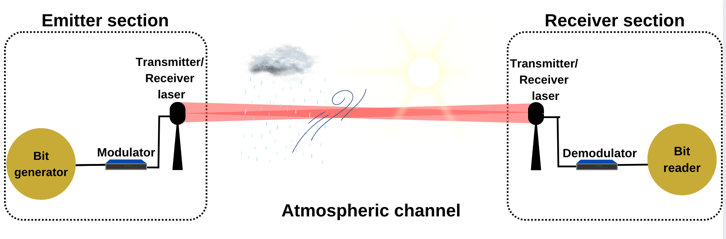
Free space optical communications are based on the exchange of information in the form of light. Conceptually, an atmospheric optical link is simple, a transmitter directs a laser beam to a receiver. The small laser beam directs all the intensity in the direction of the receiver and makes it very difficult for a third party to intercept it. As describe in Figure 1 the FSO system includes three parts: emission, propagation channel, and reception. At transmission, the data is sent as an electrical signal to the modulator, which is responsible for converting this original signal into a form suitable for transmission via a laser beam. This step is crucial as it ensures compatibility between the digital information to be transmitted and the optical channel used for signal propagation 2. The atmospheric channel serves as the medium for the propagation of the light beam and is inherently complex due to various environmental factors. These factors include rain, fog, temperature, humidity, atmospheric scintillation, wind speed, and atmospheric pressure. Each of these elements can significantly influence the properties of the incident light beam, causing signal fluctuations, increased attenuation, or even beam dispersion 3, 6. Free Space Optical links are particularly sensitive to these atmospheric variations, which limit their range and performance. For example, heavy rain or dense fog can absorb or scatter part of the light signal, reducing the intensity of the signal received. Scintillation, caused by changes in the air’s refractive index due to temperature variations, introduces rapid fluctuations in the beam’s amplitude, affecting the quality of the optical link 12. These atmospheric disturbances make the propagation channel complex and variable from one environment to another. As a result, the performance of FSO systems is highly dependent on local weather conditions, requiring transmission protocols to adapt in order to compensate for signal losses and maximize the reliability of free space optical communications. At reception, the light beam is captured by a receiver, typically a photodiode. The photodiode converts the optical signal into a corresponding electrical signal. This electrical signal is then processed by a demodulator, which amplifies and filters the data before passing it to a decoder to retrieve the original information 3, 12. This opto-electronic conversion process is essential for ensuring efficient transmission and reception in free space optical communication systems, despite the challenges posed by the atmospheric channel.

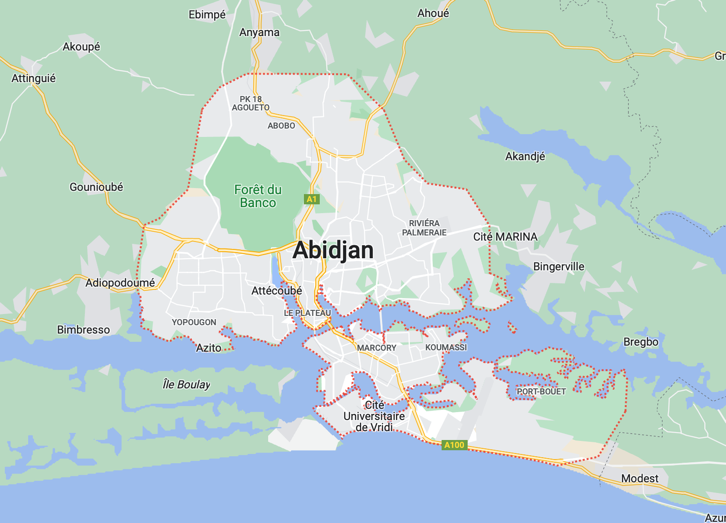
According to the Köppen-Geiger classification, Côte d’Ivoire benefits from a subtropical climate. This country, located in West Africa between the equator and the Tropic of Cancer, covers an area of 322,462km2 and has an estimated population of 29,389,150 inhabitants 13. Abidjan shown in Figure 2 is the largest city in Côte d’Ivoire in terms of both population and area, is home to around 5 million inhabitants spread over an area of 422km2 14. As the country’s economic center, this metropolis is characterized by a hot and humid climate due to its proximity to the Gulf of Guinea coast. Abidjan’s topography is mostly flat, with an average altitude of 18 meters above sea level. However, some neighborhoods like Cocody and areas around Bingerville feature slightly hilly terrain. Abidjan is also crossed by several lagoons, including the Ébrié Lagoon, which influences the local climate and contributes to the high humidity levels. The city is therefore subject to significant meteorological variations, marked by two main seasons. Abidjan’s subequatorial climate is characterized by an alternation between a rainy season and a dry season. The rainy season, from May to July, is marked by heavy rainfall, often exceeding 1500 mm per year 9, 14. This period is associated with high humidity, temperatures ranging between 25°C and 30°C, and torrential rains that can cause temporary flooding in urban areas. The low visibility due to heavy rainfall and the frequent presence of low clouds is a major factor to consider for free space optical communication systems, as suspended water droplets in the air can significantly attenuate the light beam 12. The dry season is divided into two phases: a short dry period from July to August, followed by a long dry season from November to March. During this period, precipitation decreases significantly, temperatures remain relatively high, sometimes reaching 35°C, and air humidity slightly drops 14. However, the dry season can also be marked by the Harmattan, a dry and dusty wind blowing from the Sahara desert, reducing visibility and adding an extra challenge to the propagation of optical beams in FSO systems.

As in Owerri, Nigeria, where the performance of FSO systems has already been evaluated under similar climatic conditions, Abidjan shares the characteristics of a humid coastal climate. The OWERRI project, aimed at evaluating the performance of FSO systems in West African urban environments, provides a valuable comparative basis for our study 14, 15. Indeed, the geographical proximity and climatic similarity between these two cities allow for comparative insights into the performance of optical communications in tropical environments with high humidity. The results obtained in Owerri, particularly regarding the attenuation of light beams due to rain and high humidity, will therefore serve as a reference in analyzing our own results in Abidjan. For our simulations, we will use local meteorological data provided by the national meteorological agency. This data includes measurements on precipitation, humidity, temperature, atmospheric pressure, wind speed, and average visibility from 2018 to 2022. These data will allow us to adjust our prediction models and evaluate the performance of FSO systems under similar environmental conditions, especially regarding the impact of seasonal variations on the quality of optical transmission.
The data collected are visibility, temperature, humidity, atmospheric pressure and precipitation rate per hour. These meteorological data provide essential information on the factors that influence laser beam propagation in the atmosphere of Abidjan. Their analysis allows for the characterization of the FSO communication channel, modeling of signal attenuation, and ultimately optimizing the design and deployment of efficient and reliable FSO systems in this specific environment.
The incident beam considered in our simulations operates at 1550 nm, which is the standard wavelength utilized in commercial telecommunications systems 16. The simulations are conducted using MATLAB software, and the results, presented as graphical curves, will be discussed in subsequent sections.
Rain is a natural phenomenon characterized by the fall of water droplets from clouds to the ground. It plays a significant role in non-selective diffusion, primarily due to the size of the droplets (approximately 2 mm). Rain is categorized into several types based on the nature of precipitation, including stratiform rain, convective rain, and monsoon rain 17. For this study, we focus specifically on monsoon rain, as it is the predominant type observed in the Abidjan region 14, 18. Monsoon rain is marked by a sequence of intense convective bands interspersed with periods of stratiform precipitation. The optical signal experiences random attenuation due to the presence of raindrops. Larger droplets can also induce scattering effects, irrespective of the wavelength of the light beam. The specific attenuation related to rainfall rate R (in mm/h) for a Free-Space Optical (FSO) link is expressed in Equation 1 2, 19:
 | (1) |
In this equation,  represents the specific attenuation due to rain,
  is a constant,
  is the rainfall rate, and
  is an attenuation coefficient. In a subtropical environment like Abidjan, where the rainfall rate
  mm/h 10, we find that
  and
and  .
.
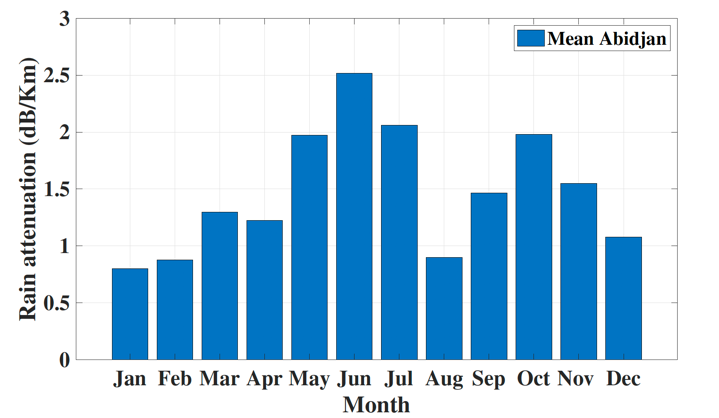
The attenuation of a light wave under hourly precipitation conditions in Abidjan for each month of the year is depicted in Figure 3. This figure is derived from average daily rainfall data collected in Abidjan from January 2018 to December 2022. For this analysis, we calculated the monthly average precipitation levels based on the five years of observed data. The simulation variables in this study focus on the monthly distribution of average rainfall rates in Abidjan, measured in millimeters per hour, as rainfall significantly impacts the performance of Free Space Optical (FSO) communication systems 19. In Abidjan, the rainy season spans from May to October, with a noticeable intermission in August. This results in two distinct periods of rainfall: the primary rainy season from May to July, characterized by intense precipitation, and the secondary rainy season from September to November, which, although less intense, still contributes to significant rainfall 10, 14. June, in particular, is identified as the month with the highest rainfall intensity. As shown in Figure 3, the period from May to July exhibits the highest levels of attenuation, ranging between 1.9 dB/km and 2.5 dB/km, with a peak attenuation in June. This heightened attenuation is directly linked to the increased rainfall typical of the primary rainy season.

According to the principles of light propagation, raindrops interact with optical signals in two primary ways: scattering and absorption 12. Scattering occurs when the raindrop size is comparable to the wavelength of the transmitted optical signal, causing the signal to deviate from its original path. This deviation leads to random dispersion of light in different directions, reducing the intensity of the signal reaching the receiver 2, 11. The degree of scattering increases with both the size of the raindrops and their density within the medium. Larger raindrops scatter light more effectively, thus causing greater disruption to the coherence of the optical beam. Simultaneously, absorption occurs as part of the optical energy is transferred to the raindrop in the form of heat. Water molecules within the raindrop absorb specific wavelengths of light, which further contributes to signal attenuation 9. This effect is particularly prominent at higher frequencies, where water absorption is more significant. The combined impact of scattering and absorption intensifies with the increasing size and number of raindrops, as both mechanisms contribute to greater transmission losses. In heavy rainfall, where both the size and density of raindrops are substantial, these effects can drastically reduce the power of the optical signal, leading to higher bit error rates (BER) and a significant decline in communication system performance 19, 20.
Following this, the secondary rainy season, from September to November, records the second highest attenuation levels, with values ranging from a maximum of 2 dB/km to a minimum of 1.49 dB/km. While this period experiences less intense rainfall than the primary rainy season, the signal attenuation remains significant enough to cause noticeable degradation in Free-Space Optical (FSO) communication performance 10. Even though the rainfall intensity is lower, the cumulative effect of continuous precipitation still introduces a substantial number of raindrops in the propagation path. These raindrops, despite being smaller or less frequent, disrupt the optical signals through scattering.
In FSO systems, signal degradation is not solely dependent on the intensity of individual raindrops but also on their overall presence in the communication channel 6, 12. Even moderate rain can cause significant scattering effects as the light interacts with numerous droplets along the optical path. This leads to phase and amplitude distortions, which reduce the power of the received signal and increase bit error rates (BER). Over extended periods, the consistent presence of rain, even at lower intensities, can accumulate enough attenuation to impact link reliability and system performance 10, 12. This highlights that, although less severe than in the primary rainy season, this secondary period still poses considerable challenges for the integrity of FSO communications. The clear correlation between periods of high attenuation and the rainy seasons underscores the considerable challenges faced by FSO communication systems during these months. Rain introduces not only random scattering of light but also fading, which further complicates signal transmission. As a result, the reliability of FSO links is particularly compromised during these high-rainfall periods 21. This emphasizes the importance of understanding seasonal variations in rainfall when designing and optimizing FSO systems in Abidjan. By accounting for these fluctuations, network operators can implement more effective planning and mitigation strategies, thereby improving the system’s resilience against the adverse effects of rain on signal quality.
Fog consists of suspended liquid water particles, and the size of these particles is generally comparable to the wavelength of the Free-Space Optical (FSO) signal. This similarity leads to significant attenuation of FSO links 22. As the concentration of fog increases, visibility decreases markedly. This high attenuation, along with the prolonged delays it induces, hampers the availability of FSO transmissions. To accurately assess this attenuation, Mie’s theory can be applied 2, 22. However, this approach requires complex calculations and precise data regarding fog parameters. An alternative method involves utilizing visibility data to predict fog attenuation through empirical models. The attenuation coefficient can be defined using Kim’s experimental model for Mie scattering, as represented in Equation 2 2, 22:
 | (2) |
In this equation,  (in Km) denotes the visibility distance,
  (in nm) refers to the operating wavelength,
  is a reference wavelength, and
  is the scattering size distribution coefficient. According to Kim's model, the values of
  are determined as follows in Equation 3 22, 23:
 | (3) |
This model provides a practical means to estimate fog related attenuation and its impact on FSO link performance.
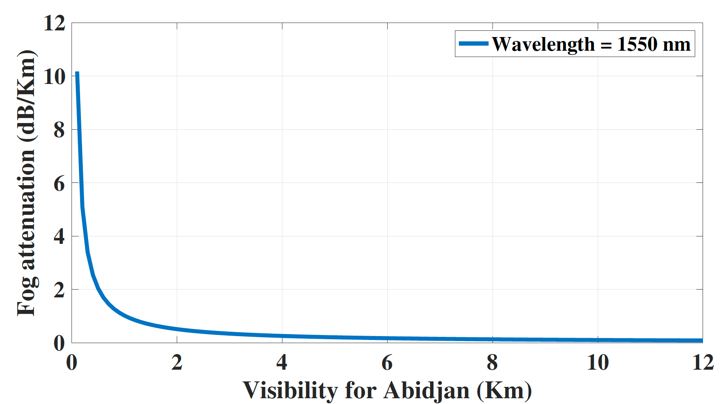
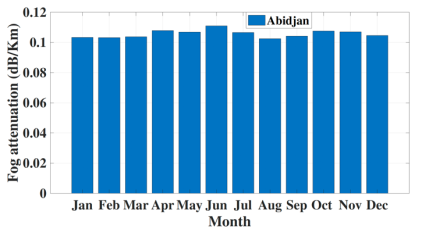
The specific attenuations caused by fog, both as a function of visibility distance and monthly variations, are illustrated in Figure 4 and Figure 5. For the estimation of fog induced scattering losses, Kim's model was employed, utilizing a transmission wavelength of 1550 nm to evaluate the associated losses.

Figure 4 illustrates a clear inverse relationship between attenuation and visibility distance in foggy conditions. This phenomenon can be explained by understanding the interaction between fog droplets and the optical signal. In fog, the presence of numerous small water droplets suspended in the air leads to scattering and absorption of light 23. The attenuation of the optical signal is primarily a result of these interactions. When visibility is low, specifically, less than 1 km, the density of fog droplets is high, causing significant scattering of the light beam. This scattering results in maximum attenuation, which can reach approximately 10 dB/km. At this level, the optical signal experiences substantial degradation, leading to potential communication failures in Free-Space Optical (FSO) systems 2. As visibility distance increases beyond 1 km, the concentration of fog droplets decreases. This reduction in droplet density leads to less scattering and absorption of the light beam, which in turn results in lower attenuation 15. Consequently, the attenuation approaches zero as visibility distances become significantly large. This behavior highlights the critical role of visibility in determining the performance and reliability of FSO links in foggy environments. To ensure optimal stability of FSO links with respect to fog resistance, it is advisable to prioritize visibility distances greater than 1 km. Operating under these conditions minimizes the impact of fog induced attenuation, thereby enhancing signal integrity and communication reliability 15, 22. In practice, achieving visibility distances beyond this threshold can be facilitated through site selection, system design, and operational strategies that account for local meteorological conditions.
The assessment of the attenuation experienced by an FSO link on a monthly basis under the meteorological conditions of Abidjan was conducted by utilizing the monthly variation of visibility distance as the primary simulation variable. To generate Figure 5, we analyzed average monthly visibility data for Abidjan spanning from January 2018 to December 2022. This data was processed to calculate the monthly average values over the five-year period, allowing for a comprehensive evaluation of visibility trends throughout the year. By focusing on monthly averages, we can identify patterns and fluctuations in visibility that directly influence the performance of FSO links. This approach provides valuable insights into how seasonal changes and climatic conditions impact signal attenuation. The results highlight periods when visibility may be particularly low, indicating higher potential for signal degradation due to fog or other atmospheric phenomena. From Figure 5, the observation that the maximum attenuation experienced by an FSO link due to fog remains below 0.12 dB/km underscores the relatively stable meteorological conditions in Abidjan 9.
This finding is consistent with Figure 4, which indicates that the average visibility distance throughout the year generally exceeds 1 km. The attenuation values show only slight fluctuations, ranging between 0.1 dB/km and 0.12 dB/km. This minimal variability can be explained by the stable visibility conditions, which fluctuate between 9 km and 10 km. Such stability suggests that fog does not frequently reach densities high enough to cause significant signal degradation, allowing for effective FSO communication. The periods of heightened attenuation correspond to the rainy seasons, particularly from May to July and from September to November. These intervals are characterized by increased humidity and precipitation, which can promote fog formation and subsequently diminish visibility 10. The peak attenuation observed in June aligns with the onset of heavy rains, which can lead to not only decreased visibility but also increased moisture in the air, contributing to more substantial fog development. Fog, formed by suspended water droplets in the atmosphere, has a direct impact on light transmission. When visibility is lower, especially during heavy rainfall, the density of these droplets increases, leading to greater scattering and absorption of the laser signal 24. This scattering can significantly affect the integrity of FSO links, making it crucial to monitor and understand the relationship between seasonal rainfall patterns and visibility distances. The data highlight the rainy season’s profound effect on the operation of FSO links. During these periods, the increased likelihood of fog formation presents a challenge for maintaining reliable optical communication. Consequently, strategies for mitigating the impact of fog, such as optimizing link design, selecting appropriate wavelengths, or deploying adaptive technologies become vital for ensuring consistent FSO performance. The correlation between the rainy season, visibility distance, and fog-induced attenuation illustrates the importance of considering meteorological factors in the design and implementation of FSO systems. By understanding these dynamics, we can better predict system performance and develop strategies to enhance the reliability of optical communication in environments like Abidjan, where seasonal variations significantly influence atmospheric conditions.

It’s important to highlight that the deployment of Free Space Optical (FSO) communication systems in Abidjan presents unique environmental characteristics compared to other regions where this technology is already in use. These differences significantly affect the performance and feasibility of FSO links.
In environments like Islamabad, where FSO technology is widely implemented, attenuation levels can reach up to 110 dB/Km due to severe atmospheric conditions, particularly heavy fog and dust storms that frequently occur in this region 3. In contrast, Abidjan experiences significantly lower maximum attenuation levels, peaking at just 3 dB/Km. This substantial difference suggests that Abidjan offers a relatively favorable environment for the deployment of FSO links, primarily because of its lower fog density and less frequent occurrences of extreme weather phenomena that severely attenuate optical signals.
Another critical finding in this study is that rain, rather than fog, is the primary attenuating factor for FSO systems in Abidjan. This contrasts with other environments such as European environnement, where fog and snow are identified as the major causes of signal degradation 12, 16. The rainy season in Abidjan, which typically spans from May to July, poses the greatest challenge to FSO deployment due to intense precipitation, which causes rapid attenuation of optical signals. During this period, signal attenuation can reach levels that significantly impair the link quality, making the rainy season the least favorable for FSO deployments. The presence of large raindrops and high rainfall rates disrupts the propagation of the optical beam, leading to increased scattering and absorption, which are detrimental to the system’s performance.
The results concerning fog-induced attenuation in Abidjan align with trends observed in other similar environments, such as Owerri. In Owerri, studies have shown that attenuation due to fog decreases as visibility distance increases, with a maximum observed attenuation of around 10 dB/Km at a wavelength of 1550 nm 15. The key difference between Abidjan and Owerri lies in the typical visibility distances: while Owerri experiences visibility up to 33.3 Km, Abidjan’s average visibility is about 10 Km. For the 1550 nm wavelength commonly used in FSO systems, the maximum observed attenuation in Owerri is 0.13 dB/Km, compared to 0.12 dB/Km in Abidjan, reflecting slightly better conditions in Abidjan for optical signal propagation. This relatively low attenuation level suggests that fog is a less critical factor in Abidjan compared to rain, making fog-related disruptions less impactful than in regions with denser and more frequent fog.
In the context of analyzing the reliability of free-space optical (FSO) communication systems, it is imperative to conduct a thorough characterization of the atmospheric channel that influences the link. The following section focuses on this characterization by examining various atmospheric modeling approaches. The objective is to determine which model provides the best evaluation of FSO system performance in the specific environment of Abidjan.
Atmospheric turbulence is a significant phenomenon that impacts the performance of free-space optical (FSO) communication systems by introducing random fluctuations in signal intensity 2, 6. These fluctuations arise from variations in the refractive index of the atmosphere, which is primarily influenced by factors such as temperature gradients, pressure differences, and wind speed 6, 11. As the optical signal propagates through the turbulent atmosphere, it encounters regions of differing refractive indices, leading to scattering, beam wandering, and phase distortions 1, 12. Given the unpredictable nature of atmospheric turbulence, accurately modeling these intensity fluctuations is essential for several reasons. First, reliable models enable engineers and researchers to predict how different levels of turbulence will affect signal transmission. This knowledge is crucial for designing FSO systems that can operate effectively under a variety of atmospheric conditions. Moreover, various statistical models have been developed to represent the behavior of atmospheric turbulence, each with its own assumptions and applications. Commonly used models include the Málaga distribution, the Gamma-Gamma distribution, and the Lognormal distribution 2, 4.
3.1. Lognormal modelAmong the commonly used statistical models, the lognormal model is used to describe scintillation under weak to moderate turbulence conditions. It is based on the assumption that the logarithm of the intensity follows a normal distribution. For this model, we assume  , where
  is a normal random variable with a mean
  and a variance
  1. The probability density of
  is given by 5:
 | (4) |
Since  , the probability density of
  is obtained by a change of variable. The change of variable implies that
  , hence the probability density becomes 4:
 | (5) |
By substituting the probability density of  into the above expression, we obtain the lognormal distribution 5:
 | (6) |
where  is the logarithmic mean and
  is the logarithmic variance.
While the lognormal model is effective in describing intensity fluctuations under weak to moderate turbulence conditions, it becomes inappropriate in highly turbulent environments 8. It does not accurately capture large intensity fluctuations and relies on a simplifying assumption of a lognormal distribution, which reduces its precision in complex turbulence situations.
3.2. K-distribution modelIn contrast to the lognormal model, the K-distribution is used to model scintillation in highly turbulent environments. It is obtained by combining a Rayleigh distribution (for small-scale scintillation) and a Gamma distribution (for large-scale scintillation) 8. Small-scale scintillation is modelled by a Rayleigh distribution, which is a special gamma distribution with a shape parameter equal to 1/2. The Rayleigh distribution is given by 6:
 | (7) |
Large scales are modelled by a Gamma distribution with a shape parameter  , given by 6, 11:
 | (8) |
The total intensity  is obtained by multiplying the small and large scales:
  . The probability density is obtained by convolving the two distributions:
 | (9) |
After calculations, the resulting probability density is the K-distribution 11, 12:
 | (10) |
Where  (x) is the modified Bessel function of the second kind, and
  is the Gamma function.
The K-distribution is used in environments where turbulence is very strong because it effectively captures large intensity fluctuations in these conditions. However, the convolution of Rayleigh and Gamma distributions leads to more complex formulas, making them difficult to manipulate and interpret. Furthermore, this model depends heavily on parameters that need to be precisely estimated, which can be challenging in practice 12. This dependence complicates the analysis and limits its application in certain scenarios.
3.3. Gamma gamma modelThe Gamma-Gamma model is used to model scintillation effects in free-space optical (FSO) communications. It is based on the idea that intensity fluctuations are caused by two scales of turbulence, represented by two independent Gamma distributions 7. The signal intensity  is then the product of two independent random variables representing small-scale
  and large-scale
  scintillation effects. These two scales are modelled by Gamma distributions 4, 12:
 | (11) |
and
 | (12) |
where  and
and  are parameters related to the small and large scales of turbulence.
The total intensity is given by  , and the total probability density
  is obtained by convolving the two independent Gamma distributions 12:
 | (13) |
After calculations and simplifications, using identities related to the Bessel and Gamma functions, the gamma gamma distribution is expressed as 7, 12:
 | (14) |
where  is the modified Bessel function of the second kind, and
  is the Euler gamma function.
This distribution is particularly effective for modelling moderate to strong scintillation since it combines the effects of both scales of turbulence. However, it is less accurate in extremely weak or very strong turbulence conditions 26. It also assumes a clear distinction between the two scales, a hypothesis that may not always hold in more complex environments where additional interactions or intermediate effects may be present. This strict decomposition may not faithfully represent the reality of atmospheric scintillation.
3.4. Málaga ModelTo address the limitations of the previous models, the Málaga distribution is introduced as a unifying solution capable of capturing the complexity of intensity fluctuations across a wide range of turbulence conditions, whether weak, moderate, or severe 26, 27. Unlike other models that focus on one or two scales of scintillation, the Málaga distribution is a more general statistical model that simultaneously accounts for the multiple effects influencing optical propagation in the atmospheric medium 8.
The Málaga model is based on a statistical description of the light intensity received by a receiver in a free-space optical (FSO) communication system. It takes into account three main components that contribute to the total received intensity: the line-of-sight (LOS) component  , which is the part of the laser beam that propagates directly from the transmitter to the receiver without undergoing significant scattering 8, 28. It is generally modelled by a Gaussian distribution, reflecting the intensity fluctuations due to large-scale turbulence. The second component is the scattered component coupled with the LOS
  , this component represents the part of the beam that has undergone multiple scatterings in the atmosphere but remains partially coherent with the LOS component 8, 28. It is modelled by a gamma distribution, with parameters related to the turbulence conditions. Finally, there is a non-coupled scattered component
  , which represents the part of the beam that has undergone multiple scatterings and has lost all coherence with the LOS component 8, 28. This component is also modeled by a gamma distribution, but with parameters different from those of the coupled component.
The total received intensity is the sum of these three components as defined by Equation 15 8, 28:
 | (15) |
where
 | (16) |
 | (17) |
 | (18) |
In Equation (16),  is a variable that follows a gamma distribution with an average value of 1. It represents the slow fluctuations of the line-of-sight (LOS) component 29.
The parameter  indicates the average power of the LOS component. The total power of the scattering components is denoted by
  . The phases
  and
and  correspond to the LOS component and the coupled scattering components, respectively 30.
Additionally,  is a factor between 0 and 1 that measures the amount of scattering power associated with the LOS component, and it depends on several elements.
Finally,  is a complex random variable, while
  and
and  represent the amplitude and phase perturbations caused by atmospheric turbulence.
For this model, the irradiance can then be defined as 30:
 | (19) |
This irradiance can be expressed as the sum of two types of irradiance, X and Y, as defined by the following equation:
 | (20) |
where the small-scale fluctuations are defined by 8, 17:
 | (21) |
and the large-scale fluctuations by 8, 30:
 | (22) |
In simple terms,  and Y represent two types of light intensity changes caused by turbulence, X (small-scale fluctuations) related to tiny turbulent air movements that cause quick changes in light brightness. It captures rapid variations in intensity. Y (large-scale fluctuations) refers to larger turbulent areas that create slower, more gradual changes in light intensity. It accounts for the overall light changes over a larger space. Together, X and Y show how light intensity varies due to different sizes of turbulence in the atmosphere 28. The probability density function (pdf) of X is given by:
 | (23) |
where  is the fading parameter, with Var[.] as the variance operator. It has been demonstrated that
  and
and  Finally,
  is the Kummer confluent hypergeometric function of the first kind. These results can be obtained by calculating the expectation of the Rayleigh component with respect to the Nakagami distribution of the complex envelope R(t) , and then deriving the probability density function (pdf) of its instantaneous power. The pdf of Y is described by 30:
 | (24) |
where  is a positive parameter related to the effective number of large-scale cells in the scattering process.
The pdf of the irradiance for the Málaga distribution model is obtained by combining  and
and  , and is given by the following equation 31, 32:
 | (25) |
where  is the modified Bessel function of the second kind and order
  . With
 | (26) |
and
 | (27) |
 is the amount of fading parameter and is a natural number.
In this section, we analyze the bit error rate (BER) for an Intensity Modulation/Direct Detection (IM/DD) Free Space Optical (FSO) communication system using On-Off-Keying (OOK) modulation. OOK is a basic form of modulation in which binary data is transmitted by switching the light source on to represent a binary ‘1’ and off for a binary ‘0’. At the receiver end, the signal is subject to noise, predominantly shot noise or thermal noise, which can be modeled as Additive White Gaussian Noise (AWGN). This assumption allows us to model the system's performance using well-known statistical methods for Gaussian noise channels.
The probability of a bit error,  , depends on the conditional error probabilities when a binary '1' or '0' is transmitted, and these are defined as
  and
and  respectively. The general expression for the bit error probability can be written as 31, 33:
 | (28) |
'1' or a '0'. In typical systems, we assume that both symbols are equally probable, meaning  . Under this assumption, and considering symmetry in the conditional error probabilities, the expression simplifies to:
 | (29) |
 |
where P is the average received optical power, R is the responsivity of the photodetector,  is the noise variance, assumed to be Gaussian, Q(.) is the Gaussian Q-function, related to the complementary error function erfc(.).
Since the FSO system is affected by atmospheric turbulence, the average BER (ABER) must take into account the statistical variations of the received signal strength, modeled through the probability density function (PDF) of the channel irradiance fluctuations. The average BER is therefore obtained by integrating the conditional BER over all possible states of the channel, as given by the following equation:
 | (30) |
where  is the PDF of the irradiance I, which characterizes the distribution of the received signal due to turbulence.
Modeling the propagation of light in Free-Space Optical (FSO) communication systems is essential for characterizing the impact of atmospheric turbulence on optical signal quality and overall link performance 1, 34. The intensity fluctuations of the light beam, caused by local variations in the air’s refractive index, directly affect the bit error rate (BER) and, consequently, the link’s reliability 2. To optimize FSO systems in different atmospheric environments, selecting an appropriate propagation model is crucial. Each statistical model considered in this study is based on different assumptions about the nature and intensity of atmospheric turbulence, offering a unique perspective on irradiance distribution under various conditions. The relevance of these models lies in their ability to accurately predict light intensity variations in an FSO channel subject to variable atmospheric conditions such as rain, fog, wind speed, or fluctuations in temperature and humidity. Comparing these models with Monte Carlo simulations, which are widely recognized for their ability to statistically reproduce complex phenomena, helps assess their accuracy and determine which model best reflects physical reality. Such an evaluation is crucial for choosing the most appropriate model, thus optimizing the design and implementation of FSO systems in specific environments 1, 4. This evaluation process is essential to validate a model’s suitability for a given environment and to identify the model that offers the greatest advantages in terms of performance and reliability.
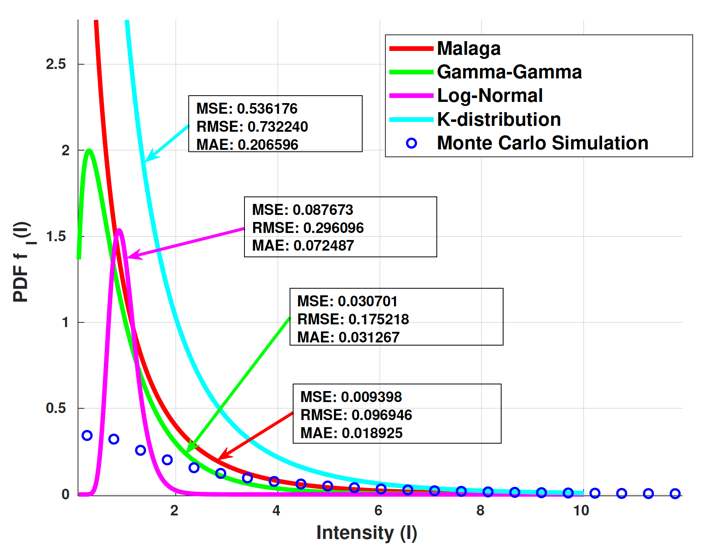
4.1. Probability Density FonctionTurbulence causes fluctuations in the intensity of the light beam, called scintillations, which degrade the quality of the received signal. These scintillations are due to variations in the refractive index of the air caused by changes in temperature, pressure, and wind speed 25. For this numerical analysis, a scintillation index of 0.3 has been considered, as obtained in the study presented by Douatia Koné et al., representing moderate atmospheric turbulence conditions for the city of Abidjan 35. The analyzed distributions were fitted to data from Monte Carlo simulations that replicate the behaviors of an optical beam subjected to atmospheric turbulence. The Monte Carlo method simulates the propagation process by generating a large number of random signal samples under Abidjan’s atmospheric conditions to capture the statistical variability of the intensity. Three error metrics were used to assess the accuracy of the distributions. First, the Mean Squared Error (MSE) measures the average of the squared errors between the simulated and theoretical values, indicating the dispersion of predicted values relative to observed values 36. Next, the Root Mean Square Error (RMSE) evaluates the mean squared error, expressing the average deviation in the original units, which is useful for interpreting the error in the context of signal intensity 36. Finally, the Mean Absolute Error (MAE) provides an estimate of the average absolute error, an intuitive measure of the average deviation of predictions from observations 36. Figure 6 presents the results obtained for the different statistical distributions applied to modeling scintillations in optical communication channels under Abidjan’s atmospheric turbulence.

The Malaga distribution (red curve) shows the best performance with low errors: MSE of 0.009398, RMSE of 0.096946, and MAE of 0.018925. These results demonstrate excellent correspondence with Monte Carlo data, especially at high intensities where other distributions show more pronounced deviations. This superiority lies in the Malaga distribution’s ability to model the combined effects of scintillations due to small and large-scale variations in the refractive index, as well as multi-path interferences 12. It uses a combination of Gamma processes and log-normal phenomena, offering great flexibility to capture a wide range of turbulence conditions, from light to severe, making it a preferred model for complex optical propagation scenarios 29.
The Gamma-Gamma distribution (green curve) shows moderate error metrics: MSE of 0.030701, RMSE of 0.175218, and MAE of 0.031267. It provides a reasonable fit but tends to deviate from the Monte Carlo data at high intensities, limiting its effectiveness in severe turbulence conditions. This model is based on a double Gamma process representing small and large turbulence scales, effectively capturing scintillations in moderate turbulence conditions 6. However, it does not adequately account for multi-path interferences, which occur when the light beam splits into multiple optical paths due to refraction, diffraction, and reflection on local variations in the refractive index of the air 6, 8. These complex effects induce additional fluctuations in the received signal intensity, leading to more pronounced and unpredictable distortions in the intensity distribution 30. This limitation explains why the Gamma-Gamma model performs less precisely compared to the Málaga distribution.
The Lognormal distribution (magenta curve) shows significantly less precise performance with higher error values: MSE of 0.087673, RMSE of 0.296096, and MAE of 0.072487. This model is primarily suited for low turbulence conditions where intensity variations follow a log-normal distribution, but it overestimates signal values at low intensities and does not adequately capture the non-linear and multi-path effects associated with stronger turbulence, which explains its deviations from the Monte Carlo simulations 4.
Finally, the K-distribution (cyan curve) exhibits the largest deviations with MSE of 0.536176, RMSE of 0.732240, and MAE of 0.206596, making this model inadequate for the studied data. It is often used in scenarios of high scintillation, especially in underwater propagation, but its rigidity and lack of flexibility to adjust to different turbulence regimes make it less effective for complex atmospheric conditions 1, 7.
These analyses highlight the Málaga distribution as the most robust for modeling scintillations in free-space optics in challenging propagation environments.
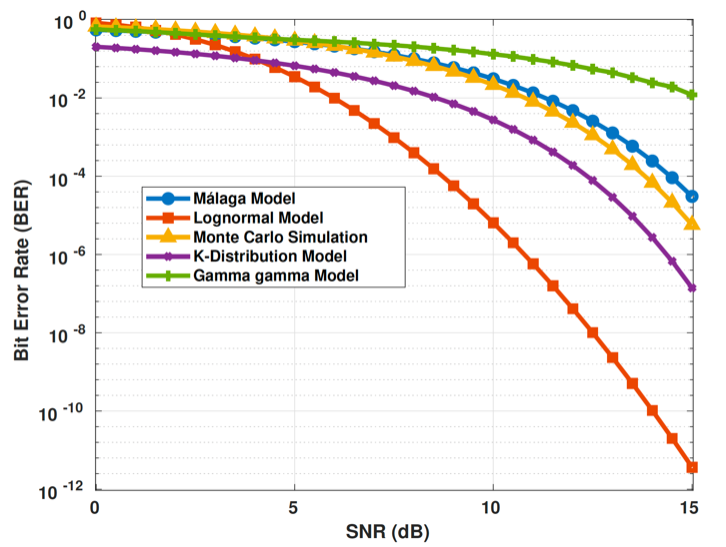
4.2. Bit Error RateFree-space optical (FSO) communication systems are highly susceptible to atmospheric turbulence, which causes fluctuations in the received signal’s intensity, leading to degraded performance. Various statistical models are used to characterize these intensity fluctuations (scintillations) and evaluate the system’s Bit Error Rate (BER) under different Signal-to-Noise Ratio (SNR) conditions. This section analyzes the performance of four prominent turbulence models (Málaga, Lognormal, K-Distribution, and Gamma-Gamma) compared with Monte Carlo simulations that represent the benchmark for real atmospheric conditions. The BER performance of each model was evaluated as a function of SNR (in dB), a key parameter that influences signal quality. The Monte Carlo simulations serve as the reference, simulating the random variations of an optical beam propagating through a turbulent atmosphere, specifically calibrated for conditions observed in Abidjan (presented in the previous section). The models were then tested against these simulations to assess their accuracy in different turbulence regimes.
The Monte Carlo method was used to simulate the propagation of an optical beam through atmospheric turbulence by generating random samples of signal intensity under Abidjan conditions. This approach provides a realistic representation of the statistical variability caused by turbulence, including the impact of small- and large-scale refractive index variations, multipath interference, and other complex effects 37. Monte Carlo simulations serve as the benchmark for modelling turbulent environments due to their comprehensive capture of atmospheric effects, offering an ideal reference for evaluating other statistical models. These simulations rely on stochastic processes to model the scattering and diffraction of light in the atmosphere, accounting for random phase and amplitude distortions induced by turbulence.

The Malaga model showed the best alignment with Monte Carlo simulation results, demonstrating the lowest BER across all SNR values tested. This model is tailored to capture the combined effects of small- and large-scale turbulence and multi-path interference, critical in highly turbulent conditions 27, 38. The near-perfect fit with Monte Carlo results, even at low SNR values, underscores the model’s robustness in severe atmospheric environments. Its combination of Gamma and log-normal processes allows it to model intensity fluctuations due to refractive index changes at both small and large scales, effectively capturing signal fading and statistical variability in turbulent channels 30.
The Gamma-Gamma model presented the second-best performance among the evaluated statistical models, showing relatively close alignment with the Monte Carlo simulations. The Gamma-Gamma model displayed consistently better BER performance compared to the K-Distribution and Lognormal models, particularly at moderate and high SNR values. This model is well-suited to capture turbulence effects that span both small and large scales, making it a strong candidate for environments with moderate to severe turbulence 7, 39.
The Gamma-Gamma model’s framework, which assumes that turbulence effects can be split into two independent scales represented by two Gamma distributions, enables it to describe moderate turbulence effectively. However, it falls short in accurately capturing more complex phase and amplitude interactions characteristic of severe turbulence, limiting its performance compared to the Málaga model 30.
In contrast, the Lognormal model, while commonly used for weak turbulence, shows considerable deviations from Monte Carlo simulations, particularly at higher SNR values. This model tends to underestimate strong scintillation effects, resulting in reduced accuracy in severe turbulence conditions 4, 40. Although it performs adequately under low to moderate turbulence, it fails at high SNR due to its inability to accurately model nonlinear and multi-path effects 4. The Lognormal model’s assumption that the logarithm of the received signal intensity follows a normal distribution limits its applicability to mild turbulence, rendering it inadequate for more complex environments.
The K-Distribution model, typically employed in strong scintillation environments, exhibited moderate performance with BER values notably lower than those of the Málaga model and Monte Carlo simulations. It effectively models deep fading conditions but lacks the flexibility required for varying turbulence scales. While suitable for scenarios with severe fading, such as underwater or highly turbulent atmospheric conditions, its tendency to overpredict BER at lower SNR values reflects its limitations in less severe environments. The model’s framework of a gamma-distributed large-scale component and a Rayleigh small-scale fading process captures strong fading but sacrifices accuracy in milder scintillation scenarios 12, 31.
The observed Bit Error Rate (BER) values on the order of  indicate that the environment in Abidjan is generally favorable for the deployment of Free Space Optical (FSO) communication systems 1, 24. Such low BER levels suggest that, under typical atmospheric conditions, the system can achieve high reliability and data integrity, making FSO a viable solution for urban communication networks 16. However, to ensure the efficient and consistent operation of these systems, especially during challenging weather conditions such as the rainy seasons, various improvement strategies must be implemented. One key strategy is the use of advanced error correction techniques to mitigate the effects of signal degradation caused by atmospheric disturbances 2, 41. Additionally, adaptive modulation schemes are essential for optimizing system performance. By dynamically adjusting modulation formats such as Quadrature Amplitude Modulation (QAM), Pulse Position Modulation (PPM), or Polarization Shift Keying (PolSK) based on real-time environmental conditions, the system can maintain optimal data transmission even during periods of increased attenuation 41, 42. These adaptive methods ensure that when conditions worsen, the modulation scheme shifts to a more robust format, preserving link quality. Hybrid FSO-RF systems can also be integrated to provide redundancy, allowing the system to switch to radio frequency (RF) communication when the optical link is severely affected by rain or fog 28. Furthermore, the deployment of spatial diversity techniques, such as multiple transmitting and receiving apertures, can help reduce the impact of localized turbulence and rain on the signal path, thereby enhancing the overall system robustness 12. By combining error correction, adaptive modulation, hybrid communication systems, and spatial diversity, the performance and reliability of FSO systems in Abidjan can be significantly enhanced, ensuring efficient deployment even under varying environmental conditions. These technological advancements will be crucial in optimizing the quality and availability of FSO links, especially during the challenging rainy seasons.
This study thoroughly examined the performance of Free Space Optical (FSO) communication systems by considering the specific environmental characteristics of Abidjan. The initial analysis revealed that several factors contribute to the degradation of FSO system performance, with rain being the main disruptive factor, leading to an attenuation of 2.5 dB/Km. It was also determined that the rainy season is the most unfavorable period for the proper
functioning of these systems. To better understand the overall performance of the FSO system in this environment, an evaluation of atmospheric turbulence was conducted using different distribution models. Four models were studied: Málaga, Gamma-Gamma, Lognormal, and K-Distribution, and compared with Monte Carlo simulations, which serve as a reference to assess each model’s ability to predict irradiance distribution and Bit Error Rate (BER) under various turbulence conditions. The Málaga model proved to be the most accurate, with a Mean Squared Error (MSE) of 0.009398, a Root Mean Squared Error (RMSE) of 0.096946, and a Mean Absolute Error (MAE) of 0.018925. It outperformed the other models by effectively capturing small- and large-scale scintillation effects, as well as multipath interferences, closely aligning with Monte Carlo simulation results for all SNR values, even under severe turbulence conditions. The Gamma-Gamma model also performed well under moderate turbulence, with an MSE of 0.030701, an RMSE of 0.175218, and an MAE of 0.031267, though its limitations became apparent under more extreme atmospheric conditions, particularly in its failure to fully capture complex phase and amplitude interactions. The Lognormal model, well-suited for weak turbulence, showed significant discrepancies for high SNR values, with an MSE of 0.087673, an RMSE of 0.296096, and an MAE of 0.072487, reflecting its inability to model non-linear and multipath effects associated with stronger turbulence. The K-Distribution model was the least effective, with high error values (MSE of 0.536176, RMSE of 0.732240, and MAE of 0.206596), limiting its efficiency in environments with strong scintillation. A detailed BER analysis indicates that the environment studied presents relatively favorable conditions for the deployment of FSO links, with a BER of approximately  . These results confirm that, despite the challenges posed by the rainy season, optimizing FSO systems is possible with appropriate strategies, ensuring robust performance even in variable weather conditions.
| [1] | Aboelala, O., Lee, I. E., and Chung, G. C. (2022). “A survey of hybrid free space optics (FSO) communication networks to achieve 5G connectivity for backhauling,” Entropy, 24(11), 1573. | ||
| In article | View Article PubMed | ||
| [2] | Mohsan, S. A. H., Khan, M. A., and Amjad, H. (2023). “Hybrid FSO/RF networks: A review of practical constraints, applications and challenges. Optical Switching and Networking”, 47, 100697.. | ||
| In article | View Article | ||
| [3] | Hameed, N., Mehmood, T., and Manzoor, H. U. (2017). “Effect of Weather Conditions on FSO link based in Islamabad,” arXiv preprint arXiv:1711.10869. | ||
| In article | |||
| [4] | Roa, C. Á., Gültekin, Y. C., Wu, K., Korevaar, C. W., and Alvarado, A. (2024). “A Simplified FSO Channel Model with Weak Turbulence and Pointing Errors,” In 2024 24th International Conference on Transparent Optical Networks (ICTON), 1-6). | ||
| In article | View Article PubMed | ||
| [5] | Duyen Trung, H. (2023). “Performance analysis of FSO DF relays with log-normal fading channel,” Journal of Optical Communications, 44(3), 395-403. | ||
| In article | View Article | ||
| [6] | Atiyah, M. A., Abdulameer, L. F., and Narkhedel, G. (2023). “PDF Comparison based on Various FSO Channel Models under Different Atmospheric Turbulence,” Al-Khwarizmi Engineering Journal, 19(4), 78-89. | ||
| In article | View Article | ||
| [7] | Badarneh, O. S., El Bouanani, F., Almehmadi, F. S., and Silva, H. S. (2023). FSO communications over doubly inverted Gamma-Gamma turbulence channels with nonzero-boresight pointing errors. IEEE Wireless Communications Letters, 12(10), 1761-1765. | ||
| In article | View Article | ||
| [8] | Jurado-Navas, A., Garrido-Balsells, J. M., Paris, J. F., Castillo-Vázquez, M., & Puerta-Notario, A. (2012). “Impact of pointing errors on the performance of generalized atmospheric optical channels,” Optics Express, 20(11), 12550-12562. | ||
| In article | View Article PubMed | ||
| [9] | Danumah, J. H. (2016). “Assessing urban flood risks under changing climate and land use in Abidjan District, South Côte d’Ivoire” (Doctoral dissertation). | ||
| In article | |||
| [10] | Yao, C., Kacou, M., Koffi, E. S., Dao, A., Dutremble, C., Guilliod, M., ... and Séguis, L. (2024). “Rainfall risk over the city of Abidjan (Côte d'Ivoire): first contribution of the joint analysis of daily rainfall from a historical record and a recent network of rain gauges,” Proceedings of IAHS, 385, 259-265. | ||
| In article | View Article | ||
| [11] | Andrews, L. C., Phillips, R. L., Hopen, C. Y., and Al-Habash, M. A. (1999). “Theory of optical scintillation,” JOSA A, 16(6), 1417-1429. | ||
| In article | View Article | ||
| [12] | Majumdar, A. K. (2014). “Advanced free space optics (FSO): a systems approach,” Springer, (Vol. 186). | ||
| In article | View Article | ||
| [13] | Akindès, F. (2003). “Côte d'Ivoire: Socio-political Crises, ‘Ivoirité' and the Course of History,” African Sociological Review/Revue Africaine de Sociologie, 7(2), 11-28. | ||
| In article | View Article | ||
| [14] | Kouassi, A. M., Nassa, R. A. K., Yao, K. B., Kouame, K. F., and Biemi, J. (2018). “Modélisation statistique des pluies maximales annuelles dans le district d’Abidjan (sud de la Côte d’Ivoire) ,“ Revue des sciences de l’eau, 31(2), 147-160. | ||
| In article | View Article | ||
| [15] | Ayo-Akanbi, O. A., Akinwumi, S. A., Omotosho, T. V., Arijaje, T. A., Ometan, O. O., and Adewusi, O. M. (2023, June). “Impacts of Aerosol Scattering Attenuation on Free-Space Optical Communication in Owerri, Nigeria,” In IOP Conference Series: Earth and Environmental Science (Vol. 1197, No. 1, p. 012007). IOP Publishing. | ||
| In article | View Article | ||
| [16] | Singh, H., Miglani, R., Mittal, N., Gupta, S., Tubbal, F., Raad, R., and Amhoud, E. M. (2023). “Designing an optimized free space optical (FSO) link for terrestrial commercial applications under turbulent channel conditions,” Optical and Quantum Electronics, 55(6), 532. | ||
| In article | View Article | ||
| [17] | Mason, B. J., and Andrews, J. B. (1960). “Drop‐size distributions from various types of rain,” Quarterly Journal of the Royal Meteorological Society, 86(369), 346-353. | ||
| In article | View Article | ||
| [18] | N’gattia, A. K., Coulibaly, D., Nzussouo, N. T., Kadjo, H. A., Chérif, D., Traoré, Y., and Tiembré, I. (2016). “Effects of climatological parameters in modeling and forecasting seasonal influenza transmission in Abidjan, Cote d’Ivoire,. BMC public health, 16, 1-7. | ||
| In article | View Article PubMed | ||
| [19] | Verdugo, E., Mello, L. D. S., Colvero, C. P., and Nebuloni, R. (2023, March). “Estimation of Rain Attenuation in FSO Links based on Visibility Measurements,” In 2023 17th European Conference on Antennas and Propagation (EuCAP) (pp. 1-5). IEEE. | ||
| In article | View Article | ||
| [20] | Mohammed, A. J., Abdulaal, A. H., Din, J., Zaidan, A. N., Yassin, R. A., Yin, L. H., and Abdullah, S. N. (2024). “Impact of Rain Weather Conditions over Hybrid FSO/58GHz Communication Link in Tropical Region,” Al-Iraqia Journal for Scientific Engineering Research, 3(3), 117-134. | ||
| In article | |||
| [21] | Giri, R. K. (2024). “FSO performance analysis of a metro city in different atmospheric conditions,” Journal of Optical Communications, 45(2), 369-377. | ||
| In article | View Article | ||
| [22] | Kaur, S. (2024). “Performance analysis of FSO link under the effect of fog in Delhi region India,” Journal of Optical Communications, 44(s1), s1385-s1393. | ||
| In article | View Article | ||
| [23] | Hamoudi, Z. A., and Ali, M. A. A. (2023). ”Performance of hybrid RF/FSO wireless communication system under low visibility,” Journal of Optical Communications, (0). | ||
| In article | View Article | ||
| [24] | Nebuloni, R., and Verdugo, E. (2022). “FSO path loss model based on the visibility,” IEEE Photonics Journal, 14(2), 1-9. | ||
| In article | View Article | ||
| [25] | Kumar, S., and Arora, P. (2024). “Modeling $C_n^2$ by inclusion of rainfall parameter and validate modified log normal and gamma-gamma model on FSO communication link,” Journal of Optical Communications, 44(1), 1803-1809. | ||
| In article | View Article | ||
| [26] | Ai, Y., Mathur, A., Verma, G. D., Kong, L., and Cheffena, M. (2020). “Comprehensive physical layer security analysis of FSO communications over Málaga channels,” IEEE Photonics Journal, 12(6), 1-17. | ||
| In article | View Article | ||
| [27] | Ibrahim, A. A., and Gucluoglu, T. (2019). “Performance analysis of maximum ratio transmission based FSO link over Málaga turbulence channel,” Optics Communications, 450, 341-346. | ||
| In article | View Article | ||
| [28] | Palliyembil, V., Vellakudiyan, J., and Muthuchidambaranathan, P. (2021). “Performance analysis of RF-FSO communication systems over the Málaga distribution channel with pointing error,” Optik, 247, 167891. | ||
| In article | View Article | ||
| [29] | Aghaei, M. R., Hemmatyar, A. A., Chamanmotlagh, A., and Fouladian, M. (2020). “Analysis of adaptive multi-rate FSO/RF hybrid systems using Málaga-ℳ distribution model in turbulent channels,” Journal of Modern Optics, 67(13), 1159-1169. | ||
| In article | View Article | ||
| [30] | Jurado-Navas, A., Garrido-Balsells, J. M., Paris, J. F., Puerta-Notario, A., and Awrejcewicz, J. (2011). “A unifying statistical model for atmospheric optical scintillation,” In Numerical simulations of physical and engineering processes (Vol. 181, No. 8, pp. 181-205). Rijeka, Croatia: Intech. | ||
| In article | View Article PubMed | ||
| [31] | Balaji, K. A., and Prabu, K. (2018). “BER analysis of relay assisted PSK with OFDM ROFSO system over Málaga distribution including pointing errors under various weather conditions,” Optics Communications, 426, 187-193. | ||
| In article | View Article | ||
| [32] | Jurado-Navas, A., Garrido-Balsells, J. M., Paris, J. F., Castillo-Vázquez, M., and Puerta-Notario, A. (2012). Impact of pointing errors on the performance of generalized atmospheric optical channels. Optics Express, 20(11), 12550-12562. | ||
| In article | View Article PubMed | ||
| [33] | Xu, G., Zhang, N., Xu, M., Xu, Z., Zhang, Q., and Song, Z. (2023). “Outage probability and average BER of UAV-assisted dual-hop FSO communication with amplify-and-forward relaying,” IEEE Transactions on Vehicular Technology, 72(7), 8287-8302. | ||
| In article | View Article | ||
| [34] | Anandkumar, D., and Sangeetha, R. G. (2022). “Performance evaluation of LDPC-coded power series based Málaga (Ḿ) distributed MIMO/FSO link with M-QAM and pointing error”. IEEE Access, 10, 62037-62055. | ||
| In article | View Article | ||
| [35] | Koné, D., Mene, N. M., and Kamagaté, A. (2024). ”Characterization of Link for Free-Space Terrestrial Optical Communications in Côte d’Ivoire,” Sciences des Structures et de la matière, 7(2). | ||
| In article | |||
| [36] | Fesl, B., Koller, M., and Utschick, W. (2023). “On the mean square error optimal estimator in one-bit quantized systems”. IEEE Transactions on Signal Processing, 71, 1968-1980. | ||
| In article | View Article | ||
| [37] | Alathwary, W. A., and Altubaishi, E. S. (2024). “Performance of coherent FSO systems with adaptive M-PSK modulation,” Optics & Laser Technology, 168, 109990. | ||
| In article | View Article | ||
| [38] | Chen, D., Liu, Y., Gao, Y., and Cao, Y. (2023). “Adaptive transmission based on MIMO mode switching over Málaga turbulence channel with pointing error,” IEEE Photonics Journal, 15(2), 1-11. | ||
| In article | View Article | ||
| [39] | Srivastava, V., and Mandloi, A. (2021). “Performance investigation of wavelength diversity based bpsk-sim fso system under gamma–gamma fading and misalignment error,” Optical and Quantum Electronics, 53, 1-14. | ||
| In article | View Article | ||
| [40] | Ai, D. H., Trung, H. D., and Tuan, D. T. (2020). “On the ASER performance of amplify-and-forward relaying MIMO/FSO systems using SC-QAM signals over log-normal and gamma-gamma atmospheric turbulence channels and pointing error impairments,” Journal of Information and Telecommunication, 4(3), 267-281. | ||
| In article | View Article | ||
| [41] | Migla, S., Selis, O., Sics, P. E., and Aboltins, A. (2024, July). “Error Analysis and Correction Techniques for PPM Communication Links with Jitter and Clock Drift”. In 2024 IEEE International Conference on Microwaves, Communications, Antennas, Biomedical Engineering and Electronic Systems (COMCAS), pp. 1-4. | ||
| In article | View Article | ||
| [42] | Koné, D., Mené, N. M., and Kamagaté, A. (2024). Wavelength-division multiplexing (WDM) FSO communications with soliton microcombs. Journal of Modern Optics, 1-15. | ||
| In article | View Article | ||
Published with license by Science and Education Publishing, Copyright © 2024 Douatia Koné, Penétjiligué Adama Soro and Aladji Kamagaté
 This work is licensed under a Creative Commons Attribution 4.0 International License. To view a copy of this license, visit
https://creativecommons.org/licenses/by/4.0/
This work is licensed under a Creative Commons Attribution 4.0 International License. To view a copy of this license, visit
https://creativecommons.org/licenses/by/4.0/
| [1] | Aboelala, O., Lee, I. E., and Chung, G. C. (2022). “A survey of hybrid free space optics (FSO) communication networks to achieve 5G connectivity for backhauling,” Entropy, 24(11), 1573. | ||
| In article | View Article PubMed | ||
| [2] | Mohsan, S. A. H., Khan, M. A., and Amjad, H. (2023). “Hybrid FSO/RF networks: A review of practical constraints, applications and challenges. Optical Switching and Networking”, 47, 100697.. | ||
| In article | View Article | ||
| [3] | Hameed, N., Mehmood, T., and Manzoor, H. U. (2017). “Effect of Weather Conditions on FSO link based in Islamabad,” arXiv preprint arXiv:1711.10869. | ||
| In article | |||
| [4] | Roa, C. Á., Gültekin, Y. C., Wu, K., Korevaar, C. W., and Alvarado, A. (2024). “A Simplified FSO Channel Model with Weak Turbulence and Pointing Errors,” In 2024 24th International Conference on Transparent Optical Networks (ICTON), 1-6). | ||
| In article | View Article PubMed | ||
| [5] | Duyen Trung, H. (2023). “Performance analysis of FSO DF relays with log-normal fading channel,” Journal of Optical Communications, 44(3), 395-403. | ||
| In article | View Article | ||
| [6] | Atiyah, M. A., Abdulameer, L. F., and Narkhedel, G. (2023). “PDF Comparison based on Various FSO Channel Models under Different Atmospheric Turbulence,” Al-Khwarizmi Engineering Journal, 19(4), 78-89. | ||
| In article | View Article | ||
| [7] | Badarneh, O. S., El Bouanani, F., Almehmadi, F. S., and Silva, H. S. (2023). FSO communications over doubly inverted Gamma-Gamma turbulence channels with nonzero-boresight pointing errors. IEEE Wireless Communications Letters, 12(10), 1761-1765. | ||
| In article | View Article | ||
| [8] | Jurado-Navas, A., Garrido-Balsells, J. M., Paris, J. F., Castillo-Vázquez, M., & Puerta-Notario, A. (2012). “Impact of pointing errors on the performance of generalized atmospheric optical channels,” Optics Express, 20(11), 12550-12562. | ||
| In article | View Article PubMed | ||
| [9] | Danumah, J. H. (2016). “Assessing urban flood risks under changing climate and land use in Abidjan District, South Côte d’Ivoire” (Doctoral dissertation). | ||
| In article | |||
| [10] | Yao, C., Kacou, M., Koffi, E. S., Dao, A., Dutremble, C., Guilliod, M., ... and Séguis, L. (2024). “Rainfall risk over the city of Abidjan (Côte d'Ivoire): first contribution of the joint analysis of daily rainfall from a historical record and a recent network of rain gauges,” Proceedings of IAHS, 385, 259-265. | ||
| In article | View Article | ||
| [11] | Andrews, L. C., Phillips, R. L., Hopen, C. Y., and Al-Habash, M. A. (1999). “Theory of optical scintillation,” JOSA A, 16(6), 1417-1429. | ||
| In article | View Article | ||
| [12] | Majumdar, A. K. (2014). “Advanced free space optics (FSO): a systems approach,” Springer, (Vol. 186). | ||
| In article | View Article | ||
| [13] | Akindès, F. (2003). “Côte d'Ivoire: Socio-political Crises, ‘Ivoirité' and the Course of History,” African Sociological Review/Revue Africaine de Sociologie, 7(2), 11-28. | ||
| In article | View Article | ||
| [14] | Kouassi, A. M., Nassa, R. A. K., Yao, K. B., Kouame, K. F., and Biemi, J. (2018). “Modélisation statistique des pluies maximales annuelles dans le district d’Abidjan (sud de la Côte d’Ivoire) ,“ Revue des sciences de l’eau, 31(2), 147-160. | ||
| In article | View Article | ||
| [15] | Ayo-Akanbi, O. A., Akinwumi, S. A., Omotosho, T. V., Arijaje, T. A., Ometan, O. O., and Adewusi, O. M. (2023, June). “Impacts of Aerosol Scattering Attenuation on Free-Space Optical Communication in Owerri, Nigeria,” In IOP Conference Series: Earth and Environmental Science (Vol. 1197, No. 1, p. 012007). IOP Publishing. | ||
| In article | View Article | ||
| [16] | Singh, H., Miglani, R., Mittal, N., Gupta, S., Tubbal, F., Raad, R., and Amhoud, E. M. (2023). “Designing an optimized free space optical (FSO) link for terrestrial commercial applications under turbulent channel conditions,” Optical and Quantum Electronics, 55(6), 532. | ||
| In article | View Article | ||
| [17] | Mason, B. J., and Andrews, J. B. (1960). “Drop‐size distributions from various types of rain,” Quarterly Journal of the Royal Meteorological Society, 86(369), 346-353. | ||
| In article | View Article | ||
| [18] | N’gattia, A. K., Coulibaly, D., Nzussouo, N. T., Kadjo, H. A., Chérif, D., Traoré, Y., and Tiembré, I. (2016). “Effects of climatological parameters in modeling and forecasting seasonal influenza transmission in Abidjan, Cote d’Ivoire,. BMC public health, 16, 1-7. | ||
| In article | View Article PubMed | ||
| [19] | Verdugo, E., Mello, L. D. S., Colvero, C. P., and Nebuloni, R. (2023, March). “Estimation of Rain Attenuation in FSO Links based on Visibility Measurements,” In 2023 17th European Conference on Antennas and Propagation (EuCAP) (pp. 1-5). IEEE. | ||
| In article | View Article | ||
| [20] | Mohammed, A. J., Abdulaal, A. H., Din, J., Zaidan, A. N., Yassin, R. A., Yin, L. H., and Abdullah, S. N. (2024). “Impact of Rain Weather Conditions over Hybrid FSO/58GHz Communication Link in Tropical Region,” Al-Iraqia Journal for Scientific Engineering Research, 3(3), 117-134. | ||
| In article | |||
| [21] | Giri, R. K. (2024). “FSO performance analysis of a metro city in different atmospheric conditions,” Journal of Optical Communications, 45(2), 369-377. | ||
| In article | View Article | ||
| [22] | Kaur, S. (2024). “Performance analysis of FSO link under the effect of fog in Delhi region India,” Journal of Optical Communications, 44(s1), s1385-s1393. | ||
| In article | View Article | ||
| [23] | Hamoudi, Z. A., and Ali, M. A. A. (2023). ”Performance of hybrid RF/FSO wireless communication system under low visibility,” Journal of Optical Communications, (0). | ||
| In article | View Article | ||
| [24] | Nebuloni, R., and Verdugo, E. (2022). “FSO path loss model based on the visibility,” IEEE Photonics Journal, 14(2), 1-9. | ||
| In article | View Article | ||
| [25] | Kumar, S., and Arora, P. (2024). “Modeling $C_n^2$ by inclusion of rainfall parameter and validate modified log normal and gamma-gamma model on FSO communication link,” Journal of Optical Communications, 44(1), 1803-1809. | ||
| In article | View Article | ||
| [26] | Ai, Y., Mathur, A., Verma, G. D., Kong, L., and Cheffena, M. (2020). “Comprehensive physical layer security analysis of FSO communications over Málaga channels,” IEEE Photonics Journal, 12(6), 1-17. | ||
| In article | View Article | ||
| [27] | Ibrahim, A. A., and Gucluoglu, T. (2019). “Performance analysis of maximum ratio transmission based FSO link over Málaga turbulence channel,” Optics Communications, 450, 341-346. | ||
| In article | View Article | ||
| [28] | Palliyembil, V., Vellakudiyan, J., and Muthuchidambaranathan, P. (2021). “Performance analysis of RF-FSO communication systems over the Málaga distribution channel with pointing error,” Optik, 247, 167891. | ||
| In article | View Article | ||
| [29] | Aghaei, M. R., Hemmatyar, A. A., Chamanmotlagh, A., and Fouladian, M. (2020). “Analysis of adaptive multi-rate FSO/RF hybrid systems using Málaga-ℳ distribution model in turbulent channels,” Journal of Modern Optics, 67(13), 1159-1169. | ||
| In article | View Article | ||
| [30] | Jurado-Navas, A., Garrido-Balsells, J. M., Paris, J. F., Puerta-Notario, A., and Awrejcewicz, J. (2011). “A unifying statistical model for atmospheric optical scintillation,” In Numerical simulations of physical and engineering processes (Vol. 181, No. 8, pp. 181-205). Rijeka, Croatia: Intech. | ||
| In article | View Article PubMed | ||
| [31] | Balaji, K. A., and Prabu, K. (2018). “BER analysis of relay assisted PSK with OFDM ROFSO system over Málaga distribution including pointing errors under various weather conditions,” Optics Communications, 426, 187-193. | ||
| In article | View Article | ||
| [32] | Jurado-Navas, A., Garrido-Balsells, J. M., Paris, J. F., Castillo-Vázquez, M., and Puerta-Notario, A. (2012). Impact of pointing errors on the performance of generalized atmospheric optical channels. Optics Express, 20(11), 12550-12562. | ||
| In article | View Article PubMed | ||
| [33] | Xu, G., Zhang, N., Xu, M., Xu, Z., Zhang, Q., and Song, Z. (2023). “Outage probability and average BER of UAV-assisted dual-hop FSO communication with amplify-and-forward relaying,” IEEE Transactions on Vehicular Technology, 72(7), 8287-8302. | ||
| In article | View Article | ||
| [34] | Anandkumar, D., and Sangeetha, R. G. (2022). “Performance evaluation of LDPC-coded power series based Málaga (Ḿ) distributed MIMO/FSO link with M-QAM and pointing error”. IEEE Access, 10, 62037-62055. | ||
| In article | View Article | ||
| [35] | Koné, D., Mene, N. M., and Kamagaté, A. (2024). ”Characterization of Link for Free-Space Terrestrial Optical Communications in Côte d’Ivoire,” Sciences des Structures et de la matière, 7(2). | ||
| In article | |||
| [36] | Fesl, B., Koller, M., and Utschick, W. (2023). “On the mean square error optimal estimator in one-bit quantized systems”. IEEE Transactions on Signal Processing, 71, 1968-1980. | ||
| In article | View Article | ||
| [37] | Alathwary, W. A., and Altubaishi, E. S. (2024). “Performance of coherent FSO systems with adaptive M-PSK modulation,” Optics & Laser Technology, 168, 109990. | ||
| In article | View Article | ||
| [38] | Chen, D., Liu, Y., Gao, Y., and Cao, Y. (2023). “Adaptive transmission based on MIMO mode switching over Málaga turbulence channel with pointing error,” IEEE Photonics Journal, 15(2), 1-11. | ||
| In article | View Article | ||
| [39] | Srivastava, V., and Mandloi, A. (2021). “Performance investigation of wavelength diversity based bpsk-sim fso system under gamma–gamma fading and misalignment error,” Optical and Quantum Electronics, 53, 1-14. | ||
| In article | View Article | ||
| [40] | Ai, D. H., Trung, H. D., and Tuan, D. T. (2020). “On the ASER performance of amplify-and-forward relaying MIMO/FSO systems using SC-QAM signals over log-normal and gamma-gamma atmospheric turbulence channels and pointing error impairments,” Journal of Information and Telecommunication, 4(3), 267-281. | ||
| In article | View Article | ||
| [41] | Migla, S., Selis, O., Sics, P. E., and Aboltins, A. (2024, July). “Error Analysis and Correction Techniques for PPM Communication Links with Jitter and Clock Drift”. In 2024 IEEE International Conference on Microwaves, Communications, Antennas, Biomedical Engineering and Electronic Systems (COMCAS), pp. 1-4. | ||
| In article | View Article | ||
| [42] | Koné, D., Mené, N. M., and Kamagaté, A. (2024). Wavelength-division multiplexing (WDM) FSO communications with soliton microcombs. Journal of Modern Optics, 1-15. | ||
| In article | View Article | ||