The study examined the levels of natural radioactivity in the soil of two cities: Wadi El-Shati and Zawiya. Eight soil samples were taken from Wadi El-Shati and four from Zawiya. A gamma spectrometry technique was used to detect the levels of radioactivity in the soil samples, using a high-purity germanium detector. The average values Activity concentrations (A) recorded for 226Ra, 232Th, and 40K were 27.25 Bq/kg, 40.83 Bq/kg, and 756.63 Bq/kg in Wadi El-Shati city areas and 26.50 Bq/kg, 05.50 Bq/kg, and 169.50 Bq/kg in Zawiya city areas. The radiation risks to health were considered, and the Radium Equivalent Activity (Raeq), external absorbed dose rate (Dout), and annual equivalent effective dose (ADout) were calculated. The average values for the areas in Wadi El-Shati City were 191.3 Bq/kg, 90.9 nGy/h, and 0.111 mSv/y, while in the areas of Zawiya City, they were 47.02 Bq/kg, 22.52 nGy/h, and 0.028 mSv/y, respectively. The average values of external (Hex), internal (Hin), and gamma radiation (Iγi) hazards were recorded in Wadi Shati City areas as 0.517, 0.721, and 1.410, respectively. In Zawiya City areas, the corresponding values were 0.127, 0.199, and 0.342. Based on the results obtained from the hazard indicators in the two cities, it has been noted that the values are within the safe and recommended limits, except for the external absorbed dose rate and the gamma radiation hazard index in the areas of Wadi EL-Shati city. These indicators are one and a half times and slightly higher respectively, compared to the recommended global average value. The obtained values may serve as reference data for future monitoring of environmental radiation for natural radionuclide activity in Libya.
The human body is mainly exposed to gamma radiation from radionuclides in the 238U and 232Th series and from 40K from external sources. some other terrestrial radionuclides, including those of the 235U series, 87Rb, 138La, 147Sm, and 176Lu, exist in nature but at such low levels that their contribution to the dose in humans is small. The median values are 400, 35, and 30 Bq/kg, and the population-weighted values are 420, 33, and 45 Bq/kg for 40K, 238U, and 232Th, respectively 1, 2, 3.
The main contribution to external exposure comes from gamma-emitting radionuclides present in trace amounts in the soil, mainly 40K and the 238U and 232Th families. Information on outdoor exposure comes from direct calculations of absorbed dose rates or evaluations based on measurements of radionuclide concentrations in soil. The worldwide mean value of outdoor absorbed dose rates in air is 50–59 nGy/h, with an average value of 58 nGy/h 4.
Indoor exposures depend on radionuclide concentrations in outdoor soil and in building materials. The relative contribution from each source is highly dependent on the type of house and building material. Information on distributions of indoor exposures can be assessed based on information on soil, shielding, and building material and then linked with the number of people exposed to estimate population exposures.
In general, average values for natural radionuclides are higher in most building materials than in soils. The highest average values for 226 Ra were 77 Bq/kg with granite and marble presenting and the highest average values for 232Th and 40K were 84 Bq/kg and 1200 Bq/kg respectively 5, 6, Therefore the value for the worldwide average indoor absorbed dose rate in air is equal to 84 nGy/h 4.
Using 0.7 Sv/Gy as the conversion coefficient from the absorbed dose rate in the air to the annual effective dose received by adults, and 0.8 for the indoor occupancy factor and 0.2 for the outdoor occupancy factor, the average annual effective dose due to external exposure to natural terrestrial sources of radiation is 0.48 mSv, with 0.41 mSv related to indoor occupancy and 0.07 mSv to outdoor occupancy. The average levels for countries are mostly in the range of 0.3–0.6 mSv 6.
This study aims to measure the concentrations of the radioactivity of radionuclides in soil samples for specific sites in the cities of Zawiya and Wadi EL-Shati using a multichannel gamma spectrometer with a high-purity germanium-type detector with an efficiency of 30% connected to a multichannel analyzer. This study also provides a determination of activity concentrations of 226Ra, 232Th, and 40K in soil samples, internal hazard index (Hin), external hazard index (Hex), radium equivalent (Raeq), outdoor absorbed dose rate (Dout), annual effective dose (ADout), and gamma index (Iγi).
A study was conducted to determine the concentration of radioactivity in the city of Wadi EL-Shati located in the southwest of Libya, where this city is characterized by its desert climate and the different composition of the soil varies from the rocks formed from it as well as clay soils. The city of Zawiya was chosen for the same study, as the city of Zawiya is located in the northwest of Libya and differs from the first in rainfall and temperature rates and is also considered to be of great agricultural activity. One of the most important reasons taken into account for conducting this study in these two cities is the difference in soil characteristics and climatic and geographical conditions in them.
For the study, six areas were identified in the city of Wadi EL-Shati: Al-Mahrouqa, Aqar, Zwiyah, Brak, Tamzawa, and Zalwaz. In the city of Zawiya, the study focused on four areas: Judaim, Omar bin Abdul Aziz, Zawiya Center, and Bin Shuaib. The places from which the samples were taken are flat sites and are not located between natural or artificial barriers, which may be a barrier to reducing the processes of radioactive precipitation in the area, Moreover, these places were not irrigated agricultural areas subject to the addition of various agricultural fertilizer, which may increase the concentration of its radioactive background.
The collected samples were carefully placed in specialized plastic bags and labeled with the date of collection and a sample number. Samples were collected from randomly formed areas of the two cities and at a depth of 10 cm from the surface layer. After drying them in an 80°C environment for two hours, the samples underwent further processing by being ground and sifted to remove any impurities such as gravel. Each sample was then transferred to a measuring vessel known as the Marinelli vessel. These vessels were tightly sealed and stored at room temperature for three to four weeks to allow for the radioactive equilibrium of the radioactive radium (226Ra) and radioactive radon gas (222Rn) and its decomposition products to be reached before the measurement process was carried out 7.
In this study, gamma spectroscopy was used to detect the levels of activity concentrations of natural nuclides of radium, thorium, and potassium. Spectral analysis of the collected samples was carried out using γ-ray spectrometry equipped with a high-purity germanium (HPGe) detector of 30% relative efficiency. The measuring time was 50000 sec.
The specific activity of 226Ra was evaluated from gamma-ray lines of 214Pb at 351 keV and 214Bi at 609.3 keV, while the specific activity of 232Th was evaluated from gamma-ray lines of 208Tl at 583 keV and 228Ac at 911.2. The specific activity of 40K was determined directly from its 1460.8 keV gamma-ray line Activity 8.
The activity concentration (A) of individual nuclides in the soil samples was calculated using the following equation (1) 9:
 | (1) |
where,  the net count rate under the corresponding peak, ε: absolute efficiency of the detector, Iγ: emission probability of a specific energy photo peak, t: sample count time (sec), m: sample weight.
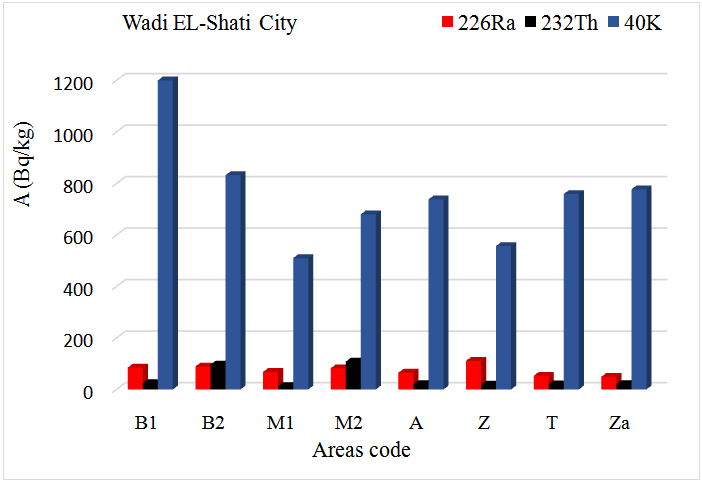
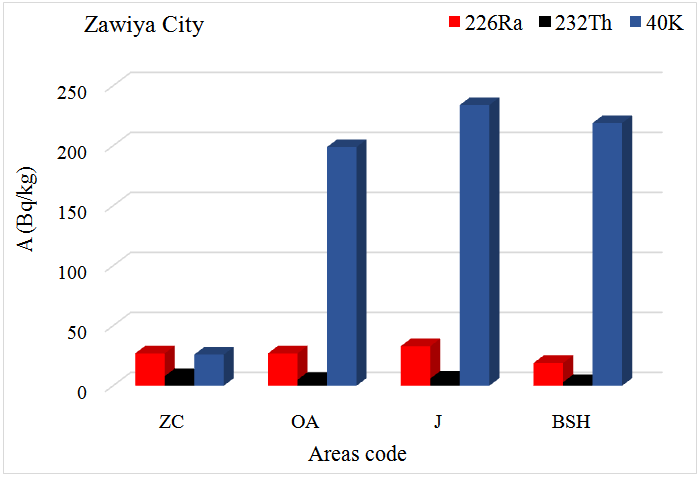
Using the gamma-ray spectroscopy technique, the activity concentrations of natural radium, thorium, and potassium nuclides were measured in soil samples in the cities of Zawiya and Wadi EL-Shati. The results are listed in Tables 1 and 2 and shown graphically in Figures 1 and 2.
The obtained results show that the average activity concentrations of 226Ra, 232Th, and 40K nuclides in the soil of the studied areas in the city of Wadi EL-Shati are 75.25, 40.83, and 756.63 Bq/kg, respectively, while the corresponding average values in the soil of the studied areas in the city of Zawiya are 26.50, 05.50, and 169.50 Bq/kg.
From the results recorded in Table 1, we find that the values of activity concentrations for radium range from 49 Bq/kg in area Za to 111 Bq/kg in area Z, and we find that the average value of activity concentration for radium is two times higher than the average globally recommended value. A slight increase in the average value of the Thorium concentration was observed in comparison with the globally permissible limit. The values of the activity concentrations of thorium range from 13 Bq/kg in the M1 area to 108 Bq/kg in the M2 (cultivated) area. The activity values for potassium range from 510 Bq/kg in the M1 area to 1200 Bq/kg in the B1 area, and the average value for activity is twice higher than the globally recommended limit. The highest value of the concentration of activity 40K was recorded in area B1 due to the presence of a type of sedimentary rock in it.

The activity values for potassium range from 510 Bq/kg in the M1 area to 1200 Bq/kg in the B1 area, and the average value for activity is twice higher than the globally recommended limit. The highest value of the concentration of activity 40K was recorded in area B1 due to the presence of a type of sedimentary rock in it.

After analyzing the activity concentrations of radium and thorium, it was discovered that the values in most areas within the city of Wadi EL-Shati exceed the globally recommended levels, as shown in Table 1. This is most likely due to the use of fertilizers in the soil of these areas or the presence of some phosphate rocks, which are a source of radioactivity, and this leads to an increase in the concentration of natural uranium 10.
From the results recorded in Table 2, we find that the activity concentrations 226Ra ranged from 19 Bq/kg at area BSh to 27 Bq/kg at area ZC and OA. The activity concentrations of 232Th vary from 3.4 Bq/kg at area BSh to 7.5 Bq/kg at area ZC. The activity concentrations of 40K ranged from 26 Bq/kg at area ZC to 234 Bq/kg at area J. It is noted, that the mean value concentrations of 226Ra, 234Th, and 40K are within the recommended safe limits of all areas in Zawiya City.
The Radium Equivalent Activity is a calculation based on the combined activities of three radionuclides 226Ra, 232Th, and 40K. The calculation assumes that 370 Bq/kg of 226Ra, 259 Bq/kg of 232Th, and 4,810 Bq/kg of 40K generate the same gamma-ray dose rate 11. Raeq is used to estimate the total radiation hazard associated with these three radionuclides.
 | (2) |
where  ,
,  and
and  are the activities of 226Ra, 232Th and 40K Bq/kg respectively. The permissible maximum value of the radium equivalent activity is 370 Bq/kg, which corresponds to an effective dose of 1 mSv for the general public 12.
To evaluate the potential radiation hazard, the radiation exposure caused by radionuclides in the soil must be determined. The correlation between the radioactivity concentrations of natural radionuclides in the soil and the resulting radiation exposure can be determined by calculating the absorbed dose rate in the air, at a height of 1 meter above the ground. The factors used to calculate the absorbed gamma dose rate (Dout) in air per unit activity concentration in Bq/Kg are 0.462 nGy/h for 226Ra, 0.604 nGy/h for 232Th, and 0.042 nGy/h for 40K 13.
 | (3) |
where  ,
,  and
and  are the mean activity concentrations of 232Th, 226Ra, and 40K in (Bq/kg), respectively.
The radium equivalent activity and absorbed dose rate in the two cities were calculated and the results were presented in Table 3.
The values of the radium equivalent activity in the city of Wadi EL-Shati ranged from 125.9 Bq/kg to 290.3 Bq/kg, with an average of 191.3 Bq/kg. The values of the radium equivalent activity in the city of Zawiya were recorded in the range between 34.7 Bq / kg and 58.9 Bq/kg with an average of 47.02 Bq / kg. It is noted from the results shown in Table 3 that the values of the radium equivalent activity in the two cities are lower than the permissible world average 13.
The Wadi El-Shati city areas have an absorbed dose rate ranging from 60.7 nGy/h to 133.0 nGy/h with an average value of 90.9 nGy/h. The average absorbed dose rate in Wadi El-Shati is one and a half times higher than the world average. The absorbed dose rate in Zawiya City ranges from 18.1 nGy/h to 28.3 nGy/h, with an average is 22.52 nGy/h, while in Zawiya, it is below the world average. Table 4 shows the contribution of each of the natural radionuclides in the soil to the average absorbed gamma, it is evident that 226Ra contributes more to the absorbed dose rate in air.
To calculate the annual outdoor effective doses  , we use a conversion coefficient of 0.7 Sv/Gy from the absorbed dose rate
  in the air to the effective dose, as well as an outdoor occupancy factor of 0.2, which means that people spend 20% of their open time in one year (8760 hours/y) 6. We calculate the effective dose equivalent rate, which is measured in mSv/y, using Equation (4).
 | (4) |
The International Commission on Radiological Protection recommends an average annual radiation dose of 1 mSv per year for an individual member of the public 13.
External hazard is an index hazard widely used in the study as it represents external exposure to humans. The value of this index must be less than unity (unity value = 1). To limit the radiation exposure in the samples to the permissible dose equivalent limit of 1 mSv/y, a conservative model was proposed by 14. The model assumes infinitely thick walls without windows and doors. The external hazard index, Hex, is calculated using the following equation (5) 15:
 | (5) |
Apart from the risks posed by external radiation, radon and its short-lived by-products can also be harmful to the respiratory system. The measure of internal exposure resulting from radon and its daughter products is determined by the internal hazard index Hin, which is calculated using the following equation (15):
 | (6) |
The Iγi level index is a measure used to assess the level of potential γ-radiation hazard associated with natural radionuclides in specific study samples. The Iγi index is utilized to correlate the annual dose rate attributable to excess external gamma radiation caused by superficial materials. The Iγi index is utilized to correlate the annual dose rate attributable to excess external gamma radiation caused by superficial materials. The level Iγi emitted from samples was calculated by using the following equation 13:
 | (7) |

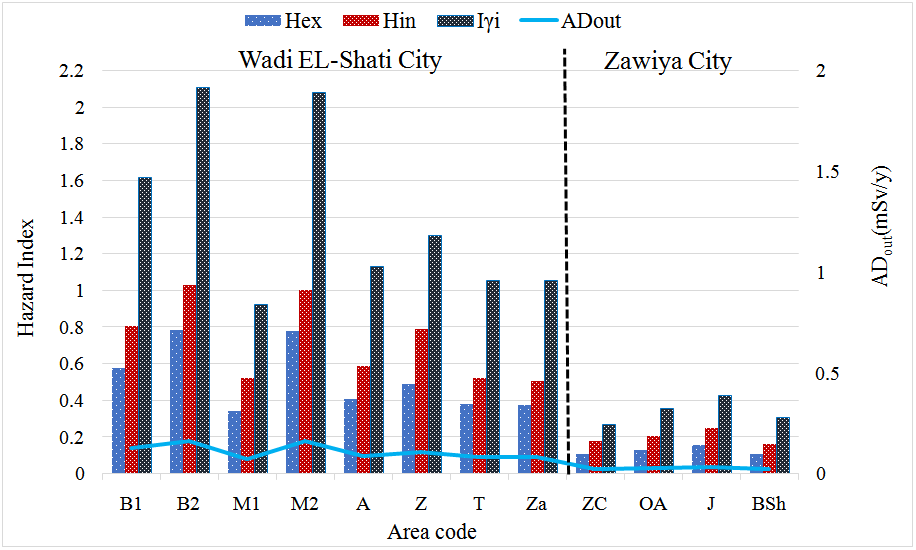
The hazard indices parameters calculated to assess the level of risk to which the population may be exposed to terrestrial radiation from the soil are shown in Table 5 and Figure 3.
The estimated annual effective dose equivalent (ADout) to which the population is likely to be exposed in the study sites ranged from 0.074 to 0.164 mSv/y with a mean value of 0.111 mSv/y in Wadi EL-Shati areas and from 0.022 to 0.035 mSv/y with a mean of 0.028 mSv/y in Zawiya areas.
The obtained values of the external hazard index (Hex) ranged from 0.340 to 0.784 with an average of 0.517 in Wadi EL-Shati areas and from 0.107 to 0.159 with a mean of 0.127 in Zawiya areas. The internal hazard index (Hin) values in Wadi EL-Shati areas and Zawiya areas varied from 0.507 to 1.032 with a mean of 0.721 and from 0.161 to 0.395 with an average of 0.199, respectively. The gamma hazard index (Iγi) ranges in Wadi EL-Shati areas from 0.923 to 2.108 with a mean of 1.410 and ranges from 0.272 to 0.431 with a mean of 0.342 in Zawiya areas.
The obtained average values of hazard indices in all study areas were lower than the safe limit recommended, Except the average value of the gamma coefficient in the Wadi EL-Shati areas is slightly higher than the recommended average.
The conclusions extracted from the present study is:
1. In this study, the radiation hazard coefficients of soil samples were detected in eight areas in the city of Wadi EL-Shati and four areas in the city of Zawiya.
2. The average values for 226Ra, 232Th, and 40K were above the recommended safe limits in soil samples from the city of Wadi EL-Shati areas. 226Ra was one and a half times higher, while 232Th and 40K were slightly higher and twice the value, respectively. From the city of Zawiya areas, the average values of 226Ra, 232Th, and 40K were found to be within safe and globally surveyed limits.
3. The radium equivalent activity (Raeq) obtained in the mining areas of Wadi EL-Shati and Zawiya was lower than the suggested maximum permissible value of 370 Bq/kg. The average values of absorbed dose rates (Dout) for soil samples from the city of Wadi EL-Shati areas were one and a half times higher than the permissible limit. While the average values of absorbed dose rates (Dout) from the city of Zawiya areas were recorded below the recommended safety limit.
4. The annual effective doses (ADout) resulting from natural soil radioactivity for the cities of Wadi El-Shati and Zawiya were below the global average recommendation of 1.0 mSv/y. It was found that the mean values of the external (Hex) and internal hazard index (Hin) for Wadi El-Shati and Zawiya were below the recommended safe limit.
5. The gamma index (Iγi) in all areas of Zawiya city was found to be below the acceptable limit of unity, while the mean value of the gamma index (Iγi) was higher than the value corresponding to the safety limits recommended by 13.
Finally, it can be concluded that the radiation levels in the study areas of Zawiya City are within the normal range, indicating minimal risk of harm to both the environment and human health from soil radioactivity. Based on a study conducted in the city of Wadi EL-Shati areas, it was found that the radiation levels of natural radionuclides were higher than the world average. In addition, the recorded average gamma coefficient value was higher than the recommended safety limit.
| [1] | UNSCEAR (United Nations Scientific Committee on the Effects of Atomic Radiation) (1993) Exposure from Natural Sources of Radiation of Radiation. Report to the General Assembly, United Nations. | ||
| In article | |||
| [2] | Mekongtso Nguelem, E.J.M.; Ndontchueng, M.M.; Motapon, O. Determination of 226Ra, 232Th, 40K, 235U and U activity concentration and public dose assessment in soil samples from bauxite core deposits in Western Cameroon, Springer Plus 2016, 5, 1253. | ||
| In article | View Article PubMed | ||
| [3] | Quindos L.S, Femendez P. L, Soto J, Rodenos C, et al., (1994); Natural radioactivity in Spanish soils, Health phys., 194-200. | ||
| In article | View Article PubMed | ||
| [4] | UNSCEAR (2008), Sources and Effects of Ionizing Radiation, United Nations Scientific Committee on the Effects of Atomic Radiation, New York. | ||
| In article | |||
| [5] | Beretka, J., & Matthew, P. J. (1985), Natural radioactivity of Australian building materials, industrial wastes and by-products. Health physics, 48(1), 87-95. | ||
| In article | View Article PubMed | ||
| [6] | Aswood, M. S., Jaafar, M. S., & Salih, N, (2017), Estimation of annual effective dose due to natural radioactivity in ingestion of vegetables from Cameron Highlands, Malaysia. Environmental, Technology & Innovation, 8, 96-102. | ||
| In article | View Article | ||
| [7] | Shams, I, Mostafa, A. M. A., (2015), Abd El-Salam M. Lotfy Radiological impacts of natural radioactivity in phosphate rocks from El-Sibaiya and Red Sea coast mines, Egypt, J Radioanal. Nucl. Chem., 303: 53–61. | ||
| In article | View Article | ||
| [8] | Hemby D M and Tynybekov A K, (2002), Uranium, Thorium and Potassium in soils along the shore of the lake Issyk-Kyol in the Kyrghyz Republic, Environ. Monit. Assess, 73, 101–108. | ||
| In article | |||
| [9] | Dovlete, C. and Povinec, P. P. (2002), Quantification of Uncertainty in Gamma Spectrometric Analysis of Environmental samples, 2nd Regional Training Course on QA/QC of Nuclear Analytical Techniques, 12-16, Kuala Lumpur. | ||
| In article | |||
| [10] | Abbady, A., (2005), Assessment of the natural radioactivity and its radiological hazards in some Egyptian rock phosphates, Indian Journal of Pure & Applied Physics, 43, 489-493. | ||
| In article | |||
| [11] | Beretka I, Mathew P.I., (1985), Natural radioactivity of Australian building materials, waste and byproducts, Health Phys 48: 87–95. | ||
| In article | View Article PubMed | ||
| [12] | Ajayi, O. S. (2009), “Measurement of Activity Concentrations of 40K, 226Ra and 232Th for Assessment of Radiation Hazards from Soils of the Southwestern Region of Nigeria”, Radiation and Environmental Biophysics 48, 323-332. | ||
| In article | View Article PubMed | ||
| [13] | United Nations Scientific Committee on the Effects of Atomic Radiation. (2000 “Sources and Effects of Ionizing Radiation”, UNSCEAR 2000 Report Vol.1, United Nations, New York. | ||
| In article | |||
| [14] | Krieger, R., (1981), Radioactivity of Construction Materials, Betonwerk und Fertigteil-Technik/Concrete Precasting Plant and Technology, 47, 468-446. | ||
| In article | |||
| [15] | Adagunodo, T. A., Enemuwe, C. A., Usikalu, M. R., Orosun, M. M., Adewoyin, O. O., Akinwumi, S. A., Oloke, O. C., Lukman, A. F., Adeniji, A. A. and Adewoye, A. O., (2021), Radiometric survey of natural radioactivity concentration and risk assessment on dwellers around Ijako active dumpsite in Ogun State, IOP Conf. Series: Ear. and Enviro. Sci., 655; 1-7. | ||
| In article | View Article | ||
Published with license by Science and Education Publishing, Copyright © 2024 Mustafa Sahoub
 This work is licensed under a Creative Commons Attribution 4.0 International License. To view a copy of this license, visit
http://creativecommons.org/licenses/by/4.0/
This work is licensed under a Creative Commons Attribution 4.0 International License. To view a copy of this license, visit
http://creativecommons.org/licenses/by/4.0/
| [1] | UNSCEAR (United Nations Scientific Committee on the Effects of Atomic Radiation) (1993) Exposure from Natural Sources of Radiation of Radiation. Report to the General Assembly, United Nations. | ||
| In article | |||
| [2] | Mekongtso Nguelem, E.J.M.; Ndontchueng, M.M.; Motapon, O. Determination of 226Ra, 232Th, 40K, 235U and U activity concentration and public dose assessment in soil samples from bauxite core deposits in Western Cameroon, Springer Plus 2016, 5, 1253. | ||
| In article | View Article PubMed | ||
| [3] | Quindos L.S, Femendez P. L, Soto J, Rodenos C, et al., (1994); Natural radioactivity in Spanish soils, Health phys., 194-200. | ||
| In article | View Article PubMed | ||
| [4] | UNSCEAR (2008), Sources and Effects of Ionizing Radiation, United Nations Scientific Committee on the Effects of Atomic Radiation, New York. | ||
| In article | |||
| [5] | Beretka, J., & Matthew, P. J. (1985), Natural radioactivity of Australian building materials, industrial wastes and by-products. Health physics, 48(1), 87-95. | ||
| In article | View Article PubMed | ||
| [6] | Aswood, M. S., Jaafar, M. S., & Salih, N, (2017), Estimation of annual effective dose due to natural radioactivity in ingestion of vegetables from Cameron Highlands, Malaysia. Environmental, Technology & Innovation, 8, 96-102. | ||
| In article | View Article | ||
| [7] | Shams, I, Mostafa, A. M. A., (2015), Abd El-Salam M. Lotfy Radiological impacts of natural radioactivity in phosphate rocks from El-Sibaiya and Red Sea coast mines, Egypt, J Radioanal. Nucl. Chem., 303: 53–61. | ||
| In article | View Article | ||
| [8] | Hemby D M and Tynybekov A K, (2002), Uranium, Thorium and Potassium in soils along the shore of the lake Issyk-Kyol in the Kyrghyz Republic, Environ. Monit. Assess, 73, 101–108. | ||
| In article | |||
| [9] | Dovlete, C. and Povinec, P. P. (2002), Quantification of Uncertainty in Gamma Spectrometric Analysis of Environmental samples, 2nd Regional Training Course on QA/QC of Nuclear Analytical Techniques, 12-16, Kuala Lumpur. | ||
| In article | |||
| [10] | Abbady, A., (2005), Assessment of the natural radioactivity and its radiological hazards in some Egyptian rock phosphates, Indian Journal of Pure & Applied Physics, 43, 489-493. | ||
| In article | |||
| [11] | Beretka I, Mathew P.I., (1985), Natural radioactivity of Australian building materials, waste and byproducts, Health Phys 48: 87–95. | ||
| In article | View Article PubMed | ||
| [12] | Ajayi, O. S. (2009), “Measurement of Activity Concentrations of 40K, 226Ra and 232Th for Assessment of Radiation Hazards from Soils of the Southwestern Region of Nigeria”, Radiation and Environmental Biophysics 48, 323-332. | ||
| In article | View Article PubMed | ||
| [13] | United Nations Scientific Committee on the Effects of Atomic Radiation. (2000 “Sources and Effects of Ionizing Radiation”, UNSCEAR 2000 Report Vol.1, United Nations, New York. | ||
| In article | |||
| [14] | Krieger, R., (1981), Radioactivity of Construction Materials, Betonwerk und Fertigteil-Technik/Concrete Precasting Plant and Technology, 47, 468-446. | ||
| In article | |||
| [15] | Adagunodo, T. A., Enemuwe, C. A., Usikalu, M. R., Orosun, M. M., Adewoyin, O. O., Akinwumi, S. A., Oloke, O. C., Lukman, A. F., Adeniji, A. A. and Adewoye, A. O., (2021), Radiometric survey of natural radioactivity concentration and risk assessment on dwellers around Ijako active dumpsite in Ogun State, IOP Conf. Series: Ear. and Enviro. Sci., 655; 1-7. | ||
| In article | View Article | ||