Hides and skins are valuable by-products of meat industry that are processed into a stable material that resists bacterial attack and chemical degradation. Temporary preservation of raw hides against microbial attack and bacterial decontamination is done using salt and bactericide which poses a major challenge of environmental pollution. Nevertheless, microbial and bacterial growth is not fully inhibited even after using these chemicals. Bacillus type of bacteria majorly found in raw hides and soaking baths can survive in sodium chloride-cured hides in the form of spores thus causing degradation. The control sample, bactericide-treated samples, and irradiated samples were evaluated for microbial analyses and showed variation in microbial load. Bactericide-tread hide ensured microbial load reduction of 2-3 times to a concentration between 4.7×10⁵ CFU/g and 7.5×10⁵ CFU/g compared to the control hide. Samples irradiated at 10 kGy displayed a microbial reduction of 531-866 times to a concentration of 5.30×10² CFU/g and 1.41×10³ CFU/g. At irradiation doses of 40 and 50 kGy, the samples were found to be sterile. The use of gamma radiation for the preservation of hides and skins, therefore, can be used as an alternative and eco-friendly approach in the beam house.
Preservation of hides and skins before processing is necessary. Curing process is done to prevent bacterial contamination and microbial attack where sodium chloride salts are applied 1, 2. Soaking is done on the hides to remove curing salts, dirt, and dung. This process rehydrates the skin and opens up the fibers for subsequent operations 3. Surfactants and detergents are always added to the soaking bath to accelerate the wetting of the fiber surface and increase the soaking efficiency as they provide an appropriate pH of 9.0-10.0 2. Some types of bacteria such as Bacillus subtilis, Escherichia coli, Proteus vulgaris, and Pseudomonas aeruginosa are majorly found in soaking baths due to their conditions which offer abundant bacterial growth 4, 5. The growth of these bacteria in hides causes rot, with an initial sign being a foul smell 6. Bacillus species of bacteria can survive in cured hide in the form of spores due to low value of pH until the final stages of leather processing 7. Antimicrobial agents (fungicides and bactericides) are added to the soaking bath to curtail bacterial activity or bacterial development 8, 9. However, the leather industry faces significant environmental issues from pollution as a result of stringent government regulations.
Alternative and eco-friendly curing systems are necessary for final leather quality. Enzymes have also been used as soaking agents as an alternative to chemicals to develop an environmentally friendly leather processing process 10. Previous studies have adopted a more eco-benign approach by using sodium chloride-less or sodium chloride-free methods of curing raw hides. A sodium chloride-less technique of using inert compound silica gel 11, 12, has been proposed over the conventional sodium chloride curing method. Similarly, sodium sulphate (Na2SO4) which has comparable properties to sodium chloride but no chloride ions in its formulation, was investigated as a curing agent alone and in combinations with sodium chloride for the preservation of goat skins and buffalo hides 13, 14. However, gamma radiation has shown tremendous possibility of preservation of not only semi-processed hide (wet-blue, split wet-blue, and crust) which are treated with synthetic antifungal chemicals with allergenic potential for the leather final product 7. Antibacterial sterilization has been performed with doses of 25 kGy while fungicidal treatments with doses of 2-10 kGy and disinfection with doses of 0.2 kGy mostly for cultural heritage objects made of wood, paper, and textiles 15. Therefore, this study seeks to determine the potency of gamma radiations in the preservation of pelt after the soaking process.
Freshly flayed bovine hide of mass approximately 30 kg was purchased from the abattoir. Temporary preservation of the hide was done by salting before being presoaked in 200 % water and 1% detergent by weight for approximately 45 minutes to remove dirts. Seven 7 samples of 100 g each were cut under aseptic conditions and Six samples irradiated at doses of 0 (control), 10, 20, 30, 40, and 50 kGy. The non-irradiated sample proceeded for main soaking in 200% water and 1% bactericide for 12 hours. A 100 g sample was cut after main soaking process.
2.2. Gamma IrradiationThe five-100 g samples cut after soaking were irradiated at KALRO Biotechnology Research Institute (Muguga) with a 60Co gamma radiation source (Model GC 220E) at room temperature and normal atmospheric conditions.
2.3. Media Preparation and Glassware Sterilization Gamma IrradiationAll glassware used was soaked overnight in detergents, rinsed using distilled water, and air-dried. Plate count agar medium was prepared and sterilized by autoclaving at 121°C for 15 minutes. Petri dishes were also sterilized in an oven at 160°C for one hour.
2.4. Isolation of Bacterial LoadBacteria from the control sample, samples soaked in bactericides and irradiated were collected by washing the samples with 50 ml of distilled water in a basin. Testing was performed under aseptic conditions to prevent contamination. Serial dilution process was done for each sample treatment until a bracket with desired cell concentration (30-300 colonies) for accurate counting was achieved. Plate count agar medium was used as an inoculating medium and pour plate method was used for plating. After plating, the samples were incubated for 24 hours at room temperature and normal atmospheric conditions which is suitable for microbes to grow. Colonies on the plates were counted using the plate count method and the colony forming units/g (CFU/g) was calculated using the equation below:
 | (1) |
Temporary preservation of rawhides is widely based on the application of sodium chloride salt with the aim of dehydration and bacteriostatic effect. Bacterial growth on hides causes putrefaction, with an initial sign being a foul smell 6, 7.
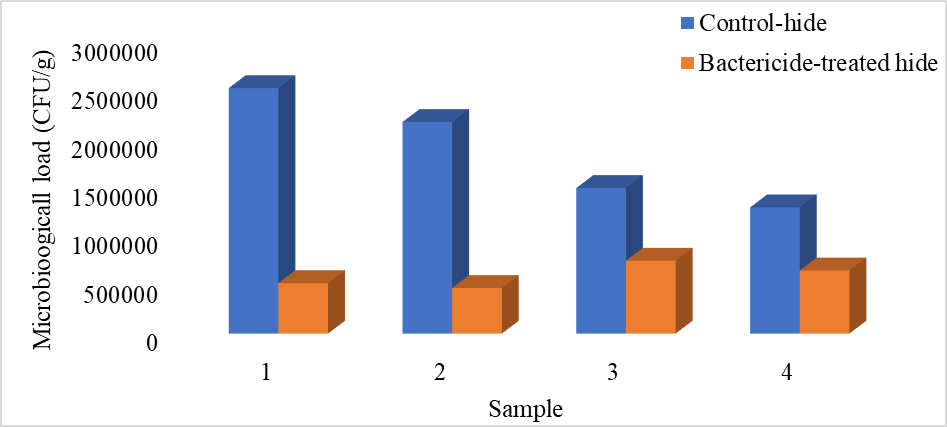
The results in Figure 1 indicate that the microbial load for control samples ranges between 1.30×10⁶ CFU/g and 2.53×10⁶ CFU/g while for bactericide-treated samples ranged between 4.7×10⁵ CFU/g and 7.5×10⁵ CFU/g. From the results, there was a significant difference (p = 0.0049) between the treatments used. The bactericide used during soaking ensured a microbial load reduction of 2-3 times to a concentration between 4.70×10⁵ CFU/g and 7.50×10⁵ CFU/g compared with the control hide state. This implies that the bactericide used inhibited the growth of bacteria. Nevertheless, some bacteria did survive and multiply even after preservation which degrades the final quality of leather. However, after curing with sodium chloride and bactericides, the microbial load was observed to be still high which means that bacteria resistant to curing were present and proliferating 16. Bacteria that can survive in cured hides are called halophilic bacteria. Halophilic bacteria have a destructive role in sodium chloride cured hides because they have special proteases and lipases that can digest substances in the cured hides 6.

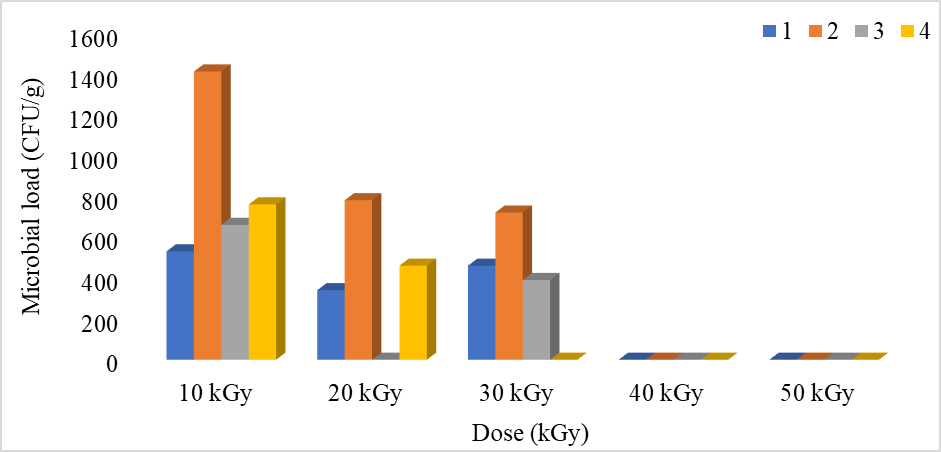
Considering the high level of bacterial load on control and bactericide-treated hide, five gamma irradiation doses (10, 20, 30, 40, and 50 kGy) were selected as an alternative approach for hide preservation. The effect of gamma radiation on the microbial load was evaluated and represented in Figure 2 which showed that irradiation reduced the microbial load with increasing doses of radiation.

From Figure 2, samples display a decreasing trend in the number of microbial loads as the dose of radiation increases. Microbial load on samples irradiated with gamma radiation was found to be lower as compared to control and bactericide-treated samples. One sample irradiated at doses of 20 and 30 kGy was found to be sterile and the others non-sterile. For samples irradiated at 20 and 30 kGy, the microbial load is almost similar (395 and 392 CFU/g on average respectively). In comparison with bactericide-treated hide, samples irradiated with 10 kGy doses of radiation had microbial load reduced by 531-886 times. Samples irradiated at 40 and 50 kGy were found to be sterile. These samples ensured microbial reduction of 1877.5×103 times compared to control hide and 597.5×10³ times compared to bactericide-treated hide.
The presence of non-sterile samples when irradiated with 20 and 30 kGy doses of radiation was attributed to samples being hydrated following the soaking process, which created favorable conditions for bacteria to proliferate and survive before testing. However, irradiation in the presence of oxygen or ambient temperature leads to increased sensitivity of the bacteria to radiation. Before microbial evaluation, the irradiated samples were packed in non-sealable polythene bags which might have allowed microbes from the surrounding environment to get into the samples thus further attacking the hide. Bacillus species of bacteria can survive in the form of spores after hide curing 7 and are also resistant to radiation 17. The dehydration that comes from the osmotically removed water from the endospore’s core plays a significant role in the endospore’s resistance to radiation. Additionally, the little acid-soluble proteins inside the endospores saturate the DNA of the endospore and shield it from radiation 17. The presence of bacteria in the samples irradiated at 20 and 30 kGy was because the ionizing radiation subjected may have not caused damage to the nucleic acid of the bacteria but damaged the enzymes and proteins which did repair with time 17. The samples irradiated at 40 and 50 kGy showed sterility because the gamma radiation did damage the nucleic acid of the bacteria.
With the uncompromising policy on environmental pollution faced by the leather industry, the application of green technology during preservation of hides and skin is more considered in tanneries. In this work, the samples were treated with bactericide and gamma radiation with doses of 10, 20, 30, 40, and 50 kGy. Control and bactericide-treated samples had a significant reduction (p = 0.00485) in the bacterial load. Irradiation of samples with gamma rays ensured sterilization at doses from 40 kGy and reduced microbial load at doses up to 30 kGy thus considered an ecological approach to hide preservation in tanneries.
The authors acknowledge International Atomic Energy Agency (MSCFP) for the financial support to do this research, Kenya Industrial Research and Development Institute and Kenya Agricultural and Livestock Research Institute for their assistance in procurement and irradiation of the samples respectively.
| [1] | Kanagaraj, J., Senthilvelan, T., Panda, R., & Kavitha, S, “Eco-friendly waste management strategies for greener environment towards sustainable development in leather industry: A comprehensive review,” Journal of Cleaner Production, 89, 1-17. 2015. | ||
| In article | View Article | ||
| [2] | Kesarwani, P., Jahan, S., & Kesarwani, K, “A review on leather processing,” International Journal of Applied Research, 1(9), 977-982. 2015. | ||
| In article | |||
| [3] | Ma, J., Hou, X., Gao, D., Lv, B., & Zhang, J, “Greener approach to efficient leather soaking process: Role of enzymes and their synergistic effect.” Journal of Cleaner Production, 78, 226-232. 2014. | ||
| In article | View Article | ||
| [4] | Berber, D., & Birbir, M, “Examination of bacterial populations in salt, salted hides, soaked hides, and soak liquors.” Journal of the American Leather Chemists Association, 105(10), 320-326. 2010. | ||
| In article | |||
| [5] | Paulus, W, Microbicides for the protection of materials: A handbook. Springer Science & Business Media. 2012. | ||
| In article | |||
| [6] | Akpolat, C., Ventosa, A., & Birbir, M., “Molecular identification of moderately halophilic bacteria and extremely halophilic archaea isolated from salted sheep skins containing red and yellow discolorations.” Journal of the American Leather Chemists Association, 110(7), 211-220. 2015. | ||
| In article | |||
| [7] | Gaidau, C., Stanculescu, I. R., Stanca, M., Cutrubinis, M., Trandafir, L., Alexandru, M., & Alexe, C, “Gamma irradiation a green alternative for hides and leather conservation.” Radiation Physics and Chemistry, 182, 109369. 2021. | ||
| In article | View Article | ||
| [8] | Mesquita, N., Portugal, A., Piñar, G., Loureiro, J., Coutinho, A., Trovão, J., Nunes, I., Botelho, M., & Freitas, H. “Flow cytometry as a tool to assess the effects of gamma radiation on the viability, growth and metabolic activity of fungal spores.” International Biodeterioration & Biodegradation, 84, 250-257. 2013. | ||
| In article | View Article | ||
| [9] | Wu, J., Zhao, L., Liu, X., Chen, W., & Gu, H, “Recent progress in cleaner preservation of hides and skins.” Journal of Cleaner Production, 148, 158-173. 2017. | ||
| In article | View Article | ||
| [10] | Kanth, S.V., Venba, R., Madhan, B., Chandrababu, N.K., Sadulla, S, “Cleaner tanning practices for tannery pollution abatement: Role of enzymes in eco-friendly vegetable tanning.” Journal of Cleaner Production, 17, 507-515. 2009. | ||
| In article | View Article | ||
| [11] | Kanagaraj, J., Babu, N. K. C., Sadulla, S., Rajkuma, G. S., Visalakshi, V., & Chandrakumar, N, “A new approach to less-salt preservation of raw skin/hide.” Journal of the American Leather Chemists Association, 95(10), 368-374. 2000. | ||
| In article | |||
| [12] | Kanagaraj, J., Chandra Babu, N., Sadulla, S., Suseela Rajkumar, G., Visalakshi, V., & Chandra Kumar, N, “Cleaner techniques for the preservation of raw goat skins.” Journal of Cleaner Production, 9(3), 261-268. 2001. | ||
| In article | View Article | ||
| [13] | Vankar, P. S., Dwivedi, A., & Saraswat, R, “Sodium sulphate as a curing agent to reduce saline chloride ions in the tannery effluent at Kanpur: A preliminary study on techno-economic feasibility.” Desalination, 201(1-3), 14-22. 2006. | ||
| In article | View Article | ||
| [14] | Vankar, P. S., & Dwivedi, A. K, “Sulphates for skin preservation—A novel approach to reduce tannery effluent salinity hazards.” Journal of Hazardous Materials, 163(1), 207-212. 2009. | ||
| In article | View Article PubMed | ||
| [15] | Katušin-Ražem, B., Ražem, D., & Braun, M, “Irradiation treatment for the protection and conservation of cultural heritage artefacts in Croatia.” Radiation Physics and Chemistry, 78(7-8), 729-731. 2009. | ||
| In article | View Article | ||
| [16] | Olukitibi, T. A., Adetuyi, F. C., Adeleke, B. S., & Abe, S. C, “Isolation and Antibiogram of Bacteria Isolated from Processed and Unprocessed Cow-Skin (Ponmo) in Ogbese Market.” J. Adv. Micro, 2(4), 1-8. 2017. | ||
| In article | View Article | ||
| [17] | Hewitt, P., & Leelawardana, S. “Gamma irradiation as a treatment to address pathogens of animal biosecurity concern.” CC By, 3, 113. 2014. | ||
| In article | |||
Published with license by Science and Education Publishing, Copyright © 2023 Mercy Chebwogen, Kallen Mulilo Nalyanya, Tabitha A. Amollo and Benson M. Githaiga
 This work is licensed under a Creative Commons Attribution 4.0 International License. To view a copy of this license, visit
https://creativecommons.org/licenses/by/4.0/
This work is licensed under a Creative Commons Attribution 4.0 International License. To view a copy of this license, visit
https://creativecommons.org/licenses/by/4.0/
| [1] | Kanagaraj, J., Senthilvelan, T., Panda, R., & Kavitha, S, “Eco-friendly waste management strategies for greener environment towards sustainable development in leather industry: A comprehensive review,” Journal of Cleaner Production, 89, 1-17. 2015. | ||
| In article | View Article | ||
| [2] | Kesarwani, P., Jahan, S., & Kesarwani, K, “A review on leather processing,” International Journal of Applied Research, 1(9), 977-982. 2015. | ||
| In article | |||
| [3] | Ma, J., Hou, X., Gao, D., Lv, B., & Zhang, J, “Greener approach to efficient leather soaking process: Role of enzymes and their synergistic effect.” Journal of Cleaner Production, 78, 226-232. 2014. | ||
| In article | View Article | ||
| [4] | Berber, D., & Birbir, M, “Examination of bacterial populations in salt, salted hides, soaked hides, and soak liquors.” Journal of the American Leather Chemists Association, 105(10), 320-326. 2010. | ||
| In article | |||
| [5] | Paulus, W, Microbicides for the protection of materials: A handbook. Springer Science & Business Media. 2012. | ||
| In article | |||
| [6] | Akpolat, C., Ventosa, A., & Birbir, M., “Molecular identification of moderately halophilic bacteria and extremely halophilic archaea isolated from salted sheep skins containing red and yellow discolorations.” Journal of the American Leather Chemists Association, 110(7), 211-220. 2015. | ||
| In article | |||
| [7] | Gaidau, C., Stanculescu, I. R., Stanca, M., Cutrubinis, M., Trandafir, L., Alexandru, M., & Alexe, C, “Gamma irradiation a green alternative for hides and leather conservation.” Radiation Physics and Chemistry, 182, 109369. 2021. | ||
| In article | View Article | ||
| [8] | Mesquita, N., Portugal, A., Piñar, G., Loureiro, J., Coutinho, A., Trovão, J., Nunes, I., Botelho, M., & Freitas, H. “Flow cytometry as a tool to assess the effects of gamma radiation on the viability, growth and metabolic activity of fungal spores.” International Biodeterioration & Biodegradation, 84, 250-257. 2013. | ||
| In article | View Article | ||
| [9] | Wu, J., Zhao, L., Liu, X., Chen, W., & Gu, H, “Recent progress in cleaner preservation of hides and skins.” Journal of Cleaner Production, 148, 158-173. 2017. | ||
| In article | View Article | ||
| [10] | Kanth, S.V., Venba, R., Madhan, B., Chandrababu, N.K., Sadulla, S, “Cleaner tanning practices for tannery pollution abatement: Role of enzymes in eco-friendly vegetable tanning.” Journal of Cleaner Production, 17, 507-515. 2009. | ||
| In article | View Article | ||
| [11] | Kanagaraj, J., Babu, N. K. C., Sadulla, S., Rajkuma, G. S., Visalakshi, V., & Chandrakumar, N, “A new approach to less-salt preservation of raw skin/hide.” Journal of the American Leather Chemists Association, 95(10), 368-374. 2000. | ||
| In article | |||
| [12] | Kanagaraj, J., Chandra Babu, N., Sadulla, S., Suseela Rajkumar, G., Visalakshi, V., & Chandra Kumar, N, “Cleaner techniques for the preservation of raw goat skins.” Journal of Cleaner Production, 9(3), 261-268. 2001. | ||
| In article | View Article | ||
| [13] | Vankar, P. S., Dwivedi, A., & Saraswat, R, “Sodium sulphate as a curing agent to reduce saline chloride ions in the tannery effluent at Kanpur: A preliminary study on techno-economic feasibility.” Desalination, 201(1-3), 14-22. 2006. | ||
| In article | View Article | ||
| [14] | Vankar, P. S., & Dwivedi, A. K, “Sulphates for skin preservation—A novel approach to reduce tannery effluent salinity hazards.” Journal of Hazardous Materials, 163(1), 207-212. 2009. | ||
| In article | View Article PubMed | ||
| [15] | Katušin-Ražem, B., Ražem, D., & Braun, M, “Irradiation treatment for the protection and conservation of cultural heritage artefacts in Croatia.” Radiation Physics and Chemistry, 78(7-8), 729-731. 2009. | ||
| In article | View Article | ||
| [16] | Olukitibi, T. A., Adetuyi, F. C., Adeleke, B. S., & Abe, S. C, “Isolation and Antibiogram of Bacteria Isolated from Processed and Unprocessed Cow-Skin (Ponmo) in Ogbese Market.” J. Adv. Micro, 2(4), 1-8. 2017. | ||
| In article | View Article | ||
| [17] | Hewitt, P., & Leelawardana, S. “Gamma irradiation as a treatment to address pathogens of animal biosecurity concern.” CC By, 3, 113. 2014. | ||
| In article | |||