The author proposed mutual energy theorem in 1987. Similar formula has been proposed as reciprocity theorem by Welch in 1960. Considering the different positioning of the same formula, the author has studied this theorem in recent years and found that it is not only an energy theorem, but also an energy conservation law in electromagnetics. The author also puts forward the principle of mutual energy and the theorem of mutual energy flow. The mutual energy flow theorem further makes the that formula a localized law of conservation of energy. Considering that the mutual energy flow has the properties of photons, the author has used the mutual energy flow to interpret photon and quantum and solve the problem of wave particle duality. This paper verifies that this theorem is indeed the law of energy conservation through a transformer environment. Then it is further extended from transformer to antenna system. The author believes that when the secondary coil of the transformer is moved to a place far away from the primary coil, the primary coil becomes the transmitting antenna and the secondary coil becomes the receiving antenna. Such antenna systems and transformer systems meet the same law of energy conservation.
As we all know, today’s electromagnetic field theory is flawed. It can not describe photons, and there is no solution to the collapse of waves and the duality of waves and particles. Wheeler Feynman put forward the absorber theory 1, 2 in 1945. This theory advocates that any current source radiates not only retarded waves, but also advanced waves. Based on the absorber theory, Cramer put forward the transactional interpretation of quantum mechanics around 1986 3, 4, arguing that the retarded wave emitted by the light source and the advanced wave emitted by the light sink really determine the electromagnetic radiation. However, absorber theory and transactional interpretation are only qualitative theories. Wheeler Feynman and Cramer did not modify the classical electromagnetic field theory. Feynman then proposed the method of quantum electrodynamics, including path integration. According to Feynman, in the field of quantum mechanics, the classical electromagnetic field theory is no longer applicable and should be abandoned. However, the scope of application of quantum electrodynamics is very small, and it is not suitable for most electromagnetic phenomena. So far, there is no unified theory applicable to classical electromagnetic field, electromagnetic wave and photon.
On the other hand, Lorentz reciprocity theorem was proposed in 1900 and later has further developed by Rayleigh-Carson 5, 6. In 1960, Welch proposed a time domain reciprocity theorem 7. In 1963, Rumsey proposed a new reciprocity theorem 8. The author proposed the mutual energy theorem in 1987 and applied it to Huygens' principle, spherical wave and plane wave expansions 9, 10, 11. At the end of 1987, de Hoop put forward the correlated reciprocity theorem 12. In 2014, the author returned to the subject of mutual energy theorem and found that the Rumsey new reciprocity theorem and mutual energy theorem can be obtained by Fourier transform of de Hoop correlation reciprocity theorem. Welch’s reciprocity theorem is a special example of de Hoop’s related reciprocity theorem. Therefore, the three reciprocity theorems and one mutual energy theorems should belong to a same electromagnetic theorem. Because the author thinks it is an energy theorem and others think it is a reciprocity theorem, the author feels it is necessary to prove that the mutual energy theorem is indeed an energy theorem. As a reciprocity theorem, only one of the two electromagnetic fields in the formula is real and the other can be virtual. As an energy theorem, the two electromagnetic fields in the theorem must be real physical quantities. The mutual energy theorem can be obtained from Lorentz’s reciprocity theorem through conjugate transformation 13. If the two electromagnetic fields before conjugate transformation are retarded waves, one of the field variables is transformed into advanced waves after conjugate transformation. Therefore, the mutual energy theorem actually involves the advanced wave. Welch first recognized the issue of the advanced wave in his time reciprocity theorem 7. Since conjugate transformation is not a mathematical transformation like Fourier transformation, but a physical transformation involving Maxwell’s equations, the mutual energy theorem (include Welch, Rumsey, de Hoop’s reciprocity theorem) and Lorentz reciprocity theorem are two different kinds of electromagnetic theorems. The author is encouraged by Wheeler and Feynman’s absorber theory, Cramer’s transactional interpretation and Stephenson’s introduction to the advanced wave 14, and believes that the advanced wave in Welch’s reciprocity theorem and mutual energy theorem should also be a real physical quantity.
Around 2017, the author re-proved the mutual energy theorem from Poynting’s theorem, so the mutual energy theorem is a sub-theorem of Poynting’s theorem. Therefore, the mutual energy theorem can indeed be regarded as the energy theorem. On this basis, the author puts forward the electromagnetic mutual energy theory, including the principle of mutual energy, the law of conservation of energy theory, the law that electromagnetic radiation does not overflow the universe, and the theorem of mutual energy flow. In addition, the author applies the theory of mutual energy to quantum mechanics, puts forward the interpretation of mutual energy flow, holds that photons are mutual energy flow and all particles are mutual energy flow, and tries to solve the problem of wave particle duality 15, 16, 17, 18.
In the classical electromagnetic theory, the theory of antenna system is completely different from the working mechanism of transformer. We usually consider that the electromotive potential of the primary coil is produced by the secondary coil of the transformer. That is, the reaction of the secondary coil to the primary coil is considered. However, for an antenna system, no one usually considers the reaction of the receiving antenna to the transmitting antenna. It is considered by the traditianal view that the reaction of receiving antenna to transmitting antenna can be ignored. Despite the author believes that the energy of the receiving antenna is still provided by the transmitting antenna. Therefore, it is very necessary to find out how the receiving antenna obtains energy from the transmitting antenna. The traditional electromagnetic field theory belives that the transmitting antenna provides electromagnetic energy to the electromagnetic wave, and the electromagnetic wave further provides energy to the receiving antenna. Here the electromagnetic wave is separated from its radiation source and propagates independently in space or in the ether. The ether has been abandoned, but it can reappear as a field in another identity. However, this statement is only a qualitative theory and can not give a specific calculation of energy conversion. The author disagrees with this view and believes that the transmitting antenna emits a retarded wave and the receiving antenna emits an advanced wave. Retarded wave and advanced wave cannot be separated from their radiation sources. Therefore, not only the transmitting antenna will act on the receiving antenna, but also the receiving antenna will react on the transmitting antenna. And this action and reaction are equal in size and opposite in direction! In particular, the directivity pattern of the receiving antenna calculated by the traditional view is different with the directivity pattern of the transmiting antenna, that is completely inconsistent with the experiment. Fortunately, we find that the pattern of the receiving antenna is consistent with that of the transmitting antenna, so we give a proof by using Lorentz reciprocity theorem 5, 6. However, the same proof can also be completed by the mutual energy theorem 9, 10, 11 (including Welch, Rumsey, de Hoop’s reciprocity theorem). In the mutual energy theorem, it has been assumed that the radiation of the receiving antenna is an advanced wave. This actually means that the traditional view is wrong!
In this paper, the mutual energy theory is limited to the scope of classical electromagnetic theory and applied to the primary coil and secondary coil of the transformer. It is considered that the system composed of transmitting antenna and receiving antenna is essentially no different from a transformer system. If the secondary coil of the transformer is moved far away from the primary coil, the primary coil becomes the transmitting antenna and the secondary coil becomes the receiving antenna. The energy conservation law and other electromagnetic laws verified under the condition of transformer can be extended to the system including transmitting antenna and receiving antenna. By the way, the traditional view and Maxwell’s theory conflict with the energy conservation law, this shows the problem of the traditional view and Maxwell’s theory.
This paper proves that for transformer and antenna system, energy and energy flow should be calculated by mutual energy theorem and mutual energy flow theorem. Mutual energy flow is the only energy flow for transmitting electromagnetic radiation energy, so the word “mutual” can be omitted. Mutual energy flow is energy flow, and mutual energy theorem is the law of conservation of energy. The traditional electromagnetic field theory holds that the electromagnetic energy flow is the energy flow corresponding to the Poynting vector. The author will clarify that there are serious problems in the Poynting energy flow in another paper 19. The other publication of the author’s mutual energy theory can be found in the references 20, 21, 22, 23, 24.
Contribution of this paper: united the energy conservation law to the transformer, antenna, and photon. Prove existance of the advanced wave by using this energy conservation law.
Maxwell’s electromagnetic field theory has achieved great success. This chapter reviews the electromagnetic field theory that needs to be applied in this paper.
2.1. Maxwell’s equationsMaxwell’s equation is known to have,
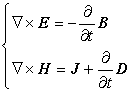 | (1) |
 is the electric field,
  is the electric displacement,
  is the magnetic field, and
  is the magnetic induction intensity.
  is the current density. Assume there are
  current elements
 , and each current element should has a Maxwell’s equations, which can be written as,
 | (2) |
where,
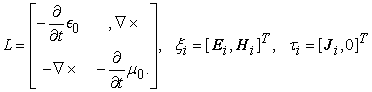 | (3) |
 is matrix transpose. The solutions of retarded potential and advanced potential can be obtained from Maxwell’s equations and Lorenz gauge,
 | (4) |
 | (5) |
 ,
, is the retarded potential.
  ,
,  is the advanced potential.
  is the speed of light.
  . The author’s theory of mutual energy holds that the advanced potential is also an real objective quantity. This view of point will be further demonstrated later.
For a classical electromagnetic field system, if there are some self-evident formulas, the author believe that can be used as axioms. When the axioms of electromagnetic field system are more than before, there may be too many constraints and conflicts. If there is a conflict, we must adjust the theory. Make it more reasonable. The author adds two new axioms, one is the law of conservation of energy, and the other is the law that radiation does not overflow the universe. In addition, the author also try to replace Maxwell’s equations with the principle of mutual energy introduced in the following.
3.1. Law of Conservation of Energy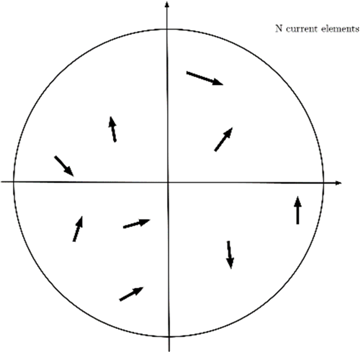
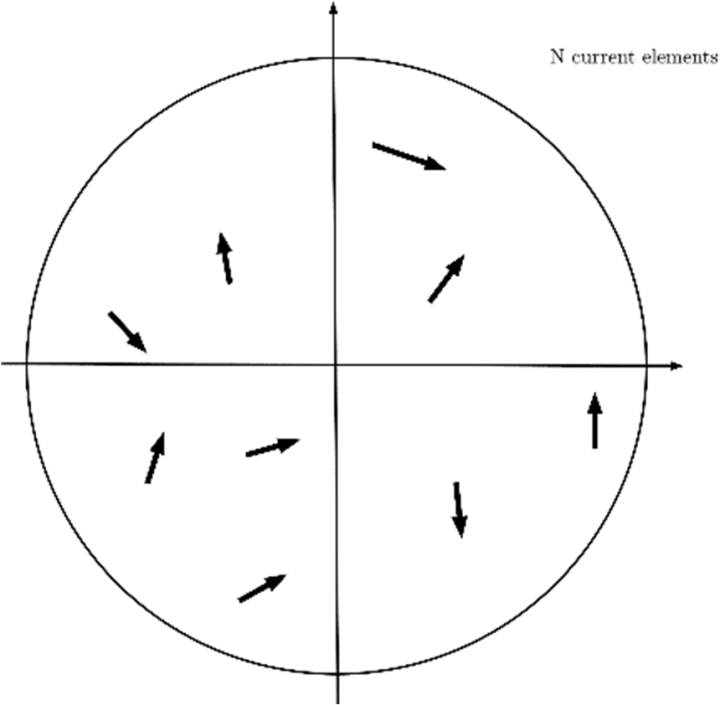
Suppose there are  charges in the completely empty space see Figure 1. Here, the completely empty space is an abstract space. In this space, there are no other charges except
  charges, no earth, no moon, no sun, no stars or even dust. When an electric charge is moving, it can have acceleration.
  charges correspond to
  current elements
 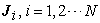 . Firstly, it is assumed that the distance between them is relatively close, so the time retardation between them can be ignored. All current elements move in circles with frequency
  , and all current elements are AC sources
  . For these current elements, there is obviously the following law of energy conservation, and the work done by them is zero. That is,
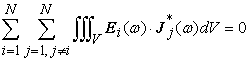 | (6) |
For the above formula, the real number part has the meaning of physics. We have omitted the operation of taking a real number. This axiom is self-evident because if the  charge does work on the
  charge, the energy of the
  charge increases and the energy of the
  charge decreases. But the total energy will remain the same. The energy remains constant and the total output power is zero. Therefore, equation (6) is satisfied. When
  , the above formula has,
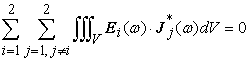 | (7) |
Or
 | (8) |
The above formula is the new reciprocity theorem proposed by Rumsey 8 and the mutual energy theorem proposed by the author 9, 10, 11. In this paper, the electric field and magnetic field use the same symbols in the Fourier domain and time domain, but in the Fourier domain, the complex conjugate symbols often appear, and there is no conjugate symbol in the time domain, so it will not cause confusion. To the variable  in the above formula do the inverse Fourier transform, we obtain,
 | (9) |
The above formula is the de Hoop correlative reciprocity theorem 12. Let  , there is,
 | (10) |
The above formula is Welch’s time domain reciprocity theorem 7. Therefore, Welch, Rumsey, de Hoop’s reciprocity theorem and the author’s mutual energy theorem are the same physical formula. This theorem can be rewritten as
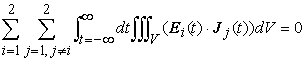 | (11) |
Extend  to
to  ,
,
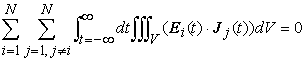 | (12) |
The above formula is the energy conservation law of  current elements. We get the above energy conservation law when the current elements are close to each other. However, this law of energy conservation should be no problem to extend to the case of longer distance between current elements. This conservation of energy is self-evident and can be applied as a aximos for the electromagnetic field theory.
Electromagnetic radiation should not overflow the energy flow of the universe. First, the previous section has proved that the mutual energy flow  does not overflow the universe.
However, for the transmitting antenna, the calculated electromagnetic field is a plane wave and the electric field  and magnetic field
  far field is in phase. Therefore, Poynting vector
  on the surface
  is not zero, here
  is a close surface, for example,
  is a big sphere with its radius as infinity. This does not comply with the law that the radiation does not overflow the universe.
According to the theory of mutual energy, our explanation is that the radiation of the transmitting antenna is actually completed by mutual energy. The radiation of the transmitting antenna is due to the environment around us. The environment around us can play the role of the receiving antennas and it can also absorb these electromagnetic waves. If the transmitting antenna is placed in the completely empty space, the average power radiated by it must be zero.
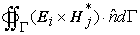
For electromagnetic field calculation, 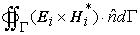 is called self energy flow,
  where
where  is called mutual energy flow. We can completely ignore the energy radiation of self energy flow. If we must investigate the radiation of this part of energy, there are two possibilities: (1) we must supplement the time reversal waves, which offsets the self energy flows, (2) the self energy flow actually radiates reactive power wave. Maxwell’s electromagnetic field theory does not support reactive power waves in the far field of an antenna, so we must modify the electromagnetic field theory. In fact, the principle that the average value of self energy flow must be the same in two the above two situations. Only in this way can we ensure that the self energy flow does not overflow the universe. This problem is more complicated, and we will discuss it more details in other articles 19, 20, 21, 22, 23, 24.
Due to mutual energy, mutual energy flow is the real medium of electromagnetic field radiation, and the energy flow radiated by self energy flow finally returns to their sources (the retarded wave return to the source, and the advanced wave return to the sink). We don’t have to investigate the specific form of self energy flow too much. These topics may only be more interested in quantum mechanics. There is a need to correctly interpret the quantum effect.
Therefore, the principle that radiation does not overflow the universe can indeed be regarded as an axiom of electromagnetic field theory. It is worth mentioning that the quasi-static electromagnetic field and the magnetic quasi-static electromagnetic field theory do not conflict with the two new axioms mentioned in the above of this section. But Maxwell's electromagnetic theory, which means that the electromagnetic theory after Maxwell increased the displacement current, conflicts with these two axioms. This shows that Maxwell's electromagnetic theory is problematic and needs further correction.
3.3. Mutual Energy PrincipleUsing the definition of operator  (3), it can be proved that a formula similar to the Green’s function,
 | (13) |
By substituting Maxwell’s equations (2) into the above formula,
 | (14) |
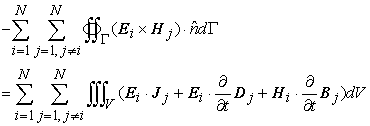
If there are  current elements instead of 2, the above formula can be extended to,
 | (15) |
The formula (14, 15) is referred as the principle of mutual energy by the author. The principle of mutual energy and  sets of Maxwell’s equations (2) form a necessary and sufficient condition for each other. However, the principle of mutual energy is obviously different from Maxwell’s equations, because the principle of mutual energy requires
  . Maxwell’s equations, of course, can have
  . This difference is essential. The mutual energy theory represented by the mutual energy principle holds that electromagnetic radiation is transmitted by mutual energy flow (including the energy flow term of
  , where
  ). The classical electromagnetic theory actually holds that electromagnetic radiation is transmitted by self energy (including the self energy flow term of
  ).
).
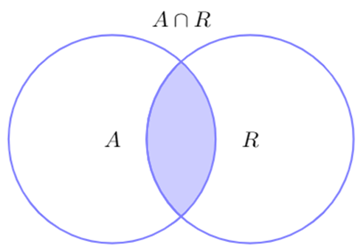
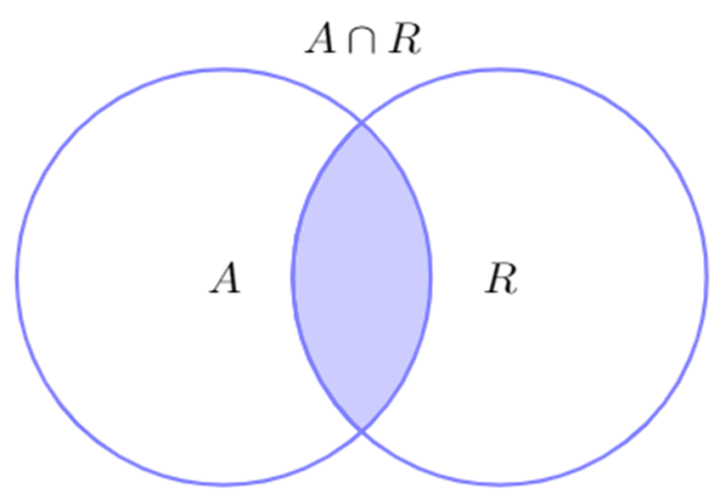
From the Figure 2, we can compare the difference between the solution set of mutual energy principle and the solution set of Maxwell’s equations.  is the solution set of the advanced wave and
  is the solution set of the retarded wave.
  represents the solution set of the Maxwell's equations, and
  is the solution set of the mutual energy principle. The solution set of the mutual energy principle is a subset of the set of solutions of Maxwell’s equations. It can be seen that the solution set of the mutual energy principle is much less than that of Maxwell’s equations. According to quantum mechanics, the solution of Maxwell’s equation is a probabilistic solution. The above theory also verifies the statement of probability solution, because the retarded wave that cannot be synchronized with the advanced wave and the advanced wave that cannot be synchronized with the retarded wave are invalid solutions. Only the synchronous solution of retarded wave and advanced wave, that is, the solution satisfying the principle of mutual energy, is the effective solution of electromagnetic radiation. Below we will see the generation of mutual energy flow theorem in this case.
We assume that there is a retarded wave  by a source
  , and the advanced wave
 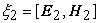 emitted by the sink
  . The two waves are synchronized, so it meets the principle of mutual energy. In the following we will derive (10) from (14). Considering,
 | (16) |
where,
 | (17) |
 means defined as. Hence,
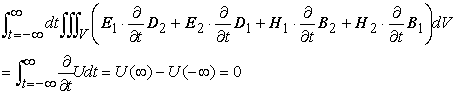 | (18) |
 is the mutual energy at the beginning of the process, which should be zero.
  is the mutual energy at the end, the process is finished hence the energy is zero. By integrating (13) in time,
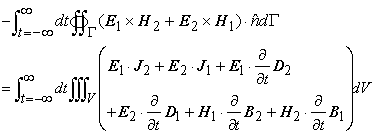 | (19) |
Considering (18), we obtain,
 | (20) |
In general, the following formula does not hold,
 | (21) |
But if  is taken on a sphere with an infinite radius, and
 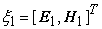 ,
, 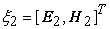 are a retarded wave and a advanced wave. In this way, the two waves do not reach the large sphere at the same time, one in the past and the other in the future. Therefore, the integral of the above formula is zero.
  is called mutual energy flow, which ensures that mutual energy flow does not overflow the universe. Satisfy the axiom that radiation does not overflow the universe. Considering (21), it is obtained from (20),
 | (22) |
Or,
 | (23) |
The above formula is Welch’s reciprocity theorem 7. Consider the Fourier transform, which is the mutual energy theorem 9.
 | (24) |
The author has upgraded it to the law of conservation of energy. Because the principle of mutual energy supports the law of energy conservation, in fact, the principle of mutual energy is also a broader law of energy conservation. The principle of mutual energy can replace Maxwell’s equations (2) as an axiom of electromagnetic field theory.
The energy conservation law can be proved with the mutual energy principle, it is seems that the energy conservation law can be removed from the axiom list of electromagnetic field theory. In fact, our proof needs to recognize the advanced wave. If the advanced wave has been recognized, the law of energy conservation can be deduced from the principle of mutual energy. However, the existence of advanced wave needs to be guaranteed by the law of energy conservation.
3.5. Mutual Energy Flow Theorem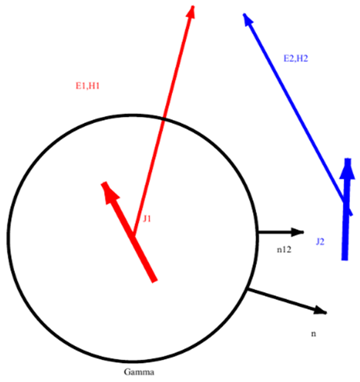

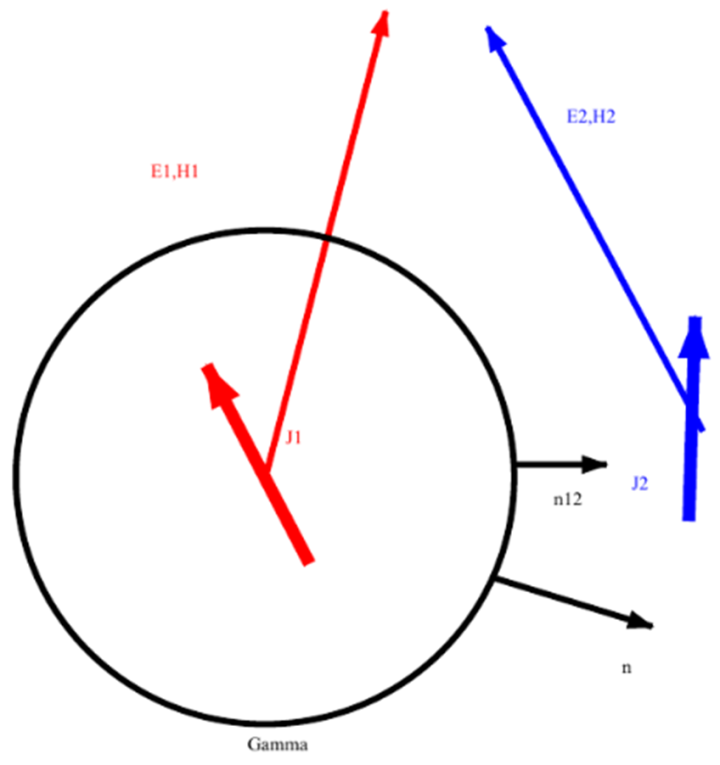
Apply the principle of mutual energy (20) to the above Figure 3, and the surface  only surrounds the current element
  , and recorded as
  . Consider
  therefore,
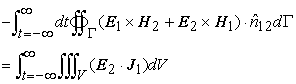 | (25) |
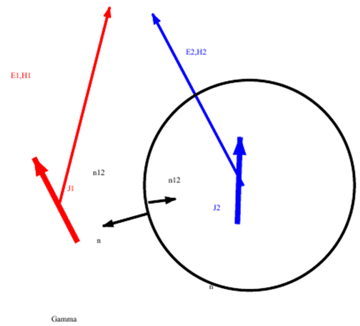

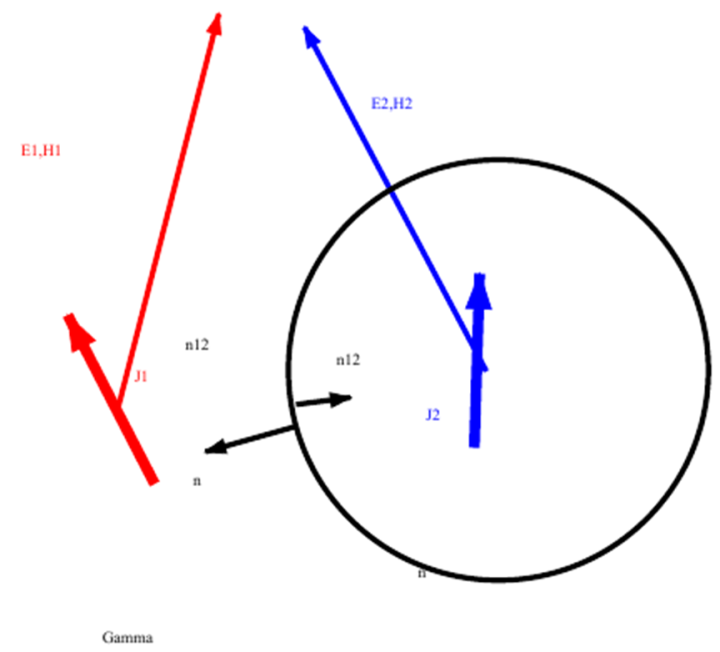
Apply the principle of mutual energy (20) to the above Figure 4, and the surface  only surrounds the current element
  , and recorded as
  , and consider
  ,
,
 | (26) |
The following mutual energy flow theorems can be proved by the mutual energy theorem (10),
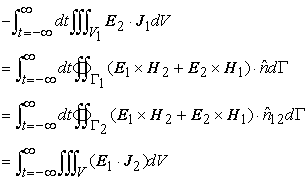 | (27) |
Consider the surface above  ,
,  is arbitrary, so there is,
 | (28) |
where,
 | (29) |
 is any segmentation surface that split current element
  and
and  , such as
  or
or  or an infinite plane. To the Fourier domain, the mutual energy flow theorem is,
 | (30) |
Where,
 | (31) |
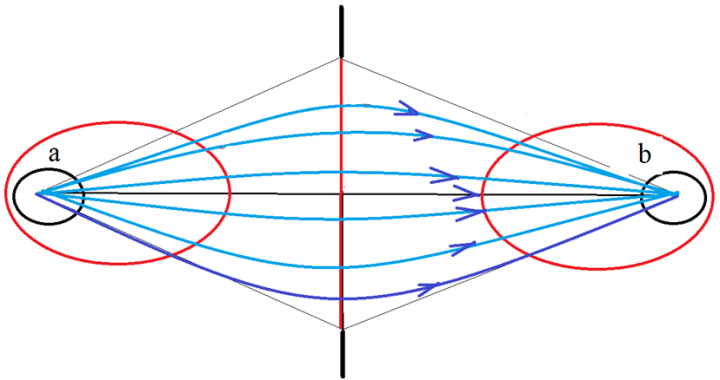
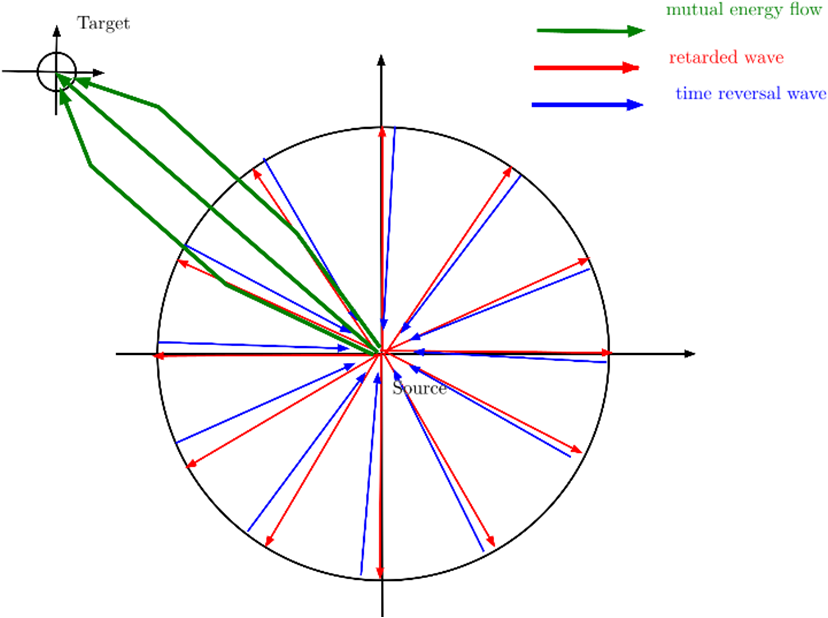
The formulas (28, 30) are the mutual energy flow theorems. The above formula shows that mutual energy is transmitted through mutual energy flow. The mutual energy flow is composed of the retarded wave of the transmitting antenna and the advanced wave of the receiving antenna. The shape of mutual energy flow is roughly as shown in Figure 5.
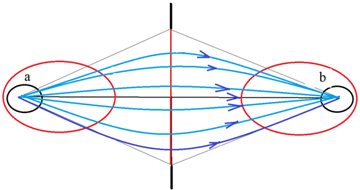
Mutual energy flow is the only energy flow to transfer energy, so the word “mutual” can be removed and called electromagnetic energy flow. However, for historical reasons, it is still called mutual energy flow.
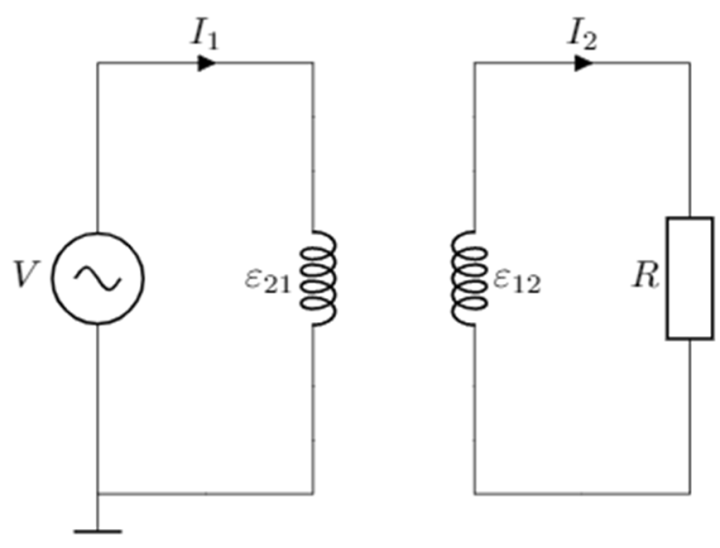
Figure 6 shows a transform system with a primary coil and secondary coil.
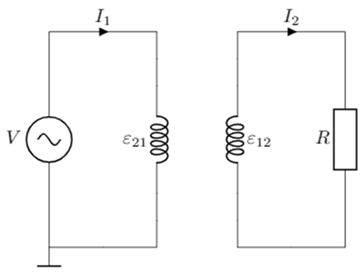
By transforming  , the formula (8) can be rewritten as,
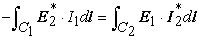 | (32) |
Where  is the primary coil,
  is the secondary coil. The above formula can be rewritten,
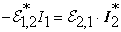 | (33) |
Here 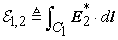 , is the induced electromotive potential generated on by current
  to coil
  .
. 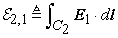 , is the induced electromotive potential generated by current
  to coil
  . The above formula is also the law of mutual energy. But what we need to do here is to verify that it is not only an energy theorem, but also a law of energy conservation for the environment of transformer. Thant means: the power provided by the primary coil
  is equal to the power received by the secondary coil
  , i.e.,
 | (34) |
Where,  here the negative sign is because this power is offered and not the consumed.
  . According to the law of electromagnetic induction, there are
 | (35) |
 is the mutual inductance from primary coil 1 to secondary coil 2. We assume that the current is AC, i.e
  .
.
 | (36) |
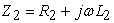 is the impedance of the secondary coil.
  Is the resistance of the secondary coil.
  is the self inductance of the secondary coil. And hence there is,
 | (37) |
 | (38) |
 is the mutual inductance from secondary coil 2 to the primary coil.
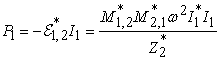 | (39) |
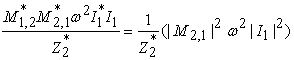
According Eq.(33), there is,
 | (40) |
Or
 |
Or
 | (41) |
The formulas (33, 41) are different forms of the law of energy conservation. For transformers, we know,
 | (42) |
 . This mutual inductances are real values. This verifies that the formula (41) is satisfied, that is, the formula (33) is satisfied, or (34), that is, the law of energy conservation (32) is verified in the case of transformers. The energy conservation law is verified in the transformer environment, which strongly supports the mutual energy theory proposed by the author.
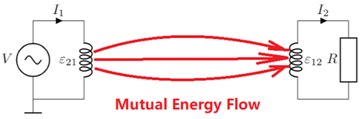
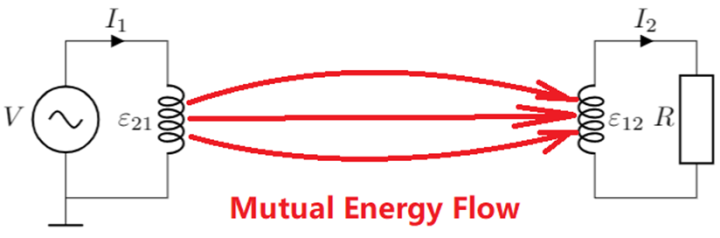
When the two coils are far away, as shown in Figure 7, the primary coil becomes the transmitting antenna and the secondary coil becomes the receiving antenna. Then for  there is a retarded factor which should be considered. Consider current
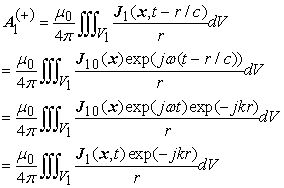
  , the retarded potential is,
 | (43) |
Where  , we can see that the retarded potential has a retarded fact
  , hence, the mutual inductance should also have a retarded factor, i.e.,
 | (44) |
If  take the advanced wave, similar to the above, we can get,
 | (45) |
Hence, there is,
 | (46) |
It can be seen that the above two formulas are equal. In this way, the law of conservation of energy (41) is verified. On the contrary, if  is taken as a retarded wave, and the formula (41) cannot be satisfied.
In other words, when we introduce the law of energy conservation as an axiom, as long as the radiation of the receiving antenna is a advanced wave. The law of conservation of energy (41) can be satisfied. This also shows that the advanced wave should be a real physical objective existence (if there is no advanced wave, we can’t satisfy the law of energy conservation)!
In addition, from the study of transformer, we also see that the word “mutual” in the mutual energy theorem can be removed, and the mutual energy is actually all energy. Self energy flow represented by transformer self inductance 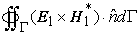 is not responsible for energy transfer. As for the calculation with dipole antenna, Poynting vector
 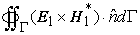 is not zero. It is a bug in classical electromagnetic theory, which will be discussed in other articles 19, 20, 21, 22, 23, 24. This is why the author upgraded the mutual energy theorem to the law of conservation of energy.
It is worth mentioning that if we recognize the advanced wave, the law of conservation of energy flow can be derived from the principle of mutual energy. Therefore, it is not necessary to put forward it as an axiom, but the advanced wave is a very controversial topic. The author would rather add an axiom of energy flow conservation, because this axiom seems to be self-evident, and we have verified it in the transformer environment. Then it can be extended to the system composed of transmitting antenna and receiving antenna. At this time, the retarded and advanced effect of electromagnetic wave propagation should be considered.
In this paper, the author introduces the law of conservation of energy into the transformer environment. When the transformer environment is extended to the antenna system, the primary coil becomes the transmitting antenna and the secondary coil becomes the receiving antenna. At this time, if the retarded effect must be considered for the mutual inductance from the transmitting antenna to the receiving antenna, then the advanced effect must be considered for the mutual inductance from the receiving antenna to the transmitting antenna. In this way, the transmitting antenna transmits the retarded wave, and the receiving antenna transmits the advanced wave. We have proved that the advanced wave is the objective existence of physics.
The author raised the law of conservation of energy to the height of axiom. The axiom that radiation does not overflow the universe is also proposed. In fact, these two axioms do not conflict with each other, but they conflict with Maxwell's equation. This is because according to Maxwell's equation, the far field electric field and magnetic field of the transmitting antenna are in phase, so the energy corresponding to Poynting vector,
 |
This shows that electromagnetic radiation always overflows the universe. In other words, self-energy flow overflows the universe. This conflicts with the law that electromagnetic radiation does not overflow the universe. Since the self energy overflows out of the universe, then the energy is not completely transferred by the mutual energy flow, so the mutual energy theorem is not the law of conservation of energy. Therefore, the law of conservation of energy the author put forward is not tenable. The mutual energy theorem can only be the reciprocity theorem or the energy theorem at most!
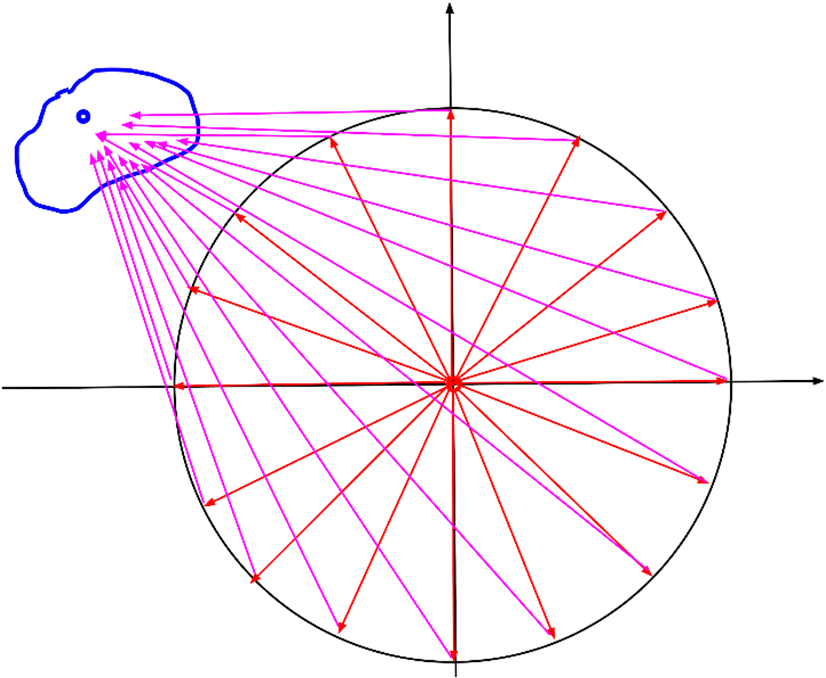
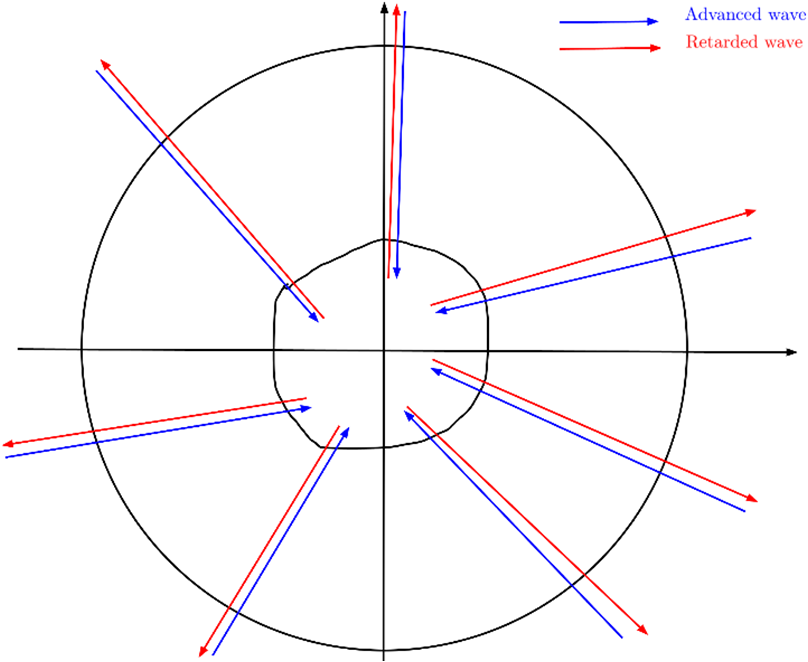
In quantum mechanics, the electromagnetic wave satisfying Maxwell is not energy wave, but probability wave! And this probability wave will collapse, see Figure 8. After the wave collapses, the wave will not bring energy out of the universe. In fact, the mutual energy theorem says that the electromagnetic wave is a probability wave. It is also doubtful that this wave can carry no energy, because the energy is carried by photons. There is no need for electromagnetic waves to carry energy. The description and understanding of electromagnetic waves in quantum mechanics is certainly not the same as that in classical electromagnetic theory. The author believes that quantum mechanics has a correct understanding of electromagnetic waves. Electromagnetic waves should not transmit energy. Here energy is transferred by mutual energy flow. Since mutual energy flow transfers energy, self energy is not necessary to also transfer energy. So the author puts forward the concept of reverse collapse of wave, See Figure 9.

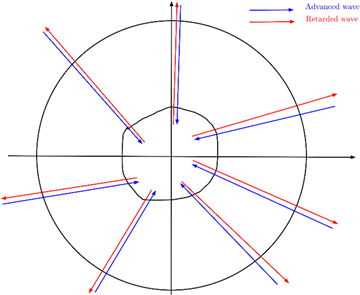
The collapse of wave can be equivalent to the reverse collapse of wave + mutual energy flow. In the author's electromagnetic theory, there is no collapse of wave, but there is time-reversal collapse of wave. As for the collapse of wave, it is composed of the reverse collapse of wave and the process of mutual energy flow, see Figure 10.
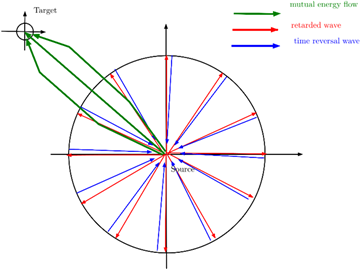
However, the theory of electromagnetic field is not the interpretation of quantum mechanics. In the theory of electromagnetic field, if there is reverse collapse, it is necessary to provide reliable evidence and even experiment. The author also doubts the concept of reverse collapse. The concept of reverse collapse is used to explain the concept of wave collapse.
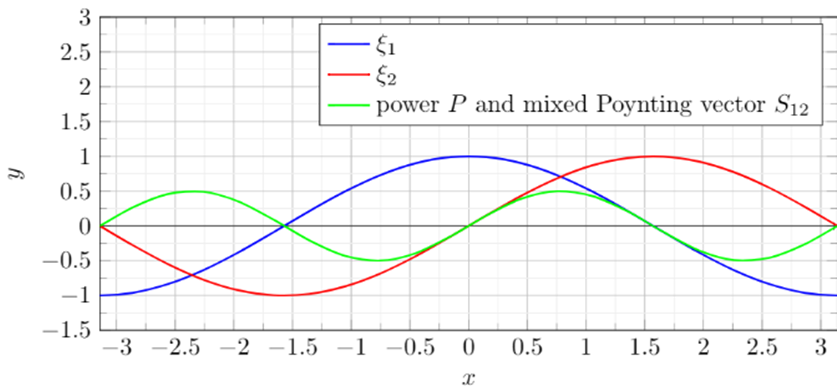
In fact, while proposing the collapse of wave, the author came up with another better concept: electromagnetic wave is reactive power. If the electromagnetic wave is reactive power, then the electromagnetic wave does not carry electromagnetic energy, or the average value of the electromagnetic energy carried is zero. Here, reactive power wave is an electromagnetic wave whose electric field and magnetic field maintain a phase difference of 90 degrees, so Poynting vector is a pure imaginary number. However, the solution of Maxwell's equation, such as the Poynting vector of the far field of the transmitting antenna, is a real number, which indicates that the electromagnetic wave is not a reactive power wave according to Maxwell's equation. The author has been worried about this matter for a long time, and finally has a vision recently. See Figure 11 for the wave with reactive power.
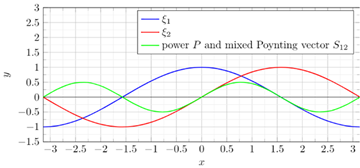
It is probably Maxwell's definition of magnetic field. The definition of Maxwell point magnetic field is derived from the equations of quasi-static and magnetic quasi-static electromagnetic fields.
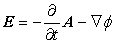 |
 |
However, the above definitions are valid in quasi-static fields, which does not mean that they are still correct when it comes to radiated electromagnetic fields. Especially the magnetic field above. We know that for the far field of the transmitting antenna, we can only measure the induced electromotive force on the receiving antenna and the current generated by this electromotive force. We don't know what electric and magnetic fields are. The electric field and magnetic field are calculated according to Maxwell's electromagnetic theory. Therefore, the author estimates that the above magnetic field is actually the  , but it is not the magnetic field
  . The real magnetic field and electric field are kept at 90 degree phase difference! Therefore, in the next step, the author should focus on the study of reactive power wave. See if the electromagnetic wave is a reactive power wave!
This paper verifies that Welch’s time domain reciprocity theorem, Rumsey’s new reciprocity theorem, de Hoop’s correlation reciprocity theorem and the mutual energy theorem proposed by the author are a formula, not only the reciprocity theorem, but also the energy theorem. Not only the energy theorem, the author further verified that it is the law of energy conservation. The author proves the mutual energy flow theorem, so the mutual energy theorem is actually the law of localized energy conservation. The mutual energy flow is composed of the retarded wave from the transmitting antenna and the advanced wave from the receiving antenna. The advanced wave is a real physical quantity.
| [1] | Wheeler. J. A. and Feynman. R. P. Rev. Mod. Phys., 17: 157, 1945. | ||
| In article | View Article | ||
| [2] | Wheeler. J. A. and Feynman. R. P. Rev. Mod. Phys., 21: 425, 1949. | ||
| In article | View Article | ||
| [3] | John Cramer. The transactional interpretation of quantum mechanics. Reviews of Modern Physics, 58: 647-688, 1986. | ||
| In article | View Article | ||
| [4] | John Cramer. An overview of the transactional interpretation. International Journal of Theoretical Physics, 27:227, 1988. | ||
| In article | View Article | ||
| [5] | J.R. Carson. Reciprocal theorems in radio communication. Proc. IRE, 17(6): 952, June 1929. | ||
| In article | View Article | ||
| [6] | J.R. Carson. The reciprocal energy theorem. Bell Syst. Tech. Jour., 9: 325-331, April 1930. | ||
| In article | View Article | ||
| [7] | W. J. Welch. Reciprocity theorems for electromagnetic fields whose time dependence is arbitrary. IRE trans. On Antennas and Propagation, 8(1): 68-73, January 1960. | ||
| In article | View Article | ||
| [8] | V.H. Rumsey. A short way of solving advanced problems in electromagnetic fields and other linear systems. IEEE Transactions on antennas and Propagation, 11(1): 73-86, January 1963. | ||
| In article | View Article | ||
| [9] | Shuang ren Zhao. The application of mutual energy theorem in expansion of radiation fields in spherical waves. ACTA Electronica Sinica, P.R. of China, 15(3): 88-93, 1987. | ||
| In article | |||
| [10] | Shuangren Zhao. The application of mutual energy formula in expansion of plane waves. Journal of Electronics, P. R. China, 11(2): 204-208, March 1989. | ||
| In article | |||
| [11] | Shuangren Zhao. The simplification of formulas of electromagnetic fields by using mutual energy formula. Journal of Electronics, P.R. of China, 11(1): 73-77, January 1989. | ||
| In article | |||
| [12] | Adrianus T. de Hoop. Time-domain reciprocity theorems for electromagnetic fields in dispersive media. Radio Science, 22(7): 1171-1178, December 1987. | ||
| In article | View Article | ||
| [13] | Jin Au Kong. Theory of electromagnetic waves. New York, Wiley-Interscience, AA(MIT, Cambridge, Mass), 1975. | ||
| In article | |||
| [14] | Lawrence M. Stephenson. The relevance of advanced potential solutions of maxwell’s equations for special and general relativity. Physics Essays, 13(1), 2000. | ||
| In article | View Article | ||
| [15] | Shuang ren Zhao. A new interpretation of quantum physics: Mutual energy flow interpretation. American Journal of Modern Physics and Application, 4(3): 12-23, 2017. | ||
| In article | |||
| [16] | Shuang ren Zhao. Photon can be described as the normalized mutual energy flow. Journal of Modern Physics, 11(5): 668-682, 2020. | ||
| In article | View Article | ||
| [17] | Shuang ren Zhao. A solution for wave-particle duality using the mutual energy principle corresponding to schrã dinger equation. Physics Tomorrow Letters, 2020. | ||
| In article | |||
| [18] | Shuang ren Zhao. Huygens principle based on mutual energy flow theorem and the comparison to the path integral. Physics Tomorrow Letters, pages 09-06, JANUARY 2021. | ||
| In article | |||
| [19] | Shuang-ren Zhao, The Contradictions in Poynting Theorem and Classical Electromagnetic Field Theory, International Journal of Physics, 2022, Vol. 10, No. 5, 242-251. | ||
| In article | View Article | ||
| [20] | shuang-ren Zhao, Solve the Maxwell's equations and Schrodinger's equation but avoiding the Sommerfeld radiation condition, Theoretical Physics Letters. 2022. 26(04). 10-05. | ||
| In article | |||
| [21] | Shuang-ren Zhao. Mutual stress flow theorem of electromagnetic field and extension of newton's third law. Theoretical Physics Letters, 10(7), 2022. | ||
| In article | |||
| [22] | Shuang ren Zhao. The paradox that induced electric field has energy in Maxwell theory of classical electromagnetic field is shown and solved. International Journal of Physics, 10(4): 204-217, 2022. | ||
| In article | View Article | ||
| [23] | Shuang ren Zhao. The theory of mutual energy flow proves that macro-scopic electromagnetic waves are composed of photons. International Journal of Physics, 10(5), 2022. | ||
| In article | |||
| [24] | Shuang-ren Zhao, “Energy Flow and Photons from Primary Coil to Secondary Coil of Transformer.” International Journal of Physics, vol. 11, no. 1. | ||
| In article | |||
Published with license by Science and Education Publishing, Copyright © 2023 Shuang-ren Zhao
 This work is licensed under a Creative Commons Attribution 4.0 International License. To view a copy of this license, visit
http://creativecommons.org/licenses/by/4.0/
This work is licensed under a Creative Commons Attribution 4.0 International License. To view a copy of this license, visit
http://creativecommons.org/licenses/by/4.0/
| [1] | Wheeler. J. A. and Feynman. R. P. Rev. Mod. Phys., 17: 157, 1945. | ||
| In article | View Article | ||
| [2] | Wheeler. J. A. and Feynman. R. P. Rev. Mod. Phys., 21: 425, 1949. | ||
| In article | View Article | ||
| [3] | John Cramer. The transactional interpretation of quantum mechanics. Reviews of Modern Physics, 58: 647-688, 1986. | ||
| In article | View Article | ||
| [4] | John Cramer. An overview of the transactional interpretation. International Journal of Theoretical Physics, 27:227, 1988. | ||
| In article | View Article | ||
| [5] | J.R. Carson. Reciprocal theorems in radio communication. Proc. IRE, 17(6): 952, June 1929. | ||
| In article | View Article | ||
| [6] | J.R. Carson. The reciprocal energy theorem. Bell Syst. Tech. Jour., 9: 325-331, April 1930. | ||
| In article | View Article | ||
| [7] | W. J. Welch. Reciprocity theorems for electromagnetic fields whose time dependence is arbitrary. IRE trans. On Antennas and Propagation, 8(1): 68-73, January 1960. | ||
| In article | View Article | ||
| [8] | V.H. Rumsey. A short way of solving advanced problems in electromagnetic fields and other linear systems. IEEE Transactions on antennas and Propagation, 11(1): 73-86, January 1963. | ||
| In article | View Article | ||
| [9] | Shuang ren Zhao. The application of mutual energy theorem in expansion of radiation fields in spherical waves. ACTA Electronica Sinica, P.R. of China, 15(3): 88-93, 1987. | ||
| In article | |||
| [10] | Shuangren Zhao. The application of mutual energy formula in expansion of plane waves. Journal of Electronics, P. R. China, 11(2): 204-208, March 1989. | ||
| In article | |||
| [11] | Shuangren Zhao. The simplification of formulas of electromagnetic fields by using mutual energy formula. Journal of Electronics, P.R. of China, 11(1): 73-77, January 1989. | ||
| In article | |||
| [12] | Adrianus T. de Hoop. Time-domain reciprocity theorems for electromagnetic fields in dispersive media. Radio Science, 22(7): 1171-1178, December 1987. | ||
| In article | View Article | ||
| [13] | Jin Au Kong. Theory of electromagnetic waves. New York, Wiley-Interscience, AA(MIT, Cambridge, Mass), 1975. | ||
| In article | |||
| [14] | Lawrence M. Stephenson. The relevance of advanced potential solutions of maxwell’s equations for special and general relativity. Physics Essays, 13(1), 2000. | ||
| In article | View Article | ||
| [15] | Shuang ren Zhao. A new interpretation of quantum physics: Mutual energy flow interpretation. American Journal of Modern Physics and Application, 4(3): 12-23, 2017. | ||
| In article | |||
| [16] | Shuang ren Zhao. Photon can be described as the normalized mutual energy flow. Journal of Modern Physics, 11(5): 668-682, 2020. | ||
| In article | View Article | ||
| [17] | Shuang ren Zhao. A solution for wave-particle duality using the mutual energy principle corresponding to schrã dinger equation. Physics Tomorrow Letters, 2020. | ||
| In article | |||
| [18] | Shuang ren Zhao. Huygens principle based on mutual energy flow theorem and the comparison to the path integral. Physics Tomorrow Letters, pages 09-06, JANUARY 2021. | ||
| In article | |||
| [19] | Shuang-ren Zhao, The Contradictions in Poynting Theorem and Classical Electromagnetic Field Theory, International Journal of Physics, 2022, Vol. 10, No. 5, 242-251. | ||
| In article | View Article | ||
| [20] | shuang-ren Zhao, Solve the Maxwell's equations and Schrodinger's equation but avoiding the Sommerfeld radiation condition, Theoretical Physics Letters. 2022. 26(04). 10-05. | ||
| In article | |||
| [21] | Shuang-ren Zhao. Mutual stress flow theorem of electromagnetic field and extension of newton's third law. Theoretical Physics Letters, 10(7), 2022. | ||
| In article | |||
| [22] | Shuang ren Zhao. The paradox that induced electric field has energy in Maxwell theory of classical electromagnetic field is shown and solved. International Journal of Physics, 10(4): 204-217, 2022. | ||
| In article | View Article | ||
| [23] | Shuang ren Zhao. The theory of mutual energy flow proves that macro-scopic electromagnetic waves are composed of photons. International Journal of Physics, 10(5), 2022. | ||
| In article | |||
| [24] | Shuang-ren Zhao, “Energy Flow and Photons from Primary Coil to Secondary Coil of Transformer.” International Journal of Physics, vol. 11, no. 1. | ||
| In article | |||