This study examines the environmental and socio-economic impacts of sand mining in three selected coastal communities (Hamilton, John Obey and Laka) along the Western Area Rural-Freetown peninsula in Sierra Leone. Coastal sand mining poses significant environmental and social problems. It damages ecosystems, increases coastal erosion and vulnerability to storms, threatens biodiversity, and can lead to social issues like corruption and violence. The study employed a quantitative cross-sectional perception survey-based research design. A simple random sampling technique was used to representatively select 666 community respondents including heads of households, community leaders, sand miners, sellers, and transporters. A combination of Statistical Package for the Social Science (SPSS) and Excel Software Package were employed. A multinomial logistic regression (MNL) model was used to analyse the data. Findings reveal that the determinants of respondents’ perceived knowledge on the negative impacts of sand mining were mainly demographic attributes including age (p<0.001), marital status (p<0.001), family size (p<0.001), and monthly household income (p<0.001). The findings further revealed that accident (p<0.001), community conflicts (p<0.001), drug abuse (p<0.001), and knowledge of negative effects of sand mining (p<0.001), exhibited a negative significant impact of sand mining. The determinants of respondents’ perceived knowledge on the positive impacts of sand mining indicated that occupation has a positive and significant impact on sand mining. The benefits of utilizing sand in the communities (p<0.001) and benefits of sand mining (p<0.001) had a negative significant impact on sand mining. It is recommended that increased awareness on the negative impacts of coastal sand mining coupled with the implementation of environmental policies could help to mitigate some of the negative environmental impacts.
Sand mining, which is the process of removing sand and gravel, is becoming a problem for the environment as a result of the growing need for sand in building and industry. Sand mining or ‘sand dredging’ is a growing industry that has long supported industrialization, housing, general construction, and urbanization worldwide 1, 2, 3, 4, 5 Sand mining, among other natural aggregates represent the main source of construction aggregates used throughout the world 6, 7, 8, 9. Sand is mostly obtained from coastal settings, including dunes, beaches, and bluff areas, as well as riverine ecosystems, which are the primary suppliers of sand for many coastal locations. The rapid increase in urbanization and development of large-scale infrastructure projects are driving increasing demands for construction materials globally. United Nations Environment Program UNEP 6 estimated that between 32 and 50 billion tonnes of sand and gravel are extracted globally each year with demand increasing, especially in developing countries 10. Sand is regarded as a "provisioning ecosystem service" resource. According to Massellink and Gehrels 11, the coastal system is the area of the Earth's surface that is directly impacted by natural phenomena such as winds, tides, waves, and currents. A highly specialized collection of habitats can be found along coasts, which mark the spatial transition between continental and marine environments 12. The evolution of these systems is due to the current interplay between flora, water, sand, and other external forces 13. Among the planet's most dynamic landscapes are the coasts, which may be found in all latitudes. Coasts are among the most dynamic environments on Earth, found at all latitudes and resulting from the integration of several important ecosystems, such as beaches, dunes, and cliffs. These geomorphic regions have historically been analyzed as discrete and unique settings, but they are actually integrated systems that require management 14. Due to its strategic location between the sea and the land, the coast is considered an environmental hotspot that offers a variety of environmental services, including regulation (e.g., sediment storage, environmental quality, 15, provision (e.g., bioindicators of pollutants), 16, ecological support 17, and cultural services (e.g., recreational opportunities, spiritual enhancement), 18.
However, the process of sand mining activities, whether small or large scale, are inherently destructive to the natural environment chiefly because sand is considered and being grouped into nonrenewable resource 19. Sand mining is considered destructive due to its increased impact on coastal erosion and the introduction of artificial structures that impede the movement of sand in the ocean, loss of aquatic biodiversity, alteration of coastal shorelines, and a source of ecological destabilization 5, 20, 21 22, 23, 24. Mined ecosystems recover very slowly, if at all, because current extraction rates surpass natural sand replenishment rates 25, 26. Coastal habitats are negatively impacted and altered by the mining process, whether it is occurring immediately at the coast or in upstream river sources. Ecosystems and water quality at mining sites and nearby areas are directly impacted by coastal sand mining. These effects frequently have detrimental effects for benthic plants and animals 27, 28. The loss of fisheries and the extinction and destruction of aquatic life are two effects on biological resources that pose issues for people whose livelihoods depend on fishing. In addition to decreasing the variety of species that can be found in these aquatic environments, this process can lead to erosion, contaminate water sources, and damage coastal vegetation 29. Sand mining will always have disastrous and, for the most part, irreversible impacts in the absence of legislation, oversight, and regulation.
In Sierra Leone, the details of the environmental, social and economic geologic importance of the extraction of sand are completely unclear. The appropriate assessment of environmental and socio-economic impacts is often a hard task because the impacts appear after a long period of time. The primary challenge is the need to implement a comprehensive strategy in the planning and management of these resources. The illegal extraction in most coastal areas also aggravates the situation. Therefore, the aim of this study is to assess the environmental and socio-economic impacts of sand mining on selected coastal communities along the Western Rural Peninsular Freetown, Sierra Leone.
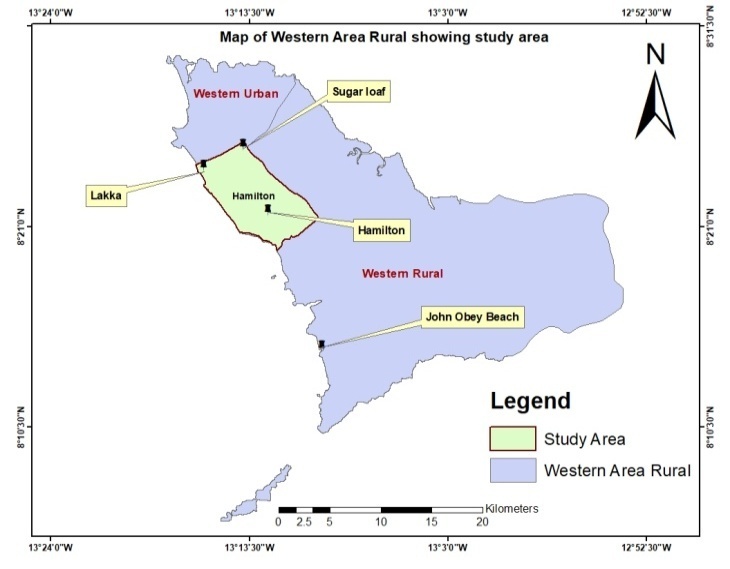
The study was conducted in three selected communities (Hamilton, John Obey and Laka), situated along the Freetown peninsula, Western Area Rural District where sand mining is highly undertaken (Figure 1). The communities fell within the Western Area Rural District which is one of the fourteen districts in Sierra Leone. The Western Area Rural District has a population of 442,951 30. Hamilton is located in the Western Area of Sierra Leone. It is known for its diverse community and historical significance with coordinates 08° 22′ 59.98″ N and 13° 13′ 00.01″ W. With a mix of urban and rural areas, Hamilton offers a unique blend of culture, tradition, and modernity. The community is home to various landmarks, schools, businesses, and residential areas, making it a bustling hub of activities like fishing and sand mining in the region. John Obey is a town in Sierra Leone known for its beautiful beaches and vibrant community, located along the Atlantic Ocean (8°14′43.8″N 13°09′51″W). John Obey offers stunning views and is a popular destination for both locals and tourists looking to relax by the sea. Laka beach is known for its pristine beauty and tranquil surroundings (8°20′N 13°04′W). Located along the Atlantic Ocean, Laka Beach offers soft golden sands, clear blue waters, and stunning panoramic views. The beach is known for a range of activities such as sunbathing, swimming, beachcombing, and taking leisurely walks along the shore.
The study was a perceptive cross-sectional survey based research which employed quantitative analytical frameworks. The field work for primary data collection was conducted between February and – April 2022. The study used primary data drawn from a field survey of the selected coastal communities and sand miners using a structured questionnaire with appropriate design. The structured questionnaire contained three sections. Section A consisted of the demographic characteristics of the respondents, Section B comprised the drivers of sand mining and the socio-economic impacts of sand mining, Section C consisted of questions on the environmental impacts of sand mining and Section D consisted of the respondents’ perception on the effects, impacts, benefits and mitigation measures of negative effects of sand mining in the Freetown.
2.3. Sampling Techniques and Sample Size DeterminationThis study firstly employed purposive sampling to select those respondents and locations identified to be directly associated with sand mining and most suitably meet the criteria for the purpose of this study and hence contacted as primary data sources for the needed information. The respondents included sand miners, sand miner’s household heads, and other key stakeholder groups (chiefs, members of community development committees, sand sellers, and sand transporters). The study purposively identified the three communities (Hamilton community, John Obey and Lakka) in the Western Area Rural with predominant coastal sand mining. A simple random sampling was employed to select from each of the respondent groups, identified as elementary sampling units for data collection.
The number of respondents was proportional and dependent on the size (land/coverage area) of sand mining communities targeted in this study. Thus, for a representative sample of respondents from the sand mining communities, the study grouped the three communities into two, the larger community, Hamilton as one and the other two relatively smaller communities (John Obey and Lakka) as another. The study used standard statistical sample size formula developed by de Vaus 31 in agreement with Saunders et al. 32, which is mostly used in social research surveys, to determine the representative minimum sample size. The formula is used with relevant information from various reliable sources at the 95% confidence level (CL) and 5% margin of error. The statistical formula is as shown below:
n = p x q {Z/(e)}2
Were,
n = Minimum sample size required,
p = Proportion belonging to the specified category
q = Proportion not belonging to the specified category (1- p)
Z = The Z-value corresponding to the level of confidence required (1.96 at 95% CL)
e = Margin of error required
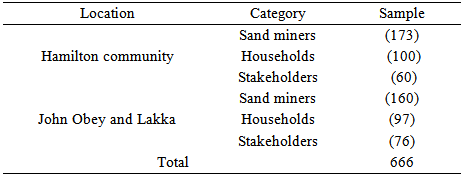
Generally, sand mining in Sierra Leone at community level, especially in the rural areas is largely driven by poverty to generate livelihoods for inhabitants. So, information used for the proportion of people in poverty or not has been sourced from the Statistics Sierra Leone population and Housing Census report of 2015. The report reveals a national estimate of 68.3% of poverty level in the country. This was considered as the proportion belonging to the specified category, because the study communities though based in rural areas, but are almost infused into the country’s capital of Freetown and Western Area Urban. Using the above information, a minimum sample size of 333 was determined for Hamilton and same for the other two communities grouped together as one location, making a total of 666 respondents. However, there was an actual 98% response rate (650 respondents). The distribution is presented in Table 1.
The Statistical Package for the Social Science (SPSS) and Excel Software Package were used to analyze and assess the significance of residents’ perception of the impacts of sand mining in the district. They were also used to determine homogeneity of respondents from different sand mining communities and to assess the significance of the impacts of sand mining on peoples’ livelihoods. The negative and positive impacts of sand mining were explored using the multinomial logistic regression (MNL) model. The MNL model was specified as follows:
Letting P j (j = 1,2,3) be the probabilities of a respondents being in each negative or positive impact and assuming that j = 1 is the reference category, the multinomial logit model showing the relative probabilities of being in the three participation categories as a linear function of X ki for the i th household, according to Greene 33, is estimated as:
ln log (P j /P 1 ) = log (P j /P 1 ) = β 0j + β 1j X 1i +... + β kj X ki + u ji
For j = 2, 3 and i = 1, 2...n respondents
where: ln = the natural logarithm (or log e),
P 1 = the probability of the respondents being in the reference category (negative/positive impacts);
β kj are the MNL coefficients to be estimated and,
X ki is the k th explanatory variable explaining the i th respondents.
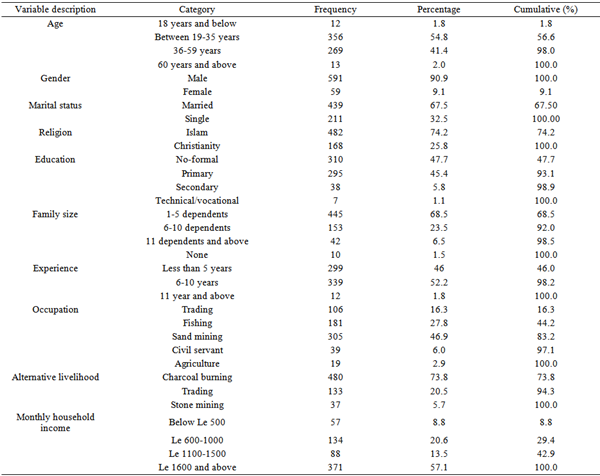
The findings showed that majority of the respondents involved in sand mining in the sampled area were male (90.9%), while 9.1% of the respondents were female. Most (52.2%) of the miners had experience of 6-10 years in sand mining. For the age category, majority of the respondents (54.8%) were in the ages of 19-35 years, while 1.8% and 2.0% of the total sampled population were the lowest obtained for the ages of <18 years and > 60 years, respectively (Table 2). The presence of different age groups that are involved in the sand mining activity with youths being the majority among the workers particularly as sand loaders are excessive dependent on the socio-economic conditions of local communities. Similarly, sand mining has been recorded to provide employment for youth as drivers and loaders and it also serves as a source of income to individuals who mine and sell sand 34. Most of the respondents (47.7 %) did not go through any formal education while 1.1% of the respondents went through Technical/vocational education. Majority of the respondents (46.9%) were engaged in sand mining as their main occupation, while 2.9 % of the respondents were engaged in Agriculture. Sand mining activities in these areas was believed to have been driven by urbanization forces. Research has shown that population growth is one of the elements that promote sand mining because as the population expands, so does the demand for jobs, which promotes increased dependence on the exploitation of natural resources [35, 36] 35, 36. According to Dacosta & Mathada 37, the majority of respondents to a survey done in the Limpopo Province's Nzhelelele River believed that sand mining provided an economic benefit.
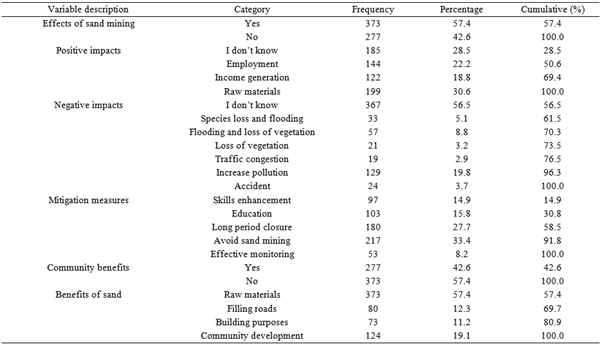
3.2. Perceived Knowledge on the Effects, Impacts, Benefits and Mitigation Measures of the Negative Effects of Sand MiningMajority (57.4%) of the respondents in the study areas were aware of the effects of sand mining, while 42.6% of them had no knowledge of the effects of sand mining (Table 3). This is consistent with the research conducted in Vietnam which reported that most of the respondents were aware of the effects of sand mining 38. Majority (71.5%) of the positive impacts of sand mining, of which, 30.6%, 22.2%, 18.8% of them enumerated its usefulness as raw materials, provision of employment, and income generation, respectively, while the remaining opined that they have no idea (Table 3). Research that supported sand mining and demonstrated its economic advantages revealed that the majority of respondents believed that sand mining produced jobs and provided local communities with a higher revenue 38, 39, 40. Among the respondents, 50% felt that sand mining was bad while the remaining 50% considered it beneficial as they perceived themselves capable of dealing with the environmental problems associated with sand mining. Research have revealed that people viewed environmental issues as a serious issue that took precedence above higher incomes where illicit sand mining caused erosion and landslides, making the impacted areas unusable 36.
The perception of majority (56.5%) of the respondents opined that they lack knowledge of the negative impacts of sand mining. However, some of the negative impacts highlighted by the remaining respondents included species loss and flooding (5.1%), flooding and loss of mangrove vegetation (8.8%), loss of vegetation (3.2%), traffic congestion (2.9%), increase water pollution (19.8%), and accident (3.7%). These findings corroborate the view that illiteracy, lack of infrastructure and socio-economic factors contribute to the lack of knowledge among relevant stakeholders 41 42 43. The equilibrium between humans and the natural resources is no longer reached through the actions heading towards modernization. There is increased deforestation due to the growing population and this affects sand mining activity. The increasing deforestation aimed at developing infrastructure, livelihood change, land degradation, flooding, erosion, threat to buildings and water pollution are some of the impacts of sand mining in the studied communities. The current findings agree with the view that illegal and indiscriminate sand mining cause changes in river channel, land degradation, flooding, erosion, threat to buildings and water pollution 44 45 46. These changes affect agriculture that also contributes to climate change through deforestation during land preparation, resulting in climate change 47 48 49 50. The mitigation measures to combat negative impacts of sand mining based on the indigenous knowledge of respondents included avoidance of sand mining (33.4%), followed by long period closure (27.7%), education (15.8%), skills enhancement (14.9%), and effective monitoring (8.2%). Majority (57.4%) of the respondents opined that their communities do not benefit from sand mining. However, the benefits of sand utilization, based on the indigenous knowledge of respondents, included (57.4%), filling roads (12.3%), construction of buildings (11.2%), and community development (19.1%) (Table 3).
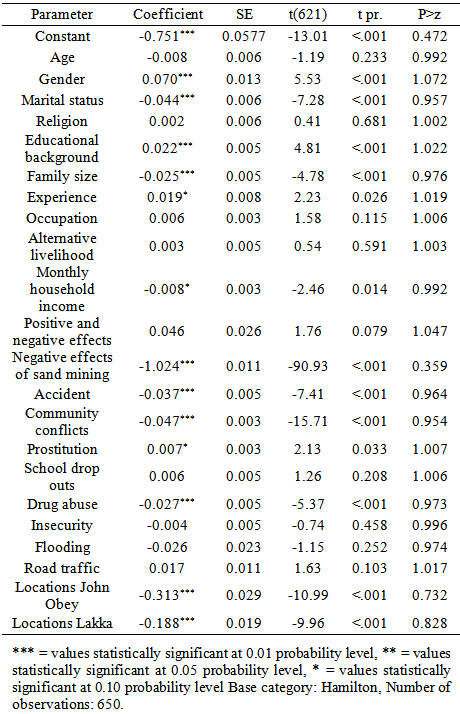
Multinomial logistic regression analysis was estimated to respondents’ perceived knowledge on the negative impacts of sand mining in the studied communities (Table 4). The results indicate that demographic attributes such as age (p<0.001), marital status (p<0.001), family size (p<0.001), and monthly household income (p<0.001) show a negative significant impact on sand mining (Table 4). The findings further reveal that accident (p<0.001), community conflicts (p<0.001), drug abuse (p<0.001), and knowledge of the negative effects of sand mining (p<0.001), exhibited a negative significant impact on sand mining. Environmental protection agency officers are most likely to influence the decision of sand miners to use other type of adaptation strategy to cope with the adverse impacts of climate change on their sand mining activities. Socioeconomic factors have been identified as the primary drivers of coastal sand mining, including low environmental awareness among communities, immense profit margins, easy access to the coast, and inadequate employment 51, 52, 53. Whatever the motivations behind sand mining, it is obvious that the failure of environmental rules being enforced by legally mandated authorities like the Environmental Protection Agency (EPA) is mostly to blame for the practice's current pervasive nature. Thus, raising public awareness and regulating resource extraction are imperative in order to support the stakeholders in developing policy to control sand mining activities along the coast. The study findings also highlight that gender (p<0.001), educational background (p<0.001), experience (p<0.026), and prostitution (p<0.033) have a positive significant impact on sand mining. Hence, John Obey community has a negative significant (p<0.001) impact on sand mining (Table 4). This implies that being from a certain area (community) where sand mining occurs influences the negative impacts on sand mining.
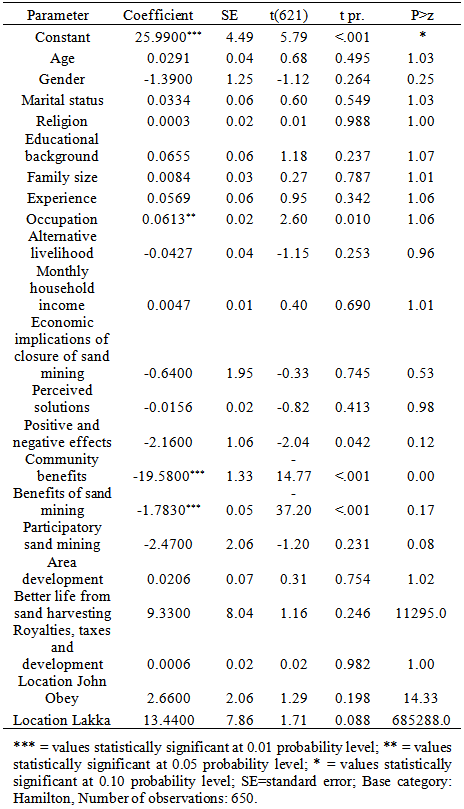
Occupation has a positive and significant impact on sand mining (Table 5). Thus, John Obey or Laka communities have no significant impact on the positive impacts of sand mining. This implies that being from a certain area (community) where sand mining occurs does not determine the positive impacts of sand mining. Benefits of utilizing sand in the community (p<0.001) and benefits of sand mining (p<0.001) have a negative significant impact on sand mining. Findings indicate that the present meagre benefits from sand mining such as area development, better life from sand harvesting, royalties, taxes and development are insufficient compared to the increasing negative impacts sand mining imposes on the environment such as flooding, insecurity, conflicts. Research has identified coastal sand mining to have several negative social and environmental impacts including coastal erosion, deforestation, livelihood change, land degradation, flooding, threat to buildings and water pollution on the built environment in the coastal areas 51, 52, 54, 55. The removal of vegetation and destruction of the soil profile during sand mining contribute to habitat destruction and faunal population decrease 35.
The authors conclude that majority of the respondents in the study areas were aware about the economic advantage or the positive impacts of sand mining to be used as raw materials, provision of employment, and income generation. Most sand miners in the peninsula of western rural District lack knowledge on the negative impacts of sand mining. However, flooding, loss of mangrove vegetation, traffic congestion, and water pollution were identified as the major negative impacts of coastal sand mining. Mangrove plants and beaches, which are made to withstand tidal waves, are destroyed by humans' excessive mining of coastal sand. Without due consideration of the precious gift of nature, commercial exploitation for short term gains by pumping out the sand indiscriminately from the rivers, dunes and beaches will destroy the environment. It is recommended that increased awareness on the negative impacts of coastal sand mining coupled with the implementation of environmental policies could help to mitigate some of the negative environmental impacts. Future studies should focus on this, particularly identifying factors that influence the increased awareness of respondents on the negative consequences of sand mining and the extent of these consequences.
| [1] | Jonah, F. E., Adjei-Boateng, D., Agbo, N. W., Mensah, E. A., & Edziyie, R. E. (2015). Assessment of sand and stone mining along the coastline of Cape Coast, Ghana. Annals of GIS, 21(3), 223-231. | ||
| In article | View Article | ||
| [2] | Asabonga, M., Cecilia, B., Mpundu, M. C., & Vincent, N. M. D. (2017). The physical and environmental impacts of sand mining. Transactions of the Royal society of South Africa, 72(1), 1-5. | ||
| In article | View Article | ||
| [3] | Haghnazar, H., & Saneie, M. (2019). Impacts of pit distance and location on river sand mining management. Modeling Earth Systems and Environment, 5, 1463-1472. | ||
| In article | View Article | ||
| [4] | Haghnazar, H., Sangsefidi, Y., Mehraein, M., & Tavakol-Davani, H. (2020). Evaluation of infilling and replenishment of river sand mining pits. Environmental Earth Sciences, 79, 1-18. | ||
| In article | View Article | ||
| [5] | Koehnken, L., Rintoul, M. S., Goichot, M., Tickner, D., Loftus, A. C., & Acreman, M. C. (2020). Impacts of riverine sand mining on freshwater ecosystems: A review of the scientific evidence and guidance for future research. River Research and Applications, 36(3), 362-370. | ||
| In article | View Article | ||
| [6] | United Nations Environment Programme (UNEP). Sand, Rarer Than One Thinks. March 2014. Available online: http://www.unep.org/pdf/UNEP_GEAS_March_2014.pdf (accessed on 24 August 2024). | ||
| In article | |||
| [7] | Bendixen, M., Iversen, L. L., Best, J., Franks, D. M., Hackney, C. R., Latrubesse, E. M., & Tusting, L. S. (2021). Sand, gravel, and UN Sustainable Development Goals: Conflicts, synergies, and pathways forward. One Earth, 4(8), 1095-1111. | ||
| In article | View Article | ||
| [8] | Torres, A., Simoni, M. U., Keiding, J. K., Müller, D. B., zu Ermgassen, S. O., Liu, J., ... & Lambin, E. F. (2021). Sustainability of the global sand system in the Anthropocene. One Earth, 4(5), 639-650. | ||
| In article | View Article | ||
| [9] | Rentier, E.S and Cammerat, L.H.(2022) ' The environmental impacts of river sand mining', Science of the Total Environment, vol 838, May. | ||
| In article | View Article PubMed | ||
| [10] | Schandl, H., Fischer‐Kowalski, M., West, J., Giljum, S., Dittrich, M., Eisenmenger, N., ... & Fishman, T. (2018). Global material flows and resource productivity: forty years of evidence. Journal of Industrial Ecology, 22(4), 827-838. | ||
| In article | View Article | ||
| [11] | Masselink, G., & Gehrels, R. (2015). Introduction to coastal environments and global change. Coastal environments and global change, 1-27. | ||
| In article | View Article | ||
| [12] | Maun, M. A. (2009). The biology of coastal sand dunes. Oxford University Press. | ||
| In article | View Article | ||
| [13] | Haslett SK (2009); Coastal systems. Routledge. | ||
| In article | View Article | ||
| [14] | Rangel-Buitrago, N., Gracia, A., Vélez-Mendoza, A., Mantilla-Barbosa, E., Arana, V. A., Trilleras, J., & Arroyo-Olarte, H. (2018). Abundance and distribution of beach litter along the Atlantico Department, Caribbean coast of Colombia. Marine pollution bulletin, 136, 435-447. | ||
| In article | View Article PubMed | ||
| [15] | Fegley, S. R., & Michel, J. (2021). Estimates of losses and recovery of ecosystem services for oiled beaches lack clarity and ecological realism. Ecosphere, 12(9), e03763. | ||
| In article | View Article | ||
| [16] | Ben-Haddad, M., Abelouah, M. R., Hajji, S., Rangel-Buitrago, N., Hamadi, F., & Ait Alla, A. (2022). Microplastics pollution in sediments of Moroccan urban beaches: the Taghazout coast as a case study. Marine Pollution Bulletin, 180, 113765. | ||
| In article | View Article PubMed | ||
| [17] | Bergamino, L., Lercari, D., & Defeo, O. (2012). Terrestrial trophic subsidy in sandy beaches: evidence from stable isotope analysis in organic matter sources and isopod Excirolana armata. Aquatic Biology, 14(2), 129-134. | ||
| In article | View Article | ||
| [18] | Alharbi, O. A., & Rangel-Buitrago, N. (2022). Scenery evaluation as a tool for the determination of visual pollution in coastal environments: the Rabigh coastline, Kingdom of Saudi Arabia as a study case. Marine Pollution Bulletin, 181, 113861. | ||
| In article | View Article PubMed | ||
| [19] | Ali, A. S. (2020). Socio-Economic Impacts of Sand Mining Activities in Zanzibar (Doctoral dissertation, The Open University of Tanzania). | ||
| In article | |||
| [20] | Ashraf, M. A., Maah, M. J., Yusoff, I., Wajid, A., & Mahmood, K. (2011). Sand mining effects, causes and concerns: A case study from Bestari Jaya, Selangor, Peninsular Malaysia. Scientific Research and Essays, 6(6), 1216-1231. | ||
| In article | |||
| [21] | Soares, M. D. O., Campos, C. C., Carneiro, P. B. M., Barroso, H. S., Marins, R. V., Teixeira, C. E. P., ... & Garcia, T. M. (2021). Challenges and perspectives for the Brazilian semi-arid coast under global environmental changes. Perspectives in Ecology and Conservation, 19(3), 267-278. | ||
| In article | View Article | ||
| [22] | Mills, R., & Staats, E. (2016). Shrinking shores: Florida sand shortage leaves beaches in lurch. Naples Daily News. | ||
| In article | |||
| [23] | Muruganandam, M., Rajamanickam, S., Sivarethinamohan, S., Reddy, M. K., Velusamy, P., Gomathi, R., ... & Munisamy, S. K. (2023). Impact of climate change and anthropogenic activities on aquatic ecosystem–A review. Environmental Research, 117233. | ||
| In article | View Article PubMed | ||
| [24] | Lewis, K. A., McClenachan, G., DeMarco, K., Salerno, J., & Thompson, K. (2023). Perspectives From Coastal Ecosystems Through the Lens of Climate Change. In Oxford Research Encyclopedia of Climate Science. | ||
| In article | View Article | ||
| [25] | Gracia, A., Rangel-Buitrago, N., & Castro-Barros, J. D. (2019). Non-native plant species in the Atlantico Department Coastal Dune Systems, Caribbean of Colombia: A new management challenge. Marine Pollution Bulletin, 141, 603-610. | ||
| In article | View Article PubMed | ||
| [26] | Hackney, C. R., Darby, S. E., Parsons, D. R., Leyland, J., Best, J. L., Aalto, R., & Houseago, R. C. (2020). River bank instability from unsustainable sand mining in the lower Mekong River. Nature Sustainability, 3(3), 217-225. | ||
| In article | View Article | ||
| [27] | Bayram, A., & Önsoy, H. (2015). Sand and gravel mining impact on the surface water quality: a case study from the city of Tirebolu (Giresun Province, NE Turkey). Environmental earth sciences, 73, 1997-2011. | ||
| In article | View Article | ||
| [28] | Pitchaiah, P. S. (2017). Impacts of sand mining on environment–A Review. SSRG Int. J. Geoinformatics Geological Sci, 4, 1-5. | ||
| In article | View Article | ||
| [29] | Zhai, T., Wang, J., Fang, Y., Qin, Y., Huang, L., & Chen, Y. (2020). Assessing ecological risks caused by human activities in rapid urbanization coastal areas: Towards an integrated approach to determining key areas of terrestrial-oceanic ecosystems preservation and restoration. Science of the Total Environment, 708, 135153. | ||
| In article | View Article PubMed | ||
| [30] | Sierra Leone’s Voter Registration Data Discredits the Midterm Census Data: What are Implications for the Presidential Election of June 2023?. | ||
| In article | |||
| [31] | de Vaus, D. A. (2002) Surveys in Social Research (5th edn). London: Routledge Farahani, H., & Bayazidi, S. (2018). Modeling the assessment of socio-economic and environmental impacts of sand mining on local communities: A case study of Villages Tatao River Bank in North-western part of Iran. Resources Policy, 55, 87-95. | ||
| In article | View Article | ||
| [32] | Saunders, M., Lewis, P., Thornhill, A. (2009) Research Methods for Business Students. 5th ed., Pearson Education Limited. | ||
| In article | |||
| [33] | Greene, W. (2002). Alternative panel data estimators for stochastic frontier models. Working paper, Stern School of Business, New York University (September 2002). | ||
| In article | |||
| [34] | Madyise, T. (2013). Case studies of environmental impacts of sand mining and gravel extraction for urban development in Gaborone (Doctoral dissertation, University of South Africa). | ||
| In article | |||
| [35] | Ikhsan, J., Fujita, M., & Takebayashi, H. (2009). Sustainable sand mining management in Merapi area using groundsills. Annual Report of the Institute for Disaster Prevention, Kyoto University. B, 52(B), 647-658. | ||
| In article | |||
| [36] | Sada, R., & Shestha, A. (2013). Report of State of Sand Mining at Per-Urban Kathmandu. Case of Thavkhel VDC. Nepa. | ||
| In article | |||
| [37] | Amponsah-Dacosta, F., & Mathada, H. (2017). Study of sand mining and related environmental problems along the Nzhelele River in Limpopo Province of South Africa. Mine Water and Circular Economy, Finland. | ||
| In article | |||
| [38] | Tran, D. D., Thien, N. D., Yuen, K. W., Lau, R. Y. S., Wang, J., & Park, E. (2023). Uncovering the lack of awareness of sand mining impacts on riverbank erosion among Mekong Delta residents: insights from a comprehensive survey. Scientific reports, 13(1), 15937. | ||
| In article | View Article PubMed | ||
| [39] | Mngeni, A., Musampa, C. M., & Nakin, M. D. V. (2017). The effects of sand mining on rural communities. WIT Transactions on Ecology and the Environment, 210, 443-453. | ||
| In article | View Article | ||
| [40] | Farahani, H., & Bayazidi, S. (2018). Modeling the assessment of socio-economical and environmental impacts of sand mining on local communities: A case study of Villages Tatao River Bank in North-western part of Iran. Resources Policy, 55, 87-95. | ||
| In article | View Article | ||
| [41] | Harvey, N., & Caton, B. (2010). Coastal management in Australia (p. 342). University of Adelaide Press. Hein, J., Guarin, A., Frommé, E., & Pauw, P. (2018). Deforestation and the Paris climate agreement: An assessment of REDD+ in the national climate action plans. Forest Policy and Economics, 90, 7-11. | ||
| In article | View Article | ||
| [42] | Omotehinse, A. O., & De Tomi, G. (2020). Managing the challenges of obtaining a social license to operate in the pre-mining phase: A focus on the oil sands communities in Ondo State, Nigeria. World Development Perspectives, 18, 100200. | ||
| In article | View Article | ||
| [43] | Hanti, G. H. (2022). An Assessment of Drivers and Management Practises of Land-based Conflicts in Tana River Delta, Kenya (Doctoral dissertation, University of Nairobi). | ||
| In article | |||
| [44] | Pitchaiah, P. S. (2017). Impacts of sand mining on environment- a review. International Journal of Geo informatics and Geological Science, 4(1), 1–5. | ||
| In article | View Article | ||
| [45] | Faseyi, C. A., Miyittah, M. K., & Yafetto, L. (2023). Assessment of environmental degradation in two coastal communities of Ghana using Driver Pressure State Impact Response (DPSIR) framework. Journal of Environmental Management, 342, 118224. | ||
| In article | View Article PubMed | ||
| [46] | Hemmler, K. S., Asare, K. Y., Tenkorang, E. Y., & Buerkert, A. (2024). Sand mining deteriorates soil fertility and farming livelihoods around Accra, Ghana. Scientific Reports, 14(1), 17063. | ||
| In article | View Article PubMed | ||
| [47] | Wijaya, A., Chrysolite, H., Ge, M., Wibowo, C. K., Pradana, A. L. M. O., Utami, A. F., & Austin, K. (2017). How can Indonesia achieve its climate change mitigation goal? An analysis of potential emissions reductions from energy and land-use policies. World Resources Institute. World Resour Inst Work Pap, 1-36. | ||
| In article | |||
| [48] | Hein, A., Weking, J., Schreieck, M., Wiesche, M., Böhm, M., & Krcmar, H. (2019). Value co-creation practices in business-to-business platform ecosystems. Electronic markets, 29, 503-518. | ||
| In article | View Article | ||
| [49] | Brack, D. (2019, March). Forests and climate change. In Proceedings of background study prepared for the fourteenth session of the United Nations forum on forests. New York, NY, USA: United Nations Forum on Forests. | ||
| In article | |||
| [50] | Dunn, L. L. (2009). Enhancing gender visibility in disaster risk management and climate change in the Caribbean: country assessment report for the Dominican Republic. | ||
| In article | |||
| [51] | Aliu, I. R., Akoteyon, I. S., & Soladoye, O. (2022). Sustaining urbanization while undermining sustainability: the socio-environmental characterization of coastal sand mining in Lagos Nigeria. GeoJournal, 87(6), 5265-5285. | ||
| In article | View Article PubMed | ||
| [52] | Anokye, N. A., Mensah, J. V., Potakey, H. M. D., Boateng, J. S., Essaw, D. W., & Tenkorang, E. Y. (2023). Sand mining and land-based livelihood security in two selected districts in the Central region of Ghana. Management of Environmental Quality: An International Journal, 34(1), 21-36. | ||
| In article | View Article | ||
| [53] | Mensah, J., & Mattah, P. A. (2023). Illegal sand mining in coastal Ghana: The drivers and the way forward. The Extractive Industries and Society, 13, 101224. | ||
| In article | View Article | ||
| [54] | Akoteyon, I. R. A. I. S., & Soladoye, O. (2021). Sustaining urbanization while undermining sustainability: the socio-environmental characterization of coastal sand mining in Lagos Nigeria. | ||
| In article | |||
| [55] | Rangel-Buitrago, N., Neal, W., Pilkey, O., & Longo, N. (2023). The global impact of sand mining on beaches and dunes. Ocean & Coastal Management, 235, 106492. | ||
| In article | View Article | ||
Published with license by Science and Education Publishing, Copyright © 2025 Prince Tongor Mabey, Cecilia Becker, Prince Emmanuel Norman and Baimba Abdulai Koroma
 This work is licensed under a Creative Commons Attribution 4.0 International License. To view a copy of this license, visit
http://creativecommons.org/licenses/by/4.0/
This work is licensed under a Creative Commons Attribution 4.0 International License. To view a copy of this license, visit
http://creativecommons.org/licenses/by/4.0/
| [1] | Jonah, F. E., Adjei-Boateng, D., Agbo, N. W., Mensah, E. A., & Edziyie, R. E. (2015). Assessment of sand and stone mining along the coastline of Cape Coast, Ghana. Annals of GIS, 21(3), 223-231. | ||
| In article | View Article | ||
| [2] | Asabonga, M., Cecilia, B., Mpundu, M. C., & Vincent, N. M. D. (2017). The physical and environmental impacts of sand mining. Transactions of the Royal society of South Africa, 72(1), 1-5. | ||
| In article | View Article | ||
| [3] | Haghnazar, H., & Saneie, M. (2019). Impacts of pit distance and location on river sand mining management. Modeling Earth Systems and Environment, 5, 1463-1472. | ||
| In article | View Article | ||
| [4] | Haghnazar, H., Sangsefidi, Y., Mehraein, M., & Tavakol-Davani, H. (2020). Evaluation of infilling and replenishment of river sand mining pits. Environmental Earth Sciences, 79, 1-18. | ||
| In article | View Article | ||
| [5] | Koehnken, L., Rintoul, M. S., Goichot, M., Tickner, D., Loftus, A. C., & Acreman, M. C. (2020). Impacts of riverine sand mining on freshwater ecosystems: A review of the scientific evidence and guidance for future research. River Research and Applications, 36(3), 362-370. | ||
| In article | View Article | ||
| [6] | United Nations Environment Programme (UNEP). Sand, Rarer Than One Thinks. March 2014. Available online: http://www.unep.org/pdf/UNEP_GEAS_March_2014.pdf (accessed on 24 August 2024). | ||
| In article | |||
| [7] | Bendixen, M., Iversen, L. L., Best, J., Franks, D. M., Hackney, C. R., Latrubesse, E. M., & Tusting, L. S. (2021). Sand, gravel, and UN Sustainable Development Goals: Conflicts, synergies, and pathways forward. One Earth, 4(8), 1095-1111. | ||
| In article | View Article | ||
| [8] | Torres, A., Simoni, M. U., Keiding, J. K., Müller, D. B., zu Ermgassen, S. O., Liu, J., ... & Lambin, E. F. (2021). Sustainability of the global sand system in the Anthropocene. One Earth, 4(5), 639-650. | ||
| In article | View Article | ||
| [9] | Rentier, E.S and Cammerat, L.H.(2022) ' The environmental impacts of river sand mining', Science of the Total Environment, vol 838, May. | ||
| In article | View Article PubMed | ||
| [10] | Schandl, H., Fischer‐Kowalski, M., West, J., Giljum, S., Dittrich, M., Eisenmenger, N., ... & Fishman, T. (2018). Global material flows and resource productivity: forty years of evidence. Journal of Industrial Ecology, 22(4), 827-838. | ||
| In article | View Article | ||
| [11] | Masselink, G., & Gehrels, R. (2015). Introduction to coastal environments and global change. Coastal environments and global change, 1-27. | ||
| In article | View Article | ||
| [12] | Maun, M. A. (2009). The biology of coastal sand dunes. Oxford University Press. | ||
| In article | View Article | ||
| [13] | Haslett SK (2009); Coastal systems. Routledge. | ||
| In article | View Article | ||
| [14] | Rangel-Buitrago, N., Gracia, A., Vélez-Mendoza, A., Mantilla-Barbosa, E., Arana, V. A., Trilleras, J., & Arroyo-Olarte, H. (2018). Abundance and distribution of beach litter along the Atlantico Department, Caribbean coast of Colombia. Marine pollution bulletin, 136, 435-447. | ||
| In article | View Article PubMed | ||
| [15] | Fegley, S. R., & Michel, J. (2021). Estimates of losses and recovery of ecosystem services for oiled beaches lack clarity and ecological realism. Ecosphere, 12(9), e03763. | ||
| In article | View Article | ||
| [16] | Ben-Haddad, M., Abelouah, M. R., Hajji, S., Rangel-Buitrago, N., Hamadi, F., & Ait Alla, A. (2022). Microplastics pollution in sediments of Moroccan urban beaches: the Taghazout coast as a case study. Marine Pollution Bulletin, 180, 113765. | ||
| In article | View Article PubMed | ||
| [17] | Bergamino, L., Lercari, D., & Defeo, O. (2012). Terrestrial trophic subsidy in sandy beaches: evidence from stable isotope analysis in organic matter sources and isopod Excirolana armata. Aquatic Biology, 14(2), 129-134. | ||
| In article | View Article | ||
| [18] | Alharbi, O. A., & Rangel-Buitrago, N. (2022). Scenery evaluation as a tool for the determination of visual pollution in coastal environments: the Rabigh coastline, Kingdom of Saudi Arabia as a study case. Marine Pollution Bulletin, 181, 113861. | ||
| In article | View Article PubMed | ||
| [19] | Ali, A. S. (2020). Socio-Economic Impacts of Sand Mining Activities in Zanzibar (Doctoral dissertation, The Open University of Tanzania). | ||
| In article | |||
| [20] | Ashraf, M. A., Maah, M. J., Yusoff, I., Wajid, A., & Mahmood, K. (2011). Sand mining effects, causes and concerns: A case study from Bestari Jaya, Selangor, Peninsular Malaysia. Scientific Research and Essays, 6(6), 1216-1231. | ||
| In article | |||
| [21] | Soares, M. D. O., Campos, C. C., Carneiro, P. B. M., Barroso, H. S., Marins, R. V., Teixeira, C. E. P., ... & Garcia, T. M. (2021). Challenges and perspectives for the Brazilian semi-arid coast under global environmental changes. Perspectives in Ecology and Conservation, 19(3), 267-278. | ||
| In article | View Article | ||
| [22] | Mills, R., & Staats, E. (2016). Shrinking shores: Florida sand shortage leaves beaches in lurch. Naples Daily News. | ||
| In article | |||
| [23] | Muruganandam, M., Rajamanickam, S., Sivarethinamohan, S., Reddy, M. K., Velusamy, P., Gomathi, R., ... & Munisamy, S. K. (2023). Impact of climate change and anthropogenic activities on aquatic ecosystem–A review. Environmental Research, 117233. | ||
| In article | View Article PubMed | ||
| [24] | Lewis, K. A., McClenachan, G., DeMarco, K., Salerno, J., & Thompson, K. (2023). Perspectives From Coastal Ecosystems Through the Lens of Climate Change. In Oxford Research Encyclopedia of Climate Science. | ||
| In article | View Article | ||
| [25] | Gracia, A., Rangel-Buitrago, N., & Castro-Barros, J. D. (2019). Non-native plant species in the Atlantico Department Coastal Dune Systems, Caribbean of Colombia: A new management challenge. Marine Pollution Bulletin, 141, 603-610. | ||
| In article | View Article PubMed | ||
| [26] | Hackney, C. R., Darby, S. E., Parsons, D. R., Leyland, J., Best, J. L., Aalto, R., & Houseago, R. C. (2020). River bank instability from unsustainable sand mining in the lower Mekong River. Nature Sustainability, 3(3), 217-225. | ||
| In article | View Article | ||
| [27] | Bayram, A., & Önsoy, H. (2015). Sand and gravel mining impact on the surface water quality: a case study from the city of Tirebolu (Giresun Province, NE Turkey). Environmental earth sciences, 73, 1997-2011. | ||
| In article | View Article | ||
| [28] | Pitchaiah, P. S. (2017). Impacts of sand mining on environment–A Review. SSRG Int. J. Geoinformatics Geological Sci, 4, 1-5. | ||
| In article | View Article | ||
| [29] | Zhai, T., Wang, J., Fang, Y., Qin, Y., Huang, L., & Chen, Y. (2020). Assessing ecological risks caused by human activities in rapid urbanization coastal areas: Towards an integrated approach to determining key areas of terrestrial-oceanic ecosystems preservation and restoration. Science of the Total Environment, 708, 135153. | ||
| In article | View Article PubMed | ||
| [30] | Sierra Leone’s Voter Registration Data Discredits the Midterm Census Data: What are Implications for the Presidential Election of June 2023?. | ||
| In article | |||
| [31] | de Vaus, D. A. (2002) Surveys in Social Research (5th edn). London: Routledge Farahani, H., & Bayazidi, S. (2018). Modeling the assessment of socio-economic and environmental impacts of sand mining on local communities: A case study of Villages Tatao River Bank in North-western part of Iran. Resources Policy, 55, 87-95. | ||
| In article | View Article | ||
| [32] | Saunders, M., Lewis, P., Thornhill, A. (2009) Research Methods for Business Students. 5th ed., Pearson Education Limited. | ||
| In article | |||
| [33] | Greene, W. (2002). Alternative panel data estimators for stochastic frontier models. Working paper, Stern School of Business, New York University (September 2002). | ||
| In article | |||
| [34] | Madyise, T. (2013). Case studies of environmental impacts of sand mining and gravel extraction for urban development in Gaborone (Doctoral dissertation, University of South Africa). | ||
| In article | |||
| [35] | Ikhsan, J., Fujita, M., & Takebayashi, H. (2009). Sustainable sand mining management in Merapi area using groundsills. Annual Report of the Institute for Disaster Prevention, Kyoto University. B, 52(B), 647-658. | ||
| In article | |||
| [36] | Sada, R., & Shestha, A. (2013). Report of State of Sand Mining at Per-Urban Kathmandu. Case of Thavkhel VDC. Nepa. | ||
| In article | |||
| [37] | Amponsah-Dacosta, F., & Mathada, H. (2017). Study of sand mining and related environmental problems along the Nzhelele River in Limpopo Province of South Africa. Mine Water and Circular Economy, Finland. | ||
| In article | |||
| [38] | Tran, D. D., Thien, N. D., Yuen, K. W., Lau, R. Y. S., Wang, J., & Park, E. (2023). Uncovering the lack of awareness of sand mining impacts on riverbank erosion among Mekong Delta residents: insights from a comprehensive survey. Scientific reports, 13(1), 15937. | ||
| In article | View Article PubMed | ||
| [39] | Mngeni, A., Musampa, C. M., & Nakin, M. D. V. (2017). The effects of sand mining on rural communities. WIT Transactions on Ecology and the Environment, 210, 443-453. | ||
| In article | View Article | ||
| [40] | Farahani, H., & Bayazidi, S. (2018). Modeling the assessment of socio-economical and environmental impacts of sand mining on local communities: A case study of Villages Tatao River Bank in North-western part of Iran. Resources Policy, 55, 87-95. | ||
| In article | View Article | ||
| [41] | Harvey, N., & Caton, B. (2010). Coastal management in Australia (p. 342). University of Adelaide Press. Hein, J., Guarin, A., Frommé, E., & Pauw, P. (2018). Deforestation and the Paris climate agreement: An assessment of REDD+ in the national climate action plans. Forest Policy and Economics, 90, 7-11. | ||
| In article | View Article | ||
| [42] | Omotehinse, A. O., & De Tomi, G. (2020). Managing the challenges of obtaining a social license to operate in the pre-mining phase: A focus on the oil sands communities in Ondo State, Nigeria. World Development Perspectives, 18, 100200. | ||
| In article | View Article | ||
| [43] | Hanti, G. H. (2022). An Assessment of Drivers and Management Practises of Land-based Conflicts in Tana River Delta, Kenya (Doctoral dissertation, University of Nairobi). | ||
| In article | |||
| [44] | Pitchaiah, P. S. (2017). Impacts of sand mining on environment- a review. International Journal of Geo informatics and Geological Science, 4(1), 1–5. | ||
| In article | View Article | ||
| [45] | Faseyi, C. A., Miyittah, M. K., & Yafetto, L. (2023). Assessment of environmental degradation in two coastal communities of Ghana using Driver Pressure State Impact Response (DPSIR) framework. Journal of Environmental Management, 342, 118224. | ||
| In article | View Article PubMed | ||
| [46] | Hemmler, K. S., Asare, K. Y., Tenkorang, E. Y., & Buerkert, A. (2024). Sand mining deteriorates soil fertility and farming livelihoods around Accra, Ghana. Scientific Reports, 14(1), 17063. | ||
| In article | View Article PubMed | ||
| [47] | Wijaya, A., Chrysolite, H., Ge, M., Wibowo, C. K., Pradana, A. L. M. O., Utami, A. F., & Austin, K. (2017). How can Indonesia achieve its climate change mitigation goal? An analysis of potential emissions reductions from energy and land-use policies. World Resources Institute. World Resour Inst Work Pap, 1-36. | ||
| In article | |||
| [48] | Hein, A., Weking, J., Schreieck, M., Wiesche, M., Böhm, M., & Krcmar, H. (2019). Value co-creation practices in business-to-business platform ecosystems. Electronic markets, 29, 503-518. | ||
| In article | View Article | ||
| [49] | Brack, D. (2019, March). Forests and climate change. In Proceedings of background study prepared for the fourteenth session of the United Nations forum on forests. New York, NY, USA: United Nations Forum on Forests. | ||
| In article | |||
| [50] | Dunn, L. L. (2009). Enhancing gender visibility in disaster risk management and climate change in the Caribbean: country assessment report for the Dominican Republic. | ||
| In article | |||
| [51] | Aliu, I. R., Akoteyon, I. S., & Soladoye, O. (2022). Sustaining urbanization while undermining sustainability: the socio-environmental characterization of coastal sand mining in Lagos Nigeria. GeoJournal, 87(6), 5265-5285. | ||
| In article | View Article PubMed | ||
| [52] | Anokye, N. A., Mensah, J. V., Potakey, H. M. D., Boateng, J. S., Essaw, D. W., & Tenkorang, E. Y. (2023). Sand mining and land-based livelihood security in two selected districts in the Central region of Ghana. Management of Environmental Quality: An International Journal, 34(1), 21-36. | ||
| In article | View Article | ||
| [53] | Mensah, J., & Mattah, P. A. (2023). Illegal sand mining in coastal Ghana: The drivers and the way forward. The Extractive Industries and Society, 13, 101224. | ||
| In article | View Article | ||
| [54] | Akoteyon, I. R. A. I. S., & Soladoye, O. (2021). Sustaining urbanization while undermining sustainability: the socio-environmental characterization of coastal sand mining in Lagos Nigeria. | ||
| In article | |||
| [55] | Rangel-Buitrago, N., Neal, W., Pilkey, O., & Longo, N. (2023). The global impact of sand mining on beaches and dunes. Ocean & Coastal Management, 235, 106492. | ||
| In article | View Article | ||