This study investigates the relationship between urbanization and ecological dynamics, focusing on evolutionary processes within urban ecosystems. It examines six key parameters: ecological dynamics, climate change impacts, evolutionary processes, human influence, education and awareness, and urbanization's effects on biodiversity. A descriptive research design was employed to gather insights from urban residents, educators, environmental professionals, and policymakers in rural areas of the Philippines. The results indicate a high level of awareness among respondents regarding ecological dynamics and evolutionary processes. Respondents recognized the significant impact of climate change on ecological interactions, noting its role in altering species relationships and habitat conditions. Urbanization was identified as a critical threat to biodiversity, with respondents highlighting its adverse effects on local flora and fauna. Additionally, human activities were acknowledged as influential in shaping ecological dynamics, underscoring the need for responsible urban planning and management. The findings suggest that enhancing public awareness is essential for fostering support for conservation efforts and environmental protection initiatives. This research highlights the necessity for targeted educational programs that improve understanding of ecological issues, particularly in urban contexts. By bridging the knowledge gap between urban and rural communities, these initiatives can cultivate a more informed public, ultimately contributing to effective conservation strategies and sustainable urban development.
Urbanization is a dominant global force that significantly alters ecological dynamics, reshaping landscapes and redefining the interactions between natural and human systems. As cities expand, they create unique urban ecosystems characterized by novel patterns of energy flow, nutrient cycling, and species interactions. Understanding these ecological dynamics is crucial for unraveling how urban-induced pressures affect species, communities, and environmental processes. The rapid transformation of habitats due to urbanization necessitates a comprehensive analysis to predict the long-term viability and functionality of these ecosystems 1.
The effects of urbanization are further complicated by climate change, which exacerbates existing environmental stressors. Urban areas, as centers of human activity, are particularly vulnerable to extreme weather events, urban heat islands, and altered hydrological cycles. These compounded impacts disrupt ecological equilibrium and can lead to significant shifts in species distributions and community structures, emphasizing the need to explore the synergistic effects of urbanization and climate change on urban ecosystems 2, 3.
In addition to altering ecological dynamics, urbanization serves as a catalyst for rapid evolutionary processes. Species in urban environments face unique selective pressures that drive the development of adaptive traits, influence population genetics, and reshape community structures. These evolutionary changes are critical for understanding how urban ecosystems respond to anthropogenic influences, including habitat destruction and pollution, which can lead to habitat fragmentation and a decline in ecological diversity 4, 5.
Education and public awareness play pivotal roles in addressing the challenges posed by urbanization. Enhancing ecological literacy and fostering a culture of environmental stewardship are essential for promoting sustainable practices and conservation initiatives. Informed citizens and policymakers are better equipped to navigate the complexities of urban ecological management and mitigate the adverse impacts of urban growth 6.
Among the most pressing consequences of urbanization is its impact on biodiversity. Habitat loss, species displacement, and the homogenization of ecosystems significantly threaten ecological integrity and disrupt the balance of local ecosystems 6, 7. The decline in genetic and species diversity not only weakens ecosystem resilience but also undermines the ecological services crucial for human well-being, such as clean air, water, and food security 2.
This study investigates the multifaceted effects of urbanization on ecological dynamics and evolutionary processes by focusing on six critical parameters: understanding ecological dynamics, the impact of climate change, evolutionary processes in ecosystems, human influence on ecological and evolutionary mechanisms, education and awareness, and the impact of urbanization on biodiversity. By integrating these dimensions, the research aims to provide a comprehensive framework for understanding and addressing the ecological challenges of urban environments while proposing pathways for sustainable urban development.
This study adopts a descriptive research design, utilizing a simple survey and a validated questionnaire to explore the effects of urbanization on ecological dynamics and evolutionary processes across six key parameters: understanding ecological dynamics, the impact of climate change, evolutionary processes in ecosystems, human influence, education and awareness, and the impact of urbanization on biodiversity. The respondents include urban residents, educators, environmental professionals, and policymakers from selected areas to ensure diverse perspectives.
The structured questionnaire, validated by experts in ecology, urban studies, and research methodologies, consists of three sections: demographic profile, awareness and perception, and experiences and practices related to urban ecological dynamics. A pilot test with 30 respondents yielded a Cronbach’s alpha of .85, indicating high reliability.
Data collection is conducted both online to maximize accessibility while ensuring anonymity and confidentiality. Descriptive statistics, such as mean scores and frequency distributions are used to analyze trends. This approach provides a systematic framework for understanding urbanization's impact on ecological and evolutionary processes, offering insights to guide sustainable development strategies.
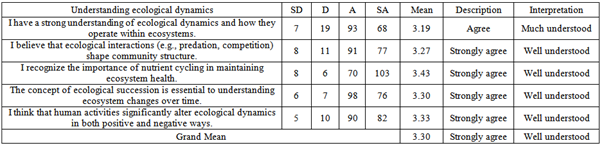
Table 1 indicates that respondents generally have a strong understanding of ecological dynamics, with a grand mean of 3.30 (Strongly Agree). This implies that respondents seem to have a strong grasp of ecological dynamics and their importance in ecosystem functioning. Furthermore, most respondents strongly agreed that ecological interactions shape community structure (x=3.27) and recognized the importance of nutrient cycling for ecosystem health (x=3.43). They also displayed a solid understanding of ecological succession (x=3.30) and the significant impact of human activities on ecosystems (x=3.33). Meanwhile, they feel moderately confident in their understanding of ecological dynamics as reflected by statement 1 with a mean of 3.19.
The respondents demonstrated a robust understanding of ecological dynamics, which closely aligns with the comprehensive insights found in the academic literature. Their awareness of key ecological concepts such as ecological interactions, nutrient cycling, ecological succession, and the impact of human activities on ecosystems highlights the multifaceted nature of ecological studies. These concepts are essential for understanding ecosystem functioning and are consistently supported by a wide range of research. For instance, ecological interactions like predator-prey dynamics play a pivotal role in shaping community structures. These interactions are frequently modeled using advanced mathematical and statistical approaches to predict system behaviors and equilibrium states 8. Additionally, Ye 9 emphasized that biodiversity plays a critical role in enhancing ecosystem resilience and the efficiency of nutrient cycling. The decline of biodiversity, on the other hand, exacerbates environmental vulnerabilities. Understanding these dynamics is essential for developing effective, sustainable management practices aimed at mitigating the negative impacts of human activities on ecosystems.
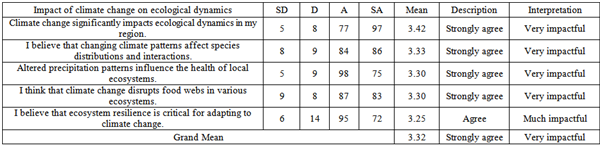
Table 2 shows the mean distribution on the known impact of climate change on ecological dynamics. The grand mean of 3.32 interpreted as Strongly Agree reflects a widespread recognition of climate change’s role in altering ecological processes.
The highest mean score, 3.42, was recorded for the statement "Climate change significantly impacts ecological dynamics in my region," suggesting that most respondents strongly believe in the tangible effects of climate change on their local ecosystems. This finding aligns with the extensive body of literature documenting the global and regional impacts of climate change on ecological systems, including shifts in species distributions and disruptions to ecosystem services 9, 10. Similarly, the statement "I believe that changing climate patterns affect species distributions and interactions" received a mean score of 3.33, indicating strong agreement. Respondents recognize that climate change influences species’ geographic ranges and their interactions, such as predator-prey dynamics, competition, and mutualism. This is consistent with research showing that climate-induced changes in temperature and precipitation patterns can cause species to shift their ranges and alter ecological interactions 10, 11. Statement 3, “Altered precipitation patterns influence the health of local ecosystems”, with a mean score of 3.30, suggests that respondents also acknowledge the significant role of changing rainfall in shaping ecosystem health. Altered precipitation can affect water availability, plant growth, and the overall stability of ecosystems, leading to cascading effects on biodiversity and ecosystem services 12, 13. Such findings highlight the vulnerability of ecosystems to changes in hydrological cycles due to climate change. The disruption of food webs, also rated with a mean score of 3.30, further underscores the respondents' understanding of how climate change can disturb intricate ecological networks. Climate change can lead to mismatches in the timing of species interactions, such as when predators and prey or pollinators and plants become temporally disconnected, threatening ecosystem stability 14, 15. These disruptions in food webs can have cascading effects on ecosystem services that are essential for human well-being. Lastly, the statement "I believe that ecosystem resilience is critical for adapting to climate change" received a slightly lower, yet still strong mean of 3.25, indicating general agreement. This suggests that while respondents acknowledge the importance of ecosystem resilience in mitigating climate impacts, they may also recognize the challenges associated with maintaining or restoring this resilience in the face of ongoing climate pressures. The concept of ecosystem resilience has been widely discussed in the literature as a key factor in helping ecosystems adapt to climate change 7, 16.
Furthermore, the results reveal a deep awareness among respondents of the multifaceted ways in which climate change influences ecological dynamics. The consistent agreement across all statements highlights the importance of addressing climate impacts on biodiversity, ecosystem functions, and resilience as part of broader climate adaptation and conservation efforts.
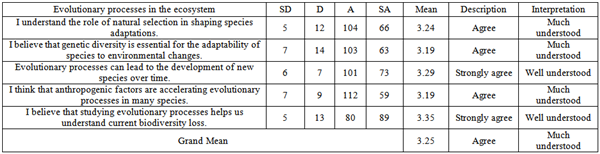
Table 3 displays the results on the understanding of evolutionary processes in ecosystems. The grand mean of 3.25 interpreted as “Agree” suggests an overall agreement with the statements related to evolutionary processes, with several items rated as "Agree" and others as "Strongly Agree."
The statement "I understand the role of natural selection in shaping species adaptations" received a mean score of 3.24, suggesting that respondents generally agree with the idea that natural selection is a key factor in species adaptation to environmental pressures. This aligns with recent research that continues to affirm the centrality of natural selection in shaping species over time 17.
Respondents also expressed agreement with the statement "I believe that genetic diversity is essential for the adaptability of species to environmental changes," which had a mean score of 3.19. This finding is consistent with studies highlighting the critical role of genetic diversity in enhancing a population's ability to respond to environmental stresses, such as climate change and habitat alteration 18, 19. For the statement "Evolutionary processes can lead to the development of new species over time," the mean score of 3.29 reflects a strong understanding of speciation. Evolutionary processes, such as adaptive radiation and genetic drift, continue to drive the diversification of life forms over time 2. Respondents’ agreement with this statement indicates an awareness of how evolutionary forces contribute to the generation of new species. The statement "I think that anthropogenic factors are accelerating evolutionary processes in many species," received a mean score of 3.19, suggesting that respondents recognize human activities as a significant driver of evolutionary change. Anthropogenic pressures, including climate change, pollution, and habitat destruction, can accelerate evolutionary processes, such as the rapid development of resistance traits in species 20, 21. Finally, the statement "I believe that studying evolutionary processes helps us understand current biodiversity loss" received the highest mean score of 3.35. This highlights the respondents' recognition of the importance of evolutionary theory in understanding biodiversity loss, as ongoing environmental changes drive species extinctions and adaptation challenges. Evolutionary studies provide key insights into how biodiversity is impacted by anthropogenic activities and how adaptive capacity may be compromised 22, 23.
The results suggest that respondents have a strong grasp of evolutionary processes, particularly in relation to adaptation, speciation, and the impacts of human activities on evolutionary dynamics. This understanding is vital for addressing the current biodiversity crisis and developing strategies for conservation in the face of rapid environmental changes.
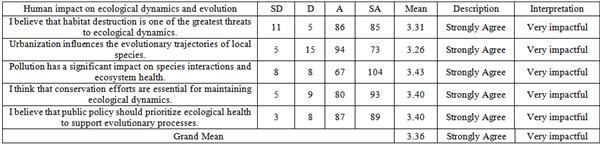
Table 4 shows the perspectives of the respondents on human impact on ecological dynamics and evolution. The grand mean of 3.36 which is interpreted as Strongly Agree indicates that the respondents recognize that human activities, such as habitat destruction, urbanization, and pollution, significantly alter biodiversity and ecological processes. Moreover, respondents believe that conservation and public policy are essential in maintaining ecological dynamics and evolutionary processes.
The respondents believe that habitat destruction is one of the greatest threats to ecological dynamics (‾x=3.31). Habitat destruction impacts 88.3% of threatened species, making it the most significant threat to biodiversity. It is the dominant factor for 71.3% of species at risk of extinction, necessitating urgent global environmental focus and resources to mitigate its effects 24. Habitat destruction is a major threat to biodiversity, particularly affecting rain forests, wetlands, and coral reefs. It leads to the loss of species-rich communities, disrupting ecological dynamics and threatening the survival of numerous species reliant on these habitats 25. Ecological dynamics are seriously threatened by habitat destruction, which results in a decline in biodiversity and changed interactions between species. Loss of habitat has serious repercussions that impact not just specific species but also the complex interactions that exist within ecosystems.
Moreover, the respondents strongly agree that urbanization influences the evolutionary trajectories of local species (‾x=3.26). Wood, Palkovacs, Olsen, & Kinnison 26 research supports the idea that human influence can enhance the eco-evolutionary potential of species, facilitating rapid evolutionary changes in response to ecological shifts. Furthermore, most respondents strongly agree that pollution has a significant impact on species interactions and ecosystem health (‾x=3.43). Pollution has a profound effect on ecosystem health and species interactions, with intricate ecological repercussions. These impacts are made worse by the interaction of chemical contaminants with climate change, which affects species behavior, community structure, and the general functioning of ecosystems. Pollution leads to habitat degradation and loss of biodiversity, disrupting ecological balance and resilience 27. Pollutants can alter the behavior and physiology of sentinel species, such as beavers and otters, which serve as indicators of ecosystem health 28. Moreover, invertebrate communities in aquatic systems show altered richness and abundance due to chemical stressors, affecting predator-prey relationships and nutrient cycling 29.
Moreover, the statements “I think that conservation efforts are essential for maintaining ecological dynamics” (‾x=3.40) and “I believe that public policy should prioritize ecological health to support evolutionary processes” (‾x=3.40) imply that students show great concern and support in maintaining ecological dynamics and evolutionary processes. Considering conservation activities have a direct impact on biodiversity, ecosystem stability, and resilience to environmental changes, they are essential for preserving ecological processes. Effective conservation strategies, including the establishment of protected areas and sustainable resource use, are necessary to support ecological balance and ensure the long-term sustainability of our planet's ecosystems 30.
Additionally, public policy should indeed prioritize ecological health to support evolutionary processes, as this approach is crucial for sustaining biodiversity and ensuring the resilience of ecosystems. The findings of Stephen 31 emphasizes that healthy public policy should extend beyond human health to include animals and ecosystems, promoting a holistic approach that recognizes the interconnectedness of health across sectors.
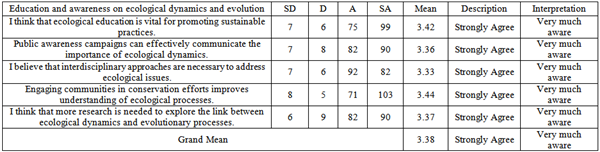
Table 5 presents the perspectives of the respondents on education and awareness on ecological dynamics and evolution. With a grand mean of 3.38 (Strongly Agree), the respondents acknowledge the importance of raising awareness and educating people about ecological dynamics and evolution in order to promote a sustainable future.
Furthermore, most of the respondents strongly agreed that ecological education is vital for promoting sustainable practices (‾x=3.42). Ecological education is essential for fostering sustainable practices, as it cultivates environmental awareness and responsibility among students. Various studies highlight the integration of eco-education into curricula and its positive impact on both students and teachers. This integration not only enhances knowledge but also encourages active participation in sustainability initiatives. Incorporating eco-education into school curricula has been shown to significantly improve students' understanding of environmental issues 5. Engaging students in practical activities, such as recycling projects and nature walks, enhances their motivation and commitment to sustainability 4. While ecological education is vital for promoting sustainable practices, challenges such as resource constraints and inadequate teacher training persist, potentially hindering its effectiveness. Addressing these issues is crucial for maximizing the impact of eco-education on future generations.
Additionally, they strongly agreed that public awareness campaigns can effectively communicate the importance of ecological dynamics (‾x=3.36). Campaigns for public awareness that use a variety of media and instructional techniques are essential in conveying the significance of ecological dynamics. By increasing public awareness of environmental challenges, these campaigns hope to motivate people to take action and preserve the environment. The findings of Hakimi, Safi, & Momand, 6 supports the notion that public awareness significantly influences climate action by inspiring sustainable practices. Effective communication through campaigns can enhance understanding of ecological dynamics, empowering communities to engage actively in environmental initiatives, particularly in the context of Afghanistan's unique climate challenges.
Moreover, they believe that interdisciplinary approaches are necessary to address ecological issues (‾x=3.33). It is because these problems are intricate and multidimensional. By combining information from different domains, researchers can create comprehensive solutions that take into account social, economic, and environmental concerns. Interdisciplinary education equips future professionals with the necessary skills to tackle environmental problems, promoting a deeper understanding of ecological systems 32. Continuous updates to curricula are vital to prepare students for emerging environmental challenges and to foster sustainable development.
In addition, they strongly agree that engaging communities in conservation efforts improves understanding of ecological processes (‾x=3.44). Involving communities in conservation initiatives greatly improves their comprehension of ecological processes. This engagement increases knowledge and awareness, which results in better environmental stewardship. Community engagement initiatives, such as those in the Sungai Jernih Geo Park, have shown that increased awareness leads to better understanding of local ecological challenges 33. Involving local populations in conservation efforts allows them to connect with their environment, as seen in the Great Plains, where participatory research improved ecological understanding among ranchers 33. While community engagement is crucial for enhancing ecological understanding, it is also essential to recognize the challenges practitioners face in balancing resource-intensive methods with effective communication strategies. This balance is vital for achieving sustainable conservation outcomes.
Also, they strongly agree that more research is needed to explore the link between ecological dynamics and evolutionary processes (‾x=3.37). The respondents shows interest in exploring ecological dynamics and evolutionary processes. Studies reveal that the interaction between ecological dynamics and evolutionary processes is intricate and multidimensional, requiring further research. The emerging field of eco-evolutionary dynamics highlights the reciprocal influences between these domains, suggesting that understanding their interactions is crucial for predicting biodiversity outcomes and species adaptations in changing environments. Despite advancements, many aspects of eco-evolutionary interactions remain underexplored, particularly the reverse feedback from evolutionary changes to ecological dynamics 34. Continued research is essential to unravel these complexities, especially in the context of global change and biodiversity management strategies. Despite the fact that our understanding of eco-evolutionary dynamics is expanding, the historical separation of ecology and evolution has resulted in knowledge gaps. Bridging these gaps through interdisciplinary research will be vital for addressing ecological challenges in the future.
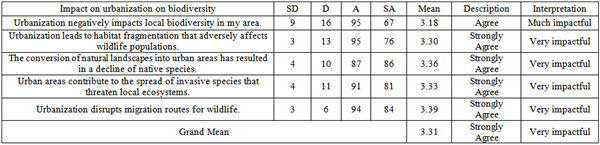
Table 6 presents the perspective of the respondents regarding the impact of urbanization on biodiversity. The grand mean of 3.31 (strongly agree) suggests that respondents believe urbanization has had a significant influence on local biodiversity, mostly because of altered ecological dynamics, habitat loss, and fragmentation. The respondents' perspectives on the impact of urbanization on biodiversity reveal a consensus on its predominantly negative effects across various species and ecosystems.
Furthermore, most of the respondents agree that urbanization leads to habitat fragmentation that adversely affects wildlife populations (‾x=3.30). Urbanization is a major factor in habitat fragmentation, which has a negative impact on animal populations through a number of methods. Although certain wildlife can survive in urban settings, fragmentation generally results in decreased genetic diversity, changed community compositions, and difficulties for species migration. The study of De Vos et. al. 35 indicates that urban expansion can significantly reduce biodiversity levels, particularly in areas with substantial urban growth, despite minor continental-scale effects.
The respondents also agreed that the conversion of natural landscapes into urban areas has resulted in a decline of native species (‾x=3.36). The conversion of natural landscapes into urban areas significantly influences biodiversity, leading to a decline in native species. Urbanization exacerbates habitat loss, alters community structures, and affects the abundance and richness of species, particularly birds and bees 36. Urbanization causes the loss and degradation of natural habitats, leading to a decline in species diversity. For instance, butterfly species richness decreased by 50% in a nature reserve adjacent to urban areas 37. The fragmentation of habitats disrupts ecological networks, making it difficult for species to thrive and reproduce, as seen in studies of woodland birds where urbanization led to poorer and more homogeneous communities 38, 39.
The results of this study reveal that respondents have a thorough understanding of ecological processes and their vital role in maintaining ecosystem health. They recognize how various ecological interactions, such as predator-prey dynamics and species relationships, contribute to community structure and the overall functioning of ecosystems. Additionally, they understand the importance of nutrient cycling and ecological succession as foundational elements for ecosystem stability. Respondents also acknowledge the significant negative effects of human activities, such as urbanization, habitat destruction, and pollution, on biodiversity and the delicate balance of ecosystems.
It further suggests that respondents are aware of the pressing challenges posed by human impact on the environment. They recognize that urbanization, in particular, disrupts local biodiversity by altering habitats and contributing to fragmentation, which can lead to species decline. The consensus indicates a strong belief in the need for effective conservation measures to protect biodiversity and mitigate the ongoing environmental degradation.
The importance of education and public awareness in fostering a more sustainable future is also emphasized. They view the promotion of ecological knowledge and the understanding of evolutionary processes as essential for encouraging responsible behaviors and creating informed policies. The findings suggest that increasing awareness can play a critical role in shaping public support for conservation efforts and environmental protection initiatives.
Thus, this study underscores the respondents' comprehensive understanding of ecological dynamics and their interconnectedness. This awareness is seen as crucial for developing strategies to address current environmental crises, including climate change, habitat loss, and biodiversity decline. Respondents advocate for informed policy decisions and conservation practices that prioritize long-term ecosystem health and sustainability.
| [1] | Korpach, A. M., Garroway, C. J., Mills, A. M., von Zuben, V., Davy, C. M., & Fraser, K. C. (2022). Urbanization and artificial light at night reduce the functional connectivity of migratory aerial habitat. Ecography, 2022(8), e05581. | ||
| In article | View Article | ||
| [2] | Hoffmann, A. A., & Sgrò, C. M. (2015). Climate change and evolutionary adaptation. Nature, 526(7574), 421-430. | ||
| In article | |||
| [3] | Bellard, C., Bertelsmeier, C., Leadley, P., Thuiller, W., & Courchamp, F. (2012). Impacts of climate change on the future of biodiversity. Ecology Letters, 15(4), 365-377. | ||
| In article | View Article PubMed | ||
| [4] | Afrikanov, L. (2024). Teaching for a sustainable future: Case studies from the green schools project in Bulgaria. Обучение по природни науки и върхови технологии, 33(3-4), 219-226. | ||
| In article | View Article | ||
| [5] | de Albuquerque, C. V., Cordeiro, A. M. R., Alcoforado, J. L. M., & de Carvalho, J. A. R. (2024). Eco-education: an intervention in the curriculum and in the training process of teachers in the Feira Nova-PE School System. Caderno Pedagógico, 21(10), e10000-e10000. | ||
| In article | View Article | ||
| [6] | Hakimi, H., Safi, M. A. H., & Momand, I. U. R. (2024). Public Awareness, and its Impacts on Climate Change. Nangarhar University International Journal of Biosciences, 380-384. | ||
| In article | View Article | ||
| [7] | Heller, N. E., & Zavaleta, E. S. (2009). Biodiversity management in the face of climate change: A review of 22 years of recommendations. Biological Conservation, 142(1), 14-32. | ||
| In article | View Article | ||
| [8] | Laubmeier, Amanda & Cazelles, Bernard & Cuddington, Kim & Erickson, Kelley & Fortin, Marie-Josee & Ogle, Kiona & Wikle, Christopher & Zhu, Kai & Zipkin, Elise. (2020). Ecological Dynamics: Integrating Empirical, Statistical, and Analytical Methods. Trends in ecology & evolution. 35. 10.1016/ j.tree.2020.08.006. | ||
| In article | View Article PubMed | ||
| [9] | Ye, X., (2024). Research on Biodiversity and Ecological Environment Cycle: Interaction and Balance Mechanisms. SHS web of conferences. | ||
| In article | View Article | ||
| [10] | Parmesan, C., & Yohe, G. (2003). A globally coherent fingerprint of climate change impacts across natural systems. Nature, 421(6918), 37-42. | ||
| In article | View Article PubMed | ||
| [11] | Thomas, C. D., Cameron, A., Green, R. E., Bakkenes, M., Beaumont, L. J., Collingham, Y. C., ... & Pearson, R. G. (2004). Extinction risk from climate change. Nature, 427(6970), 145-148. | ||
| In article | View Article PubMed | ||
| [12] | Smith, J. A., Jones, R., & Brooks, T. (2017). The effects of altered precipitation patterns on biodiversity. Environmental Research Letters, 12(9), 094005. | ||
| In article | View Article | ||
| [13] | Rasmus, S., Brower, E., & Sutton, M. (2020). Altered precipitation and ecosystem responses. Nature Climate Change, 10(5), 674-679. | ||
| In article | |||
| [14] | Visser, M. E., Van Noordwijk, A. J., & Tinbergen, J. M. (2010). Climate change and the timing of avian reproduction: A global perspective. Global Change Biology, 16(6), 1290-1299. | ||
| In article | |||
| [15] | Lurgi, M., Lopez, B. C., & Montoya, J. M. (2012). Climate change impacts on biodiversity: A review of the existing literature and an outlook for future studies. Global Ecology and Biogeography, 21(6), 566-577. | ||
| In article | |||
| [16] | Folke, C., Carpenter, S. R., Walker, B., Scheffer, M., Elmqvist, T., Gunderson, L., & Holling, C. S. (2010). Resilience thinking: Integrating resilience, adaptability and transformability. Ecology and Society, 15(4), 20. | ||
| In article | View Article | ||
| [17] | Gavrilets, S. (2015). Adaptive radiations and the evolution of species diversity. Springer. | ||
| In article | |||
| [18] | McDonald, J. H., et al. (2018). The role of genetic diversity in the adaptation of populations to environmental changes. Biological Conservation, 217, 9-15. | ||
| In article | |||
| [19] | Yang, X., et al. (2020). The significance of genetic diversity for species conservation. Trends in Ecology & Evolution, 35(8), 655-669. | ||
| In article | |||
| [20] | Urban, M. C., et al. (2016). Human influence on evolutionary trajectories of biodiversity. Nature Ecology & Evolution, 1(8), 0001. | ||
| In article | |||
| [21] | Løvlie, H., et al. (2020). Anthropogenic drivers of evolutionary change: From adaptation to extinction. Nature Reviews Ecology & Evolution, 5(11), 693-708. | ||
| In article | |||
| [22] | Habel, J. C., et al. (2019). Evolutionary dynamics of species facing global change. Nature Sustainability, 2(3), 170-179. | ||
| In article | |||
| [23] | McKinney, M. L., et al. (2021). Evolutionary consequences of environmental change on biodiversity loss. Biological Conservation, 255, 108953. | ||
| In article | |||
| [24] | Hogue, A. S., & Breon, K. (2022). The greatest threats to species. Conservation Science and Practice, 4(5), e12670. | ||
| In article | View Article | ||
| [25] | Sher, A., (2022). Threats to Biodiversity: Habitat Change. | ||
| In article | View Article | ||
| [26] | Wood, Z. T., Palkovacs, E. P., Olsen, B. J., & Kinnison, M. T. (2021). The importance of eco-evolutionary potential in the Anthropocene. BioScience, 71(8), 805-819. | ||
| In article | View Article | ||
| [27] | Mirametova, N., Kurbanazarova, A., Sapaeva, R., & Kurbanbaeva, Z. (2024). POLLUTION AND ITS ECOLOGICAL CONSEQUENCES: STRATEGIES FOR MITIGATING ENVIRONMENTAL DAMAGE. American Journal Of Biomedical Science & Pharmaceutical Innovation, 4(10), 17-35. | ||
| In article | View Article | ||
| [28] | Peterson, E. K., & Schulte, B. A. (2016). Impacts of pollutants on beavers and otters with implications for ecosystem ramifications. Journal of Contemporary Water Research & Education, 157(1), 33-45. | ||
| In article | View Article | ||
| [29] | Carter, R., & Ross, H., (2016). Wildlife, habitat and the city. Australasian Journal of Environmental Management. | ||
| In article | View Article | ||
| [30] | Durmaz, A., Torunoğlu, E. İ., Aydın, B., & Aytar, E. C. (2024). Need for Biodiversity Conservation and Conservation Strategies. In Biodiversity Loss Assessment for Ecosystem Protection (pp. 167-187). IGI Global. | ||
| In article | View Article | ||
| [31] | Stephen, C. (2020). Expanding the Concept of Healthy Public Policy for Animals, Health, and Society. In Animals, Health, and Society (pp. 167-180). CRC Press. | ||
| In article | View Article | ||
| [32] | Madhavi, P., (2019). Interdisciplinary Research Approaches on Environment: A Matter of Sustainable Development in Higher Education. | ||
| In article | View Article | ||
| [33] | Wilmer, H., Porensky, L. M., Fernández-Giménez, M. E., Derner, J. D., Augustine, D. J., Ritten, J. P., & Peck, D. P. (2019). Community-engaged research builds a nature-culture of hope on North American Great Plains rangelands. Social Sciences, 8(1), 22. | ||
| In article | View Article | ||
| [34] | Thrall, P., & Blanc, S. (2023). Unravelling eco‐evolutionary dynamics: Understanding adaptation to global change. Ecology Letters, 26(S1). | ||
| In article | View Article PubMed | ||
| [35] | Kassim, S. A., Noor, N. M., Nazri, R., Ahmad, Z., Fuad, N., & Azizan, F. L. (2024). 1. Enhancing community engagement for conservation and rehabilitation through a case study in sungai jernih geo park perlis. Journal of Tourism, Hospitality and Environment Management. | ||
| In article | View Article | ||
| [36] | Leslie, T., & Griffiths, C. (2022). The Birds and Bees of Urban Biodiversity: Patterns, Problems, and a Path Forward. In The City is an Ecosystem (pp. 59-73). Routledge. | ||
| In article | View Article | ||
| [37] | Habel, J. C., Ulrich, W., Gros, P., & Teucher, M. (2024). Butterfly loss in urban landscapes and nature reserves. Journal for Nature Conservation, 78, 126562. | ||
| In article | View Article | ||
| [38] | Sidemo‐Holm, W., Ekroos, J., Reina García, S., Söderström, B., & Hedblom, M. (2022). Urbanization causes biotic homogenization of woodland bird communities at multiple spatial scales. Global Change Biology, 28(21), 6152-6164. | ||
| In article | View Article PubMed | ||
| [39] | De Vos, K., Janssens, C., Jacobs, L., Campforts, B., Boere, E., Kozicka, M., ... & Govers, G. (2024). African food system and biodiversity mainly affected by urbanization via dietary shifts. Nature Sustainability, 1-10. | ||
| In article | View Article | ||
Published with license by Science and Education Publishing, Copyright © 2025 Krisel M. Anoling, Charmaine Ruth G. Abella, Madeilyn B. Estacio and Romiro G. Bautista
 This work is licensed under a Creative Commons Attribution 4.0 International License. To view a copy of this license, visit
http://creativecommons.org/licenses/by/4.0/
This work is licensed under a Creative Commons Attribution 4.0 International License. To view a copy of this license, visit
http://creativecommons.org/licenses/by/4.0/
| [1] | Korpach, A. M., Garroway, C. J., Mills, A. M., von Zuben, V., Davy, C. M., & Fraser, K. C. (2022). Urbanization and artificial light at night reduce the functional connectivity of migratory aerial habitat. Ecography, 2022(8), e05581. | ||
| In article | View Article | ||
| [2] | Hoffmann, A. A., & Sgrò, C. M. (2015). Climate change and evolutionary adaptation. Nature, 526(7574), 421-430. | ||
| In article | |||
| [3] | Bellard, C., Bertelsmeier, C., Leadley, P., Thuiller, W., & Courchamp, F. (2012). Impacts of climate change on the future of biodiversity. Ecology Letters, 15(4), 365-377. | ||
| In article | View Article PubMed | ||
| [4] | Afrikanov, L. (2024). Teaching for a sustainable future: Case studies from the green schools project in Bulgaria. Обучение по природни науки и върхови технологии, 33(3-4), 219-226. | ||
| In article | View Article | ||
| [5] | de Albuquerque, C. V., Cordeiro, A. M. R., Alcoforado, J. L. M., & de Carvalho, J. A. R. (2024). Eco-education: an intervention in the curriculum and in the training process of teachers in the Feira Nova-PE School System. Caderno Pedagógico, 21(10), e10000-e10000. | ||
| In article | View Article | ||
| [6] | Hakimi, H., Safi, M. A. H., & Momand, I. U. R. (2024). Public Awareness, and its Impacts on Climate Change. Nangarhar University International Journal of Biosciences, 380-384. | ||
| In article | View Article | ||
| [7] | Heller, N. E., & Zavaleta, E. S. (2009). Biodiversity management in the face of climate change: A review of 22 years of recommendations. Biological Conservation, 142(1), 14-32. | ||
| In article | View Article | ||
| [8] | Laubmeier, Amanda & Cazelles, Bernard & Cuddington, Kim & Erickson, Kelley & Fortin, Marie-Josee & Ogle, Kiona & Wikle, Christopher & Zhu, Kai & Zipkin, Elise. (2020). Ecological Dynamics: Integrating Empirical, Statistical, and Analytical Methods. Trends in ecology & evolution. 35. 10.1016/ j.tree.2020.08.006. | ||
| In article | View Article PubMed | ||
| [9] | Ye, X., (2024). Research on Biodiversity and Ecological Environment Cycle: Interaction and Balance Mechanisms. SHS web of conferences. | ||
| In article | View Article | ||
| [10] | Parmesan, C., & Yohe, G. (2003). A globally coherent fingerprint of climate change impacts across natural systems. Nature, 421(6918), 37-42. | ||
| In article | View Article PubMed | ||
| [11] | Thomas, C. D., Cameron, A., Green, R. E., Bakkenes, M., Beaumont, L. J., Collingham, Y. C., ... & Pearson, R. G. (2004). Extinction risk from climate change. Nature, 427(6970), 145-148. | ||
| In article | View Article PubMed | ||
| [12] | Smith, J. A., Jones, R., & Brooks, T. (2017). The effects of altered precipitation patterns on biodiversity. Environmental Research Letters, 12(9), 094005. | ||
| In article | View Article | ||
| [13] | Rasmus, S., Brower, E., & Sutton, M. (2020). Altered precipitation and ecosystem responses. Nature Climate Change, 10(5), 674-679. | ||
| In article | |||
| [14] | Visser, M. E., Van Noordwijk, A. J., & Tinbergen, J. M. (2010). Climate change and the timing of avian reproduction: A global perspective. Global Change Biology, 16(6), 1290-1299. | ||
| In article | |||
| [15] | Lurgi, M., Lopez, B. C., & Montoya, J. M. (2012). Climate change impacts on biodiversity: A review of the existing literature and an outlook for future studies. Global Ecology and Biogeography, 21(6), 566-577. | ||
| In article | |||
| [16] | Folke, C., Carpenter, S. R., Walker, B., Scheffer, M., Elmqvist, T., Gunderson, L., & Holling, C. S. (2010). Resilience thinking: Integrating resilience, adaptability and transformability. Ecology and Society, 15(4), 20. | ||
| In article | View Article | ||
| [17] | Gavrilets, S. (2015). Adaptive radiations and the evolution of species diversity. Springer. | ||
| In article | |||
| [18] | McDonald, J. H., et al. (2018). The role of genetic diversity in the adaptation of populations to environmental changes. Biological Conservation, 217, 9-15. | ||
| In article | |||
| [19] | Yang, X., et al. (2020). The significance of genetic diversity for species conservation. Trends in Ecology & Evolution, 35(8), 655-669. | ||
| In article | |||
| [20] | Urban, M. C., et al. (2016). Human influence on evolutionary trajectories of biodiversity. Nature Ecology & Evolution, 1(8), 0001. | ||
| In article | |||
| [21] | Løvlie, H., et al. (2020). Anthropogenic drivers of evolutionary change: From adaptation to extinction. Nature Reviews Ecology & Evolution, 5(11), 693-708. | ||
| In article | |||
| [22] | Habel, J. C., et al. (2019). Evolutionary dynamics of species facing global change. Nature Sustainability, 2(3), 170-179. | ||
| In article | |||
| [23] | McKinney, M. L., et al. (2021). Evolutionary consequences of environmental change on biodiversity loss. Biological Conservation, 255, 108953. | ||
| In article | |||
| [24] | Hogue, A. S., & Breon, K. (2022). The greatest threats to species. Conservation Science and Practice, 4(5), e12670. | ||
| In article | View Article | ||
| [25] | Sher, A., (2022). Threats to Biodiversity: Habitat Change. | ||
| In article | View Article | ||
| [26] | Wood, Z. T., Palkovacs, E. P., Olsen, B. J., & Kinnison, M. T. (2021). The importance of eco-evolutionary potential in the Anthropocene. BioScience, 71(8), 805-819. | ||
| In article | View Article | ||
| [27] | Mirametova, N., Kurbanazarova, A., Sapaeva, R., & Kurbanbaeva, Z. (2024). POLLUTION AND ITS ECOLOGICAL CONSEQUENCES: STRATEGIES FOR MITIGATING ENVIRONMENTAL DAMAGE. American Journal Of Biomedical Science & Pharmaceutical Innovation, 4(10), 17-35. | ||
| In article | View Article | ||
| [28] | Peterson, E. K., & Schulte, B. A. (2016). Impacts of pollutants on beavers and otters with implications for ecosystem ramifications. Journal of Contemporary Water Research & Education, 157(1), 33-45. | ||
| In article | View Article | ||
| [29] | Carter, R., & Ross, H., (2016). Wildlife, habitat and the city. Australasian Journal of Environmental Management. | ||
| In article | View Article | ||
| [30] | Durmaz, A., Torunoğlu, E. İ., Aydın, B., & Aytar, E. C. (2024). Need for Biodiversity Conservation and Conservation Strategies. In Biodiversity Loss Assessment for Ecosystem Protection (pp. 167-187). IGI Global. | ||
| In article | View Article | ||
| [31] | Stephen, C. (2020). Expanding the Concept of Healthy Public Policy for Animals, Health, and Society. In Animals, Health, and Society (pp. 167-180). CRC Press. | ||
| In article | View Article | ||
| [32] | Madhavi, P., (2019). Interdisciplinary Research Approaches on Environment: A Matter of Sustainable Development in Higher Education. | ||
| In article | View Article | ||
| [33] | Wilmer, H., Porensky, L. M., Fernández-Giménez, M. E., Derner, J. D., Augustine, D. J., Ritten, J. P., & Peck, D. P. (2019). Community-engaged research builds a nature-culture of hope on North American Great Plains rangelands. Social Sciences, 8(1), 22. | ||
| In article | View Article | ||
| [34] | Thrall, P., & Blanc, S. (2023). Unravelling eco‐evolutionary dynamics: Understanding adaptation to global change. Ecology Letters, 26(S1). | ||
| In article | View Article PubMed | ||
| [35] | Kassim, S. A., Noor, N. M., Nazri, R., Ahmad, Z., Fuad, N., & Azizan, F. L. (2024). 1. Enhancing community engagement for conservation and rehabilitation through a case study in sungai jernih geo park perlis. Journal of Tourism, Hospitality and Environment Management. | ||
| In article | View Article | ||
| [36] | Leslie, T., & Griffiths, C. (2022). The Birds and Bees of Urban Biodiversity: Patterns, Problems, and a Path Forward. In The City is an Ecosystem (pp. 59-73). Routledge. | ||
| In article | View Article | ||
| [37] | Habel, J. C., Ulrich, W., Gros, P., & Teucher, M. (2024). Butterfly loss in urban landscapes and nature reserves. Journal for Nature Conservation, 78, 126562. | ||
| In article | View Article | ||
| [38] | Sidemo‐Holm, W., Ekroos, J., Reina García, S., Söderström, B., & Hedblom, M. (2022). Urbanization causes biotic homogenization of woodland bird communities at multiple spatial scales. Global Change Biology, 28(21), 6152-6164. | ||
| In article | View Article PubMed | ||
| [39] | De Vos, K., Janssens, C., Jacobs, L., Campforts, B., Boere, E., Kozicka, M., ... & Govers, G. (2024). African food system and biodiversity mainly affected by urbanization via dietary shifts. Nature Sustainability, 1-10. | ||
| In article | View Article | ||