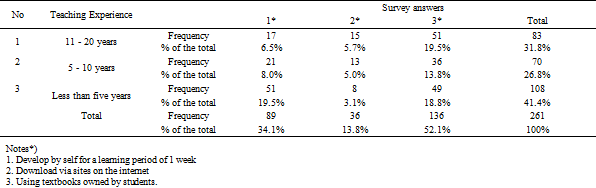
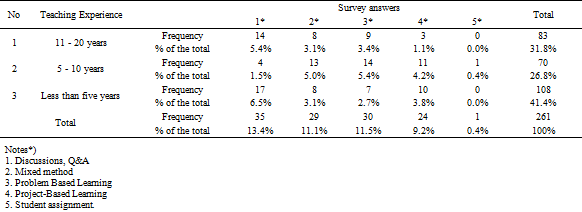
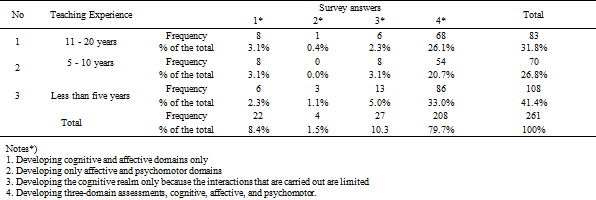
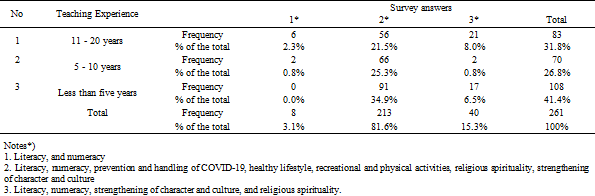
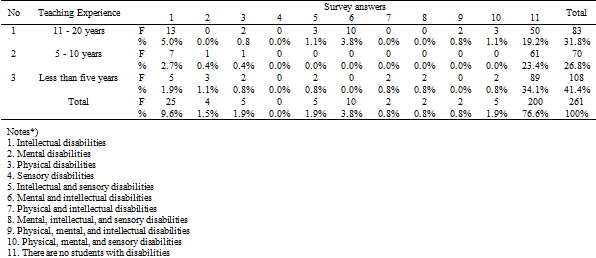
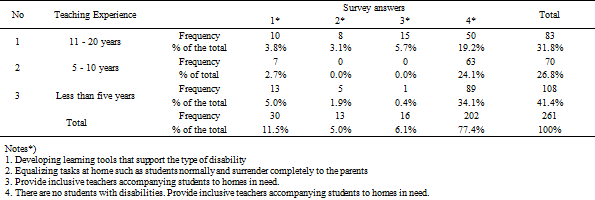
This data contains information about the implementation of distance learning carried out by elementary school teachers in Yogyakarta during the COVID-19 pandemic. The data presented is used as a GAP analysis to implement distance learning with home learning guidelines issued by the Ministry of Education and Culture of the Republic of Indonesia during the COVID-19 pandemic. The survey instrument was developed based on three essential elements in learning: planning, implementing, and evaluating the teachers in elementary schools. Expert validation test using CVR produces 20 items that match. The survey involved 261 teacher respondents spread across the city of Yogyakarta. The crosstabulation method was carried out to determine the relationship between teachers’ teaching experiences and readiness to carry out distance learning during the COVID-19 pandemic. Results crosstab analysis can be used to develop teachers’ ability to plan, implement, and evaluate distance learning if similar conditions recur in the future. The existing data also illustrates the readiness of elementary school teachers in Yogyakarta in facing the Industrial Revolution 4.0 era, where all fields require IT skills, including in education.
The development and advancement of technological innovations have an impact on all aspects of people's lives. People's behaviour and lifestyles also undergo rapid transformation because there are no boundaries between physical and virtual spaces. This began with the emergence of the industrial era 4.0, which features digitization, information transparency, connectivity, and automation 1. The big changes in the Industrial 4.0 era are understood as a breakthrough in a combination of physical and digital technologies, such as artificial intelligence (AI), cloud computing, big data, adaptive robots, augmented reality, additive manufacturing, and the Internet of things (IoT) 2. The technological revolution has changed the way people work or activities. Wolter identifies the following industry 4.0 challenges; 1) unsafe information technology; 2) reliability and stability of production machines; 3) lack of skills; 4) reluctance to change; and 5) the loss of a lot of work because of being replaced by automatic machines 3.
Facing the challenges of the industrial revolution 4.0, which is considered to degrade the role of humans, Japan gave birth to a concept of society 5.0 4. Society 5.0 has the goal of creating a supersmart society. The term supersmart means a human-centred society that can balance economic development by solving social problems through a system capable of integrating physical and virtual spaces 4. The future world of Society 5.0 must be designed so that society is endowed with vitality, comfort, and high-quality life, without being controlled or manipulated by AI or robots. It is hoped that people from all walks of life will have their needs met, receive quality serviceable to live a comfortable and vibrant life 5.
Society 5.0 focuses on humanism by prioritizing scientific and technological innovations, which have the main objective of development in the economic sector 6. Society 5.0 is human-centred and technology-based 7. Society 5.0 has the following characteristics: (1) full use of information and communication technology; (2) centred on the community; (3) community participation; (4) have the same values: sustainability, inclusion, effectiveness, and intelligence power; and (5) the development of economic disruption 8
The era of Society 5.0 also brings changes in the field of education. Enormous technological breakthroughs influence today's learning. Students in the era and Society 5.0 are technology literate and have access to technology to easily obtain information 1. Education in the technology era emphasizes access to enable people to pursue their desires and goals and provides a social learning space to easily choose and provide space for individuals to become who they want to be 9. In this context, students must be accustomed to thinking critically, constructively, creatively and innovatively so that the knowledge obtained can be applied in their lives and used as provisions in solving problems to adapt in the era of Society 5.0 10. To adapt to the era of Society 5.0, educators need to transform digital learning.
Currently, in various parts of the world, there has been an outbreak of the COVID-19 Pandemic. The existence of a pandemic has made many countries implement distance learning policies, including Indonesia. Distance learning during the pandemic was carried out from pre-school, elementary, junior high, high school to tertiary levels. Distance learning is a set of teaching methods where teaching activities are carried out separately from learning activities. The separation of the two activities can be in the form of location or condition, geographically and technologically separated (Rogers et al., 2009; Uno, 2009). Distance learning is based on the learners' learning freedom theory, with little face-to-face interaction with the teacher (Lassoued, Alhendawi, & Bashitialshaaer, 2020). Distance learning can occur through various modes of communication, including synchronous, asynchronous, or a combination of both (Perkowski, 2013). Synchronous communication occurs at the same time and generally at the same place or real time, whereas asynchronous does not occur at the same time or at the same place and generally occurs in a virtual environment via discussion platforms or e-mail. Literally, distance learning means that the learning process is carried out at a distance, separating teachers and learners, without being bound by distance, space and time.
Distance learning requires teachers to have an adequate level of information and communication technology skills; able to design quality and effective learning; understand learning media that can accommodate student literacy and support the concept of fun learning so that students feel comfortable learning independently, and maintain student interest in learning during a pandemic (Anwariningsih & Ernawati, 2013; Burdina, Krapotkina, & Nasyrova, 2019; Daniel, 2020). As the spearhead of the implementation of distance learning, teachers must have the ability to condition all instructional components, methods, media to be used in learning, use of instructional time related to application use, and psychological and social factors (Aliyyah et al., 2020).
The distance learning policy that was implemented suddenly made many schools less ready, especially in terms of minimal facilities and infrastructure (Aliyyah et al., 2020). In addition, the lack of knowledge of the skills of teachers in designing effective distance learning, unstable internet access, the unavailability of adequate learning devices from the parents' point of view such as cellphones, laptops, or tablets are also obstacles in implementing distance learning (Alea, Fabrea, Roldan, & Farooqi, 2020). Distance learning demands the involvement of the use of technology, so that students from low economic backgrounds feel the most impact of this situation (Drane, Vernon, & O'Shea, 2020). Obstacles in implementing distance learning can also be seen from the psychological side of students. Students feel forced to study distance without adequate facilities and infrastructure at home; there is no culture of distance learning among students, students are used to being in school to interact with friends and teachers; schools are closed for too long, making students bored, crying easily and losing their enthusiasm for learning (Purwanto et al., 2020).
Even though the distance learning policy raises many obstacles in the field, this moment is actually a challenge for teachers to adapt to the era of Society 5.0. The application of distance learning triggers teachers to increase competence in technology. Technology-based distance learning must be developed to provide quality education that can be accessed by anyone, anytime and anywhere (Sudibjo et al., 2019). A person starts thinking about the first steps that must be taken in facing the challenges that are in front of his eyes, thinking about how students are able to adapt to the era of society 5.0, and equipping students in critical and creative thinking (Nurjani, 2020).
The purpose of this study was to reveal patterns of distance learning in primary schools during the Covid-19 pandemic with the subject of taking data from teachers, school principals and parents / guardians of students. The research results are expected to provide an overview of the readiness of teachers in Indonesia in implementing distance learning by analyzing the gap between distance learning policies and those in the field. Thus, the results of the research can be used as a reference for determining strategic steps in preparing teachers for disaster emergencies as well as achieving educational targets in the Society 5.0 era.
• No research discusses the distance learning process during the COVID-19 pandemic in certain areas based on the guidelines for implementing learning from home issued by the Ministry of Education and Culture in Indonesia. Researchers have developed an instrument to analyze learning in a particular area for elementary school teachers as long as distance learning is applied.
• The data presented can illustrate distance learning as a form of evaluation of the local city government to improve teachers’ soft skills when faced with similar conditions.
• The data presented can illustrate the implementation of distance learning as a form of evaluation of the local city government to improve teachers’ soft skills in the face of the Industrial Revolution 4.0, full of challenges in technological development.
• The instrument developed can be used in similar studies because it has been through experts’ validation tests.
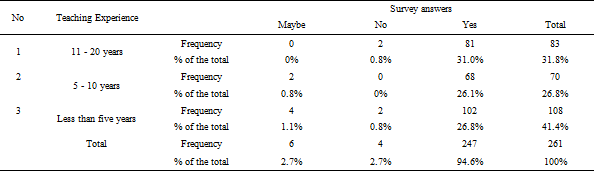
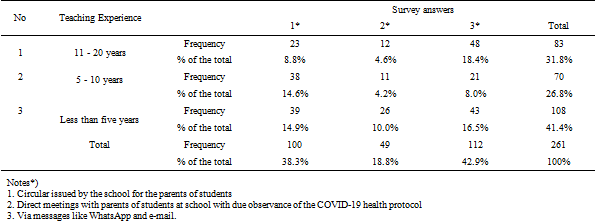
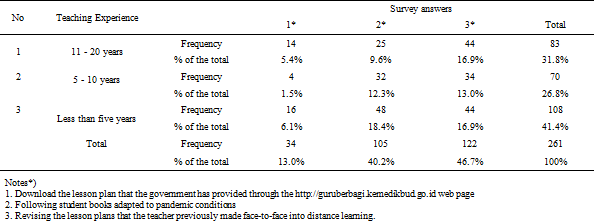
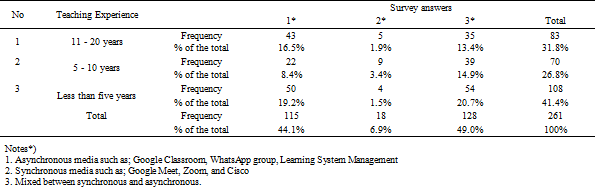
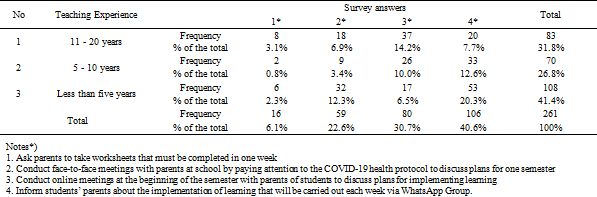
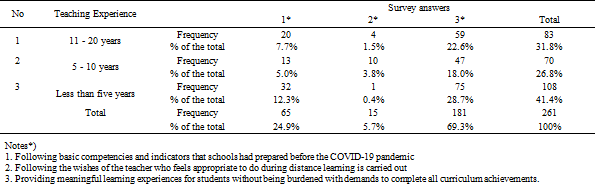
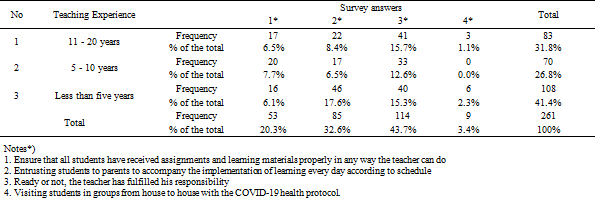
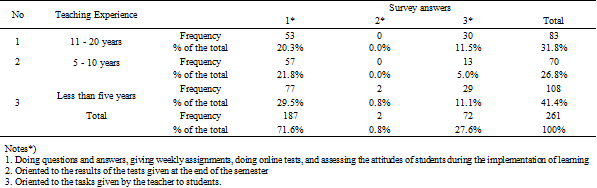
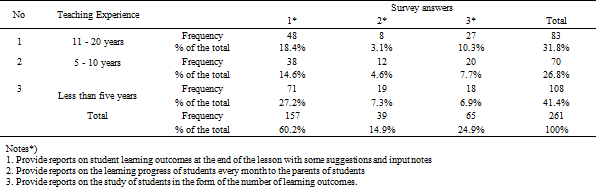
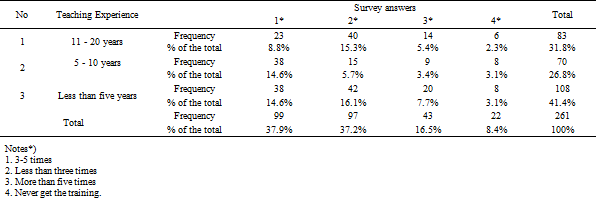
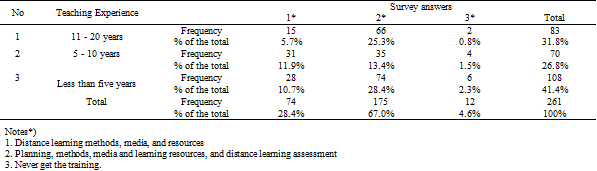
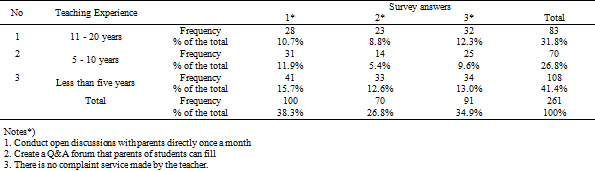
Data were obtained from 20 survey items used to collect information about the application of distance learning for elementary school teachers in Yogyakarta during the COVID-19 pandemic. The survey instrument is provided as supplementary files (link http://bit.ly/surveyInstrument). The data in this article are presented in tables. Table 1 shows the respondents’ experiences in teaching at elementary schools. Table 2 to Table 21 show the results of a cross-analysis analysis of planning, implementation, and evaluation of learning during the COVID-19 pandemic with the respondents’ teaching experiences. While Table 22 shows the results of the analysis of CVR items which ten experts validated before the instrument was used 11.
This type of research used in this research is survey research. Cross-Sectional Survey is used to find out temporary problems by collecting data only once. Survey research is used to solve actual large-scale problems with large populations, and large sample size is required 12. The survey instrument was distributed through the Google Form application and generated valid data from 261 elementary school teacher respondents in Yogyakarta City through a data coding and editing process 13. This data contains a crosstab analysis using SPSS between teacher teaching experiences and distance learning implementation during the COVID-19 pandemic. Data analysis results can be used to develop the teacher’s ability to carry out, implement, and evaluate learning if a similar condition occurs again later. The existing data also illustrates the readiness of elementary school teachers in Yogyakarta in facing the Industrial Revolution 4.0 era, where all fields require skills in using IT, including in education.
In order to fulfil the rights of students to get educational services during the emergency spread of the Corona Virus Disease (COVID-19), the learning process is carried out through the implementation of Learning from Home (BDR) as follows listed in the Ministry of Education and Culture Circular Letter Number 4 of 2020 concerning Implementation of Education Policies in the Emergency of the Spread of Corona Virus Disease (COVID-19) which was strengthened by SE Secretary-General Number 15 of 2020 concerning learning from home guidelines during the Covid 19 emergency 14.
This data provides an overview of the implementation of distance learning carried out by elementary school teachers in the Yogyakarta region of Indonesia. The results show that most of the teachers in Yogyakarta have implemented distance learning in accordance with the guidelines for implementing learning from home issued by the Indonesian Ministry of Education and Culture. Furthermore, a more in-depth research is needed on the implementation of distance learning in all regions in Indonesia using research instruments that have been developed (see Table 22). If the research is carried out thoroughly, it will get a picture of the readiness of Indonesian education, in this case, the level of primary school education in facing the era of society 5.0 in the future. Where the use of technology and information will also be widely applied in the learning process. What should be the attention of the government in Indonesia is the provision of distance learning services for children with special needs. Because there are still many inclusive schools that follow the same learning pattern as other normal children during the COVID-19 pandemic.
This manuscript has not been published elsewhere, or it is not under consideration for publication for other journals. The study was conducted by following Universitas Negeri Yogyakarta’s ethical standards. Informed consent was obtained from the participants before the survey.
The authors declare that they have no known competing financial interests or personal relationships which have, or could be perceived to have, influenced the work reported in these articles.
Firmansyah: Conceptualization, Methodology, Data Curation, Software, Writing, Formal analysis Wuri Wuryandani: Conceptualization, Validation, and Supervision Kurniawati: Formal analysis, Validation Amalia Rizki Ardiansyah: Writing - Review & Editing Irfan Wahyu Prananto: Resources and Visualization.
We want to thank all survey participants for their time and willingness to complete the questionnaire. We also thank the experts who were willing to validate the survey instruments used in obtaining research data.
Supplementary material associated with this article can be found in the online version at http://dx.doi.org/10.17632/tkmxw33y5c.1.
| [1] | N. Sudibjo, L. Idawati, H.G.R. Harsanti, Characteristics of Learning in the Era of Industry 4 . 0 and Society 5 . 0, Int. Conf. Educ. Technol. (ICoET 2019) Charact. 372 (2019). | ||
| In article | |||
| [2] | G. Karacay, Talent Development for Industry 4.0: Industry 4.0: Managing The Digital Transformation. Springer Series in Advanced Manufacturing, in: Springer, Cham, 2018: pp. 123-136. | ||
| In article | View Article | ||
| [3] | T.K. Sung, Industry 4.0: A Korea perspective, Technol. Forecast. Soc. Change. 132 (2018). | ||
| In article | View Article | ||
| [4] | M. Fukuyama, Society 5.0: Aiming for a New Human-centered Society, Japan SPOTLIGHT. 27 (2018). | ||
| In article | |||
| [5] | C. Miwa, Early Childhood Care and Education Practices in Japan for the Era of Society 5.0, in: 2020. | ||
| In article | View Article | ||
| [6] | B. Aquilani, M. Piccarozzi, T. Abbate, A. Codini, The role of open innovation and value co-creation in the challenging transition from industry 4.0 to society 5.0: Toward a theoretical framework, Sustain. 12 (2020). | ||
| In article | View Article | ||
| [7] | D.R.A. Wibawa, Ramadhan Prasetya., Peran Pendidikan Berbasis Higher Order Thinking Skills (Hots) Pada Tingkat Sekolah Menengah Pertama Di Era Society 5.0 Sebagai Penentu Kemajuan Bangsa Indonesia, Equilib. J. Ilm. Ekon. Dan Pembelajarannya. 7 (2019). | ||
| In article | View Article | ||
| [8] | B. Salgues, Society 5.0 and the Management of the Future, in: Soc. 5.0, ISTE Ltd, 2018: pp. 91-119. | ||
| In article | View Article PubMed | ||
| [9] | A. Collins, R. Halverson, The second educational revolution: Rethinking education in the age of technology, J. Comput. Assist. Learn. 26 (2010) 18-27. | ||
| In article | View Article | ||
| [10] | Emawati, Innovations of Indonesian Language and Literature Learning in The Era of Society 5.0., J. Pendidik. Indones. 3 (2020) 9-18. | ||
| In article | View Article | ||
| [11] | F.R. Wilson, W. Pan, D.A. Schumsky, Recalculation of the critical values for Lawshe’s content validity ratio, Meas. Eval. Couns. Dev. 45 (2012) 197-210. | ||
| In article | View Article | ||
| [12] | T. Widodo, Metode Penelitian Kuantitatif, UNS Press, Solo, 2008. | ||
| In article | |||
| [13] | R.M. Groves, F.J. Fowler Jr, M.P. Couper, J.M. Lepkowski, E. Singer, R. Tourangeau, Survey methodology, John Wiley \& Sons, 2011. | ||
| In article | |||
| [14] | Kemendikbud, Surat Edaran Sekretaris Jenderal No.15 Tahun 2020 Pedoman Pelaksanaan Belajar Dari Rumah Selama Darurat Bencana COVID-19 di Indonesia, Sekr. Nas. SPAB (Satuan Pendidik. Aman Bencana). (2020) 1-16. | ||
| In article | |||
Published with license by Science and Education Publishing, Copyright © 2021 Wuri Wuryandani, Firmansyah, Amalia Rizki Ardiansyah, Irfan Wahyu Prananto and Kurniawati
 This work is licensed under a Creative Commons Attribution 4.0 International License. To view a copy of this license, visit
http://creativecommons.org/licenses/by/4.0/
This work is licensed under a Creative Commons Attribution 4.0 International License. To view a copy of this license, visit
http://creativecommons.org/licenses/by/4.0/
| [1] | N. Sudibjo, L. Idawati, H.G.R. Harsanti, Characteristics of Learning in the Era of Industry 4 . 0 and Society 5 . 0, Int. Conf. Educ. Technol. (ICoET 2019) Charact. 372 (2019). | ||
| In article | |||
| [2] | G. Karacay, Talent Development for Industry 4.0: Industry 4.0: Managing The Digital Transformation. Springer Series in Advanced Manufacturing, in: Springer, Cham, 2018: pp. 123-136. | ||
| In article | View Article | ||
| [3] | T.K. Sung, Industry 4.0: A Korea perspective, Technol. Forecast. Soc. Change. 132 (2018). | ||
| In article | View Article | ||
| [4] | M. Fukuyama, Society 5.0: Aiming for a New Human-centered Society, Japan SPOTLIGHT. 27 (2018). | ||
| In article | |||
| [5] | C. Miwa, Early Childhood Care and Education Practices in Japan for the Era of Society 5.0, in: 2020. | ||
| In article | View Article | ||
| [6] | B. Aquilani, M. Piccarozzi, T. Abbate, A. Codini, The role of open innovation and value co-creation in the challenging transition from industry 4.0 to society 5.0: Toward a theoretical framework, Sustain. 12 (2020). | ||
| In article | View Article | ||
| [7] | D.R.A. Wibawa, Ramadhan Prasetya., Peran Pendidikan Berbasis Higher Order Thinking Skills (Hots) Pada Tingkat Sekolah Menengah Pertama Di Era Society 5.0 Sebagai Penentu Kemajuan Bangsa Indonesia, Equilib. J. Ilm. Ekon. Dan Pembelajarannya. 7 (2019). | ||
| In article | View Article | ||
| [8] | B. Salgues, Society 5.0 and the Management of the Future, in: Soc. 5.0, ISTE Ltd, 2018: pp. 91-119. | ||
| In article | View Article PubMed | ||
| [9] | A. Collins, R. Halverson, The second educational revolution: Rethinking education in the age of technology, J. Comput. Assist. Learn. 26 (2010) 18-27. | ||
| In article | View Article | ||
| [10] | Emawati, Innovations of Indonesian Language and Literature Learning in The Era of Society 5.0., J. Pendidik. Indones. 3 (2020) 9-18. | ||
| In article | View Article | ||
| [11] | F.R. Wilson, W. Pan, D.A. Schumsky, Recalculation of the critical values for Lawshe’s content validity ratio, Meas. Eval. Couns. Dev. 45 (2012) 197-210. | ||
| In article | View Article | ||
| [12] | T. Widodo, Metode Penelitian Kuantitatif, UNS Press, Solo, 2008. | ||
| In article | |||
| [13] | R.M. Groves, F.J. Fowler Jr, M.P. Couper, J.M. Lepkowski, E. Singer, R. Tourangeau, Survey methodology, John Wiley \& Sons, 2011. | ||
| In article | |||
| [14] | Kemendikbud, Surat Edaran Sekretaris Jenderal No.15 Tahun 2020 Pedoman Pelaksanaan Belajar Dari Rumah Selama Darurat Bencana COVID-19 di Indonesia, Sekr. Nas. SPAB (Satuan Pendidik. Aman Bencana). (2020) 1-16. | ||
| In article | |||