There are evidence that human learning can generally be mediated. Learning takes place when learners interact with learning materials and the environment of the learner has been sufficiently modified in such a way that a specified learning outcome occurs. But how can leaners apply an acquired knowledge or skill if you have not committed it to memory? Durable memory is the basis on which effective inquiry, thinking and learning are done; the ability to remember things. Hence, this study examines how durable memory strategies (Memory Palace and Mind mapping) influence pre-service teachers’ memory and achievement and find out if Intelligence Quotient is a proxy for memory and Achievement. This study adopted the Pretest Posttest Control Group Quasi-Experimental Design. The results show that there was significant main effect of treatment (mind map and Memory Palace) on pre-service teachers’ Memory and Achievement. This study shows that learning using durable memory strategies could make a difference in helping learners retain and recall content that can be used in problem solving, creating things, and thinking critically.
Memory is perhaps the most central aspect of human thought. Questions about human behavior, cognition, development, and nature require an understanding of the Human Memory 1. A learner’s memory is the house for information processing, so without a good working memory, meaningful learning cannot take place. Inadequate memory is a contributing factor to difficulties in learning thereby leading to poor academic progress among learners 2. A deficient working memory could result in reading without comprehension. Our ability to learn, and repeatedly apply the learning to practice depends on our capacity to process, store and retrieve information from our memory 3. Closer attention should be paid to learners cognitive abilities because one way to improve academic success across the transition to secondary school is through social-psychological interventions, which change how adolescents think or feel about themselves and their schoolwork and thereby encourage students to take advantage of learning opportunities in school 4. Likewise, educators must be aware of how our learners perform cognitive tasks. Emphasis must be placed on the presentation of information in multiple formats such as combining verbal associations with mental imagery because we recall information more reliably and for a longer period when we do this 5. Learners with cognitive challenges (such as learners with Attention-Deficit Hyperactivity Disorder (ADHD)) can be helped by designing constructivist teaching and learning environment for them 6. The idea of cognitive apprenticeship could be used to design a learning environment for learners in which they can learn in a variety of contexts, encouraging both a deeper understanding of concepts and a rich web of memorable associations between them 7. A variety of contexts, in this case, means using diverse settings and common real-life principles so that students learn how to apply their skills in varied real-life situation. Also, internalizing learning can make learners activate knowledge and skills when it is needed in a real-life situation 8.
Learners with cognitive deficiencies have low academic achievement. Memory deficit is associated with depression, cerebral hypoxia, autism spectrum disorder, amnesia can lead to low academic achievement 9. Memory and learning are dependent on each other and research on the memory can inform educational practice in several ways, teachers can facilitate learners’ memory and learning, there can be optimized intervention aiming at improving learning and memory. It is also important to pay attention to memory and learning because children acquire a vast amount of knowledge in the classroom; they depend on memory to decode, retain and recall all the information they acquire in the classroom. Our cognition is the basis on which effective inquiry, thinking, and learning are done; the ability to remember things. There is little argument about the important role of one’s cognitive abilities in how and what the individual learns. The major concern is the practical integration of what research tells us about memory, knowing and thinking into the design of the learning environment.
Also, the relationship that exists between Intelligent Quotient and working memory and cognitive skills has a strong link to learning outcomes. Educators could depend on information research brings on these three constructs to design an instructional content and learning environment for learners. The interplay between IQ, working memory and cognitive skills can provide us with valuable information to design a learning environment that would benefit individual learners 10. Students' cognitive abilities refers to their ability to understand complex ideas, to adapt effectively to the environment, to learn from experience, to engage in various forms of reasoning, to overcome obstacles by taking thought 11. Intelligence is considered separately from knowledge, as the acquisition of facts does not necessarily indicate an ability to apply the concepts or use them in a problem-solving context 12. However, there is a moderate correlation of IQ with self-efficacy, without a strong sense of self-efficacy; a high IQ does not necessarily lead students on a path to academic success 13.
To facilitate the teaching and learning process, teachers need to apply appropriate teaching methods that best suit specific objectives and learning outcomes 14. The method that a teacher uses plays an important role in student learning and in their academic achievement 15. Teaching methods are patterns of teacher behavior that occur either simultaneously or in sequence in a verified way and choosing specific teaching methods that best achieves course objectives is one of the most important decisions to be taken by the teacher 16. The argument on the worthiest teaching strategy and how they influence students’ academic achievement persist. However, studies have shown that cognitive-based methods have proven to be effective in enhancing students’ achievement 5, 10.
Memory strategies have been found to enhance remembering through the connection of new knowledge with familiar words and images 17, 18. Memory strategies, as one of the most effective strategies in the learning process are extremely powerful mental tools. The mind can store some 100 trillion bits of information, but only part of that potential can be used unless memory strategies come to the aid of the learner 19. Using memory strategies generally engages in associating different types of material that are helpful in learning new concepts and remembering them in the long term. The more cognitive energy a person exerts when manipulating and thinking about a word, the more likely it is that they will be able to recall and use it later 20, 21. This implies that it is not important how recently learners have learnt something, what is of more importance in learning is, the depth of processing. In other words, students must be taught on how to process information deeply. This can be achieved by introducing pedagogy as well as, exercise and learning strategies which involve a deeper engagement which in turn leads to better memory processing and higher rate of retention.
An ancient mnemonic device called the ‘method of loci’ also known as memory palace is a technique that involves learner linking mental images of the items they are trying to remember with a sequence of locations that they already know 22. One of the most useful and widely used mnemonics (or memory aids) is the memory palace, a place or series of places in your mind where you can store information that you need to remember. With time and practice, anyone can build a memory palace, and they are useful for far more than just memory competitions and trivia. The Method of Loci is an effective technique in learning that also helps in increasing students' motivation and stimulates a better attitude to actively participate in the construction of personal knowledge 23. Also, mind mapping as a strategy involves visually displaying large amounts of conceptual, hierarchical information in a concise, organized, and accessible format. Mind maps are a useful tool for helping students with the process of building conceptual understanding of content and promoting achievement 24. Brainstorming, organizers, and process maps were integral to “building conceptual links” in student understanding and recollection 25. Mind Mapping allows students to construct their thoughts in different ways (kinesthetically, verbally, and others) which helps to increase the retention ability among learners when the target information is visualized 26. It is a powerful tool for effective learning which allows the presentation of new material to build on existing knowledge. Mind Maps provide an effective study technique when applied to written material and are likely to encourage a deeper level of processing for better memory formation 27. Majority of medical students who had been newly introduced to Mind Mapping perceived it to be helpful for memorising information in an organised way compared to their previous self-study techniques 28. The human memory is not perfect; it requires periodic review for the long-term retention of knowledge and skills. However, students at every educational level are challenged by the introduction of bulky materials to study and unmotivating learning space. Forgetting happens regardless of the nature of the skills or material being taught, regardless of the age or background of the learner. Information is volatile and easily slips and this is applicable to every individual. In designing instruction and learning environment, focus should be placed on the capability to hold information, retrieve the held information and respond to external stimuli. It is assumed that Memory Palace and Mind Mapping will help pre-service teachers to associate what they are learning to their immediate environment and construct learning in their own way.
This present study examines how pre-service teachers use Memory Palace and Mind Mapping to improve their memory and retention in an Instructional design course learning environment. The following null hypotheses were tested in this study at p<.05 level of significance: There is no significant main effect of treatment on pre-service teachers’ memory and achievement, there is no significant main effect of IQ on pre-service teachers’ memory and achievement and there is no significant main effect of treatment and IQ on pre-service teachers’ memory and achievement.
This study adopted the Pretest Posttest Control Group Quasi-Experimental Design. It examines the possible effects of Memory palace and Mind Mapping on pre-service teachers’ retention and memory. Schematically, the design is represented below
 |
Where, 01, 04, 07 represent the pre-test for both experimental and control groups respectively. 02, 05, 08 represent the post-test for the experimental and control groups respectively.
X1 represents the treatment for experimental group E1- Memory Palace
X2 represents the treatment for experimental group E2- Mind Mapping
X3 represent the treatment for control group E3- Control group.
2.1. Context for the StudyThis study was set in an Instructional Technology course offered by 3rd year pre-service teachers in the Faculty of Education, University of Ibadan, Nigeria. This course is meant to prepare pre-service teachers to be equipped with pedagogical skills to use the new digital technologies in the classroom among others. Pre-service teachers are to demonstrate skills in using authoring tools e.g. Articulate Studio, Adobe Captivate; Presentation tools e.g. PowerPoint Presentation, Prezi; Learning Management System E.g. MOODLE; Instructional Video editing tools e.g. Camtasia.
The preservice teachers had multiple options of obtaining the learning resources: PowerPoint Presentations, weblinks, Instructional video: https://sites.google.com/site/tee353class/ and via Instant Messaging Service (WhatsApp). The students download and study before classroom discussion. The content of the lesson includes Introduction to instructional technology, Systems, Instructional system Design, Basic Processes in Instructional System Design, Programmed Learning and Individualised Learning system and New Trends in Educational Technology.
2.2. Selection of ParticipantsThe participants of the study comprise 3rd year pre-service teachers offering an Instructional Technology course. The age of the participants ranges between 18 and 25. The researcher used a simple random sampling method through balloting. A total number of sixty (60) pre-service teachers participated in the research 60% identify as female while the 40% identify as male. The participants were grouped equally into three groups making twenty (20) participants in each group. The first group was assigned to use the memory palace strategy, the second group was assigned to use the Mind Mapping strategy and third group which is the control self-studied.
2.3. Research InstrumentsPre-service Teachers’ Self-Report Memory Questionnaire (SSRMQ) An adapted scale consisted of items from Students’ Self-Report Memory Questionnaire by Ciuffreda, 29. Cronbach Alpha was used to analyse the data and reliability coefficient of 0.82 was obtained and this showed that instrument was reliable. Intelligence Quotient Test (IQT): In order to assess pre-service teachers’ IQ, an adapted scale consisted of items from the IQ Quiz Test by Knowledge Publisher, 30 was used. Kuder-Richarson (K-R20) was used to test for the level of difficulty and reliability coefficient index of 0.70 was obtained. Pre-service Teachers’ Achievement Test in Instructional Technology course
The Test was designed by the researcher consisted of 15 items and participants are expected to supply answer to them Kuder-Richarson (K-R20) was used to test for the level of difficulty and reliability coefficient index of 0.82 was obtained and this showed that instrument was reliable.
2.4. Memory Palace guide for Pre-service TeachersStep One: Get familiar to the topic.
Step Two: Identify the concepts in the topic.
Step Three: Brainstorm to understand each concept.
Step Four: Generate a central idea (starting point of the Mind map)
Step Five: Adds branches i.e. Keywords to their map
Step Six: Include images that will help to remember the Keywords to the branches.
Step Seven: Design a Mind map with PowerPoint or Xmind
Step Eight: Link each idea (central idea and ideas on the branches) to slides that explains it better
2.6. Control GroupHere, students are allowed to learn on their own based on individual capacity and interests.
2.7. Administration of Post TestAfter a week of treatment, posttest was administered on the experimental and the control groups. The Intelligence Quotient Test (IQT), Students’ Self Report Memory Questionnaire (SSRMQ) and Achievement Test were administered.
2.8. Data AnalysisThe data to be collected were analyzed using Tukey HSD post-hoc analysis, descriptive statistics of mean and standard deviation and inferential Statistics of Analysis of Covariance (ANCOVA) to determine the significant main effects and interaction effects. Estimated Marginal Means (EMM) was used to find the direction of the difference among the groups with significant main effect.
Ho1a: There is no significant main effect of treatment on pre-service teachers’ memory
R Squared = .513 (Adjusted R Squared = .402). There was significant main effect of treatment on pre-service teachers’ Memory (F(2,48) = 14.73; p<0.05, partial η2 = 0.380). The effect size is 38.0%. This means there is a significant difference in the pre- Self-memory mean score and post- Self memory mean scores of pre-service teachers. Thus, hypothesis 1a was rejected. However, to determine the magnitude of the significant main effect across treatment groups, the estimated marginal means of the treatment groups was carried out
The Estimated Marginal Mean (EMM) revealed that Pre-service teachers in Mind Mapping Strategy (MMS) treatment Group 2 had the highest adjusted post-memory mean score =55.49), and was followed by Memory Palace Strategy (MPS) treatment Group 1 =54.73), while the Conventional Strategy (CS) Control Group had the least adjusted post- Memory mean score =45.50). This order is represented as MMS > MPS > CS. Further, the source of the significant difference obtained and was traced using Tukey HSD post-hoc test.
Tukey HSD Post-hoc Analysis of Post-Memory scores by Treatment and Control Group revealed that the post-memory score of pre-service teachers exposed to Memory Palace strategy (MPS) was significantly different from those exposed to the self-learning Strategy (CS). Furthermore, pre-service teachers exposed to Mind Mapping Strategy was significantly different from their counterparts taught using Conventional Strategy. Although there was a difference in the mean scores of pre-service teachers exposed to Memory Palace Learning strategy and those in the Mind Map Instructional Strategy group, the difference was not significant. This implies that mind map instructional and Memory Palace learning strategies were the main sources of significant differences in treatment.
Ho1b: There is no significant main effect of treatment on pre-service teachers’ retention in technology. R Squared = .733 (Adjusted R Squared = .679) Analysis of Covariance (ANCOVA) of Retention scores by Treatment, Intelligent showed that there was a significant main effect of treatment on pre-service teachers’ retention (F(2,49) = 19.97; p<0.05, partial η2 = 0.449). The effect size is 44.9%. This means that there is a significant difference in the retention scores of pre-service teachers. Thus, hypothesis 1b was rejected. To determine the magnitude of the significant main effect across treatment groups, the estimated marginal means of the treatment groups was carried out.
Estimated Marginal Means for Retention by Treatment and Control Group revealed that pre-service teachers in Memory Palace Learning Strategy (MPS) treatment Group 1 had the highest adjusted retention mean score ( =11.81), and was followed by Mind Map Instructional Strategy (MMS) treatment Group 2 ( = 10.20), while the Conventional Strategy (CS) Control Group had the least adjusted retention mean score ( = 7.73). This order is represented as MPS > MMS > CS. The Tukey HSD post-hoc test analysis was carried out to find the group that caused the difference in treatment condition as indicated in Turkey HSD Post-hoc Analysis.
Tukey HSD Post-hoc Analysis of Retention by Treatment and Control Group revealed that the Retention score of pre-service teachers exposed to Memory Palace Learning Strategy was significantly different from those taught using Mind Map Instructional Strategy and those exposed to Conventional Strategy. Furthermore, pre-service teachers taught using Mind Map Instructional Strategy Retention score was also significantly different from those exposed to conventional strategy. This implies that memory palace and mind map instructional learning strategies were the main sources of significant differences in treatment.
Hypothesis TwoHo2a: There is no significant main effect of Intelligence on pre-service teachers’ memory
There was a significant main effect of Intelligence on pre-service teachers’ memory (F(1,48) = 6.889, p<0.05, partial η2 = 0.126). The effect size is 12.6%. Hence, hypothesis 2a was rejected. To determine the magnitude of the significant main effect across Intelligence, the estimated marginal means of the groups was carried out
Estimated Marginal Means for Memory by Intelligence revealed that pre-service teachers with high intelligence had the higher adjusted Memory mean score ( = 54.09), while their low counterparts had the lower adjusted Memory mean score (
 =50.58). This implies that pre-service teachers with high intelligence had increased memory more than the pre-service teachers with low intelligence.
Ho2b: There is no significant main effect of Intelligence on pre-service teachers’ retention in technology: There was no significant main effect of Intelligence on pre-service teachers’ retention in technology (F(1,49) = 3.26, p>0.05, partial η2 = 0.062). Thus, hypothesis 2b was not rejected. This implies that pre-service teachers’ level of Intelligence had no effect on pre-service teachers’ retention in technology.
Ho3a: There is no significant interaction effect of Treatment and Intelligence on pre-service teachers’ memory: There was no significant interaction effect of treatment and Intelligence on pre-service teachers’ memory (F(2,48) = .726, p>0.05, partial η2 = 0.029). Hence, hypothesis 4a was not rejected. This implies that there was no two-way interaction of treatment and intelligence on pre-service teachers’ memory.
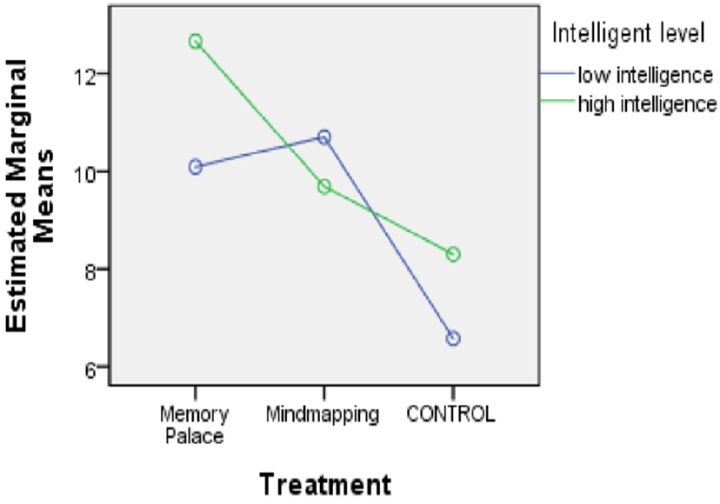
Ho3b: There is no significant interaction effect of Treatment and Intelligence on pre-service teachers’ retention: There was a significant interaction effect of treatment and Intelligence on pre-service teachers’ retention (F(2,49) = 5.094, p<0.05, partial η2 = 0.172). The effect size is 17.2%. Hence, hypothesis 4b was rejected. This implies that there were two-way interactions of treatment and intelligence on pre-service teachers’ retention in technology. To disentangle the interaction effect, Figure 1 presents the interaction in line graph.
The study revealed that there was a significant main effect of treatment on pre-service teachers’ Memory. The result showed that pre-service teachers exposed to Mind Map Instructional Strategy outperformed their counterparts in the other groups, with pre-service teachers in the Memory Palace learning group performing better than those in the conventional group regarding memory. This finding is in line with the work of some scholars who in their separate studies reported that students exposed to Mind Mapping instructional strategy were superior to others taught with the whole class methodology in medicine, reading comprehension and knowledge retention 31. The effectiveness of Mind Mapping may not be far-fetched from its advantage of shedding cognitive loads since pre-service teachers wrestle with ideas and association during learning as well as creation of two-dimensional space to tie in ideas and concepts that relate together 32. Mind Mapping was effective in improving students writhing skill and that there was an interaction between Mind Mapping and pre-service teachers’ intelligence 33.
The Memory Palace learning strategy was also found to be more effective than the self-learning strategy on pre-service teachers’ memory. This may be as a result of the fact that, in Memory Palace strategy, pre-service teachers are allowed to choose their learning environment, relate their prior experience with new things to be acquired and lick materials to be learnt with locations they are familiar with (which already exist in their working memory). This finding is supported by the findings of Abimbade and his colleagues who revealed that participants were recorded to have better memory performances as a result of the memory enhancing activities they went through while using Memory Palace for learning 34. The findings of this study also corroborate the works of McCabe who in their separate studies reported that Method of Loci generally enhance memory performance 35. Method of Loci helps students to memorize incredible amounts of information 36.
There was a significant main effect of treatment on pre-service teachers’ retention with those exposed to memory palace strategy having the highest retention scores; next to Mind Mapping strategy and finally those in the conventional group had the least retention score. This finding showed that pre-service teachers exposed to the memory palace strategy were able to recognise and recall larger amount of information retained compared to those exposed to Mind Mapping and self-study strategies. This finding agrees with Legge who reported that participants using the Memory Palace significantly outperform participants who are not instructed to use a particular strategy in knowledge retention 37. The findings also support the study of Bass and Oswald that memory palace has a significant effect of on retention and revealed that it prevents forgetfulness and aid in retention 38. The study by Touran and Sepideh corroborates the findings of this study and revealed that Memory Palace was more effective than rehearsal in the retention and recalling of lexical items 39.
The Mind Mapping learning strategy was also found to have effect that the sell-study strategy on pre-service teachers’ retention. This may be because of the engagement of pre-service teachers in active learning as they identify ideas, associate ideas, and categorise the ideas using a mind map by adding colours, symbols and diagrams. Mind Mapping technique resulted in correct recall of a statistically significantly high number of items than the self-selected study technique 40. This contradicts the findings of Anthony who revealed that students that used a self-study strategy retained the same amount of information with students that used Mind Mapping strategy 18.
The efficacy of memory palace above other strategy is related to pre-service teachers’ ability to store information in an identified part in their mind as well as the use of familiar location which have an advantage in construct remembrance.
As compared to the treatment groups, pre-service teachers in the self-study group obtained a low performance in the post memory and retention score. Self-study strategy is less engaging; pre-service teachers here participate in rote learning which is not a way to learn meaningfully. However, this method is not totally unfit; it helps in assessing the lower-order abilities such as knowledge, comprehension, and application 41.
4.2. Effects of Intelligence Quotient on Pre-service Teachers’ Memory and RetentionPre-service teachers’ intelligence was found to have a significant main effect on pre-service teachers’ memory. That implies that pre-service teachers with high intelligence performed better than pre-service teachers with low intelligence on the post memory scale. This position may be due to high intelligence which enables the pre-service teachers to better examine contents and learning materials thereby boosting their performance as against the low counterparts. This finding is supported by Ackerman, Beier, and Boyle who revealed in their study that general intelligence and working memory capacity are very highly correlated 41. This finding also corroborates a study by Levin that higher intelligence quotient scorers predicted more accurate recognition memory 42. These findings negate the study carried out by Maehler that the measure of intelligence at two levels (high and low) has no effect on working memory 18. Nonetheless, pre-service teachers’ IQ had no significant effect on their retention. The result revealed that pre-service teachers with high IQ scores do not differ from pre-service teachers with low IQ score after waiting for a period after learning. This study negates the study carried out by Hoerig that there is a significant correlation between IQ and the ability to retain information, indicating that the ability to retain information should be viewed as an important component when evaluating the intelligence quotient of children with learning disabilities 43, 44.
4.3. Interaction EffectsIn this study the findings showed that the treatment and IQ had no significant interaction effect on pre-service teachers’ memory. This could mean that the treatment is suitable to both intelligent levels with respect to memory. This finding is in mutual agreement with the findings of Bass and Oswald, which reveal that Mind Mapping was effective in improving participants writhing skill and working memory and that there was an interaction between Mind Mapping and participants’ intelligence 38.
However, the mean scores revealed that pre-service teachers with high IQ slightly differ from those with low intelligence, the difference is not significant. There was a significant interaction effect of treatment and pre-service teachers’ intelligence on pre-service teachers’ retention. This could mean that the joint effect of treatment and individual intelligence has been proved to exert great importance, as the higher contribution came from pre-service teachers with high intelligence, while the lower contribution came from pre-service teachers with high intelligence.
This study examined the effect of Memory Palace and Mind Mapping strategies on pre-service teachers’ memory and retention in the University of Ibadan. Based on the findings of this study, Memory Palace and Mind Mapping strategy enhanced memory and retention over what is attained with self-study strategy. It could also be concluded that intelligence had influence on pre-service teachers’ memory, but it had no influence on retention while self-efficacy had no influence on pre-service teachers’ memory and retention. However, limitation of study includes the sample size which could impact the generalizability of the result.
Based on the findings of this study, with caution, it is recommended that to improve pre-service teachers’ memory and retention, memory strategies (especially Memory Palace and Mind Mapping) are recommended to be introduced to learners. Teachers should encourage the use of Memory Palace and Mind Mapping in schools to improve pre-service teachers’ memory, skills, achievement, and retention in teaching and learning process. Curriculum designers and Teachers should articulate well on the usefulness and applicability of memory strategies at the development and implementation stages of the curriculum by introducing topic that will promote active participation and help pre-service teachers to plan, coordinate, construct, analyze, monitor and evaluate their learning processes. Educational administrators should organize training and seminar to enable pre-service teachers to become conversant with memory strategies awareness. Pre-service teachers generally should be motivated through persuasion, use of reinforcements and provision of learning resources. Pre-service teachers should be made to understand the need for a commitment to be fully engaged and to be willing to embrace logic behind meaningful learning. Introduction of elements of technology (like Microsoft PowerPoint) can help to build pre-service teachers’ interest towards the application of memory strategies to learning.
| [1] | Ayoka, M. O. and Akinyemi A.A, “Memory training and academic achievement in mathematics among basic seven pre-service teachers in Lagos metropolis,” International journal of psychology and counseling, 2014. | ||
| In article | View Article | ||
| [2] | Gathercole, S.E. and Alloway, T.P, Working memory and learning: A practical guide for teachers. London: Sage Publications, 2008. | ||
| In article | |||
| [3] | Stanfield, J, The role of memory in learning: Increasing the impact of education, Ausmed Education Pty Ltd, 2018. | ||
| In article | |||
| [4] | Yeager, D. S., Hanselman, P., Walton, G. M., Murray, J. S., Crosnoe, R., Muller, C., … Dweck, C. S. A national experiment reveals where a growth mindset improves achievement. Nature. 2019. | ||
| In article | View Article PubMed | ||
| [5] | Meltzoff, A. N., Kuhl, P. K., Movellan, J., & Sejnowski, T. J. Foundations for a new science of learning. Science, 325(5938), 2009. 284-288. | ||
| In article | View Article PubMed | ||
| [6] | Sajadi, S.S. A Tentative Model of the Link between Constructivist Learning Approach and Attention- Deficit Hyperactivity Disorder, iJET Vol 10, Issue 5, 2015. | ||
| In article | View Article | ||
| [7] | Reiser, B. J., & Tabak, I. Scaffolding. In R. K. Sawyer (Ed.), The Cambridge handbook of the learning sciences. 2nd ed., pp. 44-62. 2014. New York, NY: Cambridge University Press. | ||
| In article | View Article | ||
| [8] | Greeno, J. G., & Engeström, Y. Learning in activity. In R. K. Sawyer (Ed.), The Cambridge handbook of the learning sciences (2nd ed., pp. 128-147. 2014. New York, NY: Cambridge University Press. | ||
| In article | View Article | ||
| [9] | Fandakova, Y. & Bunge, S. A. What Connections Can We Draw Between Research on Long-Term Memory and Student Learning? Mind, Brain, and Education, 10(3). 2016. | ||
| In article | View Article | ||
| [10] | Alloway, T. P., & Alloway, R. Investigating the predictive roles of working memory and IQ in academic attainment. Journal of Experimental Child Psychology. 106, 20-29. 2010. | ||
| In article | View Article PubMed | ||
| [11] | Neisser, U., Boodoo, G., Bouchard, T. J., Jr., Boykin, A. W., Brody, N., Ceci, S. J. and Urbina, S, “Intelligence: Knowns and unknowns,” American Psychologist, 51 (2), 77-101, 1996. | ||
| In article | View Article | ||
| [12] | LuntunAnthony, H, “What Are Cognitive Variables? An illustration of a thinking concept” 2009. | ||
| In article | |||
| [13] | Da Costa, S. M, “Self-Efficacy, Metacognitive Awareness, Working Memory, and Academic Performance in a Research Methods Course,” A research report submitted in partial fulfilment of the requirements for the degree of Masters in Psychology in the Faculty of Humanities, University of Witwatersrand, Johannesburg, 2013. | ||
| In article | |||
| [14] | Ganyaupfu, E. M. Factors Influencing Academic Achievement in Quantitative Courses among Business Students of Private Higher Education Institutions. Journal of Education and Practice, 4(15), 2013. 57-65. | ||
| In article | |||
| [15] | Luntungan, R, “Effects of Teaching Methods and Students’ Attitude on Academic Performance” 2012. | ||
| In article | |||
| [16] | Rahman, F., Khalil, J. K., Jumani, N.B., Ajmal, M., Malik S. and Sharif, M, “Impact of Discussion Method on Students Performance,” International Journal of Business and Social Science, 2 (7). April 2011. | ||
| In article | |||
| [17] | Abimbade, O., Adedoja, G. O., Fakayode, B & Bello, L. Impact of mobile‐ based mentoring, socio‐economic background and religion on girls’ attitude and belief towards antisocial behaviour (ASB). British Journal of Educational Technology (BJET). Volume 50, Issue 2. 2019. | ||
| In article | View Article | ||
| [18] | Levin, J. R, Pictorial strategies for school learning: practical illustrations. In Pressley, M. and Levin, J.R. Cognitive Strategy Research: Educational Applications. New York: Springer-Verlag. 1983. | ||
| In article | View Article | ||
| [19] | Mastropieri, M. A. and Scruggs, T. E, Teaching pre-service teachers ways to remember: Strategies for learning mnemonically, Cambridge, MA: Brookline Press, 1991. | ||
| In article | |||
| [20] | Oxford, R. L, Language learning strategies: What every teacher should know, Boston: Heinle and Heinle, 1990. | ||
| In article | |||
| [21] | Craik, F. I. M. and Lockhart, R. S, “Levels of processing: A framework for memory research,” Journal of Verbal Language and Verbal Behavior, 11. 671-684. 1972. | ||
| In article | View Article | ||
| [22] | Craik, F. I. M., and Tulving, E, “Depth of processing and retention of words in episodic memory,” Journal of Experimental Psychology, 104. 268-294. 1975. | ||
| In article | View Article | ||
| [23] | Raugh M. R. and Atkinson R. C, “A mnemonic methodfor learning a second language vocabulary,” Journal ofEducational Psychology, 67. 1-16. 1975. | ||
| In article | View Article | ||
| [24] | Qureshi, A., Rizvi, F., Syed, A., Shahid, A. and Manzoo, H, The Method of Loci as a mnemonic device to facilitate learning inendocrinology leads to improvement in student performance as measured by assessments, 2014. | ||
| In article | View Article PubMed | ||
| [25] | Mona, I. and AdbKhalick, F, “The influence of Mind Mapping on eighth graders’ science achievement,” School science and Mathematics, 108(7). 298-312. Nov 2008. | ||
| In article | View Article | ||
| [26] | Omilani, N. A., Ayo-Vaughan, A. and Abimbade, O. A. Teachers’ Oversight of Science Values that Promotes Effective Citizenship. International Journal of Education, Culture and Society 2(3). 2017. 88-93. | ||
| In article | View Article | ||
| [27] | Farrand, P, “Hussain, F., and Hennessy, E. 2002. The efficacy of the ‘mind map’ study technique,” Medical Education, 36(5). 426-431. May 2002. | ||
| In article | View Article PubMed | ||
| [28] | Wickramasinghe, A., Widanapathirana, N., Kuruppu, O., Liyanage, I., and Karunathilake, I, “Effectiveness of mind maps as a learning tool for medical students,” South East Asian Journal of Medical Education 2011. | ||
| In article | |||
| [29] | Ciuffreda, K. J, Vision, “Perception, and Cognition: A manual for the evaluation and treatment of the adult with acquired brain injury 4th ed,” Optometry and Vision Science, 84(10). 934. Oct. 2007. | ||
| In article | View Article | ||
| [30] | Knowledge Publisher, IQ Test Questions with Answers - IQ Quiz Test http://www.knowledgepublisher.com/article-467.html 2017. | ||
| In article | |||
| [31] | Siriphanic, P. and Laohawiriyano, C, 2010. “Using Mind Mapping technique to improve reading comprehension ability of Thai EFL university pre-service teachers,” in the 2nd International Conference on Humanities and Social Sciences on April 10th, 2010 in Faculty of Liberal Arts, Prince of Songkla University Strategies in Teaching. | ||
| In article | |||
| [32] | Nesbit, J. C., and Adesope, O. O, “Learning with concept and knowledge maps: Ameta-analysis,” Review of Educational Research, 76(3). 413-448. 2006 | ||
| In article | View Article | ||
| [33] | Adedoja G. O., and Abimbade O. A. (2016). Influence of Mobile Learning Training on Pre-Service Social Studies Teachers' Technology and Mobile Phone Self- Efficacies. Journal of Education and Practice, Vol. 7, No. 2, p74-79. | ||
| In article | |||
| [34] | Abimbade, O., Akinyemi, A., Bello, L., Mohammed, H. Comparative Effects of an Individualized Computer-Based Instruction and a Modified Conventional Strategy on Students’ Academic Achievement in Organic Chemistry. Journal of Positive Psychology and Counseling. 1(2). 2017. Pp 1-19. | ||
| In article | |||
| [35] | McCabe, J. A, “Location, Location, Location! Demonstrating the Mnemonic Benefit of the Method of Loci,” Teaching of Psychology 42(2). 169-73. 2015. | ||
| In article | View Article | ||
| [36] | Maguire, E. A., Elizabeth R. V., John M. W., and Kapur, N, “Routes to Remembering: The Brains behind Superior Memory,” Nature Neuroscience 6. 90-95. 2002. | ||
| In article | View Article PubMed | ||
| [37] | Legge,.G.E., Christopher R. M., Enoch T. N. and Jeremy B.C, Building a memory palace in minutes: Equivalent memory performance using virtual versus conventional environments with the Method of Loci, Acta Psychologica 141(3). 380-390 Nov. 2012. | ||
| In article | View Article PubMed | ||
| [38] | Bass, W.S., & Oswald, K.M. Proactive control of proactive interference using the method of loci. Advances in Cognitive Psychology, 10, 2014. 49-58. | ||
| In article | View Article PubMed | ||
| [39] | Touran, A and Berenji. B "A comparative study of rehearsal and loci methods in learning vocabulary in EFL context." Theory and Practice in Language Studies, vol. 5, no. 7, 2015, p. 1451+. Accessed 25 Oct. 2020. | ||
| In article | View Article | ||
| [40] | Novak, J. D. and Gowin, D. B. 1984. Learning how to learn. New York, Cambridge University Press 1984. | ||
| In article | View Article | ||
| [41] | Ackerman, P., Beier, A. and Boyle, “Working Memory and Intelligence: Their Correlation and Their Relation,” Psychological Bulletin, 131. 30-60. 2005. | ||
| In article | View Article PubMed | ||
| [42] | Maehler, C., & Schuchardt, K. Working memory functioning in children with learning disabilities: Does intelligence make a difference? Journal of Intellectual Disability Research, 53(1), 2009. 3-10. | ||
| In article | View Article PubMed | ||
| [43] | Hoerig, D. C., David, A. S., and D’Amato, R.C, “Evaluating the relation between memory and intelligence in children with learning disabilities,” Psychological Reports, 91(3). 1169-1173. 2002. | ||
| In article | View Article PubMed | ||
| [44] | Adedoja G., and Abimbade O., “Design and Development of Mobile Learning Lesson Plan (MLLP) Template: A Design Relevant to African Context.” American Journal of Educational Research, vol. 4, no. 9 (2016): 658-662. | ||
| In article | |||
Published with license by Science and Education Publishing, Copyright © 2020 Oriade Oluwaseun, Famaye Tolulope, Bello Lukuman and Esobi Collins Ikechukwu
 This work is licensed under a Creative Commons Attribution 4.0 International License. To view a copy of this license, visit
http://creativecommons.org/licenses/by/4.0/
This work is licensed under a Creative Commons Attribution 4.0 International License. To view a copy of this license, visit
http://creativecommons.org/licenses/by/4.0/
| [1] | Ayoka, M. O. and Akinyemi A.A, “Memory training and academic achievement in mathematics among basic seven pre-service teachers in Lagos metropolis,” International journal of psychology and counseling, 2014. | ||
| In article | View Article | ||
| [2] | Gathercole, S.E. and Alloway, T.P, Working memory and learning: A practical guide for teachers. London: Sage Publications, 2008. | ||
| In article | |||
| [3] | Stanfield, J, The role of memory in learning: Increasing the impact of education, Ausmed Education Pty Ltd, 2018. | ||
| In article | |||
| [4] | Yeager, D. S., Hanselman, P., Walton, G. M., Murray, J. S., Crosnoe, R., Muller, C., … Dweck, C. S. A national experiment reveals where a growth mindset improves achievement. Nature. 2019. | ||
| In article | View Article PubMed | ||
| [5] | Meltzoff, A. N., Kuhl, P. K., Movellan, J., & Sejnowski, T. J. Foundations for a new science of learning. Science, 325(5938), 2009. 284-288. | ||
| In article | View Article PubMed | ||
| [6] | Sajadi, S.S. A Tentative Model of the Link between Constructivist Learning Approach and Attention- Deficit Hyperactivity Disorder, iJET Vol 10, Issue 5, 2015. | ||
| In article | View Article | ||
| [7] | Reiser, B. J., & Tabak, I. Scaffolding. In R. K. Sawyer (Ed.), The Cambridge handbook of the learning sciences. 2nd ed., pp. 44-62. 2014. New York, NY: Cambridge University Press. | ||
| In article | View Article | ||
| [8] | Greeno, J. G., & Engeström, Y. Learning in activity. In R. K. Sawyer (Ed.), The Cambridge handbook of the learning sciences (2nd ed., pp. 128-147. 2014. New York, NY: Cambridge University Press. | ||
| In article | View Article | ||
| [9] | Fandakova, Y. & Bunge, S. A. What Connections Can We Draw Between Research on Long-Term Memory and Student Learning? Mind, Brain, and Education, 10(3). 2016. | ||
| In article | View Article | ||
| [10] | Alloway, T. P., & Alloway, R. Investigating the predictive roles of working memory and IQ in academic attainment. Journal of Experimental Child Psychology. 106, 20-29. 2010. | ||
| In article | View Article PubMed | ||
| [11] | Neisser, U., Boodoo, G., Bouchard, T. J., Jr., Boykin, A. W., Brody, N., Ceci, S. J. and Urbina, S, “Intelligence: Knowns and unknowns,” American Psychologist, 51 (2), 77-101, 1996. | ||
| In article | View Article | ||
| [12] | LuntunAnthony, H, “What Are Cognitive Variables? An illustration of a thinking concept” 2009. | ||
| In article | |||
| [13] | Da Costa, S. M, “Self-Efficacy, Metacognitive Awareness, Working Memory, and Academic Performance in a Research Methods Course,” A research report submitted in partial fulfilment of the requirements for the degree of Masters in Psychology in the Faculty of Humanities, University of Witwatersrand, Johannesburg, 2013. | ||
| In article | |||
| [14] | Ganyaupfu, E. M. Factors Influencing Academic Achievement in Quantitative Courses among Business Students of Private Higher Education Institutions. Journal of Education and Practice, 4(15), 2013. 57-65. | ||
| In article | |||
| [15] | Luntungan, R, “Effects of Teaching Methods and Students’ Attitude on Academic Performance” 2012. | ||
| In article | |||
| [16] | Rahman, F., Khalil, J. K., Jumani, N.B., Ajmal, M., Malik S. and Sharif, M, “Impact of Discussion Method on Students Performance,” International Journal of Business and Social Science, 2 (7). April 2011. | ||
| In article | |||
| [17] | Abimbade, O., Adedoja, G. O., Fakayode, B & Bello, L. Impact of mobile‐ based mentoring, socio‐economic background and religion on girls’ attitude and belief towards antisocial behaviour (ASB). British Journal of Educational Technology (BJET). Volume 50, Issue 2. 2019. | ||
| In article | View Article | ||
| [18] | Levin, J. R, Pictorial strategies for school learning: practical illustrations. In Pressley, M. and Levin, J.R. Cognitive Strategy Research: Educational Applications. New York: Springer-Verlag. 1983. | ||
| In article | View Article | ||
| [19] | Mastropieri, M. A. and Scruggs, T. E, Teaching pre-service teachers ways to remember: Strategies for learning mnemonically, Cambridge, MA: Brookline Press, 1991. | ||
| In article | |||
| [20] | Oxford, R. L, Language learning strategies: What every teacher should know, Boston: Heinle and Heinle, 1990. | ||
| In article | |||
| [21] | Craik, F. I. M. and Lockhart, R. S, “Levels of processing: A framework for memory research,” Journal of Verbal Language and Verbal Behavior, 11. 671-684. 1972. | ||
| In article | View Article | ||
| [22] | Craik, F. I. M., and Tulving, E, “Depth of processing and retention of words in episodic memory,” Journal of Experimental Psychology, 104. 268-294. 1975. | ||
| In article | View Article | ||
| [23] | Raugh M. R. and Atkinson R. C, “A mnemonic methodfor learning a second language vocabulary,” Journal ofEducational Psychology, 67. 1-16. 1975. | ||
| In article | View Article | ||
| [24] | Qureshi, A., Rizvi, F., Syed, A., Shahid, A. and Manzoo, H, The Method of Loci as a mnemonic device to facilitate learning inendocrinology leads to improvement in student performance as measured by assessments, 2014. | ||
| In article | View Article PubMed | ||
| [25] | Mona, I. and AdbKhalick, F, “The influence of Mind Mapping on eighth graders’ science achievement,” School science and Mathematics, 108(7). 298-312. Nov 2008. | ||
| In article | View Article | ||
| [26] | Omilani, N. A., Ayo-Vaughan, A. and Abimbade, O. A. Teachers’ Oversight of Science Values that Promotes Effective Citizenship. International Journal of Education, Culture and Society 2(3). 2017. 88-93. | ||
| In article | View Article | ||
| [27] | Farrand, P, “Hussain, F., and Hennessy, E. 2002. The efficacy of the ‘mind map’ study technique,” Medical Education, 36(5). 426-431. May 2002. | ||
| In article | View Article PubMed | ||
| [28] | Wickramasinghe, A., Widanapathirana, N., Kuruppu, O., Liyanage, I., and Karunathilake, I, “Effectiveness of mind maps as a learning tool for medical students,” South East Asian Journal of Medical Education 2011. | ||
| In article | |||
| [29] | Ciuffreda, K. J, Vision, “Perception, and Cognition: A manual for the evaluation and treatment of the adult with acquired brain injury 4th ed,” Optometry and Vision Science, 84(10). 934. Oct. 2007. | ||
| In article | View Article | ||
| [30] | Knowledge Publisher, IQ Test Questions with Answers - IQ Quiz Test http://www.knowledgepublisher.com/article-467.html 2017. | ||
| In article | |||
| [31] | Siriphanic, P. and Laohawiriyano, C, 2010. “Using Mind Mapping technique to improve reading comprehension ability of Thai EFL university pre-service teachers,” in the 2nd International Conference on Humanities and Social Sciences on April 10th, 2010 in Faculty of Liberal Arts, Prince of Songkla University Strategies in Teaching. | ||
| In article | |||
| [32] | Nesbit, J. C., and Adesope, O. O, “Learning with concept and knowledge maps: Ameta-analysis,” Review of Educational Research, 76(3). 413-448. 2006 | ||
| In article | View Article | ||
| [33] | Adedoja G. O., and Abimbade O. A. (2016). Influence of Mobile Learning Training on Pre-Service Social Studies Teachers' Technology and Mobile Phone Self- Efficacies. Journal of Education and Practice, Vol. 7, No. 2, p74-79. | ||
| In article | |||
| [34] | Abimbade, O., Akinyemi, A., Bello, L., Mohammed, H. Comparative Effects of an Individualized Computer-Based Instruction and a Modified Conventional Strategy on Students’ Academic Achievement in Organic Chemistry. Journal of Positive Psychology and Counseling. 1(2). 2017. Pp 1-19. | ||
| In article | |||
| [35] | McCabe, J. A, “Location, Location, Location! Demonstrating the Mnemonic Benefit of the Method of Loci,” Teaching of Psychology 42(2). 169-73. 2015. | ||
| In article | View Article | ||
| [36] | Maguire, E. A., Elizabeth R. V., John M. W., and Kapur, N, “Routes to Remembering: The Brains behind Superior Memory,” Nature Neuroscience 6. 90-95. 2002. | ||
| In article | View Article PubMed | ||
| [37] | Legge,.G.E., Christopher R. M., Enoch T. N. and Jeremy B.C, Building a memory palace in minutes: Equivalent memory performance using virtual versus conventional environments with the Method of Loci, Acta Psychologica 141(3). 380-390 Nov. 2012. | ||
| In article | View Article PubMed | ||
| [38] | Bass, W.S., & Oswald, K.M. Proactive control of proactive interference using the method of loci. Advances in Cognitive Psychology, 10, 2014. 49-58. | ||
| In article | View Article PubMed | ||
| [39] | Touran, A and Berenji. B "A comparative study of rehearsal and loci methods in learning vocabulary in EFL context." Theory and Practice in Language Studies, vol. 5, no. 7, 2015, p. 1451+. Accessed 25 Oct. 2020. | ||
| In article | View Article | ||
| [40] | Novak, J. D. and Gowin, D. B. 1984. Learning how to learn. New York, Cambridge University Press 1984. | ||
| In article | View Article | ||
| [41] | Ackerman, P., Beier, A. and Boyle, “Working Memory and Intelligence: Their Correlation and Their Relation,” Psychological Bulletin, 131. 30-60. 2005. | ||
| In article | View Article PubMed | ||
| [42] | Maehler, C., & Schuchardt, K. Working memory functioning in children with learning disabilities: Does intelligence make a difference? Journal of Intellectual Disability Research, 53(1), 2009. 3-10. | ||
| In article | View Article PubMed | ||
| [43] | Hoerig, D. C., David, A. S., and D’Amato, R.C, “Evaluating the relation between memory and intelligence in children with learning disabilities,” Psychological Reports, 91(3). 1169-1173. 2002. | ||
| In article | View Article PubMed | ||
| [44] | Adedoja G., and Abimbade O., “Design and Development of Mobile Learning Lesson Plan (MLLP) Template: A Design Relevant to African Context.” American Journal of Educational Research, vol. 4, no. 9 (2016): 658-662. | ||
| In article | |||