Waste management should start in the four corners of the classroom to fully equip learners with the stewardship for the environment. This study evaluates existing strategies for school solid waste management, led by members of the Youth for Environment in School Organization (YES-O) at a public school in Quirino for the School Year 2023-2024. Employing a descriptive-inferential research design, the study aimed to identify the effectiveness of existing strategies in terms of sex as variable. Using purposive sampling based on students' involvement in school environmental organizations, 32 YES-O student members were selected as respondents, and the adapted and modified Effective Existing Solid Waste Management Strategies questionnaire [5] was employed. Results showed that existing effective strategies of the school were deemed to be effective and highly effective in waste segregation, reuse and recycling, collection and transport, composting organic materials, and information, education, and communication campaign. Meanwhile, in terms of sex, responses showed significant differences, particularly in the provision of success stories that motivate public participation in recycling and waste reduction as well as distribution of educational materials for local adaptation. These findings underscore the need to locally manage waste using strategies in educational environments and the importance of exploring gender-sensitive approaches to facilitate effective waste management practices.
Unsegregated waste is one of the leading factors polluting the environment and sparking disputes worldwide, and this has persisted for decades. This was supported by news about Canada’s waste, which broke in the media about a Canadian company that shipped mislabeled containers of recyclable plastics to the Philippines around 2013-2014 1. The dispute was only resolved when the cargoes were returned to Vancouver, Canada, for incineration, putting an end to a growing diplomatic commotion that highlighted how Asian countries have grown weary of being the world's trash dump 1. Meanwhile, a 2023 news article 2 on Philippine waste noted that the daily volume was 61 million metric tons, according to Environment Secretary Maria Antonia Yulo-Loyzaga, of which 24 percent were deemed plastics. She added that 33 percent of the aforementioned 24 percent of plastics are disposed of in landfills and dumpsites, whilst 35 percent are discarded into a range of terrestrial environments and marine ecosystems. This was a grave threat to the environment, especially considering that plastics can take at least 20 years to degrade, and up to 1000 years depending on how they were made 2.
Hence, the government implemented several actions, noting the Republic Act 9003, otherwise known as the Ecological Solid Waste Management Act of 2000. This aims for the Filipino citizens to use ecologically friendly techniques that optimize resource conservation and use to protect the environment and public health. It also establishes standards for waste reduction and avoidance, encourages appropriate waste disposal and segregation, and supports national research as well as private-sector involvement in waste management. The act encourages collaboration between many stakeholders, keeps local governments accountable for compliance, and incorporates ecological waste management into curricula to raise awareness of environmental issues. Withal, the education sectors, both basic and higher education, adhere to and implement this act in the public and private institutions in the country 3, 4, 5.
In another study, data and observations indicate the need for further intensification despite several public and private initiatives to improve solid waste management 3. Educational institutions should create initiatives that foster good attitudes and abilities in waste segregation, encourage hygiene, carry out community service projects that incorporate learning, and incorporate composting and trash management into the curriculum 3. Furthermore, an unpublished research paper on a similar topic suggested that to ensure a complete understanding of responsible waste disposal, the school administration should conduct an information drive or campaign on solid waste management during General Orientation Programs, Convocation Programs, and Homeroom courses 4.
Meanwhile, the Youth for Environment in Schools Organization (YES-O) was formed by the Department of Education (DepED) in collaboration with the Department of Environment and Natural Resources (DENR) after a resolution to establish a school-based co-curricular organization centered on environmental conservation was adopted following the 2003 Youth for Environment Summer (YES) Camp 6. By implementing effective environmental programs, networking with other groups for support, and encouraging community involvement in ecological efforts, YES-O seeks to increase public understanding of environmental issues. Cleanup activities, trash management initiatives, awareness campaigns, tree planting, and environmental camps are all part of the YES-O program. Coordinators at the regional and school levels assist the organization, and its operations are managed by the DepEd Center for Students and Co-Curricular Affairs 6. This led more learners to become aware of the challenges and issues in our environment, as well as to find ways and innovations to resolve these dilemmas on their own terms.
Another loophole in waste management is the customary ideation that women should handle wastes disposal especially in patriarchal society. Most men are not aware of household-specific wastes and favorably do not segregate these wastes leading to the reason of lack of time and when asked further stated that the women in their houses knew or remembered how to segregate wastes especially toxic ones 7. Women in many parts of the world are frequently seen doing household chores which is not limited to collection, segregation, and disposal of household wastes 8. This leads to women-dominated workload at home and even inside the classroom.
In a public school in Quirino, Philippines notable as one of the prime schools in the province, YES-O is one of the organizations that shows pride in their simple yet rippling act of becoming stewards of nature. They always organize clean-up drives and tree-planting activities, and they also manage the Materials Recovery Facility (MRF) under the guidance of their organization adviser. This led to numerous breakthroughs in the school's waste segregation strategies. Yet, other students are not really aware of segregation, as it was observed that it became a form of punishment for tardiness or for learners who do not follow class and/or school rules. This tends to diminish the context as to why segregation should be done by everyone, as it is the person’s responsibility to keep their own trash. Other classrooms also require learners to keep their trash in their bags to limit waste in the classroom, but once they leave their rooms, they tend to throw it where no one can see, which poses another problem for waste management.
Hence, to track which strategies are effective and can be used in the future, the researcher aimed to evaluate the effectiveness of existing strategies for solid waste management (SWM) in the aforementioned integrated public high school in terms of male and female responses. The YES-O members were deemed experts in this field, as they manage the MRF and regulate waste collection within the school. This study would provide a foundation for new research aimed at implementing highly effective strategies in SWM as well as gender-related solid waste management gaps to reduce waste pollution and explore novel ways to dispose solid wastes.
The study utilized a descriptive-inferential research design to identify the profile of the respondents and, using these data, further determine significant differences between the variables. Respondents were selected based on their involvement in environmental organizations on the school grounds, which led to the use of purposive sampling. Afterward, 32 student members of Youth for Environment in School Organization (YES-O) were identified and consensually selected as respondents. These students were identified based on their organization’s objectives, which are for awareness of the country’s environmental state, issues, and concerns, establishing doable programs to address the issues and concerns for the environment, creating networks of governmental and non-governmental units to mitigate the environmental challenges, encouraging community participation, and developing proper and appropriate environmental values 6. Henceforth, they are deemed to have strong values and skills to assess the effectiveness of existing Solid Waste Management strategies and can therefore provide reliable responses to the adapted survey questionnaire 5.
With regards to the questionnaire, it was adopted and modified based on localization and appropriation of necessary information to the SWM of basic education schools. It is composed of three parts which are Foreword and Consent Form, Profiling, and Survey checklist composed of the following sub-parts: Existing Strategies on Waste Segregation; Existing Strategies on Reuse and Recycling of Marketable Materials; Existing Strategies on Collection and Transport; Existing Strategies on Composting of Organic Materials; and Existing Strategies on Information, Education and Communication Campaign. The data were collected via a Google Form sent via Messenger Group Chats. The researcher sought the principal's approval to conduct the study and approached the YES-O adviser to help gather the necessary data. Afterward, the data were analyzed in SPSS (20) trial version using descriptive and inferential statistics. It was also supervised by the school statistician.
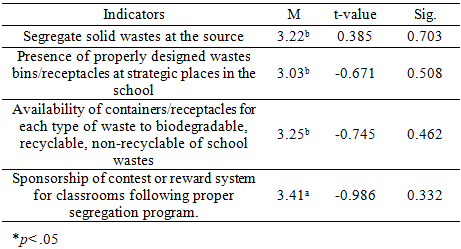
The Table 1 shows the effectiveness of existing strategies solid waste management when grouped according to sex. Statements on segregation at the source, presence of properly designed wastes bins, and availability of containers for each type of waste yielded an effective interpretationb based on their mean scores of 3.22, 3.03, and 3.25, respectively. On the other hand, statement four, which addresses sponsorship of a contest or reward system for proper segregation, had a mean of 3.41, indicating a Highly Effective interpretationa. Overall, no statement gained significant difference based on the significant values when compared to the alpha value of 0.05 when grouped according to sex.
This led to the assessment of the effectiveness of solid waste management; existing effective strategies for waste segregation are considered effective and can even be suggested for improvement and will be referred to later as Highly Effective. This could be relevant to the students at this integrated public high school, who are having a hard time identifying waste and segregating it accordingly, as there are still little to no classroom orientations or charts on what goes in the respective bins. Learners also tend to mix recyclable and biodegradable materials as food wastes were not removed properly from the plastic containers.
Incentivizing segregation habits was noted to be the Highly Effective due to conditioning the learners’ mentality on environmental stewardships and incorporating them in real-life activities where reward is given for those who follow the rules. This creates ways for them to establish certain habits that will help them later in life as well. But with no significant difference on the responses of male and female respondents, this counters the claims in a study from Ghana that gender has affected waste segregation in its rural areas 9. Additionally, men were deemed to be in charge of physical load (e.g. transportation or carrying for waste disposal), while women are involved in mental load (e.g. sorting, collection) which leads to divisions of labor especially in occupational scenarios 7.
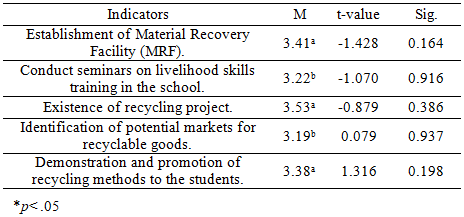
Table 2 presents the effectiveness of solid waste management and existing effective strategies in the reuse and recycling of marketable materials when grouped according to sex. Gleaned in the table, only statements 2 and 4 showed a mean lower than 3.26, denoting an Effective interpretationb. Meanwhile, the other statements that address the establishment of MRF, the recycling project, and the demonstration and promotion of recycling methods received Highly Effective interpretationsa, all above 3.26. With the significant values higher than 0.05, this determines that there is no significant difference between the responses of male and female respondents in the existing effective strategies on reuse and recycling of marketable materials.
Hence, the level of effectiveness in solid waste management, the existing effective strategies for reuse and recycling, and the marketable materials fall to a Highly Effective level and can later be suggested as ways to improve student engagement in SWM projects. This is based on the students’ efforts to put their trash to use, especially in making projects aligned with resourcefulness and environmental causes. These findings are then linked to the result from a research study which found that national and local implementations in varying degrees of effectiveness of SWM strategies as well as common areas for improvement include investing in the right technology especially for recycling waste materials, maintaining public and private sector involvement, improving national-local coordination, and accelerating changeover timescales 10. And in line with demonstration and promotion of recycling methods to the students, another research article showed that students also demonstrated appropriate solid waste management techniques, including disposal, recycling, reuse, reduction, and segregation 11.
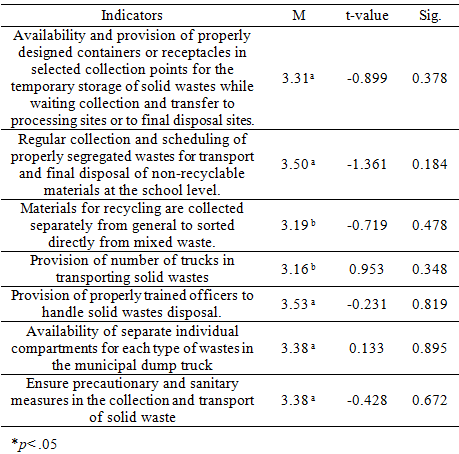
Meanwhile, shown in the Table 3 is the effectiveness of solid waste management on existing effective strategies in terms of collection and transport when grouped according to sex. It can be seen that of the seven statements, only two falls under Effective interpretationb: materials for recycling collected separately from general waste to be sorted directly from mixed waste, and the provision of a number of trucks for transporting solid waste. The rest fell into Highly Effective interpretationa, with mean scores ranging from 3.31 to 3.53. It also showed that no significant different was denoted in the responses of male as compared to their female counterparts. This means that existing strategies on solid waste management of the school is effective to highly effective based on both male and female respondents.
This was also observed by the researcher, as there is a system for collecting waste materials inside the school, spearheaded by the school nurse, to instill students’ awareness of their waste and their responsibility to the environment. A two-day collection was scheduled by the barangay and municipal office to help the school with waste collection and dump it in the local landfill. A pre-checking was conducted by the school nurse and YES-O student members for segregation purposes where unsegregated wastes were delivered back to the classroom while segregated wastes will then be directed to the collection area. The result was linked to the findings of another study 7 focusing on both sexes having little to non-existing waste disposal practices where no significant difference was noted between male and female responses contrary to the research article 8 which denoted that sex is a determinant of SWM practices as their motivation to pursue these practices are linked to their gender roles and work.
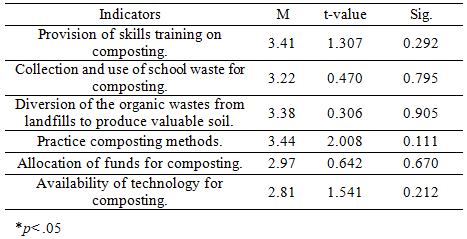
Table 4 presents the effectiveness of existing composting strategies for organic material in terms of sex. Although the number of Effectiveb and Highly Effectivea interpretations was the same, the statements with Effective interpretationb were tipped below 3.00, specifically the allocation of funds for composting and the availability of technology for composting. Meanwhile, Highly Effective interpretationsa did not also reach a mean score of 3.50. This led to no significant difference between male and female responses on all statements under composting of organic materials as shown in the significant values. With a big difference in the mean scores, it meant that allocation of school funds for composting was not highly prioritized and that technology or a systematic approach on this is not evident in the strategies of the school for solid waste management. This may be related to the fact that the school’s research areas, even at the student level of governance, were not focused on composting or agricultural practices. Hence, even the technologies for proper composting were deemed irrelevant to the respondents, especially to the other students.
Albeit the case, Gulayan sa Paaralan, a DepEd program fostering vegetables inside the school ground, also utilizes school compost for fertilizers that helps maintain vegetable production in the school garden. This creates a linked process of interdependence between these two school activities supporting local farming while utilizing biodegradable materials in the form of compost.
Moreover, composting organic waste is a particularly successful waste management approach across 12 towns; five municipalities recognized composting as a practical trash-reduction strategy when it was supported by the right technology 6. To implement composting projects at the barangay level, these towns aggressively sought funds from both internal and external sources and forged collaborations with government organizations 6. This demonstrates their dedication to sustainable waste management techniques. This supports the study's claims about a significant difference in composting.
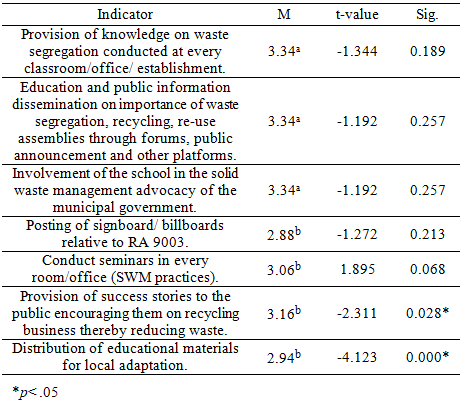
Table 5 presents the effectiveness of existing strategies in solid waste management specifically for information, education, and communication campaigns. There were more Effective interpretationsb as compared to Highly Effective interpretationsa. These results are directed to male and female responses to gain significant difference on the topics of success stories on recycling business (sig. = 0.028) as well as distribution of educational materials for localization (sig. = 0.000). This is supported by the researcher's observation that seminars and posting relevant materials on SWM practices are seen as effective only to that degree as they provide a sense of sight, whereas involvement and dissemination involve learners themselves in acting more in response to SWM practices. Moreover, YES-O members of the school incorporate social media in information brigade about their activities by posting recycled and upcycled waste materials. They post through their own social media page in Facebook to inform the mass about some environmental-friendly policies in the school like advocating the use of tumblers in school canteens instead of one-time-use paper cups or plastic bottles. Another strategy that the group has established is to integrate recycling in competitions like the use of recyclable materials to make Christmas Decors during Christmas seasons as well as making new artistic crafts during arts month celebration. While utilizing scrap materials to upcycle products for school campaigns and research poses means to incorporate existing strategies into pinnacle of success stories inside the school campus.
This was in consonance with the findings that educational level is pivotal in dealing with waste segregation 8 and aligned with another study on the positive effects of feedback on the distribution of educational materials 5. Moreover, it was also recommended that greater engagement and synergy is highly necessary with environmental education, given that the YES-O program's mandatory initiatives and activities are widely implemented 12.
The school's solid waste management was assessed based on the perspectives of the Youth for Environment in School Organization (YES-O) Members of the public high school in the province of Quirino, Philippines for the School Year 2023-2024. It was noted that the existing strategies on solid waste management of the school are ranging from effective to highly effective on waste segregation, reuse and recycling, collection and transport, composting organic materials, and information, education, and communication campaign. Meanwhile, the distribution of educational materials locally and the provision of success stories to encourage the public to recycle and reduce waste, made significant differences between male and female respondents.
These results highlight the need for customized waste management plans in educational settings and the significance of gender-sensitive methods to support efficient waste management techniques. The findings were also directed to the importance of student-led programs like YES-O in promoting environmental awareness and adopting environmental-friendly waste management techniques in classrooms. To create more inclusive, targeted waste management strategies, future research and interventions should take these demographic variations into account. This will ensure that waste management practices in school environments are more sustainable and effective.
| [1] | Dharssi, Alia, AFP. 2019. “Canada Takes Garbage Back from Philippines, Ending Long Dispute.” GMA News Online, June 29, 2019.https://www.gmanetwork.com/news/topstories/nation/699354/canada-takes-garbage-back-from-philippines-ending-long-dispute/story/. | ||
| In article | |||
| [2] | Cariaso, B. (2023, August 5). Philippines produces 61,000 million metric tons of waste daily. Philstar.com. https:// www.philstar.com/ headlines/ 2023/08/06/2286595/philippines-produces -61000-million-metric-tons-waste-daily. | ||
| In article | |||
| [3] | Prisco, A. A., & Cubillas, A. U. (2022). Ecological Solid Waste Management Program of Elementary Schools in Agusan del Norte Division: Success Stories, Challenges and Prospects. International Journal of Scientific and Research Publications, 12(1), 335–345. | ||
| In article | View Article | ||
| [4] | Paghasian, Margarita C. 2017. Awareness and Practices on Solid Waste Management among College Students in Mindanao State University Maigo School of Arts and Trades. Open Access. Proceedings of the 3rd International Conference on Education and Training (ICET 2017). Advances in Social Science, Education and Humanities Research. Atlantis Press. | ||
| In article | View Article | ||
| [5] | Azuelo, M. C. C., Barbado, L. N., & Reyes, L. M. L. (2016). Assessment of solid waste management strategies in Camarines Norte, Philippines. Asia Pacific Journal of Multidisciplinary Research, 4(4), 44–53. https:// www.academia.edu/ 79826933/ Assessment_of_Solid_Waste_Management_Strategies_in_Camarines_Norte_Philippines. | ||
| In article | |||
| [6] | Department of Education. (2003, September 1). DePEd Order 72, S. 2003 – Establishment of the Youth for Environment in Schools (YES) Organization | Department of Education. Retrieved May 19, 2024, from https://www.deped.gov.ph/2003/09/01/do-72-s-2003-establishment-of-the-youth-for-environment-in-schools-yes-organization/. | ||
| In article | |||
| [7] | Wilujeng, S. A., & Andriyanto, A. (2024). Differences in perceptions of women and men in waste management in Tenggilis Mejoyo District, Surabaya City. Eduvest - Journal of Universal Studies, 4(8), 7138–7159. | ||
| In article | View Article | ||
| [8] | Mwangi, W. W., Kimani, E., Okong’o, G., & Majale, C. (2021). A gendered perspective of knowledge of domestic solid waste management within informal settlement: A case of Kiandutu Informal Settlement, Kiambu County, Kenya.Journal of African Studies and Ethnographic Research,3(3). https:// royalliteglobal. com/ african-studies/article/view/683. | ||
| In article | |||
| [9] | Amoah, J. O., Britwum, A. O., Essaw, D. W., & Mensah, J. (2023). Solid waste management and gender dynamics: Evidence from rural Ghana. Research in Globalization, 6, 100111. | ||
| In article | View Article | ||
| [10] | Domingo, S. N., & Manejar, A. J. A. (2021). An analysis of regulatory policies on solid waste management in the Philippines: Ways forward. https://hdl.handle.net/10419/241050. | ||
| In article | View Article | ||
| [11] | Molina, R. A., & Catan, I. (2021). Solid Waste Management Awareness and Practices among Senior High School Students in a State College in Zamboanga City, Philippines. Aquademia, 5(1), ep21001. | ||
| In article | View Article | ||
| [12] | Cadiz, A. P., & Cortez, L. a. S. (2024). Exploring the best practices of the Youth for Environment in Schools – Organization (YES-O). Jurnal Pendidikan Biologi Indonesia, 10(1), 348–365. | ||
| In article | View Article | ||
Published with license by Science and Education Publishing, Copyright © 2026 Riziel M. Sarmuyan-Sagun and Ramil S. Rodriguez
 This work is licensed under a Creative Commons Attribution 4.0 International License. To view a copy of this license, visit
http://creativecommons.org/licenses/by/4.0/
This work is licensed under a Creative Commons Attribution 4.0 International License. To view a copy of this license, visit
http://creativecommons.org/licenses/by/4.0/
| [1] | Dharssi, Alia, AFP. 2019. “Canada Takes Garbage Back from Philippines, Ending Long Dispute.” GMA News Online, June 29, 2019.https://www.gmanetwork.com/news/topstories/nation/699354/canada-takes-garbage-back-from-philippines-ending-long-dispute/story/. | ||
| In article | |||
| [2] | Cariaso, B. (2023, August 5). Philippines produces 61,000 million metric tons of waste daily. Philstar.com. https:// www.philstar.com/ headlines/ 2023/08/06/2286595/philippines-produces -61000-million-metric-tons-waste-daily. | ||
| In article | |||
| [3] | Prisco, A. A., & Cubillas, A. U. (2022). Ecological Solid Waste Management Program of Elementary Schools in Agusan del Norte Division: Success Stories, Challenges and Prospects. International Journal of Scientific and Research Publications, 12(1), 335–345. | ||
| In article | View Article | ||
| [4] | Paghasian, Margarita C. 2017. Awareness and Practices on Solid Waste Management among College Students in Mindanao State University Maigo School of Arts and Trades. Open Access. Proceedings of the 3rd International Conference on Education and Training (ICET 2017). Advances in Social Science, Education and Humanities Research. Atlantis Press. | ||
| In article | View Article | ||
| [5] | Azuelo, M. C. C., Barbado, L. N., & Reyes, L. M. L. (2016). Assessment of solid waste management strategies in Camarines Norte, Philippines. Asia Pacific Journal of Multidisciplinary Research, 4(4), 44–53. https:// www.academia.edu/ 79826933/ Assessment_of_Solid_Waste_Management_Strategies_in_Camarines_Norte_Philippines. | ||
| In article | |||
| [6] | Department of Education. (2003, September 1). DePEd Order 72, S. 2003 – Establishment of the Youth for Environment in Schools (YES) Organization | Department of Education. Retrieved May 19, 2024, from https://www.deped.gov.ph/2003/09/01/do-72-s-2003-establishment-of-the-youth-for-environment-in-schools-yes-organization/. | ||
| In article | |||
| [7] | Wilujeng, S. A., & Andriyanto, A. (2024). Differences in perceptions of women and men in waste management in Tenggilis Mejoyo District, Surabaya City. Eduvest - Journal of Universal Studies, 4(8), 7138–7159. | ||
| In article | View Article | ||
| [8] | Mwangi, W. W., Kimani, E., Okong’o, G., & Majale, C. (2021). A gendered perspective of knowledge of domestic solid waste management within informal settlement: A case of Kiandutu Informal Settlement, Kiambu County, Kenya.Journal of African Studies and Ethnographic Research,3(3). https:// royalliteglobal. com/ african-studies/article/view/683. | ||
| In article | |||
| [9] | Amoah, J. O., Britwum, A. O., Essaw, D. W., & Mensah, J. (2023). Solid waste management and gender dynamics: Evidence from rural Ghana. Research in Globalization, 6, 100111. | ||
| In article | View Article | ||
| [10] | Domingo, S. N., & Manejar, A. J. A. (2021). An analysis of regulatory policies on solid waste management in the Philippines: Ways forward. https://hdl.handle.net/10419/241050. | ||
| In article | View Article | ||
| [11] | Molina, R. A., & Catan, I. (2021). Solid Waste Management Awareness and Practices among Senior High School Students in a State College in Zamboanga City, Philippines. Aquademia, 5(1), ep21001. | ||
| In article | View Article | ||
| [12] | Cadiz, A. P., & Cortez, L. a. S. (2024). Exploring the best practices of the Youth for Environment in Schools – Organization (YES-O). Jurnal Pendidikan Biologi Indonesia, 10(1), 348–365. | ||
| In article | View Article | ||