Science, Technology, Engineering and Mathematics (STEM) education is seen as vital for developing 21st century knowledge and skills. In fact, in order to achieve the 2030 Sustainable Development Goals, it is believed that male and female students must participate on an equal basis. This study examines how students' gender influences their interest and participation in STEM education, as revealed by recent findings in the international literature. In addition, the impact of teacher gender on students' STEM choices is also explored. The literature review showed that most teachers, regardless of gender, seem to stereotype that male students excel in STEM fields, thus discouraging female students from pursuing these fields, not only at school, but also later in their careers. In contrast, the presence of female teachers boosts female students' confidence and engagement in STEM subjects, although the effect remains multifaceted.
Historical Context: Women and Science
The issue of women's equality in the history of science was raised as early as the 19th century, with the first conference on women in science being held in Paris in 1894, followed by the emergence of various movements to deal with this issue. Although in the 19th and early 20th centuries, in both the United States and the United Kingdom, the establishment of women's colleges provided for the first time a clear career path for women scientists, many took advantage of what has been described as the "harem effect," in which male scientists employed teams of female assistants 1. In contrast, opposition movements, such as biological determinism, were used to legitimize male domination at the economic, social and political levels. Of course, there is no consensus of scientific evidence that any social behavior or ability that appears to differ between men and women can be exclusively associated with specific genes or sets of genes. That is why it is important to highlight the fact that gender is merely a set of characteristics associated with an individual, based on social requirements that have been extrinsically associated with their biological sex.
Although women's equality in science is a topic that has been researched for very many decades, and despite relevant movements and important personalities which have emerged over that time, it seems that the issue has not yet been fully investigated. Clarifying the reasons why women have been, and continue to be, underrepresented in science, and in STEM fields in general, is critical. It is therefore valuable to know whether in recent years females have been both interested in and participants in STEM activities in the classroom to the same extent as have males, and whether the gender of teachers can influence females’ attitudes.
STEM and education
The Rise of STEM
The widely used acronym STEM comes from the combination of the distinct but related fields of Science, Technology, Engineering and Mathematics. It has been a concept of the US National Science Foundation since 1998, when they first stressed the importance of integrating technological developments and engineering concepts into university and school teaching of Mathematics and Natural Sciences, starting with the slightly different acronym SMET 2. The rapid advances in technology and science are changing the world and improving the daily lives of people on multiple levels as new opportunities and innovative approaches to economic and social well-being present themselves. The STEM educational framework is continuously evolving in parallel with these conditions, with renewed educational tools and opportunities to prepare children and adults for their personal and professional futures. This evolution is substantiated in a recent systematic review 3 of the relevant literature, undertaken to keep up-to-date with the rapid increase in interest in STEM education, as evidenced by the rise in the scientific publications in journals over the past ten years.
In 4, Rodger Bybee answers the question about the importance of STEM education: The school environment is fertile ground for a better understanding of the function and use of technology and engineering principles. These fields encompass a variety of skills identified as essential for life in the 21st century, such as problem solving, creative and innovative thinking, communication, adaptability and self-management. Through appropriate group activities, research projects 5, studies and experimental procedures developed through STEM education programs, students can gradually become more active in their societies, and able to take decisions on issues such as environmental protection and biodiversity, health, energy, etc.
The value of STEM education is also emphasized by international organizations such as the United Nations, in particular the United Nations Educational, Scientific and Cultural Organization (UNESCO) and the United Nations International Children's Emergency Fund (UNICEF). In the context of the 2030 Agenda for Sustainable Development and its 17 Sustainable Development Goals (SDGs) put forth by the United Nations, two focal points address the issue of STEM: (1) STEM education in general, including providing appropriate access and guidance at the various educational levels for all students, and (2) the importance of increasing and expanding efforts to highlight the potential of women to make a decisive contribution in these fields. These two points are key to the success of the 2030 Agenda for Sustainable Development and its pledge to leave “no one behind in terms of equality, peace and human progress” 6.
According to the UNICEF reports 6, the contribution of women's gender to promoting many of the Sustainable Development Goals related to reorienting females’ education through STEM education is very important: through an overall higher quality education, girls can develop a wide range of skills necessary for their future careers, in order to grow personally and collectively. They will be able to participate more actively in the economy, conducting research and developing technology, as well as in the creation of more sustainable, environmentally friendly societies, without suffering social discrimination and the need to overcome barriers despite the skills they can demonstrate. In this context, a 2020 survey of publicly funded projects in STEM education showed that, in recent years, there has been a specific focus on enhancing research within this field 7.
A profusion of multiple and interdependent factors is responsible for the degree of participation, success and progression of women in a STEM field of study or career according to UNESCO’s report 8, which attempts to decode the specific situation regarding the status of females in STEM education. Starting from the individual herself, obviously biological as well as psychological characteristics are identified that influence the individual's behavior, capabilities and preferences. The individual is raised in a family and peer environment, with specific socioeconomic conditions and perceptions that heavily influence their beliefs and expectations, which often reflect those of parents and peers. At school age, they start transitioning to a different environment, where they come in contact and interact with teachers and many other children who shape their character.
The contribution of teachers is critical, along with their strong commitment to STEM, in terms of both carrying out STEM activities in their own classrooms, and of motivating their students towards STEM 9. It is also known that in terms of the quality of education, teachers' experience in STEM education can contribute to an increase in the use of STEM activities 10. It is even considered that the fewer concerns that teachers who teach STEM have, the more effective teaching of STEM subjects in the classroom is achieved 11. It is therefore evident how important the role that teachers have in engaging and encouraging students in STEM education is in every aspect of STEM education.
All these situations are embedded in a wider socio-cultural context, with whatever stereotypes and unwritten rules about gender equality are already established in a society, alongside the laws and norms projected through the media.
Research questions
This paper examines the impact of students' gender on their interest in and engagement with STEM education as reflected in the international literature in recent years. In addition, the corresponding effect of teachers' gender on the methodology they use to introduce STEM to their students is also examined.
Apart from all the factors previously mentioned which affect females in relation to a STEM field of study or career, it is crucial to initially capture what has been documented internationally by research so that effective approaches to overcoming these limitations can then be designed. Thus, in this paper we explore the following questions:
1. Does the gender of students affect their interest in STEM education subjects?
2. Does the gender of teachers influence the engagement and interest of their students in STEM education subjects?
In order to answer our two research questions, a systematic literature review (SLR) was conducted through Google Scholar according to the PRISMA (Preferred Reporting Items for Systematic Reviews and Meta-Analyses) guidelines 12. The reason this particular platform was chosen is that it includes a larger number of published sources. In this way, we aimed to incorporate as much relevant literature as possible into our review, without excluding suitable studies that might have been omitted if we had relied exclusively on a single database —such as Scopus— which, although highly reliable, contains a more limited number of sources. However, caution is needed in interpreting the results gathered by this platform, as some concern grey literature or references to articles that are not readily available. As the research in relating to gender and STEM education is extensive, the search terms yielded results as long as they were located in the title of the results rather than in the body of the text (advanced search option - displaying words only in the title of the article, adding the "allintitle:" operator to the article). This parameter allowed focusing the search on more specific articles, which probably better met the purpose of our work.
The main entries in our survey were “STEM” and “gender”, which were supplemented with additional entries in order to answer the two research questions. Regarding the first research question on students’ gender, the first search was conducted by adding the entry “student”. As the research aimed to study school-age children, the use of the terms “primary” and “secondary” was preferred, for narrowing down the results to primary and secondary education respectively, often accompanied by the word “student”. It was also considered important to add the term “middle”, given the different nomenclature of some countries' education systems, where the last grades of primary school are combined with the first grades of secondary school, in the middle school. The same stands for the terms “boys/male” and “girls/female”, which didn’t quite provide different results, if the gender was explicitly distinguished in our search. Consequently, the full search entry for the first research question was allintitle: STEM gender (primary OR secondary OR middle).
Regarding the second research question on teachers’ gender, the first search we considered as essential was “STEM gender teacher”. Because the contribution of female teachers and how they address gender equity in STEM education is particularly important, we conducted the search with female gender appearing as mandatory, i.e., “STEM female teacher”. However, by setting our results to show in the title the terms we use in the search bar, this would exclude articles that have the word teachers in plural form; therefore, we also performed a search for the phrases “STEM gender teachers” and “STEM female teachers”, in order to enrich the already existing material and not to omit any articles important for the research. Finally, the full search entry for the second research question was allintitle: STEM (gender OR female) (teacher OR teachers).
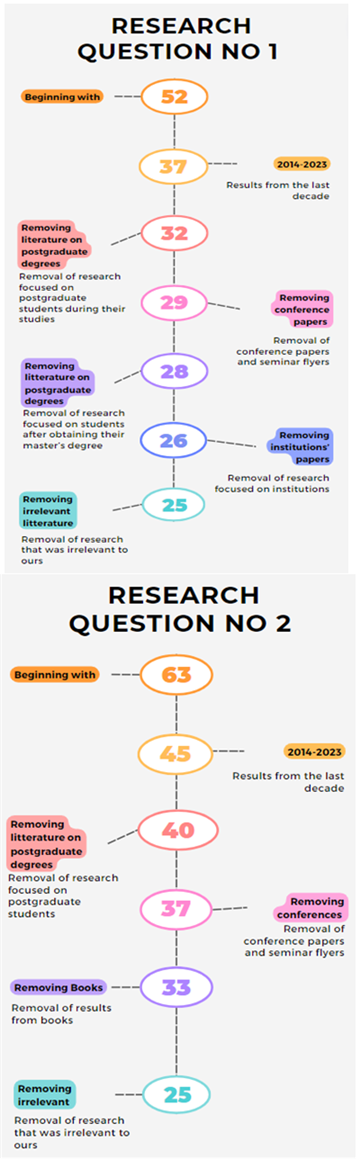
The search focused on research published during the last decade (specifically from January 2014 to May 2024, when we finalized our research), taking into consideration that since 1998, STEM disciplines would need some years to become firmly established in the educational field internationally. Our results displayed the entries in their title, while various resources that did not serve our research were excluded, with the possibility of exceptions to these exclusion criteria whenever some results were considered to offer important information for our research. In particular, we excluded theses and postgraduate or doctoral dissertations, books and conference proceedings or presentations that had not undergone wider peer review, references in languages other than English, as well as research/studies with content we considered to have nothing to offer our present work, e.g., they referred exclusively to post-secondary education.
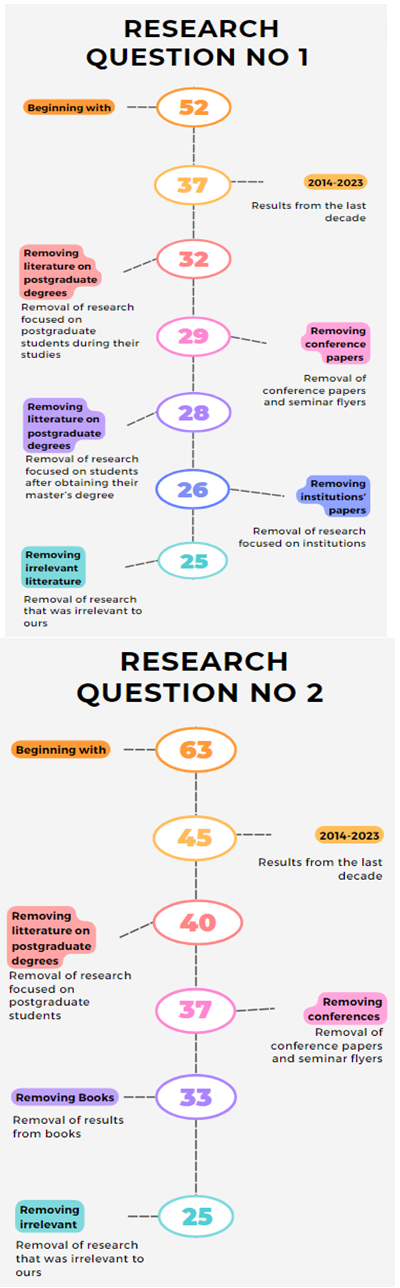
The initial search yielded 52 results relating to the first research question (i.e., correlation of students' gender with their interest in STEM education content) and 63 results for the second (i.e., influence of teachers' gender on students' interest in STEM disciplines). From these, we selected 25 articles for each research question, thus a total of 50 journal articles. The methodological procedure is illustrated in Figure 1.
Exceptions to the exclusion criteria for the first research question were a Spanish-language study on STEM education in Spanish primary schools from a gender perspective, involving students and teachers 13, and a postgraduate thesis that emphasizing that the value of female students' self-efficacy could be enhanced by a teachers' attitude 14. In addition, the article by Spanish researchers Ayuso and Merayo, in the proceedings of a conference 15, was considered very important and relevant to our research, as a follow-up to their published research in 2022 (included in this paper), on the analysis of gender and performance in STEM subjects of secondary school students.
Subsequently, exceptions to the exclusion criteria for the second research question were Pittman's doctoral dissertation 16, where she reported how the laboratory content in such courses enhances students' interest, using African American female students who grew up in a closed society as a research sample. For similar reasons, we also chose Londot's doctoral thesis as it focused on the influence of culture and family in shaping females' character 17.
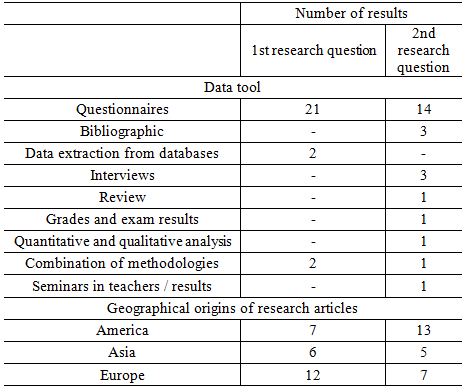
In respect of the methodology utilized in the research published in these articles, most of them deployed a questionnaire, as a data collection tool, which was completed by students, usually before and after a teaching intervention, but also by teachers. Despite that prevailing approach, other tools such as extracting data from national databases for students or teachers’ interviews were selected in some cases. Moreover, examining the geographic distribution of these studies, the majority of those pertaining to students originated in Europe, whilst most of those involving teachers were conducted in America. More details on that are presented in Table 1.
Details from our analysis of the pertinent literature are presented below.
Students’ gender and their perceptions of/relationships to STEM
Regarding perspectives towards STEM subjects and disciplines, differences between the interests of males and females can already be observed in both young and school age children, differences which are largely attributed to their gender. In a study in Hong Kong, children aged 6-9 years were asked to draw STEM professionals and answer a questionnaire 18. A significant difference was observed between males' and girls' drawings, where female STEM professionals were predominantly drawn by females. Furthermore, females may express more interest in a STEM career if they are convinced that STEM professionals build good social relationships with others, emphasizing the need for contact with professionals of different STEM disciplines to better understand their work, their characteristics, and their contribution to society through teamwork.
Continuing with some findings in Croatia 19, when children perceive themselves as a typical representative of their gender (i.e., gender identification), they adopt corresponding stereotypical beliefs about STEM professions, which is related to expected success in these professions. Such expectations favor males' engagement in a STEM field, possibly steering children towards occupations that stereotypically fit them. This situation in turn contributes to maintaining the existing racial gap in STEM fields.
In general, most studies exploring gender-associated differences find that female students have a significantly lower interest in mathematics, technology and engineering, with a smaller difference in Science 20, while males have a clear preference for STEM subjects overall 15. At the same time, of course, there are also studies which show no significant differences in children by gender, in terms of the importance they place on STEM subjects, the amount of time spent on them, the interest or satisfaction that results 13, and even in their preference and response to these subjects 21. In fact, children, regardless of gender, tend to be interested in a STEM career if they consider Mathematics and/or Science to be their favorite school subjects, compared to other, more humanistic or artistic subjects.
In a Swedish study, it was found that there was a variation between the genders in the choice of subjects based on their content, with no difference in interest in Mathematics 22. In particular, female students preferred more “soft” subjects such as languages, civics and biology, while male students preferred more “hard” subjects such as technology and physics, often describing them as accurate, logical and scientific. The aspect of a subject which attracted female students was its analytical and challenging aspects, which they perceived as both “igniting” and enriching their thinking processes. They often felt uncertainty, fear and insecurity in STEM scenarios where interaction or explanation of points in a STEM context was necessary, compared to their male peers, who were driven by interest and enthusiasm.
In Switzerland, male and female students completing their schooling were asked to use an index to rate the “masculinity of the subjects of Mathematics, Physics and Chemistry”, i.e., whether the three subjects are perceived as being more suitable for males 23. Mathematics was ranked as the most “masculine” subject by both genders – and interestingly, more so by females -- while females perceived all three subjects as more “masculine”. It should be noted that female students who were already oriented towards a STEM career considered the subjects less masculine, but conversely, female students who already considered them more masculine were less likely to be oriented towards a STEM career. A second trend seems to hold true for students who do not anticipate a STEM career, considering Mathematics also more masculine and avoiding such a future orientation. As stated in the abstract of their article, "a less strongly masculine view of science has the potential to increase the likelihood of STEM career aspirations" for both male and female students.
It may seem that female students are free to choose the subjects and studies they want to pursue, but this is not necessarily the case. Studying statistics on the reconfiguration of the STEM curriculum in Swedish high schools, which was based on market demands and in the context of “free choice”, revealed that males again dominate STEM fields, more often choosing the high specializations offered in the curriculum 24. Although girls choose Natural Sciences and Biology, the association of the other STEM fields remains strong with the male gender as more suited to this context of knowledge and occupation.
While females are more likely to finish school, it is more difficult for females to pursue and complete a STEM degree, especially in the fields of Engineering or Physics, even though they are often Life Sciences oriented. For female students, the presence of female teachers, with a relevant degree in their field of science, rather than in education, is significant and seems to increase their chances of choosing relevant courses when entering university and perhaps their intention to complete their studies 25.
This subject preference, therefore, extends to the expected careers of students. Spanish researchers Merayo and Ayuso point out that females are much more often oriented towards occupations related to health, psychology and education, as opposed to occupations usually associated with males, such as computer science and engineering 26. This relates to the greater personal demands that females place on themselves to meet the demands of STEM disciplines (e.g., they do not consider themselves as smart or courageous as males). Continuing and presenting their research at a recent conference 15, they found that motivations towards further STEM studies are different between genders, as males aim more for financial rewards and prestige in their profession, while females are more interested in helping others and improving society.
In this regard, it is interesting to note some findings on the effect of gender on STEM interests 27. Providing examples of individual female scientists or science teams to children, a greater impact and increase in interest was caused by the case of group science work, which is characterized by shared goals, collaboration, and helping others. Therefore, they believe that "simply attributing interest in STEM fields to the influence of racial stereotypes may be somewhat oversimplifying", but the emphasis in early adolescence is better placed on achieving community goals to move students toward STEM disciplines.
However, stereotypical perceptions regarding gender and STEM studies still exist, and show an increasing trend over time 28. Levels are higher among males, more easily attributing a masculine or feminine connotation to the professions in question, especially if they are aiming for a STEM discipline such as engineering. In contrast, females aiming for STEM studies have a more neutral perspective. In another study, where a STEM digital game creation program was implemented, most female students appeared to not acknowledge female stereotypes and did not discuss or focus on the relevant socio-political issues, challenging common stereotypes and assumptions that were embedded in the game 29.
Through her research in secondary schools in Turkey, Ergün found that students' STEM career interests are differentiated by gender, with the largest difference being in the field of Engineering, compared to other STEM fields and careers 30. In fact, this difference in career interests is in favor of female students in the fields of Science and Mathematics and in favor of male students in the fields of Technology and Engineering, and overall, male students' interest in STEM careers is higher compared to female students. This interest is significantly related to all subcategories (cognitive, affective and sociocultural) of the so-called 21st century skills 31. In this study, no significant difference of interest in a STEM career between female and male students emerged, but the 21st century skills, especially the emotional subcategory, in favor of female students. Indeed, in another study in China 32, while such an important skill of a more cognitive nature, computational thinking, is bidirectionally correlated and can predict better academic performance in STEM courses, it does not seem to be regulated by the gender of primary school children.
In a U.S. research, STEM learning is approached from a socio-emotional and a socio-cultural perspective 33. On the one hand, female students scored higher than their male peers on the factors of courage and social awareness, with no significant difference in their self-efficacy. On the other hand, male participants scored slightly higher than their female counterparts on the factor of sociocultural influences, with similar scores on the factor of personal focus on STEM issues. Both male and female students said that encouragement from teachers had the greatest influence on their choice of STEM fields, but that their parents/guardians also played a significant role in their STEM education. Finally, a significant difference between the genders is that males were able to encourage themselves, while female students were not, possibly indicating the greater confidence some male students had in their skills in STEM fields compared to some of their female peers.
The importance of female students' self-efficacy is also supported by Martot's Master's thesis: Once self-efficacy increases, females are driven to better academic performance in STEM fields while breaking free from gender biases that promote males' disproportionate success in their respective subjects 14. In this process of enhancing self-efficacy, the contribution of teachers is crucial, through constructive feedback, encouragement, and cultivating a positive pedagogical climate, attributing success to personal effort rather than intrinsic gender-based abilities.
The research of Xavier Hall and his team is noteworthy as it expands the concept of biological and social gender and its impact on STEM fields and sexual and gender minorities (SGM) 34. In addition to the underrepresentation of cis women in STEM professions, it appears that trans women and men, as well as non-binary individuals, show a reduced intention to engage in a STEM field. This observation is likely due to the bullying and discrimination these individuals experience due to their gender identity or sexual orientation, which negatively impacts their performance and sense of belonging in any STEM environment.
Before turning to the impact of teachers, the contribution of family and the wider family environment to children's interest in STEM fields cannot be overstated. Family support and family norms have been significantly associated with students' interests in STEM careers 20. Perhaps regardless of gender, children were more interested in STEM fields if they perceived that their parents and/or teachers valued STEM disciplines, where there is typically a greater interest from children and parents in Mathematics rather than Science 21. As regards females, it is important that they come into contact with female role models, both those who are famous and those from their immediate circle, and that they receive greater extrinsic encouragement from their parents as well as from teachers for their deeper engagement with and participation in extracurricular activities related to STEM disciplines 15, International Journal of Technology and Design Education, 1-28. Nov. 2022." class="coltj"> 26.
It is widely known that STEM disciplines are mostly male-dominated, so a particular community, such as an African American one, often views some female students' pursuit of joining such fields as less feminine 16. Culture and family contribute to shaping women's self-concept, which is difficult to change 17. Specifically, in a family setting, some mothers question their daughters' choice to pursue a male-dominated field 16, while women look to family, friends, and teachers for the positive reflection they need to gain self-esteem 17.
Even in research done on women who have already chosen STEM fields as their career, it seems that there were many childhood events and many stereotypical judgments from the family environment regarding which gender is better at Mathematics and Science 35. However, in a study conducted in Indonesia, there does not seem to be a statistically significant difference between male and female teachers in STEM disciplines in terms of behavior, knowledge, and in-class practices 36.
In most of the above-mentioned studies from different countries (i.e., Sweden, Spain, Denmark, Turkey, USA, Switzerland, etc.) which we analyzed, gender related differences in the attitudes of male and female students towards STEM subjects and disciplines can be observed from the early years of schooling, with female students showing significantly less interest, especially in Mathematics, Technology and Engineering, and slightly less in Natural Sciences. Indeed, this often stems from females' lower self-esteem in terms of their perceived ability to succeed in these subjects, and a concurrent belief in the superiority of their male classmates. Thus, the different subject preference extends to the expected careers of male and female students.
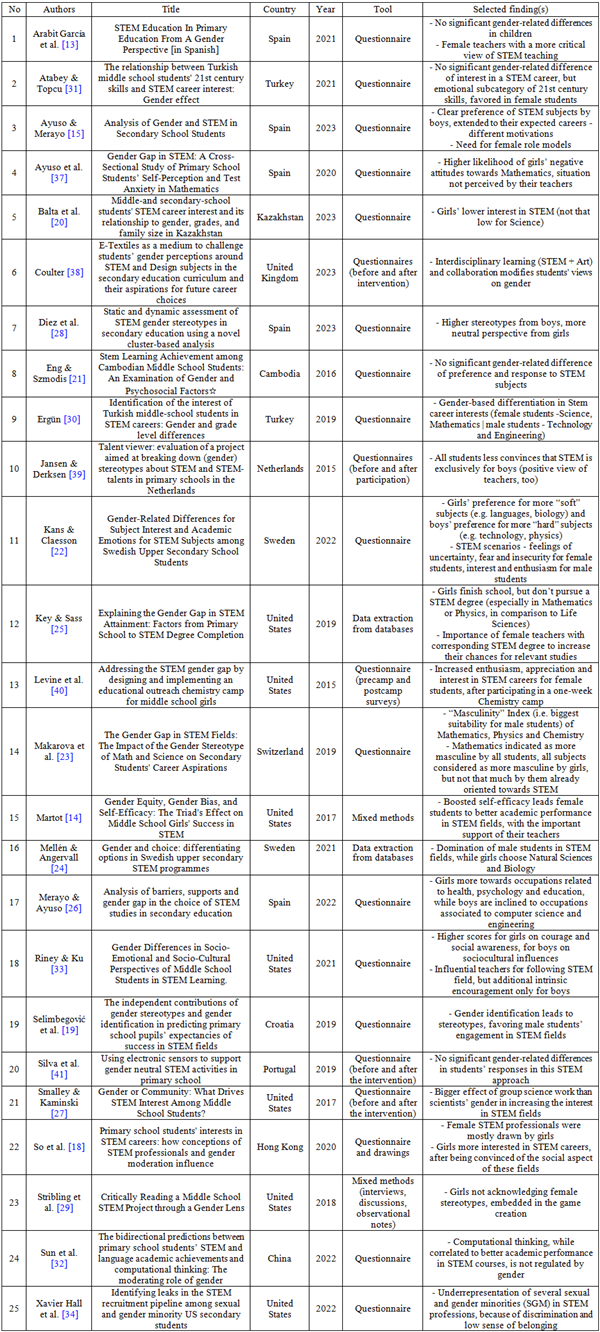
Τable 2 shows the aggregated results where the titles of the sources (articles etc.), the names of the authors, the dates of publication and the places where the researches were carried out as well as some selected results are shown.
Teachers’ gender and its influence on students’ relationship to STEM
There is a known shortage of women engaged in STEM disciplines, a shortage that can be partially attributed to subtle forms of bias associated with traditional stereotypes about gender roles 42. In the US, although women make up half of the workforce, only a quarter are employed in STEM disciplines 43. It is particularly important to examine the contribution of educators to the underrepresentation of women in STEM disciplines, as their views on gender are directly related to the degree to which stereotypes are entrenched within them 44, while their biases directly affect students' performance, self-concept, and educational trajectories 45. It also appears that female teachers have fewer stereotypical beliefs than their male colleagues 46. As a result, female students who had a female teacher appear to have a higher likelihood of enrolling in STEM higher education programs, an association not observed for male students, respectively 47. Furthermore, when teachers' biases in a STEM classroom are gender-related, the impact of these biases on women is evident 17, along with their general disposition as to how different groups are treated within the classroom 43.
Even at kindergarten level, teachers, either intentionally or not, play an important role in defining gender “norms” 35. In a Spanish study conducted in primary education (6- to 12-year-olds), teachers did not really perceive children's difficulty in Mathematics, with females having lower self-perceptions of effectiveness in this subject and consequently higher anxiety about exams 37. Therefore, females are more likely to acquire negative attitudes towards Mathematics than males as they get older, and teachers may not perceive this situation confronting their female students 37.
Furthermore, it is important to highlight the relationship between teachers' attitudes and their skills/knowledge on STEM issues 49. Specifically, in terms of gender equity issues, there are three dominant teacher views 50. The first one is gender blindness, in which teachers refuse to acknowledge that there is a problem with gender equality, without considering it relevant to their subject. The second one is gender acknowledgement, in which they notice and become aware of the problem, but do not consider that it is within their competence to act, and, lastly, there is gender intervention, in which there is strong teacher activism on gender equality issues within the classroom.
Teachers, and by extension students, have the belief that males tend to perform better than females in STEM disciplines 42. According to research conducted in a high school Engineering course, males who had strong stereotypical perceptions about females' abilities at the beginning of the year revised these views when they had a female teacher. In cases of males who had some stereotypical perceptions, the presence of females in the classroom was enough to make them reconsider. Therefore, in order for male students' strong stereotypical beliefs to be deconstructed, there must be a female role model who has some form of authority 44. However, in Denmark there was very little difference between teachers who suggested STEM education to males compared to those who suggested the same to females, a difference that is not statistically significant 51. STEM teacher stereotypes do not seem to have any effect on males, while teacher stereotypes in other subjects, such as literature, do not have the same effect on either males or females 52. This depicts the important role of the subject type in the effect of teacher stereotypes on students. It also seems that teachers in non-STEM courses are more gender-aware with more training in gender issues, recognizing the highest pressure on females 26.
Although contemporary education systems have reached a level where problematic behaviors associated with stereotypical views can be recognized, most of the time there is no willingness or actual ways to change the situation. For example, it was found that principals in one school were fully aware of the negative climate within the classroom and the discouragement of women towards STEM education, without taking further action. This necessitates the creation of a more welcoming environment for women within the school 44.
One of the main problems preventing females from choosing a STEM field as a career is a lack of self-confidence 53. There are a number of educators who suggest a solution to this problem is to return to separate schools organized by gender (males' and females'), but this reinforces the misconception that males do not need to change in order for there to be gender equality 44. Furthermore, it has been shown that teachers' stereotypes lead females to underperform in Mathematics and automatically choose less challenging courses (or even schools), even following recommendations from their teachers 52. Many females who take advanced Science courses in high school therefore do not continue their studies in Science at the tertiary level 54. Even at the university level, women who have chosen to specialize in STEM disciplines, while they seem to perform better in their jobs due to existing social pressure, feel that a man would likely do better than they would 53.
Early research from economics, neuroscience, social psychology and sociology has begun to suggest many possible forms and sources of bias that negatively harm marginalized people 45. Teachers, particularly of Mathematics, hold implicit and explicit gender biases, which manifest in a variety of ways within the classroom, such as different expectations of students and the way they receive feedback. Such attitudes accumulate over time and influence students' own perceptions of women's abilities in Mathematics, which appears to prevent females from choosing STEM careers 45. Even male students themselves believe there is a greater likelihood of negative bias when they have a male teacher instead of a female one 46.
Besides the indispensable empowerment of female teachers in schools, it is worth emphasizing that the general behavior of teachers, regardless of gender, can also influence stereotypical perceptions of students. It has been found that students who had a female teacher, or teachers in general who valued and listened to their ideas, were less likely to believe that women were better at Mathematics or Science overall 55. So, in addition to gender, reinforcing the teacher's active listening skill is crucial to develop each child's interest. In the same study, it was found that female students who had a male Math teacher and a female Science teacher did not believe that males were better at STEM, compared to them. Therefore, it is not only the teacher’s gender, but also teachers' beliefs and attitudes about gender have a direct impact on females' decision to choose to take advanced math and science courses in high school 55. However, because biases are partly gender dependent and also depend on the culture of the teachers' home country 51, both female and male teachers should be available for each student throughout their educational journey in order to have a neutrality in attitudes 55.
A major factor influencing the lower rate of females choosing to pursue STEM fields is the lack of adequate teacher training 16. Especially in Mathematics, it seems that teachers lack the appropriate training to manage their students, regardless of gender 56. Teachers should be properly trained in order to recognize problematic behaviors within the classroom. Besides, the interaction between males and females during teaching hours is a sign of the culture, which is determined by the teacher and reflects the demands of society 17. For this reason, some efforts with teacher training programs aiming to treat children without prejudice are very useful 57.
It has been found that knowledge and awareness regarding gender issues are lower in Spain compared to Greece, which is not the case with teachers' self-efficacy in developing gender attitudes 58, so it seems that these two factors are not related. Also, self-efficacy in gender attitudes in Greek male teachers was higher than in female teachers, while in Spain the opposite is true 58.
In a doctoral thesis based on a sample of African American female teachers-in-training, it was found that there they were more engaged when they had the opportunity for in-class student teaching practice, since it reinforced cooperative team teaching, but also competition, creating new motivation for women 16. There seems to be a great need for such alternative modes of teacher training, as there are statistically significant differences, in females' self-efficacy in Mathematics and Science, which is reinforced by the lack of initiatives of a new form of gender-balanced teaching on the part of teachers 42. A more contemporary form of teaching is the use of art, whose contribution to such issues is of paramount importance and effectiveness. It seems that the use of films can increase students' interest in STEM disciplines, as it can fill the gap that may exist in female role models 59.
In a study of teachers in Thailand, it was found that the self-efficacy of STEM teaching is related to their teaching effectiveness and their beliefs and expectations of teaching outcomes. Although these teachers had a high level of self-efficacy in teaching STEM subjects, most of them had doubts as to whether they had the necessary skills to teach STEM subjects 60.
It is striking how strong the gender differentiation is, even in terms of training. Female teachers adopted a more critical view of STEM teaching compared to their male counterparts. While considering not only themselves, but also everyone else less trained, they are interested in actually being trained, more than men, sharing realistic view 13.
Part of the training process of teachers for STEM disciples should include training in writing and organizing STEM education programs so that they can practically implement them in their classroom. The majority of teachers do not possess such skills, and as a result they are unable to calculate the costs and time required to properly prepare and conduct such programs. As long as teachers are able to manage these aspects of presenting a lesson, their attitude towards it improves 61.
Based on what has been reported so far, teachers stereotypically believe, and manifest it in various ways, that males can perform better than females in STEM disciplines. This ultimately leads females to lower performance and lower chances of choosing this kind of career, as their efforts are essentially discouraged, and a “defeatist” attitude is adopted. In contrast, most of the studied articles correlate females' successful response to STEM subjects with the presence of a female teacher, without this implying a decrease in males’ interest and performance.
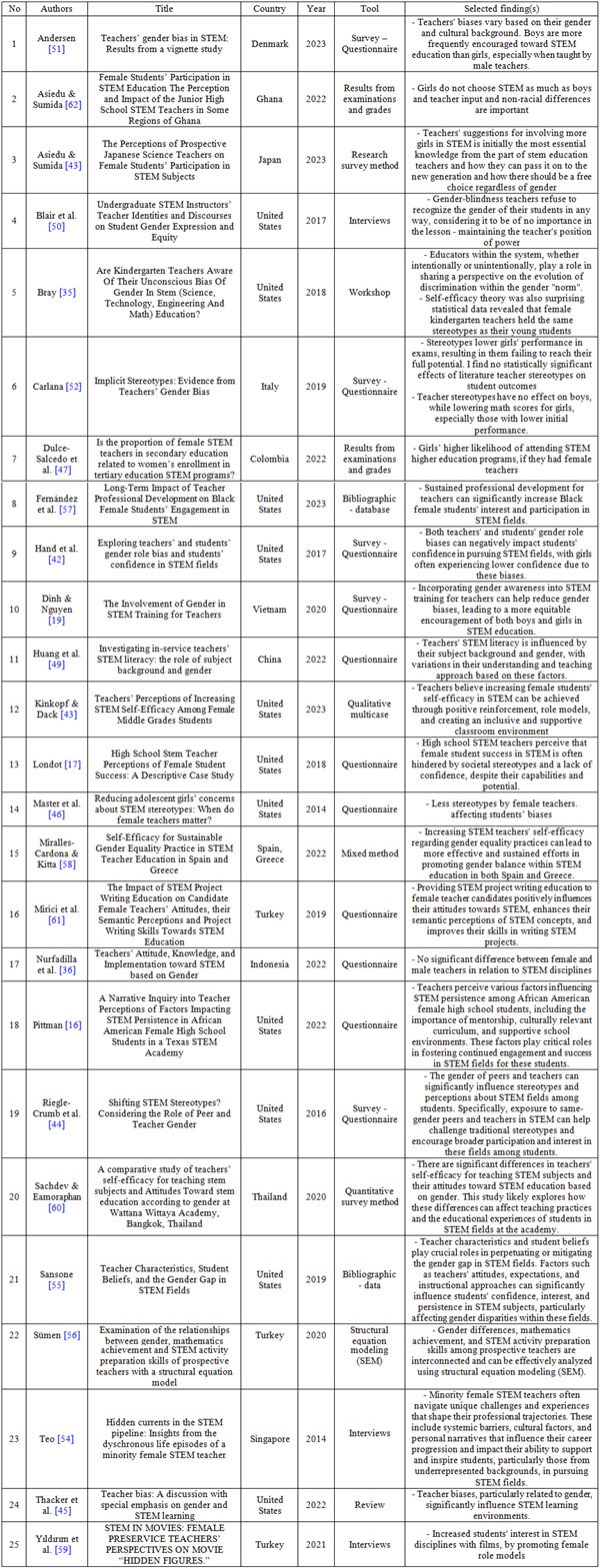
The aggregated results of the titles of the sources (articles etc.), the names of the authors, the dates of publication and the places where the research was carried out as well as some selected results are shown in Table 3.
Based on the analysis of the research studies presented above, it is apparent that the gender of students affects their choices regarding STEM education, and that the gender of teachers (as well the family context) plays a role in female students’ success in STEM studies and future careers.
In particular, female students show a tendency towards more theoretical subjects or towards Natural Sciences, compared to other STEM disciplines, which stems from a feeling of disadvantage towards their male peers in terms of their performance, character and self-efficacy e.g. 15, 22, 23, 31. The need to highlight the social component of STEM fields and careers is also noteworthy, so as to increase females' engagement with these subjects.
The reasons for the current under-representation of women in STEM industries are multifaceted and do not vary much from country to country. Starting from the family environment and the social stereotypes imposed through it in childhood, they continue with the school environment, the direct or indirect contribution of teachers, but also through the interaction of children with their classmates. The lack of self-confidence on the part of female students seems to be reinforced by the stereotypical attitudes of teachers in STEM disciplines. In several of the aforementioned studies, it was found that, while females perform better in science, they do not feel confident enough to advance to a professional level in such fields. This decreased self-confidence, already cultivated through the family environment and related to socially created stereotypes, seems to be exacerbated by the behavior of teachers.
At the teachers’ level, reduced stereotypical perceptions from female teachers seem to be transmitted through their teaching, which indicates the importance of their presence in the classroom. In turn, inadequate training, as often acknowledged by the teaching staff themselves, is an important component in this phenomenon, since an open classroom climate of acceptance and development of females' skills and confidence is not established. For this reason, there is a dire need for continuous training and familiarization with gender issues, while trying to highlight the abilities of all children. Driven by a more complete training of every teacher, and the presence of female teachers of STEM subjects, the number of available female "role models" 63, teachers and professionals, can be increased, and at the same time a more practical, but also social part of science can be integrated. This could lead to more gender-balanced approaches, providing equal opportunities for males and females to participate. Thereby, females' interest in a broader engagement with STEM fields, and a possible related career, could be enhanced.
STEM education programs and interventions
Through the UNESCO report 8, a variety of interventions are presented on the four successive factors that influence women and women's relationship with STEM fields i.e. a. individual, b. family/colleagues, c. school and d. society. Therefore, it is necessary to engage and develop various skills in females, as well as their interest in STEM disciplines, a process starting from the family context by fully informing their daughters about their abilities and combating possible misconceptions they may encounter. Particularly at school level, the broader objective is the organization and implementation of gender-neutral or gender-balanced programs, making STEM curricula more attractive to females. Some points of emphasis include gender-neutral language and treatment of children, hands-on activities, collaborative science design relevant to real-life issues, as well as more extensive exposure to technology and female professionals who can serve as role models.
The main objective of creating a training program is to provide professional development on gender equality issues and general awareness-raising regarding gender discrimination 58. Even the teachers themselves believe that in order for more females to be involved in STEM disciplines, there should be more substantial knowledge on the scientific aspect of their respective fields, but also on the teaching procedures through which the free choice of a gender-independent profession is passed on to the new generation 62.
Relevant educational programs need to incorporate case studies of female professionals or historical examples of substantial but unrecognized contributions, since a reinforcing factor of female students' under-selection for STEM careers is the lack of role models. In a Thai school, a platform (i-STEM) has been running since 2015, on which students upload the results of their projects every year, which seems to work positively in terms of selection and active participation of subsequent classes 60. In addition, a STEM department has been established in the same school, which aims for the creation of a STEM-only curriculum from early childhood through to upper secondary school.
A substantial intervention effort is documented in Levine and colleagues' research in which a one-week program targeting female high school students was designed, implemented, and evaluated 40. This included hands-on experiments, field trips, and interactions with female scientists to increase females' enthusiasm and appreciation of science. The results of the research showed that participation in the program did indeed have the desired effect in enhancing this enthusiasm and appreciation, as well as the females' interest in pursuing careers related to STEM disciplines.
STEM approaches and interventions are therefore essential for narrowing the gender gap. For example, following such a teaching intervention, on an environmental health issue, no statistically significant differences were observed between males' and females' responses in terms of relevant knowledge or proposed solutions 41. In particular, when learning is approached in a more interdisciplinary way and involves more everyday situations, with tools such as 'e-textiles', it facilitates the connection between different STEM areas and even more artistic aspects, such as designing, collaborating and modifying students' views on gender in the curriculum, increasing the expectations of both for future STEM careers 38.
Finally, in the Netherlands, the Talent Viewer program was implemented to combat STEM stereotypes in primary education 39. After participating, both girls and males were much less convinced that science and technology specifically appeal to males, as the association of these disciplines with difficulty and excellence decreased. In fact, in addition to children, teachers also showed greater gender awareness and viewed the program positively in terms of discovering children's abilities and exposing them to female professionals. This awareness about STEM standards, especially among women, as well as the promotion of science channels and content creators online is very important, as through better promotion of STEM content, children will be able to understand it even better, before deciding if it is what suits them for their future 15.
Limitations and further implications of the study
As further possible extensions of the present work, various other possibilities and search options cannot be omitted. For example, while some results included the entry "student/students", if the search had utilized this entry as such, some more useful results might have been obtained in the context of our work, and the study of STEM higher education is an interesting extension of the research. With relevance to that, while not further distinguishing boys/male students from girls/female students to highlight comparative results between these two genders, the few actual results might contain useful information focused on one specific students’ gender. In addition, our search was limited to literature references that addressed STEM fields more comprehensively, in the context of school education, however, it is possible that some research may focus on one STEM field, e.g., Mathematics or Physics, from which conclusions can be generalized and applied to other STEM disciplines. In this vein, and although the recent literature is certainly more extensive, there may be older research that addresses STEM issues, more or less holistically, that may be of interest to study. Finally, by our decision to exclude books and theses/dissertations, we may have missed some important data or studies with notable results that simply had not been published in peer-reviewed journals for wider dissemination and critique.
Undoubtedly, the factors above are not the only ones that could contribute to this direction, as the role of the family is equally important and decisive in such choices and should be investigated extensively and separately. Furthermore, teaching time allocated for each subject, their integration into the timetable 64 and opportunities for participation also play an important role, but this is beyond the scope of this paper. However, for a society that sets and strives to achieve a set of Sustainable Development Goals, it is of paramount importance to ensure equal opportunities between genders, and at every level possible.
Furthermore, future work could complement the present approach with alternative methodological perspectives, such as mixed-methods syntheses or targeted meta-analytical techniques, which may highlight additional nuances in gender-related patterns in STEM. Such approaches would not replace but rather enrich the insights already obtained, offering researchers a broader set of tools for interpreting emerging trends. In the same direction, combining large-scale quantitative evidence with more focused qualitative studies could shed light on contextual factors that remain less visible in the current literature. These parallel avenues may ultimately support a more holistic understanding of how gender and attitudes intersect across different STEM settings.
A comprehensive review of the literature relating to the impact of both students’ gender in their choice of subjects studied and teachers’ gender on the encouragement of females in STEM education was presented in this paper. Based on the research cited, gender apparently plays a role in both cases, significantly influencing the choices of females not only during their school years, but also during their later career path. Corresponding stereotypes about the superiority of male students in performance in STEM subjects were also identified. On the other hand, proper training of STEM teachers has been found to be essential for obtaining the best possible outcomes for both female and male students. For these reasons, it seems that better training of teachers in STEM subjects, increasing the number of female teachers in the field, and encouraging female students to engage in STEM subjects both initially at school and later at the professional level are strongly linked. In any case, it is imperative that we as a society help to mitigate any differences that may arise from gender issues starting from the early years of education. It is certainly a solid step that can contribute to the desired sustainable development and prosperity of societies.
| [1] | Rossiter, M. W. (1982). Women Scientists in America: Struggles and Strategies to 1940. Johns Hopkins University Press. | ||
| In article | View Article | ||
| [2] | Williams, L.S. “Information technology: Its impact on undergraduate education in science, mathematics, engineering, and technology. In Report on an NSF Workshop, Directorate for Education and Human Resources, Division of Undergraduate Education. 1998. | ||
| In article | |||
| [3] | Li, Y., Wang, K., Xiao, Y. and Froyd, J.E. “Research and trends in STEM education: A systematic review of journal publications,” International Journal of STEM education, 7 (11), 1-16, Mar. 2020. | ||
| In article | View Article | ||
| [4] | Bybee, R. “What is STEM education?” Science, 329, 996. Aug. 2010. | ||
| In article | View Article PubMed | ||
| [5] | Papadopoulou, F., Vasilou, M.P. & Georgiou, M. “Living with plants or leaving plants? A STEM-based teaching approach.” International journal of engineering research and technology, 8 (10), 520-524. Oct. 2019. | ||
| In article | View Article | ||
| [6] | Sánchez-Tapia, I. and Alam, A. Towards an equal future: Reimagining girls’ education through STEM, UNICEF, 2020. | ||
| In article | |||
| [7] | Li, Y., Wang, K., Xiao, Y., Froyd, J.E. and Nite, S.B. “Research and trends in STEM education: a systematic analysis of publicly funded projects,” International Journal of STEM education, 7 (17), 1-17, Apr. 2020. | ||
| In article | View Article | ||
| [8] | UNESCO. Cracking the code: girls' and women's education in science, technology, engineering and mathematics (STEM), 2017. | ||
| In article | |||
| [9] | Dökme, İ., Açıksöz, A., and Koyunlu Ünlü, Z. “Investigation of STEM fields motivation among female students in science education colleges,” International Journal of STEM Education, 9(8), 1-14. Jan. 2022. | ||
| In article | View Article | ||
| [10] | Wu, T., and Albion, P. “Investigating Remote Access Laboratories for Increasing Pre-Service Teachers’ STEM Capabilities,” Educational Technology & Society, 22(1): 82–93. Jan. 2019. | ||
| In article | |||
| [11] | Bryant, F.B., Kastrup, H., Udo, M., Hislop, N., Shefner, R. and J. Mallow. “Science Anxiety, ScienceAttitudes, and Constructivism: A Binational Study," Journal of Science Education and Technology, 22(4): 432–448. Aug. 2013. | ||
| In article | View Article | ||
| [12] | Page, M. J., McKenzie, J. E., Bossuyt, P. M., Boutron, I., Hoffmann, T. C., Mulrow, C. D., et al. (2021). The PRISMA 2020 statement: An updated guideline for reporting systematic reviews. BMJ, 372, n71. | ||
| In article | View Article PubMed | ||
| [13] | Arabit García, J., Prendes Espinosa, M.P., and Serrano Sánchez, J.L. “La enseñanza de STEM en Educación Primaria desde una perspectiva de género,” Revista Fuentes, 23(1), 64–76. Jan. 2021. | ||
| In article | View Article | ||
| [14] | Martot, K. “Gender Equity, Gender Bias, and Self-Efficacy: The Triad's Effect on Middle School Girls' Success in STEM,” California State University, San Marcos. Aug. 2018. Available: http://hdl.handle.net/10211.3/194739. | ||
| In article | |||
| [15] | Ayuso, A. and Merayo, N. “Analysis of Gender and STEM in Secondary School Students” in Proceedings TEEM 2022: Tenth International Conference on Technological Ecosystems for Enhancing Multiculturality: Salamanca, Spain, October 19–21, 2022 (pp. 387-396). Singapore: Springer Nature Singapore. | ||
| In article | View Article | ||
| [16] | Pittman, F.R.R. “A Narrative Inquiry into Teacher Perceptions of Factors Impacting STEM Persistence in African American Female High School Students in a Texas STEM Academy,” Electronic Theses & Dissertations. Texas A&M University-Commerce. 2022. | ||
| In article | |||
| [17] | Londot, G.L. “High School Stem Teacher Perceptions of Female Student Success: A Descriptive Case Study,” ProQuest Dissertations Publishing. University of Phoenix. Mar. 2018. | ||
| In article | |||
| [18] | So, W.W.M., Chen, Y. and Chow, S.C.F. “Primary school students' interests in STEM careers: how conceptions of STEM professionals and gender moderation influence,” International Journal of Technology and Design Education, 1-21. June 2020. | ||
| In article | View Article | ||
| [19] | Selimbegović, L., Karabegović, M., Blažev, M. and Burušić, J. “The independent contributions of gender stereotypes and gender identification in predicting primary school pupils’ expectancies of success in STEM fields,” Psychology in the Schools, 56(10), 1614-1632. Sep. 2019. | ||
| In article | View Article | ||
| [20] | Balta, N., Japashov, N., Mansurova, A., Tzafilkou, K., Oliveira, A. W. and Lathrop, R. “Middle‐and secondary‐school students' STEM career interest and its relationship to gender, grades, and family size in Kazakhstan,” Science Education, 107(2), 401-426. Mar. 2023. | ||
| In article | View Article | ||
| [21] | Eng, S. and Szmodis, W. “Stem Learning Achievement among Cambodian Middle School Students: An Examination of Gender and Psychosocial Factors☆,” Annual Review of Comparative and International Education 2015, 28, 279-305. 2016. | ||
| In article | View Article | ||
| [22] | Kans, M. and Claesson, L. “Gender-Related Differences for Subject Interest and Academic Emotions for STEM Subjects among Swedish Upper Secondary School Students,” Education Sciences, 12(8), 553. Aug. 2022. | ||
| In article | View Article | ||
| [23] | Makarova, E., Aeschlimann, B. and Herzog, W. “The gender gap in STEM fields: The impact of the gender stereotype of math and science on secondary students' career aspirations,” Frontiers in Education, 4(60). July 2019. | ||
| In article | View Article | ||
| [24] | Mellén, J. and Angervall, P. “Gender and choice: differentiating options in Swedish upper secondary STEM programmes,” Journal of Education Policy, 36(3), 417-435. Jan. 2020. | ||
| In article | View Article | ||
| [25] | Key, K.A. and Sass, T.R. “Explaining the Gender Gap in STEM Attainment: Factors from Primary School to STEM Degree Completion,” Annenberg Institute, Brown University. Apr. 2019. | ||
| In article | |||
| [26] | Merayo, N. and Ayuso, A. "Analysis of barriers, supports and gender gap in the choice of STEM studies in secondary education,” International Journal of Technology and Design Education, 1-28. Nov. 2022. | ||
| In article | |||
| [27] | Smalley, E. and Kaminski, J. “Gender or Community: What Drives STEM Interest among Middle School Students?” CogSci, 3197-3202. 2017. | ||
| In article | |||
| [28] | Diez, J. L., Ramos, A. and Candela, C. “Static and dynamic assessment of STEM gender stereotypes in secondary education using a novel cluster-based analysis,” International Journal of Technology and Design Education, 33(2), 749-774. Apr. 2023. | ||
| In article | View Article | ||
| [29] | Stribling, S.M., Berkeley, S., Kurz, L.A. and Colburn, A. “Critically Reading a Middle School STEM Project through a Gender Lens,” International Journal of Gender, Science and Technology, 10(3), 411-431. Feb. 2019. | ||
| In article | |||
| [30] | Ergün, A. “Identification of the interest of Turkish middle-school students in STEM careers: Gender and grade level differences,” Journal of Baltic Science Education, 18(1), 90-104. Feb. 2019. | ||
| In article | View Article | ||
| [31] | Atabey, N. and Topcu, M.S. “The relationship between Turkish middle school students’ 21st century skills and STEM career interest: Gender effect,” Journal of Education in Science Environment and Health, 7(2), 86-103. Apr. 2021. | ||
| In article | View Article | ||
| [32] | Sun, L., Hu, L. and Zhou, D. “The bidirectional predictions between primary school students’ STEM and language academic achievements and computational thinking: The moderating role of gender,” Thinking Skills and Creativity, 44, 101043. May 2022. | ||
| In article | View Article | ||
| [33] | Riney, D.A. and Ku, H.Y. “Gender Differences in Socio-Emotional and Socio-Cultural Perspectives of Middle School Students in STEM Learning,” Journal of Educational Research and Innovation, 9(1), 3. Oct. 2021. | ||
| In article | |||
| [34] | Xavier Hall, C.D., Wood, C.V., Hurtado, M., Moskowitz, D.A., Dyar, C. and Mustanski, B. “Identifying leaks in the STEM recruitment pipeline among sexual and gender minority US secondary students,” Plos one, 17(6), e0268769. June 2022. | ||
| In article | View Article PubMed | ||
| [35] | Bray, J. “Are Kindergarten Teachers Aware Of Their Unconscious Bias Of Gender In Stem (Science, Technology, Engineering And Math) Education?” School of Education and Leadership Student Capstone Projects. Sep. 2018. | ||
| In article | |||
| [36] | Nurfadilla, E., Halim, A., Supriatno, S., Yusrizal, Y. and Mursal, M. “Teachers’ Attitude, Knowledge, and Implementation toward STEM based on Gender,” Jurnal Penelitian Pendidikan IPA, 8(3), 1489–1494. July 2022. | ||
| In article | View Article | ||
| [37] | Ayuso, N., Fillola, E., Masia, B., Murillo, A.C., Trillo-Lado, R., Baldassarri, S., ... and Villarroya-Gaudó, M. “Gender gap in STEM: A cross-sectional study of primary school students’ self-perception and test anxiety in mathematics,” IEEE Transactions on Education, 64(1), 40-49. July 2020. | ||
| In article | View Article | ||
| [38] | Coulter, J. “E-Textiles as a medium to challenge students’ gender perceptions around STEM and Design subjects in the secondary education curriculum and their aspirations for future career choices,” Journal of Textile Design Research and Practice, 11(1–2), 168–193. June 2023. | ||
| In article | View Article | ||
| [39] | Jansen, (Noortje) E.J.M. and Derksen, L.M. “Talent viewer: evaluation of a project aimed at breaking down (gender) stereotypes about STEM and STEM-talents in primary schools in the Netherlands,” International Journal of Gender, Science and Technology, 8(1), 144–156. Oct. 2015. | ||
| In article | |||
| [40] | Levine, M., Serio, N., Radaram, B., Chaudhuri, S. and Talbert, W. “Addressing the STEM gender gap by designing and implementing an educational outreach chemistry camp for middle school girls,” Journal of Chemical Education, 92(10), 1639-1644. Sep. 2015. | ||
| In article | View Article | ||
| [41] | Silva, M.J., Ferreira, E. and Batista, S. “Using electronic sensors to support gender neutral STEM activities in primary school,” in 2019 International Symposium on Computers in Education (SIIE), IEEE, 1-6. Nov. 2019. | ||
| In article | View Article | ||
| [42] | Hand, S., Rice, L. and Greenlee, E. “Exploring teachers’ and students’ gender role bias and students’ confidence in STEM fields,” Social Psychology of Education, 20(4), 929–945. Oct. 2017. | ||
| In article | View Article | ||
| [43] | Kinkopf, D. and Dack, H. “Teachers’ Perceptions of Increasing STEM Self-Efficacy Among Female Middle Grades Students,” RMLE Online, 46(5), 1-21. Apr. 2023. | ||
| In article | View Article | ||
| [44] | Riegle-Crumb, C., Moore, C. and Buontempo, J. “Shifting STEM Stereotypes? Considering the Role of Peer and Teacher Gender,” Journal of Research on Adolescence, 27(3), 492–505. Oct. 2016. | ||
| In article | View Article PubMed | ||
| [45] | Thacker, I., Copur-Gencturk, Y. and Cimpian, J.R. “Teacher bias: A discussion with special emphasis on gender and STEM learning.” Routledge. May 2022. | ||
| In article | View Article | ||
| [46] | Master, A., Cheryan, S. and Meltzoff, A.N. “Reducing adolescent girls’ concerns about STEM stereotypes: When do female teachers matter?” Revue Internationale De Psychologie Sociale, 27(3), 79–102. 2014. | ||
| In article | |||
| [47] | Dulce-Salcedo, O.V., Maldonado, D. and Sánchez, F. “Is the proportion of female STEM teachers in secondary education related to women’s enrollment in tertiary education STEM programs?” International Journal of Educational Development, 91, 102591. Mar. 2022. | ||
| In article | View Article | ||
| [48] | Asiedu, M. and Sumida, M. “Female Students’ Participation in STEM Education The Perception and Impact of the Junior High School STEM Teachers in Some Regions of Ghana,” JSSE Research Report, 37(1), 25-28. Nov. 2022. | ||
| In article | |||
| [49] | Huang, X., Sibel Erduran, Luo, K., Zhang, P. and Zheng, M. «Investigating in-service teachers’ STEM literacy: the role of subject background and gender,” Research in Science & Technological Education, 1–21. Dec. 2022. | ||
| In article | View Article | ||
| [50] | Blair, E.A., Miller, R., Ong, M. and Zastavker, Y.V. “Undergraduate STEM Instructors’ Teacher Identities and Discourses on Student Gender Expression and Equity,” Journal of Engineering Education, 106(1), 14–43. Jan. 2017. | ||
| In article | View Article | ||
| [51] | Andersen, I.G. “Teachers’ gender bias in STEM: Results from a vignette study.” British Educational Research Journal. 00, 1– 19. Apr. 2023. | ||
| In article | |||
| [52] | Carlana, M. “Implicit Stereotypes: Evidence from Teachers’ Gender Bias,”. The Quarterly Journal of Economics, 134(3). Mar. 2019. | ||
| In article | View Article | ||
| [53] | Dinh, D.H. and Nguyen Q.L. “The Involvement of Gender in STEM Training for Teachers,” European Journal of Educational Research, 9(1). Jan. 2020. | ||
| In article | View Article | ||
| [54] | Teo, T.W. “Hidden currents in the STEM pipeline: Insights from the dyschronous life episodes of a minority female STEM teacher,” Theory Into Practice, 53(1), 48-54. Jan. 2014. | ||
| In article | View Article | ||
| [55] | Sansone, D. “Teacher Characteristics, Student Beliefs, and the Gender Gap in STEM Fields,” Educational Evaluation and Policy Analysis, 41(2), 127–144. Dec. 2018. | ||
| In article | View Article | ||
| [56] | Sümen, Ö. “Examination of the relationships between gender, mathematics achievement and STEM activity preparation skills of prospective teachers with a structural equation model,” African Educational Research Journal, 8(4), 784-790. Oct. 2020. | ||
| In article | View Article | ||
| [57] | Fernández, C.H., Barr, C., Antoine, A., Alston, C. and Nichol, C. “Long-Term Impact of Teacher Professional Development on Black Female Students’ Engagement in STEM,” Journal of STEM Outreach, 6(1), 1-12. Jan. 2023. | ||
| In article | |||
| [58] | Miralles-Cardona, C. and Kitta, I. “Self-Efficacy for Sustainable Gender Equality Practice in STEM Teacher Education in Spain and Greece,” Preprints, 2022110367. Nov. 2022. | ||
| In article | View Article | ||
| [59] | Yıldırım, B.F., Öcal, E. and Sahin-Topalcengiz, E. “STEM IN MOVIES: FEMALE PRESERVICE TEACHERS’ PERSPECTIVES ON MOVIE “HIDDEN FIGURES,” Journal of Baltic Science Education, 20(5), 740–758. Oct. 2021. | ||
| In article | View Article | ||
| [60] | Sachdev, S. and Eamoraphan, S. “A comparative study of teachers’ self-efficacy for teaching stem subjects and Attitudes Toward stem education according to gender at Wattana Wittaya Academy, Bangkok, Thailand,” Scholar: Human Sciences, 12(2), 251-264, Jan. 2020. | ||
| In article | |||
| [61] | Mirici, S., Gencer, İ. and Gündüz, Ş. “The Impact of STEM Project Writing Education on Candidate Female Teachers’ Attitudes, their Semantic Perceptions and Project Writing Skills Towards STEM Education,” International Journal of Curriculum and Instruction, 11(2), 255–272. Oct. 2019. | ||
| In article | |||
| [62] | Asiedu, M. and Sumida, M. “Female Students’ Participation in STEM Education The Perception and Impact of the Junior High School STEM Teachers in Some Regions of Ghana,” JSSE Research Report, 37(1), 25-28. Nov. 2022 | ||
| In article | |||
| [63] | González-Pérez, S., Mateos de Cabo, R. and Sáinz, M. ”Girls in STEM: Is it a female role-model thing?” Frontiers in Psychology, 11, 564148. Sep. 2020. | ||
| In article | View Article PubMed | ||
| [64] | Georgiou, M., Mavrikaki, E., Halkia, K. and Papassideri, I. “Investigating the impact of the duration of engagement in socioscientific issues in developing Greek students’ argumentation and informal reasoning skills,” American Journal of Educational Research, 8(1), 16-23. Jan. 2020. | ||
| In article | |||
Published with license by Science and Education Publishing, Copyright © 2025 Evangelos Pappas, Panagiota Kaisaridi, Zacharoula Smyrnaiou, Antonios Bouras and Martha Georgiou
 This work is licensed under a Creative Commons Attribution 4.0 International License. To view a copy of this license, visit
http://creativecommons.org/licenses/by/4.0/
This work is licensed under a Creative Commons Attribution 4.0 International License. To view a copy of this license, visit
http://creativecommons.org/licenses/by/4.0/
| [1] | Rossiter, M. W. (1982). Women Scientists in America: Struggles and Strategies to 1940. Johns Hopkins University Press. | ||
| In article | View Article | ||
| [2] | Williams, L.S. “Information technology: Its impact on undergraduate education in science, mathematics, engineering, and technology. In Report on an NSF Workshop, Directorate for Education and Human Resources, Division of Undergraduate Education. 1998. | ||
| In article | |||
| [3] | Li, Y., Wang, K., Xiao, Y. and Froyd, J.E. “Research and trends in STEM education: A systematic review of journal publications,” International Journal of STEM education, 7 (11), 1-16, Mar. 2020. | ||
| In article | View Article | ||
| [4] | Bybee, R. “What is STEM education?” Science, 329, 996. Aug. 2010. | ||
| In article | View Article PubMed | ||
| [5] | Papadopoulou, F., Vasilou, M.P. & Georgiou, M. “Living with plants or leaving plants? A STEM-based teaching approach.” International journal of engineering research and technology, 8 (10), 520-524. Oct. 2019. | ||
| In article | View Article | ||
| [6] | Sánchez-Tapia, I. and Alam, A. Towards an equal future: Reimagining girls’ education through STEM, UNICEF, 2020. | ||
| In article | |||
| [7] | Li, Y., Wang, K., Xiao, Y., Froyd, J.E. and Nite, S.B. “Research and trends in STEM education: a systematic analysis of publicly funded projects,” International Journal of STEM education, 7 (17), 1-17, Apr. 2020. | ||
| In article | View Article | ||
| [8] | UNESCO. Cracking the code: girls' and women's education in science, technology, engineering and mathematics (STEM), 2017. | ||
| In article | |||
| [9] | Dökme, İ., Açıksöz, A., and Koyunlu Ünlü, Z. “Investigation of STEM fields motivation among female students in science education colleges,” International Journal of STEM Education, 9(8), 1-14. Jan. 2022. | ||
| In article | View Article | ||
| [10] | Wu, T., and Albion, P. “Investigating Remote Access Laboratories for Increasing Pre-Service Teachers’ STEM Capabilities,” Educational Technology & Society, 22(1): 82–93. Jan. 2019. | ||
| In article | |||
| [11] | Bryant, F.B., Kastrup, H., Udo, M., Hislop, N., Shefner, R. and J. Mallow. “Science Anxiety, ScienceAttitudes, and Constructivism: A Binational Study," Journal of Science Education and Technology, 22(4): 432–448. Aug. 2013. | ||
| In article | View Article | ||
| [12] | Page, M. J., McKenzie, J. E., Bossuyt, P. M., Boutron, I., Hoffmann, T. C., Mulrow, C. D., et al. (2021). The PRISMA 2020 statement: An updated guideline for reporting systematic reviews. BMJ, 372, n71. | ||
| In article | View Article PubMed | ||
| [13] | Arabit García, J., Prendes Espinosa, M.P., and Serrano Sánchez, J.L. “La enseñanza de STEM en Educación Primaria desde una perspectiva de género,” Revista Fuentes, 23(1), 64–76. Jan. 2021. | ||
| In article | View Article | ||
| [14] | Martot, K. “Gender Equity, Gender Bias, and Self-Efficacy: The Triad's Effect on Middle School Girls' Success in STEM,” California State University, San Marcos. Aug. 2018. Available: http://hdl.handle.net/10211.3/194739. | ||
| In article | |||
| [15] | Ayuso, A. and Merayo, N. “Analysis of Gender and STEM in Secondary School Students” in Proceedings TEEM 2022: Tenth International Conference on Technological Ecosystems for Enhancing Multiculturality: Salamanca, Spain, October 19–21, 2022 (pp. 387-396). Singapore: Springer Nature Singapore. | ||
| In article | View Article | ||
| [16] | Pittman, F.R.R. “A Narrative Inquiry into Teacher Perceptions of Factors Impacting STEM Persistence in African American Female High School Students in a Texas STEM Academy,” Electronic Theses & Dissertations. Texas A&M University-Commerce. 2022. | ||
| In article | |||
| [17] | Londot, G.L. “High School Stem Teacher Perceptions of Female Student Success: A Descriptive Case Study,” ProQuest Dissertations Publishing. University of Phoenix. Mar. 2018. | ||
| In article | |||
| [18] | So, W.W.M., Chen, Y. and Chow, S.C.F. “Primary school students' interests in STEM careers: how conceptions of STEM professionals and gender moderation influence,” International Journal of Technology and Design Education, 1-21. June 2020. | ||
| In article | View Article | ||
| [19] | Selimbegović, L., Karabegović, M., Blažev, M. and Burušić, J. “The independent contributions of gender stereotypes and gender identification in predicting primary school pupils’ expectancies of success in STEM fields,” Psychology in the Schools, 56(10), 1614-1632. Sep. 2019. | ||
| In article | View Article | ||
| [20] | Balta, N., Japashov, N., Mansurova, A., Tzafilkou, K., Oliveira, A. W. and Lathrop, R. “Middle‐and secondary‐school students' STEM career interest and its relationship to gender, grades, and family size in Kazakhstan,” Science Education, 107(2), 401-426. Mar. 2023. | ||
| In article | View Article | ||
| [21] | Eng, S. and Szmodis, W. “Stem Learning Achievement among Cambodian Middle School Students: An Examination of Gender and Psychosocial Factors☆,” Annual Review of Comparative and International Education 2015, 28, 279-305. 2016. | ||
| In article | View Article | ||
| [22] | Kans, M. and Claesson, L. “Gender-Related Differences for Subject Interest and Academic Emotions for STEM Subjects among Swedish Upper Secondary School Students,” Education Sciences, 12(8), 553. Aug. 2022. | ||
| In article | View Article | ||
| [23] | Makarova, E., Aeschlimann, B. and Herzog, W. “The gender gap in STEM fields: The impact of the gender stereotype of math and science on secondary students' career aspirations,” Frontiers in Education, 4(60). July 2019. | ||
| In article | View Article | ||
| [24] | Mellén, J. and Angervall, P. “Gender and choice: differentiating options in Swedish upper secondary STEM programmes,” Journal of Education Policy, 36(3), 417-435. Jan. 2020. | ||
| In article | View Article | ||
| [25] | Key, K.A. and Sass, T.R. “Explaining the Gender Gap in STEM Attainment: Factors from Primary School to STEM Degree Completion,” Annenberg Institute, Brown University. Apr. 2019. | ||
| In article | |||
| [26] | Merayo, N. and Ayuso, A. "Analysis of barriers, supports and gender gap in the choice of STEM studies in secondary education,” International Journal of Technology and Design Education, 1-28. Nov. 2022. | ||
| In article | |||
| [27] | Smalley, E. and Kaminski, J. “Gender or Community: What Drives STEM Interest among Middle School Students?” CogSci, 3197-3202. 2017. | ||
| In article | |||
| [28] | Diez, J. L., Ramos, A. and Candela, C. “Static and dynamic assessment of STEM gender stereotypes in secondary education using a novel cluster-based analysis,” International Journal of Technology and Design Education, 33(2), 749-774. Apr. 2023. | ||
| In article | View Article | ||
| [29] | Stribling, S.M., Berkeley, S., Kurz, L.A. and Colburn, A. “Critically Reading a Middle School STEM Project through a Gender Lens,” International Journal of Gender, Science and Technology, 10(3), 411-431. Feb. 2019. | ||
| In article | |||
| [30] | Ergün, A. “Identification of the interest of Turkish middle-school students in STEM careers: Gender and grade level differences,” Journal of Baltic Science Education, 18(1), 90-104. Feb. 2019. | ||
| In article | View Article | ||
| [31] | Atabey, N. and Topcu, M.S. “The relationship between Turkish middle school students’ 21st century skills and STEM career interest: Gender effect,” Journal of Education in Science Environment and Health, 7(2), 86-103. Apr. 2021. | ||
| In article | View Article | ||
| [32] | Sun, L., Hu, L. and Zhou, D. “The bidirectional predictions between primary school students’ STEM and language academic achievements and computational thinking: The moderating role of gender,” Thinking Skills and Creativity, 44, 101043. May 2022. | ||
| In article | View Article | ||
| [33] | Riney, D.A. and Ku, H.Y. “Gender Differences in Socio-Emotional and Socio-Cultural Perspectives of Middle School Students in STEM Learning,” Journal of Educational Research and Innovation, 9(1), 3. Oct. 2021. | ||
| In article | |||
| [34] | Xavier Hall, C.D., Wood, C.V., Hurtado, M., Moskowitz, D.A., Dyar, C. and Mustanski, B. “Identifying leaks in the STEM recruitment pipeline among sexual and gender minority US secondary students,” Plos one, 17(6), e0268769. June 2022. | ||
| In article | View Article PubMed | ||
| [35] | Bray, J. “Are Kindergarten Teachers Aware Of Their Unconscious Bias Of Gender In Stem (Science, Technology, Engineering And Math) Education?” School of Education and Leadership Student Capstone Projects. Sep. 2018. | ||
| In article | |||
| [36] | Nurfadilla, E., Halim, A., Supriatno, S., Yusrizal, Y. and Mursal, M. “Teachers’ Attitude, Knowledge, and Implementation toward STEM based on Gender,” Jurnal Penelitian Pendidikan IPA, 8(3), 1489–1494. July 2022. | ||
| In article | View Article | ||
| [37] | Ayuso, N., Fillola, E., Masia, B., Murillo, A.C., Trillo-Lado, R., Baldassarri, S., ... and Villarroya-Gaudó, M. “Gender gap in STEM: A cross-sectional study of primary school students’ self-perception and test anxiety in mathematics,” IEEE Transactions on Education, 64(1), 40-49. July 2020. | ||
| In article | View Article | ||
| [38] | Coulter, J. “E-Textiles as a medium to challenge students’ gender perceptions around STEM and Design subjects in the secondary education curriculum and their aspirations for future career choices,” Journal of Textile Design Research and Practice, 11(1–2), 168–193. June 2023. | ||
| In article | View Article | ||
| [39] | Jansen, (Noortje) E.J.M. and Derksen, L.M. “Talent viewer: evaluation of a project aimed at breaking down (gender) stereotypes about STEM and STEM-talents in primary schools in the Netherlands,” International Journal of Gender, Science and Technology, 8(1), 144–156. Oct. 2015. | ||
| In article | |||
| [40] | Levine, M., Serio, N., Radaram, B., Chaudhuri, S. and Talbert, W. “Addressing the STEM gender gap by designing and implementing an educational outreach chemistry camp for middle school girls,” Journal of Chemical Education, 92(10), 1639-1644. Sep. 2015. | ||
| In article | View Article | ||
| [41] | Silva, M.J., Ferreira, E. and Batista, S. “Using electronic sensors to support gender neutral STEM activities in primary school,” in 2019 International Symposium on Computers in Education (SIIE), IEEE, 1-6. Nov. 2019. | ||
| In article | View Article | ||
| [42] | Hand, S., Rice, L. and Greenlee, E. “Exploring teachers’ and students’ gender role bias and students’ confidence in STEM fields,” Social Psychology of Education, 20(4), 929–945. Oct. 2017. | ||
| In article | View Article | ||
| [43] | Kinkopf, D. and Dack, H. “Teachers’ Perceptions of Increasing STEM Self-Efficacy Among Female Middle Grades Students,” RMLE Online, 46(5), 1-21. Apr. 2023. | ||
| In article | View Article | ||
| [44] | Riegle-Crumb, C., Moore, C. and Buontempo, J. “Shifting STEM Stereotypes? Considering the Role of Peer and Teacher Gender,” Journal of Research on Adolescence, 27(3), 492–505. Oct. 2016. | ||
| In article | View Article PubMed | ||
| [45] | Thacker, I., Copur-Gencturk, Y. and Cimpian, J.R. “Teacher bias: A discussion with special emphasis on gender and STEM learning.” Routledge. May 2022. | ||
| In article | View Article | ||
| [46] | Master, A., Cheryan, S. and Meltzoff, A.N. “Reducing adolescent girls’ concerns about STEM stereotypes: When do female teachers matter?” Revue Internationale De Psychologie Sociale, 27(3), 79–102. 2014. | ||
| In article | |||
| [47] | Dulce-Salcedo, O.V., Maldonado, D. and Sánchez, F. “Is the proportion of female STEM teachers in secondary education related to women’s enrollment in tertiary education STEM programs?” International Journal of Educational Development, 91, 102591. Mar. 2022. | ||
| In article | View Article | ||
| [48] | Asiedu, M. and Sumida, M. “Female Students’ Participation in STEM Education The Perception and Impact of the Junior High School STEM Teachers in Some Regions of Ghana,” JSSE Research Report, 37(1), 25-28. Nov. 2022. | ||
| In article | |||
| [49] | Huang, X., Sibel Erduran, Luo, K., Zhang, P. and Zheng, M. «Investigating in-service teachers’ STEM literacy: the role of subject background and gender,” Research in Science & Technological Education, 1–21. Dec. 2022. | ||
| In article | View Article | ||
| [50] | Blair, E.A., Miller, R., Ong, M. and Zastavker, Y.V. “Undergraduate STEM Instructors’ Teacher Identities and Discourses on Student Gender Expression and Equity,” Journal of Engineering Education, 106(1), 14–43. Jan. 2017. | ||
| In article | View Article | ||
| [51] | Andersen, I.G. “Teachers’ gender bias in STEM: Results from a vignette study.” British Educational Research Journal. 00, 1– 19. Apr. 2023. | ||
| In article | |||
| [52] | Carlana, M. “Implicit Stereotypes: Evidence from Teachers’ Gender Bias,”. The Quarterly Journal of Economics, 134(3). Mar. 2019. | ||
| In article | View Article | ||
| [53] | Dinh, D.H. and Nguyen Q.L. “The Involvement of Gender in STEM Training for Teachers,” European Journal of Educational Research, 9(1). Jan. 2020. | ||
| In article | View Article | ||
| [54] | Teo, T.W. “Hidden currents in the STEM pipeline: Insights from the dyschronous life episodes of a minority female STEM teacher,” Theory Into Practice, 53(1), 48-54. Jan. 2014. | ||
| In article | View Article | ||
| [55] | Sansone, D. “Teacher Characteristics, Student Beliefs, and the Gender Gap in STEM Fields,” Educational Evaluation and Policy Analysis, 41(2), 127–144. Dec. 2018. | ||
| In article | View Article | ||
| [56] | Sümen, Ö. “Examination of the relationships between gender, mathematics achievement and STEM activity preparation skills of prospective teachers with a structural equation model,” African Educational Research Journal, 8(4), 784-790. Oct. 2020. | ||
| In article | View Article | ||
| [57] | Fernández, C.H., Barr, C., Antoine, A., Alston, C. and Nichol, C. “Long-Term Impact of Teacher Professional Development on Black Female Students’ Engagement in STEM,” Journal of STEM Outreach, 6(1), 1-12. Jan. 2023. | ||
| In article | |||
| [58] | Miralles-Cardona, C. and Kitta, I. “Self-Efficacy for Sustainable Gender Equality Practice in STEM Teacher Education in Spain and Greece,” Preprints, 2022110367. Nov. 2022. | ||
| In article | View Article | ||
| [59] | Yıldırım, B.F., Öcal, E. and Sahin-Topalcengiz, E. “STEM IN MOVIES: FEMALE PRESERVICE TEACHERS’ PERSPECTIVES ON MOVIE “HIDDEN FIGURES,” Journal of Baltic Science Education, 20(5), 740–758. Oct. 2021. | ||
| In article | View Article | ||
| [60] | Sachdev, S. and Eamoraphan, S. “A comparative study of teachers’ self-efficacy for teaching stem subjects and Attitudes Toward stem education according to gender at Wattana Wittaya Academy, Bangkok, Thailand,” Scholar: Human Sciences, 12(2), 251-264, Jan. 2020. | ||
| In article | |||
| [61] | Mirici, S., Gencer, İ. and Gündüz, Ş. “The Impact of STEM Project Writing Education on Candidate Female Teachers’ Attitudes, their Semantic Perceptions and Project Writing Skills Towards STEM Education,” International Journal of Curriculum and Instruction, 11(2), 255–272. Oct. 2019. | ||
| In article | |||
| [62] | Asiedu, M. and Sumida, M. “Female Students’ Participation in STEM Education The Perception and Impact of the Junior High School STEM Teachers in Some Regions of Ghana,” JSSE Research Report, 37(1), 25-28. Nov. 2022 | ||
| In article | |||
| [63] | González-Pérez, S., Mateos de Cabo, R. and Sáinz, M. ”Girls in STEM: Is it a female role-model thing?” Frontiers in Psychology, 11, 564148. Sep. 2020. | ||
| In article | View Article PubMed | ||
| [64] | Georgiou, M., Mavrikaki, E., Halkia, K. and Papassideri, I. “Investigating the impact of the duration of engagement in socioscientific issues in developing Greek students’ argumentation and informal reasoning skills,” American Journal of Educational Research, 8(1), 16-23. Jan. 2020. | ||
| In article | |||