The study was conducted to assess the degree of relationship between effectiveness and organizational commitment of school teachers. The data were collected randomly by selecting 168 secondary school teachers from different schools in Balurghat block through the use of the Teacher Effectiveness Scale by Kumar and Mutha and Teacher’s Organizational Commitment Scale by Jamal and Raheem. The sample consisted of 55.95% male teachers and 44.05% female teachers. The descriptive survey method was employed to carry out this quantitative research. The findings revealed that a significant high positive correlation (r=0.653) exists between personality dimension and Commitment to Teaching Works (CTW) dimension; and a low positive correlation (r=0.396) exists between academic dimension and Commitment to School (CTS) dimension among male teachers. So the most contributing dimension of teacher effectiveness (TE) is personality dimension among male teachers. Whereas, the most contributing dimensions of organizational commitment is Commitment to Teaching Works (CTW) among male teachers. The result also revealed that a significant high positive correlation (r=0.589) exists between academic dimension and Commitment to Teaching Works (CTW) dimension; and a low positive correlation (r=0.306) exists between professional dimension and Commitment to School (CTS) dimension. So the most contributing dimension of teacher effectiveness (TE) is academic dimension among female teachers. Whereas, the most contributing dimensions of organizational commitment is Commitment to Teaching Works (CTW).
Education helps every individual to their all-round development by inculcating the moral values, norms, increasing quality of life etc. along with academic study from childhood. Teachers play an essential role in ensuring that the education system is effectively administered.to carry out an education system effectively.“Teaching is botha science as well as an art” 1. Teaching is a very complex profession for the dynamic nature of students and a teacher becomes effective by acquiring content knowledge as well as good professional skills that helps with the proper execution of learning-teaching 2. Effective teaching can develop learners in a holistic manner through increasing active participation, understanding, attention, various skills and ensuring the achievement of the national goal 3, 10. Effective teaching is not only limited to academicdevelopmentachievements but also physical, psychological, moral, spiritual and every aspect of life.Education involves the acquisition of knowledge, the development ofhuman qualities through character building as well as moral upliftment, to enhance the quality of life and most importantly create the sense of self-realization among all learners 4. The unique characteristics of an effective teacher are good sense of humor, empathy, attractive personality, self-confidence, in-depth subject knowledge, excellence in teaching skills and moral values 1.
Effectiveness of teachers not only depends upon the style of presentation of curriculum content in effective way but to creates conducive environment for learning for holistic development of learner 10.Effectiveness of teachers as well as students’ achievement is occurring through organizational commitment of teachers which is associated with social intelligence by building the rapport with learners, fruitful interaction within class, creating positive relationships, ensuring anopen and democratic learning environment, motivating students and classroom management 5. Only through social intelligence among teachers, it is possible to achieve the goal of effective teaching in multiple dimensions without emotional intelligence among teachers. Teacher-student interaction, rapport building and many other aspects of teaching are strongly associated with emotional intelligence. The affective dimension of organizational commitment totally depends upon the emotional quotient of teachers which gives assurance for teacher effectiveness 6. The Indian Our new education policy NEP-2020 focuses on quality education to promote all round development of learners that practically takes place by the effectiveness of teachers through their teaching experience, educational qualification and most importantly organizational commitment. Personal and emotional attachment of teachers as wellasthe environment of institutions and relationships with other staff have a major impact on commitment to their job but no major significance is observed in qualification and experience have no impacton organizational commitment of teachers 7.
Organizational commitment is the crucial interconnection between the organization and its staff by sharing the vision, goals and objectives of an organization with a democratic view among all members 8. Leadership is a necessary factor for organizational commitment like the democratic view is developed through the servant leadership style which gives emphasis on decision of every staff 4. The democratic participation of employees plays a productive role for growth of an organization which is largely dependent on the commitment of their employees who are the human resources for a particular organization 8. Not only the intention of an employee decides his/her commitment to the organization but also organizational climate, behavior of supervisor and relations with other staffs are also the contributing factors to the commitment of teachers 4. Organizational commitmenthaveis done through taking part to fulfill the goal of organization by employee who takes place practically through the identification of the major vision of the organization, the solely complete involvement and ethical values 9. Organizational commitment has three dimensions such as continuous commitment that is done through the involvement of staff for getting benefits from the organization, affective commitment occurs when anyone is attached emotionally to the organization and normative commitment is associated with the rule, regulations as well as the personal values and thoughts 4, 9.Education sector is the backbone of the nation and effectiveness of this system depends on the effectiveness and commitment of teachers who molds the learners 10.
The act of teachers in the modern educational framework is very necessary. The overall quality of teachers including academic, social, moral, professional growth and competency of a teacher make a healthy nation. It is beyond our imagination if there are no teachers in a school, what will happen with the students and their parents. According to NEP-2020, the teaching-learning process should be more enjoyable and holistic in nature. So, quality teacher required to achieve the maximum quality through holistic learning by the effective and competent teachers. If there are no teachers in a school, it is like a mass without the soul, a skeleton without flesh and blood. Effective and competent teachers are physically and mentally strong and committed towards their students, society and school. The major part of any school is the teachers who are the prime human source of school. The another dark side of education is that in spite of providing all the facilities to teachers and even teachers are more competent, yet the results are mediocre, due to the lack of teacher’s effectiveness. Likewise, the Institutions even with fewer facilities shows better results because of the effectiveness of teachers and their maximumcommitment towards their school. So integrating the two attributes e.g. organizational commitment and teacher effectiveness can help to catalyze the quality of school education and help to increase the level of cognition and understanding of students.
The study on effectiveness of 250 secondary school teachers selected through stratified random sampling technique and their attitude towards teaching in Chennai district, reveals that achievement and progress of learners was greatly influenced by the teachers’ effectiveness in where statistical techniques t- test and one way ANOVA were used for the analysis of data 3. A study on the relationship between commitment to organization, commitment to supervisor and servant leadership conducted by survey with 1756 samples showed that commitment to organization, commitment to supervisor and servant leadership are correlated 9. A quantitative study on organizational commitment and its divers conducted by taking 120 samples through a self-directed questionnaire revealed that work life balance is strongly associated with organizational commitment positively with organization 8. Commitment TO organization and social intelligence of secondary school teachers have positive relations where teaching experience is a major factor for organizational commitment and social intelligence which promotes effectiveness of teachers in secondary education 6. Teacher effectiveness has a major influence in teaching qualities of secondary school teachers 5. A quantitative work conducted through a self-administered survey questionnaire applied on 305 samples drawn by simple random sampling method showed that teachers’ organizational commitment was correlates with qualification, experience and gender of teachers and organizational commitment is very high among secondary school teachers of Bhutan, female teachers are more committed than male counterparts and experience, educational qualification do not majorly affect the organizational commitment of secondary school teachers in Bhutan 4. Teaching effectiveness, emotional intelligence & organizational commitment of teachers of Undergraduate colleges on 400 samples drawn from 20 undergraduate colleges in Lucknow by random sampling techniques revealed that 36.25% teachers were effective teachers, 34.5% teachers have high emotional intelligence and 25.75% teachers have high organizational commitment from undergraduate colleges 7.
1. To assess the degree of relationship between the effectiveness and organizational commitment of secondary school teachers in regards to different dimension.
2. To explore the degree relationship between the effectiveness and organizational commitment of male teachers in regards to different dimension.
3. To explore the degree of relationship between the effectiveness and organizational commitment of female teachers in regards to different dimension.
HO1: There is no significant relationship between the teacher effectiveness and organizational commitment among secondary school teachers.
HO2: There is no significant relationship between the teacher effectiveness and organizational commitment among male teachers.
HO3: There is no significant relationship between the teacher effectiveness and organizational commitment among female teachers.
Effectiveness is the change after giving any treatment. It refers to how a teacher teaches the content and syllabus in the best and most efficient manner should be taken note of. “Effective teachers tend to be aware of and actively pursue goals”. An effective teacher can only bring the desirable changes in the students. In this study the researchers define effectiveness as the desirable changes in the following dimensions
(i) Academic, (ii) Professional, (iii) Social, (iv) Emotional, (v) Moral, (vi) Personality
6.2. Organizational Commitment:It is the most important parameter of the teachers in the educational organization. Teachers’ qualities, qualification, professional training and the place he occupies in the school. Teachers’ performance and commitment is a crucial input in the education. Commitment of the teachers means commitment and involvement of the teachers to the institution. The researchers define organizational commitment as the involvement in the following dimensions.
(i) Commitment to School (CTS), (ii) Commitment to Teaching Works (CTW), (iii) Commitment to Work Group (CWG), (iv) Commitment to Teaching Profession (CTP).
•The study was delimited to the secondary schools only in urban as well as rural areas of Balurghat block.
•The study was delimited to male and female teachers of Govt. aided schools only.
•This study was confined to 168 school teachers only.
This was a quantitative a survey type co-relational research. Different types of data were collected by using research tools and data were analyzed by using person’s correlation statistics.
8.1. Population and Sample:This study was conducted in Balurghat block of DakhsinDinajpur District in West Bengal. The population of this study includes secondary level school teachers of all the secondary schools under WBBSE in Balurgaht block of DakhsinDinajpur district.
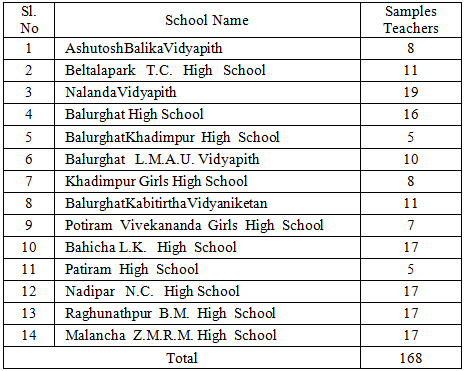
The sample was selected randomly from the population. The sample was comprised the male as well as female teachers. Total number of 74 female teachers and 94 male teachers comprised the total of 168 samples.
Total numbers of 177 secondary school teachers were selected. It was found that 168 secondary school teachers comprised the true sample given in Table 1.
Standardized tools were used for the investigation and data collection by the investigator for this quantitative study. The tools which has been used for data collection in this research are-
(i) “Teacher Effectiveness Scale” 12
This scale is developed by Kumar and Mutha (2011). (ii) “Teacher’s Organizational Commitment Scale” 11
This scale is developed by Jamal and Raheem (2014).
According to the objectives framed, null hypotheses were formulated and tested at 0.05 level. An attempt was made to determine the degree of relationship between the two major variables e.g. teacher effectiveness and organizational commitment. For this purpose Pearson’s correlation coefficient value was computed and significance level has been checked. The result is presented in a correlation matrix showing the relationship between two major variables among all secondary school teachers.
HO1: There is no significant relationship between the teacher effectiveness and organizational commitment among secondary school teachers.
Discussion
It is observed from the Table 2 that the correlation coefficient ‘r’ value between organizational commitment and teacher effectiveness is 0.8505 which is significantly very high and p value is 0.008 (p lesser than 0.05), hence correlation coefficient (r) value is significant at 0.05 level. Therefore, the null hypothesis is rejected and it is concluded that the organizational commitment is strongly positively correlated to teacher effectiveness.
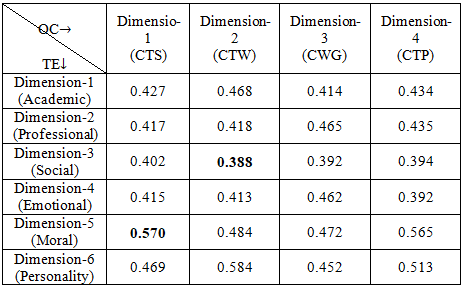
Furthermore, analyses have been done to identify those dimensions of organizational commitment in which significant relationship exists with the different dimension of teacher effectiveness and the results with correlation matrix is presented in Table 3.
From the above Table 3 it is observed that the correlation co-efficient ‘r’ between different dimensions of teacher effectiveness and various dimension of organizational commitment is in the range from 0.388 to 0.570 which is greater than the critical value of ‘r’. The correlation co-efficient ‘r’ between the various dimensions of teacher effectiveness with various dimensions of organizational commitment are falls in the range 0.40 to 0.49. The greater correlation coefficient value 0.570 is observed between moral dimension and CTS among secondary school teachers. Lower value of ‘r’ 0.388 is observed between social dimension and CTW.
Therefore, it is concluded that there was a significant high positive correlation between moral dimension and CTS dimension; and a significant low positive correlation exists between social dimension and CTW dimension. So the most contributing dimension of teacher effectiveness is moral dimension among all secondary school teachers. Whereas, the most contributing dimensions of organizational commitment is CTS (Commitment to School).
HO2: There is no significant relationship between the teacher effectiveness and organizational commitment among male teachers.
Discussion
It is observed from the Table 4 that the correlation coefficient ‘r’ value between organizational commitment and teacher effectiveness among male teachers is 0.8859 which is significantly very high and p value is 0.007 (p lesser than 0.05), hence correlation coefficient (r) value is significant at 0.05 level. Therefore, the null hypothesis is rejected and it is concluded that the organizational commitment is strongly positively correlated to teacher effectiveness.
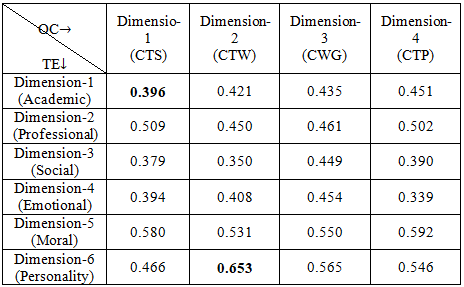
Furthermore, analyses have been done to identify those dimensions of organizational commitment in which significant relationship exists with the different dimension of teacher effectiveness and the results with correlation matrix is presented in Table 5.
From the above Table 5 it is observed that the correlation co-efficient ‘r’ between different dimensions of teacher effectiveness and various dimension of organizational commitment among male teachers is in the range from 0.396 to 0.653 which is greater than the critical value (r=0.232 at 0.05 level and 0.302 at 0.01 level) of ‘r’. The correlation co-efficient ‘r’ between the various dimensions of teacher effectiveness with various dimensions of organizational commitment falls in the range 0.40 to 0.59. The greater correlation coefficient value 0.653 is observed between personality dimension and CTW among male teachers. Lower value of ‘r’ 0.396 is observed between academic dimension and CTS.
Therefore, it is concluded that there was a significant high positive correlation between personality dimension and CTW dimension; and a significant low positive correlation exists between academic dimension and CTS dimension. So the most contributing dimension of teacher effectiveness is personality dimension among male teachers. Whereas, the most contributing dimensions of organizational commitment is CTW (Commitment to Teaching Works).
HO3: There is no significant relationship between the teacher effectiveness and organizational commitment among female teachers.
Discussion
It is observed from the Table 6 that the correlation coefficient ‘r’ value between organizational commitment and teacher effectiveness among male teachers is 0.9434 which is significantly very high and p value is 0.001 (p lesser than 0.05), hence correlation coefficient (r) value is significant at 0.05 level. Therefore, the null hypothesis is rejected and it is concluded that the organizational commitment is strongly positively correlated to teacher effectiveness.
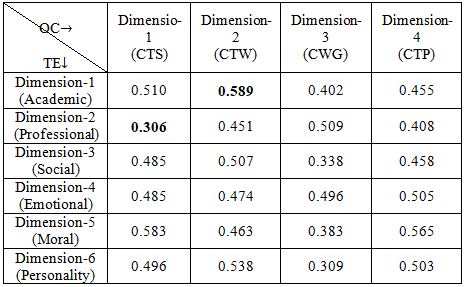
Furthermore, analyses have been done to identify those dimensions of organizational commitment in which significant relationship exists with the different dimension of teacher effectiveness and the results with correlation matrix is presented in Table 7.
From the above Table 7 it is observed that the correlation co-efficient ‘r’ between different dimensions of teacher effectiveness and various dimension of organizational commitment among female teachers is in the range from 0.306 to 0.589 which is greater than the critical value (r=0.217 at 0.05 level and 0.283 at 0.01 level) of ‘r’. The correlation co-efficient ‘r’ between the various dimensions of teacher effectiveness with various dimensions of organizational commitment falls in the range 0.40 to 0.59. The greater correlation coefficient value 0.589 is observed between academic dimension and CTW among female teachers. Lower value of ‘r’ 0.306 is observed between professional dimension and CTS.
Therefore, it is concluded that a significant high positive correlation exists between academic dimension and CTW dimension; and a significant low positive correlation exists between professional dimension and CTS dimension. So the most contributing dimension of effectiveness is academic dimension among female teachers. Whereas, the most contributing dimensions of organizational commitment is CTW (Commitment to Teaching Works).
1. There exists significant high positive relationship (r=0.570) between moral dimension of effectiveness and CTS (commitment to school) dimension of organizational commitment among secondary school teachers.
2. There exists significant low positive relationship (r=0.388) between social dimension of effectiveness and CTW (commitment to school works) dimension of organizational commitment among secondary school teachers.
3. There exists significant high positive relationship (r=0.653) between personality dimension of effectiveness and CTW (commitment to school works) dimension of organizational commitment among male teachers.
4. There exists significant low positive relationship (r=0.396) between academic dimension of effectiveness and CTS (commitment to school) dimension of organizational commitment among male teachers.
5. There exists significant high positive relationship (r=0.589) between academic dimension of effectiveness and CTW (commitment to school works) dimension of organizational commitment among female teachers.
6. There exists significant low positive relationship (r=0.306) between professional dimension of effectiveness and CTS (commitment to school) dimension of organizational commitment among female teachers.
Learning is continuous and lifelong process. Till the dawn of the universe all life form learns but most of the learning was informal hence very slow and ineffective. But in era of ultra-modernization we can't easily escape the ideologies like “Commitment" and “Effectiveness". Now is the era of rapid development and progress in every aspect especially in Education. The teacher is most important pillar upon which our future depends. Effectiveness and commitment of the teacher make them strong as a serving pillar. Learning becomes easier lucid adoptive comprehensive apprehending when it is well equipped. The teacher is the best of all equipment if they have effectiveness and commitment. Hence to get successin learning, get favourable outcome a teacher must be effective in use of methods and techniques, means and material. He must also commit to the organizational set up. Teachers must exhaust him in commitment. He must overcome all means of obstacles to pave the path of formal knowledge. Teacher plays pivotal role in learning efficiency and his commitment to the organization serves as a most important pillar which is undoubtedly intact with educational, organizational and professional success. Thus Effectiveness of work with commitment to the organization ensure better learning outcome, and good learning always serves to the up liftman of nation and society. The development of positive nation in the hands of the pupils is largely depends on the teachers commitment and learning effectiveness. Teaching thus guides the pupils to ensure proper practice and learning.
In short, in rapid and fast growing education system in term of language, science, technologies, medicine and national and international affairs our education must be valid, it must be rapid, progressive as well as authentic and so on. But all these qualities lie on teacher efficiency, effectiveness and unconditional commitment to the pupils, society and organization.
Researchers are deeply indebted to the teachers and the management of all the secondary schools from where the data were collected for this study.
| [1] | Nahak. M. &Ellitan. L. (2022). Organizational Commitment and Organizational Sustainability. International Journal of Trend in Scientific Research and Development (IJTSRD), 6(4), 604-609. www.ijtsrd.com. | ||
| In article | |||
| [2] | Hepsibha. J. R. & Catherine. J. (2022). Teacher Effectiveness. Journal of Positive School Psychology, 6(8), 2115-2119. http://journalppw.com. | ||
| In article | |||
| [3] | Begum. N. Y., Vaidharani. V. S. (2024). Teacher effectiveness of secondary school teachers in relation to their attitude towards teaching in Chennai district of Tamil Nadu. International Journal of Creative Research Thoughts (IJCRT). 12(1), c446-c452. | ||
| In article | |||
| [4] | Gyeltshen, L. (2021). Examining teachers’ organizational commitment: does teachers’ educational qualification, teaching experience and gender matter? Humanities, Arts and Social Sciences Studies, 21(1), 88-94. https://so02.tci-thaijo.org/index.php/hasss. | ||
| In article | |||
| [5] | DhanaRaju. Z. ,Vijay. Vardhini. V. (2022). A Study on Teacher Effectiveness Among Secondary School Teachers. International Journal of Creative Research Thoughts (IJCRT). 10(6), f462-f492. | ||
| In article | |||
| [6] | Nowfal. C. (2023). Organizational Commitment of Secondary School Teachers in relation to their Social Intelligence. International Journal of Novel Research and Development. 8(9), b526-b537. ISSN: 2456-4184. | ||
| In article | |||
| [7] | Dwivedi. K., gupta. A. (2020). To Study The Teaching Effectiveness, Emotional Intelligence & Organizational Commitment Of Teachers Of Undergraduate Colleges. International Journal of Creative Research Thoughts (IJCRT), 8(9), 2837-2846. | ||
| In article | |||
| [8] | Dilshan. M., Iddagoda. A. &Dissanayake. H. (2023). Organizational commitment and its divers: a study of a selected organization. Academy of Management, 7(3), 135-156. | ||
| In article | |||
| [9] | Godbersen. H., Dudek. B. & Fernandez. S. R. (2024). The relationship between organizational commitment, commitment to supervisor and servant leadership. Front. Organ. Psychol. 2:1353959. | ||
| In article | View Article | ||
| [10] | Ganai. A. A. (2023). Teacher Effectiveness and Factors Promoting teacher Effectiveness. Journal of Research in Humanities and Social Science, 11(8), 118-121. | ||
| In article | |||
| [11] | Jamal, S., &Raheem, A. (2014). Manual for Teacher’s Organizational Commitment Scale. National Psychological Corporation, Agra. | ||
| In article | |||
| [12] | Kumar, P., &Mutha, D. N. (2011). Teacher Effectiveness Scale. National Psychological Corporation, Agra. | ||
| In article | |||
Published with license by Science and Education Publishing, Copyright © 2025 Mahadeb Chattopadhyay, Sunil Kumar Baskey, Mousumi Parvin, Pallabi Banerjee and Arna Koner
 This work is licensed under a Creative Commons Attribution 4.0 International License. To view a copy of this license, visit
http://creativecommons.org/licenses/by/4.0/
This work is licensed under a Creative Commons Attribution 4.0 International License. To view a copy of this license, visit
http://creativecommons.org/licenses/by/4.0/
| [1] | Nahak. M. &Ellitan. L. (2022). Organizational Commitment and Organizational Sustainability. International Journal of Trend in Scientific Research and Development (IJTSRD), 6(4), 604-609. www.ijtsrd.com. | ||
| In article | |||
| [2] | Hepsibha. J. R. & Catherine. J. (2022). Teacher Effectiveness. Journal of Positive School Psychology, 6(8), 2115-2119. http://journalppw.com. | ||
| In article | |||
| [3] | Begum. N. Y., Vaidharani. V. S. (2024). Teacher effectiveness of secondary school teachers in relation to their attitude towards teaching in Chennai district of Tamil Nadu. International Journal of Creative Research Thoughts (IJCRT). 12(1), c446-c452. | ||
| In article | |||
| [4] | Gyeltshen, L. (2021). Examining teachers’ organizational commitment: does teachers’ educational qualification, teaching experience and gender matter? Humanities, Arts and Social Sciences Studies, 21(1), 88-94. https://so02.tci-thaijo.org/index.php/hasss. | ||
| In article | |||
| [5] | DhanaRaju. Z. ,Vijay. Vardhini. V. (2022). A Study on Teacher Effectiveness Among Secondary School Teachers. International Journal of Creative Research Thoughts (IJCRT). 10(6), f462-f492. | ||
| In article | |||
| [6] | Nowfal. C. (2023). Organizational Commitment of Secondary School Teachers in relation to their Social Intelligence. International Journal of Novel Research and Development. 8(9), b526-b537. ISSN: 2456-4184. | ||
| In article | |||
| [7] | Dwivedi. K., gupta. A. (2020). To Study The Teaching Effectiveness, Emotional Intelligence & Organizational Commitment Of Teachers Of Undergraduate Colleges. International Journal of Creative Research Thoughts (IJCRT), 8(9), 2837-2846. | ||
| In article | |||
| [8] | Dilshan. M., Iddagoda. A. &Dissanayake. H. (2023). Organizational commitment and its divers: a study of a selected organization. Academy of Management, 7(3), 135-156. | ||
| In article | |||
| [9] | Godbersen. H., Dudek. B. & Fernandez. S. R. (2024). The relationship between organizational commitment, commitment to supervisor and servant leadership. Front. Organ. Psychol. 2:1353959. | ||
| In article | View Article | ||
| [10] | Ganai. A. A. (2023). Teacher Effectiveness and Factors Promoting teacher Effectiveness. Journal of Research in Humanities and Social Science, 11(8), 118-121. | ||
| In article | |||
| [11] | Jamal, S., &Raheem, A. (2014). Manual for Teacher’s Organizational Commitment Scale. National Psychological Corporation, Agra. | ||
| In article | |||
| [12] | Kumar, P., &Mutha, D. N. (2011). Teacher Effectiveness Scale. National Psychological Corporation, Agra. | ||
| In article | |||