This study examines how virtual laboratories can enhance high school students' experimental skills and understanding of science. With the growing use of technology in education, virtual labs enable students to conduct science experiments online, which can improve their engagement, critical thinking, and teamwork. The study involved 114 senior high school students from a private school in the locale of the study during the 2024-2025 school year, who are selected based on their familiarity with virtual labs. Data was collected through a survey that evaluated the accessibility and effectiveness of these virtual environments in enhancing students' skills and understanding. The findings indicate that students generally perceive virtual labs as beneficial for learning, reporting improvements in their ability to follow scientific procedures, manipulate variables, and grasp complex concepts. Additionally, virtual labs provide a safe space for experimentation, particularly when physical labs are not feasible. The study emphasizes the importance of integrating virtual labs into the curriculum to help students better understand scientific principles and prepare for future challenges in science and technology. It also suggests the need for further research to explore how different students respond to virtual labs and the long-term impacts of technology in education. Thus, this research supports the notion that virtual laboratories are valuable resources for enhancing STEM education among high school learners.
One of the most significant and popular e-learning strategies nowadays is virtual laboratory simulation. It is regarded as a 3D immersive science simulation that lets students perform science experiments remotely at any time and from any location using their own devices. By teaching the various scientific principles and techniques, making the experiment steps more understandable, and facilitating the application of the practical portion of the curriculum, virtual laboratories help both teachers and students reach their desired educational goals 1.
Multimedia Learning Theory, developed by Richard Mayer 2, suggests that people learn more effectively from words and pictures than from words alone. It emphasizes the importance of using multiple forms of media, for example, text, images, audio, and video, to enhance learning. In virtual laboratories, multimedia elements can provide rich, interactive experiences that cater to different learning styles and help students visualize complex concepts, thereby improving comprehension and retention.
Students can investigate scientific ideas and concepts in a virtual setting by participating in simulations of experiments or other practical activities known as virtual laboratories. Students can learn and interact with the laboratory as a work environment in a flexible and convenient way by using these simulations to augment or replace traditional laboratory experiences on campus 3.
The use of virtual labs and other synthetic learning environments in STEM higher education allows students and teachers to replicate experiments that would otherwise need to be conducted in a teaching laboratory. It also gives students an interactive experience that enables them to test hypotheses, gather data, and analyze results by manipulating virtual tools and materials 4, 5. On the other hand, Kalogiannakis and Papadakis 6, highlight the effectiveness of virtual labs in improving students' conceptual understanding and practical skills.
According to Vassiliadou 7, virtual labs offer the following benefits: unlimited time, instant feedback, experiment repetition, and safety for both students and experiment subjects. Virtual and simulated experiments give students a realistic solution, at least in an emergency, and help them get ready for their real laboratories 8. With the help of technology, students can communicate with teachers, ask for assistance, and share their learning experiences. Additionally, students can work in groups to conduct virtual experiments, which promote social interaction and teamwork 9. Digital traces can be produced by virtual labs to track students' progress and pinpoint their learning preferences. According to Ramadan and Irwanto 10, these records of students' interactions with virtual labs showed improvements in their capacity for problem-solving, critical thinking, laboratory skill development, and knowledge acquisition.
Virtual labs have significantly transformed STEM education in K-12 settings by enhancing student engagement through interactive simulations and gamified elements, which increase interest and participation in STEM subjects 11. They also improve conceptual understanding by providing visual representations and hands-on virtual experiments that simplify complex scientific concepts 12. Furthermore, virtual labs foster critical thinking skills as students engage in hypothesis formation, data analysis, and conclusion drawing, which are essential for scientific reasoning. Additionally, they prepare students for future careers by exposing them to advanced technologies and enhancing their digital literacy, while ensuring accessibility and inclusion by providing equal high-quality lab experiences regardless of school resources 11.
The use of virtual laboratories may help boost students' interest in STEM subjects, which is important for developing the next generation of STEM experts. Future research should focus on addressing student individual differences, considering sociocultural context, and investigating different kinds of virtual laboratories. Examining the long-term impacts of integrating digital technologies into STEM education is also crucial 13.
The integration of arts into STEM education, as discussed by Ampartzaki et al. 14, highlights the importance of diverse pedagogical approaches in enhancing student engagement and understanding. This perspective can be extended to the use of virtual laboratories in high school education.
Hence, the integration of virtual laboratories into high school education marks a significant step forward in improving students' experimental skills and scientific understanding. As we move through an increasingly digital world, it becomes crucial to utilize these cutting-edge resources to enhance engagement, critical thinking, and collaboration among STEM students. This study aims to highlight the potential of virtual laboratories, demonstrating their role in not just enriching the learning experience but also equipping students to face future challenges in science and technology. Ultimately, this research aims to aid in the formulation of effective teaching strategies that can motivate the next generation of learners, ensuring that every student is afforded high-quality, immersive learning experiences that nurture their curiosity and enthusiasm for science.
This study employed a descriptive-quantitative research design to document, describe, analyze, and understand the perceptions of senior high school learners regarding the use of virtual laboratories in enhancing their experimental skills and scientific understanding. According to Bradshaw et al. 15, quantitative research design is a structured approach that emphasizes the collection and analysis of numerical data to understand phenomena, test hypotheses, and establish relationships among variables. This method is widely utilized across various disciplines, including healthcare, education, and the social sciences, due to its ability to provide objective and reliable results.
The participants of this study were the Senior high school students enrolled in a private school in Santiago City, Philippines, during the academic year 2024-2025. The purposive sampling technique was used to select respondents based on their experience with virtual laboratories, focusing on STEM students. Kanaki and Kalogiannakis 16 address key challenges in educational research sample design, stressing the importance of careful selection to ensure valid and reliable data. They point out that considering diversity and context in sampling strategies improves the relevance and rigor of research findings. This method is especially useful for assessing innovative educational interventions, as it ensures that the sample accurately reflects the target population. Afterwards, 114 learners were identified as respondents. These learners were identified based on their strand, which is the Science and Technology, Engineering, and Mathematics strand, and are routinely engaged in experiments and scientific inquiry. Virtual labs directly relate to their academic and practical learning as well, and they are more likely to have experience with both traditional and virtual laboratories. This allows them to compare the effectiveness of virtual laboratories with physical laboratories. Henceforth, they are deemed to have great values and skills to identify the effectiveness of virtual laboratories in enhancing students’ experimental skills and scientific understanding and can therefore produce reliable responses on the survey questionnaire.
The researchers utilized a survey questionnaire, consisting of two parts, the first part is for the respondent demographic profile which is their sex and their grade level, The next part is composed of 25 questions divided into 5 category which are Access and Usability of Virtual Laboratories; Instructional Integration of Virtual Laboratories; Enhancement of Students’ Experimental Skills; Improvement of Scientific Understanding; and Perceived Effectiveness Compared to Traditional Labs on a four point Likert scale ranging from Strongly disagree to strongly agree.
To ensure the validity and reliability of the research questionnaire, expert pooling was utilized. A panel of field experts reviewed the questionnaire items, providing feedback on clarity, relevance, and comprehensiveness. This collaborative approach facilitated the integration of diverse perspectives, thereby enhancing the instrument's quality. The insights from the expert panel were crucial in refining the questionnaire to effectively address the research questions and objectives.
The study adheres to ethical standards to ensure the protection of participants' rights and welfare. The following ethical considerations were implemented. Before participation, students and their guardians are provided with detailed information about the study's purpose, procedures, and potential risks. Written consent was obtained from both students and their parents or guardians. All data collected was treated with strict confidentiality. Participants' identities were anonymized in all reports and publications. Participation in the study was entirely voluntary, and students had the right to withdraw at any time without any consequences. As explained by Petousi and Sifaki 17, it is essential to address the ethical issues surrounding research misconduct and integrity because research misconduct harms the scientific enterprise, emphasizing the dimensions of harm that can undermine trust between science and society.
Table 1 indicates that respondents generally agree on the accessibility and usability of virtual laboratories, with a category mean of 2.97. The statement "The virtual lab platforms used in my school are easy to access and navigate" received a mean score of 3.00, indicating agreement. These results suggest that students perceive the virtual lab platforms as accessible and user-friendly, which is essential for effective learning. A study by Vassiliadou 7 supports this assertion, emphasizing that user-friendly interfaces significantly enhance student engagement in virtual learning environments. The positive feedback on usability indicates that the design of virtual labs aligns well with the needs of high school learners, facilitating a more effective educational experience However, the statement "Technical issues with virtual laboratories rarely interrupt learning activities" received a lower mean score of 2.74, suggesting that some technical challenges may still exist in using virtual laboratories.
Table 2 indicates that the mean score ranged from 2.75 to 3.08, with students agreeing that virtual labs are integrated into their lessons. The highest score was for the alignment of virtual lab activities with science learning standards, with a mean value of 3.08. This finding shows that educators are effectively incorporating virtual labs into their instructional strategies, which can enhance learning outcomes. According to Brinson 4, the integration of technology into educational practices leads to improved student engagement and understanding. The alignment of virtual labs with established learning standards further emphasizes their relevance in the curriculum, suggesting that they are not merely supplemental but fundamental to the educational process.
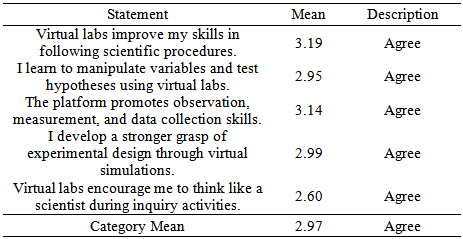
Table 3 shows that students agree that virtual labs can improve their skills in following the scientific procedures with a highest mean value of 3.19. These results suggest that virtual labs are effective in enhancing students' experimental skills, which are important for scientific inquiry. The ability to manipulate variables and test hypotheses is essential to the scientific method. Research by Sharma 11 supports this finding, indicating that virtual labs foster critical thinking and problem-solving skills, essential competencies for students pursuing STEM fields.
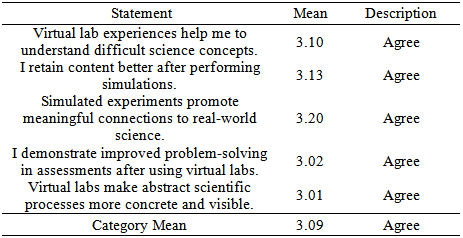
Table 4 shows that students agree that virtual lab experiences assist them in understanding difficult science concepts and promote meaningful connections to real-world science, garnering the highest mean value of 3.20. This suggests that virtual labs effectively make abstract concepts more concrete, thereby aiding comprehension. Mentis Sci. 12 found that visual representations in virtual labs significantly enhance students' understanding of complex scientific ideas. The ability to visualize and interact with scientific concepts in a virtual environment may lead to deeper learning and retention of knowledge.
Table 5 indicates that students agree that virtual lab serves as an effective alternative to hands-on laboratories, and the combination of virtual labs and physical labs yields the best result in science teaching, with the highest mean value of 3.32. This indicates that students perceive virtual labs as valuable learning tools, particularly when physical labs are not feasible. Breakey et al. 18 noted that virtual labs provide a safe and controlled environment for experimentation, which can enhance learning outcomes. The positive perception of virtual labs suggests that they can complement traditional laboratory experiences, offering flexibility and accessibility in science education.
Table 6 presents the group mean scores and corresponding t-Test results comparing Grade 11 and Grade 12 students’ perceptions of virtual laboratories across five key domains: access and usability, instructional integration, enhancement of experimental skills, improvement of scientific understanding, and perceived effectiveness compared to traditional laboratories.
Two items revealed statistically significant differences. Grade 11 students expressed stronger agreement that virtual lab activities are aligned with science learning competencies (p = .043), indicating a greater perceived curricular relevance. Furthermore, they reported a significantly higher perception that virtual labs enhance their ability to follow scientific procedures (p = .010), which may reflect a stronger sense of skill development through simulation-based activities.
In addition to these findings, the statement regarding the use of virtual labs as substitutes for physical experiments (p = .111), the development of a stronger grasp of experimental design (p = .070), and the encouragement to think like a scientist during inquiry-based tasks (p = .053) suggest emerging trends. These near-significant values imply that Grade 11 students may feel slightly more engaged and supported by virtual lab environments in developing critical scientific thinking and experimentation skills than their Grade 12 counterparts.
While both grade levels hold generally favorable and comparable views of virtual laboratories, the statistically significant and borderline differences point to Grade 11 students perceiving greater instructional alignment and skill-building benefits. These findings may be attributed to differences in curriculum content, instructional focus, or familiarity with virtual lab platforms. Such results align with the observations of Wu et al. 19, who noted that students’ engagement with educational technology can vary based on their academic stage and technological experience.
Furthermore, the results demonstrated that students generally found virtual laboratories to be user-friendly and effective in improving their understanding of difficult science concepts, as well as in developing their ability to follow scientific procedures and engage in inquiry-based learning.
These findings support earlier research by Brinson 20, whose meta-analysis highlighted the effectiveness of virtual laboratories in promoting student engagement, knowledge retention, and a deeper understanding of scientific principles in STEM education. Similarly, Sharma 11 emphasized that virtual labs foster critical thinking and problem-solving skills through interactive simulations that develop students' analytical capabilities—skills essential in STEM fields.
The study also examined whether perceptions of virtual labs varied by gender and grade level. While most responses showed no significant gender-based differences, female students reported feeling less supported in their use of virtual labs. This finding is consistent with Becker 21, who found that gender differences can influence students’ engagement and perceptions in technology-enhanced learning environments. Becker’s study suggests that additional support may be necessary to ensure equitable access and engagement for female learners.
Moreover, Grade 12 students expressed a greater perceived need for virtual labs in scenarios where physical experiments were not feasible. This trend is aligned with Wu et al. 19, who found that students’ perceptions of digital learning tools can vary with their level of technological familiarity and exposure, emphasizing the need for targeted instructional support across grade levels.
The findings also echo the work of Vassiliadou 7, who discussed the benefits of virtual labs in higher education, such as unlimited experimental time and immediate feedback. Vassiliadou’s research supports the idea that virtual labs provide a controlled and safe environment conducive to science learning, especially for high school students.
Moreover, the study aligns with findings from Mentis Sci. 22 and Acenas et al. 23, who underscored the role of visual representations in enhancing students' understanding of complex scientific ideas. Their work confirms that interactive and visual experiences in virtual labs contribute to deeper learning and improved knowledge retention.
Breakey et al. 18 further emphasized that virtual labs are viable alternatives during emergencies, ensuring continuity in science education when access to physical laboratories is limited. This assertion is supported by additional studies 21, 24, 25, 26, 27, which advocate for the inclusion of virtual learning platforms as part of educational contingency planning.
In addition, the results reflect the insights of Ramadan and Irwanto 10, who found that virtual labs enhance students’ thinking abilities, scientific skills, and attitudes. Their research suggests that the interactive and student-centered nature of virtual labs fosters deeper engagement with scientific content.
Thus, the findings of this study contribute to the growing body of literature supporting the integration of digital tools in education. Virtual laboratories, in particular, offer substantial benefits in improving scientific understanding, procedural skills, and engagement, highlighting their relevance in preparing students for future challenges in science and technology.
This research highlights the positive impact of virtual laboratories on the experimental skills and scientific understanding of high school students. The findings suggest that virtual labs serve as valuable educational resources that can enhance student engagement in STEM subjects. However, the study also points to the necessity of addressing the varying needs of students, particularly in terms of support and resources. By recognizing and responding to these differences, educators can maximize the effectiveness of virtual laboratories and ensure that all students have equitable access to high-quality learning experiences in science education. As technology continues to evolve, integrating virtual laboratories into the curriculum will be essential for preparing students for future challenges in science and technology. The insights gained from this study contribute to the ongoing discourse on the role of digital tools in education, emphasizing their potential to enrich the learning experience for all students.
| [1] | Elmesery, M. (2025). Discover our 25 new virtual science experiments and features. Praxilabs. https:// praxilabs.com/ en/blog/2022/04/28/25-new-virtual-science-experiments/. | ||
| In article | |||
| [2] | Mayer, R. E. (2009). Multimedia learning (2nd ed.). Cambridge University Press. | ||
| In article | |||
| [3] | Sellberg, C., Nazari, Z., & Solberg, M. (2024). Virtual laboratories in STEM higher education: A scoping review. Nordic Journal of Systematic Reviews in Education, 2(1), 58-75.https:// www.researchgate.net/publication/378736835_Virtual_Laboratories_in_STEM_Higher_Education_A_Scoping_Review. | ||
| In article | View Article | ||
| [4] | Brinson, J. (2015). Effectiveness of virtual labs in STEM education: A meta-analysis. Journal of Science Education and Technology, 24(3), 300-310. | ||
| In article | |||
| [5] | Reeves, S. M., & Crippen, K. J. (2021). Virtual laboratories in undergraduate science and engineering courses: A systematic review, 2009–2019. Journal of Science Education and Technology, 30(1), 16–30. | ||
| In article | View Article | ||
| [6] | Kalogiannakis, M., & Papadakis, St. (2022). Preparing Greek Pre-service Kindergarten Teachers to Promote Creativity: Opportunities Using Scratch and Makey. In K.-J, Murcia, C., Campbell, M.-M. Joubert & S. Wilson (Eds.), Children’s Creative Inquiry in STEM. Sociocultural Explorations of Science Education, vol 25, 347-354, Switzerland, Cham: Springer. | ||
| In article | View Article | ||
| [7] | Vassiliadou, A. (2020). Benefits of virtual labs in higher education: A systematic review. Journal of Educational Technology Systems, 49(1), 5-20. | ||
| In article | |||
| [8] | Breakey, H., et al. (2008). Virtual laboratories: A solution for science education in emergencies. Science Education International, 19(2), 123-130. | ||
| In article | |||
| [9] | Manchikanti, P., Kumar, B. R., & Singh, V. K. (2017). Role of virtual biology laboratories in online and remote learning. In Proceedings - IEEE 8th International Conference on Technology for Education, T4E 2016 (pp. 136–139). | ||
| In article | View Article PubMed | ||
| [10] | Ramadahan, M. F., & Irwanto. (2018). Using virtual labs to enhance students’ thinking abilities, skills, and scientific attitudes. In International conference on educational research and innovation (ICERI 2017) (pp. 494–499). | ||
| In article | |||
| [11] | Sharma, P. (2024). Gamification in virtual labs: Enhancing student engagement in STEM. International Journal of Educational Technology, 15(4), 200-215. | ||
| In article | |||
| [12] | Mentis Sci. (2025). Visual learning in virtual labs: Enhancing understanding of complex concepts. Journal of Educational Technology, 10(2), 45-60. | ||
| In article | |||
| [13] | Batesh, K., et al. (2025). The impact of digital technologies on STEM education: A review of current research. International Journal of STEM Education, 12(1), 1-15. | ||
| In article | |||
| [14] | Ampartzaki, M., Kalogiannakis, M., Papadakis, St., & Giannakou, V. (2022). Perceptions About STEM and the Arts: Teachers’, Parents’ Professionals’ and Artists’ Understandings About the Role of Arts in STEM Education. In St. Papadakis & M. Kalogiannakis (Eds), STEM, Robotics, Mobile Apps in Early Childhood and Primary Education - Technology to promote teaching and learning. Lecture Notes in Educational Technology, 601-624, Switzerland, Cham: Springer | ||
| In article | View Article | ||
| [15] | Bradshaw, C., Atkinson, S., & Doody, O. (2017). Employing a qualitative description approach in health care research. Global Qualitative Nursing Research, 4, 1-8. | ||
| In article | View Article PubMed | ||
| [16] | Kanaki, K., & Kalogiannakis, M. (2023). Sample design challenges: An educational research paradigm, International Journal of Technology Enhanced Learning, 15(3), 266- 285 | ||
| In article | View Article | ||
| [17] | Petousi, V., & Sifaki, E. (2020). Contextualizing harm in the framework of research misconduct: Findings from discourse analysis of scientific publications. International Journal of Sustainable Development, 23, 10.1504/IJSD.2020.10037655. | ||
| In article | View Article | ||
| [18] | Breakey, K. M., Levin, D., Miller, I., & Hentges, K. E. (2008). The use of scenario-based-learning interactive software to create custom virtual laboratory scenarios for teaching genetics. Genetics, 179(3), 1151–1155. | ||
| In article | View Article PubMed | ||
| [19] | Wu, Y., et al. (2022). Age and technology: Understanding the digital divide in education. Computers & Education, 178, 104-120. | ||
| In article | |||
| [20] | Brinson, J. (2015). Learning outcome achievement in non-traditional (virtual and remote) versus traditional (hands-on) laboratories: A review of the empirical research. Computers & Education, 87, 218-237. | ||
| In article | View Article | ||
| [21] | Becker, R. (2022). Gender and survey participation: An event history analysis of the gender effects of survey participation in a probability-based multi-wave panel study with a sequential mixed-mode design. Methods, Data, Analyses: A Journal for Quantitative Methods and Survey Methodology, 16(1), 3-32. | ||
| In article | |||
| [22] | Mentis Sciences, Inc. (2025). Laboratory without limits: How science virtual labs are transforming K-12 education. https://www.mentissciences.com/Laboratory-Without-Limits--How-Science-Virtual-Labs-Are-Transforming-K-12-Education-1-22131.html | ||
| In article | |||
| [23] | Acenas, R., Martin, R., & Bautista, R. (2019). Chemistry made easy: Unraveling the experiences of biological science majors in using a virtual laboratory. American Journal of Educational Research, 7 (2), 170-173. | ||
| In article | |||
| [24] | Becker, K. (2022). Gender differences in survey participation: A review of the literature. Journal of Educational Research, 115(3), 345-356. | ||
| In article | |||
| [25] | Sharma, N. (2024). 7 benefits of using virtual labs in K12 education. Higher Ed & K-12 Solutions. https:// www.hurix.com/ blogs/benefits-of-using-virtual-labs-in-k-12-education. | ||
| In article | |||
| [26] | Vasiliadou, R. (2020). Virtual laboratories during coronavirus (COVID-19) pandemic. Biochemistry and Molecular Biology Education: A Bimonthly Publication of the International Union of Biochemistry and Molecular Biology, 48(5), 482–483. | ||
| In article | View Article PubMed | ||
| [27] | Zhao, K., & Fils-Aime, F. (2022). Response rates of online surveys in published research: A meta-analysis. Computers in Human Behavior Reports, 7, 100206. | ||
| In article | View Article | ||
Published with license by Science and Education Publishing, Copyright © 2025 Jason P. Dela Cruz, Marissa V. Lejano, Jericho Martin, Sei Jane R. Marquez, Angel Rose S. Fernandez and Romiro G. Bautista
 This work is licensed under a Creative Commons Attribution 4.0 International License. To view a copy of this license, visit
http://creativecommons.org/licenses/by/4.0/
This work is licensed under a Creative Commons Attribution 4.0 International License. To view a copy of this license, visit
http://creativecommons.org/licenses/by/4.0/
| [1] | Elmesery, M. (2025). Discover our 25 new virtual science experiments and features. Praxilabs. https:// praxilabs.com/ en/blog/2022/04/28/25-new-virtual-science-experiments/. | ||
| In article | |||
| [2] | Mayer, R. E. (2009). Multimedia learning (2nd ed.). Cambridge University Press. | ||
| In article | |||
| [3] | Sellberg, C., Nazari, Z., & Solberg, M. (2024). Virtual laboratories in STEM higher education: A scoping review. Nordic Journal of Systematic Reviews in Education, 2(1), 58-75.https:// www.researchgate.net/publication/378736835_Virtual_Laboratories_in_STEM_Higher_Education_A_Scoping_Review. | ||
| In article | View Article | ||
| [4] | Brinson, J. (2015). Effectiveness of virtual labs in STEM education: A meta-analysis. Journal of Science Education and Technology, 24(3), 300-310. | ||
| In article | |||
| [5] | Reeves, S. M., & Crippen, K. J. (2021). Virtual laboratories in undergraduate science and engineering courses: A systematic review, 2009–2019. Journal of Science Education and Technology, 30(1), 16–30. | ||
| In article | View Article | ||
| [6] | Kalogiannakis, M., & Papadakis, St. (2022). Preparing Greek Pre-service Kindergarten Teachers to Promote Creativity: Opportunities Using Scratch and Makey. In K.-J, Murcia, C., Campbell, M.-M. Joubert & S. Wilson (Eds.), Children’s Creative Inquiry in STEM. Sociocultural Explorations of Science Education, vol 25, 347-354, Switzerland, Cham: Springer. | ||
| In article | View Article | ||
| [7] | Vassiliadou, A. (2020). Benefits of virtual labs in higher education: A systematic review. Journal of Educational Technology Systems, 49(1), 5-20. | ||
| In article | |||
| [8] | Breakey, H., et al. (2008). Virtual laboratories: A solution for science education in emergencies. Science Education International, 19(2), 123-130. | ||
| In article | |||
| [9] | Manchikanti, P., Kumar, B. R., & Singh, V. K. (2017). Role of virtual biology laboratories in online and remote learning. In Proceedings - IEEE 8th International Conference on Technology for Education, T4E 2016 (pp. 136–139). | ||
| In article | View Article PubMed | ||
| [10] | Ramadahan, M. F., & Irwanto. (2018). Using virtual labs to enhance students’ thinking abilities, skills, and scientific attitudes. In International conference on educational research and innovation (ICERI 2017) (pp. 494–499). | ||
| In article | |||
| [11] | Sharma, P. (2024). Gamification in virtual labs: Enhancing student engagement in STEM. International Journal of Educational Technology, 15(4), 200-215. | ||
| In article | |||
| [12] | Mentis Sci. (2025). Visual learning in virtual labs: Enhancing understanding of complex concepts. Journal of Educational Technology, 10(2), 45-60. | ||
| In article | |||
| [13] | Batesh, K., et al. (2025). The impact of digital technologies on STEM education: A review of current research. International Journal of STEM Education, 12(1), 1-15. | ||
| In article | |||
| [14] | Ampartzaki, M., Kalogiannakis, M., Papadakis, St., & Giannakou, V. (2022). Perceptions About STEM and the Arts: Teachers’, Parents’ Professionals’ and Artists’ Understandings About the Role of Arts in STEM Education. In St. Papadakis & M. Kalogiannakis (Eds), STEM, Robotics, Mobile Apps in Early Childhood and Primary Education - Technology to promote teaching and learning. Lecture Notes in Educational Technology, 601-624, Switzerland, Cham: Springer | ||
| In article | View Article | ||
| [15] | Bradshaw, C., Atkinson, S., & Doody, O. (2017). Employing a qualitative description approach in health care research. Global Qualitative Nursing Research, 4, 1-8. | ||
| In article | View Article PubMed | ||
| [16] | Kanaki, K., & Kalogiannakis, M. (2023). Sample design challenges: An educational research paradigm, International Journal of Technology Enhanced Learning, 15(3), 266- 285 | ||
| In article | View Article | ||
| [17] | Petousi, V., & Sifaki, E. (2020). Contextualizing harm in the framework of research misconduct: Findings from discourse analysis of scientific publications. International Journal of Sustainable Development, 23, 10.1504/IJSD.2020.10037655. | ||
| In article | View Article | ||
| [18] | Breakey, K. M., Levin, D., Miller, I., & Hentges, K. E. (2008). The use of scenario-based-learning interactive software to create custom virtual laboratory scenarios for teaching genetics. Genetics, 179(3), 1151–1155. | ||
| In article | View Article PubMed | ||
| [19] | Wu, Y., et al. (2022). Age and technology: Understanding the digital divide in education. Computers & Education, 178, 104-120. | ||
| In article | |||
| [20] | Brinson, J. (2015). Learning outcome achievement in non-traditional (virtual and remote) versus traditional (hands-on) laboratories: A review of the empirical research. Computers & Education, 87, 218-237. | ||
| In article | View Article | ||
| [21] | Becker, R. (2022). Gender and survey participation: An event history analysis of the gender effects of survey participation in a probability-based multi-wave panel study with a sequential mixed-mode design. Methods, Data, Analyses: A Journal for Quantitative Methods and Survey Methodology, 16(1), 3-32. | ||
| In article | |||
| [22] | Mentis Sciences, Inc. (2025). Laboratory without limits: How science virtual labs are transforming K-12 education. https://www.mentissciences.com/Laboratory-Without-Limits--How-Science-Virtual-Labs-Are-Transforming-K-12-Education-1-22131.html | ||
| In article | |||
| [23] | Acenas, R., Martin, R., & Bautista, R. (2019). Chemistry made easy: Unraveling the experiences of biological science majors in using a virtual laboratory. American Journal of Educational Research, 7 (2), 170-173. | ||
| In article | |||
| [24] | Becker, K. (2022). Gender differences in survey participation: A review of the literature. Journal of Educational Research, 115(3), 345-356. | ||
| In article | |||
| [25] | Sharma, N. (2024). 7 benefits of using virtual labs in K12 education. Higher Ed & K-12 Solutions. https:// www.hurix.com/ blogs/benefits-of-using-virtual-labs-in-k-12-education. | ||
| In article | |||
| [26] | Vasiliadou, R. (2020). Virtual laboratories during coronavirus (COVID-19) pandemic. Biochemistry and Molecular Biology Education: A Bimonthly Publication of the International Union of Biochemistry and Molecular Biology, 48(5), 482–483. | ||
| In article | View Article PubMed | ||
| [27] | Zhao, K., & Fils-Aime, F. (2022). Response rates of online surveys in published research: A meta-analysis. Computers in Human Behavior Reports, 7, 100206. | ||
| In article | View Article | ||