The lack of practical and sustainable strategies for incorporating error analysis into mathematics classrooms is a significant research gap in mathematics education examined in this systematic mapping review. In order to determine common instructional goals, sample characteristics, mathematical domains, research design, strategies, types of errors addressed, and reported learning outcomes, thirteen empirical studies published between 2017 and 2025 were analyzed. The findings show that while error analysis improves problem-solving skills, metacognitive development, and conceptual understanding, its use can be demanding for teachers and students. Students often struggle to analyze and articulate their errors, notably when guidance is lacking, and teachers must deal with heavier workloads, time restraints, and specialized training requirements. While international research emphasizes the potential of artificial intelligence tools to support real-time feedback and lower instructional demands, local studies mainly rely on conventional, teacher-led methods. The review recommends a hybrid model that blends AI-enhanced tools with teacher facilitation to support error analysis's scalable, efficient, and context-responsive integration in mathematics classrooms.
Error analysis is becoming more popular to help students learn mathematics by using their mistakes and misunderstandings to help them comprehend mathematics better. Students are encouraged to think about how they think by systematically finding, analyzing, and resolving their mistakes. This teaching strategy helps them become clearer about their ideas, strengthen their metacognitive skills, and improve at solving problems 1. Early intervention in the learning process is critical since persistent mathematics misconceptions can make it harder to be successful in school in the long term 2, 3. Also, studies show that interacting with right and wrong answers makes students more interested, helps them remember what they have learned, and improves their critical thinking skills 4, 5.
Even though error analysis is widely acknowledged to have pedagogical value, little is known about how to apply it in actual classroom settings in a way that is both sustainable and effective. The practical realities of its integration, especially the logistical, instructional, and cognitive demands it places on teachers and students, are rarely covered in the currently available literature. Even though research like Lacerna 6 shows that it improves student performance, a conspicuous dearth of studies looks at the day-to-day difficulties that arise when used consistently, particularly in settings where teachers are already overworked. Large class sizes, limited resources, and a variety of learner needs make it extremely difficult to implement sophisticated teaching techniques like error analysis in the Philippine educational system, making this gap particularly significant. Error analysis's potential to be both practical and successful in regular mathematics classrooms is limited by the lack of targeted research into these implementation challenges, which impedes the creation of valuable recommendations and essential support for educators.
This systematic review fills a critical gap in the literature by investigating the conceptualization and application of error analysis as an integrative activity in mathematics classrooms, especially its practical and sustainable implementation. The review aims to synthesize findings about instructional purposes, sample characteristics, mathematical domains, research designs, implementation strategies, and reported learner outcomes by drawing on local and foreign studies. It also examines the difficulties and restrictions researchers and practitioners face when integrating error analysis into mathematics classrooms in response to the scant attention paid to real-world constraints. This review attempts to determine what kinds of support, enabling conditions, and instructional reinforcements are required to implement error analysis successfully and sustainably—particularly in ways that lessen the burden on teachers and students in resource-constrained educational contexts like the Philippines—by mapping current approaches and empirical evidence.
1.1. Research Questions1. What is the scope of error analysis as integrative activity in the mathematics classroom in terms of:
1.1 purpose;
1.2 sample;
1.3 mathematical domains covered;
1.4 research design;
1.5 strategies;
1.6 mathematical errors addressed; and
1.7 the reported outcomes?
2. What challenges and limitations have researchers encountered in implementing error analysis in mathematics classroom?
This study employed the Systematic Mapping of Literature methodology outlined by Petersen et al. 7 to ensure a structured, transparent, and methodologically sound review process. The inquiry began with the formulation of focused research questions designed to investigate how error analysis is effectively integrated into mathematics instruction as a purposeful classroom activity. A clear set of inclusion and exclusion criteria was established based on the review's objectives to ensure the relevance and quality of the studies included.
2.1. Search StrategyA comprehensive literature search was conducted to identify relevant data-driven studies on integrating error analysis as a classroom activity in mathematics education. The search was closed to traditional pedagogical implementations and recent innovations involving artificial intelligence (AI) tools to support or facilitate error analysis in instructional settings. To align with the study’s objectives, a set of targeted keyword combinations was used, including: “error analysis activity,” “student errors,” “student mistakes,” “mathematics education,” and “reflective learning.” Boolean operators (AND, OR) were applied to maximize search sensitivity and retrieve diverse yet relevant literature.
The search was limited to peer-reviewed journal articles, graduate theses, and dissertations published between January 2017 and March 2025 to encompass established and emerging research. Only studies written in English or Filipino were included. Emphasis was placed on works that examined error analysis as an interactive and integrative instructional strategy situated within classroom teaching and learning processes across various educational levels and mathematical domains.
2.2. Result FiltersThe articles were selected according to the following Inclusion and Exclusion Criteria:
Thirteen (13) studies were selected from an initial pool of 381 retrieved records after applying the criteria. The selection process followed a rigorous two-stage screening procedure. In the first stage, titles and abstracts were reviewed to assess alignment with the research objectives. In the second stage, full-text articles of shortlisted studies were examined in detail to confirm their relevance—particularly their integration of error analysis as an instructional strategy within classroom settings.
The selected articles provide a comprehensive perspective on implementing error analysis across diverse educational contexts by incorporating Philippine-based and international studies. The final synthesis included only those studies that integrated error analysis as an active learning strategy in mathematics classrooms, either through teacher-led instruction or with the support of technological tools such as artificial intelligence
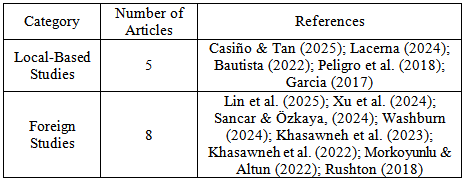
Table 2 displays the geographic distribution of the thirteen (13) reviewed studies based on their contextual origin. Five (5) studies are classified as local, with three (3) conducted in Mindanao and two (2) in Luzon. No studies are identified from the Visayas region.
The remaining eight (8) studies are foreign and conducted in various international contexts. These include countries such as China, Turkey, Jordan, and the United States of America, among others.
This section summarizes the results obtained from the 13 primary articles analyzed, considering each of the research questions.
3.1. Scope of Integration of Error Analysis as Integrative Activity in Mathematics ClassroomThe analysis of the studies in Table 3 shows several prevailing patterns regarding error analysis as an integrative activity in mathematics classrooms. From the reviewed literature, the primary goal of using error analysis is to encourage students to reflect on their errors and misconceptions to enhance their mathematical understanding. While earlier research often focused solely on improving achievement, more recent studies emphasize broader cognitive and affective outcomes like critical thinking, confidence, and metacognitive awareness. This pedagogical shift results from a growing awareness of error analysis as a teaching strategy and a methodology supporting all-encompassing learning.
Most research on learner demographics focuses on middle schoolers, especially those in Grades 5 through 10, emphasizing the strategy's applicability in cognitive development. Error analysis has value beyond foundational education and can support professional development and pedagogical training, as demonstrated by some studies that include college-level and pre-service teachers. Although a wide range of mathematical topics are covered, geometry and proportional reasoning are the most commonly integrated topics, probably because of their abstract nature and high student misunderstandings. Other areas, like statistics, algebra, and trigonometry, are also heavily represented, highlighting the strategy's wide range of applications.
In order to measure both performance outcomes and qualitative elements of learning, like engagement and reflection, the majority of studies use mixed-method or quasi-experimental research designs. These designs offer a balanced perspective on error analysis as a cognitive and social process, making them appropriate for classroom-based interventions. In terms of instructional strategies, two major clusters emerge. The first includes traditional, teacher-led approaches—such as group discussions, lesson exemplars, reflective journaling, and formative assessments—prevalent in Philippine-based studies. The second, found in more recent international studies, involves the integration of artificial intelligence (AI), such as GPT-4 and virtual AI tutors, which leverages the conduct of error analysis activity in mathematics classrooms by providing real-time error detection and personalized feedback. This emerging model represents a shift toward scalable, adaptive learning environments that reduce the burden on teachers while enhancing student support.
Although many different kinds of errors are addressed, procedural, conceptual, and computational errors are the most frequently mentioned. Semantic, notational, and strategic errors were covered in some studies through structured frameworks like Newman's Error Analysis or customized taxonomies. A key trend is the emphasis on conceptual errors, indicating a pedagogy of fostering substantial understanding rather than just correcting surface-level mistakes. Numerous studies have documented generally favorable results, such as enhancements in retention, conceptual understanding, problem-solving abilities, and metacognition. However, some research points out that improvements in academic performance might not always happen immediately, with longer-term gains or improvements in affective domains like confidence and engagement showing larger benefits.
One noteworthy finding is that in the Philippine-based studies, no technology is incorporated in the error analysis activity, which supported the idea that despite being pedagogically rich, implementations rely primarily on teacher facilitation, which burdens teachers who might not have the necessary resources or training. In contrast, international research shows that utilizing AI technologies to conduct error analysis activities in mathematics classrooms is an excellent strategy. These tools are promising, but they also make people worry about how relevant they are to the situation, how accurate they are, and how easy they are to get to, especially in places with few resources.
3.2. Challenges and Limitations Researchers Encountered in the Integration of Error Analysis as Integrative Activity in Mathematics ClassroomDespite its demonstrated potential, several systemic and practical obstacles prevent error analysis from being widely and sustainably implemented in mathematics classrooms. The inability of students to identify, express, and classify their mistakes is a significant issue in several studies. Garcia 8 observed that students, particularly those with weaker metacognitive skills, struggled to analyze the reasoning behind their mistakes. Lacerna 6 discovered that students made encoding and comprehension mistakes even after structured error-analysis interventions. These key results show that conceptual misunderstandings could persist if scaffolded instruction and guided feedback are not provided.
Another significant limitation lies in teacher preparedness. Error analysis requires teachers to possess a firm grasp of diagnostic pedagogy, the ability to design reflective tasks, and the skill to facilitate discussions that turn errors into learning opportunities. However, Peligro et al. 9 noted that many educators lacked sufficient training in implementing error-based activities, particularly in higher-level topics like geometric proofs. Bautista 10 further emphasized that designing practical formative assessments around error analysis is time-intensive and often adds to teachers' workload. These demands can discourage implementation, especially in under-resourced settings with minimal teacher support systems.
Another persistent issue that surfaced was time constraints. Due to error analysis's reflective and dialogic nature, students need more time in class to recognize, discuss, and correct their mistakes. According to Lacerna 6, this lengthy time requirement frequently made it difficult for teachers to cover the entire curriculum, creating a conflict between breadth of content coverage and depth of understanding. Additionally, while many studies reported cognitive and affective gains, some, such as Bautista 10 and Casiño & Tan 11, found that error analysis did not always translate into statistically significant improvements in achievement scores compared to traditional methods like explicit instruction. This signals that the effectiveness of error analysis as an integrative activity in mathematics classrooms depends on the content's nature, the student's developmental level, and how the strategy was implemented.
From a scalability perspective, most studies remain limited to small-scale interventions or single-classroom contexts. Thus, the generalizability of findings is restricted, and the need for broader implementation studies is highlighted. Furthermore, while promising, integrated technology, particularly artificial intelligence, introduces a new set of challenges. International studies demonstrated that AI tools can enhance the efficiency of error detection and feedback, yet these platforms require sufficient accuracy, contextual awareness, and teacher training for effective deployment. Xu et al. 12 reported a detection of a curacy of 78.3%, which, while impressive, still leaves room for misclassification and student confusion. In addition, the infrastructure and digital literacy required to support these tools may not yet be widely available in many educational systems, especially in developing regions like the Philippines.
Finally, error analysis integration in mathematics classroom ultimately depends on curriculum alignment, consistent teacher development, enough instructional time, and, where appropriate, access to and training in emerging technologies. To fully realize error analysis's pedagogical potential as a method for encouraging more in-depth, reflective, and customized mathematics learning, these constraints must be addressed.
This systematic review mapped the landscape of error analysis as an integrative classroom activity in mathematics classrooms, examining thirteen empirical studies conducted locally and internationally. The findings demonstrate that error analysis is a powerful pedagogical strategy that improves students’ conceptual understanding, metacognitive skills, and mathematical problem-solving. It provides a structured means to transform mistakes into learning opportunities, encouraging students to reflect, engage more deeply with mathematical ideas, and take ownership of their learning.
Two prevailing implementation models emerged from the studies: traditional teacher-led approaches and technologically assisted models—most notably, those integrating artificial intelligence (AI). While teacher-guided strategies such as lesson exemplars, group discussions, reflective journals, and formative assessments have effectively cultivated conceptual insight and classroom interaction, they are often constrained by practical factors such as teacher readiness, time demands, and instructional load. On the other hand, AI-enhanced approaches, as evidenced in recent international studies, show promising results in real-time error detection, iterative feedback, and personalized learning, thereby reducing teacher burden and scaling the approach for larger or more diverse classrooms.
However, these technological innovations are largely absent in local studies, relying on traditional models. These findings highlight a critical research and implementation gap in the Philippine context, where challenges related to infrastructure, digital literacy, and pedagogical training still limit the adoption of AI-driven education tools. Furthermore, while most studies reported positive learning outcomes, results also suggest that the impact of error analysis varies depending on the mathematical domain, student readiness, and instructional design. In some cases, explicit instruction outperformed error analysis in immediate achievement outcomes, suggesting that the strategy is most effective when thoughtfully aligned with learner needs and content complexity.
To fully realize the potential of error analysis in mathematics classrooms, especially in resource-constrained environments, a hybrid implementation model is recommended—one that blends the strengths of technology with the irreplaceable role of the teacher. Sustained professional development, localized curriculum integration, and equitable access to supportive technologies are key to making error analysis a scalable, sustainable, and effective instructional strategy. For practical implementation in the Philippine context, education stakeholders should invest in low-cost, modular teacher training programs focused on error-based pedagogy delivered through regional education centers or blended online formats. In parallel, DepEd and partner institutions can pilot AI-supported tools that operate offline or via mobile apps to assist with basic error detection and feedback—making them accessible even in schools with limited internet connectivity. As the educational landscape evolves, embracing pedagogical rigor and technological innovation will be essential to fostering deeper, more meaningful mathematics learning.
The researcher sincerely extends his deepest appreciation to all those who, in various ways, have contributed to the completion of this study.
| [1] | Große, C. S., & Renkl, A. (2007). Finding and fixing errors in worked examples: Can this foster learning outcomes? Learning and Instruction, 17(6), 612–624. | ||
| In article | View Article | ||
| [2] | Sumule, U., Amin, S. M., & Fuad, Y. (2018). Error analysis of Indonesian junior high school students in solving space and shape content PISA problem using Newman procedure. Journal of Physics: Conference Series, 947, 012053. | ||
| In article | View Article | ||
| [3] | Thomas, D. S., & Mahmud, M. S. (2021). Analysis of students’ error in solving quadratic equations using Newman’s procedure. International Journal of Academic Research in Business & Social Sciences, 11(12). | ||
| In article | View Article | ||
| [4] | Chusnul, C. R., Mardiyana, & Retno, S. (2017). Errors analysis of problem solving using the Newman stage after applying cooperative learning of TTW type. AIP Conference Proceedings, 1868, 080009. | ||
| In article | |||
| [5] | Rushton, S. J. (2018). Teaching and learning mathematics through error analysis. Fields Mathematics Education Journal, 3(1). | ||
| In article | View Article | ||
| [6] | Lacerna, D. J. D. (2024). Integrating error analysis strategy in developing students’ ability in solving non-routine problems in trigonometry. iJOINED ETCOR Educational Research Journal, 3(1), 55–69. | ||
| In article | |||
| [7] | Petersen, K., Vakkalanka, S., & Kuzniarz, L. (2015). Guidelines for conducting systematic mapping studies in software engineering: An update. Information and Software Technology, 64, 1–18. | ||
| In article | View Article | ||
| [8] | Garcia, M. L. B. (2017). Error Analysis, Metacognition and Mathematics Problem Solving Performance of College Students. Ateneo de Manila University. | ||
| In article | |||
| [9] | Peligro, R. M., Luna, C. A., & Lomibao, L. S. (2018). Students’ error analysis on a given geometric proof and solutions: Its effect on their achievement and conceptual understanding. International Journal of Advanced Research in Management and Social Sciences, 7(6), 186–198. | ||
| In article | |||
| [10] | Bautista, C. (2022). The Influence of Error Analysis as a Formative Assessment Activity in the Performance of Junior High School Students in Geometry. Psychology and Education: A Multidisciplinary Journal, 3(10), 2-12. | ||
| In article | |||
| [11] | Casiño, A. C. A., & Tan, R. G. (2025). Explicit instruction vs error analysis: Which is the better method in teaching mathematics. Journal of Innovations in Teaching and Learning, 5(1), 7–11 | ||
| In article | |||
| [12] | Liu, M., Xu, Z., Yao, Y., Zhang, T., Wang, Y., Chen, Q., Xu, S., Liu, Y., & Wang, W. (2024). AI-driven virtual teacher for enhanced educational efficiency: Leveraging large pretrained models for autonomous error analysis and correction(arXiv preprint arXiv:2409.09403). arXiv. | ||
| In article | |||
Published with license by Science and Education Publishing, Copyright © 2025 Sanddy H. Madera and Jennifer O. Parcutilo
 This work is licensed under a Creative Commons Attribution 4.0 International License. To view a copy of this license, visit
http://creativecommons.org/licenses/by/4.0/
This work is licensed under a Creative Commons Attribution 4.0 International License. To view a copy of this license, visit
http://creativecommons.org/licenses/by/4.0/
| [1] | Große, C. S., & Renkl, A. (2007). Finding and fixing errors in worked examples: Can this foster learning outcomes? Learning and Instruction, 17(6), 612–624. | ||
| In article | View Article | ||
| [2] | Sumule, U., Amin, S. M., & Fuad, Y. (2018). Error analysis of Indonesian junior high school students in solving space and shape content PISA problem using Newman procedure. Journal of Physics: Conference Series, 947, 012053. | ||
| In article | View Article | ||
| [3] | Thomas, D. S., & Mahmud, M. S. (2021). Analysis of students’ error in solving quadratic equations using Newman’s procedure. International Journal of Academic Research in Business & Social Sciences, 11(12). | ||
| In article | View Article | ||
| [4] | Chusnul, C. R., Mardiyana, & Retno, S. (2017). Errors analysis of problem solving using the Newman stage after applying cooperative learning of TTW type. AIP Conference Proceedings, 1868, 080009. | ||
| In article | |||
| [5] | Rushton, S. J. (2018). Teaching and learning mathematics through error analysis. Fields Mathematics Education Journal, 3(1). | ||
| In article | View Article | ||
| [6] | Lacerna, D. J. D. (2024). Integrating error analysis strategy in developing students’ ability in solving non-routine problems in trigonometry. iJOINED ETCOR Educational Research Journal, 3(1), 55–69. | ||
| In article | |||
| [7] | Petersen, K., Vakkalanka, S., & Kuzniarz, L. (2015). Guidelines for conducting systematic mapping studies in software engineering: An update. Information and Software Technology, 64, 1–18. | ||
| In article | View Article | ||
| [8] | Garcia, M. L. B. (2017). Error Analysis, Metacognition and Mathematics Problem Solving Performance of College Students. Ateneo de Manila University. | ||
| In article | |||
| [9] | Peligro, R. M., Luna, C. A., & Lomibao, L. S. (2018). Students’ error analysis on a given geometric proof and solutions: Its effect on their achievement and conceptual understanding. International Journal of Advanced Research in Management and Social Sciences, 7(6), 186–198. | ||
| In article | |||
| [10] | Bautista, C. (2022). The Influence of Error Analysis as a Formative Assessment Activity in the Performance of Junior High School Students in Geometry. Psychology and Education: A Multidisciplinary Journal, 3(10), 2-12. | ||
| In article | |||
| [11] | Casiño, A. C. A., & Tan, R. G. (2025). Explicit instruction vs error analysis: Which is the better method in teaching mathematics. Journal of Innovations in Teaching and Learning, 5(1), 7–11 | ||
| In article | |||
| [12] | Liu, M., Xu, Z., Yao, Y., Zhang, T., Wang, Y., Chen, Q., Xu, S., Liu, Y., & Wang, W. (2024). AI-driven virtual teacher for enhanced educational efficiency: Leveraging large pretrained models for autonomous error analysis and correction(arXiv preprint arXiv:2409.09403). arXiv. | ||
| In article | |||