The development and validation of future-proof learning materials for learners with special needs along with difficulty in remembering and concentrating, and seeing in DepEd Camarines Sur and DepEd Naga City focused on descriptive qualitative research design. Pre and post-test assessments were done through testing and direct observations. Likewise, informal interviews were done with the group of special education teachers and parents in order to gauge how they conducted and facilitated the entire process of assessing the students in different groups. Furthermore, in order to get the content reliability of the materials, format, and language level acceptability, a series of validation and try out was done by school administrators and area supervisors in DepEd Camarines Sur. For difficulty in remembering and concentrating, the learning activity sheet using clay, clay molding and playing with the clay dough was developed; for difficulty in seeing, the learning activity developed learners’ multi-sensory approach leans toward knowing the five senses and their corresponding body parts and learning to understand the different senses with the use supplementary visual and audio material with clear verbal explanations. Each instructional material developed contains steps that the learners followed. Set of scoring rubrics was used based on a specific set of criteria.
The Department of Education (DepEd) issues the Policy Guideline on the Provision of Educational Programs and Services for learners with disabilities in the K to 12 Basic Educational Program. This is pursuant to Section 3 of Republic Act No. 10533 known as the Enhanced Basic Education Act of 2013 and Sections 8 and 8.2 from its Implementing Rules and Regulations 1. The enclosed policy guidelines shall provide an overall direction and guidance in the organization, management, and implementation of appropriate programs, services, and interventions for learners with disabilities at the different levels of governance in the Department. Likewise, this policy may serve as guide for external stakeholders and partners in addressing the needs of learners with disabilities. Moreover, the K to 12 curriculum offers various educational opportunities that are developmentally appropriate for learners and are based on their interests, strengths, and needs. Ensuring that it is learner-centered, contextualization and adaptations of the curriculum shall be made in favor of the learner. The special education teachers also made several adjustments through chunking or simplifying content, extending, or shortening time and periods for tasks, and using differentiation in instruction when providing instructions. Teachers also developed several materials to be used by the students with special needs at various levels due to lack of instructional support and materials.
This study developed four-future-proof learning instructional materials for students with special needs. These covered the four difficulties such as remembering and concentrating and seeing, in DepEd Camarines Sur and Naga City Division for the school year 2021-2022. The developed instructional materials followed ADDIE model approach (Analysis, Design, Develop, Implement and Evaluate). ADDIE is one of the most used learning models 2, 3, 4. It is important because it provides a proven method for designing clear and effective training programs. The developed materials underwent content and reliability validation by DepEd key officials and were able to use as part of this study. The progress evaluation of learners with disabilities shall be based on his/her IEP and goals was also considered. Assessment of a learner with disability was consistent with the curriculum. The instructional materials are essential tools in learning every subject in the school curriculum and these benefits the stakeholders in and out of the school system. This research therefore may provide policymakers with information that could be useful in developing policies in support of providing necessary importance and learning materials for learners with special needs.
The findings generated from this study also may be useful for teacher training institutions in DepEd Camarines Sur, where a greater degree of attention might be directed to materials that facilitate inclusivity and learning for learners with special needs and to encourage teachers to provide suitable resources.
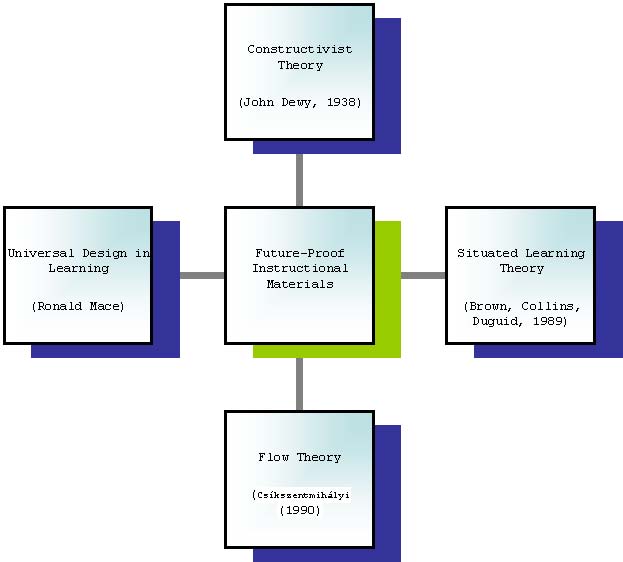
Future-proof learning materials consist of multimedia and guides that can be accessed on any platform available as shown in Figure 1. The constructivist theory by Dewey 5 was posited that learners are active participants in their learning journeys and knowledge is built based on experiences. Oyarzun, B. & Sheri Conklin 6 pointed out that constructivism revolves around the premise that students actively construct knowledge. In this study, the learners with special needs learned the art of modelling clay and followed step by step procedure through hands on learning activity. Modelling can be accessed by use if printed media and audio-visual presentation that increases the attention span of the learners. A set of instructions was provided and assessed the learners based on the achieved goals. These instructions were easy to understand.
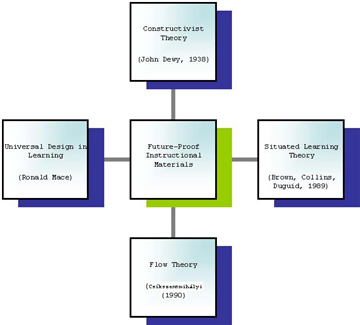
The Situated Learning Theory of Brown, Collins, and Duguid 7 on the hand was based on the premised that active learning is combine with knowing and doing. Kurt 8 divulges that technology has become an important tool in assisting situational learning. In this study, the integration of videos and prompt was helpful in guiding learners on the different steps and procedures that makes learners with special needs active and attentive.
The Flow theory of Csíkszentmihályi 9 focused on learners’ attention gained by the use of multimedia that a serves as guide in the engaging activities in the developed materials. The design of the future proof learning materials allows some choice of activity to build on the learner’s strengths and interests and strive to match and personalize the challenge level of the learning to the learner’s abilities.
Universal Design in Learning (UDL) principle by Mayer et. al 10 cater multiple means of representation that helps different learning styles of the LSENs. Other than that, it is a powerful approach because from the very start of your lesson, it helps to anticipate and plan for all the learners. This design also allows the developed materials to be flexible in use. In this, the materials became accessible to the learners and teachers who will be using it. The universal design utilizes different learning styles to maximize the intended learning outcomes of the learners especially the learners with special educational needs.
The study developed and validated future-proof instructional materials for learners with special needs along with difficulty in remembering and concentrating, and seeing in the Department of Education, Division of Camarines Sur for school year 2021-2022.
The development and validation of future-proof instructional materials for learners with special needs along with difficulty in remembering and concentrating, and seeing in DepEd Camarines Sur focused on descriptive qualitative research design. The different disabilities were the areas of concentration of the material development based on their academic response to the sets of learning activity sheets and instructional videos provided.
Moreover, pre and post-test assessments were done through testing and direct observations to measure students’ abilities and skills especially fine motor abilities and following sequential directions. On the other hand, informal interviews were done with the group of special education teachers in order to gauge how they conducted and facilitated the entire process of assessing the students in different groups. Also, part of the descriptive design was the consultations, interviews, and response inputs of external validators on the LAS materials in order to look into the different parameters used in the learning activity sheets. Furthermore, in order to get the content reliability of the materials, format, and language level acceptability, a series of validation and try out was done by school administrators and area supervisors in DepEd Camarines Sur.
DEVELOPMENT OF FUTURE-PROOF LEARNING MATERIALS FOR LEARNERS WITH DIFFICULTY IN REMEMBERING AND CONCENTRATING
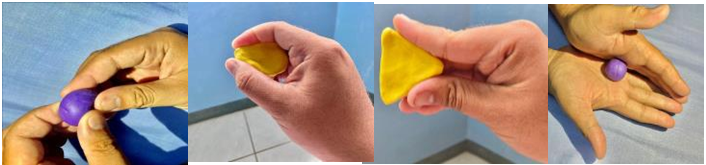
Analyze Phase. The learning activity sheet developed learners’ creativity using clay, following sequential steps on clay molding and developing their fine motor skills in playing with the clay dough. These learners use their hands to interact with the objects provided with the help of instructional videos
Design Phase. The learning activity sheet contains the intended content standards, performance task, and the duration of the activity.

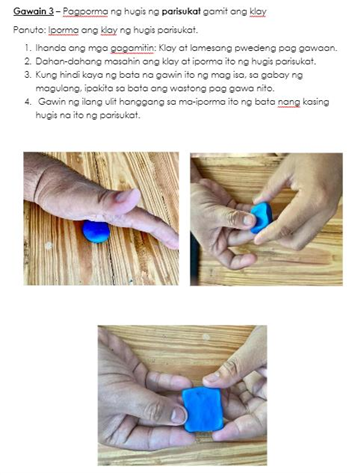
Steps: “Ihanda ang mga gagamitin: Klay at lamesang pwedeng pag gawaan; dahan-dahang masahin ang klay at iporma ito ng hugis bilog (Kung hindi kaya ng bata na gawin ito ng mag isa, sa gabay ng magulang, ipakita sa bata ang wastong pag gawa nito) and huli gawin ng ilang ulit hanggang sa ma-iporma ito ng bata nang kasing bilog ng bola at hanggang sa magawa nya ito ng mag-isa.
Development Phase. The three sets of activities such as pagporma ng hugis ng bilog gamit ang klay, pagporma ng hugis ng tatsulok gamit ang klay, and pagporma ng hugis ng parisukat gamit ang klay was provided to the learners.
Implementation Phase. The researchers crafted learning activity sheets based on MELCs for non-graded class level 1-Prevocational skills with parents. One-day orientation was done for parents in order to discuss the step-by-step procedures, activities, and the expected output.
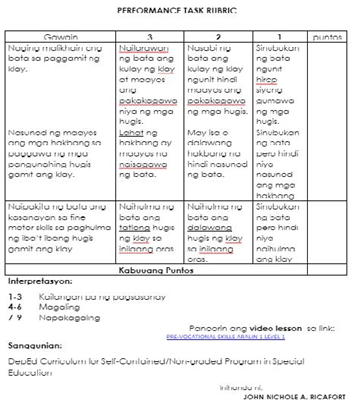
A set of rubrics and a checklist were utilized to gauge how far the learners understand the entire activity
Evaluation Phase. The evaluation of the learning activity sheets for non-graded class level 1-Prevocational skills “Kasanayan sa Fine Motor” using Modeling Clay Dough was very effective since the learners achieved what is expected to them despite modular distance learning approach. The activity creates and forms associations that connect different details and make the activity more memorable and realistic using concrete objects. Furthermore, interviews were made to the parents and teachers who administered the developed learning materials and it was found out to be effective to provide quality learning hands on experience to learners with difficulty in remembering and concentrating.
|
|
|
DEVELOPMENT OF FUTURE-PROOF LEARNING MATERIALS FOR LEARNERS WITH DIFFICULTY IN SEEING
Learners with difficulty in seeing were those learners who have the manifestation of having visual impairment. These learners have eyesight problems that affect their learning in the class. Visual impairment can interfere with the development of learning, mobility, social growth and adjustment.
Analysis Phase. The learning activity developed learners’ multi-sensory approach leans toward knowing the five senses and their corresponding body parts and learning to understand the different senses
Design Phase. Given the preliminary concepts based on most essential learning competencies for the self-contained/ non-graded program of special education specifically on MELC for children with difficulty in seeing, the learning activity sheet contains the intended content standards, performance task, and the duration of the activity.
The Five Senses and their Corresponding Parts
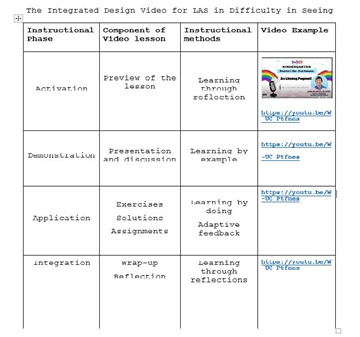
The objectives were: maaraman an limang pagmati kang sarong tawo and masabutan an gamit kang limang pagmati sa ara-aldaw. The objectives explored the learner’s capacity to understand the five senses, and the corresponding body parts and leading to an understanding of the different senses. The instructional video was embedded to helped learners and parent follow through with the entire lesson activity.
Development Phase. The two sets of activities such as Bilugan an ngaran kang parte kang hawak na ginagamit sa pagmati and pagkabiton ang parte kang hawak sa nasasabot kaining gamit was provided to the learner.
Screenshot of Matching the Five Senses into its Corresponding Uses or Functions
Implementation Phase. As to the implementation of the learning activity sheets to the learner, the researchers with the help of parents encourage them to walk through the process of utilizing the activity by following the step-by-step procedures, activities, and the expected output.
Moreover, the audio prompts were also helpful in order to guide learners through the entire process. The researchers also advised parents to use verbal and physical prompts in presenting instructions on identifying the five senses and their parts and functions.
Evaluation Phase. The evaluation of the learning activity sheets for non-graded class level 1-Prevocational skills (Ang Limang Pagmati) with two sets of activities was very effective since the learners achieved what is expected of them despite the modular distance learning approach. Also, as per the parent feedback, they allowed the child to seat away from the window and glaring light to help increase focus and concentration while doing the activity.
|
|
|
Two (2) identified graded and three (3) non-graded underwent pre-assessment according to their individual educational plan. The researchers selected pre-vocational skills level 1 activity to supplement to classroom teaching that promotes collective and differentiated learning styles and needs through play and physical activity that covers fine motor skills (“Paggamit ng mga kamay upang matapos ang mga gawain”). The learning activity sheet developed learners’ creativity using clay, following sequential steps on clay molding and developing their fine motor skills in playing with the clay dough. These learners use their hands to interact with the objects provided with the help of instructional videos. Moreover, the researchers map out the process of how learners achieved the desired learning objectives based on most essential learning competencies for the self-contained/ non-graded program of the special education specifically on MELC for children with intellectual disability level I-III. The learning activity sheet contains the intended content standards, performance task, and the duration of the activity. The objectives were: malinang ang pagiging malikhain ng bata sa paggamit ng klay; matutong sumunod sa panuto sa mga hakbang sa paggawa ng mga pangunahing hugis gamit ang clay at malinang ang fine motor skills sa paglalaro ng klay.
The three sets of activities such as pagporma ng hugis ng bilog gamit ang klay, pagporma ng hugis ng tatsulok gamit ang klay, and pagporma ng hugis ng parisukat gamit ang klay was provided to the learners. One-day orientation was done for parents in order to discuss the step-by-step procedures, activities, and the expected output. Attached also under the LAS is the expected sample output for the learners to achieve.
Parents assisted the learners at home in a three-day session until the learners master the craft on their own. Based on the parent’s feedback, the Learning Activity Sheets provided were a short version of the module which they find easy to use and implement at home. Moreover, the video prompts were also helpful in order to guide learners through the entire process. The evaluation of the learning activity sheets for non-graded class level 1-Prevocational skills “Kasanayan sa Fine Motor” using Modeling Clay Dough was very effective since the learners achieved what is expected to them despite modular distance learning approach.
The activity creates and forms associations that connect different details and make the activity more memorable and realistic using concrete objects. Furthermore, interviews were made to the parents and teachers who administered the developed learning materials and it was found out to be effective to provide quality learning hands on experience to learners with difficulty in remembering and concentrating.
DEVELOPMENT OF FUTURE-PROOF LEARNING MATERIALS FOR LEARNERS WITH DIFFICULTY IN SEEING
Only two (2) non-graded learner underwent pre-assessment based on their individual educational plan. The researchers selected pre-vocational skills level 1 activity to carefully provide accommodation but not limited to providing clear instructions as the learner may misinterpret gestures and facial expressions, the use of enlarged print/magnified worksheets, and the use of concrete material and hands-on experience whenever possible form part of crafting the LAS. The learning activity developed learners’ multi-sensory approach leans toward knowing the five senses and their corresponding body parts and learning to understand the different senses. It also provides them the opportunity to use supplementary visual and audio material with clear verbal explanations.
Moreover, the researchers map out the process of how learners achieved the desired learning objectives for learners with difficulty in seeing. Given the preliminary concepts based on most essential learning competencies for the self-contained/ non-graded program of special education specifically on MELC for children with difficulty in seeing, the learning activity sheet contains the intended content standards, performance task, and the duration of the activity. The objectives were: maaraman an limang pagmati kang sarong tawo and masabutan an gamit kang limang pagmati sa ara-aldaw. The objectives explored the learner’s capacity to understand the five senses, and the corresponding body parts and leading to an understanding of the different senses.
The instructional video was embedded to helped learners and parent follow through with the entire lesson activity. The two sets of activities such as Bilugan an ngaran kang parte kang hawak na ginagamit sa pagmati and pagkabiton ang parte kang hawak sa nasasabot kaining gamit was provided to the learner as shown in Table 5 and Figure 5. Set of scoring rubrics was used to assess student performance based upon a specific set of criteria. The rubric consists of the following three components: the characteristics of performance; levels of performance: the degree to which a student is expected to meet a given criterion (3,2,1); and the descriptors: specific explanation linked to each criterion and level of performance. the characteristics associated with each dimension. As to the implementation of the learning activity sheets to the learner, the researchers with the help of parents encourage them to walk through the process of utilizing the activity by following the step-by-step procedures, activities, and the expected output.
Moreover, the audio prompts were also helpful in order to guide learners through the entire process. The researchers also advised parents to use verbal and physical prompts in presenting instructions on identifying the five senses and their parts and functions. A set of rubrics and checklists was utilized to gauge how far the learners understand the entire activity. The evaluation of the learning activity sheets for non-graded class level 1-Prevocational skills (Ang Limang Pagmati) with two sets of activities was very effective since the learners achieved what is expected of them despite the modular distance learning approach. Also, as per the parent feedback, they allowed the child to seat away from the window and glaring light to help increase focus and concentration while doing the activity.
| [1] | Department of Education, "Official Gazette of the Republic of the Philippines," 24 September 2013. [Online]. Available: https:// www.deped.gov.ph/wp-content/ uploads/ 2013/ 09/ DO_ s2013_43.pdf. | ||
| In article | |||
| [2] | T. &. P. E. Trust, "Using the ADDIE model and universal design for learning principles to develop an open online course for teacher professional development," Journal of Digital Learning in Teacher Education, vol. 4, no. 32, pp. 219-233, 2018. | ||
| In article | View Article | ||
| [3] | A. L. Davis, "Using instructional design principles to develop effective information literacy instruction: The ADDIE model," College & Research Libraries News, vol. 74, no. 4, pp. 205-207, 2013. | ||
| In article | View Article | ||
| [4] | M. Mayfield, "Creating training and development programs: using the ADDIE method," Development and Learning in Organizations: An International Journal, vol. 25, no. 3, pp. 19-22, 2011. | ||
| In article | View Article | ||
| [5] | J. Dewey, Experience and Education, The Macmillan Company, 1938. | ||
| In article | |||
| [6] | B. &. S. C. Oyarzun, "Learning Theories," EdTech Books, 2020. [Online]. Available: https://edtechbooks.org/id/learning_theories. | ||
| In article | |||
| [7] | J. S. Brown and A. &. D. P. Collins, "Situated cognition and the culture of learning," Educational Researcher, vol. 18, no. 1, pp. 32-42, 1989. | ||
| In article | View Article | ||
| [8] | S. Kurt, "Situated Learning Theory," Educational Technology, 17 2 2021. [Online]. Available: https:// educationaltechnology.net/ situated-learning. | ||
| In article | |||
| [9] | M. Csikszentmihalyi, "Flow: The Psychology of Optimal Experience.," Journal of Leisure Research, vol. 24, no. 1, pp. 93-94, 1990. | ||
| In article | View Article | ||
| [10] | R. Mayer, "Applying the Science of Learning to Multimedia Instruction," Handbook of research on educational communications and technology, pp. 77-87, 2011. | ||
| In article | View Article | ||
Published with license by Science and Education Publishing, Copyright © 2025 John Nichole A. Ricafort
 This work is licensed under a Creative Commons Attribution 4.0 International License. To view a copy of this license, visit
http://creativecommons.org/licenses/by/4.0/
This work is licensed under a Creative Commons Attribution 4.0 International License. To view a copy of this license, visit
http://creativecommons.org/licenses/by/4.0/
| [1] | Department of Education, "Official Gazette of the Republic of the Philippines," 24 September 2013. [Online]. Available: https:// www.deped.gov.ph/wp-content/ uploads/ 2013/ 09/ DO_ s2013_43.pdf. | ||
| In article | |||
| [2] | T. &. P. E. Trust, "Using the ADDIE model and universal design for learning principles to develop an open online course for teacher professional development," Journal of Digital Learning in Teacher Education, vol. 4, no. 32, pp. 219-233, 2018. | ||
| In article | View Article | ||
| [3] | A. L. Davis, "Using instructional design principles to develop effective information literacy instruction: The ADDIE model," College & Research Libraries News, vol. 74, no. 4, pp. 205-207, 2013. | ||
| In article | View Article | ||
| [4] | M. Mayfield, "Creating training and development programs: using the ADDIE method," Development and Learning in Organizations: An International Journal, vol. 25, no. 3, pp. 19-22, 2011. | ||
| In article | View Article | ||
| [5] | J. Dewey, Experience and Education, The Macmillan Company, 1938. | ||
| In article | |||
| [6] | B. &. S. C. Oyarzun, "Learning Theories," EdTech Books, 2020. [Online]. Available: https://edtechbooks.org/id/learning_theories. | ||
| In article | |||
| [7] | J. S. Brown and A. &. D. P. Collins, "Situated cognition and the culture of learning," Educational Researcher, vol. 18, no. 1, pp. 32-42, 1989. | ||
| In article | View Article | ||
| [8] | S. Kurt, "Situated Learning Theory," Educational Technology, 17 2 2021. [Online]. Available: https:// educationaltechnology.net/ situated-learning. | ||
| In article | |||
| [9] | M. Csikszentmihalyi, "Flow: The Psychology of Optimal Experience.," Journal of Leisure Research, vol. 24, no. 1, pp. 93-94, 1990. | ||
| In article | View Article | ||
| [10] | R. Mayer, "Applying the Science of Learning to Multimedia Instruction," Handbook of research on educational communications and technology, pp. 77-87, 2011. | ||
| In article | View Article | ||