Background: Breast cancer is a prevalent global disease, causing over one million new cases and over 60,000 deaths annually. We developed the health belief model (HBM) to explain health behaviors, such as the use of health services and views on avoiding illness. The model was expanded to include self-efficacy, a person's belief in their ability to act successfully. Aim: to evaluate effect of an educational program on enhancing female workers’ health belief model of breast cancer preventive measures. Subjects and Methods: Design: A quasi-experimental design. Sample and Settings: 323 working women at Beni-Suef University were selected. Tools: The study utilizes a structured interviewing questionnaire, a Health Belief Model Questionnaire, and an Arabic booklet to assess pregnant women's psychological readiness for breast cancer prevention. Results: there was a highly statistically significant improvement in female workers’ health belief regarding to perceived susceptibility, benefits, and self-efficacy during post-test HBM as p≤0.01 in comparison to the pretest. Moreover, there was a statistically significant improvement in female workers’ health belief regarding to perceived seriousness, barriers, and cues to action during post-test HBM as p≤0.01. Conclusion: Based on the findings of the present study, it can be concluded that there was a statistically significant improvement in female workers’ health belief toward all items of HBM including perceived susceptibility, seriousness, benefits, barriers, cues to action, self-efficacy during post implementation program compared to per-implementation. The implemented educational program about health belief model had a positive effect of female workers’ breast cancer preventive measures. Recommendations: Apply health belief model for preventive measures for other types of gynecological cancer.
Each year, more than one million new cases of breast cancer have been diagnosed in the world, and for this reason. In more than six hundred thousand cases, death occurs 1, 2, 3, 4, 5, 6, 7, 8. Worldwide, breast cancer is a prevalent tumor in women. Breast cancer causes a burden in terms of prevention, diagnosis, and treatment, regardless of a nation's economic situation 9, 10, 11, 12 13, 14, 15, 16.
A social psychology model for health behavior modification, the health belief model (HBM) was created to explain and forecast behaviors connected to health, especially the use of health services. It also describes a person's views on avoiding illness, preserving good health, and aiming for well-being 17, 18, 19.
The four elements of the HBM perceived susceptibility, severity, benefits, and barriers were expanded in 1988 to include self-efficacy. A person's belief in their ability to act successfully is known as self-efficacy. An attempt was made to enhance the HBM by including self-efficacy to better explain individual variations in health behaviors 20, 21, 22.
The updated Champion's HBM Scale (CHBMS) consists of six elements: perceived susceptibility to illness, risk perception, perceived severity of illness, perceived benefits of behavior modification, and perceived barriers to action. It suggests women with serious breast cancer risk are more likely to participate in screenings 23.
Perceived susceptibility refers to the subjective estimation of one's vulnerability to a health issue, which can lead individuals to take actions to reduce their likelihood of experiencing it 24. Perceived severity refers to the subjective assessment of the severity and potential outcomes of a health issue, influencing individuals to take action to prevent or reduce its impact, including opinions on the illness's terminality and effects 25. Perceived benefits refer to an individual's evaluation of the worth or effectiveness of adopting a health-promoting action to reduce disease risk 26.
Perceived barriers to action significantly influence health-related behaviors, as individuals evaluate impediments to altering their actions, even if they believe it will reduce the threat of their health condition 27. Cues to action are situations that prompt decision-making about health, including media messages, social interactions, and influence. Interior cues, such as disease signs and symptoms, can influence individuals to seek treatment for advanced-stage breast cancer 28. Self-efficacy, a person's belief in their ability to act successfully, was incorporated into the Health Behavior Model (HBM) to better explain individual health behaviors 20.
The current study was conducted to evaluate effect of an educational program on enhancing female workers’ health belief model of breast cancer preventive measures.
Research design:
The research utilized an interventional, quasi-experimental design, which included a pre-test and a post-test.
Subjects and Settings:
A sample of 323 working women aged 18 to 60 at Beni-Suef University was chosen due to their absence of cancer, chemotherapy, radiation, and psychological illnesses.
Tools of data collection:
Tool I: A Structured Interviewing Questionnaire Sheet
Age, education, marital status, place of residence, and family income are just a few of the socio-demographic and personal characteristics of women that the researcher collected through a review of the literature.
Tool II: Health Belief Model Questionnaire:
Subscale (1): Perceived susceptibility to breast cancer is influenced by health status, anxiety, self-examination, family history, and exercise, with health status, family history, and exercise all contributing factors.
Subscale (2) Breast cancer is a hopeless disease that significantly impacts self-perception, financial stability, and long-term health issues, making it a more dangerous and difficult condition than any other.
Subscale (3) Breast self-examination offers numerous benefits, including early detection of tumors, preventing future issues, promoting a healthy diet, and reducing the risk of breast cancer, while also reducing complications.
Subscale (4): Perceived barriers to breast cancer include financial costs, time consumption, interference with activities, and pain associated with medical examinations.
Subscale (5): The individual prioritizes health through healthy eating habits, following doctor's instructions, taking vitamins, seeking health-related information, regular check-ups, and regular examinations.
Subscale (6): The individual believes they can handle breast cancer screenings, even if others object, and is confident in their ability to cope with the resulting emergency, despite the potential risks associated with a healthy diet.
Scoring system: A study rated responses on a five-point Likert scale, resulting in 300 degrees of total attitude. Three categories were created: positive belief (≥75%), neutral belief (50-74%), and negative belief (<50%). The questions related to susceptibility, seriousness, and barriers had a reversed scoring system, with higher scores indicating more negative health beliefs.
Tool III: Supportive material (Arabic booklet):
The text provides a comprehensive overview of breast cancer, outlining its definition, signs, symptoms, risk factors, types, stages, diagnosis, treatment, and preventive measures.
Tools Validity and Reliability
Five experts from Beni-Suef University evaluated the study tools' content validity and reliability, with total knowledge, Health Belief Model, and breast cancer preventive measures having high reliability coefficients.
Ethical Consideration and Administrative Design:
The study received ethical approval from Beni-Suef University's Faculty of Medicine's Research Ethics Committee, nursing faculty dean, and hospital director, and an official letter was sent.
Pilot study:
A pilot study on 10% of 32 women evaluated tool applicability, efficiency, and clarity, identifying obstacles and making necessary modifications, excluding the pilot sample from the main study.
Fieldwork
The study, which began in December 2023 and concluded in May 2024, involved phases of assessment, planning, implementation, and evaluation.
Preparatory phase:
The researcher created and evaluated data collection tools through a review, and a panel of experts assessed their validity, substance, knowledge, correctness, and relevance.
Phase (I): Assessment phase:
The researcher conducted interviews with women to understand their socio-demographic traits and knowledge about breast cancer, which served as the baseline for an educational program and influenced the health belief model's impact.
Phase (II): Planning phase:
The researcher used pre-test results and a health belief model to inform the development of an educational program aimed at improving the knowledge and behaviors of women on the prevention of breast cancer.
Phase (III): Implementation phase:
Through theoretical sessions, the program sought to inform women about breast cancer's causes, risk factors, symptoms, diagnosis, treatment, and preventive measures.
Program sessions:
Health education sessions were scheduled for 45 minutes each, starting with an orientation about the program and objectives. Each session summarized previous sessions and objectives, followed by questions and answers, and a plan for the next session. Feedback was used for termination. Educational media included an artificial breast module, laptop, and guidance booklet, along with Arabic and audiovisual materials.
Phase (IV): Evaluation phase:
Post-tests were conducted on female participants to assess their knowledge and practices of preventive behaviors, and abnormal signs were referred to maternal healthcare centers for further investigation.
Statistical Design:
The study analyzed data on women's knowledge and preventive behaviors before and after HBMS implementation using SPSS version 20 and compared results using various statistical tests, p-value of ≤0.001, and insignificant at a p-value >0.05.
Table 1 shows that there was a statistically significant improvement in female workers’ health belief toward all items of perceived susceptibility during post-test HBM as p≤0.01 in comparison to the pretest, as noticed that less than one tenth (5.0%, 5.3% & 5.9%) of females were strongly agreeing regarding the perceived susceptibility of breast cancer in the pretest, which improved to more than one third and nearly one half (49.5%, 39.3% & 44.6%) post HBM implementation, respectively.
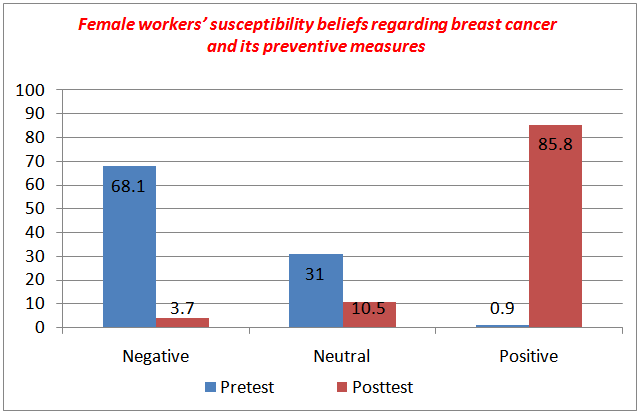
Figure 1 shows that there was a highly statistically significant improvement in female workers’ health belief regarding to perceived susceptibility during post-test HBM as p≤0.01 in comparison to the pretest, as noticed that negative belief in the pretest was reported by 68.1%, which improved to 3.7% post HBM implementation, while positive belief in the pretest was reported by 85.8%, which improved to 0.9% post HBM implementation.
Table 2 reveals that there was a statistically significant improvement in female workers’ health belief toward all items of perceived seriousness (severity) during post-test HBM as p ≤ 0.05 in comparison to the pretest, as noticed that less than one tenth (7.4%, 7.7%, & 8.4%) of females were strongly disagreeing regarding the perceived seriousness of breast cancer in the pretest, which improved to more than one third and nearly less than half (40.2%, 39.3%, & 39.6%) post HBM implementation, respectively.
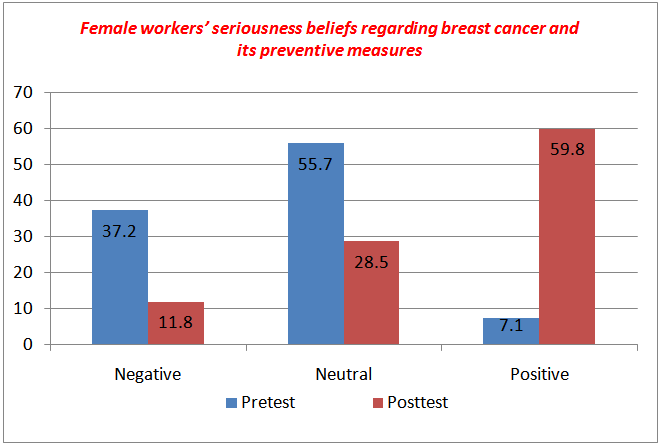
Figure 2 shows that there was a highly statistically significant improvement in female workers’ health belief regarding to perceived seriousness (severity) during post-test HBM as p≤0.05 in comparison to the pretest, as noticed that negative belief in the pretest was reported by 37.2%, which improved to 11.8% post HBM implementation, while positive belief in the pretest was reported by 7.1%, which improved to 59.8% post HBM implementation.
Table 3 illustrates that there was a highly statistically significant improvement in female workers’ health belief toward all items of perceived benefits during post-test HBM as p ≤ 0.01 in comparison to the pretest, as noticed that the minority (12.1% & 14.2%) of females were strongly agreeing regarding perceived benefits of breast cancer in the pretest, which improved to less than half (48.6% & 48.9%) post-HBM implementation, respectively.
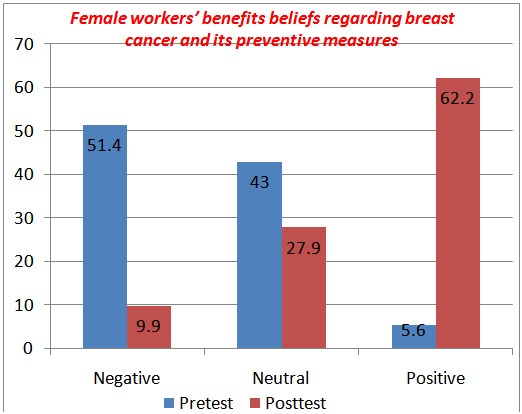
Figure 3 shows that there was a statistically significant improvement in female workers’ health belief regarding to perceived benefits during post-test HBM as p≤0.05 in comparison to the pretest, as noticed that negative belief in the pretest was reported by 51.4%, which improved to 9.9% post HBM implementation, while positive belief in the pretest was reported by 5.6%, which improved to 62.2% post HBM implementation.
Table 4 shows that there was a statistically significant improvement in female workers’ health belief toward all items of perceived barrier during post-test HBM as p≤0.05 in comparison to pretest, as noticed that nearly one quarter and more (21.4%, 27.6%, & 31.9%) of females were strongly disagreeing regarding the perceived barrier of breast cancer in the pretest, which improved to nearly one half and more (54.2%, 48.0%, & 46.1%) post HBM implementation, respectively.
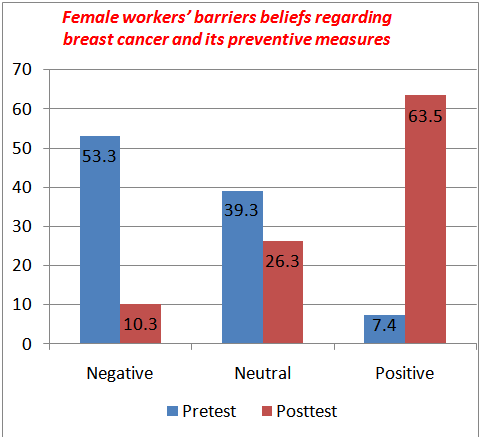
Figure 4 shows that there was a statistically significant improvement in female workers’ health belief regarding to perceived barrier during post-test HBM as p≤0.05 in comparison to the pretest, as noticed that negative belief in the pretest was reported by 553.3%, which improved to 10.3% post HBM implementation, while positive belief in the pretest was reported by 7.4%, which improved to 63.5% post HBM implementation.
Table 5 reveals that there was a highly statistically significant improvement in female workers’ health belief toward all items of cues to action during post-test HBM as p ≤ 0.01 in comparison to the pretest, as noticed that more than one tenth (10.5% & 18%) of females were strongly agreeing regarding cues to action of breast cancer in the pretest, which improved to less than half (43.3% & 42.7%) post HBM implementation, respectively.
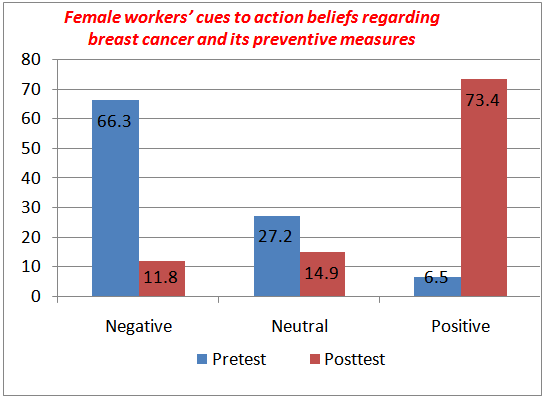
Figure 5 shows that there was a highly statistically significant improvement in female workers’ health belief regarding to perceived cues to action during post-test HBM as p≤0.01 in comparison to the pretest, as noticed that negative belief in the pretest was reported by 66.3%, which improved to 11.8% post HBM implementation, while positive belief in the pretest was reported by 6.5%, which improved to 73.4% post HBM implementation.
Table 6 presents that there was a highly statistically significant improvement in female workers’ health belief toward all items of self-efficacy during post-test HBM as p ≤ 0.01 in comparison to the pretest, as noticed that the minority (16.1% & 13.9%) of females were strongly agreeing regarding self-efficacy of breast cancer in the pretest, which improved to less than half (43.0% & 41.8%) post-HBM implementation, respectively.
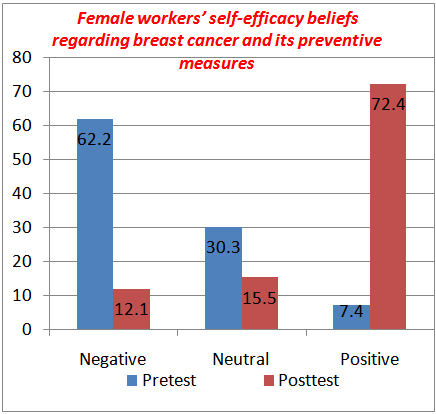
Figure 6 shows that there was a highly statistically significant improvement in female workers’ health belief regarding to perceived self-efficacy during post-test HBM as p≤0.01 in comparison to the pretest, as noticed that negative belief in the pretest was reported by 62.2%, which improved to 7.4% post HBM implementation, while positive belief in the pretest was reported by 85.8%, which improved to 72.4% post HBM implementation.


Originally, the model was created to explain health-related one-time activities like getting a vaccine or going through a cancer screening. In due course, the HBM was extended to include more significant, long-term behavioral changes, including quitting smoking, exercising, and altering one's diet. The model's creators understood that a crucial element of changing health-related behavior was self-efficacy, or the belief in one's capacity to influence changes in outcomes 29, 30. The aim of the study was evaluate effect of an educational program on enhancing female workers’ health belief model of breast cancer preventive measures.
Concerning female workers’ beliefs regarding breast cancer and its preventive measures as measured by the health belief model, it is discussed under the following headlines. Firstly, regarding the studied female worker’s perceived susceptibility of BC pre and post-implementation of the HBM-based educational program, the current study indicates regression in perceiving negative susceptibility and progression in positive ones with an improvement. A highly statistically significant improvement in the posttest HBM compared with the pretest toward susceptibility of BC. This finding is in the same line with Wondmu et al. (2022), who investigated the “effect of breast cancer education based on the health belief model on knowledge, health belief, and breast self-examination among female students” and found that there was a highly statistically significant difference observed between the intervention group and the control group in perceived susceptibility regarding breast cancer and breast self-exam using HBM within pre- and one month post-intervention 31. From the researcher's point of view, encouraging group discussions or support groups can create a supportive environment where participants motivate each other to act on their health.
Secondly, concerning perceived severity (seriousness) of BC pre and post-implementation of the HBM-based educational program, the current study revealed that there was a marked improvement in the posttest HBM compared with the pretest toward susceptibility of perceived severity of BC with a highly statistically significant difference. This finding is in accordance with Ştefănuţ et al. (2023), who studied “psychotherapeutic intervention on breast self-examination based on the health belief model” and demonstrated that there were statistically significant differences between perceived severity regarding BC & BSE beliefs 32. From the researcher's point of view, enhanced perceived severity by sharing information about the consequences of breast cancer, participants may better understand the seriousness of the disease and increase their motivation to take preventive action.
Thirdly, regarding the studied female worker’s perceived benefits, the current study presented that there was a marked improvement in the posttest HBM compared with the pretest toward perceived benefits of BC. Regression in perceiving negative benefits and progression in positive ones with an improvement with a highly statistically significant difference was observed. This finding was supported by Elsawy et al. (2023), who investigated the “effect of utilizing the health belief model on knowledge, beliefs, and behavior of visually impaired women toward breast self-examination” and showed that there were highly statistically significant differences between perceived benefits regarding BC & BSE behavior 27. From the researcher's point of view, this finding may be due to the program highlighting the advantages of early detection and preventive behaviors, helping individuals recognize the positive outcomes of screening and lifestyle changes.
Fourthly, in relation to the studied female worker’s perceived barrier of BC pre and post-implementation of the HBM-based educational program, the current study revealed that there was a marked improvement in the posttest HBM compared with the pretest toward perceiving the barrier of BC with a highly statistically significant difference. This finding agreed with El-kest et al. (2021), who discussed “the effect of a health education program on the prevention of breast and cervical cancer based on the health belief model among female employees at the medical campus” and found that there were highly statistically significant differences between perceived barriers regarding BC beliefs 33. From the researcher's point of view, this finding may be due to addressing common misconceptions and fears about screening or lifestyle changes that can help reduce perceived barriers, making participants more likely to engage in preventive actions.
Fifty; regarding the studied female worker’s cues to action, the current study revealed that there was a marked improvement in the posttest HBM-based educational program compared with the pretest toward cues to action of BC with a highly statistically significant difference. This finding agreed with Wondmu et al. (2022), who addressed the “effect of breast cancer education based on the health belief model on knowledge, health belief, and breast self-examination among female students” and found that there was a highly statistically significant difference noted between the intervention group and the control group in cues to action regarding breast cancer and breast self-exam using HBM within pre- and post-intervention 31. From the researcher's point of view, this finding might be due to educational materials providing brochures, videos, and workshops that can serve as tangible reminders to encourage participants to engage in screening, seeking necessary health services, and preventive behaviors.
Sixthly, concerning self-efficacy, the present study illustrated that there was a marked improvement in the posttest HBM compared with the pretest toward self-efficacy regarding BC with a highly statistically significant difference. This finding was congruent with Elsawy et al. (2023), who discussed the “effect of utilizing the health belief model on knowledge, beliefs, and behavior of visually impaired women toward breast self-examination” and proved that there were highly statistically significant differences between perceived benefits regarding BC & BSE behavior 27.
Based on the findings of the present study, it can be concluded that there was a statistically significant improvement in female workers’ health belief toward all items of HBM including perceived susceptibility, seriousness, benefits, barriers, cues to action, self-efficacy during post implementation program compared to per-implementation. The implemented educational program about health belief model had a positive effect of female workers’ breast cancer preventive measures
Apply health belief model for preventive measures for other types of gynecological cancer
| [1] | Mohamed S., Fatma Saber Nady F., Hassan H. Breast Cancer Preventive Measures among Female Workers at Beni-Suef University: Educational Program Based on Health Belief Model. Egyptian Journal of Health Care, 2025; 16 (1): 117-142. | ||
| In article | View Article | ||
| [2] | Mohamed A., Hassan H., Gamel W., Arafa A. Awareness about breast and cervical cancers among nursing students in Beni-Suef University. Journal of Nursing Education and Practice, 2019; 9(5): 44-51. | ||
| In article | View Article | ||
| [3] | Mohammed F., Shahin M., Youness E., Hassan H. Survivorship in Women Undergoing Gynecological and Breast Cancer Treatment in Upper Egypt: The Impact of Quality of Life Improvement Educational Program”. American Research Journal of Gynaecology. 2018; 2(1): 1-28. | ||
| In article | |||
| [4] | Nady F., Said M., Youness E., Hassan H. Effect of Nursing Intervention Program on Quality of Life Improvement for Women Undergoing Gynecological and Breast Cancer Treatment. Assuit Scientific Nursing Journal, 2018; 6(15): 62-77. | ||
| In article | View Article | ||
| [5] | Qalawa, Sh., Eldeeb, A., & Hassan, H. Young Adult Women’s intention regarding breast and cervical cancer screening in Beni-Suef. Scientific Research Journal, 2015; 3(3): 11-24. | ||
| In article | |||
| [6] | Nady F., Said M., Youness E., Hassan H. Impact of Tailored Educational Program of Quality of Life Improvement on Women Undergoing Breast Cancer Treatment at El-Minia Region, Egypt. American Research Journal of Gynaecology. 2017; 1(1): 1-17. | ||
| In article | |||
| [7] | Atwa A., Hassan H., Ahmed S. The impact of a hospital-based awareness program on the knowledge of patients about breast cancer and cancer cervix. International Journal of Studies in Nursing. 2019; 4(1): 20-29. | ||
| In article | View Article | ||
| [8] | Ali R., Abd El Salam S., Kamal H., Hassan H. Women with Cervical Cancer: Impact of an Educational Program their Knowledge. Journal of Obstetrics Gynecology and Reproductive Sciences, 2021; 5(2): 1-8. | ||
| In article | View Article | ||
| [9] | Hassan H., Zaki S., Nady F. Effect of an Educational Program on Female Workers’ Knowledge about Breast Cancer Preventive Measures at Beni-Suef University. American Journal of Nursing Research. 2025; 13(1):1-10. | ||
| In article | View Article | ||
| [10] | Hassan H., Zaki S., Nady F. Female Workers’ Socio-demographic characteristics and Their Total Knowledge about Breast Cancer: Effect of an Educational program at Beni-Suef University, International Journal of Nursing Science, 2025; 15(1):1-8. | ||
| In article | View Article | ||
| [11] | Nady F, Zaki S, Hassan H. Female workers’ knowledge about breast cancer preventive measures at Beni-Suef University. Nursing & Care Open Access Journal. 2025; 11(1): 16‒20. | ||
| In article | View Article | ||
| [12] | Hassan H., Nady F., Zaki S. Northern Upper Egyptian Female Workers’ Beliefs Regarding Breast Cancer according to Health Belief Model: Effect of an Educational Program. Public Health Open Access, 2025; 9(1): 1-12. | ||
| In article | View Article | ||
| [13] | Zaki S., Hassan H., Nady F. Female Workers’ Knowledge about Breast Cancer at Beni-Suef University: Effect Socio-demographic characteristics. American Journal of Public Health Research, 2025; 13(1) | ||
| In article | View Article | ||
| [14] | Nady F., Zaki S., Hassan H. Study Relation between Female Workers’ History and Their Knowledge About Breast Cancer, Breast-Self-Examination and Preventive Measures. Journal of Pediatric Advance Research, 2025; 4(1):1-9. | ||
| In article | View Article | ||
| [15] | Hassan H., Zaki S., Nady F. Relation between Female Workers’ History and Their Knowledge About Breast Cancer, Breast-Self-Examination and Preventive: Effect Of An Educational Program. Journal of Community Medicine and Public Health Reports, 2025; 6(2). | ||
| In article | |||
| [16] | Zaki S., HassanH., Nady F. Breast Self-Examination Practices: An Educational Program for Female Workers’ at Beni-Suef University. Journal of Community Medicine and Public Health Reports, 2025; 6(2). | ||
| In article | |||
| [17] | Anuar, H., Shah, S. A., Gafor, H., Mahmood, M. I., & Ghazi, H. F. Usage of Health Belief Model (HBM) in health behavior: A systematic review. Malaysian Journal of Medicine and Health Sciences, 2020; 16(11): 2636-9346. | ||
| In article | |||
| [18] | Hassan H., Zahran K., Youness E., Nady F. Pregnant Women's Awareness, Intention and Compliance regarding Folic Acid Usage for Prevention of Neural Tube Defects According to Health Belief Model in Beni-Suef City. Pyrex Journal of Nursing and Midwifery, 2015, 1(3): 13-26. | ||
| In article | |||
| [19] | Mohamed S., Fatma Saber Nady F., Hassan H. Breast Cancer Preventive Measures among Female Workers at Beni-Suef University: Educational Program Based on Health Belief Model. Egyptian Journal of Health Care, 2025; 16 (1): 117-142. | ||
| In article | View Article | ||
| [20] | Mousavi, F., Shojaei, P., Nazemi, A., Babania, S & Aliniagerdroudbari, E. Health Belief Model and Determinants of Breast Selfexamination Performance: Int J Cancer Manag, 2021; 14(10):e111509. | ||
| In article | View Article | ||
| [21] | Nady F., El-Sherbiny M., Youness E., Hassan H. Effectiveness of Quality of Life Planned Teaching Program on Women Undergoing Gynecologic Cancer Treatment. American Research Journal of Oncology. 2018; 1(1): 1-17. | ||
| In article | |||
| [22] | Hassan, H., Bayoumi, M., & Atwa, A. Emotional Distress Associated with Gynecologic and Breast Cancer in Beni-Suef City. International Journal of Science and Research, 2016; 5(2): 1118-1129. | ||
| In article | View Article | ||
| [23] | Htay, M. N. N., Schliemann, D., Dahlui, M., Cardwell, C. R., Loh, S. Y., Tamin, N. S. B. I., & Su, T. T. Validation of the champion health belief model scale for an investigation of breast cancer screening behaviour in Malaysia. International journal of environmental research and public health, 2021; 18(17): 9311. | ||
| In article | View Article PubMed | ||
| [24] | Ogunkorode, A., Holtslander, L., Ferguson, L., Maree, J. E., Anonson, J., Ramsden, V. R., & Isaiah, D. O. The Suitability of the Health Belief Model as an Assessment Framework for Women with Breast Ill-Health. International Journal of Women's Health & Reproduction Sciences, 2021; 9(4). 5-14 | ||
| In article | View Article | ||
| [25] | Cal, A., Bahar, Z., & Gorken, I. Effects of Health Belief Model based nursing interventions offered at home visits on lymphedema prevention in women with breast cancer: a randomised controlled trial. Journal of Clinical Nursing, 2020; 29(13-14): 2521-2534. | ||
| In article | View Article PubMed | ||
| [26] | El-Hosary, E. Health Belief Model as a predictor of Self-Breast Examination Behaviors among Female Shaqra University Students: International Journal of Novel Research in Healthcare and Nursing, 2021; 8(3): 304- 323. | ||
| In article | |||
| [27] | Elsawy,M., Mohamed,H & Mousa,K. Effect of Utilizing Health Belief Model on Knowledge, Beliefs, and Behaviour of Visually Impaired Women toward Breast Self-examination: The Open Nursing Journal, 2023; 17. | ||
| In article | View Article | ||
| [28] | Taklual, W., Tesfaw, A., Mekie, M., & Shemelis, T. Breast Self-Examination Practice among Female Undergraduate Students in Debre Tabor University, Northcentral Ethiopia: Based on Health Belief Model. Middle East Journal of Cancer, 2021; 12(4): 1-10 | ||
| In article | |||
| [29] | Nasution, A., Yusuf, A., Iskandar,Y & Ab Hadi, I. Mobile Health Application Applying the Health Belief Model for Breast Cancer Awareness: What Is Missing?: Malaysian Journal of Medicine and Health Sciences, 2021; 17(4): 384-398. | ||
| In article | |||
| [30] | Nady F., Zahran K., Youness E., Hassan H. Women’s Knowledge and Perception about Benefits of Folic Acid Intake Before and During Pregnancy According to Health Belief Model in Beni-Suef City. Assuit Scientific Nursing Journal, 2014; 2(3): 1-13. | ||
| In article | View Article | ||
| [31] | Wondmu, K. S., Tessema, M. T., Degu, G., Mihiret, G. T., & Sinshaw, M. T. Effect of breast cancer education based on the health belief model on knowledge, health belief, and breast self-examination among female students of Debre Markos University, Northwest Ethiopia, in 2021. Frontiers in oncology, 2022; 12(3): 1034183. | ||
| In article | View Article PubMed | ||
| [32] | Ştefănuţ, A. M., & Vintilă, M. Psychotherapeutic intervention on breast self-examination based on health belief model. Current Psychology, 2023; 42(18): 15616-15624. | ||
| In article | View Article PubMed | ||
| [33] | El-kest, H. R. A., Elagemy, M. A. E., & El-Gamal, S. M. A. The Effect of A Health Education Program on Prevention of Breast and Cervical Cancer Based on the Health Belief Model among Female Employees at MedicalCampus. the breast, 2021; 5(8): 2314-5595. | ||
| In article | |||
Published with license by Science and Education Publishing, Copyright © 2025 Hanan Elzeblawy Hassan, Sahar Gamal Zaki and Fatma Saber Nady
 This work is licensed under a Creative Commons Attribution 4.0 International License. To view a copy of this license, visit
http://creativecommons.org/licenses/by/4.0/
This work is licensed under a Creative Commons Attribution 4.0 International License. To view a copy of this license, visit
http://creativecommons.org/licenses/by/4.0/
| [1] | Mohamed S., Fatma Saber Nady F., Hassan H. Breast Cancer Preventive Measures among Female Workers at Beni-Suef University: Educational Program Based on Health Belief Model. Egyptian Journal of Health Care, 2025; 16 (1): 117-142. | ||
| In article | View Article | ||
| [2] | Mohamed A., Hassan H., Gamel W., Arafa A. Awareness about breast and cervical cancers among nursing students in Beni-Suef University. Journal of Nursing Education and Practice, 2019; 9(5): 44-51. | ||
| In article | View Article | ||
| [3] | Mohammed F., Shahin M., Youness E., Hassan H. Survivorship in Women Undergoing Gynecological and Breast Cancer Treatment in Upper Egypt: The Impact of Quality of Life Improvement Educational Program”. American Research Journal of Gynaecology. 2018; 2(1): 1-28. | ||
| In article | |||
| [4] | Nady F., Said M., Youness E., Hassan H. Effect of Nursing Intervention Program on Quality of Life Improvement for Women Undergoing Gynecological and Breast Cancer Treatment. Assuit Scientific Nursing Journal, 2018; 6(15): 62-77. | ||
| In article | View Article | ||
| [5] | Qalawa, Sh., Eldeeb, A., & Hassan, H. Young Adult Women’s intention regarding breast and cervical cancer screening in Beni-Suef. Scientific Research Journal, 2015; 3(3): 11-24. | ||
| In article | |||
| [6] | Nady F., Said M., Youness E., Hassan H. Impact of Tailored Educational Program of Quality of Life Improvement on Women Undergoing Breast Cancer Treatment at El-Minia Region, Egypt. American Research Journal of Gynaecology. 2017; 1(1): 1-17. | ||
| In article | |||
| [7] | Atwa A., Hassan H., Ahmed S. The impact of a hospital-based awareness program on the knowledge of patients about breast cancer and cancer cervix. International Journal of Studies in Nursing. 2019; 4(1): 20-29. | ||
| In article | View Article | ||
| [8] | Ali R., Abd El Salam S., Kamal H., Hassan H. Women with Cervical Cancer: Impact of an Educational Program their Knowledge. Journal of Obstetrics Gynecology and Reproductive Sciences, 2021; 5(2): 1-8. | ||
| In article | View Article | ||
| [9] | Hassan H., Zaki S., Nady F. Effect of an Educational Program on Female Workers’ Knowledge about Breast Cancer Preventive Measures at Beni-Suef University. American Journal of Nursing Research. 2025; 13(1):1-10. | ||
| In article | View Article | ||
| [10] | Hassan H., Zaki S., Nady F. Female Workers’ Socio-demographic characteristics and Their Total Knowledge about Breast Cancer: Effect of an Educational program at Beni-Suef University, International Journal of Nursing Science, 2025; 15(1):1-8. | ||
| In article | View Article | ||
| [11] | Nady F, Zaki S, Hassan H. Female workers’ knowledge about breast cancer preventive measures at Beni-Suef University. Nursing & Care Open Access Journal. 2025; 11(1): 16‒20. | ||
| In article | View Article | ||
| [12] | Hassan H., Nady F., Zaki S. Northern Upper Egyptian Female Workers’ Beliefs Regarding Breast Cancer according to Health Belief Model: Effect of an Educational Program. Public Health Open Access, 2025; 9(1): 1-12. | ||
| In article | View Article | ||
| [13] | Zaki S., Hassan H., Nady F. Female Workers’ Knowledge about Breast Cancer at Beni-Suef University: Effect Socio-demographic characteristics. American Journal of Public Health Research, 2025; 13(1) | ||
| In article | View Article | ||
| [14] | Nady F., Zaki S., Hassan H. Study Relation between Female Workers’ History and Their Knowledge About Breast Cancer, Breast-Self-Examination and Preventive Measures. Journal of Pediatric Advance Research, 2025; 4(1):1-9. | ||
| In article | View Article | ||
| [15] | Hassan H., Zaki S., Nady F. Relation between Female Workers’ History and Their Knowledge About Breast Cancer, Breast-Self-Examination and Preventive: Effect Of An Educational Program. Journal of Community Medicine and Public Health Reports, 2025; 6(2). | ||
| In article | |||
| [16] | Zaki S., HassanH., Nady F. Breast Self-Examination Practices: An Educational Program for Female Workers’ at Beni-Suef University. Journal of Community Medicine and Public Health Reports, 2025; 6(2). | ||
| In article | |||
| [17] | Anuar, H., Shah, S. A., Gafor, H., Mahmood, M. I., & Ghazi, H. F. Usage of Health Belief Model (HBM) in health behavior: A systematic review. Malaysian Journal of Medicine and Health Sciences, 2020; 16(11): 2636-9346. | ||
| In article | |||
| [18] | Hassan H., Zahran K., Youness E., Nady F. Pregnant Women's Awareness, Intention and Compliance regarding Folic Acid Usage for Prevention of Neural Tube Defects According to Health Belief Model in Beni-Suef City. Pyrex Journal of Nursing and Midwifery, 2015, 1(3): 13-26. | ||
| In article | |||
| [19] | Mohamed S., Fatma Saber Nady F., Hassan H. Breast Cancer Preventive Measures among Female Workers at Beni-Suef University: Educational Program Based on Health Belief Model. Egyptian Journal of Health Care, 2025; 16 (1): 117-142. | ||
| In article | View Article | ||
| [20] | Mousavi, F., Shojaei, P., Nazemi, A., Babania, S & Aliniagerdroudbari, E. Health Belief Model and Determinants of Breast Selfexamination Performance: Int J Cancer Manag, 2021; 14(10):e111509. | ||
| In article | View Article | ||
| [21] | Nady F., El-Sherbiny M., Youness E., Hassan H. Effectiveness of Quality of Life Planned Teaching Program on Women Undergoing Gynecologic Cancer Treatment. American Research Journal of Oncology. 2018; 1(1): 1-17. | ||
| In article | |||
| [22] | Hassan, H., Bayoumi, M., & Atwa, A. Emotional Distress Associated with Gynecologic and Breast Cancer in Beni-Suef City. International Journal of Science and Research, 2016; 5(2): 1118-1129. | ||
| In article | View Article | ||
| [23] | Htay, M. N. N., Schliemann, D., Dahlui, M., Cardwell, C. R., Loh, S. Y., Tamin, N. S. B. I., & Su, T. T. Validation of the champion health belief model scale for an investigation of breast cancer screening behaviour in Malaysia. International journal of environmental research and public health, 2021; 18(17): 9311. | ||
| In article | View Article PubMed | ||
| [24] | Ogunkorode, A., Holtslander, L., Ferguson, L., Maree, J. E., Anonson, J., Ramsden, V. R., & Isaiah, D. O. The Suitability of the Health Belief Model as an Assessment Framework for Women with Breast Ill-Health. International Journal of Women's Health & Reproduction Sciences, 2021; 9(4). 5-14 | ||
| In article | View Article | ||
| [25] | Cal, A., Bahar, Z., & Gorken, I. Effects of Health Belief Model based nursing interventions offered at home visits on lymphedema prevention in women with breast cancer: a randomised controlled trial. Journal of Clinical Nursing, 2020; 29(13-14): 2521-2534. | ||
| In article | View Article PubMed | ||
| [26] | El-Hosary, E. Health Belief Model as a predictor of Self-Breast Examination Behaviors among Female Shaqra University Students: International Journal of Novel Research in Healthcare and Nursing, 2021; 8(3): 304- 323. | ||
| In article | |||
| [27] | Elsawy,M., Mohamed,H & Mousa,K. Effect of Utilizing Health Belief Model on Knowledge, Beliefs, and Behaviour of Visually Impaired Women toward Breast Self-examination: The Open Nursing Journal, 2023; 17. | ||
| In article | View Article | ||
| [28] | Taklual, W., Tesfaw, A., Mekie, M., & Shemelis, T. Breast Self-Examination Practice among Female Undergraduate Students in Debre Tabor University, Northcentral Ethiopia: Based on Health Belief Model. Middle East Journal of Cancer, 2021; 12(4): 1-10 | ||
| In article | |||
| [29] | Nasution, A., Yusuf, A., Iskandar,Y & Ab Hadi, I. Mobile Health Application Applying the Health Belief Model for Breast Cancer Awareness: What Is Missing?: Malaysian Journal of Medicine and Health Sciences, 2021; 17(4): 384-398. | ||
| In article | |||
| [30] | Nady F., Zahran K., Youness E., Hassan H. Women’s Knowledge and Perception about Benefits of Folic Acid Intake Before and During Pregnancy According to Health Belief Model in Beni-Suef City. Assuit Scientific Nursing Journal, 2014; 2(3): 1-13. | ||
| In article | View Article | ||
| [31] | Wondmu, K. S., Tessema, M. T., Degu, G., Mihiret, G. T., & Sinshaw, M. T. Effect of breast cancer education based on the health belief model on knowledge, health belief, and breast self-examination among female students of Debre Markos University, Northwest Ethiopia, in 2021. Frontiers in oncology, 2022; 12(3): 1034183. | ||
| In article | View Article PubMed | ||
| [32] | Ştefănuţ, A. M., & Vintilă, M. Psychotherapeutic intervention on breast self-examination based on health belief model. Current Psychology, 2023; 42(18): 15616-15624. | ||
| In article | View Article PubMed | ||
| [33] | El-kest, H. R. A., Elagemy, M. A. E., & El-Gamal, S. M. A. The Effect of A Health Education Program on Prevention of Breast and Cervical Cancer Based on the Health Belief Model among Female Employees at MedicalCampus. the breast, 2021; 5(8): 2314-5595. | ||
| In article | |||