E-pal exchange, which has been utilized as the digital form of ‘pen pal exchange’, has been employed as a means of foreign language learning practice for a long time. In academic contexts, this application is essentially utilized so as to strengthen cross-cultural communication among language learners and lay the groundwork for future language teachers to adapt diversity within their future teaching contexts. In other words, this digital practice assists both foreign language teachers and learners to constitute a wider discernment of the world, people and the target language. With regard to this notion, it was found expedient to generate this research study in terms of initiating university EFL learners’ intercultural awareness. To this end, this research embraced 32 EFL learners at university preparatory classes and aimed at generating an e-pal exchange activation for two months. Learners were expected to email their e-pals at least three times a week and note their written reflections as a means of data collection for this research. A qualitative research design was administered by means of learners’ written reflections and their oral responses to an interview. Findings identify their views and perceptions on discrete cultures in addition to their feelings subsequent to this e-pal phase and reflect distinct implementations for both learners and teachers of English who intend to widen their horizon of the world.
Learners of English as a foreign language at preparatory programs at university level in Turkey encounter a number of adversities and challenges whilst their language learning process. Language learning context, syllabus, materials, teacher strategies and cultural background knowledge could be considered as some of the most pivotal challenges of these learners. Additionally, these learners mostly do not have the opportunity to practice their target language outside the classroom, which leads to a decrease in both their motivation and exposure to English. In accordance with this state, teachers of English additionally need to take their language instruction beyond the linguistic surface. At this point, knowledge and awareness of intercultural communication comes into prominence. To explain, a language learning context could be enriched by means of transforming learners into culturally more aware ones. To this end, it is an EFL / ESL teachers’ activation of learners through introducing familiar and unfamiliar processes or means of utilising their English 1. With this objective, acquainting learners with discrete forms of the language, people and cultures was targeted within this research study.
There exist discrete alternatives so as to constitute culture awareness of English learners. One way in some of the American universities is to bring different institutions’ students together and provide them with the opportunity to interact on cultural issues. However, findings of studies which explored the effect of such application designated that little exchange and interaction was supplied among those students (DeSilver, 2013) 2.
Another means to introduce learners of English with distinct cultures or perspectives is the generation of pen pal exchange. According to Dimitrov and Haque 3, it is considerably possible for learners to gain an insight on the lifestyle, customs, beliefs, politics and more concerns related to their pen pals’ culture. According to Smith, J. L., Lombardi, M., Asmi, R., Hinrichs, M., Robertson, K., & Buck, L. 4, pen pal exchange application has distinct benefits for learners of English such as cultural awareness, cultural tolerance, a wider understanding of different lifestyles and use of English.
In association with the notion above, this research study was administered so as to address the issue of substantiating intercultural communication skills with regard to learning English as a foreign language at university preparatory programmes in Turkey. E-pal exchange practice was selected to implement this action research since email has become the most common communication tool for university students in terms of their academic studies.
Related to the focus above, a number of research studies investigating the utilisation of e-pal exchange was discovered in literature. One of these studies conducted by Choi (1998) 1 embraced an e-pal exchange project in Korea. As a result of this study, reflections by both students and teachers revealed that there existed significant enhancement in participants’ reading comprehension skill, vocabulary knowledge and level of motivation. A major point specified in connection with these findings was the substantial role of organization whilst application of the e-pal exchange phase.
A further study implemented by Nozawa 5 incorporated e-pal exchange practice among low-level English learners. In this concept, these participants were expected to find their e-pals through e-pal websites and respond to their e-pals in their daily routine. Results of this study reflected that 63 % of these learners were unwilling to apply e-pal exchange practice since they had anxiety in foreign language production.
On the other hand, an additional study by Fedderholdt 6 encapsulated an e-pal exchange application between Japanese university students and Danish high school learners. Findings of this implementation revealed an enhanced level of relevance and connection to writing in the target language.
Another study by Walker-Dalhouse 7 aimed at exploring elementary level majors’ cultural exchange with middle school learners of English through penpalling. The essential focus of the study was to specify how much awareness the majors acquired both linguistically and culturally. A further study by McMillon 8 accordingly comprised the pen pal exchange project of teachers and learners in distinct schools. Findings revealed positive reflections by both groups.
An additional study which encapsulated the use of pen pal exchange among American students at the university of Montana targeted at exploring the participants’ change in their cultural awareness and utilised Inventory of Cross-Cultural Sensitivity (ICCS). As a result, no significant difference was obtained from learner responses to the survey. However, distinct implementations were identified for future studies.
With reference to the pieces from literature above, the goals below have been specified with the purpose of initiating this e-pal exchange application:
Reinforce learners’ intercultural communication skills
Performing writing through e-pal exchange could be considered as one of the most efficient ways to supply interaction between learners of English who come from discrete cultures. In addition to improving their target language skills, learners can catch the opportunity to broaden their perception of the target culture.
Enhance learners’ relevance to writing in English
Writing through emails provides foreign language learners the opportunity to supply communication in an original context 6. Additionally, it provides learners a restful context for communication since learners are not expected to interact face to face. Moreover, it is highly suggested for foreign language learners to utilize and practice their target language in an authentic way 8. Therefore, e-pal exchange could be considered as a means to motivate foreign language learners to produce in their target language, which is essentially supported by Dörnyei, 2001. According to Dörneyi 9, second language learning becomes efficient so long as it is executed through real-life situations.
Transform the notion of foreign language learning practice
This research study additionally aimed at designating English learning as a ‘life-long skill’, more than a lesson solely to practice at school. With relevance to this notion, participants were expected to perform their target language outside the class and harness a communicative tool so as to interact with people from such afar.
Ameliorate learners’ online writing skill in English
An online writing practice in participants’ target language was aimed in order to prepare their writing performance for their future professional lives. Since email has been considered as the most-often preferred means of communication within professional contexts, this research study aspired to arrange learners of English towards a superior execution in writing.
Problem Statement and Research Questions
Despite the existence of distinct research studies implemented on the use of pen pal exchange among different cultures, the longest of them in Turkey was applied for solely four weeks. However, this study aimed at activating learners by means of e palling for two months, which could be considered a longer period of time. Furthermore, this study aimed at investigating the effect of e-pal exchange in terms of how learners perceived and felt about this application. However, previous studies mostly explored the knowledge learners shared with their e-pals or pen pals.
With reference to this gap in literature, this research study was conducted within a foreign languages school of a state university where learners are exposed to strictly organized English instruction. Learning is generated considerably by the management of a teacher. However, it was found avail to implement an activity for learners which they could manage themselves. Therefore, e-pal exchange was specified as a means to construct social interaction among distinct cultures and designate cultural differences to participants. To this end, two research questions were reflected to participants:
RQ1: What are the essential topics the learners shared with their e-pals during the treatment?
RQ2: What are the learners’ views and perceptions about the cultural exchange at the end of the e-pal application?
Participants and Research Context
32 EFL learners at university preparatory class of a state university in Turkey were randomly selected as participants of this study. Having a 12 years of English learning background prior to university preparatory class, they were at pre-intermediate level during the phase of this study. All learners were eager to have an e-pal and enhance their level of cultural awareness through this experiment.
The research environment is a context where learners are exposed to 24 hours of English as a foreign language instruction. Integrated skills system has been deployed in this context for six months and learners are exposed to a systematic syllabus and schedule throughout two terms. A course book named Language Hub is utilised and it is aimed to allow learners to acquire all four language skills by means of this system.
Data Collection and Analysis
Data for this study was gathered by means of learners’ written reflections and their responses to an open-ended interview. Subsequent to a period of two months, learners were required to write and reflect what they thought, perceived and felt about the cultural exchange they had through e-pals. Additionally, they were expected to respond to interview questions orally and identify their views.
Data collected was transcribed, coded and categorised essentialising their themes. The categorised data were specified within tables and verbalised.
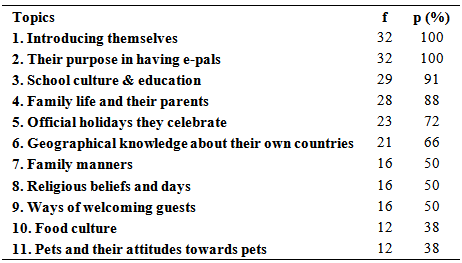
This research study aimed at exploring the answers to two essential research questions. The initial research question intended to investigate learners’ content of knowledge which they shared with their e-pals. Table 1 demonstrates the frequencies and percentages of each content they shared. This group of data were collected by means of an open-ended interview.
According Table 1, all learners introduced themselves and specified their target in having e-pals to each other (100%). Over 85% of them intended to share information about their school culture, education life, family life and their parents. In addition, nearly two-third of them mentioned their official holidays and geographical knowledge about their own countries. Furthermore, exactly half of them (50%) stated they emailed their family manners, religious beliefs, days and ways of welcoming guests. Besides this, food culture and pets comprised the least-mentioned topics by over one-third of learners.
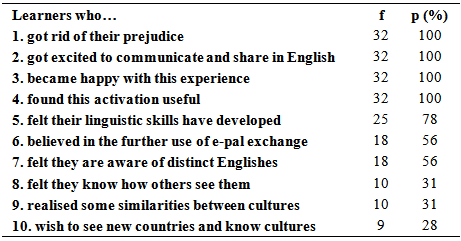
The second research question of this study targeted to explore learners’ beliefs, perceptions and feelings related to the cultural exchange via having e-pals. This category of data was collected by means of learners’ written reflections which encapsulated no guiding questions. Findings obtained with the help of these reflections are designated in Table 2.
According to findings in Table 2, exactly all learners got rid of their prejudice, had an exciting experience through communication in English, became happy and thought this was a useful experience. In addition to this, over 75% of learners perceived a development in their linguistic skills. Besides this, around half of them thought e-pal exchange would be avail in the future and became familiar with discrete versions of English. Furthermore, nearly one-third of learners realised some similarities between discrete cultures and wish to see new countries and cultures.
This research study aimed at constructing intercultural awareness on EFL learners at preparatory classes of a state university in Turkey. To this end, an experiment of two months by means of e-pal exchange was implemented and participants found the opportunity to communicate and interact with young adults from distinct countries. Two research questions for this study were reflected to learners. By means of these questions, it was targeted to explore learners’ both shared knowledge contents and feelings associated with e-pal experience.
Responses to the first research question revealed that learners had the chance to share their knowledge about various topics such as school, holidays, family, religion, education and pets, which designates similar findings as Fedderholdt (2001) specified. In addition to this, like Walker-Dalhouse’s 7 findings in his study, positive outcomes were obtained subsequent to this e-pal exchange phase. These positive outcomes could be identified as learners’ feeling well in terms of communicating in the target language, learning about distinct cultures and people, becoming aware of various forms of English and realising similarities between their own culture and their e-pal’s. Furthermore, as in McMillon’s 8 study, learners in this project reflected no negative experience or feelings.
In the light of the findings, it could be specified that applying e-pal exchange on learners could extend their consciousness on how to adapt their language whilst communicating through e-palling. Additionally, by means of this application, EFL learners could be able to modify their word knowledge and sentence forms to be more apprehensible by their e-pals. Furthermore, attaining further sense of self-efficacy through utilizing their target language efficiently and being comprehended by someone overseas could ameliorate foreign language learners in their attitude towards language learning. Besides these points, e-pal exchange may be avail for even solely reforming and updating learners’ writing performance in the target language. As a result, most of these linguistic, psychological and academic benefits of executing e-pal exchange could be observed on the participants of this research study.
With regard to future uses of e-pal exchange, further digital writing tools could be suggested. Additionally, teachers could apply this practice so as to ameliorate their learners’ writing performance in their foreign language. Furthermore, incorporating e-pal exchange into foreign language learning programmes at secondary education and universities could serve as a supplementary practice for foreign language learners. As an additional point, providing additional writing skill instruction by teachers could yield better results for learners in terms of their writing performance and sense of self-efficacy whilst generating e-pal exchange.
As a consequence, it could be specified that encouraging EFL learners to be active in e-pal communication could be avail for both their world knowledge and apprehension of English from diverse perspectives.
| [1] | Choi, J. and Nesi, H. (1998). An account of a pilot key pal project for Korean children. English Language Teacher Education and Development (ELTED), 4/1: 21-45. | ||
| In article | |||
| [2] | DeSilver, D. (2013). Jewish essentials: For most American Jews, ancestry and culture matter more than religion. | ||
| In article | |||
| [3] | Dimitrov, N., & Haque, A. (2016). Intercultural teaching competence: a multi-disciplinary model for instructor reflection. Intercultural Education, 27(5), 437-456. | ||
| In article | View Article | ||
| [4] | Smith, J. L., Lombardi, M., Asmi, R., Hinrichs, M., Robertson, K., & Buck, L. (2017). Raising Cultural Awareness in Undergraduate Students through an Online Pen Pal Program. | ||
| In article | |||
| [5] | Nozawa, K. (2002). Keypal Exchanges for. The Changing Face of CALL, 2, 187. | ||
| In article | |||
| [6] | Fedderholdt, K. (2001). An email exchange project between non-native speakers of English. ELT journal, 55(3), 273-280. | ||
| In article | View Article | ||
| [7] | Walker-Dalhouse, D., Sanders, V., & Dalhouse, A. D. (2009). A university and middle-school partnership: Preservice teachers' attitudes toward ELL students. Literacy Research and Instruction, 48(4), 337-349. | ||
| In article | View Article | ||
| [8] | Thompson McMillon, G. M. (2009). Pen pals without borders: A cultural exchange of teaching and learning. Education and urban society, 42(1), 119-135. | ||
| In article | View Article | ||
| [9] | Dörnyei, Z. (2001). New themes and approaches in second language motivation research. Annual review of applied linguistics, 21, 43-59. | ||
| In article | View Article | ||
Published with license by Science and Education Publishing, Copyright © 2025 Sezen Balaban Şahin
 This work is licensed under a Creative Commons Attribution 4.0 International License. To view a copy of this license, visit
http://creativecommons.org/licenses/by/4.0/
This work is licensed under a Creative Commons Attribution 4.0 International License. To view a copy of this license, visit
http://creativecommons.org/licenses/by/4.0/
| [1] | Choi, J. and Nesi, H. (1998). An account of a pilot key pal project for Korean children. English Language Teacher Education and Development (ELTED), 4/1: 21-45. | ||
| In article | |||
| [2] | DeSilver, D. (2013). Jewish essentials: For most American Jews, ancestry and culture matter more than religion. | ||
| In article | |||
| [3] | Dimitrov, N., & Haque, A. (2016). Intercultural teaching competence: a multi-disciplinary model for instructor reflection. Intercultural Education, 27(5), 437-456. | ||
| In article | View Article | ||
| [4] | Smith, J. L., Lombardi, M., Asmi, R., Hinrichs, M., Robertson, K., & Buck, L. (2017). Raising Cultural Awareness in Undergraduate Students through an Online Pen Pal Program. | ||
| In article | |||
| [5] | Nozawa, K. (2002). Keypal Exchanges for. The Changing Face of CALL, 2, 187. | ||
| In article | |||
| [6] | Fedderholdt, K. (2001). An email exchange project between non-native speakers of English. ELT journal, 55(3), 273-280. | ||
| In article | View Article | ||
| [7] | Walker-Dalhouse, D., Sanders, V., & Dalhouse, A. D. (2009). A university and middle-school partnership: Preservice teachers' attitudes toward ELL students. Literacy Research and Instruction, 48(4), 337-349. | ||
| In article | View Article | ||
| [8] | Thompson McMillon, G. M. (2009). Pen pals without borders: A cultural exchange of teaching and learning. Education and urban society, 42(1), 119-135. | ||
| In article | View Article | ||
| [9] | Dörnyei, Z. (2001). New themes and approaches in second language motivation research. Annual review of applied linguistics, 21, 43-59. | ||
| In article | View Article | ||