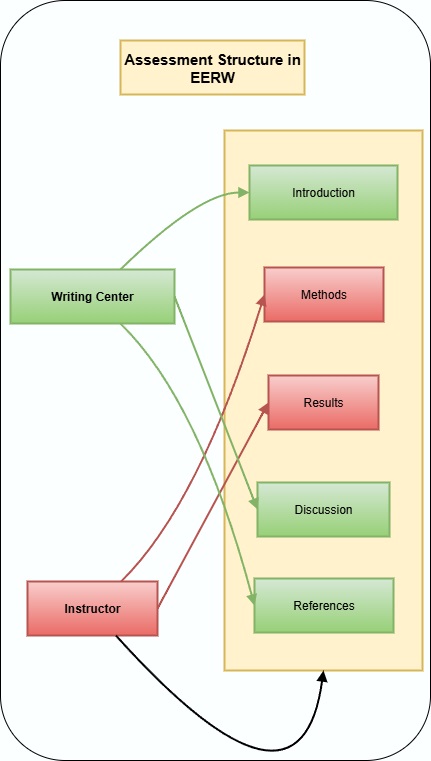
With the high demand for data-driven knowledge, students today need to comprehend skills in problem-solving, critical thinking, communication, and collaboration. However, in traditional statistics lectures, students learn descriptive algorithms, hypothesis, and linear regression at their early stage of college. Unfortunately, they often analyze numbers without considering the context, purpose, audience, and the meaning of the numbers. Therefore, providing students the early opportunity to research and write with data in college will allow them to deepen their understanding of the subjects, to think critically about the data and the results, to communicate effectively with diverse audience, and to prepare for their future research. In this article, I propose and demonstrate a novel “Early Entering Research and Writing (EERW)” scheme in introductory college-level statistics. Not only does EERW scheme help students understand and apply statistics to solve real-world problems and communicate effectively, but also lessens the burden of instructor’s assessment task.
College students typically learn descriptive algorithms, confidence intervals, hypothesis tests, and linear regression in their first statistics course. Unfortunately, they often analyze numbers without considering the context, purpose, audience, and the meaning of the numbers. With the high demand for data-driven knowledge, students today need to comprehend skills in problem-solving, critical thinking, communication, and collaboration 1, 2. Several studies 3, 4, 5 have shown that undergraduate research has a high impact in higher education. References 6, 7, 8 assert that developing writing skills supports mathematical reasoning and problem solving while helping students internalize the characteristics of effective communication. Reference 9 highlights the benefits of incorporating writing in quantitative courses, including enhanced problem-solving skills and a deeper understanding of data interpretation. Providing students the early opportunity to research and write with data in college will allow them to deepen their understanding of the subjects, to think critical about the data and the results, to communicate effectively with diverse audience, and to prepare for their future research 1, 10, 11.
Class projects and writing assignments are not new applications in Statistics. Reference 12 designed six mini projects for their students to complete throughout the semester. Reference 13 required students to write a journal that supplemented their class notes. They also asked their students to provide written answers to questions posed at the beginning or end of class. According to reference 14, minute papers or brief written assessments are effective tools for assessing student learning. However, there has been little reference on the incorporation of a semester-long research project or writing research paper throughout an introductory statistics course.
In this article, I propose and demonstrate a novel “Early Entering Research and Writing (EERW)” scheme in introductory college-level statistics teaching. In this new scheme, students design and conduct their research using the statistics concepts and methods that they learn from each class. They also learn the skills necessary to write a research paper, such as how to state the importance of their research, how to conduct literature reviews, how to describe the methods they use, and how to report their results. By the end of the semester, they need to submit their research paper for assessment, which includes Introduction, Methods, Results, Discussion, and Reference sections. Through the whole semester, students will develop and advance their skills in problem-solving, critical thinking, communication, and collaboration. Another feature of the proposed EERW scheme is that the instructor will not get the burden of extra writing training and grading because the Writing Center on campus provides the service and assistance to students.
The ultimate objective of the EERW scheme is to develop student’s skills in statistics in alignment with the demands of modern society. This article will focus on the strategies of the EERW scheme I have tried in my introductory statistics courses.
Writing a statistics research paper is challenging, especially for those who have little writing skills 13. In order to provide students with professional writing training, I invite the Writing Center to be a partner in my EERW class. The Writing Center is a free, easy-to-use resource available for all of our students, faculty, staff, and alumni. It provides in-person, zoom, and asynchronous appointments.
As part of the EERW framework, the Writing Center plays a central role in supporting students’ academic writing development. A faculty from the Writing Center will visit the class and provide students a targeted writing training. This training will cover:
• Understanding and applying APA (American Psychological Association) format
• Correctly citing primary sources
• Structuring and developing the Introduction section
• Writing a deeper and more analytical Discussion section
In this training, students will gain practical knowledge of what a research paper should look like and how to approach it effectively. The Writing Center’s involvement ensures that students not only strengthen their writing skills but also develop confidence in producing discipline-appropriate scholarly work.
Through the whole semester, students make several appointments with Writing Center consultants to strengthen their research writing. They will have their APA formatting and citation style checked, receive feedback on the clarity and structure of their Introduction and Discussion sections, and access individualized guidance on additional writing challenges as needed. Before each Writing Center visit, I set a clear goal for the session and provide students with a rubric sheet aligned with course expectations. Students are required to bring both their writing draft and the rubric when meeting with a Writing Center consultant. The consultant will then evaluate the student’s work based on the rubric. For example, after completing the Introduction section, students will take their draft and the specifically designed rubric (Appendix) to the Writing Center, where consultants will offer targeted feedback. This process is repeated for other key sections of the research paper. Within the EERW scheme, the Writing Center plays an active role in assessing students’ writing in the Introduction, Discussion, and References sections. This sustained collaboration with the Writing Center ensures that students not only refine specific sections of their papers but also develop stronger overall writing habits and skills.
2.2. EERW in ClassroomIn the first class, I clearly explain the syllabus and the EERW scheme. It is essential and important that every student understand the requirements and expectations of this course. To guide students in connecting course content with research and writing, I divide the whole semester into five stages (Table 1). At each stage, I will demonstrate how statistics contents and course materials are incorporated into the process of developing a research paper.
From the second class, I start to introduce data structure, variables, parameter and statistic, and prescriptive statistics, which are the required course contents in an Introductory Statistics course. In the meantime, students are provided with a real-world dataset with 253 observations and 27 variables. They will use this dataset to practice the statistics concepts learned in class, such as determining the sample size, identifying the type of each variable, calculating the corresponding descriptive statistics, etc.
Through the exploration of the data structure, students select variables of interest from the dataset and frame researchable questions. I encourage them to choose two variables and investigate the relationship. Some students with stronger backgrounds can select three variables and look into their relationship. In this way, students with little statistics training will not be scared and students with better foundation will not get bored. Due to the size of the class, I also encourage them to find one or two research partners, which helps lessen the grading burden and enhances students’ collaboration skills. Once students decide their research topic, they can start the literature review and work with the Writing Center on their writing training. By the end of this stage, students are expected to complete their Introduction sections, with feedback from the Writing Center to guide revisions.
Following the course contents, I teach univariate visualizations, such as histogram, boxplot, frequency table, bar chart, and pie chart, as well as bivariate visualizations, such as scatter plot, side-by-side boxplot, and contingency table. In the class workshop or practice, students pick any categorical variable(s) and/or numerical variable(s) to generate each visualization. Then they will create appropriate figures for their own variables in their research. Besides creating visualizations, they will explain what each figure or table reveals in the context of their research. For example, when creating a bar chart of anxiety status, they should explain the frequency of each category, identify any trends, and describe the ranking of the categories. After generating a scatter plot, they should examine the pattern of the data, note any outliers, and discuss potential correlations between the two numerical variables.
Based on their research question, students will complete the visualization component as part of their Methods and Results sections of the paper. In this state, students will learn how to use visualizations and numbers to tell a compelling and evidence-based story. By designing and interpreting graphs, tables, and figures, students not only strengthen their technical skills but also practice communicating complex data in clear and meaningful ways. This process fosters their creative thinking and deepens their conceptual understanding of statistics.
In Stage 3, I start by introducing sampling distributions, confidence intervals, hypothesis testing framework, single mean test, single proportion test, mean comparison, proportion comparison, chi-square tests, ANOVA, and linear regression. All in-class examples and practice exercises are drawn directly from the variables in each student’s research dataset. By grounding lessons in their own data, students see immediate applications of statistical concepts and writing strategies. This approach makes abstract ideas more concrete, increases engagement, and helps students connect course content to their ongoing research and writing projects.
Since most students investigate the relationship of their chosen variables, they are required to identify and apply an appropriate statistical test. Students will learn how to justify their choice of test, run the analysis, and interpret the results in the context of their research question. This process not only strengthens their understanding of statistical methods but also develops critical thinking skills as they evaluate which techniques best fit their data and research design.
This is the most challenging stage for students. Many of them initially feel uncertain about which statistical test to use or how to interpret the results. To address this, I always ask them to explain what they are testing and why they selected a particular hypothesis test. It helps them think through the rationale behind their choice rather than simply applying procedures. Then, I guide them to identify the p-value and interpret what this p-value indicates. In the meantime, I strongly encourage peer assistance, in which students support and learn from one another by comparing approaches and discussing interpretations. This collaborative environment keeps the class highly engaged and promotes shared problem-solving. By the end of Stage 3, students are expected to complete the Methods and Results sections of their research paper.
With results in hand, students transition to interpreting what their findings indicate. Students will have multiple classes to practice how to interpret their results. I emphasize the difference between simply reporting numbers and telling a meaningful story with data. Students learn how to connect results to prior literature, discuss limitations, and propose directions for future research, strengthening both their analytical and scientific communication skills. Writing Center consultants play an important role in this stage by providing feedback on the depth and clarity of students’ Discussion sections. By the end of this stage, students are expected to complete a draft of the Discussion section.
In the final stage, students bring together all sections of their research paper—Introduction, Methods, Results, and Discussion—into a coherent whole. They follow APA formatting, finalize references, and ensure consistency and flow across sections. In addition to the written paper, each student group gives a 5-minute speed oral presentation in class. This presentation allows students to practice concise scientific communication and actively engage with their peers’ work. By the end of Stage 5, students submit their final research paper and present their group findings, which demonstrates not only their mastery of statistical analysis but also their growth as academic researchers.
2.3. Outside of ClassroomIn the spirit of problem based learning, students are not assigned large amounts of traditional textbook homework. Instead, their out-of-class work is devoted to research-related reading and writing. Students are expected to meet outside of class, individually and in groups, to read scholarly sources, draft sections of their research paper, and revise their writing based on feedback from peers, the instructor, and Writing Center consultants. This shift ensures that students spend their time applying course concepts directly to real-life research and writing tasks, rather than completing repetitive problem sets.
2.4. Assessment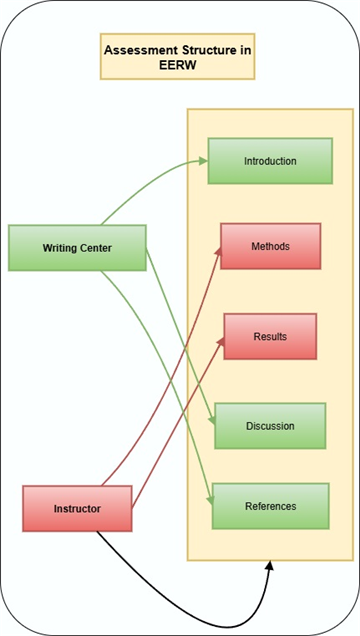
Statistics educators have long recognized the value of writing as a tool for assessment and deeper learning, and the statistics education community strongly encourages its use 15, 16, 17. However, despite its benefits, grading student writing often places a heavy burden on instructors, particularly in large introductory courses.
In the EERW scheme, the Writing Center helps address this challenge by providing structured feedback on key sections of students’ research papers, including the Introduction, Discussion, and References (Figure 1). Students bring their drafts and rubrics to Writing Center consultants, who evaluate the work, provide feedback, and guide revisions. As an instructor, I assess student’s Methods and Results sections and evaluate the logic and flow of the whole paper at the end.
This approach not only ensures consistent, high-quality comments for students but also significantly reduces the grading burden on the instructor, allowing more time for instruction and individualized support.
Several research articles have shown that improving student’s writing skills improves their learning capacity 18, 19, 20. In this article, I propose a novel “Early Entering Research and Writing (EERW)” scheme in introductory college statistics courses. The ultimate objective of the EERW scheme is to develop student’s skills in statistics in alignment with the demands of modern society. This article focuses on the strategies of the EERW scheme as implemented in my introductory statistics courses. The EERW scheme not only helps students understand and apply statistics to solve real-world problems and communicate effectively but also reduces the instructor’s assessment workload by collaborating with other on-campus resources, such as the Writing Center.
Based on the benefits of the EERW scheme, I aim to share it with other higher education instructors. I hope these strategies will stimulate conversations among stakeholders—librarians, educators, and administrators—as enrollment in introductory statistics courses at colleges and universities continues to increase each year. When implemented meaningfully, the EERW scheme can help instructors introduce freshmen to scholarly research across disciplines by providing hands-on experience, fostering critical thinking, and clarifying potential career paths.
Thank you to Dr. Meredith Steck from Writing Center at John Carroll University for her support.
The authors have no competing interests
| [1] | Thornhill-Miller B, Camarda A, Mercier M, Burkhardt JM, Morisseau T, Bourgeois-Bougrine S, Vinchon F, El Hayek S, Augereau-Landais M, Mourey F, Feybesse C, Sundquist D, Lubart T. “Creativity, Critical Thinking, Communication, and Collaboration: Assessment, Certification, and Promotion of 21st Century Skills for the Future of Work and Education,” J Intell. 11(3): 54, March 2023. | ||
| In article | View Article PubMed | ||
| [2] | Cummins, Phyllis A., Yamashita Takashi, Millar Roberto J., and Sahoo Shalini. “Problem‐Solving Skills of the U.S. Workforce and Preparedness for Job Automation,” Adult Learning 30(3): 111-120. 2019. | ||
| In article | View Article | ||
| [3] | Chase L, McMurray M, Stavnezer AJ, Buffalari D, Fernandes JJ, Lom B, Morrison ME. “Integrating Research into the Undergraduate Curriculum: 3. Research Training in the Upper-level Neuroscience Curriculum,” J Undergrad Neurosci Educ. 19(1): A75-A88. Dec 2020. | ||
| In article | |||
| [4] | Dolan E. “Course-based undergraduate research experiences: Current knowledge and future directions,” Committee on Strengthening Research Experiences for Undergraduate STEM Students. National Science Foundation. 2016. | ||
| In article | |||
| [5] | White, D. “A Project-Based Approach to Statistics and Data Science,” PRIMUS, 29(9), 997-1038. 2019. | ||
| In article | View Article | ||
| [6] | Pugalee, D. K. “Writing to develop mathematical understanding,” Norwood, MA: Christopher-Gordon, 2005. | ||
| In article | |||
| [7] | Teledahl, A., Kilhamn, C., Ahl, L.M. et al. “Defining and measuring quality in students’ mathematical writing: a systematic literature review,” Math Ed Res J. 37, 557-576. 2025. | ||
| In article | View Article | ||
| [8] | Aljura, A, Retnawati, H, Dewanti, S, Kassymova, G, Sotlikova, R, & Septiana, A. “Mathematical reasoning and communication word problems with mathematical problem-solving orientation: A relation between the skills,” Journal on Mathematics Education. 16. 529-558. 2025. 10.22342/jme.v16i2.pp529-558. | ||
| In article | View Article | ||
| [9] | Shibli, A. “Increasing Learning with Writing in Quantitative and Computer Courses,” College Teaching, 40, 123-127. 1992. | ||
| In article | View Article | ||
| [10] | Holmes, K. “Tips for Incorporating Writing Into An Introductory Statistics Course,” Association for Psychological Science. December 28, 2011. | ||
| In article | |||
| [11] | Woodard, V., Lee, H., & Woodard, R. “Writing Assignments to Assess Statistical Thinking,” Journal of Statistics Education, 28(1), 32-44. 2020. | ||
| In article | View Article | ||
| [12] | Holcomb, J. P., and Ruffer, R. L. “Using a Term-long Project Seq-uence in Introductory Statistics,” The American Statistician, 54, 49-53. 2000. | ||
| In article | View Article | ||
| [13] | Stromberg, A. J., & Ramanathan, S. “Easy Implementation of Writing in Introductory Statistics Courses,” The American Statistician, 50(2), 159-163. 1996. | ||
| In article | View Article | ||
| [14] | Zahn, D. A. “Notes on the Use of Minute Papers in Teaching Statistics Courses,” American Statistical Association Proceedings of the Section on Statistics Education, 62-71, 1992. | ||
| In article | |||
| [15] | Jolliffe, F. “The Changing Brave New World of Statistics Assessment,” IASE/ISI. 2007. | ||
| In article | |||
| [16] | American Statistical Association, “Guidelines for Assessment and Instruction in Statistics Education (GAISE) College Report,” Alexandria: American Statistical Association. 2016. | ||
| In article | |||
| [17] | Woodard, V, Lee, H, & Woodard, R. “Writing Assignments to Assess Statistical Thinking,” Journal of Statistics Education. 28. 1-23. 2019. 10.1080/10691898.2019.1696257. | ||
| In article | View Article | ||
| [18] | Reynolds, J. A., Thaiss, C., Katkin, W., & Thompson, R. J., Jr. “Writing-to-learn in undergraduate science education: a community-based, conceptually driven approach,” CBE life sciences education, 11(1), 17-25. 2012. | ||
| In article | View Article PubMed | ||
| [19] | Kayaalp, F., Meral, E., & Başcı Namlı, Z. “An analysis of the effect of writing-to-learn activities on students' academic achievement and self-regulation skills,” Participatory Educational Research, 9(1), 324-348. 2022. | ||
| In article | View Article | ||
| [20] | DeLuca, L. S. “Developing students' statistical expertise through writing-to-learn activities,” Journal of Statistics Education, 33(1), 1-13. 2025. | ||
| In article | View Article | ||
Published with license by Science and Education Publishing, Copyright © 2025 Shurong Fang
 This work is licensed under a Creative Commons Attribution 4.0 International License. To view a copy of this license, visit
http://creativecommons.org/licenses/by/4.0/
This work is licensed under a Creative Commons Attribution 4.0 International License. To view a copy of this license, visit
http://creativecommons.org/licenses/by/4.0/
| [1] | Thornhill-Miller B, Camarda A, Mercier M, Burkhardt JM, Morisseau T, Bourgeois-Bougrine S, Vinchon F, El Hayek S, Augereau-Landais M, Mourey F, Feybesse C, Sundquist D, Lubart T. “Creativity, Critical Thinking, Communication, and Collaboration: Assessment, Certification, and Promotion of 21st Century Skills for the Future of Work and Education,” J Intell. 11(3): 54, March 2023. | ||
| In article | View Article PubMed | ||
| [2] | Cummins, Phyllis A., Yamashita Takashi, Millar Roberto J., and Sahoo Shalini. “Problem‐Solving Skills of the U.S. Workforce and Preparedness for Job Automation,” Adult Learning 30(3): 111-120. 2019. | ||
| In article | View Article | ||
| [3] | Chase L, McMurray M, Stavnezer AJ, Buffalari D, Fernandes JJ, Lom B, Morrison ME. “Integrating Research into the Undergraduate Curriculum: 3. Research Training in the Upper-level Neuroscience Curriculum,” J Undergrad Neurosci Educ. 19(1): A75-A88. Dec 2020. | ||
| In article | |||
| [4] | Dolan E. “Course-based undergraduate research experiences: Current knowledge and future directions,” Committee on Strengthening Research Experiences for Undergraduate STEM Students. National Science Foundation. 2016. | ||
| In article | |||
| [5] | White, D. “A Project-Based Approach to Statistics and Data Science,” PRIMUS, 29(9), 997-1038. 2019. | ||
| In article | View Article | ||
| [6] | Pugalee, D. K. “Writing to develop mathematical understanding,” Norwood, MA: Christopher-Gordon, 2005. | ||
| In article | |||
| [7] | Teledahl, A., Kilhamn, C., Ahl, L.M. et al. “Defining and measuring quality in students’ mathematical writing: a systematic literature review,” Math Ed Res J. 37, 557-576. 2025. | ||
| In article | View Article | ||
| [8] | Aljura, A, Retnawati, H, Dewanti, S, Kassymova, G, Sotlikova, R, & Septiana, A. “Mathematical reasoning and communication word problems with mathematical problem-solving orientation: A relation between the skills,” Journal on Mathematics Education. 16. 529-558. 2025. 10.22342/jme.v16i2.pp529-558. | ||
| In article | View Article | ||
| [9] | Shibli, A. “Increasing Learning with Writing in Quantitative and Computer Courses,” College Teaching, 40, 123-127. 1992. | ||
| In article | View Article | ||
| [10] | Holmes, K. “Tips for Incorporating Writing Into An Introductory Statistics Course,” Association for Psychological Science. December 28, 2011. | ||
| In article | |||
| [11] | Woodard, V., Lee, H., & Woodard, R. “Writing Assignments to Assess Statistical Thinking,” Journal of Statistics Education, 28(1), 32-44. 2020. | ||
| In article | View Article | ||
| [12] | Holcomb, J. P., and Ruffer, R. L. “Using a Term-long Project Seq-uence in Introductory Statistics,” The American Statistician, 54, 49-53. 2000. | ||
| In article | View Article | ||
| [13] | Stromberg, A. J., & Ramanathan, S. “Easy Implementation of Writing in Introductory Statistics Courses,” The American Statistician, 50(2), 159-163. 1996. | ||
| In article | View Article | ||
| [14] | Zahn, D. A. “Notes on the Use of Minute Papers in Teaching Statistics Courses,” American Statistical Association Proceedings of the Section on Statistics Education, 62-71, 1992. | ||
| In article | |||
| [15] | Jolliffe, F. “The Changing Brave New World of Statistics Assessment,” IASE/ISI. 2007. | ||
| In article | |||
| [16] | American Statistical Association, “Guidelines for Assessment and Instruction in Statistics Education (GAISE) College Report,” Alexandria: American Statistical Association. 2016. | ||
| In article | |||
| [17] | Woodard, V, Lee, H, & Woodard, R. “Writing Assignments to Assess Statistical Thinking,” Journal of Statistics Education. 28. 1-23. 2019. 10.1080/10691898.2019.1696257. | ||
| In article | View Article | ||
| [18] | Reynolds, J. A., Thaiss, C., Katkin, W., & Thompson, R. J., Jr. “Writing-to-learn in undergraduate science education: a community-based, conceptually driven approach,” CBE life sciences education, 11(1), 17-25. 2012. | ||
| In article | View Article PubMed | ||
| [19] | Kayaalp, F., Meral, E., & Başcı Namlı, Z. “An analysis of the effect of writing-to-learn activities on students' academic achievement and self-regulation skills,” Participatory Educational Research, 9(1), 324-348. 2022. | ||
| In article | View Article | ||
| [20] | DeLuca, L. S. “Developing students' statistical expertise through writing-to-learn activities,” Journal of Statistics Education, 33(1), 1-13. 2025. | ||
| In article | View Article | ||