This article attempted to know the perception of Postgraduate students and teachers on MOODLE Learning Management System. The study finds out the relationship between the perception of students and teachers on MOODLE Learning Management System. The study also identified some advantages and pitfalls of MOODLE Learning Management System as perceived by students and teachers. The Descriptive research method was used in this study. All the Postgraduate students and teachers of Kazi Nazrul University comprised the population of the study. A total of 190 Postgraduate Students (62 Male and 128 Female) and 25 teachers of Kazi Nazrul University in Paschim Bardhaman district were taken as a representative sample of the whole population. Simple Random Sampling technique was adopted for selecting students and teachers. Perception scales were used for collecting the data from students and teachers separately. Data were analysed with relevant statistics. It was revealed that the level of perception of Postgraduate students and teachers on MOODLE Learning Management System is moderate. The study exposed that the perception of Postgraduate students on MOODLE Learning Management System in relation to their Locale, User type, and Stream differs significantly. Whereas the perception of teachers on MOODLE Learning Management System in relation to their User type (User & Non-User) differs significantly. It is also found that there is no significant relation between the perception of students and teachers on MOODLE Learning Management System. The pandemic due to the COVID-19 virus is a boon on the one hand; on the other hand, it is the bane. The students and teachers can learn from the crisis state, and any kind of system can upgrade its features to align with the contemporary condition. MOODLE learning management system can cast a great opportunity for distance learning and had a pivotal role during COVID-19.
Education is a lifelong process through which every individual acquires knowledge, attitudes, values and skills. This is one of our basic needs in life. Quality education is much needed for the bright future of any individual in modern society. Education develops the four H, i.e., Head, Heart, Hand and Health, which enable us to be self-dependent and unlock our potential 1. Now in the 21st century, we can learn in two ways- through Regular Education and Online Education. Regular Education is a learning mode where educators teach various subjects in formal educational institutions. Online Education is based on science and technology, and it is characterised by the creation and multiplication of PC, the globalisation of thoughts and human acts and the utilisation of scientific innovation, giving admittance to more individuals.
The Fifth Industrial Revolution, or Industry 5.0, is a new and developing stage of industrialization in which humans collaborate with cutting-edge technology and robots with artificial intelligence to improve workplace procedures. Human centricity, sustainability, and resilience are Industry 5.0's three main tenets. Nowadays, it is quite impossible to educate an individual without the help of Information and Communication Technologies (ICTs). ICTs refer to a set of technological tools which are often used to create, store and share various data or knowledge. Various ICTs tools or software are used in online learning, such as MOODLE, Google Classroom, Edmodo, Blackboard, Schoology etc. A Learning Management System (LMS) is software which is used for direct learning and preparation of different courses for students. Normally, an LMS is a cloud-based framework that permits students to validate themselves, register for the course, total the course, and afterwards take appraisals for learning results 2.
MOODLE stands for Modular-Object-Oriented-Dynamic-Learning-Environment. It is one of those fascinating technologies that can be used in online learning. Martin Dougiamas created it in 2016. MOODLE is a web-based program that uses computer hardware to facilitate online learning management systems. With the aid of a browser, we can complete every learning activity connected to content access, discussion, question and answer, and evaluation through the website display. Access to Moodle is unrestricted 3. MOODLE LMS is an open-source learning management system with inherent privacy and security features used by hundreds of millions of learners around the world. MOODLE LMS enables educators to create and share learning materials in a flexible, safe, and accessible way around the world. Teachers can also evaluate the performance of hundreds and thousands of students by giving them grades or personal information or by assessing their academic performance.
In this changeable world, advancement has been occurring in the technological field for 10- 15 years, which makes our life simpler. Technology-based Education helps improve the quality of life. It has special relevance in teaching and is supported by the Learning Management System (LMS). A good learning media is that which can improve students' motivation, achievement and overall learning outcome. These are taking advantage of emerging digital space. It has been seen in various journals that education, as well as students' learning outcomes, can be improved by using MOODLE. Not only students, teachers also should use internet-based media with MOODLE approach to support the teaching-learning process so that students' learning outcomes and quality of education, in general, can be improved. MOODLE is the opportunity to transform the traditional boring model of university education into a unique and proactive approach for further modernisation of education.
If the study is done at the primary or secondary level, then the investigators would never get the correct information because the primary and secondary level students’ study and concentrate on all the matter at the memory level. The investigators have chosen the university level for their study because it is an LMS that is used exclusively for Higher Education, and here most of the students observe their study and other matter at their understanding level.
The first lockdown in India was proclaimed on 22 March 2020. All the educational institutions, including schools, colleges and universities, remained closed for months. Various educational institutions started using LMS as a platform for education to cope with the situation. At present, MOODLE is the most popular LMS than any other LMS.
It is apparent from the preceding discussion that good knowledge and understanding of MOODLE Learning Management System are required in the teaching and learning process. Students and teachers must become familiar with this LMS in order to have a successful teaching-learning process. MOODLE has the potential to be a game changer in the world of Education. As a result, it is important for us to understand its benefits and drawbacks. As post-graduation or Higher Education is an important element of India's current education system, LMS, particularly MOODLE, needs special attention. Many questions regarding the perceptions of students and teachers at higher educational levels are appearing in the thoughts of researchers. Knowing and using MOODLE in the teaching-learning process is a critical and delicate subject. In order to know about students' and teachers' perceptions of MOODLE's usage in the teaching-learning process, the investigators chose to conduct a systematic and objective study. The researchers sought to limit their research to the district of Paschim Bardhaman of West Bengal.
Chourishi et al. 4 found that MOODLE helps to make teaching more effective, and the accessibility, usability and student collaborative learning can be improved, and higher motivation among the students and the teachers can be achieved with E-learning. Costa et al. 5 showed that, despite the great potential of MOODLE, it is mainly used as a repository of materials. However, students recognise the importance of using other features of the platform to promote the success of the teaching-learning process. Their study "Comparison of Students' Perception of MOODLE in a Taiwan University against Students in A Portuguese University" revealed that MOODLE is a suitable tool for universities performing blended learning. Moreover, a comparison with UM Portugal has shown that the "communication" mechanism in teaching is the major difference. This difference is due to both schools' culture and student background. Both schools have a significant difference in their usage of the online platform when it comes to blended learning 6. Zakaria and Daud 7 found that students have a positive view of the use of MOODLE. MOODLE will benefit teachers and students accordingly if it is used fully and systematically. Boopathiraj and Chellamani 8 clarified and discussed the first experience and satisfaction of graduate students using the MOODLE Learning Management System (LMS) in the online "Educational Research Methods" course. This study used research methods, open questionnaires and scoring scales. In this study, the researcher found that PG students are very supportive and interested in learning through the provided electronic platform. Expanding the electronic platform for all other courses in the teacher's training program is also recommended. Goyal and Tambe 9 analysed the experience of using MOODLE and the benefits and obstacles of using it. Results revealed that students could easily adapt to the online teaching mode of these two courses (biotechnology management and pharmaceutical management). Xu and Mahenthiran 10 found that students' overall satisfaction with online learning is significantly affected by how the course is organised and the sequence of content, the difficulty of students completing homework, and the use of LMS and content interaction. Parmeswar et al. 11 studied the factors that affect the familiarity with the MOODLE e-learning platform among students at the Open University of Mauritius. Factors such as gender, computer and media literacy, the quality of university support and the perception of mobile learning were found to have a significant impact on the use of knowledge in the digital environment. On the other hand, it was found that age, gender, occupation and community service did not have a significant impact. Saleem et al. 12 showed the emergence of two groups of teachers: one group using MOODLE and the other group not using MOODLE. Between the groups that use MOODLE- performance expectations, effort expectations, social influence, convenience conditions, and behaviour intentions are positively correlated, which affects teachers' user behaviour. Sarfo and Yidana 13 found that Blended learning systems appear to be effective and efficient in development (Ghanaian background). However, the development of users (scholars) presents a series of challenges that must be solved in order to fully realise its potential to promote skill development in the 21st century. Zainuddin et al. 14 analysed the main functionalities and tools available on the MOODLE platform and their use at University Sains Islam Malaysia. The results show that despite its great potential, MOODLE is primarily used as a repository of materials. In addition, the speakers recognised the importance of using other functions of the platform to promote the success of the teaching and learning process. Gunduz and Ozcan 15 examined students' perception of using the MOODLE system in secondary school in English as a foreign language. The results show that students generally believe that they are well-suited to the MOODLE system. Teachers believe that the system is modern and beneficial in the long run, but it does not work well during the research. Sari et al. 16 find out whether using the MOODLE method as a learning medium can improve the quality of Education. Based on the result of analyses of the journals about learning media using MOODLE, it can be concluded that MOODLE could improve the quality of Education. Verma et al. 17 improve the quality of student learning and provide feasible solutions for their different problems. Findings of the study: Their experiments are very useful for classifying student questions and detecting other interesting patterns related to MOODLE data sources. Okesene 18 evaluated the use of MOODLE for, interactions and their impact on student “confidence”, “motivation” and “performance”. The results show that in the context of this research, using MOODLE to promote online interaction improves student-to-student and student-content interaction. Singh and Gokool 19 explored students' views and experiences on integrating and implementing the assessments. The results of this study affirmed many benefits of the evaluation method. However, it is recommended to make additional improvements to the isiZulu experimental test design. Thamrin et al. 20 examined whether using Moodle to encourage independent study among students in grammar classes. Their view of studying grammar can be used to emphasise the outcome of their motivation. Maphosa et al. 21 evaluated factors that influence the usage of LMS for effective teaching and learning activities in a rural institution. Results showed that perceived usefulness and simplicity were positive, affecting students' attitudes toward using the LMS. The findings support the notion that a strong network and ongoing bandwidth upgrades are necessary for the effective adoption of an LMS, as the majority of students believed that Moodle usage was negatively impacted by network failure. Zharova et al. 22 indicated by a correlation analysis of the variables influencing the audience of LMS Mobile consumers' happiness. The essay analyses the issues with using LMS Moodle that developed before the COVID-19 outbreak and offered some recommendations for enhancing the platform. Ahmad and Subekti 23 analysed Mathematics Teachers' perception of the use of Moodle based learning management system in teaching mathematics during the time of COVID-19. The mixed methods research design was used. The result revealed that more than 40% of teachers agree that Moodle facilities are very good, and more than 60% of teachers opined that using Moodle positively impacts mathematics learning. It is also found that more than 30% of teachers disagree that they are prepared to use Moodle, indicating that teachers also have a negative opinion of the readiness of the resources. Truong 24 aimed to set light on the students 'attitude toward the implementation of Moodle-based LMS in teaching and learning speaking skills at Van Lang University. The results showed that the majority of participants thought that additional LMS practices were helpful for improving their speaking skills, particularly their grammatical competence, which includes grammar, vocabulary, and pronunciation. Ahmed 25 explored the innovative use of ICT in teaching and learning, accessibility, and quality of education, as well as learners' academic performance during the COVID-19 lockdown. Study highlighted that the adoption of ICT tools significantly enhanced both the accessibility and quality of education during that period. Gamage et al. 26 aimed to summarise this research to assist three sets of stakeholders—educators, researchers, and software developers. It showed that Moodle effectively boosts student performance and engagement and is primarily employed in university STEM subjects. Moodle is being utilised increasingly as a platform for collaborative and adaptive learning and to enhance online assessments. The use of Moodle is evolving quickly to solve security, morality, and academic integrity challenges while incorporating artificial intelligence to improve speed and navigation. Ghina et al. 3 determined students' perceptions and attitudes towards the use of MOODLE as a learning tool in English teaching-learning. The results show that students tend to have a positive view of using MOODLE as a learning tool. This tendency also leads to the results of the investigation of students' attitudes. Students show a sense of liking towards MOODLE. This positive attitude increased as their familiarity with the MOODLE app and ability to organise their learning increased. Al-Fraihat et al. 27 explored the experiences and comments of students using Moodle to improve its design and layout and make it more in line with the modern-day educational requirements. The views of 103 university students were gathered through an open-ended questionnaire. The qualitative data analysis found seven broad themes upon the factors contributing to the success of the Moodle learning management systems. The results showed that having usability problems, i.e., system functionality and quality content design, were the main obstacle to the student experiences. The positive factors, i.e., general satisfaction and perceived usefulness, were the strengths of Moodle. The researchers indicated implications of these results on educators, system administrators and policymakers as well as indicated limitations and recommendations of future research.
The researchers discovered that there had been numerous studies conducted abroad on MOODLE in a variety of areas after analysing earlier studies. Indian researchers also conduct a few studies. However, there was no research done on how students and teachers saw MOODLE in the teaching and learning process in India, specifically in West Bengal at the higher education level, which is a crucial step in enhancing the online education system. The investigators were, therefore, very interested in how students and teachers saw MOODLE as part of the teaching and learning process.
The following were the objectives of this study:
1. To find out the level of perception of Postgraduate students and teachers of Kazi Nazrul University in Paschim Bardhaman district of West Bengal on MOODLE Learning Management System.
2. To compare the perception of PG students on MOODLE Learning Management System with respect to their Gender (Male & Female), Locale (Rural & Urban), Semester (Second & Fourth) and User type (User & Non-user).
3. To compare the perception of teachers on MOODLE Learning Management System with respect to their Gender (Male & Female), Locale (Rural & Urban) and User type (User & Non-user).
4. To compare the perception of PG students on MOODLE learning management system with respect to their caste (General, SC, ST and OBC) and streams (Arts, Science and Commerce).
5. To compare the perception of teachers on MOODLE Learning Management System with respect to their caste (General, SC and OBC) and streams (Arts, Science and Commerce).
6. To know the relationship between the perception of students and teachers on MOODLE Learning Management System.
7. To identify the advantages of MOODLE LMS gained by the students and teachers.
8. To identify the pitfalls of MOODLE LMS encountered by the students and teachers.
The hypotheses were formulated in null form-
H01: The Postgraduate students and teachers will have a low level of perception of MOODLE Learning Management System in Paschim Bardhaman district of West Bengal.
H02: There is no significant difference between the perception of PG students on MOODLE Learning Management System with respect to their Gender (Male & Female), Locale (Rural & Urban), Semester (Second & Fourth) and User type (User & Non-user).
H03: There is no significant difference between the perception of teachers on MOODLE learning Management System with respect to their Gender (Male & Female), Locale (Rural & Urban) and User type (User & Non-user).
H04: There is no significant difference in the perception of PG students on MOODLE Learning Management System with respect to their caste (General, SC, ST and OBC) and streams (Arts, Science and Commerce).
H05: There is no significant difference among teachers' perception on MOODLE Learning Management System concerning their caste (General, SC and OBC) and streams (Arts, Science and Commerce).
H06: There is no significant relationship between the perception of students and teachers on MOODLE Learning Management System.
4.2. Research QuestionsRQ1: What are the advantages of MOODLE LMS gained by the students and teachers?
RQ2: What are the pitfalls of MOODLE LMS encountered by the students and teachers?
The Descriptive research method was used in the present study. Descriptive research is the study of gathering information without changing the environment. It is used to obtain information about the current state of the phenomenon to describe "what exists" related to a variable or condition in a certain situation 28.
5.1. DelimitationsThe study was delimited to only the Paschim Bardhaman district of West Bengal. The study was demarcated to the PG students and Kazi Nazrul University teachers in the Paschim Bardhaman. Only the students of Semesters 2nd and 4th were considered as the subjects of the present study. The subjects of the current study were only PG students and Faculty members from the Arts, Science, and Commerce streams.
5.2. PopulationAll the Postgraduates students and teachers of Paschim Bardhaman district of West Bengal comprised the population of this study.
5.3. Sample and Sampling ProcedureA total of 190 PG Students (Male and Female) and 25 teachers (Male and Female) of Kazi Nazrul University in Paschim Bardhaman district were taken as a representative sample of the whole population. A Simple Random Sampling technique was adopted for selecting PG students and teachers.
5.4. Instruments usedTwo perception scales were used to know the perception of the Postgraduate students and teachers towards MOODLE Learning Management System separately. The perception scales consisted of 40 items under five dimensions and another dimension for knowing the advantage and pitfalls of Moodle Learning Management System (See Table 1 & 2). Such as:
Both scales consisted of 5 options: Strongly Agree, Agree, Neutral, Disagree, and Strongly Disagree. The subject is asked to choose the degree of agreement towards each item on a 5-point scale. The scoring procedure was done in the following manner. Favourable items- 5 for Strongly Agree, 4 for Agree, 3 for Neutral, 2 for Disagree and 1 for Strongly Disagree. Unfavourable items- 1 for Strongly Agree, 2 for Agree, 3 for Neutral, 4 for Disagree and 5 for Strongly Disagree. The coefficient of correlation between the two sets of scores was 0.68 for PG Students and 0.76 for Teachers.
5.5. Statistical TechniquesPercentage, Mean, SD, t-test, ANOVA and r-test were used to analyse the collected data and verify the hypotheses.
Testing of H01:
• Level of Perception of PG Students
Through the help of the cut-off point, the investigators verified the H01. Here Cut-off Point is M + 1σ. It means, Mean=142.64, N=190 and σ= 20.62. Hence M +1 σ is 142.64 + 1× 20.62= 163.26, And M -1 σ is 142.64-1×20.62 = 122.02. Most Postgraduate Students (136 in number), i.e., 71.58% of Postgraduate Students, were between 122.02 – 163.26 scores (See Table 3). Hence, it can be said that the level of perception of Postgraduate Students on MOODLE learning management system is neither high nor low, i.e. moderate or average level. It is due to the fact that PG students have been using the MOODLE LMS for several months during the pandemic situation. Earlier, they were not familiar with this LMS in such a way. Even after the awareness drive taken up by the faculty members on the use of MOODLE still, some students are facing problems while using this LMS. That is why their perception of MOODLE is moderate.
• Level of Perception of Teachers
Through the help of the cut-off point, the investigator verified the H01. Here Cut-off Point is M + 1σ. It means, Mean=153.80, N=25 and σ= 24.67. Hence M +1 σ is 153.80 + 1× 24.67 = 178.47. And M -1 σ is 153.80-1×24.67 = 129.13. Most Postgraduate teachers (19 in number), i.e., 76% of Postgraduate teachers, were between 129.13-178.47 scores (See Table 4). Hence, it can be said that the level of perception of Postgraduate teachers on MOODLE learning management system is neither high nor low, i.e., moderate or average level of perception of MOODLE learning management system. It is due to the fact that using the MOODLE LMS due to COVID-19 is new for all teachers. Earlier, they were not familiar with this LMS in such a way.
Testing of H02:
• Gender (Male & Female)
In order to assess the significant difference between the perception of PG Male and Female students, an independent sample t-test was utilised. The result revealed that there is no significant difference (p=0.802) in the perception of PG Male (N=62, M= 142.10, SD= 21.49) and PG Female (N=128, M= 142.90, SD= 20.26) students on MOODLE learning management system (See Table 5). That is to say that there is no significant difference between PG Male and Female students in MOODLE Learning Management System. So, H02 (Male and Female students) is accepted. The reason for the aforementioned result was that gender disparities have been greatly reduced in recent years. There is no gender difference in the use of an online tool or LMS in Education. Aside from gender equality, an education system that is inclusive of gender, caste, and creed has been implemented. Everyone is now aware of the newly discovered scientific issues in every field. As a result, male and female students have equal access to the MOODLE Learning Management System. This small difference is only because of the amount and experience of using MOODLE. The present finding corroborates with other findings conducted by Parmeswar et al. 11 and contradicts the findings of Gunduz and Ozcan 15 and Sari et al. 16.
• Locality (Rural & Urban)
From Table 5, it is found that there is a significant difference (p=0.048) in the perception of PG Rural (N=115, Mean= 145.02, SD= 22.07) and PG Urban (N=75, Mean= 138.99, SD= 17.69) students on MOODLE learning management system. That means H02 (Rural and Urban Students) is rejected. The mean score indicates that the perception of PG Rural students is higher than that of PG Urban students. It is because rural students are very much more more serious about MOODLE LMS in their study than PG urban students. Though urban students receive newly invented technologies faster than rural students, rural students are much more interested in using new online systems in their studies than urban students. This finding is exceptional from other findings. It is a unique finding.
• Semester (2nd & 4th)
It is found that there is no significant difference (p=0.200) in the perception of PG 2nd (N=37, M= 138.73, SD= 15.24) and PG 4th (N=153, M= 144.58, SD= 21.66) semester students on MOODLE learning management system (See Table 5). So, it can be said that H02 (Semester 2nd and 4th Students) is accepted. But there a slight difference exists between the mean score of PG 2nd and 4th semester students. The mean score of PG 4th semester students is a little bit higher than PG 2nd semester students. It is due to the fact that both 2nd and 4th semester PG students are comfortable with using the MOODLE learning management system. They have a similar understanding. However, there is a slight difference in their mean score, with 4th semester students scoring higher. Because 4th semester students are seniors, they have more experience than 2nd semester students, and they have covered more material and had more discussions with their teachers. The 4th semester students outperform 2nd semester students in terms of the mean score due to their greater maturity and seniority in knowledge, skill, attitude, and understanding.
• MOODLE (User & Non-user)
It is also found that there is a significant difference (p=0.002) in the perception of PG MOODLE users (N=170, Mean= 144.19, SD=20.73) and PG MOODLE non-user (N=20, Mean= 129.45, SD= 14.15) students on MOODLE learning management system (See Table 5). That means H02 (MOODLE User and Non-user Students) is rejected. It is due to the fact that the mean score of PG MOODLE User students is greater because they have used MOODLE LMS directly, so they know more about it. It is very much obvious that there could be a difference between the user and non-user of MOODLE Learning Management System. MOODLE system is a very innovative learning system that provides greater opportunity in case of growth of understanding knowledge and last but not least, one's perception. Whereas the user would have greater knowledge of the ICT and innovative strategies invented recently, the non-user would be completely unaware of the invention.
Testing of H03:
• Gender (Male & Female)
The researchers revealed that there is no significant difference (p=0.256) in the perception of Male (N=20, Mean= 156.65, SD=24.13) and Female (N=5, Mean= 142.40, SD= 26.15) teachers on MOODLE Learning Management System (See Table 5). So, it is said that H03 (Male and Female teachers) is accepted. But there is little difference between the mean score of PG male and female teachers. Undoubtedly, there is no gender disparity among teachers or in their workplace. For these reasons, there is no statistically significant difference between male and female PG teachers. They are equally aware of MOODLE Learning Management Systems like PG male and female students. The mean score of PG Male teachers is a little bit higher than PG Female teachers. It is due to the fact this small difference is only because of the amount of using MOODLE.
• Locality (Rural & Urban)
The researchers explored that there is no significant difference (p=0.541) in the perception of Rural (N=5, Mean= 160, SD=12.96) and Urban (N=20, Mean= 152.25, SD= 26.85) teachers on MOODLE learning management system (See Table 5). Hence, H03 (Rural and Urban Teachers) is accepted. In the case of students, there was a difference between the PG rural and urban students. But in the case of teachers, there is no locality dividend as there is no significant difference between rural and urban teachers in the perception of MOODLE Learning Management System. With the use of e-learning, e-courses, and many kinds of digital activities, rural and urban teachers understand and know MOODLE, especially with technological invention and digitalisation. This difference between rural and urban teachers' perceptions was removed. The perception of rural teachers is relatively higher than that of urban teachers. It is due to the fact that rural teachers are very much enthusiastic about learning and use technology in their teaching-learning process.
• MOODLE (User & Non-user)
The investigators also found that there is a significant difference (p=0.005) in the perception of PG MOODLE users (N=23, Mean= 157.65, SD=21.53) and PG MOODLE non-user (N=2, Mean= 109.50, SD= 12.02) teachers on MOODLE learning management system (See Table 5). Therefore, H03 (MOODLE User and Non-user Teachers) is rejected. It had been found that the score is higher in the case of the MOODLE user teachers than that of the non-users. Some teachers who don’t use MOODLE are unaware of facts, processes and various courses in the very said learning management system. Usability increases their perception and their understanding regarding the MOODLE management system. User teachers utilise the activities of MOODLE frequently for their upgradation, and they also deliver their knowledge in the teaching learning process. It is quite obvious that the result revealed a significant difference in the perception of the user and non-user of MOODLE. So, the use of MOODLE Learning Management System can change the perception among its users in terms of knowledge, skill and accessibility of MOODLE Learning Management System and its opportunities.
Testing of H04:
It is also found that the computed F- value (0.087) is less than the critical value of F (3.88 & 2.65) for 3 and 186 df at 0.01 & 0.05 levels of significance (See Table 6). Hence the H04 (General, SC, ST and OBC students) is accepted. It indicates that there is no significant difference among PG General, SC, ST, and OBC students on MOODLE Learning Management System. The mean score on the perception of PG SC caste students is also found to be relatively higher than their counterparts. This small difference is only because of the more and less importance of online learning.
It is explored that the computed F- value (7.136) is greater than the critical value of F (4.71 & 3.04) for 2 and 187 df at 0.01 & 0.05 levels of significance (See Table 7). Hence the H04 (PG Arts, Science and Commerce students) is rejected. It indicates that there is a significant difference among PG Arts, Science and Commerce students on MOODLE Learning Management System. The mean score on the perception of PG Arts stream students is also found to be relatively higher than their counterparts. It is due to the fact that they are more active in MOODLE LMS.
Testing of H05:
The Investigators revealed that the computed F- value (0.153) is less than the critical value of F (5.72 & 3.44) for 2 and 22 df at 0.01 & 0.05 levels of significance (See Table 8). Hence the H05 (General, SC and OBC) is accepted. It indicates that there is no significant difference among General, SC and OBC teachers on MOODLE Learning Management System. It is also found that the mean score on the perception of PG OBC caste teachers is relatively higher than their counterparts. It is due to the fact that the small difference is only because of the more and less importance of online learning.
It is found that the computed F- value (1.807) is less than the critical value of F (5.72 & 3.44) for 2 and 22 df at 0.01 & 0.05 levels of significance (See Table 9). Hence the H05 is accepted. It indicates that there is no significant difference among PG Arts, Science and Commerce teachers on MOODLE Learning Management System. The mean score on the perception of PG Commerce stream teachers is also found to be relatively higher than their counterparts. It is due to the fact that they are more active in MOODLE LMS.
Testing of H06:
The researchers have found that the relationship between the perception of PG Students and Teachers is not significant since Pearson’s r = 0.066 and p = 0.754 is greater than 0.05 and 0.01 levels (See Table 10). So, it is said that H06 is accepted, and there is no significant relationship between PG students' and teachers' perceptions on MOODLE Learning Management System. But the correlation is very weak and positive. It is due to the fact that though the students and teachers at Kazi Nazrul University are using MOODLE LMS in their teaching-learning process, it seems there are some external variables responsible for this finding.
RQ1: What are the advantages of MOODLE LMS gained by the Students and Teachers?
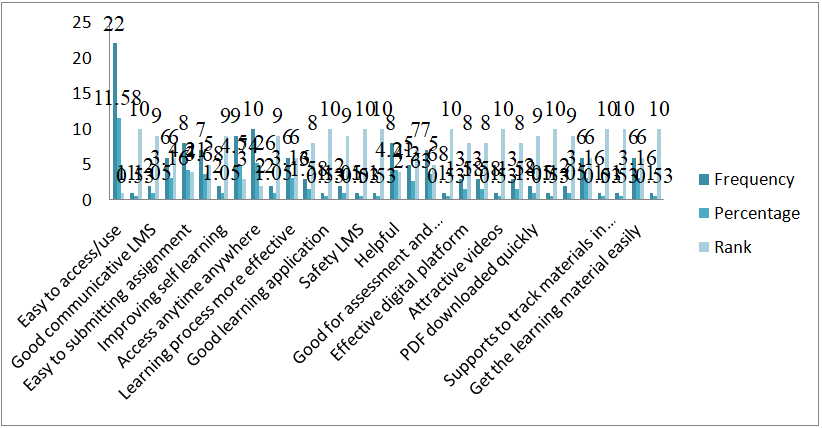
To know the advantages of the use of MOODLE perceived by the students, the investigators got a few responses out of one hundred ninety students who are given below.
The Advantages of MOODLE LMS gained by the Students are given below.
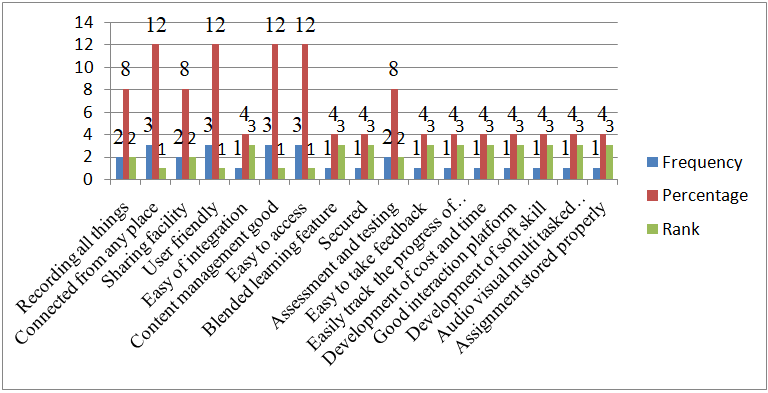
To know the advantages of the use of MOODLE perceived by the teachers, the investigators got a few responses out of twenty-five teachers, which are given below:
It is revealed that the PG Students have perceived 32 facilities of MOODLE LMS (See Table 11 and Figure 1), and Teachers have perceived 17 facilities of MOODLE LMS (See Table 12 and Figure 2). Most of the students have perceived that MOODLE is easy to access, and most of the teachers have identified that they can access MOODLE anytime and anywhere. It is easy to access, content management is very good, and it's a user-friendly LMS.


RQ2: What are the pitfalls of MOODLE LMS encountered by the Students and Teachers?


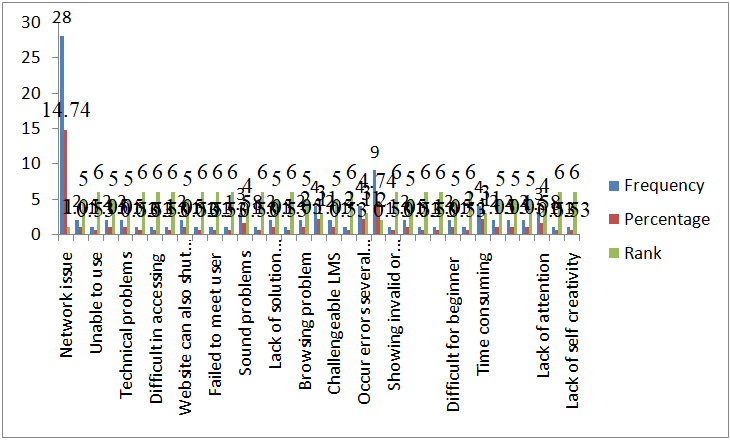
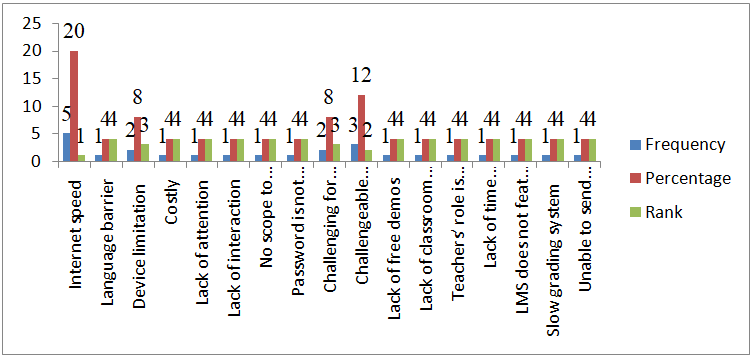
The researchers have found through this study that the PG Students have identified 35 pitfalls of MOODLE LMS (See Table 13 and Figure 3), and Teachers have identified 17 pitfalls of MOODLE LMS (See Table 14 and Figure 4). As most of the students and teachers have identified network issues, it means they both are facing the same problem.
The investigators encountered various obstacles while conducting the study. These are mentioned below:
• Investigators had to collect data online during the COVID-19 pandemic as all educational institutions were closed, which was very problematic.
• In the case of teachers, the sample (lowest number) may be represented as the whole population.
• The researchers could not use other research tools like interviews, observation etc.
• After this study, students will be able to measure their educational progress in MOODLE platform.
• This study will be helpful in improving the quality of Education.
• Teachers will be more available on the online platform.
• This study will be helpful in understanding the importance of technology in the classroom.
• This study is very interesting for social and educational institutions because it supports lifelong learning.
• The result of the study can help decision–makers to learn more about the influence of an e-learning platform on student success and satisfaction.
• This work will be very helpful for Kazi Nazrul University because, in the current situation, all the academic activities are being done on MOODLE LMS.
• Special training should be arranged for the proper use of MOODLE LMS for PG Urban, General, ST, OBC and MOODLE non-user students in their teaching-learning process.
• Special training should be arranged for the proper use of MOODLE LMS for General, SC, Arts, Science and MOODLE non-user teachers in their teaching learning process.
In this study, researchers evaluated the perception of PG students and teachers of Kazi Nazrul University in Paschim Bardhaman district of West Bengal towards MOODLE Learning Management System. The responses of the students and teachers indicate that they have a moderate level of perception towards MOODLE Learning Management System. A special initiative should be taken by the University in order to develop the perception of MOODLE among students and teachers. The researchers discovered that the PG students had identified 32 facilities of MOODLE LMS, and Teachers have identified 17 facilities of MOODLE LMS. On the other hand, PG students have identified 35 pitfalls of MOODLE LMS, and Teachers have identified 17 pitfalls of MOODLE LMS. This study will help understand the importance of technology in the classroom. This is likely to cater for the needs of educational institutions and society because it supports affordable lifelong learning. The findings of the study can assist decision-makers in learning more about the impact of using an e-learning platform on student success and satisfaction. As the study is conducted at the University level, this research work will be extremely beneficial to Kazi Nazrul University in particular and other higher educational institutions, in general, when it comes to the question of the perception of post-graduation students and teachers on MOODLE learning management system.
| [1] | Ravi, S. S. (2015). A Comprehensive Study of Education (2nd ed.). PHI Learning Private Limited. | ||
| In article | |||
| [2] | Hurix. (2019, February 27). Top 10 Benefits of a MOODLE-based Learning Management System (LMS). Hurix Digital. https://hurix.com/benefits-MOODLE-based-learning-management-system/ | ||
| In article | |||
| [3] | Ghina, N.N., Mustofa, M., & Awaliyah, M. (2022). The Role of Technology: Moodle as a Learning Tool and Its Impact on the ELT Students. ELT-Lectura: Studies and Perspectives in English Language Teaching, 9(2), 203-208. | ||
| In article | View Article | ||
| [4] | Chourishi, D., Buttan, C.K., Chaurasia, A., & Soni, A. (2011). Effective E-Learning through MOODLE. International Journal of Advance Technology & Engineering Research, 1(1), 34-38. | ||
| In article | |||
| [5] | Costa, C., Alvelos, H., &Teixeira, L. (2012). The use of MOODLE e-learning platform: a study in Portuguese University. Procedia Technology, 5, 334-343. | ||
| In article | View Article | ||
| [6] | Wang, Y.H., Tseng, Y.H., & Chang, C.C. (2013). Comparison of Students’ Perception of MOODLE in a Taiwan University against Students in a Portuguese University. In Wang, J.F., Lau, R. (eds) Advances in Web-Based Learning – ICWL 2013. Lecture Notes in Computer Science, 8167. Springer, Berlin, Heidelberg. | ||
| In article | View Article | ||
| [7] | Zakaria, E., & Daud, M. Y. (2013). The Role of Technology: MOODLE as a Teaching Tool in a Graduate Mathematics Education Course. Asian Journal of Management Sciences & Education, 2(4), 46-52. | ||
| In article | |||
| [8] | Boopathiraj, C., & Chellamani, K. (2015). Pre service and Post service graduate teachers’ first times experience with constructivist learning environment (CLE) using MOODLE. I-manager’s Journal on School Educational Technology, 10(4), 23-27. | ||
| In article | View Article | ||
| [9] | Goyal, E., & Tambe, S. (2015). Effectiveness of MOODLE - enabled blended learning in private Indian business school teaching NICHE programs. The Online Journal of New Horizons in Education, 5(2), 14-22. | ||
| In article | |||
| [10] | Xu, H., & Mahenthiran, S. (2015). Factors that influence online learning assessment and satisfaction: using MOODLE as a learning management system. International Business Research, 9(2), 1-18. | ||
| In article | View Article | ||
| [11] | Parmeswar, R., Jaunky, V.C., & Ramesh, V. (2017). Familiarity of MOODLE e-learning platform among open university of Mauritius students. International Journal of Management and Applied Science, 3(5), 120-127. | ||
| In article | |||
| [12] | Saleem, N.E., Al-Saqri, M.N., & Ahmad, S. E. A. (2016). Acceptance of MOODLE as a Teaching/Learning Tool by the Faculty of the Department of Information Studies at Sultan Qaboos University, Oman based on UTAUT. International Journal of Knowledge Content Development & Technology, 6(2), 5-27. | ||
| In article | View Article | ||
| [13] | Sarfo, F.K., & Yidana, I. (2016). On university lecturers experience in the design and use of MOODLE and blended learning environments. The Online Journal of New Horizons in Education, 6(2), 143-154. | ||
| In article | |||
| [14] | Zainuddin, N., Idrus, R., & Jamal, A. F. M. (2016). MOODLE as an ODL teaching tool: A Perspective of Students and Academics. The Electronic Journal of e-Learning, 14(4), 282-290. | ||
| In article | |||
| [15] | Gunduz, N., & Ozcan, D. (2017). Implementation of the MOODLE System into EFL Classes. Profile: Issues in Teachers’ Professional Development, 19(1).51-64. | ||
| In article | View Article | ||
| [16] | Sari, A.P., Baedhowi, & Indrawati, C. D. S. (2017). The Use of Learning Media with MOODLE Approach to Improve the Quality of Education: A Literature Study. Advances in Social Science, Education and Humanities Research, 158, 54-59. | ||
| In article | View Article | ||
| [17] | Verma, A., Rathore, S., Vishwakarma, S., & Goswami, S. (2017). Multilevel analysis of student’s feedback using MOODLE logs in virtual cloud environment. International Journal of Computer Science & Information Technology, 9(5), 15-28. | ||
| In article | View Article | ||
| [18] | Okesene, V. P. (2018). E-Learning: The Use of MOODLE. International Journal for e-Learning Security, 7(1), 540-548. | ||
| In article | View Article | ||
| [19] | Singh, U.J., & Gokool, R. (2018). Students’ perceptions of the MOODLE Quiz E-assessment tool in an isiZulu language course, American Journal Online, 52(1), 4-24. | ||
| In article | View Article | ||
| [20] | Thamrin, N.S., Suriaman, A., & Maghfirah (2019). Students’ Perception on the Implementation of Moodle Web-Based in Learning Grammar. IJOTL-TL, 4(1), 1-10. | ||
| In article | View Article | ||
| [21] | Maphosa, V., Jita, T., & Dube, B. (2020). Students’ perception and use of Moodle as the E-Learning system implemented at a rural University in Zimbabwe. In Proceedings of EdMedia + Innovate Learning (pp. 175-182). Online, The Netherlands: Association for the Advancement of Computing in Education (AACE). Retrieved September 19, 2022 from https:// www. learntechlib.org/primary/p/217300/. | ||
| In article | |||
| [22] | Zharova, M.V., Trapitsin, S.Y., Timchenko, V.V., & Skurihina, A.I. (2020). "Problems and Opportunities of Using LMS Moodle before and during COVID-19 Quarantine: Opinion of Teachers and Students” (pp.554-557), 2020 International Conference Quality Management, Transport and Information Security, Information Technologies (IT&QM&IS), 2020, Yaroslavl, Russia, IEEE. | ||
| In article | View Article | ||
| [23] | Ahmad & Subekti, F. E. (2021). Mathematic teachers’ perception on the use of moodle based learning management system in teaching mathematic during the time of covid 19. Journal of Physics: Conference Series 1778, 012033, IOP publishing. | ||
| In article | View Article | ||
| [24] | Truong, H.N. (2021). Students’ Perception Towards the Use of Moodle-Based LMS in Learning Speaking Skill at Tertiary Level. Proceedings of the 17th International Conference of the Asia Association of Computer-Assisted Language Learning (AsiaCALL 2021). Atlantis Press. | ||
| In article | View Article | ||
| [25] | Ahmed, M. M. (2022). The Usefulness of ICT in Education During the Lockdown for COVID-19: Asian Perspective. In M. R. Islam, S. K. Behera & L. Naibaho (Eds.), Handbook of Research on Asian Perspectives of the Educational Impact of COVID-19 (242-253). IGI Global Scientific Publishing. | ||
| In article | View Article | ||
| [26] | Gamage, S.H.P.W., Ayres, J.R., & Behrend, M.B. (2022). A systematic review on trends in using Moodle for teaching and learning. IJ STEM Ed, 9(9). | ||
| In article | |||
| [27] | Al-Fraihat, D., Alshahrani, A. M., Alzaidi, M., Shaikh, A. A., Al-Obeidallah, M., & Al-Okaily, M. (2025). Exploring students’ perceptions of the design and use of the Moodle learning management system. Computers in Human Behavior Reports, 18, 1-15. | ||
| In article | View Article | ||
| [28] | Gulzar, A.A. (2021). Types of Research by Method. https:// www.educarepk.com/. | ||
| In article | |||
Published with license by Science and Education Publishing, Copyright © 2025 Santosh Kumar Behera, Priti Sarkar, Suryadeep Dey, Mega Novita and Abdullahi Yusuf
 This work is licensed under a Creative Commons Attribution 4.0 International License. To view a copy of this license, visit
http://creativecommons.org/licenses/by/4.0/
This work is licensed under a Creative Commons Attribution 4.0 International License. To view a copy of this license, visit
http://creativecommons.org/licenses/by/4.0/
| [1] | Ravi, S. S. (2015). A Comprehensive Study of Education (2nd ed.). PHI Learning Private Limited. | ||
| In article | |||
| [2] | Hurix. (2019, February 27). Top 10 Benefits of a MOODLE-based Learning Management System (LMS). Hurix Digital. https://hurix.com/benefits-MOODLE-based-learning-management-system/ | ||
| In article | |||
| [3] | Ghina, N.N., Mustofa, M., & Awaliyah, M. (2022). The Role of Technology: Moodle as a Learning Tool and Its Impact on the ELT Students. ELT-Lectura: Studies and Perspectives in English Language Teaching, 9(2), 203-208. | ||
| In article | View Article | ||
| [4] | Chourishi, D., Buttan, C.K., Chaurasia, A., & Soni, A. (2011). Effective E-Learning through MOODLE. International Journal of Advance Technology & Engineering Research, 1(1), 34-38. | ||
| In article | |||
| [5] | Costa, C., Alvelos, H., &Teixeira, L. (2012). The use of MOODLE e-learning platform: a study in Portuguese University. Procedia Technology, 5, 334-343. | ||
| In article | View Article | ||
| [6] | Wang, Y.H., Tseng, Y.H., & Chang, C.C. (2013). Comparison of Students’ Perception of MOODLE in a Taiwan University against Students in a Portuguese University. In Wang, J.F., Lau, R. (eds) Advances in Web-Based Learning – ICWL 2013. Lecture Notes in Computer Science, 8167. Springer, Berlin, Heidelberg. | ||
| In article | View Article | ||
| [7] | Zakaria, E., & Daud, M. Y. (2013). The Role of Technology: MOODLE as a Teaching Tool in a Graduate Mathematics Education Course. Asian Journal of Management Sciences & Education, 2(4), 46-52. | ||
| In article | |||
| [8] | Boopathiraj, C., & Chellamani, K. (2015). Pre service and Post service graduate teachers’ first times experience with constructivist learning environment (CLE) using MOODLE. I-manager’s Journal on School Educational Technology, 10(4), 23-27. | ||
| In article | View Article | ||
| [9] | Goyal, E., & Tambe, S. (2015). Effectiveness of MOODLE - enabled blended learning in private Indian business school teaching NICHE programs. The Online Journal of New Horizons in Education, 5(2), 14-22. | ||
| In article | |||
| [10] | Xu, H., & Mahenthiran, S. (2015). Factors that influence online learning assessment and satisfaction: using MOODLE as a learning management system. International Business Research, 9(2), 1-18. | ||
| In article | View Article | ||
| [11] | Parmeswar, R., Jaunky, V.C., & Ramesh, V. (2017). Familiarity of MOODLE e-learning platform among open university of Mauritius students. International Journal of Management and Applied Science, 3(5), 120-127. | ||
| In article | |||
| [12] | Saleem, N.E., Al-Saqri, M.N., & Ahmad, S. E. A. (2016). Acceptance of MOODLE as a Teaching/Learning Tool by the Faculty of the Department of Information Studies at Sultan Qaboos University, Oman based on UTAUT. International Journal of Knowledge Content Development & Technology, 6(2), 5-27. | ||
| In article | View Article | ||
| [13] | Sarfo, F.K., & Yidana, I. (2016). On university lecturers experience in the design and use of MOODLE and blended learning environments. The Online Journal of New Horizons in Education, 6(2), 143-154. | ||
| In article | |||
| [14] | Zainuddin, N., Idrus, R., & Jamal, A. F. M. (2016). MOODLE as an ODL teaching tool: A Perspective of Students and Academics. The Electronic Journal of e-Learning, 14(4), 282-290. | ||
| In article | |||
| [15] | Gunduz, N., & Ozcan, D. (2017). Implementation of the MOODLE System into EFL Classes. Profile: Issues in Teachers’ Professional Development, 19(1).51-64. | ||
| In article | View Article | ||
| [16] | Sari, A.P., Baedhowi, & Indrawati, C. D. S. (2017). The Use of Learning Media with MOODLE Approach to Improve the Quality of Education: A Literature Study. Advances in Social Science, Education and Humanities Research, 158, 54-59. | ||
| In article | View Article | ||
| [17] | Verma, A., Rathore, S., Vishwakarma, S., & Goswami, S. (2017). Multilevel analysis of student’s feedback using MOODLE logs in virtual cloud environment. International Journal of Computer Science & Information Technology, 9(5), 15-28. | ||
| In article | View Article | ||
| [18] | Okesene, V. P. (2018). E-Learning: The Use of MOODLE. International Journal for e-Learning Security, 7(1), 540-548. | ||
| In article | View Article | ||
| [19] | Singh, U.J., & Gokool, R. (2018). Students’ perceptions of the MOODLE Quiz E-assessment tool in an isiZulu language course, American Journal Online, 52(1), 4-24. | ||
| In article | View Article | ||
| [20] | Thamrin, N.S., Suriaman, A., & Maghfirah (2019). Students’ Perception on the Implementation of Moodle Web-Based in Learning Grammar. IJOTL-TL, 4(1), 1-10. | ||
| In article | View Article | ||
| [21] | Maphosa, V., Jita, T., & Dube, B. (2020). Students’ perception and use of Moodle as the E-Learning system implemented at a rural University in Zimbabwe. In Proceedings of EdMedia + Innovate Learning (pp. 175-182). Online, The Netherlands: Association for the Advancement of Computing in Education (AACE). Retrieved September 19, 2022 from https:// www. learntechlib.org/primary/p/217300/. | ||
| In article | |||
| [22] | Zharova, M.V., Trapitsin, S.Y., Timchenko, V.V., & Skurihina, A.I. (2020). "Problems and Opportunities of Using LMS Moodle before and during COVID-19 Quarantine: Opinion of Teachers and Students” (pp.554-557), 2020 International Conference Quality Management, Transport and Information Security, Information Technologies (IT&QM&IS), 2020, Yaroslavl, Russia, IEEE. | ||
| In article | View Article | ||
| [23] | Ahmad & Subekti, F. E. (2021). Mathematic teachers’ perception on the use of moodle based learning management system in teaching mathematic during the time of covid 19. Journal of Physics: Conference Series 1778, 012033, IOP publishing. | ||
| In article | View Article | ||
| [24] | Truong, H.N. (2021). Students’ Perception Towards the Use of Moodle-Based LMS in Learning Speaking Skill at Tertiary Level. Proceedings of the 17th International Conference of the Asia Association of Computer-Assisted Language Learning (AsiaCALL 2021). Atlantis Press. | ||
| In article | View Article | ||
| [25] | Ahmed, M. M. (2022). The Usefulness of ICT in Education During the Lockdown for COVID-19: Asian Perspective. In M. R. Islam, S. K. Behera & L. Naibaho (Eds.), Handbook of Research on Asian Perspectives of the Educational Impact of COVID-19 (242-253). IGI Global Scientific Publishing. | ||
| In article | View Article | ||
| [26] | Gamage, S.H.P.W., Ayres, J.R., & Behrend, M.B. (2022). A systematic review on trends in using Moodle for teaching and learning. IJ STEM Ed, 9(9). | ||
| In article | |||
| [27] | Al-Fraihat, D., Alshahrani, A. M., Alzaidi, M., Shaikh, A. A., Al-Obeidallah, M., & Al-Okaily, M. (2025). Exploring students’ perceptions of the design and use of the Moodle learning management system. Computers in Human Behavior Reports, 18, 1-15. | ||
| In article | View Article | ||
| [28] | Gulzar, A.A. (2021). Types of Research by Method. https:// www.educarepk.com/. | ||
| In article | |||