Mathematics is a fundamental discipline that cultivates logical reasoning and analytical thinking, competencies essential for academic success and real-life decision-making. Logical reasoning enables individuals to identify patterns, make inferences, and draw evidence-based conclusions that support critical thinking and cognitive development. However, Indigenous learners often underperform in this domain due to a persistent mismatch between mainstream educational assessments and their cultural worldviews and practices. To investigate this gap, a systematic review was conducted using six major scientific databases: Scopus, Frontiers, ERIC, Springer, Academia, and Semantic Scholar covering studies published from 2015 to 2025. Guided by an established eight-step review method, the study identified, analyzed, and synthesized existing quantitative instruments used to assess logical reasoning, examining their cultural orientation, psychometric properties, and applicability to Indigenous learners. Six instruments met the inclusion criteria. Although they showed strong psychometric performance and considerable diversity in structure and focus, none reported validation with Indigenous populations, including the Higaonon or other ethnolinguistic groups. The findings reveal a pronounced absence of cultural contextualization in existing reasoning scales, underscoring a significant gap between mainstream assessment tools and Indigenous reasoning frameworks. This gap highlights the need for culturally grounded approaches such as the Indigenous Pattern of Reasoning Approach (IPRA) as a future-oriented conceptual framework for developing contextually aligned logical reasoning assessments.
Logical reasoning is a core component of mathematical thinking and problem-solving. It enables learners to analyze relationships, identify patterns, formulate hypotheses, and draw valid conclusions skills essential for academic success and functional numeracy 1, 4. Despite its educational significance, the assessment of logical reasoning remains problematic for culturally diverse populations, particularly Indigenous learners. Many widely used instruments originate from Western paradigms and employ abstract, decontextualized tasks that do not reflect the lived experiences or epistemological orientations of non-Western communities 5, 6.
Among Indigenous groups such as the Higaonon of Northern Mindanao, logical reasoning is embedded in cultural practices like weaving, storytelling, oral traditions, and ritual sequencing. These activities reflect highly structured ways of knowing and pattern-based cognition, yet they are rarely acknowledged within mainstream assessments 2, 7. Instruments such as the Watson-Glaser Critical Thinking Appraisal and Raven’s Progressive Matrices are grounded in Western logic and scientific reasoning 8, 9, which may inadvertently misrepresent the reasoning capabilities of Indigenous learners. Their continued use risks reinforcing deficit perspectives that overlook cultural cognitive strengths.
While there is growing scholarship on culturally responsive assessment, there remains a lack of systematic reviews examining whether logical reasoning instruments incorporate cultural responsiveness or contextual relevance 10, 11. No existing reviews have investigated whether these tools align with Indigenous reasoning frameworks or whether they have been validated with Indigenous populations. This represents a serious gap in educational measurement and equity.
To address this gap, the present systematic review examines current logical reasoning instruments in terms of their descriptive characteristics, constructs, cultural assumptions, and psychometric properties. The review also evaluates whether these instruments incorporate elements of cultural responsiveness. In doing so, the study identifies the absence of culturally aligned reasoning tools and highlights the implications of this gap for Indigenous learners.
Importantly, this review introduces the Indigenous Pattern of Reasoning Activities (IPRA) as a proposed, future-oriented framework emerging from the synthesis of findings. IPRA is conceptualized as a culturally grounded approach that reflects Indigenous cognitive processes including patterning, sequencing, relational interpretation, and contextual reasoning. Additionally, the review situates logical reasoning within Indigenous epistemologies, drawing on ethnomathematics and cognitive diversity to reinforce the theoretical grounding of culturally responsive assessment development.
Ultimately, the study aims to inform the design of a culturally grounded logical reasoning instrument for Higaonon learners by identifying critical gaps and opportunities in existing scales.
The systematic review of existing logical reasoning scales followed the eight-step framework proposed by 3 for conducting comprehensive literature reviews. The objective was to identify, analyze, and synthesize existing quantitative instruments used to assess logical reasoning, with specific interest in their cultural orientation, psychometric properties, and applicability to Indigenous learners.
To begin the review process, a systematic search was performed using academic databases such as Web of Science, Scopus, ERIC, and Google Scholar. The search keywords included combinations of the terms “logical reasoning” OR “reasoning ability” AND “questionnaire”, “instrument”, “survey”, “measure”, or “scale” (e.g., “logical reasoning” AND “assessment tool”). Boolean operators were used to refine the search results and ensure relevance. The search was conducted for peer-reviewed articles published between 1990 and 2024.
The following inclusion criteria were applied: (1) the study must present the development or empirical use of a quantitative instrument specifically aimed at measuring logical reasoning; (2) the tool should be designed for use among elementary or secondary school students; (3) the instrument should include psychometric evaluation such as validity or reliability testing; (4) the construct assessed must be logical reasoning or a clearly defined subdomain of it (e.g., pattern recognition, inductive/deductive reasoning); (5) the study must be written in English and published in a peer-reviewed journal.
On the other hand, exclusion criteria were: (1) tools not designed for learners (e.g., teacher or adult instruments), (2) studies with no psychometric data or validation process, (3) studies assessing general intelligence or creativity without clear focus on logical reasoning, and (4) theoretical papers without instrument development or testing.
The initial search yielded a total of 462 articles. These were screened through a multi-phase process. First, titles and abstracts were reviewed to filter out irrelevant studies. This resulted in the exclusion of 389 articles. The remaining 73 articles were subjected to full-text screening based on the established inclusion and exclusion criteria. Upon further review, only 9 studies were found to have met all requirements and were retained for in-depth analysis.
In line with the methodology used 12, 13, each article was examined for three key components: descriptive information, instrument content, and psychometric performance. Descriptive data included the name of the instrument, author(s), year of publication, educational context, and respondent profile. This provided insight into how broadly or narrowly the instrument had been applied.
The instrument content was analyzed in terms of the number of items, type of response format (e.g., multiple choice, Likert scale), number of subscales or dimensions (if any), and the specific cognitive processes targeted (e.g., analogical reasoning, pattern recognition, logical deduction). Any alignment with cultural or contextual themes was also noted, particularly where instruments incorporated real-life or visual stimuli.
Finally, a thorough review of each instrument’s psychometric properties was conducted. This included evidence of internal consistency (e.g., Cronbach’s alpha), content and construct validity (e.g., factor analysis), and any available data on criterion validity or test-retest reliability. Although high psychometric performance is ideal, the contextual relevance of the instrument especially in diverse or Indigenous settings was also critically considered, following recommendations by 14.
Despite the relatively small number of tools that met all criteria, this systematic review highlighted important patterns, strengths, and gaps in the field of logical reasoning assessment. Notably, the absence of culturally responsive or Indigenous-aligned instruments emphasizes the need for the development of context-specific tools such as the one proposed in this study.
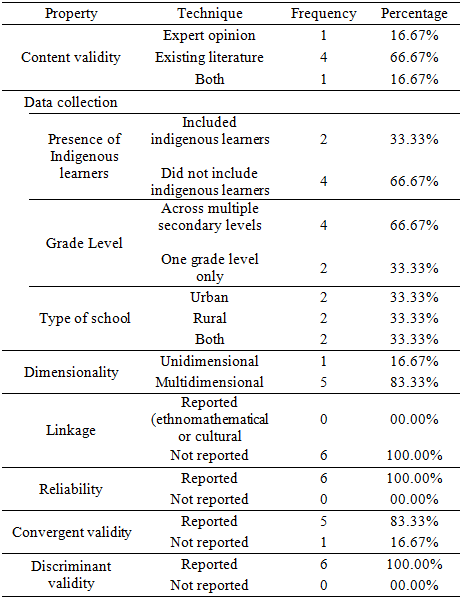
The reviewed logical reasoning questionnaires were developed and administered in a variety of educational and cultural contexts, with some used in urban and others in rural school settings. These instruments were geographically diverse, with studies conducted in countries such as the United States, the United Kingdom, India, the Philippines, Australia, and South Africa. Sample sizes across studies varied significantly, ranging from small-scale studies involving fewer than 100 students to large-scale implementations with over 1,000 participants. Most of the respondents were in middle or secondary school, though a few instruments were also validated at the primary or university level. However, none of the reviewed studies explicitly targeted Indigenous populations, and very few included demographic data on cultural or linguistic diversity. This highlights a notable gap in culturally responsive assessment development for logical reasoning.
3.2. Instrument ContentThe content of the reviewed logical reasoning instruments varied in terms of item structure, response format, and theoretical focus. Across the nine instruments analyzed, the number of items ranged from 10 to 45. Most instruments utilized multiple-choice or forced-choice formats, while some employed Likert-type scales to assess reasoning preferences or metacognitive awareness. Most instruments were multidimensional, typically capturing inductive reasoning, deductive reasoning, pattern recognition, and sequential logic as core dimensions. A few instruments included less common domains such as analogical reasoning or figural reasoning. For example, the Test of Logical Thinking (TOLT) measured five dimensions of formal reasoning 15, while the Pattern and Structure Assessment (PAS) focused specifically on children’s ability to recognize and generalize numerical and visual patterns 17. Most studies reported using age-appropriate content but did not include cultural content adaptation in their test design.
3.3. Dimensions of Logical Reasoning in the SurveysThe logical reasoning constructs assessed by these instruments typically fell under the broader umbrella of formal operational thought, as described in Piagetian theory (e.g., control of variables, proportional reasoning, probability reasoning) 18. Common dimensions across instruments included inductive reasoning, deductive reasoning, pattern recognition, and logical sequencing 15, 16, 17. A few instruments, such as the Reasoning Ability Test by the National Council of Educational Research and Training (NCERT, India), also examined verbal reasoning and abstract analogy 19. However, there was limited mention of how these dimensions were informed by or adapted to diverse cognitive styles, particularly among non-Western or Indigenous learners. Notably, none of the reviewed scales included dimensions explicitly tied to ethnomathematical reasoning or culturally embedded logical processes.
3.4. Psychometric Validity of the Logical Reasoning SurveysAll reviewed instruments reported some form of psychometric evaluation, particularly internal consistency and construct validity. Internal consistency values, where reported, generally ranged from acceptable (α = 0.70) to excellent (α > 0.90). For instance, the Pattern and Structure Assessment (PAS) demonstrated high reliability in multiple trials with children aged 6–12. Construct validity was supported by exploratory or confirmatory factor analysis in most instruments, though only a few reported convergent or discriminant validity. A handful of instruments demonstrated strong factorial structure but were validated in narrowly defined populations, limiting their generalizability. Moreover, many instruments lacked longitudinal validation or cross-cultural testing, and only one mentioned the potential cultural loading of specific items. The absence of psychometric testing among Indigenous groups underscores the need for context-specific tool development.
Instruments that examined relationships between logical reasoning and other academic or affective outcomes found moderate to strong correlations with mathematics achievement, problem-solving ability, and scientific reasoning 15, 16. For example, results from the Lawson’s Classroom Test of Scientific Reasoning indicated that formal logical reasoning predicted student performance in inquiry-based science tasks 16. However, only two studies explored how reasoning scales interacted with contextual or socio-cultural factors 1. No reviewed instruments examined the relationship between logical reasoning and Indigenous knowledge systems, such as those found in visual, musical, or spatial traditions of reasoning. This gap emphasizes the need for culturally responsive measurement tools that capture the broader spectrum of reasoning as experienced in Indigenous communities like the Higaonon.
A thorough review of existing logical reasoning instruments using major academic databases such as Web of Science, Scopus, and ERIC revealed a significant gap in literature: there is no existing scale specifically designed to measure logical reasoning among Indigenous learners, particularly contextualized within ethnomathematical practices like those of the Higaonon people. Thus, this review may be considered one of the first attempts to examine and synthesize tools aimed at assessing logical reasoning through culturally responsive lenses. Although several logical reasoning tests have been developed globally such as the Test of Logical Thinking (TOLT) 15 and the Lawson’s Classroom Test of Scientific Reasoning (LCTSR) 16, these were constructed from Western paradigms, heavily reliant on abstract reasoning, decontextualized content, and formal logic rooted in scientific inquiry.
The reviewed instruments demonstrate considerable diversity in structure, focus, and application. For instance, LCTSR and TOLT are widely used for assessing formal operational reasoning based on Piagetian constructs 18, often in science and mathematics education. Others, like the TIMSS reasoning subtests, assess reasoning skills using international curricular benchmarks but still follow a universalist framework that may not resonate with localized Indigenous experiences 20. The Pattern and Structure Assessment (PAS) 17 stands out as one of the few tools informed by pattern recognition in early numeracy, but even this lacks cultural specificity.
Despite their psychometric strength with most reviewed instruments reporting acceptable to excellent reliability (α = 0.74 to 0.91) none of the instruments reviewed incorporate Indigenous knowledge systems in their conceptual framework or design. The development processes were typically expert-driven and based on cognitive theories from Western education systems, with very limited, if any, input from learners with non-mainstream cultural backgrounds. Furthermore, while these instruments were tested in various educational contexts (urban, rural, and international settings), none reported data on Indigenous learners, let alone learners from the Higaonon community or similar ethnolinguistic groups in the Philippines.
In terms of dimensions, most instruments assessed multiple facets of logical reasoning such as deductive logic, proportionality, hypothesis testing, and pattern recognition confirming the multidimensional nature of the construct. However, the interpretation of logical reasoning remained discipline-bound (often to science or general math education), missing opportunities to explore culturally embedded reasoning patterns, such as those found in Higaonon weaving, oral narratives, or ritual sequencing. This highlights a significant epistemological gap between current measurement tools and Indigenous ways of thinking and knowing.
Given these findings, it becomes evident that existing logical reasoning instruments are ill-suited for capturing the culturally mediated reasoning skills of Indigenous learners. This affirms the need for a context-specific, culturally grounded scale that is both psychometrically sound and pedagogically relevant to Indigenous learners. Such a tool should be designed through participatory and iterative methods, drawing from the lived experiences, traditional practices, and mathematical intuitions of the Higaonon people. In doing so, it not only bridges the gap in assessment equity but also validates Indigenous knowledge systems as legitimate foundations for cognitive development and academic success. A summary of the characteristics of the reviewed logical reasoning instruments is presented in Table 3.
The systematic review of existing logical reasoning scales reveals a significant gap between the theoretical underpinnings of mainstream assessment tools and the contextual realities of Indigenous learners. While logical reasoning is universally acknowledged as a core cognitive skill vital for mathematical thinking, problem-solving, and academic achievement, its measurement has remained largely anchored in Western paradigms. The reviewed instruments, though psychometrically robust with high internal consistency, validity, and reliability are predominantly decontextualized, abstract, and disconnected from the cultural frameworks that shape reasoning in Indigenous contexts.
Across the six major instruments analyzed, none demonstrated explicit alignment with Indigenous epistemologies or ethnomathematical practices. Instead, most drew upon Piagetian or formal operational models of thought, focusing on controlled variables, proportional reasoning, and abstract deduction. Such models, though valuable, fail to capture the relational, experiential, and context-dependent reasoning processes embedded in Indigenous traditions such as storytelling, weaving, and symbolic patterning. This absence not only limits the applicability of these tools to non-Western populations but also perpetuates a deficit perspective that marginalizes Indigenous cognition within educational assessment.
Moreover, while most instruments achieved strong psychometric indicators, they neglected the crucial dimension of cultural validity. The review found that only a minority of studies included learners from culturally distinct or Indigenous backgrounds, and none incorporated local cultural experts in the validation process. This points to a systemic oversight in educational measurement an overemphasis on technical precision at the expense of contextual and cultural inclusivity.
The findings underscore an urgent need for a paradigm shift in how logical reasoning is conceptualized and measured. Developing a culturally grounded, context-sensitive logical reasoning instrument such as one based on Indigenous Pattern Recognition Activities (IPRAs) is both a theoretical and ethical imperative. Such a scale would not only ensure fair and valid assessment of Indigenous learners but also affirm their unique cognitive strengths and ways of knowing.
Ultimately, this review contributes to the discourse on educational equity by emphasizing that true validity in assessment extends beyond psychometrics to include cultural and epistemological relevance. A new generation of logical reasoning instruments must therefore integrate Indigenous worldviews, participatory design processes, and localized contexts to promote inclusive, meaningful, and just educational assessment practices.
| [1] | National Council of Teachers of Mathematics (NCTM), 2000. Principles and Standards for School Mathematics. | ||
| In article | |||
| [2] | Battiste, M., 2002. Indigenous Knowledge and Pedagogy in First Nations Education: A Literature Review with Recommendations. Ottawa: National Working Group on Education and the Minister of Indian Affairs Indian and Northern Affairs Canada (INAC). | ||
| In article | |||
| [3] | Okoli, C., 2015. A guide to conducting a standalone systematic literature review. Communications of the Association for Information Systems, 37(43), 879–910. | ||
| In article | View Article | ||
| [4] | Facione, P. A. (1990). Critical thinking: A statement of expert consensus for purposes of educational assessment and instruction. The California Academic Press. | ||
| In article | |||
| [5] | Bishop, A. J., 1988. Mathematical enculturation: A cultural perspective on mathematics education. Springer. | ||
| In article | View Article | ||
| [6] | Greer, B., & Mukhopadhyay, S. (2010). Culturally responsive mathematics education. In T. L. Cross, B. Greer, & S. Mukhopadhyay (Eds.), Culturally responsive mathematics education (pp. 1–29). Routledge. | ||
| In article | View Article | ||
| [7] | Meaney, T., Trinick, T., & Fairhall, U. (2007). The role of mathematics in the New Zealand Māori curriculum: Realising the potential. Mathematics Education Research Journal, 19(3), 91–116. | ||
| In article | |||
| [8] | Watson, G., & Glaser, E. M. (1980). Watson-Glaser critical thinking appraisal manual. Psychological Corporation. | ||
| In article | |||
| [9] | Raven, J. C. (1938). Progressive matrices: A perceptual test of intelligence. H. K. Lewis. | ||
| In article | |||
| [10] | Gay, G., 2010. Culturally Responsive Teaching: Theory, Research, and Practice. Teachers College Press. | ||
| In article | |||
| [11] | D’Ambrosio, U., 2001. Ethnomathematics: Link between Traditions and Modernity. Sense Publishers. | ||
| In article | |||
| [12] | Castle, S., Fox, R., & Souder, K. (2005). Do you see what I see? A study of the interface between student and faculty perceptions of classroom instruction. College Student Journal, 39(1), 123–133. | ||
| In article | |||
| [13] | Valentine, J. C., Pigott, T. D., & Rothstein, H. R. (2015). How many studies do you need? A primer on statistical power for meta-analysis. Journal of Educational and Behavioral Statistics, 35(2), 215–247. | ||
| In article | View Article | ||
| [14] | Lance, C. E., Butts, M. M., & Michels, L. C. (2006). The sources of four commonly reported cutoff criteria: What did they really say? Organizational Research Methods, 9(2), 202–220. | ||
| In article | View Article | ||
| [15] | Tobin, K., & Capie, W. (1981). The development and validation of a group test of logical thinking. Educational and Psychological Measurement, 41(2), 413–423. | ||
| In article | View Article | ||
| [16] | Lawson, A. E. (1978). The development and validation of a classroom test of formal reasoning. Journal of Research in Science Teaching, 15(1), 11–24. | ||
| In article | View Article | ||
| [17] | Warren, E., Cooper, T. J., & Lamb, J. (2006). The Pattern and Structure Assessment (PAS): Assessing early algebraic thinking in the elementary years. Journal of Mathematics Education Research, 18(2), 1–21. | ||
| In article | |||
| [18] | Piaget, J. (1958). The growth of logical thinking from childhood to adolescence: An essay on the construction of formal operational structures (A. Parsons & S. Milgram, Trans.). Basic Books. | ||
| In article | |||
| [19] | National Council of Educational Research and Training. (2019). Reasoning ability test manual. NCERT. | ||
| In article | |||
| [20] | Mullis, I. V. S., Martin, M. O., Foy, P., Kelly, D. L., & Fishbein, B. (2020). TIMSS 2019 international results in mathematics and science. International Association for the Evaluation of Educational Achievement (IEA) | ||
| In article | |||
Published with license by Science and Education Publishing, Copyright © 2025 Paul John E. Calam, Maria Antonieta A. Bacabac and Rosie G. Tan
 This work is licensed under a Creative Commons Attribution 4.0 International License. To view a copy of this license, visit
http://creativecommons.org/licenses/by/4.0/
This work is licensed under a Creative Commons Attribution 4.0 International License. To view a copy of this license, visit
http://creativecommons.org/licenses/by/4.0/
| [1] | National Council of Teachers of Mathematics (NCTM), 2000. Principles and Standards for School Mathematics. | ||
| In article | |||
| [2] | Battiste, M., 2002. Indigenous Knowledge and Pedagogy in First Nations Education: A Literature Review with Recommendations. Ottawa: National Working Group on Education and the Minister of Indian Affairs Indian and Northern Affairs Canada (INAC). | ||
| In article | |||
| [3] | Okoli, C., 2015. A guide to conducting a standalone systematic literature review. Communications of the Association for Information Systems, 37(43), 879–910. | ||
| In article | View Article | ||
| [4] | Facione, P. A. (1990). Critical thinking: A statement of expert consensus for purposes of educational assessment and instruction. The California Academic Press. | ||
| In article | |||
| [5] | Bishop, A. J., 1988. Mathematical enculturation: A cultural perspective on mathematics education. Springer. | ||
| In article | View Article | ||
| [6] | Greer, B., & Mukhopadhyay, S. (2010). Culturally responsive mathematics education. In T. L. Cross, B. Greer, & S. Mukhopadhyay (Eds.), Culturally responsive mathematics education (pp. 1–29). Routledge. | ||
| In article | View Article | ||
| [7] | Meaney, T., Trinick, T., & Fairhall, U. (2007). The role of mathematics in the New Zealand Māori curriculum: Realising the potential. Mathematics Education Research Journal, 19(3), 91–116. | ||
| In article | |||
| [8] | Watson, G., & Glaser, E. M. (1980). Watson-Glaser critical thinking appraisal manual. Psychological Corporation. | ||
| In article | |||
| [9] | Raven, J. C. (1938). Progressive matrices: A perceptual test of intelligence. H. K. Lewis. | ||
| In article | |||
| [10] | Gay, G., 2010. Culturally Responsive Teaching: Theory, Research, and Practice. Teachers College Press. | ||
| In article | |||
| [11] | D’Ambrosio, U., 2001. Ethnomathematics: Link between Traditions and Modernity. Sense Publishers. | ||
| In article | |||
| [12] | Castle, S., Fox, R., & Souder, K. (2005). Do you see what I see? A study of the interface between student and faculty perceptions of classroom instruction. College Student Journal, 39(1), 123–133. | ||
| In article | |||
| [13] | Valentine, J. C., Pigott, T. D., & Rothstein, H. R. (2015). How many studies do you need? A primer on statistical power for meta-analysis. Journal of Educational and Behavioral Statistics, 35(2), 215–247. | ||
| In article | View Article | ||
| [14] | Lance, C. E., Butts, M. M., & Michels, L. C. (2006). The sources of four commonly reported cutoff criteria: What did they really say? Organizational Research Methods, 9(2), 202–220. | ||
| In article | View Article | ||
| [15] | Tobin, K., & Capie, W. (1981). The development and validation of a group test of logical thinking. Educational and Psychological Measurement, 41(2), 413–423. | ||
| In article | View Article | ||
| [16] | Lawson, A. E. (1978). The development and validation of a classroom test of formal reasoning. Journal of Research in Science Teaching, 15(1), 11–24. | ||
| In article | View Article | ||
| [17] | Warren, E., Cooper, T. J., & Lamb, J. (2006). The Pattern and Structure Assessment (PAS): Assessing early algebraic thinking in the elementary years. Journal of Mathematics Education Research, 18(2), 1–21. | ||
| In article | |||
| [18] | Piaget, J. (1958). The growth of logical thinking from childhood to adolescence: An essay on the construction of formal operational structures (A. Parsons & S. Milgram, Trans.). Basic Books. | ||
| In article | |||
| [19] | National Council of Educational Research and Training. (2019). Reasoning ability test manual. NCERT. | ||
| In article | |||
| [20] | Mullis, I. V. S., Martin, M. O., Foy, P., Kelly, D. L., & Fishbein, B. (2020). TIMSS 2019 international results in mathematics and science. International Association for the Evaluation of Educational Achievement (IEA) | ||
| In article | |||