The study aimed to assess the basic psychological need satisfaction and how it affects employees' work engagement in Tangub City Global College, Tangub City, during the school year 2023-2024. Survey, descriptive, and correlational research methods were used in the study using the questionnaire checklist, weighted mean, standard deviation, and Spearman Rank-Order Correlation Coefficient. The results showed that the respondents rated their satisfaction with basic psychological needs as very satisfied and their level of work engagement as very highly engaged. Furthermore, the study found a strong and positive connection between basic psychological need satisfaction and work engagement among employees. Employees who strongly affirm their work engagement also highly affirm their basic psychological need satisfaction. To continually sustain or maintain the employees' management trust and work commitment to the institution, the Tabgub City Global College, Tangub City, must keep a team of highly motivated and satisfied employees. The management should ensure that they build a more satisfied workplace and drive higher employee physical engagement.
Maintaining and enhancing well-being is a universal plan for every employee. Improving organizational performance has no single solution because many aspects of human factors cause organizational performance. The performance of the organization depends on its employees who are working for the objectives of the organization. However, employees' psychological needs dissatisfaction could lead to organizational cynicism, leading to poor work engagement, low morale, high absenteeism, turnover, disillusionment, job dissatisfaction, and fewer citizenship behaviors. Lack of physiological needs can affect the well-being of psychological conditions 1. Hence, disengaged employees become disconnected from their jobs and conceal their fundamental identities and ideas, leading to negative emotions during the performance of duties 2.
Self-determination theory emphasizes the importance of essential psychological needs satisfaction for optimal functioning and ongoing psychological growth. These needs indicate the necessary conditions for psychological well-being, and satisfying employees' needs such as psychological and physiological, which lead to the most optimal functioning. Autonomy, competence, and relatedness influence an employee's level of intrinsic motivation on a given task 3. Moreover, work engagement can be characterized by energy, involvement and positive interaction in the workplace and is regarded as an important concept for enhancing employees’ recruitment and retention 4.
As for basic psychological need satisfaction and work engagement, the same meta-analysis concluded that this concept needs further research because it has not received much attention in the City of Tangub. However, the studies differ in scope and limitation because the various studies focused on different sectors. This study on basic psychological need satisfaction and work engagement are significant for it would help assess the present situation of the employees of Tangub City Global College.
The research methodology is the precise steps taken during the investigation process. The survey is a research method used for collecting data from a predefined group of respondents to gain information and insights on various topics of interest 5. The survey method was employed since the researchers’ gathered data through a questionnaire checklist of basic psychological need satisfaction and level of work engagement.
Research Design
The study included survey and descriptive-correlational research methods. The researchers performed a correlational analysis to determine the significant relationship between basic psychological need satisfaction and work engagement 6.
The Locale of the Study
The locale of the study was Tangub City Global College in Tangub City Misamis Occidental.
Population
Those who answered the questionnaires were the faculty and employees of the Tangub City Global College, Tangub City in Misamis Occidental. Given the limited number of employees, the researchers applied a total enumeration method.
Data Gathering Instruments
The study adopted questionnaires on basic psychological need satisfaction and on work engagement 7.
Data Gathering Procedures
The adviser duly signed a letter to the President of Tangub City Global Colle, seeking permission to use the study's instrument. Next, the researcher's letter, along with the president’s endorsement letter, and the endorsement letter were forwarded to the Research and Ethics Committee, requesting ethics clearance to approve the study's instrument to field out. Finally, the ethics clearance was sent to the head of the different department's office, asking permission to administer the instrument.
Statistical Treatment of Data
To analyze the data, descriptive and inferential statistic was used. The weighted mean was used to determine the level of basic psychological need satisfaction of the college, Standard Deviation is used to determine the homogeneity and heterogeneity of the employees scores, and Spearman Rank-Order Correlation was used to measure the correlation between basic psychological need satisfaction and work engagement of employees.
The following ranges of values with their descriptive implication will be used:

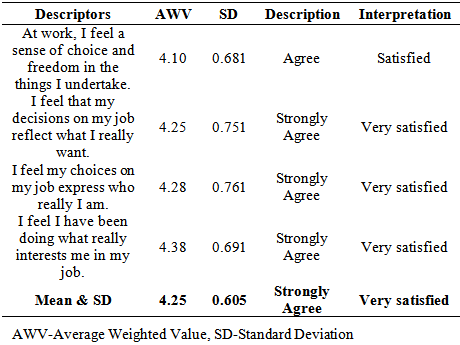
The respondents' perceived level of basic psychological need satisfaction in terms of autonomy is shown in Table 1. According to the table, respondents rated the basic psychological need satisfaction in terms of autonomy as "very high" [AWV = 4.25, SD = 0.605]. The raters deemed their assertions to be true for three (3) descriptors [Items, 2, 3, & 4], and one (1) agree suggested that employees’ workplaces feel a sense of choice and freedom in doing their task.
[Item 1]. The respondents' "very satisfied" assessment may have been influenced by the fact that employees exercise their free will, experience a sense of choice, and have psychological freedom when carrying out tasks. Abun et al. 7, which found that employees' basic psychological need for autonomy is generally satisfied. They further indicated that employees' intrinsic desire for meaningful engagement, the autonomy of choice, and psychological freedom during task execution are substantial.
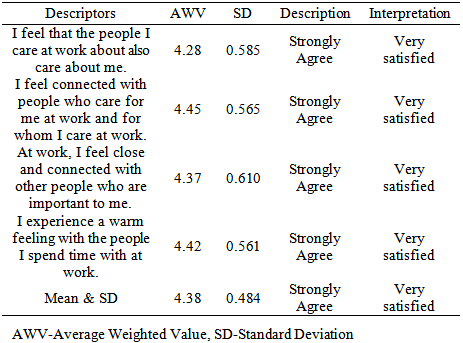
Depicted in Table 2 is the respondents' perceived level of basic psychological need satisfaction in terms of relatedness. Employees rated the workplace as having relatedness, which is evidenced by their connectivity, caring, industry, and importance of each other, providing a good example. The table reveals that respondents rated all four (4) items pertaining to staff, heads, and employees as "very satisfied," leading to an overall relatedness rating of "very satisfied" for basic psychological need satisfaction [AWV=4.38, SD=0.484]. Baes et al. 8, which discovered that employees with high social and external esteem needs have positive relationships or involvement with friends, family, and coworkers.
Table 3 displays the respondents' perceived level of basic psychological need satisfaction in terms of competency. According to the table, respondents rated the competency as "very satisfied" [AWV = 4.31, SD = 0.645]. The raters deemed their assertions to be true for four (4) descriptors that suggested that employees are knowledgeable, skilled, and capable in their assigned tasks. The fact that employees feel competent—which is considered effective in social contexts and expresses his/her ideas and talents—may have contributed to the respondents' "very satisfied" assessment. Coxen et al. 9, employees with high competency and satisfaction with the working environment can confidently perform tasks and develop new skills to enable mastery in the future.
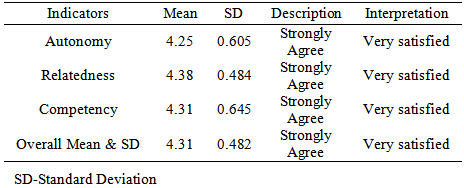
To summarize, Table 4 shows the respondents' perceived level of basic psychological need satisfaction as "very satisfied." The raters also perceived autonomy, relatedness, and competency as indicators of basic psychological need satisfaction at a "very satisfied" level. This indicates that Tangub City Global College employees expressed satisfaction with the working environment and services provided by top-level management. Similarly, their firm self-determination leads to increased job performance and work engagement. This could ultimately indicate that the employees at Tangub City Global College in Tangub City are content with their work environment because autonomy-supportive environments are predictive of higher levels of well-being, autonomy, openness, resilience, and vitality. The present data corroborates the findings of Abun, Magallanez, Foronda, and Agoot 7, indicating that the overall satisfaction of employees' basic psychological needs is regarded as high. They additionally stated that employees concur that their needs for autonomy, relatedness, and competency are fulfilled.
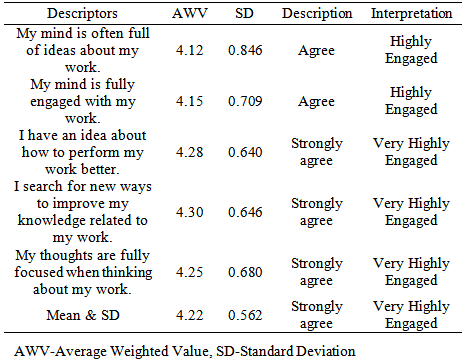
The respondents' perceived cognitive level of work engagement is shown in Table 5. According to the statistics, employees at Tangub City Global College in Tangub City, had an overall "very highly engaged" level of cognitive work engagement. Additionally, the indicators show "highly engaged" to "very highly engaged" engagement levels. It indicates that the employees Tangub City Global College, are knowledgeable about what they do and regularly consider and give their jobs their whole attention. Employees approach their work with concentration and are free from distractions that could reduce output. They have the capacity and desire to complete the work at hand. Cognitive engagement covers the length of time and effort that workers are willing to put into the task at hand.Tenney 10 asserts that cognitively engaged workers actively support organizational objectives by aligning with the institution's vision, mission, and strategy. Similarly, Joo et al. 11 point out that intellectually engaged workers show a strong sense of loyalty to the company and their position. They derive purpose and value from completing tasks.
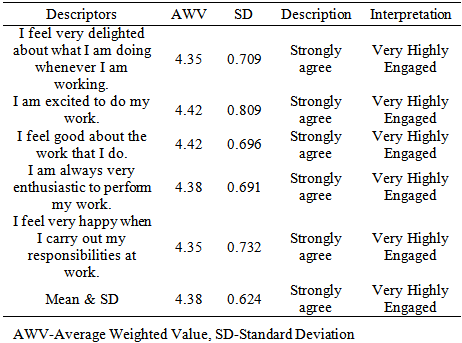
Table 6 shows the respondents' perceived emotional level of work engagement. According to the results, employees at Tangub City Global College, had an overall emotional job involvement with a mean rating of 4.38, indicating a "strongly agree/very highly engaged" level. It implies that workers had a "very high" emotional engagement, as evidenced by their joy, contentment, and enthusiasm for their jobs. Macaspac, Galat, Cumlat, and Julian 12, the results of the current study support the idea that emotionally involved workers typically display higher work performance and engagement levels and are more eager to put effort into their duties 13.
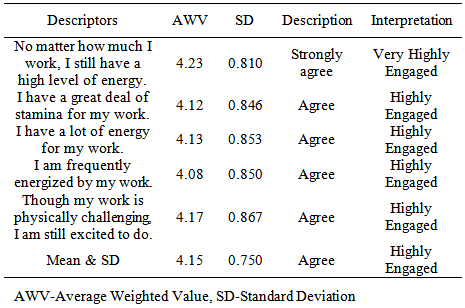
Table 7 shows the respondents' perceived level of physical work engagement. According to the information presented, employees at Tangub City Global College had a highly engaged overall level of physical work engagement, which is indicative of a robust degree of participation. Every indicator likewise shows this highly engaged level of involvement, except item 1, where respondents engaged at a "very highly engaged" level, indicating a degree of physical energy, endurance, and vitality in their work. The current study's findings are consistent with those of Kiema-Junes et al. 14, who found that physically active workers typically had high engagement and performance ratings, which boost output and improve organizational performance 15.
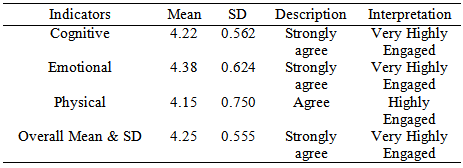
Table 8 summarizes the respondents' perceived level of work engagement. According to the table, there was a "very highly engaged" level of cognitive and emotional engagement among the workers at Tangub City Global College, Tangub City. On the other hand, the workers thought their physical engagement at work was " highly engaged." The educational institution's employee work engagement was rated as "very highly engaged" on an excellent scale. This implies that workers are likely to be efficient and effective in delivering high-quality work. It shows how dedicated, committed, and persevering the employees are to supporting their educational institution objectives. The current findings disagree the findings of Baes and Naparota, 8 found that the respondents' reported level of work involvement was highly engaged.
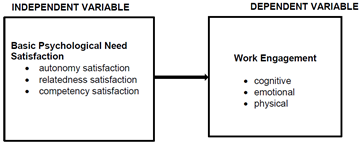
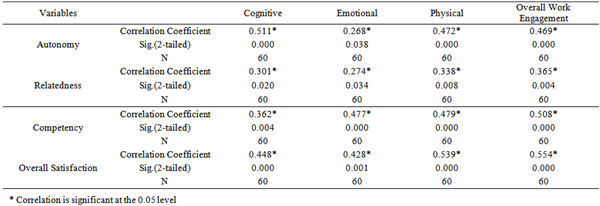
The test of correlations between measures of basic psychological need satisfaction and work engagement among employees of the Tangub City Global College, Tangub City, is shown in Table 9. A closer examination of the data reveals that basic psychological need satisfaction indicators (autonomy, relatedness, and competency) were moderately, highly, and positively connected with, and significantly related to, indicators of work engagement (cognitive, emotional, and physical). In general, however, basic psychological need satisfaction among employees of Tangub City Global College, Tangub City was found to be highly and positively connected with, and significantly related to, the work engagement [rho=0.554, p<0.001]. It means that the documented relationship was substantial. It implies that those employees who highly affirm their basic psychological need satisfaction in the workplace also strongly affirm their work engagement. Baes and Naparota, 8 findings are supported by the current findings. The findings demonstrated a strong relationship between work engagement and the basic psychological need satisfaction dimensions of autonomy, relatedness and competency.
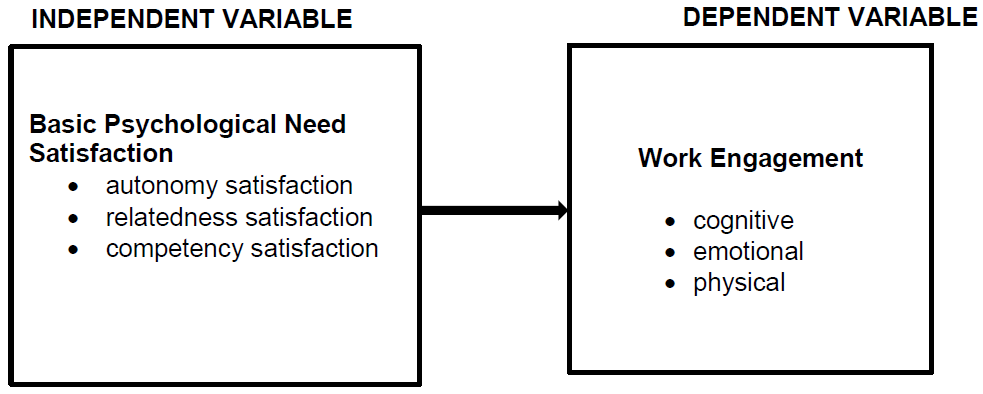
The main purpose of the study is to determine the correlation between basic psychological need satisfaction and the work engagement of employees. The study found out that there is a significant relationship between basic psychological need satisfaction and work engagement. This implies that as employees the level of basic psychological need satisfaction increases, the level of work engagement also increases. This further implies that employees work engagement is significantly connected by basic psychological need satisfaction. Baes and Naparota 2022 indicated that Autonomy, competence, and relatedness satisfaction were significantly associated with work engagement. Abun et al. 16 indicated that Autonomy, competence, and relatedness satisfaction were significantly associated with work engagement.
Based on the findings of the study as reflected in the data, the study demonstarted that the basic psychological need satisfaction of the Tangub City Global College, Tangub City, is considered strongly agreeable, and the work engagement of employees is considered very highly engaged. The coefficient correlation indicates a correlation between the basic psychological need satisfaction and the work engagement of employees at Tangub City Global College, Tangub City. Therefore, the study rejects its hypothesis.
The study's findings indicate that employees at Tangub City Global College, Tangub City, who experience a "very satisfied" level of basic psychological need satisfaction, rely on their managers and leaders due to their competence. They firmly satisfied in the reliability, integrity, competence, and robustness of the institutional framework and assure the satisfaction on the services, capabilities, or character of the executive leadership. On the other hand, employees demonstrating a significant level of work engagement are more inclined to be productive and deliver high-quality output. The institution's objectives are significantly supported by the employees' resilience, dedication, and commitment. Moreover, employees who exhibit strong work engagement also demonstrate a high level of basic psychological need satisfaction within the workplace.
In order to consistently sustain and maintain the employees' basic psychological needs, satisfaction, and commitment to the institution, Tangub City Global College, Tangub City, must maintain a team of highly motivated, satisfied employees and foster a positive work environment. The management should ensure that they build more satisfaction in the workplace and drive higher employee physical engagement. To enhance the current study's results, further research is required to investigate the relationship between basic psychological need satisfaction and wider work engagements. The perceptional nature of the current research may have skewed the results.
| [1] | Abun, D., & Magalanez, T. (2018). Psychological need satisfaction at work of faculty and employees of divine word colleges in region I, Philippine and their work engagement. International Journal of Applied Research, 4(3), 21-30. | ||
| In article | |||
| [2] | Lovina, R., Genuba, R., & Naparota, L. (2020). Structural Equation Model on Work Engagement of Non-Commissioned Police Officers. International Journal of English Literature and Social Sciences (4). | ||
| In article | View Article | ||
| [3] | Havik, T., Bru, E., & Ertesvåg, S. K. (2015). School factors associated with school refusal-and truancy-related reasons for school non-attendance. . Social Psychology of Education, 18(2), 221-240. | ||
| In article | View Article | ||
| [4] | Abarantyne, I., Naidoo, V., & Rugimbana, R. (2019). The impact of psychological contracts on employee engagement at a university of technology. SA Journal of Human Resource Management, 17(1), 1-11. | ||
| In article | View Article | ||
| [5] | Creswell, J., & Guetterman. (2014). Research Design Quantitative, Qualitative and Mixed Approaches. | ||
| In article | |||
| [6] | Bhat, A. (2019). What is a correlational study? – Definition with examples. Retrieved from https:// www.questionpro.com/ blog/correlational-research/. | ||
| In article | |||
| [7] | Abun, D., Magallanez, T., Foronda, S. L., & Agoot, F. (2019). Measuring Basic Psychological Need Satisfaction and Frustration and Work Engagement of Employees of Divine Word Colleges in Ilocos Region, Philippines. International Journal of English Literature and Social Sciences (IJELS), 4(2). | ||
| In article | View Article | ||
| [8] | Baes, J. O., & Naparota, L. C. (2022). Basic Psychological Need Satisfaction and Work Engagement of Employees in Andres Bonifacio College, Inc., Dipolog City, Philippines. International Journal of English Literature and Social Sciences (IJELS), 7(6). | ||
| In article | View Article | ||
| [9] | Coxen, L., Van Der Vaart, L., Van den Broeck, A., & Rothmann, S. (2021). Basic psychological needs in the work context: A systematic literature review of diary studies. Frontiers in psychology, 12. | ||
| In article | View Article | ||
| [10] | Tenney, M. (2023). Three types of employee engagement. Business Leadership. https://businessleadershiptoday.com. | ||
| In article | |||
| [11] | Joo, B.K., Zigarmi, D., Nimon, K. & Shuck, B. (2016). Work cognition and psychological well-being: The role of cognitive engagement as a partial mediator. The Journal of Applied Behavioral Science, 53(4), 446-469. | ||
| In article | View Article | ||
| [12] | Macaspac, L. G., Galat, M., Cumlat, J., & Julian, F. P. (2024). Does Employees’ Trust in the Management Predict Employees’ Work Engagement?. Divine Word International Journal of Management and Humanities (DWIJMH)(ISSN: 2980-4817), 3(1), 566-584. | ||
| In article | View Article | ||
| [13] | Zhao, L. & Zhao, J. (2017). A framework of research and practice: Relationship between work engagement, affective Commitment, and turnover intentions. Open Journal of Social Sciences, 5, 225-233. | ||
| In article | View Article | ||
| [14] | Kiema-Junes, H., Saarinen, A., Korpelainen, R., Kangas, M., Ala-Mursula, L., Pyky, R., & Hintsanen, M. (2022). More physical activity, more work engagement? A Northern Finland Birth Cohort 1966 Study. Journal of occupational and environmental medicine, 64(7), 541–549. | ||
| In article | View Article | ||
| [15] | Singh, A.K., Singh, A.P. & Amish. (2021). Role of employee engagement in organizational effectiveness: Empirical evidence in the context of Indian public sector organizations. International Journal of Education & Management, 11(2), 74-80. https:// www.proquest.com/openview/d1f1baee25d29f0aaa149cbefd562481/1?pq-origsite=gscholar&cbl=2032132. | ||
| In article | |||
| [16] | Abun, D., Magallanes, T., Foronda, S. L., & Encarnacion, M. J. (2020). Employees’ workplace well-being and work engagement of divine word colleges’ employees in Ilocos region, Philippines. International Journal of Research in Business and Social Science,, 9(2), 70-84. | ||
| In article | View Article | ||
Published with license by Science and Education Publishing, Copyright © 2024 Love H. Falloran and Leo C. Naparota
 This work is licensed under a Creative Commons Attribution 4.0 International License. To view a copy of this license, visit
https://creativecommons.org/licenses/by/4.0/
This work is licensed under a Creative Commons Attribution 4.0 International License. To view a copy of this license, visit
https://creativecommons.org/licenses/by/4.0/
| [1] | Abun, D., & Magalanez, T. (2018). Psychological need satisfaction at work of faculty and employees of divine word colleges in region I, Philippine and their work engagement. International Journal of Applied Research, 4(3), 21-30. | ||
| In article | |||
| [2] | Lovina, R., Genuba, R., & Naparota, L. (2020). Structural Equation Model on Work Engagement of Non-Commissioned Police Officers. International Journal of English Literature and Social Sciences (4). | ||
| In article | View Article | ||
| [3] | Havik, T., Bru, E., & Ertesvåg, S. K. (2015). School factors associated with school refusal-and truancy-related reasons for school non-attendance. . Social Psychology of Education, 18(2), 221-240. | ||
| In article | View Article | ||
| [4] | Abarantyne, I., Naidoo, V., & Rugimbana, R. (2019). The impact of psychological contracts on employee engagement at a university of technology. SA Journal of Human Resource Management, 17(1), 1-11. | ||
| In article | View Article | ||
| [5] | Creswell, J., & Guetterman. (2014). Research Design Quantitative, Qualitative and Mixed Approaches. | ||
| In article | |||
| [6] | Bhat, A. (2019). What is a correlational study? – Definition with examples. Retrieved from https:// www.questionpro.com/ blog/correlational-research/. | ||
| In article | |||
| [7] | Abun, D., Magallanez, T., Foronda, S. L., & Agoot, F. (2019). Measuring Basic Psychological Need Satisfaction and Frustration and Work Engagement of Employees of Divine Word Colleges in Ilocos Region, Philippines. International Journal of English Literature and Social Sciences (IJELS), 4(2). | ||
| In article | View Article | ||
| [8] | Baes, J. O., & Naparota, L. C. (2022). Basic Psychological Need Satisfaction and Work Engagement of Employees in Andres Bonifacio College, Inc., Dipolog City, Philippines. International Journal of English Literature and Social Sciences (IJELS), 7(6). | ||
| In article | View Article | ||
| [9] | Coxen, L., Van Der Vaart, L., Van den Broeck, A., & Rothmann, S. (2021). Basic psychological needs in the work context: A systematic literature review of diary studies. Frontiers in psychology, 12. | ||
| In article | View Article | ||
| [10] | Tenney, M. (2023). Three types of employee engagement. Business Leadership. https://businessleadershiptoday.com. | ||
| In article | |||
| [11] | Joo, B.K., Zigarmi, D., Nimon, K. & Shuck, B. (2016). Work cognition and psychological well-being: The role of cognitive engagement as a partial mediator. The Journal of Applied Behavioral Science, 53(4), 446-469. | ||
| In article | View Article | ||
| [12] | Macaspac, L. G., Galat, M., Cumlat, J., & Julian, F. P. (2024). Does Employees’ Trust in the Management Predict Employees’ Work Engagement?. Divine Word International Journal of Management and Humanities (DWIJMH)(ISSN: 2980-4817), 3(1), 566-584. | ||
| In article | View Article | ||
| [13] | Zhao, L. & Zhao, J. (2017). A framework of research and practice: Relationship between work engagement, affective Commitment, and turnover intentions. Open Journal of Social Sciences, 5, 225-233. | ||
| In article | View Article | ||
| [14] | Kiema-Junes, H., Saarinen, A., Korpelainen, R., Kangas, M., Ala-Mursula, L., Pyky, R., & Hintsanen, M. (2022). More physical activity, more work engagement? A Northern Finland Birth Cohort 1966 Study. Journal of occupational and environmental medicine, 64(7), 541–549. | ||
| In article | View Article | ||
| [15] | Singh, A.K., Singh, A.P. & Amish. (2021). Role of employee engagement in organizational effectiveness: Empirical evidence in the context of Indian public sector organizations. International Journal of Education & Management, 11(2), 74-80. https:// www.proquest.com/openview/d1f1baee25d29f0aaa149cbefd562481/1?pq-origsite=gscholar&cbl=2032132. | ||
| In article | |||
| [16] | Abun, D., Magallanes, T., Foronda, S. L., & Encarnacion, M. J. (2020). Employees’ workplace well-being and work engagement of divine word colleges’ employees in Ilocos region, Philippines. International Journal of Research in Business and Social Science,, 9(2), 70-84. | ||
| In article | View Article | ||