Based on theoretical and practical research, the study highlights the importance of the Competency Development Pathway in Experiential Activities in primary education for categorizing students' abilities across three developmental zones: the Zone of Actual Development (ZAD), the Zone of Proximal Development (ZPD), and the Hoping Zone (HZ). By employing theoretical research methods, practical research methods, and sociological research methods in Educational Science, the research team demonstrated that each student's competency development and knowledge acquisition process is unique. During the same period and with the same content, some students exhibit exceptional growth, surpassing the ZPD and reaching the higher Hoping Zone (HZ). This finding marks a distinction and advancement over previous studies, which suggested cognitive and competency development only spanned the ZAD and ZPD. Given this reality, it is crucial to develop a tool that enables educators to accurately determine each student's competency development process and identify individuals with exceptional abilities. Such a tool is vital for adjusting teaching content and methods to help students maximize their potential based on their true capabilities.
In the global educational landscape, considerable attention has been directed towards early developmental regions by educators. Lev Vygotsky is credited with introducing the theory and laying the foundational concepts for subsequent research on the Zone of Proximal Development (ZPD), the nearest developmental zone. Stemming from Vygotsky's developmental framework, numerous studies worldwide have undertaken research and experiments regarding the practical application of the Zone of Proximal Development in educational contexts. Authors Lantolf, J. P., & Thorne, S. L. (2006) have elucidated the real-world implications of ZPD theory on teaching and learning. Their research delves into the pivotal role of teachers in supporting student learning within the ZPD and offers insights into effective teaching plans and strategies. Meanwhile, Liu, M. (2019) explored the application of the Zone of Proximal Development in English language teaching, with a particular emphasis on the efficacy of scaffolding methods in fostering learners' oral language development within their ZPD 1, 2.
The development of secondary education programs with a competency-based approach is a common trend in many countries worldwide, including Vietnam 3. However, the reality demonstrates that building a competency development pathway within experiential activities still faces many challenges. The research objective of this topic is to design competence development pathways for elementary school students, thereby assisting schools and teachers in assessing students' competencies, as well as evaluating the effectiveness of experiential activity programs and their organization in elementary schools. The research subject is educational activity organizations in elementary schools, and the object of study is the competence development pathway in experiential activities at elementary schools. We utilized a combination of theoretical research methods (document collection and analysis, synthesis, interpretation) and practical research methods (teacher observation, interviews, surveys, experience summarization, expert opinions, and experimentation).
Children learn best by actively doing and using their existing knowledge. Individual needs and backgrounds influence how they learn. Family, schools, and society all play a role in shaping a child's development 4. Feeling safe and supported with opportunities to explore and collaborate fosters better learning. Effective teachers act as facilitators, guiding students to construct their knowledge through exploration and questioning. Students learn from each other, and educators should provide challenges that are just beyond a student's current abilities to promote growth. This creates a path for continuous intellectual development 5.
According to Carol Blades, students' learning activities do not follow a linear path but rather a concentric spiral shape. This circle begins with awareness through experience and exploration, then students move on to investigation, research, comparison, and approach cultural standards. Next, students establish standards based on their experiences and apply them in practice. Finally, the circle repeats with concepts, skills, and techniques but in more complex and creative forms. For effective learning, students need to self-recognize their ability to explore, search, use, and apply knowledge 6.
Lev Vygotsky's conceptualization of the Zone of Proximal Development (ZPD) underscores the importance of learning materials falling within this zone to optimize educational outcomes. Jerome Bruner's scaffolding theory underscores the necessity of educators designing supportive structures to assist students in overcoming intellectual challenges. Thus, educators must devise diverse instructional strategies tailored to individual student's current levels of attainment, thereby establishing a scientific foundation for competency development trajectories 7.
Georg Rasch and Robert Glaser's proposition of a competency development trajectory theory, predicated on predefined criteria, delineates a continuous trajectory of intellectual growth. Students progress incrementally, guided by behavioral indicators, towards the attainment of higher levels of intellectual prowess. Consequently, students' competency development trajectories serve as manifestations of their individual intellectual progressions.
Lev Vygotsky's theory of the zone of proximal development (ZPD) presents a model for understanding the developmental process of each student:
The Zone of Actual Development (ZAD) represents the level of development at which learners can independently acquire knowledge and solve problems without external assistance from individuals with higher expertise.
The Zone of Proximal Development (ZPD) indicates a higher level of development compared to the current zone, where children can only solve problems with the guidance of individuals with greater knowledge and external influences.
The outermost zone, termed the "Beyond my reach" zone, denotes tasks that students cannot perform even with adult support due to their complexity or high requirements.
Consequently, according to Vygotsky, during the learning process, students' psychological development transitions between two cognitive levels: the current development zone (what they can achieve independently) and the zone of proximal development (what they can accomplish with assistance). Teaching must precede development, guiding it along the way. To teach ahead of development, educators must assess students' current levels and the potential development achievable through appropriately structured learning activities 8.
The application and advancement of these studies have been demonstrated through the concept of the "zone of expectation" (HZ) stems from the research of Robert Glaser and Rasch. Robert Glaser proposed a theory of the competency development line based on "criterion-referenced explanation," which involves viewing knowledge acquisition as a continuous process, characterized by mastery progressing from basic to advanced levels. This approach emphasizes defining mastery through specific behavioral criteria, with the aim of providing a framework for designing intellectual development ladders to help students overcome barriers and progress along their capacity development path.
The Rasch model is employed to evaluate the quality of learning behaviors by arranging the criteria in ascending order. This facilitates student progression from smaller behavioral indicators to achieving larger criteria, thereby fostering the gradual development of individual capacity. 9
The Experiential Activities in primary schools in Viet Nam built to monitor learners’ development areas 10. The ZAD, representing the current level of skills, knowledge, and abilities of students in specific areas, will serve as the foundations and bases for teachers to select the necessary requirements and develop appropriate learning content to help children continue to develop and progress towards the ZPD. From the abilities children have developed previously, the content of the Experiential Learning program continues to focus on self-development, life skills, relationships with friends, teachers, and family members. The requirements are set at a higher and more complex level so that children can overcome challenges, expand their learning abilities, and achieve the required standards with support from teachers. In addition, labor activities, social activities, and introduction to some familiar professions are also organized and implemented. 11
It can be observed that in the Experiential Learning program in elementary school, the zones of proximal development are manifested through the required standards for each grade level. Achieving the required standards at this grade level corresponds to the child reaching the corresponding ZPD of that activity content. At that time, the requirements that have been met will become the child's existing abilities (ZAD), serving as a basis for teachers to select appropriate content and activities for the next grade level 12.
2.2. PracticalThe research team conducted a survey with teachers working in some primary schools about the competency development line based on the above theories. It showed that the competency development line would be an important basis for teachers to effectively assess and classify students'. However, there are still many teachers who do not have a clear understanding of this issue. Most of them only understand it at a basic level and not comprehensively. This outcome highlights the challenges in assessing Experiential Learning Activities at the elementary school level. Overall, assessing students in Experiential Learning Activities remains challenging due to the lack of specific competency development pathways to guide the process.
2.3. SolutionTo ensure scientific rigor, the competency development pathway must align with the requirements of the Experiential Activity program.
To ensure objectivity, the steps of the competency pathway need to be clear, detailed, with comprehensive indicators and levels of student competencies.
To ensure practicality, the competency development pathway should be capable of supporting teachers in assessing students' learning progress.
To ensure suitability, the competency development pathway needs to be appropriate for the target audience, which in this case is elementary school students, and should assess both competencies and qualities required during the learning process.
For student development, it's crucial to ensure the assessment of progress relative to the students' own capabilities. This fosters the development of responsibility for learning and monitoring their own progress.
Step 1: Identify the developmental zones of students, including the Zone of Actual Development (ZAD), the Zone of Proximal Development (ZPD), and the Horizon of Expectations (HZ).
Step 2: Determine the criteria for assessing student competencies and construct an indicator table for each criterion for each developmental zone.
Step 3: Design the competency development pathway for students in Experiential Activity 3 at the elementary school level, comprising three zones: ZAD, ZPD, and HZ, with corresponding criteria for each zone.
Step 4: Solicit feedback from experts and pilot the competency development pathway for practical student assessment in elementary schools, adjusting and refining as necessary.
Within the constraints of the allowed scope, the proposed research concludes at the fourth stage, where the research team consults with experts to assess the scientific rigor and feasibility of the project. Additionally, the research team conducts trials incorporating the competency development pathway into lesson design and student competency assessment before, during, and after the learning process on the topic.
To test the accuracy of the research problem, the research team conducted a scientific experiment.
Experimental Location: Ly Thai To Elementary School - Trung Hoa - Cau Giay – Hanoi.
Experimental Scale: The experiment covered five 3rd-grade classes at Ly Thai To Elementary School, including classes 3Q1, 3Q2, 3Q3, 3Q4, and 3Q5, totaling 180 students.
(1) Development of indicator tables for competency criteria
Indicator tables were developed to assess student competencies across the three zones: ZAD, ZPD, and HZ. Within each zone, the research team categorized indicator levels for each student's competency attainment. These levels played a crucial role in determining the extent of student competency development and assisted educators in accurately assessing the competency level of learners for effective classification and adjustment of teaching methods. Specifically, the research team identified the categorized indicators for the capacity to design and organize activities for grade 3 on the theme "New Year and Smart Consumption" 13 (Table 1).
(2) Three-Stage Experimentation
The decision to implement a three-stage experimentation process was guided by the recognition of three developmental zones of learners: the Zone of Actual Development (ZAD), the Zone of Proximal Development (ZPD), and the Hoping Zone (HZ). Initially, the experiment aimed to assess students' competency development before, during, and after a lesson, leveraging their existing knowledge base and aligning with the learning objectives set for the lesson to devise an appropriate competency assessment test.
(3) Pre-test
A pre-test was administered to evaluate students' existing knowledge related to the upcoming lesson topic. For the selected theme "New Year and Smart Consumption," Grade 2 students were expected to possess prior knowledge concerning coin recognition and basic calculations involving currency. Consequently, the pre-test primarily focused on these foundational aspects to gauge whether students' competency at the time was sufficient to assimilate subsequent, more intricate knowledge.
(4) Experimental Teaching and Process Evaluation
The experimental teaching phase transpired within the confines of a single class period dedicated to the Experiential Activity. The lesson was meticulously designed with the overarching objective of enabling students to achieve all predetermined learning objectives, including comprehending family members' income, identifying prudent purchases to mitigate wasteful spending in specific scenarios, and discerning rational from irrational expenditure practices in daily life. Employing diverse activities, instructional methodologies, and pedagogical strategies, the lesson facilitated students' continuous acquisition of new knowledge building upon their existing foundation. At this juncture, all students were actively engaged in competency development, primarily targeting the ZPD. Progressing from the ZAD to the ZPD signified advancement in students' competency levels. Notably, students underwent direct participation in the process evaluation test during the lesson. The acquired knowledge aligned with their ZPD, and successful completion of the test demonstrated ongoing competency development and knowledge assimilation.
(5) Post - test
Following the conclusion of the lesson, students underwent a post-test to reassess their understanding. This assessment included a review of both previously acquired knowledge and newly introduced concepts, extending beyond the scope of prior learning. This facilitated identification of students exhibiting superior competency development compared to the general cohort, indicative of their progression towards the HZ. Based on empirical findings obtained from teaching the lesson across five 3rd-grade classes, it was evident that a distinct Hoping Zone (HZ) existed within the continuum of competency and knowledge development among students.
The results indicate that in all five classes, there were students demonstrating superior cognitive abilities compared to the general class cohort. It is evident that the majority of students across all classes exhibited competency and knowledge development both during and after the lesson. However, the degree of development varied among individuals, as reflected in the distribution of students across different competency levels and zones. Particularly noteworthy is the presence of a subset of students in each class who displayed exceptional development, surpassing the expected learning outcomes post-lesson. This demonstrates that these students' competency development has reached a higher level compared to their peers, indicative of entry into the Hoping Zone.
(6) Data Compilation, Processing, and Analysis
Following the completion of all three assessment tests, the research team collected all test sheets and categorized students based on the criteria outlined in the previously mentioned competency assessment chart. Based on this data, the research team could ascertain the extent of students' development throughout their participation in the experiential activity. This serves as the basis for designing the competency development trajectory for students.
(7) Drawing the Competency Development Trajectory
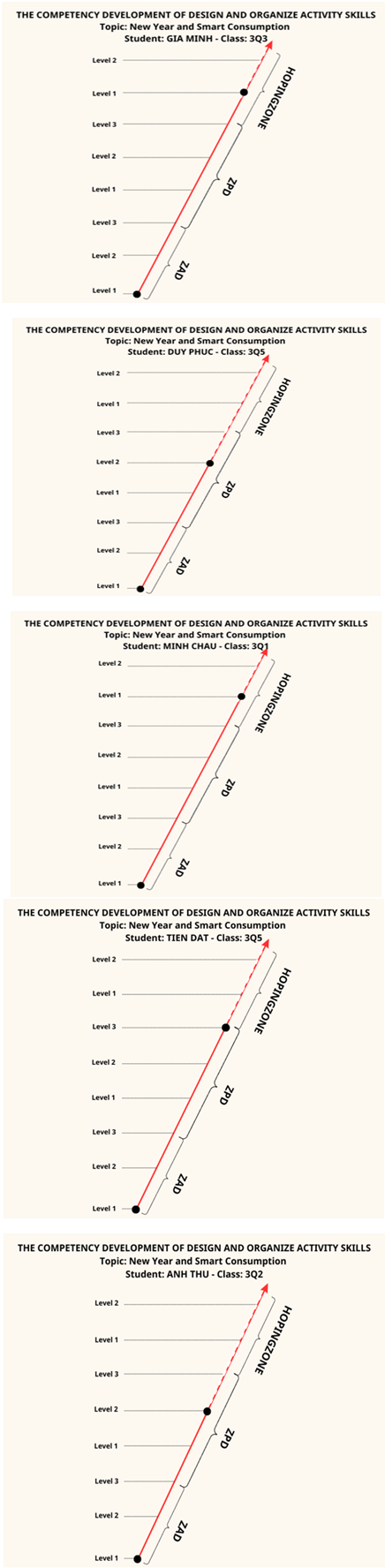
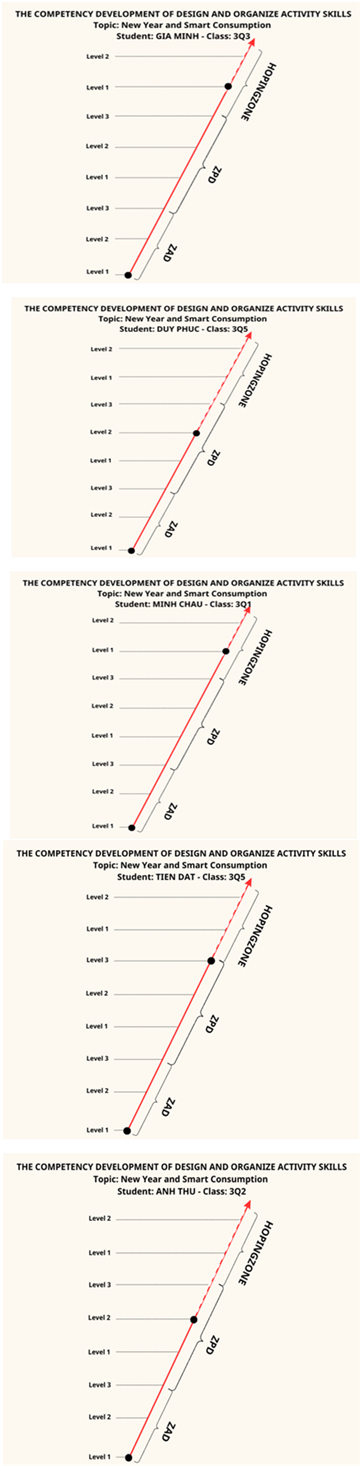
Based on the gathered data, the research team proceeded to draw the competency development trajectory for students across the classes. Five specific cases were selected for further analysis (Figure 1).
It can be observed that students achieve varying levels on the competency scale within each developmental zone. Accordingly, based on individual students' competency development trajectories, teachers can aggregate and categorize students. In cases where no students reach the Hoping Zone (HZ), teachers need to review and adjust the indicators to align with the abilities of their class.
(8) Student Categorization
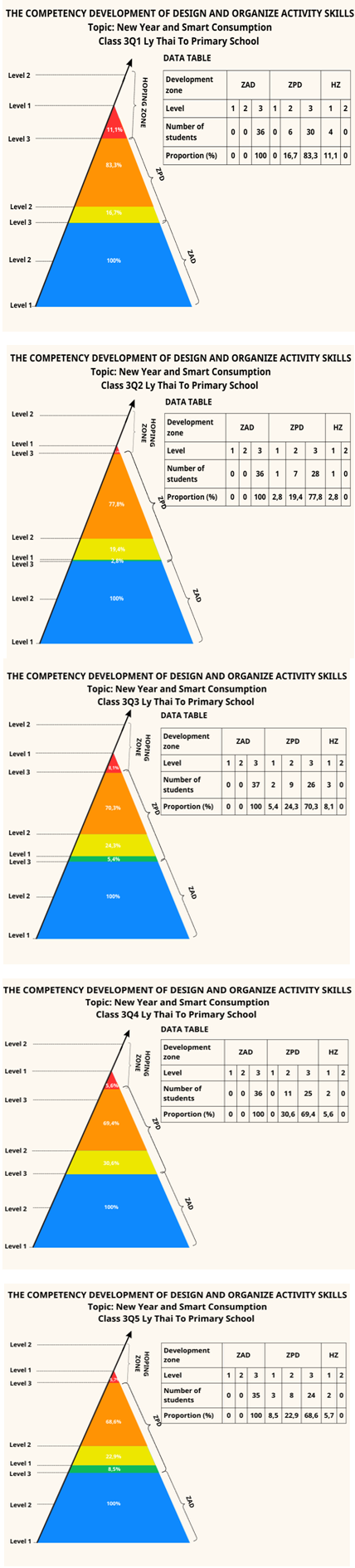
Drawing from students' competency development trajectories, the research team synthesized the results and categorized students based on the percentage of total students. In practice, there are still students who exhibit competency development surpassing that of the nearest developmental zone. Therefore, this sets the stage for appropriate student assessment and categorization, providing teachers with a basis for selecting suitable teaching methods and adjusting teaching materials and content to cater to the needs of each student group (Figure 2).
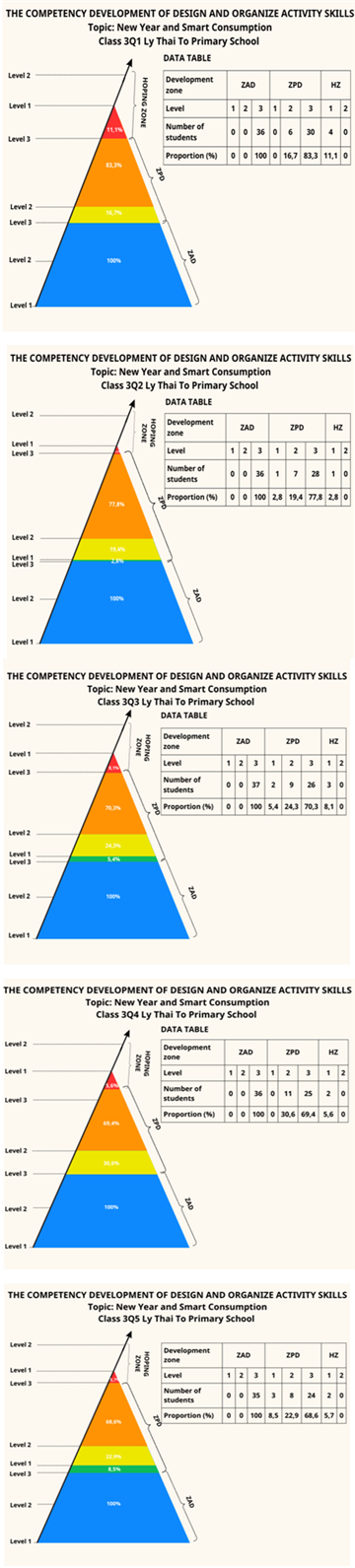
Through the experimental process, the research group developed an indicator table based on three developmental zones. Using this indicator table, the group created tests for the students. The test results showed that some students met the criteria within the Zone of Proximal Development (ZPD) and progressed towards the Hoping Zone (HZ).
The experiment also revealed that the competency development pathways of each student vary in their levels of development. The pathway includes zones with smaller levels arranged in an upward direction, reflecting the general development process. The individual development of each student is represented by a black dot moving along the general development pathway.
The Hoping Zone (HZ) has higher and more complex requirements, so very few students achieved this level even with support. In fact, no student reached the HZ, indicating that teachers need to review and adjust the indicators to better suit their class.
Based on the competency development pathways of each student, teachers can summarize and categorize students into different levels.
| [1] | J. P. &. T. S. L. Lantolf, "Implementing Vygotsky’s Zone of Proximal Development: The Role of the Teacher," The Modern Language Journal, 2006. | ||
| In article | |||
| [2] | M. Liu, "Implementing the Zone of Proximal Development in EFL Classrooms: A Study of the Effects of Scaffolding on Speaking Proficiency," Language Teaching Research, 2019. | ||
| In article | |||
| [3] | Galileo, Educational Network, University of Calgary, Canada, 2014. | ||
| In article | |||
| [4] | Pho Duc Hoa, Acitive Teaching and Learning in Primary Education, Hanoi National University of Education Publishing House, 2013. | ||
| In article | |||
| [5] | Pho Duc Hoa, Ngo Quang Son, Teaching Methods and Technologies in Interactive Pedagogical Environments, Hanoi National University of Education Publishing House, 2016. | ||
| In article | |||
| [6] | C. Blades, Thoughts on Children and Learning, University of Calgary, Canada, 2002. | ||
| In article | |||
| [7] | Do Huong Tra, Pho Duc Hoa Theory of Modern Teaching, Hanoi National University of Education Publishing House, 2024. | ||
| In article | |||
| [8] | D. John, Democracy and Education, The free press, 2001. | ||
| In article | |||
| [9] | Andrich, D. (2005). The Rasch model explained. Applied Rasch measurement: A book of exemplars: Papers in honour of John P. Keeves, 27-59. | ||
| In article | View Article | ||
| [10] | M. o. E. a. Training, "Thư viện pháp luât," 26 12 2018. [Online]. Available: https://thuvienphapluat.vn/van-ban/Giao-duc/Circular-32-2018-TT-BGDDT-promulgating-general-education-program-519827.aspx. [Accessed 26 05 2024]. | ||
| In article | |||
| [11] | Ministry of Education and Training, Using Teaching and Educational Methods to Develop the Qualities and Competencies of Primary School Students (Rgep Project - Modules 2, 3, 4), Hanoi, 2020 – 2021. | ||
| In article | |||
| [12] | Pho Duc Hoa, Vu Thi Lan Anh, Organization of Experiential Activities in Primary Education, Hanoi National University of Education Publishing House, 2020. | ||
| In article | |||
| [13] | Pho Duc Hoa (Editor), Textbooks and Teaching Guides for Experiential Activities 1, 2, 3, 4, Creative Horizon Series (Edition 1), Vietnam Education Publishing House, 2020-2023. | ||
| In article | |||
Published with license by Science and Education Publishing, Copyright © 2024 Pho Duc Hoa, Nghiem Thanh Hien, Truong Khanh Linh, Nguyen Thi Thu Hien, Nguyen Thi Van Khanh and Bui Thi Quynh Chau
 This work is licensed under a Creative Commons Attribution 4.0 International License. To view a copy of this license, visit
https://creativecommons.org/licenses/by/4.0/
This work is licensed under a Creative Commons Attribution 4.0 International License. To view a copy of this license, visit
https://creativecommons.org/licenses/by/4.0/
| [1] | J. P. &. T. S. L. Lantolf, "Implementing Vygotsky’s Zone of Proximal Development: The Role of the Teacher," The Modern Language Journal, 2006. | ||
| In article | |||
| [2] | M. Liu, "Implementing the Zone of Proximal Development in EFL Classrooms: A Study of the Effects of Scaffolding on Speaking Proficiency," Language Teaching Research, 2019. | ||
| In article | |||
| [3] | Galileo, Educational Network, University of Calgary, Canada, 2014. | ||
| In article | |||
| [4] | Pho Duc Hoa, Acitive Teaching and Learning in Primary Education, Hanoi National University of Education Publishing House, 2013. | ||
| In article | |||
| [5] | Pho Duc Hoa, Ngo Quang Son, Teaching Methods and Technologies in Interactive Pedagogical Environments, Hanoi National University of Education Publishing House, 2016. | ||
| In article | |||
| [6] | C. Blades, Thoughts on Children and Learning, University of Calgary, Canada, 2002. | ||
| In article | |||
| [7] | Do Huong Tra, Pho Duc Hoa Theory of Modern Teaching, Hanoi National University of Education Publishing House, 2024. | ||
| In article | |||
| [8] | D. John, Democracy and Education, The free press, 2001. | ||
| In article | |||
| [9] | Andrich, D. (2005). The Rasch model explained. Applied Rasch measurement: A book of exemplars: Papers in honour of John P. Keeves, 27-59. | ||
| In article | View Article | ||
| [10] | M. o. E. a. Training, "Thư viện pháp luât," 26 12 2018. [Online]. Available: https://thuvienphapluat.vn/van-ban/Giao-duc/Circular-32-2018-TT-BGDDT-promulgating-general-education-program-519827.aspx. [Accessed 26 05 2024]. | ||
| In article | |||
| [11] | Ministry of Education and Training, Using Teaching and Educational Methods to Develop the Qualities and Competencies of Primary School Students (Rgep Project - Modules 2, 3, 4), Hanoi, 2020 – 2021. | ||
| In article | |||
| [12] | Pho Duc Hoa, Vu Thi Lan Anh, Organization of Experiential Activities in Primary Education, Hanoi National University of Education Publishing House, 2020. | ||
| In article | |||
| [13] | Pho Duc Hoa (Editor), Textbooks and Teaching Guides for Experiential Activities 1, 2, 3, 4, Creative Horizon Series (Edition 1), Vietnam Education Publishing House, 2020-2023. | ||
| In article | |||