Lackadaisical attitude, the lack of spirit and liveliness, is considered as one of the integral factors contributing to the success of researchers in their task of crafting manuscripts and articles relative to their academic works. This study is designed to determine the level of lackadaisical attitude of graduate students in conducting research in the locale of the study. Employing mixed-method design particularly the Sequential Explanatory Design, the level of lackadaisical attitude among the respondents and the factors attributed to this utility from the informants are known. Mostly, the respondents hold high lackadaisical attitude on personal interest, research anxiety, and research difficulties, while very highly lackadaisical on conducting research and research use. Work affiliation is not found to be a significant factor on the occurrence of the lackadaisical attitude among the respondents while age is found to be a significant factor along personal interests and research difficulties. Likewise, the graduate students in the locale of the study hold varying lackadaisical attitude in conducting researches with age as an intervening factor. Moreover, the informants mostly find difficulty in developing topics and writing the research in general. These known difficulties form part in their confidence amidst their expected concordances in the Graduate School. Albeit developing poor spirit, the informants showed motivation to be better with their promotion and self-actualization. Thus, research students are in a constant stride of besting their abilities in engaging and performing a behavior in an academic parlance.
The dawn of the 21st century including the integration of research in the curricula is the birth of an emerging concern on the belief of students in doing research. Research, in the form of a thesis in the master’s program and a dissertation in the doctorate program, is regarded as funneling in the tedious process of acquiring an advanced degree. Corollary to this requirement is the alarming attitude of students in doing research which is becoming a world-wide phenomenon through the manifestation of a utility conflict in this academic pursuit in the graduate or advanced education.
In the Philippines, research in the graduate level engages students in discovery and applied research. As such, they are expected to demonstrate research knowledge towards government policies for them to participate in propelling the country’s competitiveness in the knowledge-driven global economy 1, 2, 3, 4. Moreover, research capability of students in the graduate level is very essential in this day and age of global competitiveness among different countries.
On the other hand, graduate education is a tough and robust level involving the writing of a thesis. Apparently, students are found in a burdening and stressful process 5, 6. This, however, depends on the institution’s research environment, a microclimate in the form of a shared emotionality that at times trigger the development of such negative intuitions about research 7. At the most, thesis writers are convoluted with the intricacies of conducting research along with their personal interest, research use, research anxiety, and research difficulties [8, 9,10,11].
Concomitantly, thesis writers particularly in the graduate level are facing a conflict of crafting research of academic rigor. This conflict has become an inequality in the equilibrium that stems drawbacks on the interest of many in doing a thesis as an academic requirement; albeit, for a fact that this requirement is equated to a relief in their work and works, achievement, and promotion. It can be underscored that higher academic ranks require the completion of an advanced study that involves research. Promotion serves a motivating factor among graduate students and thesis writers to undergo the tedious process of having an advanced education and undergoing the thesis program.
The crux is: research is an essential feature of the graduate or advanced education. In fact, it is always regarded as difficult by the students as they are expected to form new knowledge, re-interpret existing knowledge, and design new technologies towards the improvement or development of processes and procedures of strategic thrusts and pathways of an inclusive bureaucracy. It shall also address the dynamics and challenges of the society towards a functional and optimized institution of an advanced education.
The Mixed Method design particularly the Sequential Explanatory Design was employed in this study. This design fits best the need of this study to determine first the lackadaisical attitude of the respondents before describing their notion about the thesis of the study. The survey was employed to determine the respondents’ lackadaisical attitude while the narratology was employed in gathering data on the factors that trigger their lackadaisical attitude including their motivations in dealing with it.
In the case of the current study, a total of 46 thesis Writing students answered the survey designed to determine the lackadaisical attitude and spirit of students in conducting educational researches. From this number, five were chosen as the informants for the qualitative aspect of the study. They were the respondents who had the greatest score in terms of their vouched lackadaisical attitude or spirit. They were allowed to describe and narrate their insights on the factors that trigger their affordances including their motivations in overcoming this known attitude.
The instrument was based on the study of Nicolas, Sebastian, and Bautista 1 along attitude towards research. It has four parts: on conducting research, on personal interest, on research use, on research anxiety, and research difficulties. The instrument has the following reliability: .851, 874, .891, .895, and .829, respectively. According to Taber (2018), an alpha of at least .70 suggests reliability. Hence, it is valid and reliable instrument.
The quantitative data were treated through frequency, mean, t-Test Independent Samples, F-test, and Scheffe test for post hoc analysis. On the other hand, the qualitative data were analyzed using thematic analysis. Themes are formulated according to the recurring claims of the informants which served as bases in an inquiry-based analysis vis-à-vis the research problem. Aptly, the analysis done in the research includes familiarization and organization, coding and recoding, and summarizing and interpreting 3, 12.
Table 1 presents the general lackadaisical attitude of graduate students in conducting academic research. As it can be seen in the table, most of the respondents hold high lackadaisical attitude on personal interest, research anxiety, and research difficulties, while very highly lackadaisical on conducting research and research use. It is also apparent that the scores are skewed to the left with most scores vouched to high and very high lackadaisical categories. The foregoing results denote that the respondents hold a strong lackadaisical attitude in conducting academic research.
In view of the locale and parameters of this study, the respondents are confronted by the conflict of crafting research of academic rigor. In view of the Conflict Theory 13, the inequality in terms of academic preparation on research writing has made a significant conflict on the interests of many research writers. This conflict on knowing to conduct research is a natural phenomenon among them: a conflict that must not draw strata on the equity of having an advanced education.
The foregoing results construe with the findings of reference 5, 10, 14. It was claimed that graduate students do not show optimum attitude in doing advanced research. Moreover, it was further claimed that graduate students are encountering challenges on developing interest in research and the inability to select researchable topics 2. Aptly, they are found to develop anxieties in conducting researches as requirements of their program.
Table 2 presents the lackadaisical attitude of the respondents in conducting academic researches when grouped by affiliation. It can be noted that respondents hold varying levels of lackadaisical attitude, from moderate to high lackadaisical. Respondents from the non-academic group hold higher level of lackadaisical along conducting researches, personal interest and research use than their counterparts in the academic group although their vouched responses are of similar descriptions. On the other hand, respondents from the academe hold higher affordances along research anxieties and difficulties when compared to their counterparts from the industry. Albeit of varying responses, statistical analyses paved for the determinant of comparable states in the five areas of concern in conducting academic researches. Henceforth, the study failed to reject the null hypothesis stating that there are no significant differences on the lackadaisical attitude of the graduate students in conducting academic researches when grouped by affiliation.
In view of the studies conducted oversees, students in the advanced studies, whether master’s or doctorate, are in a stride of developing positive attitude towards research because it has been a major requirement of the program 14, 15, 16, 17. This positive attitude of the advanced students overseas is attributed to the fact that research plays a major factor in the job descriptions of professionals. Moreover, research is also a major requirement of an advanced education along with research presentation and publication which is an international good practice of universities long time ago.
In the case of the current study, research had been a major course requirement but the students are not required to undergo research presentation to international fora and conference, and publication to peer-reviewed journals especially international journals. These requirements were just initiated in 2019 by the virtue of CMO 15 of the Commission on Higher Education which centers on the Policies, Standards, and Guidelines for Graduate Programs 18. Moreover, research requirement in both academe and industry is not necessarily taken seriously by the workers as it may not be a major requirement for workers. It may be a component but employees do not necessarily comply with it.
Table 3 presents the lackadaisical attitude of the respondents in conducting academic researches when grouped by age. It can be noted that respondents hold varying levels of lackadaisical attitude, from moderate to high lackadaisical. Furthermore, it can be noted that responses along conducting research, research use, and research anxiety earned comparable results: p-values of .161, .921, and .079, respectively, which further suggest insignificant results. On the other hand, significant results are posted along personal interest and research difficulties at .05 level of significance. As to research interest, respondents belonging to the age group 37+ earned the highest lackadaisical attitude followed by the 32-36 group. It can be noted that the age groups 22-26 and 27-31 have the least lackadaisical attitude. Moreover, the age group 37+ is also found to conform with greater difficulties in research when compared with their counterparts in the younger age groups. Apparently, age is a factor involved in establishing the interest of researchers since they are the products of the new curriculum in their undergraduate programs that require academic researches.
The following are the factors associated with the known lackadaisical behavior of the informants in conducting academic researches:
Difficulty in formulating research topics. The very first step in doing research is to identify a concept or a topic of academic rigor. The studies of reference [3, 4] 3, 4 elucidated that research requires expertise and preparation which could be manifested in the formulation of research topics or concepts. Their abilities in identifying and formulating one are believed to require a mental cognition and acumen which is sometimes a problem of many.
The following transcripts qualify the claim of this study that the informants’ difficulty in identifying and formulating research topics triggers their lackadaisical attitude in doing research:
“…identifying a relevant and timely topic is difficult to do…” GS1
“… formulating a topic is the most difficult thing to do…” GS2
“…I find difficulty in coming up with a concept or a topic…” GS3
“… What makes a sound topic? This is always my problem and I have difficulty in doing one…” GS4
“…identifying and formulating a research topic worthy of writing and defending is too difficult. I got stocked in it…” GS5
In the case of the current study, the admissions of the informants on their difficulty in conceptualizing a topic is considered to be the most difficult thing to do in the lives of thesis writers vis-à-vis the relevance and timeliness of the concept (GS1, GS2, GS3). Academic soundness is also considered on top of the idea of writing and defending it (GS4, GS5).
Difficulty in writing. Part and parcel of an advanced study is a thesis or dissertation. Nowadays, this requirement is upscaled through a research presentation and publication as stated in CMO 15, s. 2019 18. However, contrary to this usual norm in pursuing an advanced studies is the fact that not everybody is a writer. Alongside with this, writing is claimed to be a gift which falter many like the cases of the following informants as research is believed to have its own language and standards 16, 19, 20.
The following transcripts qualify the claim of this study that the informants’ difficulty in writing triggers their lackadaisical attitude in doing research:
“…writing the thesis is another thing to consider. I am not a good writer; I know that for a fact…”GS1
“…I want to learn proper ways to write the manuscript. I need to learn the intricate writing styles of doing thesis/research…” GS2
“…I want to write (of course) but I need to learn how. At times, I have difficulty in writing, in honing my motivation to write, etc…”GS3
“…I wanted to write, to do research but I struggle in writing…” GS4
“…I am troubled in digesting the literature of my work as a preliminary in writing it. I am sweating with this, how to write it is difficult…”GS5
In the case of the current study, all of the informants have difficulty in writing. The full admission of the informants manifests that students in the Graduate School are not necessarily capable of doing the research requirement of their academic courses and program. Albeit in the midst of a constraint, the informants are still in a stride of doing their best to respond to this requirement which requires mental virility and robustness.
Lack of Confidence. Corollary to the difficulty in writing is the lack of confidence among thesis or dissertation writers due to their technical knowledge and know-how including expertise 21, 22. Confidence in this sense is the drive of every person to undergo rigorous cognition and self-actualization like undergoing a thesis writing. In most cases, student-writers tend to abate as they lack the courage, confidence, and technical know-how of the intricate process of thesis writing.
The following transcripts qualify the claim of this study that the informants’ confidence triggers their lackadaisical attitude in doing research:
“…doing research requires much motivation and confidence. It involves technical know-how on the intricate process of doing a scientific paper. It is just I am not confident with regards to my writing skills…”GS1
“…I can write but I lack the confidence in writing. After that I need to present it before a forum of which I am afraid of. I do not have the courage; the confidence of doing it…” GS2
“…I do not have the guts of doing it: in writing, presenting, etc…” GS3
“…I know that it (research) is only for the strong ones: those who have intuitive bravery…” GS4
“…I feel something strange every time I write. I know that my output is not nice. I know that I am not confident with my output…” GS5
In the case of the current study, the informants manifested a strange scenario in the academic community. Their current state and concordances are clear deviances to the expected competencies of students in the advanced programs.
On the other hand, the informants draw a gargantuan motivation in dealing with this academic requirement, writing a thesis. The informants have immensely claimed that they are motivated by promotion and self-actualization in pursuing their thesis. The following are the factors associated with the motivation of the informants in conducting academic researches:
Promotion. Promotion, along with the growth and development of employees and workers, forms an integral part on how people aspire in their respective work and works. Aptly, employees are often motivated by being promoted. Promotion, which entails a financial reward, is often regarded as one of the drivers affecting the motivation, actions, and intentions of every employee in the workplace. These are believed to fuel hardwork among employees affecting their performances and work-related behavior 3, 22, 23, 24.
The following transcripts qualify the claim of this study that promotion inspires the informants to write research despite their difficulties in doing one:
“…Yeah! I am motivated by promotion. I must admit that I am doing this for my promotion. Research has been a criterion…” GS1
“…of course, it is promotion…” GS2
“…I am inspired by the criteria for promotion in my work. Research is now included as a key factor…” GS3
“…Promotion inspires me more. It requires advanced studies and of course, research…” GS4
“…Promotion counts as researchers are prioritized to be awarded and promoted…” GS5
In the cases of the informants of this study, their elucidated reasons are attuned with their promotion, there being incorporated in their advanced education and research outputs. It must be noted that research is now the main requirement of an advanced study. Moreover, research is now an emerging requirement in almost all forms of work and works. Informant 5 (GS5) admission is a clear manifestation that employees who are into research are prioritized to be awarded and promoted. Likewise, GS3 realized that research is a key factor in today’s promotional scheme.
These concordances are in parallel with the provisions of the Incentive Theory of Motivation 25. This theory follows the behaviorist idea of operant conditioning with certain parallels. Behaviors are learned in operant conditioning by creating connections with performance via consequences. Moreover, this theory involves the concept of incentives implying that people follow various courses of actions in obtaining rewards and recognition. The greater the offer and reward, the greater is the likelihood for people to pursue reinforcements relative to the tasks involved. Henceforth, thesis writing as a partial fulfillment of the requirements for an advanced study is fulfilled by a series of motivations and incentives.
Self-actualization. A part from the monetary motivation brought by their promotion in their workplace is the idea of fueling their psychological needs and the relatedness of having realized their full potentials. Self-actualization could be regarded as the drive and idea to co-exist with their workmates despite their incapability in doing academic research. The Theory of Reasoned Action (TRA) of Fishbein and Ajzen 26 explicates the congruency of actions and motivations in mental acumen of people. The tenets of TRA rationalize the actions of people in adversaries, like the conflict of the utility on research in their studies and promotion, to wit: (1) the more favorable the attitude of an individual towards a behavior, the stronger will be the intention of the individual to engage in the behavior; (2) the greater the subjective norm, the stronger the intention of the individual to perform the behavior; and (3) the stronger the intention of the individual to engage in a behavior, the more likely the individual will be to perform it.
Moreover, self-actualization is coined to the Humanistic Motivation Theory 27. Under the ambits of this theory, people hold strong cognitive reasons for doing different actions as claimed in the hierarchy of needs and motivation in various levels. At the onset, people are motivated to fulfill their basic biological needs. Consequently, people shift their focus to the need for self-actualization or the desire to fulfill one's individual potential. Therefore, the output of the researchers is paramount to the realization of their potentials.
The following transcripts qualify the claim of this study that self-actualization is one of the considerations of the informants to write research despite their difficulties in doing one:
“…Aside from the promotion, I want to discover my ability to write. I am inspired by the researchers that I meet…”GS2
“…I would like to learn more aside from being promoted (I hope so). I want to discover my writing prowess. I want to grow professionally…”GS3
“…Researchers are often times recognized (too often). I am inspired by this and I want to discover my abilities…” GS5
The admissions of informants 2, 3, and 5 clear their inner drive and concordances of doing better in their requirements as they want to discover their abilities in writing. Their knowledge and appreciation to the researchers they meet propel their idea of growing professionally on top of becoming recognized as a researcher. Aptly, despite being challenged by the intricacies of doing research is the motivation to be better in their work and works.
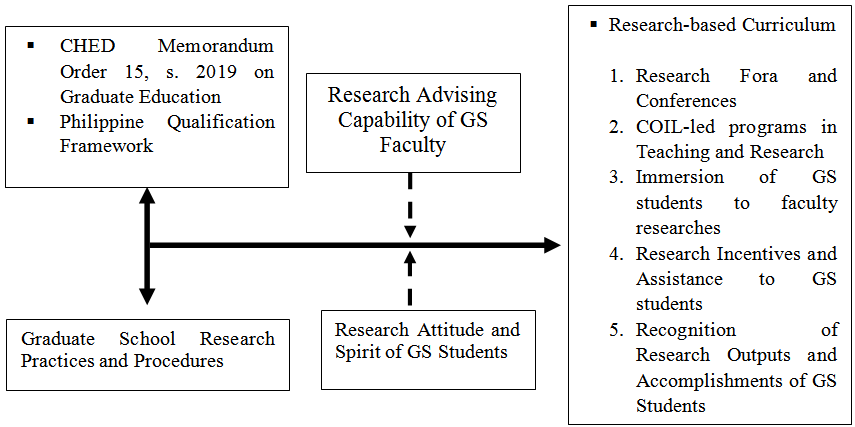
3.3. Intervention Program to Bolster the Research Attitude and Behavior of Graduate StudentsPresented in Figure 1 are the standards required of a Graduate School faculty and student as stated in CHED Memorandum Order 15, s. 2019 on the revitalized Graduate Education program and the Philippine Qualification Framework. Corollary to these standards are the practices and procedures implemented by the Graduate School of the university. Impinging to these practices and standards are the research attitude and spirit of the students together with the qualifications and advising prowess of the faculty. It can be noted that the success of the students in their Thesis Writing depends much on their research advisors.
The concordances and affordances of the graduate school students in the realms of their research requirements for their academic degrees are embodiment of the institution’s research culture as reflected in their curriculum. The following may be done to bolster the research culture in the university:
1. Conduct of Research Fora and Conferences. Since they are in advanced education, students may be exposed to a potpourri of academic learning experiences with other resource speakers and lecturers. They may be brought to learning encounters in fora and conferences including colloquia. These encounters are expected to sharpen the academic insights and understanding of the students and in return, new insights and perspectives that can transform their research capabilities;
2. Corollary to the university’s conduct of fora and conferences, the management may offer their own conferences and colloquia through their initiatives of bringing in new culture and experiences with their partners under the Collaborative Online International Learning (COIL) program;
3. As part of their learning encounters, the students may be immersed to the research activities of their professors as research assistant, tabulators, literature miners, among others. Professors may mentor these graduate students in doing the intricate process of research under the niche and shepherding program. Exposure to such framing activities and experiences may harness their potentials and eventually transcend their research culture;
4. The university may also devise a program to incentivize the research activities, output, and accomplishments of faculty and students. They may be sent to research conferences either as a participant or a presenter. Reliefs on registration fees and other monetary assistance may also be given. Other reliefs on research publications may also be given like free access to data treatment facilities, plagiarism checker, free publication, among others to student output;
5. The university may also initiate recognizing the research outputs of the faculty and students like awarding best researcher, best paper, best presenter, publication award, best research advisor, among others during the slated colloquium or graduation rites.

Based on the parameters and findings of this study, the following are drawn:
1. Graduate students own lackadaisical attitude and spirit in conducting advanced educational researches;
2. Age of the graduate students affects their personal interest and research difficulties in conducting advanced educational researches;
3. The factors associated with the lackadaisical attitude of the graduate students are centered on their difficulty in formulating research topics, difficulty in writing, and lack of confidence;
4. The factors motivating the graduate students to draw interests in conducting advanced educational researches are promotion and self-actualization.
Having said that the graduate students in the locale of the study hold lackadaisical attitude and spirit in conducting advanced educational researches, the management may devise strategic programs and activities that will develop their passion in writing researches, e.g., research-based courses, exposure to fora and conferences (locally, nationally, and internationally), seminars and workshops, faculty-student tandem to mini-papers, among other strategies that will maximize the potentials of every graduate student.
| [1] | Nicolas, MU., Ignacio, SS., & Bautista, RG. (2023) Action research attitude of teacher-researchers in a schools-district in Quirino Province, Philippines. International Journal of Social Sciences & Humanities, 8(2), 106-117. | ||
| In article | |||
| [2] | Casanova, VS. (2021). Predictors of graduate students’ research performance in the Philippine state-run higher education institution. Journal of Education and Learning, 10(5), 170-176. | ||
| In article | View Article | ||
| [3] | Bautista, RG. (2021). Paid academic services with mercy and compassion: Phenomenologizing the lived experiences of research mercenaries in the Philippines. Turkish Journal of Computer and Mathematics Education, 12(3), 5335-5340. | ||
| In article | View Article | ||
| [4] | Sanchez, K.L.D., Malinao, C.W.M., & Bautista, R.G. (2017). University research writing: A burden or a key to success? QSU-CTE Journal of Educational Practices and Standards, 2(1), 10-21. | ||
| In article | |||
| [5] | Akyurek, E. & Afacan, O. (2018). Problem encountered during the scientific research process in graduate education: The institute of educational sciences. Higher Education Studies, 8(2), 47-58. | ||
| In article | View Article | ||
| [6] | Anttilla, H., Lindblom-Ylanne, S., Londa, K., & Pyhaltö, K. (2015). The added value of a PhD in medicine - PhD students’ perceptions of acquired competences. International Journal of Higher Education, 4(2), 172-180. | ||
| In article | View Article | ||
| [7] | Christensen, M. K.,& Lund, O. (2014). Doctoral education in a successful ecological niche: A qualitative exploratory case study of the relationship between the microclimate and doctoral students’ learning to become a researcher. International Journal of Higher Education, 4(3), 103-113. | ||
| In article | View Article | ||
| [8] | Parshad, NM., & Qasim, SH. (2021) Attitude towards research among the research scholars of sciences and arts stream. Science, Technology and Development, 9(7), 737-745. | ||
| In article | |||
| [9] | Iffat, S. (2020). Weighing research competency of undergraduates: An empirical study. IOSR Journal of Research & Method in Education, 10(2), 01-10. | ||
| In article | |||
| [10] | Abun, D., Magallanes, T., Encarnacion, MJ., & Foronda, SL. (2019). The attitude of graduate students toward research and their intention to conduct research in the future. International Journal of Modern Research in Engineering & Management, 2(11), 74-87. . | ||
| In article | |||
| [11] | Papanastasiou, E. C. (2005). Factor Structure of the Attitudes Toward Research Scale. Statistic Education Research Journal, 4(1), 16-26. | ||
| In article | View Article | ||
| [12] | Nowell, L., Norris, J., White, D., & Moules, N. (2017). Thematic analysis: Striving to meet the trustworthiness criteria. International Journal of Qualitative Methods, 11, 248-258. | ||
| In article | View Article | ||
| [13] | Keenan, E. K., & Miehls, D. (2008). Third space activities and change processes: An exploration of ideas from social and psychodynamic theories. Clinical Social Work Journal, 36(2), 165-175. https://10.1007/s10615-007-0117-1. | ||
| In article | View Article | ||
| [14] | Kakupa, P. & Xue, H. (2019). Students’ Attitudes towards Research: A Study of Graduate Education Students at a Chinese Normal University. Educational Process: International Journal, 8(2), 97-110. | ||
| In article | View Article | ||
| [15] | Khan, S., Shah, SM., & Khan, TM. (2018). An investigation of attitudes towards the research activities of University teachers. Bulletin of Education and Research, 40(1), 215-230. | ||
| In article | |||
| [16] | Muthuswamy, P., Vanitha, R., Suganthan, C. & Ramesh, PS. (2017). A study on the attitude towards research among doctoral students. International Journal of Civil Engineering and Technology, 8(11), 811–823. | ||
| In article | |||
| [17] | Butt, Intzar H. & Shams, JA. (2013). Master in education student attitude towards research: A comparison between two public sector universities in Punjab. South Asian Studies, 28(1), 97-105. | ||
| In article | |||
| [18] | CMO 15, s. 2019. Commission on Higher Education, Policies, Standards, and Guidelines for Graduate Programs. https://ched.gov.ph/wp-content/uploads/CMO-No.-15-Series-of-2019-–-Policies-Standards-and-Guidelines-for-Graduate-Programs-Updated.pdf. | ||
| In article | |||
| [19] | Asogwa, B. C., Wombo, A. D., & Ugwouke, C. U. (2015). Challenges and coping strategies adopted by postgraduate students of agricultural education in Thesis writing in Nigerian universities. American Journal of Operations Research, 4, 311−318. | ||
| In article | View Article | ||
| [20] | Moral, RV (2020). Teachers’ attributes and their students’ research productivity. Journal of Creative Writing, 4(2), 1-34. | ||
| In article | |||
| [21] | Nasser-Abu Alhija, FM., & Majdob, A. (2017). Predictors of teacher educators’ research productivity. Australian Journal of Teacher Education, 42(11), 34-51. | ||
| In article | View Article | ||
| [22] | Subia, GS., Florencodia, NT., Trajano, MG., Gutierrez, MP., ZAbala, BA. (2018). Factors associated with the research paper writing capabilities of Engineering Management and Vocational Technological Education freshman students. International Journal for Research & Development in Technology, 9(3), 110-114. | ||
| In article | |||
| [23] | Alvarado, F., Leon, M., & Colon, A. (2016). Design and validation of a questionnaire to measure research skills: experience with engineering students. Journal of Technology and Science Education, 6(3), 219-233. | ||
| In article | View Article | ||
| [24] | Aguiran, J. M. N., Lazo, R. B., & Salabat, M. J. C. (2014). Factors affecting students’ performance in research. CVCITC Research Journal, 1(2), 37−47. | ||
| In article | |||
| [25] | Gormezano, I., & Coleman, S. R. (1985). [Review of Mechanisms of Adaptive Behavior: Clark L. Hull’s Theoretical Papers, with Commentary, by C. L. Hull, A. Amsel, & M. E. Rashotte]. Behaviorism, 13(2), 171–182. http://www.jstor.org/stable/27759075. | ||
| In article | |||
| [26] | Kim, J., & Nan, X. (2012). Understanding the psychology of attitudes: A review of attitudes research guided by theories of behavioral intention and dual-process models. In Psychology of Attitudes (pp. 35-59). Nova Science Publishers, Inc. | ||
| In article | |||
| [27] | Winston, CN. (2016). An existential-Humanistic-Positive Theory of Human Motivation. The Humanistic Psychologist, 44(2), 142-163. | ||
| In article | View Article | ||
Published with license by Science and Education Publishing, Copyright © 2024 Romiro G. Bautista and Peter Paul S. Cagatao
 This work is licensed under a Creative Commons Attribution 4.0 International License. To view a copy of this license, visit
http://creativecommons.org/licenses/by/4.0/
This work is licensed under a Creative Commons Attribution 4.0 International License. To view a copy of this license, visit
http://creativecommons.org/licenses/by/4.0/
| [1] | Nicolas, MU., Ignacio, SS., & Bautista, RG. (2023) Action research attitude of teacher-researchers in a schools-district in Quirino Province, Philippines. International Journal of Social Sciences & Humanities, 8(2), 106-117. | ||
| In article | |||
| [2] | Casanova, VS. (2021). Predictors of graduate students’ research performance in the Philippine state-run higher education institution. Journal of Education and Learning, 10(5), 170-176. | ||
| In article | View Article | ||
| [3] | Bautista, RG. (2021). Paid academic services with mercy and compassion: Phenomenologizing the lived experiences of research mercenaries in the Philippines. Turkish Journal of Computer and Mathematics Education, 12(3), 5335-5340. | ||
| In article | View Article | ||
| [4] | Sanchez, K.L.D., Malinao, C.W.M., & Bautista, R.G. (2017). University research writing: A burden or a key to success? QSU-CTE Journal of Educational Practices and Standards, 2(1), 10-21. | ||
| In article | |||
| [5] | Akyurek, E. & Afacan, O. (2018). Problem encountered during the scientific research process in graduate education: The institute of educational sciences. Higher Education Studies, 8(2), 47-58. | ||
| In article | View Article | ||
| [6] | Anttilla, H., Lindblom-Ylanne, S., Londa, K., & Pyhaltö, K. (2015). The added value of a PhD in medicine - PhD students’ perceptions of acquired competences. International Journal of Higher Education, 4(2), 172-180. | ||
| In article | View Article | ||
| [7] | Christensen, M. K.,& Lund, O. (2014). Doctoral education in a successful ecological niche: A qualitative exploratory case study of the relationship between the microclimate and doctoral students’ learning to become a researcher. International Journal of Higher Education, 4(3), 103-113. | ||
| In article | View Article | ||
| [8] | Parshad, NM., & Qasim, SH. (2021) Attitude towards research among the research scholars of sciences and arts stream. Science, Technology and Development, 9(7), 737-745. | ||
| In article | |||
| [9] | Iffat, S. (2020). Weighing research competency of undergraduates: An empirical study. IOSR Journal of Research & Method in Education, 10(2), 01-10. | ||
| In article | |||
| [10] | Abun, D., Magallanes, T., Encarnacion, MJ., & Foronda, SL. (2019). The attitude of graduate students toward research and their intention to conduct research in the future. International Journal of Modern Research in Engineering & Management, 2(11), 74-87. . | ||
| In article | |||
| [11] | Papanastasiou, E. C. (2005). Factor Structure of the Attitudes Toward Research Scale. Statistic Education Research Journal, 4(1), 16-26. | ||
| In article | View Article | ||
| [12] | Nowell, L., Norris, J., White, D., & Moules, N. (2017). Thematic analysis: Striving to meet the trustworthiness criteria. International Journal of Qualitative Methods, 11, 248-258. | ||
| In article | View Article | ||
| [13] | Keenan, E. K., & Miehls, D. (2008). Third space activities and change processes: An exploration of ideas from social and psychodynamic theories. Clinical Social Work Journal, 36(2), 165-175. https://10.1007/s10615-007-0117-1. | ||
| In article | View Article | ||
| [14] | Kakupa, P. & Xue, H. (2019). Students’ Attitudes towards Research: A Study of Graduate Education Students at a Chinese Normal University. Educational Process: International Journal, 8(2), 97-110. | ||
| In article | View Article | ||
| [15] | Khan, S., Shah, SM., & Khan, TM. (2018). An investigation of attitudes towards the research activities of University teachers. Bulletin of Education and Research, 40(1), 215-230. | ||
| In article | |||
| [16] | Muthuswamy, P., Vanitha, R., Suganthan, C. & Ramesh, PS. (2017). A study on the attitude towards research among doctoral students. International Journal of Civil Engineering and Technology, 8(11), 811–823. | ||
| In article | |||
| [17] | Butt, Intzar H. & Shams, JA. (2013). Master in education student attitude towards research: A comparison between two public sector universities in Punjab. South Asian Studies, 28(1), 97-105. | ||
| In article | |||
| [18] | CMO 15, s. 2019. Commission on Higher Education, Policies, Standards, and Guidelines for Graduate Programs. https://ched.gov.ph/wp-content/uploads/CMO-No.-15-Series-of-2019-–-Policies-Standards-and-Guidelines-for-Graduate-Programs-Updated.pdf. | ||
| In article | |||
| [19] | Asogwa, B. C., Wombo, A. D., & Ugwouke, C. U. (2015). Challenges and coping strategies adopted by postgraduate students of agricultural education in Thesis writing in Nigerian universities. American Journal of Operations Research, 4, 311−318. | ||
| In article | View Article | ||
| [20] | Moral, RV (2020). Teachers’ attributes and their students’ research productivity. Journal of Creative Writing, 4(2), 1-34. | ||
| In article | |||
| [21] | Nasser-Abu Alhija, FM., & Majdob, A. (2017). Predictors of teacher educators’ research productivity. Australian Journal of Teacher Education, 42(11), 34-51. | ||
| In article | View Article | ||
| [22] | Subia, GS., Florencodia, NT., Trajano, MG., Gutierrez, MP., ZAbala, BA. (2018). Factors associated with the research paper writing capabilities of Engineering Management and Vocational Technological Education freshman students. International Journal for Research & Development in Technology, 9(3), 110-114. | ||
| In article | |||
| [23] | Alvarado, F., Leon, M., & Colon, A. (2016). Design and validation of a questionnaire to measure research skills: experience with engineering students. Journal of Technology and Science Education, 6(3), 219-233. | ||
| In article | View Article | ||
| [24] | Aguiran, J. M. N., Lazo, R. B., & Salabat, M. J. C. (2014). Factors affecting students’ performance in research. CVCITC Research Journal, 1(2), 37−47. | ||
| In article | |||
| [25] | Gormezano, I., & Coleman, S. R. (1985). [Review of Mechanisms of Adaptive Behavior: Clark L. Hull’s Theoretical Papers, with Commentary, by C. L. Hull, A. Amsel, & M. E. Rashotte]. Behaviorism, 13(2), 171–182. http://www.jstor.org/stable/27759075. | ||
| In article | |||
| [26] | Kim, J., & Nan, X. (2012). Understanding the psychology of attitudes: A review of attitudes research guided by theories of behavioral intention and dual-process models. In Psychology of Attitudes (pp. 35-59). Nova Science Publishers, Inc. | ||
| In article | |||
| [27] | Winston, CN. (2016). An existential-Humanistic-Positive Theory of Human Motivation. The Humanistic Psychologist, 44(2), 142-163. | ||
| In article | View Article | ||