The topic Fundamental of Chemistry is one of the three learning topics in the Chemistry Grape 10 Program (2018). The objective of the topic is to expand and improve knowledge to meet the requirements of deep differentiation at the high school level. With the specificity of the content, which includes basic knowledge as a basis for learning and research in chemistry, the organization of teaching this topic has many opportunities to develop chemical thinking, problem-solving, and creativity competencies for students. This article shows the research results on the application of learning contract teaching methods in teaching the topic Fundamental of Chemistry in order to develop problem-solving and creativity competencies for students.
In the world, the concept of competency appeared long ago in history. According to Mulder, the Weigel & Collins concept of NL first appeared in Plato's work (Lysis 215 A., 380 BC), but became popular and focused on research from the beginning in the 1970s. Up to now, there have been many different approaches and definitions of competency given by organizations and individuals such as the OECD (2002), Québec - Ministere de l'Education (2004), F.E. Weinert, Howard Gardner, Tremblay, etc. However, it can be seen that the authors have made general statements that competency is the ability of each individual to mobilize knowledge, skills, and attitudes to successfully perform a certain task in a defined context 1. In research on problem-solving and creative competency development, author V. Okon, a Polish educator, proposed the problem-based teaching method 2. In addition, Lecne has researched and clarified the nature of the problem-based teaching method to stimulate creativity, promote students' cognitive positivity, and improve learning results 3. Furthermore, Ian Robertson's research has highlighted three important issues related to problem-solving: (1) How do we create problematic situations, and what does the strategy apply when we do not know what to do? (2) How do we apply it in different contexts? That is related to the role of logic in the thinking of each person; (3) the process of thinking to solve problems will promote creativity in the solutions of the learners. Besides, the authors of Ester Care, Patrick Griffin, and Mark Wilson proposed the structure of problem-solving competency with two components: social and cognitive competency, the problem-solving competency classification scale includes six levels from low to high to measure problems from simple to complex 4.
In Vietnam, problem-solving competency is one of the important general competencies that need to be formed and developed for high school students 5. Some authors have studied and developed NL for students in chemistry teaching, such as Nguyen Thi Phuong Thuy, Nguyen Thi Suu, Cao Thi Thang, Pham Thi Bich Dao, Nguyen Thi Hong Gam, etc. In their studies, the authors mentioned the characteristics, structure, and manifestations of the problem-solving competency and proposed a number of measures to develop this competence, such as project teaching, problem-solving teaching, integrated teaching, etc.
In research on topic-based teaching methods, authors Nguyen Van Thai Binh, Nguyen Tien Trung, and Nguyen Manh Tuan mentioned the concept of teaching topics, some causes leading to the need to design teaching topics; Objectives of designing teaching topics; some requirements when developing the classroom program through teaching topics; Structure of a teaching topic; Steps to design teaching topics 6. In addition, the authors Phan Thi Thanh Hoi and Le Thanh Oai mentioned the process of building an integrated thematic education to protect the environment and illustrated the design of a biological thematic 7 integrating environmental protection education 7. Author Nguyen Van Bien proposed the process of building an integrated topic in natural science in seven steps 8. Moreover, in order to meet the needs of general education innovation, the Ministry of Education and Training has compiled teacher training materials on "Developing teaching, testing, and assessment topics in the direction of developing students' competencies". In particular, the Vietnam Education Curriculum in Chemistry (2018) has identified Chemistry Grape 10 learning topics, including thematic topics 9: (1) Fundamental of Chemistry; (2) Chemistry in the prevention of fire and explosion; (3) Practice: Chemistry and information technology.
The inclusion of learning topics in the curriculum of the Vietnam Chemistry Grape 10 to meet the differentiation and career orientation requirements is one of the new points in the Vietnam General Education Curriculum (2018). Therefore, research on the use of active teaching methods to organize the teaching of learning topics to develop competencies in general and the problem-solving and creativity competencies in particular is an important and urgent requirement to help teachers effectively implement the current new General Education Curriculum. In this article, we present the research results on the application of the learning contract teaching method in the teaching of the topic "Fundamental of Chemistry" (Chemistry Grape 10) to develop problem-solving and creativity competencies for students.
Problem-solving and creativity competencies are the ability of individuals to effectively use cognitive processes, actions, attitudes, and emotions to analyze, propose solutions, choose solutions, and solve situations, solve learning or practical problems where there are no conventional processes, procedures, or solutions, and evaluate problem-solving solutions to adjust and flexibly apply them in new circumstances and tasks 5.
According to the General Education Program, the Master Program (2018), problem-solving and creativity competencies are two of the important general competencies that need to be formed and developed for students through all subjects and educational activities in general schools. The structure of problem-solving and creativity competencies includes the following competencies: (1) Recognizing new ideas; (2) Detecting and clarifying problems; (3) Forming and implementing new ideas; (4) Suggesting and selecting solutions; (5) Designing and organizing activities; (6) Independent thinking 5.
2.2. The Concept of Learning Contract TeachingLearning contract teaching is a way of organizing a learning environment in which each student is assigned to complete a package of different tasks/ assignments within a certain period of time. Students have the right to actively and independently decide on tasks (optional), the time for each task/ assignment and the order in which to perform those tasks/ assignments in the general time period 10.
2.3. Application of the Learning Contract Teaching Method in Teaching the Topic "Fundamental of Chemistry" (Chemistry Grape 10) to Develop Problem-Solving and Creativity Competencies for StudentsAccording to the Vietnam Education Curriculum in Chemistry (2018), the topic content of "Fundamental of Chemistry" consists of two main parts: (1) Structure of substances (chemical bonding) and (2) Chemical processes (nuclear reactions; activation energy of chemical reactions; entropy and Gibbs free energy variation). Accordingly, the study of the composition of the substance will give students a basis to deduce the properties of the substance (physics and chemistry), and chemical processes will help to consider the likelihood of reactions occurring or not and the level of reaction. The study of general chemistry knowledge will help learners approach the nature and rules of chemistry when studying and learning about it, as well as the application of chemistry in practice.
Students have acquired some basic knowledge of "Chemical bonding" in the Chemistry Grape 10 program, but through the topic "Fundamental of Chemistry." Students will study this knowledge at a deeper and more extended level through the topic "Fundamental of Chemistry,", such as: using the VSEPR model to predict geometry for some simple molecules, hybridization, etc. In addition, the knowledge of chemical processes is new to students. Characteristics of the knowledge of the "Fundamental of Chemistry" are difficult and abstract. Therefore, in the teaching process, teachers need to increase the use of visual means combined with verbal methods such as presentations, conversations, etc. to form knowledge for students. Furthermore, in order for students to inculcate knowledge, teachers need to pay attention to applying active teaching methods such as contract teaching, cooperative teaching, etc. to organize practice activities and apply them to the learning process of students. Below, we would like to present the process of designing lesson plans according to the contract teaching method in teaching the learning topic "Fundamental of Chemistry", Chemistry Grape 10 in order to develop problem-solving capacity and creativity for high school students.
Applying the learning contract teaching method to teaching topics in Chemistry Grape 10 can help students promote positivity, initiative, and creativity through individual and group activities. Below, we propose the process of applying the learning contract teaching in the topic "Fundamental of Chemistry", Chemistry Grape 10, to develop problem-solving and creativity competencies for high school students.
Stage 1: Determine the teaching objectives
Determining teaching objectives is one of the most important requirements in the teaching process in general and in the teaching of the subject "Fundamental of Chemistry" (Chemistry Grape 10) in particular. Teaching objectives are the guidelines to help orient the content, teaching methods, means, forms of organization, and assessment in the teaching process. The determination of teaching objectives should be based on the requirements to be met for each specific topic. On the other hand, in order to develop problem-solving and creativity competencies for students, teachers need to rely on the structure of problem-solving and creativity competencies and the characteristics of the knowledge content of the topic "Fundamental of Chemistry," from which there are appropriate measures to achieve the goals set out in the teaching process.
Stage 2: Select the teaching content according to the learning contract teaching method
The selection of appropriate content to build and organize teaching according to learning contract teaching methods will help the teaching process achieve higher results and promote the initiative and creativity of students in the learning process. Based on the characteristics of learning contract teaching methods 10, it can be seen that the content of topics/lessons such as: review and practice is the most appropriate. Furthermore, this teaching method can be applied to new lessons in which tasks are not performed in the proper order. For the topic "Fundamental of Chemistry" in Chemistry Grape 10, the lessons include: Lesson 1. Chemical bonding; Lesson 2. Nuclear reactions; Lesson 3. Activation energy of chemical reactions; Lesson 4. Entropy and Gibbs free-energy variation can both apply the learning contract teaching method to organize teaching. Due to the characteristics of these lessons, students have studied some fundamental knowledge in the Program of Chemistry Grape 10, on the basis of which the knowledge in the topic is presented more advanced and in-depth about the structure of substances and the theory of chemical processes. Moreover, the knowledge of the Fundamental of Chemistry section is relatively abstract to students. With this characteristic, teachers need to select and develop the content of contractual tasks suitable for each student so that the learning process can be effective. Otherwise, teachers need to design supportive sheets with the necessary levels to guide/instruct students in the process of organizing learning activities.
Stage 3: Determine the time of contract performance
Teachers need to determine the implementation time of the student's contract. The minimum time for the contract should be 2 periods (about 90 minutes) and should be consistent with the teaching content to achieve the set goals. On the other hand, in order to promote autonomy and develop the problem-solving and creativity competencies for students, teachers can arrange for students to perform some tasks of the activities outside of the main class hours or at home.
Stage 4: Design the lesson plan
After determining the teaching objectives, content and time, teachers design lesson plans. The lesson plan according to the learning contract teaching method is similar to the regular lesson plan. However, when building the lesson plan according to the learning contract teaching method, teachers need to pay attention to the following contents:
(1) Regarding equipment and learning materials, in addition to equipment and learning materials such as regular lessons, teachers need to prepare a detailed contract so that students can easily learn, sign contracts and perform tasks independently or with the support of teachers and other students. In particular, teachers need to design vouchers to support students in performing learning tasks and use them appropriately in the teaching and learning process to improve learning outcomes for students.
(2) The teaching procedure of the lesson is usually conducted in the following stages:
- Students study and sign contracts (at this stage, teachers can assign students to study and sign contracts at home).
- Perform the contract: This activity is usually implemented in class. However, teachers can be flexible in organizing activities to perform contractual tasks in class and at home.
- Provide a report on results and contract acceptance.
- Evaluate the results
Based on the process of using the learning contract teaching method in the teaching of the topic "Fundamental of Chemistry", Chemistry Grape 10, to develop the problem-solving and creativity competencies for high school students, we have researched and designed four lesson plans in the teaching of the learning topic "Fundamental of Chemistry", Chemistry Grape 10 applying the learning contract teaching method, which include: Chemical bonding; Nuclear reactions; Activation energy of chemical reactions; Entropy and Gibbs free-energy variation. Below we would like to introduce 01 lesson plan, Lesson: "Chemical Bonding" in Chemistry Grape 10, according to the learning contract teaching method:
LESSON: CHEMICAL BONDING
(Chemistry Grape 10, Duration: 04 periods)
The timeline for organizing the lesson "Chemical Bonding" is implemented as follows:
+ 02 periods are used to organize activities "Opening" and "Forming new knowledge": in these activities, teachers can use a combination of teaching methods such as: evocative dialogue, group teaching, problem solving teaching, and etc. to form knowledge about chemical bonds for students.
+ 02 periods are used to organize "Practice" and "Application" activities: in practice activities, we apply the learning contract teaching method to organize teaching.
Below, we present the plan to organize students' learning activities for the content of "Practice" in “Chemical Bonding”.
I. Objectives
1. Knowledge: In this lesson, students learn about: Lewis's formula, the VSEPR model, and hybridization of atomic orbitals (AO) (sp, sp2, sp3).
2. Competence:
- Be able to write Lewis’s formula, use the VSEPR model to predict geometry for some simple molecules.
- Be able to present the concept of AO hybridization (sp, sp2, sp3), then apply it to explain of bonds in some molecules.
- Be able to identify learning tasks in the contract.
- Be able to make a plan to solve the problems set out in the contractual tasks.
- Collect and process necessary information during the implementation of the contract.
- Be able to solve the tasks/problems set out through individual and group activities.
- Report on the results of the contract performance.
3. Quality: Be more hard-working and responsible by participating in individual learning tasks and group activities in the contract.
II. Equipment and materials
- Teacher: Lesson plan, contract, study sheets, supportive cards/ sheets, computers, projectors, cameras, color cardboard, adhesive tape, A0 paper, scissors.
- Students: Chemistry Grape 10 textbooks, the learning topic materials of Chemistry Grape 10.
III. Procedures
Activity 1: Warm-up (Performed at home)
a) Objective: Students can state the knowledge they have already known and the knowledge they want to know about "Chemical bonding".
b) Procedure
- Teacher assigns the tasks: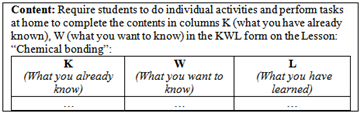
- Students perform the tasks:
- Teacher organizes and reports the discussion:
The student groups submit their work through the learning management system (or via email) to the teacher before class. The teacher monitors and supports students in need of help.
- Teacher summarizes and gives comments:
The teacher summarizes the knowledge students already know and what they want to know, thereby identifying the key knowledge that should guide students to research and learn in the next activity.
Activity 2: Studying and signing the contracts (10 minutes)
(Students can study the contract at home, go to class to discuss and sign the contract)
a) Objective: Students can identify learning tasks through studying and signing contract.
b) Procedures:
- Teacher assigns the tasks: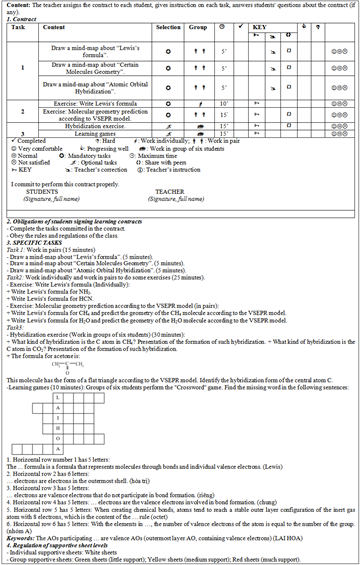
- Students perform the tasks:
Students study and sign contracts under the guidance of teachers.
- Teacher organizes and reports the discussion:
Students discuss individual tasks, group tasks, mandatory tasks and optional tasks in the contract and complete the contract signing task with teachers.
- Teacher summarizes and gives comments:
Teachers conclude and emphasize the content and duration of the tasks in the contract that students have signed.
Activity 3: Contract performance (70 minutes)
a) Objectives:
- Be able to write Lewis’s formula, use the VSEPR model to predict geometry for some molecules.
- Apply AO hybridization (sp, sp2, sp3) to explain the bonds in some molecules.
- Be able to make plans to solve problems set out in the task.
- Collect and process the necessary information in the process of performing the task.
- Be able to complete the tasks/problems assigned.
b) Procedures:
- Teacher assigns the tasks:
- Students perform the tasks:
+ Students perform the learning tasks in the signed contract.
+ Teachers monitor and provide timely assistance to individuals or groups of students in difficulty who request assistance.
- Teacher organizes and reports the discussion:
*Task1:
+ Ask a representative from each group to report the results.
+ Comment, evaluate and correct the answers.
*Task2:
+ Ask individuals and representatives of each group to present the results.
+ Comment, evaluate and give answers.
*Task3:
+ Ask a representative to report the results of the section: Application exercises.
+ Get the volunteer spirit of students' answers in the section: Learning games.
- Teacher summarizes and gives comments:
Teacher organizes learning activities for students, comments and concludes on the knowledge that students need to master.
Activity 4: Contract liquidation (10 minutes)
a) Objective: Help students to draw and synthesize the necessary knowledge of the lesson.
b) Procedures:
- Teacher assigns the tasks:
- Students perform the tasks:
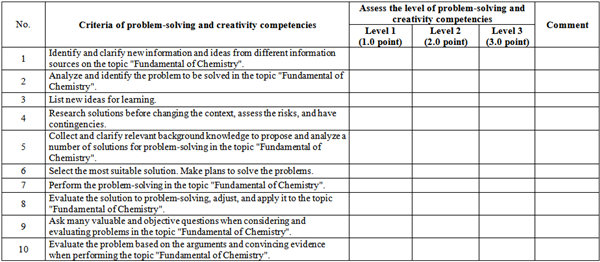
We develop a toolkit to assess the development of problem-solving and creativity competencies in students through the application of learning contract teaching methods in the teaching of the topic "Fundamental of Chemistry" (Chemistry Grape 10): (1) Assessment sheet according to the criteria of teachers; (2) Self-evaluation sheet of students; (3) Test. The assessment sheet according to the criteria of teachers and the assessment sheet of students is built based on the structure of the problem-solving and creativity competencies of students, with nine criteria and three levels of assessment (Level 1: 1.0 points; Level 2: 2.0 points; Level 3: 3.0 points). The specific criteria and levels of assessment are presented in Table 1.
We select pre-assessment and post-assessment designs for a single target group. The pedagogical experimental process was conducted on students of class 10A2 of Xuan Hoa High School, Phuc Yen city, Vinh Phuc province in the school year 2022 - 2023. Experimental lessons include: Lesson 1. Chemical bonding; Lesson 2. Nuclear Reactions.
The assessment toolkit for the development of problem-solving and creativity competencies in students has been used flexibly in the process of experimental teaching. Within the scope of this paper, we present the results of pedagogical experimentation obtained through the assessment sheet according to criteria and tests for students of class 10A2 of Xuan Hoa high school, Phuc Yen and Vinh Phuc (40 students).
After collecting the data from the evaluation sheet according to the teacher's criteria on the development of problem-solving and creativity competencies in students, we synthesize and analyze the collected data. In each criterion of assessment (from 1 to 10), we make statistics of the frequency of students corresponding to the levels of achievement of the criteria, the standard deviation, the average result difference of the experimental group in pre-assessment and post-assessment, and perform the T-test to determine the difference in the average results achieved by students of the experimental group in pre-assessment and post-assessment. Below is a table summarizing the results achieved by students through the criteria-based assessment sheet.
From the results of Table 2 above, it can be seen in each criterion (from 1 to 10): the average result difference of the experimental group in pre-assessment and post-assessment > 0 and p < 0.05; the standard deviation of the post-assessment experimental group is smaller than the standard deviation of the pre-assessment experimental group. Thus, it can be confirmed that the results achieved in each evaluation criteria by students in the post-assessment experimental group are higher than those in the pre-assessment experimental group. The most significant differences are in the following criteria: 3 (List new ideas for learning), 6 (Select the most suitable solution. Make the plans to solve the problems), 8 (Evaluate the solution of problem-solving, adjust, and apply it in the topic "Fundamental of Chemistry"). That is because in the learning process, students are often encouraged to learn and propose methods to solve related types of exercises/solve learning tasks by identifying problems to be solved, making study plans, finding appropriate resources, and evaluating and adjusting solutions for problem solving. Thanks to that process, these criteria in students are well developed.
The results of the tests (two 10-minute tests) are processed statistically, synthesized and presented in Table 3.
From the results of the tests of students before and after the experiment in Table 3, the average difference (After the experiment - Before the experiment) >0 and p < 0,05 shows that the difference between the average scores is statistically significant. On the other hand, the standard deviation value of the results after the experiment is smaller than before the experiment. From the above results, it can be seen that the results of the tests of students after the experiment are higher than before the experiment, or the impact measure has been effective.
The results after statistically processing pedagogical experimental data show that students' teachers have been developed through the application of the learning contract teaching method in the teaching topic "Fundamental of Chemistry" (Chemistry Grape 10). In the process of learning, based on the pace of their own learning, students are developing the ability to actively identify problems to be solved, propose solutions and plan for problem-solving, find information, make reasonable use of learning time at home and in class to solve the tasks set out, etc. On the other hand, the flexible application of the learning contract teaching method also helps each student learn according to their own level, pace, and energy, contributing to innovating teaching methods and improving the quality of education in high schools.
This study was funded by Science and Technology funding of Hanoi Pedagogical University 2 for the project code: HPU2.UT-2021.14.
| [1] | Chu Van Tiem, Dao Thi Viet Anh, Nguyen Thi Thanh Chi (2018), Developing Students’ Problem-Solving Capacity through the Teaching of Integrated Natural Science in Secondary Schools in Vietnam, American Journal of Educational Research, Vol. 6, No. 6, pp. 741-748. | ||
| In article | View Article | ||
| [2] | V. Ôkôn, (1976), The foundations of teaching raise issues, Education Publishing House, Hanoi. | ||
| In article | |||
| [3] | Lecne. I la, (1977), Teaching raises issues, Education Publishing House, Hanoi. | ||
| In article | |||
| [4] | Ester Care, Patrick Griffin and Mark Wilson, (2018), Asessment and Teaching of 21St century Skills Spring International Publishing. | ||
| In article | View Article | ||
| [5] | Vietnam Ministry Of Education And Training, (2018), General Education Curriculum, Hanoi. | ||
| In article | |||
| [6] | Nguyen Van Thai Binh, Nguyen Tien Trung, Nguyen Manh Tuan, (2016), Some issues about curriculum, curriculum development and classroom curriculum development through the design of teaching topics, Journal of Education, Vol. 384. pp. 38-41. | ||
| In article | |||
| [7] | Phan Thanh Hoi, Le Thanh Oai, (2015), Develop a topic for teaching students grade 7 biology that integrates environmental protection education, Journal of Education, Vol. 370. pp. 48-52. | ||
| In article | |||
| [8] | Nguyen Van Bien, (2015). Developing and teaching multidisciplinary topics in science, HNUE Journal Of Science, Educational Sci., Vol. 60, No. 2, pp. 61-66. | ||
| In article | View Article | ||
| [9] | Vietnam Ministry Of Education And Training, (2018), Education Curriculum in Chemistry, Hanoi. | ||
| In article | |||
| [10] | Nguyen Lang Binh, Do Huong Tra, (2010), Active teaching and learning. Some teaching methods and techniques, Hanoi University of Education Publishing House. | ||
| In article | |||
Published with license by Science and Education Publishing, Copyright © 2024 Nguyen Thi Thu Lan, Chu Van Tiem and Dao Thi Viet Anh
 This work is licensed under a Creative Commons Attribution 4.0 International License. To view a copy of this license, visit
http://creativecommons.org/licenses/by/4.0/
This work is licensed under a Creative Commons Attribution 4.0 International License. To view a copy of this license, visit
http://creativecommons.org/licenses/by/4.0/
| [1] | Chu Van Tiem, Dao Thi Viet Anh, Nguyen Thi Thanh Chi (2018), Developing Students’ Problem-Solving Capacity through the Teaching of Integrated Natural Science in Secondary Schools in Vietnam, American Journal of Educational Research, Vol. 6, No. 6, pp. 741-748. | ||
| In article | View Article | ||
| [2] | V. Ôkôn, (1976), The foundations of teaching raise issues, Education Publishing House, Hanoi. | ||
| In article | |||
| [3] | Lecne. I la, (1977), Teaching raises issues, Education Publishing House, Hanoi. | ||
| In article | |||
| [4] | Ester Care, Patrick Griffin and Mark Wilson, (2018), Asessment and Teaching of 21St century Skills Spring International Publishing. | ||
| In article | View Article | ||
| [5] | Vietnam Ministry Of Education And Training, (2018), General Education Curriculum, Hanoi. | ||
| In article | |||
| [6] | Nguyen Van Thai Binh, Nguyen Tien Trung, Nguyen Manh Tuan, (2016), Some issues about curriculum, curriculum development and classroom curriculum development through the design of teaching topics, Journal of Education, Vol. 384. pp. 38-41. | ||
| In article | |||
| [7] | Phan Thanh Hoi, Le Thanh Oai, (2015), Develop a topic for teaching students grade 7 biology that integrates environmental protection education, Journal of Education, Vol. 370. pp. 48-52. | ||
| In article | |||
| [8] | Nguyen Van Bien, (2015). Developing and teaching multidisciplinary topics in science, HNUE Journal Of Science, Educational Sci., Vol. 60, No. 2, pp. 61-66. | ||
| In article | View Article | ||
| [9] | Vietnam Ministry Of Education And Training, (2018), Education Curriculum in Chemistry, Hanoi. | ||
| In article | |||
| [10] | Nguyen Lang Binh, Do Huong Tra, (2010), Active teaching and learning. Some teaching methods and techniques, Hanoi University of Education Publishing House. | ||
| In article | |||