In most cases, teacher-centered methods in Zambia fall short of performance and motivation of the students in teaching and learning of mathematics, specifically, in the topic of trigonometric ratios, where students fail to interpret the symbols and their meaning in formulas. This study aims at designing theoretical proposal using problem – based learning to enhance the teaching and learning of this topic among the Grade 11 students. To design a theoretical proposal, I have proposed a combination of student-centered methods i.e., problem-solving and problem-based approaches and the model of cognitive competence of Socas. I suggest that the implementation of this proposal could improve the learning and understanding of trigonometric ratios by the students.
Mathematics education involves the teaching and learning of mathematics. The processes of learning and teaching of mathematics have proved problematic in the mathematics education domain. From a general perspective, students are faced with a lot of difficulties, errors and obstacles that surround the teaching and learning of mathematics. More than often, many students turn out to be very miserable and inattentive in mathematics classes after being taught a topic and discover they are not able to understand and recall any concept with ease. While it is true that mathematics serves as an important tool in our life, in general, it is unfortunate to observe that students find difficulties in learning mathematics subject until they reach the point of disliking it. Reference 1 asserts that many teachers shy away from difficult topics such as trigonometric ratios; and many students run away from mathematics class because they believe that it is an abstract and difficult subject. Students lose hope; get de-motivated to learn and many tend to dislike mathematics on account of their low performances. Students become discouraged to learn and have success in mathematics due to their poor mathematics knowledge base. From 1996 to date Zambian School curriculum has undergone reformation and fine turning in the bid to improve academic excellence. Despite that, teachers have problems of content knowledge of mathematics, strategy, method of presentation as well as method of evaluation. It is still evident that the issue of difficulty of mathematics in secondary school remains un-resolved. Additionally, fear and anxiety for mathematics, and poor performance in this subject can be as a result of un- cultivated problem-solving skills for secondary school students. Deficiency in problem solving skills is one of the principal causes of failure in school mathematics, particularly in trigonometric ratios. Problem solving is a complex intellectual task which students must be helped to develop. Reference 2, (p.5) states that, “Your problem may be modest; but if it challenges your curiosity and brings into play your inventive facilities, and if you solve it by your own means, you may experience the tension and enjoy the triumph of discovery. Such experiences at a susceptible age may create a taste for mental work and leave their imprint on (your) mind and character for a lifetime.” This substantiates the extraordinary importance problem solving has in the study of mathematics. Therefore, it must be taken as primary goal of mathematics teaching and learning to help students develop the ability to solve a wide variety of complex mathematics problem.
The researcher has identified trigonometry to be one of the school subjects that very few students like and succeed at, and which most students hate and struggle with. During the working experience of the researcher students have indicated that they experience difficulties in understanding trigonometry and that they are not motivated to do it. Nevertheless, trigonometry is an important school subject not only for mathematics but also for some other fields, as I explain in the following paragraph.
Trigonometry is the study of relations between the sides and angles of triangle. The word “trigonometry” is derived from the Greek words “trigonon”, meaning “triangle”, and “metria”, meaning “measure”. Trigonometry was used by ancient Greek, in their study of astronomy between roughly 150 B.C – A.D 200. Proponents such as Hypparchus and Ptolemy showed mastery in the use of trigonometric ideas in astronomy. Trigonometry is literally the measuring (of angles and sides) of triangles. Triangular approach to trigonometry has very rich ancient history. The circular approach to trigonometry which is now being taught in schools is relatively recent. Trigonometry is an extension of geometry 3 Trigonometry involves very rich visual representations of objects. It is vastly applied in many areas such as navigation, motion, rotations, elevations, and bearing, to mention but a few.
Trigonometry offers rich problem-solving opportunities and involves finely tuned reasoning and proof capacities. It is essential for enhancing mathematical thinking and fostering mathematical discourse as well as creativity and innovations in students 4. Trigonometry helps the students to see the value of angles of elevation and work with cyclical patterns of waves of sound or light. It is often used hand in hand with geometry to calculate the relations between angles and circles relations. Trigonometry as a topic is very useful in natural sciences such as geography in order to predict weather pattern and measure earth tremors. In fact, trigonometry aids students’ easy understanding of earth geometry topic. It is as well generally studied from various areas such as physics, optics, electricity, cartography, maritime, and architecture. The affirmation that trigonometric competency has a wide spectrum of application in daily life, work realm and other disciplines, makes it interesting and important topic for students to study.
In Zambia trigonometry is often introduced early in grade 11 with most textbooks traditionally starting with naming sides of right-angled triangles. Mostly students are drilled to work on the exam successfully rather than to conceive and to apply the trigonometric concepts studied. This kind of approach to the teaching of mathematics contributes to students’ poor performance. Reference 5 reported on patterns of candidature across subjects, indicated that although candidature had increased in most subjects in the 2014 examination, Literature in English, Silozi, Additional Mathematics and Metal Work recorded declines from 1,828 (Literature in English), 2,468 (Silozi), 3,465 (Additional Mathematics), and 6,721 (Metal Work) in 2014 to 1,735, 2,376, 3,198 and 6,710 respectively (p. 12). The number of students entering for additional mathematics examination shows a decline of 267, this is evidence that students still shy from mathematics. The report further shows that the lowest performance mean percentage was recorded in Commerce (15.66%) followed by Mathematics (17.39%). The average performance in English, Mathematics, Biology and Science fell below the pass mark of 40 percent. Generally, poor performance was recorded in Mathematics, Science and Commerce (p. 15).
According to the researcher’s sixteen (16) years of teaching experience, students have difficulties in learning trigonometric ratios compared to some other topics in mathematics. Reference 6 showed that questions on statistics and sets were well attempted by most students but questions on trigonometry, construction and loci, earth geometry, linear programming and circle geometry were poorly attempted. It was also observed that among the poorly attempted questions, trigonometry was the least. The analysis indicated that the students who attempted trigonometry failed to cope with the semiotic representations (symbolic language) used. A great number of students have concrete problems and difficulties with the trigonometric ratios, such as the following:
• The interpretation of the symbols and their meanings in the formulas
• Use of 
 and
and  where
where  is some value, to find the angle.
• Use trigonometric ratios to find the angles of elevation and depression.
• Given an angle and the length of one side of a right-angled triangle, calculation of the distance of the other side by making subject of the formula, and then find the product of side and the given angle.
These identified difficulties which are related to the trigonometric ratios make students generally perform poor in trigonometry. This poor performance in the above topics has made the Ministry of Education to quicken all secondary schools to find means and ways of arresting the situation. Arising from that, the researcher was motivated to research about difficulties students face when learning trigonometric ratios and potential responses to improve the situation. The researcher got more interested in the idea after the departmental specific evaluation meeting about performance in mathematics tests in various topics at Kalulushi Secondary school, which is also the location area of this research. In this meeting it was also found that students, least performed in trigonometry in the monthly tests given. The researcher is a teacher at Kalulushi secondary school in Kalulushi district in Zambia. At Kalulushi secondary school, each department holds termly and monthly evaluation performance meetings. At district level, students’ evaluation performance meetings are held every end of the year. The idea was re-enforced after a series of other general performance evaluation meetings in mathematics at both school and district level. During all these meetings it were brought to light that trigonometric ratios pose a challenge to student learning trigonometry.
The difficulties students face with topics in mathematics (such as trigonometric ratios) and failure that accompany them have been attributed to the teaching strategies and methods employed by teachers to teach such topics. The teaching in mathematics classrooms still hubs on teacher centered instructions, and worse still teachers make use of the traditional teaching methods where there is little or no vertical coupled with horizontal interaction between students and teachers. Mathematics as a subject which poses challenges to students ought to be taught with strategies or methods such as Problem-Based Learning that would encourage students to interact amongst them and teachers. The problem-based learning has been found to be an effective tool in imparting the relevant knowledge and problem-solving skills in the students. Problem-based learning (PBL) is described throughout literature as an inquiry-based approach to learning that is student centered and provides the means for gaining problem solving and life-long learning skills 7. PBL has five objectives: to increase students’ knowledge base, to develop students’ cognitive structure so to enhance problem solving strategies, to develop self-directed learning skills, to increase motivation to learn and to help students to be better collaborators. Our main hypothesis is that employing PBL will help students to overcome many of the difficulties they encounter during their learning of trigonometric ratios.
The general aim of this research is to design a concrete implementation of the topic of trigonometric ratios in the classroom using the PBL approach. The researcher doesn’t have the possibility to develop and carry out an implementation in a real classroom situation. This is due to limitations in terms of financial resources and time to go back to Zambia (from Spain) to go and do the implementation at Kalulushi Secondary.
This chapter will be organized into three major sections. In the first section the researcher will discuss problem solving as it has been used with multiple meanings that range from “working rote exercises” to “doing mathematics as a professional”. The section will outline the various meanings that have been ascribed to problem solving and meta-cognition and discuss their role in mathematics learning. In the second section the classification of tasks by Socas will as well be discussed. The third section will discuss PBL in a more abstract way and consider the broader discussions of theory and practice underlying this approach. The researcher will end this chapter with a brief account on limitations of PBL and some thoughts on the benefits of PBL pertaining to cognitive development and learning.
2.2. Mathematical Problems and Its Ascribed MeaningsOne primary goal of mathematics education is to prepare students to become proficient problem solvers. Reference 8 had put, on its top agenda, problem solving to be the center of school mathematics. Mathematical knowledge is understood from one end of the continuum as a body of facts and procedures dealing with quantities, magnitudes, and forms, and relationships among them; knowing mathematics is considered as having "mastered" these facts and procedures. At another end of the continuum, mathematics is conceptualized as the "science of patterns," an (almost) experimental discipline very much similar to the sciences in its stress on pattern- seeking on the basis of empirical evidence 9. The latter conceptualization offers a better view than the former point of view. The former trivializes mathematics because the curriculum which is based on mastering a number of mathematical facts and procedures is severely poor and does not support the main aim of mathematics education of training students to become capable problem solvers.
References 9, 10, 11 posited that Mathematics has been described as a living subject, which seeks to understand patterns that infuse both the world around us and the mind within us. Even if the language of mathematics is based on rules that must be learned, it is imperative for inspiration that students move further than memorizing rules and begin to articulate concepts in the language of mathematics. Mathematics involves transformed effort to center on: looking for solutions, rather than memorizing procedures; exploring patterns, not only memorizing formulas; formulating conjectures and sound inferences, not just doing routine exercises. When teaching begins to mirror these emphases; students will have privilege to study mathematics as an investigative, lively, developing discipline rather than as a stiff, absolute, clogged body of laws to be internalized. They will be expectant to see mathematics as a science, not as a canon, and to make out that mathematics is actually about problem solving and not just about numbers.
Reference 10 describes problem solving as a process which engages students into becoming flexible thinkers with a broad collection of techniques and perspectives for handling novel problems and situations. Students become analytical, both in thinking about their own issues and in probing the point of view put forth by others. Problem solving has become a motto taking on different views of what education, schooling and mathematics are and why educators should teach mathematics in broader sense and problem solving in particular. Reference 8 prearranged the following categories as goals for problem solving: to guide students into thinking in a creative manner and/or develop their problem-solving capability; to present prospective teachers with education tools in a willowy band of heuristic strategies; to offer a new approach to corrective mathematics (basic skills) or to stimulate significant thinking and innovativeness or systematic reasoning skills.
In the problem-solving process, sets of mathematics tasks (problems) have been used as vehicles of instruction, as means of practice, and as yardsticks for the gaining of mathematical skills. Reference 12 described a problem as a situation that is quite different from an exercise in the sense that the problem solver does not have a procedure or set of rules which will lead to finding a definite solution. She proposed a problem to have the following four structural elements as discussed below and which can be used as tools for the cataloging of problems from an educational point of view.
(a) The formulation of the problem
Reference 12 stated that formulation of a problem implies the definition of the task to be performed should be free of ambiguity and/or doubt. It is better for the formulation to appear in the text of the problem itself in the form of explicit questions to be answered or stating the task that has to be performed. If, on the other hand, the task of figuring out what is to be done is left mainly to the problem solvers; in that case different individuals will most likely come up with different formulations depending upon their understanding of the problem, their curiosity, their involvement, and so on. In such instance, each formulation will deeply affect the whole approach to the problem and therefore its solution. Every so often it would be helpful to redefine the formulation given so as to reach a solution more easily.
(b) The Context
She defined the context of the problem as the situation or circumstance in which the problem itself is implanted. Context presents the problem solver with the sequence that may facilitate the finding of solution to problem. Typically, the context is identified at least partially, in the framework of the problem itself. Sometimes the context can be fully given in the text of the problem itself. It should be noted that if context is not well stated, the whole problem may present substantial differences in terms of the number of possible formulations and the interest generated will also differ.
(c) The solutions to a problem
Reference 12 argued that the set of suitable solutions refer to the set of solution(s) that should be deemed adequate for the problem given. In other words, the idea of solvability should be basically rooted in the concept of problem itself. This can be actualized by the specific formulation which will guide into finding solution to the problem. It is as well significance to note that formulations related to the same context may have diverse levels of abstraction from the data given and can influence the directness of mind with which the task is approached.
(d) Methods of approach
In the argument, 12 referred to Methods of approach as being all the methods, strategies or activities that may be valuable for solving a specific problem. These may include:
• Ways of collecting the essential information
• Problem posturing strategies, in order to correctly construct or re-construct the problem
• Heuristics that could be of help to arrive at a solution once the problem is devised and the context identified.
Reference 13 considered the definition of the problem as, "Approach of a situation of unknown response, which is not immediate, that the student has to solve by mathematical methods and that, in addition, must have the will to do so" (p. 114). This research is aligned with definition of the problem proffered by 13 who further argued that problems only exist when the statements are available. With a view to improving the teaching of mathematics and to facilitate students’ learning, it is required that the formulated statements are motivating and implicitly containing exciting elements for the students. Motivation and dynamism should be part of statements that connect curriculum mathematics with the real-life situations and with other areas of knowledge. They have also attested those problems must be well constructed and sequenced, both in increasing order of complexity and in writing, because the nature of syntactic structure used can as well create difficulties in understanding. In their argument, they have underscored understanding of the statement of a problem as being fundamental to its resolution. The words used may form part of the mathematical language, carrying with them a particular and peculiar meaning as opposed to the way they are used in their usual sense and this can make conception difficult. This may imply that if the statements are by far further away from everyday use and experiences, the closer they are to abstraction and the more difficult they are to be represented mentally.
Besides that, 13 presented, in a broader sense, problems solving as a means to use mathematics in situations that crop up from the real world, from other sciences, or from mathematics itself. They have inferred that problem solving signifies that the student internalizes the progression as his/her own, permitting students to autonomously maneuver over the problem, getting familiar with the situation, uncovering their difficulties, develop strategies for finding resolutions, test resolution processes using specific content and finally solve the problem. Therefore, the creation of statements with a specific purpose is the most important thing and these statements must be appealing, striking and novel to accomplish meaningful learning for students. Statements have to help students to establish connections of mathematics with real life, with history, with other sciences and among other facets of mathematics itself.
Reference 14 identified three main themes regarding the usage of problem solving. In the first theme they affirmed the five useful roles of problem solving. They stated that problems are used as conduits to achieve other curricular goals. The two scholars argued that real-world experiences are a justification for teaching mathematics. The problems are a means to provide specific motivation for mathematics topics. Problems are often used to introduce topics with a conviction that when one has learnt the lesson that follows, he/she will be able to work out problems of the same sort. Problems should be recreational and be a way of providing motivation so student. As a means of developing new skills, well-structured problems are used to introduce students to new subject content, and provide a direction for discussions of subject matter techniques. The teacher demonstrates a technique to students, and then provides problems to practice on, in order for students to master the technique (p. 13). In all afore mentioned roles, problems are seen as rather ordinary entities and are used as a means to the focused ends. By implication, problem solving is not usually considered as a goal in itself, but solving problems is conceived as a means to facilitate the achievement of other goals.
Reference 14 identified the second theme of problem solving as being a skill. Their basic premise of identifying this second theme was in reaction to Thorndike's work. Thorndike's research debunked the simple notion of "mental exercise," in which an assumption was made that learning reasoning skills in such a domain as mathematics would result in generally enhanced reasoning performance in other domains. Thus, if mathematical problem solving was as important, it was not because it could make one a better problem solver, but it was for the reason that solving mathematical problems was valuable in its own right. This led to the conception of problem solving as a skill. Problem solving as a skill though somewhat narrowly defined (as being able to find solutions to the problems which would be assigned to one) it is worthy of instruction in its own right. Problem solving is often perceived and listed as one of several other skills to be taught in the school curriculum.
Distinctions of course are drawn between solving routine and non-routine problems. Non-routine problem solving is ranked as a higher-level skill to be attained after skill at solving usual problems (which, in turn, is to be acquired after students learn basic mathematical concepts and skills) 14. The skill that students develop during and after the schooling process remains with them. These skills are contained in students’ mathematical tool kit. Students’ mathematical tool kit is assumed to contain "problem solving skills" as well as the facts and procedures they have studied. This extended pool of knowledge apparently comprises the students' mathematical knowledge and understanding.
Reference 14 identified the third theme as problem solving being an art. This conception strongly supports the idea of a problem as being a question that is perplexing or difficult as the heart of mathematics if not mathematics itself. The housing theme is that the work of mathematicians, on an ongoing basis, is solving problems. Those problems should be of the perplexing or difficult kind. Reference 15 asserts and plainly says that solving problems is the heart of mathematics and the main purpose for mathematician's existence is to solve problems. Therefore, what mathematics really consists of are problems and solutions. Basing on that, 15 claims that students' mathematical experiences should nurture them for tackling such challenges. In other words, students should engage in real life problem solving. Whilst learning (during their academic careers) students should be offered with a viable opportunity to work out problems of significant difficulty and complexity. It was underscored that those problems are the heart of mathematics, and advised that as teachers, in the classroom, in seminars, and in the books and articles we write, we have to make this point stand out more and more. This should be done with a view to training students to be better problem-posers and problem solvers.
In addition, 16 made an observation that: becoming a good mathematical problem solver; becoming a good thinker in any discipline, may be as much a matter of acquiring the habits and dispositions of interpretation and sense-making as of acquiring any picky set of skills, strategies, or knowledge. Going by that mathematics education should instill in students the mathematical power, inclusive of the use of specific mathematical modes of thought which are both flexible and potent. Besides that, modeling, abstraction, optimization, logical analysis, inference from data, and use of symbols must be cultivated. Mathematics classroom is a community in which mathematical sense- making of the kind we hope to have students develop should be practiced. In order to develop the mathematical sense making attitude, student’s meta-cognition cannot be overruled.
Understanding, even in a slightest sense, how mathematics student’s construct, organize and store mathematical information is of great importance. The underlying principle is that every human being has the abilities to process information, and that each individual’s mind constructs symbolic representations of the world. In line with that, thinking about and acting in the world consist respectively of working mentally on those symbolic representations and taking actions externally that match to the results of the minds' internal operations 8. With regards to internal cognitive representations, there are multiple standpoints that go with the nature and function of representations. Relating cognition to the learning of mathematics and in order for the students to become skillful problem solvers, they should begin to exercise their cognitive competences to rationalize mathematical representations. Like in any other science, it cannot be understated that mathematics has its own symbols and signs which are used to communicate mathematical thoughts and concepts.
2.3. Classification of Tasks by SocasGoing by that, Socas and colleagues 17 have proffered the cognitive competence model as being organized around three components: the semiotic representations of a mathematical object, the levels of cognitive development of these systems of representation and the difficulties, obstacles and errors in the learning of the students.
The philosophical approach that triggers Socas’ idea is that the mathematical objects have real existence but not material existence. Therefore, the process of mathematical knowledge construction should be necessitated by the use of signs as a means of making mathematical objects present and communicating different characteristics about them 18. These signs are known as “representations” or “semiotic representations” of the object. Basically, each sign acquires its meaning within a system of signs in which that particular sign is analyzed and understood 19.
The semiotic systems can exist in different kinds and each is connected with a mathematical object. Examples of such semiotic systems can be graphical system, algebraic/symbolic system or verbal system. Each of the semiotic system is partially cognitive in view of the represented mathematical object and it can give insights for some aspects of the mathematical object but also overshadows others. It also follows that each semiotic system has different strong and weak spots in relation to the meaning of the mathematical object and the work with it. Mathematical objects must be distinguished from semiotic representations with a greater margin. Mathematical objects are also referred to as concepts.
Reference 18, defends the principal role played by conversion of semiotic representations of an object in any mathematical activity and advances the point that mathematical work can be characterized and understood as a sequence of such actions and transformations. Actions of different level (and different cognitive complexity) can be displayed as recognition of a semiotic representation and the elements there in, treatments or internal transformations within the same semiotic system of representation (hereinafter, SSR), conversions or external transformations from one SSR to another, and lastly, co-ordinations between different SSR of an object and their elements. The model of cognitive competence of Socas and colleagues follows the works of 18, 20. It is taken that the semiotic representations have a very important role in the learning of a mathematical concept or object. It is underscored that the process of learning mathematics is conceptualized as a process of abstraction of the SSR of the concept or object. This process stands on the view that the student must have prior knowledge about the subject matter. Three progressive stages of cognitive development of a mathematical concept/object are significant in this process. These are semiotic stage, structural stage and autonomous stage. The learning aligned with each stage is the basis that supports learning of the following stage. In other words, learning in new stage is dependent upon the learning in the preceding stage. Reference 19 characterizes the stages via the learning actions on the SSR of the object. The three stages are described below.
This is a stage a student reaches when he/she is able to figure out the meaning of the signs in one system of representation in relation to the object departing from their previous knowledge and previous signs already known. In this stage, a student is able to identify the mathematical object in one SSR and to recognize the elements of this SSR in connection with the mathematical object in question.
According to 19, structural stage consists of two different levels. In the first level, a student can recognize one SSR of the object and also be able to carry out treatments or internal transformations within this SSR. These transformations help the student structure this SSR such that he/she knows and controls one SSR of the object. In the later level, the student uses his/her knowledge of this SSR to perform correct conversion actions from the preceding SSR to another system. In these activities, the control of the former SSR facilitates the conversion to the new SSR.
In this last stage, the new SSR acquires meaning by itself and the student is able to articulate and coordinate (at least) two different SSR of the object. The student dominates each SSR independently. The student can make use of either system to develop and explain different aspects of the meaning related to the mathematical object. Eventually the student would exercise control of the SSR he/she wants to use and, in the process, develops spontaneous co-ordinations of different SSR. Relating this cognitive model to learning, the student will acquire mathematical object when he/she carries out coordination, free of contradictions, between different SSR (at least two) of a mathematical object.
The third part of the cognitive competence model is constituted by the difficulties, obstacles and errors of students in their mathematics learning. The difficulties in the learning of mathematics may be due to different previous learning experiences. Reference 19 classified these difficulties in five major categories. These are difficulties:
• Associated with the complexity of the mathematical objects (dual nature of a mathematical object: structural conception / operational conception).
• That result from the processes of mathematical thinking (logic aspects, breaks related to different mathematical modes of thought) connected with the teaching processes in the learning of mathematics.
• That is related with the processes of cognitive maturity of the students.
• Allied with affective and emotional aspects towards mathematics in the students
Dealing with these difficulties is much more dependent on where the emphasis is placed. In this case three cases are cardinal: the cognitive maturity of the students, the mathematics curriculum or the teaching methods. These difficulties work as obstacles in the practices and eventually manifested through errors or mistakes of the students. The mistakes emerge because the student is lacking knowledge and has a poor or inappropriate existing cognitive scheme. The errors are classified in different forms in the literature of mathematics education 21.
Socas and colleagues 19, 22 established three directions of analysis and likened them to the three coordinated axes. The three axes can be used by the teacher to identify the origin of an error and to devise more effective teaching procedures and remedies. These three axes are: the origin of the mistake or obstacle (epistemological, didactical or cognitive), an absence of meaning (originated in the different stages of cognitive development), and in affective and emotional attitudes. Instruction in mathematics classes is dominated by teachers explaining material, working out problems on the board, and then giving students mathematics problems to work on their own. This characterization has not helped to curb the difficulties that students face in their learning process. There are better ways for students to learn mathematics than listening to their teachers and then practicing what they have heard in rote fashion. The rarity of innovative approaches in solving mathematical problems is a matter of serious concern, particularly in the Zambian context. Students need to begin to apply their newly acquired mathematics skills by getting involved in investigative situations but their responses point out very few activities to engage in such activities 23.
Reference 2 points to problem solving as a process where students learn to grapple with new and unfamiliar tasks, when the relevant solution methods (even if only partly mastered) are not known. If students are drilled in solution procedures, they get crippled and do not develop the broad set of skills. Pedagogically, the role of a teacher is to decide when to intervene, and/or bring up suggestions which will help the students while leaving the solution essentially in their hands. Guidance and suggestions should be done for each student or group of students in the classroom throughout the learning process. Another duty of a teacher is to train students to become independent learners, interpreters, and users of mathematics hence the emphasis on problem solving to be part of daily learning process.
2.4. Problem-Based LearningOne approach that aids problem solving is Problem Based Learning PBL. Problem based learning (PBL) is an inquiry-based approach to learning that is student centered and provides the means for developing problem solving skills that last for life time of an individual student 7. Reference 24 stated PBL to be defined by the following characteristics: Learning is driven by ill-structured and open-ended problems with no one “right” answer, usually in small collaborative groups, students work as self-directed active researchers and problem solvers. Students work on problems and/or cases that are context specific. Students identified a problem to which a solution is sought and agreed upon for implementation. Teachers take the role of facilitators of learning, guiding the learning process and provide an environment suitable for inquiry. Students are presented with contextualized complex problems and are asked to explore and ascertain meaningful solutions. Reference 24 also agreed to the claim that PBL develops critical thinking and creative skills, improves problem-solving skills, enhances motivation and helps students exercise the ability to transfer knowledge to new situations in an innovative way. Reference 25 postulates that individuals in this highly demanding world need to have some useful skills, for continuity of their long-life learning. Problem-based learning offers meaningful opportunities for students to develop dispositions for inquiry, engage in collaborative learning, and exercise critical thinking, reflective practice, and judgment processes. Problem based learning cultivates the ability to identify critical issues, to integrate knowledge from different disciplines, to evaluate ideas and research, and to develop content knowledge for both teacher and the student.
In PBL, students “learn to learn” so that they can make their learning relevant to their own educational needs. Students have opportunity to analyze and discuss problems in depth. The discussions give students an insight of how much gap there is between their own knowledge base and the new knowledge presented to them. In the end students are made to realize their own strength and weak points control their own learning and develop self-regulatory skills 26.
Problem-based learning promotes collaborative learning. Reference 27 defined collaborative learning as a kind of learning strategy in which students, study together and complete common goals. Each student does the level best to contribute his/her own efforts in small groups to promote all students’ performance. Students equally exhibit their short comings and they are helped by colleagues. In this process of knowledge exchange, students produce interaction which involves many activities such as communication, observation and support. Reference 28 explains that, in a collaborative learning class, students often elaborate on the concepts being taught to achieve what is expected.
Problem-based learning enhances the learning of students through interactive discussions and explanation as well as deepening the understanding of the student providing such explanation. Using such a teaching method as problem-based learning, both high ability and low ability learners would be able to collaborate in terms of understanding, explaining and retaining the concept they have learnt in a mathematics class. The job of the educator is to facilitate the learning that goes on in the classroom. Since PBL necessitates a task-based classroom, the teacher’s role is to prepare well-planned activities that guide students to a conclusion whose general nature the teacher has anticipated. Therefore, the responsibility of a teacher is to create the features which make up a classroom that develop and as well encourage understanding.
Reference 29 underscores that problem-based learning begins with the presentation of an ill-structured problem to be solved that has potentially multiple solutions. The teacher supports the learning process, guiding students with meta-cognitive questions. Students actively construct knowledge by defining learning goals and seeking information to build upon prior knowledge. Students make reflections on the learning process, and participate in active group collaboration. Reference 30 says that if teachers tell too much, students will not need to develop their own problem-solving abilities; if teachers tell too little, students will not make much progress. In this respect, it is important as teachers to allow students to collaborate and make their own discoveries. As students take ownership of their learning, they are much more likely to take pride in what they learn and commit it to long term memory. In any case problem-based learning tends to bring together a broader range of learning objectives, lead to more complex activities, and call for more independence and self-direction on the part of students.
Problem Based Learning exists as a teaching method grounded in the ideals of constructivism and student-centered learning. It is rooted in both cognitive and social constructivist theories, as developed by 2, 4, 8, 14, 16, 19, 22, 31, 32, 33 respectively. The major tenet in constructivism theories is that learning is an active constructive process. Jean Piaget was an influential researcher in his time and had more interest in the biological influences on how we come to know. His personal belief was that the ability to do abstract symbolic reasoning is what distinguishes human beings from other animals. As he delved profoundly into the thought-processes of doing science, his desire to understand the nature of thought itself grew stronger, especially in the development of thinking. Piaget talked about cognitive structures that contain pre-existing ideas of the world which are constantly changing and by which the child makes sense of the world. In other words, the mind’s cognitive structure is responsible for knowledge manipulation and reorganization. Student exercise autonomous thinking and take responsibility for their learning. Meaningfulness and personal motivation for learning are related to individual ideas and experiences. Information organized around concepts, problems, questions, themes and interrelationships take place within the cognitive conceptual framework.
Constructivism theory proffers that learning should be facilitated since it supplies learners with opportunities to construct knowledge in meaningful contexts of social environment; hence they have the chance to construct a comprehensive understanding. PBL is as well supported by Vygotsky, a social constructivist who underscored that social interaction plays a fundamental role in the development of cognition. Reference 33 states that every function in the child's cultural development appears twice: first, on the social level, and later, on the individual level; first, between people (inter psychological) and then inside the child (intra-psychological). This applies equally to voluntary attention, to logical memory, and to the formation of concepts. All the higher functions originate as actual relationships between individuals (p. 57). A second aspect of Vygotsky theory that supports PBL is the idea that the potential for cognitive development depends upon the "Zone of Proximal Development" (ZPD): a level of development attained when children engage in social behavior. Full development of the ZPD depends upon full social interaction. Zone of proximal development is the difference between what a student can do without help and what he or she can do with help. Vygotsky asserted that a child follows an adult example and gradually develops the ability to do certain tasks without help. During the process of learning a teacher or more competent peer gives aid to the student in his/her ZPD as necessary, and tapers off this aid as it becomes unnecessary. In other words, the student’s learning is aided by the more knowledgeable other. In the process the range of skill that can be developed with adult guidance or peer collaboration exceeds what can be attained alone 33.
Problem Based Learning has been criticized for the reason that students may not really know what might be important for them to learn, especially in novel situations to which they have no prior exposure. In this situation the teacher as facilitator must be vigilant to evaluate and account for the prior knowledge that students bring to the classroom. Another criticism is that PBL approach is time consuming and so the teacher who opts to adopt this method may not be able to cover as much material as a conventional lecture-based course. PBL is challenging to implement since it demands a lot of planning, dedication and hard work for the teacher. It can be difficult at first for the teacher to give up a role of a controller and become a facilitator who encourages the students to take an active part in their learning. It can as well be difficult for the teacher to give up the role as information dispenser to a motivator who would encourage students to frame and ask the right questions during their learning process.
The following section discusses the hypothetic implementation of problem-based learning approach in the student-centered classroom. It will begin by defining student centered and outlines its essence and explores the roles of both a student and a teacher. Next, it will give a brief description of the design in three phases of implementation and evaluation process of problem-based learning in a student-centered environment.
3.2. A Student - Centered ClassroomA student-centered classroom is by definition a classroom where the students are actively engaged in the learning process. In a student-centered classroom the focus is not on the teacher but on the students’ learning. Students take responsibility of their own learning 34. Combs also proffered three characteristics needed in creating an effective student-centered learning atmosphere:
• The learning environment should facilitate students’ exploration of meaning. The classroom must make available the opportunities for student’s participation, interaction, and socialization.
• Students must be given many opportunities to deal with new information and experiences in the search for meaning. However, these opportunities have to be provided in ways that allow students to do more questioning, exploration and practicing than just receiving information. The learning environment should be friendly to allowed students to face up new challenges using their past experiences without the dominance of a teacher.
• The learning environment should enable students to make meaning through a process of personal discovery. In any case the methods used to encourage such personal discovery have to be highly individualized and adaptable to the learner's own learning style.
There are three main roles that a student ought to play in a tutorial group. The student can play the role as a chair person, secretary and group member. The tasks related to each role are described below.
The chairperson structures the learning group, chairs the discussion, and supervises progress and time as well as summing up results of every particular step. Contributes actively and encourages active participation of every group member.
The secretary writes down the remarks, solutions and conclusions made at each phase to present to the class. Actively participating in the discussion while carrying out the secretarial work
Contributes actively to the discussion and participates in research. Makes notes and writes down matters that are of individual relevance. Students also organize data to the problem in their individual self-study time. The students rotate in taking up tutorial responsibilities.
The role of a teacher in PBL revolutionizes from all-knowing, to helper or guide. Reference 35 suggested that PBL in the student-centered classroom teachers are the channel through which the students acquire the skills for learning, not as a supplier for knowledge but as a rod for students to gain that knowledge on their own. The teacher becomes a tutor and a facilitator, whose responsibility is to create a favorable learning environment in which students feel happy and expectant to structure their ideas liberally. As a facilitator the teacher, of course, still has content/pedagogical knowledge and should the discussion go way ward, he/she has to mediate by asking probing questions to redirect the discussion back to the right pathway 36.
3.3. PBL in Problem-Solving ProcessIn the PBL procedure, students are positioned into small groups and given ill-structure problem to grapple with as a stimulus for learning. The problem(s) should be by any means related to real-life scenarios and motivating enough for continued learning 26.
The typical problem-solving process can be summed according to three broad and reiterative phases.
In this first phase each small group of students will need to gather information and list it under a heading; "What do we already know?" students will have to entertain the problem in light of the knowledge they already possess from past experiences. Each group will have to discuss the current situation surrounding the problem in the form it has been presented. This pre-analysis necessitates discussion and accord on the working definitions of the problems, and categorizing out issues and aspects of the situation that are worthy of further investigation. The purpose of this initial analysis is to formulate a problem statement that serves as a starting point for the investigation, and can be revised as assumptions are questioned when new information comes to light.
For this phase students will engage with the problem by also identifying under a second heading, “What do we need to know (to solve this problem)?” students will begin by listing questions or learning issues that must be addressed in order to bridge up the gap of missing knowledge, or to shed more light on the problem. In this phase each group of students will be analyzing the problem into constituents, discussing implications, bringing up possible explanations or solutions, and developing working hypotheses. At this stage student do activity of "brainstorming", with evaluation poised while explanations or solutions are written down. Each group of students will need to formulate learning goals, outlining what further information is wanted, and devise plans by which this information can be obtained.
The preceding list should inform the students in what to do so as to solve the problem. In this phase the students will have to discuss, assess, and come up with hypotheses and tentative hypotheses. At this point students will have to make a "What should we do?" list that prepares and keeps record of the resources to be used, people to interview, articles to read, and the specific actions group members have to perform. It is in this phase that the students in their groups will have to identify and assign learning tasks, and develop study plans to discover required information. Students engage into research of the useful information to aid them solve the problem. Having acquired new information students will need to meet to analyze and evaluate it for its reliability and usefulness before applying it to the problem. Lastly, they have to use the newly organized information to problem solving.
3.4. PBL and AssessmentThis concept of assessment-as-learning progresses focuses on what students are able to achieve not what a teacher can provide. In any case, student assessment has to be a multidimensional process, integral part to learning that involves observing performances of individual learners in action and judging them on the premise of collaboratively decisive factors 35.
In general, students would be evaluated in three broad areas:
1. Applied competence: students should demonstrate the ability to relate prior knowledge to undertake new problematic situation as opposed to knowing actual facts about a topic. Students are to be assessed on how they are discussing up-to- date, real-life and relevant problems with pleasure, and how able they are to link the theoretical knowledge to the problem 35.
2. Critical thinking, problem-solving and communicative competence: students should identify problems and/or opportunities in the specific context(s) and make viable proposals supported by theory to help improve the situation. Students should be assessed on how accurately and competently they use theories to interpret and solve problems, and effectively communicating their analyses to others in a variety of forms and contexts 35.
3. Collaborative and leadership Competence: students have to be assessed on the way they are collaborating as members of a team, devising initiatives in identifying and solving problems or pursuing opportunities for learning and improvement within and across the groups. Regarding self-directed study, it would be advisable to assess students for doing some research, describing a problem and a reasonable solution. Students should show ability to formulate and articulate questions and complete assignments. Most of all, students should be assessed whether or not they can apply the acquired knowledge to new everyday life situations than to memorize answers to old questions 35.
In this section, the researchers will endeavor to give a detailed curriculum analysis basing on Zambian mathematics curriculum content. This section will begin with a preamble to be followed by rationale, description of a set of objectives and general outline, and then the detailed curriculum content analysis. The analysis will begin with topics preceding trigonometry and end with topics which proceed after trigonometry.
Deciding on and putting into practice a thorough and appropriate curriculum is very important to success in today’s educational environment. The government policy of providing education for all makes it necessary for educators throughout our educational system to take a serious look at the level of applicability and significance in curricula, most importantly in the areas of mathematics, selected to support government learning policy. The vision of the Zambian government is to provide quality, lifelong education for all which is accessible, inclusive and relevant to individual, national and global needs and value systems. To attain government’s vision entails that the teaching of Mathematics should expose learners to practical applications of mathematics in everyday life. Learners are to be exposed to do more of practical work as much as possible and as necessary, through contextual reference to the local situation 37.
The curriculum has been reviewed on premise of outcome-based education principles which seek to link education to real life experiences that give students skills to access, criticize, analyse and practically apply knowledge in order for them to gain life skills. Its competences and general outcomes are the performance expectations to be attained by the student through the acquisition of knowledge, skills, techniques and values which are very vital for the learning progress of the individual. This section will specifically analyse content and performance expectations.
4.2. Structure of the Zambian Education SystemZambian education system is divided into three levels i.e., primary level, secondary level and tertiary level. Secondary level, which is the researcher’s focus, begins from grade 8 and run through to grade 12. At secondary level the age group of students ranges from 15 to 19. The average age of grade 11 students is 18.
4.3. RationaleMathematics is very significant tool for the development and improvement of a person’s intellectual capability in analytical reasoning, spatial visualization, logical and abstract thinking. Once students gain adequate knowledge in mathematics, they build up numeracy, interpretation, thinking skill and problem-solving skills. Mathematics is very vital in science and technology as key drivers for the development for any country but most importantly in everyday life and various workplaces. Mathematics is as well an important tool to enable students to contribute to the social and economic development of any country and the world as a whole.
Mathematics also prepare and increases the student’s vision of career path way and useful for furthering education as it also plays a central role for learning other disciplines and subject. Mathematics is pre-requisites for college entry to further one education. It is a known fact that other subjects in science and technology greatly depend on mathematics concepts. Therefore, there is great need to make a deliberate emphasis on mathematics education for Zambia to comfortably reach the 2010 millennium goals 38.
Mathematics serves as an interesting subject and valuable for enjoyment and excitement. It offers students an opportunity for creativity, innovations and pleasure. It becomes quite exiting for students when they discover ideas and insights that would help them pursue mathematics even outside school walls.
The main goal of mathematics is to develop a clear mathematical thinking and expression in a student and also develop ability to recognize problems and foster problem solving using related mathematical knowledge and skills. Through the study of mathematics students will build up ethical values that are necessary for accountability in matters of finance. Students acquire interpreting and analysis skills needed for planning, budgeting and effective decision-making.
4.4. Description of Objectives and General Outline of Mathematics in Secondary SchoolThe layout of content begins with general outcomes which emphasize the provision of clear mathematical thinking and expression in the learner so to assimilate essential mathematical concepts for use in everyday life such as environment and other related disciplines. The general outcomes are as follows:
• Develop mathematical knowledge and skills to empower the student’s mind to begin to think mathematically and precisely in problem solving skills and apply these skills to devise and solve mathematical and other related problems in everyday life
• Deepen the students’ understanding of mathematical concepts in order to facilitate further study of the discipline
• Build up abilities and ideas basing on mathematical constructs to enable the student to reason logically, communicate mathematically, and learn independently without much supervision (self- discipline)
• Enable the student represent, interpret and use data in a variety of forms and inculcate a desire to develop different career paths in the learners 38.
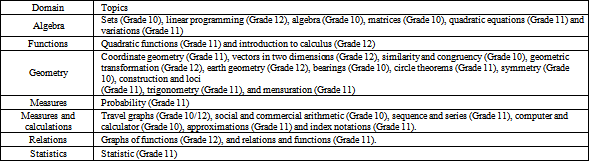
General outcomes are then followed by the deductive presentation of the topics in tabular format. The presentation begins with the main topics from which sub-topics are drawn. The sub-topics inform the specific outcomes which further defines the scope of knowledge. The last two columns of the curricular tables display the skills and values which students are expected to acquire after going through the learning process. The general outline of mathematics scope and the sequence of topics within each domain are presented in Table 1.
4.5. Detailed Curriculum AnalysisAs can be seen in Table 1, the topic of trigonometry is presented in Grade 11, within the domain of Geometry. This topic is informed by triangles, Pythagoras theorem, bearings, geometric construction computer and calculators. These topics are taught in grades 8, 9 and 10. Then, I write a summary about the curricular analysis of each topic, following a structure similar to the presentation of each topic in the curriculum, and paying special attention to the aspects most closely related to trigonometry.
The topic of angles is taught in grade 8. Attention is paid to special angles i.e., 0o, 30o, 45o, 60o and 90o respectively. The focus is on the right angle and the two acute angles. The sum of the two acute angles in a right-angled triangle is 90°(complementary angles). The aforementioned are the most closely related concept to trigonometric ratios. Having learnt the above angles student should be able to identify angles of elevation and depression.
Geometrical construction of angles and lines is taught at grade 8. Students are taught how to construct 60o and 90o angles using ruler and pair of compasses. Students construct angle bisectors using ruler and compass, giving rise to other angles; 45o, 30o, 15o, and 75o. They are also taught to use ruler and compass to construct perpendiculars bisectors to a given line and from a given point without using set squares. They further do the construction of diagonals and right-angled triangles. The performance expectations of students after learning the topic of geometrical construction are to be able to construct angles, perpendicular lines, bisecting angles and diagonals to form right angled triangle. These activities are very relevant to trigonometric ratios because the right-angled triangle is made up of hypotenuse (which is a diagonal in some sense) and two perpendicular lines. Geometric construction also aids students to identify sides of a right-angled triangle.
Pythagoras’ theorem is taught at 9th grade. Students are first given background to Pythagoras’ theorem. Students are help to identify sides of the right-angled triangle as two adjacent sides and hypotenuse. Thereafter, students are made to identify sides of the right-angled triangle using letters a, b and c or a set of letters such as AB, BC and AC as an example. Students are then asked to draw a right-angled triangle with length of sides such as 3cm, 4cm and 5cm as an example. Student is instructed to form squares on each side of the right-angled triangle and then calculate the areas for each of the squares formed. The last activity on this stage is to sum up the areas of the two adjacent sides and compare with the area of the hypotenuse side. This is done to help student state the Pythagoras theorem by areas of squares
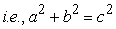 | (1) |
Students are given real life situations where Pythagoras’ theorem is used. Other concepts that are taught alongside Pythagoras’ theorem are roots (squares and square roots) and subject of the formula. The performance expectations of the students after learning the topic of Pythagoras’ theorem are to be able to; identify sides, calculate area and length of sides, state Pythagoras theorem make subject of the formula and apply to real life problem solving. These concepts are very important for learning of trigonometric ratios.
Directions and bearings, is a topic that is taught in grade 9. Students are led through the process of identification of the cardinal points on the compass and interpretation of the three figure bearings. Students do not only interpret but also find the three figure bearings of one point from another. Students get acquainted with the use of North and South points to find compass bearings (for example, N650E or N750W). They learn to present three figures- bearing of one point from another as an example (060o). Emphasis is made to students to measure angles clockwise from the true north as they work out problems involving bearings. Students practice bearings and scale drawing by drawing and sketching diagrams to represent position and direction. Students use concept of angles of elevations and depression as well as properties of right-angled triangle to find the bearings. The concepts of angles of elevation and depression are very useful and supportive to trigonometric ratios. They help students to find heights (perpendicular height and the slant height) and the horizontal distance.
Computer and calculator are taught at 10th grade. Students learn various functions of a calculator. Students demonstrate the use of a calculator to find angles. Students learn to use the shift function on a calculator to find inverse of functions and convert degrees to radians. They identify different keys (i.e., 


 arrow and the function keys) and interpret their use. Students go through the process of identifying and describing of basic components of a computer (i.e., Input, Process and Output Parts/devices). Students define an algorithm and learn methods of implementing-flow charts and pseudo codes. Students do model of simple algorithms of sequence and decision loops. Outline Stages of problem solving by defining a problem, analysis method of solution, write a computer program and document the program. These are very important concepts for learning trigonometric ratios. Besides that, students learn to use different kinds of software which are useful for simulations and animations.
Table 2 presents the contents of trigonometry of the Zambian Curriculum for Grade 11 38.
Students define the right-angled triangle as a triangle with two acute angles and one right angle. They learn to identify the sides of the right-angled triangle as hypotenuse and the other two sides being adjacent. Either of the sides is said to be opposite depending on the angle from which one is reading. Students are then introduced to the symbolic representations used in trigonometry (i.e., Sine-Opposite-Hypotenuse SOH, Cosine-Adjacent-Hypotenuse CAH, Tangent-Opposite-Adjacent TOA) as the three trigonometric ratios related to the right-angled triangle. Describe the three trigonometric ratios and calculate sides and angles of a right-angled triangle. Attention is paid to the three special angles (60o, 45o and 30o). They also learn other representations of trigonometric ratios such as Sin(ɤ), Tan(θ), Cos(x),
 | (2) |
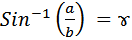 | (3) |
 | (4) |
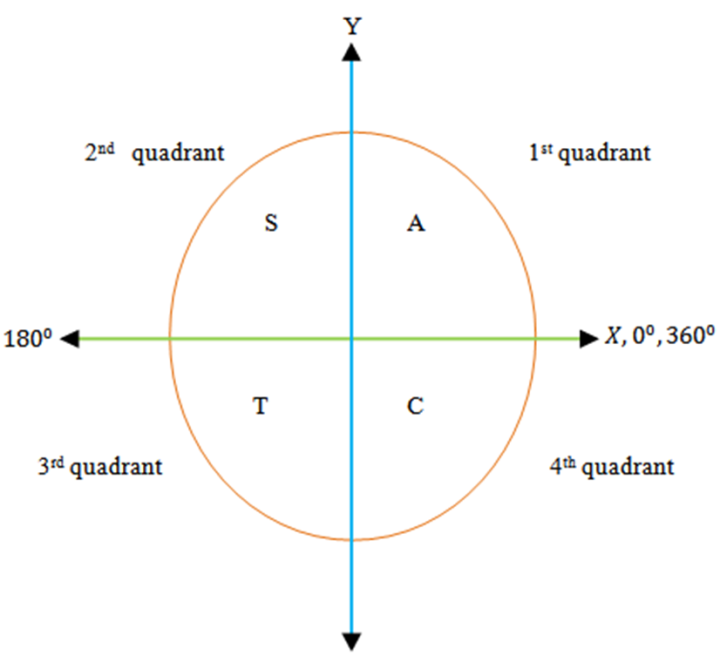
Students are led into determining the signs of the three trigonometric ratios in the respective quadrants. Several acronyms are used to help students master this concept of signs. An example of such acronyms is; All Students Take Chemistry – ASTC implying that the three ratios are positive in the first quadrant, only sine is positive in the second quadrant, only tangent is positive in the third quadrant and lastly cosine is positive in the last quadrant. Emphasis is made to measure angles in counter clockwise direction. Students apply trigonometric ratios on solving problems involving bearings, angles of elevations and depression. Furthermore, students draw graphs for sine, cosine and tangent curves
Graphs of;
 | (5) |
 | (6) |
 | (7) |
They solve trigonometric equations by factorization and use of trigonometric identities. Students learn to differentiate the symbolic representations such as sin2θ and sin2θ as they solve trigonometric equations. They as well learnt to use sine rule
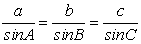 | (8) |
and cosine rule in the forms
 | (9) |
 | (10) |
 | (11) |
to find sides and angles of non-right-angled triangles. Besides that, students calculate area of a non-right-angled triangle using the sine rule,
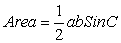 | (12) |
and Heron’s formula,
 | (13) |
In all these processes mathematical tables, scientific calculators and computers are used. The topic culminates in application of trigonometry to solve practical problems inclusive of three-dimensional figures and Bearings. The performance expectations include defining, identifying, describing, relating, determining, comparing, interpreting and computing. In order to confirm their understanding of trigonometry students should exhibit curiosity in using cosine and sine rules, logical thinking in computing trigonometric problems and apply trigonometry knowledge to real life situations.
4.7. Subsequent Topics Related to TrigonometryTwo topics closely linked with trigonometry, and in which trigonometry is a required prior knowledge are mensuration and earth geometry.
This topic is taught later in grade 11. Students identify and interpret sector of a circle. They calculate the area of a sector and surface area of three-dimensional figures (i.e., pyramid and cone). Students use the trigonometric ratios to calculate the slant and the vertical heights of a pyramid and when given one acute angle. Students also use the trigonometric ratios to calculate the radius, slant and vertical heights of a cone. Having used trigonometric ratios to find radius, slant and vertical heights, they can now use them to calculate volume of various prisms. They find the volume of solids such as cone, rectangular and triangular pyramids including the frustum. Students apply right angled triangle properties in the process of finding area and volume of three-dimensional figures.
Students learn to distinguish between small and great circles. Great circles include the equator and all longitudes. They identify and state the positions of point. Additionally, students sketch the earth and express points and places in form of:  where
where  is the latitude and y being the longitude. They distinguish between the radius of the earth ‘R’ at the equator and the radius of latitude ‘
 ’. At this point they apply trigonometric ratios to formulate
 | (14) |
which translates to
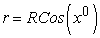 | (15) |
Thereafter calculate distance between parallels of latitudes and longitude in kilometres and nautical miles. Students use two important formulas to calculate the distance between latitudes and distance between longitudes. The two useful formulas are:
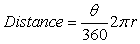 | (16) |
for finding distance between latitudes and
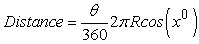 | (17) |
for finding distance between longitudes; where ‘ ’ is the difference in longitudes or latitudes and
  is the radius if the
Students use
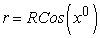 | (18) |
which if formulated using concept of trigonometric ratios and substitute in the first formula to come up with the second formula.
At this stage, learning of students begins from known to the unknown. Students have prior knowledge about a right-angled triangle and the Pythagoras’ theorem. They are able to define a right-angled triangle as a triangle in which one angle is a right angle (i.e., 90-degree angle).
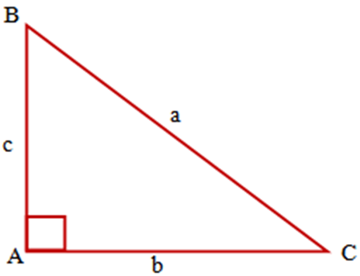
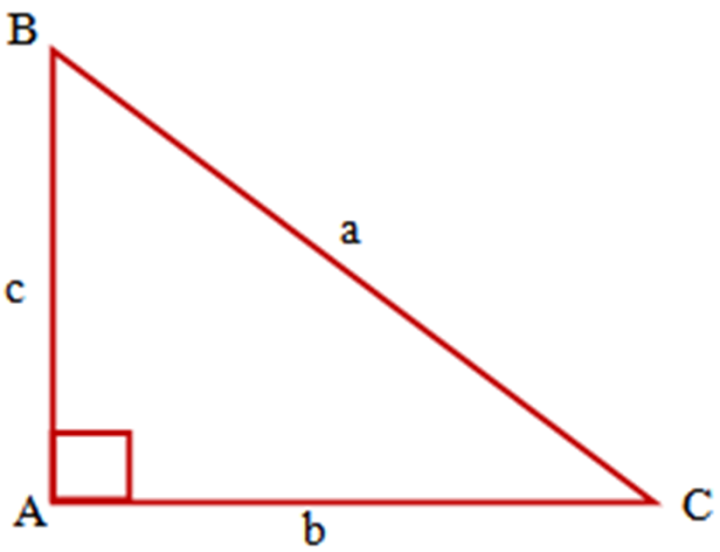
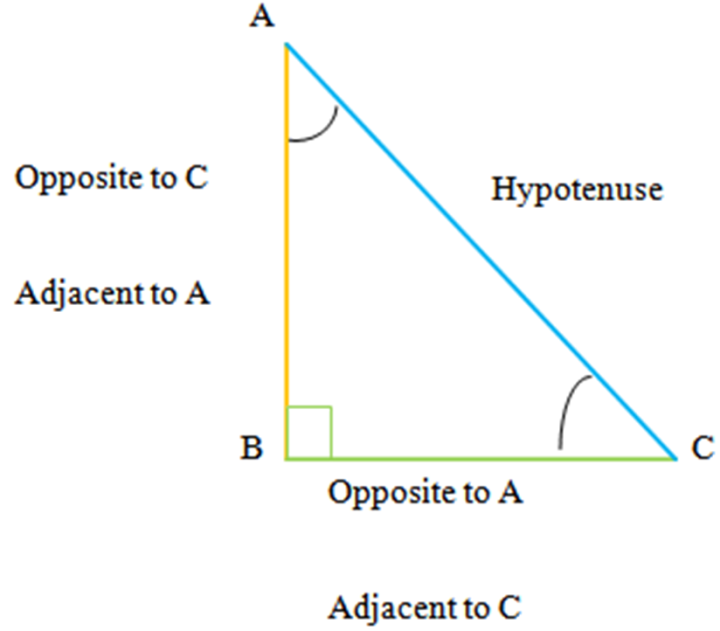
Students are able to identify that the side which is opposite to the right angle is known to be the hypotenuse (side “a” as in Figure 1). The sides which are adjacent to the right angle are called legs (or catheti, and singular: cathetus). Side “c” may be identified as the side adjacent to angle B and opposite angle C, while side “b”  is the one adjacent to angle C and opposite to angle B. In a right-angled triangle: the square of the hypotenuse is equal to the sum of the squares of the other two sides. That is called Pythagoras theorem.
From that background (at this semiotic stage) the students are introduced to symbolic language used in the learning of trigonometric ratios.
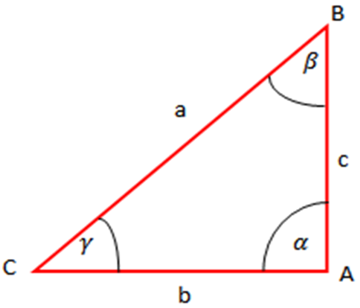
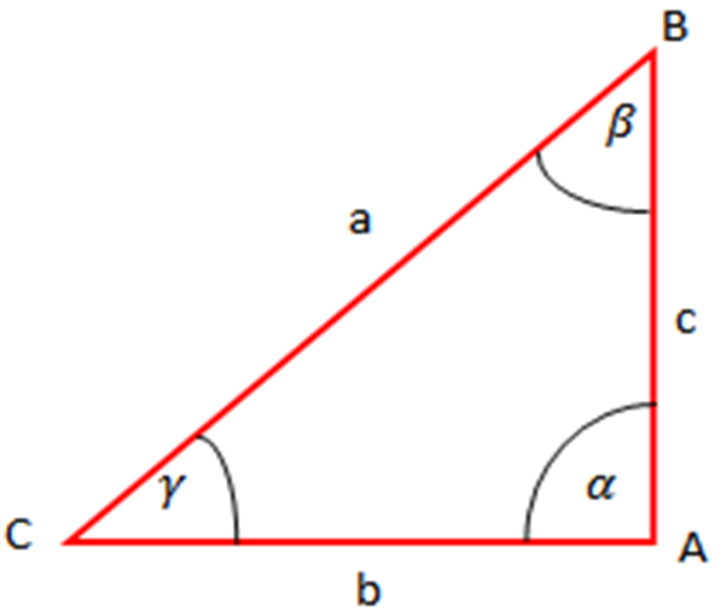
Students are made to identify sides of the right-angled triangle as (a) hypotenuse and (b) the other two adjacent sides. Either of the sides is said to be opposite depending on the angle from which one is reading. For example, we consider the right-angled triangle of the Figure5.2 (with legs b and c, hypotenuse a, acute angles as β and γ, and right angle α). Here the hypotenuse is distinguished from the two adjacent sides using small letters that are opposite to the capital letters at each of the three vertices. It is important to learn to name and to write expressions of angles using  ,
, 


 and these being examples. Define trigonometric ratios as; ratios of the lengths of two sides of a right-angled triangle (i.e.,
  ). Show the relationship between angles and the ratio of sides. For instance, for the angle γ, the trigonometric ratios are defined as follows:
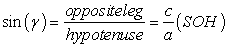 | (19) |
 | (20) |
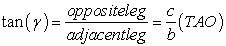 | (21) |
For the angle β, the trigonometric ratios are defined as follows:
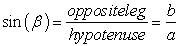 | (22) |
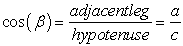 | (23) |
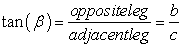 | (24) |
Use of the acronym SOH-CAH-TOA is very important at Semiotic stage. These are the three basic trigonometric ratios related to the right-angled triangle. These ratios are defined using an arbitrary right-angled triangle. This object must be known by the students.
5.2. Structural StageIn this stage, some symbolic representations can be considered such as trigonometric inverse of:
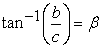 | (25) |
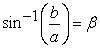 | (26) |
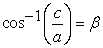 | (27) |
or
 | (28) |
 | (29) |
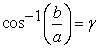 | (30) |
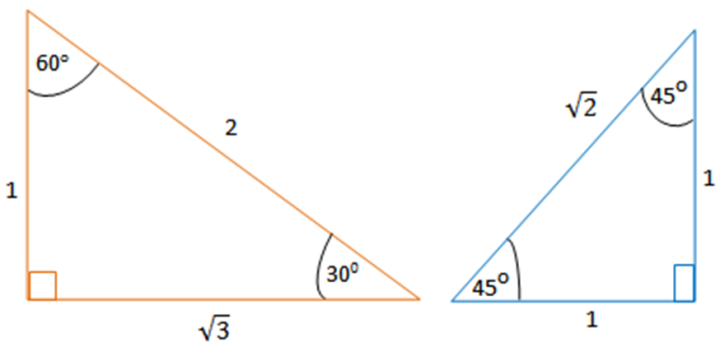
Further, describe the three trigonometric ratios and calculate sides and angles of a right-angled triangle. Attention is paid to the three special angles (60o, 45o and 30o).
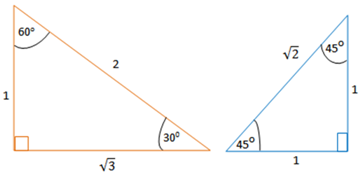
From Figure 3, students should formulate the three trigonometric ratios for special angles as follows:
• For the special angle 30°;
 | (31) |
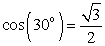 | (32) |
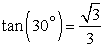 | (33) |
• For special angle 45o;
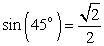 | (34) |
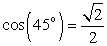 | (35) |
 | (36) |
• For special angles 60o;
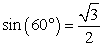 | (37) |
 | (38) |
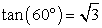 | (39) |
The above trigonometric ratios of special angles can also be presented as in the table below:
Having formulated the trigonometric ratios of special angles, students can apply them to determine the exact values of various trigonometric expressions. For example:
Determine the exact value of each of the following;
(a) sin30o tan45o + tan30o sin60o
(b) cos30o sin30o + sin30o tan30o.
5.3. Autonomous StageStudents are led into determining the signs of the three trigonometric ratios in the respective quadrants. Several acronyms are used to help students master this concept of signs. An example of such acronyms is; All Students Take Chemistry – ASTC implying that the three ratios are positive in the first quadrant, only sine is positive in the second quadrant, only tangent is positive in the third quadrant and lastly only cosine is positive in the last quadrant. Emphasis is made to measure angles in counter clockwise direction.
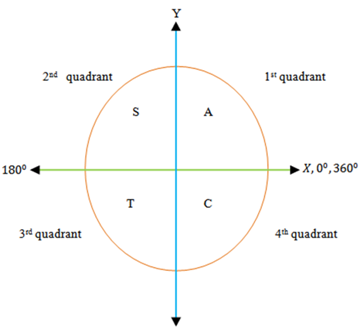
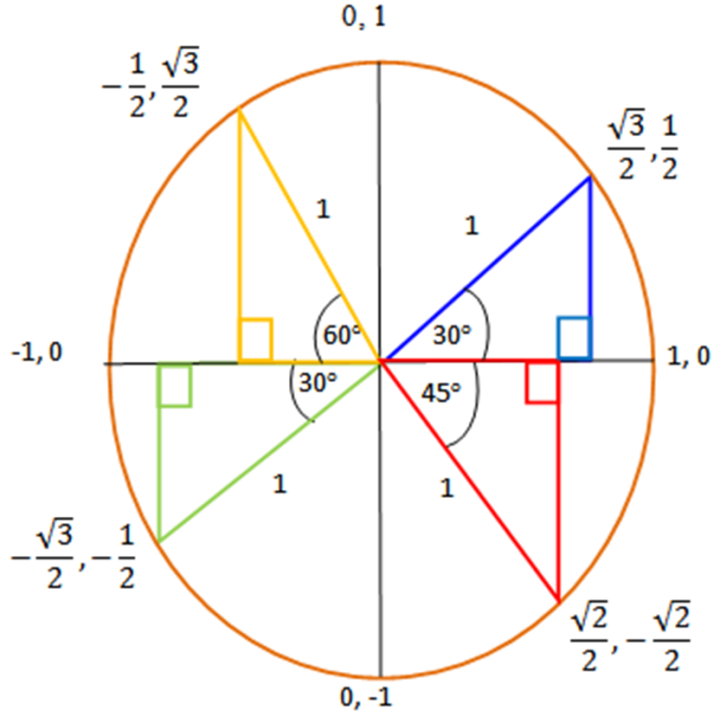
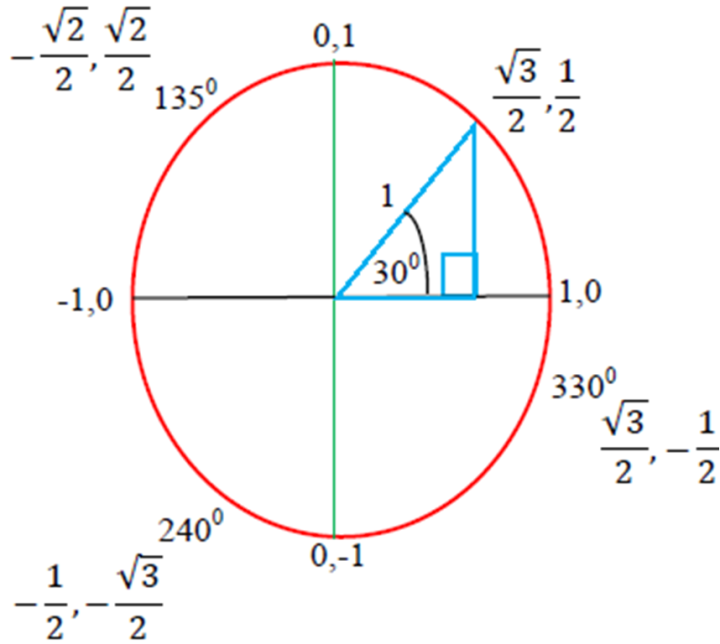
Having the introduction to the four-quadrant concept, students connect the knowledge of trigonometric ratios of special angles to the unit circle to determine the signs of the ratios in the four quadrants.
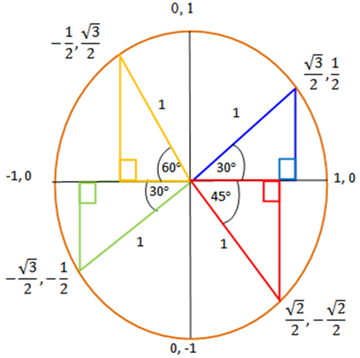
1. Definitions when angle θ is 30o in the first quadrant:
 | (40) |
 | (41) |
 | (42) |
Students recognize that all three trigonometric angles are positive in the first quadrant.
2. When angle θ is 120o (60o measured from x axis) in the second quadrant:
 | (43) |
 | (44) |
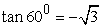 | (45) |
Students observe that only sine 60o is positive.
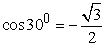
3. When angle θ is 210o (30o measured from x axis) in the third quadrant:
 | (46) |
 | (47) |
 | (48) |
Students have to identify that  only as the positive ratio in this quadrant.
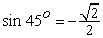
4. When angle θ is 315o (45° measured from x axis) in the fourth quadrant:
 | (49) |
 | (50) |
 | (51) |
In the fourth quadrant only  is positive.
Students have to try all special angles in the four respective quadrants before they can generalize about the signs of trigonometric ratios in each quadrant.
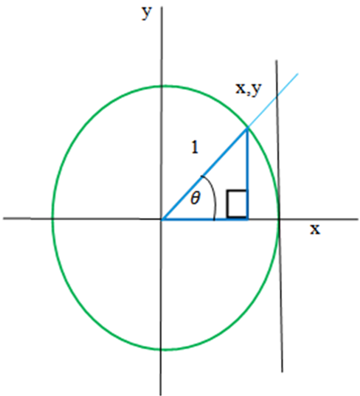
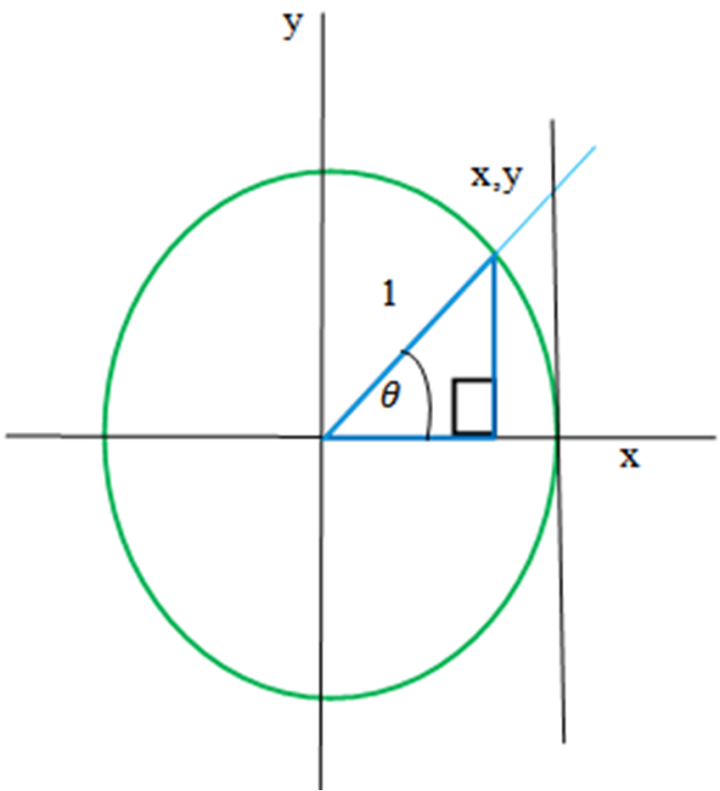
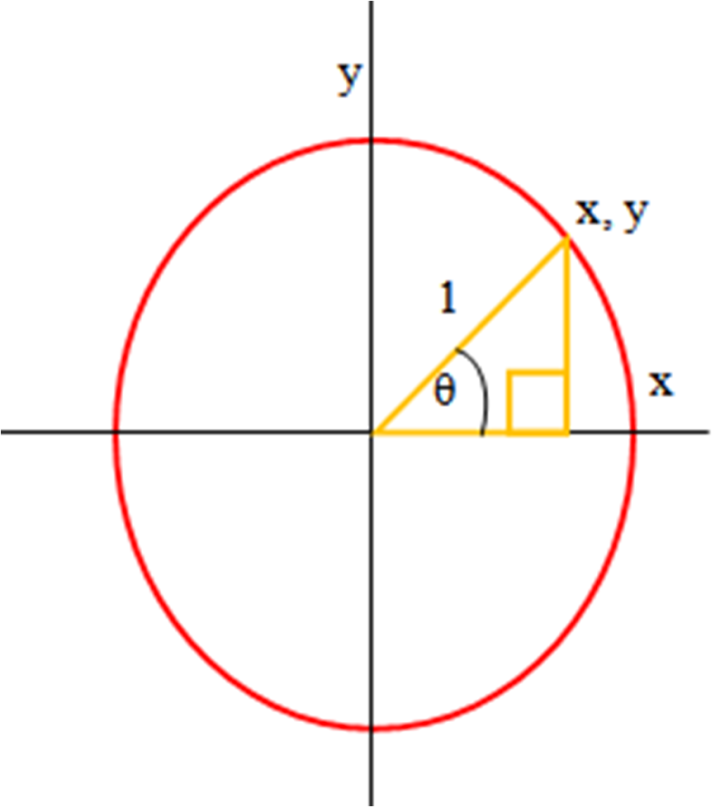
Students define trigonometric ratios as lengths of the unit circle using the SOH-CAH-TOA acronym.
Definitions:
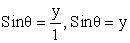 | (52) |
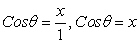 | (53) |
 | (54) |
replacing  for sin θ and
  for
for  they obtain,
 | (55) |
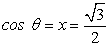
In this section, basing on Figure 3 and 5, students begin to identify relationships such as
 | (56) |
 | (57) |
(When  ). They have to recognize that “x” and “y” represents the ratios. They need also to apply Pythagoras’ theorem to show that:
 | (58) |
and by substitution they come up with
 | (59) |
It is important for students at this autonomous stage to learn about the relationship about radians and degrees and how to express angles is radians (i.e., 2π radians = 360 degrees).
Students apply trigonometric ratios on solving problems involving bearings, angles of elevations and depression. For example, students apply trigonometric ration and special angles to determine heights of objects such as trees and classrooms. Students also use the trigonometric ratios to determine the distance travelled by an airplane which is later used to calculate the speed of that respective airplane.
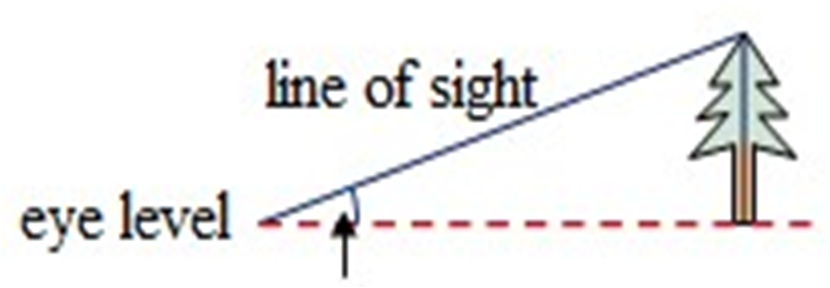
The angle of elevation is the angle between the horizontal and a direction above the horizontal (Figure 7).
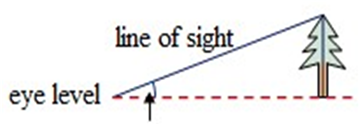
What is required is to apply trigonometric ratios to find angle of elevation, height of objects, distance from eye to an object and the slanting height.
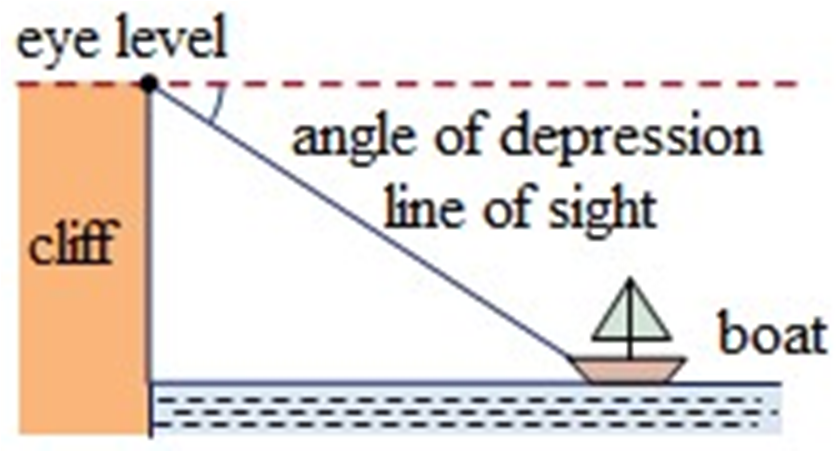
The angle of depression is the angle between the horizontal and a direction below the horizontal (Figure 8).
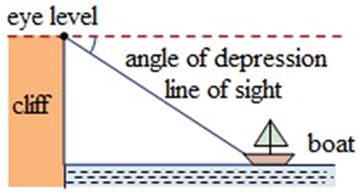
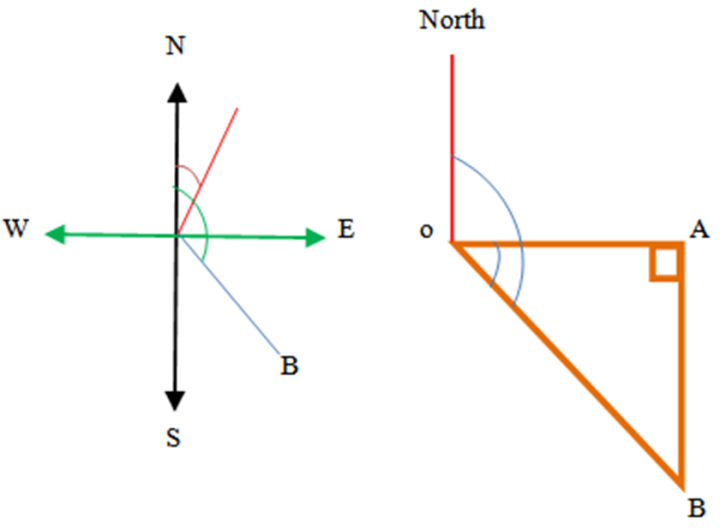
The three-figure bearing (or compass bearing) is the direction measured clockwise from North.

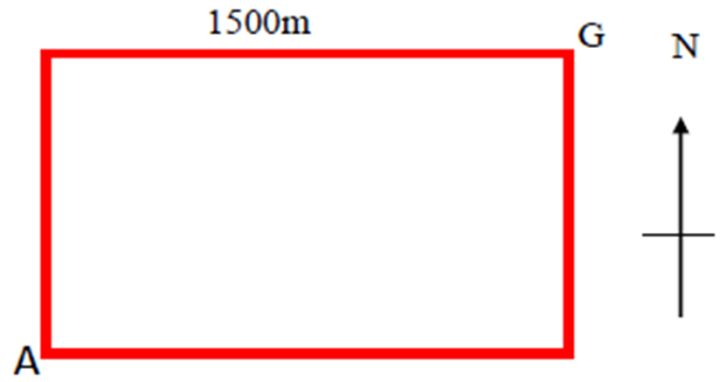
Students have to apply trigonometric ratios on bearings to find the distance between points and locate places. They apply the trigonometric ratios to find the bearing of one point from the other. Students solve all sorts of real-life problems that involve trigonometric ratios.
This section would look at the concrete implementation of problem-based learning in a classroom situation. The section will be organized into seven sessions. It will describe a step-by-step implementation of PBL approach to teach trigonometric ratios. The duration of each session would be 80 minutes. The total number of periods will be 14, implying that the implementation would be done in two weeks. The role of the teacher in the implementation process would be to facilitate the learning process. The role of the students is to actively participate in finding solutions to the posed questions in the learning process. The sessions would follow the model of cognitive competence of Socas 19, according to our interpretation of the contents about trigonometric ratios presented in the previous chapter. The students will be set in groups of 5 members each. The first section would be for students to answer a pre-test so to determine their prior knowledge. The second would be to review the pre-test and formulate students’ learning groups. The third and fourth sessions will be presented to build students’ basic knowledge about trigonometric ratios. The latter two would be for students to do practical and theoretical problems depicting real life situations. The last session would be for students to answer a post-test necessary for individual evaluation.
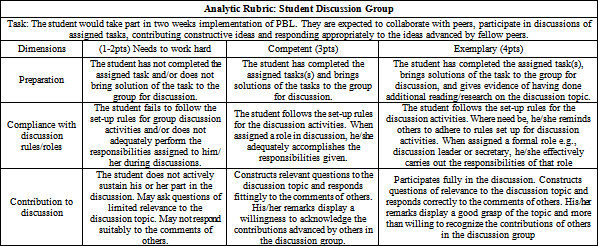
Assessment of participation in students’ discussion groups and problem-solving processes during implementation would be done using rubric schemes. Rubrics are considered to be powerful evaluation tools that use the pre- determined set of rules following certain criterion that are complex and subjective 39. The rubrics tables are presented below the sessions.
6.2. Session 1In this phase the teacher would give a pre-test to students. The duration of the pre-test will be 80 minutes. The purpose of this pre-test would be to determine the prior knowledge students may have. The pre-test would be based on the topics that precede and are a pre-requisite to trigonometry (i.e., angles, geometric construction, Pythagoras’ theorem, direction and bearings, and computer and calculators). The targeted concepts in the test would be:
• Properties of a right-angled triangle
• Construction of special angles
• Use of calculator to perform certain functions
• Pythagoras’ theorem
• Bearing of given points and their distances apart.
The outlined concepts are the more related to trigonometric ratios selected from each preceding topic.
The students’ prior knowledge would be necessary to inform the teacher about how much students know. Besides that, the students’ prior knowledge would be useful to help the teacher to form groups. Prior knowledge would inform the teacher on how to go about the introduction of trigonometric ratios. Students’ prior knowledge would be the spring board to start whole process of teaching trigonometric ratios using PBL.
KALULUSHI SECONDARY SCHOOL
GRADE 11 MATHEMATICS PRE - TEST
INSTRUCTIONS:
(1) Attempt all questions (2) Show all the working.
Time: 1:20 hours, Total marks: 100
1. In the diagram below, PQR is parallel to STV, <SQT = 90o, <QST = 42o, and PQ = QT
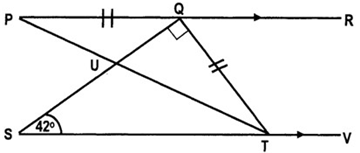 |
Calculate: (a) <TQR (b) <PTS (c) <PUS
2.
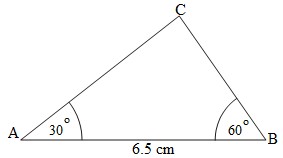 |
a) Make an accurate drawing of this triangle.
b) Measure the length of the line AC on your drawing. You must state the units.
c) Measure the size of the angle at C in your triangle.
d) Write down the mathematical name for this type of angle.
3. Show that the following triples are perfect.
a) 7,24 and 25
b) 50, 120 and130
4. MATRIX is a company which makes mathematical instruments. They intend to make a new size of set square which must have a perfect right angle at one of its corners. If the setsquare has sides of length 8.7 cm, 11.6cmand 14.5 cm, will it be acceptable.
(Give reasons for your answer).
 |
5. An orienteering course has 3 checkpoints A, Band C. B is on a bearing of 030° and a distance of 8 km from A. C is on a bearingof155°fromB and a bearing of 105° from A.
(a) Explain clearly why <ABC= 55°
(b) Calculate the bearing of point B from C.
Do not use a scale drawing
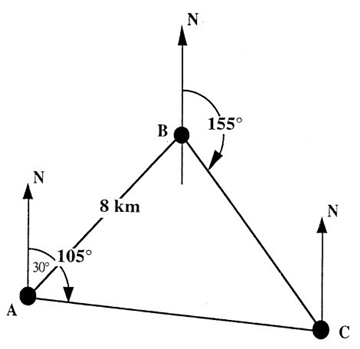 |
Review of the pretest to remind the students of the concepts they might have forgotten but are necessary for the learning of trigonometric ratios. Also, the review would serve the purpose to bridge the knowledge gap for the student who might have had no sufficient prior knowledge. In this second phase the teacher will as well form the groups basing on the pre-test results. The useful criterion would be to determine the least performing, the average performing and best performing. When this is done, the teacher would form groups by mixing the abilities so to balance up the groups. The teacher would follow the purposive kind of sampling so that the balancing of abilities in groups would be beneficial to every member of a particular group. The researcher’s preference of the group size is five students per group.
6.4. Session 3Having formed the groups, the teacher would introduce the topic of trigonometry. The teacher would give students sufficient basic information about the topic. This process must be in line with the three stages of Socas cognitive competence model, based on semiotic representations. These are semiotic, structural and the autonomous stages.
Presenting a Lesson under Semiotic Stage Using PBL
The objective at semiotic stage is to help students to learn the symbolism that is used in trigonometric ratios and then identify the three forms of presenting trigonometric ratios i.e., graphical, algebraic and in word form. Students should also use the three trigonometric ratios to solve given problems.
The teacher would design and present a lesson as elaborated bellow: the teacher would ask students to sit according to the set groups and then choose the chair person and the secretary. Whilst in groups the students draw and label the right-angled triangle ABC on the sheets of paper already distributed. Students should base the drawing of the right-angled triangle on their prior knowledge and the review of the pre-test. In other words, students would build knowledge beginning from known to the unknown.

After labeling the right-angled triangle, students identify sides using sets of letters that are at the three vertices of the drawn right angled triangle i.e., AC being the hypotenuse, AB being opposite to C but adjacent to A and BC being opposite to A, but adjacent to C. The students need to identify and describe the angles in the right-angle triangle as <A, <B, and <C. where both <A and <C are acute angles but <B is a right angle (90°). The teacher would provide information to student on how to state angles in terms of sine, cosine and tangent. As an example, the students state angles as  ,
,  ,
,  and
and 

 respectively. Thereafter the students are guided into determining the relationship between the sides and angles using the acronym – SOH-CAH-TOA. At this point, students would write the expressions to define trigonometric ratios algebraically. As an example, and considering angle C, the ratios would be;
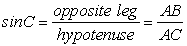 | (60) |
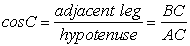 | (61) |
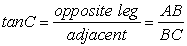 | (62) |
For angle A students obtain;
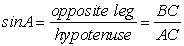 | (63) |
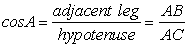 | (64) |
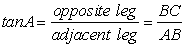 | (65) |
Emphasis would be made to the students that the triangle can be labeled differently can be used but the way of formulating trigonometric ratios is the same. Different symbols can be used to represent angles such as 


 etc. Another emphasis to be made to students is that they have formulated algebraic representations from the graphical representation of trigonometric ratios.
In the next step, students would define trigonometric ratios in word form, i.e., trigonometric ratios are the ratios of the lengths of two sides of a right-angled triangle. The sine is the ratio of the length of the opposite side to the hypotenuse. The cosine is the ratio of the length of the adjacent side to the hypotenuse. The tangent is the ratio of the length of the opposite side to the adjacent side of the right-angled triangle. Students identify the three forms of presenting trigonometric ratios as (i) graphical (ii) algebraic and (iii) word form.
In the last step the teacher would guide the students into using the trigonometric ratios to find the values of angles, length of sides and the angle itself. Students would use the inverse of sine, cosine and tangent to evaluate the angle. Thereafter, students would do the following task.
i. Identify the opposite and adjacent sides of
b) < K
Ans. LM is the opposite side to K
Ans. KL is the adjacent side to K
c) < M
Ans. KL is the opposite side to M
Ans. LM is the opposite side to M
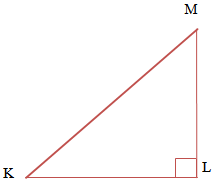 |
ii. Write the ratio needed to calculate the trigonometric ratio in the stated angles in the right-angled triangles below.
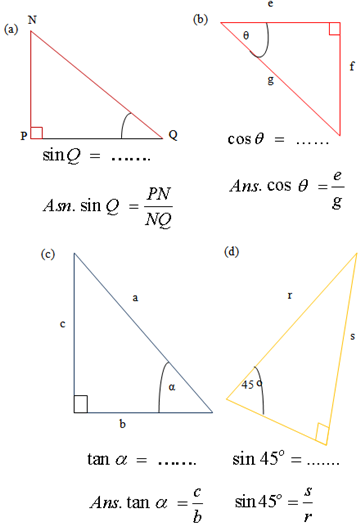 |
iii. Use the calculator to find the values of  ,
,  and
and  in the following. Collect your answer to one decimal place.
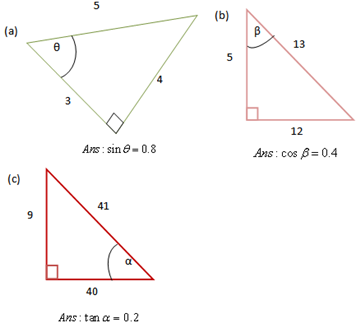 |
iv. Draw right angled triangle HIJ were
 |
 |
 |
Calculate the length of HJ.
 |
v. The right-angled flower bed is marked JKL at is three vertices such that
 |
 |
and
 |
Draw the flower bed and then find (a) < L (b) < J.
Ans. (a) < L = 22.6°
(b) < J = 67.4°
After finding solutions to the task, the secretaries or any other chosen members from the group would stand to present the findings for their respective groups. Then students compare their solutions and make conclusions.
Home Work
Calculate the angles and the missing sides in the two triangles given bellow.
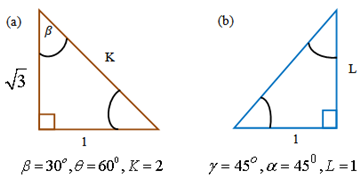 |
Presenting a lesson under structural stage
This session begins with the review of the home work. Representatives from each group stands to present the solution before the class. The students compare, agree or disagree to the findings.
The review of the home work marks the beginning of the lesson for the day. To discourage rote memorization of the special angles, the students would be advised to derive the lengths of the sides using Pythagoras theorem as follows;
After knowing how to come up with the length of sides of the triangles, students formulate trigonometric ratios for the special angles basing on the two triangles as follows.
• Trigonometric ratio for the special angle 30o;
 | (66) |
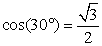 | (67) |
And
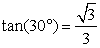 | (68) |
• For special angle 45o;
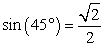 | (69) |
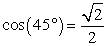 | (70) |
And
 | (71) |
• For special angles 60°;
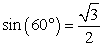 | (72) |
 | (73) |
And
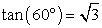 | (74) |
The teacher would tell the students that the angles you have found are called the special angles. Students would state why the said angles are called special angles after analyzing the formulated trigonometric ratios. The expected description would be that; they are called special angles because their trigonometric functions equate to the specific and known ratios and that they are easy to committee to memory and recall, and, also, these angles appear in a lot of common situations. They can be manipulated easily without a calculator. Having formulated the trigonometric ratios of special angles, students would apply them to determine the exact values of various trigonometric expressions. For example: determine the exact value of each of the following;
(a)
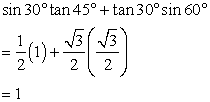
(b)
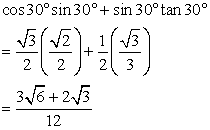
Relationship Between Basic Trigonometric Ratios and Trigonometric Ratios of Special Functions.
Students determine the relationship between basic trigonometric ratios and the trigonometric ratios for the special angle. They further combine the basic trigonometric angles and the trigonometric ratios for special angles to solve the real-life problem. Students do the following problem.
Question
Given that the angle of elevation from the top of the tower to point C on the ground is 60° and the distance from the foot of the tower to point C is15m.
Draw a sketch of the situation. Find:
a) the height of the tower
b) the slant height
Solution
(a) 
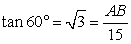

(b) 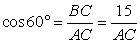


Phase 1
In this session students would be led into determining the signs of the three trigonometric ratios in the respective quadrants. At this point the learning of trigonometric ratios extends beyond 90o.In the first place; students would use the pair of compasses to draw a unit circle. They would as well draw reference angles in the unit circle using special angles in the four quadrants following the example drawn in the first quadrant.
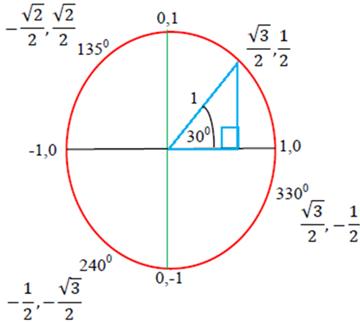
After they finish drawing the reference angles in the four quadrants, they would use the knowledge learnt in the previous class to state the trigonometric ratios so to determine the sign of each ratio in the respective quadrant.
They state the trigonometric ratios as follows;
1. When angle θ is 30° in the first quadrant:
 | (75) |
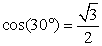 | (76) |
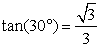 | (77) |
Students would observe that all three trigonometric ratios in the first quadrant are positive.
2. When angle θ is 135° (45° measured from x axis) in the second quadrant:
 | (78) |
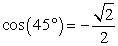 | (79) |
 | (80) |
Students observe that only sin45° is positive.
3. When angle θ is 240° (60o measured from x axis) in the third quadrant:
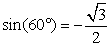 | (81) |
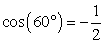 | (82) |
 | (83) |
Students have to identify that tan 60o only has positive ratio in this quadrant.
4. When angle θ is 330o (30o measured from x axis) in the fourth quadrant:
 | (84) |
 | (85) |
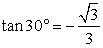 | (86) |
In the fourth quadrant only cos 30o is positive.
Students would then try all special angles in the four respective quadrants before they can generalize about the signs of trigonometric ratios in each quadrant. When that is done, students learn the acronym All Students Take Chemistry (ASTC) as a mnemonic aid.
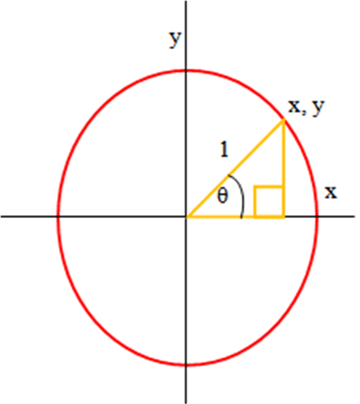
Students would define trigonometric ratios as lengths of the unit circle using the SOH-CAHTOA acronym.
Definitions:
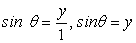 | (87) |
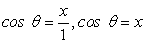 | (88) |
 | (89) |
Replacing y for sinθ and x for cosθ they obtain,
 | (90) |
Teacher to highlight to students that x and y are representing a ratio of two sides in a unit circle. The teacher would ask students to compare the three definitions of trigonometric ratios as; lengths, special angles, and basic angles. Students would begin to identify relationships such as
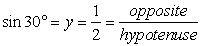 | (91) |
And
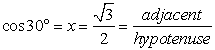 | (92) |
Thereafter, students have to also apply Pythagoras’ theorem to show that:
 | (93) |
and by substitution they come up with
 | (94) |
Before they begin to attempt problems, students would learn about the relationship between radians and degrees and how to express angles is radians (i.e., 2π radians = 360 degrees)
Phase 2
The previous sessions of the implementation served a purpose of equipping students with thinking tools necessary for problem solving. In this session the teacher would present students with theoretical problems depicting the real-life situations. Every time students meet in their respective groups; they have to choose the chair person and the secretary. In the problem-solving process students would be guided by the three questions bellow;
• What do we already know?
• What do we need to know in order to solve this problem?
• What should we do?
Students in their groups to do the following problems;
Instruction: sketch the diagram for each problem where possible.
1. A pole of height 25m stands vertically on the ground. The angle of elevation from the top of the pole to point ‘P’ on the ground is 45o. Find the distance of the point P from the foot of the pole.
2. A boy standing on the tower observes a ball on the ground at an angle of depression of 30o. The ball is located 60 meters from the foot of the tower. Find the height of the tower.
3. The upper part of a tree is broken by the wind and touches the ground making an inclination of 30o at a distance of 10m from the foot of the tree. Find the height of the tree before it was broken.
4. From a point on a bridge across a river, the angles of depression of two points on opposite sides of the river are 30o and 60o respectively. If the bridge is at the height of 10m from the banks, find the width of the river.
5. John wants to measure the height of a tree. He walks exactly 100 feet from the base of the tree and looks up. The angle from the ground to the top of the tree is 33o. To the nearest foot, how tall is the tree?
6. An aero plane flying horizontally 1km above the ground is observed at an elevation of 60o. After 10 seconds, its elevation is observed to be 30o. Find the speed of the aero plane.
7. A farmer has a rectangular field. He describes the path he walks across the field starting at point A. First, he walks on a bearing of 075o for 1000m to reach point B. He then turns at point B and walks 500m at the bearing of 323o reaching point C on the north side of the field. Calculate how far he still needs to walk to reach the corner G, of the field.
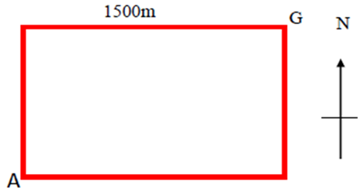
The teacher would provide students with learning material such as text books, rules, manila papers, markers, protractors, pair of compasses and dividers. As students walk through the process of finding solutions to the presented problems, the teacher would go round guiding them. The teacher would be asking probing questions to help and redirect students thinking. Teacher would help students to get back into focus in case of them going wayward. After students are done with answering the question, they have to make presentations through the secretaries or any chosen member of the group. Students (as a class) have to compare, discuss and make amendments if any, to their work.
6.5. Session 6In this session students would be deeply engaged in the problem-solving process with little or no guidance from the teacher. The students would be guided by the three questions as in phase 2 of session 5. In this session students would be provided with the following tools; goniometer and tape measure.
Phase 1
While in class students plan how to determine;
a) The height of the school wall
b) The area of a non-right angled triangular flower be in front of the administration block
c) The tree height using an angle of elevation of 60o from the eyes of the observer
d) Students find the slant height from the top of the tree using 30o and 45o
e) The height of an Ant hill which is in the school yard
f) The last activity is for the students to determine the angle of elevation when one student is standing on top of the hill looking at a friend who is standing at some reasonable distance from the base of the hill.
Phase 2
Students would go outside the classroom (according to groups) and carry out the planned activities.
Phase 3
After finishing the outdoor activities students would compile their findings and make presentations in class. During presentations the students have to give an extensive explanation of the undertaken procedures and how they arrived at the conclusions. The students have to systematically and with precision keep records of their work. During presentations, students are given audience to ask question so to get clarification. Students would also make contributions and share the experiences. In all these proceedings, the teacher would be there to facilitate the learning process.
6.6. Session 7This session would be for evaluation of students at an individual level. Students would write a post-test individually which should be marked and analyzed to see if students’ learning of trigonometric ratios has improved or not. The post-test results would be compared with the pretest results in order to infer upon performance of students and the impact PBL will have made on the students’ learning.
KALULUSHI SECONDARY SCHOOL
GRADE 11 MATHEMATICS POST - TEST
INSTRUCTIONS: (1) Attempt all questions (2) Show all the working.
Time: 2:00 hours, Total marks: 50
1. A three-meter ladder is placed against a brick wall. The base of the ladder is 900mm from the base of the wall. Find the angle the ladder makes with the wall.
2. An unknown angle θ complies with the relation  Find all the possible values of the angle θ .
3. Evaluate  .
.
4. Two support cables, from the top (T) of a motorway light, are attached to a pair of points, A and B, on the ground, as shown in the diagram.
a) Calculate the distance from B to C.
b) Calculate the distance from A to B.
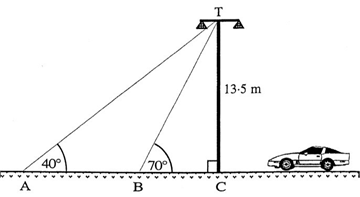 |
5. A 5metre ladder rests against a building so that the foot of the ladder is 3.5 m out from the bottom of the wall. Determine, correct to the nearest degree, the angle that the foot of the ladder makes with the ground.
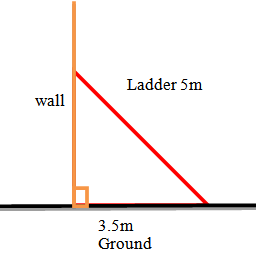 |
6. Buseko stands 70m from the base of a building and measures the angle of elevation to the top of the building as being 35o. Taona is standing 40m from the base of the building on the other side of the building as shown on the figure below.
a. Calculate the height of the building, correct to two decimal places
b. Calculate the angle of elevation of the top of the building that Taona would measure, correct to the nearest degrees.
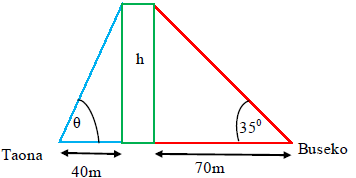 |
7. Buseko and Madalitso are both flying a kite from the same point. Buseko’s kite is flying on 50 meters of string and the string makes an angle with the ground. Madalitso’s kite is flying on a 60 metres piece of string and is at the same height as Buseko’s kite, as shown in the figure on the right. Calculate the;
a. Angle that the string from Madalitso’s kite makes with the ground. Give your answer correct to the nearest degree.
b. The distance between A and B.
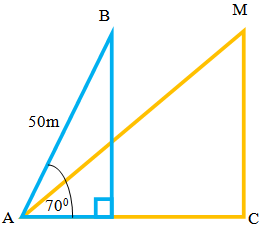 |
8. An observer on top of the cliff 200m above the see-level observes the angles of depression of the two ships to be 45o and 30o respectively. Find the distance between two ships, if the ships are
a. On the same side of the cliff
b. on the opposite sides of the cliff
9. Town B is 4.5km due west of town C. Town A is 2.4km due north of B.
a. Calculate the size of the angle at x. Give you answer, correct to 3 significant figures.
b. Find the bearing of C from town A. Give your answer, correct to 3 significant figures.
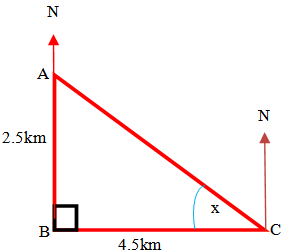 |
10. Watchers in two 10 metre observation towers each spot an aircraft at an altitude of 400 meters. The angles of elevation from the two towers are shown in the diagram. (Assume all three objects are in a direct line).
a. What is the horizontal distance between the nearest tower and the aircraft (correct to the nearest10 metres)?
b. How far apart, are the two towers from each other (correct to the nearest 100 metres)?
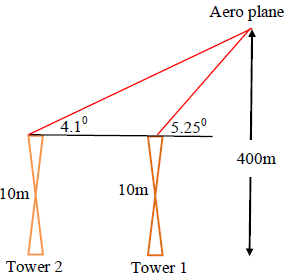 |
A teacher would be interested in assessing students' attainment of the general goal which outlines anticipations for participation in discussion groups. The teacher would also want to assess the students’ problem–solving abilities attained by students during the implementation process. To that effect the teacher would create the following analytic problem-solving rubric with a 4-item scale. The teacher awards the student with assigned points for every appropriate performance.
Student Name: …………………………………….
Group: …………………………………………….
Teacher’s Name: …………………………………
Date: ……………………………………………….
Grade: ……………………………………………...
MATHEMATICS REAL LIFE PROBLEM -SOLVING RUBRIC
Student Name: …………………………………….
Group: ……………………………………………...
Teacher’s Name: …………………………………
Date: ……………………………………………….
Grade: ……………………………………………...
There are many challenges that Kalulushi Secondary school teachers face in terms of teaching of trigonometric ratios. As a result, students also encounter reciprocative difficulties during their learning of the said topic. To address the challenges teachers and students face, the study has proffered the blending of problem-based learning approach, problem-solving strategy and cognitive competence model of Socas 19 to be embraced and put to good use by all well-meaning teachers.
Problem Based Learning helps in cultivating potent and to enhance students’ achievement. It exposes students to more real-life situations and helps them to generate knowledge by themselves with the teacher only being there to correct their misconstruction. Problem-based learning requires the teacher to facilitate learning rather than being a dictator and sole owner of knowledge.
Problem based learning allows students to be actively engaged in learning process which is not so in conventional learning method. This attribute of PBL facilitates the students’ development of mathematical thinking abilities and problem-solving skills. PBL offers an interesting and enjoyable way to learn mathematics. It helps students to learn new mathematics with greater understanding and eventually, it produces positive attitudes towards mathematics. It develops research skills and triggers critical thinking, flexibility and creativity in students. PBL approach is more effective in improving students’ self-directed and lifelong learning skills. In a general sense PBL enhances students’ academic performance and escalates their impetus about mathematics learning.
Since trigonometric ratios involve the graphical system, algebraic/symbolic system and verbal system of representations, there is need to infuse cognitive competence of Socas which considers the system of semiotic representations into the teaching process. Cognitive competence model of Socas underscores that the semiotic representations have an indispensable role in the learning of a mathematical concept or object: this process of learning is understood as a process of abstraction of the system of semiotic representations of the concept or object.
Just like PBL, this process of abstraction process has its starting point in the prior knowledge of the student, and it distinguishes three progressive stages of cognitive development of a mathematical concept/object: semiotic, structural and autonomous 19. The cognitive competence model is organized around three components: the semiotic representations of a mathematical object, the stages of cognitive development of these systems of representation and the difficulties, obstacles and errors in the learning of the students 17.
The principle of problem-solving is embodied in both PBL and cognitive competence model of Socas. This is the more reason why the study has suggested the intertwining of PBL and the cognitive competence model of Socas so as to arrest most challenges which both students and teachers may face in the teaching and learning of trigonometric ratios.
7.1. RecommendationBased on this research, the researcher recommended the following:
• Mathematics teachers should adopt the use of PBL approach intertwined with cognitive competence model of Socas at Secondary school level
• Teacher trainers in colleges should consider PBL approach as one of their teaching strategies so to equip new breed of Secondary teacher with this teaching approach.
• Problem based learning entail material usage to a large extent. For this reason, mathematics classes should be supplied with the necessary materials and equipment
• Students to be accorded chance to do in class and out of class activities too often in order to excite and consolidate their learning of mathematics
• Creating a suitable Secondary school environment for practicing PBL approach should be a priority on the agenda for the school administrators
• Training is needed for all mathematics in service Secondary school teachers across disciplines about the use of PBL.
It is hard to express adequate appreciation to Dr. Matías Arce Sánchez, Prof. Cristina Pecharromán Gómez and Prof. Tomás Ortega del Rincón who have rendered their selfless service to the fruition of this dissertation. They provided me with materials, guidance and made criticisms to most of my work. Certain people deserve special mention in this document; my dear wife, Thandiwe Shawa Musonda and my lovely children, Buseko Mwenya Musonda and Madalitso Taona Musonda for their sacrifice and anguish they endured while I was away for studies. You are just amazing and central to my thoughts.
I would as well give special thanks to Mr. Mulumbu Geoffrey for his generosity during the development of this work. It is important for me to recognize the significant contribution made to the development of this research by my lecturers Prof. Luis Carro Sancristobal, Prof. Carmen Guillen Diaz and Prof. Maria de Valle Flores Lucas and Mercedes de la Calle. I cannot forget to convey my sincere ratitude to my Spaniard friends; Pablo Moreno Amo, Elena Betegon Blanca, Avalos Diaz Nicole and Lopez Blanco Diego who were so friendly and interpreting lessons which were taught in Spanish.
Special gratitude goes to my mother Mrs. Kambole Eunice and my father Mr. Musonda Stephen Chapu who have been an invaluable source of inspiration. May I also extend my sincere gratitude to my brothers Mr. Mwila Obed David, Mr. Musonda Stephen, Kanyanta Fredrick Musonda and my nephew Mr. Musonda Marron Davis who have been source of drive in my academic career. I wouldn’t forget to appreciate my two sisters Josephine Musonda and Melody Musonda who have always been there for me. I would be failing if I fail to recognize my sponsor DREAM ACP who facilitated my exchange program.
| [1] | Yusha’u, M. A Difficult topic in Junior Secondary school mathematics: a practical aspect of teaching and learning. Scientific journal of pure and applied science, 2(4), 161-174. 2013. | ||
| In article | |||
| [2] | Polya, G. How to solve it. University press, Princeton, NJ. 1973. | ||
| In article | |||
| [3] | Corral, M., Trigonometry, Livonia: Michigan, 2009. | ||
| In article | |||
| [4] | Thomas, G., & Finney, R., Calculus and analytic geometry (9th ed.). Addison-Wesley Publishing Company, Reading, MA, 1996. | ||
| In article | |||
| [5] | Examinations Council of Zambia Examination performance report – General Performance Analysis: Lusaka, 2014. | ||
| In article | |||
| [6] | Examinations Council of Zambia Examination performance report – General Performance Analysis. Lusaka 2008. | ||
| In article | |||
| [7] | Becker, K. H., & Maunsaiyat, S. A comparison of students' achievement and attitudes between constructivist and traditional classroom environments in Thailand vocational electronics programs. Journal of Vocational Education Research, 29(2), 133-153, 2004. | ||
| In article | View Article | ||
| [8] | Schoenfeld, A. H. Learning to think mathematically: Problem solving, meta-cognition, and sense-making in mathematics. In D. Grouws (Ed.), Hand book for Research on Mathematics Teaching and Learning, MacMillan. New York, 1992, 334-370. | ||
| In article | |||
| [9] | National Council of Teachers of mathematics. Curriculum and evaluation standards for school mathematics, NCTM, Reston, VA, 1989. | ||
| In article | |||
| [10] | National Research Council. Everybody counts: A report to the nation on the future of mathematics education. National academy press, Washington, DC, 1989. | ||
| In article | |||
| [11] | National Research Council. Reshaping school mathematics: A philosophy and frame work for curriculum, National Academy Press, Washington, DC, Jan. 1990a. | ||
| In article | |||
| [12] | Borasi, R., On the nature of problems. Educational Studies in Mathematics, 17(2), 125-141, May 1986. | ||
| In article | View Article | ||
| [13] | Ortega, T., Pecharromán, C y Sosa, P. La importancia de los enunciados delos problemas matemáticos, Educatio Siglo XXI, 29(2), 2011, 99-116. | ||
| In article | |||
| [14] | Stanic, G., & Kilpatrick, J. Historical perspectives on problem solving in the mathematics curriculum in the teaching, 1-22, 1988. | ||
| In article | |||
| [15] | Halmos, P. R., The heart of mathematics. American Mathematical Monthly, 87, 519-524, 1980. | ||
| In article | View Article | ||
| [16] | Resnick, L. B. Knowing, learning, and instruction: Essays in honor of Robert ‘Glaser, Lawrence Erlbaum Associates, Hillsdale, NJ, 393-451, 1989. | ||
| In article | |||
| [17] | Camacho-Machín, M., Afonso, M. C, Socas, M. M. &Depool, R. University students’ understanding of tasks involving ways to approximated finite integrals. Far East Journal of Mathematical Education, 13(2), 91-115, 2014. | ||
| In article | |||
| [18] | Duval, R. Semiosis y pensamiento humano. Registros semióticos y aprendizajes intelectuales. Cali, Colombia: Universidad del Valle, Instituto de Educación y Pedagogía, Grupo de Educación Matemática, 1999. | ||
| In article | |||
| [19] | Socas, M. M. Dificultades y errores en el aprendizaje de las matemáticas. Análisis desde el enfoque lógico semiótico. In M. Camacho, P. Flores, & P. Bolea (Eds.), Investigación en Educación Matemática XI, SEIEM, La Laguna, 19-52, 2007. | ||
| In article | |||
| [20] | Duval, R., A cognitive analysis of problems of comprehension in a learning of mathematics. Educational Studies in Mathematics, 61(1) 103-131, 2006. | ||
| In article | View Article | ||
| [21] | Movshovit-Hadar, N., Zaslavksi, O., & Inbar, S. An Empirical Classification Model for Errors in High Schools Mathematics. Journal for Research in Mathematics Education, 18(1), 3-14, 1987. | ||
| In article | View Article | ||
| [22] | Socas, M. M. & Hernández, J., Mathematical problem solving in training elementary teachers from a Semiotic Logical Approach. The Mathematics Enthusiast Journal, 10(12), 191-218, 2013. | ||
| In article | View Article | ||
| [23] | Dossey, J., Mullis, I., Lindquist, M, & Chambers, D., The mathematics report card: Are we measuring up? Trends and achievement based on the 1986 National Assessment. Educational Testing Service, Princeton, NJ, 1988. | ||
| In article | |||
| [24] | Filipenko, M., & Naslund, J.A. (Eds.), Problem-Based Learning in Teacher Education, Springer International Publishing, Switzerland, 2016. | ||
| In article | View Article | ||
| [25] | Knowles, M. S., Self-directed learning: A guide for learners and teachers, Association Press, New York, NY, 1975. | ||
| In article | |||
| [26] | Barrows, H.S. & Tamblyn, R.M, Problem-based Learning. An Approach to Medical Education. Springer Publishing Company. New York, NY, 1980. | ||
| In article | |||
| [27] | Yi-wen, C., A Synthesis of Research on Cooperative Learning with Mathematics. Curriculum and Instruction, Dec, 1999 | ||
| In article | |||
| [28] | Mckeachie, W.J., Teaching Tips: Strategies, Research and Theory of College and University Teachers (10thed), DC & Health Co, 1999. | ||
| In article | |||
| [29] | Barrows, H.S. (The essentials of problem-based learning. Journal of Dental Education. 62(9), 630-633, 1998. | ||
| In article | View Article PubMed | ||
| [30] | Hiebert, J., Carpenter, T. P., Fennema, E., Fuson, K. C., Weame, D., Murray, H., Olivier, A., & Human, P., NH: Heinemann, making sense: Teaching and learning mathematics with understanding., Portsmouth, 1997. | ||
| In article | |||
| [31] | Piaget J. La representation de l'espace chez l'enfant. Paris: P.U.F., 1972. | ||
| In article | |||
| [32] | Radatz, H. Error Analysis in Mathematics Education. Journal for Research in Mathematics Education, 10(3), 163-172, 1979. | ||
| In article | View Article | ||
| [33] | Vygotsky, L.S. Mind in Society. Harvard University Press, Cambridge, MA, 1978. | ||
| In article | |||
| [34] | Combs, A, W. Fostering maximum development of an individual. In Learner-centered Classrooms, Problem-Based Learning, and the Construction of Understanding and Meaning of students, 77(6), 65-87, November 1976. | ||
| In article | View Article | ||
| [35] | Gentry, E. Creating Student-centered., Problem-based Classroom. Huntsville: University of Alabama in Huntsville, 2000. whttp://ww.aspire.cs.uah.edu/aspire/project_based_classroom.pdf. | ||
| In article | |||
| [36] | Gijselsers, W.H. Connecting problem-based practices with educational theory. In L. Wilkerson & W.H. Gijselsers (Eds), Bringing problem-based learning to higher education: theory and practice, San Francisco, 1997. | ||
| In article | |||
| [37] | Ministry of Education. Educating our future: National policy on education, Zambia Education Publishing House, Lusaka 1996. | ||
| In article | |||
| [38] | Ministry of Education. ‘O’ Level mathematics syllabus grade 10 - 12. Curriculum Development Centre, Lusaka, 2013. | ||
| In article | |||
| [39] | Cronin, P, J., Dekker, J., & Dunn, J, G. A procedure for using and evaluating concept maps. Research in science education, 12(1), 17-24, 1982. | ||
| In article | View Article | ||
Published with license by Science and Education Publishing, Copyright © 2023 Matías Arce Sánchez, Cristina Pecharromán Gómez, Tomás Ortega del Rincón and Thomas Mwenya Musonda
 This work is licensed under a Creative Commons Attribution 4.0 International License. To view a copy of this license, visit
http://creativecommons.org/licenses/by/4.0/
This work is licensed under a Creative Commons Attribution 4.0 International License. To view a copy of this license, visit
http://creativecommons.org/licenses/by/4.0/
| [1] | Yusha’u, M. A Difficult topic in Junior Secondary school mathematics: a practical aspect of teaching and learning. Scientific journal of pure and applied science, 2(4), 161-174. 2013. | ||
| In article | |||
| [2] | Polya, G. How to solve it. University press, Princeton, NJ. 1973. | ||
| In article | |||
| [3] | Corral, M., Trigonometry, Livonia: Michigan, 2009. | ||
| In article | |||
| [4] | Thomas, G., & Finney, R., Calculus and analytic geometry (9th ed.). Addison-Wesley Publishing Company, Reading, MA, 1996. | ||
| In article | |||
| [5] | Examinations Council of Zambia Examination performance report – General Performance Analysis: Lusaka, 2014. | ||
| In article | |||
| [6] | Examinations Council of Zambia Examination performance report – General Performance Analysis. Lusaka 2008. | ||
| In article | |||
| [7] | Becker, K. H., & Maunsaiyat, S. A comparison of students' achievement and attitudes between constructivist and traditional classroom environments in Thailand vocational electronics programs. Journal of Vocational Education Research, 29(2), 133-153, 2004. | ||
| In article | View Article | ||
| [8] | Schoenfeld, A. H. Learning to think mathematically: Problem solving, meta-cognition, and sense-making in mathematics. In D. Grouws (Ed.), Hand book for Research on Mathematics Teaching and Learning, MacMillan. New York, 1992, 334-370. | ||
| In article | |||
| [9] | National Council of Teachers of mathematics. Curriculum and evaluation standards for school mathematics, NCTM, Reston, VA, 1989. | ||
| In article | |||
| [10] | National Research Council. Everybody counts: A report to the nation on the future of mathematics education. National academy press, Washington, DC, 1989. | ||
| In article | |||
| [11] | National Research Council. Reshaping school mathematics: A philosophy and frame work for curriculum, National Academy Press, Washington, DC, Jan. 1990a. | ||
| In article | |||
| [12] | Borasi, R., On the nature of problems. Educational Studies in Mathematics, 17(2), 125-141, May 1986. | ||
| In article | View Article | ||
| [13] | Ortega, T., Pecharromán, C y Sosa, P. La importancia de los enunciados delos problemas matemáticos, Educatio Siglo XXI, 29(2), 2011, 99-116. | ||
| In article | |||
| [14] | Stanic, G., & Kilpatrick, J. Historical perspectives on problem solving in the mathematics curriculum in the teaching, 1-22, 1988. | ||
| In article | |||
| [15] | Halmos, P. R., The heart of mathematics. American Mathematical Monthly, 87, 519-524, 1980. | ||
| In article | View Article | ||
| [16] | Resnick, L. B. Knowing, learning, and instruction: Essays in honor of Robert ‘Glaser, Lawrence Erlbaum Associates, Hillsdale, NJ, 393-451, 1989. | ||
| In article | |||
| [17] | Camacho-Machín, M., Afonso, M. C, Socas, M. M. &Depool, R. University students’ understanding of tasks involving ways to approximated finite integrals. Far East Journal of Mathematical Education, 13(2), 91-115, 2014. | ||
| In article | |||
| [18] | Duval, R. Semiosis y pensamiento humano. Registros semióticos y aprendizajes intelectuales. Cali, Colombia: Universidad del Valle, Instituto de Educación y Pedagogía, Grupo de Educación Matemática, 1999. | ||
| In article | |||
| [19] | Socas, M. M. Dificultades y errores en el aprendizaje de las matemáticas. Análisis desde el enfoque lógico semiótico. In M. Camacho, P. Flores, & P. Bolea (Eds.), Investigación en Educación Matemática XI, SEIEM, La Laguna, 19-52, 2007. | ||
| In article | |||
| [20] | Duval, R., A cognitive analysis of problems of comprehension in a learning of mathematics. Educational Studies in Mathematics, 61(1) 103-131, 2006. | ||
| In article | View Article | ||
| [21] | Movshovit-Hadar, N., Zaslavksi, O., & Inbar, S. An Empirical Classification Model for Errors in High Schools Mathematics. Journal for Research in Mathematics Education, 18(1), 3-14, 1987. | ||
| In article | View Article | ||
| [22] | Socas, M. M. & Hernández, J., Mathematical problem solving in training elementary teachers from a Semiotic Logical Approach. The Mathematics Enthusiast Journal, 10(12), 191-218, 2013. | ||
| In article | View Article | ||
| [23] | Dossey, J., Mullis, I., Lindquist, M, & Chambers, D., The mathematics report card: Are we measuring up? Trends and achievement based on the 1986 National Assessment. Educational Testing Service, Princeton, NJ, 1988. | ||
| In article | |||
| [24] | Filipenko, M., & Naslund, J.A. (Eds.), Problem-Based Learning in Teacher Education, Springer International Publishing, Switzerland, 2016. | ||
| In article | View Article | ||
| [25] | Knowles, M. S., Self-directed learning: A guide for learners and teachers, Association Press, New York, NY, 1975. | ||
| In article | |||
| [26] | Barrows, H.S. & Tamblyn, R.M, Problem-based Learning. An Approach to Medical Education. Springer Publishing Company. New York, NY, 1980. | ||
| In article | |||
| [27] | Yi-wen, C., A Synthesis of Research on Cooperative Learning with Mathematics. Curriculum and Instruction, Dec, 1999 | ||
| In article | |||
| [28] | Mckeachie, W.J., Teaching Tips: Strategies, Research and Theory of College and University Teachers (10thed), DC & Health Co, 1999. | ||
| In article | |||
| [29] | Barrows, H.S. (The essentials of problem-based learning. Journal of Dental Education. 62(9), 630-633, 1998. | ||
| In article | View Article PubMed | ||
| [30] | Hiebert, J., Carpenter, T. P., Fennema, E., Fuson, K. C., Weame, D., Murray, H., Olivier, A., & Human, P., NH: Heinemann, making sense: Teaching and learning mathematics with understanding., Portsmouth, 1997. | ||
| In article | |||
| [31] | Piaget J. La representation de l'espace chez l'enfant. Paris: P.U.F., 1972. | ||
| In article | |||
| [32] | Radatz, H. Error Analysis in Mathematics Education. Journal for Research in Mathematics Education, 10(3), 163-172, 1979. | ||
| In article | View Article | ||
| [33] | Vygotsky, L.S. Mind in Society. Harvard University Press, Cambridge, MA, 1978. | ||
| In article | |||
| [34] | Combs, A, W. Fostering maximum development of an individual. In Learner-centered Classrooms, Problem-Based Learning, and the Construction of Understanding and Meaning of students, 77(6), 65-87, November 1976. | ||
| In article | View Article | ||
| [35] | Gentry, E. Creating Student-centered., Problem-based Classroom. Huntsville: University of Alabama in Huntsville, 2000. whttp://ww.aspire.cs.uah.edu/aspire/project_based_classroom.pdf. | ||
| In article | |||
| [36] | Gijselsers, W.H. Connecting problem-based practices with educational theory. In L. Wilkerson & W.H. Gijselsers (Eds), Bringing problem-based learning to higher education: theory and practice, San Francisco, 1997. | ||
| In article | |||
| [37] | Ministry of Education. Educating our future: National policy on education, Zambia Education Publishing House, Lusaka 1996. | ||
| In article | |||
| [38] | Ministry of Education. ‘O’ Level mathematics syllabus grade 10 - 12. Curriculum Development Centre, Lusaka, 2013. | ||
| In article | |||
| [39] | Cronin, P, J., Dekker, J., & Dunn, J, G. A procedure for using and evaluating concept maps. Research in science education, 12(1), 17-24, 1982. | ||
| In article | View Article | ||