Part-time teaching (Multi-School Teaching) is one of the practices which have for long been rampant among secondary school teachers in Uganda, despite being castigated by government and perhaps considered illegitimate. This practice exists amidst the complex and ambiguous pedagogical environment especially in terms of planning and preparation, management of classroom environment, actual instruction, as well as other professional responsibilities. In fact, involvement of teachers in part-timing could support or dampen their classroom interaction and pedagogical effectiveness. This study therefore explored how teachers who engage in part-time teaching comply with classroom interaction and pedagogical effectiveness. The study discovered a breadth of both authentic and improbable compliance strategies which part-timing teachers use to comply with pedagogical effectiveness. It was thus recommended that administrative supervisory and regulatory machinery should be strengthened in these school; as well as shifting the focus of education from mainly examination orientation to a more holistic focus.
Over the recent years, there has been unprecedented global surge of teachers' pedagogical ineffectiveness 1, 2, 3. In Uganda and particularly Wakiso district for example, low teacher salaries and thus the need by teachers to adequately provide for their families coerces about 68 percent of them to engage in teaching more than one school 4, 5, despite the strict restrictions that were put on part-time teaching by government (DES circular no. 0054/2019) for its susceptibility to employment contract breach as well as the apparent less time the involving teachers would accord to learners in each school. In Wakiso, rampant teacher absenteeism, late coming, failure to assess and give feedback to learners, leaving school before official time, failure to cover syllabus on time and thus low UCE/UACE grades has been reported in government aided secondary schools 6, 7, 8, 9. It was however unclear whether teachers’ involvement in part-time teaching had a stake in explaining these evident pedagogical inconsistencies among teachers in this district and it was thus important to investigate the involvement of teachers in part-time teaching in view of understanding how these teachers comply with giving students enough time and pedagogical effectiveness in Uganda, specifically among government aided secondary schools in Wakiso district.
Meanwhile, the Government has continued castigating this practice as unfair, corrupt and immoral. Besides, there has been attempts by the Government to periodically increase teachers’ salaries 10, as well as the recent promise of the 2.3 billion UGX for teachers’ SACCO 3 but part-time teaching has continued as an overriding ingredient in the pedagogical practices exercised by many teachers yet research on how the involved teachers comply with pedagogical effectiveness and give enough time to interact with students has for long remained fragmented, inconclusive, and equivocal. Unless the issue of teachers’ involvement in part-time teaching is carefully investigated through scientific research to ascertain how these teachers comply with pedagogical effectiveness, the progress towards attaining objectives of Uganda’s Vision 2040, Sustainable Development Goal 4 as well as the National Teacher Policy could be fore closed.
Meanwhile, available studies such as Baah-Boateng et al. 11, 12, Mageto 13 as well as Sussmann as cited by Genza et al. 14 have focused on reasons for teachers’ involvement in part-time teaching, they were also done in developed countries. Those done in Uganda like 14 concentrated on part-time teaching as a venture aimed at pecuniary motivation to boost teachers’ standards of living moreover in a rural area (Kalungu District). Besides, Muwanguzi et al. 5’s study concentrated on pedagogical dilemmas which part-timing teachers encounter and thus the pedagogical effectiveness of these teachers was ignored. The current study sought to fill these gaps by examining how part-timing teachers comply with pedagogical effectiveness among government aided secondary schools in Uganda, particularly in Wakiso district.
Much of the available early scholarly work describes teachers from the point of view of pure and less interrupted commitment to mediating knowledge and skills to learners 15, 16, 17, 18. The Greeks and Romans for example employed “Paidagogos” (slave-teachers) who offered full time commitment to their pedagogical work, although literature indicates that these teachers financially survived on the mercy of the well wishers 19, 20. Besides, teachers that were employed in sub-Saharan Africa before the introduction of formal education offered adequate time to learners to equip them with survival skills through music, games and sports yet literature perhaps reports their effectiveness to be arising from the need to respect the high social status they enjoyed in society 17. Related trends existed in Uganda even after the introduction of formal education, although pedagogy had changed towards aiding reading and writing 21; and it was not until Uganda’s independence in 1962, that the GoU took over education and pedagogy again shifted towards fostering self-realization and as a tool for social transformation 22, 23. Today, with the need to keep with Uganda’s Vision 2040, Sustainable Development Goal number four (SDG4) and the recent National Teacher Policy approved by cabinet in 2019, teachers’ pedagogical effectiveness is key if teachers are to attend to students’ cognitive, affective and behavioral development while in school 24.
In an attempt to trace the genesis of part-time teaching, liberalization of education in Uganda in 1990’s emerges as the ground breaking factor in the pervasiveness of this practice due a number of events which took place in education field after liberalization. Among the events was/is the emergence of heterogeneity of schools with varying physical, financial and human resources (first world and third world schools), cut-throat competition between these schools in which Uganda Certificate of Education/ Uganda Advanced Certificate of Education (UCE/UACE) examinations scores stood/stand as their strongest survival bait as well as public view of best secondary schools from the perspective of who produces the best UCE/UACE grades 25. In response to such events schools started benchmarking teachers and this emerged amidst teachers’ inadequate salaries. As a matter of fact, teachers started engaging in part-time teaching from which they are reported to be generating extra income as well contributing to pedagogical practices like improving students’ grades 5, 14, 26. Nevertheless, complaints are high in Uganda today that students are not effectively learning especially among government aided secondary schools in Wakiso district because teachers could apparently be showing low compliance with the important domains of pedagogical effectiveness 7, 8, 9, 27, 28, although the aim of Uganda’s liberalization of education in 1990s, introduction of Universal Secondary Education (USE) in 2007 and the recent cabinet approval of the new National Teacher Policy in 2019 was to improve the effectiveness of secondary education provision 24, 27, 29. With such, and the fact that literature presented no study in Uganda that had endeavored to examine how teachers who engage in part-time teaching comply with pedagogical effectiveness specifically in Wakiso district, the current study proved to be inevitable.
Part-time teaching (Multi-School Teaching) refers to a knowledge-mediation venture of economic importance in which teachers find employment in more than one school with reasons related to extra income generation and raising their standards of living 14. In the current study, it is used to refer to an “illegitimate’’ academic-related income generating practice adopted by teachers in government aided secondary schools through teaching in more than one secondary or non-secondary school with an extra income motive but also carrying inconclusive pedagogical implications. On the other hand, pedagogical effectiveness can be defined differently depending on the pedagogical aspects one needs to assess. In the current study, teachers’ pedagogical effectiveness refers to teachers’ ability to accomplish/comply with the four core domains of effective teaching (as stated by Danielson 30’s teaching framework) if they are to achieve specific teaching-learning outcomes. These four core domains of effective teaching include; planning and preparation, classroom environment, instruction as well as professional responsibilities 30, 31. Teachers’ pedagogical effectiveness was thus assessed basing on the various components and elements of the four domains of Danielson’s framework for teaching model. We modified these components and elements to align with the pedagogical standards of Uganda’s education system.
In this study, we employed a synthesis of two theoretical frameworks. These are the Klockars 32’s Noble Cause Corruption framework and Danielson 30’s Framework for Effective Teaching Model. Noble Cause Corruption framework is a means-ends dilemma model which was intended to signal a problem of supposedly good ends achieved with legally dangerous/illegitimate means. It was advanced by Delattre 33 but with its origin from Klockars 32 who wrote about the violations committed by police officers for a noble cause despite the debilitating effects they may inflict to the vulnerable people. Its distinctive characteristics that make it suitable for my study are; dangerous/illegitimate means, good ends and debilitating effects. Although part-time teaching violate regulations stated by education policy makers in Uganda for being considered “illegitimate” (dangerous means), it is apparently undertaken by teachers to pedagogically help learners to improve their academic grades and attainment of these grades connotes the framework’s good ends. Besides, there are marginalized learners (for example those from third world schools) who may hardly manage the pedagogical delivery of part-timing first world school teachers (debilitating effects). As such, this framework provided lenses through which a qualitative explanation of how teachers who engage in part-time teaching comply with pedagogical effectiveness was ascertained. Although this frame enabled the conceptualization of the concept of part-time teaching, it lacked a measurement criterion for assessing teachers’ pedagogical effectiveness due to inability of its aspects to explain the position of who an effective teacher is. We therefore chose to support it with Danielson 30’s Framework for Effective Teaching Model which clusters the complex activity of effective teaching and learning into four major domains; include Planning and Preparation (PP), Classroom Environment (CE), Instruction (I), and Professional Responsibilities (PR). Danielson provides a clear criterion on how each of these domains was assessed which we adapted.
Although educators were traditionally not allowed to part-time teach (Babar as cited by 24, 34, 35), the need for an extra income/financial motivation to meet the ever skyrocketing cost of living 11, 12, 13 (Sussmann as cited by Genza et al., 14), the science teachers’ shortage in the pathology of the teacher labour market amidst the unprecedented proliferation of competitive secondary schools 25, 26 and perhaps the high employment uncertainty today 36, 37, have forced many secondary school teachers today to persistently continue engaging in part-time teaching.
However, part-time teaching teachers have often left the profession because of a lack of time for the associated intense duties 38. They are also reported to feel cheated because they do not have enough “time for adequate sleep, free time, and time with loved ones 39. Muwanguzi et al.’s study however concentrated on pedagogical dilemmas of these teachers than it did on how they comply with pedagogical effectiveness. Another study by Brown et al. 40 in Texas indicates that, teachers felt their quality of teaching would improve significantly if they did not have to engage in part-time teaching despite the fact that even when their salaries increased were unable to quit the practice. Meanwhile, this study’s findings are quite confusing perhaps due lack of concentration on part-time teaching as it was studied as just an example of the many moonlighting practices, many of which were even not academic related. Besides, apart from these studies being done in developed countries, Genza et al. 14’s study which was done in Uganda was not only done in a rural area (Kalungu District), but the study also concentrated on part-time teaching as a venture aimed at pecuniary motivation to boost teachers’ standards of living than it did on how the involved teachers complied with pedagogical effectiveness. This explains the need to investigate this practice from the point of view of teachers’ compliance with pedagogical effectiveness in a district which houses both urban and rural settings such as Wakiso district.
Further review of pessimistic and optimistic literature on part-time teaching indicates that, given the wide range of teachers’ pedagogical responsibilities, many involving teachers have created extra stress for themselves because of the additional responsibility of having alternative job 41. However according to the same study by Parham and Gordon, many teachers gained confidence from their alternative jobs which increased their self–esteem and this worsens the contradiction. Further evidence from China indicates that, many of these teachers felt employment security and thus the likelihood of those who were not involving to join increased 37. Other scholars such as García and Weiss 42 contend that policymakers need to think holistically about how to address what coerces teachers into part-time teaching, and then act in ways that support teachers at their workplaces, so as to enhance the prestige and the professionalism of teaching. Clearly, these studies highlight the positivity, negativity as well as policy recommendations relating to teachers’ involvement in part-time teaching. These studies however did not endeavor to harmonize the hitherto contradictory pessimistic and optimistic voices as well as policy recommendations in literature to craft strapping and indisputable conclusion on the how part-time teaching teachers are able to comply with pedagogical effectiveness among government aided secondary schools in Uganda, particularly in Wakiso district.
In summary, the literature reviewed is quite enlightening, informative and certainly puts the study in a scholarly perspective. It also exposes several scholarly gaps in knowledge of part-timing teachers’ pedagogical effectiveness. First, the literature does not focus on part-time teaching but rather mixes it with so many other income generating ventures whose nature is farfetched from teachers’ pedagogical obligations. Secondly, the literature exposes a shortage of studies about how teachers who engage in part-time teaching comply with pedagogical effectiveness. Thirdly, none of the studies used the Noble Cause Corruption framework to conceptualize part-time teaching and besides, available studies did not use Danielson 30’s framework for effective teaching model in their assessment and exploration of teachers’ pedagogical effectiveness. Lastly, most of the reviewed studies were not only done in higher education institutions as well as not being done in government aided secondary schools, but was also done in other countries whose education systems are closely monitored compared to that of Uganda. Thus, the gaps so highlighted render the current study quite ground breaking.
The study being qualitative in nature followed a constructivist/interpretivist paradigm for its focus on the interpretation of people’s actions, views and interactions 43, 44 and it provided the right frame we needed to understand the phenomena 45. A descriptive case study design was used with teachers who engage in part-time teaching as the unit of analysis. A sample of 2 teachers, 2 head teachers, 2 directors of studies, and 2 heads of department were purposively selected. Other participants were 20 students (10 from each school; 5 from s.4 and 5 from s.6). Interviews, lesson observations, focus group discussions and documentary analysis were the primary data collection methods we used. Data was analyzed using thematic analysis. Data quality control which addresses issues of trustworthiness was considered on the criteria of credibility, transferability, dependability and conformability of findings. The study was conducted in Wakiso District situated in Buganda region, central Uganda. This area was selected for its premeditated value and not for representativeness. For example, we selected Wakiso district because it belongs to the hub of the education industry in Uganda, with the biggest number of government aided secondary schools in the country (about 27). Besides, despite the many pedagogical tribulations reported about teachers in this district, many of them survive under financial distress, due to the urban and semi-urban nature of the district (their cost of living is high), and thus are coerced into part-time teaching yet it was un clear how they comply with pedagogical effectiveness 5, 9, 46, 47.
The subsequent results presented in this section are a manifestation of each teacher’s standing in terms of how they comply with pedagogical effectiveness amidst their involvement in part-time teaching. Such data is supported by the data collected from their head teachers, directors of studies, heads of department and students. Also, data obtained from all these respondents is further supported by information obtained from the classroom observations and reviews of relevant documents. The study addressed the four domains of pedagogical effectiveness which include; planning and preparation, classroom environment, instruction and professional responsibility. The study thus addressed how teachers who engage in part-time teaching comply with pedagogical effectiveness. Part-time teaching is used in this study to signify those teachers who are permanently employed in government aided secondary schools but instead decide to engage in teaching of other schools on a part time basis. It was therefore inevitable for us to ask teachers why they decide to engage in such a practice that seem to breach their contracts with the government; before we went ahead to investigate how they comply with pedagogical effectiveness.
The two cases (T1 and T2) who were studied lamented the following as regards why they engaged in part-time teaching:
‘…the truth of matter is that government salary can’t solely help me cater for all my basic financial needs and I think you can understand well my brother since you must be aware of the cost of living in Uganda today…’ (T1, first world school).
Another teacher also narrated that:
‘…my colleagues keep on providing teaching opportunities for me to teach in the nearly schools and given the fact that my time table is not so tight here, it is easier for me to take up an opportunity of teaching in other neighboring private schools…’ (T2, third world school).
Administrators in their interviews especially when asked why teachers who are posted to serve on full time basis are left to teach in other private schools, they had this to say: ‘...Apart from the time table not accommodating all of them on a daily basis, I cannot manage the involved costs of feeding them, providing enough staffroom space, allowances and the like…’ (H/T, third world schools).
Another H/T Commented that,
‘…how can I know someone who has gone may be for his/her garden to work and one who has gone to teach other schools? I think it’s all about a teacher being available to work whenever he/she is scheduled to be there…’ (H/T, first world school).
The interview with the DOS revealed that: ‘...just because someone is assured of his/her job and salary from the government, to me I think it’s one of the reasons why the teacher decides to look for other schools to teach…’ (DOS, third world school). Generally, the extracts indicates that extra income generation, relaxed time tabling as well as constrained school finances to maintain teachers in school explains why part-time teaching continues to exist among teachers in government aided secondary school.
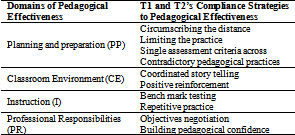
Away from the above, this study specifically aimed at assessing how teachers who engage in part-time teaching comply with pedagogical effectiveness. Interviews, lesson observation, focus group discussion and documentary sources present ten strategies which the two teachers use in compliance with pedagogical effectiveness amidst their involvement in part-time teaching. These strategies are as summarized in Table 1.
Planning and Preparation-related Compliance Strategies for Teachers who engage in Part-Time Teaching
Table 1 indicates that T1 and T2 comply with effective planning and preparation using four strategies. From the analysis of data, circumscribing the distance, single assessment criteria across, limiting the practice as well as contradictory pedagogical practices emerged as the cross cutting strategies in which the two teachers who engage in part-time teaching comply with planning and preparations for their teaching.
Circumscribing the distance is in reference to making sure that their part-timing schools are in close proximity to the “mother” government school. During interviews with the two teachers it was established that having their part-timing schools in close proximity to their government schools gave them an opportunity to be at work on time and make all the necessary preparation before they went to classrooms to teach. ‘…my other schools are within this locality which I think has helped me not to be on pressure of planning and preparing for my lessons… (T2, third world school).
Another teacher further informed me that:
‘…the fact that I don’t accept schools that take me far away from my government school, I don’t thing I fail to do the needful when it comes to effective planning and preparing for my lessons…if sometimes I fail to be effective, I don’t think it’s because I have other schools…’ (T1, first world school).
When administrators were asked how these teachers comply with effective planning and preparation, they were not sure of the how but confirmed that these teachers provided their schemes of work at the beginning of each term just as one DOS narrates:
‘…I may not be very certain of how she complies but what I am sure of is that each teacher here must have made a scheme of work in not later than the first two weeks from the start of each term…’ (Dos, first world school).
The above data from the interviews was further backed up by lesson observations where T1 was observed in two schools on the same day. On that day, the teacher had her lessons in the government school up to launch time and yet had afternoon lessons in another nearby private school. However she acknowledged that it was only a special arrangement for that day, otherwise she did not intend to operate that way in the subsequent weeks. Although she had made a scheme of work that reflected important concepts in the subject, it was very brief with no clear relationships between current and prior lessons. Besides, she did not only have lesson plans for her lessons, but also did not make use of relevant and timely planned teaching aids although they were stated in her scheme of work. We were forced to ask the HOD why the teacher acted that way and this is what he had to say:
‘…she hardly has a settled mind just because of the pressure to move here and there…how do you expect such a person to concentrate on the proper guidelines of effectives planning for the lesson…anyway her students excel when it comes to final examinations…’ (HOD, first world school).
It was therefore clearly evident that final examinations results obstruct school administrators from enforcing the truth fullness of teachers effective planning and preparation by acting indifferently about such teachers’ actions. In fact, compliance would not matter if good academic grades would be made out of students.
Single assessment criteria across is in reference to organizing the same assignments and tests for all the schools one teaches, for easy marking and feedback. Teachers 1 and 2 were in agreement that in their setting of instructional outcomes as well as designing students’ assessments, they use a single criterion for all their schools. To them, assessment and feedback especially for summative purposes becomes a bit easier for them once this strategy is employed. During their interviews, we were informed that:
‘…I don’t need to set more than one paper for my schools, neither do I need to write more than one marking guide…the logic is that I teach the same subjects, to the same classes at almost the same pace…I therefore assess using the same paper for all… (T1, first world school).
Another teacher also clearly stated that:
‘...like I told you earlier, in my scheme of work I only change the name of the school, the same applies to the mid-term and end of term exams…this has made my compliance with effective planning in terms of designing assessment easier and feedback is also easier since I mark the same assignments for all my school…(T2, third world school).
During the interviews with the administrators, although they encouraged the teachers to source out maternal from their other better schools, there was some kind of uncomfort which they experienced especially on the side of T2 who sometimes brought examination containing names of other schools for students in the government school to do. In his own words, the DOS lamented that:
‘...yes he is one of our best teachers when it comes to producing good grades but now you find him sometimes bringing a paper for our students to do without editing it in any way!…you know those literature in English stories some times are written with names of schools of origin, so even if you remove the name of school on top, the students will know from the text…(DOS, third world school).
However, when students were asked about this issue during the focus group discussion, they were very proud that they were doing the same examinations like those done in better performing private schools. For example one “A” level literature in English student narrated that:
‘…I personally see no problem with our teacher teaching in other schools so long as those schools are better than us and the teacher is available for us whenever he is time tabled to teach here…whenever he makes us do papers done by other students in better schools, we become confident that we shall pass in our UNEB examinations…’ (STD, third world school).
Overall, however much school administrators wanted to have both impressive grades and effective compliance with standard planning and preparation by the teachers, the over emphasis of examination results motive on the side of teachers and students did not warrantee its actual possibility. Although the two teachers used the single assessment criteria across as a strategy of complying with effective planning and preparation, at the back of their minds was the need to have their students excel in the final examinations since they were also sure that this would keep their relationship with administrators safe.
Limiting the practice is in reference to getting employed to only a manageable number of schools with the aim of being prepared to offer adequate service to all. Evidence on this was basically generated from the data collected during interviews with the administrators. One H/T for example informed me that:
‘….this teachers’ engagement in part-time teaching would not be in any way a problem to his planning and preparedness to teach, but the problem is that he seems to be attached to many other schools…he is now biting what he cannot swallow and you are aware that too much of anything is always bad…’ (H/T, third world school).
Similarly, one DOS further agreed that:
‘…I have ever personally engaged in part-time teaching also but I can assure you that if you exceed one other school, just as I here this teacher does, you can’t effectively plan and prepare for your lessons…You can’t first of all know all the students and their interests and then plan and prepare accordingly…’ (DOS, first world school).
When the teachers were asked about how they limited their practice of part-time teaching, they had this to say:
‘...I have never heard my bosses complaining about my teaching because I’m able to hand in my schemes of work even faster than those who are ever here…yes I may not know all the students but ask for my student’s UNEB grades and compare me with those of some teachers who are permanent here…’ (T2, third world school).
From the findings it remained unclear whether the strategy of limiting the practice applied to the number of schools one taught in or to how the involved teacher handled the schools to adequately serve all.
Data from the review of documents also established that, the schemes of work for the two teachers demonstrated knowledge of content and pedagogy, had clear expectations of lesson out comes as well as indicating interdisciplinary connections in their scheming. We also went ahead to check the teachers’ attendance books for the two teachers and what was observed was that the two teachers were present at school whenever scheduled on the time table and on time. When we asked students about how the teachers were prepared to teach them, almost all students agreed that the teachers were very good at helping them to learn and pass in their examinations. One student for example said ‘…the good thing about that madam is that she does not dodge us and whenever she comes she teaches us to the maximum…’ (STD, first world school). Another student informed us that ‘...you may think he does not know your name but when actually he knows…I was for sure surprised one time when he called me by name to take my book to him for marking…’ (STD, third world school).
Contradictory pedagogical practice is in reference to identifying schools where adequate planning and preparation is a must and then those where no one is concerned about whether one has planned for their lessons or not. Data from teachers’ interviews revealed that not all schools were strict on effective planning and preparation and thus could only focus on planning for their government schools. T1 for example narrated that:
‘...the good thing I have is that the private schools I teach basically employed me purposely to make academic grades out of their students…asking me for lesson plans and the like is not within the confines of what worries me…there is no reason why I don’t concentrate on planning for my government school here...’ (T1, first world school.
The reverse seemed true for T2 who reported that ‘…there is no pressure here for making schemes of work and lesson plans…yes it is a requirement that we should submit schemes of work to DOS’ office at the beginning of each term, but I can easily forge out any within a short time and hand in …’ (T2 , third world school).
With such information from the teachers, we later discovered that drafts of schemes of work were surely submitted to the DOS’ office for both teachers, but the truth is that they did not adequately conform to key components of effective s planning and preparation. For example, there was no clear indication of relationship between current and prior lessons, no organized formative assignments based on lesson expectations as well as absence of formal and informal information about students that was used in planning. In fact, none of these teachers carried the schemes to the classroom during any of the lessons which was a sign that they were only making these schemes as a school requirement but not as a way of complying to effective pedagogy. This also implies that the aim was perhaps to keep their relationship with administrators as safe as possible.
Classroom Environment Compliance Strategies for Teachers who engage in Part-Time Teaching
Table 1 show that teachers 1 and 2 complied with effective classroom environment using two strategies. From the analysis of data, coordinated storytelling as well as positive reinforcement emerged as the crosscutting strategies in which the two teachers who were studied for engaging in part-time teaching comply with effective classroom environment.
Coordinated storytelling is in reference to informing students what happens elsewhere in the academic and behavioral spheres of the students in order to attract their attention and responsiveness. Data from teachers’ interviews indicated that, their engagement in teaching other schools gives them an opportunity to experience different students behaviors and outcomes of such behaviors which through sharing with the students in the government schools are able to achieve an effective classroom environment. For example T1 during one her lesson observations told students about how a certain student who passes with an “A” in CRE always used to carry two books to the class (one for notes taking and one for the summary) in every lesson. During this storytelling process, all students were seen very attentive to what the teacher as she was telling them and this was a way of establishing a culture for learning .
It was also a sign that T1 was aware of her students’ conduct and behaviors. More data from T1’s classroom observation indicated that, students were within her close proximity encouraged them to participate, to actively listen during her lessons, and to organize a suitable furniture arrangement that was appropriate for the learning activities yet little or no loss of instructional time was observed. In fact, coordinated storytelling apparently promoted teacher-student relationship in general.
T2 when responding to how he complied with effective classroom environment indicated that:
‘…the exposure I get from my other schools help me to inform my students here how the financially and academically weaker students in other schools struggle to pass even highly than some of them who are at least beater off…I am sure such stories attract for attention to what I teach during the lesson and thus I am able to conduct a controlled classroom environment...’ (T2, third world school).
However, although there were clearly stipulated standards of conduct, posted in this classroom, he was not heard referring to any of them neither did he use any physical resources like technology during his lessons. In fact there was no encouragement of students to participate in the learning process however much there was no criminology concerning behavior between him and his students. Basically, T2’s use of coordinated storytelling did not adequately promote compliance with the basic components of effective classroom environment as it did for T1. As a matter of fact the strategy instead supported how the two teachers promoted their relationship with the students. Despite this, their performance in their appraisal forms were rated as good pertaining their maintenance of classroom discipline.
Positive reinforcement is in reference to the process of encouraging or establishing a pattern of behavior in which a teacher offers rewards for those outstanding students in terms of both classroom behavior and academics. Data portrayed that while most of T1’s lessons were covered by a lot of hand clamps almost from the beginning to the end, T2 had put his class into groups in which they did different assignment and best group was always awarded a special breakfast or lunch by the teacher. In fact when we observed T2’s students playing an important role in carry out classroom routines, questioning one another on an answer as well as taking incentives in improving the quality of their work, we were forced to ask them during the focus group discussion why this was like that; in their responses, T2 had put them in groups and whenever they entered class they immediately sat according to their respective groups such that all classroom contributions, activities and assignment were according to the groups and thus the teacher would base on that and determined the weekly wining group. One student notified me that:
‘…we are always active in his class because we expected a reward from him on weekly basis for the two days he comes here…we do his exercises on time, we don’t make noise in his class and no student misbehaves because doing such would weaken each group’s chance of winning for that week…’ (STD, third world school).
From the teachers’ interviews, it was discovered that the two teachers had discovered rewards (positive reinforcement) to have worked for many other teachers in others schools where they teach and thus adopted it too for their students. While T1 told us that consistent hand clapping kept the students active in class since clapping for them made them feel important, T2 over emphasized the offering of financial related rewards in form of buying for them a special breakfast and Lunch for the winning group per week. In his words T2 told me that:
‘…It was not until I discovered the that rewarding my student could only be the easiest way that could help me have a positive classroom environment, that my students started being active and eventually performing well…for sure my involvement in multi–school teaching has at least given me some extra income which I am able to use here to reward my students every week…’ (T2, third world school).
This implies that the extra income generated, did not only support the teachers’ commitment to comply with pedagogical effectiveness but also improved students’ performance in class.
Instructional Compliance Strategies for the Teachers who engage in Part-Time Teaching
From Table 1, teacher 1 and 2 complied with effective instruction using two compliance strategies. From data analysis, benchmark testing as well as repetitive practice emerged as the cross cutting strategies which the two teachers who engage in part-time teaching use to comply with effective instruction.
Benchmark testing is in reference to sourcing out papers from other schools and is done by the government school students in a way of comparing them to their fellows elsewhere. It was established that the two teachers would always compare their students by giving similar papers to them in all their schools. The logic behind was to create a kind of competitive behavior as well as creating confidence among students that much as they did in government schools, they were ably competing with those in the “good private schools”. Students for the two teachers for example said that, ‘…whenever we do paper from other schools and the teacher marks us together with them, we gain that confidence that we are on the right academic track…’ (STD, third world school). This means that students seem to have a chance of assessing their own progress using other students’ performance as an established yardstick.
Another student contended that:
‘…she gives us papers of other students during the lesson to mark with a pencil and asks us to spot out mistakes done by those students in their answering…as we do so, we are able to also learn from what these fellow students of other schools do rightly and wrongly…’ (STD, first world school).
T1’s H/T had observed this being done by the teacher and was against it claiming that sometimes teachers give students to mark their fellow students and they end up not doing effective assessment and feedback. However, although this was the case, the administration acted indifferent about it since no attempts had been crafted to overcome such.
In fact during classroom observations, both teachers used benchmark testing to help students assess their own work against established criteria, stimulated students’ interest, thinking and problem solving skills. Apparently, assessing their fellow students’ work was not only enabling them to have a high level of thinking but also made sure that they were aligned with lesion objectives. In all the observed lessons where the teacher had given papers to students to mark, they were seen actively working rather than watching while the teacher works. The importance of doing so was further strengthened by the teachers during their interviews by claiming that:
‘…When I give students’ scripts to their fellow students here, I’m sure that there is a lot they learn from them especially as a result of being able to discover what has been done well and wrongly…so in the process they are learning…’ (T1, first world school).
These findings show that teachers try to help students to construct their own learning as well as paying attention to evidence of students understanding. More importantly is that, the practice made the lessons cheerful for students.
Repetitive practice is in reference to teaching the same content many times in different schools thereby finding it easy to teach such content. The two teachers indicated how part-time teaching enabled them to grasp all their subject content due to over repeating it from school to school. T1 for example said that:
‘…instruction of the learning is easier for me when I started multi-school teaching than previously when I had not yet started this practice…for sure teaching is no longer a burden for me simply because I now have almost all the content in my head…’ (T1, first world school).
Indeed, HODs further confirmed that these teachers were very knowledgeable about subject content and many of their fellow teachers always approached them in the need to clarify for them some areas. Besides, it was established that, the whole department relied on for example T1’s expertise in the subject as a basis for making good grades in the department.
Similarly, results from the lesson observations further show that the two teachers were very confident about what they were teaching since they were repeating what had been taught elsewhere.
‘…for starters, I enjoy my work as a part timing teacher simply because of the repetitive nature of what I teach to students…I can teach some concepts here today and I teach the very same content tomorrow in my other school and therefore with time I perfected the subject contentment and now I can even teach without carrying any books to the class…’ (T2, third world school).
This perhaps implies that, limited or no content errors would be found in his instructional practices and thus much easier for his instructional practices and thus much easier for him to comply with effective instruction. In fact, the students loved the teacher for being aware of what ever questions they had for him. This probably strengthened the relationship between the teacher, students and administrators.
Professional Responsibility–related Compliance Strategies for the Teachers who engage in Part-Time Teaching
From Table 1, teacher 1 and 2 comply with effective profession responsibility using seven strategies. From the analysis of data; objective negotiation as well as building pedagogical confidence emerged as the crosscutting compliance strategies in which the two teachers who engage in part-time teaching comply with effective professional responsibilities.
Objective negotiation is in reference to strategic discussions aimed at persuading the bosses to accept what the teacher could adequately offer in terms of professional responsibilities and thus ignore the rest. It was established that administrators did not expect much out of these teachers in terms of compliance with professional responsibilities. The point here is that the teachers took the initiative to explain to their bosses that they could not adequately be available to conduct some activities with students such as co-curricular, talking to their parents as well as may be involvement in community service extension. T1’s DOS for example told us that;
‘…okay if she is around when the activities are scheduled, well and good she can engage but the fact that she is not here the whole week we don’t over rely on her when it comes to some of those school activities…’ (Dos, first world school).
During the interview with T2, he informed us how he was very open to his bosses right from the day he was posted in that school that he would hardly participate in most of the non-academic school activities. ‘…for me all administrators know that I will not attend too many of those “things” of professional responsibility…like I told you earlier, my main work here is teaching these students to pass well in their final examinations…’ (T2, third world school).
This finding implies that the teaching profession is today no longer as professional as it used to be especially because the examination orientation over shadows the actual constituents of effective teaching and learning and thus compliance with professional responsibility has today become more of a myth in government aided secondary schools. Objective negotiations entitle teachers to a hand full of engagements to professional responsibilities and instead keep the relationship with administrators safe.
Building pedagogical confidence is in reference to making administrators and students at large to have belief or faith in what the teacher does. T2 revealed to us that, ‘…the academic grades I have produced in this school have already proved to my bosses that I am professionally responsible…’ (T2, third world school). When we asked the DOS whether T2 had a way of tracking students’ non-instructional records or even involve students’ family in enforcing their learning progress, the DOS had this to say: ‘...it’s good that he makes good grades out of students in UNEB exams…whether he involved parents or not, what they want is their children to excel in final examinations…’ (DOS, third world school). Also, during our stay in school, T1 was heard informing the H/T informally that he should leave her students to first complete her lesson before they went back home for school requirements/dues.
This means that the pedagogical confidence which T1 had built among the administrators enabled her to prioritize students by challenging the existing school programs in order to put students first. Besides, she narrated to us during the interview that:
‘…apart from being a UNEB examiner, I make sure that I attend teachers’ workshops in my subject, I network with my colleagues about the new changes in the subject and I have also been able to subscribe to many other professional organizations of academic inquiry which have all helped me to grow professionally…’ (T1, first world school).
In all, both T1 and T2’s compliance to professional responsibilities is basically from academic-related perspective than in other important non-academic responsibilities which are expected to professionally comply to.
Cross-Case Analysis
Results show that, both T1 and T2 were highly interested in complying with pedagogical effectiveness. It was also established that in most circumstances the teachers knew what they were supposed to do but seemingly just failed to comply given the nature and demands of part-time teaching. Generally, the two part-timing teachers complied more to instruction and classrooms environment than they did with planning and preparation as well as professional responsibilities regardless of the nature of schools and subjects they taught. This evidence gathered therefore demonstrates that the two teachers complied with pedagogical effectiveness through maintaining a good relationship with both their students and administrators.
The study investigated the strategies used by teachers who engage in part-time teaching to comply with pedagogical effectiveness. This study was key because of the argument that the involvement of teachers in this practice exposes them to employment contract breach as well as less time which the involving teachers are assumed to accord to students in each school 24, 48. Besides, there were already claims in literature that teachers were already appearing in their schools only two days in a week 8 yet others arrived at their respective schools, signed in attendance books and disappeared 7. Although there is no consensus among scholars and administrators about who a pedagogically effective teacher is 49, in this study we used Danielson 30’s frame work for effective teaching model and successfully investigated how effective and using which strategies are teachers who engage in part-time teaching comply with pedagogical effectiveness.
Findings of this study established that teachers under took strategies that simplified the practice of part-time teaching in a pedagogically complaint manner. They for example taught in schools that were near to their government schools, got attached to only a manageable number of schools as well as setting the same assessments across their schools. These findings are in disagreement with Levin 50 who notes that it is technically difficult for part-timing teaching teachers to effectively cater for both high financial returns and better pedagogical outcomes since the practice may occasionally end up serving the business (profit) motive at the expense of the pedagogical one, given the time and other resource constraints. From the review of their schemes of work, teachers did not lay clear strategies for assessing students’ attainment of what they taught. This being an important component of effective planning and preparation, Haynes 51 as well as Ko and Reed 52 notes that planning for instruction begins with assessing whether intended learning objectives have been achieved.
Whereas it seemed less convincing from the findings that the above strategies helped teachers to comply with effective planning and preparation, it was later discovered in the data that some schools did not mind about whether teachers planned or not. In other words, the focus was more on being able to produce good academic grades despite of whether teachers planned or not. These findings are in line with National Assessment of Progress in Education (NAPE) report of 2016 which stated that, the teaching in secondary schools in Uganda encourages rote learning rather than imparting skills, given the fact that it is more examination driven and does not consider the learning of competences 53. Therefore as Musisi 25 concludes, Uganda’s pedagogical context is dysfunctional with lack of basic principles of effective instruction since impressive examination scores and effective pedagogy are not mutually incompatible.
The study results also show that positive reinforcement of students help to establish a culture of learning, proper management of classroom procedures as well as managing students’ behavior. These being key components of Danielson 30’s domain of classroom environment, this finding positively supports his frame work for effective teaching. Moreover even the observation of lessons indicated smooth functioning of all classroom routines as well as encouragement of students by the observed teachers. The findings further agree with Bartlett 54 that positive reinforcement is a useful strategy for teachers to boost students’ self-esteem and prevent feelings of being a failure which could cause a child to disengage from the lesson. Ferguson 55 however partly disagrees by stressing the need to balance the reinforcement since too much praise can be detrimental to the learning of the students.
Further findings from students focus group discussion as well as lesson observation showed that teachers did not only tell stories in form of scenarios of what happens in other school, but also ensured proper use of space and facilities such as furniture and black boards. This aligns well with Kausar et al. 56’s arguments that a properly managed classroom makes learners interested and attentive during the lesson which portrays that the learning environment has a positive impact both on learners’ motivation to learn and also on their performance. In this same line of argument, Izuagba et al. 57 looks at learning spaces as the environment that responds to educators’ goal and facilitates the development of rigorous thoughts from the learners. Consequently it can be understood that the exposure which teachers gain from part-time teaching supported their compliance with effective organization of a conducive classroom environment through importing such ideas to their government schools.
Findings of the study further established that, teachers comply with effective instruction using peer learning and assessment strategies from which students are supported to construct their own learning. This concurs with Danielson 30’s frame work for effective teaching model which was designed to support students’ achievement and professional best-practices, ground in a constructivist view of teaching and learning. Besides, several literatures within the 21st century support the constructivist view as a relevant model and teaching style that provides minimally guided instructions to learners 58, 59, 60. On the contrary however, the findings partially contradict with Buluma 61 who emphasized that teachers must undertake a diagnostic assessment as well as providing appropriate feed back to learners thereby improving the learning process. Unlike Buluma whose study was conducted among teacher educators, Nabiryo 62’s study done among secondary school teachers recommended peer teaching and assessment to be of the greatest benefit since every learner manages to go through the process and hence mastery of what is taught.
Results also portrayed that the pedagogical confidence which arise from the repetitive practice offered by part-time teaching support their compliance with effective instructional practices. The challenge with this finding is that effective instruction goes beyond mere mastery of content to other spheres such as demonstration of flexibility and responsiveness in teaching as well as engaging learners in learning process. Musisi 25 also support this challenge by recommending competence based teaching-learning frame work that could help to reorient schools away from focusing on UCE/UACE examination requirement and thus giving school incentive to strengthen their pedagogical environment. Therefore, although mastery of pedagogical content is necessary for effective instructing, it does not sufficiently define it. In fact Thompson 63 suggest instructional practices that instead promote learners’ critical thinking as well as promoting problems based learning as opposed to teacher knowledge ability that perhaps promote drilling.
In terms of compliance to professional responsibility, data reveals that objective negotiation between the teachers and administrators support teachers to comply with a few responsibilities and only when available in school. Students also revealed that it was not regularly that the teachers who engage in part-time teaching participate in school activities beyond their teaching work. Indeed, we also failed to observe the two teachers at any time engaged in any of such activities. These finding are supported by other research, for example Epstein and Sheldon 64, Komulainen et al. 65 and Urwick and Kisa 37. While Komulainen et al. 65 emphasized the apparent belief that teachers’ economic perspectives may lead to skepticism in their professional obligations, Epstein and Sheldon indicated how teachers’ suspected failure of acting professionally made part-time teaching to face a bumpy journey in the global education arena. For Urwick and Kisa concludes that part-time teaching teachers especially those of science were specifically hired in other schools only to cover the existing teaching gaps that emerged from the scarcity of science teachers but not to attend to other professional responsibilities despite being core to the profession.
In summary, the discussion of findings from the current study and other studies clearly show that, despite the efforts to comply with pedagogical effectives, teachers who engage in part-time teaching are time constrained and thus the good relationship they maintained with administrators and students helped them to ease their objective negotiation of the possible compliance strategies. Besides, the fact that they are exposed pedagogically due to the nature of part-time teaching, they could probably comply more with pedagogical effectiveness than they did if their attitudes, supervision and professional trainings were in place amidst their engagement in part-time teaching.
From the findings, the study makes the following conclusions;
1. The congruence of teachers’ compliance with the domains of pedagogical effectiveness as set out by Danielson 30’s model is largely inconsistent with Uganda’s education system (save may be for the new lower secondary curriculum).
2. Teachers’ compliance strategies indirectly aim at demonstrating the importance of part-time teaching especially within an examination oriented education system but does not promote holistic pedagogy.
3. Teachers’ compliance strategies just “shade a picture” that they are pedagogically effective in the face of administrators and students yet the actual compliance of these teachers is quite questionable.
1. Given that part-time teaching operates within a UCE/UACE examination oriented system where national examination league tables maneuver, we recommend that policy makers should shift the focus of teachers’ pedagogical outcomes from producing impressive examination grades to a holistic student development objective perhaps cultivated via teachers’ compliance with domains of pedagogical effectiveness.
2. Policy makers should sensitize teachers (concerning their attitude) as well as administrators and parents (concerning their supervisory role) to basically target a holistic student development other than impressive scores in examinations.
3. Policy makers also need to adapt to a pedagogical paradigm shift where teachers will now only seek their worth through their compliance with pedagogical effectiveness.
4. A similar study may be done within a mixed methods approach, at both primary and post-secondary levels of education as well as assessing the implication of teachers’ compliance to pedagogical effectiveness on students’ academic performance.
| [1] | Mupa, P., & Chinooneka, T. I. (2015). Factors contributing to ineffective teaching and learning in primary schools: Why are schools in decadence? Journal of Education and Practice, 6(19), 125-128. | ||
| In article | |||
| [2] | Tubasise, E. (2018). Survival strategies of teachers in Government aided primary schools in Bushenyi Town Council [unpublished Masters Dissertation] Makerere University. | ||
| In article | |||
| [3] | Tumusiime, J. B., & Kasujja, J. P. (2020). Teacher motivation and teacher commitment to work among Government aided secondary schools in Masaka municipality. International Journal of Education and Research, 8(2), 2411-5681. | ||
| In article | |||
| [4] | Murungi, D. (2018, August 20). A parent forced to pay coaching fees for her child who was referred to as a slow learner. Daily monitor, p.4. | ||
| In article | |||
| [5] | Muwanguzi, S. E., Kaahwa, Y. T., & Itaaga, N. (2021). Teacher Generated Pamphlets as a Feasible Covid-19 Learning Alternative in Uganda: A Review of Existing Global and Domestic Pandemic Pedagogies. American Journal of Educational Research, 9(9), 580-586. | ||
| In article | |||
| [6] | Alton, M. (2017). The effects of teacher’s commitment on student achievement: A case study in Iraq. International Journal of Academic Research in Business and Social Science, 7 (11), 417-426. | ||
| In article | |||
| [7] | Kato, J. (2018, July 28). Teachers in Uganda dodge classes to ride bodas-study. Daily monitor. Retrieved from http://www.monitor.co.ug. | ||
| In article | |||
| [8] | Ssegawa, D., & Matovu, M. (2020). Head teachers’ delegation practices and teachers’ job commitment in secondary schools in Wakiso district. European Journal of Special Education Research, 6(1), 2501-2428. | ||
| In article | |||
| [9] | Mugizi, W. (2019). Human resource development practices and organizational commitment of teachers in Wakiso district, Uganda. American Journal of Research, 3(4) 109-127. | ||
| In article | |||
| [10] | Chrisantus, O. (2018, June 8). RE: Effect of pay satisfaction on teachers’ commitment in some selected secondary schools [online forum comment]. Retrieved from https://www.projecttopics.org. | ||
| In article | |||
| [11] | Baah–Boatengl, W., Adjei, P., & Oduro, A. D. (2013). Determinants of moonlighting in china: an empirical investigation. African review of economic and finance, 4(2), 176-202. | ||
| In article | |||
| [12] | Cita (2012). Teachers’ salary and terms and conditions: position paper 2010-2012. Cambodia [Independent Teachers Association]. | ||
| In article | |||
| [13] | Mageto, P. (2007). Corporate and personal ethics for sustainable development:Experiences, challenges and promises of part-time teaching in selected universities in Kenya. Retrieved from http://www.strathmore.edu/ethics/pdf/mageto-sustainable-devt.pdf. | ||
| In article | |||
| [14] | Genza, G. M., Kobusingye, P., & Mukokoma, M. (2016). The relationship between knowledge mediation entrepreneurial ventures and secondary school teachers’ standards of living (SOL) in central Uganda: The case of Kalungu District. International journal of social science and humanities Research, 4(1), 138-148. | ||
| In article | |||
| [15] | Government of Uganda, (1996). The teaching service commission regulations for teachers. UPPC printers. | ||
| In article | |||
| [16] | Landford, G. (1968). Philosophy and education: an introduction. MacMillan Education Limited. | ||
| In article | |||
| [17] | Ssekamwa, J. C. (1996). Professional ethics for teachers. Nets Africana Limited. | ||
| In article | |||
| [18] | Zimulinda, R. (1999). Students’ guide to careers in Uganda. Fountain. | ||
| In article | |||
| [19] | Farrant, J. S. (1980). Principles and practice of education. Essex: Longman. | ||
| In article | |||
| [20] | Thelen, H. A. (1978). Profession anyone? In D.J. McCarty (Eds.), New perspectives on teacher education (pp.167-184), Jossey–Bass publishers. | ||
| In article | |||
| [21] | Ssekamwa, J. C. (1995). History of Education in East Africa. Fountain Publishers. | ||
| In article | |||
| [22] | Ssekamwa, J. C. (2000). History and development of education in Uganda. Fountain publishers. | ||
| In article | |||
| [23] | Kimani, G. N., Kara, A. M., & Njagi, L.W. (2013).Teachers’ factors influencing students’ academic achievement in secondary schools in Nyandarua County, Kenya. International Journal of Education and Research, 1(3), 1-14. | ||
| In article | |||
| [24] | Busingye, C. (2019, April 11). What is the National Teachers Policy in Uganda all about? New vision, p.7 | ||
| In article | |||
| [25] | Musisi, B. (2013). Pedagogical ramifications of competitive secondary education market in central Uganda [unpublished doctoral thesis]. Makerere University. | ||
| In article | |||
| [26] | Urwick, J., & Kisa, S. (2014). Science teacher shortage and the moonlighting culture: the pathology of teacher labour market in Uganda. International Journal of Educational Development, 36, 72–8 | ||
| In article | |||
| [27] | Ministry of Education and Sports (2016). The Education and Sports Sector Annual Performance Report (ESAPR) (FY 2014/15). The Government of Uganda. | ||
| In article | |||
| [28] | Oduut, D. (2017). Government paying Uganda Shillings 16 billion to absentee teachers monthly, say report. PML daily, p.8. Retrieved from https:// www.pmldaily.com/...../gov’ tpaying-shs-16-billion-to-absentee-teachers-monthly-says-r…. | ||
| In article | |||
| [29] | Malunda, P., & Atwebembeire, J. (2018). Instructional Resources and Teacher Effectiveness in Government-aided Secondary Schools in Uganda. International Conference on Multidisciplinary Research ISBN: 978-99949-0-384-9. | ||
| In article | |||
| [30] | Danielson, C. (1996). Enhancing professional practice: A framework for teaching. Alexandria, VA; Association for supervision and curriculum Development. | ||
| In article | |||
| [31] | Danielson, C. (2nd Eds.). (2007). Enhancing Professional Practice: A Framework for Teaching. VA: ASCD, Retrieved from http://www.ascd.org/publications/books/106034/chapters/Preface-to-the-First-Edition.aspx | ||
| In article | |||
| [32] | Klockars, C. B. (1980). The Dirty Harry problem.Annals of the American Academy of Political and Social Science, 452(1), 33-47. | ||
| In article | |||
| [33] | Delattre, E. J. (6thEd.). (1989). Character and Cops: Ethics in policing. Washington, DC: The AEI Press. | ||
| In article | |||
| [34] | Betts, S. C. (2006). Gender differences in multiple job holding: Moonlighting among teachers. Journal of Business & Economics Research, 2(8), 25-34. | ||
| In article | |||
| [35] | Kisumano, G. M., & Wa-Mbaleka, S. (2017). Moonlighting as a growing phenomenon: A case study of a Congolese Christian University. International Forum, 20(2), 237-253. | ||
| In article | |||
| [36] | Hisrich, R. D., Peters, M. P. & Shepherd, D. A. (Eds.). (2016). Entrepreneurship. McGraw-Hill Education. | ||
| In article | |||
| [37] | Sangwan, S. (2014). Managing employee moonlighting: Issues and implications. International Journal of Scientific Research and Education, 2(12), 2552-2556. | ||
| In article | |||
| [38] | Brown, L., & Roloff, M. (2011). Extra-role time, burnout, and commitment: The power of promises kept. Business Communication Quarterly, 74(4), 450-474. | ||
| In article | |||
| [39] | Muwanguzi, S. E., Musisi, B., & Itaaga, N. (2021b). The Pervasiveness of Multi-School Teaching (MST) among Public Secondary Schools in Wakiso District (Uganda): Pedagogical Dilemmas, Handling and Way Forward. American Journal of Educational Research, 9(8), 522-531. | ||
| In article | |||
| [40] | Brown, S., Sullivan, S. L., & Maninger, B. (2019). Moonlighting and Morale: The Impact on Educators Who Moonlight and How Classroom Teaching Suffers. Journal of Multidisciplinary Graduate Research, 1(8), 1-17 | ||
| In article | |||
| [41] | Parham, J., & Gordon, S. (2011). Moonlighting: A harsh reality for many teachers. Ph.Delta Kappan, 92 (5), 47-51. | ||
| In article | |||
| [42] | García, S., & Weiss, A. (2019). The third report in ‘The Perfect Storm in the Teacher Labor Market’ series [paper presentation]. Retrieved from https//www.epi.org/161908. | ||
| In article | |||
| [43] | Guba, E. G. & Lincoln, Y. S. (1994). Competing Paradigms in Qualitative Research. SAGE Handbook of qualitative research. London: Sage. | ||
| In article | |||
| [44] | Cohen L. & Manion, L. (1994). Research Methods in Education. London, Routledge. | ||
| In article | |||
| [45] | Creswell, J. W. (2ndEd.). (2003). Research design: Qualitative, Quantitative and mix methods approach. Thousand Oaks. | ||
| In article | |||
| [46] | Fountain group (2007).Uganda districts information handbook: expanded edition 2007-2008. Kampala. | ||
| In article | |||
| [47] | Uganda Bureau of Statistics [UBOS], (2018).Uganda National House Hold Survey. Kampala. | ||
| In article | |||
| [48] | DES Circular No. 0054/2019. Section 24 of the education act against moonlighting amended in 2003. Ref. No: MoES/KPMG/001. | ||
| In article | |||
| [49] | Good, T. L. & Brophy, J.E. (2008). Looking in classrooms. New York: Pearson Education Inc. | ||
| In article | |||
| [50] | Levin, H.M. (2006). Why is educational entrepreneurship so difficult? In Hess, F. (ed.): Educational entrepreneurship. Cambridge, MA: Harvard Education press. | ||
| In article | |||
| [51] | Haynes, J. (2010). The complete guide to lesson Planning and Preparation.Bloomsbury Publishing PLC | ||
| In article | |||
| [52] | Ko, E. K. & Reed, N. (2012). What makes an effective teacher Presentation to read first? Journal of teacher Education, 6(3), 67-90. | ||
| In article | |||
| [53] | Uganda National Examination Board, (2016). The Achievement of S2 Students and Teachers in English Language, Mathematics and Biology. Uganda National Examination Board. | ||
| In article | |||
| [54] | Bartlett, J. (2015). Outstanding Assessment for Learning in the Classroom. London: Taylor and Francis Group. | ||
| In article | |||
| [55] | Ferguson, P. (2013) Assessment, feedback and reporting. In R. Churchill, P. Ferguson, S. Godinho, N. F. Johnson, A. Keddie, W. Letts, J. Mackay, M. McGill, J. 289 Moss, M. Nagel, P. Nicholson & M. Vick (eds), Teaching: Making a difference. London: Routledge. | ||
| In article | |||
| [56] | Kausar, A., Kiyanin, A.I & Suleman, Q. (2017). Effect of classroom environment on the academic achievement of secondary school students in the subject of Pakistani Studies at secondary level in Rwawalpindi District, Pakistan.Journal of Education and Practice, 8(24), 56-63. | ||
| In article | |||
| [57] | Izuagba, A. C., Afurobi, A., Nwigwe, N. B & Okwonkwo, A. (2018). Effects of creating physical learning spaces on the reading comprehension skills performance of primary four pupils. International Journal of Language, Literature and Gender Studies. 7(1). | ||
| In article | |||
| [58] | Goodyear, V. & Dudley, D. (2015). I’m a Facilitator of Learning!” Understanding What Teachers and Students Do Within Student-Centered Physical Education Models. Quest Journal, 6(3), 274-289. | ||
| In article | |||
| [59] | Brent, D. & Carrie, H. (2017).Mastering Formative Assessment Moves: 7 Highleverage Practices to Advance Student Learning. Virginia: ASCD. 279. | ||
| In article | |||
| [60] | Stronge, G. H. (2018). Qualities of an effective teacher.3rd edn. ASCD. | ||
| In article | |||
| [61] | Buluma, A. (2021). Teacher Education Pedagogical Practices and the Development of 21st Century Competences among Teacher Trainees in Uganda: A Case Study of Kyambogo University. [Unpublished doctoral thesis]. Makerere university. | ||
| In article | |||
| [62] | Nabiryo, N.R. (2021). The value of classroom cultures in writing instruction among lower secondary school learners. [Unpublished doctoral thesis]. Makerere university. | ||
| In article | |||
| [63] | Thompson, C. (2011). Critical Thinking across the Curriculum: Process over Output. International Journal of Humanities and Social Science, 1(9) [Special Issue – July 2011]. | ||
| In article | |||
| [64] | Epstein, J.L., & Sheldon, F. L. (2019). School, Family, and Community Partnerships: Preparing Educators and Improving Schools. Boulder, CO: Westview Press. | ||
| In article | |||
| [65] | Komulainen, k., Naskali, p., Korhonen, m. & Keskitalo-Foley, s. (2011). Internal Entrepreneurship-aTrojan horse of the Neoliberal governance of education? Finish pre-and in-service teachers’ implementation of and resistance towards entrepreneurship education. Journal for critical education policy studies, 9(1), pp.341-374. | ||
| In article | |||
Published with license by Science and Education Publishing, Copyright © 2023 Yuda Taddeo Kaahwa and Sande Erunao Muwanguzi
 This work is licensed under a Creative Commons Attribution 4.0 International License. To view a copy of this license, visit
http://creativecommons.org/licenses/by/4.0/
This work is licensed under a Creative Commons Attribution 4.0 International License. To view a copy of this license, visit
http://creativecommons.org/licenses/by/4.0/
| [1] | Mupa, P., & Chinooneka, T. I. (2015). Factors contributing to ineffective teaching and learning in primary schools: Why are schools in decadence? Journal of Education and Practice, 6(19), 125-128. | ||
| In article | |||
| [2] | Tubasise, E. (2018). Survival strategies of teachers in Government aided primary schools in Bushenyi Town Council [unpublished Masters Dissertation] Makerere University. | ||
| In article | |||
| [3] | Tumusiime, J. B., & Kasujja, J. P. (2020). Teacher motivation and teacher commitment to work among Government aided secondary schools in Masaka municipality. International Journal of Education and Research, 8(2), 2411-5681. | ||
| In article | |||
| [4] | Murungi, D. (2018, August 20). A parent forced to pay coaching fees for her child who was referred to as a slow learner. Daily monitor, p.4. | ||
| In article | |||
| [5] | Muwanguzi, S. E., Kaahwa, Y. T., & Itaaga, N. (2021). Teacher Generated Pamphlets as a Feasible Covid-19 Learning Alternative in Uganda: A Review of Existing Global and Domestic Pandemic Pedagogies. American Journal of Educational Research, 9(9), 580-586. | ||
| In article | |||
| [6] | Alton, M. (2017). The effects of teacher’s commitment on student achievement: A case study in Iraq. International Journal of Academic Research in Business and Social Science, 7 (11), 417-426. | ||
| In article | |||
| [7] | Kato, J. (2018, July 28). Teachers in Uganda dodge classes to ride bodas-study. Daily monitor. Retrieved from http://www.monitor.co.ug. | ||
| In article | |||
| [8] | Ssegawa, D., & Matovu, M. (2020). Head teachers’ delegation practices and teachers’ job commitment in secondary schools in Wakiso district. European Journal of Special Education Research, 6(1), 2501-2428. | ||
| In article | |||
| [9] | Mugizi, W. (2019). Human resource development practices and organizational commitment of teachers in Wakiso district, Uganda. American Journal of Research, 3(4) 109-127. | ||
| In article | |||
| [10] | Chrisantus, O. (2018, June 8). RE: Effect of pay satisfaction on teachers’ commitment in some selected secondary schools [online forum comment]. Retrieved from https://www.projecttopics.org. | ||
| In article | |||
| [11] | Baah–Boatengl, W., Adjei, P., & Oduro, A. D. (2013). Determinants of moonlighting in china: an empirical investigation. African review of economic and finance, 4(2), 176-202. | ||
| In article | |||
| [12] | Cita (2012). Teachers’ salary and terms and conditions: position paper 2010-2012. Cambodia [Independent Teachers Association]. | ||
| In article | |||
| [13] | Mageto, P. (2007). Corporate and personal ethics for sustainable development:Experiences, challenges and promises of part-time teaching in selected universities in Kenya. Retrieved from http://www.strathmore.edu/ethics/pdf/mageto-sustainable-devt.pdf. | ||
| In article | |||
| [14] | Genza, G. M., Kobusingye, P., & Mukokoma, M. (2016). The relationship between knowledge mediation entrepreneurial ventures and secondary school teachers’ standards of living (SOL) in central Uganda: The case of Kalungu District. International journal of social science and humanities Research, 4(1), 138-148. | ||
| In article | |||
| [15] | Government of Uganda, (1996). The teaching service commission regulations for teachers. UPPC printers. | ||
| In article | |||
| [16] | Landford, G. (1968). Philosophy and education: an introduction. MacMillan Education Limited. | ||
| In article | |||
| [17] | Ssekamwa, J. C. (1996). Professional ethics for teachers. Nets Africana Limited. | ||
| In article | |||
| [18] | Zimulinda, R. (1999). Students’ guide to careers in Uganda. Fountain. | ||
| In article | |||
| [19] | Farrant, J. S. (1980). Principles and practice of education. Essex: Longman. | ||
| In article | |||
| [20] | Thelen, H. A. (1978). Profession anyone? In D.J. McCarty (Eds.), New perspectives on teacher education (pp.167-184), Jossey–Bass publishers. | ||
| In article | |||
| [21] | Ssekamwa, J. C. (1995). History of Education in East Africa. Fountain Publishers. | ||
| In article | |||
| [22] | Ssekamwa, J. C. (2000). History and development of education in Uganda. Fountain publishers. | ||
| In article | |||
| [23] | Kimani, G. N., Kara, A. M., & Njagi, L.W. (2013).Teachers’ factors influencing students’ academic achievement in secondary schools in Nyandarua County, Kenya. International Journal of Education and Research, 1(3), 1-14. | ||
| In article | |||
| [24] | Busingye, C. (2019, April 11). What is the National Teachers Policy in Uganda all about? New vision, p.7 | ||
| In article | |||
| [25] | Musisi, B. (2013). Pedagogical ramifications of competitive secondary education market in central Uganda [unpublished doctoral thesis]. Makerere University. | ||
| In article | |||
| [26] | Urwick, J., & Kisa, S. (2014). Science teacher shortage and the moonlighting culture: the pathology of teacher labour market in Uganda. International Journal of Educational Development, 36, 72–8 | ||
| In article | |||
| [27] | Ministry of Education and Sports (2016). The Education and Sports Sector Annual Performance Report (ESAPR) (FY 2014/15). The Government of Uganda. | ||
| In article | |||
| [28] | Oduut, D. (2017). Government paying Uganda Shillings 16 billion to absentee teachers monthly, say report. PML daily, p.8. Retrieved from https:// www.pmldaily.com/...../gov’ tpaying-shs-16-billion-to-absentee-teachers-monthly-says-r…. | ||
| In article | |||
| [29] | Malunda, P., & Atwebembeire, J. (2018). Instructional Resources and Teacher Effectiveness in Government-aided Secondary Schools in Uganda. International Conference on Multidisciplinary Research ISBN: 978-99949-0-384-9. | ||
| In article | |||
| [30] | Danielson, C. (1996). Enhancing professional practice: A framework for teaching. Alexandria, VA; Association for supervision and curriculum Development. | ||
| In article | |||
| [31] | Danielson, C. (2nd Eds.). (2007). Enhancing Professional Practice: A Framework for Teaching. VA: ASCD, Retrieved from http://www.ascd.org/publications/books/106034/chapters/Preface-to-the-First-Edition.aspx | ||
| In article | |||
| [32] | Klockars, C. B. (1980). The Dirty Harry problem.Annals of the American Academy of Political and Social Science, 452(1), 33-47. | ||
| In article | |||
| [33] | Delattre, E. J. (6thEd.). (1989). Character and Cops: Ethics in policing. Washington, DC: The AEI Press. | ||
| In article | |||
| [34] | Betts, S. C. (2006). Gender differences in multiple job holding: Moonlighting among teachers. Journal of Business & Economics Research, 2(8), 25-34. | ||
| In article | |||
| [35] | Kisumano, G. M., & Wa-Mbaleka, S. (2017). Moonlighting as a growing phenomenon: A case study of a Congolese Christian University. International Forum, 20(2), 237-253. | ||
| In article | |||
| [36] | Hisrich, R. D., Peters, M. P. & Shepherd, D. A. (Eds.). (2016). Entrepreneurship. McGraw-Hill Education. | ||
| In article | |||
| [37] | Sangwan, S. (2014). Managing employee moonlighting: Issues and implications. International Journal of Scientific Research and Education, 2(12), 2552-2556. | ||
| In article | |||
| [38] | Brown, L., & Roloff, M. (2011). Extra-role time, burnout, and commitment: The power of promises kept. Business Communication Quarterly, 74(4), 450-474. | ||
| In article | |||
| [39] | Muwanguzi, S. E., Musisi, B., & Itaaga, N. (2021b). The Pervasiveness of Multi-School Teaching (MST) among Public Secondary Schools in Wakiso District (Uganda): Pedagogical Dilemmas, Handling and Way Forward. American Journal of Educational Research, 9(8), 522-531. | ||
| In article | |||
| [40] | Brown, S., Sullivan, S. L., & Maninger, B. (2019). Moonlighting and Morale: The Impact on Educators Who Moonlight and How Classroom Teaching Suffers. Journal of Multidisciplinary Graduate Research, 1(8), 1-17 | ||
| In article | |||
| [41] | Parham, J., & Gordon, S. (2011). Moonlighting: A harsh reality for many teachers. Ph.Delta Kappan, 92 (5), 47-51. | ||
| In article | |||
| [42] | García, S., & Weiss, A. (2019). The third report in ‘The Perfect Storm in the Teacher Labor Market’ series [paper presentation]. Retrieved from https//www.epi.org/161908. | ||
| In article | |||
| [43] | Guba, E. G. & Lincoln, Y. S. (1994). Competing Paradigms in Qualitative Research. SAGE Handbook of qualitative research. London: Sage. | ||
| In article | |||
| [44] | Cohen L. & Manion, L. (1994). Research Methods in Education. London, Routledge. | ||
| In article | |||
| [45] | Creswell, J. W. (2ndEd.). (2003). Research design: Qualitative, Quantitative and mix methods approach. Thousand Oaks. | ||
| In article | |||
| [46] | Fountain group (2007).Uganda districts information handbook: expanded edition 2007-2008. Kampala. | ||
| In article | |||
| [47] | Uganda Bureau of Statistics [UBOS], (2018).Uganda National House Hold Survey. Kampala. | ||
| In article | |||
| [48] | DES Circular No. 0054/2019. Section 24 of the education act against moonlighting amended in 2003. Ref. No: MoES/KPMG/001. | ||
| In article | |||
| [49] | Good, T. L. & Brophy, J.E. (2008). Looking in classrooms. New York: Pearson Education Inc. | ||
| In article | |||
| [50] | Levin, H.M. (2006). Why is educational entrepreneurship so difficult? In Hess, F. (ed.): Educational entrepreneurship. Cambridge, MA: Harvard Education press. | ||
| In article | |||
| [51] | Haynes, J. (2010). The complete guide to lesson Planning and Preparation.Bloomsbury Publishing PLC | ||
| In article | |||
| [52] | Ko, E. K. & Reed, N. (2012). What makes an effective teacher Presentation to read first? Journal of teacher Education, 6(3), 67-90. | ||
| In article | |||
| [53] | Uganda National Examination Board, (2016). The Achievement of S2 Students and Teachers in English Language, Mathematics and Biology. Uganda National Examination Board. | ||
| In article | |||
| [54] | Bartlett, J. (2015). Outstanding Assessment for Learning in the Classroom. London: Taylor and Francis Group. | ||
| In article | |||
| [55] | Ferguson, P. (2013) Assessment, feedback and reporting. In R. Churchill, P. Ferguson, S. Godinho, N. F. Johnson, A. Keddie, W. Letts, J. Mackay, M. McGill, J. 289 Moss, M. Nagel, P. Nicholson & M. Vick (eds), Teaching: Making a difference. London: Routledge. | ||
| In article | |||
| [56] | Kausar, A., Kiyanin, A.I & Suleman, Q. (2017). Effect of classroom environment on the academic achievement of secondary school students in the subject of Pakistani Studies at secondary level in Rwawalpindi District, Pakistan.Journal of Education and Practice, 8(24), 56-63. | ||
| In article | |||
| [57] | Izuagba, A. C., Afurobi, A., Nwigwe, N. B & Okwonkwo, A. (2018). Effects of creating physical learning spaces on the reading comprehension skills performance of primary four pupils. International Journal of Language, Literature and Gender Studies. 7(1). | ||
| In article | |||
| [58] | Goodyear, V. & Dudley, D. (2015). I’m a Facilitator of Learning!” Understanding What Teachers and Students Do Within Student-Centered Physical Education Models. Quest Journal, 6(3), 274-289. | ||
| In article | |||
| [59] | Brent, D. & Carrie, H. (2017).Mastering Formative Assessment Moves: 7 Highleverage Practices to Advance Student Learning. Virginia: ASCD. 279. | ||
| In article | |||
| [60] | Stronge, G. H. (2018). Qualities of an effective teacher.3rd edn. ASCD. | ||
| In article | |||
| [61] | Buluma, A. (2021). Teacher Education Pedagogical Practices and the Development of 21st Century Competences among Teacher Trainees in Uganda: A Case Study of Kyambogo University. [Unpublished doctoral thesis]. Makerere university. | ||
| In article | |||
| [62] | Nabiryo, N.R. (2021). The value of classroom cultures in writing instruction among lower secondary school learners. [Unpublished doctoral thesis]. Makerere university. | ||
| In article | |||
| [63] | Thompson, C. (2011). Critical Thinking across the Curriculum: Process over Output. International Journal of Humanities and Social Science, 1(9) [Special Issue – July 2011]. | ||
| In article | |||
| [64] | Epstein, J.L., & Sheldon, F. L. (2019). School, Family, and Community Partnerships: Preparing Educators and Improving Schools. Boulder, CO: Westview Press. | ||
| In article | |||
| [65] | Komulainen, k., Naskali, p., Korhonen, m. & Keskitalo-Foley, s. (2011). Internal Entrepreneurship-aTrojan horse of the Neoliberal governance of education? Finish pre-and in-service teachers’ implementation of and resistance towards entrepreneurship education. Journal for critical education policy studies, 9(1), pp.341-374. | ||
| In article | |||