The main concern of this study was to determine the factors affecting administrators’ performance in the practice of innovation, the level of performance of public elementary school administrators research competencies and the reasons for research engagement and non-engagement. Most importantly, this study tried to find out the extent of contribution of each factor to the administrators’ performance in the practice of innovation. The respondents of the study were the public elementary school administrators in Don Carlos II, Don Carlos III, Kadingilan I, and Kadingilan II districts SY 2022-2023. The data were analyzed using descriptive statistics such as frequency counts, percentage, average weighted mean, and standard deviations. Deeper analysis of data was done using Pearson r correlation technique and the multiple regressions. Based on the findings, public elementary school administrators in Don Carlos II, Don Carlos III, Kadingilan I, and Kadingilan II districts were competent in conducting action research as regards to technical aspect, major parts and other parts of action research. The administrators in Don Carlos II, Don Carlos III, Kadingilan I, and Kadingilan II engage in action research to solve problems in school and for professional development. For their non-engagement, it is due to insufficient time and not having access to the books and journals.
Action research is a type of research wherein researchers identify and examine a possible problem in their respective working space and takes careful consideration to resolve it. Action research develops specific steps as an intervention to solve those problems. Action research is primarily used to solve issues in the most effective way possible. In the educational setting, action research serves as a systematic and reflective inquiry to improve practices or resolve issues in classrooms, schools, and offices 1. Recently, there has been a growing interest in the implementation, effectiveness, difficulties encountered, level of competence, and research engagement by researchers in conducting action research. However, most of these studies solely focus on teachers. Only few studies have school administrators as participants despite their integral role in the success of schools. The observation mentioned shows the great responsibility of the school administrators. However, some school administrators face the same dilemma as the teachers. Some think that they are not capable of conducting it. This led the researchers to consider that if school administrators are competent and actively doing action research, they will undoubtedly be able to fix issues, enhance their performance, and improve the schools’ overall performance. DepEd issued Order No. 26, s. 2021, amending guidelines from Order No. 16, s. 2017 on Research Management Guidelines (RMG), supporting policy development and research agenda. It provided guidance in managing research initiatives at different levels during the COVID-19 pandemic. DepEd's aim of sustainable development involves teachers and administrators conducting action research and prioritizing seminars and training on action research for teacher evaluation. School leaders, including principals, play a crucial role in driving educational innovation and challenging traditional grammar in schools 2. They have the ability to influence key aspects such as the school's vision, structures, working conditions, and staff capacity, thereby acting as drivers of change 3, 4. Their ambidexterity contributes to a climate that fosters teacher creativity, impacting teaching and learning practices (Da'as, 2021). Particularly during the pandemic, school leaders were vital in promoting psychological safety and innovation in times of crisis 5, 6, 7. Their leadership style had to balance reducing uncertainty while adapting to new teaching methods 8, and fostering a culture of innovation was linked to effective leadership practices 9. The study was grounded on Gray 10 Research Competencies Framework, which defines research competency as a combination of solid theoretical knowledge, practical experience, and the ability to independently complete tasks without assistance. It highlights that researchers can acquire competencies through various means, emphasizing the importance of self-assessment for researchers engaging in any type of research, including teachers and school administrators. Professor Barry's 11 Living Educational Theory (LET) supports this perspective, as it encourages action researchers to challenge existing educational practices, aiming to improve their own work and forge deep connections with individuals and communities involved in their research. LET also emphasizes the innovative approaches of individual practitioner-researchers in generating explanations. When conducting action research, school administrators should identify relevant issues in their professional practice and schools, taking ownership of the process and actively seeking solutions. By doing so, they contribute to a focused mission of enhancing learner achievement, improving instructional practices, and elevating overall school performance through the use of action research. However, the researchers noticed, and this was confirmed by district research coordinators, that not all school administrators possess the necessary confidence and competence to conduct research. Even after attending multiple training sessions and seminars, some administrators failed to submit an action research proposal. Furthermore, there are administrators who do not actively pursue professional development opportunities such as engaging in research or enrolling in graduate school, as they do not view these activities as valuable avenues for enhancing their research skills, which are essential for conducting research. In fact, some school administrators perceive action research as burdensome. This situation motivated the researchers to conduct a study to examine the level of research competencies of school administrators in conducting action research in terms of the technical aspect, major parts: introduction of the research, action research methods, results and discussion, conclusion, and other parts of an action research paper: abstract and references, and their research engagement; determined the research engagement on how often the school administrators conduct action research; ascertained the performance of school administrators based on their practice of innovation; evaluated the significant relationship existing between the school administrators’ performance in the practice of innovation, research competencies, and research engagement; and analyzed the extent to which the identified factors will influence performance of school administrators in the practice of innovation. The result of this study hopes to supplement the existing knowledge on school administrators’ research competencies and engagement on performance in the practice of innovation.
1.1 Statement of the ProblemThis study determined the level of research competencies and engagement, and the performance of public elementary school administrators in the practice of innovation in Kadingilan I, Kadingilan II, Don Carlos II, and Don Carlos III Districts, in the Division of Bukidnon for the school year 2022-2023. Specifically, it sought to find answers to the following questions:
1. What is the level of competencies of public elementary school administrators in conducting action research in terms of:
1.1 Technical Aspect
1.2 Major Parts
1.2.1 Introduction of the Research;
1.2.2. Action Research Methods;
1.2.3 Results and Discussion; and
1.2.4 Conclusion
1.3 Other Parts of action research
1.3.1 Abstract; and
1.3.2 References?
2. What reasons contribute to public elementary school administrators’ research engagement and non-engagement?
3. What is the performance of public elementary school administrators towards the practice of innovation in terms of:
3.1. encouraging innovative ideas;
3.2. developing school environment; and
3.3. solving innovative problems?
4. Is there a significant relationship existing between the performance in the practice of innovation, and research competencies, and research engagement of the public elementary school administrators?
5. To what extent to which the identified factors influence performance in the practice of innovation of the public elementary school administrators?
This study employed a descriptive-correlational research design to describe the relationship between the performance of school administrators in the practice of innovation and their research competencies and engagement. Descriptive statistics such as the mean and standard deviation were used to describe the characteristics of the population and phenomenon being studied 12. Specifically, it is a survey type. It is a type of research which is most appropriate for this study since an assessment survey is needed. The survey was administered to the specified sample through a questionnaire using Google Forms to follow the COVID-19 Health and Safety Protocols imposed by the Inter-Agency Task Force and Department of Health. This allowed the researchers for quicker data collection and interpretation while ensuring the maximum safety of the participants.
2.2. Locale of the StudyThe study took place in Kadingilan I, Kadingilan II, Don Carlos II, and Don Carlos III Districts in the Division of Bukidnon, focusing on the school year 2022-2023. Participants were selected through cluster sampling in complete enumeration, targeting the 42 school administrators in these districts. Internet connectivity varied among the districts, with Kadingilan I having strong connectivity in all 11 schools, while Kadingilan II had slow connectivity in 7 out of 11 schools and no connectivity in 4 schools. Similarly, Don Carlos II and Don Carlos III Districts experienced varying levels of connectivity, hindering some school administrators from accessing relevant web updates.
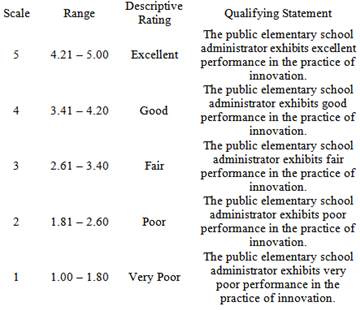
2.3. Research InstrumentsThe instrument that was used to assess the level of research competencies is an adapted questionnaire from Gomez and Panaligan 13 to test the research competencies of school administrators in terms of technical aspect; major parts such as introduction of the research, research methods, results and discussion, and conclusion; and other parts of action research such as the abstract and references. For the assessment on the research engagement and non-engagement of school administrators, a survey questionnaire with the format developed on an international baseline proposed by Borg 14 was utilized. The questionnaire is composed of a scale asking the participants on the reasons of research engagement and non-engagement. For the performance of the public elementary school administrators in the practice of innovation, a survey questionnaire adapted from Abu-Shreah & Zidan 15 was utilized. There are three domains in the questionnaire: encouraging innovative ideas, developing school environment, and solving innovative problems. The questionnaire contains twenty-four (24) indicators assessing the quality of performance among public elementary school administrators in the practice of innovation. The following rating scales were used to understand the data better:
|
|
In analyzing and interpreting the data, the following were applied: Descriptive statistics defined the phenomenon by computing the mean and the standard deviation to answer the problem. To assess the level of competencies of public elementary school administrators in conducting action research, determine the reasons for their research engagement and non-engagement, and to ascertain the performance of school administrators based on their practice of innovation, the mean, standard deviation, and rank were used. Pearson-moment correlation was utilized to measure the extent of relationship between the dependent variable (school administrators’ performance in the practice of innovation) and independent variables (research competencies and engagement). Further, stepwise regression was utilized to identify which variable predicts school administrators’ performance in the practice of innovation.
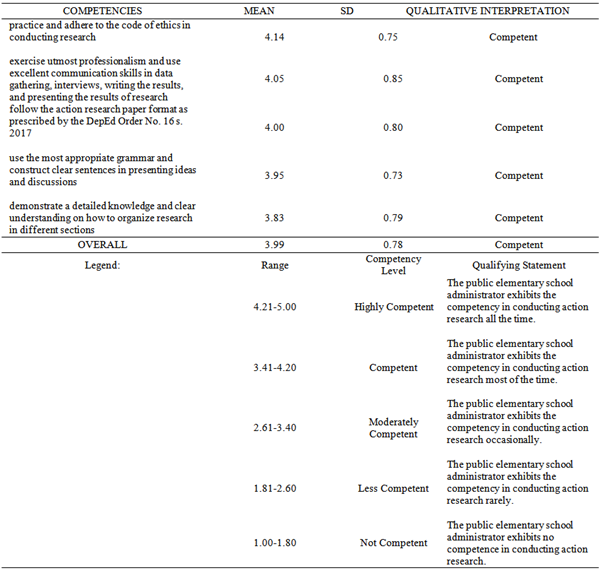
2.5. Research Competency of Administrators in Terms of Technical AspectThe assessment of the competency level of school administrators in conducting action research in terms of technical aspect is shown in Table 1. The assessment shows that in general, the school administrators are competent in the technical aspect of making action research. This means that they exhibit the competencies in this area of conducting action research most of the time. Moreover, the standard deviation is low, which indicates that the responses are clustered around the mean. This means that from their perspectives, they have nearly the same level of competence which results in low variation of scores. Specifically, the participants rated themselves as competent in following the code of ethics in conducting action research with a mean score of 4.14 as the highest, exercising utmost professionalism, using excellent communication skills in data gathering, conducting interviews, writing the results, and presenting the results of research with a mean score of 4.05, and following the action that the effort of the school’s districts in organizing district-based action research seminar-workshops helped the participants. In another aspect, the competency in using the most appropriate grammar and constructing clear sentences in presenting ideas and discussions got the second lowest mean sore of 3.95 and the least is on demonstrating a detailed knowledge and clear understanding on how to organize research in different sections which the participants rated themselves least. Though it yielded the least mean of all the indicators, the participants are still regarded as competent. This indicates that in these areas, the participants need more seminar-workshops to improve their competencies to come up with a quality research paper. The result of this study supports Ashraf’s, et al 16 concept that organization and format are essential in academic writing. As organization refers to the larger parts of a piece of writing, how sentences and paragraphs are written, and how accurate words are put together to convey ideas. Also, in his study, the findings revealed that postgraduate students face difficulties in academic writing since they are not only required to compose but to think and analyze things critically. Aside from that, comprehension and conception of ideas, composition, language accuracy, and appropriate use of vocabulary should also be considered.
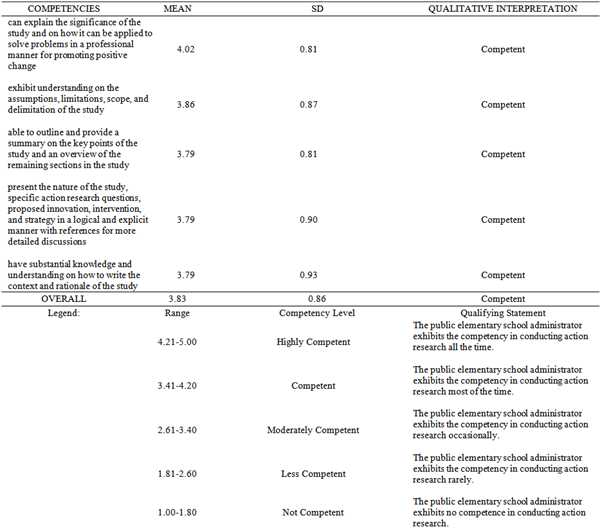
Table 2 shows the competency level of school administrators in conducting action research in terms of major aspect specifically in the introduction of the research. In general, the participants assessed themselves as competent in all five indicators which means that they exhibit the competencies in writing the introduction of action research most of the time. Moreover, the standard deviation is low. This indicates that the scores are clustered around the mean and are almost the same. In writing the introduction, the first major part of action research, the participants rated themselves as competent in explaining the significance of the study conducted, its relevance, and its application in real-life scenarios with a mean score of 4.02. Also, they rated themselves competent on the assumptions, and in writing the limitations, scope, and delimitation of the study with the second highest mean score of 3.86. This means that the school administrators exhibit the competencies in these indicators most of the time. This could be attributed to each other as the two indicators are closely related when it comes to usage and application in writing a research paper.
The indicators that received the lowest ratings, despite still being considered competent, had identical mean scores of 3.79. These indicators include the ability to summarize the key points of the study and provide an overview of the remaining sections, presenting the study's nature, action research questions, proposed innovation, intervention, and strategy in a clear and logical manner, supported by references for further in-depth discussions. Additionally, having a strong grasp and comprehension of how to write the study's context and rationale was also highlighted as an area for improvement. The result gives the researchers a presumption that school administrators have already mastered and learned the basics of how to write these parts. The result further implies that although the participants are competent, they still need to enhance their skills in the area of writing the introduction. This could be attributed to the exclusion of these topics in seminar-workshops as these salient points are not emphasized during action research seminars. Most of the topics focused on identifying the research problem and how to formulate the research title. There should be no topic and area that are less focused during a seminar or training. Each part should be given equal emphasis during discussion as there are specific areas in writing like the techniques that they need to practice and master. This should be taken into consideration for the next training and seminars. The study of Qasem 17) supports the findings as he explored the challenges faced by undergraduate students when they are writing proposals and research projects at the early stages using a questionnaire and informal interviews with 60 students and teachers of the target groups. The results revealed that around 70% of the participants who are writing or conducting research projects in English is one of the predominant challenges for them. Around 50% prefer to conduct their research in their first language. The study also explored other various and common challenges/difficulties during writing the research proposals and projects. These include difficulty in deciding the topic for research, lack of good knowledge of the methodology and other parts, inability of finding modern, specialized and related references, lack of interest in research, lack of understanding of the subject matter, lack of time, and research guiding. The study also attempted to give some suggestions/recommendations for developing the process of writing research proposals and research projects.
Table 3 shows the competency level of public elementary school administrators in conducting action research specifically in the research methods. In general, the assessment showed that the school administrators are competent in the major part of action research, specifically in the research methods. It means that they exhibit the competencies in this part of conducting action research most of the time. In addition, the standard deviation is low and shows that most of the participants’ responses are nearly the same. Thus, they have almost the same level of competency in this aspect. The indicator with the highest mean score of 3.93, interpreted as competent is on ensuring that the participants of the study are aware of the nature of the study, their rights and to protect the confidentiality of data and privacy of research participants. This indicates that the participants are well-informed on the ethics of research in terms of how to properly manage research participants. The indicator with the second highest rating (mean score of 3.76) pertains to participants' awareness of ethical principles and standards in research, including information security, intellectual property plagiarism, privacy, and copyright, indicating their knowledge and understanding of professional conduct in research, making these indicators highly significant. Due to the requirement of participants in research, it is essential for researchers to be aware of and adhere to ethical guidelines when engaging in action research. Additionally, the third highest rating of 3.69, which is still considered as competent, pertains to the provision of thorough explanations regarding the reliability and validity of the research tools used in the study. In relation to this aspect, participants are well-informed that prior to the administration of any instrument, it must undergo rigorous testing to ensure its reliability and, more importantly, its validity. Banegas and Villacañas de Castro 18 emphasized the importance of considering various ethical factors in research, such as voluntary collaboration, young learners' rights, power dynamics, confidentiality, authority, representation, benefits, and sustainability, to foster a positive researcher-participant relationship. However, the lowest mean scores were observed in research design and data analysis. Specifically, participants faced difficulties in articulating how to analyze and utilize their gathered data. To address this, it is essential to provide more thorough discussions on data analysis and consider introducing statistical software like SPSS in seminar-workshops to facilitate easier data analysis. The indicators with the lowest ratings, averaging at 3.55, relate to describing procedures for handling inconsistent cases and having adequate knowledge of different research designs and their appropriate use. This suggests a lack of understanding among participants regarding how to deal with conflicting data and select suitable research designs. Research design plays a crucial role in integrating study components coherently and logically, ensuring effective resolution of research problems, and serving as a blueprint for data collection, measurement, and analysis to address research questions. Therefore, it is recommended for DepEd and school districts to allocate specific days for in-depth discussions on each part of action research, supported by a quality assurance team to assist researchers. Asenahabi 19 supports these findings by highlighting that research success relies on incorporating a suitable research design. The research design serves as a pre-data collection blueprint, guiding researchers in achieving valid objectives. Neophyte researchers often face dilemmas in choosing an appropriate research design, and the study also revealed that the selection of a research design is guided by a careful analysis of the problem statement, research questions, conceptual or theoretical framework, and relevant literature.
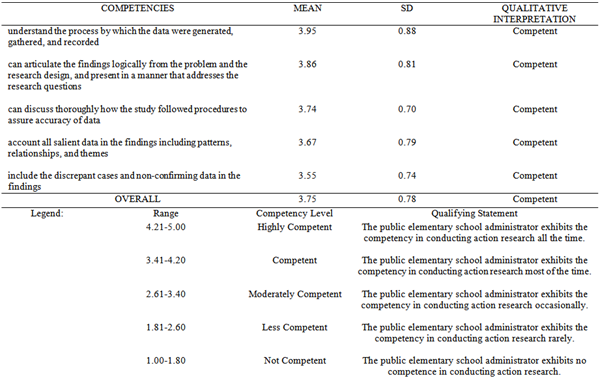
Table 4 presents the competency level of school administrators in conducting action research in the major aspect specifically in the results and discussion. As shown in the table, the participants assessed themselves as competent in all five indicators of writing the results and discussion part of action research. It means that the participants exhibit the competencies in these areas most of the time.
The low standard deviation also discloses that most of the responses are nearly the same. Specifically, the participants rated themselves with the highest mean score of 3.95 in the first indicator with understanding the process by which the data were generated, gathered, and recorded. The second highest-rated indicator, with a mean score of 3.86, focuses on articulating findings in a logical manner that addresses research questions, discussing adherence to procedures, and incorporating all relevant data. The third highest-rated indicator, with a mean score of 3.74, involves a thorough discussion of how the study followed procedures to ensure data accuracy. These results indicate that participants demonstrate strength in these areas of action research. They possess knowledge and expertise in working with and interpreting data, particularly in improving key performance indicators, overall school performance, and even at the school district level. This proficiency stems from their technical competence, as participants exhibit professionalism in data collection, results reporting, and the use of appropriate grammar in presenting ideas and discussions. This competence is further enhanced through collaborative efforts, with colleagues, district research coordinators, and division research coordinators providing valuable assistance and feedback. According to the Academy for Educational Development as cited by Benigno 20, data, whether in the form of numbers, characters, images, or other recordings, only hold significance when interpreted, transforming into information that enhances knowledge and guides decision-making. This principle applies equally to the field of education. To identify problems and improve performance, data is integral. Additionally, Benigno 20 posits the idea that visionary leaders utilize data wisely. They make use of it to make informed decisions and work a shared leadership team to develop a purposeful plan for the sustainable development of schools. They align the curriculum, instruction, and assessment practices to the school’s vision and mission. Using the data gathered from studies, school leaders may be able to address problems and transform their schools. Meanwhile, the participants regarded themselves as competent in the indicator of accounting salient data in the findings including patterns, relationships, and themes with the second lowest mean score of 3.67. A good thing to know because they know the concepts and important points to include in their study. It also implies that their research paper is focused on what are essentials. Moreover, the lowest rated indicator with a mean score of 3.55 is on including discrepant cases and non-confirming data in the findings. Though these concepts may be explained whether the participants are familiar or unfamiliar with the concept. They may have experienced it while doing some research in the past without realizing that they are already doing it. They may have experienced analyzing data and decided to include or exclude it which should be avoided in research. This could also mean that they are not knowledgeable enough on interpreting the data but surely, they know what to include in the discussion. This further implies that the participants have experienced some confusion and difficulty when dealing with data in the past and may experience it again when they conduct action research. It is essential, as part of research ethics, to deal with any type of data accordingly, not to disregard any non-confirming ones just to satisfy the researchers predicted results by altering the actual data gathered. Thus, thorough discussions on this matter are crucial during seminars and workshops on dealing with these types of data. Research experts are highly needed to provide technical assistance. Daynter 21 explored the issue of validity and described six different safeguards designed to increase the accuracy and validity of data. These include: triangulation, establishing a data trail, acknowledging researcher subjectivity, member checks and participant review, prolonged engagement, and considering non-confirming evidence and contradictory interpretations. The author emphasized the idea that to make your data as valid as possible, use multiple data collection methods to increase the validity of data. Since validity is the researcher’s responsibility.
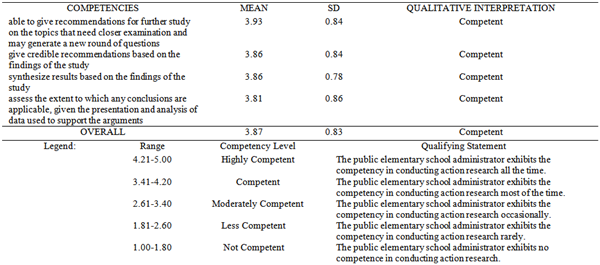
Table 5 presents the competency level of school administrators in conducting action research in the major aspect specifically in writing the conclusion. Based on the result, the school administrators’ competency level in writing the conclusion is competent. This means that they exhibit the competencies in this aspect most of the time.
They rated themselves competent in all four indicators. Being able to give recommendations for further study on the topics that need closer examination and may generate a new round of questions got the highest mean score of 3.93. The second and third indicators, with mean scores of 3.86, focus on giving credible recommendations and synthesizing results based on the study's findings. However, despite participants' capability in these areas, some may have faced confusion and difficulty when dealing with discrepant and non-confirming data, as indicated in Table 5. This can have a significant impact on formulating findings and recommendations. The participants' varying levels of competence in these indicators are reflected by the low standard deviation, indicating differing perspectives in self-assessment. As these aspects are crucial in completing comprehensive action research, seminars, and training on data analysis, writing conclusions, and recommendations are essential. Equal attention should be given to these components alongside other aspects of the research process. As stressed by Mugenda 22, the presentation and analysis of data should be given careful examination as the summary and conclusions should lead logically to the recommendations. Recommendations must be consistent with the purpose of the study, its objectives, the evidence presented by the data, and the interpretations given. It should be practical and achievable. Although the participants knew that recommendations are added suggestions that they want future researchers to follow when conducting their research, they stated that they still need technical assistance from experts to validate their work. On the other side, the indicator which got the lowest mean score of 3.81, still interpreted as competent is on assessing the extent to which any conclusions are applicable given the presentation and analysis of the data used to support the arguments. The results can be interpreted as the effect of the participants having low ratings on the indicators of data analysis and research designs as shown in Table 4. Implications can be drawn that the participants find it somewhat hard when it comes to writing conclusions which should be based from the findings. The result further entails that some of the participants have limited knowledge of data collection and writing the conclusion. In this regard, the participants can somehow effectively make use of triangulation or mixed method as the best way to solve such doubts and try to draw conclusions based on the reliable data that they will be able to collect. With this, there is a great necessity for school’s districts to intensify and give more seminars and training specifically on discussions about data collection and writing conclusions. Technical assistance is also vital to mentor researchers.
As Kabir 23 asserts, data collection is one of the most critical stages in conducting action research. One can have the best research design, but if one fails to collect the required data, then the research cannot be completed. Appropriate data collection instruments and clear instructions would reduce the chance of errors occurring.
2.7. Research Competency of Administrators in Other PartsTable 6 presents the competency level of school administrators in conducting action research in terms of other parts, specifically in writing the abstract.
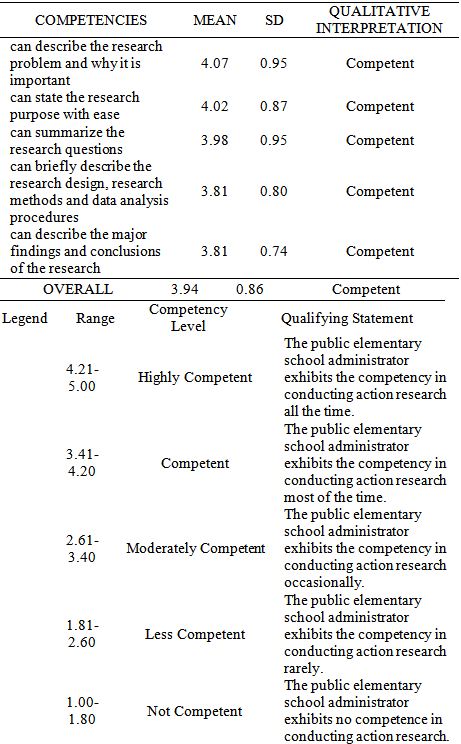
In general, the competency level of school administrators in this aspect is competent. This means that they exhibit the competencies in this aspect most of the time. The low standard deviation also indicates that the ratings given by the participants are nearly the same and that way they assessed themselves in this aspect is almost of the same level. Out of the five indicators, the participants got the highest rating with a mean score of 4.07 on describing the research problem and why it is important. As a school administrator, they face educational problems almost every day. And with that comes the capability of knowing and understanding the nature of a problem and why it is important to act and solve it using action research. This is followed by the second highest rating with a mean of 4.02 on stating the research purpose with ease and the third highest which garnered a mean score of 3.98 on summarizing research questions. Implications can be drawn that the result of them being competent in these three indicators originates from the two indicators found in Table 1, indicators 2 and 4 which have attributes on being good in communication skills, writing skills, and presenting ideas and discussions with clarity. On the contrary, they scored the least with the same mean scores of 3.81 in the indicators of describing research design, research methods, and data analysis as well as describing the major findings and conclusions of the research. This holds true as Table 4, indicators 6 and 8 showed that in these areas, the participants have least ratings which is specifically on research designs, research methods, and data analysis. The result implicates age, interest, and lack of research engagement as some of the possible factors why some of the participants have limited knowledge of research designs and research methods and find it challenging to write abstracts. However, this denotes another study in the future. On a positive note, the researchers firmly believe that with continuous research engagement and attendance in training and seminars, the competence in this aspect would surely be enhanced. Technical assistance is also needed as writing an abstract need reading and practice. As Vogt 24 stated, it is so easy to investigate how to employ a particular research design and method. However, it is considerably more challenging to decide which to use because research design significantly shapes what would happen in the entire study. It also carries an important influence on the reliability of the results attained. Moreover, research designs are most effective when they are dictated by the nature of the research problem.
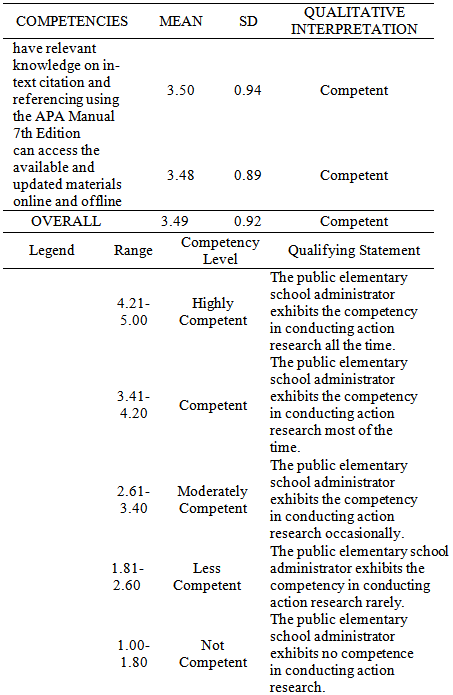
Table 7 presents the competency level of school administrators in conducting action research in terms of other parts, specifically in writing the references. The data revealed that the school administrators’ competency level in writing the references are competent. This means that they exhibit the competencies in writing the references part most of the time. The standard deviation further signifies that responses are almost the same. In terms of the indicators, the higher mean score of 3.50 is on having relevant knowledge on in-text citation and referencing using the APA Manual 7th Edition. However, it is worth mentioning that out of all the indicators in all parts of action research starting from Table 1, this got the second lowest rating. The result implies that although the participants regarded themselves as competent in this indicator, they may have encountered some difficulty and they may have limited amount of knowledge when it comes to referencing. Though this entails another research. Furthermore, based on the researchers’ experiences during training and seminars in action research, referencing is often the most neglected part because the resource speakers tend to discuss more on identifying the research problems and formulating the research title. The result suggests that most of the participants have limited knowledge on referencing. This is important as referencing is acknowledging the idea of the authors that you borrowed ideas from, whether found in in-text citation or in reference list. Without it, one might be charged with plagiarism. Since it is crucial and a must in academic writing, it should be given equal importance and should be discussed thoroughly in a seminar-workshop. The study of Jomaa 25) supports this result as they pointed out that citation is the most distinctive feature of language use in academic disciplines. Citing and referring to other authors’ studies are fundamental for persuasiveness and the acceptance of academic arguments. It highlights the researchers’ familiarity with the topic and establishes the research on a solid basis of knowledge that enables them to argue, claim, and justify. Moreover, Jomaa 25 found out that the challenges in citation include addressing the credibility of information in published sources, adopting a stance toward the citation, insufficient knowledge about using citation, and second language difficulties. The overall least rated indicator in all areas of conducting action research in which the participants are still competent is on accessing the available and updated materials online and offline. Based on the data, implications can be drawn that the participants may have experienced some difficulty in searching for credible reference materials online and offline. The researchers, also based from experiences and real-life work setting, observed that some of the school administrators are not well-acquainted with using computers and that this may affect their ability to access credible information online.
This may be due also to age-related factors, but this needs to be studied and validated. When accessing available and updated materials offline, DepEd has a minimal number of reference materials available offline and it will take a lot of time to search for the materials available in schools and schools districts. The school administrators, due to their busy schedules still have other areas of concern that they need to attend which may affect this indicator. Moreover, since this part got the least ratings in all indicators, this entails immediate assistance. One way to alleviate this problem is to capacitate the school administrators on how to identify relevant literature online and how to identify research gaps through another series of seminar workshops. To make it happen, school administrators must do their part on engaging themselves for their own learning. Mudavanhu 26 pointed out that a review of related literature describes what others have published presented in the form of summaries. By explaining what has been done and what has not, the researchers give a justification for their contribution to the field. Related literature plays an indispensable role in the formulation of a research design and the whole research process. In addition, it is also often argued that the research problems not grounded in current literature are weak. If literature accessed online is not enough, other sources of primary data and secondary data is a must.
Table 8 displays the summary of school administrators’ competence in conducting action research. Overall, the administrators’ competence was interpreted qualitatively as "competent" with a mean of 3.79 and with a standard deviation of 0.83, indicating almost the same level of responses as the participants rated themselves. Among the seven (7) indicators, research competencies in technical aspect of action research was rated the highest, with a mean score of 3.99. It was followed by administrators’ research competencies in other parts of action research specifically in making abstract (3.94), and research competencies in major parts specifically in drawing conclusion (3.87). It can be noticed that the school administrators research competencies in other parts of action research such as referencing has the lowest mean score and the technical aspect has the highest mean score. This implies that school administrators are competent in the technical aspect of making action research. In another aspect, administrators’ competency in making action research in terms of referencing and writing the references yielded the least mean of all the indicators, however, participants are still regarded as competent. This indicates that in all aspect of making action research, school administrators are competent and mastered the basic parts.
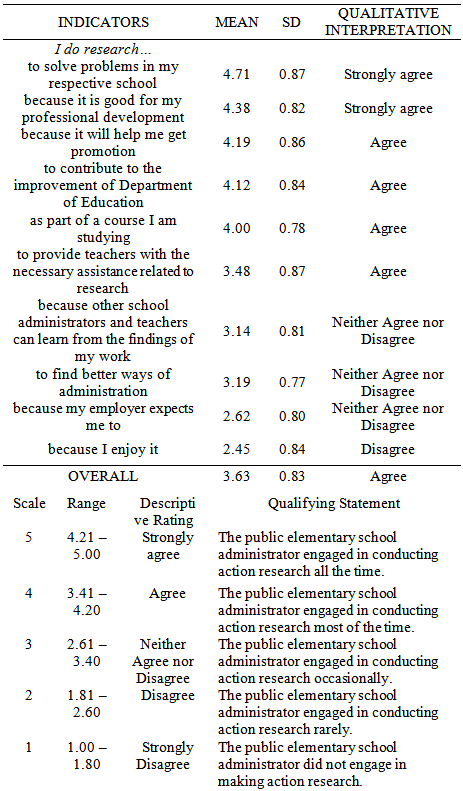
2.8. Research Engagement in Conducting Action ResearchTable 9 presents the reasons contributing to school administrators research engagement in the conduct of action research. Out of the ten indicators, the participants got the highest rating with a mean score of 4.71 on administrators engage in research to solve problems in their respective schools. As a school administrator, they face educational problems almost every day. And with that comes the
capability of knowing and understanding the nature of a problem and why it is important to act and solve it using action research. This is followed by the second highest rating with a mean of 4.38 on the reason that is good for their professional development. The third main reason of administrators engaged in action research is it will help them getting promoted with a mean of 4.19. The overall standard deviation of 0.83 also indicates that the responses are concentrated around the mean which entails that most of the school administrators engage themselves in action research for the same reasons. Implications can also be drawn that the result of them being engaged in conducting action research is for professional development and they know the benefits of it for the school as a whole. On the contrary, the least reason for research engagement is enjoyment with a mean score of 2.45. Result implies that the school administrators conduct action research not because they enjoy it but rather they see it as useful and beneficial in the field of administration. Overall, the school administrators agreed on the importance of action research and are engaged to making one for the overall development of the department. Because it is through action research that enables administrators to improve educational practices, enhance student learning outcomes, and foster a culture of continuous improvement within schools. Soe 27 supports the findings as she stressed how important research is as it is the lifeblood of education development. In her study on research engagement and professional development of English language teachers (ELT), she investigated the Myanmar ELT teachers’ perspectives on research and found that ELT teachers considered a large-scale survey and statistical data as research. Also, she found out that ELT teachers’ reasons for non-engagement in research were not having enough time and unfamiliarity with research principles and methods. She firmly believed that an understanding of the teachers’ views on research is an initial step in the effort to promote research engagement.
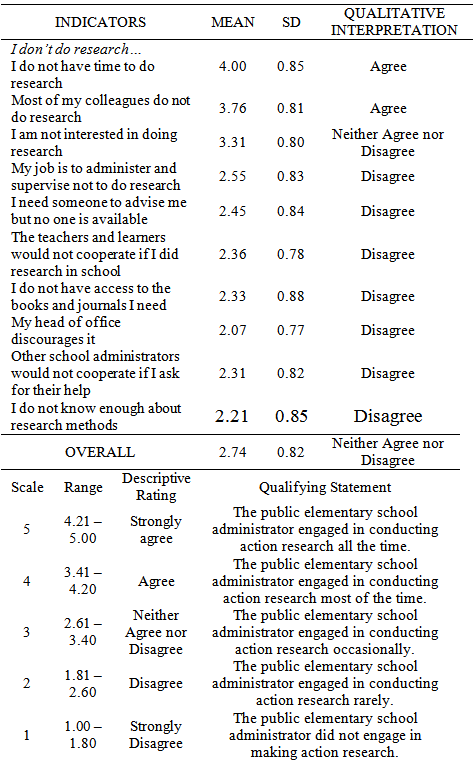
Table 10 presents the reasons contributing to school administrators non-engagement in the conduct of action research. Out of the ten indicators, the participants got the highest rating with a mean score of 4.00 on administrators’ non-engagement in action research due to not having sufficient time to do research. This is followed by the second highest rating with a mean of 3.76 on the reason that most of their colleagues did not conduct action research. The third main reason of administrator’s non-engagement is because they are not interested in doing research with a mean of 3.31. Also, the overall standard deviation of 0.82 reveals that the scores are not scattered, but rather, closely dispersed around the mean. The result further implies that some administrators may not be aware of the concept of action research or may not fully understand its benefits and relevance to their role. Without proper knowledge about the value of action research, they may not prioritize or see the need for engaging in such activities. School administrators often have demanding schedules, with multiple responsibilities and tasks to manage. They may feel overwhelmed with administrative duties, leaving little time for engaging in research activities. The perception that action research requires significant time and resources may discourage some administrators from pursuing it. The study's findings are corroborated by Kutlay 28 and Morales 29, who claimed that time constraints and a lot of work could be other factors that discourage teachers from conducting, presenting, and publishing action research, particularly in public elementary and secondary schools. Moreover, as stated by Bocar 30, engaging in research often proves to be a challenging and uninteresting endeavor. Another contributing factor to teachers' inability and lack of skills in conducting action research is the absence of support and training, as mentioned by Embury & Clarke 31. Also, Erba 32 highlighted similar factors that hindered the implementation of action research, including insufficient in-service training, limited knowledge and skills among teacher practitioners, lack of interest and motivation, inadequate availability of materials or resources, and financial constraints.
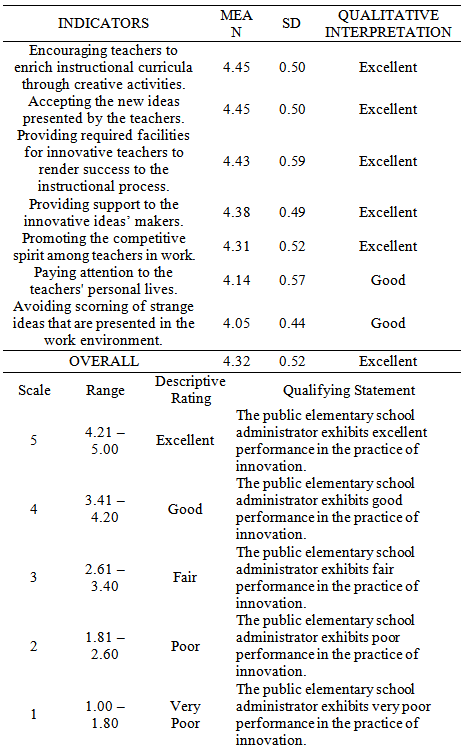
2.9. Performance of Administrators in the Practice of Innovation in terms of Encouraging Innovative ideasTable 11 depicts the performance of public elementary school administrator in the practice of innovation. The findings of the study showed excellent performance with a mean of 4.32. Also, the standard deviation of 0.52 implicates that the responses given by the participants are concentrated around the mean. This implies that the public elementary school administrators exhibit excellent performance in the practice of innovation, specifically on encouraging innovative ideas. Encouraging teachers to enrich instructional curricula through creative activities and accepting the new ideas presented by the teachers are the indicators that have highest mean value. The study of Ibrahim, et al., 33 supports the findings as he stressed that the performance of the school is a measure of the performance of the principal. Leadership must always create a harmonious social atmosphere, both among employees and with the leadership. Encouraging innovative ideas helps in the attainment of the school’s goals and objectives. An intimate and open atmosphere will also be able to facilitate tasks and help each other in completing work to achieve the goals of the organization. Also, Mbangula and Albert 34 backed this as they emphasized the effectiveness of school principals on school performance and how principals play a major role to make the school do well in terms of academic results and improve the overall school performance.
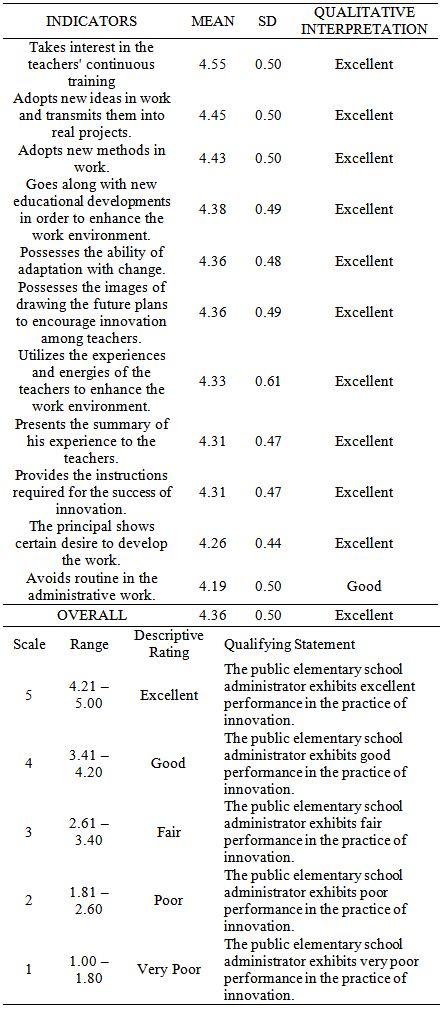
Table 12 shows the performance of public elementary school administrator in the practice of innovation in terms of developing school environment. The findings of the study revealed that in the practice of developing school environment, the participants garnered an excellent performance with a mean of 4.36. The standard deviation of 0.50 means that the ratings given by the participants are closely distributed around the mean. This implies that the public elementary school administrator exhibits excellent performance in the practice of innovation, specifically on developing school environment. Taking interests in teacher’s continuous training and adopting new ideas in work and transmitting them into real projects are the indicators that received the highest mean values of 4.55 and 4.45 respectively. The least indicator is on avoiding routine in administrative work with a mean of 4.19, earning a “Good” descriptive rating. The study of Aroca, Abellan, and Lopez 35 supports the findings of the study as they stressed the importance of initial, continuous, and lifelong learning among teachers as a driver of professional development. They also concluded that teacher training linked to professional development has a great impact on school improvement, especially if it is carried out from an intergenerational collaborative perspective, and the acquisition of new skills.
Table 13 shows the performance of public elementary school administrator in the practice of innovation in terms of solving innovative problems. The findings of the study revealed that in the practice of solving innovative problems, the participants are of excellent performance with a mean of 4.36 and a standard deviation of 0.47 indicating the same level of responses. This indicates that the public elementary school administrators exhibit excellent performance in solving innovative problems. The highest rated indicator is on motivating teachers to be flexible in giving solutions with a mean of 4.52. It is followed by the indicator of attempting to use new ideas in solving problems with a corresponding mean of 4.45. Among the seven indicators, granting full authorities to innovative teachers to solve problems got the least mean with 4.14 indicating a “Good” descriptive rating. It is important to note that this could be attributed to the school principal’s attitude and perspective as to empowering the teachers in solving innovative problems. Moreover, the standard deviation is low indicating that the responses are clustered around the mean and that the variation of the scores is low. This means that from their perspectives, they have nearly the same viewpoints on granting full authorities to the teachers. Kalguya 36 posits that the development of flexible and transferable problem-solving skills is important especially for contemporary education systems.
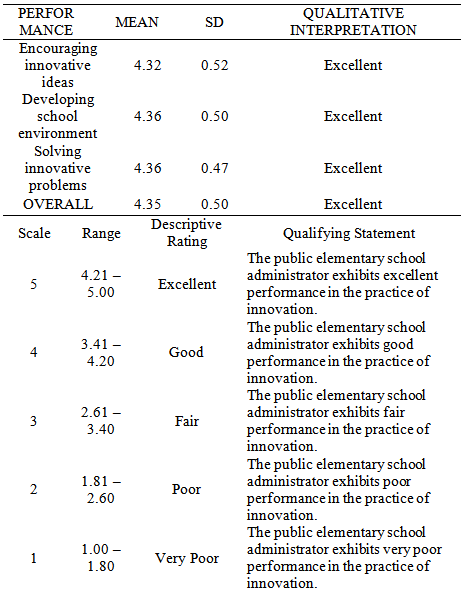
Table 14 displays the summary of administrator’s performance in the practice of innovation. Overall, the administrators’ performance was interpreted qualitatively as "excellent" with a mean of 4.35. Moreover, the overall low standard deviation of 0.50 indicates that most of the school administrators have the same level of assessment on how they viewed themselves in the practice of innovation as indicated from their responses. Among three (3) indicators, developing school environment and solving innovative problems were rated the highest, with a mean score of 4.36. It was followed by encouraging innovative ideas (4.32). The result of the study implies that administrators’ performance is excellent in the practice of innovation. The findings of the study revealed that in the practice of innovation, the administrators are of excellent performance. This indicates that the public elementary school administrators exhibit excellent performance in encouraging innovative ideas, developing school environment, and solving innovative problems. The study by Ibrahim et al. 33, which emphasized that the performance of the school is a gauge of the performance of the principal, supports the findings. A positive social environment must always be fostered by the leadership, both with the staff and with themselves. The goals and objectives of the school are more easily attained when innovative ideas are encouraged. Assisting one another in completing tasks and achieving organizational objectives will be possible in a warm, open environment. Additionally, this was supported by Mbangula and Albert (2022), who emphasized the impact of principals on academic achievement and the importance of principals in enhancing the performance of schools as a whole.
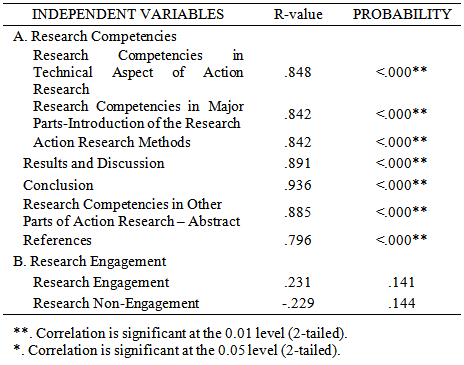
2.10. Correlation of the VariablesThe highlight of this study was to determine the relationship between school administrators’ performance in the practice of innovation, research competencies, and research engagement which is analyzed using the Pearson Product-moment Correlation as shown in Table 15. Based on correlation coefficients, the positive correlation indicates that the research competencies in terms of technical aspect of action research, research competencies in major parts – introduction of the research, action research methods, results and discussion, conclusion, research in other parts of action research – abstract, references, research experience, and frequency of conducting action research, all carry coefficient of correlation values that are significant at 0.01 level. This implies that research competencies and research engagement have contributed to the performance of the school administrators in the practice of innovation. In this connection, the null hypothesis which states that “research competencies and research engagement do not influence administrators’ performance in the practice of innovation” was rejected. The results revealed that the public elementary school administrators’ performance in the practice of innovation was found out to have significant correlation to the research competencies in the technical aspect of action research (r= .848, p less than .01), research competencies in major parts – introduction of the research (r= .842, p less than .01), action research methods (r= .842, p less than .01), results and discussion (r= .891, p less than .01), conclusion (r= .936, p less than .01), research in other parts of action research – abstract (r= .885, p less than .01), and references (r= .796, p less than .01). In terms of research engagement (r= .231, p<.05), and research non-engagement (r= -.229, p>.05). Furthermore, Fausan and Noor 37 supports the findings as they concluded based on research analysis that having the competence to do something has a significant effect on performance in which the influence of the competence variable on the performance variable is 57.8% while the remaining 42.2% is influenced by other variables. Thus, performance is the result of efforts made by employees on certain job functions and activities during a certain period. To get high performance, the competence of the individual must be in accordance with the competence of the position held by someone in the organization.
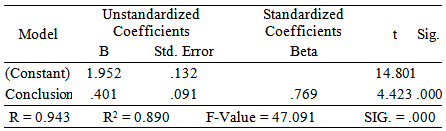
Table 16 shows the result of the stepwise regression analysis on the extent of influence of set of independent variables on administrators’ performance. As shown in the Table 16, the R2 = 0.890 means that 89.00% of the dependent variable can be accounted to conclusion, thus, 11.00% was attributed to the variables not included in the study. When the independent variables were regressed, only research competency in the major aspect specifically in the conclusion best predicts and influences administrators’ performance in the practice of innovation with beta weight = .401 which is statistically significant at .000 respectively. Having a positive value of Beta in the conclusion implies that when the school administrator’s competency level in writing the conclusion part of action research increased, the performance of school administrators in the practice of innovation may also increase given that when one is capable of finishing an action research, they are capable of utilizing the innovation they developed in their action research to improve the performance in terms of using innovations at school.
Mallari and Santiago 38 emphasized that research competencies specifically on writing the conclusion and references hinder some school administrators from conducting and finishing an action research which affects their performance when it comes to utilizing research to improve schools. Knowledge of research methods alone is not enough. The competence to conduct research is necessary. This competence aided by skills should have been developed or enhanced through schooling and trainings. Experiences in the conduct of research also help in improving research competence.
Based on the findings of the study, the following conclusions were drawn: Since the public elementary school administrators were competent in the technical aspect, major parts of action research, such as: writing the introduction, action research methods, results and discussion, and conclusion; other parts of action research such as: writing the abstract and references, therefore they exhibit the competencies in these areas of conducting action research most of the time. Most of the public elementary school administrators engage in conducting action research to solve problems in school and for professional development. For the non-engagement, it is due to insufficient time and not having access to the books and journals. Based on the performance of the school administrators in the practice of innovation for the school year 2021-2022, the public elementary school administrators of Kadingilan I, Kadingilan II, Don Carlos II, and Don Carlos III in the Division of Bukidnon perform beyond required in their respective schools as indicated in the descriptive rating of “Excellent”. This helps in contributing to the attainment of DepEd’s thrust, programs, and projects. Research competencies in terms of technical aspect of action research, research competencies in major parts – introduction of the research, action research methods, results and discussion, conclusion, research in other parts of action research – abstract, references, research experience, and frequency of conducting action research have significant relationship to school administrators’ performance in the practice of innovation. Result of the stepwise regression analysis revealed that only research competency in the major aspect specifically in the conclusion best predicts and influences administrators’ performance in the practice of innovation with beta weight = .401 which is statistically significant at .000 respectively.
3.2. RecommendationsThe findings and conclusions led the researchers to advance the following recommendations: Public schools district supervisors and district in-charge may encourage their school administrators to seek MS/MA and PhD degrees to improve their research competencies. School administrators may also be encouraged to attend trainings/seminars/workshops and join any organization that could help them grow professionally. The schools district supervisors, district in-charge, and higher offices of the DepEd may give a definite schedule ahead of time for the public elementary school administrators to have ample time to prepare their action research. Quality assurance team may also be established and strengthened in schools districts to assist the public elementary school administrators in conducting action research. They may be composed of research experts like PhD degree holders and experts in conceptualizing innovations and interventions, different research designs, data analysis and interpretation, research methods and referencing. It is also recommended that public elementary school administrators of Kadingilan I, Kadingilan II, Don Carlos II, and Don Carlos III districts need to sustain their outstanding performance and strive harder to attain outstanding rating performance. The schools districts and DepEd may provide rigid training and seminars for the public elementary school administrators focusing on the topics of improving school performance and sustaining best practices. Further study on research competencies specifically in research competencies in major parts – introduction of the research, action research methods, results and discussion, conclusion, research in other parts of action research – abstract, references, research experience, and frequency of conducting action research are encouraged since significant relationship was found that these variables affect school administrators performance in the practice of innovation. This will validate the results of the study. Considering the significant impact of research competencies, particularly in the major aspect, on administrators' performance and innovation practices, it is highly recommended that school administrators prioritize enhancing their competency in writing conclusive research findings. This involves completing action research projects to validate the effectiveness of their innovations in addressing specific school challenges. Cultivating a positive mindset towards conducting action research is strongly encouraged. Additionally, district supervisors and those in charge of public-school districts should actively promote and motivate administrators in public elementary schools to consistently engage in action research. By doing so, they can effectively improve overall school performance, address persistent problems, and enhance competencies in action research.
The researchers would like to extend their gratitude to the school administrators who participated in the conduct of the study and the public schools district supervisors of Kadingilan I, Kadingilan II, Don Carlos II, and Don Carlos III districts.
| [1] | Abu-Shreah, M., Zidan, H. (2017). The Degree of Schools Principals Practicing Innovation and its Relation with the Teachers’ Professional Development. Journal of Education and Practice, (8)8, 2222-1735. | ||
| In article | |||
| [2] | DepEd Order no. 16, s. of 2017 Research Management Guidelines. | ||
| In article | |||
| [3] | Hubbard, L., & Datnow, A. (2020). Design thinking, leadership, and the grammar of schooling: Implications for educational change. American Journal of Education, 126(4), 499–518. | ||
| In article | View Article | ||
| [4] | Hallinger, P. (2011). Leadership for learning: Lessons from 40 years of empirical research. Journal of Educational Administration, 49(2), 125–142. | ||
| In article | View Article | ||
| [5] | Harris, A., Day, C., Hopkins, D., Hadfield, M., Hargreaves, A., & Chapman, C. (2013). Effective leadership for school improvement. Routledge. | ||
| In article | View Article | ||
| [6] | McLeod, S., & Dulsky, S. (2021). Resilience, reorientation, and reinvention: School leadership during the early months of the COVID-19 pandemic. Frontiers in Education. | ||
| In article | View Article | ||
| [7] | Weiner, J., Francois, C., Stone-Johnson, C., & Childs, J. (2021). Keep safe, keep learning: Principals’ role in creating psychological safety and organizational learning during the COVID-19 pandemic. Frontiers in Education. | ||
| In article | View Article | ||
| [8] | Beabout, B. R. (2010). Leadership for change in the educational wild west of post-Katrina New Orleans. Journal of Educational Change, 11, 403–424. | ||
| In article | View Article | ||
| [9] | Harris, A., Jones, M. (2020). COVID 19 – school leadership in disruptive times. School Leadership and Management, 20(4). | ||
| In article | View Article | ||
| [10] | Heissenberger, Petra, & Heilbronner, Nancy (2017). The influence of primary school principals’ leadership styles on leadership practices. Global Education Review, 4 (4), 86-101. | ||
| In article | |||
| [11] | Gray, C. (2007). Research competencies framework. Faculty of General Dental Practice (UK) The Royal College of Surgeon of England. | ||
| In article | |||
| [12] | Barry, W. (2012). Living Educational Theory. Liz Atkins and Susan Wallace's book. | ||
| In article | |||
| [13] | Ethridge, D.E. (2004) “Research Methodology in Applied Economics” John Wiley & Sons. | ||
| In article | |||
| [14] | Gomez, M.J.S. and Panaligan, C. (2013). Level of research competencies and satisfaction of the faculty members from the college of criminology. Research Journal of Social Science and Humanities. | ||
| In article | |||
| [15] | Borg, S. (2014). University teacher educators’ research engagement: perspectives from Saudi Arabia, teaching and teacher education. | ||
| In article | |||
| [16] | Ashraf, M., Rubab, I., & Ajmal, M. (2020). Investigating the problems of organization and vocabulary in academic writing encountered by students at postgraduate level. International Journal of Advanced Science and Technology (29)8, 2766-2779. | ||
| In article | |||
| [17] | Qazem, F. (2019). The challenges and problems faced by students in stage of writing research projects in L2. University of Bisha, Saudi Arabia. | ||
| In article | |||
| [18] | Banegas, D.L., Villacañas de Castro, L.S. (2015). A look at ethical issues in action research in education. Argentinian Journal of Applied Linguistics (3)1, 58-67. | ||
| In article | |||
| [19] | Asenahabi, B., Busula, A., & Ronoh, R. (2019). A choice dilemma in selecting an appropriate research design. International Journal of Advanced Research in Computer Engineering & Technology (IJARCET), (8)8, 2778-1323. | ||
| In article | |||
| [20] | Benigno (2018). School heads’ performance in 21st century leadership roles: basis for an enhancement plan. Unpublished master's thesis, Bukidnon State University. Malaybalay City. Bukidnon. | ||
| In article | |||
| [21] | Daynter, K. (2016). Validity in qualitative research: application of Safeguards. Western Illinois University, EIS Department, 115Q Horrabin Hall, Macomb, IL 61455. | ||
| In article | |||
| [22] | Mugenda, O. & Mugenda, A. (2013). Research methods: quantitative and qualitative approaches. (2nd ed.). Nairobi: African Centre for Technology Studies (ACTS). | ||
| In article | |||
| [23] | Kabir, S.M.S. (2016). Basic guidelines for research: an introductory approach for all disciplines. Book zone publication, ISBN: 987-984-33-9565-8, Chittagong-4203, Bangladesh. | ||
| In article | |||
| [24] | Vogt, P. (2012). The dictatorship of the problem. Choosing research methods. Illinois State University. | ||
| In article | |||
| [25] | Jomaa, N.J., & Bidin, S.J. (2017). Perspective of EFL doctoral students on challenges of citations in academic writing. Malaysian Journal of Learning and Instruction (MJLI), 14 (2), 177-209. | ||
| In article | View Article | ||
| [26] | Mudavanhu, Y. (2017). Quality of literature review and discussion of findings in selected papers on integration of ICT in teaching, role of mentors, and teaching science through science, engineering, and mathematics. Educational Research and Reviews. | ||
| In article | |||
| [27] | Soe, T. (2019). Research engagement and professional development: English language teachers’ perspectives. Department of English, University of Mandalay, Myanmar. | ||
| In article | |||
| [28] | Kutlay, N. (2012). A survey of English language teachers’ view of research. Procedia Social and Behavioral Sciences, 70, 188-206. | ||
| In article | View Article | ||
| [29] | Morales, M.P.E. (2016). Participatory Action Research (PAR) cum Action Research (AR) in teacher professional development: A literature review. International Journal of Research in Education and Science (IJRES), 2(1), 156-165. | ||
| In article | View Article | ||
| [30] | Bocar, A. (2013). Difficulties Encountered by the Student – Researchers and the Effects on Their Research Output. Proceeding of the Global Summit on Education. http//.10.2139/ssrn.1612050. | ||
| In article | |||
| [31] | Embury, D. and Clarke, L. (2017). Turning Teachers into Action Researchers in their Classrooms. The Journal of the Teacher Education Division of the Kentucky Council for Exceptional Children, 3(2). https://digitalcommons.wku.edu/ktej/vol3/iss2/2. | ||
| In article | |||
| [32] | Erba, B. (2013). The Practice and Challenges in Conducting Action Research:The case of Sululta Secondary School. | ||
| In article | |||
| [33] | Ibrahim, B., Ahmad, N., Yerry, S. and Imam, G. (2020). Primary school principal performance measurement. Advances in Social Science, Education and Humanities Research, 487. | ||
| In article | |||
| [34] | Mbangula, D. K. & Albert, J. I. (2022). Effectiveness of principals’ roles on school performance: Perspective of school principal-ship. Research Journal, January 2922. | ||
| In article | View Article | ||
| [35] | Aroca, J., Abellan, P., and Lopez S. (2022). Teacher’s professional development and intelligent ways of coping with it: A systematic review in elementary and middle school education. Journal of Science, Department of Theory and History in Education, Spain. | ||
| In article | |||
| [36] | Kalguya, S. (2015). Facilitating problem solving: A cognitive load perspective. Erasmus University. | ||
| In article | |||
| [37] | Fausan, P. D., & Noor, M. T. (2021). Pengaruh kompetensi dan kompensasi terhadap kinerja karyawan pada pt borneo sawit perdana di kabupaten kotawaringin timur. Profit (Jurnal Penerapan Ilmu manajemen Dan Kewirausahaan), 6(1), 44-54. | ||
| In article | |||
| [38] | Mallari, M. & Santiago, M. (2013). The research competency and interest of accountancy faculty among staff colleges and universities in region III. Society of Interdisciplinary Business Review. | ||
| In article | |||
Published with license by Science and Education Publishing, Copyright © 2023 Jay-ar P. Castañeros and Melisa R. Sumbilon
 This work is licensed under a Creative Commons Attribution 4.0 International License. To view a copy of this license, visit
http://creativecommons.org/licenses/by/4.0/
This work is licensed under a Creative Commons Attribution 4.0 International License. To view a copy of this license, visit
http://creativecommons.org/licenses/by/4.0/
| [1] | Abu-Shreah, M., Zidan, H. (2017). The Degree of Schools Principals Practicing Innovation and its Relation with the Teachers’ Professional Development. Journal of Education and Practice, (8)8, 2222-1735. | ||
| In article | |||
| [2] | DepEd Order no. 16, s. of 2017 Research Management Guidelines. | ||
| In article | |||
| [3] | Hubbard, L., & Datnow, A. (2020). Design thinking, leadership, and the grammar of schooling: Implications for educational change. American Journal of Education, 126(4), 499–518. | ||
| In article | View Article | ||
| [4] | Hallinger, P. (2011). Leadership for learning: Lessons from 40 years of empirical research. Journal of Educational Administration, 49(2), 125–142. | ||
| In article | View Article | ||
| [5] | Harris, A., Day, C., Hopkins, D., Hadfield, M., Hargreaves, A., & Chapman, C. (2013). Effective leadership for school improvement. Routledge. | ||
| In article | View Article | ||
| [6] | McLeod, S., & Dulsky, S. (2021). Resilience, reorientation, and reinvention: School leadership during the early months of the COVID-19 pandemic. Frontiers in Education. | ||
| In article | View Article | ||
| [7] | Weiner, J., Francois, C., Stone-Johnson, C., & Childs, J. (2021). Keep safe, keep learning: Principals’ role in creating psychological safety and organizational learning during the COVID-19 pandemic. Frontiers in Education. | ||
| In article | View Article | ||
| [8] | Beabout, B. R. (2010). Leadership for change in the educational wild west of post-Katrina New Orleans. Journal of Educational Change, 11, 403–424. | ||
| In article | View Article | ||
| [9] | Harris, A., Jones, M. (2020). COVID 19 – school leadership in disruptive times. School Leadership and Management, 20(4). | ||
| In article | View Article | ||
| [10] | Heissenberger, Petra, & Heilbronner, Nancy (2017). The influence of primary school principals’ leadership styles on leadership practices. Global Education Review, 4 (4), 86-101. | ||
| In article | |||
| [11] | Gray, C. (2007). Research competencies framework. Faculty of General Dental Practice (UK) The Royal College of Surgeon of England. | ||
| In article | |||
| [12] | Barry, W. (2012). Living Educational Theory. Liz Atkins and Susan Wallace's book. | ||
| In article | |||
| [13] | Ethridge, D.E. (2004) “Research Methodology in Applied Economics” John Wiley & Sons. | ||
| In article | |||
| [14] | Gomez, M.J.S. and Panaligan, C. (2013). Level of research competencies and satisfaction of the faculty members from the college of criminology. Research Journal of Social Science and Humanities. | ||
| In article | |||
| [15] | Borg, S. (2014). University teacher educators’ research engagement: perspectives from Saudi Arabia, teaching and teacher education. | ||
| In article | |||
| [16] | Ashraf, M., Rubab, I., & Ajmal, M. (2020). Investigating the problems of organization and vocabulary in academic writing encountered by students at postgraduate level. International Journal of Advanced Science and Technology (29)8, 2766-2779. | ||
| In article | |||
| [17] | Qazem, F. (2019). The challenges and problems faced by students in stage of writing research projects in L2. University of Bisha, Saudi Arabia. | ||
| In article | |||
| [18] | Banegas, D.L., Villacañas de Castro, L.S. (2015). A look at ethical issues in action research in education. Argentinian Journal of Applied Linguistics (3)1, 58-67. | ||
| In article | |||
| [19] | Asenahabi, B., Busula, A., & Ronoh, R. (2019). A choice dilemma in selecting an appropriate research design. International Journal of Advanced Research in Computer Engineering & Technology (IJARCET), (8)8, 2778-1323. | ||
| In article | |||
| [20] | Benigno (2018). School heads’ performance in 21st century leadership roles: basis for an enhancement plan. Unpublished master's thesis, Bukidnon State University. Malaybalay City. Bukidnon. | ||
| In article | |||
| [21] | Daynter, K. (2016). Validity in qualitative research: application of Safeguards. Western Illinois University, EIS Department, 115Q Horrabin Hall, Macomb, IL 61455. | ||
| In article | |||
| [22] | Mugenda, O. & Mugenda, A. (2013). Research methods: quantitative and qualitative approaches. (2nd ed.). Nairobi: African Centre for Technology Studies (ACTS). | ||
| In article | |||
| [23] | Kabir, S.M.S. (2016). Basic guidelines for research: an introductory approach for all disciplines. Book zone publication, ISBN: 987-984-33-9565-8, Chittagong-4203, Bangladesh. | ||
| In article | |||
| [24] | Vogt, P. (2012). The dictatorship of the problem. Choosing research methods. Illinois State University. | ||
| In article | |||
| [25] | Jomaa, N.J., & Bidin, S.J. (2017). Perspective of EFL doctoral students on challenges of citations in academic writing. Malaysian Journal of Learning and Instruction (MJLI), 14 (2), 177-209. | ||
| In article | View Article | ||
| [26] | Mudavanhu, Y. (2017). Quality of literature review and discussion of findings in selected papers on integration of ICT in teaching, role of mentors, and teaching science through science, engineering, and mathematics. Educational Research and Reviews. | ||
| In article | |||
| [27] | Soe, T. (2019). Research engagement and professional development: English language teachers’ perspectives. Department of English, University of Mandalay, Myanmar. | ||
| In article | |||
| [28] | Kutlay, N. (2012). A survey of English language teachers’ view of research. Procedia Social and Behavioral Sciences, 70, 188-206. | ||
| In article | View Article | ||
| [29] | Morales, M.P.E. (2016). Participatory Action Research (PAR) cum Action Research (AR) in teacher professional development: A literature review. International Journal of Research in Education and Science (IJRES), 2(1), 156-165. | ||
| In article | View Article | ||
| [30] | Bocar, A. (2013). Difficulties Encountered by the Student – Researchers and the Effects on Their Research Output. Proceeding of the Global Summit on Education. http//.10.2139/ssrn.1612050. | ||
| In article | |||
| [31] | Embury, D. and Clarke, L. (2017). Turning Teachers into Action Researchers in their Classrooms. The Journal of the Teacher Education Division of the Kentucky Council for Exceptional Children, 3(2). https://digitalcommons.wku.edu/ktej/vol3/iss2/2. | ||
| In article | |||
| [32] | Erba, B. (2013). The Practice and Challenges in Conducting Action Research:The case of Sululta Secondary School. | ||
| In article | |||
| [33] | Ibrahim, B., Ahmad, N., Yerry, S. and Imam, G. (2020). Primary school principal performance measurement. Advances in Social Science, Education and Humanities Research, 487. | ||
| In article | |||
| [34] | Mbangula, D. K. & Albert, J. I. (2022). Effectiveness of principals’ roles on school performance: Perspective of school principal-ship. Research Journal, January 2922. | ||
| In article | View Article | ||
| [35] | Aroca, J., Abellan, P., and Lopez S. (2022). Teacher’s professional development and intelligent ways of coping with it: A systematic review in elementary and middle school education. Journal of Science, Department of Theory and History in Education, Spain. | ||
| In article | |||
| [36] | Kalguya, S. (2015). Facilitating problem solving: A cognitive load perspective. Erasmus University. | ||
| In article | |||
| [37] | Fausan, P. D., & Noor, M. T. (2021). Pengaruh kompetensi dan kompensasi terhadap kinerja karyawan pada pt borneo sawit perdana di kabupaten kotawaringin timur. Profit (Jurnal Penerapan Ilmu manajemen Dan Kewirausahaan), 6(1), 44-54. | ||
| In article | |||
| [38] | Mallari, M. & Santiago, M. (2013). The research competency and interest of accountancy faculty among staff colleges and universities in region III. Society of Interdisciplinary Business Review. | ||
| In article | |||